




Abstract
There are many factors that account for disclosure of private information on social network sites, but a potentially powerful determinant that remains understudied is social norms, which refer to perceptions of what other people do, approve of, and expect us to do on social media. To address this gap, we conducted an in-depth analysis of descriptive, injunctive, and subjective norms for verbal and visual disclosure on Facebook and Instagram, using a preregistered survey study with 863 participants. We further analyzed whether critical media literacy and media-related self-reflection could buffer against uncritical adoption of these norms. The findings revealed that all three types of norms positively and independently predicted self-disclosure, regardless of the platform or type of self-disclosure (visual vs. verbal), while controlling for other common predictors of self-disclosure, including perceived benefits and risks of self-disclosure. Self-reflection and critical media literacy neither directly predicted disclosure, nor accounted for differences in norm-behavior relationships.
Social network sites (SNS) such as Facebook, Instagram, or TikTok have become lively online environments where intimate storytelling and self-presentation is practiced as a natural extension of daily life (Miguel, 2016). Sharing intimate insights into one’s life with potentially large and unknown audiences, however, comes with risks. It has been found that people who disclose a great deal of themselves are also more likely to experience privacy violations such as unwanted sharing of information with third parties, re-contextualization of information, or identity theft (e.g., Büchi et al., 2017; Masur & Trepte, 2021).
Previous research has extensively investigated why people engage in self-disclosure on SNSs (for overviews, see e.g., Abramova et al., 2017; Bazarova & Choi, 2014; Trepte & Reinecke, 2011). Following a rational actor paradigm according to which individual users act as rational agents whose decisions are based on cost-benefits calculations, previous research has often found perceived risks and benefits of self-disclosure to be small to moderately strong predictors of actual self-disclosure on SNSs (Dienlin & Metzger, 2016; Krasnova et al., 2012). However, social media users at times have insufficient knowledge and skills to weigh pros and cons (Masur, 2020) and often additionally rely on heuristics or external cues to guide their behaviors (Sundar et al., 2013). In situations of uncertainty, people tend to turn to other people’s behavior for guidance to ensure that they act in socially approved ways (Chung & Rimal, 2016; Lapinski & Rimal, 2005).
With regard to self-disclosure on SNSs, it seems likely that people similarly adapt to other people’s behavior, using it as cues to learn about what is appropriate to do on different social media platforms. First studies have started to investigate the role of social norms in shaping SNS users’ self-disclosure behavior, suggesting a small, but positive relationship (e.g., Ho et al., 2017; Utz & Krämer, 2009; Zlatolas et al., 2015). Despite these initial efforts, however, a comprehensive investigation of the relationships between different norm types and self-disclosure on SNS is still missing. Therefore, the goal of this study is to provide an in-depth analysis of the relationships between people’s norm perceptions and their self-disclosure on SNSs. We thereby extend prior research (1) by implementing a more comprehensive analysis of social norm perceptions, which differentiate between perceptions of what others do (descriptive norms), what they approve of (injunctive norms), and what they presumably expect one to do (subjective norms); (2) by studying the relationship between each type of norms with both verbal and visual disclosure behaviors; and (3) by investigating these relationships on two different SNSs, namely Facebook and Instagram.
We further argue that it is important to understand the role of social norms in the context of other factors exerting influence on people’s self-disclosure behaviors. If social norms are (partly) responsible for what and how much people disclose online, it could create an online disclosure spiral where people conform to a prevailing disclosure norm and, in turn, help reify this norm, thereby influencing others’ disclosure behaviors (cf. Helbing et al., 2014). Norms that encourage more sharing of personal information can expose individuals to information misuse and abuse by unscrupulous individuals and commercial interests that harvest their data (Baruh & Popescu, 2015), unless they are able to resist the sharing norm. A second goal was hence to investigate whether some people are less prone to such norm adoptions than others. To explore this question, we investigated the moderating effect of critical media literacy and media-related self-reflection in reducing norm effects on self-disclosure.
Theoretical Background
Self-Disclosure—A Key Feature of Online Communication
Self-disclosure is typically understood as an intentional act of revealing personal information to others (Cozby, 1973; Jourard, 1971; Omarzu, 2000) in which people “deliberately divulge something personal to another” (Greene et al., 2006, p. 411). Disclosure decision-making is thus presented as a rational process through a deliberate weighing of risks and benefits in which people seek to satisfy disclosure goals, while managing possible risks and vulnerabilities that come from sharing personal information (Altman & Taylor, 1973; Petronio, 2002). Disclosing private information and aspects of the self is a common practice on social media (e.g., Taddicken, 2014). Particularly on SNSs, individuals create and maintain profiles as well as continuous representations of their lives through verbal and visual posts. They further reveal parts of themselves through comments on their own and others’ posts.
While previous research has focused on privacy concerns (for an overview, see Kokolakis, 2017) and perceived risks and benefits (e.g., Dienlin & Metzger, 2016), there has been less emphasis on the role of the social environment in shaping self-disclosure in social media, specifically social influence through perceived norms of what others do, approve of, and expect one to do in a certain situation (but see Masur et al., 2021). In what follows below, we explicate the role of social norms in different kinds of behaviors and social contexts, ultimately tying them as potential determinants of self-disclosure in social media.
Social Norms as Powerful Determinants of Human Behavior
Social norms have been extensively studied in the social sciences (for overviews, see Chung & Rimal, 2016; Cialdini & Trost, 1998). The literature is nonetheless characterized by a lack of consensus on what actually constitutes social norms. In broad terms, social norms refer to informal rules and standards that guide or constrain behavior in groups and societies by eliciting conformity (e.g., Cialdini & Trost, 1998). While collective norms refer to a collective social entity’s code of conduct and thus operate at the societal level, perceived norms capture how individuals construe the collective norm (Chung & Rimal, 2016).
An on-going stream of research showed that perceptions of “what others commonly do” and perceptions of “what others commonly approve of” represent separate sources of human motivation (Cialdini et al., 1990). This distinction is evident in contemporary conceptualizations of perceived social norms. Descriptive norms refer to people’s perceptions of the prevalence of a behavior, that is, what is actually done by most others in one’s social group (Lapinski & Rimal, 2005). Injunctive norms, in contrast, refer to people’s belief about what ought to be done, or what most other people approve of (Lapinski & Rimal, 2005). Although descriptive and injunctive norms often converge, they differ in what type of motivation they serve: Descriptive norms provide an information-processing advantage and can act as a decisional shortcut when individuals have to decide how to behave in any given situation (Chung & Rimal, 2016; Cialdini et al., 1990). Injunctive norms, in contrast, provide information about the values that others in a social group might hold. They therefore motivate people’s behavior by increasing the desire to belong to that group (Cialdini et al., 1990). Social media affordances facilitate inferences about both descriptive and injunctive norms (Evans et al., 2016): descriptive norms by scrolling through a news feed that allows one to view and review posts, and injunctive norms by seeing which types of posts attract most attention and approval through likes, positive comments, and resharing. Algorithmic curation of social media content further reinforces the visibility of descriptive and injunctive norms, as posts with high levels of interaction tend to be more likely to appear in the news feed.
A third type of norm, called subjective norm, refers to the perceived social pressure to act in a particular way (Chung & Rimal, 2016). Although some scholars assert that there is no difference or at least considerable overlap between injunctive and subjective norms (e.g., Ajzen, 1991; Lapinski & Rimal, 2005), empirical research demonstrated the unique impact of subjective norms on behavioral outcomes (e.g., Park & Smith, 2007). Whereas injunctive norms capture how one views what behavior receives others’ approval, subjective norms refer to perceptions of what others expect one to do. As such, subjective norms are very similar to the concept of peer pressure, but include the expectation of social sanctions for the lack of respective behavior. Various studies have shown that such perceptions of peer pressure are positively related to self-disclosure (e.g., Walrave et al., 2012).
To gain a more granular understanding of the distinct normative influences on self-disclosure on social media, we investigated all three types of norms and their interactions as potential determinants of self-disclosure on social media in this study. In the following, we review evidence for the relationship between social norm and self-disclosure on social media, pinpointing at gaps and limitations to develop our hypotheses.
Social Norms and Self-Disclosure on Social Media
While social norms have been extensively studied in the context of social media and information technology (e.g., Ho et al., 2017; Yeoh et al., 2022; Zillich & Müller, 2019; Zillich & Riesmeyer, 2021), research on the influence of norm perception on online self-disclosure is still in its infancy. Although some early research examined social influence on people’s decisions to reveal themselves on social media, most of them did not explicitly examine social norm perceptions. For example, network analyses of Facebook profiles revealed that the likelihood of having a private profile was contingent on whether the closest network had a private profile too (Lewis et al., 2008). A finding that was supported by an analysis of tracking data by 140,000 new Facebook users revealing that newcomers were more inclined to share photos when they saw their friends contributing (Burke et al., 2009). More recent survey studies explicitly measured norm perceptions—often as part of larger theoretical frameworks such as the theory of planned behavior—and found small to medium, positive relationships between perceived social norms and self-disclosure (e.g., Ho et al., 2017; Utz & Krämer, 2009; Zlatolas et al., 2015). Furthermore, norms are likely to differ depending on the communication channel, with people perceiving intimate disclosure as more appropriate for private than public contexts (Teutsch et al., 2018), and, correspondingly, sharing more intimate disclosure in private than public channels (Bazarova & Choi, 2014).
Qualitative work has revealed more intricate connections between perceived social norms and self-disclosure. Focus group interviews with students in the United States, for example, revealed that norms regarding the appropriateness of disclosures within Facebook are not expressed explicitly, but nonetheless known among users (McLaughlin & Vitak, 2012). Participants in this study also reported learning appropriate behaviors by observing others. Zillich and Müller (2019) found, based on interviews with 30 German Facebook users, that the participants self-reported modeling their behavior by both observing others behaviors (descriptive norms) and by referencing what they thought others would find appropriate (injunctive norms).
In sum, while past research provides initial evidence that different types of social norms indeed play a role in shaping disclosure behavior on social media, there are a few gaps that need to be addressed: First, most studies did not explicitly distinguish between the aforementioned types of norms. Despite theoretical granularity, quantitative studies of online disclosure tend to measure norms with comparatively abstract single-item measures. Second, most studies have focused on one type of disclosure, mostly verbal, and a single platform, often via status updates. Despite the fact that visual self-disclosure represents a very common type of social media practices, little research has been done to examine visual disclosure or the differences between visual and verbal self-disclosure. Finally, while previous research accounted for normative influence, there is limited understanding of its role relative to other antecedents of self-disclosure, particularly those based on the rational actor paradigm, that is, perceived benefits and risks of disclosure. Our primary goal was hence to disentangle the relationships between descriptive, injunctive, and subjective norm perceptions and verbal and visual self-disclosure on social media, while controlling for other common antecedents of self-disclosure:
H1: Perceived (a) descriptive, (b) injunctive, and (c) subjective norms will be positively related to disclosure behavior in social media environments.
However, by differentiating between these norm types, we also open up the questions of whether or not these norm types interact in predicting self-disclosure. The theory of normative social behavior (Rimal & Real, 2005) posits that social norms do not always affect behavior and are contingent on several moderating forces. Accordingly, and supported by empirical work (Lapinski & Rimal, 2005; Park & Smith, 2007), the impact of descriptive norms is moderated by injunctive norms, outcome expectations, and other factors. Park and Smith (2007) further found that subjective norms can moderate the influences of descriptive norm effects on behavior. In their discussion, they argue that the pressure to conform can be a strong predictor of a behavior when the majority of people are already engaging in this behavior. Applied to the context of social media, it can be argued that a high prevalence of behavior on its own (descriptive norm) may not necessarily influence people’s likelihood of engaging in self-disclosure, but depends on whether this behavior is seen as socially approved (e.g., via likes; injunctive norm) and users perceive a pressure to adapt to the norm (subjective norm). Drawing from these considerations, we predicted that injunctive and subjective norms would strengthen the relationship between descriptive norms and behavior:
H2: The relationship between the descriptive norm and disclosure behavior depends on the (a) injunctive or (b) subjective norms such that it becomes stronger with an increase of the perceived injunctive and subjective norm, respectively.
As our main goal was to estimate the relationship between various norm types and self-disclosure, we also aimed to control for other important, prominently investigated predictors of self-disclosure. As mentioned before, research on online self-disclosure often focused on privacy concerns and perceived gratifications, which have been found to consistently predict disclosure behavior (Dienlin & Metzger, 2016; Krasnova et al., 2012). First, we thus included both horizontal (with regard to other users) and vertical privacy concerns (with regard to providers) as negative predictors, and typically perceived benefits of disclosure (i.e., enjoyment, relationship development, and self-presentation/expression) as positive predictors. Assessing the strength of distinct social norm effects on self-disclosure, we therefore asked:
RQ1: How much variance in self-disclosure is explained by norms after controlling for privacy concerns and perceived benefits?
In addition, we controlled for network size and composition, two variables that have been found to relate to disclosure in previous research (e.g., Choi & Bazarova, 2014; Vitak, 2012) and added age, gender and education as potential higher-level predictors.
Differences in Norms and Behaviors on Different Platforms
Because self-disclosure is a contextually-driven behavior (Nissenbaum, 2010), it is important to understand whether the relationship between norm perceptions and self-disclosure differs across communication channels. For example, Waterloo et al. (2018) found, based on 1201 Dutch adolescents, that the expression of negative emotions was considered to be most appropriate for WhatsApp, followed by Facebook, Twitter, and Instagram. Positive emotion expression, in contrast, was perceived to be more appropriate on WhatsApp, followed by Instagram, Facebook, and Twitter. Qualitative interviews with 33 German internet users also showed that the perceived level of privacy differs across communication channels and platforms, with many participants viewing Facebook or Instagram as inappropriate for very private disclosures (Teutsch et al., 2018).
Even though most social media allow for various forms of self-disclosure (e.g., both verbal and visual disclosure), each platform has unique design features and affordances that make certain forms of disclosure more likely. For example, Instagram is much more conducive to posting pictures from one’s mobile phone and linking them to specific (hash-)tags. This has led to various Instagram-specific practices, such as the regular posting of selfies and the designation of such via respective tags (e.g., #me, #selfie, or #selflove). Facebook instead offers more ways to post content, lending itself more to elaborate verbal status updates or combinations of verbal and visual disclosures. As mentioned above, there is also quantitative evidence that norms and disclosure practices differ between platforms. For example, SNS with clearly defined privacy boundaries (e.g., via audience segmentation options) have been shown to lead to more intimate disclosures (Choi & Bazarova, 2014). We hence explore differences in social norm effects on self-disclosure depending on the type of disclosure (verbal disclosure, e.g., in status updates, comments or photo captions; and visual self-disclosure, e.g., by posting photos that reveal the self) on two of the most prominent SNSs: Facebook and Instagram.
RQ2: To what extent do the relationships between norms and disclosure behavior depend on (a) the type of behavior (visual vs. verbal) and (b) the platform (Instagram vs. Facebook)?
Protecting Against Risky Norm Adoption: The Role of Critical Media Literacy
Considering the potential risks of disclosing private information in online environments, it is important to identify factors that moderate the relationship between social norms and self-disclosure, and thus may serve as a buffering factor against the uncritical adoption of risky social norms. It is often argued that higher levels of media literacy equip users with the necessary knowledge and skills to deal with the challenges and risks of social media, including a higher awareness of norms and practices (Livingstone, 2014; Masur, 2020; Schreurs & Vandenbosch, 2021). Conceptualizations of media literacy distinguish between knowledge, self-reflection, and critical engagement (Livingstone, 2004; Schreurs & Vandenbosch, 2021). Particularly higher critical media literacy and self-reflection may have the potential to reduce an uncritical adoption of prevailing norms on social media. The former can be defined as the ability to question and challenge the ways in which media content is created (Kellner & Share, 2005). In other words, a critical media user is “able to analyze and interpret socio-cultural, economic, and political consequences of media content” (Koc & Barut, 2016, p. 835). The latter may be understood as the ability to evaluate one’s own behavior, assess associated risks, and consider alternative actions (Masur, 2020). We propose that users with both critical media literacy and media-related self-reflection should be more aware of existing norms and practices on social media (such as that the majority engages in and approves of high levels of self-disclosure), should be more able to identify and judge associated risks (e.g., identity theft, recontextualization, and misuse of information), and thus question their own behavior (whether or not they should actually engage in similar levels of self-disclosure), and weigh the risks and benefits more deliberately before adopting prevalent behavior such as the disclosing of private information.
Although the moderating effect of media literacy on the norm-behavior relationship has not been tested explicitly, research in other areas testifies to the importance of higher literacy in avoiding negative effects of social media use. For example, it has been found that higher critical media literacy prevents negative effects of exposure to idealized body representations on social media on an individual’s well-being (Tamplin et al., 2018). In the context of online privacy, studies likewise showed that higher literacy leads to more data protection and less disclosure (e.g., Park, 2013). In their qualitative study, Zillich and Müller (2019) also found that awareness of social media providers’ practices and critical evaluation of potential consequences led people to disclose less on these platforms. Based on the theoretical perspectives and the empirical evidence discussed above, we hypothesize that critical media literacy and self-reflection skills can play a twofold buffering role by directly reducing the willingness to disclose oneself and by indirectly weakening the adoption of risky behaviors through prevailing norms:
H3: Both (a) critical media literacy and (b) media-related self-reflection is negatively related to disclosure behavior in social media environments.
H4: Both (a) critical media literacy and (b) media-related self-reflection reduce the hypothesized individual and interactive effects of social norms on disclosure behavior in social media environments.
All hypotheses are combined in a conceptual model that is shown in Figure 1. In sum, our goal is to conduct an in-depth investigation of the relationship between norm perceptions and self-disclosure, thereby acknowledging different norm types, their potential interactions, and their contingency on different platforms or types of disclosure. We further investigate the potential buffering potential of critical media literacy and media-related self-reflection to avoid the potentially risky norm adoption on social media.

Conceptual model. Note that the figure does not reflect the additional two research questions that investigate (RQ1) the explanatory power of norms in comparison to typically investigated antecedents of self-disclosure (privacy concerns and perceived benefits) and (RQ2) whether the norm-behavior-link differs across platforms (Facebook vs. Instagram) and behaviors (visual vs. verbal self-disclosure).
Methods
Hypotheses, study design, and analysis plan were preregistered prior to data collection (cf. Dienlin et al., 2021; Nosek et al., 2018): https://osf.io/2mpaz/. The data, questionnaire, analysis scripts and the online supplementary material (OSM) can be accessed via https://osf.io/ce7qb/. The OSM includes all item formulations, descriptive analyses, reliability and factor analyses, and additional analyses: https://osf.io/ufc6k/.
Procedure, Power, and Sample
Due to the variability in effect sizes in prior research, we determined a small effect size of r = .10 as our smallest effect size of interest (for all hypotheses). An a priori power analysis revealed that we would need a minimum sample of N = 782 to test such effect sizes with a power of 80% (given a significance level of 5% in two-tailed tests).
To recruit participants, we used Amazon’s Mechanical Turk (Mturk). MTurk samples have been found to be demographically more diverse than traditional recruitment procedures (e.g., university participant pools or internet samples; Buhrmester et al., 2011). The data quality is comparable to data obtained from graduate or commercial participant pools (Thomas & Clifford, 2017). Overall n = 1,146 participants provided consent, completed the survey and were either Facebook or Instagram users or used both platforms. However, we excluded 147 participants because they did not pass two simple attention checks (twice and randomly placed in one of the scales, an item asking participants to select a particular response option), which is a recommended quality check for Mturk samples. Finally, we used listwise deletion to remove any participants with missing values. The final sample size was n = 863 (M = 36.40 years, SD = 11.20, range = 18% - 80; 61.40% female; 38.20% 4-year college or bachelor’s degree). Completion of the survey took on average M = 13.53 (SD = 7.85) minutes.
Repeated Measures Across Vignettes
Social norm perceptions and self-disclosure behaviors were measured across four vignettes (2x2 within-subject design): (a)
Item Formulations for the Different Norm Types.

Note: Aspects in square brackets represent differences between the four vignettes. These example items refer to visual disclosure. For all item formulations across all vignettes, see: https://osf.io/q69sf.
The social norm scale (Park & Smith, 2007) was adapted to measure descriptive, injunctive, and subjective norms, with all the items administered on a 7-point scale ranging from 1 (strongly disagree) to 7 (strongly agree). Example items for each type of norm are provided in Table 1. The reference group was always participants’ social media network. Based on a multi-group confirmatory factor analysis (CFA), the three-dimensional model with constrained loadings across the four vignettes fitted the data well, χ2(231) = 820.81, p < .001; comparative fit index (CFI) = .98; Tucker-Lewis index (TLI) = .97; root mean square error of approximation (RMSEA) = .05, 90% confidence interval (CI) [.05, .06]; standardized root mean square residual (SRMR) = .03; see also p. 14, Figure 2A in the OSM. The reliability of all subdimensions in all four vignettes was high (ω = .79-.91). Although the CFA clearly supported the multidimensional model and no multicollinearity issues were detected in subsequent modeling steps, it has to be noted that the three norm types correlated moderately to strongly (mean correlations between .39 and .79), suggesting that they share a lot of common variance. Whereas people perceived a comparatively strong descriptive (Ms = 5.26–5.45, SDs = 0.97–1.03) and injunctive norm (Ms = 5.41–5.50, SDs = 0.92–0.96) across all vignettes (cf. Figure 2), they perceived less strongly that other users expect them to engage in self-disclosure (subjective norm: Ms = 4.28–4.51, SDs = 1.37–1.46).

Mean differences in norm perceptions and disclosure behavior across platforms and types of behavior (including 95% confidence intervals). Note that the x-axis is truncated to reveal the comparatively small differences.
In the literature, self-disclosure has been operationalized in various ways, ranging from explicit questions about what type of information is shared to more abstract measures that aim to capture the depth of disclosure more broadly. With our measure, we aimed to capture disclosure on a more general level (similar to Dienlin & Metzger, 2016) as this allowed us to implement fewer items (necessary due to the repeated measurement across vignettes), and ensured consistency between written and verbal disclosure as well as compatibility with the items of the social norm scale. Visual and verbal depth of disclosure was hence measured with six items (e.g., “I post photos on [Instagram/Facebook] that reveal who I am”; “I post information in [photo captions/status updates] on [Instagram / Facebook] that reveal who I am”). Participants answered all items on a 7-point scale ranging from 1 (strongly disagree) to 7 (strongly agree). The uni-dimensional multigroup model with constrained loadings across the vignettes fitted the data well, χ2(51) = 356.10, p < .001; CFI = .98; TLI = .98; RMSEA = .08, 90% CI [.08, .09]; SRMR = .04 (see Figure 2B in the OSM) and was reliable across all four vignettes (ω = .94–.96). People on average engaged in medium levels of self-disclosure across platforms and behaviors (Ms = 4.57–4.96, SDs = 1.29–1.46).
Person-Related Measures
To measure critical social media literacy (CML), we adapted previously used social media literacy scales (Scull et al., 2010; Tamplin et al., 2018). An example item is “When I view posts by my Facebook friends or the people I follow on Instagram, I think about what people behind those posts would want me to believe or see.” To measure media-related self-reflection (MSR), we developed new items (e.g., “When I view posts by my Facebook friends or the people I follow on Instagram, I ask myself if I would have posted similar content”). Each scale consisted of 7 items that were measured on a 7-point scale ranging from 1 (strongly disagree) to 7 (strongly agree). We estimated one measurement model in which both scales were treated as related factors. After removing two items with low factor loadings from each subscale, the two-dimensional model fitted the data well, χ2(34) = 125.94, p < .001; CFI = .97; TLI = .96; RMSEA = .06, 90% CI [.05, .07]; SRMR = .03 (see Figure 1A and Figure 1B in the OSM) and both subscales had high reliabilities (ω = .79–.85). Self-reported levels of critical media literacy (M = 4.85, SD = 1.24) and media-related self-reflection (M = 4.20, SD = 1.34) were moderate.
The online privacy concerns scale (Masur, 2018) included five dimensions which can be subsumed under vertical (i.e., concerns with regard to online service providers and institutions and governments) and horizontal privacy concerns (i.e., concerns with regard to unwanted access of other users, unwanted information sharing by other users, and identity theft). An example item is “How concerned are you about social media companies sharing the information you posted on social media with third parties?” Participants answered 3 items per subdimension on a 7-point scale ranging from 1 (not at all concerned) to 7 (very concerned). In the CFA, the second-order model fitted the data well, χ2(84) = 542.06, p < .001; CFI = .97; TLI = .96; RMSEA = .08, 90% CI [.07, .09]; SRMR = .05 (see Figure 1 C in the OSM). All subdimensions had high reliabilities (.92-.96). Participants were slightly more concerned about intrusions from companies/institutions (M = 5.27, SD = 1.46) compared to privacy violations by other users (M = 5.15, SD = 1.40).
The perceived benefits of social media use scale (Krasnova & Veltri, 2010) distinguishes motives related to relationship maintenance, enjoyment, and self-presentation—three distinct functions of both self-disclosure and social media use—with three items per subdimensions (e.g., “Social media allow me to make a better impression on others”), all measured on a 7-point scale ranging from 1 (strongly disagree) to 7 (strongly agree). The three-dimensional model fitted the data well, χ2(24) = 113.30, p < .001; CFI = .98; TLI = .97; RMSEA = .07, 90% CI [.05, .08]; SRMR = .03, Figure 1D in the OSM, and all dimensions showed high reliabilities (ω = .81-.90). Participants generally perceived rather strong benefits from disclosing themselves on social media (Ms = 5.16-5.64, SD = 0.96-1.07).
Data Analysis
All variables were computed as mean indices in accordance with the CFA results reported above. To test our hypotheses, we used a stepwise multilevel analysis in which measurements across the four vignettes were nested within persons (see Tables 2 and 3). We treated the different vignettes as fixed effects (i.e., we included two dummy variables for type of platform and type of behavior as Level 1 predictors and their interaction). All variables were centered around the grand mean (Enders & Tofighi, 2007).
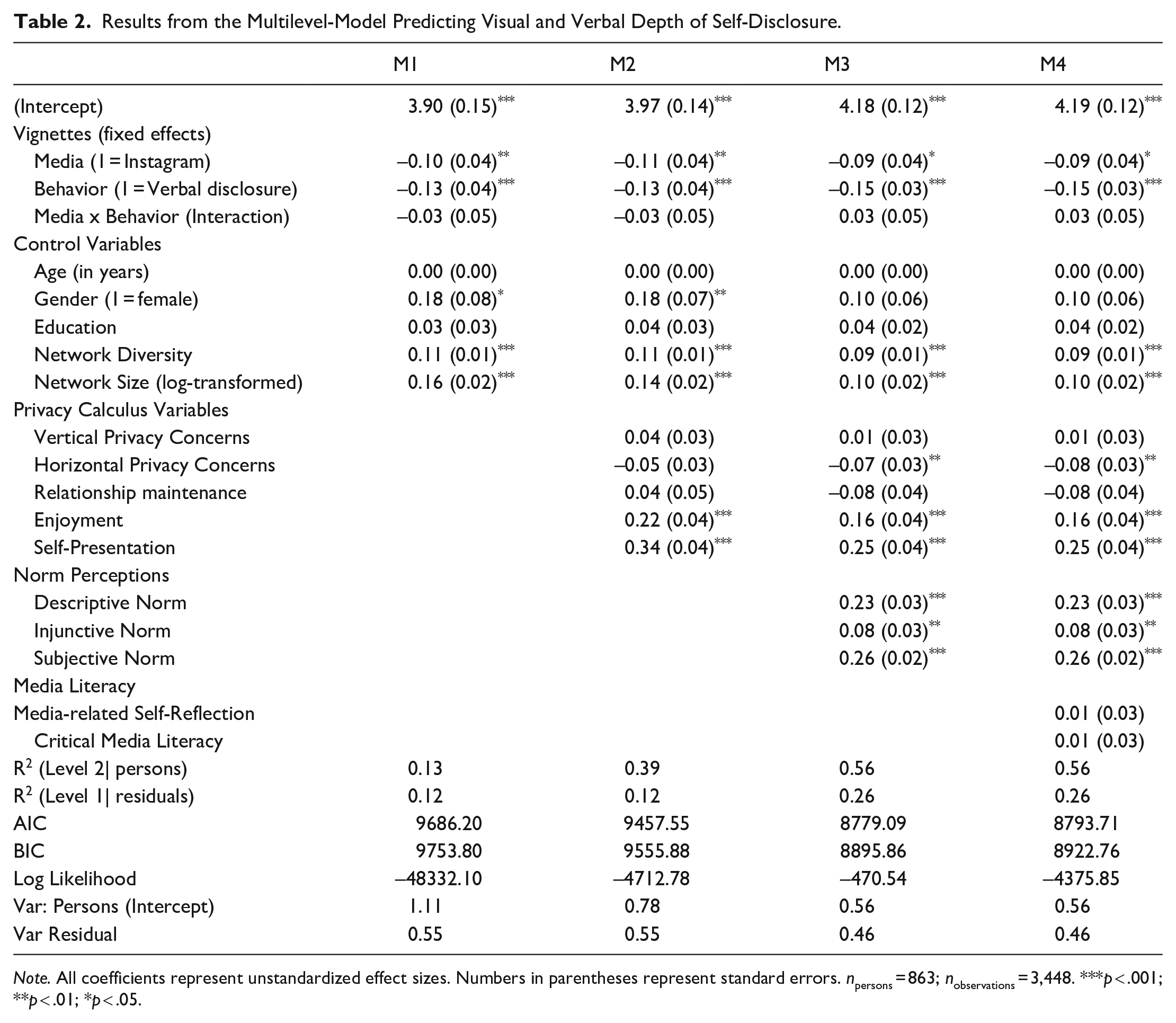
Results from the Multilevel-Model Predicting Visual and Verbal Depth of Self-Disclosure.
Note. All coefficients represent unstandardized effect sizes. Numbers in parentheses represent standard errors. npersons = 863; nobservations = 3,448. ***p < .001; **p < .01; *p < .05.
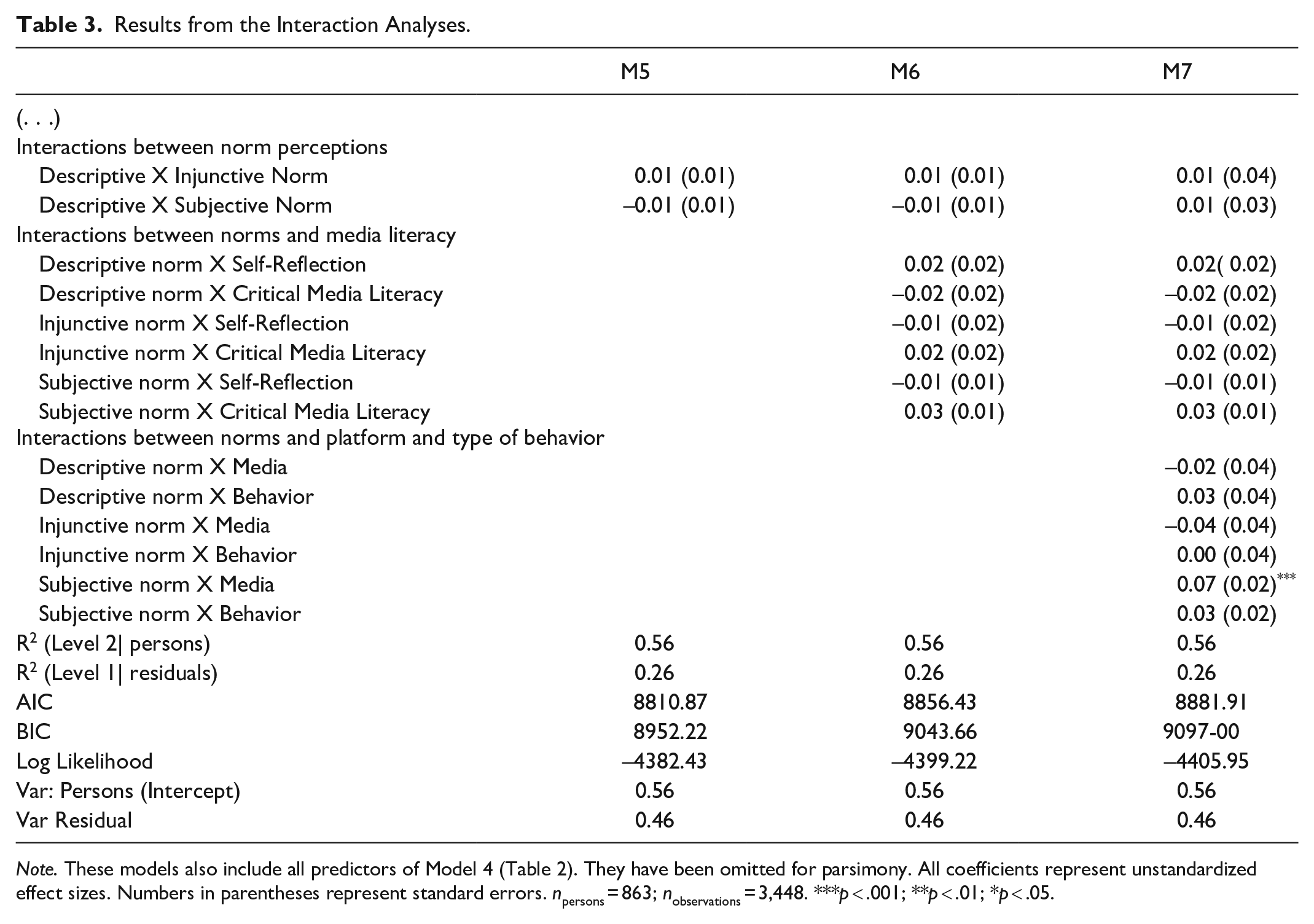
Results from the Interaction Analyses.
Note. These models also include all predictors of Model 4 (Table 2). They have been omitted for parsimony. All coefficients represent unstandardized effect sizes. Numbers in parentheses represent standard errors. npersons = 863; nobservations = 3,448. ***p < .001; **p < .01; *p < .05.
Results
Preregistered Analyses
H1 posited that all three types of norms should be positively related to self-disclosure (independent of the type of disclosure behavior and the type of platforms). Our findings revealed that the descriptive (Table 2, Model 4: b = 0.23, 95% CI [0.18, 0.28], p < .001), injunctive (Model 4: b = 0.08, 95% CI [0.03, 0.14], p = .002) and the subjective norm (Model 4: b = 0.26, 95% CI [0.23, 0.29], p < .001) positively predicted the depth of self-disclosure. H1a, H1b, and H1c were hence supported.
H2 argued that both injunctive and subjective norm perceptions would moderate the relationship between descriptive norms and self-disclosure. However, neither the injunctive norm (Table 3, Model 5: b = 0.01, 95% CI [–0.02,0.03], p = .680) nor the subjective norm (Model 5: b = –0.01, 95% CI [–0.04,0.01], p = .345) moderated the effect of the descriptive norm on self-disclosure. H2a and H2b were hence not supported.
With RQ1, we inquired about the power of social norms in shaping people’s disclosure behavior. In general, norm perceptions explained 17% of the between-person variance (cf. Table 2, the difference in R2 on Level 2 between M2 and M3). Platform- (Facebook vs. Instagram) and behavior-specific fluctuations (visual vs. verbal disclosure) further explained 14% of the variance in self-disclosure (difference in R2 on Level 1 between M2 and M3). In comparison, online privacy concerns and perceived benefits of social media use explained 26% of the between-person variance in disclosure behavior. Social norms thus explain less variance compared to privacy concerns and perceived benefits, but still account for a sizable amount.
With H3, we predicted that both critical media literacy and media-related self-reflection would be negatively related to self-disclosure. However, both types of literacy did not predict self-disclosure (Table 2, Model 4, CML: b = 0.01, 95% CI [–0.04, 0.07], p = .700; MSR: b = 0.01, 95% CI [–0.05,0 .06], p = .810). H3a and H3b were hence not supported. In line with this result, both types of literacy did also not moderate the relationships between the three norm types and self-disclosure (Table 3, Model 6). H4 was thus not supported.
With RQ2, we asked to what extent the relationships between norm perceptions and disclosure behaviors depend on the type of platform and the type of behavior. Figure 2 visualizes the differences in norm perceptions and disclosure behavior across the four vignettes. Although self-disclosure was slightly higher on Facebook compared to Instagram (Table 2, Model 4: b = –0.09, 95% CI [–0.16, –0.02], p = .012), as well as for verbal compared to visual disclosure (Model 4: b = –0.15, 95% CI [–0.21, –0.08], p < .001), neither the platform nor the type of behavior considerably moderated the size of the relationship between the norm perceptions and self-disclosure (Table 3, Model 7). That said, the effect size of the relationship between the subjective norm and self-disclosure was slightly larger on Instagram compared to Facebook (Model 7: b = 0.07, 95% CI [0.03, 0.11], p = .001), but did not differ between visual and verbal disclosure (Model 7: b = 0.03, 95% CI [–0.01, 0.07], p = .120). The norm effects were hence largely independent of platform and type of self-disclosure.
Exploratory Analyses
To estimate the relationships between the three types of norm perceptions and disclosure with higher precision, we controlled for several variables that prior research has found to be related to self-disclosure. Although these were primarily added for estimation precision, their relationships with self-disclosure offer interesting additional insights. It is noteworthy that network diversity (Table 2, Model 4: b = 0.09, 95% CI [0.07, 0.11], p < .001) and network size both positively predicted self-disclosure (Model 4: b = 0.10, 95% CI [0.07, 0.13], p < .001). Interestingly, only horizontal, but not vertical privacy concerns were negatively related to self-disclosure (Model 4: b = –0.08, 95% CI [–0.13, –0.02], p = .004). Furthermore, if participants indicated to enjoy using social media (Model 4: b = 0.16, 95% CI [0.09, 0.24], p < .001) and felt that social media allows them to present themselves in a favorable way to others (Model 4: b = 0.25, 95% CI [0.17, 0.32], p < .001), they indicated higher levels of self-disclosure.
Discussion
With this study, we provide an in-depth analysis of the relationship between social norms and self-disclosure on social media. Extending prior research, we explicitly disentangle descriptive, injunctive, and subjective norms and their relationships with both verbal and visual disclosure. To increase generalizability, we tested these relationships on both Facebook and Instagram, while controlling for other, more commonly investigated predictors of online disclosure. As the results show, all three norm types positively predicted self-disclosure, explaining variance beyond privacy concerns or perceived benefits of disclosure. Descriptive and subjective norms correlated more strongly with disclosure than injunctive norms. The effect sizes could be characterized as moderate (equivalent to r = .24-.26). These findings first suggest that people can indeed distinguish between different norms related to self-disclosure on Facebook and Instagram. Second, social media users adjust their self-disclosure behaviors based on what they perceive other users are doing and what those others expect of them, using these distinct social norms as reference points for their own self-disclosure. The distinct predictive power of all types of norms supports the assumptions of general norm theories (Cialdini et al., 1990; Rimal & Real, 2005) and supports the special predictive power of subjective norms found in previous research (Park & Smith, 2007). This further holds true across different levels of (self-reported) social media literacy, both for verbal and visual disclosure, and for both platforms examined in the study.
That said, it has to be considered that while the descriptive, injunctive, and subjective norm dimensions were distinguishable empirically, we found them to be strongly overlapping. Even though regression diagnostics did not suggest multicollinearity problems, descriptive and injunctive norms were highly correlated. This is important for future research on norms, as it shows that the theoretical distinction between descriptive and injunctive norms may not always translate into empirically measurable differences. It is thus important to investigate the contexts and factors under which these dimensions are distinct and under which they are not. Furthermore, as online disclosure is shaped by the dynamic interplay of forces which include audiences, affordances, and platforms (Zhang et al., 2021), future studies should also investigate how social norms about online disclosure evolve through the multitude of social contexts and situational factors that constitute one’s social media disclosure ecology.
Next, our findings show that, surprisingly, different norms did not interact in predicting online disclosure, which contradicts assumptions of the theory of normative social behavior (Rimal & Real, 2005) and empirical findings about the moderating role of subjective norms in the context of organ donation (Park & Smith, 2007). This divergence suggests that norm interactions may be contingent on specific social contexts and behaviors. As highlighted above, all three norms were comparatively strong as well as strongly correlating, suggesting considerable overlap in the particular context under study (social media) and with regard to the specific behavior (self-disclosure). Given that self-disclosure is a defining feature of social media use and without which users cannot reap the benefits such services offer (Ellison et al., 2007), this may explain why the norms by themselves already exert sizable influence. Thus, interactions may only be identifiable if the strength of the different norms varies. For example, in the study by Park and Smith (2007), the descriptive norm was rather low (not many people register to donate their organs), but the injunctive norm was rather strong (many people approve of organ donation). In such cases, a low descriptive norm may nonetheless become influential via a strong injunctive norm.
A surprising result was that neither critical media literacy nor media-related self-reflection moderated the norm-behavior link. Given the often-proclaimed potential of media literacy to serve as a buffering factor against negative effects of SNS use (Livingstone, 2014; Schreurs & Vandenbosch, 2021), this finding is somewhat at odds with prior research (e.g., Tamplin et al., 2018). It still might be that higher literacy makes people more aware of potential risks and negative outcomes, but this does not seem to translate into lower levels of self-disclosure. That said, it also has to be noted that the used measure was based on self-reports and may thus be biased because of overestimation of one’s skills and abilities. Future research should develop more objective ways to assess media literacy.
As we controlled for commonly investigated antecedents of self-disclosure, this study also replicated some previous findings beyond the norm-behavior link. For example, replicating prior research (e.g., Vitak, 2012), we found that network diversity and size positively correlated with disclosure. Thus, people who have large audiences that contain people from various social contexts also disclose more. More importantly, horizontal privacy concerns referring to possible privacy violations from other users emerged as negative predictors of depth of disclosure, providing more evidence against the privacy paradox. At the same time, vertical privacy concerns, referring to possible privacy violations from social media platforms and institutions, did not significantly predict disclosure, lending support to the argument by Raynes-Goldie, (2010) that SNS users generally care about protecting their privacy from other users, but are uncertain about potential privacy violations from institutions or online service providers. Perceived benefits such as enjoyment and self-presentation again turned out to be positive predictors of disclosure (e.g., Dienlin & Metzger, 2016). In combination with the negative effect of privacy concerns, this lends further support to the privacy calculus, which suggests that participants take both risks and benefits into account when disclosing themselves online. In fact, it seems that both the assessment of risks and benefits as well as what others do and approve of are important antecedents of self-disclosure on social media.
Limitations
The first limitation of the present study refers to the cross-sectional nature of our data, which does not allow for causal inferences. Future research should continue to investigate the norm-behavior link in experimental designs and field experiments to examine the role, dynamic changes, and origin of social norm perceptions in relation to online disclosure in social media. Likewise, cross-sectional designs only represent one moment in time and cannot model long-term changes in norms and disclosure practices. Future longitudinal studies could be fruitful in identifying such longer temporal dynamics in the initiation and maintenance of disclosure norms and practices.
Second, we implemented vignettes to investigate differences across media platforms and types of behaviors. Although our findings suggest that this relationship is largely independent of the platform and type of self-disclosure, we recommend that future research takes specific affordances (e.g., ephemerality posts, editability) of more diverse and particularly more recent social media platforms, such as TikTok, BeReal or Snapchat, into account.
Third, our norm measures asked participants to think about a specific reference group: those other users that participants were either friends with on Facebook or followed on Instagram. We deemed this a relevant reference group as it is these accounts whose content and disclosure behavior is visible to the user. However, work in other areas (Park & Smith, 2007) has shown that whether norms refer to the broader population or to a more specific group of people (e.g., friends) matters for predicting behavioral outcomes. Future research should investigate whether specific users in a person’s social media feed (e.g., close friends, popular accounts with many followers, idolized accounts or influencers) have a stronger influence on people’s disclosure behavior.
Fourth, this study relied on participants’ self-reports of their disclosure behavior. This requires the recollection of typical situations in which they have engaged in such behavior. Such a measure is inherently subjective and may thus be biased. Future research should consider collecting behavioral data and determine more objective levels of disclosure through content analysis (e.g., similar to Bazarova & Choi, 2014). Furthermore, our measure of both visual and written self-disclosure remained on a general level (allowed to create smaller scales that could be used in the repeated measurement design and ensured compatibility between vignettes). It is possible that a more fine-grained analysis of depth or breadth of disclosure, maybe even focusing on particular types of information, would lead to different results.
Fifth, even though the study is based on a heterogeneous and diverse MTurk sample, it nonetheless represents a non-probability sample. In comparison with the US population, for example, females were overrepresented. Although we do not expect different results in more representative samples, it should be noted that the generalizability of the findings to the broader population may be limited.
Conclusion
In sum, we found that verbal and visual disclosure levels on Instagram and Facebook are positively related to all three types of norm perceptions. In comparison to the often-studied variables of privacy concerns and perceived disclosure benefits, these norm perceptions explain a distinct and sizable, although slightly less, amount of variance in self-disclosure. These results suggest that evaluations of what others do, approve of and expect one to do, coupled with strong gratifications of disclosing oneself on social media are strong drivers of online communication behaviors and should be considered when trying to explain self-disclosure on social media. Theoretical approaches such as the privacy paradox or the privacy calculus, which aim at explaining disclosure decision on social media, could hence benefit from including social norm perceptions. Differences in self-assessed critical media literacy and self-reflection did not change these relationships, raising the question of whether and how much educational interventions can protect users from uncritically learning from the risky behaviors of others on social media.
Footnotes
Declaration of Conflicting Interests
The author(s) declared no potential conflicts of interest with respect to the research, authorship, and/or publication of this article.
Funding
The author(s) disclosed receipt of the following financial support for the research, authorship, and/or publication of this article: This project was funded by NSF CHS grant ##1405634 awarded to Natalya N. Bazarova. Recruitment was further funded within the Collaborative Project “Digital Behaviors in the Digital Age” of the Cornell Center for Social Science. Philipp Masur received funding from the Dutch Science Foundation (Grant number: VI.Veni.211 S.063).
