




Abstract
This study explores how traditional socioeconomic markers of the digital divide interact with new markers of marginalization when it comes to online privacy protecting behaviors. To do this, we analyze data from a representative sample of social media users in the United States. Using hierarchical linear regression, we explore the relationships between established components of the digital divide, antecedents of privacy concerns, privacy-protecting behaviors, and privacy literacy. Our analysis highlights privacy literacy as a potentially understudied dimension of the digital divide and unpacks how traditional markers of marginalization explain distinct dimensions of privacy-protecting behaviors. Moreover, our findings suggest that the privacy literacy divide can amplify aspects of the second- and third-level digital divides, when translated into privacy-protecting behaviors.
Writing almost a decade ago, Manuel Castells (2010) described the ability to use and adapt information and communication technology (ICT) as “the critical factor in generating and accessing wealth, power, and knowledge in our time” (p. 93). The meaning of that use and adaptation, however, has been continuously changing. Previously, the concern was primarily about exclusion of marginalized and vulnerable populations from the information society (Warschauer, 2003). Currently, the attention is shifting toward negotiating the terms of inclusion and managing unwanted or unwilling, and potentially harmful, exposure of the same populations (Marwick & boyd, 2018; Wu et al., 2019) or even creating new markers of marginality, rooted in digital powerlessness and dehumanization (Solove, 2001).
In increasingly digitized and datafied environments, where we trade information about ourselves and our behaviors in exchange for access to products and services, privacy emerges as another factor demarcating the powerful and the powerless (Papacharissi, 2010). Marwick and boyd (2018) refer to this disparity as “privilege,” which is both required to obtain online privacy and is reified through differential privacy perceptions, attitudes, and behaviors. For marginalized or at risk users, the loss of privacy may mean further limitations on access to social, financial, and political resources (Bridges, 2017; Horvitz & Mulligan, 2015; Park, 2018a; Stutzman et al., 2012; Westin, 2003), justification of their marginality status (Bridges, 2017), additional discrimination (Horvitz & Mulligan, 2015), or even abuse (Martin & Adams, 2012; Sheng et al., 2010), thus further reifying their structural disadvantage (Marwick et al., 2017). Put differently, in a “data-by-circumstance world” (Marwick & boyd, 2018, p. 1159) privacy is a dimension of power, which can be used for both empowerment and discrimination as a function of regulation, design, and use (Andrejevic, 2014; Solove, 2001).
From an inequality perspective, privacy knowledge and practices are fundamental to the shaping of one’s position vis-à-vis institutions that collect, modify, cross-reference, and trade data. With increased datafication of human experiences, grows the importance of privacy for “power-over people” (Moss, 2002, pp. 159–161) exercised by formal and informal social institutions. Thus, scholars face questions about systematic knowledge disparities about privacy, the dynamics linking privacy knowledge and practices, repercussions of such dynamics for traditionally marginalized groups or emergence of new markers of marginality online. Engaging with these questions is important for complicating the notions of privacy and marginality, and for advancing policy discourses targeting both.
Despite its impressive tenure and elusive definition, the digital divide remains a useful framework for understanding marginalization in increasingly mediated and digitized communication environments (Pearce & Rice, 2013). First, it offers a systematic and established body of knowledge about the relationship between online disparities and offline inequalities. Second, it allows for the investigation of structural questions of power in the information society, with individual-level data about users’ mundane practices, attitudes, and perceptions. Finally, the digital divide framework is inherently flexible and accommodating to the ever-changing substantive field of communication. As such, the broad moves toward platformization of the web (Helmond, 2015) and datafication of society (Kennedy et al., 2015), coupled with a growing number of high-profile privacy scandals such as Cambridge Analytica, require that the digital divide framework explicitly engages with questions of online privacy.
While acknowledging the breadth of digital divide research, this article zeroes on privacy as an area in which marginalization might be both observed and have a profound impact in the information society. Specifically, we focus on how privacy is expressed through knowledge and practices on social media. We empirically map systematic disparities in privacy literacy of social media users in the United States and their relationship to privacy-protecting behaviors (PPBs). While bound to particular technological and cultural contexts, this project draws on a nationally representative survey to test the relationships between established antecedents of the digital divide, privacy, and privacy literacy.
Literature Review
This article draws on literatures on digital divide and social media privacy. The former offers an analytical framework for examining the link between online and offline inequalities. The latter offers a systematic way to incorporate privacy into the analysis of said inequalities. Taken together, these two bodies of literature enable exploring systematic disparities in people’s understanding and enactment of online privacy.
Digital Divide
The three levels of the digital divide are a commonly used framework to map the concept in a way that recognizes it as a range of inequalities and marginalization (Helsper & van Deursen, 2017; van Deursen & van Dijk, 2015). They distinguish between disparities in material access to technology (the first level), inequalities in digital literacy and skills (DLS; the second level), and differences in the use of ICTs (the third level; also see van Dijk, 2005). While early research has focused primarily on disparities in material access (e.g., Warschauer, 2003), today’s focus is on inequalities in DLS and use (e.g., Li et al., 2018).
Hargittai has led the claim that disparities in DLS are fundamental to explaining online inequalities (DiMaggio et al., 2004; Hargittai, 2002; Hargittai & Shafer, 2006). Her research has demonstrated that disparities in DLS tend to fall across established socioeconomic markers, where those higher in socioeconomic status enjoy higher levels of DLS. Thus, for example, she demonstrated that younger and more educated participants are better at retrieving information online (Hargittai, 2002), and younger adults coming from more educated households and those identifying as either Asian American or White, are likelier to have both better access to technology and stronger DLS (Hargittai & Hinnant, 2008). Today, there is a body of work demonstrating a persistent relationship between income, education, race, and age, and inequalities in DLS (e.g., Park, 2018b; van Deursen & van Dijk, 2015; van Dijk, 2005; van Dijk & Hacker, 2003).
DLS, however, matter only to the extent their application makes a difference either for the individual or for a larger social group. Hargittai et al. (2010) and Metzger (2007) have established a link between the level of DLS and the ability to assess the credibility of online information. DiMaggio et al. (2004) showed how capital-enhancing and recreational uses of the internet are tied to variance in skills and different long-term structural outcomes. Stoycheff et al. (2016) have demonstrated that differential uses lead to different levels of demand for democracy. Van Deursen and van Dijk (2015) found that more educated and wealthier people are likelier to use the internet for information gathering and news consumption, as opposed to the more recreational uses; they are also more likely to engage in online commerce. Helsper and van Deursen (2017) demonstrated that younger and more educated users derive greater economic, social, and educational values from the internet; younger people and males are also more likely to derive political value from their internet use; while wealthier and more educated internet users are more likely to derive political value or value related to obtaining government services online.
The persistent link between socioeconomic factors and the different levels of the digital divide suggests that offline inequalities may be reflected, or even amplified, online. The precise relationships may differ as a function of the cultural context (Gonzales, 2016), the sample, or the measures used in the study (Barzilai-Nahon, 2006), but broader trends are preserved. Surprisingly, questions of privacy as a component of the digital divide have not been substantively addressed in the literature (Park, 2013). Yet, if the ability to manage privacy is at the core of emerging power structures based on datafication, surveillance, and algorithmic profiling, we would expect it to be an important marker of marginalization—one that both manifests disparities and acts as a sphere of potential intervention for coping with inequality.
Privacy
The turn to social media in the developed world poses additional challenges to qualifying the digital divide and using it for unpacking the link between offline and online marginalities. First, the injection of interconnected social data throughout the web creates a situation where an individual is engaged in personal information sharing regardless of her awareness or consent, and in a variety of contexts of traditional internet use (Helmond, 2015; Marwick & boyd, 2018). Second, adoption of social media may not conform to the rather robust relationships described above, particularly in light of the push by commercial players (e.g., Facebook, Google, Apple) to embed social media components into devices or the connectivity itself, as it is done in the zero-rating programs (Correa, 2016). Finally, critical engagement with social media places additional requirements on the DLS of a person. It is no longer enough to know how to retrieve or evaluate online information, as it is also important to know how to navigate social relations online (Bucher, 2015; Park, 2018b).
Taken together, these developments make privacy a potential new frontier for the digital divide research (Park, 2013). As privacy becomes the de facto currency of both access and use of social media, lack of knowledge or skills to protect and manage personal information may become a source of disadvantage. If the digital divide is about exercising power over people (Moss, 2002), PPBs are about exercising agency in online interactions (Sundar & Marathe, 2010). Currently, the lack of balance in privacy-protecting structures creates a situation where the disadvantaged (i.e., those lacking relevant literacies) are less likely to report security or privacy concerns (Park, 2013; Redmiles et al., 2017) and social media users in general develop a sense of powerlessness vis-à-vis platform providers, such as Facebook (Hargittai & Marwick, 2017).
In empirical research, privacy has often been operationalized as a relationship between privacy concerns and PPBs. Such concerns are explained through a series of antecedents (i.e., privacy experiences and awareness or personality and demographic differences), and they impact PPBs, playing into a privacy calculus that weighs potential risks and benefits (Dienlin & Metzger, 2016; Smith et al., 2011). The antecedents in this view of privacy, also known as the APCO model (for Antecedents, Privacy Concerns, and Outcomes), have significant crossover with factors that explain the digital divide.
Exploring the crossover between traditional markers of marginalization and privacy antecedents, previous research has found that younger users are likelier to self-disclose on social media, and they also more frequently engage in PPBs, compared with older adults (Kezer et al., 2016); females are more likely to modify privacy settings as a function of frequency of use (boyd & Hargittai, 2010), and to read privacy policies before joining a social media site, compared with males (Redmiles, 2018); yet males are more likely to rely on technical PPBs (Redmiles, 2018).
Conversely, different types of social media use relate differently to the various PPBs. Using social networking websites for relationship management, for example, is positively associated with self-disclosure (Krasnova et al., 2010) and use for companionship is negatively associated with such PPBs as changing privacy controls from default values (Quinn & Papacharissi, 2018).
Another strength of the APCO model lies in its flexibility, which allows addressing some criticism of other approaches to privacy, such as contextual integrity (Nissenbaum, 2010), privacy management theory (Petronio, 2002), and privacy calculus (Dinev & Hart, 2006). All these approaches focus on the individual as the locus of privacy interactions, but do not address surveillance or privacy violations that result from data aggregation by third parties (Baruh & Popescu, 2017). Focusing on a range of privacy concerns and PPBs allows the teasing out of additional dimensions of online privacy, such as distinctions between interactions among human beings (social or horizontal privacy) and interactions between individuals and institutions, such as companies or the government (institutional or vertical privacy; Bartsch & Dienlin, 2016; Masur, 2018; Raynes-Goldie, 2010). Such nuance is required to address both the rapidly changing technology and the evolving relationships people develop within digital spaces (Raynes-Goldie, 2010), since each involves different characteristics in terms of scalability, underlying perceptions, and potential threats (Masur, 2018).
Online Privacy Literacy
Online privacy literacy (OPL) is a promising conceptual avenue to incorporate a dimension of privacy into the analysis of second-level digital divide (Baruh et al., 2107; Park, 2013). Some previous research focused on questions of awareness and knowledge about data collection practices by large organizations and marketers (Milne & Rohm, 2000; Turow, 2003). Other research examined knowledge about relevant privacy-protecting technologies (Bartsch & Dienlin, 2016; boyd & Hargittai, 2010; Hargittai & Litt, 2013; Jensen et al., 2005). Yet still other research has focused on legal dimensions of data protection (Hoofnagle et al., 2010) or social aspects of limiting the spread of data through privacy settings (Bartsch & Dienlin, 2016).
Combining a few dimensions of DLS (familiarity with technology, policy understanding, and surveillance awareness) and PPBs, Park (2013) drew on a national sample of US internet users to show positive effects of DLS on information-controlling behaviors, while demonstrating that literacy is unequally divided along markers of age and gender. Baruh et al. (2017), in their meta-analysis of privacy management literature, have reinforced the mediating role of OPL in amplifying privacy concerns and scope of online engagement. Complimentarily, Bartsch and Dienlin (2016), focusing explicitly on Facebook, showed how privacy-literate users employ stronger protections and feel safer when using the platform; they have also pointed at quantity of use as a predictor of OPL. Recently, Li et al. (2018) examined low-income communities in the United States focusing on the interaction between privacy concerns, skills, and engagement in privacy-compromising activities online (e.g., online commerce). They also demonstrate the predictive power of OPL (as opposed to privacy concern) toward the willingness to engage in online privacy-compromising activities, showing that even within a marginalized population variance in OPL can be further explained by demographic differences.
Trepte et al. (2015) have unpacked OPL as a combination of declarative and procedural knowledge along four dimensions: knowledge about institutional practices, technical aspects of privacy protection, potential threats and risks, and privacy regulation. This conceptualization is particularly sensitive to the challenges placed on users by platformization of the internet and datafication of their experiences; it is also more comprehensive compared with earlier attempts (see Masur, 2018, pp. 337–338). With this conceptualization of OPL in mind, we investigate online privacy through the lens of the digital divide. Specifically, we ask to examine the relationship between (a) sociodemographic factors confounding the digital divide, (b) select antecedents of privacy concerns, and (c) OPL.
Next Steps
Drawing on prior literature, we begin with exploration of how structural (age, income, educational attainment, and race and ethnicity) and experiential (amount of social media use, privacy self-efficacy) factors relate to the concept of OPL. As a series of structural markers has consistently been demonstrated to indicate marginality in other digital contexts (van Duersen & van Dijk, 2011), we state our first research question as:
RQ1: How do traditional sociodemographic markers of marginalization relate to OPL among social media users in the United States?
Based on prior research on the digital divide and on the OPL, we expect to see the more affluent publics, and those belonging to the majority, to have higher OPL. The novelty of our approach lies in the explicit focus on social media and in the use of a more comprehensive measure for OPL, compared with the earlier work.
Answering the calls for unpacking privacy-related decision-making hurdles (Acquisti & Gross, 2006), we examine self-efficacy as a construct that has continually surfaced in conversations related to the digital environment. Chai et al. (2009) demonstrated that self-efficacy is influential to PPBs among teens; others showed it to be positively associated with privacy concerns (Mohamed & Ahmad, 2012; Yao et al., 2007). Thus, we leverage the APCO model (Smith et al., 2011) by adding self-efficacy as an antecedent to privacy concerns, and explore how these intersect with OPL in shaping PPBs. Self-efficacy has also been touched upon in the digital divide literature as a factor that can influence more affluent uses of the web (Eastin & LaRose, 2000). Accordingly, we state our second research question as:
RQ2: What effects do OPL and self-efficacy have on the relationship between privacy concerns and PPBs?
In addition, there is a growing recognition among privacy scholars to view PPBs as multidimensional constructs. As discussed above, one useful distinction is between vertical (or institutional) and horizontal (or social) privacy. The first refers to the privacy relationship between an individual and an institution or platform sponsor, while the second refers to privacy relationships among individual actors (Bartsch & Dienlin, 2016; Raynes-Goldie, 2010). While research has so far focused mostly on institutional privacy (e.g., Purchases et al., 2013), social media users tend to prioritize its social aspects, particularly privacy from unwanted audiences (Quinn et al., 2019). This distinction is pertinent to understanding how marginalized groups engage with privacy, because their relationships with institutions may substantially differ from their relationships with peers. Thus, we engage with the multidimensionality of privacy by asking:
RQ3: What effects does OPL and self-efficacy have on the relationship between privacy concerns and horizontal PPBs?
RQ4: What effects does OPL and self-efficacy have on the relationship between privacy concerns and vertical PPBs?
To address these questions, we employ original, cross-sectional survey data in hierarchical multiple regression models. While we do not pose specific hypotheses for these last RQs, we do expect the two sets of relationships to differ from each other.
Method
We collected the data in a self-administered, web-based survey between June 15, 2018 and July 31, 2018 through the Qualtrics panel service. Participants received a small incentive in the form of reward points from Qualtrics for taking the survey. We used quotas to match the sample to the 2015 US Census Bureau’s American Community Survey data on parameters of age, income, and gender. 1 Participants reported on uses, behaviors, and privacy attitudes on their most frequently used social media platform (based on definitions of boyd & Ellison, 2007, and Obar & Wildman, 2015). Facebook was the most frequently utilized platform (n = 541, 79.4%), followed by Instagram (n = 55, 8.1%) and Twitter (n = 46, 6.8%). This study was reviewed and approved by the Institutional Review Board at the University of Illinois at Chicago.
Sample
Descriptive statistics of the sample (n = 689) are summarized in Table 1. The average age of respondents was 46.91 years (SD = 17.2, range = 18–91, Mdn = 47.0) and the sample was balanced with respect to gender (55.2% female, 44.4% male, 0.2% not reported). Racial and ethnic identities were reported as follows: African American, 8.7% (n = 59); Hispanic/Latino, 7.8% (n = 53); Asian, 4.7% (n = 32); Caucasian, 82.8% (n = 564); multi-ethnic/other/undisclosed, 3.8% (n = 26). 2 Participants in the study were active on social media, with 93.1% reporting use of two or more social media accounts and 84.9% reporting that they accessed their favored social media platform at least daily.
Sample Descriptives.

Measures
We constructed independent variables in three domains: structural and experiential antecedents, and privacy concerns. We explored OPL first as a dependent, then as an independent variable, contributing to the PPBs. Finally, as a dependent variable, we explored PPBs in two respects: (1) protecting oneself from socially oriented privacy incursions, or involving others on the platform—horizontal PPBs and (2) protecting oneself from privacy incursions by institutional actors, such as a platform sponsor—vertical PPBs (Table 1). Following is a brief description for each variable.
Structural Antecedents
We rely on factors identified in other digital contexts as meaningful to online participation (Hargittai & Hinnant, 2008; van Duersen & Helsper, 2015) and privacy (Park, 2013). These include age (computed by a report of year of birth), income (seven categories, ranging from “Under US$25,000” to “Over US$200,000”), education (six categories, ranging from “Less than high school” to “Graduate school”), and race and ethnicity (reported separately). In this analysis, income and education were treated as ordinal variables.
Experiential Antecedents
Previous work has consistently demonstrated that self-efficacy, and quantity of social media use are strongly associated with privacy concern (e.g., Dinev & Hart, 2004; Yao et al., 2007). We captured social media privacy self-efficacy, using a 5-item scale (Dienlin & Metzger, 2016) with responses scored on a 7-point Likert-type scale (Strongly Disagree to Strongly Agree). Scores for self-efficacy ranged from 5 to 35 (M = 22.72, s = 6.98, α = .928). The quantity of social media use was a product of respondents’ estimate of the frequency of platform access by the estimate of average time spent during each visit (range 2–42, M = 16.23, s = 8.55).
Privacy Concerns
We conceptualize those as concerns “about possible loss of privacy as a result of information disclosure” (Xu et al., 2011, p. 800). As privacy is better understood when placed in specific contexts (Waldo et al., 2007), privacy concerns were assessed in the context of the participant’s most frequently used social media platform. Items included concerns related to information being misused by the platform, risk perceptions (such as whether disclosure could result in unexpected problems), and the individual’s assessment of their concern for privacy relative to others (Xu et al., 2011). The resulting composite index (M = 57.66, s = 11.45) demonstrated strong reliability (α = .921).
Privacy-Protecting Behaviors
We view PPBs as applied or procedural knowledge about privacy, in contrast to the declarative knowledge captured in OPL measures. A series of 12 questions related to privacy-protection strategies (Young & Quan-Haase, 2009), and precautionary and technical PPBs (Buchanan et al., 2007; Masur et al., 2017) indicated participant’s level of activity on a 5-point Likert-type scale (Never to Always). The resulting composite measure of PPBs (M = 57.58, s = 15.70) demonstrated strong reliability (α = .902).
To explore the dimensionality of PPBs, we performed exploratory factor analysis with principal components extraction and oblimin rotation with Kaiser normalization. This rotation technique was used, as PPBs were correlated (Buchanan et al., 2007); correlation of the extracted components was confirmed through analysis of the component correlations. Visual analysis of the scree plot suggested a two-factor solution. The components showed strong variable loadings in excess of .50 with items loading substantially on only one component (Costello & Osborne, 2005), and explained 53.08% of the total variance. Close reading of the questions composing each of the two factors suggests that they capture the horizontal (social) and the vertical (institutional) dimensions of PPBs. The two components are summarized in Table 2 and have a correlation of r = .42.
Factor Analysis of PPBs.

PPBs: privacy-protecting behaviors.
Online Privacy Literacy
Building on Trepte et al. (2015), we conceptualize OPL as declarative knowledge related to: technical and strategic privacy-protecting measures, legal and regulatory protections, and institutional practices of platform sponsors and governmental agencies concerning data collection. The original OPL scale (Masur et al., 2017) was adapted to the US context (OPL-US) by modifying original items pertaining to legal protections of privacy to reflect US legal environment.
Like the original, the OPL-US scale included four factual knowledge subscales: five items related to knowledge about institutional practices (OPL-IP), such as the data collection practices of social media platform providers and governmental agencies; five items about knowledge on technical protection measures (OPL-TEC), such as the meaning of terms like “Trojan” or “firewall”; eight items about laws surrounding data protection (OPL-DPL), such as the types of personal information legally protected in the United States; and five items on knowledge about data protection strategies (OPL-DPS), such as the utility of deleting browsing history. Correct responses on the individual items were summed into the individual subscale scores, and each subscale was weighted as 25% of the overall OPL-US score.
Scores on the OPL-US scale ranged from 0 to 18.75 (M = 10.88, s = 3.65) out of a possible score of 20. Scores on the four subscales were as follows: OPL-IP ranged from 0 to 5 (M = 2.40, s = 1.50); OPL-TEC ranged from 0 to 5 (M = 2.98, s = 1.50); OPL-DPS ranged from 0 to 5 (M = 3.30, s = 1.30); and OPL-DPL ranged from 0 to 8 (M = 3.52, s = 1.71).
Analysis
Data were screened for missing values, multicollinearity, homoscedasticity, and normality assumptions, resulting in elimination of eight outlier response sets. To address RQ1, regression on OPL-US characteristics of users were employed block-wise into a hierarchical multiple regression model using SPSS Version 25. Next, to examine the indirect effects of OPL-US on the relationship between privacy concerns and PPBs, on an overall basis, as well as on its vertical and horizontal dimensions (RQs 2, 3, and 4), we used Hayes’ (2017) PROCESS macro Version 3.3, Model 4 with 5,000 bootstrap samples to estimate confidence intervals.
Results
Markers of Marginality and OPL-US
Viewing OPL as a core component in unpacking privacy as a digital divide issue, we start by exploring OPL-US in relation to traditional markers of marginality, which are largely structural privacy antecedents. We used hierarchical multiple regression to address RQ1 and test whether traditional markers of marginality are significantly associated with participants’ OPL-US (Table 3). Model 1 demonstrates that sociodemographic factors of age, income, gender, education, and race explained 5.5% of the variance in OPL-US (Adj R2 = .055, F(7,668) = 6.63, p < .001). Consistent with previous work, being female is significantly and negatively associated with OPL-US (β = –.15, p < .001), as does identifying as Black (β = –.08, p = .045). Conversely, age is positively associated with OPL-US (β = .08, p = .046), along with education (β = .13, p = .003). Adding the quantity of social media use in Model 2, as an experiential privacy antecedent that had previously been demonstrated to predict disparity in OPL (e.g., Hargittai & Shaw, 2014; van Deursen & van Dijk, 2011), did not prove to be significant or add explanatory power to the model.
Regression of OPL on Predictors of Marginality.
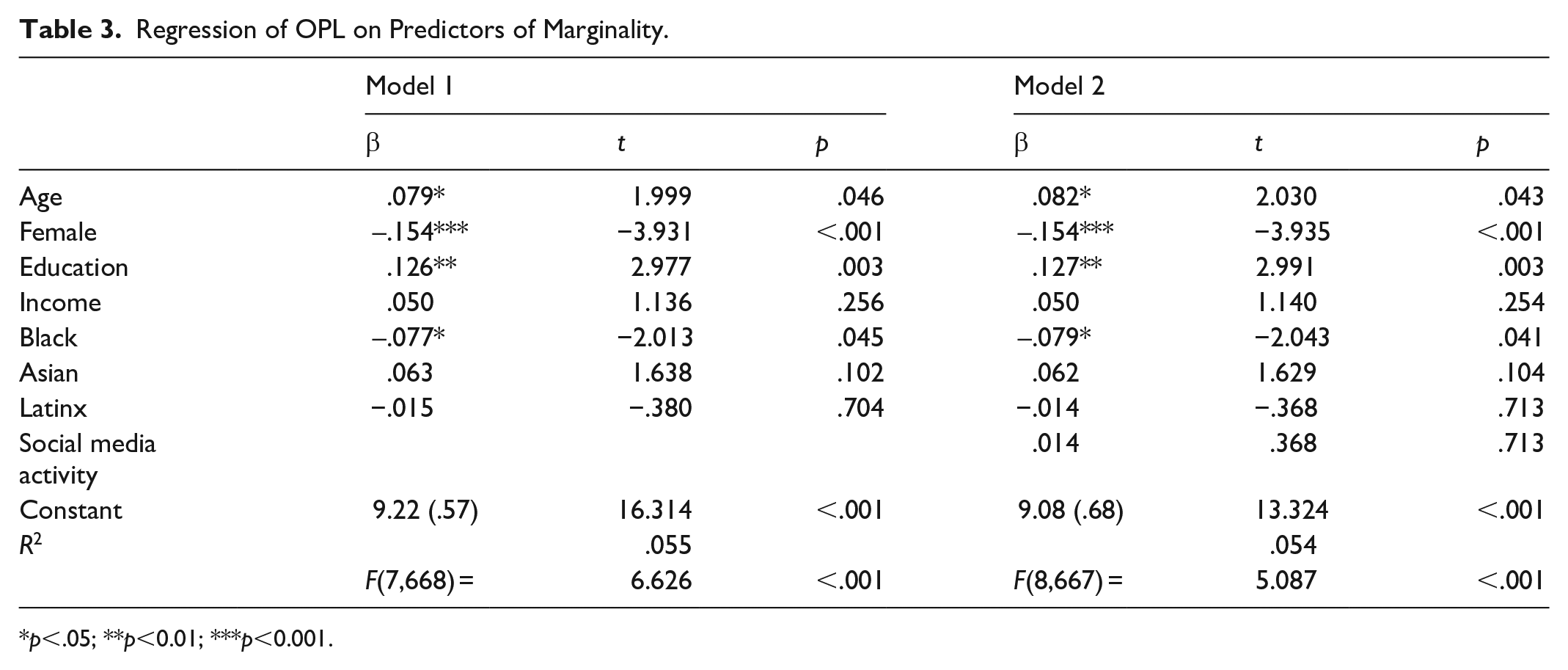
p<.05; **p<0.01; ***p<0.001.
Regression and Mediation Analysis of OPL-US and Overall PPBs
Building on the original APCO model (Smith et al., 2011), we performed mediation analysis using ordinary least squares path analysis to examine the relationship between privacy concerns and PPBs. To the original model, which is based mostly on structural privacy antecedents and quantity of social media use, we add a new, experiential antecedent: self-efficacy. We then use this updated model to explore the mediating effects of OPL-US on overall PPBs.
These findings (Table 4), which address RQ2, reveal that traditional indicators of marginality, or structural privacy antecedents, continue to be associated with OPL in established directions. Being female (β = –.14, p < .001) or Black (β = –.09, p < .001) are negatively associated with OPL, while higher levels of education (β = .14, p < .001) correspond to higher literacy. Privacy concern is also a significant indicator of OPL (β = .15, p < .001), as is self-efficacy (β = .10, p = .014). There were no interaction effects between self-efficacy and the demographic variables.
Regression of PPBs on Privacy Concerns, OPL, and Predictors of Marginality.
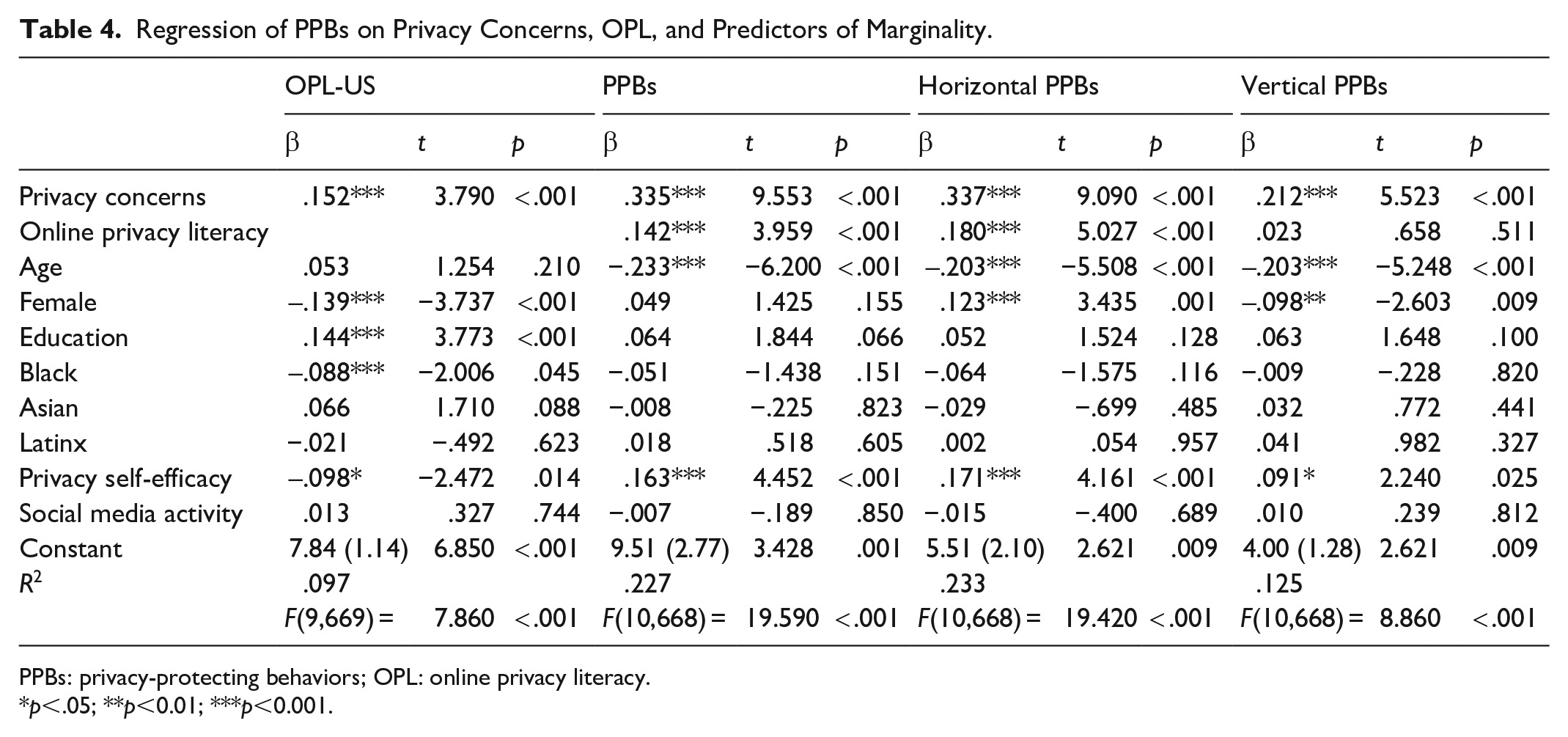
PPBs: privacy-protecting behaviors; OPL: online privacy literacy.
p<.05; **p<0.01; ***p<0.001.
Focusing on PPBs as the dependent variable, gives a slightly different picture. Privacy concern, as expected, continues to be a major indicator of PPBs (β = .34, p < .001), along with OPL-US (β = .142, p < .001) and privacy self-efficacy (β = .16, p < .001). The only structural factor related to marginality that is still evident in the model is age (β =–.23, p < .001), which was notably absent in its association with OPL-US. There were no interaction effects between the demographic variables and OPL-US.
Figure 1 displays the mediation analysis regression coefficients between privacy concerns, OPL-US, and PPBs (all relationships are statistically significant). The standardized indirect effect of privacy concerns on PPBs as mediated by OPL-US was (.152) (.142) = .022. Unstandardized indirect effects were computed for 5,000 bootstrapped samples, and the 95% confidence interval was computed by determining the indirect effects at the 2.5th and 97.5th percentiles. The bootstrapped unstandardized indirect effect was .02, and the 95% confidence interval ranged from .01 to .03. Thus, the indirect effect was small but statistically significant.

Mediation model.
Dimensionality of PPBs
We conducted mediation analysis using ordinary least squares path analysis to examine the distinct dimensions of horizontal and vertical PPBs (RQ3 and RQ4). The analysis is summarized in Table 4, Figure 2 (horizontal), and Figure 3 (vertical). Table 4 reveals that some structural antecedents continue to explain both horizontal and vertical PPBs, while other, such as education and race, are not significant. Age is significantly and negatively indicative of both horizontal (β = –.20, p < .001) and vertical (β = –.20, p < .001) PPBs. Somewhat surprisingly, being female is positively associated with horizontal PPBs (β = .12, p = .001), but negatively associated with vertical PPBs (β = –.10, p = .009). Figure 2 displays the mediation analysis regression coefficients between privacy concerns, OPL-US, and horizontal PPBs (all relationships are statistically significant). Figure 3 shows the same analysis for vertical PPBs (note that the relationship between OPL-US and vertical PPBs is not significant).

Mediation model on horizontal PPBs.

Mediation model on vertical PPBs.
Discussion
Today, when in developed economies both internet connectivity and socioeconomic inequality continue to grow, privacy is a major component in maintaining one’s independence, freedom, and economic and social well-being. Continuous monitoring, surveillance, data aggregation, algorithmic profiling, and unintended exposure make maintaining individual freedoms and independence a complex and laborious task. The tension between the omnipresence of digital technology and fragility of one’s privacy makes the awareness of privacy considerations, knowledge of privacy mechanisms, and ability to enact them a major asset for both reifying and rectifying social inequalities. As we set to explore how socioeconomic disparities manifest themselves in online privacy, our goal was to shed light on mechanisms that may preserve traditional structures of marginalization in the United States, or contribute toward the creation of new ones.
New Dimensions of the Digital Divide?
We focused the search for potential new modalities of marginalization in PPBs, as these are micro-manifestations of agency in an increasingly digitized and datafied environment, and wanted to know whether systematic disparities in OPL might translate into PPBs. We also took a nuanced approach to privacy antecedents, and included both structural markers of marginality and experiential factors. Though facing limitations due to the use of self-reported data and the explanatory power of our models, our findings do prompt initial thoughts about potential new dimensions—or new markers—of the digital divide.
Privacy Literacy Divide
Our analysis offers two interrelated findings about OPL. First, we observe that sociodemographic factors, as traditional markers of structural marginality, also demarcate disparities in OPL, which suggests that we may need new ways to think about inequality in the information society. Consistent with literature on the digital divide (e.g., Park, 2018b; van Duersen & van Dijk, 2015) and inequalities in OPL (e.g., Li et al., 2018; Park, 2013), being less educated, female, and minority are negatively associated with OPL. This is not to say that being less privacy-literate is a marker of one or more of these groups, but instead that belonging to those groups carries aspects of structural marginalization that may make it harder to build OPL as measured in this study (Gandy, 2016). Reinforcing work on the second-level digital divide, this study suggests that even as the technology access gap is narrowing, disparities in using ICTs in capital-enhancing ways may continue. Privacy may not appear as a tangible asset, compared with activities that explicitly help build capital; but privacy does preserve capital (e.g., Park, 2018b). In a reality where personal information is the product, protecting it is tantamount to protecting one’s most vital and depletable assets. Our findings suggest that those who are initially more vulnerable may also be less well-equipped to protect their privacy online.
Second, these same, traditional sociodemographic markers of marginality are less dominant in the modeling of the relationship between privacy concerns and PPBs. This finding is contrary to what we observe in the literature on the third-level digital divide (e.g., Park, 2018b; van Deursen & van Dijk, 2015), particularly as it relates to PPBs (Hargittai & Litt, 2013; Park, 2018a). On the surface, this would suggest that traditional indicators of marginality are less relevant to explaining PPBs. However, when we distinguish vertical from horizontal PPBs, traditional markers of marginality, such as age and gender, are more evident. This observation supports emerging calls to treat privacy as multidimensional construct (Wu et al., 2019), as individual privacy dimensions harbor different dynamics in terms of power asymmetries, hierarchies, and social stratification (Hargittai & Litt, 2013; Park, 2018a). Our findings imply that each dimension may necessitate different explanatory mechanisms.
Taken together, these observations add to previous findings about the mediating role of OPL (Baruh et al., 2017; Park, 2013) by suggesting OPL as a new marker of digital marginalization. On one hand, OPL reflects some classic markers of social marginalization, such as education, gender, and minority status. On the other hand, when introduced into the model, these same markers are rendered insignificant, while retaining explanatory power. If we consider that digital space may have markers of marginalization that are unique, OPL may capture additional aspects of marginalization not reflected in sociodemographic variables. As digital spaces become appropriated for differential uses by various communities, we may be witnessing the emergence of a new type of structural marginalization—one that stems from inadequate civic education, not tailored to the challenges of the information society.
Privacy Self-Efficacy
Our results also suggest an interesting dynamic between privacy self-efficacy and OPL. On one hand, one’s belief in the ability to protect one’s privacy online enables higher engagement with PPBs; although it may also reflect lesser knowledge of the complexities that surround them. One way to view these results is the dominance of “doing” in the digital realm. Obtaining desired results is more important than fully comprehending the underlying technical or legal contexts. While practical, this view also highlights a major constraint on users’ agency, as “doing without understanding” may reify existing power structures, likely reinforcing the relatively powerless status of already marginalized groups. Indeed, stronger association of self-efficacy with horizontal PPBs may suggest the dominant privacy orientation of our sample (i.e., they are more concerned with horizontal privacy). Yet, such orientation neglects institutional privacy threats that have deeper structural repercussions for inequality.
From a broader perspective, these findings reinforce the calls for digital divide research to add psychological dimensions to the study of digital inequalities (e.g., Broos & Roe, 2006). As with OPL, self-efficacy has experiential dimensions and can only partially be explained through structural factors. For practitioners, self-efficacy may offer an avenue for digital divide interventions, albeit with caution given the dissonance.
Explaining Privacy Literacy
While age emerges as a significant marker of the privacy literacy divide, our findings suggest a relationship that is contrary to expectations. Typically, digital divide literature places older adults at a disadvantage when it comes to online abilities (Hargittai, 2002; van Deursen & van Dijk, 2015) and privacy (Park, 2018b), but we find age making a positive contribution to OPL. Although this may be counterintuitive, it is possible that older adults have a richer understanding of privacy, based on life experience, and are able to translate this into a form of literacy. Additional explanation may lay in how we measured OPL. While prior research focused on knowledge of the technical dimensions of privacy protection, our literacy measure (Trepte et al., 2015) adopts a broad view that includes knowledge of legal and procedural aspects of privacy protection. Thus, while older adults may lack technical knowledge, it is compensated by knowledge in other domains. Future research should investigate this nuance of OPL in greater depth.
As to gender, the positive relationship between being a female and horizontal PPBs is consistent with prior literature. It may reflect heightened awareness among females of the voyeuristic potential of social media as an everyday surveillance technology directed at gendered bodies (Monahan, 2009). Contrary to horizontal PPBs that rely on general technical or social mechanisms, vertical PPBs rely on technical knowledge (e.g., the use of TOR). Thus, the negative relationship between being female and vertical PPBs reflects the gender disparity observed in prior literature on digital inequality (Hargittai & Litt, 2013) and may offer another avenue for practitioner-intervention.
Implications
These findings have implications for research on the digital divide and online marginality, privacy scholarship, and policy efforts alike. First, our findings present OPL as an underexplored dimension of the digital divide. OPL both encapsulates traditional, structural markers of marginality and is a significant indicator of PPBs. As our relationships with ICTs evolve, so should we expand on the dimensionality of the digital divide with OPL as a new dimension. Second, our analysis highlights the importance of teasing out interrelationships between layers of the digital divide, instead of studying them in isolation. The fact that OPL encompasses established markers of marginality, though apparently not as stand-alone factors in the final model, suggests an interdependency between skills and uses that requires more nuanced attention. Our observations about self-efficacy reinforce this imperative. OPL presents a mechanism connecting the second- and third-level divides: At once an indicator of PPBs, as well as suggestive of second-order skills and domain knowledge, OPL acknowledges privacy as a resource, in a very capital-enhancing sense. Privacy, as a luxury good, makes the ability to protect it analogous to capital enhancement.
For the study of privacy, our analysis suggests that research should attend to the characteristics of groups and identity of individuals, who are making privacy decisions. Studying privacy within marginalized groups offers critical vantage points, where factors such as perceptions, trust, and literacy highlight privacy’s dynamics that are harder to observe in general populations. These vantage points might provide insight into the meaning of privacy, its dimensionality, and the mechanisms through which it is enacted. Such attention is particularly important when research feeds policy.
Finally, our findings offer a trial contribution for policy thought. First, they challenge the notion of the omnipresent user and uniformly understood subject matter. Future-oriented thinking about privacy should acknowledge that different privacy dimensions may require distinct policy solutions, as will different groups within society. Second, our findings highlight that the non-technical dimensions of the digital divide, including OPL, cannot be divorced from broader questions of inequality. Privacy regulation and OPL capacity-building efforts should expand on questions of structural inequality, of which OPL is just one manifestation. Third, this study suggests that qualitatively different markers of marginalization, such as privacy literacy, may materialize and not necessarily align with established social stratifications. While recognizing that ICT and inequality are fundamentally tied to questions of socioeconomic development, future-oriented policy should accept that the ubiquity of ICT causes new, unique challenges. Individuals on the “wrong” side of the OPL divide may be groups that are marginalized in ways unique to the digital realm.
Limitations and Future Steps
Some limitations of this work include the voluntary nature of online survey research recruitment. While this sample was targeted to be representative of the US population, the nature of quota sampling and online recruitment precludes generalizability. Likewise, the reliance on self-reported behavior presents the potential for reporting bias, and is a common source of error in surveys.
The lack of significance of OPL-US to vertical PPBs may also suggest a limitation of our data. PPB is increasingly recognized as a multidimensional construct. Future work should incorporate additional indicators of PPBs including mechanisms that are both explicit (e.g., use of privacy controls) and implicit (e.g., disclosing). Capture of additional PPBs would provide a foundation for a more refined understanding of this overly broad, but critically important concept.
Our analysis also suggests that future research should include a broader examination of PPBs, and their intersection with literacy. Also, the idea of OPL should be further interrogated, including relationships between declarative, procedural, and applied knowledge, as well between OPL and established measures of DLS. Finally, more should be done to understand how members of marginalized communities think about, perceive, and understand online privacy.
In conclusion, we argue that OPL is not only a significant explanatory factor in PPBs, but also a new significant marker of digital disparity. Further work is needed to tease out how OPL, as an important factor in PPBs, may have subsumed more traditional, structural indicators of disparity and what this might indicate for understanding inequality in the information society.
Footnotes
Declaration of Conflicting Interests
The author(s) declared no potential conflicts of interest with respect to the research, authorship, and/or publication of this article.
Funding
The author(s) received no financial support for the research, authorship, and/or publication of this article.
