




Abstract
This article is based on a study that analyzes the use of pictures to build and convey intimacy through social media interactions across two platforms of different genres: Badoo (dating/hook-up platform) and Facebook. The study explores what kinds of pictures participants (aged 25–49 years) consider to be intimate and whether they disclose those kinds of images through these platforms. My discussion moves from the photographs (often portraits and selfies) that participants choose to disclose in order to (re)present themselves on the network to the topic of negotiating the publication of pictures with other users. Participants mainly identified as intimate sexy pictures and images showing sexual orientation or relationships status. In the context of Badoo, double sexual standards were found to be a key issue in the disclosure of sexy pictures. For Facebook, associated intimacy and censoring of images, with revelation of sexual orientation, publication of relationship status, and sharing of emotions with wider or unintended audiences, were the main topics discussed. Using in-depth interviews and user profile analysis, the aim of this article is to understand the roles of images within public intimacy practices in different types of relationships across two distinct social media platforms.
Introduction
Since social media exploded onto the media landscape, numerous scholars have been quick to comment on the way in which these tools of sociability and communication have radically transformed existing notions and experiences of privacy and intimacy. Following Laurent Berlant (2000), Garde-Hansen and Gorton (2013) suggest that social media profiles are good examples of online settings where intimate storytelling is practiced, as people tell intimate stories about their family, their travels, or their parenting experiences. The shift with social media is the increasing publicity of information previously defined as private, and this is fostered by social media platform architecture (Van Dijck, 2013). Gabriela David (2009), in her analysis about exposed intimacy through digital media, argues that the popularity of sharing platforms, such as YouTube or Flickr, has normalized the practice of sharing videos and pictures. Likewise, Stine Lomborg (2013) explains that the use of social media has become an everyday activity that opens space for intimacy practices, especially intimacy at a distance (see Elliott & Urry, 2010).
Creating a profile, as observed by different scholars (e.g., Baym, 2010; Joinson et al., 2011; Thumim, 2012), is a necessary precondition to participate in social media. What differentiates most contemporary popular social media platforms from bulletin boards or chat rooms is the increasingly extensive use of images. Scholars (e.g., Ardèvol & Gómez-Cruz, 2012; Lasén & García, 2015; Mendelson & Papacharissi, 2011; Van Dijck, 2008) have analyzed the performative use of photographs in social media platforms and emphasized the important role they play in self-presentation. In recent years, the pervasive use of smartphones has boosted the popularity of self-portraits in front of a mirror or at arm’s length, the so-called selfies, as discussed by Gómez-Cruz and Miguel (2014), which are often uploaded on social media. Amparo Lasén (2015) argues that disclosing selfies through social media entails three functions—presentation, representation, and embodiment—which are necessary to address different publics. As she puts it, “These photographs are forms of online presentation in front of a mixed audience of strangers, acquaintances and friends. They are gendered personal and public representations and performances of the self for oneself and for the others” (Lasén, 2015, p. 64). In the case of dating platforms, Eva Illouz (2007) highlights that, despite the disembodying aspects of digital communication, pictures representing the beauty and the body are paramount in the online dating market. Illouz’s argument is supported by Gómez-Cruz and Miguel’s (2014) study, in which they observe that in the profiles of hook-up/dating platforms, there is not only a short personal description but also a number of pictures, which can usually be rated by other users. The authors suggest that images, and particular self-portraits, are central to claiming attention from other users.
In the search for intimacy, there is always a certain level of exposure that implies vulnerability (Zelizer, 2009). Thus, social media users negotiate the breadth and depth of their public disclosures in order to at once develop intimacy with others while also protecting themselves from potential harm. Helen Nissenbaum (2009) theorized how different contexts are governed by different norms. She developed the contextual integrity framework, which together with concept of context collapse (Marwick & boyd, 2009) can help to understand how different publics interact in the context of social media through the same platform and the different privacy expectations and social norms which operate in different social circles. Alex Lambert (2013), drawing on Hull, Lipford, and Latulipe (2011), suggests that Facebook negates contextual integrity and undermines norms of distribution (i.e., by posting photographs that depict friends in an unflattering light). As Hasinoff and Shepherd (2014) observe, problems may arise when users have different assumptions about what kind of information can be published. Other scholars (e.g., Brake, 2014; Lomborg, 2013) have observed how users have adapted their sharing behaviors over time, as they have developed their social media communication skills by using different social media services, and learned the social norms that operate in each network.
Nissenbaum (2009), drawing on Tom Gerety (1977), explains that despite privacy being a contextual concept, there are certain forms of personal information that are expected to remain private. Gerety (1977) calls these “intimacies of personal identity” (p. 281), and Nissenbaum (2009) enumerates these as possibly including “close relationships, sexual orientation, alcohol intake, dietary habits, ethnic origin, political beliefs, features of the body and bodily functions, the definitions of self, and religious and spiritual beliefs and practices” (p. 123). There are also theories in terms of what is normatively acceptable to disclose or not at different stages of the development of a relationship and in relation to the kind of relationships kept with others. As Joinson, Houghton, Vasalou, and Marder (2011) highlight, “It is not just the environment that dictates social norms and expectancies of self-disclosure, but also the nature of the relationship between interaction partners” (p. 36). Similarly, Julie Cohen (2012) states that in the context of social media, self-presentation skills are used to manage different kinds of relationships. In sum, it is a calculated assemblage or personal information disclosure, location and place of disclosure, people and audiences involved in the disclosure, and type of relationship developed, among other qualities, that shape and dictate what is shared and what is not in the development of intimate relations.
This study targeted users aged 25-49 years because there is little research about online self-disclosure and intimacy practices among adults. It is further based on users’ perspectives of their own concept of intimate pictures in the context of social media. The main data collection technique was in-depth interviews, which was complemented by user profile analysis. To tease out the importance of the role of images for negotiating intimacy through social media, this article begins from the premise that pictures play a paramount role in creating new relationships on hook-up/dating platforms. In the case of Facebook, images are both used for self-representation and to negotiate the kind of relationships kept with others. Thus, images claim attention from users, and signify intimacy, with regard to sexual orientation and the level of friendship or commitment in a romantic relationship. This study shows which topics participants consider to be intimate and how they negotiate the uploading of pictures they deem intimate on their social media profiles.
The Role of Images for Intimacy Practices Through Social Media
There is limited research available examining the important role images play in connecting people in different modes across social media platforms. Malik, Dhir, and Nieminen (2016), in their study about the uses and gratification of photo sharing through Facebook, identified six different types of gratification in photo sharing: “affection, attention seeking, disclosure, habit, information sharing, and social influence” (p. 129). Nancy Van House (2007), who studied photo sharing through Flickr, argues that users replicate prior uses of personal photos—such as life chronicling—for the user and for his or her close relationships. Van House (2007) identified experiencing “togetherness” as a main use of public photo sharing through social media in the context of personal relationships. This connects with similar concepts by other theorists such as co-presence (Hjorth, 2012). In relation to self-portraits, Lasén (2015) links selfie practices with the concept of co-presence and the negotiation of intimacy in public facilitated by the shareability (see Fletcher & Cambre, 2009; Papacharissi & Gibson, 2011) afforded by social media:
Selfie practices are one example of how nowadays intimacy is modulated outside the private realm. The ability of digital inscriptions to be displayed, replicated and shared facilitates these forms of public and mobile intimacy. Some examples of the modulation of intimacy are different forms of presence and co-presence, ways of sharing, modes of accessibility and forms of affective attunement through digital connections. (pp. 75–76)
The modes of intimacy developed on social media often involve a bridging of online and offline and public and private realms. Lasén (2015) argues that social media platforms are stages where users negotiate intimacy in public through self-disclosure “in a choreographic way” (p. 76), where comments are useful to check other people’s reactions and affections. In the same vein, Ardèvol and Gómez-Cruz (2012) highlight that in the process of the disclosure of selfies online in the context of everyday narratives of the self, one’s intimacy becomes public. Thus, selfies could be understood as a public self-representation: “the public performance of the personal identity and the result of a performative practice with the own body” (Ardèvol & Gómez-Cruz, 2012, p. 182). In addition, the practice of sharing selfies through social media helps to develop intimacy insofar as it “creates a techno-mood that not only enables but also drives users in the direction of intimacy and self-awareness” (Gómez-Cruz & Miguel, 2014, p. 141).
Apart from managing their own self-representation, users on Facebook engage in negotiation of the publication of pictures with their friends. Lipford, Hull, Latulipe, Besmer, and Watson (2009) suggest that photographs that depict several people can be seen as shared artifacts, where each person who appears in the picture “may have differing opinions on the content and disclosure of that image, based upon their individual social contexts” (p. 988). In his study on Facebook and intimacy, Alex Lambert (2013) notes that posting pictures with other people reinforces the right to expose other people’s private lives in relation to ours and may convey intimacy as they denote “reality,” or “Photographs emphasise this private meaning by the manner in which they transmit intimacy through the eye” (p. 85). Lambert (2013) draws on Berger (1982) to argue that photographs can be a kind of emotional disclosure.
The connection of the concept of intimacy with its representation through the use of images can be observed on social media. According to Cohen and Shade (2008), posting pictures of parties, travels, and friends is a popular practice on Facebook. Their study reveals that most users are concerned about sexually provocative pictures. Likewise, Mendelson and Papacharissi (2011) observe that college students rarely posted pictures showing “overt sexual behavior” (p. 251), including kissing on the lips (which was seen as an indicator of a serious relationship). On the other hand, they discovered that uploading pictures of kissing on the cheek and hugging was common practice among female users, although this gender difference disappeared in the context of parties, perhaps, they suggest, due to the influence of alcohol.
This article is situated among previous studies on intimate disclosure via social media (e.g., Jordán-Conde et al., 2013; Lomborg, 2013; Pedroni, Pasquali, & Carlo, 2014), which mainly identified sex and emotional aspects of the self as intimate topics. From a social psychology perspective, Zayira Brian Mennecke and Anthony Townsend (2013) conducted a multimodal study with college students in the United States. In her study, participants ranked three “highly intimate” topics: “feelings and attitudes toward death, sexual behaviors, and emotional aspects of self” (Jordán-Conde, 2013, p. 156). Meanwhile, Lomborg (2013), in her study about social media use among adults in Denmark, discovered that relationship problems and sex lives were considered to be too intimate and rarely posted about. In the same vein, Pedroni et al. (2014), in their qualitative study of self-representation on Facebook in Italy (which targeted users aged 14-55 years), found that excessive expression of feelings, what they label deep intimacy, or sex-related posts were not welcomed by users. Whereas these previous studies have mainly focused on the medium of the word and textual disclosure, this article examines which topics participants consider to be intimate when crafting their profiles or interacting online, with a particular focus on visual disclosures. On another level, this article will look at how photo-sharing practices inform debates within studies of social media on the relationship between privacy and intimacy and whether there are gender differences in the disclosure of intimate pictures in this context.
About the Study
The study analyzes how users negotiate the disclosure of intimate pictures across two different social media platforms, Badoo and Facebook, in two European cities: Barcelona (Spain) and Leeds (United Kingdom). Badoo is a social media platform where users look for interaction with strangers mainly for looking for hook-ups or dates. On Badoo, there is a search engine where users choose to see the profiles of the users who are in the platform to “Make new friends,” “Chat,” or “Date.” Then, users may choose to see the profiles of “Guys,” “Girls,” or both, the age range, and the location. There are advanced search options where users can add three other filters that correspond to the fields that compose the profile, which include education, weight, or height, among others. Badoo users interact one-to-one, mainly through chat, although it is also possible to leave comments in pictures. Despite the fact that some new sexual and romantic relationships may be created through Facebook, it is mainly used to communicate with existing friends and significant others. Including Facebook in the analysis allowed me to observe the differences in photo-sharing practices in two different contexts: the search for sexual and romantic relationships, and the maintenance and development of friendships and existing romances.
The fieldwork took place between March 2013 and February 2014. I created academic accounts on Badoo and Facebook and presented myself as a researcher in my personal description. After an initial phase of immersion of 2 months, where I got to know the workings of Badoo and Facebook, I proceeded to recruit participants either through snowballing or Badoo chat feature. First, I approached potential participants with brief information about the study; in case they were interested, I provided them with more details about what their participation in the research would imply. I conducted interviews in May and August 2013 in the United Kingdom and in September and December 2013 in Spain. I collected user profiles manually in word format after the interviews took place since I wanted to have written consent before data collection. Finally, I used NVivo software to gather all the data in one setting and code it by using thematic analysis.
The study includes 24 participants who were members of Badoo, Facebook, or both. Participants self-identified as male (14) or female (10). The research targeted social media users aged 25-49 years (although the oldest participant was actually 44 years old) because, as explained earlier, most of the research mentioned above was conducted with college students (18-22 years old) and there is less research available about online self-disclosure and intimacy practices among adults. Table 1 shows the distribution of participants per country and site. The study included 12 participants based in the United Kingdom, 7 of whom are/were Badoo users. Of these, 2 UK-based participants had deleted their Badoo profile, but the other 5 participants authorized me to analyze their profile. In the United Kingdom, all participants were Facebook users. Of these, 9 participants friended me on Facebook for this study, one of them had deleted her profile, while 2 rejected to friend me on Facebook for the study. The other 12 participants were based in Spain, 11 of whom are/were Badoo users. Apart from 2 of them who had deleted their profiles, the other 9 participants permitted me to analyze their Badoo profiles. All of the participants based in Spain were Facebook users, and 10 of them connected with me on Facebook for the study. Participants who did not want to have their Facebook profile analyzed claimed to be concerned not only about their own privacy but also about their relatives’ and friends’ privacy. Taking into account participants’ privacy concerns, I provided all participants with pseudonyms. I used their age, gender, and place of residence to identify them as subjects of the study.
Distribution of participants per country and site.
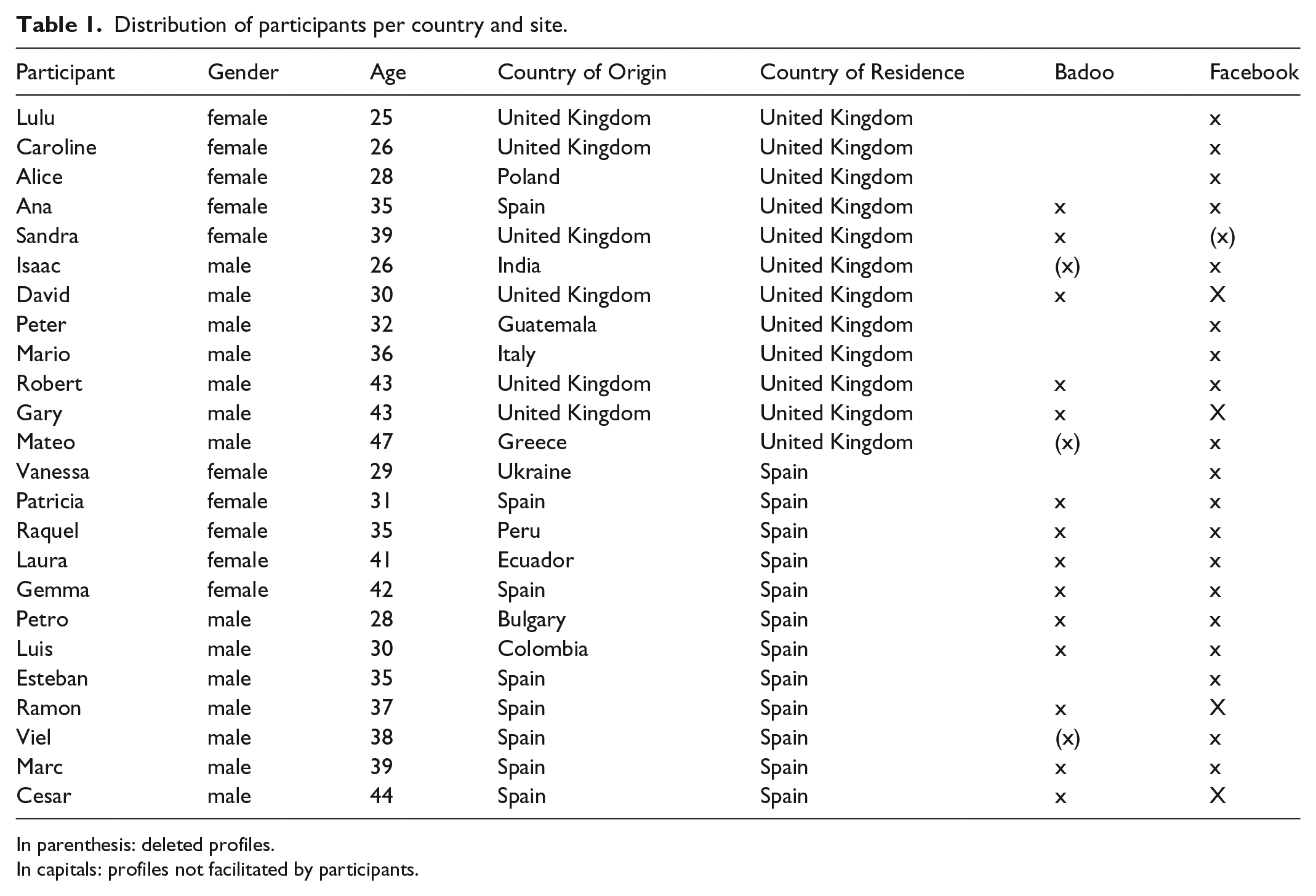
In parenthesis: deleted profiles.
In capitals: profiles not facilitated by participants.
Participants had uploaded a number of pictures to their profiles to represent themselves on the network (6 pictures on average on Badoo and around 200 pictures on average on Facebook), but the kinds of pictures they choose to upload onto each platform were varied. Some users upload what may be considered sensual pictures (e.g., pictures in a bikini or with revealing clothes). These “sexy pictures,” which foreground the body and face in aesthetically pleasing and demonstrative ways, are especially prevalent on Badoo because it is a hook-up platform designed for match-making. Badoo requires users to upload three pictures before a user can view the pictures of other users. If users wish to use Badoo through their Facebook app, the app requires users to further upload a minimum of three Facebook photos, 1 thus increasing the users’ visibility of both platforms. Thus, Badoo utilizes the principle of reciprocity in order to foster the disclosure of pictures among its users.
Following Bernie Hogan’s (2010) exhibitionistic approach, which builds on symbolic interactionism (Goffman, 1969), I analyzed user profiles as cultural artefacts, which are tools for self-(re)presentation and impression management. I analyzed all the pictures users had in their Badoo and Facebook profiles, provided that only the participant appeared in those pictures. I did this for ethical reasons since it is often the case in social media research that researchers have consent of the participants but not of their friends (Salmons, 2014). Furthermore, following Beninger et al. (2014), I chose not to publish any photos of participants in this article because while comments and quotes can be anonymized, identifiable images cannot and participants may feel embarrassed by the publication of certain images outside of the context of social media.
In order to identify emerging topics, the interview data and the user profiles were analyzed using thematic analysis. Mohammed Alhojailan (2012) argues that thematic analysis identifies the key themes in the data gathered and also allows creating connections between ideas among the data gathered through different data collection techniques, over time and in different situations. I conducted the first wave of interviews in the United Kingdom, and I coded the data before starting the interviews in Spain. Following David Gray (2009), I began analysis of the data immediately instead of waiting until the end. After a first coding phase, I reviewed the codes 2 (e.g., Bazeley, 2009; Braun & Clarke, 2006; Gray, 2009) and began to identify the main themes as suggested by Braun and Clarke (2006). Later, I initiated the data reduction process (e.g., Alhojailan, 2012; Miles & Huberman, 1994) wherein I selected, simplified, and transformed the data reducing it to a more manageable size. Finally, I made connections between the themes, identified different positions within them, and interpreted the data (Bazeley, 2009).
I compared the information gathered during the interviews with the information actually disclosed in profiles, which helped me to understand how users negotiate the disclosure of what has been called “intimacies of personal identity” (Gerety, 1977, p. 281), that is, what kind of intimate information (in this case visual) users disclose through their profile(s). In this way, I was able to identify and compare what kinds of pictures participants disclosed through their profiles and which of those they considered being intimate. I also analyzed the captions because, as Jenny Davis (2010) notes, captions help to “contextualize self-presentations and reduce ambiguity” (p. 1113). During the interviews, we also discussed why participants decided to publish what they deemed intimate pictures online. In the following sections, I address how participants negotiated the disclosure of sexy pictures, sexual orientation, and relationship status—the main three themes that they identified as intimate with a particular eye to what became increasingly evident in the data analysis as a gender double standard between what guides the intimate images women disclose and that which guides the intimate images that men post.
Sexy Pictures
Although images of the body and the face were prevalent on Badoo, participants did not have sexy pictures on their Badoo profiles. Nevertheless, some participants reported that the use of sexy pictures was common practice on Badoo (although some users have these kinds of pictures set to private). The use of beautified and sexualized pictures to attract attention from other users is paramount in hook-up/dating platforms. Petro (29, Spain) confirmed this emphasis based on physical attractiveness and nice photos, suggesting during the interview that Badoo was based on physical beauty. He further said that he and his friends (who were also Badoo users) only talked to female users they found attractive because it was the only feature they actually perceived online. Luis, a 30-year-old Spain-based participant, described how he found out about the abundance of sexy pictures after creating his Badoo profile. First, he uploaded some pictures and then he checked other users’ profiles and felt he did not fit in with the network because his pictures were not sexy. Despite that most participants highlighted the importance of attractive pictures to approach other users in Badoo, other participants emphasized that they were more interested in their personality. Luis (30, Spain) was a PhD student looking for a girlfriend with higher education. During the interview, he complained about the lack of intellectual women on Badoo. He implied that people who only focus on the looks, whose self-representation is mainly constructed around sexy photos, were not interesting for him, as he was a “cultivated man” who wanted to date an “elegant and intellectual woman.” Likewise, Ana considered that she was not led by the looks to interact with other users but by their communication skills:
I don’t pay attention to the pictures with abdominals, I pay attention to the guys who write me something appealing, original, those who read my profile and answer in reference to something I wrote. (Ana, 35, United Kingdom)
Participants did not upload sexy pictures on their Badoo profiles, nevertheless a few pictures in a bikini or half naked were found on their Facebook profiles. I posit that the reason for having sexy pictures on Facebook rather than on a hook-up/dating platform is because of the number of pictures Facebook allows users to upload (one participant had more than 1,000 pictures uploaded). The large number of pictures enables the presentation of more image variety (e.g., pictures on the beach). For Facebook, participants reported that it is not unusual to find some sexy pictures from parties or at the beach, but in this study few sexy pictures uploaded by participants were found. Some participants explained that they considered it intimate to have pictures of themselves wearing few clothes, for example, a bikini. As Alice and Raquel report, they did not upload those kinds of pictures or at least tried to keep them to a minimum:
But like showing pictures from the parties, or half naked, for me that is intimacy, I wouldn’t put pictures like that. And I don’t need to see someone else doing it, so . . . For me some people just cross a line I would never cross. But again, that’s freedom of speech, and the freedom of showing whatever they want, so . . . (Alice, 28, United Kingdom) What concerns me more is when I google myself and there appears a lot of information with pictures. Maybe a picture of myself in a bikini . . . Why? I don’t like it, therefore I try to upload less of these kinds of pictures, and that’s all because I don’t have other tools. (Raquel, 35, Spain)
It was mainly female participants who claimed they would not upload pictures showing their bodies on Facebook. Women who upload very revealing pictures of themselves often face slut-shaming
3
when interacting through social media (Lasén, 2015; Tanenbaum, 2015). In fact, some of the male participants had several pictures of themselves in bathing suits on the beach uploaded to Facebook, but they did not consider them intimate. In relation to this, Luis (30, Spain) compared Badoo to another dating/hook-up platform called AdoptaUnTio (AdoptAGuy). Luis considered that the style of the pictures on AdoptaUnTio (e.g., pictures in the beach) was more “elegant” compared to the pictures displayed on Badoo (e.g., selfies in the bathroom in underwear):
The profile of people who are there is different, there aren’t many selfies in the toilet. [. . .] Well, there are some pictures of people on the beach, but not with a bra in the toilet. There isn’t a big difference, but the aesthetic is different, it seems higher class. [. . .] I suppose that among them they have a good match, the girls with the bras in the toilet and the boys without a T-shirt, and I’m there with my glasses . . . (Luis, 30, Spain)
Jessica Ringrose (2011), in her study about the digital performance of a “sexual self” among British teens in Bebo, found similar disciplinary norms, where “holiday photos were acceptable, while underwear shots were not” (p. 107). Her female participants also reported to self-censor the kind of pictures they uploaded in order to look sexy but not “like a slut.” In reference to this, Cesar, a 44-year-old Spain-based participant, explained how he was asked by a friend to find his 19-year-old sister on Badoo because he was concerned about her looseness. Cesar searched for girls of her age in Barcelona and found her profile, where she had plenty of sexy pictures and where he commented that she looked “like a prostitute.” Cesar described how he finds it inappropriate that young girls publish erotic selfies online and how he communicated it to the girl:
“Have you seen the kinds of pictures you have on your profile? OMG!”. [. . .] I consider that a 19-year-old girl shouldn’t upload those kinds of pictures on a website, moreover a person that I know, because if someone that I don’t know . . . do it, I’m fine with that, but if it’s a girl I care about I consider that it is not appropriate. So I told her: “How come that you uploaded those pictures on your profile?” You have beautiful pictures where you are not showing your cleavage; I’m not saying that’s not beautiful what you have . . . [She wasn’t naked in any picture, but she was very provocative], so I told her there are pictures where you look like a prostitute, and you aren’t. (Cesar, 44, Spain)
Cesar insisted on the inappropriateness of sexy pictures of young girls, especially in this case because he cared about the well-being and reputation of his friend’s sister, having known her since she was born. It is interesting to note that Cesar believes it is acceptable for “other young girls” to upload sensual pictures on their profiles. Amy Dobson (2015) argues that the protective behavior toward women (from society and the media) based on moral panics to avoid a potential risky scenario of being sexually active disempowers them since they are denied sexual agency. As Cohen and Shade (2008) observe, young females are often considered as irresponsible for gaining attention from potential sexual offenders: “gender-based discourses in mainstream media have outlined limited roles for young women as agents. Instead, they have been depicted as passive consumers or misguided youth whose provocative photographs risk attracting unwanted attention” (p. 212). However, when women’s agency is acknowledged, as Anne Burns (2015) notes, they are considered as “sexually licentious” (p. 1723) and they are blamed for engaging in self-sexualization. Cesar took the position that mainstream media often takes, insofar as he did not acknowledge agency in his friend’s sister’s behavior which required him to act as the sexual police (Tanenbaum, 2015) and put her in her place and thus within public displays that reinforce heteronormative performances of gender and sexuality (Dobson, 2015).
Later in the interview, Cesar insisted on the view that she did not want to find sex, and he implied that if that had been the case, it would have been something to feel ashamed of. Traditional sexual roles legitimate men showing their sexual desire publicly since manifesting sexual desire is coded as masculine (Giddens, 1992). Thus, double sexual standards, Anthony Giddens (1992) notes, represent men as naturally interested in sex and women as more inclined to romance. Leora Tanenbaum (2015) defines double sexual standards as “the mind-set that the males are expected to be sexually active, even in an uncontrolled manner, while women are supposed to police themselves (and other females) to remain minimally sexual” (p. 8). This patriarchal double standard about what kind of women’s sexual behavior is socially acceptable has been reproduced online. Therefore, when women represent themselves online as sexually liberated and in search for sexual encounters, people seeing through the lens of traditional gender roles may find this behavior non-normative. Some authors (e.g., Burns, 2015; Cohen & Shade, 2008; Dobson, 2015) claim that traditional patriarchal gender roles, which are both maintained and reinforced online, are the basis for harassment.
Then, Cesar explained that she also had private pictures (which are usually the most erotic ones) but she did not allow him to see them and deleted them. Cesar continued to describe how his friend’s sister finally changed her erotic pictures after his suggestion and uploaded pictures with more clothes on. Subsequently, he reported that she started to receive invitations to dates as opposed to previous messages where she was asked for explicit sexual encounters. Cesar stressed that for him, the photos users upload dictate what kind of social encounter the user wants to invite, reproducing iconographic conventions of “good girls” versus “sluts” (Tanenbaum, 2015). He narrated one experiment he conducted with a female friend, who uploaded sexier pictures in her Badoo profile and started to receive obscene proposals. In retelling the story, Cesar attempted to justify that women who upload sexy pictures to their profiles ought to receive nasty messages, for example, “I would like to fuck you.” He considers that women who upload sexy pictures are not “girlfriend material.” Here, we see gender disciplining (Hasinoff & Shepherd, 2014), slut-shaming (Lasén, 2015; Tanenbaum, 2015), and victim blaming (Rentschler, 2015), being extended to the realm of social media images, where Cesar stated, “I don’t talk to girls with too provocative pictures, because I don’t want to meet these kinds of girls” (Cesar, 44, Spain). Burns (2015) gathered similar comments from her study about self-regulation of selfie disclosure on social media in the United States. Women who upload sexualized selfies, Burns (2015) suggests, are considered cheap and responsible for their own stigmatization and the viewer’s disdain.
Despite Badoo being a dating/hook-up platform, where sexy pictures might be considered normative by some users, most participants agreed that they would never upload those kinds of pictures neither on Badoo or Facebook since they considered that they could damage their reputation (especially in the case of women) and would attract a type of audience they are not interested in. Thus, participants engaged in self-censorship because, since overtly sexy photos were observed with disdain, they wanted to prevent external judgment. The management of self-representation is an ongoing task that does not finish on self-monitoring. In the case of Facebook, the co-construction of one’s identity by friends implies a further negotiation of the publication of the content that users consider to be suitable to appear in their profiles.
Relationship Status and Sexual Orientation
The use of selfies to convey relationship status as single was rare. The only example in the study was Laura (40, Spain), who had plenty of bedroom selfies on her Facebook profile, and in one of these selfies, she had included the caption, “Giving another opportunity to love” to signal that she was single and open for a new relationship. While some participants explained that it was a common practice on Facebook to upload pictures to show a romantic relationship, most participants reported not engaging in this practice themselves because they felt posting such relationship statuses may impinge on their privacy.
Ramon (37, Spain) was the only participant who acknowledged that he uploaded pictures to show he was in a relationship. Ramon did not express his feelings in writing, but he used to upload pictures on Facebook showing his love for his former girlfriend. He explained that his ex-girlfriend was not happy about him uploading intimate pictures of the couple displaying their romantic relationship on Facebook. Similar to what Zeynep Tufekci (2008) found in his study of online privacy behavior, my participant Ramon observed that women are often more concerned about privacy online than men. Ramon blamed cultural scripts 4 for oppressing women: “Probably it’s culture shit, all the shit we gave to women for thousands of years” (Ramon, 37, Spain). Again, as seen in the case of sexy pictures being uploaded to Badoo, female social media users are judged in different ways than male users. Ramon suggested that his ex-girlfriend might be worried about being judged by people for having pictures of them kissing online because women are more often denigrated for public sexual behavior than men.
The co-production of content concerning relationship status in one’s social media profile was deemed as problematic. Drawing on Tíscar Lara (2007), Lucía Caro (2012) defines the expression of identity through self-disclosure, affiliation, and interaction with other users through social media as mosaic identity, where identity is a compendium of explicit and implicit self-disclosure (e.g., groups membership, likes) and information posted by other contacts on one’s profile, for example, pictures kissing one’s partner. Thus, online identity is a complex picture composed of many pixels or, following the metaphor of the mosaic, composed of many tesserae. For instance, Petro remarked that privacy is much more difficult to keep in the age of social media. He used an example of controversial pictures taken in public and uploaded on Facebook by a common friend:
This happened to some friends of mine who were cheating on their girlfriends and the pictures went online. Because you can be in Plaza Catalunya kissing a girl and 20 people can see you, but through Facebook a lot of people can see you. [. . .] I think that when I was 20 years old I didn’t care about kissing in public, but nowadays I do care. (Petro, 29, Spain)
A few users had pictures uploaded by their partners on Facebook, and they were especially concerned about the further distribution of the photographs published on Facebook by their friends. For example,
Those kinds of pictures that I consider intimate I don’t share them. I know that there are pictures of me kissing my ex-girlfriend, but it was her who uploaded them. And that was really a problem. She used to put many things that I considered too much for Facebook. I took some pictures out, she also did it, obviously. But there are some pictures that are still there, I suppose. Once one girl uploaded a picture of me kissing her and I asked her to remove it; we were just friends, we weren’t dating, so it wasn’t appropriate. And she removed it. If I consider that something is intimate I don’t upload it onto Facebook. (Peter, 32, United Kingdom)
What Peter did not consider acceptable at all was to have intimate pictures on his profile with someone with whom he did not maintain a long-lasting relationship. Looking at the profile of this participant, it could be observed that his ex-partner had recently deleted those intimate pictures, but he was now tagged in other pictures kissing his current partner. Therefore, although he would not upload those kinds of pictures himself, he did not feel annoyed enough by this practice to untag himself or to ask his current partner to delete those pictures.
Lesbian, gay, bisexual, and transgender (LGBT) participants, in particular, were more concerned about the disclosure of sexual orientation through pictures showing their relationship status (e.g., hugging one’s partner) on Facebook because of the possibility that this information might reach unintended audiences (e.g., family members who do not know about their sexual orientation). For example,
I would say I would have never uploaded so many pictures. But there have been pictures that have been uploaded of like me, and like a partner and things, that I wouldn’t personally upload, but they (my ex-partners) had uploaded them. I wouldn’t have put them online. [. . .] I’m gay, and not everybody, well . . . most people know I’m gay, but there are certain members of my family who don’t, and my cousins are on Facebook and they go to my Facebook and they probably see that I’m, I’m gay. [. . .] There are probably pictures of me kissing out there. (Caroline, 26, United Kingdom)
Caroline clarified that she shares intimate information on a one-to-one basis through the chat feature, but she would not publish intimate information on her Facebook profile for all other users to see. She expressed her concern about the information published by other people about her, such as pictures, because she is a lesbian and she has some family members as friends on Facebook who are unaware of her sexual orientation—a piece of information she said she would like to keep private from them.
Conclusion
The topics most participants consider to be intimate when interacting through social media were sexy pictures, sexual orientation, and relationship status. In fact, some participants identified intimacy only with regard to sexual or romantic relationships. Obviously, when interacting through social media, it is not possible to experience physical intimacy, and therefore, intimate interaction is based on sharing/exchanging text and pictures, both of which are often displayed in public (especially pictures). Pictures were categorized as intimate by many participants, mainly in the context of Facebook, although they rarely uploaded pictures that they consider to be intimate. A few participants referred to Badoo when discussing the topic of intimacy in public through social media, mainly in relation to sexy selfies. In this study, participants did not include sexy selfies in their Badoo profiles, nevertheless they identified it as a common practice in the platform. A few male participants commented on how female Badoo users engage in self-sexualization—a practice that they consider cheapens them. These participants expressed their lack of interest in female users who upload sexy pictures because they did not seem intellectual or because they did not seem “respectable.” In the same vein, since female users are often blamed for slut-shaming, in this study, the female participants reported keeping their sexy selfies to a minimum, especially on Facebook, due to the wider audiences they interact with through this platform. Nevertheless, some male participants had pictures in a bathing suit on Facebook, but they did not consider these to be intimate and were not concerned about their distribution. It seems that context affects the interpretation of the pictures, since they are taken in a public space. The findings seem to suggest that the patriarchal gender roles have not changed, but they are simply reproduced online because participants take their social/cultural assumptions online with them.
Visual public intimacy appeared as an emergent topic, especially in the context of Facebook. Most participants claimed to not post intimate information on Facebook because they wanted to protect their privacy and because they considered that intimacy loses its status when it is advertised. Nevertheless, some of them have not untagged themselves from intimate pictures posted by partners (e.g., kissing), implying that they accept that level of public intimate disclosure with their significant others, but they reported not allowing that kind of intimate disclosure with people outside of their intimate circle. Most participants shared a common understanding of what they considered appropriate to publish on social media platforms, where sexy pictures or images showing relationship status or sexual orientation were policed.
Footnotes
Declaration of Conflicting Interests
The author(s) declared no potential conflicts of interest with respect to the research, authorship, and/or publication of this article.
Funding
The author(s) received no financial support for the research, authorship, and/or publication of this article.