



Abstract
On 19 May 2018, more than 12,000 women gathered at Hyehwa subway station in Seoul, South Korea to protest discrimination against Korean women and spy camera involved crimes. This rally was a response to an incident in which a male nude model in a class was secretly photographed by a female model at Hongik University. This study examined how discourses on Twitter regarding the incident led to the demonstration and what was the memory working that shaped significant discourses through critical discourse analysis. First, a discourse that “women have long been victims” emerged through personal remembrances. Second, photographs of the female suspect standing with police officers directed a discourse that “women have been treated unfairly by public authorities” through collective witnessing. Third, many women contextualized the incident as a gendered event by connecting the past feminist movements. Finally, through appropriating past slogans and accumulated hashtags on Twitter, the main slogan of the rally #Equal_punishment_for_equal_crime was established. This study provides an under-researched context of digital mnemonic practices and the logic of connective actions by analyzing feminist movements in South Korea.
On 19 May 2018, more than 12,000 women dressed in red clothing gathered at Hyehwa subway station in Seoul, South Korea to protest discrimination against Korean women and increased spy camera involved crimes. This rally, leading to five additional rallies with over 360,000 women attendees and recorded as, the largest feminist protest (Y. Lee, 2018), was a response to the “Hongik University Hidden Camera Incident” (hereafter Hongik incident) in which a male nude model in a class was secretly photographed by a female model who was immediately arrested by the police.
The series of street rallies, including the first protest at Hyehwa station, has several characteristics of “connective action” (Bennett & Segerberg, 2013) common to contemporary global social movements (Bennett & Segerberg, 2013; Gerbaudo & Treré, 2015; Lim, 2012; Smit et al., 2018). For example, the public discourse was driven by personal stories posted on social media by a large number of unspecified individuals who were not affiliated with any feminist organizations; anonymous and sporadic female participants organized the protests in a temporal online community called “Uncomfortable Courage” in decentralized ways and interacted with each other through social media and online messengers (H. W. Kim et al., 2018).
In general, including the mainstream Korean media and government officials, there were considerable questions about a large number of females gathered for the protests: why women were so angry? And how and why so many women took to the streets? These questions arose because in the case of the Hongik incident the perpetrator was, in fact, a woman and the victim was a man; hence women’s anger and the protests seemed to puzzle the media and general public. This article aims to find answers to these questions by analyzing discourses about the spycam incident and women’s memory working that was responsible for constructing and justifying the discourses. Specifically, we analyzed the characteristics of interaction on Twitter to investigate how collective memory work and unified strategy contributed to views on the Hongik incident and ensuing protests. Drawing on the results, we contend that the incident gave the momentum that enabled women’s memories stored in online space to be recalled and connected, which eventually changed mainstream discourses on the Hongik incident and led that many women to gather in the streets. In this process, from posting personal stories to organizing the rallies, collective memories were mediated by social media platforms.
Memory work is “an active practice of remembering that takes an inquiring attitude toward the past and the activity of its (re)construction through memory” (Kuhn, 2010, p. 303). The process consists of a complex set of recursive activities that shape our inner worlds, reconciling past and present, allowing us to make sense of the world around us, and constructing an idea of continuity between self and others (van Dijck, 2007). Memory work is also emphasized as a stage of conscious and intentional memory (Haug, 1992; Lohmeier & Pentzold, 2014; Onyx & Small, 2001). With respect to intention, memory work can be the act of consciously appropriating historical figures and symbols for the present purpose (Jansen, 2007). Even if unintended, photos, phrases, and memes can create unexpected mnemonic effects, and certain personal stories that individuals remember can consequently act as public memory working (Gerbaudo & Treré, 2015; Smit, 2020). In this sense, mediated memory working is a conscious and dynamic process of reconstructing the past here and now by using media and transferring it to the future (Hoskins, 2011; van Dijck, 2007). In the context of this study, we focused on the process of constructing discourses based on mediated memories around the Hongik incident and the process by which memory work mobilizes individuals to act, justifies causes, locates their struggles historically, and helps to create a collective identity (Smit et al., 2018) in the Korean context.
To elucidate the connections between the digital feminist movement in Korea and memory work, we examined the memory work before the first rally. We tackled how discourses over the illegal filming incident at Hongik University led to the demonstration and what were the memory working that shaped significant discourses toward the incident. Specifically, we analyzed discourses on Twitter, an online social media platform, focusing on how users expressed their voices and share their misogynistic experiences. We conducted critical discourse analysis (CDA) to identify the ways in which such discourses were converged into the main hashtag and the main slogan of the street rallies: #Equal_punishment_for_equal_crime.
Literature Review
Two areas of literature are reviewed for this study: research into memory studies in the social media era and research on feminist movements through social media. Spycam involved crimes in the Korean context are also explained.
Memory Studies in the Social Media Era
Until the 1990s, collective memory studies were mainly conducted on mass media such as newspapers and movies. These notions assumed that there are media institutions producing collective memories at one end of the spectrum (i.e., public spheres) and there are individuals who receive the produced memories in an impressionable state at the other end of the spectrum (i.e., private spheres; e.g., Edy, 1999). With the advent of the digital media era advocating individuals’ participation and sharing, however, the concept of collective memory has been redefined as more fluid. That is, individual representations and group memories are rather intricately intertwined within a networked digital environment than as having rigid and linear attributes (Hoskins, 2009; van Dijck, 2007).
In such notion of collective memory studies, the term “network memory” (Hoskins, 2009, p. 92) or “connective memory” (Smit, 2020, p. 87) is used and regarded as a place where the mind and technology are intertwined. This also means that memories in the digital age are evolving with technology and penetrated by technological unconsciousness (Hoskins, 2009), which is dynamically rearranged through the connectivity of the network along with our digital practices. This digital networking of memories refers to the dynamics of connections on a networked platform forming conditions for memory, which leads to the continuous presence of mediated memory (van Dijck, 2011). Thus, recent collective memory researchers have focused on the work of collective memory on social media platforms such as Instagram, Twitter, and Facebook. For example, users’ postings on Instagram were analyzed not only as active processes of finding themselves in the past but also as group memories socially structured and executed (Villa-Nicholas, 2019). This was because the postings were often about positioning individuals at specific times and places through private memory, and it could be seen as both an act of memory and a product of memory that involve trying to understand the lives of others and their surroundings (van Dijck, 2007; Villa-Nicholas, 2019). In this process, Instagram allowed users to circulate memories that compete with each other, which is defined as a space where real-time dialogue (van Dijck, 2007) of memories takes place (Didem & Humphreys, 2015).
A similar study, on the Facebook platform, is found in Smit et al. (2018). They analyzed protest activities for Justice for Mike Brown (JfMB), the online hub of protest activities for Mike Brown. Mike Brown was an African American teenager who was charged for stealing a box of cigars and killed by police in Ferguson in the United States, which has a long history of racial tension, in 2014 (Teague, 2014). To link JfMB with historical protests against racialized violence and encourage participation, some Facebook users carried out memory work recalling monumental protests, including the civil rights protests in the era of Dr Martin Luther King (Smit et al., 2018). Specifically, the Facebook page clearly reflected users’ participation in memory work demonstrating racial inequality experiences through historicization, drawing parallels, contextualization, re-mediation of symbols, and icons.
All the studies reviewed above show that through social media platforms individuals actively and sometimes tactically engage in establishing and sharing collective memories, which was traditionally produced by institutions rather publicly and shared linearly.
Feminist Movements Through Social Media and Digital Sexual Violence in Korea
In feminist debates, social media has been noted as a virtual community in which women can identify themselves as feminists and define feminist behavior while sharing their actual everyday experiences (Dixon, 2014). In a study of social media in Western Europe, the feminist public recognized themselves as a counter-public in a conflicting relationship with the dominant public in the online space (Shaw, 2012; Warner, 2002). In South Korea, themes such as makeup, plastic surgery, and diet were activating the female online communities (Shin, 2005). These themes were obviously related to the traditional stereotypes of gender roles. However, with time, these online communities became female-only public opinion spaces for mobilizing women to cultivate an autonomous political entity that resisted the male-centered internet discourse by constructing counterarguments (A. Kim, 2006).
Many discussions on female-only online communities took place on specific bulletin boards. Hashtag feminism movements with the attributes of participating culture (Jenkins, 1992) began in earnest along with the creation of a spreadable media environment that allowed diffusion through social media. In the Korean context, a representative example is Megalia’s development of a “mirroring” strategy in an online community which was temporarily created with a view to overturn existing misogynistic expressions and men’s caricatures of women. Even after it closed down, this mirroring strategy was widely shared and spread online (Jang, 2016).
Since the online feminism movement began in the mid-2010s, the hashtag feminism movement against discrimination and misogyny in the real world and online has increasingly been active. On Twitter as a leading platform in the Korean context, feminist hashtags such as #I’m_a_feminist, #Police_is_the_perpetrator, #femicide, #DigitalSexCrimeOut, #Soranet, and #misogyny have been generated continuously. As daily feminist debates and accusations of misogyny in the Korean society continue, such hashtags on Twitter offer an alternative interpretation of gender perspective on recent social issues within Korean culture. For example, a case of murder in 2016—a woman was killed by an unknown man in the public toilet at Gangnam subway station—was reported on the mainstream media as an unmotivated murder, while the case was discussed with #femicde on Twitter. Twitter plays a role as a public sphere and a diffusion channel for sharing real-time information and expanding it to a broader public in Korea (J. Kim, 2017; Lim, 2017).
Many feminist researchers argue that hashtags are a platform for recognizing women’s pain and for sharing their experiences living in a male-dominated society. Hashtags create spaces in which women can safely talk and reveal themselves (Capachi, 2013), and they serve as a “re-authoring” (J. Lee, 1997) for women who have been silenced in male-dominated societies to share their gender-oriented stories (Dixon, 2014). Hashtagging in the Korean online space is becoming a “leading means of change” that combines emotional connectivity with the advantage or Twitter’s fact aggregation (H. Kim, 2017).
While many of the so-called digital native generation were born and raised in the 1990s to the 2000s (Prensky, 2001), issues of digital sexual violence such as illegal filming of women’s bodies have become a severe threat to the society, and recent digital feminist movements in Korea have been fights against this illegal pornography. The number of crimes involving photographing other people’s bodies with illegally installed spycams in Korea dramatically surged from 564 in 2007 to 6,615 in 2017 (Teshome, 2019). A maliciously developed “hidden camera culture” in Korea has become an acute social problem. Women’s bodies are photographed without their consent and broadly distributed for profits and sexual pleasures through illegal websites such as Soranet. For the past 6 years, nonprofit organizations such as Digital Sexual Crime Out and Korea Cyber Sexual Violence Response Center have responded to such cyber–sexual violence and crimes and attempted to inform the public about the seriousness of cybersex crimes using hidden cameras.
The social awareness of cybersex crimes has reached to the point that many Korean movies and dramas address the seriousness of the problem (Tan, 2019), but new types of cybercrime continue to emerge. In 2020, the existence of Telegram groups, “nth room,” was revealed: There are at least 100 serial rooms named after their ordinal numerals (hence the name “nth room”). Operators sold sexual exploitation videos and pictures created by blackmailing females, including minors, and the videos and pictures were purchased by over 260,000 male users in South Korea. Amateur activist reporters in their twenties reported on this and it became known to the world. The suspects were arrested, but numerous accomplices were not actively investigated. Several lead operators were arrested and sentenced, including Cho Joo bin who was sentenced to 42 years’ imprisonment, which was the longest one given to cybersex crimes in Korea (BBC, 2021), but copycat crimes have frequently occurred with more sophisticated techniques.
In sum, digital media have provided conditions for Korean women to share their personal experiences and be empowered as feminists, while cybersex crimes have evolved with technology.
Method
The following research questions are addressed in this study:
(1) How did the discourses on Twitter regarding the Hongik incident involving illegal filming lead to a series of protests?
(2) What was the memory working on Twitter that shaped significant discourses toward the Hongik incident?
To answer these research questions, we employed CDA as a methodological tool. CDA is adhered to considering discourses as a type of social practice and identifying socio-political elements influencing the discourse production (Carvalho, 2008). In this process, we considered Twitter as a major technological environment encouraging female users to express themselves and share their misogynistic experiences in the Korean society. Although users of social media platforms operate individually in their own space and time, results of their online activities tend to form a constant flow of discourses over time. Thus, we traced the process of how the entire discourse regarding the Hongik incident formed and how it evolved toward a certain direction by examining users’ daily posts in the context of memory work through CDA.
There were four steps: (1) examining major discourse units, (2) analyzing the appearance and disappearance of the discourse units, (3) exploring main discursive themes from the discourse units, and (4) identifying memory working including mnemonic resources and written forms of memories operated throughout the process. Regarding the first step, we identified the discourse units such as keywords, hashtags, sentences, slogans, images, memes, and metaphors (Potter & Wetherell, 1987; Smit et al., 2018). Second, we traced the discourse units that had occurred most repeatedly in tweets and had gained the most users’ empathy through the number of retweets, mentions, and likes. With regard to the third step, four emerging themes were identified after repeatedly revisiting the discourse units. Finally, comprehensive memory working was identified, such as recalling, contrasting, contextualizing, and historicizing.
We analyzed a total of 1,340 tweets posted over a 19-day period, from the day when the illegal filming was first reported in the media on 1 May 2018, to the day of the first protest at Hyehwa station on 19 May 2018. To collect relevant tweets, we searched two keywords and one hashtag: 홍대 (the abbreviated name for Hongik University), 몰카 (“spycam”), and #동일범죄_동일처벌 (#Equal_punishment_for_equal crime). A total of 1,925 tweets containing those two keywords and the hashtag were collected. We then removed 585 irrelevant tweets such as tweets about restaurants near Hongik University or advertisements of illegal filming websites. All tweets referenced in this study were translated or summarized from Korean to English.
Results
We present findings under five subheadings here: (1) Shaping #Equal_punishment_for_equal _crime on Twitter; (2) We are victims: sharing memories of holes in toilet walls; (3) How would a man have been punished?: Testifying their past; (4) This is the gendered issue: contextualizing the incident as feminist cases; and (5) Equal punishment for equal crime: mobilizing crowds to organize the street protest. A comprehensive timeline of the Hongik incident is provided first. Major discourse themes and memory working shaping the discourses are then described followed by detailed processes of memory workings on Twitter.
Shaping #Equal_Punishment_for_Equal _Crime on Twitter
After the Hongik incident, a male nude model filmed by a female model using her mobile phone in the class on 1 May 2018, the university authorities promptly began processing the incident. The female suspect was specified by police and news media. On 11 May the day after the police arrested her, a petition titled “Women are Korean people, I request for the same government protection regardless of gender.” was posted to the petition section of the Blue House website and received 342,292 signatures within 5 days (Cho, 2018). Ten days after the suspect was arrested on 10 May, a street protest of over 10,000 women demanding #Equal_punishment_for_equal _crime was held at nearby Hyehwa station. Below is a more detailed timeline leading to the first protest in 2018:
1 May: A photo of a male nude model for a Hongik University nude croquis class temporarily appears in an online community.
10 May: The police arrest a female suspect who took and first distributed the photo.
10 May: A substantial number of female users on Twitter begin to criticize the police for arresting the female suspect publicly and swiftly, commenting on slow investigation in similar crimes in the past.
11 May: A petition is posted on the Blue House Petition titled “Women are Korean citizens, I request for the same government protection regardless of gender.”
12 May: In the process of moving the suspect from Mapo Police station to Western District Court, the police place the suspect on a photo line and expose her to multiple media.
14 May: The number of signers for the petition on the Blue House website exceeds 300,000, and the Seoul police chief announces that there is no gender discrimination in the Hongik incident.
19 May: The first protest against the unequal treatment of the female suspect is held at Hyehwa station; the police estimate 10,000 protesters, whereas the organizers estimate 12,000.
Identified memory working processes are four. First, the concrete discourse theme that “women have long been victims” emerged through personal remembrances, including residual images especially relating to spycams installed in public toilets. Second, photographs of the female suspect standing with police officers directed the discourse that “women have been treated unfairly by public authorities.” Third, many women contextualized the incident as a gendered event by connecting a few significant feminist movements and events of the past in Korea: many tweets about the incident were posted with hashtags such as #GangNam_station_10th_Exit—a male involved spycam incident in the past—#MeToo, or #I_am_a_feminist. Fourth, through appropriating well-known past slogans such as “Equal pay for equal work,” the discourse proceeded to fight against sexual injustice by organizing and justifying street rallies.
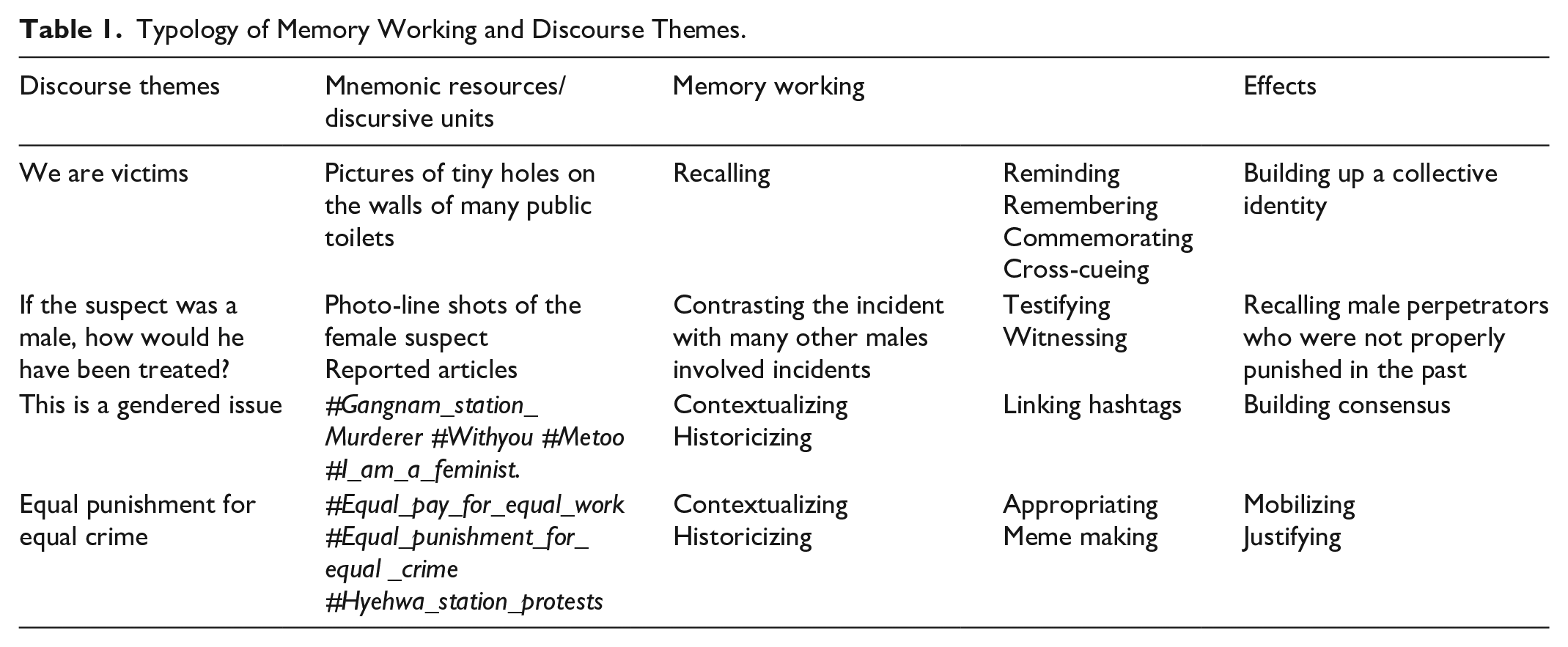
Four key messages of the first Hyehwa station demonstration through four steps as shown in Table 1. First, many users presented evidence for traces of spycams hidden in public toilets and established a collective identity of “we are victims of illegal shooting crimes.” Second, a number of users shared their own experiences of being a victim, collectively recalling male perpetrators who had not been justly convicted in the past. Third, many regarded the Hongik incident as a case by which the issue of gender inequality can meaningfully be discussed. Fourth, a substantial number of users demanded rallies against unfair law enforcement and encouraged others to participate in the rallies.
Typology of Memory Working and Discourse Themes.
We Are Victims: Sharing Memories of Hidden Holes on the Walls of Public Toilets
When I went to the restroom on the Gyeongui line at the entrance of Hongik University, there were small holes and silicone marks which looked like tears from women. However, even if there were hidden cameras, there was nothing I could do about it. I’m so angry after the Hongik incident. (Tweet 1, May 15, 2018)
Tweet 1, written by a woman, reveals a feeling of anger evoked by the media coverage of the Hongik incident. We found many similar tweets containing individuals’ memories of tiny holes in public toilet walls in subway stations, schools, workplaces, and other places. As more news broke about the Hongik incident in the media, there was a growing number of tweets about small holes in public toilet walls. Many commented on that they became anxious in even most private and ordinary-looking places.
These tweets were mostly written informally without the audience (i.e., their followers) in mind. The remembrances included in the tweets would not have emerged if the women had not encountered relevant news or tweets other women had previously shared. In this sense, these can be viewed as collective memories recalled by cross-cueing (Andersson et al., 2006) on Twitter. In other words, each individual woman might never have connected the Hongik incident to their own memories of toilet holes. As similar tweets accumulated, however, their experiences of witnessing holes in public toilets were collectively evoked in that it was evidence that many women suffered in their daily lives, not anecdotal stories from some paranoics.
There were many such tweets, including memories of spycams or that might have been ones installed in public toilets, because videos filmed in public restrooms are one of the most prevalent forms of illegal filming on pornographic websites in Korea (Yun, 2018). It has been reported that Korean women have repeatedly encountered news on spycams hidden in public toilets (Clark, 2021). As reported, many women in Korea are fearful that there might be hidden cameras in public toilets and the great majority, 60%, said that they check whether there are holes to make sure that there are no hidden cameras (Oh, 2019).
Female users on Twitter recalled such holes in their pasts when they encountered news about hidden camera involved crimes. It was individuals recalling their own spycam memories, but they came to realization, through Twitter, that most women in the Korean society had similar experiences. This means that they realized that it was not because they were out of luck that they had such experiences, but many other women also had similar experiences. Such recalled anecdotes can be seen as collective memories in the sense that they were rooted in Korean women’s collective victimhood from personal anecdotes and collective feelings of anxiety about being filmed in public spaces. It appears that photos filmed through tiny holes became an important mnemonic resource in building their collective identities as victims. As their fear of possible illegal filming in their daily lives accumulated, the hashtag #we_are_victims followed.
How Would a Man Have Been Punished?: Testifying Their Past Experiences
Figure 1, the picture taken on 12 May 2018, shows a reporter asking the woman suspect who was charged with the illegal photographing in the Hongik incident. Multiple news articles containing the picture appeared in the major press. Meanwhile, Twitter users commented on and so actively retweeted these articles that it became trending in real-time. On one hand, the composition of the photograph was a familiar one in that it was typical of how serious criminals, such as serial killers, are displayed in the media. It was commented on by the users, however, that they noticed they had never seen any man be condemned to this degree for illegal filming: Wow. She is wearing handcuffs and standing in the photo line. I’ve never seen such a sight in my life. It’s way too much. So, this could actually have been possible when tens of millions of male suspects were charged! (Tweet 2, 12 May 2018) The investigation process couldn’t be faster. Why is it only for female victims that investigation is slow and punishment is so weak? They set her up on the photo line as if she were a serial killer. They even mobilized divers to search for the suspect’s mobile phone in the Han River case. (Tweet 3, 12 May 2018)
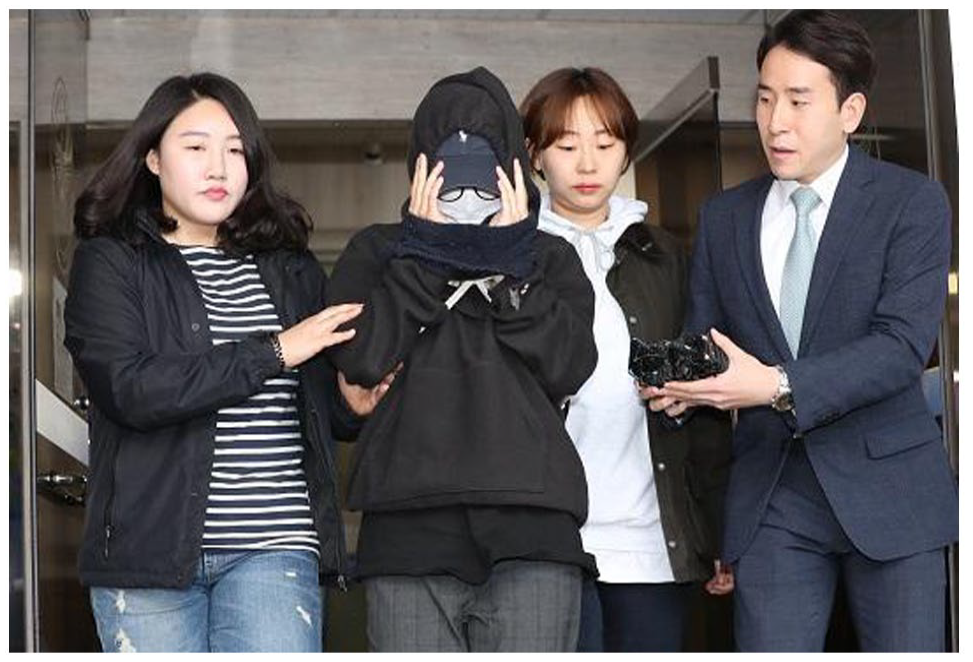
The photo of the female suspect standing in handcuffs on the photo-line.
Tweets, including Tweets 2 and 3 as shown above, recognized and criticized the disparities between male and female perpetrators in the way they are photographed for the media. These were followed by tweets such as “they [male suspects] could have been treated as she is now!,” “why didn’t the police protect female victims as they do now in the past?,” and “why didn’t they investigate and catch criminals as quickly as they did in this incident?” There were also comments on with regard to how perpetrators were treated, including “I believe that she is sentenced to jail in this Hongik incident, so they will equally punish all hidden camera criminals.”
Growing awareness of gender gap facilitated by the photo in Figure 1 and earlier tweets seems to provide many users of Twitter with a more collective perspective toward the incident and media. Tweets starting with “I” talking their personal feelings and experiences by this time began to shift to posting more about Korean women “we.” In addition, beyond criticizing individual men, the women began specifically singling out the press, police, and judicial institutions as perpetrators of discrimination against women in Korea.
As described in earlier results, the afterimage of bathroom holes for spycams triggered the first discourse theme, women’s memories of prevalent illegal filming in daily lives. The photo-line photograph in Figure 1 then gave rise to another discourse, sexual discrimination against women at the societal level in Korea. Sharing personal memories of the users became collective memories of most Korean women, during the period from online responses (i.e., tweets posted) to the Hongik incident to the images of toilet holes and the photo-line photograph. This suggests collective memory as a pool of memories, knowledge, and information shared by a social group and such collective memory is significantly associated with the group’s identity. The perpetrator of the Hongik incident is in fact a woman; however, these collective memories played an important role in Korean women’s identities as victims of such crimes in a much larger number of cases.
This Is a Gendered Issue: Contextualizing the Incident as Feminist Cases
As described earlier, a narrative of collective victimhood was formed and differences in how the Hongik incident was reported and similar cases in the past were heatedly discussed on Twitter. Another discourse theme emerged encompasses institutionalized sexual discrimination that prevailed in the Korean society more generally. Tweets 4–6 are about how women are treated differently by government, police, or media. Specifically, it is noticeable that many of the tweets mentioned past incidents which were discussed along the lines of gendered issues. For example, the most mentioned incident “Gangnam station femicide” (see the footnote below for details) caused an intense discussion of hate crimes against women and femicides in Korean society: Looking at the male victim of the Hongik incident, I felt that the social safety net exists only for Korean men. (Tweet 4, 11 May 2018) Wow. Police officers—are you just finishing the investigation of another case where a woman was subjected to digital sexual violence while searching through the Han River to find the female suspect’s mobile phone? (Tweet 5, 14 May 2018) In the Gangnam Station murder case, I felt that I could get killed only because I was a woman. Looking at this Hongik incident, I feel that the public authority won’t protect me. Women are not citizens. (Tweet 6, 12 May 2018)
In addition to mentioning “Gangnam station femicide,” many users added hashtags including #Gangnam_station10th_Exit, which had continuously been used and in recent years in relation to feminist issues. Table 2 provides a list of hashtags/keywords frequently mentioned in tweets about this event.
A List of Hashtags/Keywords 1 Frequently Mentioned in Tweets About the Hongik Incident.

Hashtags, such as #MeToo, tend to be widely used in accusations of social violence and inequalities inside and outside Korea. This means that hashtags and the cases represented by the hashtags have anchored broadly shared meanings among the public, and the users, by using those hashtags, intentionally contextualize the Hongik incident within contemporary feminism. In other words, people know that such an action, by making references to past events, can be seen as active memory working to contextualize and re-emphasize the current incident and they can show the continued gendered injustice in present time. As a result, the incident was perceived not as a woman illegally photographing a man but as a typical case of institutionalized sexual discrimination prevailing in Korean society. To awaken more women who have not yet realized what the Hongik incident revealed and implied, many hashtags were later merged into a few mother tags such as #Gangnam_station_murder and #MeToo, so their voices were heard.
While the first two steps, sharing and testifying, were unintentional and spontaneous memory works by female users who had identified the existence of a kind of a community of common memory, the contextualization and historicalization addressed in this section can be viewed as intentional memory work to mobilize more people to connective action.
Equal Punishment for Equal Crime: Mobilizing Crowds to Organize the Street Protests
The discourse framing the incident as gendered injustice proceeded to fight against the injustice through organizing a street rally (i.e., the first rally) as shown in Figure 2. Salient slogans and hashtags derived from appropriating resources from the past were used in the street rally to justify women’s demands (Tweets 7–9).
The protest was not aimed at men: It was a protest and a warning against prejudiced responses of the prosecutors and police captured in the hashtags. #Protest_at_Hyehwa_station and #Equal_punishment_for_equal _crime (Tweet 7, 19 May 2018) The police expected 500 people at the station to protest the investigation, but it was revealed on May 20 that over 10,000 gathered. #Equal_punishment_for_equal _crime (Tweet 8, 21 May 2018) Shouldn’t it be said that the function of the judiciary is already dead? It is the judiciary put down the libra and the goddess of justice, which symbolize equality, justice, and fairness? Or have you forgotten what’s written in the constitution? (Tweet 9, 21 May 2018).

The street rally.
Specifically, #Equal_punishment_for_equal_crime was the most salient hashtag, and it became the official slogan of the street rally. The phrase was borrowed from the well-known phrase “equal pay for equal work,” which argued the labor rights that individuals performing the same work should be given equal pay. The phrase is widely used in the context of labor and pay gaps based on gender. Another example was “no dick, a criminal, a dick, not a criminal,” which was modified from “no money, a criminal, money, not a criminal.” These are similar to the English phrases “no penny, no pardon” and “there’s one law for the rich, and another for the poor,” which have generally been used since the 1980s to criticize the unequal application of laws in Korea. The phase used in the rally highlighted criminal injustice in Korea that favored men.
The tweets containing these phrases are different from earlier tweets that incorporated mnemonic resources such as photos of public toilets and the female suspect and feminist hashtags in three ways; therefore it can be discussed with different perspectives. First, unlike earlier tweets, in which the users vented their rage or talked to themselves, these tweets were written as if they had spoken to other women to deliver their wish to form solidarity by using conjugated forms and terms of respect; and as if they had directly raised their voices against the institutions by using second-person pronouns. Second, these tweets reflect what the users want to say and why: to vow, encourage, and urge readers to act for change and call for official institutional equality. Third, the phrases and the tweets are future-oriented. Imperative forms (e.g., “The same level of investigation should be carried out for female victims. Don’t say you won’t.”) are often used to express what women must do to achieve gender equality in the future.
Conclusion and Implications
Since the 2010s when the use of social media became common, a new form of civic movements emerged using digital networks and hashtags. Bennett and Segerberg (2013) defined these new civil movements as a connective action distinct from traditional collective action. A series of rallies in 2008 against the import of beef from the United States and those in 2017 to impeach the president in the Korean society can be seen as connective actions. An online network attracted hundreds of thousands of people in Gwanghwamun in Seoul city to a series of large candlelight vigils. The digital networks and rallies described and discussed in this article provide meaningful implications for understanding the logic of connective actions in this digital age, particularly from the feminist viewpoint.
First, the Hyehwa station protest clearly shows the characteristics of connective action. Through digital media, anonymous individuals voluntarily produced messages, spread key messages of protests through hashtags, and provided channels for anonymous individuals to participate through technological openness. Second, the Hyehwa station protest had the most number of participants of all feminist protests. The protest had the effect of socially publicizing cyber sexual violence, which was subsequently emerged as a new feminist issue in the Korean society in the 2010s. Finally, the most notable attribute of the Hyehwa station demonstration was the gap between the Hongik incident that triggered a series of rallies and what many protesters called for as shown in the slogan #Equal_punishment_for_equal_crime. The first demonstration was triggered by illegal photography of a male nude model during an art class, but the protest slogan did not directly call for the resolution of the case. Rather, the aim was to condemn online sex crimes against an unspecified number of women, which had largely been overlooked in the society.
The results of the analysis revealed common experiences among female users in witnessing the traces of hidden cameras on the walls of many public toilets in Korea, and it was spontaneous encountering of these private memories floating on Twitter that led many women to realizing the unfairness of this particular digital sex crime investigation. Furthermore, as the arrested female suspect was broadcast live, many women were able to see the discrepancy between how the female suspect was treated and how other male suspects, in their memories, were usually treated in the past. That is, they had never seen sex crimes against women publicly punished to the same degree.
Women whose identities as usual victims were awakened by the two mnemonic resources (i.e., tiny holes on the walls of public toilets and photo-line shots of the female suspect) then actively reproduced the discourse by drawing on and historicizing past misogynistic episodes through intentional memory working and organizing protests through hashtagging. What led to the recognized protests was the memory work of a new era. Users speak, by tweeting, private monologues, encounter past events, and claim in the form of hashtags. This study reveals that the concept of connective memory covers not only people’s memories but also people and technology. In this study, women demanded the same punishment under #Equal_punishment_for_equal _crime, requiring the same level of punishment for male sex offenders.
This study as memory research offers an under-researched context of digital mnemonic production and consumption by analyzing feminist movements in South Korea. In the study, the mnemonic resource, holes in public toilets, triggered a collective memory. Drawing on this mnemonic resource, women recognized how they had experienced sexual discriminations and anxiety in their daily lives. It had not been recognized as a common or universal experience until it was simultaneously confessed by many women on a digital social media platform, Twitter. Their anecdotal stories themselves are weak evidence for gender discrimination. However, as the memories of women’s anxiety poured out in the form of private monologues and encountered through digital networks, these memories were reexamined as a common experience and developed into the conviction that prevalent sexual violence should publicly be resolved. Twitter played a key role in creating the Hyehwa station protests through the public’s collecting, checking, and reexamining their shared memories.
The Hyehwa station protest demonstrated the capacity of Korean digital feminism and was explosively visible. In 2019, the Korean Women’s Congress awarded the “Special Women’s Movement Award” to 300,000 women who attended the Hyehwa demonstration. Digital feminism movements are active in the Korean society because digital networks enable sexual exploitation crimes that did not exist in the past. In our daily life, the online experience is becoming increasingly important. Also, private experiences, thoughts, and emotions, which might be found in personal diaries in the past, can now be recorded and networked on digital media and construct public discourses. Thus, academic interest in the phenomenon of how new memory work is formed as a connective action should persist.
Footnotes
Author contributions
Hyewon Kang, Hae Won Kim and Giyeon Baek contributed equally to this study.
Declaration of Conflicting Interests
The author(s) declared no potential conflicts of interest with respect to the research, authorship, and/or publication of this article.
Funding
The author(s) disclosed receipt of the following financial support for the research, authorship, and/or publication of this article: This study was supported in part by grants from the Korean Women’s Association for Communication Studies and from NS Homeshopping.
