




Abstract
This article investigates the ways in which Dutch Extinction Rebellion activists discursively engage with the past, present and future on Instagram and leverage the platform’s affordances for mnemonic purposes. We argue that Extinction Rebellion activists, in their communication on the platform, connect these temporal planes retrospectively and prospectively. First, Extinction Rebellion activists use the past as a resource for present action aimed at producing lasting change. This relates to cultural reservoirs and repertoires of past injustices. Second, the present is perceived by Extinction Rebellion activists as a concern for future memory. The recording and documenting of climate injustices and the actions of the movement itself are examples of this. Both positive and negative imagined futures are used by Extinction Rebellion activists to legitimise and delegitimise past and present (in)action. In other words, Extinction Rebellion activists’ future imaginaries not just shape present action, but also shape their memory work. Instagram’s affordances of archivability, connectivity and spreadability are used by Extinction Rebellion to support their digital memory work. These socio-technical affordances are thus appropriated as mnemonic affordances for rhetorical and practical purposes. We support these claims through in-depth interviews with Extinction Rebellion activists and a thematic analysis of Instagram content shared by them.
Keywords
Introduction
On 4 March 2019, Extinction Rebellion Nederland (XR NL) posted a photograph on Instagram of a young woman holding up a pamphlet with the title: ‘Rebel for life. Save the planet’. The caption of the photo reads: ‘On #WorldWildlifeDay we mourn all species lost in the past, present and future. Since 1970 we’ve seen a decline in species of 60%. In remembrance we organized a die-in in the heart of Utrecht’ (Figure 1).
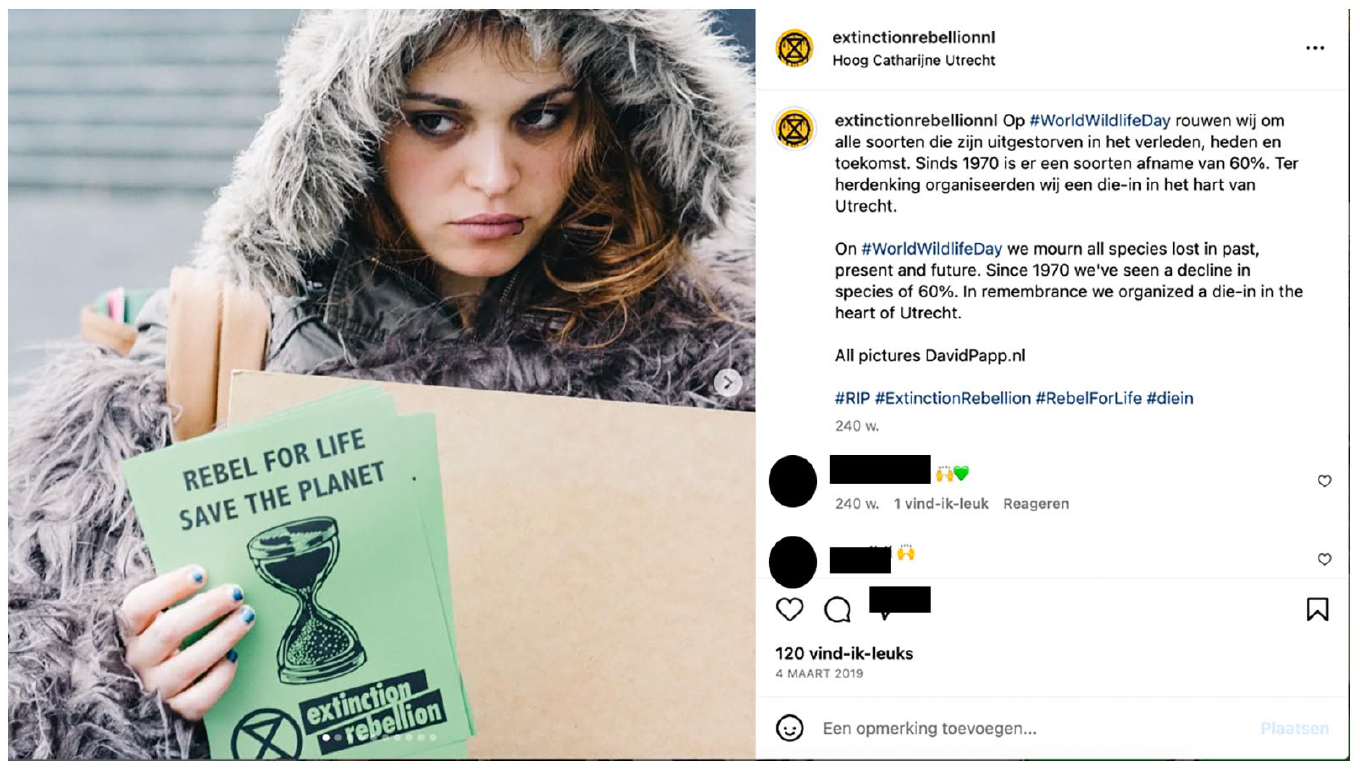
A screenshot of a post mourning lost species, shared on Extinction Rebellion Nederland’s Instagram account on 4 March 2019. Screenshot made by authors on 10 October 2023.
This Instagram post not only informs people about the ‘die-in event’ – a recurring non-violent protest in which participants lie on the ground next to each other to symbolise the fatal impact of the climate crisis – but also encourages people to mourn lost species, including those that will perish in the future. This post is illustrative of the ways in which XR activists engage with the past, present and future simultaneously in their activist communication. Rhetorically, a post like this works on a number of levels: it rallies people to a cause, calls for direct action and justifies this not just by looking ahead, but also by looking back. It reminds us, prospectively, of what is inevitably coming. The post constructs a particular future imaginary based on past data while mourning that future in the present. Beyond the content of the post, this example also makes clear how XR NL uses Instagram’s affordances for mnemonic purposes. The hashtags serve both a connective and archival function (Fridman, 2022) and help spread the content among and beyond XR NL’s followers, while the ability to comment, like and share helps increase the post’s visibility. This article scrutinises this interplay between memory work and platform affordances.
We argue that future-oriented social movements like XR purposefully navigate past, present and future through their memory work, using Dutch XR activism as a case study. Memory work entails those practices, technologies and cultural forms that help construct the past in the present and transfer it into the future (Smit, 2020: 86). XR activists are equipped with ‘repertoires’ and ‘repositories of memory’ (Zamponi, 2018: 25). Lorenzo Zamponi (2018: 7) defines a repertoire of memory as ‘the set of mnemonic practices that social actors put in place in reference to the past’ and repositories of memory as ‘the set of products, both implicit and explicit, formal and informal, symbolic and material that act as objectified carriers of the past’. In line with this thinking, as we will demonstrate in this article, XR activists employ, first, the past as a mnemonic resource. Second, they are concerned with the present as future memory. Moreover, XR activists utilise imagined futures to legitimise and delegitimise past and present (in)action. Put differently, the past, present and future are not neatly separated in their activism, but are intertwined and mutually inform each other (see also Gutman et al., 2010).
Besides demonstrating how Dutch XR activists articulate and engage with the past, present and future, we argue that Instagram’s platform affordances of connectivity, spreadability and archivability support this memory work. What we mean by this is that while social media platforms generate a flow of content that privileges the new (in terms of what is most visible), they can also be used to act as vast archives in which content easily travels from one moment in time to another, while appearing to be new (Jacobsen, 2021). Of course, one could argue whether or not social media platforms are archives in the first place. They are not in the traditional, institutional sense, but as Abigail De Kosnik (2016) argues, non-professional everyday Internet users curate and preserve cultural content with them. These archives are problematic, though, in terms of accountability and visibility. This becomes evident when a platform is discontinued, when algorithms are changed and when platforms are (semi-)automatically ‘cleaned’ to conform to updated moderation regimes. On social media, as is the case with other social movements, historical references and protest repertoires travel within XR and between other and older activist groups (see Daphi, 2024). These repertoires are often, and consciously, repetitive, in order to become recognisable and memorable. For example, XR activists’ disruptive protests on the Dutch highway A12 have become highly visible, fuelling Dutch collective memory about XR and the message the movement wishes to communicate. XR activists’ sharing of these protests on social media amplifies this message while also adding to the movement’s social media archive. Through such practices, XR activists actively appropriate Instagram’s technical features and ‘social media logic’ (Van Dijck and Poell, 2013) for both activist and mnemonic purposes.
The media-savviness of XR can be partly explained by the fact that the movement mainly comprises young climate activists. XR was established in 2018 in the United Kingdom and its ‘headquarters’ are based in London. However, it has a number of globally dispersed ‘chapters’ and, following the ‘logic of connective action’ (Bennett and Segerberg, 2012), it describes itself as ‘leaderless and truly global’ (Extinction Rebellion, 2024). This grassroots and global character has also been noted in the emergent scholarship on the movement (Gardner et al., 2022: 424). The ‘chapters’ are a core feature of XR’s organisational structure. They are ‘local groups that share most demands, though with a degree of autonomy in strategies and priorities’, and are aligned in their dedication to non-violent, radical ecological protest (Burgess and Read, 2020; Smyth and Walters, 2020: 622). Beyond having an organisational purpose, the chapters also act as national, regional and even local imagined communities and brands (Gardner et al., 2022). In their strategic communication and identity construction, the past seems to be a resource that allows comment on the present and future, but also a legitimisation of present action. As the website of XR NL reads: ‘history has repeatedly shown that civil disobedience is a very effective means to bring about fast change’ (Extinction Rebellion, 2024).
In this article, we are particularly concerned with how this social movement employs and ‘activates’ (Smit, 2018) the past, present and future to make this change possible. When XR activists collectively imagine the future and construct their imaginaries in images, videos and texts on Instagram, they build on shared interpretations of the past. They collectively ‘think about what the world or life might be like, was like, or is like in another time/space’ (Markham, 2021: 385; see also Koselleck, 2004). Imagining the future is tied to the process of interpreting the past, as ‘the available material for any imaginative act is greatly influenced by prior imaginations’ (Markham, 2021: 385). We argue that when Dutch XR activists imagine the future, they are simultaneously engaged in imagining and interpreting the past. Vice versa, while they imagine and interpret the past, they do so through ‘collective future thought’ (Szpunar and Szpunar, 2016) and remind people of what needs to be done through mediated prospective memory (Tenenboim-Weinblatt, 2013). Our analysis aims to demonstrate how social media platforms act as the infrastructure for this memory work, as social media platforms and their users shape and constrain these practices of memory and imagination through their associated technological affordances, practices and dominant cultural forms. By showing how a future-oriented social movement engages in platformed memory work, we add to the growing scholarly literature on the movement–memory nexus in the digital age (Daphi and Zamponi, 2019; Merrill et al., 2020; Rigney, 2018; Smit et al., 2024). We first engage with the literature concerning collective future thought, prospective memory, digital media and activism in order to construct an analytical lens. The second part of the article offers an explorative empirical study of XR NL and its activist memory practices.
Memory and/of the future
Memory and Memory Studies have a complex relationship with the future. This relationship deserves scrutiny because future-oriented social movements make sense of the present and past through the lens of an imagined future. In memory work, past, present and future are not constructed as part of a linear process from then to there, but rather intertwine and intersect. In discussing social movements, Ann Rigney (2018) writes, for example: Remembering the past, shaping the future remembrance of the present, and struggles for a better future feed into each other in ways that still need unpacking along with the distinctive cultural forms and practices that are used in the transmission of civic commitment. (p. 372)
One way to unpack this ‘movement-memory nexus’ (Daphi and Zamponi, 2019; see also Rigney, 2018) is by means of the concept ‘collective future thought’ (Szpunar and Szpunar, 2016). Bringing together perspectives from the humanities, social sciences and cognitive science, Piotr and Karl Szpunar (2016) define collective future thought as ‘the act of imagining an event that has yet to transpire on behalf of, or by, a group’ (p. 378). Events, they write, can be either specific or schematic: ‘The specific refers to particular dates, times, names, and details that make up events. The schematic refers to the underlying and generalizable patterns that structure the feel of imagined futures’ (Szpunar and Szpunar, 2016: 379). The schematic futures imagined by XR are one in which humanity is faced with the disastrous consequences of human-induced climate change and one in which humans live in harmony with the planet and its other life forms.
Simultaneously in the wild and in the head (Barnier and Hoskins, 2018), hopeful and disastrous ‘social fact’ (Durkheim, 1982: 52) and rooted in individual experience, ‘these imagined futures ‘exist’ beyond the individual and in social/group processes that draw on – and reinforce or challenge – various social narratives and anxieties’ (Szpunar and Szpunar, 2016: 379). Moreover, Szpunar and Szpunar (2016) make a distinction between ‘future as after-thought’ and ‘future as forethought’. In the future as after-thought, the past is the resource from which our imagination draws for future projection. The future as forethought operates the other way around: Rather, positing the future as the impetus for remembrance is intended to stress that projections, predictions, and anticipations regarding the future can fundamentally alter the ways in which a collective remembers (and forgets). Here, the relationship between future and past is not unidirectional, nor is it linear. (Szpunar and Szpunar, 2016: 382)
In other words, collectively imagining the future can impact how we make sense of the past in the present, which can be used for political purposes.
Similarly, as Patricia Dunmire (2005) argues, ‘a key ideological component of political discourse lies in its construction and representation of future realities and the rhetorical function those representations serve in implicating more immediate material and discursive practices and actions’ (p. 484). We acknowledge this power of the future over present practices and actions, but we also recognise that ideas about what ‘ought’ to, ‘should’ or ‘will be’ can equally be perceived as consequences of past (in)actions and collective memories thereof. In addition, the future can be connected to the present by arguing that the times we are living in now will soon be the past to future generations. We are, so to speak, living in the future past. This is related to what Stef Craps (2017) has called ‘anticipatory memory’ (p. 487). In order to explain this concept, Craps uses the example of going to a live show. Instead of simply enjoying it in the moment, we take pictures of the show to capture the experience. Instead of just enjoying the performance, we anticipate the narration of that experience in the future. This anticipatory mode of being then influences our current experience. Likewise, as we have seen in our introductory example, ‘proleptic mourning’, or mourning that which is lost in the future, can be a ‘spur to action’ (Craps, 2017: 488). An imagined future can affect how the past is assessed in the present and how it is ‘used’ rhetorically. For example, the biblical Apocalypse has been used to interpret past events as signs of this impending doom. Likewise, XR activists legitimise present actions based on future scenarios caused by past inactions and climate injustices. The future thus holds significant political force, either as a desirable new situation to strive towards or a negative scenario to move away from. Both can be used as a means to assess and influence the ways we interpret the past and the current status quo.
It follows that the ways in which the future is imagined, and the past interpreted through the lens of the future, are especially important for the formation of collective identity and memory. As Szpunar and Szpunar (2016) argue, Collective future thought is essential to the persistence of collective identity and also highlights how group identity is malleable and changing – how its continuity depends on its ability to adapt and change rather than simply persevere – in relation to its projections of the future. (p. 284)
What the concept of collective future thought stresses is that the ‘the future is now’ and shapes how groups make sense of what has happened. In this sense, the concept helps us understand how imagined futures not just shape present action, but also activist memory work. By offering a shared frame of mind and common objectives, collective future thought affects how activists purposefully and strategically reconstruct the past in the present and how they transmit the past and present into the future. Activist memory work, therefore, is perhaps always influenced by a shared imagined future, whether negative or positive, and whether retrospective (looking back) or prospective (looking ahead).
Memory work is not only shaped by future imaginaries but also by commitments made in the past that have not been fulfilled yet. In psychology and associated disciplines, this is defined as ‘memory for one’s intentions’ (Marsh et al., 2006: 115; Tenenboim-Weinblatt, 2013: 98) or ‘remembering to carry out intended actions at an appropriate time in the future’ (Einstein and McDaniel, 2007: 1; Tenenboim-Weinblatt, 2013: 97). Keren Tenenboim-Weinblatt (2013) takes up this idea and, connecting it to agenda-setting and social theory, sees this as a process that is also played out in the publicly mediated discourse. ‘Collective prospective memory’, she writes, ‘refers to collective remembrance of what still needs to be done, based on past commitments and promises’ (Tenenboim-Weinblatt, 2013: 92). This forward-looking dimension makes prospective memory different from retrospective memory, which concerns the reconstruction of the past in the present. Therefore, prospective memory, like collective future thought, shows that past, present and future inform each other and that they can help shape collective identities. As we will see later, XR activists remind politicians, organisations, corporations and the general public about commitments made in the past. For example, the 2015 Paris Climate Agreement is a recurrent theme in their actions and communication.
Prospective memory is central to XR activists’ communication because the climate commitments (or lack thereof) of past generations have not been followed up on. Statements by XR activists ‘highlight how previous generations have deprived the current youth of their future’, writes Anna Friberg (2022: 49). Consequently, they want to spread the message that time is running out, as observed by Friberg (2022): ‘the new generation of environmental youth movements highlights time and temporality in order to explain the possibilities of change’ (p. 48). In her analysis of youth climate movements, Friberg (2022) argues that these movements mobilise and organise through dystopian pessimism while still relying on hope expressed by discourses of possible futures and new beginnings. She writes, [u]sing the future as a threatening disaster creates ideas about how past futures have been hindered, but it also results in new visions of what might be possible, which in turn provide inspiration for mobilization and action directed toward making these possibilities real. (Friberg, 2022: 52)
The shared memory of hindered past futures and commitments made, in other words, can have both rhetorical and practical efficacy in future-oriented activism.
Synthesising the literature above, the retrospective and prospective dimensions of activist memory work connect the past, present and future. First and foremost, the past can act as a resource for present action. This dimension relates to the vast reservoir of symbolic content, past promises, historical injustices and (in)actions that activist groups like XR can draw from to inspire (future-oriented) practices and discourses. Second, a shared understanding of the future shapes activist memory work. That is, how and to what end the past is assessed and activated. Relatedly, practices such as recording, documenting or archiving are future-oriented. The intended purposes of these practices are to keep a record of promises or the lack of commitment, to add to the collective memory of a future-oriented cause and to document the protests themselves. To put this succinctly, an imagined future (both positive and negative) can be used to legitimise and delegitimise past and present (in)action. This imagined future is connected to the past because what ‘ought’ to, ‘should’, and ‘will be’ relates to what ‘has been’: predictions and shared imaginaries are always partly rooted in the past. We pick up on these dimensions of memory work in our analysis, but first, we theorise another component of our analytical model, namely what we call the mnemonic affordances of social media.
The mnemonic affordances of social media
As Tenenboim-Weinblatt (2011, 2013) demonstrates, media are important ‘agents of memory’. Media overcome space and time and can transmit symbolic content into the future and overcome physical distance (Thompson, 1995). Moreover, as John Durham Peters (2012) has argued, media function as logistical technologies (such as calendars, clocks and bell towers) that can coordinate bodies in space and in time. Related to memory, therefore, media can shape not only how, but also when and where people remember specific past events, people and places. While Tenenboim-Weinblatt mainly focuses on traditional news media, digital and social media platforms can also be seen as agents of memory.
Just like the media before them, digital platforms shape memory work in idiosyncratic ways. Rik Smit (2022, 2024), based on David Nieborg and Thomas Poell (2018), argues that this ‘platformization of memory’ involves two forms of contingency. On one hand, we increasingly depend on platforms and the many applications built on them for engaging with our personal and collective pasts. That is, platforms act as the infrastructures of memory. Second, platforms actively perform memory work or ‘forget’ and even automatically create reminders or collages based on digital traces and data (Jacobsen, 2021; Schwarz, 2014). These ‘memory objects’ are contingent in the sense that they are malleable, unpredictable and based on user feedback, and what we see of our personal and collective past on platforms is increasingly dependent on the algorithmic processing of these mediated pasts.
In a similar vein, and specifically linked to activist remembrance, Samuel Merrill and Simon Lindgren (2018) write that, ‘digital technologies and platforms have complicated the somewhat static notion of isolated sites of memory, encouraging the mobilization of activist memories in additional geographical and temporal contexts’ (p. 658). In their view, especially the ways in which social media platforms reshape the temporality of social movements deserves critical scrutiny because they ‘are more broadly reshaping both the spatialities and temporalities of activist remembrance’ (Merrill and Lindgren, 2018: 658; see also Mousavi, 2024). In their analysis, Merrill and Lindgren specifically focus on different rhythms of activist remembrance and how platforms shape when remembrance occurs in social movements, which is similar but different from earlier commemorative calendars due to their technological design.
In their struggle for climate justice, XR and similar climate action groups that focus on the future, can leverage, or are at least shaped by, the ways in which social media platforms compress time in a perpetual present, a specific ‘social media time’ (Kaun and Stiernstedt, 2014). As Anne Kaun and Fredrik Stiernstedt (2014) argue in their work on Facebook, the platform’s affordances allow for certain archival uses, shape the experience of content through flow and impact the narrative function of the platform (see also Rigney, 2024). Related to their archival dimension, social media, next to keeping vast amounts of content, structure uploaded materials in specific ways. Most social media platforms allow for the circulation and recycling of older cultural products. Connected to that, content can be tagged, titled, described or hashtags can be added to make content searchable, or to make it resurface, next to interactions with material in the form of likes and comments (see Smit et al., 2018). This can turn social media platforms into ‘platforms of memory’ (Merrill and Lindgren, 2018; Smit, 2018). Users of social media experience content in a temporal flow of information, an experience of ‘immediacy, ephemerality, “liveness,”’ a flow state, as described by Kaun and Stiernstedt (2014: 1161). Finally, social media allow for the sharing of stories (e.g. Instagram has a ‘stories’ function), but which stories are visible ultimately depends on personalisation and visibility algorithms.
Taking the above into consideration, ‘imagined affordances’ (Nagy and Neff, 2015) actively shape for which mnemonic purposes social media are used. Affordances are not features but rather describe how users make sense of technologies, objects or environments through imagination and practice. They are the perceived range of actions of a technological environment or object. Environments or objects do not ‘have’ affordances, but rather affordances emerge out of human interactions with them – affordances have a relational ontology. A ‘share’ button is a feature, part of the broader affordance of ‘spreadability’; the option to tag or describe content relates to the affordance of ‘archivability’; and the possibility to ‘make friends’ or ‘follow’ a person concerns the affordance of ‘connectivity’. The usage of Instagram can inform the imagined affordance of a shared temporal experience. Social media can be used as living (and problematic) archives that keep memories of protest, or future agendas set in the past. They can be used to share narratives that remind users of futures that never were and/or should come about. The design and use of platforms can therefore shape collective future thought and the prospective memory of and by social movements. The rest of this article will be devoted to answering how various local Dutch chapters of XR shape and engage with these mnemonic affordances of Instagram.
Methodological approach
In the following sections, we analyse activist memory work by XR members on Instagram. Before we do so, however, we reflect on our methodological approach and explain the research design of our study. Next to investigating the mnemonic practices of Dutch XR activists, we scrutinise platform affordances and the reflections of activists on these practices and affordances. It is important to note that we regard both platforms and the people using these platforms as memory agents – their agency is distributed in a socio-technical assemblage (see Latour, 2005). We decided to focus on Instagram because this is the publicly accessible platform most used by Dutch XR activists and it cuts across different generations of social media users. We aim to answer the question: How are Instagram’s socio-technical affordances used for retrospective and prospective activist memory work?
In order to answer this question, the study employs two methods: thematic content analysis of Instagram posts and interviews with Dutch XR activists who manage chapter Instagram accounts. Concerning the former, we conduct a thematic content analysis of Instagram posts on the XR NL account and eight accounts for local Dutch chapters: XR Amsterdam, XR Utrecht, XR Arnhem, XR Leiden, XR Maastricht, XR Rotterdam, XR Fryslân and XR Haarlem. In addition, we included the Dutch account ‘memes_rebellion’ because several administrators of local chapter Instagram accounts reposted content from this account and mentioned it in their interviews.
The study consisted of two different stages of data collection between August and December 2023, in both virtual and physical spaces. In stage one, we identified relevant Instagram accounts and created a data corpus that consisted of screenshots of Instagram posts. For this part, we purposely sampled posts and comments that engage directly with the past in relation to the future and those that position XR and its actions in time. In stage two, we collected data through semi-structured interviews. Semi-structured interviews were part of the research design to gain more insight into the personal motivations, emotions, thoughts and experiences of Dutch XR activists in connection to their memory work. In this second stage, interview transcripts and audio recordings (following informed consent) were added to our data corpus. Participants were recruited via private messages on Instagram to XR NL and the abovementioned related accounts. The sample was made up of people of different ages and genders, but all participants were adults and of Dutch nationality. Our only selection criterion was that participants actively used Instagram for XR NL-related activism.
Four interviews were held online and two were held at a location selected by the participants in the Netherlands: one in Utrecht and the other in Leiden. In these interviews, we asked participants about their use of social media platforms, in particular Instagram. Why did they decide to join XR? Why do they use Instagram for activist purposes? How do they decide which topic to post about and what the post should look like? Furthermore, we asked them whether and how they discuss the future and/or the past within their organisation, either in conversations with each other or in team meetings. How do they envision the planetary future? The interview transcripts were analysed thematically through inductive, qualitative coding. Using an embedded coding process, we assigned primary and secondary codes to phrases and words of the interview transcripts, focusing mainly on references to temporality and Instagram affordances. For privacy reasons, we anonymised the participants by giving them pseudonyms and decided to avoid connecting direct interview quotes to the name of the Instagram account that the interviewee administrated. Moreover, we anonymised the comment section in the screenshots that were included in this article, leaving only XR accounts visible. The Instagram content that was captured in these screenshots was reproduced according to fair-use conventions (Franzke et al., 2020).
XR activists’ Instagram use
Before we offer our analysis of XR NL’s memory work on Instagram, we briefly describe how the activist movement uses the platform. XR NL and their local chapters are active on Instagram, Facebook, Twitter, TikTok, YouTube, LinkedIn and Mastodon. In addition, the apps Signal and Telegram are used widely by activists and supporters to socialise and organise events and meet-ups. As mentioned earlier, we focus on Instagram because this platform is most used for XR activism. We asked activists from six different local chapters which platform they prefer using and they all answered Instagram. Five interviewees mentioned that they believe Instagram allows them to reach the widest audience, and all of them explained that they already use Instagram in their personal lives, which makes it easier to navigate the platform for activist purposes.
Instagram is used by XR NL and its local chapters for three main purposes: mobilisation, organisation and recruitment (see also Agur and Frisch, 2019). Mobilisation refers to the use of Instagram to increase participation in protest actions. By posting summaries of scientific reports, responses to news events and practical information about upcoming events and protests, the administrators aim to motivate their fellow activists and would-be activists (Agur and Frisch, 2019: 5) to join events and protests (Friberg, 2022). By organisation, we mean that XR activists use Instagram to present XR as a leaderless yet unified movement that strategically plans to increase pressure on the government. XR does not impose rules on who can or cannot create or run an Instagram account related to the movement. Yet, by using the same logos, fonts, images and phrases, the many different Instagram pages belonging to the local chapters in the Netherlands do form a coherent unity. The organisational purpose is also reflected in the content of the posts. The majority of Instagram posts by Dutch XR accounts provide information about where and when events will take place, often including instructions on what to wear, how to deal with the police, and sometimes on how to deal with the anxiety, stress and fatigue that often accompany acts of civil disobedience. Finally, recruitment refers to the purpose of achieving popular support among people not (yet) involved in the XR movement (Agur and Frisch, 2019: 5). For this last purpose, Instagram is also used to create a certain image of XR. Multiple Instagram posts, for example, express disagreement with the movement’s image in mainstream media. By stressing that XR understands that some people are frustrated by their acts of civil disobedience, Instagram is then used to persuade people to understand XR’s reasoning and raison d’être.
The content on the XR Instagram accounts we analysed often draws on pop-cultural references, such as Hollywood actors and memes. XR NL even launched a separate Instagram account only for memes related to the climate crisis called memes_rebellion. Interviewee Elise, who administrates a local Instagram account for XR NL, explained that she recently started collaborating with an activist whose sole task is creating and posting memes on their Instagram account. She explains the popularity of memes by arguing that they are often relatable and lighten the mood, ‘which is sometimes necessary as we discuss such heavy topics and deal with anxiety, exhaustion, stress and sometimes even physical violence in run-ins with the police’ (interview on 6 October 2023). Moreover, the use of memes and pop-cultural references connects the movement to a broader audience, as they form a recognisable frame of reference. Such posts can be viewed as a form of global communicative memory (Assmann, 2008), as they add to and tap into a pool of shared popular knowledge that allows for creative forms of political participation to emerge.
XR’s digital memory work
The content of Instagram’s archive is spreadable and connective in the sense that it spreads within and beyond the movement and shapes the collective identity (mainly based on visual content) of the movement. The platform functions as an infrastructure of memory and its affordances actively shape what new content is added to XR’s digital protest archive. The documentation of activism, often done by social media administrators who ‘archive’ this on platforms, becomes a form of memory work (Smit et al., 2017). The use of hashtags is an essential mnemonic practice (Fridman, 2022: 132), because they can serve as an archival tool for finding and searching content in the present and future. Administrators of individual accounts play a pivotal role in these dynamics. They act as mnemonic agents who compress time by actively connecting the past and future to the present. By emphasising that the climate crisis is now (which is a recurring message on Instagram), Dutch XR activists use Instagram to highlight the urgency and time-sensitivity of the climate crisis. XR’s logo, an hourglass, is a constant reminder that time is running out to save our planet. Various scientific reports are shared on Instagram to highlight that all inhabitants of the Earth are already (and have been historically) experiencing more extreme weather conditions, temperatures and ecological disasters as a result of climate change. The content posted on Instagram therefore not only attempts to create a collective vision about the future but also attempts to shape a shared interpretation and understanding of what led to this moment. Following our theoretical framework, we explore the retrospective and prospective dimensions of digital memory work on our sample of Instagram accounts.
Retrospective memory work
In our analysis of Dutch XR Instagram accounts, we found many references to the past, some more explicit than others. Dutch XR activists reference the past on Instagram when they highlight outcomes of previous mobilisations, protest traditions ‘that structure the set of strategic possibilities for contemporary action’ (Zamponi, 2018: 182) and direct comparisons with previous waves of mobilisation worldwide. In comments and posts, historical events are referenced to justify present and future protests. Yet, our interviews and content analysis suggest that XR is hesitant to compare itself directly to historical protest groups or activist movements. Activist Simon explained that this is difficult because of the ‘white privilege’ of the majority of Dutch XR activists:
Historically, there have been many activist groups that used civil disobedience. But it is basically impossible to compare ourselves to them. Because if you take me as an example, I’m a white young activist in the Netherlands. I can get arrested thousands of times and it won’t make a big difference for my future. But people in these past movements were assaulted and even murdered. So, we cannot make a direct comparison, but these activists did prove that the method of civil disobedience works (Interview on 5 October 2023).
Simon is hesitant to make direct comparisons to historical activist groups, but they do serve as inspiration for XR and the method of civil disobedience is connected to a larger memory of activism. Photos of the civil rights movement do pop up occasionally in the comment sections of XR NL’s Instagram posts. The civil rights movement is also mentioned as a source of inspiration for several XR information meetings (see also Seagrave, 2023: 67). It is important to note here that Simon explained that he does make more direct comparisons in his private life when he is not posting on behalf of the movement on Instagram:
To my parents, for example. They were against my involvement in XR in the beginning, and then I explained to them that in the past there have also been groups that fought for rights for black people or women’s rights. At the time, what they did was illegal. But morally they did the right thing (Interview on 5 October 2023).
This demonstrates the difficulty administrators face to decide which historical references are connected to XR’s activism. However, other users can bring these references in via comments, using XR’s hashtags, tagging XR accounts in their own posts or by writing them on banners in protest actions, which can then circulate in photos on Instagram.
Direct references to historical events or actors on Instagram are mostly drawn from Dutch cultural memory. For example, on 13 August 2019, XR NL posted a photograph of an XR protest (Figure 2) which they directly compared with the Insektensekte, one of the first Dutch environmental movements, which was mostly active in the 1960s and 1970s.
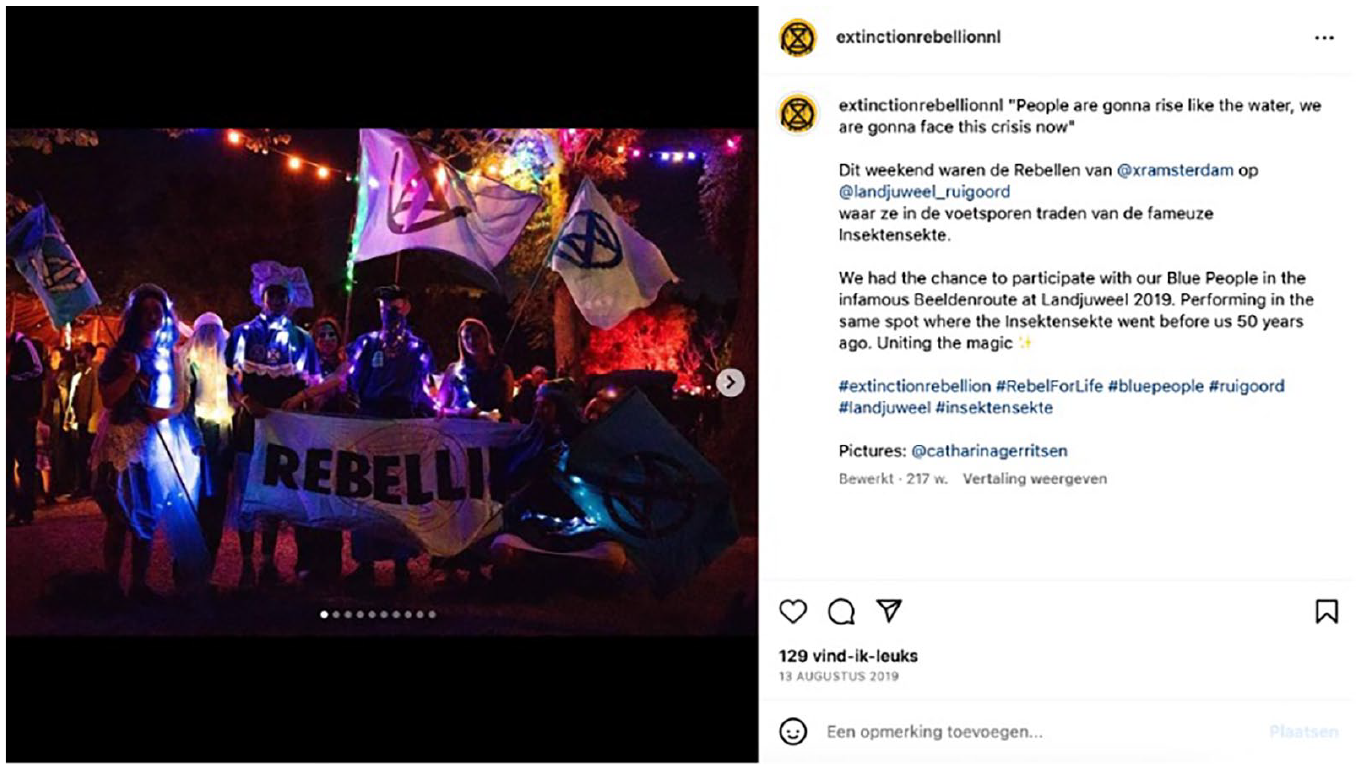
A screenshot of a post directly referencing the Insektensekte shared on Extinction Rebellion Nederland’s Instagram account on 13 August 2019. Screenshot made by authors on 10 October 2023.
The post explains that XR activists went to Ruigoord, ‘the same spot where the Insektensekte went before us 50 years ago’. In Dutch, they argue that they are ‘stepping into the footsteps’ of this historical activist group. In this post, Dutch XR activists thus perform retrospective memory work by using an Instagram post to position themselves in the canon of Dutch environmental activism.
The importance of location should not be overlooked when analysing how XR situates itself in time and engages with the past, present and future on Instagram. In the abovementioned post, the visit of XR activists to Ruigoord is remediated online because this location is given historical importance for Dutch climate activism. Moreover, sites of memory (Nora, 1989), such as monuments, are appropriated by XR activists in a recurring protest action called ‘Statue Sunday’. This is a global protest organised by Scientist Rebellion (a subgroup of XR), in which statues are blindfolded throughout the world to point attention to how politicians have ‘looked away’ when it comes to the climate crisis. Many photos of blindfolded statues in the Netherlands have been shared on Instagram by the XR NL account. Visiting or creating such sites of memory is an important part of the activist repertoire. Social media platforms often incorporate features for geotagging or which automatically display location, thereby leveraging a specific platform feature for this activist memory work. This further blurs the boundaries of online and offline activism (Smit, 2020; Smit et al., 2018).
In addition, historical photographs are occasionally used to bring the past into the present. For example, on 19 September 2023, meme_rebellion posted a collage of two photographs from different protests: one of the A12 blockade in 2023 and one of a protest in favour of new bicycle lanes in 1977 (Figure 3).
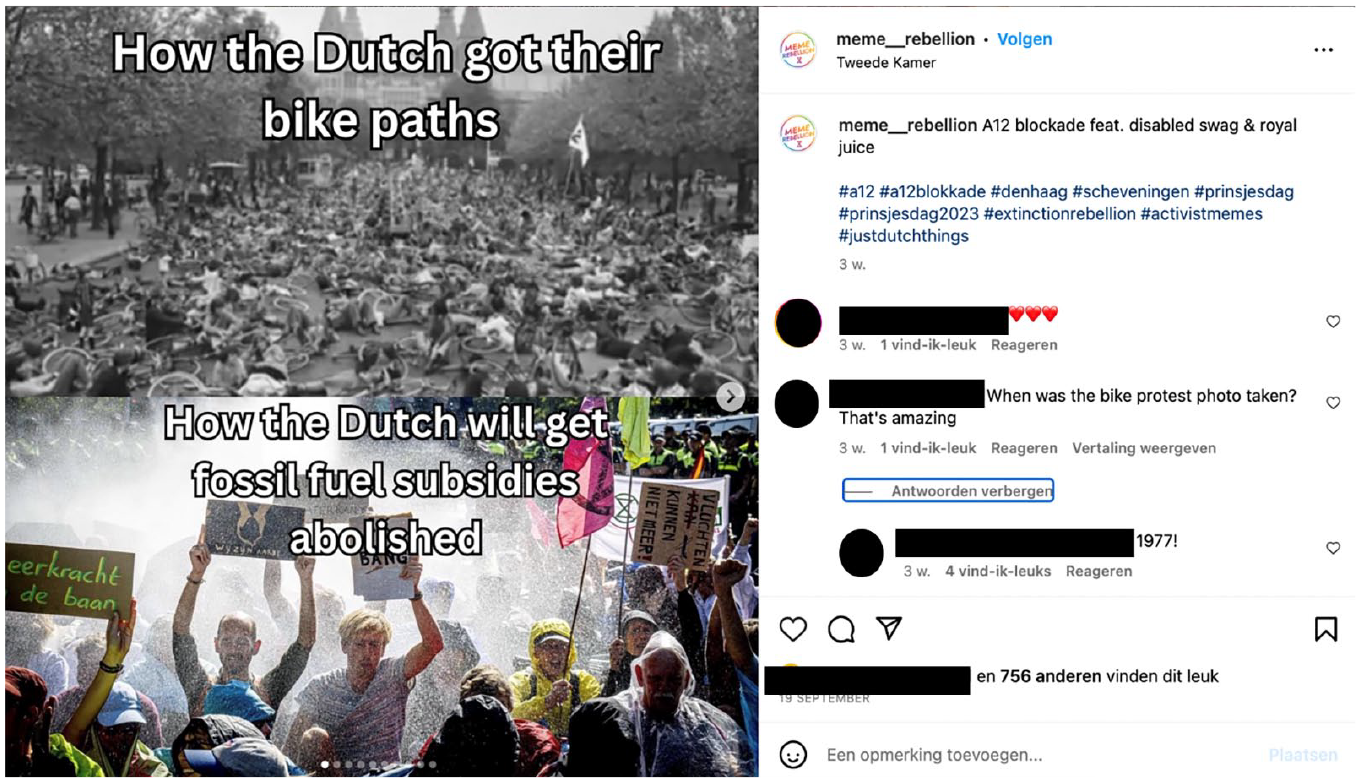
A screenshot of a post making direct reference to the past, shared on meme_rebellion’s Instagram account on 19 September 2023. Screenshot made by authors on 10 October 2023.
References to this historical event also came up in four interviews with administrators from different cities who did not know each other, which demonstrates that specific historical references do circulate among activists. In referencing the past in direct relation to present activism, these Instagram posts reflect how memory functions for the movement as a cultural resource that provides inspiration and ideas (Daphi and Zamponi, 2019: 405); they are simultaneously indicative of retrospective and prospective memory work. XR thus engages with the past on Instagram in captions, comments and through historical photographs. As a global movement, it collectively interprets historical events, global environmental circumstances in the present, and predictions of the future, which are spread online to vast audiences on Instagram.
In addition, it is important to note that XR activists use Instagram for what Merrill (2019) defines as ‘mediatised performative commemoration’. Instagram’s affordances blur ‘the boundaries between acts of commemoration, (self)representation and (self)witnessing’ (Merrill, 2019: 1366) when photos of commemorative events are shared on the platform, accompanied by hashtags, geotags, captions and comments. Merrill (2019) explains that ‘performance indicates not only embodied and cognitive acts of remembrance but also these acts’ digital remediation and distribution along with other associated forms of online participation’ (p. 1366). A recurring example of an embodied act of remembrance that is remediated on XR NL’s Instagram accounts is the ‘funeral procession’. Worldwide, XR activists regularly hold funeral processions in honour of the dying planet Earth, in which activists engage in bodily acts that are usually associated with funerals and memorial services: dressing in black, throwing roses on a coffin or monument, holding 2 minutes of silence, and carrying a coffin from one designated location to another. When XR activists use Instagram to announce funeral processions, livestream or post during the event, or share content to look back on them, they perform retrospective memory work. The Instagram posts further connect viewers through hashtags, the ‘share’ and ‘like’ buttons, and the comment section, immediately making the content spreadable and archivable.
Figure 4 is a screenshot of an Instagram post by XR NL (17 June 2019), showing a photograph of a woman dressed in black, holding her hands in a prayer-like position, engaging in the activity of throwing a rose on a pile of other roses while other people, also dressed in black, are solemnly watching her. The photo was taken during a funeral procession that XR NL had organised in order to alarm the municipality of Amsterdam about the loss of biodiversity.
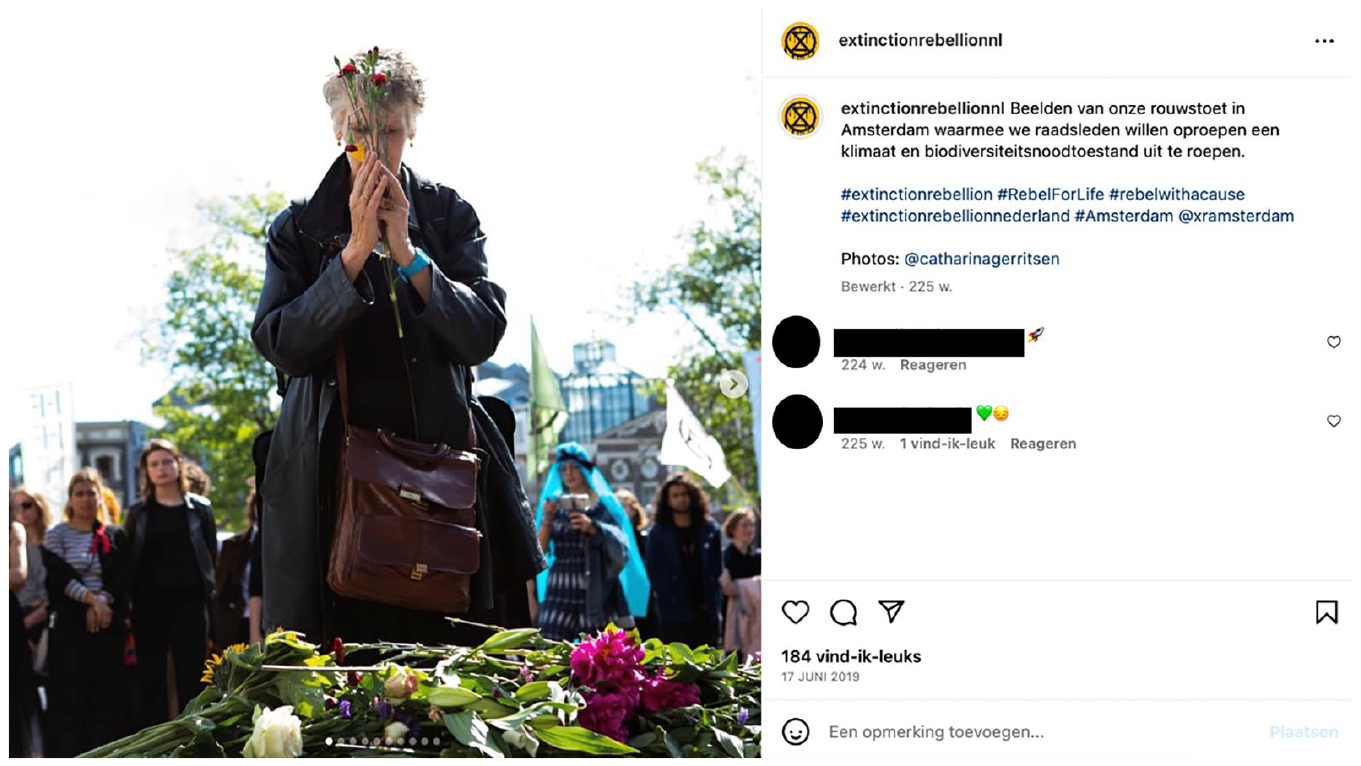
A screenshot of a post showing the mourning of lost species in the future, shared on Extinction Rebellion Nederland’s Instagram account on 17 June 2019. Screenshot made by authors on 10 October 2023.
Various XR chapters have organised multiple funeral processions similar to this one and have devoted several Instagram posts to this activity. The funeral procession (also called ‘funeral march’ or ‘funeral ceremony’ by XR) is part of XR’s mnemonic protest repertoire, not just in the Netherlands but worldwide (see, for example, regarding the UK, Seagrave, 2023). XR publicly grieves the loss of climate activists, biodiversity, nature and, ultimately, the future. In doing so, activists orient themselves towards both the past and the future in the present, performing retrospective and prospective memory work at the same time. As Jacob Seagrave (2023) observed during an XR funeral procession in London in 2019: ‘mourning involves both a stepping out of the flow of time and an ensuing reattachment to a differently qualified time with a new relation to the threat of the future’ (p. 64). By repeatedly posting photos of these public acts of commemoration, XR activists remediate these performances and help turn them into recognisable frames of reference. Instagram’s affordances allow these performances to then reach a much wider audience than is possible offline and become part of a connective memory of the social movement.
In line with the funeral theme, XR Haarlem posted an image on 6 November 2022 that resembled an obituary for the planet, announcing that: ‘After a long and eventful life, she could not handle the exhaustion anymore. Therefore, it is with a heavy heart that we announce the death of Our planet’. The obituary announces that a funeral procession is planned to draw attention to the devastating environmental impact of Black Friday and consumerism in general. A ritual associated with remembrance (writing and publishing an obituary) is hereby connected to the future (the death of the earth). This post is an example of how XR activists ‘give life to mnemonic practices’ and access existing mnemonic material (Zamponi, 2018) on Instagram. XR foregrounds its own relationship with the past on Instagram by accessing the existing symbols and mnemonic practices of ‘available pasts’ (Zamponi, 2018: 203).
Prospective memory work
In addition to historical references, an imagined future (both positive and negative) can be used to legitimise and delegitimise past and present (in)action. References to the future and the present on the Instagram accounts we analysed are largely related to catastrophe (see also Cassegård and Thörn, 2018; Friberg, 2022). Descriptions of the future highlight disastrous scenarios and in particular the prediction that the Netherlands will flood in the future. For example, XR Haarlem wrote on 23 September 2022 that it is only a matter of time before the city’s church towers are ‘the only things visible above water’. In addition, XR NL wrote on 22 September 2019: ‘Ever wonder about the future of The Netherlands if temperatures keep going up and sea level rise accelerates? Yup, you guessed it: flooding’, which was accompanied by an illustration of a typical Dutch canal house underwater. Similarly, in October 2023, XR NL posted a photo of an activist sitting on a bridge over the Dutch A12 highway with a banner saying ‘it’s about our survival and our future. The cars here wouldn’t be able to drive if this tunnel is under water [sic]. We have to act now’. Activists perform prospective memory work when they use the expected flooding of the Netherlands as a trope to highlight a shared understanding of the future. Instagram’s affordances of connectivity and spreadability allow this imaginary to circulate and reach a wide audience.
Besides the expected flooding of the Netherlands, other weather extremes are also used to connect the present to the future on Instagram. XR Haarlem posted a photograph on 16 August 2022, which was – until 2023 – the hottest summer ever recorded in Europe (Reuters, 2023), of seven activists holding up cardboard signs. The signs read from left to right: ‘This is the coldest summer of the rest of your life’, ‘Summers won’t get colder than this’ and ‘Welcome to this hot and bone dry world’. The caption of the post next to the photo reads, ‘This heat is the future! We have to act now’. These posts not only imagine a catastrophic future, but they also call for present action and argue that we must get used to a future that is already starting. Instagram is used to collectively envision the future and share this collective future thought with a wide audience, while at the same time archiving evidence that XR activists are aware of ‘the new normal’ in the present.
Instagram is not only used to collectively imagine catastrophic futures; some Instagram posts argue that the next generations might not even have a future. This is illustrated in Figure 5.
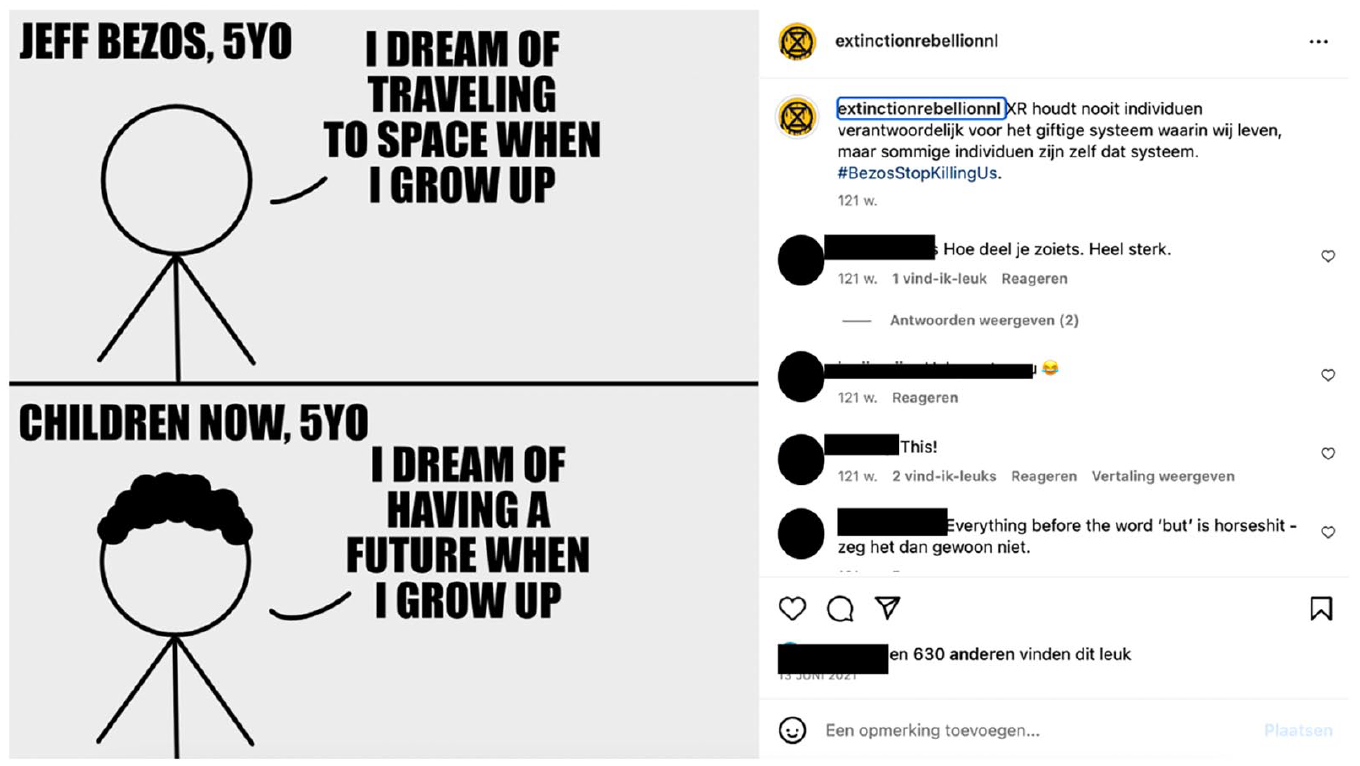
A screenshot of a post about future generations, shared on Extinction Rebellion Nederland’s Instagram account on 13 June 2021. Screenshot made by authors on 10 October 2023.
Moreover, the funeral procession (as described earlier) is not only used by Dutch XR activists to mourn lost species, it is also performed to mourn a lost future. On 18 June 2021, XR NL posted a series of photos on Instagram to announce a protest against the Dutch bank Rabobank (Figure 6). In these photos, four people (dressed in white instead of black) carry a white cardboard coffin with ‘our future’ written in Dutch on the side. A figure on stilts, dressed in a black cloak and wearing white skull-like face paint, sprays a liquid on the coffin. The caption explains that Rabobank finances industrial agriculture and the use of poison and chemical fertilisers, which is symbolised by the figure in black spraying poison on ‘our future’. On Instagram, this procession is recorded, spread and archived – connecting an imagined future to rituals associated with commemoration.
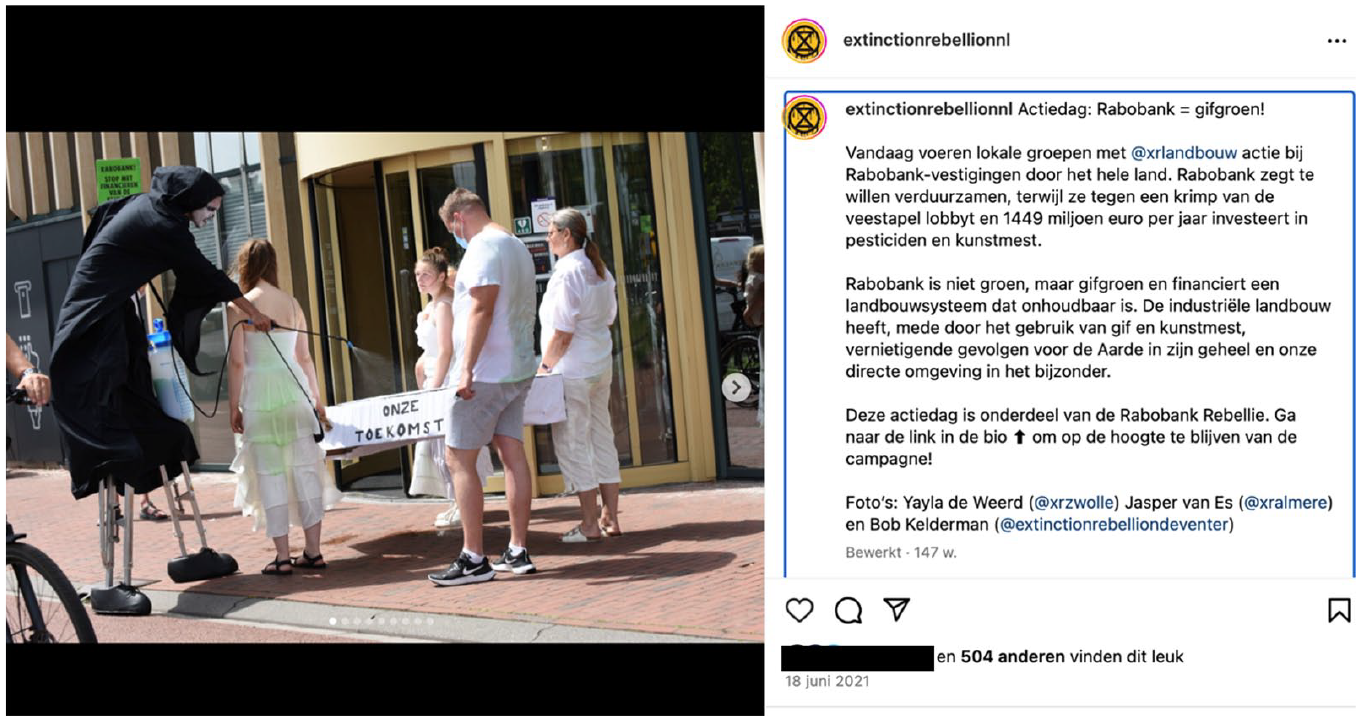
A screenshot of a post about the Dutch Rabobank, shared on Extinction Rebellion Nederland’s Instagram account on 18 June 2021. Screenshot made by authors on 10 October 2023.
In addition, Instagram is used for the recording, documenting and archiving of the present for future use, allowing users to perform prospective memory work. Sophie, administrator of a local chapter’s Instagram account, explained that XR NL works with ‘sociocratic circles’, which are groups of activists across the country that discuss and make decisions about specific themes. She is a member of the circle ‘media and communication’, which is responsible for press releases, delegating spokespeople, writing the monthly newsletter, updating members via ‘broadcast’ groups on WhatsApp and Telegram and maintaining the social media accounts on Instagram, X and Facebook. ‘Together with other administrators of social media accounts, we share information and discuss who will pick up a topic for a post, and, for example, who will be livestreaming certain protests’ (Interview on 5 October 2023). Livestreams are live videos that are recorded directly on Instagram, allowing viewers to interact with each other and with people who are present at the event via a real-time comment feed (Butkowski, 2022: 1). By livestreaming protests, XR activists can record and immediately mediatise ongoing events. Viewers not only become witnesses to these live events through Instagram, but also mourn, grieve, commemorate and/or remember together at a distance. As soon as the livestream is over, the recorded video can be archived and shared with people who were not part of either the live event or the livestream. As this example demonstrates, Instagram is used not just as a medium for liveness, allowing others to ‘be there’ at a distance, but also as a medium for memory work, ranging from grieving ‘in the moment’ to keeping a record for the future.
The future is frequently connected to the present when XR activists argue that the times we are living in now will soon be the past to future generations. We are, so to speak, living in the future past. In several Instagram posts, Dutch XR activists argue that it is important to think about how people will look back on this current period in time. People who engage with XR’s Instagram posts also participate in this mental exercise. For example, when XR NL posted an image of protesters blocking and dancing on the A12 highway in October 2023, a commenter responded: ‘There will come a time when people ask you . . . back then, were you on the A12?’ Through this strategic prospective memory work, the future is used for a present call to action.
In a similar vein, the achievements of XR are often celebrated in connection to how people in the future will look back on them. For example, the phrase we schrijven geschiedenis (which translates to ‘we are writing history’) is often used triumphantly when photos depict large groups of people engaged in activism or when XR claims that political changes are the result of XR’s activism. Activist Simon confirmed in his interview that he also believes that XR is changing the course of history and that this is visible on Instagram:
For example, the A12 blockades, everybody knows about that now. When you check the hashtag on social media, you can see it has been used many, many times. We are making history. I think we are even the first country in the world that has mapped how the fossil fuel industry is subsidised by our government (Interview on 5 October 2023).
Instagram’s affordances support memory work here through hashtags, user interaction and archive accessibility, providing administrators new insights into the way certain narratives and interpretations of the past, present and future are interacted with online.
The latter observations are in line with conclusions that Seagrave (2023) drew from his ethnographic fieldwork within the XR movement in the United Kingdom: this becoming aware, energised, and empowered in certain key moments of revelation is a theme common in the movement, signifying a distinct temporal subject experience of activism in XR, of living in and through an accelerating historical transformation, with the hope of also making history too. (p. 54, original emphasis)
Important to note here is how XR NL and its local chapters and individual activists experience time and how this experience shapes how they understand the past and anticipate the future. XR activists experience a sense of urgency and wish to accelerate present action because they foresee the future to be disastrous if we do not act now. A future in which Earth’s human and nonhuman beings can live together becomes the maximally achievable future.
XR activists create a repertoire of activism (Zamponi, 2018) on Instagram, by drawing on past events of XR worldwide. XR activists are part of a relatively new movement and use Instagram to create new traditions. Specific events are repeated on designated or tied to specific days. For example, every first Monday of the month the air raid alarm goes off at 12:00 in the Netherlands and every month, at the same time, XR NL organises a ‘die-in’ in several cities throughout the country. These events are announced every week on Instagram and users are reminded of how these die-ins fit into an ongoing routine, connecting the protests to earlier activism. Drawing on past events of XR worldwide, the movement therefore creates a repertoire of activism. This is also visible in occasional ‘throwback’ posts, in which XR NL or related Instagram accounts post about past events. The ‘share’, ‘like’ and ‘comment’ functions of Instagram make these posts connective and spreadable, but they are also archived, allowing users to scroll down on Instagram pages to find out about past protests and routines.
Conclusion
On 5 July 2019, XR NL posted a photograph on Instagram of a young woman holding up a banner that read: Rebel voor mijn dochter (Rebel for my daughter) (Figure 7). The post reads: Rebel for my daughter. Rebel for victims of climate chaos in the past, the present and the future. Rebel for all species that are already extinct or are about to become extinct. Rebel for all people in the global South that have contributed the least to climate change but feel its consequences the most. Rebel for all original inhabitants that have solutions but are not heard. Rebel for everyone who feels powerless. REBEL FOR LIFE!
Retrospective and prospective memory come together in this post that both mourns the past and the future. XR’s engagement with past, present and future stems from what Seagrave (2023: 52) calls ‘historical responsibility’ and ‘ecological stewardship’. This, he argues, is ‘constitutive of many XR activists’ subjectivities and symptomatic of an intimacy with catastrophe, a close and sometimes all-too-immediate orientation towards the future’ (Seagrave, 2023: 52). This does not mean that the past is not ‘made present’ through retrospective memory work. Rather, such memory practices occur alongside or are used instrumentally in this post, that is, future- and present-oriented. In this post, the future is both an afterthought and a forethought. Beyond the content of this post, Instagram’s platform affordances are appropriated by XR for mnemonic purposes: the tags connect this post to other, existing posts while also referencing a broader cultural repertoire of rebellion against injustice and powerful institutions. At the same time, the post itself is searchable and may emerge in later protests. It is a record, part of a protest repertoire, that can become a resource for future XR actions and other movements.
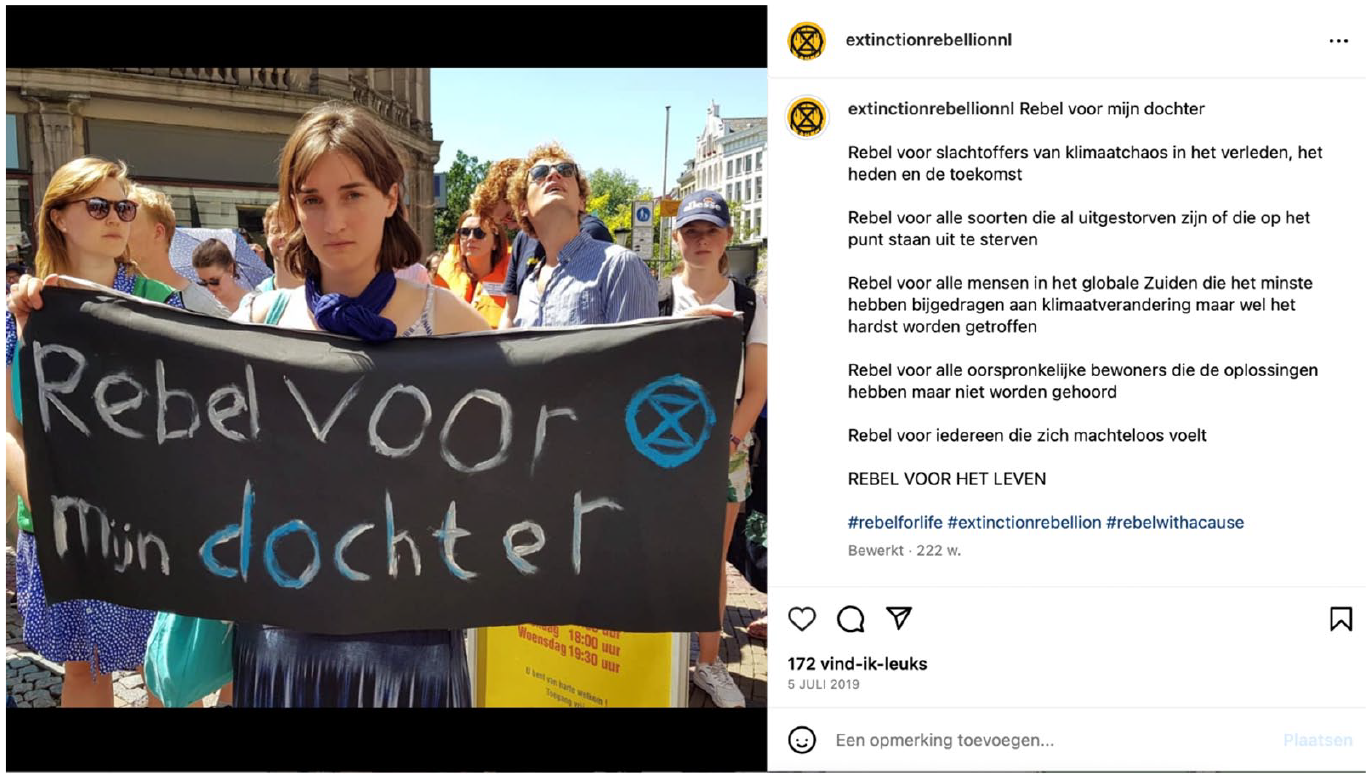
A screenshot of a post, ‘Rebel for my daughter’, shared on Extinction Rebellion Nederland’s Instagram account on 5 July 2019. Screenshot made by authors on 10 October 2023.
This concluding example is meant to illustrate the overall argument of this article. We have shown how past, present and future intersect in XR’s activist memory work. XR activists regard these temporal planes as a continuum in their discursive fights and practical actions for policy changes. The rhetorical function of this is to persuade politicians, businesses, banks and the general public to act now. XR activists intentionally appropriate Instagram’s affordances of archivability, spreadability and connectivity for this digital memory work. The platform serves as the infrastructure for these practices and simultaneously shapes them. Ultimately, this article contributes to the emerging literature on the role of the future in memory, by showing how a future-oriented social movement engages in platformed memory work. As the empirical part of this article is explorative, future research could continue critical investigations into how digital platforms, as assemblies of users, technologies and cultural forms, shape activist engagements with the past and future.
Footnotes
Acknowledgements
The authors thank the anonymous reviewers and special issue editors Ann Rigney and Samuel Merrill for their invaluable comments on this article. They also express their gratitude to the organisers and participants of the 2023 Remembering Activism Conference in Utrecht, who helped shape the thoughts expressed in this paper.
Funding
The author(s) received no financial support for the research, authorship and/or publication of this article.
