



Abstract
As the space for discussing feminism and related issues on domestic social media platforms in China narrows, Chinese women and feminists are increasingly seeking new platforms that provide a more supportive digital environment for advancing gender justice. This article explores the growing transnational engagement of Chinese digital feminism, with a focus on its presence on the foreign-based social media platform, Instagram. Based on interviews with 12 Chinese female Instagram users and an analysis of 184 of their women-focused posts, this study employs thematic and content analysis to explore the intricate, multi-layered transnational connectivity and social representations that contribute to a distributed form of gendered collective memory. The article argues that the digital engagement of Chinese women on Instagram plays a critical role in offsetting the limitations found in domestic social media platforms. This is vital for preserving certain vanished recollections, disseminating feminist narratives, and building gendered collective memory that challenges and reframes the often-distorted and stereotypical perceptions of Chinese women in public consciousness within China’s domestic media landscape. Despite the constrained impact and visibility of their gendered collective memory on Instagram, largely due to the specific class and group these women socially represent, their transnational efforts in shaping a more equitable collective memory remain noteworthy.
Keywords
Introduction
Distinct from the global North, contemporary Chinese feminism serves as an advantageous case study for examining the complicated implications of digital feminism from a nationally specific perspective. Following increasing popularity in recent years, social media have been strategically used by Chinese women and feminists to articulate a distinctive presence and voice (Wang & Driscoll, 2019). These uses have been differentiated from top-down modes of Chinese feminism, which have conventionally forged an “intimate bonding between women and state” as an essential political and elite discourse of “modernization” (Hu, 2019, p. 106).
#MeToo in China is viewed as a phenomenal transnational dialogue. It domesticates globally traveling feminist values within China, facilitated by cross-boundary social media uses, thereby becoming transnational (Liao & Luqiu, 2022). Wesoky (2016) outlines the “indigenization” (p. 53) of Western feminism in China, noting that national and global power dynamics are inextricably linked, with social media functioning as productive channels of communication connecting with international trends. However, such transnational interplay appears predominantly unilateral: Chinese feminism on indigenous social media (e.g., Weibo, WeChat, Xiaohongshu) receives, adopts, and indigenizes “global concepts” (Zheng & Zhang, 2010, p. 42) from Western feminism.
At the domestic level, Chinese women and feminists have confronted restrictions inherent in the affordances and constraints of home-grown social media platforms. More women and feminists leverage the democratic nature of digital communications to practice active civic engagement in various forms. Nevertheless, digital control mechanisms that are consistent with the authoritarian drive for conformity (Feldman, 2003) largely limit their “discursive rights” and “space” (Chen & Wang, 2020, p. 266). If women’s voices are marginalized, overlooked, or distorted, failing to form a crucial component of the collective memory mediated by social media, it signifies a substantial loss in China’s historical narrative, specifically, the parts where women played a crucial role.
During the Covid-19 pandemic, these issues became more pronounced. In China, the management of Covid-19 through the “zero-Covid policy” (Yuan, 2022, p. 1856) transcends mere virus containment measures. This policy has profoundly influenced various facets of Chinese society, including the portrayal of women’s heroic and self-sacrificing roles in combating the coronavirus (Fang & Zou, 2023), and the consequent intensification of censorship and surveillance (Chang et al., 2022). Domestic online space for expressing gender-related discontent and confusion has been further narrowed. In response, the collective memory predominantly shaped by “national mainstream news media” (Birkner & Donk, 2020, p. 368) has been significantly challenged by the rising crucial role of social media in constructing a “new memory ecology” (Brown & Hoskins, 2010, p. 94).
Consequently, Chinese netizens have been increasingly compelled to seek alternative platforms, such as foreign-based social media, to discuss women’s challenges, conditions, and needs, given the widespread and comprehensive nature of top-down constraints on discourse. Instagram serves as one unique locus “where feminism is being mobilized and enacted” (Savolainen et al., 2022, p. 559). It is also one of the social media platforms with the largest number of global active users (DataReportal, 2023). Given the dilemma Chinese women have been facing in the domestic digital realm, and the emergent importance of Instagram for exercising feminism and mediating gendered memories, this study conducted 12 semi-structured, in-depth interviews with Chinese female Instagram users who have different types of digital engagement (active audience and activists). Thematic analysis (TA) is complemented by content analysis of 184 women-centric Instagram posts by the interviewees.
This article argues that the feminist expressions and practices of Chinese women on Instagram offer an alternative avenue for furthering gender justice in China. Through their digital engagement on foreign-based social media, they play a crucial role in preserving marginalized recollections, promoting feminist discourse, and cultivating gendered collective memory. Their endeavors challenge and reconstruct the previously misconstrued and stereotypical image of Chinese women in public consciousness within China’s domestic media landscape. Although the influence of the gendered collective memory they create is limited as a distributed form, largely attributable to the particular social class and group these women represent, their transnational initiatives in reinscribing gendered memories into collective memory are significant.
Literature review
Transnational digital feminism: communicational transformation of gendered politics in the globalized world
The growing digital engagement in feminism has empowered more women around the world to leverage the borderless nature of social media, fostering connections among them to collaboratively create a more gender-equitable world. In this process, a considerable amount of feminist scholarship has paved the way for developing theories and interpretations of “transnational feminism” (Kaplan, 1994; see also Spivak, 1996). Their work demonstrates how global unequal economic, cultural, or political structures perpetually shape the politics of gender in any given local setting, while local relations, in turn, interact with macro global dynamics through connections and disconnections. As Shome (2006) writes, “gender troubles always manifest global troubles” (p. 255). Feminist geographers’ research (Massey, 1994; see also Katz, 2001; Pratt & Hanson, 1994) also advances underexplored connections between gender and place, space, identity, transnationality, and globalization, portraying them as an open and fluid process of constructing differences. In the digital age, the increasing popularity of social media has fundamentally transformed spatial connections at various geographic levels (Kraemer, 2014) between the “global” and “local.” Accordingly, transnational feminism frameworks have been integrated with the ever-evolving digital culture of globalized media practices.
Transnational feminism, as exercised in digital realms, becomes inextricably linked with diverse groups of women from different countries and cultures. Each group of women is uniquely narrated and represented on globally accessible platforms, accompanied by the potential risk of distortion. “The politics of representation” (Shome, 2006, p. 258) thus becomes a focal point in transnational feminism. It is built on feminist postcolonial critiques of the “global sisterhood” (Morgan, 1970; quoted in Bernacchi, 2017, p. 437) predominantly fostering solidarity among white, western, middle-class women (Spivak, 1994; see also Bahramitash, 2009; Hooks, 2015). Comparatively, the politics of representation challenges hegemonic and orientalist portrayals of third-world women in global media, while underscoring their agency and empowerment in mediated forms of resistance (Kasana, 2014). To thoroughly analyze representations of women, Disch (2016, pp. 781-802) suggests a three-pronged approach: cultural representation, focusing on the politics of mass representation, epitomized by terms like “vamps”; historical representation, which involves “visibility” through critical reflections and the theorization of writing women’s history and representative categories; and political representation, emphasizing “voice,” achieved through both descriptive and constitutive approaches to political presence.
Collective remembering and participatory culture: the role of active audiences and activists in socially constructing gendered memories on social media
Beyond the spatial connections forged by transnational feminism and its politics of representation, previous studies have also delved into how temporal connections, established through memories, can influence society via the process of collective remembering. Collective memory, rooted in past experiences, shapes the present through its social representations, ensuring continuity across time and space for social groups (Wagoner, 2015). Viewed through the lens of social representations, collective memory is “actively engaged, socially and materially situated, reconstructive and oriented to the future” (Wagoner, 2015, p. 143). In the digital era, Birkner and Donk’s (2020) research underscores the pivotal role of social media as an alternative public sphere. It challenges mainstream media and political narratives, playing a crucial part in cultivating a new historical awareness throughout the process of constructing collective memories.
To construct and reshape the collective memory associated with women, active audiences and activists play distinctive roles in the realm of online participatory culture. Playing the active role of audiences, women are empowered with greater opportunities and access to newer forms of communication (Cummings & O’Neil, 2015), increase social capital, and bring them into “the national audience and potentially also into the arenas of (trans)national politics” (Sreberny, 2001, p. 64; quoted in Shome, 2006, p. 264) in the new digital setting. Briandana and Azmawati’s (2020) research reveals that female audiences can actively construct and interpret gender meanings and expressions of new media content. Different from active audiences on social media, digital feminist activists create public selves or/and online communities built on their citizenship and identities. They intend to become role models for their followers, consistently redrawing deeper meanings of feminism through content embodying their political beliefs (Mendes, 2015; Mendes et al., 2018; Parahita, 2019).
This dynamic of participatory culture, involving active audiences and activists, is altering the intricate set of memory practices through which women can reinterpret past narratives to inform the current perspectives, maintaining the “future past” dynamics (Grever, 2003, p. 5). Feminist researchers acknowledge that gender acts as a “structural framework” (Annabell, 2023, p. 41), influencing the formation of memories, and mediating their recollection (Hirsch, 2019). In the digital age, Giaccardi and Plate (2017) argue that memory with social media is actively built and performed by “participatory practices of remembering” (p. 65). Van Dijck (2007b) relevantly presents the concept of “mediated memories” (p. 1). She unpacks the interdependent and reciprocal dynamics between memory and media. Media do not just enhance, corrupt, extend, or replace memory; “but media invariably and inherently shape our memories, warranting the term ‘mediation’” (Van Dijck, 2007a, p. 16). Therefore, social media serve not only to share lived experiences and build immediate communications, but also to mediate personal and collective memories (Jungselius & Weilenmann, 2023). This mediation process is accompanied by online “co-memorations” (Burke, 2010, p. 105). Participatory culture drives co-memorations, empowering netizens with the belief that they can contribute freely at their convenience, and that their contributions will be duly valued (Jenkins, 2009).
Consequently, women can leverage social media to challenge prevailing narratives of historical events, thereby “contesting power through remembering” (Florini, 2014, p. 316). They provide a platform for immediate reactions to messages, allowing women to actively participate in and shape the memories associated with unfolding events. With the growing significance of digital networks in feminist expressions and activities, the role of social media goes beyond just being avenues for women to voice their needs or resistance. They are actively contributing to the mediation of gendered memories, a process that involves not only the factual archiving of specific events (Uimonen, 2020) but also the active construction and expression of gender identity surrounding these public events prevailingly defined by patriarchal ideals (Cook & Hasmath, 2014).
Contextual review: the prospects and perils of digital feminist practices on China’s home-grown social media
Following the increasing popularity of social media use in recent years, a growing set of scholarly works has acknowledged that social media served as a crucial bottom-up avenue for Chinese women to express their personal gendered experiences and foster greater awareness of previously underexplored gender-unequal fields (Lindberg, 2021). For instance, the #MeToo movement in China is widely regarded as a pivotal and transformative force that has connected Chinese women with the global community (Huang & Sun, 2021). It has awakened and empowered younger Chinese women to vocalize their experiences, disclose the pain of past harassment, and advocate for the rights of all Chinese women (Lin & Yang, 2019, p. 119). Yin and Sun (2021) further highlight the critical role of digital media in advancing feminist activism, highlighting how #MeToo in China emerged from “feminist, subaltern, and pro-change counter-publics” detached from the state (p. 9). Nevertheless, they argue that although technology can empower these groups, it cannot entirely transcend existing structural inequalities.
Wesoky’s (2016) reservations about Chinese feminism’s cultural nationalism are echoed by a growing number of studies that introspect and assess the affordances and constraints of home-grown social media platforms. They address challenges faced by women and feminist activists in China on a domestic scale, even though these platforms have created a conducive environment for Chinese feminism to become more “visibly influential” to some extent (Wang & Driscoll, 2019, p. 1). As more women and feminists leverage the democratic nature of digital communications to practice active civic engagement in various forms, the Chinese government concurrently employs authoritarian tools (Chen & Wang, 2020), deploying information control mechanisms that involve extensive online censorship, surveillance, and restrictions (Xiong & Ristivojević, 2021).
Regarding the complex interaction between online control and activism, Yang (2009a, 2009b) proposes several factors upon which this relationship hinges: the existence of online communities as a digital form of civic association, contentious discussions that are beneficial for business and platforms, driving netizens’ interest and content output; and Chinese netizens’ creative forms of resistance in response to an ever-evolving online system of political control and surveillance. The latter point is echoed by Tan (2017), proposing “digital masquerading” (p. 171) of online feminist activism to depict how the self-aware act taken by Chinese feminist activists tactically circumvents online censorship, shapes media agenda, and broadens public impact.
Specifically, on Weibo, Chen and Wang (2020) highlight the crucial impact of “transnational capitalist media control” (p. 259) on shaping public perceptions. Yet, Weibo remains the key platform offering a certain degree of anonymity conducive to active feminist activism, primarily curated by hashtags. Comparatively, WeChat, dubbed “the terminator of all other social media” (p. 263), furnishes more intimate digital environments through public accounts and group chats, facilitating women and feminists to connect online and offline communications within relatively tight-knit communities. Although Chinese women and feminists have strategically harnessed the affordances of these home-grown social media to advance feminism and challenge long-lasting patriarchal structures (Fincher, 2018), they remain vulnerable to online censorship and surveillance regardless of any anonymity or privacy settings (King et al., 2013; Liao, 2019; Xu & Albert, 2014).
Beyond online censorship and surveillance, several scholars also critically question the effectiveness of digital feminist activism in achieving gender justice in China, as social media concurrently serve as breeding grounds for online misogyny (Han, 2018). As Zhang (2021) noted, “activism mostly occurs in fragmented digital spaces” (p. 14); Liao (2020) explores the “precariousness” (p. 259) of Chinese feminism, reflecting the escalating polarization of feminist discourse on social media with rising misogyny and stigmatization of feminist narratives and representations (Han, 2018; Liao, 2023). Overall, compounded by “a greater degree of fragmentation, polarization, and cynicism among Chinese netizens” (Jiang, 2016, p. 45), the persistence and advancement of Chinese digital feminism face considerable challenges and obstacles. Thus, exploring digital domains beyond indigenous social media becomes a promising alternative “out of the system” (Chen & Wang, 2020, p. 255).
Following the transnational exchanges of capital, political and cultural interpenetrations, Chinese diaspora members have formed a significant migratory group (Ang, 1993; Cheung, 2004; Poston & Wong, 2016). Shi (2005) outlines the media’s “constructive” role, as opposed to a “reflective” one, while exploring diasporic identities that are socially constructed through “recognition of necessary heterogeneity and diversity” along migration paths, yet there is an enduring desire to reconnect with their origins (p. 57). Quinsaat (2013) illustrates the evolution of diaspora activism/politics from “long-distance nationalism” to “transnational activism,” particularly among those who faced “repression and displacement” by their governments of origins (p. 952). Conversely, Zhao (2020) challenges this “essentialist tendency” (p. 98), arguing it reductively positions social movements in non-democratic contexts as merely oppositional to those in democracies, overlooking the complexities of transnational activism occurring in a multifaceted landscape. For this reason, to comprehensively investigate Chinese feminism on Instagram, it is imperative to consider the potential diasporic nature of users and activists, challenging “our parochial imagination” of diasporic activism (p. 101).
Research questions
The current body of literature reveals two critical issues that have not been thoroughly addressed or theoretically examined. First, there is a tendency to treat the evolution of digital feminism in the Global South and North as relatively distinct and static, which fails to recognize their spatial and temporal interconnectivity. This division is largely due to the dominant emphasis on Western media studies and the tendency to conduct only country-specific research within the global South. Given the growing interconnectedness of digital feminism across the global North and South, fueled by the blurring of national borders (Kraidy, 2018, p. 339) and ongoing unequal power dynamics in digital spaces, it becomes crucial to adopt a transnational lens. Such a perspective is vital to understanding how social media engagement influences both local and global power structures, shaping gendered representations (Waisbord & Mellado, 2014), and mediating collective memories (Annabell, 2023).
Second, current research overlooks the emergent expressions and practices of Chinese feminism on foreign-based social media platforms, including their role in constructing or reshaping gendered representations and memories. Most scholars predominantly focus on Chinese digital feminism on home-grown platforms. The “great firewall” (Ensafi et al., 2015, p. 61) prevents most Chinese netizens in China from accessing international social media platforms. Nevertheless, it is crucial to acknowledge the significant minority, located in China or the cosmopolitan Chinese diaspora abroad (Anderson, 2012; Nseke, 2018; Taneja & Wu, 2014), who have access to foreign-based platforms. These groups offer unique perspectives and engagement in the global digital arena. Their presence and input are too substantial to overlook in constructing gendered collective memories and advancing Chinese feminism in the worldwide digital realm.
To bridge these gaps, this study unpacks the transnational challenges and opportunities that shape the development of Chinese digital feminism on Instagram, potentially offering alternative trajectories for its advancement. Understanding the multi-faceted evolution of Chinese digital feminism is imperative, especially in light of China’s rising importance in the global arena and the constraints inevitably imposed by domestic platforms. Taneja and Wu (2014, p. 299) highlight the necessity for more “empirical investigation” to assess the impact of “access blockage” on Chinese online expressions. This requirement becomes increasingly pertinent as foreign-based online platforms gain popularity, affecting the online expressions and practices of Chinese netizens and the formation of their collective memories in the digital realm.
This study therefore addresses the following research questions: To what extent do Chinese women’s digital engagements on Instagram shape the evolution of Chinese feminism? To what extent does Instagram offer an alternative avenue and digital realm for constructing and reshaping gendered collective memories for Chinese women and feminists, divergent from those accessible within China?
Method: data collection and participants
This study employed semi-structured in-depth interviewing as the qualitative and primary data-collection method. Interviews were supplemented by the analysis of 184 women-related Instagram posts by the interviewees. This mixed-methods approach was designed to unravel the personal experiences, feelings, attitudes, beliefs, emotions, and values of female Instagram users regarding Chinese feminism represented on Instagram and to investigate their self-reflections regarding their own Instagram posts. It strongly aligns with the fundamental objective of qualitative interviews to “understand the meaning of respondent’s experiences and life worlds” (Warren, 2002, p. 83) related to “the behaviors of people in particular social contexts” (Gaskell, 2000, p. 39).
This study employed purposive and snowball sampling and ultimately recruited 12 interviewees (see Table 1). Regarding the sample size, interviews with an “idiographic” focus usually prefer a relatively small sample size that allows individual participants to have a distinct and identifiable presence in the study, thereby ensuring the depth and comprehensive analysis of each specific case (Robinson, 2014, p. 29). Purposive sampling ensured the inclusion of a particular demographic that aligns with the set criteria in the final sample (Robinson, 2014; Trost, 1986): Chinese female Instagram users who have engaged digitally with feminism through activities like posting, liking, commenting, and resharing relevant content. These practices encompass two forms of online engagement: first, active audiences who have received, reinterpreted, and recontextualized messages (Lee & Kim, 2016) about Chinese feminism on Instagram, frequently using Instagram for personal or private social aims; second, activists who have exclusively shared media content related to feminism and refrain from using their accounts for any personally identifiable purposes.
Interviewee Information.
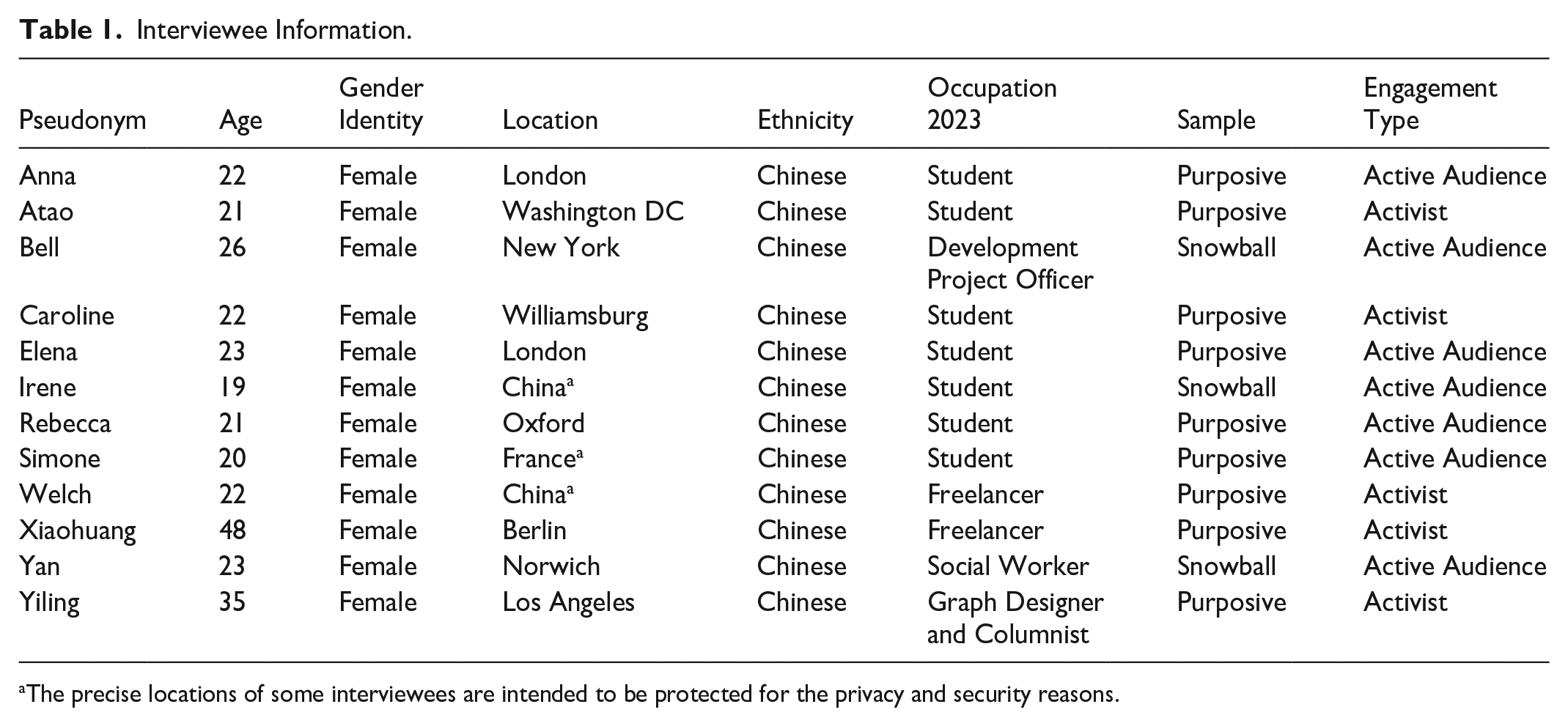
The precise locations of some interviewees are intended to be protected for the privacy and security reasons.
Given the sensitive nature of feminism as a topic, potential interviewees were noticeably hesitant to respond to recruitment advertisements (Heckathorn, 2002). To ensure an adequate number of interviewees for productive discussions and a diverse range of perspectives on the research topic, snowball sampling was also employed. Interviewees recommended others of their acquaintances fitting the interviewing inclusion criteria. This approach enabled this study to access interviewees through participants’ networks who were actively involved in feminist practices on Instagram. It further offered profound insights into the connectivity and solidarity among Chinese women and feminists.
Out of 690 total Instagram posts shared by the interviewees, 184 were selected as an additional dataset for analysis. These posts, which were published between 19 September 2021 and 20 November 2023, specifically related to Chinese women and broader issues concerning women and feminism. Holsti (1969) defines content analysis as “any technique for making inferences by objectively and systematically identifying specified characteristics of messages” (p. 14). Analysis of these posts sought to determine “trends and patterns in word usage, their frequency, relationships, and the structures and discourses of communication” (Vaismoradi et al., 2013, p. 400). The direct link between these posts and the interviewees positions these Instagram posts as mediated technologies recording individual and cultural memories, as “the internet doesn’t forget” (García-Gavilanes et al., 2017, p. 1). Therefore, the content analysis of these descriptive posts provides a solid factual foundation to support the qualitative insights from the interviews.
Data analysis
This study primarily employed TA, owing to its advantageous flexibility to identify, analyze, and report “themes” (i.e., recurring opinions), allowing for a structured and detailed exploration of the dataset (Braun & Clarke, 2006, p. 79). This study applied inductive/deductive hybrid coding, adhering to a codebook approach (King, 2012) (see Table 2). This approach was beneficial in examining intricate and multi-layered issues (e.g., the interplay between the transnational trend and Chinese digital feminism). Inductive coding aims to explore new findings driven by data and avoid “analytical preconceptions” (Braun & Clarke, 2006, p. 83). It operated within a constructivist framework, seeking “more latent, deeper themes” (Kiger & Varpio, 2020, p. 847), as meaning and experience are shaped and perpetuated through social interactions and structures (Burr, 1995). Comparatively, deductive coding intends to well organize the data, identify relevant data with a key focus on research questions (Bingham & Witkowsky, 2021, p. 133).
Example From A Selected Section of the Codebook.

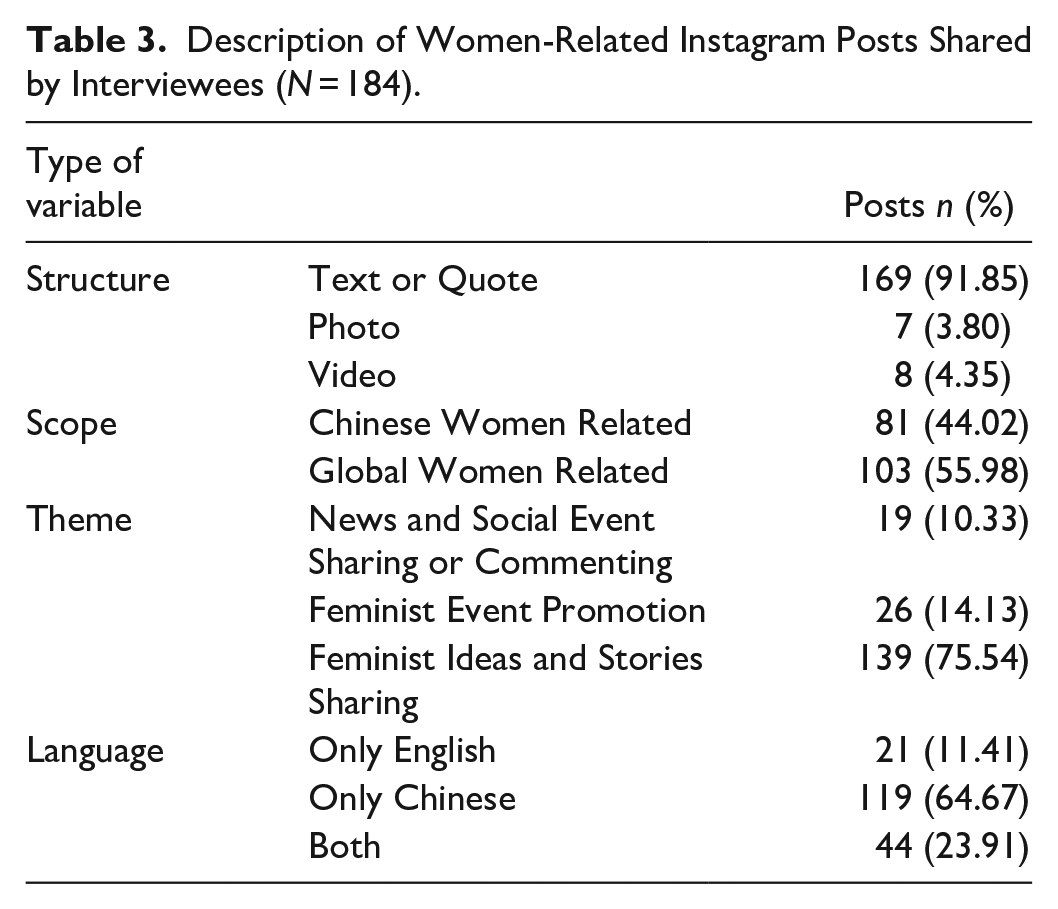
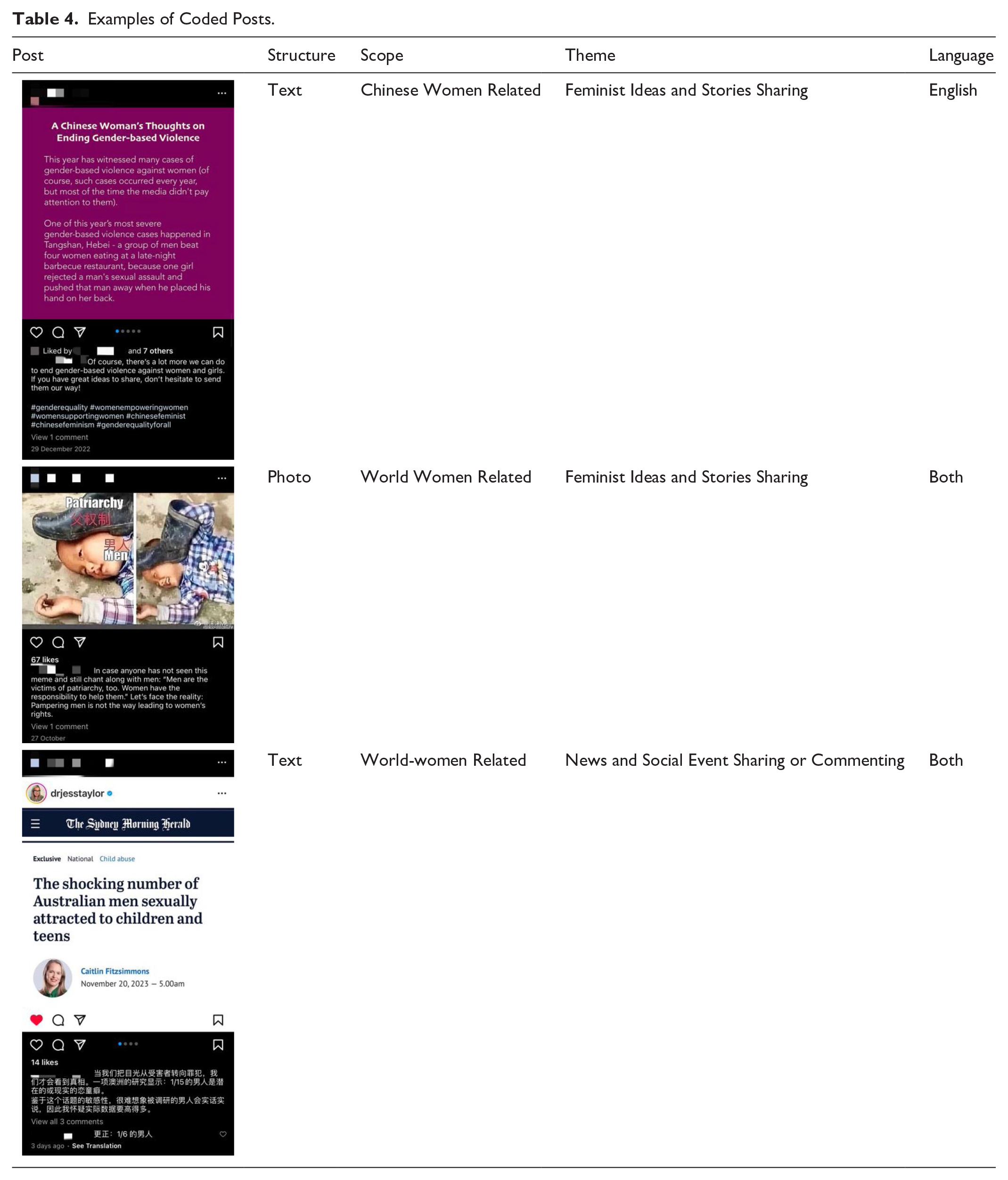
The content analysis of the interviewees’ Instagram posts found three themes inductively: (1) sharing or commenting on women-related news and social events, (2) promoting feminist events, and (3) sharing feminist ideas and stories. In this context, “women-related” content encompasses subjects descriptively pertinent to women’s experiences, roles, or concerns. Meanwhile, “feminist” content inherently centers on critically examining gender inequalities and often advocates for social change. This includes scrutinizing power structures, challenging patriarchal norms, and confronting systemic issues that impact women. A frequency table was employed to detail the structure, scope, theme, and language of these posts. This approach facilitated the examination of “patterns and trends” (Stemler, 2001, p. 1) in the posts related to Chinese women and feminism on Instagram (see Tables 3 and 4). It was carried out using the four-phase “social media-to-concepts” methodology (Lai & To, 2015, p. 141), which includes (1) Definition of Goal and Scope, (2) Data Collection, (3) Data Transformation, and (4) Interpretation of Results.
Description of Women-Related Instagram Posts Shared by Interviewees (N = 184).
Examples of Coded Posts.
Findings and discussion
Transnationality: multi-layered connectivity as the prerequisite to construct Chinese women’s gendered memories
Layer one: Chinese digital feminism on Instagram and home-grown social media platforms
The collective memory of Chinese women stems chiefly from an emotional connection with the past. It is not essential for these women to have experienced the same or a similar event; rather, it is about existing within a comparable social context and possessing a holistic understanding of the past within the group. In the context of Covid-19, almost all participants identified their increased use of Instagram to engage with and articulate issues about Chinese feminism. Their increased Instagram uses arose from a lack of sufficient information and a space for self-expression and dialogue on home-grown social media platforms. Consequently, several participants concurrently referred to their access to Instagram as an “outlet” for these purposes.
I find that discussing Chinese feminism on Instagram serves as a sort of emotional outlet, particularly during the pandemic when I felt especially stifled. I felt as if I were on the verge of madness. Expression became my only means of releasing my negative emotions, reassuring me that I still had something meaningful to pursue (Irene).
The notion of “political depression” became particularly evident. Interviewees frequently used words like “powerless” and “emotionally drained” to describe their feelings about gender issues in China. Interviewees frequently referenced a series of triggering public events during the coronavirus pandemic that shaped their collective memory of the challenges faced by Chinese women in that period. These events included, but were not limited to: the misrepresentation of female health care workers in mass media, trivializing their self-sacrificial contributions in fighting the pandemic; a noticeable rise in domestic violence cases during lockdown and quarantine periods; the Xuzhou chained woman incident, which involved a mentally disturbed women who had been unlawfully chained to a wall, and gave birth to eight children, the video unfolding her situation went viral on Chinese social media.
The collective sense of negativity toward gendered memories of the past among participants was not only attributed to these specific events but also the increasingly stringent online censorship and surveillance. This top-down approach effectively curtailed public outcry on gender issues, leaving Chinese women and feminists particularly vulnerable when participating in gender-related discussions on home-grown social media. Almost all interviewees recounted experiences of being silenced or having their accounts deleted on various domestic platforms, whether they were creating original content or reposting. Yan referred to this phenomenon as a “chain-like serial account deletion.”
I often feel restricted by the affordances of Chinese platforms. I posted about feminism on Xiaohongshu during International Women’s Day. [. . .] I remain uncertain as to which specific element—be it the images or words—triggered the platform’s censorship algorithms. Xiaohongshu labeled my post as a violation of its regulations and disallowed the publication. While the post did go through after converting my text into images, it received a disappointingly low number of views and likes (see Figure 1). (Simone)

Simone’s Instagram post on 08 March 2023 with the caption “Women’s Day Manifesto,” originally shared on Xiaohongshu (RedNote). It was swiftly removed for “allegedly containing inappropriate suggestive material.”
Critically, several interviewees also acknowledged the recent progress of digital feminism on China’s home-grown social media platforms. They have observed that in China, digital feminism is on the rise, partly because more people are embracing feminist views and spreading feminist ideas online. Despite the noticeable advancement in Chinese women’s digital discursive power, some believed that the growing volume of Instagram posts concerning Chinese women has made this foreign-based platform a more attractive option for open expression. China’s gender issues are gaining increased visibility and generating significant attention on Instagram.
I do feel that the feminist movement in China has gained increased attention and visibility on Instagram. I have noticed that many accounts emerged during the pandemic, or if they existed prior, the pandemic has considerably heightened their exposure. (Bell) On Instagram, I often check the latest updates on certain matters that have been censored. [. . .] Due to the limited space to disseminate these voices within the Great Firewall, people turn to Instagram. However, I believe the core subjects of the feminist discussions remain unchanged. (Irene)
While Taneja and Wu (2014) suggest that the online behaviors of Chinese netizens are more influenced by cultural proximity than internet censorship, the findings of this study indicate that, at least in terms of online expressions and practices of Chinese feminism, it is difficult to ascertain which factor has a more significant impact. The restrictive media landscape in China emerges as a key reason for the shift to Instagram as an alternative space for constructing gendered memories. Simultaneously, Chinese women’s gendered remembering on Instagram is largely focused on gender issues in China, driven by a persistent concern for Chinese feminism due to cultural proximity. This results in the transnational connectivity between the content and discussion topics on Instagram and those on China’s domestic platforms, as evidenced by the content analysis of participants’ Instagram posts. Notably, a significant portion (44.02%) of their posts is centered on Chinese women-related content. Often, this connectivity follows a chronological pattern, with trending topics from within China being later transferred to Instagram for memory archiving, more open discussions, and breaking silences (see Figure 2).

Welch’s Instagram post on 29 June 2023 about Weibo trending hashtags about feminism.
Layer two: Chinese women and feminists overseas and in China
Almost all participants belong to the Chinese diaspora, having studied, or lived abroad, yet retaining strong ethical and cultural ties to China. Participants operating private Instagram accounts engage with content related to Chinese feminism on Instagram mostly through receiving, sharing, and interpreting feminism-related posts within a confined scale. They were attracted to Instagram initially by its distinctive features that facilitate social networking with a considerable degree of privacy. For this reason, participants’ attitudes toward being publicly associated with feminism or being labeled as feminist are varied. Affected by the stigmatization (Huang, 2023, p. 9) and depoliticization (p. 14) of feminism within the Chinese context, a few participants indicated a preference for quietly following and viewing feminist-related posts rather than actively engaging in public discussions on these topics, even on foreign-based platforms. Comparatively, others actively shared content related to Chinese feminism, harboring no apprehensions about being labeled as feminists by their friend-followers. The varying willingness to publicly express their feminist identity significantly influences their level of online engagement with gendered memory constructions.
Although I am a little ashamed to admit it, another reason I am really not too keen on reposting Instagram posts about women’s issues is that I do not really want to be tagged as a feminist. (Anna) I believe that for those of us who are particularly concerned with Chinese feminism and deeply engaged with these issues on Instagram, we may be perceived as rather radical feminists. “Radical” is not a term that is generally embraced. [. . .] However, I consider this radicalism to reflect our forward-looking vision that transcends the zeitgeist. (Elena)
The diversity among participants also helps explain the differences in their eagerness to act as connectors between women and feminists in China and those overseas. Their transnational role as intermediaries is unique considering their status as cosmopolitan Chinese diaspora members, and their access to both China-based and foreign-based digital environments simultaneously. Some interviewees are inclined to share content from Instagram on domestic social platforms, engaging in nuanced conversations and limited circulations within their familiar circles in China.
Platforms like Instagram are widely used by young people of my age, and almost all of us have private accounts. Therefore, the scope of information dissemination related to Chinese feminism is largely confined to a specific circle of friends or acquaintances. [. . .] Compared to my use of home-grown social media, I am much more carefree when sharing on Instagram; the degree of self-censorship is considerably reduced. (Simone)
In contrast, others prefer to keep their feminist discussions exclusively on Instagram, hesitating to reveal their feminist interests on home-grown platforms, or to their offline social networks. While Instagram offers Chinese women a relatively unrestricted platform to express themselves freely, the frequent stigmatization of feminism on home-grown social media and in offline spaces in China makes feminist participation and expression an evident burden for some of the interviewees. They are interested in women’s issues, but they prefer to engage in a quieter, more reserved way.
On Instagram, I am more likely to simply “like” some posts. My account is primarily a space for sharing personal life moments. I am conscious that a diverse audience might see my posts, including schoolmates, and there are matters I would rather not expose to a broad viewership within my offline social relations. (Rebecca)
As a result, transnational connectivity between women in China and those living overseas is fragmented. Such a dynamic further generates a noticeable divergence in the collective memories among Chinese women. While they may experience or witness similar gender-related events, the development and shaping of their memories are significantly influenced by varying degrees of online engagement, as well as the different narratives and discourses present on both domestic and foreign-based social platforms, leading to variations in their collective remembering.
Layer three: Chinese feminism and global feminism
As a foreign-based platform, Instagram affordances empower Chinese users by offering transnational opportunities and avenues for new forms of communication (Cummings & O’Neil, 2015), increasing social capital and potentially integrating them into “(trans)national political spaces” (Sreberny, 2001, p. 64; cited in Shome, 2006, p. 264). On one hand, some participants have observed the active participation of Chinese women abroad in overseas feminist conversations and movements on Instagram. During major international feminist protests, the active involvement of Chinese women is visible, exemplified by their expressions of solidarity on Instagram with the women’s revolution in Iran, ignited by the tragic death of Mahsa Amini. On the other hand, the consensus among those interviewed is that Chinese feminism seems to have garnered only minimal support or attention from international communities on Instagram. These findings suggest that the transnational connectivity between Chinese and global feminism evolves into a pattern characterized more by a unidirectional flow rather than a two-way, interactive exchange.
I have attempted to reach out to feminist scholars in the UK and Germany while producing my podcast, but each one has declined, perceiving a barrier when it comes to Chinese feminism. [. . .] It is challenging to make Western feminists recognize the significance of Chinese feminism at this moment. (Xiaohuang)
In addition, many participants hold the view that the challenges encountered by Chinese women stem from China’s unique national and cultural context, following a distinctive, comprehensive image of historical experiences. Consequently, they believe that this culturally specific form of gendered memory lacks a certain degree of compatibility or interchangeability with global feminism. This perspective is encapsulated in the words of the interviewee Irene, who argues, “[. . .] These globally disseminated feminist ideas and perspectives merely provide Chinese women with a glimpse into alternative possibilities for women’s lives.”
Despite the widespread availability of social media like Instagram, which is designed to enable transnational communication, significant challenges remain. There exists a pronounced divide between the Western-centric concept of “global sisterhood” (Bahramitash, 2009) and third-world feminisms, such as Chinese feminism. This gap makes the transnational connectivity and solidarity between North and South feminists difficult to build due to cultural, linguistic, and economic differences. Consequently, as Shome (2006, p. 258) highlights, the “politics of representation” remains a crucial aspect of transnational feminism. The empowerment of women from the global South to craft their gendered discourses and collective memories within the transnational media landscape is key to reshaping existing imbalanced power dynamics. This process fosters a reciprocal interaction with the erstwhile dominant narrators of gendered memory, further reshaping the collective remembering of women from both the global North and South. Despite the significant disparities between North and South feminists, the emergence of such a transnational collective memory helps prevent the erasure of marginalized groups’ collective memories, which typically occurs due to exclusive and subjective remembering controlled by the most powerful entities.
However, China’s relatively insular digital environment limits the number and diversity of Chinese users on foreign-based social media platforms like Instagram (Shu et al., 2018; Sun, 2021). This situation poses questions: Can the global presence and transnational digital engagement of Chinese women and feminists create collective memories as the social representation that authentically reflects Chinese women? Is this social representation as the carrier of Chinese women’s collective memory strong enough to transnationally challenge the Westernized notions of global sisterhood?
Transnational representations: social carriers in constructing the distributed version of Chinese women’s collective memory
Vamps—cultural representation
Language serves as the primary medium through which we interpret, generate, and exchange shared meanings in the remembering process. It is considered as the main repository of cultural values and significance through collective remembering (Wertsch & Roediger, 2008). Disch (2016) outlines the conceptual transformation of cultural representation from “a concern with media stereotypes of women to a conception of texts as signifying systems rather than mirrors” (p. 787). Accordingly, the language used to express and practice Chinese feminism on Instagram has become a key concern for both active audiences and activists. Given that language shapes memories and remembering mediated by narratives, interviewees attempt to represent Chinese women in a culturally and appropriately nuanced manner on the global digital stage.
Of the 184 posts collected that relate to women, more than half (64.67%) were composed in Chinese, as evidenced in both the images and captions. The main reason cited by interviewees for choosing Chinese is its ease of self-expression. They believe that communicating in their mother tongue maximizes clarity and minimizes the risk of distorted narratives that might arise from language barriers. In addition, some interviewees argue for the necessity of developing a unique linguistic and discursive framework for constructing and shaping collective memories of Chinese women. They assert that the Chinese language is essential in this context, viewing it as the only medium capable of fully conveying the complex cultural nuances inherent in Chinese feminism.
My target audience specifically comprises Sinophone women. This Instagram account was originally created for the feminist podcast I had been producing using Chinese (see Figure 3). (Xiaohuang)

Xiaohuang’s Instagram post on 28 October 2023, written in Chinese, shares a quote from Tianyibao, one of the earliest Chinese feminist magazines.
On the other hand, interviewees who practiced Chinese feminism in English on Instagram believed that the Chinese linguistic system has been “polluted” when it comes to expressing gender issues. By contrast, English allowed for a more gender-accurate and inclusive expression of their views. Moreover, especially for Chinese diasporic feminists, when they were introduced to diverse feminist concepts, such as ideas of structural violence or intersectionality, they were mostly originally presented in English. As a result, they found it strange and unknown to say these notions in Chinese. Critically, some participants also self-reflect that the use of specific feminist terminology did ensure that they could communicate and understand each other among people in their networks, such as those with similar educational backgrounds. However, particularly when taking the role of activists disseminating feminist content to the wider public, the use of such terminology could be potentially exclusive for some women who were not familiar with these terms or concepts. Inclusivity of feminist discourse is therefore critical to enable the intercultural construction of gendered memories and transnational solidarity among women over the digital globe.
Since we must translate much of our content into English on Instagram, this requires additional effort and time. Compared to the content we released on Chinese platforms using Chinese, the posts on Instagram are significantly more concise due to the different languages we chose (see Figure 4). (Yiling)

Yiling’s Instagram post in English about Chinese women.
The value systems of the interviewees, another cultural tool instrumental in shaping collective memory, demonstrate “cultural hybridization and synchronization” that influences their digital engagement and expression (Fung, 2000, p. 157). The interviewee Elena, for instance, pointed out that Confucianism remains a significant ideological influence in culturally shaping Chinese feminism. This aligns with the notions of “cultural nationalism” (Wesoky, 2016, p. 55) and blends the Confucian ideal of a “harmonious society” with “a new female identity” (Chang et al., 2018, p. 325) in the context of China. Moreover, as neoliberal narratives gain traction on Chinese social media, they undergo constant adaptation in the course of their transnational dissemination. Blended cultural ethics emerge from the intersection of neoliberalism and the Chinese cultural setting (Li, 2023). The engagement with Chinese feminism to construct gendered memories on Instagram is perceived by most interviewees as an interactive process. This process of collective remembering is facilitated by the intercultural environment on Instagram. The interviewees’ value systems are continuously influenced and updated by other cultural norms. Accordingly, the cultural representation of Chinese feminism on Instagram evolves into a more culturally complex narrative of collective memory, incorporating global gendered cultural constructs and perspectives.
Visibility—historical representation
Previous “standards of historical significance” were primarily constructed by men, women were not seen as “active agent[s] of history” (Scott, 1998, pp. 17–18; quoted in Disch, 2016, p. 787). Feminist historians have shaped theories of women’s visibility by highlighting the construction of “women’s history” and examining the “historical context of categories like ‘woman’ and ‘lesbian’” through which women have been historically represented (Disch, 2016) in collective memories (pp. 790–791). In this study, several interviewees highlighted the misrepresented women’s public images in both mainstream and social media narratives. This has historically distorted women’s active contributions and diluted their visibility within Chinese collective memories.
Consequently, most interviewees viewed the expression and participation in Chinese feminism on Instagram as highly significant for Chinese women, especially those who were marginalized or instrumentalized during major historical events like the coronavirus pandemic. Their roles as active historical agents have often been overlooked or diminished. Hence, Instagram emerged as a vital platform for enhancing the visibility of Chinese women in collective memory, providing a space for their stories and contributions to be recognized and valued. Participants who are feminist activists on Instagram intend to challenge and overturn traditional patriarchal and male-centric historical narratives, adopting a feminist lens to reshape collective memory. Their efforts focus on re-examining various historical or present events from a perspective that emphasizes women’s involvement, striving to ensure that women’s contributions are not overlooked or rendered invisible in historical accounts of remembering. While some participants acknowledge that enhancing the visibility of Chinese women on Instagram may only have a limited impact on advancing gender justice within China, they believe that any action, no matter its scope, is better than no action at all. This pragmatic stance on using platforms like Instagram for feminist activism recognizes their potential to incrementally contribute to broader dialogues and enhance public consciousness of the roles and rights of women, both historically and in contemporary society.
Our key aim of having this Instagram public account is to provide a safe space for women to express themselves, which led me to launch the “Call for Chinese Feminist Narratives” campaign during the pandemic (see Figure 5). [. . .] We ourselves were in a rather fragmented state during the pandemic. Being situated in the United States as Chinese diasporic women, we have the privilege of enjoying a relative freedom of speech—a privilege many do not have. Therefore, we feel it is our responsibility to utilize this privilege to do what others may not be able to (see Figure 5). (Atao)

Atao’s Instagram post about “call for Chinese feminist narratives.”
Essentially, individuals are affiliated with multiple social groups centered around family, age, profession, gender, or nation. Our brains encode “multiple systems of collective memory,” sometimes leading to conflicting or contradictory recollections, potentially leading to psychological and social tensions (Dudai, 2002, p. 51). The participants’ gendered collective memories often clash with mainstream societal and media narratives about women or gender-related issues, resulting in their psychological strains regarding women’s issues in China. On Chinese social platforms, these women actively strive to shape collective memories by voicing their opinions, bringing attention to gender injustices previously unconscious in a patriarchally influenced culture. Instagram thus becomes a crucial platform, enabling these women to vocalize unexpressed or censored thoughts, contributing to collective memory in the digital realm. However, it is crucial to recognize that this “collective memory” is constrained in terms of scope, space, and time, largely because of its limited visibility and reach to the broader public.
Voice—political representation
Political representation indicates a complex interplay between individuals experiencing oppression and the “movement that claim or aspire to act in their names,” which is mostly raised from the marginalized and neglected (Disch, 2016, p. 791). From the interview findings, a complex “dual” nature of the political representation of Chinese digital feminism on Instagram was identified, reflecting varying levels of power dynamics in the construction of gendered collective memory.
First, many interviewees acknowledged that access to Instagram signifies a form of privilege among certain Chinese individuals, thereby restricting the class-representative breadth of their feminist expressions and advocacies on this platform. While they could descriptively represent Chinese women to some degree due to linguistic and cultural ties, their social status, along with their economic, social, and cultural capitals, imposed significant constraints. These factors infused elitist elements into their efforts to constitutively shape a global image or identity for Chinese women through campaigns and expressions on Instagram. This inherent limitation results in the social representations of Chinese women and the development of collective memory on Instagram being a “distributed version” of collective memory (Wertsch, 2009, p. 119). It manifests socially through interactions within small groups, yet also operates “instrumentally,” involving both active agents and various tools that facilitate the process of remembering. However, some interviewees pointed out that while they might not fully represent all Chinese women on Instagram, this gap underscores the necessity for greater efforts to make Chinese feminism on Instagram intersectionally inclusive. This involves acknowledging and addressing the diverse experiences and challenges faced by Chinese women across different social strata, geographical locations, and cultural backgrounds.
I think that the ability to participate in feminist discourse, or to take action, is a privilege. For instance, the struggles faced by women in rural areas of China are fundamentally different from the issues that concern us as diasporic feminists. [. . .] It does not mean we should cease our engagement with them; rather, this very issue should galvanize us to redouble our efforts. (Bell)
Moreover, some participants expressed self-reflection and skepticism regarding the ability of Chinese women’s political representation on Instagram to significantly alter their marginalized status in constructing gendered memory. Nonetheless, they maintained a sense of optimism, suggesting that while an immediate transformation of prevailing power dynamics through digital representation might not be achievable, a gradual shift is possible as Chinese women persist in expressing their experiences on foreign-based platforms like Instagram. Tuzcu (2016) captures this sentiment by describing the “feminist excitement” toward digital spaces not as a quick fix that eradicates all existing barriers, but rather as a gateway to new forms of political engagement that embrace differences (p. 150). This perspective resonates with the approach of Chinese Instagram users, who view the platform as an alternative avenue for representing Chinese women in a way distinct from that in home-grown social media. This approach acknowledges the gradual, yet potentially impactful, nature of digital advocacy in reshaping narratives and memories around Chinese women and their role in society, both locally and globally.
[. . .] Each additional voice amplifies our reach to individuals who may not have previously considered these gendered issues. A single spark can start a prairie fire. If our audience is sufficiently large, I believe there will be some level of change, even if it is not immediately observable. (Atao)
Conclusion
To conclude (see Figure 6), the digital engagement of Chinese feminism on Instagram has effectively transcended digital national boundaries, notably the Great Firewall. Its transnational presence has substantially provided new opportunities for Chinese feminism to construct gendered memories from the bottom up, challenging the problematic constructions of collective memory related to Chinese women in domestic cyberspace. This development is particularly significant considering the ongoing online censorship and surveillance on home-grown platforms in China. Simultaneously, this transnational trend faces inherent challenges in the process of collective remembering within the context of Chinese digital feminism.

The transnational process of constructing gendered collective memory among Chinese women on foreign-based social media.
Chinese digital feminism’s transnational trend on Instagram has sparked a complex web of multi-layered connectivity, serving as a prerequisite for building gendered memories and reinscribing into public consciousness. It is embedded in intricate networks between diverse subjects and actors, navigating the complex and ever-evolving dynamics: (1) among Chinese home-grown and foreign-based social media platforms, (2) between Chinese women and feminists at home and abroad, and (3) between Chinese and global feminism. While the multi-layered connectivity facilitates the transnational construction of gendered memories, drawing on shared similarities among different actors, it is important to recognize its potential fragility and fragmentation. Language and cultural differences, for instance, create significant rifts between Chinese and global feminism. Consequently, the imagined transnational sisterhood remains elusive due to distinct contexts between China and the rest of the world, with Western feminism often holding sway in the global feminist narrative.
With multi-layered transnational connectivity establishing a shared knowledge base, social representations serve as a carrier for further developing gendered collective memory. This contains cultural representation, rooted in language and value systems; a historical representation that aims at enhancing the visibility of women and reshaping their often-distorted narratives, positioning women as active agents in collective memory constructions. In addition, political representation highlights the privileged position of Chinese women accessing Instagram, typically limited to a certain social class and primarily diasporic women. Therefore, the gendered memories these women create on Instagram essentially represent a “distributed version” of collective memory (Wertsch, 2009, p. 119), reflecting the online expressions and practices of a select segment of Chinese women with specific traits.
Thus, the transnational trend of Chinese digital feminism on Instagram has indeed helped preserve and build gendered memories, challenging mainstream narratives and bringing Chinese feminism more exposure to the global media landscape. However, the gendered memories crafted through their ongoing online engagement have considerable limitations. The relatively homogeneous social group of Chinese women they represent restricts their potential to be fully reinscribed into the broader public consciousness and to constitute a robust collective memory. Nevertheless, this marks a positive beginning, showcasing an alternative pathway for the evolution of Chinese feminism and another possibility for constructing collective memories of Chinese women under globalization.
The article proposes that future research could either track the ongoing transnational trends of the collective construction of gendered memories in the post-pandemic era or focus more deeply on the specific role of diasporic activists within these transnational networks, for a more thorough and nuanced understanding. Overall, as Xiaohuang, a participant in this study, poignantly stated: “True change begins with ‘loving women.’ Love brings both hope and pain, yet my love for them, and this community, remains unwavering. I am proud to be a part of it.”
Footnotes
Acknowledgements
The author would like to express sincere gratitude to Dr. Alessandro Castellini and Dr. Randy Lake for their exceptional guidance, insightful remarks, and extensive feedback, all of which have been immensely valuable in shaping this work.
Author’s note
The research was initially conducted and developed while the author was studying at the Department of Media and Communications at the London School of Economics and Political Science and was ultimately completed during her time at the Annenberg School for Communication and Journalism at the University of Southern California.

Funding
The author received no financial support for the research, authorship, and/or publication of this article.
Declaration of conflicting interests
The author declared no potential conflicts of interest with respect to the research, authorship, and/or publication of this article.