



Abstract
The Querdenken movement, the leading force behind German corona protests, is suspected of being a gateway to far-right attitudes due to radicalizing inward-oriented communication on Telegram. To investigate potential connections of this movement to the far right and alternative media—and to explore key topics of the Querdenken network over time—we analyzed 6,294,955 messages from 578 public Telegram channels via network analysis and structural topic modeling. This analysis revealed that Querdenken’s subcommunities preferably forward content from far-right and QAnon communities, while far-right and conspiracy theorist alternative media channels act as content distributors for the movement. Four main topics appeared in the Querdenken network with varying prevalence over time and across different communities: promotion, QAnon, right-wing populism, and COVID-19 conspiracy theories. Our results highlight potential directions for future research and practical implications, for example, that political decision makers should account for the increasing influence of the QAnon movement on Querdenken mobilizers’ Telegram activity.
Keywords
Introduction
As measures were introduced to fight the SARS-CoV-2 pandemic, a group called Querdenken (thinking against the grain) became the dominating social movement behind corona protests from mid-2020 in Germany (Holzer et al., 2021; Plümper et al., 2021). Querdenken made headlines as a pool of outraged citizens, far-right extremists, conspiracists, and esoterics who distrust the government, media, and conventional medicine (Holzer et al., 2021; Teune, 2021; Vieten, 2020). The far right’s presence at corona protests (Vieten, 2020) suggests an exploitation of the COVID-19 pandemic for the far right’s own purposes, for example, by contributing to growing fears in the general population (Caiani et al., 2012). Yet, the Querdenken protests received only low support in the German population overall (Koos & Binder, 2021).
Although a large proportion of Querdenken protesters were initial Green and Left voters with an esoteric and anthroposophical background (Nachtwey et al., 2020), the perceived overreaching state as a common enemy (Teune, 2021) established support for right-wing populist ideas that softened the boundaries between middle-class Green/Left voters, esoterics, and far-right extremists through anti-elitist grievance (Vieten, 2020). During later protests, Querdenken participants’ reluctance to demonstrate with far-right extremists decreased, while their self-stylization as resistance fighters strengthened the cohesion between the very diverse subcommunities, making the use of violence seem plausible to many (Morris & Guinan-Bank, 2022; Teune, 2021).
Aside from the problematic composition of Querdenken protests, the movement’s increasingly radicalizing inward-oriented communication (Holzer, 2021; Schulze et al., 2022) and polarizing outward-oriented communication pose a threat to German society (Kaiser & Rauchfleisch, 2019). For protesters and leaders of the Querdenken movement, the messenger service Telegram—with its public broadcasting channels that allow unlimited numbers of subscribers—is their most important tool for inward-oriented communication (Holzer, 2021; Koos, 2021). The absence of content moderation made public Telegram channels attractive to far-right mobilizers who were expelled from other social media platforms, such as YouTube, due to their extreme content (Rogers, 2020). The ability to forward messages from one public channel to an unlimited number of other public channels allowed Querdenken to build a dense network of message circulation that potentially amplified skepticism and distrust within the community (Holzer et al., 2021). Due to their radicalizing, inward-oriented communication, Querdenken is suspected of being a gateway to far-right attitudes (Koos, 2021). Despite the far right’s small numbers of online and offline followers, its potential for violence is highly relevant, especially for ethnic or religious minorities and political adversaries (Caiani et al., 2012). This problem will likely persist when new crises emerge to which the far right can adhere (Teune, 2021). However, there is currently a lack of research on Querdenker mobilizers and their communication networks and topics (Koos, 2021). Accordingly, we analyzed the inward-oriented communication of the Querdenken movement within public Telegram channels to explore potential connections to the far right, generated through mutual message forwarding between channels. We also investigated key topics that circulate within the textual messages of this communication network over time.
Formation of Far-Right Networks: First PEGIDA, Now Querdenken?
To understand far-right mobilization, the protesters who are mobilized and the actors who mobilize them must be considered (Caiani et al., 2012). The far right follows renowned patterns to create networks and articulate topics. In particular, the far right relies on new media platforms (e.g., Telegram) to create network structures, using autonomous cells and emerging concerns (e.g., COVID-19) to bridge these concerns to old ideological frames, such as racism or anti-modernism (Caiani et al., 2012). In our paper, we understand the far right as an umbrella concept that includes extreme-right and radical-right variants, being aware of differences within this ideology (see Castelli Gattinara & Pirro, 2019, p. 4).
Many movements have started peacefully but have been radicalized due to a lack of success (Caiani et al., 2012). This process of radicalization can be traced back to online communication and counterpublics (Kaiser & Rauchfleisch, 2019). A counterpublic is a specific form of networked public sphere that is structured around a polarizing issue opposed to the dominant hegemony, marginalized, and/or excluded from the dominant public discourse, and in possession of its own influential media outlets (i.e., alternative media; Kaiser, 2017). Here, alternative media “represent a proclaimed and/or (self-) perceived corrective, opposing the overall tendency of public discourse emanating from what is perceived as the dominant mainstream media in a given system” (Holt et al., 2019, p. 862). Accordingly, alternative media are outlets that criticize mainstream media, promote activism, and devote their work to issues, opinions, values, and events not discussed by mainstream media (Rauch, 2014). Counterpublics can pose two main problems: radicalization if a counterpublic is publicly ignored or polarization of the public if its ideas are accepted (Kaiser & Rauchfleisch, 2019).
One example of a German far-right movement that used social media and the networked public sphere to evolve into a counterpublic is PEGIDA (Patriotic Europeans Against the Islamization of the Occident; Vorländer et al., 2019). This movement was triggered by the 2015 refugee movement and the belief that conspiratorial powers aim to Islamize Germany, casting refugees as a tool of Islamization and expulsion as the solution (Vorländer et al., 2019). However, PEGIDA was heavily struck by the deletion of its Facebook page (Vorländer et al., 2019), an early example of deplatforming. Although deplatforming can thin out far-right audiences (Rogers, 2020), far-right actors can quickly recreate similar structures on Telegram (Urman & Katz, 2022). Since 2019, the Western far right has migrated to Telegram, rapidly establishing connections on this platform (Rogers, 2020; Urman & Katz, 2022). Thus, Telegram acts as a refuge for the operations of deplatformed far-right forces (Rogers, 2020).
Similar to PEGIDA, Querdenken is structured around a triggering event: the government’s response to the COVID-19 pandemic. Following previous research (e.g., Koos, 2021; Teune, 2021), we compare Querdenken and PEGIDA because we find patterns in the Querdenken movement that we have already seen at PEGIDA (e.g., organizing around a triggering event, using alternative media offerings to communicate and connect). In addition, the Querdenken movement contains former actors of the PEGIDA movement. We suggest that there is a dynamic base of anti-democratic actors in Germany that evolve around different crises (e.g., the refugee movement 2015, the Corona pandemic). An initial analysis of Querdenken’s Telegram channel network showed that the majority of its forwarded messages led to other public Telegram channels, alternative media, or YouTube videos that denied the COVID-19 pandemic, criticized the government’s measures, or spread conspiracy theories (Holzer, 2021). Querdenken channels relate to either public Telegram channels that consider themselves as alternative media but are run by individual users (presenting themselves as unbiased, uncut, or uncensored) or professional media domains, such as Russia Today (RT), Sputnik News, or Epoch Times (Holzer, 2021). Querdenken mobilizers made use of Telegram even in the early stages of the movement, as the messenger service provided an unmoderated technical infrastructure through which they could immediately organize nationwide protest actions (Holzer et al., 2021). Unlike PEGIDA, Querdenken strategically organized protests in times of low infection rates but strict containment measures and in densely populated regions with great political discontent (Plümper et al., 2021). Protest organizers deliberately aimed to mobilize not only pandemic policy skeptics but also conspiracists and political radicals (Plümper et al., 2021). In addition, recent research shows that Querdenken had support of an established party, namely the right-wing populist AfD (Alternative für Deutschland). Several AfD politicians cooperated with Querdenken, adopted their claims, and helped with the protest mobilization, which not only polarized the party itself but also the entire German Bundestag (Heinze & Weisskircher, 2022). However, to whom exactly Querdenken mobilizers are connected is a research gap (Koos, 2021). Thus, we asked: (RQ1) How are the actors that comprise the Querdenken sphere on Telegram connected to far-right and alternative media channels?
PEGIDA, Querdenken, and Social Media: Different Triggering Events, Same Topics?
A network of the German far-right sphere on YouTube evolved around the 2015 refugee movement and promoted anti-Semitic conspiracy theories. This network contained alternative media channels that connected various subcommunities (Rauchfleisch & Kaiser, 2020). As part of this far-right sphere, PEGIDA mainly relied on one Facebook page (Vorländer et al., 2019) and several Facebook groups (Haller & Holt, 2019), mobilizing politically apathetic people (Dostal, 2015) who readily demonstrated approval of far-right attitudes (Kocyba, 2018). The PEGIDA Facebook page served as a forum for inward-oriented communication, and the radicalizing reinforcement on this page was crucial in developing a counterpublic (Vorländer et al., 2019). Research has shown that five topics were most prevalent on PEGIDA’s Facebook page: immigrant criminality, demonstration organization, Islam, Lügenpresse (lying press), and contempt for politicians and their alleged conspiratorial intentions (Stier et al., 2017; Vorländer et al., 2019).
It is evident that Querdenken protesters are driven by COVID-19 denial; a rejection of political, scientific, and media systems; and conspiracy theories, including anti-Semitism, anti-vaccination ideology, and central ideas of the QAnon movement (Koos, 2021; Nachtwey et al., 2020). Originating from the United States and spreading worldwide, the QAnon conspiracy theory and the underlying movement assume that secret intriguers run a child sex-trafficking ring and are working against Donald Trump (Hoseini et al., 2021). A troubling parallel between Querdenken and PEGIDA is their collective identity of standing against the mainstream, which is not necessarily a right-wing stance but leaves them susceptible to right-wing radicalization (Koos, 2021; Nachtwey et al., 2020). An initial content analysis of three Querdenken Telegram channels between March 2020 and February 2021 revealed a steep increase in the prevalence of conspiracy narratives, anti-elitism, and calls for activism, indicating a radicalization dynamic within Querdenken’s inward-oriented communication (Schulze et al., 2022). While we know core topics, actors, and goals for the far right (see Caiani et al., 2012; Mudde, 2016), these are not clearly defined yet for Querdenken mobilizers. What is known so far is that the Querdenken movement cannot be clearly assigned politically, but that it reaches out to many (including far-right) political milieus; that Querdenken protests are locally very diverse in composition, but united in anti-elitism; and that conspiratorial ideas and general distrust strengthen cohesion of the movement, but also have a radicalizing effect (Teune, 2021; Vieten, 2020). Therefore, just as we understand the far right as an umbrella concept for the broad spectrum of right-wing ideologies (Castelli Gattinara & Pirro, 2019), we understand Querdenken as an umbrella concept for anti-democratic and conspiratorial actors which establish their consensus on Telegram and can act as a bridge to far-right ideology (Koos, 2021; Teune, 2021).
To shed light on the assumption that Querdenken’s network of message circulation is indeed a gateway to far-right attitudes (Koos, 2021) and to expand upon previous research (Holzer, 2021; Schulze et al., 2022), we asked, (RQ2) What topics are discussed in the public Telegram channels of the Querdenken sphere, and how have they changed over time?
Methods
Study Design
We conceptually replicated the work of Rauchfleisch and Kaiser (2020), given the aforementioned similarities between the Querdenken sphere on Telegram and the far-right sphere on YouTube. Consequently, we compiled a list of Telegram channels belonging to the Querdenken movement and the far right. We then identified the most important parts of Querdenken’s communication network, including its various sub-communities. Afterward, we used structural topic modeling (STM; Roberts et al., 2019) to elaborate the core topics of Querdenken’s message circulation network. This study was evaluated and approved by our institutional ethics committee.
Sampling
The population of public Telegram channels and channels of the Querdenken movement was unknown. Thus, we used multiple seed lists and snowball sampling to gradually identify public Telegram channels related to our research questions. Please refer to our Online Appendix for the detailed sampling description. 1
The first seed list encompassed 238 Telegram channels and included both Querdenken-related and far-right actors. We used the Telegram API and the Telethon Python package to scrape all messages from these public channels. For seed list two and three, we used the scraped data, identified public Telegram channels that were forwarded at least 50 times, and aligned the time periods of the collected messages. Finally, we extracted Telegram-specific URLs from all collected messages to scrape public channels mentioned 50 times or more as well. The final composition of our dataset is shown in the Online Appendix in Table A1. In summation, our dataset encompassed 6,294,955 messages from 578 public Telegram channels sent from 28 October 2015 to 3 January 2022. These channels belong or are related to the Querdenken sphere through mutual message forwarding.
Network Analysis Workflow
To analyze the message circulation network, we analyzed all identifiable 1,225,406 forwarded messages from the 578 collected channels (19.5% of the entire dataset). We used the backbone package for R to extract the binary backbone (i.e., the graph preserving the most meaningful edges) of a weighted and directed unipartite network containing 557 nodes (Domagalski et al., 2021). An edge was retained in the backbone if its weight was statistically significant (alpha = 0.05) using the disparity filter (Serrano et al., 2009), which retained 10.9% of all edges (n = 4,208).
Community Detection and Labeling
We applied community detection to separate the backbone into groups of nodes that were more closely connected to the nodes within their respective communities (Urman & Katz, 2022). We used the Infomap algorithm (Rosvall & Bergstrom, 2008) due to its excellent performance on directed graphs (Lancichinetti & Fortunato, 2009), its suitability for answering questions about the flow of communication (Smith et al., 2020), and its ability to correctly detect communities in small networks (Yang et al., 2016).
For each channel in the backbone network, we calculated the authority score (Kleinberg, 1999), as well as in-degree, out-degree, betweenness, and eigenvector centrality. We then describe communities whose member channels made up 1% or more of the backbone network in total (Urman & Katz, 2022). This resulted in 19 communities, which we labeled based on their respective top 20 most authoritative channels (Urman & Katz, 2022).
Categorizing the Backbone of Querdenken’s Network
Next, we categorized all 557 channels in the backbone as Querdenken, far-right, or alternative media. Channels were labeled Querdenken if they were listed by Holzer (2021) or the Twitter profiles’ movement reports (n = 156, see detailed sampling description in the Online Appendix). Channels were labeled far-right (n = 163) if they appeared in Rauchfleisch and Kaiser (2020), Urman and Katz (2022), or Caiani et al. (2012). Combining the appendices of these three works yielded a list of 27,228 far-right actors, which we matched with our list of channels. We used the R package stringdist (van der Loo, 2014) and a Levenshtein distance of five or less to identify far-right channels in case they had altered their names over time. Channels were labeled alternative media through binary manual coding of their channel names and descriptions following the definition stated by Rauch (2014). An intra-rater reliability test was performed on 10% of the channels (n = 55) a priori (agreement = 100%, Krippendorff’s α = 1.0). We identified 162 alternative media channels in the backbone. Each actor could receive multiple labels, for example, if they appeared in previous data as a far-right journalist but are now part of the Querdenken movement.
Topic Modeling Workflow
Text Cleaning and Preprocessing
For the topic modeling, we excluded messages without text (i.e., photos and videos) and removed stop words and content that did not consist of letters or did not conform to ASCII. We applied language recognition using the fastText package (Mouselimis, 2022) to identify non-German texts. We removed true positive classifications for the most common foreign-language messages (e.g., English, Dutch, and Turkish), but we did not remove less prevalent languages (e.g., Polish or Finnish made up less than 1%) as they did not affect the topic modeling or were misclassified German messages anyway. We also excluded five channels due to large amounts of repetitive, meaningless sentences or non-German language. This text cleaning process removed 1,421,969 messages.
Afterward, we included only messages from the 19 meaningful communities to reduce the number of features included in the STM. These 2,497,679 text messages (39.7% of all collected messages) were summarized per channel per month into one document to guarantee meaningful document length for the pre-pandemic timespan. Finally, we used German and English-language stemmers from the SnowballC package (to stem anglicisms; Bouchet-Valat, 2020) and deleted words that appeared in less than 1% or more than 95% of a document’s messages.
Structural Topic Modeling (STM)
We used STM to determine the topics to include in our sample and to include document-level metadata (e.g., community number) as covariates in the model (Rauchfleisch & Kaiser, 2020). To find the optimal number of topics (K), we ran 41 candidate models (from K = 10 to K = 50 in steps of one) and chose the model with the best trade-off between average semantic coherence and exclusivity. The final model was an STM with 20 topics; 7,845 documents; and a 33,528-word dictionary. The topics were qualitatively validated in three steps per topic. First, we used the words with the highest probability and frequency–exclusivity (FREX) words per topic to create a rough idea of a topic label. Second, we used the top 20 highest β-values per word per topic to identify the most distinctive terms per topic (Maier et al., 2018) and thus arrive at a narrower topic label. Third, we used a random sample of 15 documents with ɣ > .50 per document per topic and inferred the commonality across the included messages to create a final label that most concisely captured the underlying concept. This step involved reading the sampled documents and writing a brief summary of each topic (Maier et al., 2018). Topics were discarded if they did not reveal a coherent semantic meaning across the sampled documents (e.g., Topic 20) or solely represented the content of a single channel (e.g., Topic 5; Maier et al., 2018).
Results
Network Analysis
General Network Description
The most popular channels in our backbone network were far-right conspiracist publicists [oliverjanich (in-degree = 96); EvaHermanOffiziell (in-degree = 67)], QAnon channels [QlobalChange (in-degree = 75); Qparadise (in-degree = 61)], and Querdenken channels [FaktenFriedenFreiheit (in-degree = 70); Haintz (in-degree = 62)]. The most active channels, as measured by their out-degree centrality, mostly shared QAnon-related conspiracy content or were considered far-right alternative media. The gatekeepers controlling the flow of information, as measured by their betweenness centrality, included the far-right publicist Oliver Janich, the Querdenken leader Markus Haintz, six QAnon channels, and two alternative media channels. All centrality measures for all 557 channels of the backbone (including their community memberships and labels) can be seen in our Online Appendix and the respective CSV file. The top 10 most frequently linked websites outside of Telegram were Twitter (n = 134,765), Epoch Times (n = 77,106), Journalistenwatch (n = 28,669), Fox News (n = 23,670), The Gateway Pundit (n = 21,512), Focus (n = 18,397), Breitbart (n = 17,220), Boris Reitschuster (n = 16,681), n-tv (n = 15,334), and Tichys Einblick (n = 14,116).
Communities Within Querdenken’s Message Circulation Network
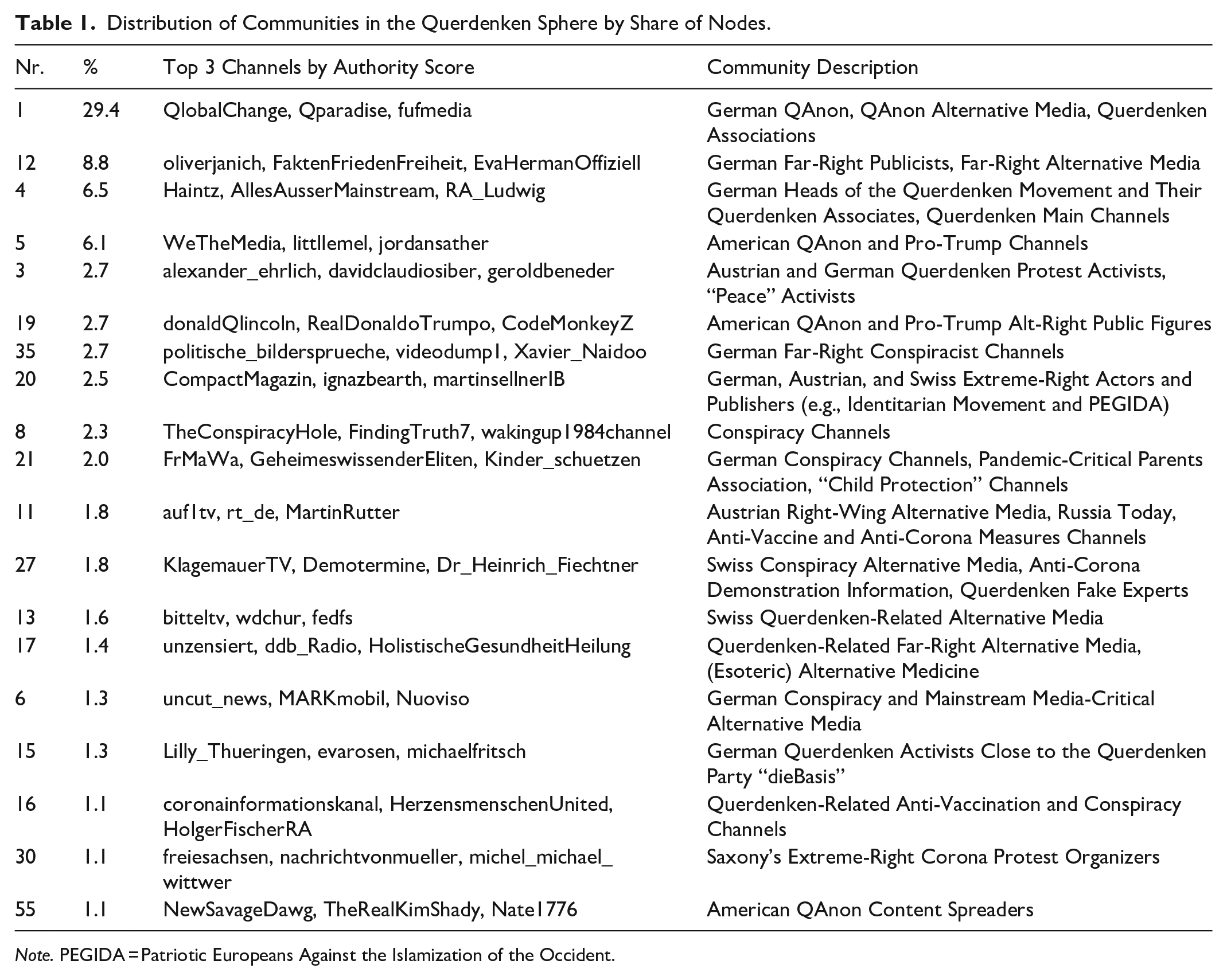
The distribution of meaningful communities in the backbone is presented in Table 1. This distribution revealed a clear but somewhat weak community structure (modularity = 0.28; Newman & Girvan, 2004) including multiple communities. Each community preferentially forwarded its own messages but remained connected to other communities through Telegram’s forwarding feature.
Distribution of Communities in the Querdenken Sphere by Share of Nodes.
Note. PEGIDA = Patriotic Europeans Against the Islamization of the Occident.
The largest community (1) in our network is led by the main entities of the German QAnon movement. It also includes QAnon and right-wing alternative media, German QAnon channels tied to right-wing esotericism, and scattered Querdenken associations. The second largest community (12) is headed by far-right publicists Oliver Janich and Eva Herman, as well as by far-right alternative media channels. The third largest community (4) is composed of the Querdenken movement’s leaders, associations, and main channels. Other smaller communities representing branches of the Querdenken movement have formed around Austrian and German activists (3), Swiss Querdenken media (13), the Querdenken party dieBasis 2 (15), and Querdenken-related anti-vaxxers and conspiracists (16).
Apart from Community 12, we identified 3 other extreme-right communities. Community 35 formed around right-wing extremist Sven Liebich from Halle (Saale) and also includes several right-wing conspiracy channels. Community 20 forms the core of the extreme right in Germany, Austria, and Switzerland; this community includes Lutz Bachmann (initiator of PEGIDA), Martin Sellner (leader of Identitarian Movement Austria and key activist of the New Right in Germany), and Ignaz Bearth (far-right Swiss politician and streamer). Community 30 includes the channel named Freie Sachsen (Free Saxons), an extreme right-wing movement against perceived Corona coercive measures.
Communities 5 and 55 contain American QAnon and pro-Trump channels, while Community 19 contains the channels of American QAnon and pro-Trump public figures. These figures include Ron Watkins (major propagator of the far-right QAnon conspiracy theory), as well as Sidney Powell, Lin Wood, and Michael T. Flynn, who attempted to overturn the 2020 U.S. presidential election and spread QAnon conspiracy theories around the time of the election.
Connections of the Querdenken Communities
From the Querdenken communities—including German leaders of the movement (4), branches in Austria (3) and Switzerland (13), and smaller activist channels (15 and 16)—we filtered out unique edges connecting pairs of communities. Then, for each pair, we counted how many channels of one community were connected to channels of the other community through message forwarding. We found that the German QAnon (1) and German far-right publicist (12) communities were among the top three communities from which Querdenken communities forwarded content, outside of their own Querdenken network (see Table A2, Online Appendix). Message circulation was highest between the German Querdenken leaders, German QAnon, and German far-right publicist communities. Conversely, tracking community connections of German far-right publicists and alternative media (12), we find that in addition to the German QAnon community (1), messages are most frequently forwarded from German conspiracy media (6), Austrian right-wing alternative media, Russia Today, anti-vaxx channels (11), and the German, Austrian, and Swiss extreme right (20).
Topic Modeling
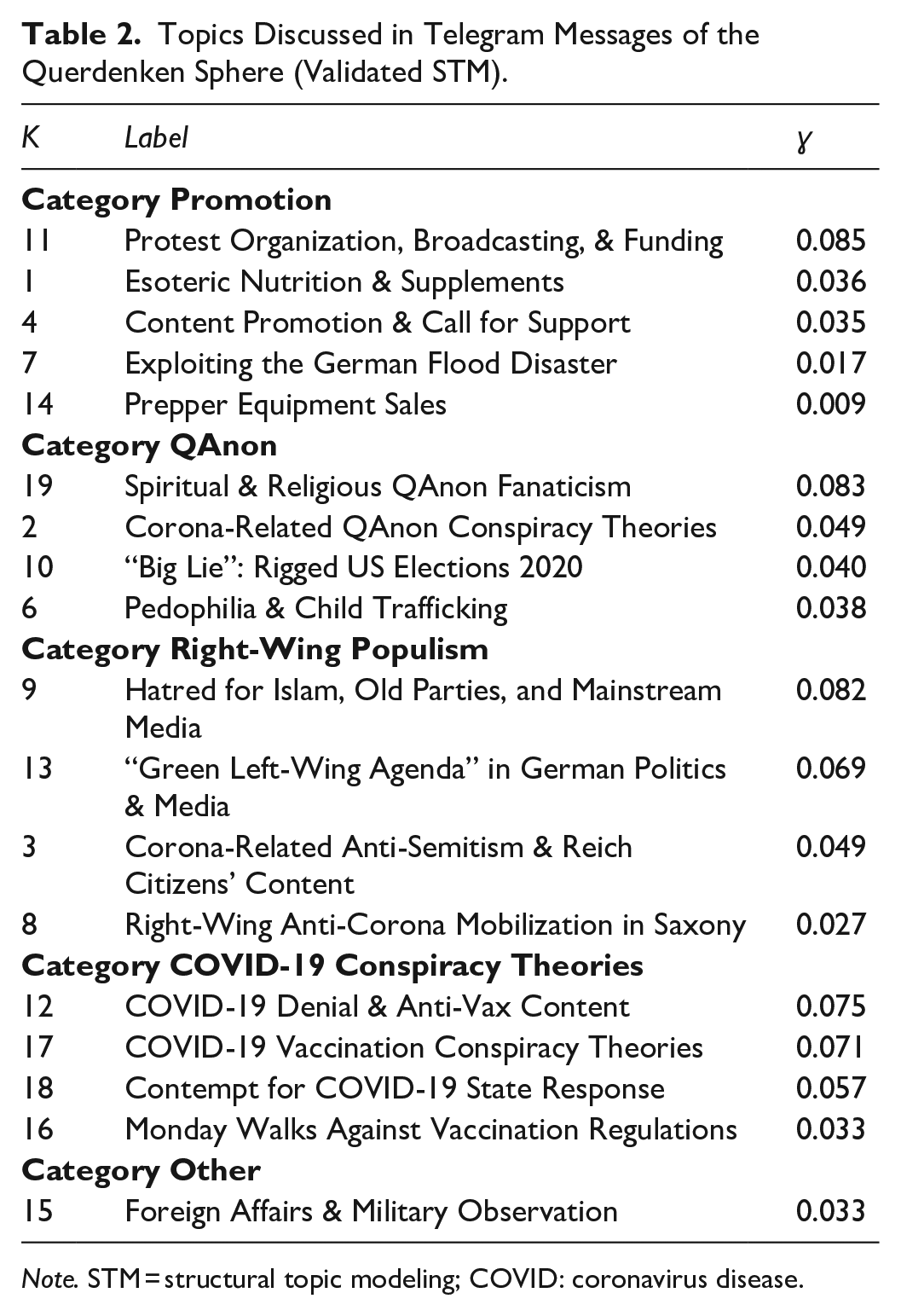
We present the main message topics of the Querdenken sphere in Table 2 (see Online Appendix Table A3 for the complete list, including the most important terms per topic). In addition, each topic is summarized in the Online Appendix in Table A4. These 18 topics can be divided into four overarching categories: promotion, QAnon, right-wing populism, and COVID-19 conspiracy theories. In the following section, we describe the individual topics across time and across all 19 communities, ordered by overarching category (for a visual depiction, see Figure A1, Online Appendix). Then, we explain which topics were most prevalent in particular Querdenken and right-wing communities (for a visual depiction, see Figure A2, Online Appendix).
Topics Discussed in Telegram Messages of the Querdenken Sphere (Validated STM).
Note. STM = structural topic modeling; COVID: coronavirus disease.
Development of Individual Topics Across Time and All 19 Communities
Within the promotion category, the most prevalent topic was protest organization, broadcasting, and funding (see Figure A1, Online Appendix). Messages under this topic contain information about gatherings, travel planning, livestreams, and calls for donations by Querdenken organizers. This topic gained momentum after the first lockdown in April 2020, when COVID-19 safety measures were relaxed and protests erupted across Germany. The topic later peaked during large demonstrations, especially when COVID-19 safety measures were stopped or reconsidered. Other topics, such as content promotion or esoteric nutrition and supplements, became widespread in parallel with the overarching topic of promotion. In addition, the July 2021 flood disaster in the German Ahr Valley was quickly exploited to put pressure on political and economic actors and to promote movements like Querdenken and QAnon through Telegram aid channels approaching victims of the flood.
Across all 19 communities, the most prevalent topic in the QAnon category was spiritual and religious QAnon fanaticism. This fanaticism has taken up increasingly more space in Telegram messages since 2019, becoming the most prevalent QAnon sub-theme after the 2020 U.S. election and the U.S. Capitol attack in January 2021. Related messages are anti-science and describe QAnon supporters as “awakened children of light.” The narrative in these messages is often that the in-group—QAnon supporters who know the truth, acting as God’s army and servants of Donald Trump—must fight the out-group, which includes the deep state, Trump’s enemies, and QAnon disbelievers. Across all 19 communities, corona-related QAnon conspiracy theories spiked sharply during summer 2020, Black Lives Matter (BLM) protests, and the attack on the German Reichstag. However, these theories plummeted to insignificance following the allegedly rigged U.S. election and the U.S. Capitol attack.
The two most prevalent topics of the right-wing populism category were hatred for Islam, old parties, and mainstream media and the alleged green left-wing agenda in German politics and media. While hatred for Islam, old parties, and mainstream media lost some space in Telegram messages when COVID-19 started, the alleged green left-wing agenda in politics and media peaked several times throughout 2020 and 2021 (e.g., during BLM protests or party congresses of the left and green parties). Here, we emphasize that questioning the political status quo or criticizing the mainstream media is not necessarily far-right. Nonetheless, the way the respective Telegram messages talk about these topics reveals that key features of far-right ideology in the form of nativism, authoritarianism, populism, anti-Semitism, or hostility toward democracy (Caiani et al., 2012; Mudde, 2016) are included in the discourse around, for example, media and politics, but also in the other topics we found. Corona-related anti-Semitism and Reich Citizens content has been steadily building in the background since the COVID-19 pandemic began and culminated in the 2020 winter wave. Related messages describe corona as a means of enslaving the German people as part of an international Jewish conspiracy and call for a “war against the elites.” These messages reject the legitimacy of the modern German state and claim that German politicians and medical experts are part of a New World Order controlled by Israel. Joint walks, a substitute for banned demonstrations initiated by right-wing mobilizers from Saxony, became a dominant right-wing topic in fall 2021.
Finally, topics under the COVID-19 conspiracy theories category can be divided into denying COVID-19 entirely, spreading conspiracy theories about COVID-19 vaccinations, or condemning the German state for its corona containment measures. Messages denying COVID-19 included claims of incomplete evidence, the worship of fake experts, attacks on scientists like Christian Drosten, and conspiracy theories regarding the virus and vaccinations in general. These messages gained momentum after the first lockdown in April 2020 and reached a peak in March 2021, when the German vaccination campaign first got rolling and a few rare cases of thrombosis were reported following AstraZeneca vaccinations. Then, in April/May 2021, this topic was replaced by conspiracy theories that focused exclusively on COVID-19 vaccinations. Related messages depicted mRNA vaccinations by Pfizer and Moderna as “untested effectless gene experiments” with “toxic and contagious spike proteins” and as part of a planned genocide by the New World Order. In these messages, we once again identified a distinct in-group and out-group, in that the unvaccinated are cast as fighters against an unjust regime who (in contrast to the vaccinated “sheep”) will not take part in the alleged “gene experiment.” This topic became less prominent in winter 2021, when right-wing mobilizers used prospective mandatory vaccine regulations as justification for their Monday Walks.
Most Prevalent Topics of Querdenken and Right-Wing Communities
Within the Querdenken communities (4, 3, 13, 15, and 16; see Table 2), the most prevalent topic categories were COVID-19 conspiracy theories and promotion, which grew constantly after the first lockdown in Germany (see Figure A2, Online Appendix). The topic of protest organization, broadcasting, and funding was particularly prevalent among communities of Querdenken activists (3, 15) and leaders (4), while the topics of COVID-19 denial and vaccination conspiracy theories were most prevalent among communities of Swiss Querdenken media (13) and Querdenken-related anti-vaxx and conspiracy activists (16). Of the topics regarding right-wing populism within Querdenken communities, we found that corona-related anti-Semitism and Reich Citizens content was prevalent among anti-vaxx and conspiracy activists (16), while right-wing anti-corona mobilization from Saxony was most prevalent among Querdenken activists close to the Querdenken party dieBasis (15). Although QAnon topics and other right-wing topics were less prevalent in Querdenken communities than in other communities, they have appeared in a growing number of messages since the first lockdown in April 2020.
Within the right-wing communities (12, 35, 20, and 30), the most prevalent categories of topics were right-wing populism, promotion, and COVID-19 conspiracy theories. After the COVID-19 pandemic began, right-wing populist topics dropped slightly in right-wing communities, while QAnon topics grew and COVID-19 conspiracy theories entered the field. After the first lockdown in April 2020, right-wing populist topics had returned in right-wing channels and even outnumbered COVID-19 conspiracy theories until the first winter wave in late 2020. After the German vaccination campaign began in January 2021, right-wing populist topics and COVID-19 conspiracy theories continued to see increased prevalence in far-right messages, while QAnon topics decreased to a pre-pandemic level. In addition, anti-corona mobilization from Saxony was a prevalent topic in all right-wing communities. While Saxony’s extreme-right protest organizers (30) pushed this particular topic almost exclusively, the extreme-right movement surrounding Martin Sellner and Ignaz Bearth (20) took a two-pronged approach to also push protest organization, broadcasting, and funding. All right-wing communities—except for the German, Austrian, and Swiss extreme right (20)—focused on contempt for the state response to COVID-19 if they covered COVID-19 conspiracy theories at all. Among German far-right publicists and far-right alternative media (12), the topics of an alleged green left-wing agenda in German politics and media, COVID-19 denial and anti-vaccination content, and hatred for Islam, old parties, and mainstream media were most prevalent.
Discussion
In the current study, we analyzed the communications of the German Querdenken movement on Telegram. In particular, we used network analysis to uncover potential communities of this movement and its relations to the far right and alternative media. Then, we used structural topic modeling to explore discussions within this network.
Regarding RQ1 (How are the actors that comprise the Querdenken sphere on Telegram connected to far-right and alternative media channels?), we found that nearly one-third of the Querdenken channels had been classified as right-wing even before they became part of the Querdenken movement (Caiani et al., 2012; Rauchfleisch & Kaiser, 2020; Urman & Katz, 2022). We demonstrated that several far-right, conspiracy, and QAnon communities are highly connected to subcommunities of the Querdenken movement. Furthermore, some Querdenken channels belong to communities containing or led by far-right or QAnon-related channels. We argue that renowned far-right actors and activists not only are part of this network but also play a key role in determining who Querdenken channels take content from. Alternative media play a dual role in the studied network. On one hand, far-right and conspiracy theorist alternative media channels are frequently referenced in the messages of this network. Both Querdenken and the referenced alternative media among themselves almost invariably forward content from far-right, QAnon, or conspiratorial communities. On the other hand, the Querdenken movement has created its own influential channels that view themselves as full-fledged media outside the mainstream. These Querdenken-related alternative media channels explicitly claim that they offer uncut, independent viewpoints and information not presented in mainstream media, while essentially, they focused on far-right conspiracy theories about corona, German politics, or the very media they criticize.
Regarding RQ2 (What topics are discussed in the public Telegram channels of the Querdenken sphere, and how have they changed over time?), we found that emerging topics in the Querdenken network can be divided into four overarching categories: promotion, QAnon, right-wing populism, and COVID-19 conspiracy theories. Within Querdenken communities, most messages revolve around promotion and COVID-19 conspiracy theories. Both of these topics have grown since fall 2020, with several peaks bound to COVID-19 containment measures and vaccine regulations. However, we found considerable differences between the Querdenken communities with regard to these topics. While Querdenken leaders and activists emphasize promotion, Querdenken media and conspiracy channels emphasize COVID-19 conspiracy theories, including corona-related anti-Semitism, Reich Citizens content, and far-right mobilization. Since the start of the pandemic, QAnon ideas and right-wing populism have found their way into the Querdenken movement and steadily gained popularity. With the introduction of COVID-19, the main interest of right-wing communities shifted away from right-wing populism toward COVID-19 conspiracy theories and QAnon content. However, since the first wave of COVID-19 in winter 2020, COVID-19 conspiracy theories and right-wing populism have formed a dominant interplay in right-wing communities, further fueled by the introduction of vaccinations and differing measures for the vaccinated and the unvaccinated.
The insights described above confirm and extend upon previous findings in similar contexts. The surge of COVID-19 conspiracy theories in right-wing communities and their alignment with right-wing populism is indicative of the far right’s attempts to fuel growing fears (Caiani et al., 2012) and exploit the COVID-19 crisis, analogous to its strategies in previous social challenges, such as the 2015 refugee movement. Similar to the PEGIDA movement, the Querdenken network revolved around the common denominator of pandemic measures and quickly connected with right-wing communities (Rauchfleisch & Kaiser, 2020). While Querdenken communities became active only after fall 2019, alternative media, QAnon, and far-right communities were active long before the start of the pandemic. Similar to the spread of far-right messages on YouTube (Rauchfleisch & Kaiser, 2020), crisis-related anti-Semitic conspiracy theories are spread throughout every community of the studied network. The presence of PEGIDA within Querdenken’s communication network suggests that these actors remain active and are attempting to adapt to recent crises and emerging platforms. In terms of content, Querdenken essentially absorbed PEGIDA. The core topics of PEGIDA (Stier et al., 2017; Vorländer et al., 2019) recurred in our dataset and were especially prevalent in right-wing and QAnon communities, with several peaks in Querdenken communities. However, unlike PEGIDA (Haller & Holt, 2019), traditional media did not play an important role in either the forwarded Telegram channels or the frequently linked websites. We found that Querdenken-related alternative media almost exclusively forwarded content from the far right or were part of the far right itself. We argue that this effect likely occurred because far-right alternative media focus on amplifying alternative media from their own media-sphere (Freudenthaler & Wessler, 2022). Future research could here analyze exactly which alternative and traditional media content is allowed by mobilizers in their channels or why the mobilizers seem to try to seal off their channel subscribers from traditional media. Possible implications of the absence of traditional media and the dominance of far-right alternative media are consequently the erosion of traditional media’s democratic function (Reiter & Matthes, 2021) and a further increase of distrust and polarization (Figenschou & Ihlebæk, 2019).
The present results also confirm the findings of previous Querdenken-related research. The topic of protest organization, broadcasting, and funding has risen to prominence alongside the rise of offline protests, especially during times of low incidence rates and stringent containment measures (Plümper et al., 2021). The self-stylization as resistance fighters has played a key role in this and other topics, and the motifs of COVID-19 denial, rejection of the political and media system, support for QAnon, and openness to right-wing ideas from the offline protests (Koos, 2021; Nachtwey et al., 2020; Teune, 2021) were reflected in Telegram messages of the Querdenken mobilizers. In line with Koos (2021), we argue that the current crisis acted as a catalyst for populist attitudes, which grew massively in the studied network after COVID-19 was declared a global pandemic. Furthermore, we presume that strong alienation from established media and parties and a latent tendency toward anti-Semitism (Nachtwey et al., 2020) is under the influence of the far right, QAnon communities, and Querdenken activists close to dieBasis. Thus, we argue that Querdenken’s Telegram network is a gateway to various far-right and QAnon ideologies. Conspiracy theorist and right-wing channels are, indeed, just one click away (Holzer, 2021).
Furthermore, we have underscored previous findings highlighting the growing influence of QAnon on Telegram, both in general and in Germany specifically (Hoseini et al., 2021). The share of QAnon topics in Querdenken communities has remained consistently on par with right-wing populist topics since fall 2020. Our results coincide with the steep increase in conspiracy narratives, anti-elitism, and calls for activism found by Schulze et al. (2022). These indicators of radicalization are most prevalent in QAnon communities that either include or are connected to Querdenken channels. The German Telegram channel QlobalChange, the most authoritative channel of the largest community in our dataset, has also been identified as a major QAnon content spreader by Hoseini et al. (2021). In addition, we found that other German channels within the Querdenken sphere frequently forward content from American QAnon channels. Previous research has shown that Donald Trump has played a central role as a purported leader in the war against the so-called deep state in many conspiracy theories (Papasavva et al., 2020) and that Trump-related channels have significant influence within the far-right Telegram network (Urman & Katz, 2022). In the present study, this role of Donald Trump was at the core of the topic of spiritual and religious QAnon fanaticism. Future studies could explore the offline and online influence of the American QAnon movement on Querdenken mobilizers and protesters in greater detail.
The present study had several limitations. First, the sample was restricted to channels that used admin signatures. In addition, not all forwarded messages were labeled as such in the data (e.g., videos and pictures without text). Thus, frequently forwarded channels that only shared pictures and videos might have been excluded from the network analysis due to the absence of admin signatures. Language recognition via computational text analysis with the fastText package (Mouselimis, 2022) is not perfect, especially for very short text; thus, some messages might have been misclassified. Moreover, the identified topics were influenced by network activity and the volume of messages per channel (i.e., the most productive channels influence the topics per community the most). Herein, we have focused solely on one part of the inward-oriented communication of the Querdenken movement; meanwhile, the outward-oriented communication of the movement remains largely unexplored. Future research should investigate how this movement, through its online and offline activism, has influenced political decisions, media coverage, and the views of the German population throughout the pandemic. While the present study focused exclusively on Telegram, such movements could use different platforms for their communication and networking strategies. Accordingly, future research could explore what roles other fringe platforms with very little content moderation, such as Gettr (an alternative for deplatfomed Twitter users) or Odysee (an alternative to YouTube), play in the Querdenken movement.
The present results have several practical implications for policymakers. We call for closer, preferably real-time, monitoring of the Querdenken network in Telegram and other platforms to better recognize and counteract crisis-related waves of radicalization at an early stage. Crises are not only instrumentalized by existing radical right-wing groups but can also spawn new groups, which may have enormous radicalization potential and may join forces with right-wing actors or renowned conspiracy theorists. This networking between various radical groups may also occur in future crises beyond the COVID-19 pandemic (e.g., the already apparent sub-crises of worsening climate change). Online and offline threats and violence against dissenters and journalists at Querdenken protests have shown that messages glorifying violence on Telegram are not merely empty phrases but can have real consequences (Kennedy, 2022; Silk, 2021). Apart from right-wing acts of violence in past demonstrations, the growing influence of QAnon and the U.S. Capitol attack should serve as warning signs for German politicians. Subsequently, we recommend policymakers to take Querdenken-related research and existing suggestions for action seriously (e.g., Mudde, 2016, p. 129).
Footnotes
Declaration of Conflicting Interests
The author(s) declared no potential conflicts of interest with respect to the research, authorship, and/or publication of this article.
Funding
The author(s) disclosed receipt of the following financial support for the research, authorship, and/or publication of this article: We acknowledge support for the publication costs by the Open Access Publication Fund of the Ilmenau University of Technology.
