




Abstract
Increasingly, influencers are employed to market not only products but also ideas and beliefs. The far right has recognized the strategic potential of influencer communication to tap into new target groups and mobilize supporters. This paper provides insights into the little-explored field of far-right influencers. We conceptualize them as individual actors characterized by far-right ideology, positioned as political influencers, actively advocating for their ideological aims. Employing a multi-layered computational approach to explore communication practices and networking structures of 243 German-speaking far-right influencers on Telegram, we derive a typology and observe the emergence of a functionally differentiated influencer collective. In this collective, each community has specific functions and characteristics that emphasize different ideological aspects, mobilization modes, and influencer practices. Despite the decentralized organization, we find high efficiency in information dissemination. The results corroborate the assumed potential of far-right influencers as disseminators of ideological content who can be particularly persuasive through their role as parasocial opinion leaders.
Keywords
The far right spreads hate, divides the world into good and evil, and incites fear of this “evil” among their supporters. They not only fuel societal polarization and intergroup conflict (Bliuc et al., 2021), but also threaten democratic values and pluralism in society (Minkenberg et al., 2021; Mudde, 2000). Far-right extremism can culminate in criminality, violence, and terrorism; the terrorist attacks in Hanau and Christchurch and the “Unite the Right” rally in Charlottesville are only a few recent examples. Far-right actors push their way into public discourse online and adopt modern communication trends (Winter, 2019).
One of these trends is influencer communication. Social media influencers no longer only talk about fashion, beauty, or lifestyles; many also take a stance in political debates. Some, like the German YouTuber Rezo, create public attention by engaging with elections (De Gregorio and Goanta, 2022); some even build their personal brands around political issues. Influencer content can substantially impact followers’ decisions (Hudders et al., 2021); in the context of politics, influencers are able to steer political interest as well as online and offline participation (Dekoninck and Schmuck, 2022; Naderer, 2022); Riedl et al., 2021. Furthermore, influencers provide political information, can function as parasocial opinion leaders (Stehr et al., 2015), and play an increasingly important role in the public’s consumption of political information (Newman et al., 2021).
Influencers can encourage young people, in particular, to engage with politics and enhance political participation (Naderer, 2022). However, this may be harmful when they spread manipulative information, express anti-democratic or anti-pluralistic views, or incite resentment. Being relatively adept at tapping into online trends and changing media environments, the far right has arguably been quick to recognize the persuasive potential of influencer communication (Conway et al., 2019; Winter et al., 2020). Far-right influencers are deliberately positioning themselves on social media and communicating strategically to advocate their worldviews to mainstream society, especially among younger, more impressionable members (Gaden and Dumitrica, 2014).
Many major platforms such as Facebook and YouTube have thus begun to delete far-right content and accounts. This deplatforming forces far-right actors to switch to less restrictive alternative platforms. One alternative platform that is particularly attractive to the far right is Telegram (Rogers, 2020; Urman and Katz, 2022). During the COVID-19 pandemic, German-language far-right Telegram channels and groups have recorded enormous increases in their reach (Schulze, 2021). Despite the growing importance of influencers to far-right strategic communication, few studies have explored this topic (Åkerlund, 2021; Lewis, 2018; Maly, 2020; van der Vegt et al., 2020). This paper aims to provide initial insights into the current German-language far-right influencer scene by exploring (1) which structures and communities far-right influencers form on Telegram, (2) what communication practices characterize the influencer communities, and (3) how intense and based on which communication patterns they converge.
We conceptualize far-right influencers as individual actors who are (1) characterized by far-right ideology (Carter, 2018; Mudde, 2000), (2) positioned as political influencers (Bause, 2021), and (3) in this position actively advocate and mobilize for their ideological aims. Based on these research strands, we propose a definition of far-right influencers, which we applied empirically in an exploratory analysis of German-language far-right influencers and their communication networks on Telegram. To explore the vast networks of far-right influencers as well as their communicative patterns and information environments, we used a computational approach combining several iterations of network analysis with structural topic modeling in a multi-layered framework. After characterizing the far-right influencer scene and its (sub-)communities using network analysis including community detection, we inspected (unique) communication and interaction patterns within these communities to develop a typology of far-right influencers. Finally, we used structural topic modeling to analyze which communication patterns and practices the far-right influencers (community-overarchingly) have in common.
Our study’s contribution is threefold: First, we put forth a definition and conceptualization of far-right influencers embedded between far-right extremism research (e.g. Carter, 2018; Mudde, 2000) and parasocial opinion leadership theory (Stehr et al., 2015), assuming that individual actors like influencers can unfold a high persuasion potential due to their parasocial component. Second, we designed a methodological framework helping to derive a typology of far-right influencers combing network analytical with topic modeling approaches that may be fruitful for other contexts as well. Third and most importantly, we provide initial insights into the networking structures and communication patterns of the still new scientific field of far-right influencers.
The analyses reveal the emergence of a functionally differentiated far-right influencer collective on Telegram. The collective is decentrally organized into six communities that disseminate information very efficiently among each other. Each community fulfills specific functions, roles, and characteristics. Far-right influencers use several practices and communication styles similar to non-political influencers.
The ideological background: far-right beliefs
“Far right” is an umbrella term incorporating several heterogeneous ideological strands. Conceptually, research differentiates between the radical right (accepting democracy but rejecting liberal elites) and the extreme right (rejecting democracy and considering violence as legitimate means) (Berntzen, 2018; Bjørgo and Ravndal, 2019). However, scholarship agrees that this differentiation cannot be employed when approaching the phenomenon empirically because the theoretical boundaries are not as strict in their “real world” and furthermore, strategically blurred by extremist actors to obfuscate the real intentions (Pirro, 2022). The most relevant narratives and characteristics include combinations of nationalism, racism/exclusionism, xenophobia, anti-democratic attitudes, authoritarianism, nativism, and populism; the specific composition and intensity may vary from actor to actor and is (generally) reflected on the content level (Carter, 2018; Mudde, 2000).
The basis for intensifying radical beliefs is group-focused enmity, which refers to the devaluation and discrimination of people based on their membership in a particular group (Küpper and Zick, 2014). Devaluations of these groups stem from ideologies of inequality that convey a hierarchy and help legitimize unequal treatment, thereby providing an entry point for the black-and-white-thinking typical of far-right beliefs (Zick et al., 2008).
Far-right communication forms (e.g. hate speech, emotionalization, simplification, disinformation) “work” particularly well online, can increase the probability that users encounter radical material and accelerate radicalization dynamics (Rieger et al., 2020). Besides, the far right benefits from (seemingly) moderate actors that address typical right-wing thought patterns (e.g. conspiracy content, anti-elite sentiment), as it promotes the normalization and de-tabooization of right-wing narratives in public (Wodak, 2020).
Factors like perceived threats, loss of control, or insecurities—characteristic consequences of crisis events such as a pandemic—can contribute to people turning toward conspiracy narratives as a form of processing and compensation (Douglas et al., 2019). In this vein, the COVID-19 pandemic accelerated the online distribution of conspiracy narratives; for example, QAnon, a highly adaptive far-right conspiracy movement that originated in the United States and presents Trump as a savior fighting against the “deep state” (Rajan et al., 2021). Conspiracy content “presents a critical radicalization gateway” (Rajan et al., 2021: 6) since it fuels black-and-white thinking that is common in far-right worldviews (Garry et al., 2021).
To expedite narrative distribution and radicalization dynamics, the far right employs a variety of content formats: not only do they utilize different organizational structures, such as parties, sports clubs, or initiatives, to spread their ideas but also individual key figures like influencers position themselves online to strengthen the far-right narrative. Influencer communication can have a particularly high persuasion potential when they are perceived as parasocial opinion leaders, as pointed out in the following section.
Persuasive effects of (political) influencers
Despite their increasing relevance to digital communication and society, the role of influencers in political communication has rarely been explored (Hudders et al., 2021). This new phenomenon can be approached with the concept of parasocial opinion leadership (Stehr et al., 2015), which is an extension of opinion leadership originally posed by Lazarsfeld et al. (1944). Influencers can persuade followers not only to purchase products but also to “buy” political ideas and beliefs. Persuasive communication aims at changing individuals’ attitudes and behaviors (Fransen et al., 2015). Interpersonal communication stronger impacts attitudes and behavior than mass communication and thus has a greater persuasive impact since people trust recommendations from those with whom they have close social bonds to a higher degree (Lazarsfeld et al., 1944).
Opinion leadership is a dynamic concept defined by the recipients’ perspective: A person can function as an opinion leader for some people, topics, or situations and not for others (Geise, 2017). Specific characteristics such as perceived expertise, communication skills, social status, and political interest make individuals more likely to become opinion leaders and, ultimately, to promote persuasion (Geise, 2017).
As an adaptation of opinion leadership to the contemporary digital culture, Stehr et al. (2015) propose parasocial opinion leadership: Accordingly, parasocial relationships can replace real-life relationships and enable media figures to take over the role of opinion leaders. As one-sided reactions to a media figure’s action often generate the illusion of real-life interaction, multiple parasocial interactions can increase identification with this figure and create a sense of intimacy and friendship, ultimately resulting in a parasocial relationship (Chung and Cho, 2017; Horton and Wohl, 1956).
The intensity of this parasocial relationship depends on several factors: (1) obtrusiveness and persistence (i.e. the frequency of media presence used to position the influencer and build their personal brand), (2) the mode in which the audience is addressed (direct or indirect), whereas direct addresses and calls to action increase the intensity of the parasocial interaction, and (3) the audience’s motivation to interact parasocially with the media figure (Hartmann et al., 2004). All of those can apply to far-right influencers due to their particular interest in persuading and mobilizing their followers to distribute the ideology and to strengthen the far right.
Building close parasocial relationships with followers is essential for influencers. They position themselves online based on one or more specific topics to (1) build a personal brand, (2) generate reach, and (3) use both to promote brands, products or—in case of the far right—political ideologies (De Veirman et al., 2017; Schouten et al., 2020). Concerning the personal brand, Enke and Borchers (2019) distinguish four influencer roles: content creators who are specialized in producing content/material, multipliers who generate reach by using platform-specific mechanisms to curate content, moderators who initiate exchange with and among followers, and protagonists who focus on self-presentation. These roles are not distinct. Rather, influencers can specialize in one role, combine several roles, or dynamically switch between them (Enke and Borchers, 2019). For the reach, categorizations exist that differentiate influencers based on their follower counts (e.g. nano-, micro-, macro-influencers; Campbell and Farrell, 2020).
Far-right influencers can be considered a subgroup of political influencers. Drawing on parasocial opinion leadership, Bause (2021: 269) proposed a first definition. Accordingly, political influencers are “users who became well known in social media and, as self-created personal brands, regularly distribute self-produced political content with which they reach and potentially influence a dispersed audience.” The characterization as a parasocial opinion leader is not linked to a certain profession or role. Most importantly, opinion leaders must be individuals with whom followers can establish parasocial relationships. They may be activists, journalists, politicians, private people, or anonymous individuals using pseudonyms. Building on these considerations, we propose defining far-right influencers as individual actors who operate under their real name or an alias, position themselves publicly through political content, and advocate far-right ideology via social media. They can serve as parasocial opinion leaders for their followers and use this mechanism to persuade and mobilize.
Far-right influencers’ use of social media
By now, few studies focus on the topic of far-right influencers (Åkerlund, 2021; Lewis, 2018; Maly, 2020; van der Vegt et al., 2020). These suggest that they are adopting practices also known from non-political influencers. A case study of the far-right influencer Brittany Sellner (Maly, 2020) reveals her use of typical influencer tactics: She promotes content across multiple platforms, collaborates with other influencers to exploit network effects, produces posts in an engaging manner that encourages followers to distribute the content among like-minded, jumps on online trends, and shares details about her private life to create a sense of intimacy. Similarly, Lewis (2018) and van der Vegt et al. (2020) show that far-right influencers seek to build parasocial relationships by giving insights into their private lives, pick up controversial issues to generate public attention, call for support, and collaborate with other influencers. Collaboration in particular structurally promotes radicalization. It allows influencers to present their followers additional, (partly) escalating radical content and personalities, thus making use of network effects and generating more ideological-loaded information opportunities that can incrementally promote radicalization (Lewis, 2018; Munn, 2019). How radical the content is presented also depends on the digital environment it is expressed in: While hate can be expressed more overtly on fringe platforms with loose content moderation policy, the risk of being deplatformed of large social media (e.g. YouTube, Facebook) forces far-right influencers to convey ideology in more subtle ways—using codified language is one tactic they employ (Åkerlund, 2021).
Besides platforms like YouTube or Instagram, instant messengers like WhatsApp and Telegram gained relevance for spreading political information (Newman et al., 2021; Vermeer et al., 2021). They offer secure, private communication, which is especially attractive for extremists. Specifically, Telegram has become increasingly important to the far right since 2016 (Schulze, 2021). Telegram’s hybrid platform architecture combines the functionalities of traditional social media (especially the option of top-down communication) with the advantages of instant messaging (i.e. secure, private one-to-one or group chats) (Schulze, 2021). This structure can be used to mobilize supporters and sympathizers while ensuring privacy and anonymity and establishing a sense of exclusivity, proximity, and shared group identity. Due to Telegram’s relevance and strategic use by far-right actors, we assume that a network of influencers emerged on that platform. This paper exploratively investigates this network’s structures and the influencers’ communication habits.
One feature of Telegram that enables interaction is the forwarding of posts (i.e. sharing posts from other channels, groups, or private chats). Forwarding is one central way to interact, increase the content’s reach and, ultimately, build up a far-right network. Within this network, ideological content can flow from actor to actor, reach different subgroups of this network, and enter the information environments of different audiences more or less intense and fast—depending on the network’s structure. By forwarding each other’s content, groups of far-right influencers (communities as densely interconnected parts of the network) arise around specific content because they discuss similar topics, share similar views, and focus on different aspects of far-right ideology (e.g. conspiracy content, anti-immigration content).
Some actors may appear less radical or extreme than others, which can but does not need to be an intended obfuscation tactic. Specifically, influencers appearing or deliberately depicting themselves as radical or extreme to a lesser degree can function as a gateway or bridge for their audiences toward more radical milieus (Heitmeyer et al., 2020).
However, while we know that there are far-right influencers who use social media platforms effectively, we know little about how and to what extent far-right influencers form connections online and which kind of communicative and interaction networks arise. With our first research question, we aim to address this and thus ask:
Forwarding introduces followers to (1) other influencers and (2) other actor types (e.g. alternative media, parties), potentially increasing the recipients’ information repertoires. Forwarding provides followers with additional ideological input, strengthening the recipients’ worldview. A few influential people are enough to spread information to large parts of a network via information cascades, thus reaching many people quickly (González-Bailón et al., 2013). This mechanism can be employed to leverage mobilization opportunities effectively.
The mobilization potential of specific content varies depending on the issue addressed. Frequent posting is less critical than the posts’ content to successfully distribute far-right online material (Schwemmer, 2021). According to the concept of issue networks, thematic foci are embedded in different network structures (Maier et al., 2018; Marres and Rogers, 2005). Assessing content synchronization and interaction allows evaluating the degree of integration within a subgroup and issue-specific mobilization (Maier et al., 2018). Besides that, influencer practices (e.g. directly addressing followers, calls to share content) can become visible not only on the structural but also on the linguistic level. To account for community-specific differences, we aim to take a closer look at networking and communication patterns of each community:
Marcks and Pawelz (2022) illustrate that different far-right actors have collectively built a self-referential system of narratives using anti-immigration rhetoric as the centerpiece of right-wing campaigns to evoke emotions of imperilment, relate various issues to it, and immunize from countervailing voices. Far-right influencers share specific narratives and use similar communication patterns to strengthen ideology. Finally, this paper aims to investigate these practices:
Method
We designed a multi-layered, computational approach combining several network analyses with topic modelings to address the RQs exploratively.
Categorizing channels as far-right influencers
We used the following criteria to assess whether a channel is a far-right influencer:
Individual actor (only individuals can establish parasocial relationships and function as opinion leaders; i.e., no collectives);
Self-positioning through and thematic focus on political content;
Publication of far-right ideology (following Carter (2018) and Mudde (2000); for guidelines, see Supplemental Appendix);
Public focus (i.e. formally, it must be a channel);
Minimum reach of 370 followers (we adapted influencer tier typologies based on influencers’ reach on large platforms like Instagram to the considerably smaller platform Telegram, Figure 1).
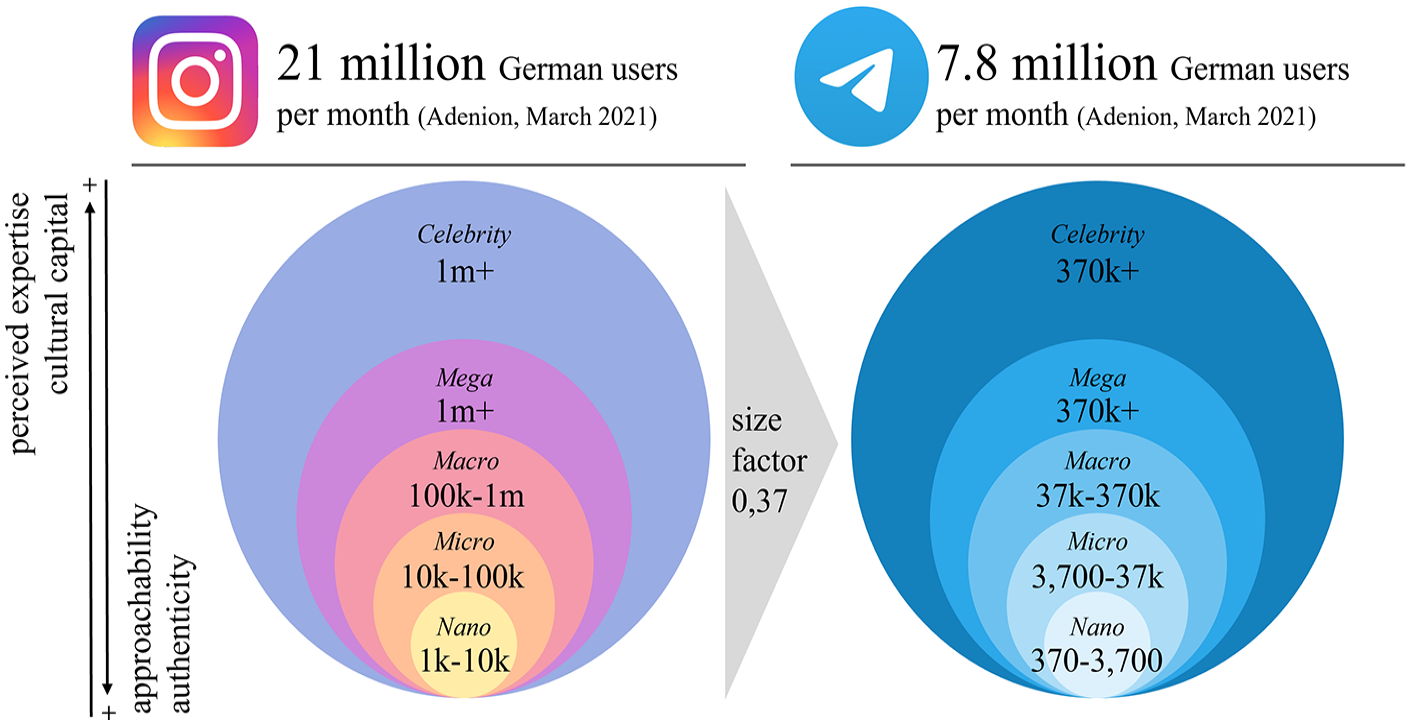
Categorization based on follower counts.
Data collection
We manually screened 700 German-language Telegram accounts to determine whether they met the inclusion criteria. This original list was compiled by Schulze (2021) and Fielitz and Schwarz (2020). We classified 82 as influencers and set them as seeds for snowball sampling. All accounts forwarded by these seed accounts during the investigated period (January to May 2021) and all influencers’ (retrospectively available) posts were collected in early June 2021 via 4CAT (Peeters and Hagen, 2022).
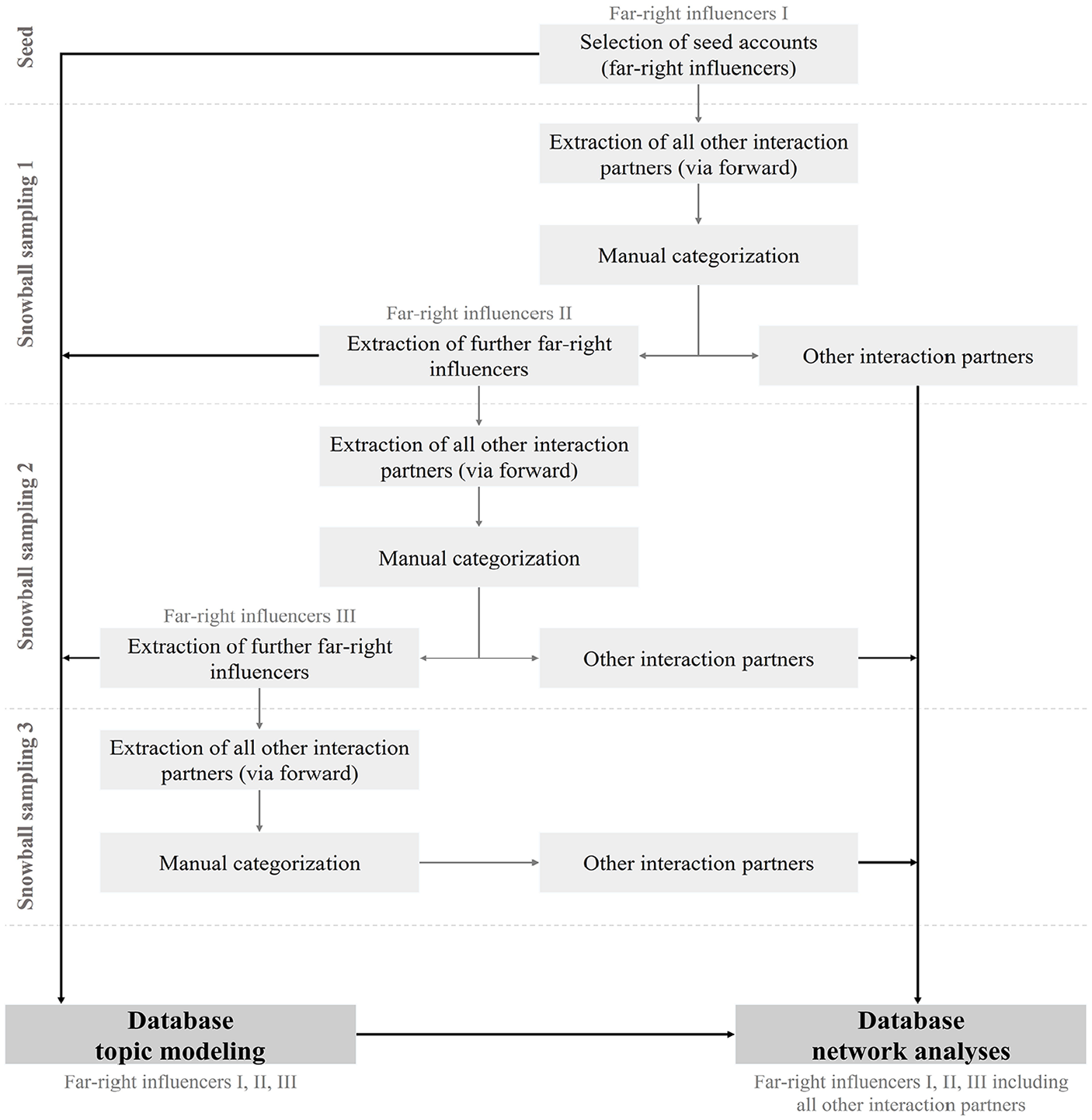
We again manually checked the forwarded accounts against the influencer inclusion criteria. All additional influencers (Table 1) were then included in further rounds of snowball sampling (Figure 2). Accounts that did not meet the criteria were categorized according to their actor type (Table 2). After categorizing almost 11,000 Telegram accounts and excluding chat groups and private accounts (due to privacy concerns), we finally had 9,343,982 relevant posts from 4,615 channels; 724,583 of these stem from 243 accounts classified as far-right influencers. To gain more specific insights into the influencers, we further classified them based on their main engagement in public (Table 3).
Data collection.
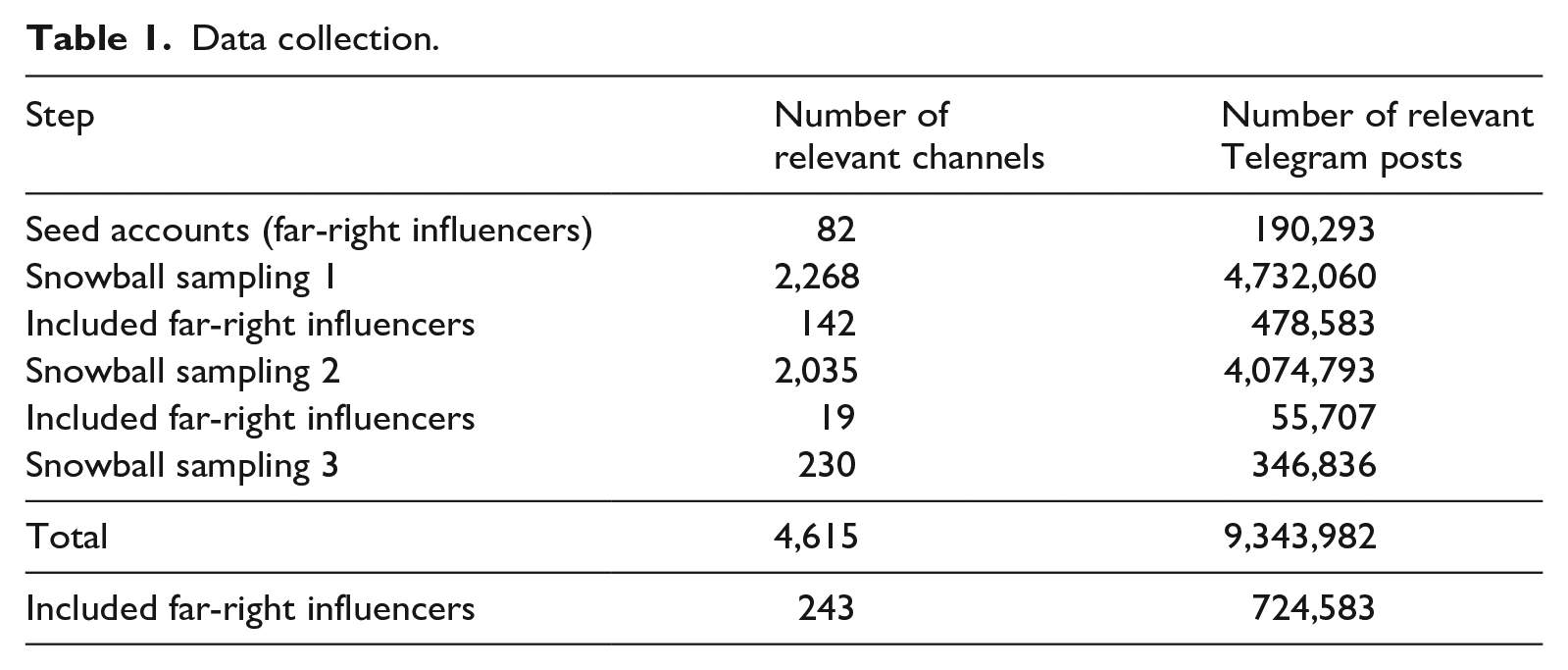
Data collection.
Channel categorization.
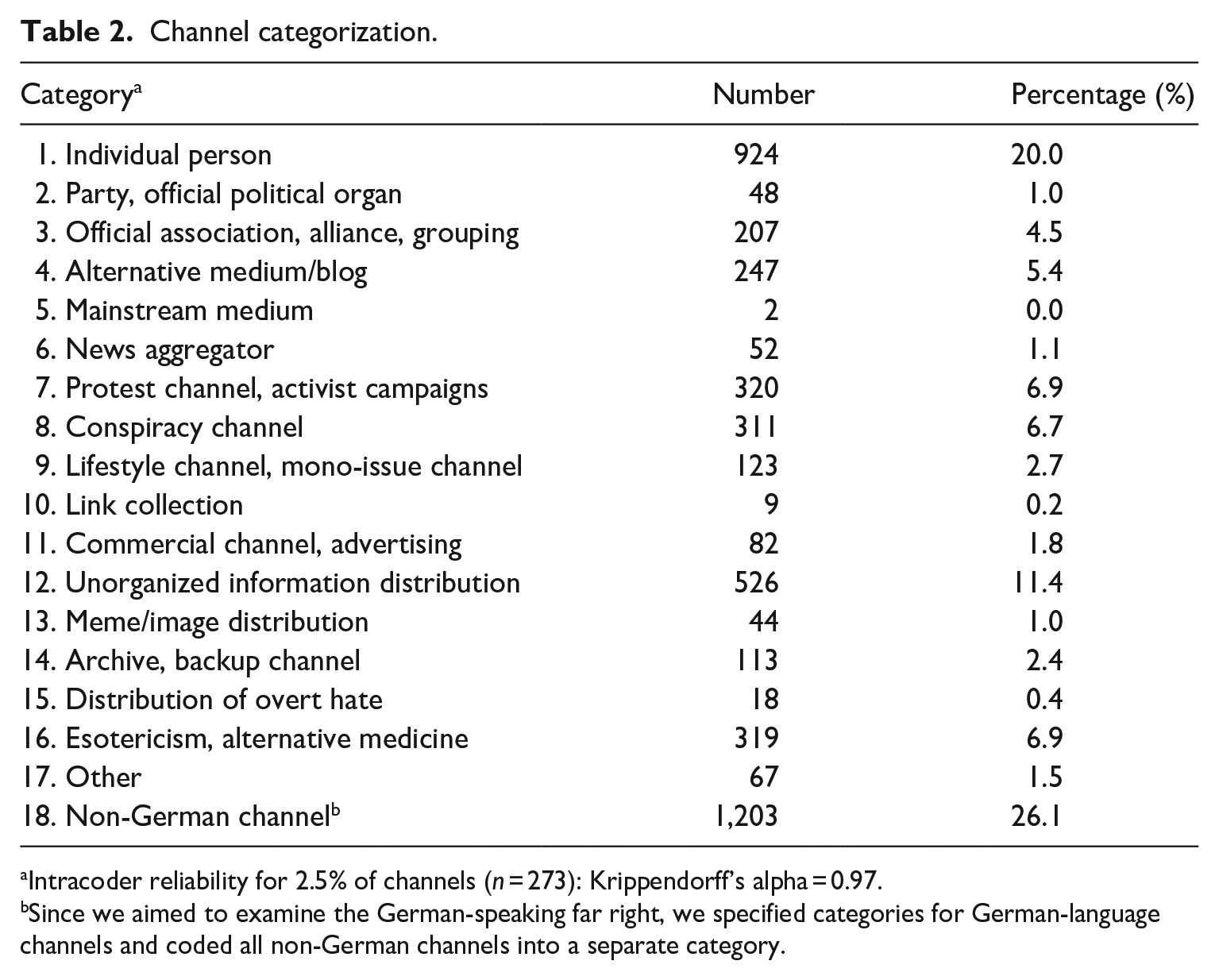
Intracoder reliability for 2.5% of channels (n = 273): Krippendorff’s alpha = 0.97.
Since we aimed to examine the German-speaking far right, we specified categories for German-language channels and coded all non-German channels into a separate category.
Far-right influencer categorization.
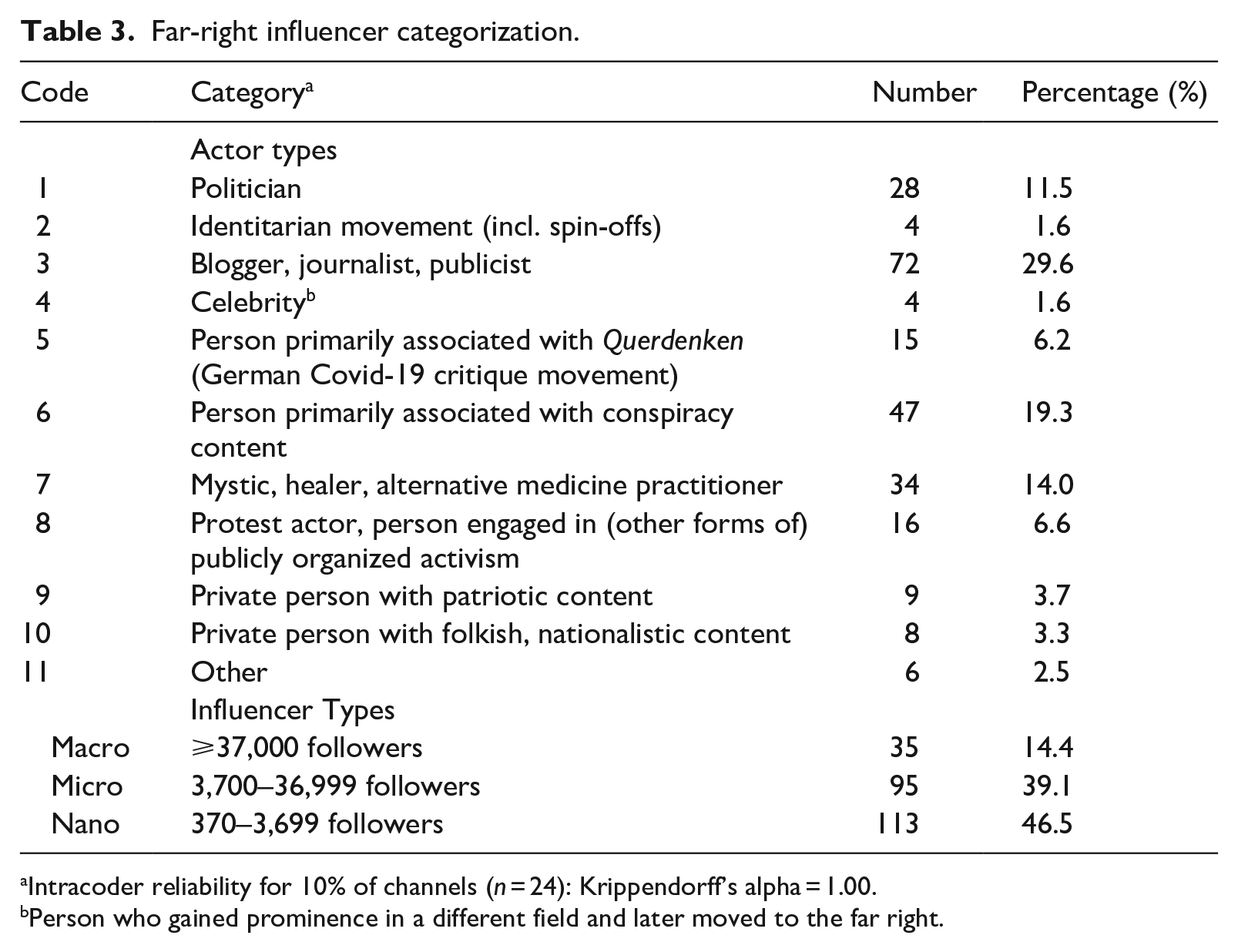
Intracoder reliability for 10% of channels (n = 24): Krippendorff’s alpha = 1.00.
Person who gained prominence in a different field and later moved to the far right.
We analyzed the data by employing network analysis (including community detection) and structural topic modeling (Figure 3) using R/R Studio (R Core Team, 2020).
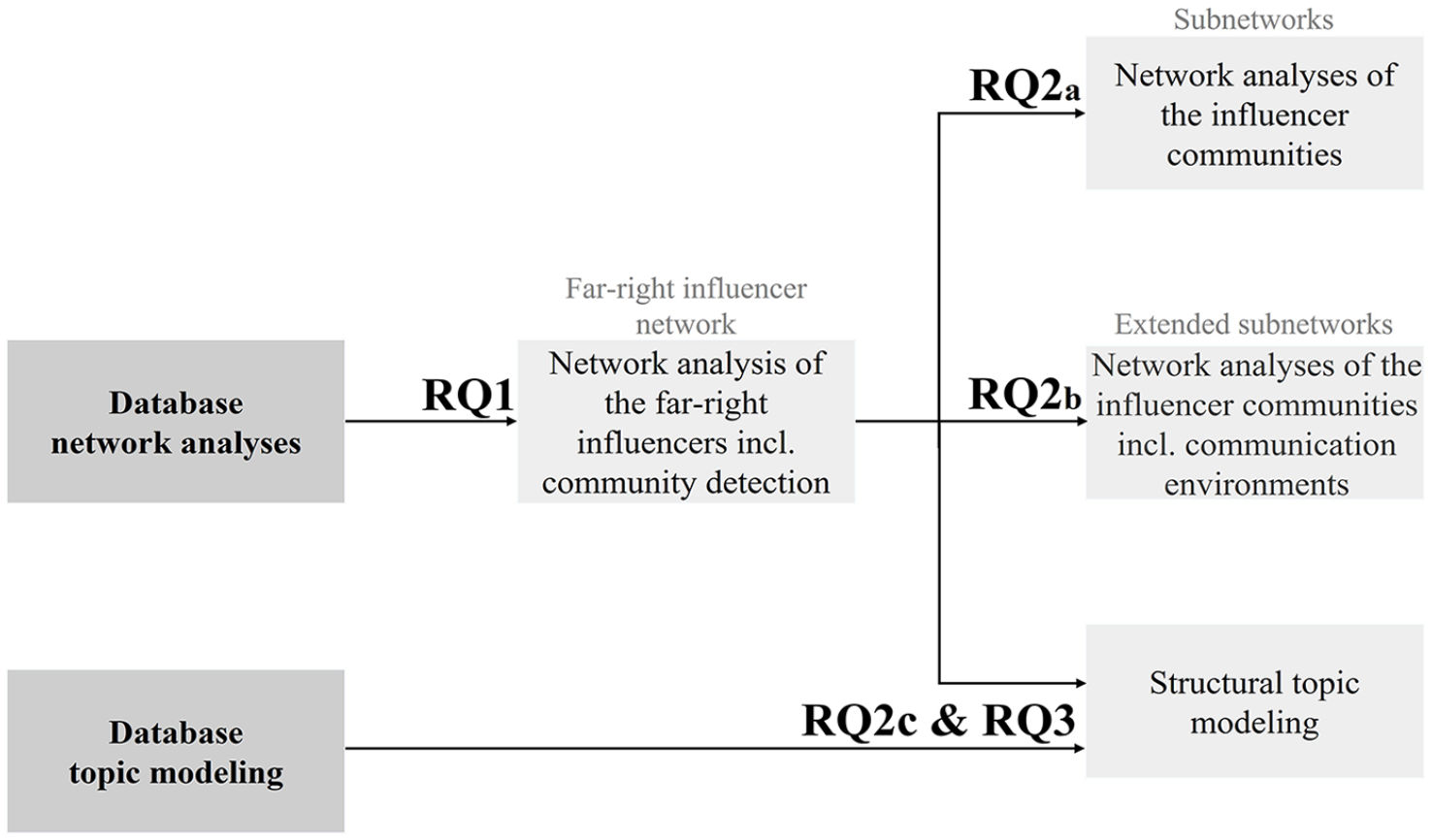
Methodological framework.
Network analysis
Step 1: The network analysis shows interactions of the identified influencers with each other and their positions in the network. The network is based on the directed, weighted interactions (edges; in this case: forwards) among influencer channels (nodes). We calculated different network- and actor-specific metrics (detailed explanations: Supplemental Appendix) using the igraph- (Csardi and Nepusz, 2006) and qgraph-packages (Epskamp et al., 2012). Then, we applied the HITS-algorithm (Kleinberg, 1999), which is split into two metrics per node: The authority score refers to the relevance of a node’s content; it indexes whose content other users consider particularly important; the hub score indicates how significant a node is for disseminating important content, that is, how frequently a node links to authorities. HITS is best suited for assessing the influencers’ roles described by Enke and Borchers (2019). The authority score indicates an influencer’s success as a content creator; the hub score points to the influencer’s role as a multiplier. We used Gephi (Bastian et al., 2009) to visualize the networks using the ForceAtlas layout algorithm, particularly appropriate for networks with one to 10,000 nodes representing real-world data (Gephi, 2011). We anonymized information linking to account names for privacy and safety reasons.
Step 2: We applied community detection to the overall network (ON) of 243 influencer channels. Communities are parts of a network representing condensed communication spaces based on intense interaction (Maireder and Schlögl, 2015). Community detection is based on the Louvain algorithm (for a discussion of different community detection methods: see Supplemental Appendix), which is ideal for identifying communities whose members are connected as closely as possible among each other but only have loose connections to members of other communities (Blondel et al., 2008). We used Louvain to assign each influencer to a community. Subsequently, we examined each community individually by analyzing and visualizing its subnetwork. We first analyzed connections among community members; then, we included all interaction partners (extended subnetworks).
Structural topic modeling
To automatically extract the topics covered in the posts we computed structural topic models (STMs; Roberts et al., 2019) for each community individually based on the assumption that different issues are embedded in different communicative structures (Maier et al., 2018). STM allows controlling for covariates (here: calendar weeks, communicator/account; Roberts et al., 2019). We preprocessed the posts following Grimmer and Stewart (2013): We only included posts containing at least three words; removed punctuation, symbols, numbers, URLs, and stopwords; tokenized the posts; and reduced all terms to their stem using the quanteda-package (Benoit et al., 2018). We included single words and bigrams (groupings of two consecutive words) in our corpus and excluded very (un-)common terms that occurred in more than 80% or less than 0.1% of posts.
To evaluate the best-performing number of containers (K; see Supplemental Appendix), we computed every fifth topic model between K = 10 and K = 50 to identify an appropriate range based on held-out likelihood, lower bound, residuals, semantic coherence, and semantic coherence in relation to exclusivity. Next, every STM was calculated for this range, and the diagnostics were inspected again. After we identified the numbers of topics considered optimal for each community, we qualitatively examined the topics, assigned labels and descriptions (see Supplemental Appendix) based on top-beta- (word-probability per topic) and top-theta-values (topic-probability per post) and validated both measures for all of the six STMs using oolong’s (Chan and Sältzer, 2020) word intrusion and topic intrusion tests showing good results. 1 Table 4 lists the final number of topics per community and the number of documents and terms the STMs are based on.
Overview of STMs.
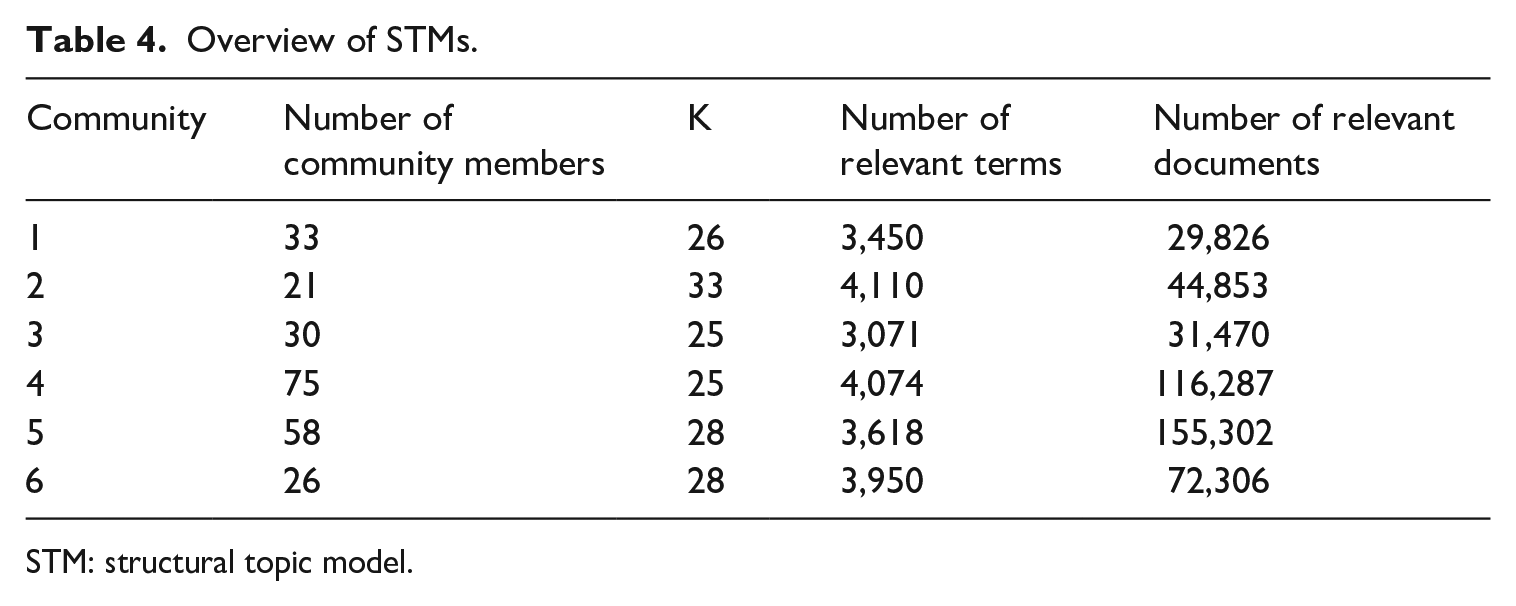
STM: structural topic model.
Results
The far-right influencer network (RQ1)
In total, 4,615 channels forwarded 3,377,538 posts. Of these, 20.9% originally stem from a far-right influencer (5.3% of the 4,615 actors). The directed network of influencers comprises 243 nodes connected by 7,549 edges (Figure 4). These 7,549 edges originate from 724,583 Telegram posts. Although influencers only make up a small part of the far-right communication environment on Telegram, their communication plays a decisive role in shaping the discourse of the far right.
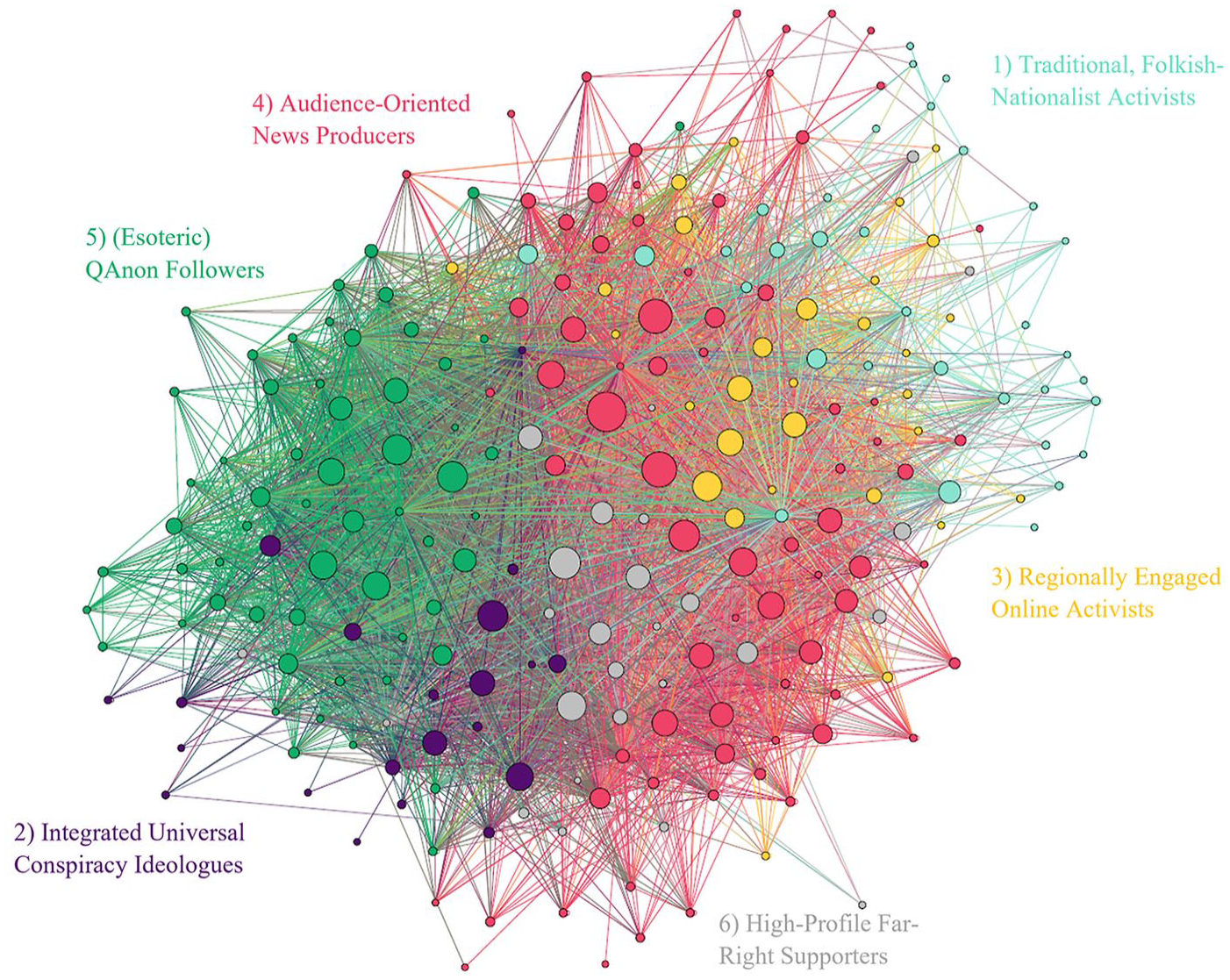
Far-right influencer network.
On average, an influencer interacted with 31 other influencers during the observation period—often multiple times by forwarding multiple posts of the respective other influencer. Thus, when users follow one far-right influencer, they are rapidly introduced to numerous others. Combined with the low average path length (pl = 2.36), this means that the audience can explore large parts of the network in a short time. If an individual is receptive to far-right ideology, this might facilitate radicalization since cross-channel information exchange significantly increases the volume of reception opportunities. Even if a person initially followed only a few influencers, the network provides a communication environment structurally conducive to building extensive far-right information repertoires. The small-world index—a measure that indicates conversation efficacy within a network (Epskamp et al., 2012)—supports this assumption: With a value of 3.14, the influencer network is classified as a “small world” and thus characterized by fast, highly efficient content dissemination (Humphries and Gurney, 2008).
Despite the fast distribution potential within the network, the density (η = 0.13) combined with the high diameter (d = 40) indicate that some parts of the network are less involved and have lower interaction levels. The reciprocity (r = 0.11) points in a similar direction: one-sided interaction relationships are the rule. In network parts where exchange takes place, however, it is intense: The transitivity (t = 0.49) shows that, in almost half of all possible cases, two interaction partners of a node are in contact with each other. Even if some nodes disappeared, the network itself would be maintained—which are first indications of high stability and decentralization:
The top 10 authorities are mainly influencers whose posts focus on conspiracy narratives, specifically traceable to QAnon. In addition to channels that successfully position themselves as content creators, the top authorities include influencers who share esoteric content. Conspiracy mentality and belief in supernatural forces are closely intertwined; underlying both is a common cognitive pattern (Asprem and Dyrendal, 2018): To explain complex issues, people search for connections that are often based on an illusion and lead to irrational conclusions (van Prooijen et al., 2018). Conspiracies and superstition mediate far-right attitudes (Schließler et al., 2020) by providing access to far-right thinking (Senholt, 2013). Most of the top hubs comprise influencers who post conspiracy content, have a high share of forwards (60%–90%), and lower reach (487–46,368 followers; with one exception with > 100,000 followers); they are predominantly nano- and micro-influencers acting as information distributors and multipliers.
We identified 6 communities with 21 to 75 members (see node coloring, Figure 4). The influencer network has a moderately high modularity score of 0.33 supporting the conclusion that the network is decentrally organized into subgroups (communities). Still, we observe cross-community contacts and networking tendencies that indicate that the influencers act as collective pursuing common goals.
Influencer-communities: their structures, topics, and practices (RQ2)
We explored the main characteristics of each community and assigned labels to them that describe the members’ communication and interaction patterns. However, due to the algorithmic computation, not every community member perfectly fits the overall description of the subnetwork. Rather, the characteristics described in the following typology represent particularly salient patterns observed in that specific community.
Community 1: Traditional, Folkish-Nationalist Activists
Compared to the overall network (ON), the Traditional, Folkish-Nationalist Activists (v = 33) are little integrated (innorm = 0.07; outnorm = 0.07), relatively inactive online, and characterized by people who are involved in organized offline protest structures. While COVID-19 is rarely addressed, ideological themes appear frequently: nationalistic traits and history, Nordic mythology, and reinterpretations of Black Lives Matter as an anti-white movement. These themes are often associated with mobilization and calls for participation in offline demonstrations, openly advocating political statements or listening to folkish music. Not only non-political influencers encourage followers to purchase items; also, far-right ones employ this communication strategy: musicians and activists who own or link to online shops are among the Traditional, Folkish-Nationalist Activists.
Members in this subgroup have a high degree of homogeneity, which supports our assumption of homophilic interaction patterns (McPherson et al., 2001; Newman, 2003) in three ways. First, while all other communities have negative degree-degree correlations, in this subnetwork, nodes with similar degrees tend to interact mainly with one another (ddc = 0.10; for the other communities, this value is negative). Combined with the finding that overall Telegram activity is lower in this community (community 1: Ø9 posts per day and account; all other communities: Ø12-31), this suggests that networking is more likely to be based on offline contacts. Second, this community has the highest nominal assortativity of actor types (nasactor = 0.32), which indicates that mainly influencers with similar public positions interact with each other. Third, influencers with similar reach tend to interact primarily with one another (nasinfluencer = 0.16).
Community 2: Integrated Universal Conspiracy Ideologues
Although the Integrated Universal Conspiracy Ideologues are the smallest community (v = 21) and do not stand out due to extraordinary activity or high prominence (reach), they play a highly central role in the ON: they are the second most important information provider (innorm = 0.14) and the group that refers most frequently to members of other communities (outnorm = 0.18), thus functioning as the most important community for information circulation. Community 2 engages in networking extensively and fulfills a bridging function based on this. These networking efforts occur with members of different communities and within the community, making this group’s subnetwork the densest (η = 0.29) and most stable one (t = 0.65). This focus on networking activities is also visible in the extended subnetwork: Community 2 has 1,853 interaction partners—only communities 4 and 5 interact with more channels, but those communities are significantly larger (community 4: v=75; community 5: v=58).
Thematically, the community’s posts are characterized by conspiracist tone. They do not cater to a specific conspiracy narrative but promote a wide range of these (see, for example, Mahl et al., 2021 for a mapping of 10 different conspiracy myths on Twitter). The influencers within community 2 stand out with their “universalism” in terms of conspiracy myths, including general ones like flat earth but also far-right ones (e.g. Great Replacement). This result goes in hand with findings that belief in one conspiracy myth also promotes the belief in others—even if contradictory (Wood et al., 2012). Community 2’s important position within the ON goes along with their topical focus on a variety of conspiracy content: They promote and increase the overall salience of conspiracy tenor within the far-right (influencer) scene. In doing so, they link different facets of far-right culture and ideology, which are all based on dichotomous worldviews of strictly differentiating groups of people in “good” (ingroup) and “bad” (outgroups) (Pfahl-Traughber, 2010), in seeding and cultivating a conspiracy thinking that is built around the depiction of the “good” people being betrayed by corrupt (elitist) outgroups as conspirators.
Community 2’s attempts to mobilize in a rather unspecific way advocating to “stand up against the elites.” These abstract mobilization attempts are in line with the overall theme regarding elite actors perceived as conspirators. To leverage their mobilization power (i.e. their impact on their followers), these influencers intensely try to “bond” with their audience using several influencer practices. They intend to build connections, for instance, by demonstrating expertise (which is one characteristic that fosters taking over a role as opinion leader; Geise, 2017) or by appealing to their followers in a very direct way (e.g. frequently using terms/salutations like “you”).
Community 3: Regionally Engaged Online Activists
The third community (v = 30) largely consists of bloggers and YouTubers who aim to reach the broader public by addressing recent trends. In addition to bloggers, politicians with a regional focus and activists of or closely linked to the Identitarian movement and, specifically, activists engaged in regional far-right group organizations, are central to this community. The members combine online forms of communication with offline regional protest activities. Given the contemporary context, these are mainly issued around demonstrating against the COVID-19 policy and specific protection measures such as lockdowns or wearing masks. They not just try to mobilize their followers to participate in these street protests, but also to financially support their work and these actions (e.g. by calling them to use alternative news, to donate money, or to buy protest songs), and thus attempt to permeate the everyday lives of their followers.
The regional focus is linked to patriotic interests and also evident in the extended subnetwork: International, non-German channels are forwarded much less frequently (6.5%) than in the ON (26.1%). Thematically, the third community focuses on several aspects of the COVID-19 pandemic, including sharp criticism of elite institutions (e.g. government, media, health authorities). These influencers work to mainstream far-right worldviews by instrumentalizing COVID-19 as a mobilization framework.
Despite the important role of online activism, the community’s influencers are comparatively inactive on Telegram as measured by the number of posts each influencer publishes on average per day (n = 12) and networking activities with their extended subnetwork (v = 1,147). At first, this seems counterintuitive, but a deeper look suggests a strategic use of Telegram: Telegram posts often function as teasers promoting more detailed blog posts or videos. The community intensely uses other platforms, such as the livestreaming platform DLive.
Community 4: Audience-Oriented News Producers
The Audience-Oriented News Producers are the largest community (v = 75) and have a central position in the ON (innorm = 0.14; outnorm = 0.11). This group receives much attention from other communities and consists predominantly of publicistically active influencers. Community 4 is characterized by short communication paths: The subnetwork is very compact (d = 28; pl = 2.21) and interactive (r = 0.17; t = 0.54). The homophily values indicate that influencers with varying levels of prestige (ddc = -0.25) mix the most here. This allows community members to convey far-right messages from multiple perspectives, which is also reflected in the variety of topics identified through STM (predominantly numerous facets of COVID-19). Influencer activities are highly professionalized according to the roles defined by Enke and Borchers (2019). They switch between presenting themselves (protagonists), running blogs or producing videos (content creators), acting as multipliers by promoting each other’s content, and acting as moderators by using interactional formats to engage with their audience. Influencers include their audience in their communication to create a sense of proximity, promote parasocial relationships and increase their messages’ persuasive potential.
Community 5: (Esoteric) QAnon Followers
The fifth community (v = 58) mainly consists of influencers who either directly refer to QAnon (41.4%; ON: 19.3%) or primarily disseminate esoteric content (37.9%; ON: 14.0%). This finding of intertwined conspiracy and esoteric beliefs aligns with previous research (Asprem and Dyrendal, 2018). Community 5 is the most active one, with an average of 31 posts per day per influencer and 2,949 interaction partners in the extended subnetwork. It is extremely compact and dense (η = 0.26; d = 11; pl = 2.00). In line with QAnon’s focus on the United States, this community is the most internationally connected one (26.6% non-German interaction partners; average for all other communities: 15.2%). Thematically, this community focuses on a variety of sub-narratives around the QAnon conspiracy myth. The element distinguishing the influencers of this community from those of community 2 (Integrated Universal Conspiracy Ideologues) is their strong focus on one specific conspiracy “framework,” namely QAnon; whereas the latter post about a variety of very different conspiracy myths (also including references to QAnon from time to time—and, thus, thematically overlapping with this community 5 which can also be observed in their topological proximity in ON graph; Figure 4—but rather referring to much more conspiracy narratives).
Community 6: High-Profile Far-Right Supporters
The last community (v = 26) occupies an important position in the ON: The High-Profile Far-Right Supporters receive the most attention from other communities (innorm = 0.16), but also often forward posts from these (outnorm = 0.15), which can be observed topologically in the ON graph (Figure 4): the community is located centrally and takes on a mediating role between Communities communities 2 and 4. Community 6 is notable for the public reputation of its members. On average, each influencer has a 71.9% higher follower count than the average influencer of all other communities, which is also reflected in the higher proportion of macro- and micro-influencers (macro/micro/nano: community 6: 19.2%/42.3%/38.5%; other communities: 13.8%/38.7%/47.5%). Community 6’s key figures have a broad followership which is mainly due to their role outside of Telegram: This community comprises high-profile figures who receive much attention from news media and the general public. Some members gained prominence in other fields (e.g. VIPs from entertainment industry, their former role in public broadcasting) and later turned to the far right.
Community 6 is characterized by heterogeneous influencers and content with various topics, from mobilizing ideological posts to conspiracy narratives, esoteric content, and current events related to COVID-19. Thus, influencers within this community largely overlap with those of many other communities thematically. As a result, this community’s influencers share a great deal of similarities with those of many other communities, making them useful for connecting themes and/or ideologies in far-right narratives. This is also supported by their outstanding characteristic, namely their high-profile public standing: “VIPs” well known outside the far right are central to this community and especially these kind of influencers are able to steer attention—also beyond Telegram.
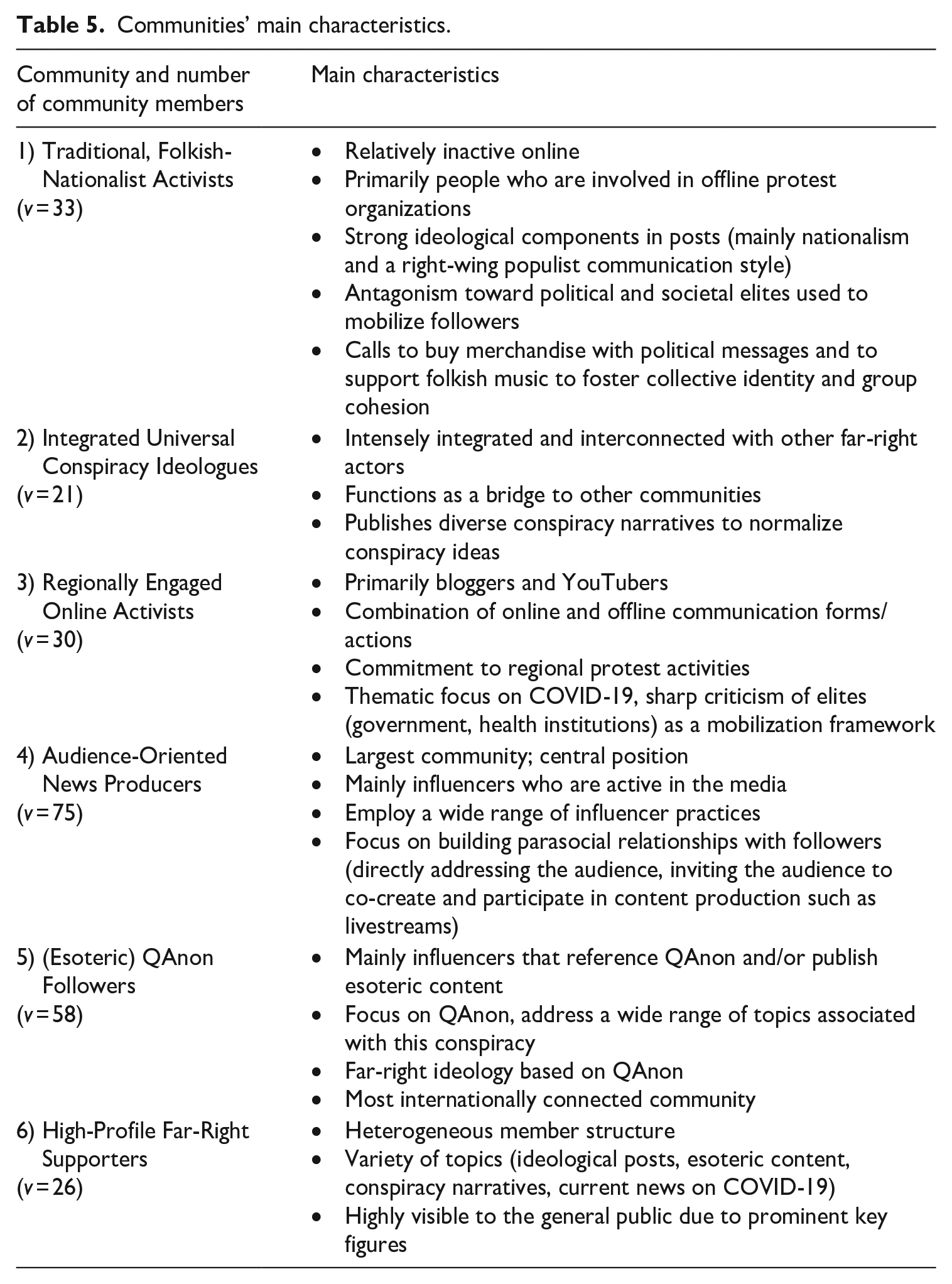
We summarized the main (distinguishing) characteristics of each community (Table 5). Visualizations of each subnetwork can be found in the Supplemental Appendix.
Communities’ main characteristics.
What unites the far right: communication patterns and influencer practices (RQ3)
Although each community has its focus, overall, the German-speaking far-right influencer scene does not appear disintegrated; rather, the individual communities fulfill different functions for the influencer collective, address diverse audiences, and converge, cooperate, and network on a superordinate level.
Currently, far-right influencers are using COVID-19 to gain access to disaffected segments of the public with a lack of trust in institutions through elite critique. This finding is supported by the German Federal Office for the Protection of the Constitution (2021). Once a dismissive attitude is anchored in the recipients’ minds, they could be more receptive to similar thought patterns. Conspiracy narratives work similarly. The fact that conspiracist channels function as top authorities in every extended subnetwork shows that conspiracies are extremely important to far-right communication. As conspiracy-focused channels also address other current content, they enter the information repertoires of influencers and recipients who previously had little or no contact with such narratives and can thus cultivate conspiracy thinking. Spiritual themes—as found in Communities 5 and 6—facilitate this, since superstition and conspiracy beliefs are based on similar cognitive patterns (van Prooijen et al., 2018).
What also unites the far-right scene is its “underdog” position in relation to the general public. They stage themselves and their ingroup as victims threatened by a left-wing, cosmopolitan society and various elite actors like politicians, powerful individuals, groups perceived as foreign, or traditional news. Such narratives of victimhood are often employed in far-right speech (Marcks and Pawelz, 2022; Oaten, 2014). In that context, far-right influencers also often articulate their concerns referring to external pressure applied by operators of “mainstream” social media, conveying that they are aware of their risk of being deplatformed. This external pressure forces them to constantly develop and adapt communication strategies to retain their follower base, which they do by utilizing several influencer practices.
Influencer practices became visible in the STMs and can be categorized into three strands: content-related, audience-centered, and internal-cooperative practices. Far-right influencers employ content-related practices to gain popularity and ensure recognition. For instance, some establish their individual style using specific vocabulary or post structures. They also promote content on other platforms via Telegram. Video formats seem to be extremely important. Livestreams on alternative, less regulated platforms, such as BitChute, DLive, or Odysee, are particularly en vogue. These make it possible to share offline events in the online sphere in real-time and encourage exchange with like-minded.
The second type of influencer practices are audience-centered and aim at developing a closer bond with followers (i.e. parasocial relationships). In addition to direct participation in livestreams, this is achieved by providing space for subscribers’ opinions (e.g. in group chats or by featuring subscribers’ messages in posts). They directly address recipients and call for collective action to strengthen group cohesion. Other audience-centered practices fulfill a service function: Influencers offer in-depth information (e.g. adding sources to posts or sharing news articles), provide recipes and guide spiritual self-development within esoteric topics.
Far-right influencers also offer their followers discount codes for online shops that partner with them for marketing purposes. They mainly advertise items related to the prepper scene, supplements, products sold by far-right publishing houses or own merchandise showcasing political claims (e.g. stickers, clothing). However, such kind of advertising known from, important for, and largely practiced by non-political influencers is rather rare among far-right ones: The topic models suggest that marketing posts only make up a little portion of all Telegram posts analyzed (in sum, five topics across all six communities’ topic models). Whereas marketing posts on platforms, like Instagram, are labeled as an advertisement to disclose that the author is being paid, Telegram does not have such a functionality so that it is more difficult to determine whether it is paid advertisement or not. At the same time, we observe a second pattern connected to monetizing far-right activities: appeals to financial support. Influencers who seem to not have opportunities for marketing cooperations link to their PayPal accounts or post their bank details asking for donations, either very generally to “support their work” or more specificly for certain (group) protest actions (e.g. organization of a street protest).
A strong focus on the third type of influencer practices, internal-cooperative ones, indicates a higher degree of professionalization. These influencers use networking to increase their reach, positively impacting the public position of all involved influencers—the most subtle form of this is Telegram’s forwarding-feature. In addition to directly promoting other channels in textual posts, some influencers strategically invite others to participate in discursive video formats (see also Lewis, 2018) to provide their audiences with a range of far-right opinions. Some influencers also support far-right musicians to strengthen collective identity through songs as a (sub-)cultural expression of ideology.
Discussion and conclusion
This paper set out to study the interactions and communication patterns of far-right influencers on Telegram. Our study makes three contributions. First, it presents a conceptualization and definition of far-right influencers, according to which far-right influencers can be defined as individual actors who publicly position themselves on social media, advocating far-right ideas and attempting to mobilize and persuade their following in their potential role as parasocial opinion leaders. Second, methodologically, we show that combining network analyses and community-specific topic modeling is a fruitful approach for characterizing subgroups and drawing a typology. Third and most importantly, we have generated initial empirical insights into the networking structures and communication patterns of the still new scientific field of far-right influencers and derived a typology of these actors on Telegram. Providing these contributions, we hope to encourage further studies devoting to and discussions arising about far-right influencers’ online engagement.
On the higher level, the 243 German-language far-right influencers form a dense and stable network that is highly efficient in information diffusion. Communication flows dynamically between influencers, who receive different amounts of attention—both by other influencers through frequently being forwarded and by their audience by gaining many followers. Channels receiving high attention are more capable of steering actions and debates to specific issues. High reach, however, is not per se synonymous with influence. Reach in terms of follower counts can be bought. What is crucial to be influential is to be able to persuade others, which can be achieved when parasocial relationships are built successfully.
The absence of one key influencer within the far right and the decentralized distribution of authority aligns with previous empirical findings on the structure of general far-right networks (e.g. Klein and Muis, 2019; Urman and Katz, 2022). Thus, the German-speaking far-right influencer network on Telegram appears to be characterized by decentralization and multidimensionality, comprising six subgroups of far-right influencer networks. These subgroups are defined by specific characteristics and mobilizing content, often conveyed using specific influencer practices, to varying degrees (also linked to the influencer roles proposed by Enke and Borchers, 2019) and incorporate different ideological aspects (as defined by Carter, 2018; Mudde, 2000). Based on their main characteristics (Table 5), each community fulfills specific functions that can help strengthen the far-right (influencer) scene as a whole. Community 2, for example, increases the overall salience of conspiracy content; community 3 uses COVID-19 and related regional-level demonstrations/activities as mobilization framework to “catch up” with critical, potentially alienated citizens. Overall, we find mobilization modes referring to both, online (e.g. encouraging the audience to engage with specific content formats like live streams or alternative news media) and offline activities (e.g. calling their followers to get involved in street protests where they are provided with in-person contacts to like-minded). Furthermore, we observe the integration of both, for instance, when offline protests are simultaneously translated to the online sphere via live streaming. Using and integrating online and offline mobilization was found to be especially effective for protest movements (Berntzen and Weisskircher, 2016).
Altogether, the far-right influencers identified here form a functionally differentiated influencer collective. Each community has specific functions, roles, and characteristics with which different ideological aspects, mobilization modes, and influencer practices are emphasized. Despite the decentralized organization we find high efficiency in information dissemination and convergence, cooperation, and networking on a superordinate level.
However, the results must be interpreted against the background of the study’s limitations. 4CAT limits data collection to the 50,000 most recent posts, and some influencers might have deleted posts. Each influencer was assigned to one community exclusively, which might neglect interactions outside the specific community to some degree. Nonetheless, a modularity value of 0.33 points to (moderately strong) clustering tendencies, so we accepted this to generate insights into the communities’ unique characteristics. Also, methodologically, we relied on snowball sampling. While this is an effective sampling approach enabling us to quickly enhance our data collection with more relevant actors and content, this approach does not allow us to assess the representativeness or the spread of the phenomenon of far-right influencers on Telegram. However, trying to do so would hardly be realizable, since a random sample of all Telegram users or content would be required (which is not available and/or extremely challenging).
Focusing on textual content can be a further limitation since visual content is important for far-right (influencer) communication (e.g. memes; Schwarzenegger and Wagner, 2018). We encourage future studies to analyze visual content and, since influencers are often active on multiple platforms, to also account for cross-platform strategies. Also, the concept of trans-mediated parasocial relationships (Wellman, 2021) highlights how influencers maintain interactions across platforms and “take their followers with them” when migrating to other (alternative) social media. To be able to differentiate how far-right influencers communicate and interact on specific social media platforms (e.g. also distinguishing between large versus fringe platforms), systematic studies comparing the same actors’ behavior on multiple platforms are highly needed (expanding what Maly, 2020 provided with his qualitative case study; e.g. Ritzmann, 2021 comparing the same actors’ behavior across four platforms).
Our study has implications for the scholarship of far-right radicalization/extremism and political influencer communication, as well as for practitioners focusing on the far right. Research on political influencers, much less far-right influencers, is—despite their relevance in the contemporary social media environment—scarce. The present study and the proposed definition can be a starting point for future research. Further studies are needed to sharpen our conceptualization, for example, by comparing political influencers not associated with right-wing ideologies with far-right ones. Since far-right influencers communicate strategically and actively aim at building and strengthening parasocial relationships to persuade recipients of their ideology, to mobilize, and ideologically consolidate followers, we need to improve our knowledge of their online behavior and the consequences—also across various platforms. The analyses show that conspiracy content is decisive in far-right information environments. Conspiracy channels even manage to enter information repertoires of influencers who do not focus on conspiracies. Hence, the role of conspiracy narratives should be focused on specifically by future studies, also accounting for the role of different actor and influencer types in spreading conspiracies.
Since connections among far-right influencers are intense and influencers work to introduce their followers to various other far-right (influencer) channels, susceptible citizens and supporters can quickly build a large far-right communication environment in which they are exposed to a variety of ideological content that reinforces existing or sprouting beliefs. Combined with the personal component and the possibility of parasocial opinion leadership, persuasion and, ultimately, manipulation is a particular threat of far-right influencer communication.
Whereas our study generated insights into content and interaction patterns of far-right influencers and presents a typology of these, we cannot draw conclusions about their target groups, or their audience based on the data we have. Nonetheless and considering weak but existing edges (forwards) between communities, it is likely that the introduced far-right influencer types also target different but (partially) commonly shared audiences. For instance, we consider it plausible that community 1 (Traditional, Folkish-Nationalist Activists), which comprises many (also demographically older) persons known from traditional offline protest groups (e.g. PEGIDA), may rather target older people with right-wing orientation, probably already engaged in such organizations because rather traditional protest and mobilization modes with a smaller amount of modern online communication formats were promoted. In contrast, community 4 (Audience-Oriented News Producers) are more like the “typical type” of social media influencer, taking up lifestyle or entertainment content and formats (also known from non-political influencers), thus can be more appealing to and targeting people that grew up to (non-political) lifestyle-/entertainment-influencers (i.e. younger people).
At least evidence exists that especially young people are a typical target group of influencer communication (van Reijmersdal and van Dam, 2020) on the one hand, and of far-right actors (Schils and Verhage, 2017) on the other hand, as they are in a phase in which their identity and political opinions are being (pre-)formed for their adult lives and are thus, specifically vulnerable and susceptible. By building and emphasizing a collective identity connected with typical far-right ideological features, far-right influencers try to tap into this process. Following the suggestion made by Rieger et al. (2020), democratic, liberal influencers could offer an alternative to far-right influencers and serve as positive role models for young people—so to speak: as ambassadors of democracy.
Footnotes
Authors’ note
Herby, we confirm that all authors have agreed to the submission, and that the article is not currently being considered for publication by any other print or electronic journal.
Funding
The author(s) disclosed receipt of the following financial support for the research, authorship, and/or publication of this article: This study was supported by grants from the German Federal Ministry of Education and Research within the framework of the program “Research for Civil Security” of the Federal Government (grant no. MOTRA-13N15223).
