




Abstract
Telegram is a central space for unifying far-right actors and ideology, activists and movements, alternative media, conspiracies, and Coronavirus scepticism. While much research has focused on network dynamics and topic modelling, there is a scarcity of large scale, in-depth content analyses. The present research examines this environment through a semi-automated content analysis of German COVID-19 protest movement Querdenken on Telegram, to determine discursive features of the politicisation of this public health crisis within Querdenken’s communities. The analysis of 1.4 million chat messages shows that key elements of right-wing populist discourse can be detected in several sub-communities. The people and the homeland are antagonised by the corrupt, oppressive elite. Within this environment, politicised anti-COVID-19 restrictions narratives combine with populist discourse, distributed from Querdenken channels via general information channels, connecting to activist, protest, news, lawyer, and doctor-themed chats. Within these channels, external links lead towards publications promoting far-right ideology and conspiracies.
Introduction
The COVID-19 pandemic has proven itself a highly fertile ground for protest movements, and an opportunity for the discursive politicisation of the crisis through anti-elitism and anti-establishment narratives (Bobba and Hubé, 2021), issued during street protests and in various online environments (Bratich, 2021; Grande et al., 2021; Heinze and Weisskircher, 2022). Employing such discourse, protest movements, activists, alternative and partisan media are part of a myriad of misinformation and scepticism (Holzer et al., 2021; Levy, 2023; Roozenbeek et al., 2020), also observable within online communities during the pandemic (Ferrara et al., 2020; Himelein-Wachowiak et al., 2021). The German COVID-19 protest movement Querdenken epitomises these processes, as studies indicate a conjunction of participants and far-right attitudes and ideology (Grande et al., 2021), while surveys show a general distrust in mainstream news media and reliance upon alternative media as an information source (Frindte, 2021; Pantenburg et al., 2021), interacting via different social media (Goreis and Kothgassner, 2020). One such social media serving as an infrastructure for the movement is Telegram, described as the central space for unifying activism, protest, conspiracy theories, far-right ideology, and COVID-19 scepticism (Holzer et al., 2021; Schulze et al., 2022).
Academic knowledge on social media and political communication highlights the significance of mapping far-right political activists’ use of social media in exploring community building of movements and political actors (Klein and Muis, 2019), group dynamics and issues (O’Callaghan et al., 2013) as indicators for offline activities (Müller and Schwarz, 2018). Studies observed adapted mechanisms of framing and gatekeeping within the information flow of news content in such communities (Haller and Holt, 2019), where key figures and communication initiators can play a central role in the spread of issue-specific information (Froio and Ganesh, 2019). For example, through analysis of ‘the biggest radical right mobilisation effort in Germany since 1945’ (Berntzen and Weisskircher, 2016: 556), namely German protest movement PEGIDA (Patriotic Europeans against the Islamization of the West), Stier et al. (2017) showed how actors, especially those associated with parties, can stimulate political narratives and frames.
Following the banning of such actors on mainstream social media, Telegram has become a favoured destination (Rogers, 2020; Van Dijck et al., 2021) due to its increased anonymity, encryption (Anglano et al., 2017), many-to-many communication and channels with administrators as main communicators (Jalilvand and Neshati, 2020), allowing for large audiences, less filters and more direct communication (Nobari et al., 2021). Since different communication modes can be a beneficial feature for cyber-activists’ agenda (Sandoval-Almazan and Ramon Gil-Garcia, 2014), instant messaging services have become an important asset for protest movements mobilisation (Bekkers et al., 2011). Employed as an alternative media channel (Fielitz et al., 2021) targeting perceived elites, experts, pandemic restriction measures and anti-COVID-19 vaccination (Walther and McCoy, 2021), Telegram is increasingly radicalised (Kinnvall and Svensson, 2022). This could be owed to its infrastructure, which lacks content moderation and provides politicisation and radicalisation potential (Urman and Katz, 2022), thus generating a flow of unchecked and unverified information, making the platform a breeding ground for mis- and disinformation (Brubaker, 2020). For instance, Curley et al. (2022) found narratives about the great reset (nativist replacement conspiracy) or Bill Gates (as anti-elite and anti-vaccine) in most clusters in an Irish Telegram network.
Researchers found strong connections between Querdenken channels, conspiracy, and QAnon channels, arguing that ‘renowned far-right actors and activists not only are part of this network but also play a key role in determining who Querdenken channels take content from’ (Zehring and Domahidi, 2023: 8). A substantial number of far-right alternative media links were identified through network and topic analyses of Germany’s Querdenken Telegram network, its infrastructure described as ‘attempts to construct a “reality” corresponding to the protest, based on and distancing themselves from mass media, parliamentary politics and science’ (Holzer, 2021: 11), thus emphasising the importance of analysing both infrastructure and content to fully understand the environment’s information influx, dynamics and discourses.
To that end, the present research provides necessary insights on narrative construction in connection to link sharing patterns, by conducting a semi-automated quantitative content analysis of messages consisting of written text (n = 1,273,744), mapping narrative fields within the greater discourse of the included groups and channels (n = 152). The study’s novelty is its in-depth content-centred analysis of a data sample generated within a larger timeframe (April 2018–January 2022), aiming to close the gap in the literature regarding the Querdenken movement and its discursive politicisation of the COVID-19 crisis.
The Querdenken movement
Querdenken (thinking outside the box) was born as a string of organised and large-scale anti-restriction protests in Germany, after the federal government announced measures to combat COVID-19 infection rates in March 2020. It originated in Stuttgart but quickly formed franchises all over the country, amassing between 5000 and over 350,000 participants in major German cities (Holzer et al., 2021). The organisation is heterogeneous in terms of participants and ideology, unifying restriction and mask mandate critics, COVID-19 sceptics, opponents of current governments and liberal democracy (Eisenmann et al., 2021; Koos, 2021).
Within the movement, scholars see a growing distance from public institutions, traditional media, and parties (Nachtwey et al., 2020), highlighting far-right populist anti-elitism (Pantenburg et al., 2021), as well as cooperation between the movement and far-right party AfD (Alternative for Germany) (Heinze and Weisskircher, 2022). Its particularly high citizen participation and their ideological heterogeneity, as well as their high engagement on social media, especially in direct messaging services like Telegram, warrant an analysis of Querdenken’s communication.
Far-right populist discourse
The (populist) radical right is characterised by nativism, authoritarianism, and populism, by emphasis on a strong state, law-and-order society, and the struggle of a homogenous people (Heinisch, 2003; Mudde, 2007; Pirro, 2015). Far-right populism can be understood as a communication style or discourse pattern to expand boundaries of the sayable (Brubaker, 2017; Kallis, 2013), as ‘fragmented, personalized and medially staged’ (Puhle, 2003: 16), as political practice (Laclau, 2005) or strategy (Mudde and Kaltwasser, 2017). The populist notion represents a thin ideology (Mudde and Kaltwasser, 2017) that consists of five core elements: sovereignty, a collective (the people), corrupt elites, (perilous) out-groups and the heartland (Engesser et al., 2017).
These core elements function as frames within greater discourse (Borah, 2011; de Vreese, 2005), triggering specific perceptions (Scheufele and Tewksbury, 2009) or ideological identifiers (Zald, 1996), setting the perspective of an issue (Chong and Druckman, 2007) by highlighting the collective struggle of an oppressed group, pitched against corrupt elites and outsiders (Mudde, 2007; Reinemann et al., 2016). As such, the Master Populist Frame (Heinisch and Mazzoleni, 2017) proposes three stages of frame building regarding the threat, the source, and the solution, as foundation for the Agenda Setting/Building process (Brubaker, 2008; Guo, 2015).
Encompassing opposition to the liberal values of parliamentary democracy, pluralism, and minority rights (Mudde, 2014; Werkmann and Gherghina, 2018), European far-right populism strives for an ethno-pluralistic Europe of separate nations, peoples, and cultures (Hentges et al., 2014; Rydgren, 2007). This is especially visible within the ‘identity, ethno-nationalism and liberation nationalism’ (Hentges et al., 2014: 3) of groups like Generation Identity, the German anti-elitist, anti-refugee, anti-Muslim protest movement PEGIDA (Haller and Holt, 2019), or the anti-globalisation and national sovereignty narratives of German far-right populist party AfD (Lengfeld, 2017). Identity formation based on cultural, social, or ethnic features (Marchlewska et al., 2018; Noury and Roland, 2020) is essential within this specific mode of politics, based on the interplay of its core characteristics (Stanley, 2008).
Within social media, populist actors exploit low moderation, lack of gatekeeping and professional news practices (Lindgren, 2022; Mudde, 2019). This leaves room for network agendas in which prioritised issues and their connection within semantic networks (Guo, 2015) can be associated with specific news media, activists, parties, and politicians, making them identifiable with such issues (Guo and Vargo, 2015), like anti-COVID-19 restrictions protests, vaccine scepticism or critique of authorities. For instance, Zehring and Domahidi (2023: 5) find several clusters featuring alternative media, movement channels, alternative medicine, and activism as descriptors within Querdenken communications. Curley et al. (2022) identify information sharing and medical themed groups in a similar Irish network, and Holzer (2021) observes protest, news, and legal advice related clusters in the early stage of Querdenken infrastructure. Such categories can be employed to better label the different spheres of the Querdenken movement and its affiliated channels, correlating those to the different levels of discourse. Based on these general topics and combined with an analysis of shared hyperlinks, chat categories can be established, allowing for more in-depth analyses of different communication environments or clusters within the movement and its extensions on Telegram.
Research design
This research examines the network of German protest movement Querdenken’s Telegram channels, as well as accounts of actors from a similar environment that were found mentioned within the chat history of Querdenken’s Stuttgart branch. To explore preferences in external information sharing within the different Telegram communities, thus providing insights into the political leanings of the ideologically heterogeneous movement (Koos, 2021), the study first asks:
RQ1: How can external link sharing be characterised in terms of ideological or political leaning?
The study also examines the discursive politicisation of the COVID-19 crisis by Querdenken communities on Telegram, aiming to determine far-right narrative patterns and frame building mechanisms within the greater discourse, and the connection between actors and issues, by asking:
RQ2: To what extent do the different categories of channels (Querdenken, Info, Activism, Protest, News, Lawyers, Doctors) employ patterns of right-wing populist narrative?
As the movement is rather new, connected categories of Querdenken channels and affiliated chat categories might differ in terms of ideological direction, therefore, the research also aims to map any differences in terms of ideology or attitudes, by asking:
RQ3: How do narrative patterns within Querdenken channels and other categories or affiliated channels compare?
Data collection and sampling
The initial chat history selected as the starting point for this sample was the Querdenken Telegram channel of the movement’s Stuttgart branch, as it is the largest channel in terms of subscribers among all franchises of the movement, with around 40,000 members at the time of this writing. This branch represents the first Querdenken group founded under that name, out of which other groups under the same label all over the country originated (Holzer, 2021), which makes the Telegram channel of @QUERDENKEN_711 a suitable seed for further sampling. Using a snowball sampling method (Wasserman and Faust, 1994), the sample was created by including public Telegram groups and channels explicitly mentioned as hyperlinks (t.me/[channelname]) within messages issued by channel administrators and users. Private channels were excluded from the sample.
@QUERDENKEN_711’s chat history was extracted on January 20th, 2022 using Telegram’s open API. A total of 152 channels and groups were identified, and their entire chat histories were extracted as well (n1 = 1,426,938 messages). Based on previously-identified relevant categories (Curley et al., 2022; Holzer, 2021; Zehring and Domahidi, 2023), a broad categorisation of the contents in each channel and group was made to create smaller sub-samples: Querdenken (n = 617,119; movement infrastructure featuring the name), Activism (n = 273,001; social and political activism), Info (n = 316,126; general information about pandemic-related issues), News (n = 95,284; news outlets and stories), Protest (n = 69,864; information and organisation of protests), Lawyers (n = 33,438; legal advice) and Doctors (n = 22,106; health advice). For the semi-automated quantitative content analysis, only messages featuring exclusively text (n2 = 1,273,744) were kept in the sample.
Methods
To answer RQ1, all hyperlinks leading towards resources outside Telegram were extracted from the sample. The domains for these links were gathered, and those leading towards news media or websites other than predominant social media (Facebook, Twitter, Instagram, YouTube) were kept for a comparative analysis of ideological leaning of external sources. To answer RQ2 and RQ3, a two-step analytical approach of communities and contents was employed. First, a modularity analysis was conducted to detect communities within the entire sample, by applying a community detection algorithm in Gephi (Blondel et al., 2008). All messages were included, even those without textual contents (images, videos, polls, links), mapping message frequency and direction per account, resulting in a modularity score of 0.906 at a resolution of 1.0 (Newman and Girvan, 2004). A semi-automated quantitative content analysis (Higuchi, 2016) was then conducted on the contents issued by the top three accounts by output within these communities, to connect those clusters to narratives within greater discourse (Caiani et al., 2012). To hone in on the initially established categories with a more accurate tool for community detection and to account for any potential limitations of the quantitative approach, the clusters with more than 5% share of accounts were also qualitatively examined through concordance, as these communities are notably smaller than the categories established during the sampling process.
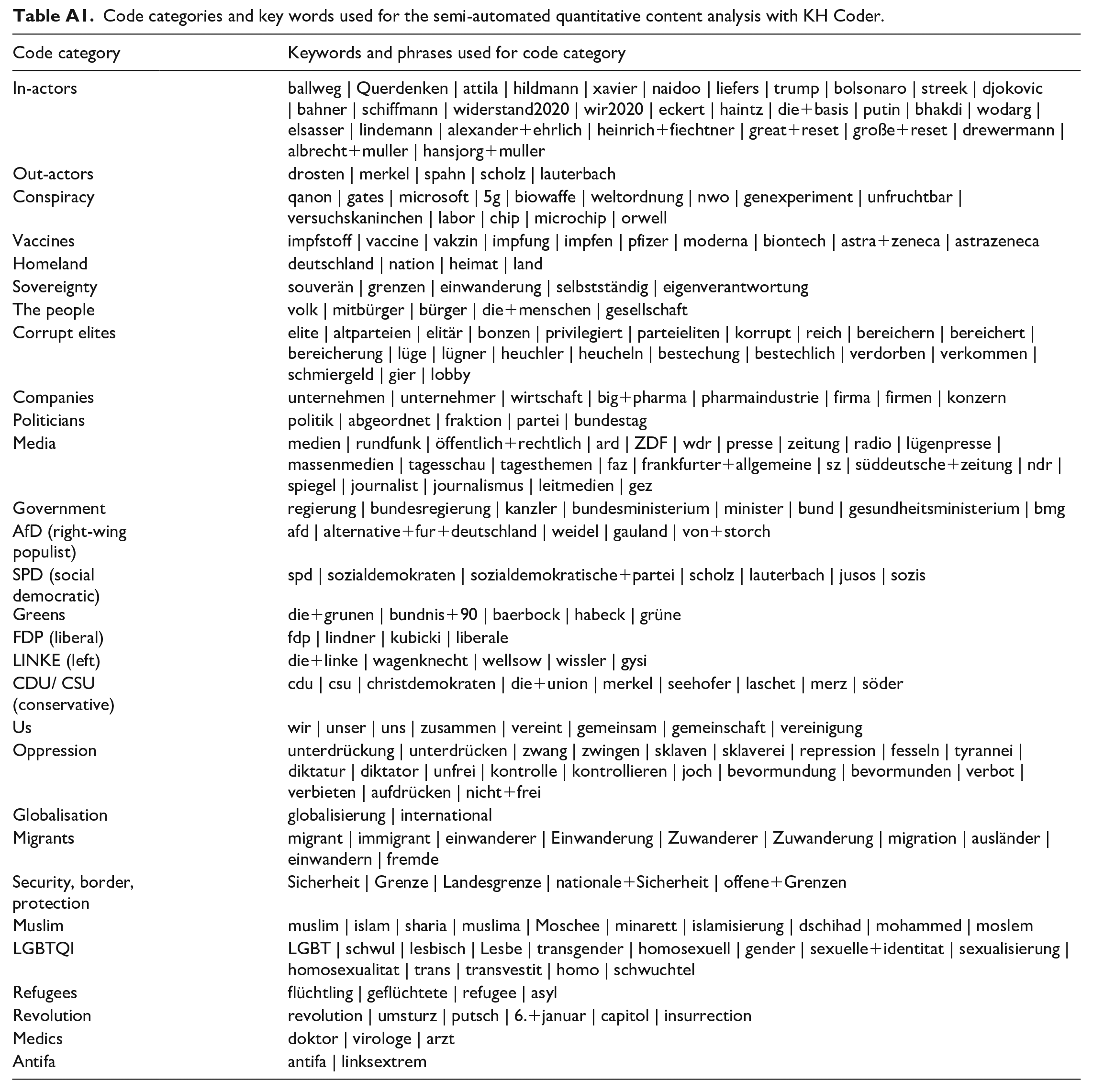
Second, a semi-automated quantitative content analysis of chat messages was conducted to determine how frequently certain narrative patterns were employed within each category. This was done by deductively (literature-specific categories) and inductively (topic-specific categories) coding narrative fields based on keywords. These codes include the five core elements lined out by Engesser et al. (2017) regarding sovereignty, the people or in-group, corrupt elites, out-groups, and the homeland. They further feature COVID-19-specific topics, like vaccination, conspiracies, companies and businesses, the media, traditional parties, and oppression-related terms. A detailed codebook is provided in Table A1 (Appendix). Codes were validated by conducting a qui-square test of independence, determining code independence. Significance level was considered at an alpha of p < 0.01. For the cross tabulation of codes in Doctors, Lawyers and Querdenken chats (X² (56, N = 244,208) = 2894.22, p < 0.01), four codes were not significantly independent (Greens, p < 0.05; Muslim, p > 0.05; LGBTQ, p > 0.05; Refugees, p > 0.05). For the cross tabulation of codes in Activism, Info, News and Protest chats (X² (84, N = 291,207) = 10721.29, p < 0.01), all codes were significantly independent (p < 0.01).
To determine and contextualise narrative patterns stemming from these code clusters, which ultimately form discourse specific to their communities and categories, coded keywords serve as the base for further concordance analysis conducted for each of the established sample categories (Activism, Protest, News, Info, Lawyers, Doctors and Querdenken). Messages that did not feature textual contents, such as images, polls, and links were excluded, as they could not be analysed with the proposed research method, so that the sample of analysed messages consists of 1,273,744 messages.
Findings
External link sharing
External links shared within the established categories (Figure 1) of groups and channels indicate a variety of mainstream and alternative, partisan news media, and other resources, mostly right-leaning. Frequently linked alternative and partisan news media reflecting far-right and populist ideology are Kopp Publishing (n = 21,975), which is the most prevalent of all shared links within Activism and News channels, selling products like survival equipment, promoting books about alleged left-wing extremist takeover of government, the great reset and the plandemic. Such media feature anti-elitist and anti-mainstream narratives, acting as correctives to perceived mainstream or traditional media (Haller and Holt, 2019; Harcup, 2013). Other frequently appearing platforms are Reitschuster (n = 7806), a right-wing conservative news blog, Epochtimes Germany (n = 7414), a far-right international media outlet, and RT DE (n = 7226), a television network funded by the Russian government. Other German language far-right news media shared include Wochenblick (n = 3762) and Report24 (n = 1903) from Austria, Journalistenwatch (n = 3035) and Junge Freiheit (n = 2861).
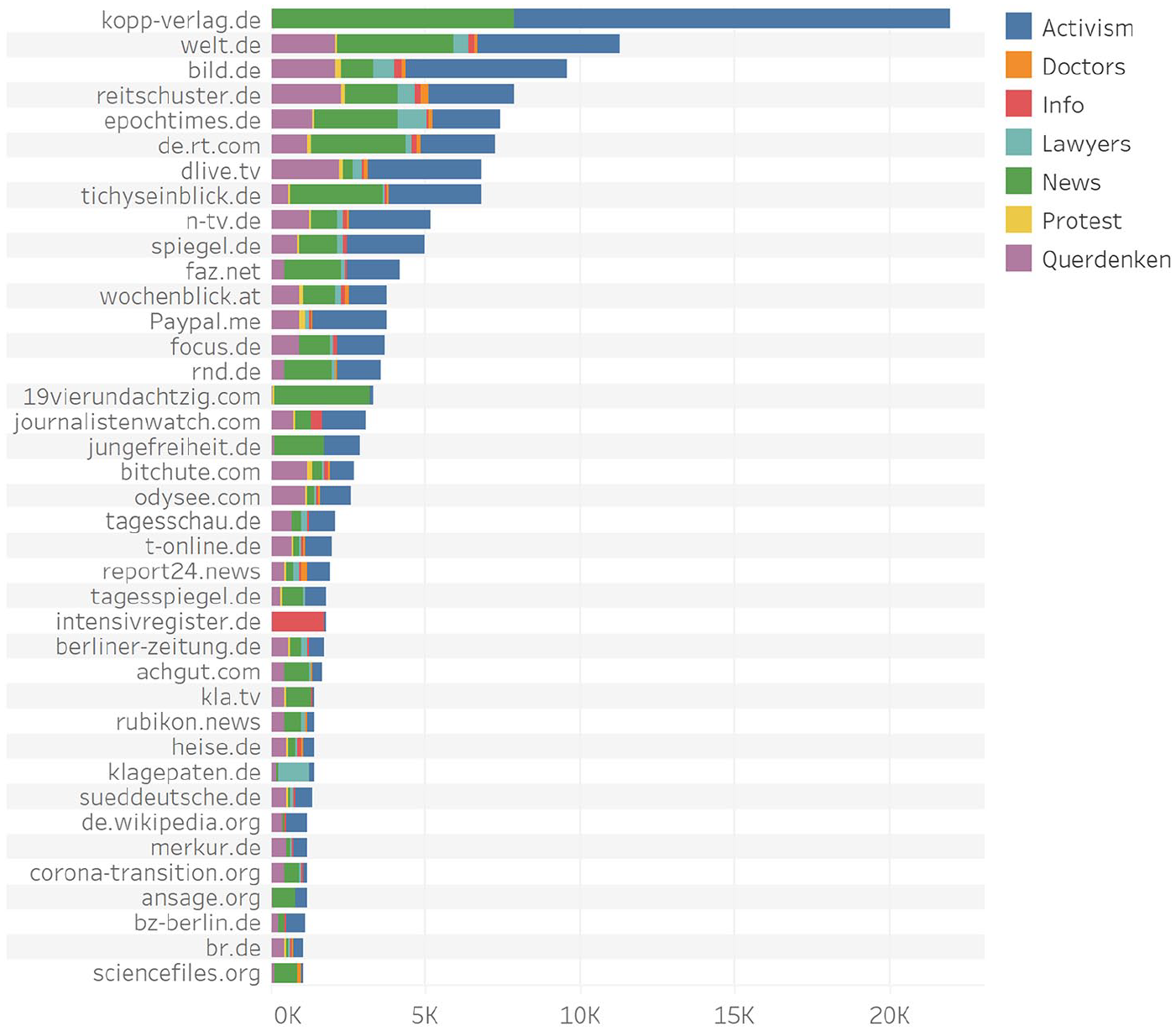
External links most frequently shared within all categories with at least 1000 shares. Hyperlinks towards other social media (Telegram, YouTube, Facebook, Twitter, Instagram) were excluded.
Several alternative and partisan news media pages that can be placed in the conspiracy and misinformation spectrum during the COVID-19 pandemic are 19vierundachtzig (1984) (n = 3191) of Oliver Flesch, a far-right activist, vlogger and blogger, Corona-Transition (n = 1143), an aggregator for news of Swiss journalist and publicist Christoph Pfluger, vaccine critic and anti-COVID-19 restrictions advocate, as well as Sciencefiles, a far-right blog concerned with COVID-19 misinformation, anti-mainstream media, anti-elite and anti-feminism narratives.
Most frequently linked traditional media are newspaper Welt (n = 11,291), tabloid Bild (n = 9559), N-TV (n = 5146), Spiegel magazine (n = 4987) or newspaper FAZ (n = 4175), indicating that traditional news media contents still have a certain relevance within the Querdenken community.
Several video streaming platforms can also be found among the most frequently shared external links. These services include Odysee (n = 2570), Dlive (n = 6823) and BitChute (n = 2681), which have also been frequented by far-right actors in the US due to their low levels of moderation and resistance to contents (Holt, 2022; Trujillo et al., 2020), as well as monetisation (Squire, 2021), further indicated by links towards Paypal (n = 3765) within all communities, especially for Querdenken and Activism channels.
Sub-communities within the sample
Applying a community detection algorithm (Blondel et al., 2008) to the entire sample, 128 communities can be observed. The different Querdenken communities show ties between movement channels to Telegram accounts that were categorised as general information distributors. These Info channels are part of each major community and can be traced back to before the COVID-19 pandemic. When comparing the top 10 accounts in terms of betweenness centrality, seven of these accounts or channels are general information chats and another three are regional Querdenken chats (Table 1).
Top 10 accounts with highest betweenness centrality.
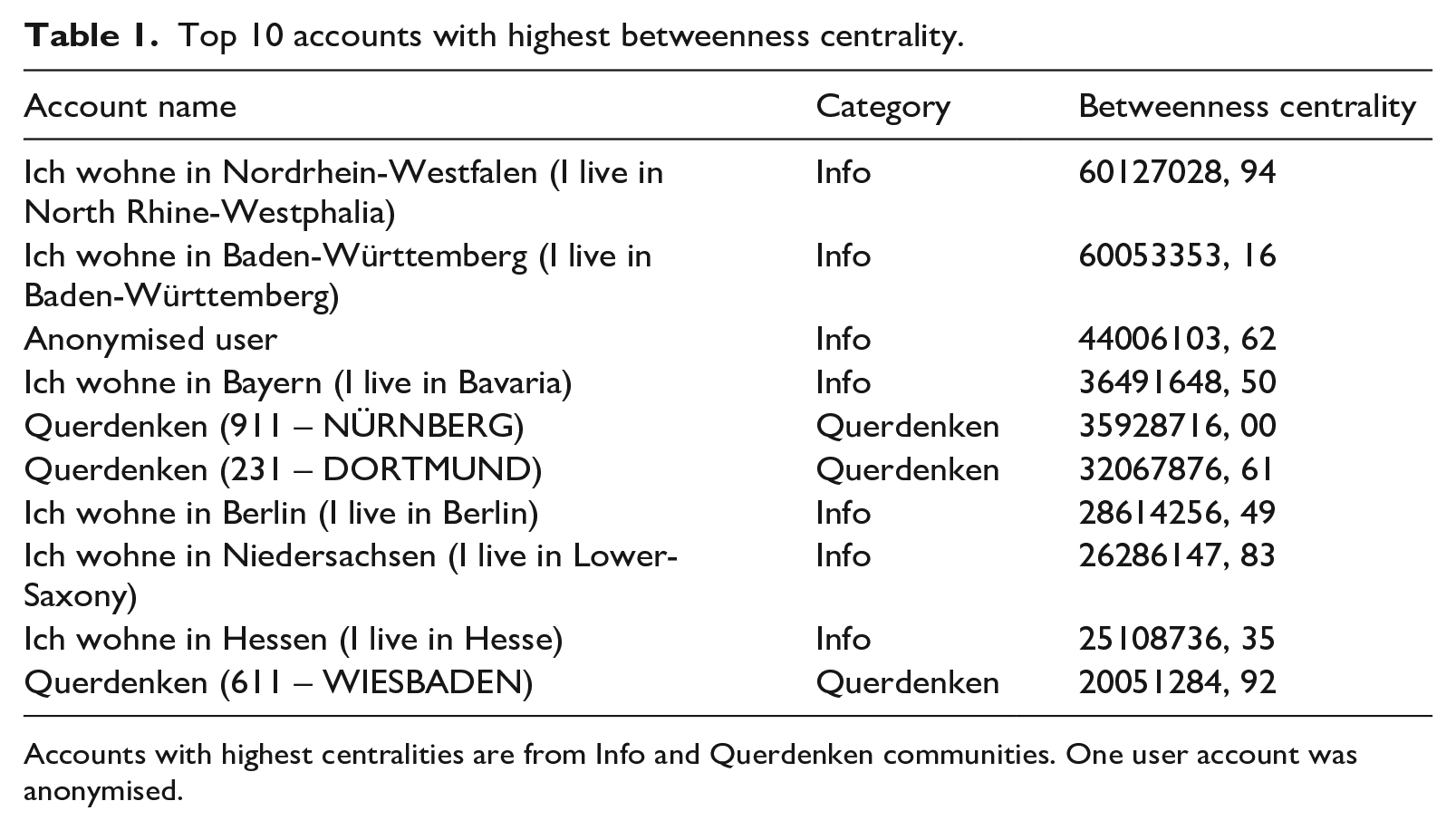
Accounts with highest centralities are from Info and Querdenken communities. One user account was anonymised.
This shows that especially Info-chats serve as junctions between Querdenken infrastructure and other channels that were categorised as Activism, Protest or News, even if those appear in significantly smaller numbers, when compared to activity and size of Info and Querdenken channels.
The analysis of the top three accounts within communities with more than 5% share of accounts (Table 2) provides an insight on topics within their discourse. All modularity classes feature a substantial amount of anti-vaccine narratives and criticism of mask mandates, framed as an issue regarding children’s safety, families and workplaces. Such narratives combine several of the most frequently featured topics within anti-elite and anti-mainstream frames: ‘[n]ow kids are lab rats’, ‘masses of children and pensioners are locked up, women are beaten, companies are forcibly closed, journalists are persecuted [and] attacked by Nazi journalists from ARD and ZDF [public broadcasting channels] with made-up stories’. Anti-vaccine and conspiracy narratives are interwoven in all cases, referencing 5G, Big Pharma, George Soros and Bill Gates as personified signifiers for new world order and great reset narratives: ‘Bill Gates and his vaccines or DNA changes’, or ‘the NWO will strip us of our last rights’. In class 116 particularly, references to QAnon appear more frequently as part of conspiracy narratives.
Overview of communities with more than 5% share of accounts with descriptions of contents issued by the top-three account by output.
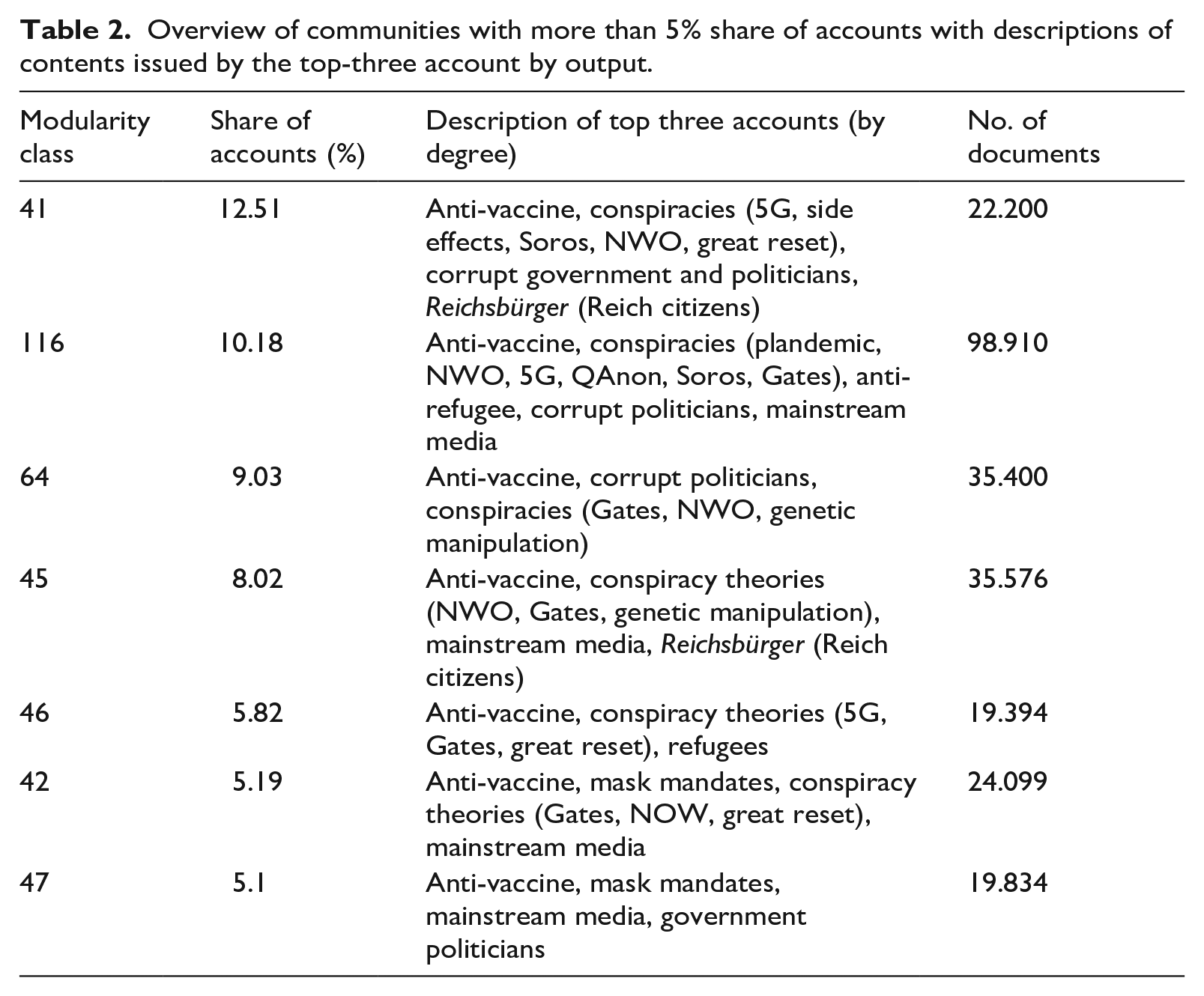
All modularity classes feature anti-elite, anti-mainstream, and anti-government narratives, with politicians and parties as signifiers for the elite and government. Some messages compare restriction measures to Nazi Germany’s oppression of Jewish citizens, portraying politicians such as Merkel (former chancellor), Scholz (current chancellor), Söder (Minister-President of Bavaria), Spahn (former Minister of Health) or Lauterbach (current Minister of Health) as corrupt or criminals. Only within class 64, discourse about corrupted politics can be observed with a stronger focus on state and parties, rather than politicians.
Another frequent narrative featured in a high number of classes (116, 45, 42, 47) refers to mainstream news media outlets as biased and accused of misrepresentation and censorship, alleging that ‘mainstream media is completely silent again and reports nothing’. Messages read that ‘[i]t is only the mainstream media and the politicians who create the illusory world of the pandemic for people who listen to the mainstream’, asking to spread information ‘because the mainstream media doesn’t tell us everything’.
Specific to two of the modularity classes (41, 45) are references to Germany being run as a company (BRD GmbH or Ltd.), a popular narrative within the far-right Reichsbürger movement (Reich citizens). The core ideology of the Reichsbürger movement encompasses refusal of the German constitution on grounds of illegitimacy, acknowledging the German territory of 1937 (as the German Reich), anti-elitism and antisemitism (Keil, 2021). Furthermore, one modularity class (116) also features an increased amount of anti-refugee narratives, stating that ‘[t]he old parties propagate it, the mainstream media report it faithfully and the church leaders support the fairy tale of the will of the population to take in more refugees’, connecting anti-elitist, anti-mainstream and anti-refugee narratives inside a single frame. Similar frames consist of the ‘Merkel government and the onset of refugee propaganda in the mainstream media’ for example.
Semi-automated content analysis of chat categories
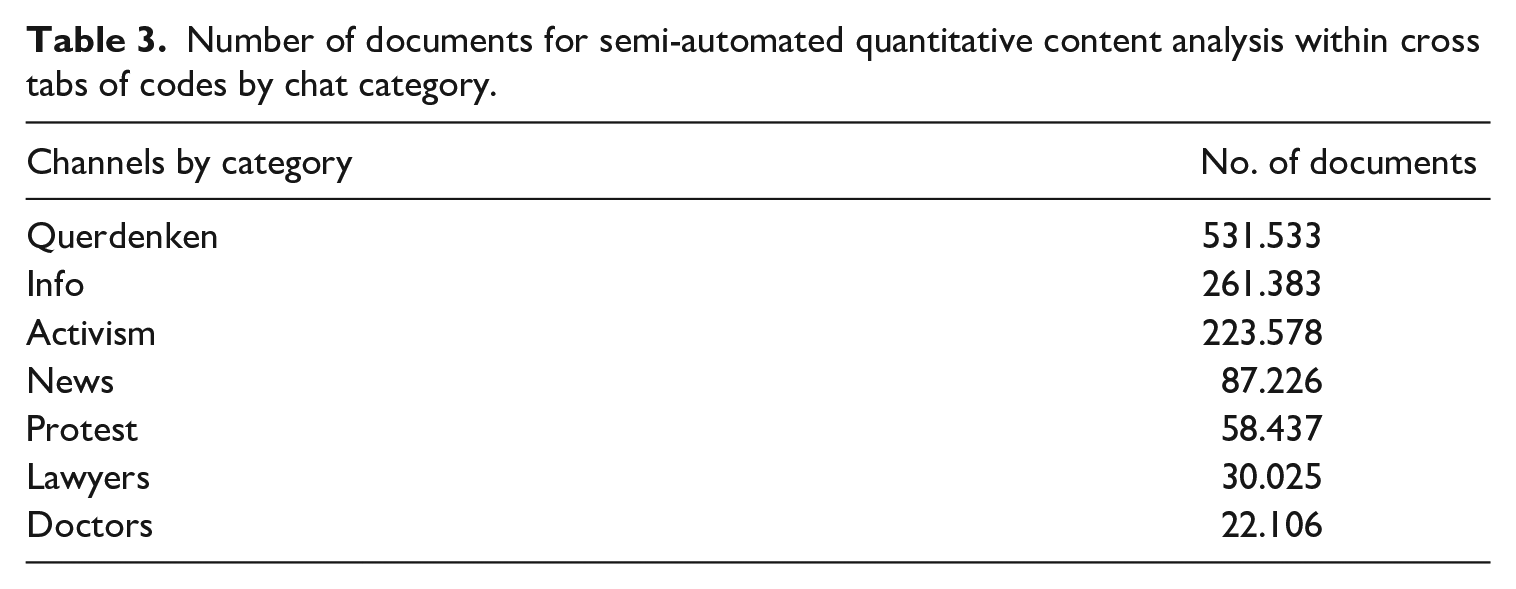
A semi-automated quantitative content analysis was conducted on the initially established categories to track differences or similarities in discourse and focus on narrative fields established through codes. In Table 3, the analysed number of documents shows a hierarchy in terms of output with most messages originating from Info, Querdenken and Activism channels, which ties to the findings of the modularity classes in terms of numbers and message frequency.
Number of documents for semi-automated quantitative content analysis within cross tabs of codes by chat category.
The analysis of code clusters within the seven categories of channels and groups provides further insight into the degree to which right-wing populist discourse is applied within the different categories. A comparison among the codes for Querdenken, Lawyers and Doctors is shown in Figure 2, whereas Figure 3 shows coding results comparing Info, Activism, News and Protest messages.
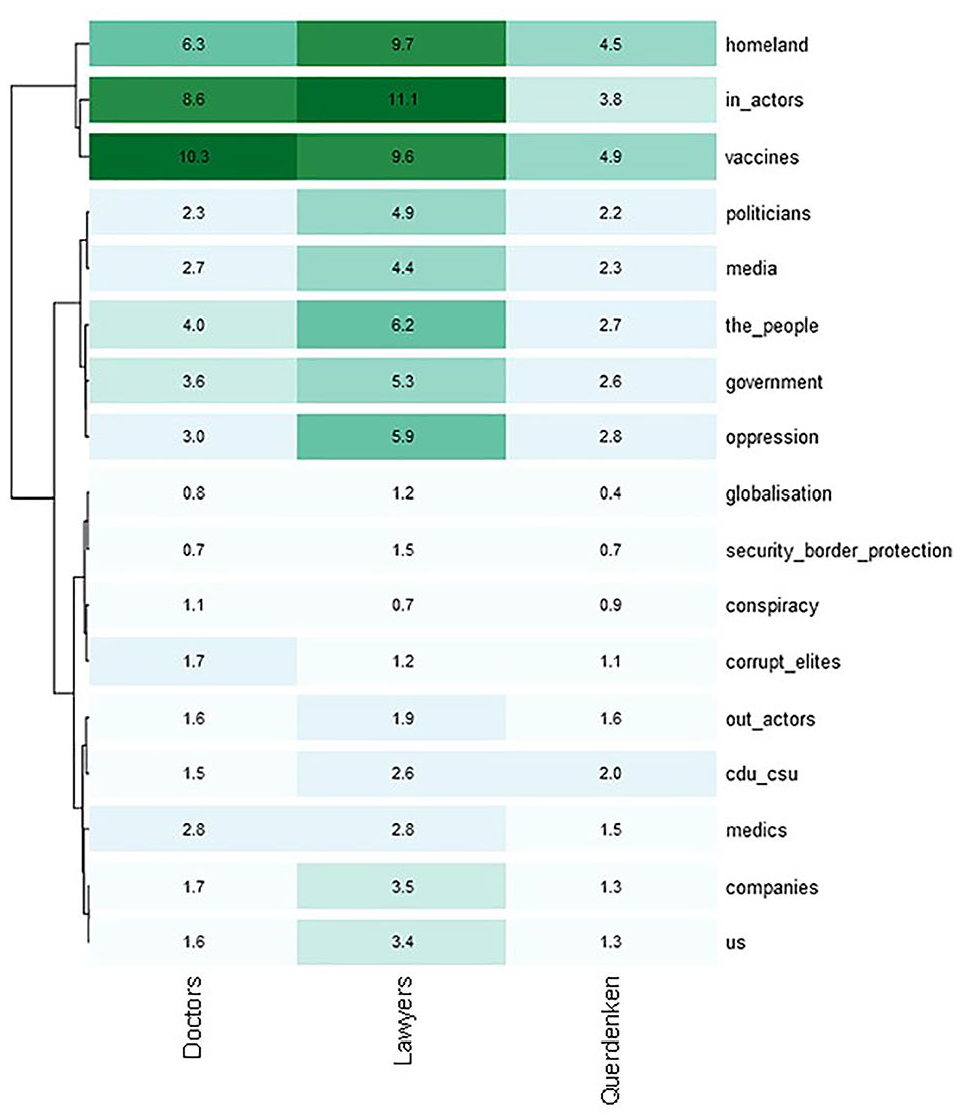
Cross tab of codes found within Doctors, Lawyers and Querdenken chat messages. Only codes with at least 1% of corpus within one category were included.
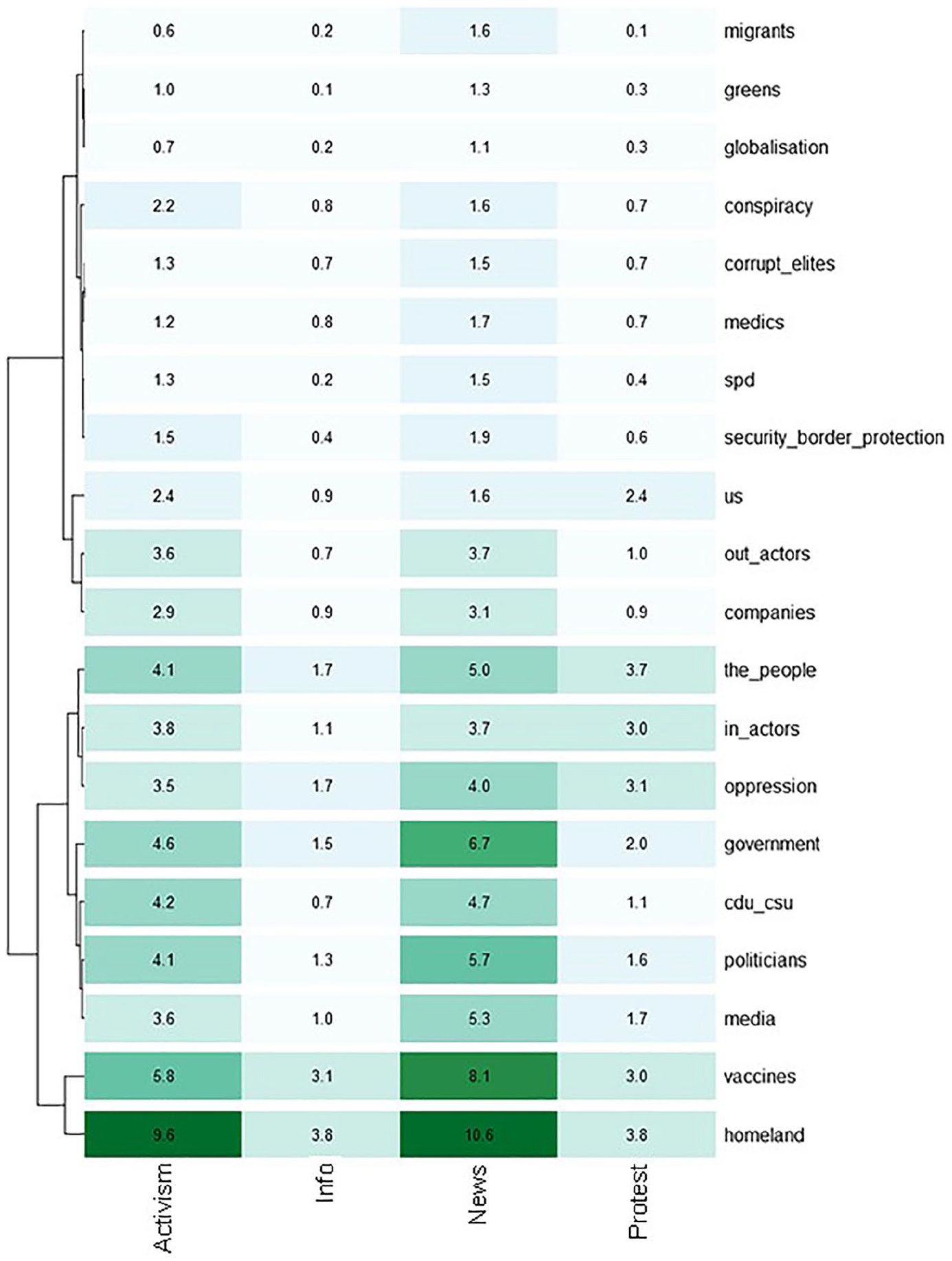
Cross tab of codes found within Activism, Info, News and Protest chat messages. Only codes with at least 1% of corpus were included.
The heartland
In both cross tabulations, the heartland represents a core feature of the greater discourse, most frequently connected to vaccine narratives, visible within messages that describe anti-COVID-19 vaccination as ‘unnecessary, inefficient and dangerous’, stating that ‘Corona was just the beginning – now comes the great destruction’, connecting anti-COVID-19 measures to society and nation: ‘everyone in my fatherland loses their freedom’, ‘the eternal Jew is behind the Corona vaccination. His goal: wipe out all peoples except his own’.
Within Querdenken, Lawyers, and Doctors chats (Figure 2), heartland references are further interwoven with in-actor narratives, connecting those to key movement actors, and those associated, like Querdenken founder Ballweg, Markus Haintz (Querdenken affiliated), or Wolfgang Wodarg (former MP for Social Democratic Party, now part of Die Basis, a party affiliated with Querdenken and anti-COVID restrictions). Activism, Info, News, and Protest chats (Figure 3) further connects to a larger field about the people, oppression, elites and media. Messages highlight the populist, nativist and authoritarian character of far-right ideology, stating that apart from far-right party AfD ‘the other parties do not represent the opinion of the German people’, and note that ‘the republic experienced a concerted action by politicians and the media, in which millions of people were declared enemies of society’.
The people
Querdenken, Lawyer and Doctor chats (Figure 2) connect narratives about the people with government and oppression-related issues, most frequently emphasised within Lawyer chats. The people here are represented by messages stating ‘we the people we are the sovereign’, and that ‘we – the German people – now have the unique opportunity to defeat these traditional fascist spirits for the first time and once and for all by our own efforts’. The people are depicted as the resistance to state oppression in messages stating that ‘if they demand further measures and deprivation of liberty, the German people will wake up at some point and chase all the despots out’. Within Activism, Info, News, and Protest chats (Figure 3), people-centred narratives are closer connected to in-actors and oppression-related issues, portraying activists, movement actors and perceived allies alongside the people.
In both cases, the frame is constructed through oppression-related discourse that places the threat against the people: ‘a people is only oppressed as long as it lets itself being oppressed’, ‘can anybody still take this fascist regulatory state seriously’, ‘the people now realise that bondage is not normal but a state of political oppression’. The frame is also built through references to perceived elites (government, parties, politicians, media). Some messages compare government and COVID-19 regulations to historically authoritarian regimes, stating that ‘the fascist Corona police state based on the Stasi-Nazi model must fall’ or that during Merkel’s terms as chancellor, Germany had ‘internet censorship, gag orders, defamation, insults and work bans for critics of her policies’.
The elites
Various anti-elite-related narratives can be detected within Querdenken, Lawyer and Doctor chats (Figure 2), as these combine politicians and the media in one cluster, with government and oppression in another. General references to corrupt elites further connect to conspiracies. Similarly, Activism, Info, News, and Protest chats (Figure 3) also connect perceived elites, featuring a larger cluster where government, former government alliance CDU/CSU (a centre-right Christian democratic political alliance of -Christian Democratic Union and Christian Social Union), politicians and the media are combined to one big anti-elite cluster. In both cases, CDU/CSU serve as a signifier for oppressive and corrupt government, as all other parties appear less frequently.
Messages featuring specific politicians like Merkel, Söder and Heiko Maas (former Minister of Foreign Affairs) state that ‘they want to take away our freedom of movement and muzzle us with masks’. The anti-elite frame is also seen in messages about mainstream media, ‘state media’, or the ‘political and media agitation’, highlighting how ‘for months, politicians and media are trying to portray critics of Corona measures as Nazis’, talking about ‘censorship in German media’, or declaring that ‘state media once again prove their subservience in reporting’ and ‘coverage of COVID-19 is the preliminary culmination of a malicious, biased, selective work by the mainstream media’.
The out-group
The out-group within Querdenken, Lawyer and Doctor chats (Figure 2), is closely tied to CDU/CSU again, further portraying the perceived threat as coming from specific politicians that serve as signifiers. Out-group narratives in Activism, Info, News, and Protest chats (Figure 3) are closely connected to narratives about companies, and by extension to us-narratives. This shows that out-actors are perceived as connected to companies and economic interests, which also fits into corruption-related narratives about politicians, parties and government. Examples can be found in messages making specific mentions of politicians and parties, stating that ‘the Greens with Habeck [Robert Habeck, current Vice-Chancellor], Hofreiter [Anton Hofreiter, MP and former co-chair of Green parliamentary group] and Baerbock [Annalena Baerbock, Minister of Foreign Affairs] [are] no better than Merkel, Laschet [former centre-right candidate for Chancellor] and Söder’, that ‘not only the Merkel system is at its end’ and declare that ‘it wasn’t Corona, [but] it was Merkel, Spahn, Söder and the other “corona agitators”’, when debating responsibility for the pandemic. References to them and the system as opposed to the people and popular will create the out-group as an opposition and therefore complete the second stage of the master frame.
Sovereignty
Sovereignty, as outlined by Engesser et al. (2017) encompasses a popular sovereignty of the people, not only in a nativist sense. Within Querdenken communities, this sovereignty happens in resistance to government, parties, and politicians and what is referred to as the system. Within these narratives the people and in-actors are displayed in opposition to out-actors, which also includes mainstream media. Therefore, sovereignty-related narratives connect to those revolving around anti-elitist and anti-mainstream discourse, as the threat (elites, parties, politicians) is tied to the people and their popular will, opposing those threats.
Such messages referencing the popular sovereignty of the people read that ‘Federal Republic of Germany wages war against the people’, and state that ‘Europe is standing up against the neo-fascist Corona coup of corporations and governments’. Connecting this to the heartland, message emphasise that ‘we are the change, the power, the resistance that you never expected – we are the people – and our beloved Germany is finally awakening’.
The discourse analysis of the categorised channels shows that parts of the core elements of right-wing populist discourse exist within Querdenken and their affiliated channels. In all cases, narratives evolving around the homeland could be found, which were connected to the people, government, and the leitmotif of oppression. This creates a frame of an in-group being oppressed by a government personified by certain ministers and the chancellor in this case, advocating anti-elitist, populist notions and beliefs about the homeland and a homogenous people in fragmented audiences.
Within Activism, Lawyers, Doctors and Protest communities, this frame is further connected to frequent narratives about vaccines. Only two categories of channels referenced socialist party LINKE (Die LINKE, the left) on a frequent basis, next to all other parties present in the German parliament, suggesting that the party only plays a marginal role for COVID-19 related topics in parliamentary opposition.
Conservative party and politicians of CDU/CSU were most frequently mentioned in comparison with all other parties, suggesting that they serve as signifiers or personifications and fix points for critique and protest. This relates to their position in government, as references to Merkel, Spahn and their party peak in 2020 and 2021, yet decrease for the beginning of 2022. On the other hand, references to actors and parties of the government coalition of social democrats, greens, and liberals, formed in December 2021, increase towards the general elections of September 2021.
The high frequency of out-actor narratives, closely tied to CDU/CSU and their politicians, suggests a personality cult when identifying threats towards the collective. The findings also indicate that there is no increased focus on right-wing AfD politicians. The presence of in-actors within the main narrative in Querdenken, Lawyers and Doctors chats shows a strong focus on movement key figures within the analysed discourse. Protest communities frequently reference in-actors, which connects to the focus on key figures or initiators. The findings imply a fixation on key actors and groups such as elites, politicians or the media, as collective terms for perceived threats.
Discussion and conclusions
This research examines and analyses a Telegram community of a COVID-19 critic movement, Querdenken, and affiliated accounts on general information, activists, protests, (alternative) news, legal and health advice. Next to external link sharing, the textual content within these channels and groups was examined, to map their discourse and determine the extent to which right-wing populist discourse is employed within the different communities.
The findings within the smaller communities suggest that the general information groups and channels serve as a link between Querdenken channels or groups and all the other established categories. These Info channels and groups represent an infrastructure that has partly already existed on Telegram prior to the COVID-19 pandemic since 2018. This exemplifies a population that has been affected by deplatforming (Rogers, 2020; Van Dijck et al., 2021) and effectively migrated towards another, less restrictive infrastructure and made use of it. Furthermore, this would also indicate the growth of an existing infrastructure after migration and the linking of different virtual communities.
A heavy influence of far-right alternative and partisan media is observable within all chat categories, further supported by the discourse analysis findings, which suggests a strong influx of far-right ideology within these communities. Mainstream news media is equally shared within these channels, but unsympathetically so, as the discourse analysis indicates. Though the protest movement has been described as heterogeneous in terms of attitudes, the heavy far-right partisan news media influence on the network might strengthen far-right ideology and attitudes, conspiracy theories, vaccine criticism and anti-elitism within the community.
The in-depth analysis of the top three channels of communities with over 5% share of accounts shows anti-vaccine narratives in all cases, involving children and familes’ safety narratives. Several conspiracy theories could be detected in all communities, predominantly involving 5G, key figures like George Soros and Bill Gates, narratives about genetic manipulation through vaccines and their side effects, but also narratives originating from the far-right Reichsbürger movement, revolving around the so-called plandemic and new world order motifs. Mainstream media are accused of bias and misrepresentation in several cases and government key figures are frequently described as corrupt, criminal, and power hungry. Issues are politicised by including perceived elites (politicians, government, mainstream media) as sources of threats, charging general critique of COVID-19 measures with (partly far-right) conspiracies. Vulnerable groups, in this case, are the general population, families and children especially.
All in all, a similar discourse was found in all established categories, touching several of the core elements of right-wing populist discourse defined by Engesser et al. (2017), yet not all of them in all cases. The leitmotif of a pure people is understood in terms of a common emphasis on freedom, as opposed to restrictions vaccination, and mask mandates, connecting to an idea of personal sovereignty rather than a national one. An element that was found in the main narrative of three of the analysed cross tabulations lies in mainstream media as another antagonistic actor, also suggested by early surveys (Frindte, 2021; Koos, 2021; Pantenburg et al., 2021), connecting to claims about misrepresentation.
This study complements previous limited survey results with a big data approach, finding actors that are perceived as antagonists within virtual communities tied to the Querdenken movement. The results exemplify the construction of discourse from various narratives evolving around certain leitmotifs. The employed narrative patterns combine to a discourse specific both to Querdenken, as well as other far-right communities.
By categorising channels and groups according to the topics found in previous studies (Curley et al., 2022; Holzer, 2021; Zehring and Domahidi, 2023), the construction of (far-right) populist narratives and frames, and the politicisation of a public health crisis within specific communities by combining topics/issues was explored beyond general topic modelling. The results show that narrative and frame construction follow clear mechanisms of personifying threats, most obvious in references to Merkel, Spahn (government actors at the time) and their conservative party alliance as out-actors, but also current government of social democrats, greens, and liberals. This also includes mainstream media actors, displayed as henchmen of a greater system seeking absolute control, more power or to replace the native population. This shows how frame building of Zehring and Domahidi’s (2023: 6) topic cluster entitled ‘“Green Left-Wing Agenda” in German Politics & Media’ manifests within specific narratives forming this discourse, using opponents as ideological signifiers.
The findings further show that popular sovereignty, especially within this heterogeneous movement, is understood as the common resistance to threats (freedom, anti-restrictions, anti-vaccine, anti-government or elite control) and not only in a nativist and classic far-right sense (cf. Mudde, 2007; Pirro, 2015). Zehring and Domahidi (2023) emphasise the existence of QAnon conspiracies in their study of Querdenken communication, which have also been explored here, as they connect to those of the far-right Reichsbürger movement. These narratives display classic populist anti-elite and anti-mainstream rhetoric (cf. Mudde and Kaltwasser, 2017), connecting a perceived corrupt and criminal government and party system to theories around the great reset, a new world order (QAnon), the state as an illegitimate corporation, with an invalid constitution and its politicians as autocratic, subservient, money-driven, and corrupt actors (Reichsbürger). In addition to their findings about protest mobilisation as a topic, the results of this study show how protest mobilisation is fuelled with nativist narratives (patriots, the people), references to the popular will, and perceived threats like vaccinations especially, but also other public health measures, which are compared to Nazi Germany legislation, fascist behaviour, or Stasi (GDR secret police) methods.
The high frequency of references to key actors from Querdenken (Ballweg, Haintz) and affiliated activists (Ehrlich, Hildmann), who personify protest and resistance, strongly highlights discourse about oppressive government actors and resistance. The analysis shows how politicians and media are displayed as enforcing autocratic and oppressive policies against the popular will of the people. Overall, the display of state, government, and politicians as an autocratic, oppressive system, with controlled and manipulative media, presents a leitmotiv in Querdenken frame building and discourse, and that of affiliated channels and groups. In all cases, the frame is constructed based on naming the initial problem (the pandemic and the restrictions) and the source of the problem as perilous out-groups (elites, parties, politicians, institutions), and by outlining the people/in-group’s popular will as threatened (freedom, anti-restrictions, anti-vaccine, anti-government or elite control). Therefore, the Querdenken movement and its affiliated channels effectively politicise the COVID-19 pandemic through blaming elites, politicians, and other out-actors by connecting them to specific pandemic-relevant issues. This corresponds with Heinisch and Mazzoleni’s (2017) frame building stages of the Master Populist Frame, interwoven with core elements of right-wing populist discourse (Engesser et al., 2017).
The contribution of this research also lies in exemplifying the extent to which mainstream media is perceived as an antagonistic actor, being framed as part of the apparatus around corrupt political and economic elites. Furthermore, this study provides an insight into the connection of topics highlighted in previous studies, and the way in which issues and actors are combined and used within far-right populist frame building, serving as ideological signifiers. The findings support Haller and Holt’s (2019) observations about framing and lack of gatekeeping within alternative (partisan) media and fill the research gap left by topic modelling analyses of these protest movements (Curley et al., 2022; Zehring and Domahidi, 2023), exemplifying how issues are constructed, operationalised, and politicised within different frame building stages.
Previous research in Telegram-centred anti-government movements has focused on more restrictive and authoritarian contexts (Akbari and Gabdulhakov, 2019; Bykov et al., 2021; Urman et al., 2020; Wijermars and Lokot, 2022), stressing moderation modes, censorship escape and alternative media, marking the messenger a useful tool for different types of movements. The results of this study show how Telegram is employed as a space that unifies secluded, separate, deplatformed communities sharing similar discourse and narratives. Though Telegram has recently restricted 64 channels in Germany, including Attila Hildmann’s channels (activist and anti-COVID-19 restrictions protest advocate), which are part of this sample, there is still little to no moderation, which could further contribute to the radicalisation of users in time. The dynamics within these communities exemplify that narratives can be connected and shared amongst various groups with different specifics in terms of topics and content, even within a heterogeneous protest movement. Further research could examine both the radicalisation potential of such environments, the evolution of attitudes towards mainstream media within these communities, and user attitudes as well, as some of the analysed channels offer the possibility to extract comments. Furthermore, future research could also examine how the movement integrates topics that are not COVID-19-related into its discourse, like the invasion of Ukraine, climate change, or future elections, as its mobilisation potential might be prove influential in electoral outcomes in the future.
Limitations
The starting point for the present research was the Telegram channel of Querdenken’s Stuttgart branch, which influenced further sampling, as only channels and groups mentioned within the initial chat history were sampled. As such, a potential limitation of this approach in sampling is its lack of accounting for all communities affiliated with the channel. However, the present study allows for extensive insight into the communities affiliated with a specific channel. Prior research has pointed towards populist attitudes within the movement, even if also described as homogeneous, and discovered far-right news media within its virtual communities, which implies that from the very start specific narratives will be detected and little variation might be anticipated. However, the novelty of this study is its communication-centred content-based in-depth analysis, a methodological approach that can serve as a model for further research concerned with the discursive politicisation of public crises.
Footnotes
Appendix
Code categories and key words used for the semi-automated quantitative content analysis with KH Coder.
| Code category | Keywords and phrases used for code category |
|---|---|
| In-actors | ballweg | Querdenken | attila | hildmann | xavier | naidoo | liefers | trump | bolsonaro | streek | djokovic | bahner | schiffmann | widerstand2020 | wir2020 | eckert | haintz | die+basis | putin | bhakdi | wodarg | elsasser | lindemann | alexander+ehrlich | heinrich+fiechtner | great+reset | große+reset | drewermann | albrecht+muller | hansjorg+muller |
| Out-actors | drosten | merkel | spahn | scholz | lauterbach |
| Conspiracy | qanon | gates | microsoft | 5g | biowaffe | weltordnung | nwo | genexperiment | unfruchtbar | versuchskaninchen | labor | chip | microchip | orwell |
| Vaccines | impfstoff | vaccine | vakzin | impfung | impfen | pfizer | moderna | biontech | astra+zeneca | astrazeneca |
| Homeland | deutschland | nation | heimat | land |
| Sovereignty | souverän | grenzen | einwanderung | selbstständig | eigenverantwortung |
| The people | volk | mitbürger | bürger | die+menschen | gesellschaft |
| Corrupt elites | elite | altparteien | elitär | bonzen | privilegiert | parteieliten | korrupt | reich | bereichern | bereichert | bereicherung | lüge | lügner | heuchler | heucheln | bestechung | bestechlich | verdorben | verkommen | schmiergeld | gier | lobby |
| Companies | unternehmen | unternehmer | wirtschaft | big+pharma | pharmaindustrie | firma | firmen | konzern |
| Politicians | politik | abgeordnet | fraktion | partei | bundestag |
| Media | medien | rundfunk | öffentlich+rechtlich | ard | ZDF | wdr | presse | zeitung | radio | lügenpresse | massenmedien | tagesschau | tagesthemen | faz | frankfurter+allgemeine | sz | süddeutsche+zeitung | ndr | spiegel | journalist | journalismus | leitmedien | gez |
| Government | regierung | bundesregierung | kanzler | bundesministerium | minister | bund | gesundheitsministerium | bmg |
| AfD (right-wing populist) | afd | alternative+fur+deutschland | weidel | gauland | von+storch |
| SPD (social democratic) | spd | sozialdemokraten | sozialdemokratische+partei | scholz | lauterbach | jusos | sozis |
| Greens | die+grunen | bundnis+90 | baerbock | habeck | grüne |
| FDP (liberal) | fdp | lindner | kubicki | liberale |
| LINKE (left) | die+linke | wagenknecht | wellsow | wissler | gysi |
| CDU/ CSU (conservative) | cdu | csu | christdemokraten | die+union | merkel | seehofer | laschet | merz | söder |
| Us | wir | unser | uns | zusammen | vereint | gemeinsam | gemeinschaft | vereinigung |
| Oppression | unterdrückung | unterdrücken | zwang | zwingen | sklaven | sklaverei | repression | fesseln | tyrannei | diktatur | diktator | unfrei | kontrolle | kontrollieren | joch | bevormundung | bevormunden | verbot | verbieten | aufdrücken | nicht+frei |
| Globalisation | globalisierung | international |
| Migrants | migrant | immigrant | einwanderer | Einwanderung | Zuwanderer | Zuwanderung | migration | ausländer | einwandern | fremde |
| Security, border, protection | Sicherheit | Grenze | Landesgrenze | nationale+Sicherheit | offene+Grenzen |
| Muslim | muslim | islam | sharia | muslima | Moschee | minarett | islamisierung | dschihad | mohammed | moslem |
| LGBTQI | LGBT | schwul | lesbisch | Lesbe | transgender | homosexuell | gender | sexuelle+identitat | sexualisierung | homosexualitat | trans | transvestit | homo | schwuchtel |
| Refugees | flüchtling | geflüchtete | refugee | asyl |
| Revolution | revolution | umsturz | putsch | 6.+januar | capitol | insurrection |
| Medics | doktor | virologe | arzt |
| Antifa | antifa | linksextrem |
Declaration of conflicting interests
The author declared no potential conflicts of interest with respect to the research, authorship, and/or publication of this article.
Funding
The author disclosed receipt of the following financial support for the research, authorship, and/or publication of this article: This work was supported by Babeș-Bolyai University, Romania.