



Abstract
Established in 2014, SputnikTR (a localized version of Sputnik News) is the most popular pro-Russian media outlet active in Turkey. The news content published by SputnikTR’s Twitter account currently attracts the highest engagement rates among the international public broadcasters active in Turkey. SputnikTR’s official Twitter account has more followers (1M) than Sputnik News English (326K). This article argues that SputnikTR’s Twitter account is used to promote Russian vaccine technologies in Turkey. We believe that it is also a conduit for the dissemination of pro-Russian as well as anti-Western narratives to the Turkish online public. Using a computational methodology, we collected 2,782 vaccine-related tweets posted by SputnikTR’s Twitter account between April 2019 and April 2021. We deployed framing as well as critical discourse analysis to study the contents of our dataset. Our findings suggest that SputnikTR uses (a) disinformation as well as misinformation in vaccine-related news and (b) unethical communication techniques to maximize engagement with content posted on Twitter. Our findings are significant insofar as they are the first documented instances of Russian propaganda efforts on Turkish Twitter. These efforts seem to be focused on promoting the Russian vaccine while encouraging public hesitancy toward Western vaccine technologies.
Keywords
Introduction
For a long time, the West has been caught between a rock and a hard place in regard to the problem of Russian propaganda. There is ample and indisputable evidence that media outlets such as Russia Today (RT) and Sputnik News (SN) have a corrosive effect on political processes in electoral democracies. Yet, Western political leaders have been reluctant to take radical action against Russian propaganda. This reluctance, however, has been overturned with the brutal Russian invasion of Ukraine on 24 February 2022. As a response to the Russian invasion, unprecedented steps are being taken to curb the influence of Kremlin’s media outlets in Western societies. Within the timeframe of just 1 week, both RT and SN broadcasts have been banned in the European Union. Although time will show whether these actions achieve any desired outcome, they nonetheless highlight the threat posed by Russian media to electoral democracies. We believe this latter aspect is important insofar as it serves as a wakeup call for other countries hosting a Russian media presence.
Most academic research about the efforts of Russian news media to manipulate international public opinion focuses on Europe, Ukraine, and the United States (see, for instance, Elswah & Howard, 2020; Neudert et al., 2019; Onuch et al., 2021; Yablokov, 2015). This means that the Kremlin’s use of RT or SN in other countries and regions has scarcely been discussed. As such, this article is the first in-depth study on SputnikTR’s activities in Turkey. SputnikTR’s Twitter account has more followers (1M) than SN English (326K). The engagement rates of content posted on SputnikTR’s Twitter account consistently outperforms other international public broadcasters (IPBs) such as BBC Turkish or Deutsche Welle Turkish. 1 Within such a context, our article’s hypothesis is that SputnikTR’s Twitter account is used to promote Russian vaccine technologies in Turkey. We believe that it is a conduit for the dissemination of pro-Russian influence to the Turkish online public.
It is important to note that SputnikTR’s efforts to promote the Russian vaccine are occurring within the backdrop of the ongoing Russian–Turkish rapprochement, wherein the personal friendship of Putin and Erdoğan has transformed bilateral relations between the two countries. As the building of a nuclear power plant in Akkuyu, Turkey, as well as the controversial sale of S-400 air defense systems demonstrate, Russian investments in Turkey have grown exponentially within the past decade. In exchange, Turkey has become one of Russia’s most important trade partners and one of the most popular destinations for Russian tourists. This shift in bilateral relations is reflected in the Turkish public’s outlook on foreign affairs.
For instance, the results of a yearly survey conducted by Kadir Has University suggest that Russia’s image in Turkey is steadily improving after the crisis years of 2015–2016 (Unver, 2019a). For instance, the percentage of people who see Russian–Turkish cooperation as an alternative to European Union membership has risen from 11.2% to 26.6% between 2015 and 2021. The Turkish public increasingly sees Russia less as a threat and more as an ally in contrast to the United States and Israel, both of whom are seen by the Turkish public as the country’s top enemies (Aydın et al., 2021).
Similarly, a national survey conducted by the Metropoll Center for Strategic and Social Studies showed that 48.3% of respondents saw United States and the North Atlantic Treaty Organization (NATO) as being responsible for the war in Ukraine (Sencar, 2022, p. 74). In comparison, only 33.7% of respondents found Russia to be responsible for the war (Sencar, 2022, p. 74). In the same survey, 72.7% of respondents thought that the European Union had a discriminatory attitude toward Turkey (Sencar, 2022, p. 10), and 27.8% of respondents thought that Turkey should leave the North Atlantic Treaty Organization (Sencar, 2022, p. 13).
The findings of both polls suggest that the Turkish public’s outlook on international affairs is becoming increasingly anti-Western and “Eurasianist” (Ratsiborynska, 2016). Given Turkey is a founding member of NATO and a candidate country for European Union (EU) membership, the implications of such a shift in public opinion are immense. Within such a context, we believe that it is of paramount importance to comprehend the mechanisms through which Russian influence is disseminated to the Turkish public.
The outline of our article is as follows: The first section of the literature review provides an overview of how Russia has historically used communication technologies to manipulate international public opinion. The second part of the literature review discusses the Russian strategic communication paradigm active in Turkey as well as its pro-Russian media ecosystem. The last section of the literature review looks at the international controversy surrounding the Russian vaccine as well as Turkey’s policy to procure vaccines from multiple suppliers. The method section provides an overview of the data collection process as well as the analytical approaches used by the authors. The analysis section focuses on the two main themes through which the Russian vaccine is portrayed to Turkish audiences. This section also draws attention to the tactics used by SputnikTR’s Twitter account to maximize online engagement. The remaining sections provide an overview of our findings as well as possible avenues for further research.
Literature Review
The historical evolution of the press and mass media in Russia has followed a different path in comparison to the West. Most importantly, the media in Russia has always served as an instrument of political propaganda, going back to the country’s first newspaper in the 18th century, Vedomosti (Ognyanova, 2010). Under the Soviet Union, information was considered a dangerous commodity to be feared and controlled, rather than a right and a public good. The regime saw the media as danger to be tightly controlled, with only select elites permitted access to objective news or to foreign publications (Soldatov & Borogan, 2015). As such, the Soviet Union was widely acknowledged as employing strategic communication and reaping the benefits in both the domestic and the foreign realms (Glantz, 1988), as well as utilizing agitation and propaganda to mobilize its population (Kenez, 1985). Strategic communication can be defined as the use of various measures or tactics with the purpose of influencing other actors’ decisions and actions to achieve policy objectives (Godzimirski & Østevik, 2018).
In line with such a worldview, the Soviet Union had numerous institutions that pursued an offensive strategy of overt and covert propaganda techniques to further Russian interests in the international arena. For overt activities, the Soviet Union relied extensively on news agencies such as Informatsionnoye agentstvo Rossii (TASS) and RIA Novosti. These agencies were founded to spread official, state narratives that would counter Western news agencies such as Reuters, France Presse (AFP), or Associated Press (AP) and further Russian foreign policy objectives (Zakem et al., 2017, p. 16). For covert operations, the Komitet Gosudarstvennoy Bezopasnosti (KGB) had a separately functioning branch that was named as “special disinformation office” (van Herpen, 2016).
With the dissolution of the Soviet Union in 1991, the nascent Russian Federation began to lose its competitive advantages in the realm of strategic communication and information warfare. This decline continued well into the early 2000s until Russian political leaders and academics started to acknowledge that controlling both communication and information is of vital importance in its international strategy (Lankina & Niemczyk, 2015). In an attempt to reverse the decline in Russian communication power and to ensure national information security, Russian president Putin unveiled the doctrine of “Information Security” during the fifth month of his presidency (Maréchal, 2017). Under Putin’s leadership, the annual budget for the state-controlled international media grew to an estimated one billion USD per year (Abrams, 2016). As part of this initiative RT, a Kremlin-sponsored (state-backed) international news channel was established in 2005, soon after the official adoption of the “Information Security” doctrine. On 10 December 2005, RT went live as a “24 hour English-language channel.” Soon afterward, RT began broadcasting in Arabic (2007) and Spanish (2009). Next, it began to offer local news coverage for the United States and the United Kingdom. In 2015, RT began providing alternative-to-mainstream online news and comments, with a strong social media focus on Twitter, Facebook, and YouTube in German and French (Miazhevich, 2018).
According to Rutland and Kazantsev (2016, p. 402), the primary motivation for establishing a brand-new transnational media organization was to “change the dynamics of the global media market” and to “demolish the concrete monopoly of Western news organizations like the BBC, CNN and Associated Press (AP).” The authors also state that RT “. . . presents itself as a radical, free-thinking critic of establishment thinking.” In doing so, RT focuses heavily on Russia’s image abroad, placing particular emphasis on its unique culture, ethnic diversity, and history. It is important to note that the establishment of RT came at a moment wherein Russia was facing Color Revolutions in Georgia (2003) and Ukraine (2004) within its former sphere of influence. Faced with these geopolitical challenges, Russia increased its efforts in strategic communication to sway international public opinion (Saari, 2014).
Initially, Russian efforts to influence international public opinion floundered spectacularly, particularly within the context of the 2008 Georgia–Russia war. Although Russia was victorious in the conflict militarily, Georgia successfully spread the image of itself as a “tiny neighbor battered by imperialists in Moscow” (Avgerinos, 2009). Despite RT’s international popularity, the outlet was unsuccessful in convincing international audiences about the necessity of a Russian intervention in the Caucasus. This failure led to a seismic shift in the editorial policies and broadcasting strategies of RT—“from 2009 onward, RT began to change, . . . from a defensive . . . to offensive weapon” (van Herpen, 2016, p. 72). Although Russia was able to quickly develop its ability to influence foreign publics after 2008 (see, for instance, Galeotti, 2016; Paul & Matthews, 2016), RT began to acquire an untrustworthy and notorious reputation as the blunt instrument of Russian propaganda (Snegovaya, 2015).
In place of the now-discredited RT, the Kremlin founded the multilingual transnational news agency SN. SN defines itself as a “modern news agency whose products include newsfeeds, websites, social networks, mobile apps, radio broadcasts, and multimedia press centers” that “targets an international audience” by publishing news and videos “in more than 30 languages”. In contrast to RT, SN uses subtler language and tries to hide its explicit ties to the Kremlin. It presents itself as a “normal” international news broadcaster and from the outside, SN seems like a Russian media service with the least possible ties to the Kremlin. Yet, studies show that SN coverage is heavily biased toward Russia (Wilbur, 2021) and is a source of conspiracist propaganda (Watanabe, 2017). In a study of Swedish SN conducted in 2015, Kragh and Åsberg (2017) found that its news articles repeatedly project positive images of Russia, and emphasize Western countries’ social and economic problems and their aggression toward non-Western countries.
Pro-Russian Media Ecosystem in Turkey
Russian disinformation and opinion manipulation efforts in Western democracies have been quite brazen, making them easy for researchers to pinpoint (see, for instance, Bastos & Farkas, 2019; Benkler et al., 2018; Gorwa, 2018; Karlsen, 2019; Woolley & Guilbeault, 2018). One documented goal of Russian disinformation efforts is promoting antivaccination content on social media (Rebello et al., 2020; Wilson & Wiysonge, 2020). In comparison, it has been suggested that Russian disinformation efforts in the Turkish social media ecosystem are minimal (Unver, 2019a). In our opinion, this does not mean that Russian interference does not exist on Turkish social media or that the effects of Russian disinformation efforts are insignificant. Instead, we believe that the locus of such efforts is located elsewhere.
The pro-Russian media ecosystem in Turkey can be divided into local pro-Russian outlets such as Aydınlık and TurkRus (a pro-Russian website), and localized Kremlin-owned media outlets, such as SputnikTR and Rusya’nın Sesi FM (Voice of Russia FM, RSFM). 2 Within such a context, the objective of Russian efforts is to impose the Kremlin’s worldview on the Turkish public and to make these views mainstream. It is less concerned with making the Turkish public “like” Russia and more about aligning Turkish public opinion with Russian policy on key strategic issues (Unver, 2019a, p. 42). Accordingly, domestic pro-Russian social media accounts and bots tend to disseminate accurate yet distorted and decontextualized information (Unver, 2019b). Furthermore, domestic pro-Russian accounts and bots use timing to their advantage to push a factually accurate narrative during crisis-prone periods to distort the public narrative in favor of Russia. These actions, which Unver broadly describes as “forced perspective operations,” not only increase public support for pro-Russian policies but also decrease support for pro-NATO policies. The pro-government nationalist and Islamist media, eager to criticize Western institutions and the European Union for the sake of their own cynical agendas, often adopt narratives that are implicitly pro-Russian. In a similar manner, opposition media outlets adopt narratives that are implicitly pro-Russian to put pressure on the government. The Kremlin is not interested in which side prevails, as long as it can continue influencing the narratives on both sides and push pro-Russian views to the mainstream. As the findings of our study demonstrate, SputnikTR is an important resource for distorted and decontextualized information.
SputnikTR—The Bear in Sheep’s Clothing
Established in 2014, SputnikTR (http://tr.sputniknews.com) “combines different fields of media such as news reporting, digital journalism and radio broadcasting under one roof” and draws attention with a sleek website design and multimedia content. The official slogan of SputnikTR is “We are telling the untold!” (“Anlatılmayanı, anlatıyoruz!”). SputnikTR offers news from different geographies and positions itself as an alternative to the “west-centrist” approach in the world media. At the same time, SputnikTR positions itself as overwhelmingly pro-opposition with much of its local reporting being critical of the Erdoğan regime (Unver, 2019b). On the other hand, international coverage is mostly Turkish translations of Russian news content published by SN, SputnikTR’s parent institution.
SputnikTR aggressively leverages the opportunities afforded by social media to attract online traffic. Links to news content on SputnikTR website are posted on a variety of social media platforms. Among these platforms, it can be argued that SputnikTR uses Twitter in a particularly efficient manner. As of February 2022, reports from web traffic company Similarweb show that SputnikTR’s website received 23.6 million visits, 19.28% of which came from Twitter (Similarweb, 2022). This places Twitter as the second largest traffic-generating source for SputnikTR, only surpassed by Google Search and direct access to SputnikTR’s website.
In addition, a benchmark report from the analytics platform BoomSocial shows that SputnikTR’s Twitter account tweets very frequently (an average of 200 posts per day) in comparison to other international news broadcasters active in Turkey (BoomSocial, 2022). The same report shows that content tweeted by SputnikTR’s Twitter account enjoys relatively high engagement rates per post (6%). In comparison, despite having a larger number of followers on Twitter, BBC Türkçe only has a 2% engagement rate per post. Yet many of the tweets posted on SputnikTR’s Twitter feed often link back to fewer news articles published on the same day. In other words, many tweets link to a few news items. Accordingly, one may argue that SputnikTR’s communication strategy for Twitter is quantity over quality. It is important to note that SputnikTR’s dominance in the realm of Twitter does not cross over into other social media platforms. For instance, the BoomSocial (2022) benchmark report indicates that the subscription rates of SputnikTR’s YouTube channel (137K) are far lower than those of BBC Türkçe (797K) and DW Türkçe (687K).
We argue that there are two primary motivations for why SputnikTR uses Twitter. The first motivation may broadly be described as cost efficiency. As it has been already discussed in the previous section, the Kremlin is currently committed to maintaining the status quo in Turkey. As such, there is no need for Russia to commit significant resources to manipulate public opinion. Furthermore, given the current state of censorship and press freedoms in Turkey, adopting a more aggressive, confrontational approach could simply result in the Turkish state restricting access to SputnikTR. Within this mindset, maximizing the interactive opportunities afforded by one specific social media platform is a cost-effective, low-risk strategy.
The second motivation is more to do with the public perception of Twitter and more broadly social media in Turkey. Despite an ever-widening net of restrictions, Turkey is still one of the most active countries in terms of discussion and dissemination of political information online (Saka, 2018) and ranks among the most active countries in terms of social media usage (Bozdağ, 2017). As of January 2022, there are roughly 69 million social media users active in Turkey, and from these 16.10 million are regular Twitter users (We Are Social, 2022). Despite being endemically plagued by trolls (Saka, 2016), fake news (Akgül, 2019), and at times, intense polarization (Furman & Tunç, 2020), Twitter still offers a refreshing albeit chaotic alternative to mainstream media in Turkey. Within such a context, most use Twitter to follow the public agenda and access information not normally found on mass media (Kocer & Bozdağ, 2020).
SputnikTR’s oppositional editorial stance can be attributed to the polarized nature of the media landscape in Turkey (Yesil, 2016). Almost all of the mainstream media (television channels and the printed press) are pro-government while opposition media outlets dominate much of the digital news ecosystem in Turkey. Hence, an oppositional stance toward the Erdoğan regime allows SputnikTR to “blend in” within the local digital news ecosystem. Furthermore, the audience demographics of mainstream media and digital news are quite different with youth preferring to access news through online resources (Yanardağoğlu, 2021). Accordingly, operating on Twitter affords SputnikTR the opportunity to tap into an audience demographic that does not follow mainstream media in Turkey (Ünal & Çiçeklioğlu, 2019).
SputnikTR’s efforts to expose Turkey’s online public to pro-Russian narratives have been particularly pronounced within the context of the Sputnik V vaccine and more generally the Covid-19 pandemic.
Promoting the Russian Vaccine in Turkey
Toward the end of 2019, a mysterious virus began circulating in Wuhan, China. This virus, soon to be known as SARS-CoV-2, quickly spread around the world, starting a global pandemic. In August 2020, the President of the Russian Federation, Vladimir Putin, surprised the world by announcing that Russia had developed a vaccine for Covid-19. Soon afterward, Russia took the step of registering its vaccine (Sputnik V) with the World Health Organization (WHO). This proved to be a problematic move and as of September 2022, the WHO has not yet granted Emergency Use Listing (EUL) approval for Sputnik V (WHO, 2022). This means that the international health community is unable to verify the science behind the Russian vaccine. 3 Regardless of the WHO’s approval, Russian health authorities have decided to press forward with the production and distribution of the vaccine worldwide.
In the meantime, with no national vaccine program of its own, Turkish health authorities were forced to procure vaccines from abroad. This led to a timeline wherein the Ministry of Health signed agreements with multiple suppliers in an opaque and often secretive manner. Toward the end of November 2020, Turkish health authorities initially signed a deal with the Chinese Sinovac company for 10 million doses of vaccine. Then in December, the Turkish Health Minister announced that 4.5 million doses of the Pfizer-BioNTech vaccine would be delivered by spring 2022. One month later, the Russian Direct Investment Fund (but not Turkish health authorities) announced that it had reached a deal with the Turkish pharmaceutical company VisCoran for the production and distribution of the Sputnik V vaccine in Turkey. By May 2022, Turkish health authorities stated that they had placed orders for 100 million doses of Sinovac, 90 million doses of Pfizer-BioNTech, and 50 million doses of Sputnik V vaccines. Turkish health authorities also announced that citizens were free to choose the vaccine they want (TRT Haber, 2021).
Given Sputnik V’s dubious standing with the international science community, it is quite remarkable that the Turkish health authorities chose to order 50 million doses of the Russian vaccine after signing procurement agreements for both Sinovac and Pfizer-BioNTech. This decision can be interpreted as a product of the ongoing Russian–Turkish rapprochement. Within the backdrop of Turkey’s strategy to procure vaccines from multiple suppliers, we believe that SputnikTR’s strategic communication capacity was mobilized toward the end of 2020 to market Russian vaccine technologies to the Turkish public. We formed this hypothesis upon an observed surge in Russian vaccine-related news on SputnikTR from November 2020 onward (Figure 1).
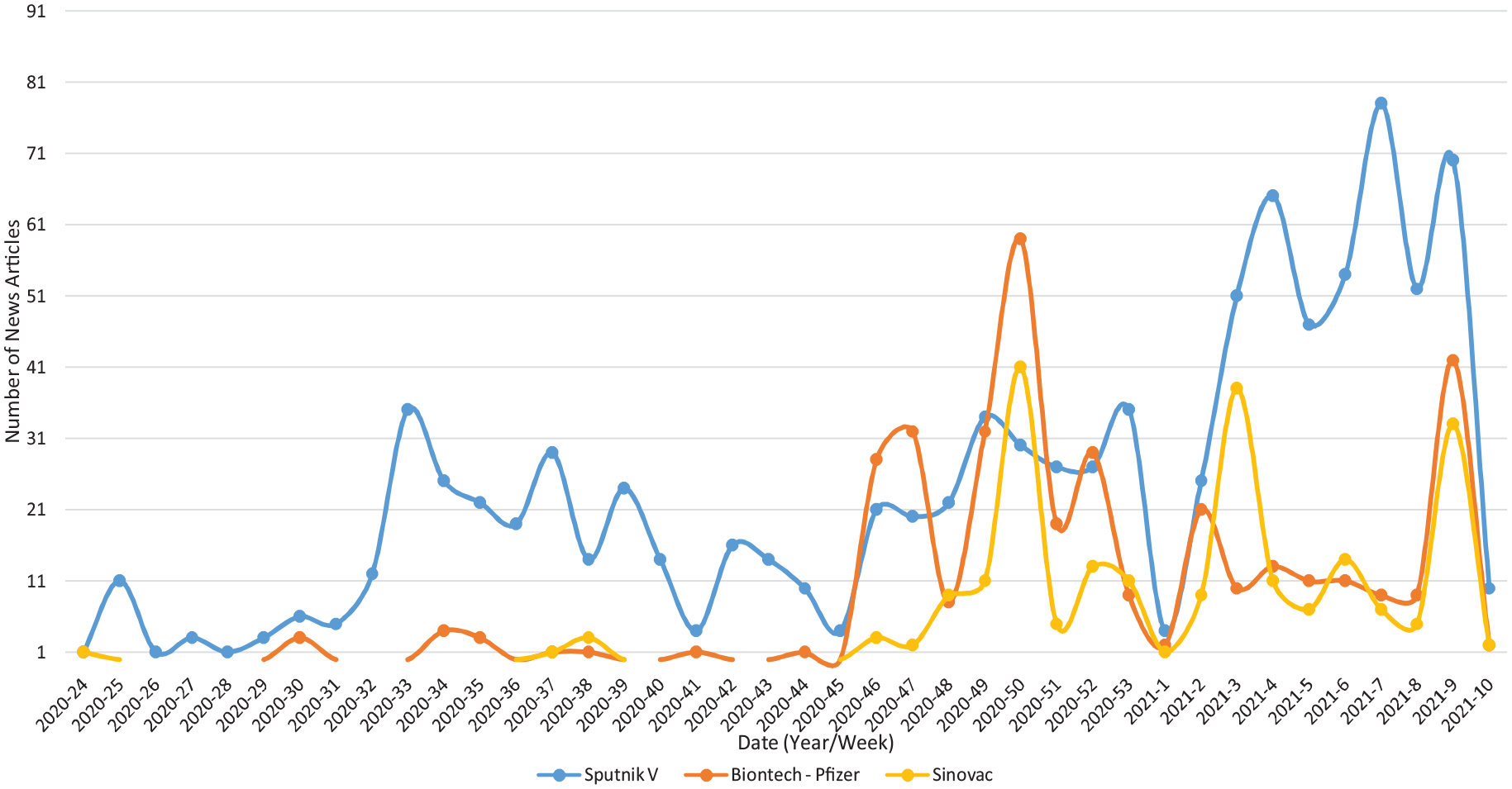
Weekly frequency of Sputnik V, Pfizer-BioNTech, and Sinovac-related news on SputnikTR.
Methodology
We relied on several methodological and analytical approaches to study SputnikTR’s strategic communication capacity on Twitter. To collect data from Twitter, we used a social media analytics (SMA) tool. SMA tools collect data in real time by scraping posts from social media accounts or pages. These tools collect both the post’s content and the post’s engagement metrics. Engagement metrics are usually frequency-based counts of interactions (likes, comments, and shares) per post. SMA tools organize social media content according to their distribution over time and whether they (a) contain visual or video content and (b) contain URL links to content external to their home platform. Such tools also rank the collected data according to various criteria, for instance, posts with the most number of likes or shares. Lastly, SMA tools also collect information about the author of every post, including the number of people following the author, the biography of the author, and the author’s time zone or location. SMA tools also allow users to compare social media accounts or pages with one another and allow for the metrics of similar accounts or pages to be ranked within predefined categories (for instance, “international media networks” or “Turkish digital news platforms”). Accordingly, one can argue that the design goal for SMA tools is to provide quantitative instruments for those interested in monitoring and evaluating the performance of social media accounts or more specifically the performance of particular communication campaigns on social media.
The SMA tool used for this article is BoomSocial (https://www.boomsocial.com). Using an account-specific approach, BoomSocial constantly crawls over 80,000 official and commercial social media accounts on Facebook, Twitter, Instagram, and YouTube. Categories of accounts crawled by BoomSocial include companies, brands, institutions, organizations, and public figures. These accounts are not just based in Turkey and there are 24 separate categories under which these accounts are classified. SputnikTR can be found in the media category of BoomSocial, alongside international broadcasters as well as commercial news outlets and digital news platforms active in Turkey.
As part of this study, 150,199 tweets posted by SputnikTR between the dates of April 2019 and April 2021 were retrieved from the database of BoomSocial. This initial dataset contained the following metrics to SputnikTR’s tweets:
Tweet date & time
Tweet URL
Tweet contents
Type of media used in the tweet (image or video)
Number of likes per tweet
Number of comments per tweet
Number of retweets per tweet
Engagement rate per tweet
These metrics were used to determine tweets relevant for our study and to study the tactics used by SputnikTR to maximize online engagement on Twitter. Yet, the contents of our dataset showed that most of the tweets posted by SputnikTR contained links to news stories on the parent website rather than news reporting. In other words, SputnikTR was using Twitter as a conduit for attracting web traffic to https://sputniknews.com.tr/.
To access content that SputnikTR’s Twitter account was linking to, we used a customized Python text-mining script. This script parsed all the source URLs found in our dataset and collected keywords tags found at the end of each news item on the parent website. On this compiled list were a number of keywords (for instance, “pandemic,” “vaccine,” “Covid”) used by SputnikTR to categorize Covid-related news content. Using these keywords, we parsed the dataset again, this time only keeping tweets that were linked to SputnikTR new articles about Covid. After determining our final list of Covid-related SputnikTR tweets, we modified our script to collect the opening paragraph of every SputnikTR news item linked to our list of tweets. This resulting dataset of 25,526 tweets (19% of the initial dataset) related to Covid 19 was then manually checked to eliminate any false positives. In all, 2,782 of all Covid-related SputnikTR tweets (roughly 10.89%) were about vaccines. From this subset, around 44% were about the Russian vaccine (Sputnik V), while the remaining 56% were about other vaccines (mainly Biontech Pfizer and Sinovac) (see Figure 2 for the distribution of vaccine-related tweets per producer.). Vaccine-related new stories were the focus of our analytical efforts.

Frequency of vaccine-related news tweets posted by SputnikTR per producer.
For the final step of our methodology, we deployed critical discourse analysis as well as framing analysis to study the contents of our dataset. Critical discourse analysis examines not only the content of news but also the “(a) discursive practices, events and texts, and (b) wider social and cultural structures, relations and processes” to make sense of how “texts . . . are ideologically shaped by relations of power and struggles over power” (Fairclough, 2003, p. 132). Here, the notion of discourse needs to be understood as a cultural and social product that has an enabling, subjectivizing effect on the audience (Van Dijk, 1985, p. 5). When applied to the realm of media studies, researchers have adopted a holistic approach that incorporates both textual and contextual analysis. Textual analysis accounts for layout and structural organization, objects and actors, grammar and rhetoric, discursive strategies, and ideological standpoints. On the other hand, the contextual analysis focuses on comparative (synchronic) as well as historical (diachronic) dimensions (Carvalho, 2008, pp. 167–72).
Alongside content analysis, we also opted to look at the frames through which vaccine-related news content was presented on SputnikTR. Framing is a process that makes selected aspects of a “perceived reality . . . more salient in a communicating text in such a way as to promote a particular problem definition, causal interpretation, moral evaluation, and/or treatment recommendation for the item described” (Entman, 1993, p. 52). In line with the approach outlined by Linstrom and Marais (2012, p. 33), we chose “themes” to be the unit of study for our framing analysis. A thematic frame must contain distinguishing (a) written/grammatical devices (metaphors, exemplars, presence and/or absence of certain words, repeating sentences that reinforce clusters of facts or judgments) as well as (b) technical devices (headlines, visuals, patterns of quotation, introduction of sources, positioning of quotes in news item, and categories of experts/officials quoted to claim empirical validity or facticity). Using this definition, we began to inductively code Russian vaccine-related new stories without a predetermined number of themes.
Analysis
After several rounds of triangulated coding, two dominant themes were identified in our dataset: (a) international popularity of the Russian vaccine and (b) scientific integrity of the Russian vaccine. Content analysis was then applied to the news items belonging to these two frames. In the last part of our analysis, tweets linking to the aforementioned news items were analyzed using the metrics from BoomSocial.
International Popularity of the Russian Vaccine
The most frequent theme in our dataset focuses on emphasizing the international popularity of the Russian vaccine. International popularity is expressed through dull news bulletins about countries that have authorized the Russian vaccine. These bulletins are then turned into tweet headlines for SputnikTR’s Twitter accounts. For instance, a tweet titled “Pakistan became the 22nd country to ratify Sputnik V”
4
published on 9 February 2021, links to an article describing the details of Pakistan’s decision. This template is reiterated each time Russia acquires new clients: Hungary becomes first EU country to register Sputnik V vaccine.
5
These template bulletins are often combined with news articles about the shipment and production of the Russian vaccine in client countries. The registration of Sputnik V vaccine, for example, was published in Hungary on the 21st of January, and one day later a tweet featuring the details of trade deal was published: “Hungarian Foreign Minister: we will receive 2 million doses of vaccine from Russia,” 6 and in consecutive days, the details about the first shipment with the production of vaccine in Hungary were announced. 7 This predictable and linear pattern of reporting is applied to all Russian vaccine clients.
Political branding or the association of world leaders with the Russian vaccine is another technique used by SputnikTR in this theme. As part of this technique, SputnikTR showcases Russian vaccine endorsements from political leaders around the world: “Thanks From Vucic to Russia for the Sputnik V.”
8
“Philippines Minister of Health: I can only entrust my life to Sputnik V.”
9
These endorsements are first presented as news items on the SputnikTR websites. After the publication of the news item, quotes from the story itself are posted on Twitter alongside URL links to the article. Perhaps unsurprisingly, SputnikTR presents Putin as the ultimate endorser or “brand ambassador” of the Russian vaccine. Some more direct endorsements include tweets showcasing Putin’s claims that “the Russian vaccine is the best in the world”
10
or that “Sputnik V is a good vaccine, both safe and showing its effect quickly.”
11
These tweets link to an article containing the following passage comparing the Russian vaccine to the Moderna vaccine: I think global markets have decided to support the U.S’s Moderna vaccine. Pfizer, the US-European vaccine competing with this vaccine, is taking a very aggressive stance on the market. The U.S promises that the Moderna vaccine will be innovative and very modern. The effectiveness of the Moderna vaccine will be clear after 10 years, but the Russian vaccines are already effective. Russian vaccines are very modern and there is no doubt that they are the safest and safest vaccines as of today . . .
12
No factual evidence is provided about why the Russian vaccine is better. Instead, praise of the Russian vaccine is used as an opportunity to discredit a rival vaccine producer.
An unlikely brand ambassador we encountered in our dataset was Venezuelan president Nicolás Maduro. In our dataset, we encountered numerous tweets showcasing Maduro’s endorsements for the Russian vaccine. These endorsements were periodic and intensive in nature (August 2020, October 2020, December 2020, and February 2021), which suggests that they were part of a wider public relations campaign. For instance, on 1st and 2nd of February 2021, SputnikTR’s Twitter account posted tweets with the following header: “Maduro: tests in Venezuela show that the Sputnik V vaccine is 100% effective.”
13
Soon afterward on the 8th of February, SputnikTR’s Twitter accounts another series of tweets with the following header: “Venezuelan leader Maduro: #SputnikV safest vaccine in the world.”
14
Ten days later, on the 18th of February, SputnikTR’s Twitter feed featured a link to a news story with the following header: “Maduro: my wife and I chose to be vaccinated with Sputnik V.”
15
The tweet links to a news story which carries the following endorsement: [Maduro] “Right now I believe it is the most advanced and best vaccine in the world, I have no doubts, I talked to experts, I asked the opinions of infectious disease experts and experts from all over the world, Sputnik V is undoubtedly the safest.”
16
Given Maduro’s international image as an authoritarian kleptocrat, we find it quite remarkable that SputnikTR uses the Venezuelan president for endorsements. One possible explanation about SputnikTR’s usage of Maduro might be his image as an anti-establishment figure. There is a notable (and increasing) cross-partizan demographic in Turkey who harbor anti-Nato, anti-American, and more broadly anti-Western sentiments. This demographic has a positive opinion of Maduro due to the fact that he rejects the status quo imposed by the Western establishment. Accordingly, using Maduro as a brand ambassador might be part of SputnikTR’s strategy to connect with and influence this demographic.
Scientific Integrity of the Russian Vaccine
Another theme we encountered in our dataset emphasizes the scientific legitimacy of the Russian vaccine. Endorsements from national scientific organizations, businesses, and even obscure health experts are often featured as a demonstration of the international scientific community’s acceptance of the Russian vaccine: A Japanese expert acknowledges the efficacy of Sputnik V vaccine.
17
In these endorsements, SputnikTR resorts to totum pro parte (whole for a part), a technique that presents the views of a single expert or politician as the official view or position of a government. Sometimes these endorsements veer on the edge of sheer exaggeration. For instance, one news story about the scientific efficiency of the Russian vaccine features a quote from an Austrian health expert. This quote compares the “simplicity, efficiency and reliability” of the Russian vaccine to “a Kalashnikov rifle.” 18
Such exaggerated endorsements tend to be misleading and at times not even real. For instance, one SputnikTR news story, which is actually a translation of an opinion piece published in the Spanish edition of the French newspaper Le Monde Diplomatique, discusses Russia’s success in developing a vaccine. 19 In a section of the SputnikTR translation, there is a quote about how the Russian vaccine has the potential to quell the pandemic. Here, the author’s opinion (it is worth noting that Federico Kukso is not a health expert but instead a science and technology journalist) is presented not as an opinion but as a fact. As such, the translation purposefully distorts the author’s position as well as the meaning of the original opinion piece. The SputnikTR translation ends with a section describing the affordable price of the Russian vaccine as well as the following quote from Kukso: “unlike the USA and European Union (EU) countries, where pharmaceutical laboratories impose their products at astronomical prices, Russia is not after money.” Quite remarkably, this quote does not exist in the original Le Monde Diplomatique article. 20 SputnikTR adds a fake quote to strengthen the resonance of the translation. Given the evidence reviewed in this article so far, it is perhaps unsurprising that the fake quote is an open endorsement of Russian vaccine technologies. These examples show us that SputnikTR frequently relies on “expert opinion” as a tactic to build up and advance narratives about the scientific legitimacy of the Russian vaccine. These opinions can be at times exaggerated, misleading or even fake.
Other than expert opinions, some news reports on this theme invoke conspiracy discourses to defend the legitimacy of the Russian vaccines. In these reports, SputnikTR focuses on building a claim that the West is using dirty tricks to discredit the scientific legitimacy of the Russian vaccine. This claim is advanced through news items about sanctions imposed on Russian research institutes: White House Secretary General: USA will not accept test results of Russian Covid-19 vaccine.
21
US sanctions Russian research institutes: Among the sanctioned institutions are centers that participate in the development of the coronavirus vaccine.
22
The research institutes mentioned in the SputnikTR articles do not just work on developing vaccine technologies. Furthermore, the sanctions mentioned in the SputnikTR articles concern research on biological and chemical weapons. But SputnikTR twists the narratives in these news reports to imply that the United States is penalizing these institutes for their vaccine research.
Similar stories claiming that the West is conspiring to discredit the Russian vaccine tend to be published in short succession. Alternatively, these claims are transmitted via many tweets linked to a single news article. Interestingly enough, once the claim is made, there are no follow-up stories published for a long period of time afterward. These claims portray the West as trying to prevent Russia from helping other countries. As such, Russia is presented as a victim of global conspiracy, struggling against attempts to sabotage the production and distribution of vaccine technologies. In this Manichean world, Russia is portrayed as a benign force wanting to share the fruits of its scientific harvests with the world. The West is the nefarious force wanting to stop Russia for its own cynical purposes. An example of this discourse can be found in a news story titled “We have extensive knowledge that resources are allocated from abroad to discredit the Sputnik V vaccine.” 23 The story features a quote from Igor Konashenkov (the Spokesman of the Russian Ministry of Defense) warning about “a series of fake investigations and statements based on ‘eyewitnesses’ being prepared on social media and Russian internet resources.” According to the article, the goal of these disinformation attempts is to heighten the public perception that the Russian vaccine is dangerous or that it is not in widespread use. The Russian authorities are presented as having knowledge of the conspiracy, but there is no clear information about the culprits. Similarly, there is no information about the steps taken by Russian authorities to stop this conspiracy. A striking visual is used by SputnikTR to emphasize the conspiracist, paranoid tone of the report. The visual used in the article is a cartoon wherein Sputnik V (metonymically representing Russia through the flag) is holding in one hand an umbrella over the frightened globe (Figure 3). This umbrella is protecting the globe from missiles (labeled “fake”) shot from satellites labeled “medya” (media). Using the other hand, the Russian vaccine crushes the Coronavirus. The cartoon’s message is straightforward and powerful: Russia, while destroying Covid, is also defending the world against attacks from external forces. Yet who these forces really are is not clear.

“Sputnik V defending the world from international media, fake news while simultaneously crushing the coronavirus” (Sputnik/Vitaliy Podvitskiy, https://bit.ly/3Iu9RHA).
Within the context of this frame, there are attempts by SputnikTR to discredit the Pfizer–BioNTech vaccine. Here, disinformation is openly used to attack the Pfizer–BioNTech vaccine. For instance, one story published on 17 January 2021, has the title “13 Israelis vaccinated with Pfizer vaccine stricken with facial paralysis.” 24 The source given in the article is Yediot Aharonot, a national newspaper in Israel. Yet there is no such story on Yediot Aharonot’s website, it is what Donald Jensen (2018) describes as a “false fact” (p. 10). Our suspicions about the authenticity of the story were confirmed by the Poynter Institute’s International Fact-Checking Network (IFCN); no such event ever happened. 25 Nevertheless, the tweet linking to this story was liked 687 and shared 211 times, making it the sixth most popular SputnikTR news item about the Pfizer–BioNTech vaccine.
Sometimes rather than resorting to blatant disinformation, SputnikTR also publishes misleading information portraying the Pfizer–BioNTech vaccine in a negative light. For instance, in an article titled “US doctor dies 2 weeks after receiving Pfizer vaccine” (published on 8.01.2022), SputnikTR covers the death of Dr Gregory Michael. 26 Despite no medical evidence linking the vaccination shot to Dr Gregory Michael’s cause of death, a subheading in the SputnikTR article speaks of how “his death is 100 percent linked to the vaccine” and how American health authorities are investigating the role of Pfizer–BioNTech in the doctor’s death. This latter part of the story is only partly true, as an investigation was launched by health authorities in Miami, albeit with no findings to support SputnikTR’s claims. Elsewhere, this technique has been described as “card stacking” (Jensen, 2018, p. 11) or the selective offering of information or key facts that guide audiences to false or prefabricated conclusions. Just this singular tweet was liked 217 and retweeted over 42 times.
Semantic hacking is a more subtle tactic used by SputnikTR to discredit the Pfizer–BioNTech vaccine. This technique is based on highlighting the “Pfizer” aspect of the Pfizer–BioNTech partnership and associating it with negative coverage. In our dataset, there are only 20 instances wherein the term Pfizer–BioNTech is used. Most of the coverage associated with this term is neutral. On the other hand, the term “Pfizer” is used in more than 262 news items. Most news items associated with this term are negative. Some examples of negative coverage news titles are as follows: German Paul Ehrlich Institute: 10 people have died because of the Pfizer vaccine.
27
Le Monde: European Medicines Agency under pressure to register Pfizer vaccine.
28
US Congressman Lynch, who was received two doses of the Pfizer vaccine, has Covid.
29
In comparison, news coverage associated with “BioNtech” is much more positive. Out of 238 news items associated with “BioNtech,” only 4 have negative coverage. The motivation behind why SputnikTR resorts to semantic hacking may be related to the risks associated with openly attacking BioNtech. The founders of this company have Turkish origins meaning that any direct attack may elicit negative pushback from SputnikTR’s Turkish readership. Along this line of logic, a safer bet would be to focus the attack on BioNtech’s American partner, Pfizer. Semantic hacking allows SputnikTR to treat the two companies as separate entities and to direct its negative coverage toward the American partner. By doing so, SputnikTR is able to increase distrust toward the Pfizer–BioNTech vaccine among its readers while simultaneously bypassing the Turkish connection.
Maximizing Online Engagement Through “Salami Slicing”
One unique technique we encountered across both themes analyzed in our study strongly resembles the unethical academic practice of “salami slicing.” This practice involves segmenting the content of a single news item and publishing it as a series of tweets on Twitter. Unsuspecting readers are fooled into thinking that each tweet is linked to new content on the SputnikTR homepage. Quite often, images attached to salami-sliced tweets tend to be dissimilar, thus ensuring that these tweets both look and read differently from one another. When used repeatedly, salami slicing maximizes user engagement with the news item in question. It is a technique of increasing online engagement with individual news stories through regular mass Twitter postings.
Defending the scientific legitimacy of the Russian vaccine is one instance wherein salami slicing has been extensively used by SputnikTR. Within the timeframe of roughly 1 week, salami-sliced content from one news item produces these and other similar tweets:
Reflections of the world’s first registered coronavirus vaccine, Sputnik V, in the Western media: “West finds the vaccine, Russia can only claim to have found it.” 30
Retired physician Akif Akalın: “Russian scientists draw upon Russia’s 100 years of experience for the coronavirus vaccine, and Smallpox was eradicated thanks to the Soviet Union and its support to the WHO.” 31
Assoc. Dr. Hakan Güneş: “Criticisms of Sputnik V originate from anti-Soviet and anti-Russian attitudes and are malicious. Russia’s vaccination record is undeniable.” 32
Russia’s Covid-19 vaccine did not please the West nor Westernized Turks in Turkey. 33
Although all these tweets read like the headlines of news items, they are in fact all linked to the same opinion article titled “Sputnik V: Why did the first registered vaccine against the coronavirus, which killed hundreds of thousands of people, shock the West?.” These four tweets were in total liked 159 and retweeted 29 times.
Quite remarkably on the same day (21.08.2020), almost the same article was published anonymously on the website of Aydınlık, an indigenous pro-Russian and pro-government media outlet. Upon further inspection, we discovered that all 41 Russian vaccine-related news items on Aydınlık during the period of our study (April 2019–April 2021) were also featured on SputnikTR. This means that Aydınlık copies and distributes Russian vaccine-related content from a Kremlin-affiliated source voluntarily. It also indicates that the Kremlin is playing both sides, manipulating narratives about vaccine technologies on both the pro-government and pro-opposition media outlets. Without further evidence, it is difficult to determine whether such actions are part of a broader Kremlin publicity campaign to market Russian vaccine technologies to the Turkish public.
When the article in question is examined, it can be seen that its contents are a series of independent events and explanations that (a) support the scientific legitimacy of the Russian vaccine and (b) denounce Western prejudice and chauvinism toward the Russian vaccine. In the case of the former, one encounters a series of statements by Turkish doctors and health experts. These statements are less about the actual vaccine in question and instead more about demonstrating the legitimacy of Russian vaccine research based on past Russian scientific achievements. These experts emphasize that “Russia continues the successful healthcare concept inherited from the Soviet Union” and that there is an ideological difference in the way Russia (“tradition of social medicine”) and the West approach vaccination. This ideological difference is presented as the reason why Russia was able to develop a Covid vaccine before the West.
In the case of the latter, the underlying suggestion in the opinion article is that Russian vaccine research is not trusted and is even ignored by Western media and institutions due to their inherent Russophobia. As such, the article is not just about demonstrating the scientific credibility and reliability of the Russian vaccine but also about showing Western prejudices and chauvinism. Aggressive and polarizing language is deployed as part of SputnikTR’s strategy to stir up anti-Western sentiment. For instance, the article speaks of “the West’s attempts to assassinate Sputnik V’s reputation” and “the West’s intentional pessimism over Sputnik V,” arguing that the West is using Cold War language to discuss the Russian vaccine. The article concludes by stating that “. . . no matter how Russophobic the Western media may be, Moscow will always take responsibility in delivering medical supplies to NATO countries in case of a possible health crisis . . . .” The concluding sentence of the article is particularly important as it potentially touches a sensitive nerve in a Turkish audience. Similar discourses around the Western and the hypocritical policies of the EU are a common trope in both mainstream and oppositional media in Turkey. Playing the Russophobia card allows SputnikTR to tap into this vein of popular discontent, effectively portraying Russians (and hence the Russian vaccine) as fellow victims of Western prejudice. One can argue that this is an effective strategy to legitimize the Russian vaccine within the eyes of the Turkish audience as it discredits by default all Western sources and actors opposing the Russian vaccine.
Conclusion
In summary, our research shows that Russian strategic communication efforts begin on the homepage of SputnikTR. Vaccine-related news items containing either or both misinformation and disinformation are then distributed to the online public through Twitter. As such, Twitter functions as a conduit for the dissemination of pro-Russian as well as anti-Western narratives to the Turkish online public.
Within such a framework, our findings suggest that SputnikTR used Twitter to promote new stories about (a) international popularity of the Russian vaccine and (b) scientific integrity of the Russian vaccine. When doing so, SputnikTR’s Twitter account relied on salami slicing to increase online engagement around individual news stories. When promoting the international popularity of the Russian vaccine, SputnikTR played the numbers game to exaggerate the international popularity of Sputnik V and used anti-establishment figures as brand ambassadors. In contrast, news items emphasizing the scientific integrity of Sputnik V frequently contained various forms of disinformation and misinformation. For instance, we encountered news stories that
Resorted to totum pro parte and falsified information to legitimize the science behind Sputnik V;
Resorted to conspiracy discourses to defend the scientific legitimacy of Sputnik V;
Used false news stories to discredit the Pfizer–BioNTech vaccine;
Focused negative coverage on “Pfizer” and not Pfizer–BioNTech;
Alluded to Russophobia and Western chauvinism to discredit critics of Sputnik V.
Quite like its international version, news coverage of SputnikTR is heavily biased toward Russia and is a source of conspiracist as well as anti-Western propaganda. Yet our findings suggest that rather than promoting anti-vaccination content on social media, Russian disinformation efforts in Turkey are instead focused on heightening hesitancy solely toward Western vaccine technologies. This makes Turkey a unique example within the context of Russian online propaganda research. At the same time, our findings constitute the first documented instances of Russian propaganda efforts in the Turkish Twittersphere.
As a concluding remark, it is important to note that more research is needed on (a) the dissemination of SputnikTR new stories across local pro-Russian media outlets active in Turkey and (b) who retweets news content published by SputnikTR’s Twitter account. Without having a better understanding of who disseminates SputnikTR content online, it is difficult to assess the scale and range of Russian strategic communication efforts in Turkey. Another avenue of further research needs to assess the impact of SputnikTR’s communication tactics on audience perceptions. How do the things described above transform audiences’ opinions about the Russian vaccine? Finally, adding a comparative dimension would create the opportunity to check if (a) SputnikTR’s coverage of Russian vaccine technologies constitutes a unique case and (b) SN deploys similar tactics in other countries.
Footnotes
Declaration of Conflicting Interests
The author(s) declared no potential conflicts of interest with respect to the research, authorship, and/or publication of this article.
Funding
The author(s) received no financial support for the research, authorship, and/or publication of this article.
