



Abstract
In this article, we analyze the spread of political disinformation in events of discursive struggles on Twitter, during the 2018 presidential election in Brazil. These were disputes for the hegemonic narrative between two stories based on opposed hashtags: one based on news from mainstream media and the other, based on disinformation, mostly from hyperpartisan outlets. Our goal was to understand how hyperpartisan outlets created and shaped these discursive struggles and the strategies used to spread disinformation to create an “alternative narrative” to the facts. Our case study is focused on two discursive struggles, for which we will use critical discourse analysis and social network analysis. Our findings suggest that (1) the structure of the hashtag wars was very polarized and right-wing groups had higher exposure to hyperpartisan content and disinformation, while traditional media discourse circulates more among other different ideological clusters; (2) right-wing hyperpartisan media mostly used biased framing and polarized ideological discourse structure as manipulative strategies to reframe the events and create a counter-narrative (and thus, to create the dispute); and (3) opinion leaders were major spreaders of disinformation among far-right users, as they reinforced hyperpartisan content and became key actors in the discursive struggles (and thus, reinforced the dispute).
Keywords
Introduction
The 2018 Brazilian presidential election happened amid several polemics and a difficult context regarding democracy. It was the 8th time since the end of the military dictatorship period (1964–1985) that Brazilians voted for president. Besides, during these 24 years, two presidents were impeached—Fernando Collor (1992) and Dilma Rousseff (2016). Furthermore, the former president and one of the most popular leaders of the left in the country, Lula da Silva, from the Workers’ Party (who was a presidential candidate in 2018) was convicted of corruption and imprisoned during the campaign. He was, thus, put out of the run and further substituted by Fernando Haddad.
For this election, 13 candidates were running for the presidency. In the first round, Jair Bolsonaro (a polemic far-right candidate from the Social Liberal Party—PSL) received 46% of the votes and Fernando Haddad, 29%. Both disputed a runoff and Bolsonaro won with 55% of the votes. Apart from many controversial declarations 1 from Bolsonaro, his campaign was also accused of using illegal aid from a group of entrepreneurs to disseminate massive disinformation against Haddad. 2 Furthermore, Bolsonaro himself and some of his political supporters were notified by Brazilian Supreme Electoral Court due to their public declarations based on false information. 3 The polemics also increased the polarization of political conversations both online and offline, creating more extreme positions (Machado et al., 2018; Soares et al., 2019). At the same time, the role (and responsibility) of opinion leaders and politicians in the spread of disinformation on social media is now a key theme discussed by authorities and legislators in the country. 4
In this article, we focus on the “hashtag wars,” discursive struggles (Barros, 2014) about the hegemonic narrative over the same fact on Twitter, where different narratives about the same fact dispute visibility on conversations. We aim to discuss (1) the role hyperpartisan outlets played in shaping the political discussion through creating these discursive struggles and (2) the role they have in the spread of disinformation during the Brazilian 2018 presidential campaign. For this study, we will focus on two “hashtag wars.” During these struggles, media outlets covering the election proposed one narrative and “hyperpartisan outlets” that supported Bolsonaro and his agenda proposed another one.
Disinformation, Hyperpartisan Media, and Influencers
In this article, we understand disinformation as the deliberate creation and sharing of information that is false or manipulated to deceive people to achieve political gain (Benkler et al., 2018; Chadwick & Vaccari, 2019; Digital, Culture, Media and Sport Committee [DCMS], 2019; Fallis, 2015; Jack, 2017). Disinformation is also motivated by profit, which reflects on platforms’ actions to disrupt the economics of disinformation operations (Iosifidis & Nicoli, 2020). Disinformation is dangerous because it negatively influences conversations in the public sphere by misleading people and consequently undermines the quality of democracy (Benkler et al., 2018; Derakhshan & Wardle, 2017; Tucker et al., 2018).
Several studies have been focusing on disinformation in political elections. The 2016 US election was a turning point due to the centrality of disinformation during the campaigns (Benkler et al., 2018), along with the Brexit campaign (Bastos & Mercea, 2017). Since then, academics identified the influence of disinformation in elections in countries such as India (Das & Schroeder, 2020), Italy (Giglietto et al., 2019), Norway (Larsson, 2019), and Brazil (Recuero et al., 2020; Soares et al., 2019), which is the context we focus in this study.
Disinformation is not composed of fabricated content only. On the contrary, it can be based on misleading information, that is, the use of false context or false connection between facts (Derakhshan & Wardle, 2017). In fact, many studies have seen disinformation as more often based on framing and manipulation of real facts than completely fabricated content (Mourão & Robertson, 2019; Potthast et al., 2017; Recuero et al., 2020). Because of these characteristics, disinformation is also associated with hyperpartisan content.
Hyperpartisan outlets are connected to disinformation because they produce biased information, often shared as “another view on the facts” that shows the truth traditional media does not show (Larsson, 2019). Thus, they frequently state that mainstream media outlets are not trustworthy (Benkler et al., 2018), which is especially important for the conversations we will analyze in this article. Hyperpartisan outlets also frequently spread false or misleading content to counteract news that is bad for their candidate or party, in what we call “discursive struggles” on Twitter (Barros, 2014; Hardy & Phillips, 1999). These disputes as we focus on this article are different versions of the same fact that are reverberated by political groups to support their narratives, one from traditional media and the other, by hyperpartisan outlets. Because these “alternative” narratives are connected to disinformation, they also encompass manipulation and the intention to influence the public discussion about a candidate or a party.
For this work, we will consider hyperpartisan outlets the ones that publish mostly biased and sensationalist content, clearly supportive of a political party or a political view. These outlets are often anonymous, focusing on stories that privilege partisanship, inaccuracy, sensationalism, and other elements that are not typical of traditional journalism (Mourão & Robertson, 2019). Finally, hyperpartisan outlets lack accountability, differently from traditional media (Gorrel et al., 2019), and often impersonate “traditional” news or journalists (Bastos, 2016). Hyperpartisan online media is also often connected to user-generated information that fuels the polarized contexts (Bastos & Mercea, 2017) and strategies to give misleading or fake content more visibility.
Other actors associated are also to disinformation, such as bots, activists, and political leaders/elites (Tucker et al., 2018). In this study, we also focus on political leaders. Opinion leaders, such as politicians, journalists, and bloggers, are especially dangerous in the context of disinformation because they have more followers, and when they engage in disinformation spread, they might end up reaching broader publics (Soares et al., 2018). Although opinion leaders are more likely to trust news media and to fact-check online (Dubois et al., 2020), studies have also found that opinion leaders are major sources of disinformation (Recuero et al., 2020; Weeks & Gil de Zúñiga, 2021). Therefore, the political/opinion leaders are also part of the ecosystem of disinformation that relies not only on the hyperpartisan outlets but also on the people that have credibility and share this information (Benkler et al., 2018; Soares et al., 2019). The status and authority of political actors (both opinion leaders and hyperpartisan media) might be key for this ecosystem, as the level of trust in the message originator influences the organic spread of disinformation (Buchanan & Benson, 2019).
On Twitter, hyperpartisan messages and disinformation campaigns might have a high impact because political discussions on the platform often assume public characteristics of a macro or social level discussion (Bruns & Moe, 2014). Furthermore, political conversations on Twitter often cluster people around shared political views, potentially increasing homophily (Bastos & Mercea, 2017; Gruzd & Roy, 2014). These conversations tend to be structured as “polarized crowds”: networks characterized by the presence of two opposing groups weakly connected to each other (Himelboim et al., 2017; Smith et al., 2014).
Polarized contexts with like-minded groups are perfect environments for disinformation to spread. Even more, polarization and disinformation may fuel each other (Benkler et al., 2018; Recuero et al., 2020; Tucker et al., 2018). Disinformation campaigns are frequently associated with the right and, mostly, the far-right ideology (Benkler et al., 2018; Chadwick & Vaccari, 2019; Soares et al., 2019). Because of this tendency, Benkler et al. (2018) designed the idea of “asymmetric polarization.” In the polarized context of the United States, they identified the right-wing group adopted more extreme political ideology and media diet and engaged more frequently in disinformation campaigns—the polarization was, thus, asymmetric. These are key ideas that we will further discuss in this article.
Discursive Struggles, Manipulation, and Political Conversation
For this study, we will use the critical discourse analysis (CDA) framework to define discourse. CDA approaches language as a social practice; therefore, discourse is both the text unities and their function (Fairclough, 2001). Discourse is then a form of social action that involves power relations and at the same time is influenced by social structures and might influence and even modify the social structures (Van Dijk, 2009). Discourses are used to naturalize, maintain, or transform social meanings based on ideologies (different political positions) (Fairclough, 2001). In this article, we will focus on the discourse practices that are comprised in the text of the tweets. We aim to understand how this discourse is used to manipulate public opinion through the disputes of narrative and the social practices that emerge from these disputes.
Discourse is a key concept for the events we analyze in this article, as they are characterized as “discursive struggles” and they emerge from controversies and conflict in political conversations. A discursive struggle is a dispute of meaning, where different discourses use social and power relations to be validated as hegemonic (Hardy & Phillips, 1999). In the case of Twitter, discursive disputes happen often through trending topics and hashtags that offer different views on a fact (Barros, 2014 has shown some of these cases). In our case, one of the discourses was based on traditional media outlets’ narratives and the other, on hyperpartisan content, mostly based on disinformation. This is the context in which we will use the concept of “discursive struggle” to examine the competition between two different narratives about the same political fact, during the 2018 presidential campaign, on Twitter.
In light of the CDA background, disinformation is based on manipulation through discourse. Van Dijk (2006) defines manipulation as making others believe or do things that are in the interest of the manipulator. Manipulative discourse violates social norms by emphasizing partial, irrelevant, or even false aspects or facts to support a biased understanding. Frequently, manipulative discourse uses the strategy of positive self-presentation and negative other presentation—called “polarized ideological discourse structures” by Van Dijk (2006, 2009). This strategy is used to favor the manipulator’s interests and to offend or discredit the opponents—as seen in some cases of disinformation campaigns when hyperpartisan media seeks to depict mainstream media as untrustworthy (Benkler et al., 2018; Larsson, 2019).
Manipulation is also related to access to some form of public discourse, which depends on the power of a group or person (Van Dijk, 2006). Political leaders are then more likely to succeed in manipulation as they have already consolidated power relations with some group and have a stable audience who is likely to listen to them and even be persuaded (Soares et al., 2018).
Manipulative discourse is used in some common disinformation strategies, for example, when fabricated content is used to spread an entirely false story or when false context or connections are used to create a biased framing (Derakhshan & Wardle, 2017; Mourão & Robertson, 2019; Potthast et al., 2017). Based on this background, we define four strategies of manipulation used to spread disinformation that we will use to analyze the political conversations in this article:
Fabricated information—The use of fabricated information is when an entirely false story is used to mislead others, possibly discrediting the mainstream narrative. Fabricated information might include conspiracy, false accusations, and any other type of made-up stories.
Biased framing—Biased framing is used to mislead others mostly by making false connections or mentioning false contexts (Derakhshan & Wardle, 2017; Mourão & Robertson, 2019; Potthast et al., 2017; Van Dijk, 2006).
Change of focus—The change of focus is used to manipulate others when peripheral aspects are highlighted rather than reverberate the main story (Van Dijk, 2006).
Polarized ideological discourse structure—Van Dijk (2006, 2009) calls it the use of positive self-presentation and negative other presentation to favor manipulator’s interests and to offend or discredit the opponents. The strategy is used to differentiate “us” and “them.”
We decided to approach hyperpartisan media tweets through the categories described above both based on our theoretical background and in the first observation of our data, which helped us to identify the applicable categories. These strategies are important for this article since the hashtag wars that depict discursive struggles show two opposite ideologies that dispute hegemony (Barros, 2014; Hardy & Phillips, 1999). Also, by analyzing the discursive manipulation strategies, we aim to understand how social actors spread and/or legitimate some kind of disinformation in political conversations. In this context, the research questions that guide this work are as follows:
RQ1. How did hyperpartisan outlets help shape these “hashtag wars” or discursive struggles on Twitter?
RQ2. What were the strategies used to legitimate disinformation?
RQ3. How did disinformation from hyperpartisan outlets circulate during these “wars” on Twitter?
Methods
To answer the proposed research questions, we will work with two cases. We selected tweets from two moments where discursive struggles based on opposed hashtags happened on Twitter. These events were as follows:
28 September 2018 (a few days before the election first round), when Veja, a traditional Brazilian magazine, historically associated with a right-wing political position, published a story based on a legal process against Bolsonaro. In this process, his ex-wife accused him of concealment of property, corruption, and other crimes. When the scandal emerged on Twitter, another story quickly followed, boosted by hyperpartisan outlets. The story said that the Veja had received 600 million Brazilian reais from the Workers’ Party to destroy Bolsonaro’s reputation and that the story published by traditional media was false.
18 October 2018 (a few days before the election final round) when Folha de S.Paulo, another traditional Brazilian news outlet, published a story that accused Bolsonaro of getting illegal help from a group of Brazilian entrepreneurs who were bankrolling disinformation campaigns on social media that benefited him. 5 This story also had a counter-narrative created by hyperpartisan outlets explaining that the denounces were all lies created by the Workers’ Party in a desperate attempt to stop Bolsonaro’s win.
These two hashtag wars were marked by hashtags promoted by Bolsonaro’s supporters or opposers, such as “#veja600million,” “#JairsMaketeers,” “#Bolsonarocorrupt,” and “#SlushFundBolsonaro.” They disputed Twitter’s trending topics during the bigger part of the days analyzed.
Data Collection
During the Brazilian election (August-October 2018), we used Social Feed Manager 6 to collect tweets related to “Bolsonaro.” Data collection was done on a daily basis, once per hour. From this original dataset of more than 10 million tweets, we filtered two datasets (Table 1) that we used to analyze the conversations related to the discursive struggles selected. Both datasets were filtered by date (28 September and 18 October). We decided to use this dataset based on the collection of Bolsonaro’s name because he was the main subject of the discursive struggles and so we could find different hashtags that were used to promote the different stories. Table 1 provides a breakdown of the data collected.
Summary of the Datasets.

Anti-Bolsonaro campaign led by women due to his sexist positions. bReference to an important corruption scandal in Brazil called “mensalao.”
Data Analysis
We used a mixed-methods approach to analyze our data. To understand how the discursive struggles occurred and how hyperpartisan outlets shaped the conversations, we used social network analysis (SNA) (Wasserman & Faust, 1994). In the networks we analyzed, each node represents an individual Twitter account and each connection, a retweet, a reply, a mention, or a quote.
Through SNA, we aimed to identify clusters and analyze the position of the traditional media and hyperpartisan outlets within those groups. Thus, we used a modularity algorithm to identify the clusters in the conversation (Blondel et al., 2008) and indegree to identify users with high visibility, which are the ones that received the most attention, and thus, have more influence (Cha et al., 2010). We also calculated the external-internal (E-I) index to measure group closure. The E-I index is based on the number of ties within groups and between groups, and it is helpful to measure how isolated or integrated groups are (Krackhardt & Stern, 1988). The possible scores for this index range vary from −1.0 (all the edges are internal) to +1.0 (all the edges are external). By calculating the E-I index, we can measure how closed or open the groups are—that is, how much the groups interact within them versus how much they interact with other clusters. This is an important factor since it may show how much a discursive struggle may result in groups that only interact with like-minded content.
To achieve this goal, we first identified all media outlets among the top 1% indegree users in each dataset. We limited to the top 1% because we aimed to identify users who had high visibility to their tweets, and both conversations had long tails patterns. Figures 1 and 2 show the indegree distribution. On 28 September, the indegree interval of the top 1% users was from 16 to 10,915, and on 18 October, the interval was from 14 to 24,958.
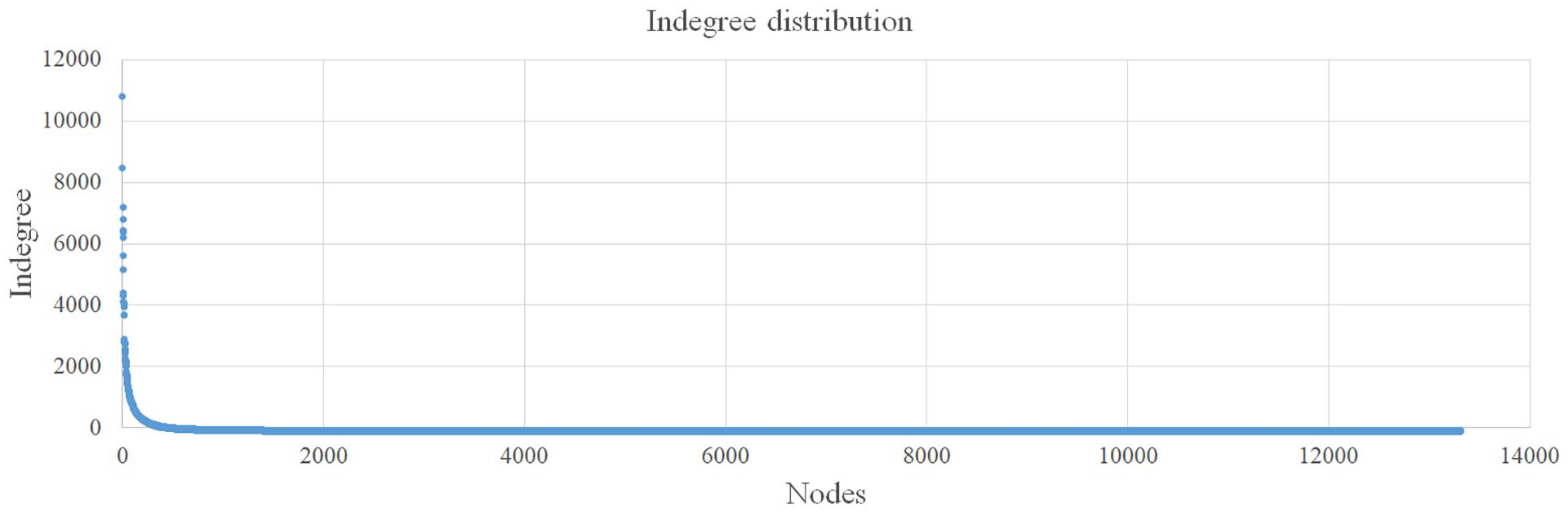
Indegree distribution on 28 September.1

Indegree distribution on 18 October.
With this dataset, we looked for nodes that represented media outlets. We investigated their Twitter profile and classified the nodes as mainstream or hyperpartisan media based on the criteria we explained on the theoretical background, that is, (1) clear support of a political party or political view (either on tweets or on Twitter profile) and (2) biased and sensationalist content.
We then analyzed the hyperpartisan outlets’ tweets looking for disinformation. We used the CDA framework to analyze these tweets (Fairclough, 2001; Van Dijk, 2009), classifying their manipulative strategies into four categories based on the theoretical background: (1) use of fabricated information, (2) use of biased framing, (3) change the focus of the discussion, and (4) use of polarized ideological discourse structure. Based on the CDA framework, we could analyze how these discursive strategies mobilized power relations and created social practices.
Finally, we analyzed the discourse of a sample of the 30 most retweet messages 7 from the clusters that reproduced disinformation to find the strategies they used to gain visibility. We filtered the messages based on the topic, that is, we only selected messages related to the discursive struggles we analyzed. On the other hand, we did not filter the messages based on whether they contain disinformation or not. We used the same four categories used to analyze hyperpartisan outlets to analyze these tweets. Furthermore, we identified whether the user (who tweeted the message) was a politician, a journalist, a political party, political movement, or some other type of political influencers (such as internet personalities and “public” people involved in the campaigns), to understand if and how opinion leaders helped to shape the discursive struggles.
Results
Hashtag Wars: Discursive Struggle Networks
When we analyzed the structure of these discursive struggles, we found out there were two main modules that represented most users engaged in the conversation, as we can see in Figures 3 and 4. On both networks, the green module (left) was bigger than the purple module: slightly more than 50% of the users on 28 September were within the green module and around 29% were within the purple module, while on 18 October, there were more than 51% of the users within the green module and approximately 23% within the purple module.
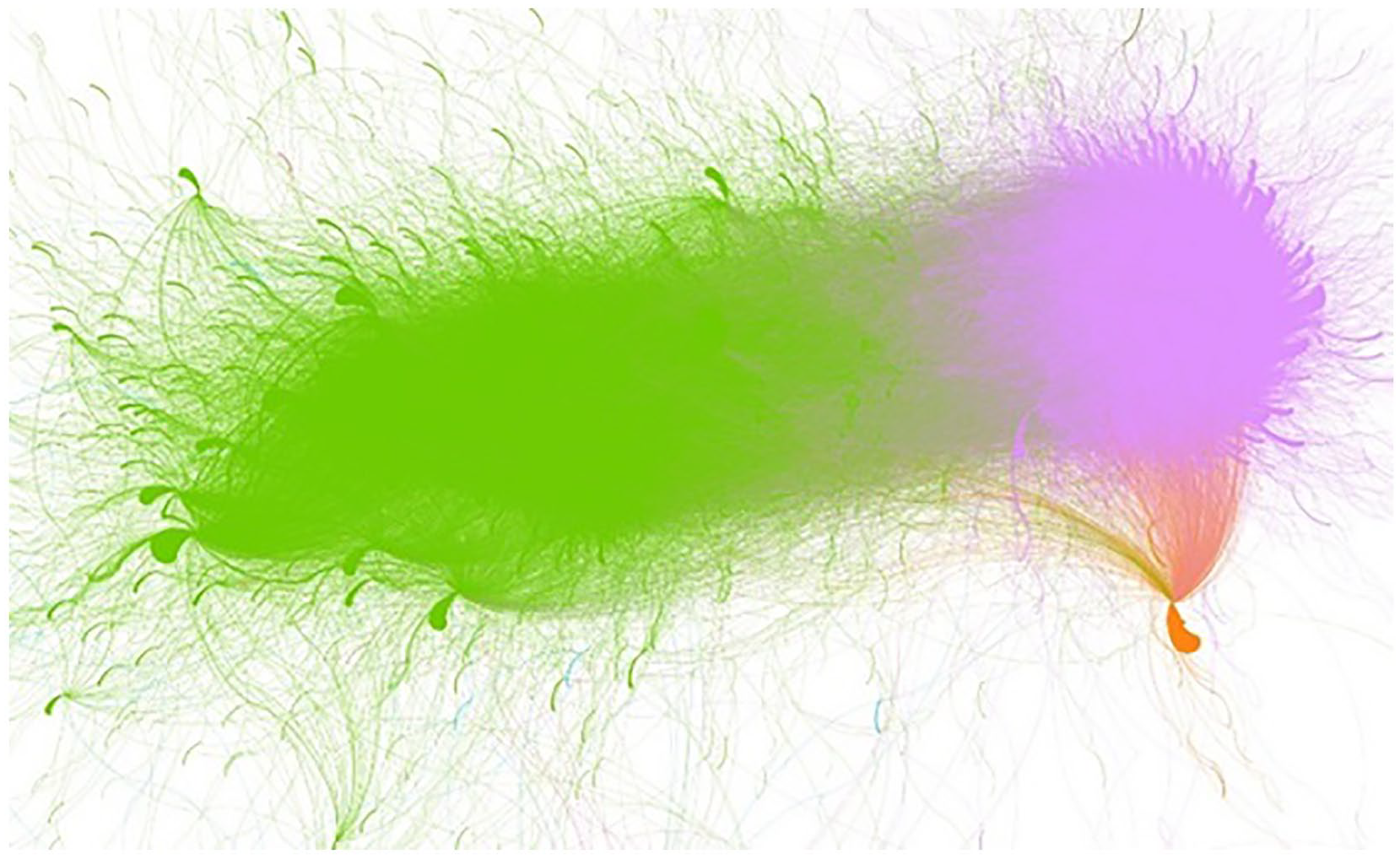
28 September.

18 October.
We also calculated the E-I index using only the two main modules (green and purple). On 28 September, the E-I index is −0.93 and on 18 October, the E-I index is −0.92. In both conversations, the E-I index is very close to −1.0 (when all the edges are internal), which indicates edges are mostly internal. The low E-I index indicates that the informational flow is done mostly within the groups and there are sparse exchanges between them—those within the green group mostly interact with other users within the green module and the same happens within the purple group. This is an important indication that the structure of these networks is strongly connected to polarized groups that circulate mostly their own content. Both struggles, thus, assumed the polarized crowds structure (Himelboim et al., 2017; Smith et al., 2014) with two groups weakly connected to each other.
The clusters had clear ideological alignment. The purple group (Figures 1 and 2) reproduced a pro-Bolsonaro discourse, offering an alternative narrative regarding the event that was in the news for the traditional news outlets. For this group, in the first case, Veja magazine received 600 million Brazilian reais to publish a fraudulent story about Bolsonaro, and in the second case, they questioned the usage of bots denounced by the traditional media, claiming it was false.
The green module (Figures 1 and 2) was not centered on one politician, but rather a diverse range of parties and ideologies, including center-right, center-left, and left-wing parties. In common with each other, these nodes within the green module had an anti-Bolsonaro sentiment, so we decided to call it “anti-Bolsonaro.” This group discussed the traditional media outlet news. The most used hashtags in each group also reflect these discursive alignments (see Table 1). This polarization depicts the structure of the dispute, the “war” between the two narratives about the facts.
Hyperpartisan Outlets and Disinformation
We examined every media account and classified the outlets as “mainstream/traditional media” or “hyperpartisan media.” To identify hyperpartisan outlets, we looked for a combination of characteristics: (1) clearly stated identification with a political party, candidate, or ideology, (2) the usage of emotional language or sensationalism in their tweets, 8 and (3) the publication of biased or manipulated information (Gorrel et al., 2019; Mourão & Robertson, 2019). To identify mainstream outlets, we looked for the Twitter “checked” logo (provided for official accounts) and the identification of a traditional news source.
Among the top 1% indegree nodes, we identified 94 media outlets (both mainstream and hyperpartisan) on 28 September and 119 media outlets on 18 October. In both datasets, there were more mainstream outlets than hyperpartisan outlets in numbers. However, when we measure how influential they were, we identified that the pro-Bolsonaro group gave more visibility to hyperpartisan outlets than mainstream media. The anti-Bolsonaro group, on the other hand, preferred mainstream outlets to hyperpartisan media. Table 2 provides a summary of these data:
Outlets Distribution.

We then looked at the hyperpartisan outlets to identify disinformation. We identified that the anti-Bolsonaro cluster mostly reverberated mainstream media discourse and did not engage in disinformation campaigns. It might have happened because the mainstream media discourse was favorable to the left-wing hyperpartisan outlets’ perspective, since in both cases, there were accusations against Bolsonaro. The example below illustrates it: Veja, the mainstream magazine that publishes the accusations against Bolsonaro on 28 September, and Diário do Centro do Mundo, a left-wing hyperpartisan outlet, tweeted very similar content.
@VEJA: EXCLUSIVE: In a legal process of more than 500 pages to which Veja had access, Bolsonaro’s ex-wife accuses him of stealing a vault, hiding his assets, receiving non-declared payments, and acting with “unlimited aggressiveness”
9
@DCM_online: Bolsonaro stole a vault, hid his assets, and acted with “unlimited aggressiveness,” accused his ex-wife
10
Similarly, on October 18, mainstream media and hyperpartisan outlets reverberated Folha’s accusations. In the examples below, Exame, a mainstream magazine, and Brasil 247, a left-wing hyperpartisan outlet, tweeted about lawsuits to revoke Bolsonaro’s candidature due to the accusations.
@exame: PDT prepares a lawsuit to cancel the elections after complaint against Bolsonaro
11
@brasil247: Deputy Jorge Solla calls for revoking Jair Bolsonaro’ registration
12
On the other hand, in both conversations, hyperpartisan outlets within the pro-Bolsonaro module did not reverberate the accusations against him, but engaged in disinformation campaigns to create counter-narrative stories to deny the accusations. In this case, hyperpartisan outlets gained visibility within this group.
We further examined the manipulative strategies used on the hyperpartisan outlets’ messages. The categories are not exclusive, and some tweets used more than one strategy. We identified 11 hyperpartisan outlets’ original tweets containing disinformation related to the discursive struggle on 28 September and 27 original tweets on 18 October. Tables 3 and 4 provide a breakdown of our analysis.
Manipulative Strategies on 28 September.

Manipulative Strategies on October 18.

On 28 September, pro-Bolsonaro users (in general, not only hyperpartisan media) used the hashtag #Veja600milhoes to spread the false story Veja received money to vilify Bolsonaro. All the hyperpartisan media tweets that used fabricated information on 28 September reproduced the false story. All of them also used polarized ideological discourse structure as a strategy because the Workers’ Party was accused of paying Veja. See the example below: @RenovaMidia: After using information from a troubled divorce in 2007 to attack Jair Bolsonaro, the hashtag #Veja600Millions is one of the most commented topics on Brazilian Twitter this Friday morning.
13
(1049 retweets [RT])
Even though #Veja600milhoes was a trending topic that day, fabricated information was not the most frequent strategy of manipulation on 28 September. It was the use of biased framing. This category was present in five messages that reached more than half of the retweet numbers of the messages that contained disinformation. Hyperpartisan outlets used it to diminish the accusations by saying the legal process was not about the allegations reverberated by the mainstream media—which they accused of sensationalism. The strategy of biased framing was not only the most frequent but was also used in the two most retweeted messages: @PolitzOficial: Good morning Brazilians! Today, at dawn, we published the information exclusively: The Abril Publishing was responsible for reopening a family lawsuit involving Bolsonaro and his ex-wife. Bolsonaro WASN’T THE DEFENDANT. He was the AUTHOR of the lawsuit against her. Share!
14
(1217 RT) @conexaopolitica: BREAKING NEWS: VEJA X Bolsonaro: the sensationalism behind a lawsuit about alimony and child custody
15
(1094 RT)
On October 18, pro-Bolsonaro hyperpartisan outlets focused on denying Folha de S.Paulo accusations that the Bolsonaro campaign was using illegal money to spread disinformation against Workers’ Party. Many activists also called themselves Bolsonaro’s robots—to refute the idea of the automated spread of messages. Table 4 provides a breakdown of the messages used in the hyperpartisan outlets’ tweets.
On 18 October, biased framing was once again a frequent strategy and present in the most retweeted messages, although this time the polarized ideological discourse structure was more frequent and reached more RT. The biased framing was mostly used to accuse Haddad and the Workers’ Party of creating a false narrative (the accusations against Bolsonaro) in a desperate attempt to win the election (see the @conexaopolitica tweet below, the most retweeted in our dataset). Biased framing was also used to create false connections, as when Renova Mídia (@renovamidia) compares the amount of money spent on each campaign—which is not related to illegal (thus, not declared) money.
@conexaopolitica: LATEST: Haddad spreads fake news: “Folha proves Bolsonaro created criminal organization”; the information is false.
16
(1401 RT) @RenovaMidia: PT asked the TSE to declare the ineligibility of its opponent Jair Bolsonaro (PSL) for abuse of economic power. To date, Haddad has spent more than 30 million on the campaign, while Bolsonaro under 400,000.
17
(740 RT)
Polarized ideological discourse structure was the most frequent strategy on 18 October, especially because the case was related to the disinformation campaign against the Workers’ Party (led by entrepreneurs supporting Bolsonaro). Therefore, many messages used the antagonistic relationship with the Workers’ Party to frame the accusations as lies created by the central-left party. Polarized ideological discourse structure was present in most of the messages using biased framing to mislead others, but it was also used in almost half of the messages that changed the focus of the discussion. This strategy (change of focus) was mostly used by giving voice to political actors, including Bolsonaro, who denied the accusations and attacked the Workers’ Party and Folha de S.Paulo, the newspaper accusing Bolsonaro. See the example below that uses both change of focus and polarized ideological discourse structure as manipulative strategies to reinforce the idea that the illegal helping hand was false because it was unnecessary: @o_antagonista: Bolsonaro: “Voluntary support is something the PT is unaware of.”
18
(516 RT)
To summarize, although the results were slightly different in the two conversations, biased framing seems to be the most effective strategy used to spread disinformation in our dataset, as it was used in the messages most highly retweeted on both dates (see Tables 3 and 4). Completely fabricated information had some prevalence on 28 September because of the false story related to #Veja600milhoes, but it was rarely used on 18 October. Polarized ideological discourse structure was used in both conversations to diminish the accusations by linking them with the Workers’ Party. Although polarized ideological discourse structure was a prominent strategy, it has always been used to complement other strategies. Finally, change of focus was more prevalent on 18 October, when hyperpartisan outlets gave voice to Bolsonaro and some of his supports to criticize Folha de S.Paulo and accuse the Workers’ Party of being involved in such manipulation of public opinion.
Disinformative Tweets and Opinion Leaders
We identified hyperpartisan content and disinformation within the pro-Bolsonaro group in both conversations, so we looked at the tweets of this particular group in both datasets. We selected the 30 most retweeted messages in each conversation to analyze how they helped disinformation to circulate. We did not include messages from news outlets because they were analyzed in the last section.
We found out most of these messages came from opinion leaders (politicians, journalists, political party/movement, and political influencers) and their discourse reinforced the pro-Bolsonaro narrative—as it is common in like-minded groups (Soares et al., 2018). Furthermore, almost all the messages reproduced disinformative discourse: only one of the 60 messages (30 for each day) did not reproduce hyperpartisan content. The other 59 most retweeted messages contained disinformation.
The presence of opinion leaders is also an important result because they are capable of influencing others on social media due to their reputation (Cha et al., 2010). Furthermore, in these two discursive struggles, the number of RT of their messages is higher than hyperpartisan outlets’ messages, which means opinion leaders have a high impact on the disinformation spread and play a central role in these discursive struggles. This result reinforces the observation that opinion leaders are major spreaders of disinformation (Weeks & Gil de Zúñiga, 2021). Table 5 details the classification and the circulation of the messages.
Manipulative Strategies in the Top 30 RT Messages Within Pro-Bolsonaro Groups.

RT: retweets.
In both datasets, the pro-Bolsonaro group mostly gave centrality to actors involved with politics, reproducing the same tendency found in other studies (Cha et al., 2010; Soares et al., 2018) of giving visibility to actors who invest in their reputation. The number of messages by journalists is low, although, in both datasets, there were political influencers who are columnists in hyperpartisan outlets (four on 28 September and two on 18 October)—they were classified as political influencers because they are not journalists. The only message without hyperpartisan content and manipulative discourse in our sample (on 18 October) was from a journalist, who only mentioned Workers’ Party actions due to the accusations against Bolsonaro.
The discourse within the most retweeted messages was very similar to the hyperpartisan outlets’ discourse. On 28 September, there were a higher number of tweets with fabricated information because they also mentioned the false story about Veja being paid to vilify Bolsonaro, but it was still the strategy with the lowest RT. On 18 October, most of the messages were based on false connections, using biased framing to mislead others. They tried to prove that Bolsonaro was innocent because it was not necessary to use any money to fuel his campaign since his supporters were doing it voluntarily and engaging more people than those supporting Haddad. See the examples of fabricated information (first) and biased framing (second) below: Veja accessed, using bribes and in 100% unlawfully way, a confidential process in which Bolsonaro is the AUTHOR, to accuse him of EXTREMELLY SERIOUS things in which there is no other case about. Veja practiced a crime of lese Patria! No doubt who received: #VEJA600MILLIONS
19
(2697 RT) Why on earth would anyone spend money to spread messages against the Workers’ Party or in favor of Bolsonaro? Any conservative kid has more social media engagement than Haddad, who doesn’t put a thousand people on a live. Who needs money to fight it?
20
(3788 RT)
The polarized ideological discourse structure (Van Dijk, 2009) was also a prominent strategy. In our dataset, this strategy was mostly used to associate the accusers (Veja and Folha de S.Paulo) with the Workers’ Party (the negative other) to suggest the accusations against Bolsonaro were biased or false—part of a communist/leftist plot to win the election.
In general, we identified that biased framing and polarized ideological discourse structure were both the most frequent and most effective strategies used in the most retweeted messages. Both strategies were frequently used together, as the “us versus them” strategy helped to justify the biased interpretation of the facts. In addition, it is important to notice that opinion leaders had an important role in spreading and legitimating the disinformation content, giving visibility to hyperpartisan outlets discourse.
Discussion: Political Hashtag Wars
We now return to our research questions to discuss our results. Our first research question was connected to how hyperpartisan outlets helped shape discursive struggles on Twitter. When examining the data, we found a polarized network structure with two modules connected to pro-Bolsonaro and anti-Bolsonaro’s narratives, which showed the structure of the “hashtag wars,” where two narratives supported by opposed groups are repeatedly tweeted through different hashtags.
When we looked specifically at media outlets’ centrality (using indegree metric), we also found that media diet in the conversations we analyzed was highly asymmetric (Benkler et al., 2018), with more centrality to hyperpartisan outlets within the pro-Bolsonaro group in both datasets. The anti-Bolsonaro module, on the other hand, gave more visibility to mainstream media. Furthermore, we identified that only the hyperpartisan outlets within pro-Bolsonaro engaged in disinformation, while hyperpartisan outlets within the anti-Bolsonaro module reverberated mainstream media discourse. This is probably because mainstream media was reproducing accusations against Bolsonaro and their narrative was favorable for left-wing hyperpartisan outlets. In the discursive struggles (Hardy & Phillips, 1999), the two groups circulated either information or disinformation, which aligned with their political positions. The political hashtag wars, thus, were based on different and opposite narratives, with the strong support of hyperpartisan outlets for the “alternative version” of the mainstream media story.
This evidence may have a negative effect on the public sphere and the political debate because disinformation shares visibility with information and struggles for the hegemonic narrative within public opinion. This also means that instead of a discursive struggle simply based on different ideologies and beliefs, there was a discursive struggle in which one group uses disinformation to support their ideology. The visibility hyperpartisan nodes have on this polarized structure suggests that their tweets are important to legitimate the disinformation that circulate on a cluster. This also shows that hyperpartisan outlets are used to support these disputes (or “wars”).
Our second research question was about hyperpartisan outlet’s strategies to legitimate disinformation on these disputes. The strategies used by hyperpartisan outlets varied in the datasets we analyzed, but we identified that biased framing was especially effective. Biased framing was mostly used by creating false connections or false contexts to mislead others. As Derakhshan and Wardle (2017) highlight, disinformation does not need to be based on entirely false information, but it is frequently based on creating false connections and mentions facts out of context. We also identified this tendency of using biased framing. This strategy was related to the discursive struggle context (Hardy & Phillips, 1999) because hyperpartisan outlets presented the biased information as an alternative version of the facts, trying to make it reliable (Larsson, 2019). This evidence suggests that disinformation may be more easily legitimated if based partially on truthful content rather than completely fabricated content.
The hyperpartisan outlets that engaged in disinformation also used their discourse to say mainstream media was untrustworthy, reinforcing their own (hyperpartisan) narrative—as it is also very common in disinformation campaigns (Benkler et al., 2018). To do so, they mostly used the polarized ideological discourse structure, in which they evoke a negative Workers’ Party presentation to discredit the opposite discourse and acquit Bolsonaro of the accusations. This strategy was used because of the strong anti-left sentiment in Brazil, which increased the public’s susceptibility to far-right propaganda—consider these sort of sentiments and shared beliefs is a manipulative discourse strategy to succeed (Van Dijk, 2006). These situations affect the political debate because hyperpartisan media outlets try to reinterpret the facts disclosed by mainstream media, readjusting it according to their ideology, similarly to what Larsson (2019) argues.
Both biased framing and polarized ideological discourse structure strategies were used to reframe the events to create an “alternative” narrative. Therefore, these strategies were used to create a disinformation discourse that did not completely deny the facts but rather suggested another interpretation of the news. The counter-narrative was created and spread by political actors (hyperpartisan outlets, opinion leaders, and others) to dispute the hegemony of the public discourse, thus creating the discursive struggle. The polarized discourse act by creating a large discursive background connected to political issues that helped frame this “other interpretation.” We understand these two strategies were particularly effective because they mobilized social beliefs and shared knowledge of a particular ideology. That is, the political events were reframed to reinforce a pro-Bolsonaro narrative.
Hyperpartisan outlets also used fabricated information and change of focus, but they were less prevalent and usually related to one specific aspect of the discursive struggle (as the false story that said Veja received money to vilify Bolsonaro).
Finally, our third question was about how disinformation from hyperpartisan outlets circulates on Twitter. We identified that opinion leaders (Cha et al., 2010; Soares et al., 2018) were central to the disinformation campaigns and contributed to its validation. We also found that politicians and journalists were among the most retweeted users and reproduced disinformation by using manipulative discourse. Their access to public discourse and their authority and reputation are especially persuasive in discursive struggles (Van Dijk, 2006), which makes their presence notable. The engagement of opinion leaders in disinformation campaigns is dangerous because they legitimate false information due to their reputation. Furthermore, as described in Tables 3 to 5, opinion leaders’ messages circulated much more than hyperpartisan outlets’ messages, which is another evidence of the central role of opinion leaders in spreading disinformation.
Although the traditional political elites had centrality among pro-Bolsonaro users, other political influencers, mostly users that invested in their reputation on social media, were even more prominent. Some of these opinion leaders were related to pro-Bolsonaro hyperpartisan outlets and they also tried to depict mainstream media as untrustworthy. Within a highly closed group, as indicated by the E-I index we calculated (Krackhardt & Stern, 1988), the environment created by highly active activists (Soares et al., 2018), hyperpartisan media, and opinion leaders that reinforce the like-minded narrative of the group is extremely suitable for the emerging of the “propaganda feedback loop” (Benkler et al., 2018). This context occurs when media, politicians, activists, and other participants create a self-reinforcing feedback loop only reproducing like-minded hyperpartisan content, reinforcing their position and frequently producing an alternative narrative only shared by those within the group. In this context, negative information about Bolsonaro is filtered and “translated” by hyperpartisan media and opinion leaders according to the pro-Bolsonaro narrative. Our study, thus, shows some evidence on the role particular users have in spreading disinformation and how their endorsement may further legitimate disinformation. This is important, since these players endorse the hashtags and further, the dispute around the facts.
Based on our analysis, the CDA framework (Fairclough, 2001; Van Dijk, 2009) helps us understand how disinformation influences discursive struggles (Hardy & Phillips, 1999). We observed that several actors (including hyperpartisan media and opinion leaders) used multiple discursive framing (such as the four manipulation strategies we analyzed). However, the different actors and framing were all used to create a counter-narrative to mobilize specific social practices to deny the accusations against Bolsonaro. The presence of disinformation in these discursive struggles shows how discourse is mobilized to create a social meaning based on a specific ideology (Fairclough, 2001). In particular, we identified that hyperpartisan media discourse tried to dispute visibility with the mainstream media through disinformation. In this context, disinformation is “naturalized” in the social discussion (Fairclough, 2001) as “another interpretation” of the same facts, within a political discursive alignment. Furthermore, opinion leaders mobilize their social power and authority to influence public discourse and legitimate a narrative based on disinformation (Van Dijk, 2009).
This study has some limitations. We only analyzed two discursive struggles in which hyperpartisan outlets used manipulative discourse to spread disinformation and opposed the mainstream media discourse. In both cases, mainstream media shared negative news toward Bolsonaro and it could have affected our results. It is necessary to further investigate how left-wing hyperpartisan outlets engage in discursive struggles when mainstream media discourse does not favor their narrative. It is also necessary to analyze other contexts to state the existence of asymmetric polarization in Brazilian political conversation on Twitter, as we identified in our analysis. Finally, other cases in different contexts would be very useful to test our categories and evaluate their prevalence in disinformation campaigns. Finally, we cannot tell for sure whether a retweet signalizes the support for the original message or not, although it usually does.
Footnotes
Declaration of Conflicting Interests
The author(s) declared no potential conflicts of interest with respect to the research, authorship, and/or publication of this article.
Funding
The author(s) disclosed receipt of the following financial support for the research, authorship, and/or publication of this article: This project is partially funded by FAPERGS (grant number 19/2551-0000688-8) and CNPq (grant number 301433/2019-4).
