




Abstract
Vaccine hesitancy has been a growing public health issue, but during COVID-19, understanding vaccine hesitancy and promote vaccine favorability takes on a troubling immediacy. With the growing political polarization on scientific issues, the COVID-19 vaccine-related sentiment has recently been divided across ideological lines. This study aims to understand how vaccine favorability and specific vaccine-related concerns including possible side effects, distrust in medical professionals, and conspiratorial beliefs concerning COVID-19 vaccines were articulated and transmitted by Twitter users from opposing ideological camps and with different follower scopes. Using a combination of computational approaches, including supervised machine-learning and structural topic modeling, we examined tweets surrounding COVID-19 vaccination (N = 16,959) from 1 March to 30 June 2020. Results from linear mixed-effects models suggested that Twitter users high on conservative ideology and with a standard instead of large follower scope tend to express less favorable vaccine-related sentiments and talk more about vaccine side effects, distrust of medical professionals, and conspiracy theories. There is also an interaction effect where liberals with large follower scope expressed the least amount of distrust of medical professionals, whereas extreme conservatives expressed greater distrust for health professionals, regardless of their follower scope. Finally, structural topic modeling revealed distinct topical focuses among liberal and conservative users. Theoretical and practical implications for leveraging social media in effective health communication practice were discussed.
As COVID-19 continues to spread, sicken, and kill, widespread vaccination adoption becomes critical for battling the pandemic (Peretti-Watel et al., 2020). As vaccines became authorized and available in the United States, the focus shifts from vaccine development and availability to barriers for vaccination adoption. Using vaccination to fight the COVID-19 pandemic will not work well unless the majority of the population gets vaccinated (Dror et al., 2020). However, polls from nationally representative samples collected between August 2020 and February 2021 concerning COVID-19 vaccination show widespread vaccine hesitancy, with much of the US public currently undecided about whether to take a COVID-19 vaccine, and only around three out of five Americans indicating they will “definitely” or “probably” get vaccinated (SteelFisher et al., 2021). Such hesitancy may derive from specific concerns about long-term safety, fears due to past experiences and other uncertainties about COVID-19 vaccines (Larson & Broniatowski, 2021).
Concurrently, research shows that public conversations about COVID-19 have been widely divided along partisan lines (SteelFisher et al., 2021), reflecting an increasingly polarized citizenry in the US society (Finkel et al., 2020) as well as the politicization of science and health issues (Woolhandler et al., 2021). This division may go deeper than general vaccine attitudes, registered in specific perceptions and concerns about the role and effects of vaccination. For example, concerns about side effects (Gorman et al., 2020), distrust of medical professions (Reuben et al., 2020), and broader conspiratorial beliefs (Jolley & Douglas, 2014) may not be equally shared across ideological camps. Moreover, most studies rely on self-reported survey items for exploring how partisan ideology is related to vaccine attitudes (e.g., Rabinowitz et al., 2016; SteelFisher et al., 2021). We know less about how partisan division figures in citizens’ expressions in an unobstrusive communicative setting. Thus, the first goal of this study is to understand how COVID-19 vaccine sentiment and specific vaccine hesitancy concerns are expressed in tweets from liberal and conservative users.
Apart from political ideology, Twitter discourses circulated among networked publics may also vary across users with different levels of connectedness. On Twitter, connections and network activities such as retweeting or following are not based on reciprocal relationships and tend to be unidirectional and asymmetric (Kwak et al., 2010). Users with a large following are likely to have greater influence and visibility in the course of conversation (Dubois & Gaffney, 2014). This subset of users also tends to find themselves embedded in diversified information networks, which likely becomes hubs of cross-cutting interaction (Lee & Kim, 2017). Thus, it is important to explore whether and in what ways tweets from users with a large following differ from those from standard users with a manageable set of network audience.
In this article, we examine differences in Twitter expression about COVID-19 vaccination in terms of general vaccine favorability and specific hesitancy concerns (i.e., concerns about side effects, distrust of medical professions, and conspiratorial beliefs). We focus on the following two aspects of comparison: expressions between those with varying political ideology and following size. To this end, we constructed a corpus of Twitter data that contained a range of COVID-19 vaccine-related keywords and collected between 1 March and 30 June 2020. Using a combination of computational approaches, this article provides insight into the relationships between ideology and COVID-19 vaccination-related expression. Furthermore, results indicate that users with a large following in general have more favorable expression about vaccination and thus could be leveraged by communication scholars to spread evidence-based information among the population that otherwise is hard to reach. Finally, our study demonstrates how monitoring naturally occurring public expressions can help identify key vaccine-related concerns among specific communities (Bonnevie et al., 2020; Broniatowski et al., 2020).
Social Media and Vaccine-Related Expression
Social media has become a public sphere where individuals make expressions and exchange opinions about a variety of issues of public concerns (Papacharissi, 2015). The discussion online generates substantial naturally occurring public expression (Papacharissi, 2002). In the context of health-related issues, this potential of mining public opinion through social media conversations has been explored across a wide range of topics, including influenza-like illness, insomnia, dental health, and organ donation (Jiang et al., 2019; Paul & Dredze, 2014).
Among these topics, vaccine-related content has been widely present on social medial platforms, even before the COVID-19 global pandemic (Puri et al., 2020). Previous research has employed Twitter data to reveal vaccine sentiments (Kang et al., 2017), uncover specific topics and concerns (Mitra et al., 2016), and track temporal dynamics (Gunaratne et al., 2019). For example, one study explored Twitter discourses to detect and describe changes of pseudo-scientific claims regarding the Zika vaccine (Dredze et al., 2016). Another study revealed that specific anti-vaccination attitudes on Twitter manifested conspiratorial thinking, mistrust in government, and are in-group focused in language (Mitra et al., 2016).
The role of social media as a valuable window into public sentiments and vaccine hesitancy may be further amplified during the current COVID-19 pandemic, during which vaccine-related discourse has become a focus of intense conversation (Wilson & Wiysonge, 2020). Twitter reported that a COVID-19-related tweet came every 45 ms and the hashtag #coronavirus rapidly became the second most used in 2020 (Puri et al., 2020). On one hand, for constantly evolving global health crises like COVID-19, social media affords networked publics an opportunity to insert their narratives and counter the mainstream information distributed by the government and medical establishment (Lalancette et al., 2020). On the other hand, in the face of high uncertainty and disruptions of daily lives, social media provides a common space for the sharing of personal stories, grievances, and anxieties (Papacharissi, 2015).
In particular, discourses about vaccine hesitancy have gained a growing presence on social media, causing concerns for downstream vaccine hesitancy (Nan & Madden, 2012; Puri et al., 2020). Understanding what types of vaccine hesitancy information is shared and by whom thus becomes a pressing task for governments and health professionals worldwide. As a multi-faceted notion, vaccine hesitancy pertains to a wide range of related perceptions and beliefs, such as distrust of experts, political worldviews, and concerns over safety (Kennedy, 2019). Importantly, those with vaccine hesitancy tend to interact with a small yet tightly connected cluster of like-minded, undecided users (Cossard et al., 2020), making online vaccine skeptical content stable over time and not responsive to the fluctuation of reported cases of corresponding disease (Deiner et al., 2019). These studies underscore the need to look into specific hesitancy concerns and how they are related to more deeply seated orientations and worldviews shared among certain social groups.
Vaccine-Related Sentiments and Political Ideology
One such important factor that has been identified as related to vaccine hesitancy is political ideology. Political polarization is implicitly and explicitly shaping daily lives of people in the United States (Finkel et al., 2020). As polarization deepens, it has a clear and substantive effect on attitudes toward health and science issues (Gadarian et al., 2021; Krupenkin, 2021). For example, Democrats are more receptive to advice of scientists than Republicans (Blank & Shaw, 2015). Amid COVID-19, conservatives perceive the virus as less severe and more likely to think the pandemic is a conspiracy (Calvillo et al., 2020).
Such partisan division is also pervasive in vaccine-related attitudes, with previous studies showing that conservatives in general are less favorable of vaccination (Baumgaertner et al., 2018; Hornsey et al., 2020; SteelFisher et al., 2021). Compared to their liberal counterparts, conservatives tend to perceive higher levels of vaccine risks and lower levels of benefits (Kahan, 2014) and less likely to follow scientific recommendations regarding vaccination (Blank & Shaw, 2015).
There are several reasons for conservatives’ tendency to harbor less favorable sentiments toward vaccination (for a summary, see Rabinowitz et al., 2016). First, research has provided evidence for the liberal-conservative psychological differences, with conservatives having stronger skepticism toward scientific evidence (Kraft et al., 2015). Conservatives also tend to favor more intuitive, heuristic-driven processing styles over systematic, deliberative modes of thinking (Jost & Krochik, 2014). In addition, partisan media exposure may be another contributing factor, with viewers of Fox News, whose editorial perspective is more conservative-leaning, showing lower intention to vaccinate that those of CNN or MSNBC, which are more liberal leaning media (Ruiz & Bell, 2021). Furthermore, among economic conservatives, support for parental decisions to refrain from vaccinating their children is in part driven by their opposition to governmental mandates (Rabinowitz et al., 2016).
In many ways, the COVID-19 pandemic has become further politicized, with partisanship affecting individuals’ attitudes toward wearing a mask and confidence in the validity of COVID-19 statistics (Lewis, 2020). Particularly with controversies over vaccine approval in the election year, vaccine attitudes have grown more contentious along ideological lines (Bokemper et al., 2021). Messages from politicians—including the president, congress members, and state governors—were also highly polarized along partisan lines (Jing & Ahn, 2021). With such divided elite rhetoric, public attitudes have also become politically motivated: Trump supporters were documented to maintain greater vaccination concerns than non-supporters (Hornsey et al., 2020), and there is also a large partisan gap in COVID-19 vaccination likelihood, with half as many Republicans (26%) saying they will “definitely” get vaccinated as Democrats (52%) in polls from August 2020 to February 2021 (SteelFisher et al., 2021). It is hence plausible that conservatives would talk less favorably about COVID-19 vaccine.
Despite general vaccine favorability, little is known about whether specific concerns underpin liberals’ and conservatives’ vaccine hesitancy. To fill this gap, we examine the following three concepts that have been identified in prior research as relevant to vaccine hesitancy: concerns about side effects (Gorman et al., 2020), distrust of medical professions (Reuben et al., 2020), and broader conspiratorial beliefs (Jolley & Douglas, 2014).
First and foremost, concerns over side effects have played a critical role in vaccine hesitancy (Hwang, 2020; Nan & Madden, 2012), at times grounded in legitimate concerns about negative externalities of vaccination. Given the novelty of the disease and the unusually rapid speed of vaccine development, fears over vaccine side effects have been cited as barriers to vaccination (Tyson et al., 2020). As conservatives not only in general have less favorability of COVID-19 vaccination, but they also tend to be more risk averse than those who are liberal (Jost et al., 2003), it is likely that conservatives express more side effect concerns than liberals.
Another concern over COVID-19 vaccine is the lack of trust in medical professionals. Distrust in medical professionals has long been a key driver of general vaccine hesitancy (Reuben et al., 2020), and the complex context of COVID-19 vaccine has made distrust in medical professionals a more salient issue. Research has showed that those who are more conservative are less likely to trust medical experts (Baumgaertner et al., 2018; Reuben et al., 2020), and this tendency might be more pronounced given the politicized context of COVID-19.
The last concern pertains to conspiracy beliefs, which refers to beliefs that some covert but influential organization or governmental entity is responsible for a nefarious circumstance or event, or has an underlying motive for their involvement (Douglas et al., 2019; Imhoff & Bruder, 2014; Jolley & Douglas, 2014). Holding conspiracy beliefs is associated with distrust in science and lower compliance with COVID-19 preventive behaviors (Imhoff & Lamberty, 2020). Importantly, research showed that conspiracy beliefs in the vaccination context are often politically grounded, with conservatives more likely to endorse conspiracy theories such as vaccine dangers being “covered up” by pharmaceutical companies (Featherstone et al., 2019). Few studies, however, explored how the liberals and conservatives talked about conspiracy theories concordantly with an ongoing public health crisis like COVID-19. Based on the above, we propose the following hypothesis:
H1. Conservative Twitter users (a) express less general COVID-19 vaccination favorability, express more (b) concerns about vaccine side effects, (c) distrust of medical professionals, and (d) conspiracy theories.
Follower Scope and Expression on Social Media
Besides political ideology, public expression about COVID-19 vaccines may also differ for those with a large follower count and those without. On social media, users can “follow” other users or groups based on their interest, while simultaneously rejecting connect with which they do not agree (Puri et al., 2020). This functionality, together with addressivity markers available on the platform (e.g., retweet, mention), allows users to develop a unique network of interactions and information streams based on their ideology or partisanship. At the same time, such following-based connections, typically non-reciprocal, also allow users to grow their ego-centric network where their personal concerns and viewpoints can be easily broadcast to an indefinite number of unknown audience (Kwak et al., 2010).
Understanding the discursive practices of these users with large follower scope is important for several reasons. First, while millions of people post content on social media, users with a large audience are more capable of inserting their narratives into the online information ecosystem, attracting engagement, and heightening the visibility of their viewpoints (Burke-Garcia, 2019; Leader et al., 2021). From this perspective, an account’s social media following serves as their audience that is critical for information diffusion (Zhang et al., 2021). In addition, individuals may ascertain influence through growing follower counts (Dubois & Gaffney, 2014); these semi-public individuals have come to occupy an important niche on social media (Burke-Garcia, 2019). By establishing their online profiles about a topic or set of topics they are familiar with, these users often have a cohort of followers ready to trust and disseminate their thoughts, opinions, and perspectives (Leader et al., 2021).
Facing a different scope of audience, those most-followed Twitter users may tweet in a way that is different from standard users. On the Twitter platform, research indicated political elite users’ discourses resolve around particular types of topics (Green et al., 2020), which may be different from tweets of users with more modest following. Study also found vaccine hesitant influencers may think about their followers’ reactions when posting about vaccine-related content (Leader et al., 2021). Yet, it remains unclear whether users of a large following exhibit more favorable vaccine attitudes, as well as disseminating different sets of hesitancy concerns.
RQ1. How do tweets from users with a large follower scope differ from those of standard users in terms of the expression of (a) general COVID-19 vaccine favorability, (b) concerns about side effects, (c) distrust of medical professionals, and (d) conspiracy theories?
There might also be an interplay between ideological stance and follower scope, with ideology’s association with vaccine-related expression more or less salient among users with large follower scope. One possibility is that the partisan divide in vaccine attitude is more pronounced among users with a large following, as they are motivated to put forth more extreme content to secure their niche position, especially on Twitter where polarization has grown (Garimella & Weber, 2017). They are also more likely to tweet about specific topics that resonate well with their audience, compared to standard users who should be less motivated to “write for their audiences” (Marwick & boyd, 2011). Analysis of political elites’ (also those with large follower counts) Twitter discourses about COVID-19 revealed substantive polarization—while Democratic elites’ discourses put more emphasis on the pandemic itself, such as talking about threats to public health and workers, Republican elites talked more about China and placed importance on economic consequences for business (Green et al., 2020). This polarized pattern might apply to vaccine discourse, with liberal and conservative users with large following differ more in COVID-19 vaccine-related expression than standard users.
However, it is also likely that users with a large audience express more perspectives aligned with normative views. As the size of follower networks is positively related to audience diversity (Choi & Lee, 2015), those with a larger audience tend to feel obliged to subscribe to social norms, avoid taking extreme position and tempering their public comments (Leader et al., 2021). They are also more likely to anticipate challenging opinions and more aware of social norms. In other words, their Twitter expressions are likely to be in line with health authorities and the best available evidence. Given the competing hypotheses, we propose the following research question:
RQ2. Is the association between political ideology and Twitter expressions about (a) general vaccine favorability, (b) concerns over side effects, (c) distrust of medical professionals, and (d) conspiracy theories more or less pronounced among those with a large follower scope, compared to standard Twitter users?
Finally, apart from the three theory-informed dimensions (i.e., concerns over side effects, distrust in medical professionals, and conspiracy theories), we pose an additional question to explore the thematic structures about liberal and conservative vaccine discourses inductively. The inductive approach helps us explore the most prominent topics without researcher preconception (i.e., without constraining the analysis to established salient concerns; see Walter & Ophir, 2019).
RQ3. What are the COVID-19 vaccine-related topics discussed by (a) liberal Twitter users and (b) conservative Twitter users separately?
Data and Methods
Data Retrieval, Classification, and Integration
We constructed a corpus using Twitter data to answer the above-mentioned questions. This corpus was collected and processed in the following steps. First, we used Synthesio to retrieve a 1% random sample of tweets containing a broad range of COVID-19-related keywords between 1 March and 30 June 2020. We focus on the time period that witnessed the initial stage of the public’s COVID-19 vaccine discussion because it reflects the public’s original reaction to vaccination, which may be highly influenced by many factors such as constantly changing information, scientific uncertainty, and a highly partisan information environment. We believe understanding public reaction in the onset of the pandemic is an important first step toward finding the key to successful health communication outreach. Second, we used vaccine-related keywords to extract a vaccine-related dataset (see Supplemental Appendix 1 for keywords), resulting in a sample of 349,979 tweets.
We first classified tweets along several variables of interests. This was achieved by labeling a random sample of 5,000 tweets, which we used to train a machine-learning classifier. The coding schemes for variables of interest pertain to general vaccination favorability, side effects, distrust in scientists, and conspiracy theories (see Supplemental Appendix 2 for codebook). The coding scheme focuses on various forms of expression reflecting the empirical concept of vaccine hesitancy and was constructed based on existing literature.
We begin with vaccination favorability, which pertains to the expressed sentiment regarding COVID-19 vaccination, including favorable vaccine sentiment on the one side and unfavorable vaccine sentiment on the other side. We defined “favorable vaccination sentiment” tweets as tweets that express positive attitudes or contain positive information about the COVID-19 vaccine, or include positive comments from vaccine supporter; “unfavorable vaccination sentiment” tweets were classified as those including negative attitudes or contain negative information about the COVID-19 vaccine, or include negative comments from vaccine opponents. Tweets not falling within these categories are labeled neutral and not included in analysis.
The “side effects” category was operationalized as tweets mentioning vaccine side effects, including safety concerns, risk, and unknown effects (Massey et al., 2016; Nan & Madden, 2012). The “distrust of medical professionals” construct includes tweets that expressed distrust in scientists, doctors, researchers, and scientific institutions (Kang et al., 2017; Reuben et al., 2020). Given that COVID-19 information has come from both scientific experts and health agencies, we included both scientists (e.g., Dr Fauci) and scientific institutions (e.g., CDC, WHO). Finally, the conspiracy theory category involves tweets containing conspiracy views, including claims about the nefarious or ulterior motives of individuals, organization, and/or governments behind vaccination development and dissemination (Imhoff & Lamberty, 2020; Jolley & Douglas, 2014). Prominent scenarios included organizations pursuing profits over human life, scientists disguising truth for their own benefits, and governments hiding information or initiating propaganda to mislead the public (Imhoff & Lamberty, 2020; Klofstad et al., 2019; Miller, 2020).
Two coders coded these variables for vaccine favorability on a binary basis (1 = favorable, 0 = unfavorable), and the three vaccination concerns (1 = present, 0 = absent). After achieving intercoder agreement (see Supplemental Appendix 3), the coders labeled another 5,000 randomly selected tweets, and continued coding until the balance between the two classes was roughly reached (2,500 tweets for both 0 and 1). The procedure was applied for all variables, and the labeled tweets were used for machine-learning. We then fine-tuned the Bidirectional Encoder Representations from Transformers (BERT) model for the downstream classification problem (Devlin et al., 2018). Each sequence embedding extracted from the BERT is with dimension 768. To deal with the unbalanced dataset, we use under-sampling, which randomly removes samples from the majority class. After fine-tuning, the trained models were used to label the remaining tweets (see Supplemental Appendix 4 for procedure details and accuracy rate).
Next, we randomly sampled 10% of unique users, which resulted in 11,818 users and obtained their ideology score and follower count. Using Twitter’s application programming interface (API), we extracted the number of followers for each user, and classified users who have more than 20,000 followers as users of large follower scope, and all others as standard users. This approach follows previous research, which used absolute number of followers to differentiate users with large follower scope from other types of users, setting the threshold at the level for designation as a micro-influencer (Primario et al., 2017; Shah et al., 2015). We conducted stratified sampling to make the user dataset balanced regarding the audience scope, including equal number of users with large follower counts and standard follower counts.
We then scaled each user’s ideology from liberal to conservative using established network homophily methods. We applied a latent space model approach for estimating political ideology through an iterative process, which impute Twitter users’ ideological position based on the observed connections among them (Barberá et al., 2015). Specifically, using the structure of following links (i.e., which political actors each user follows), we obtained an ideal point estimate, with standard errors, on a continuous scale where more positive scores indicate a more conservative orientation.
Finally, we filtered this dataset by removing (a) users whose accounts were suspended or did not have network information available for ideology scaling and (b) tweets that did not contain explicit vaccination favorability stance by the machine classifier. The final dataset had 16,959 tweets posted by 6,861 users, with 3,656 of users having a large audience, and 3,205 with a standard audience. In total, there were 10,311 tweets favorable to vaccination and 6,648 tweets unfavorable to vaccination, with 946 tweets mentioning side effects, 2,217 tweets conveying distrust, and 3,854 tweets making reference to conspiracy theories. We used this dataset for analysis.
Data Analysis
Compare Vaccination Views Between Ideological Groups
The vaccination favorability and concerns were then compared between liberal and conservative groups, taking into consideration of accounts with large following and standard accounts. Given users may post multiple tweets, we used linear mixed-effects models to average across all tweets posted by the same user and compare the resulting scores as a function of the predictors (Judd et al., 2012). To be precise, we used the data in long format (one row per tweet) and estimated a series of linear mixed-effects models in which we analyzed the outcome variable (e.g., whether the tweet mentioned side effects or not) as a function of ideology (mean-centered), user status (contrast-coded), and their interaction. This approach is mathematically equivalent to using data in wide format (one row per participant), computing proportion scores for each participant (e.g., the proportion of each user’s tweets that mention side effects) and estimating a series of general linear models in which the proportion score is analyzed as a function of ideology (mean-centered), audience size category (contrast-coded), and their interaction.
Structure Topic Modeling of Both Ideological Group
Besides this statistical analysis, we also assessed vaccination attitudes in different ideological groups more comprehensively by comparing the semantic structure of their discourses. We used structural topic modeling (STM) for this purpose, which is a text analysis method incorporating meta data into topic models. STM infers the latent topic structure based on word co-occurrence (Roberts et al., 2019), and allows incorporating document-level information (i.e., pre-labeled vaccination attitude of each tweet). Given that our goal is to detect nuanced topical differences across the ideological spectrum, we opted for separate STM models for liberal and conservative tweets. The model specification includes general vaccination attitude as a covariate, to facilitate the detection of specific topics in tweets with positive or negative vaccination sentiments.
To create a document-term matrix, data were preprocessed following standard procedures. We further removed too frequent (appearing in over 90% of the documents) or infrequent features (appearing in less than 0.005% of the documents), as their distribution patterns often do not contribute to meaningful topics (Burscher et al., 2016; Maier et al., 2018). Model assessment was done by comparing models with a broad range of possible k (2–100) on the following four commonly used metrics: coherency, exclusivity, residuals, and lower-bound.
Results
Linear Mixed-Effects Model Results
The linear mixed-effects models showed that ideology was significantly related to users’ general vaccination favorability after controlling for the effect of user status and interaction between ideology and user status, b = –0.09, SE = 0.04, F(1, 6,841) = 540.88,
For side effects, conservative ideology was positively related to it after controlling for user status and interaction effect, b = 0.01, SE = 0.002, F(1, 6,841) = 35.64,
Conservative ideology is also positively related to expression regarding distrust of medical professionals after controlling for user status and the interaction, b = 0.04, SE = 0.002, F(1, 6,841) = 244.97,
In terms of conspiracy theories, conservative ideology was also positively related to sharing posts containing conspiratorial views after holding user status and interaction effect consistent, b = 0.07, SE = 0.003, F(1, 6,841) = 689.03,
Linear Mixed-Effects Models Predicting Vaccination Favorability and Specific Concerns in Tweets.


Expressed COVID-19 vaccination favorability and concerns as a function of user ideology and follower scope. (1) Vaccination favorability. (2) Side effects. (3) Distrust. (4) Conspiracy.
Overall, these results showed conservatives and standard Twitter users had less favorable vaccination expressions and had more specific vaccination concerns, supported H1a to H1d and answered RQ1a to RQ1d. The interaction effect answered RQ2a to RQ2d. We further examined whether the above-mentioned relationships remain the same when one statistically controls for the number of tweets that each user provided. We reran all of the models described earlier, but this time included the number of tweets as a covariate. The results remained virtually the same; both ideology and elite status remained significantly related to all of the outcome variables, whereas all interactions (except for distrust of medical professionals) were non-significant.
Structural Topic Modeling Results
To more fully understand the differences between conservatives and liberals regarding COVID-19 vaccine hesitancy inductively, we conducted separate STM models for both liberal and conservative users. This approach allowed deeper examination of the thematic focuses that characterize their respective vaccine discourses.
Results from STM yielded seven topics in tweets from liberal users, and eight topics from conservatives. On the liberal side, prominent topics are broadly consistent with liberals’ favorable attitudes toward vaccines and optimism in science-based solutions. The most prominent topic is “vaccine development” (27.08%), which focused on the development, testing, and production of COVID-19 vaccines. The second most prominent topic is “conspiracy regarding big pharma and inequality” (19.46%), including discussions about the profit motives behind vaccine development, concerns about inequality in vaccination access, and conspiracies regarding scientists. Another topic concern the “role of vaccine in the pandemic” (14.82%), along with “need for vaccine” (4.65%). Liberals also expressed opinions surrounding “vaccines as a coping strategy,” sometimes on a global scale (13.44%), “vaccine-related events and health policy” (10.67%), and had discussion about “vaccine effectiveness” (9.88%).
By contrast, conspiracy theories top the list of most prominent topics on the right (24.68%). It is noticeable that while both liberals and conservatives talk about conspiracy theories, the foci and targets are markedly different in line with their respective ideological orientation. On the political left, a large amount of conspiracy tweets expressed doubts in big pharma and their monetary intention, with statements such as “I will not take the Gates Vaccine . . . I will question the corrupted public health industrial complex & its financial conflicts of interest.” Another unique liberal talking point was equality-related topics, reflected in keywords such as “insurance,” “animal rights,” and “#blacklivesmatter,” manifested in tweets like “Compulsory Vaccinations in Africa? Globalist Eugenicist Bill Gates Allegedly Tried To Bribe Nigerian MPs with $10.” The label “conspiracy” was also exclusively used by liberal Twitter users to refer to “anti-vaccination liars and quacks.” Alternatively, on the political right, conservative conspiracy tweets centered around “digital surveillance, mandatory vaccination and other doubts,” reflecting concerns over surveillance through injected tracking chips and mandatory requirements; additionally, other themes—doubts about scientists (“#fakescience,” “#informedconsent”), supporting anti-establishment (“follothemoney,” “#coronahoax,” “#qanon2020”) and populist views (#americafirst, #wethepeople), and mentions of foreign countries (#wuhan, #chinesevirus)—are also unique on the right.
Following conspiratorial beliefs, the second most discussed topic is “countries and individuals’ roles in vaccine development” (17.73%), which emphasized specific research institutions’ and countries’ progress in vaccination development. The next most prominent topic on the right is “vaccine misconduct and hidden truth” (14.16%), which brought about claims of fraud and hidden agendas in vaccine research and news. Conservatives also voiced concerns about “vaccine mandates and efficacy” (7.82%), structuring their discussions on informed consent and parents’ choice. Moreover, they talked about “vaccine trials” (11.61%), expressed “opinions and events surrounding vaccine development” (10.91%), as well as paying attention to “measures to slow down the spread of COVID-19” (7.28%), and “vaccine mechanisms” (5.81%). The contrast in themes is noteworthy, with implications for addressing vaccine hesitancy (see Table 2 for topic labels, Figure 2 for topical contrast across covariates).
Structural Topic Modeling for Tweets From Liberal and Conservative Users.
(1) Prominent Topics in Vaccine Discourse Among Liberal Twitter Users.

(2) Prominent Topics in Vaccine Discourse Among Conservative Users.

Note. The resulting topics were later labeled based on (a) each topic’s most frequently occurring features, (b) top exclusive words that distinguished one topic from others (or FREX words), and (c) the most representative texts (tweets with the highest theta scores). Two authors took additional steps to validate the topic labels with a random sample of 200 tweets of the liberal topics (81.5% agreement), and 200 tweets of the conservative topics (91.5 % agreement).
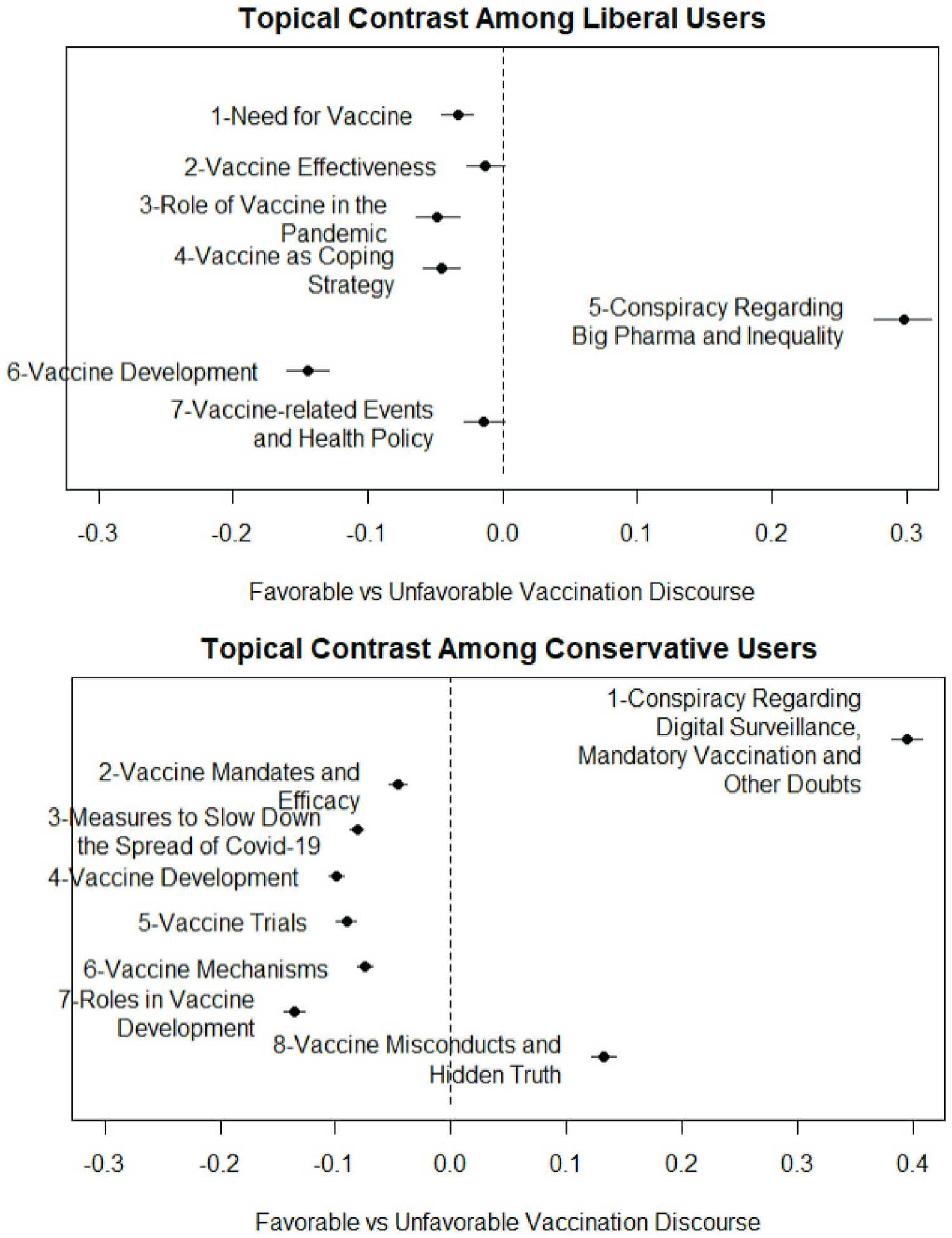
STM topical contrast.
Despite the distinct focuses, tweets across the ideological spectrum shared a common theme of vaccine politicization. While the right discussed #deepstate, #democratsaredestroyingamerica, #bluestarzon, #voteredtosaveamerica, those on the left also advanced criticism about their political opponents, particularly Trump (#idiotinchief, #trumpgenocide, #donaldtrumpisthetypeofguy, #trumphasnoplan, #theageofthetrumpsewer, #impeached4life, #trumplicans), and rallied their base for election (#election2020, #bluewave2020). These findings answered RQ3a and RQ3b.
Discussion
This study examined whether and how COVID-19 vaccination favorability and three vaccine hesitancy concerns differ by users’ ideological stance and their follower size by analyzing Twitter discourse. We constructed a corpus using vaccine-related tweets from a subset of liberal and conservative users with either a standard or large number of followers. This approach makes it possible to understand how individuals’ vaccine favorability and hesitancy concerns about COVID-19 vaccine are related to their ideology unobtrusively, allowing us to overcome self-report biases such as social desirability or recall biases in survey data (Gittelman et al., 2015; Hunger et al., 2013). Our findings are among the first to untangle the relationship between political ideologies and COVID-19 vaccine sentiment by examining these individual traits within the naturally occurring social media content.
Overall, our findings suggest that conservative (vs. liberal) and standard users (vs. users with a large following) express less favorable views on COVID-19 vaccine, more concerns about side effects, higher distrust in medical fields, and stronger beliefs in conspiracy theories. Furthermore, our interaction analysis demonstrated liberal users with a large following were the least distrustful of medical professionals, while strong conservatives express similarly large amount of distrust of medical professionals regardless of follower scope. Finally, our STM analysis revealed that while liberal users appear to focus on vaccine development and its role in ending the pandemic, conservative users discuss the potential misconduct in vaccine research and communication. Notably, while both sides mention conspiracy theories, their focuses were clearly ideologically driven; in line with their views on civil liberties and government role, conservatives tweeted more about mandatory vaccination and digital surveillance, whereas liberals expressed skepticism about hidden agendas related to big pharma and inequality.
Our findings contribute to the literature on several fronts. First, we advanced research on ideology and scientific issues, which, to date, has mainly adopted traditional methods such as survey to examine the relationship between these variables. For example, public opinion polling reveals that conservatives have weaker COVID-19 vaccine intention (SteelFisher et al., 2021). Our study contributes to this body of work by leveraging an approach using social media data, which allowed scaling users’ ideology and vaccine favorability and concerns based on their actual discourse.
Moreover, we moved one step further by focusing on specific concerns and worries underpinning ideologically driven vaccine hesitancy. Our results revealed that conservative users were more likely to express concerns about side effects, distrust in medical professionals, and conspiratorial beliefs. This provides insight on the group that hold vaccine hesitancy. It is known that general vaccination hesitancy is to a large extent constituted by concern about side effects, distrust in medical professionals, and conspiracy beliefs (Featherstone et al., 2019; Nan & Madden, 2012; Reuben et al., 2020), and it is also known that COVID-19 vaccination sentiments is divided across ideological lines (Tyson et al., 2020). Our finding bridges these two aspects of previous finding in the COVID-19 context, offering empirical evidence regarding ideological group difference in the general vaccination favorability and specific vaccination concerns.
Notably, our study is among the first to examine whether Twitter users’ network audience size is related to the content of their tweets, expecially in the COVID-19 context. Building on research on social media network and information flow (Boutyline & Willer, 2017; Primario et al., 2017), we found that users with large audience size talked more favorably toward COVID-19 vaccine, possibly due to the heterogeneity of their audience. On the contrary, users with a large audience are less likely to mention specific vaccination concerns—side effects, medical mistrust, and conspiracy theories—which, again, might be due to consideration of avoiding alienating some group of followers or creasing combative discourses (Leader et al., 2021), as well as normative pressure due to having large audience.
Our interaction analysis further revealed an interplay between ideology and follower scope. While liberal users with a large following expressed the least amount of distrust in medical professionals, conservative users’ expression of distrust in medical professionals did not depend on the following size. These findings suggest that liberal users with a large following may be the group that build trust and credibility of health agencies and scientific experts, conveying the safety as well as stringent standards enforced in vaccine development process, and facilitating equitable dissemination of vaccine information across the social media platforms. However, conservatives’ higher distrust of medical professionals across both users with large follower scope and standard users indicate the imperative to restore the conservatives’ trust in medical professionals and develop strategies to combat the specific set of vaccine hesitancy concerns among Americans on the political right.
On a broader note, while conspiracy thinking has been commonly associated with the conservative side, our findings reveal that conspiracy rhetoric offers a political instrument for both sides to advance interpretations aligned with their ideology. Given the uncertainty and lack of coping strategies at the initial stage of the pandemic, it is natural that conspiracy thinking offers a vehicle for maintaining a sense of meaning, control, and security amid uncertainty across the ideological spectrum (Allport & Postman, 1947; Newheiser et al., 2011). Yet, our findings underscore that the details of the conspiracy beliefs from the left and the right differ substantially, with the left and the right seeing nefarious or ulterior motives in distinct sets of individuals and organizations behind vaccination development and dissemination.
This study has several limitations. Primarily, as with all other research using topic models, the topic modeling labels reflect the authors’ subjective interpretation. In addition, we used a cut-off number to categorize user status. Although it is an established method in social media studies (e.g., Primario et al., 2017), future studies can leverage other measures. Finally, our study assessed public sentiment regarding COVID-19 vaccination by analyzing Twitter content from the first 4 months of pandemic. We believe an important follow-up question would be investigating whether, and in what ways, Twitter discourses evolve across the course of the pandemic.
Overall, our study responds to the need for vaccine-related public health communication that imparts meaningful and compelling messages (Broniatowski et al., 2020). The findings inform COVID-19 vaccination campaigns and suggest liberals and conservatives who have large follower scope on Twitter could be mobilized and compensated to address vaccine hesitancy. The ideological division in vaccination attitudes points to the need of targeted interventions, with users of a large audience serving as intermediary information hubs; with a cohort of followers ready to listen, these users can help deliver tailored messages based on specific concerns that drive vaccine hesitancy among their audience.
Supplemental Material
sj-docx-1-sms-10.1177_20563051211048413 – Supplemental material for Polarization Over Vaccination: Ideological Differences in Twitter Expression About COVID-19 Vaccine Favorability and Specific Hesitancy Concerns
Supplemental material, sj-docx-1-sms-10.1177_20563051211048413 for Polarization Over Vaccination: Ideological Differences in Twitter Expression About COVID-19 Vaccine Favorability and Specific Hesitancy Concerns by Xiaoya Jiang, Min-Hsin Su, Juwon Hwang, Ruixue Lian, Markus Brauer, Sunghak Kim and Dhavan Shah in Social Media + Society
Footnotes
Declaration of Conflicting Interests
The author(s) declared no potential conflicts of interest with respect to the research, authorship, and/or publication of this article.
Funding
The author(s) disclosed receipt of the following financial support for the research, authorship, and/or publication of this article: The author(s) received John S. and James. L. Knight Foundation. Award ID is MSN231314.

Supplemental material
Supplemental material for this article is available online.
Author Biographies
References
Supplementary Material
Please find the following supplemental material available below.
For Open Access articles published under a Creative Commons License, all supplemental material carries the same license as the article it is associated with.
For non-Open Access articles published, all supplemental material carries a non-exclusive license, and permission requests for re-use of supplemental material or any part of supplemental material shall be sent directly to the copyright owner as specified in the copyright notice associated with the article.
