



Abstract
News reports and online comments suggest that social media applications like TikTok play an important role in challenging traditional notions of masculinity. Male creators who don jewelry and engage in dance in their videos are emblematic of a broader shift in social and mainstream media toward gender non-conformity. Do these videos represent a movement away from hegemonic ideals? Based on a visual content analysis of 205 TikTok videos across the application’s 43 most followed male creators, we examine representations of masculinity on the platform. Drawing on the concept of hybrid masculinity, we find that TikTok creators both challenge and reinforce traditional notions of masculinity, subverting widely recognizable tropes, and gender norms while simultaneously reinforcing the importance of men’s muscularity, attractiveness, and sexual bravado. Taken together, our findings contribute to a broader discussion of the role that social media play in reproducing inequality along the lines of gender, race, and sexuality, including how beauty is rewarded symbolically and materially in online spaces.
Introduction
In October 2020, New York Times columnist Alex Hawgood exclaimed that on TikTok, “everyone is gay.” His coverage of the social media application called attention to a flurry of young men—turned stars—who routinely cross the boundaries of traditional masculinity and normative heterosexuality by posting videos of nail-painting, dancing, and intimate interactions with their male friends (Hawgood, 2020). That Hawgood profiled TikTok specifically is no accident; TikTok, an increasingly popular mobile application, has provided a platform for young men to share new gendered behaviors, and these behaviors have been met with significant praise. Indeed, young men have gone viral for fashioning what some have called “radical” masculinities (Sherman, 2020), such as short videos kissing their same-sex peers or “twirling in skirts” while centering their appearance (Hawgood, 2020; Ran, 2020).
TikTok users’ content is emblematic of a broader shift in mainstream media toward gender non-conformity (Midkiff, 2020; Scheibling & Lafrance, 2019) and hybrid masculinity, the fusing of feminine and gay aesthetics with that which is traditionally masculine without sacrificing the power and privilege afforded to men (Bridges, 2014; Bridges & Pascoe, 2014; Demetriou, 2001). Consider, for example, Vogue’s December 2020 cover featuring singer/songwriter Harry Styles wearing a dress. Journalist Daniel Rodgers (2020) described Vogue’s cover as “the logical apex of Styles’ feminine frills, TikTok’s femboy culture, and fashion’s heady embrace of non-binary aesthetics,” signaling to readers that an “unprecedented” move has taken place, as men—from cover stars and celebrities to TikTok creators—push against the boundaries of normative masculinity and heterosexuality. Similarly, others draw attention to the rise of Korean pop (K-pop) stars and their androgynous presentation, suggesting that these stars are “redefining masculinity and conventional male beauty standards” (Lee et al., 2020, p. 5901).
Reports such as these arise alongside a broader debate surrounding the democratic and inclusive potentials of social media applications (Cunningham & Craig, 2019; Duffy, 2015; Marwick, 2013; Poell et al., 2021; Turner, 2004, 2006), raising important questions about who is (and is not) poised for fame and visibility online. Absent a well-defined set of gatekeepers and industry conventions (Foster, 2021), social media platforms are thought to offer creators more freedom and autonomy than the legacy media circuit (Cunningham & Craig, 2019). YouTubers, for example, are known to “exercise a higher level of control over their career prospects” (Cunningham & Craig, 2019, p. 11) and content production than traditional celebrities including film stars, writers, and performers. This might suggest that many male users are free to use their platform to redefine what it means to be a man (Ran, 2020). A closer look at TikTok, however, reveals that things are more complex.
In what follows, we use the concepts of hybrid masculinity and masculine capital to better understand how men assert their gender identities on TikTok. Drawing on over 200 videos shared by 43 of the application’s most followed users, we extend the existing literature on hybrid masculinity with an eye toward the importance of widely shared appearance ideals and their increasing centrality among men in our visual and virtual culture—a theorized but understudied area of research (Gill et al., 2005; Ricciardelli et al., 2010; Widdows, 2018). We aim not just to explore the femboy aesthetic, but also to examine whether these videos challenge or reinforce norms and expectations surrounding masculinity and sexuality, and investigate how beauty and its symbolic rewards operate for and among men online.
Bridging the established literature on beauty with the literature on masculinities is necessary for at least two reasons. First, beauty’s social and symbolic significance, as well as its implications for gender inequality, cannot be understood, we argue, without accounting for the dynamic and co-constitutive relationships that connect and contrast both men and women within the gender order (Connell, 1987, p. 98). Yet, beauty is often operationalized in terms related to the female body, partitioning men’s relationship to beauty’s norms and practices. Second, and relatedly, beauty’s increasing visibility and importance among men necessitates that we reconsider our understanding of masculinities to address their contemporary expressions and changing character alongside broader shifts in our visual and virtual culture (Widdows, 2018), including shifts related to the public presentation of masculinities online. Indeed, digital content creators, influencers, and the like “operate firmly on the terrain of the aesthetic using the body . . . and beauty” (Hearn & Banet-Weiser, 2020, p. 3) to garner visibility and accrue capital online. Driven at least in part by the proliferation of social media applications and their technical features, creators are divided by visible metrics of popularity that render some hyper-visible and others hidden from view. With this in mind, we contribute to a broad conversation on the often taken-for-granted role that social media play in the reproduction and maintenance of inequality along the lines of gender, race, and appearance (Butkowski et al., 2019; Tripodi, 2021).
We find that TikTok creators both challenge and reinforce traditional notions of masculinity, subverting widely shared tropes and gender norms while simultaneously reinforcing the importance of men’s muscularity and sexual bravado. When male creators diverge from or cross gender boundaries, they do so in ways that serve to guard against perceptions of effeminacy and preserve their masculine capital. They may, for example, don jewelry while also baring their chest to show a muscular physique. Specifically, men’s engagement with the traditionally feminine domain of beauty and appearance is often veiled in allusions toward masculinities’ hegemonic qualities, particularly heterosexuality and muscularity, undermining the inclusive potentials of their content online.
Understanding Beauty Ideals
Beauty ideals, as media scholars and sociologists have long shown, play an important role in shaping how we see and understand ourselves and those around us. Whether measured by skin color, fitness, or facial symmetry, beauty functions as a resource or form of aesthetic capital, distinguishing who is (and is not) worthy of our attention (Anderson et al., 2010; Connell & Mears, 2018; Foster & Pettinicchio, 2021; Mears, 2015). It returns material and social rewards to those who are thought to possess it, including increased earnings and greater social esteem (Jæger, 2011; Pfeifer, 2012). In recent years, these rewards have been made hyper-visible. Evident in the ubiquity of beauty’s representation online and the commodification of appearance among social media users and “influencers” across platforms like Instagram and TikTok, beauty has never been more central to our cultural economy (Banet-Weiser, 2015; Hearn & Banet-Weiser, 2020; Pham, 2015). Online, beauty is rewarded in the form of “likes” and “comments” to social media users including and especially to young women (Banet-Weiser, 2015; Hearn & Banet-Weiser, 2020; Toffoletti & Thorpe, 2018). Yet, these rewards are not distributed equally; whiteness is a particularly powerful social privilege, closely wedded to beauty ideals both online and off (Baumann, 2008; Glenn, 2008; Hunter, 2005; Pham, 2015; Strings, 2019). Those who lie outside its boundaries receive fewer real and symbolic rewards, namely, fewer likes, comments, and of course, brand work online.
While debate continues to surround the democratic and inclusive potential of social media platforms as compared to their counterparts in legacy media (e.g., Cunningham & Craig 2019; Poell et al. 2021), it is clear that social media’s most followed stars “generally reflect rather than challenge Western standards of beauty (including thinness, youthfulness, and cuteness),” reproducing existing norms and social privileges surrounding appearance and its symbolic significance online (Pham, 2015, p. 50; see also Hearn & Banet-Weiser, 2020). Indeed, these patterns are not lost on TikTok creators who sometimes comment on or critique the centrality of appearance online.
To date, the literature on beauty, and on beauty and social media specifically, has said comparatively less about men. To borrow from Barber (2016), “research on beauty tends to focus on women and overlooks the ways men primp their bodies to carve out social identities and access social rewards” (p. 5). The relative silence is not altogether surprising when one considers the opprobrium that has long surrounded men’s engagement with “body work” or the management and modification of appearance (Gimlin, 2007), and the vanity that this work is thought to imply (Ahmed, 2006; Barber, 2008, 2016b). What scholarship does exist in these areas tends to focus on “metrosexual” men or men who take care to mind their appearance while “resisting feminization” (Barber, 2008; Salzman et al., 2005, p. 455) or else hinges on men’s interest in muscularity and physical fitness—interests that men insist are unrelated to beauty norms or appearance anxieties (e.g., Gill et al., 2005; Grogan & Richards, 2002). The men in Coffey’s (2016) interview study were, for example, adamant that their engagement in weightlifting was about health, rejecting the idea that vanity played any role in their body work, lest these men be confused as effeminate. Others engage in body work to attract attention and increase their social and sexual desirability among women (Enguix & Gómez-Narváez, 2018), thus shoring up, rather than breaking down, masculinity’s most dominant norms.
Despite these long-standing gaps in the extant literature and many men’s tendencies to distance themselves from body work, we know that men’s aesthetic visibility is on the rise. As Widdows (2018) observes of our visual culture, “men’s bodies are increasingly to be looked at, as women’s bodies have long been” (p. 240). Mainstream images and advertisements, for example, increasingly position men in “idealized and eroticized fashions, coded in ways that give permission for them to be looked at and desired” (Gill et al., 2005: 38; see also Patterson & Elliott, 2002; Schroeder & Zwick, 2004). This trend began in earnest with billboards and print media that drew attention to hegemonically attractive men or men who embodied a “socially central” form of masculinity associated with “authority” and “power” (Barry & Martin, 2016; Connell & Messerschmidt, 2005: 846; Scheibling & Lafrance, 2019). Although these depictions have become slightly more varied (Barry & Martin, 2016; Ricciardelli et al., 2010; see also Attwood, 2005), they continue to reflect vestiges of the hegemonic male—namely they depict men who are heterosexual, muscular, and white (Waling et al., 2018).
Hybrid Masculinity and Its Inclusive Potentials
Although much advertising continues to emphasize the muscular male body ideal, Scheibling and Lafrance (2019) suggest that mainstream media images of men are becoming more flexible by constructing what others have called “hybrid masculinities” (Barber & Bridges, 2017; Bridges, 2014; Bridges & Pascoe, 2014; Gill et al., 2005; Waling, 2017). Fusing elements of femininity with gay aesthetics (Bridges, 2014; Demetriou, 2001), hybrid masculinities assemble men’s gender identities to allow for a more adroit presentation and public posturing. Men might, for example, frame their participation in beauty-focused body work—a traditionally feminized domain of practice—in progressive terms while drawing important distinctions between themselves and other men including and especially gay men (Barber, 2008; Bridges, 2014; see also Szabo, 2014).
Hybrid masculinities might also leverage shared cultural scripts related to femininity and subordinate masculinities to “conceal systems of power,” particularly those that reinforce and maintain men’s social, political, and economic dominance over women and other men (Pfaffendorf, 2017, p. 220; see also Sobal, 2005). This is the case when, for example, heterosexual men borrow articles of femininity “for purely strategic purposes,” increasing their social visibility among peers while fostering an arguably false sense of allegiance with women and marginalized men (Demetriou, 2001, p. 353). Or when men deploy gay aesthetics to “distance themselves from stigmatizing stereotypes of masculinity” in the absence of any real self-reflection or commitment to the erasure of gender or sexual inequality (Bridges, 2014, p. 59). Demetriou (2001, p. 348) makes it clear that this distancing is tactical, allowing men to resist accusations of effeminacy, to “regroup,” and ultimately, resist broader social, economic, or cultural changes that threaten their power.
While questions about the scope and sincerity of men’s divergence from hegemonic norms and their willingness to engage with behavior coded as feminine or “gay” remain a contentious point of discussion, the ability to transgress or to engage with hybrid masculinities is not available to all men (Connell & Messerschmidt, 2005). Hybrid masculinities tend to be most easily accessed by men with high masculine capital (Anderson, 2005; McCormack & Anderson, 2010)—men whose gender expressions align with traits of stereotypical masculinity, such as stoicism and athleticism—and men who embody existing social privileges related to their race, class, sexuality, and appearance. Indeed, existing research suggests that these men are better able to construct hybrid masculinities, incorporating “tools and strategies . . . associated with femininity and subordinate masculinities” like emotion work, all the while maintaining their “dominance” (Pfaffendorf, 2017, pp. 219–220).
Race plays a particularly powerful role in shaping men’s hybrid masculinities and their ability to transgress gender boundaries. As Bridges and Pascoe (2014) observe, “men of color, working-class men, immigrant men, among others, are often (in)directly cast as the possessors of regressive masculinities in the context of these emergent hybrid masculinities” (p. 249). These men align themselves with hegemonic ideals to “borrow privilege” and “undermine their marginalization” (Oselin & Barber, 2019, p. 204) and tend to experience a narrower range of options for the expression of their gender (Barry, 2018; Collins, 2004; Messner, 1990). White men, however, can leverage their masculine capital to “redeem” themselves from perceived wrongdoing and combat feelings of shame or stigma when and if they transgress gender norms (Burke & Haltom, 2020). Put differently, white men can “maneuver” among hybrid masculinities with comparatively more ease (Haltom, 2021b). That hybrid masculinities are not available to all men raises questions about whether and to what extent their various configurations online signal any real change in the distribution of power within the gender order (Chen, 1999; Demetriou, 2001; Frank, 2014; Messner, 1993).
To date, few media studies have applied the concept of hybrid masculinity to examine men’s gender identities online, or to assess whether or how social media afford opportunities for variation in men’s public presentation. The important exceptions have produced mixed results, with some suggesting that social media might function as a vehicle through which greater inclusivity is promoted (e.g., Owen & Riley, 2020; Maloney et al., 2019), while others find that these media reinforce and reproduce gender inequalities (Pascoe & Diefendorf, 2018). In an investigation of men’s Facebook use, for example, Scoats (2017) found that homosocial tactility or affectionate touch and dance was on the rise in men’s images. However, both affectionate tactility and dance were identified among a sample of “exclusively white, university-attending males” (Scoats, 2017, p. 340). Pascoe and Diefendorf (2018) took a similar look at Twitter, investigating how and under what circumstances users deployed the phrase “no homo” in their posts and exchanges. Perhaps unsurprisingly, men were found to use the phrase far more than women and often at moments in which questions surrounding their masculinity and heterosexuality were at stake (Pascoe & Diefendorf, 2018). In this way, men police the boundaries of normative masculinity and heterosexuality, asserting that, though they may transgress gender expectations, they are neither feminine nor gay (see Bridges, 2014). Schrock and Schwalbe (2009) refer to such behaviors as a “compensatory manhood act” or a strategy through which men guard against accusations of effeminacy and re-assert their sexuality.
Emerging research among men in YouTube’s beauty community has come to a somewhat different conclusion, suggesting that gendered transgressions online may move beyond the gender binary, complicating our view of what is feminine and masculine. Male beauty YouTubers, for instance, “adopt certain forms of feminine presentation” in the realm of cosmetics, subverting widely recognized gender boundaries (Chen & Kanai, 2021). But this possibility for subversion appears limited to creators who identify as gay and queer, raising important questions about heterosexual men’s divergence from commonly recognized gender norms and the role that masculine capital plays in shaping their gender transgressions.
Social media may afford men high in masculine capital greater flexibility to craft content of their own design including content that diverges from traditional media and the gender norms this media tends to capture. With few barriers to production (Poell et al., 2021), users can turn to social media to “disrupt traditional narratives” (Blevins et al., 2019, p. 1636), providing new forms of representation online (Foster & Pettinicchio, 2022). Disruptive or unconventional narratives may be especially likely on TikTok where creators are known to receive praise for their transgressions (e.g., Hawgood, 2020; Ling, 2020) and where conversations related to the application’s progressive and inclusive potentials continue to circle around creators and users who are characterized as both “candid” and “critical” (see Nguyen, 2022). For these men, praise is recorded through visible metrics and symbolic rewards in the form of likes, follows, and comments. To the extent that these metrics can be monetized, men’s capital may be converted to economic rewards and lucrative brand contracts in turn.
In what follows, we use a sample of TikTok videos posted by the application’s most-followed, young, male creators to assess whether and to what extent these videos challenge or reinforce shared norms surrounding masculinity. We do this with a critical eye toward the ways in which these videos center on men’s beauty and ask how physical appearance and attractiveness operate for and among men online. We show that men’s physical appearance and attractiveness are of crucial importance to their virality and visibility online. Yet, these markers of appearance and attractiveness—and the beauty work that undergirds them—are often veiled in allusions toward masculinity’s hegemonic qualities, preserving men’s capital while undermining the inclusive potential of social media applications and the creators who populate them.
Introducing TikTok
Known first as “ByteDance” and later as “Musical.ly,” TikTok is among the fastest growing and most used social media applications today (Abidin, 2021; Bursztynsky, 2021; Kennedy, 2020). Total downloads reportedly exceed 2 billion, with TikTok’s video content amassing some 1 billion views per day (Abidin, 2021; Aslam, 2021). According to reporting by advertising agencies and e-commerce consultants, TikTok’s users are mostly male and relatively young, with just over 40% of all users aged 16–25 (Aslam, 2021; Doyle, 2021). Like other forms of social media, including Instagram and Snapchat, TikTok is a highly visual medium, centering the user’s appearance in short video clips and digital assemblages. These videos range in length from 15 s to 3 min and can be set against music, sound effects, or other audio clips (Zulli & Zulli, 2020).
TikTok videos are highly memetic and poised for virality (Zulli & Zulli, 2020). Although these videos tend to be less edited than their counterparts on Instagram (Leaver et al., 2020), TikTok provides some options to filter users’ appearances with special effects and a “beauty” tool. The centrality of appearance on TikTok is no secret to users, such that it sometimes functions as a point for parody. Several TikTok videos do, for example, comment on and sarcastically suggest that everyone on the application is physically attractive (Jennings, 2019), and that some are followed for this reason alone. Said differently, popular discourse surrounding TikTok tends to highlight the application’s democratic and inclusive potentials, yet the application’s technical architecture can undermine this discourse; TikTok’s algorithm, not unlike other social media applications, creates uneven visibility among creators, rewarding those who embody existing privileges related to race, sexuality, and physical attractiveness (Cotter, 2019; O’Meara, 2019).
Data and Methods
As part of a wider project related to the application, we began by compiling and comparing lists of TikTok’s top 100 content creators. These lists are generated by such industry tools as Social Blade, Brand Watch, and Social Tracker and often used by talent agents and industry representatives to determine with whom collaborations and partnerships should be brokered. Excluding mainstream celebrities made famous through Hollywood 1 and the most followed women from among TikTok’s top 100, we narrowed our search to the most followed male creators on the application (n = 43). 2 For reference, the most widely followed creator in our sample at the time of data collection had accrued 91.1 million followers on TikTok, while the least widely followed had 16.1 million followers. Most of these creators are situated in the United States—of the 43, 28 are situated in the United States—and produce English-speaking content. Although new creators may rise among TikTok’s most followed, fame appears to be relatively stable, with creators like Noah Beck, Josh Richards, and the Lopez brothers holding a place among the top 100 creators year over year. This owes at least in part to algorithmic logics that grant those with a significant number of followers greater exposure online (Poell et al., 2021), and to the inertia of fame in our visual and virtual culture.
Creators’ videos are publicly available for view and were collected and analyzed week by week from March to August 2021. After a preliminary review of creators’ content, we focused on their five most recently posted videos as these were determined to be representative of creators’ overall content and style. We dropped from our analysis any videos that were marked as advertisements, as these differed from creators’ typical content and because advertisements online are often circumscribed by brand representatives who shape creators’ messaging and style (Long & Wilhoit, 2018). In sum, we engaged in a content analysis of 205 videos (41 accounts × 5 videos each) posted to TikTok, coding the 334 figures featured across them.
Our coding procedure attends to men’s gendered behavior as well as to a range of dimensions designed to capture commonly shared appearance ideals. This procedure is informed by Goffman’s (1979) work on the portrayal of gender in advertisements, and by more recent studies related to media representations of beauty (Butkowski et al., 2019; van der Laan & Kuipers, 2016), visual methodologies (Rose, 2016), and observational netnography (Costello et al., 2017). Men’s behaviors and appearance ideals were measured using a list of key variables including those related to physical characteristics like muscularity, slenderness, and facial symmetry. Muscularity and slenderness were measured using a 9-point visual scale (see Figure 1; van der Laan and Kuipers, 2016). Facial symmetry was broken down into five categories ranging from (1) very symmetrical or near perfect facial symmetry; (2) mostly symmetrical, some imperfections or imbalances; (3) somewhat symmetrical; (4) not symmetrical; and (5) unclear. Visual references were provided for each category to assist coders in distinguishing between creators’ level of facial symmetry.
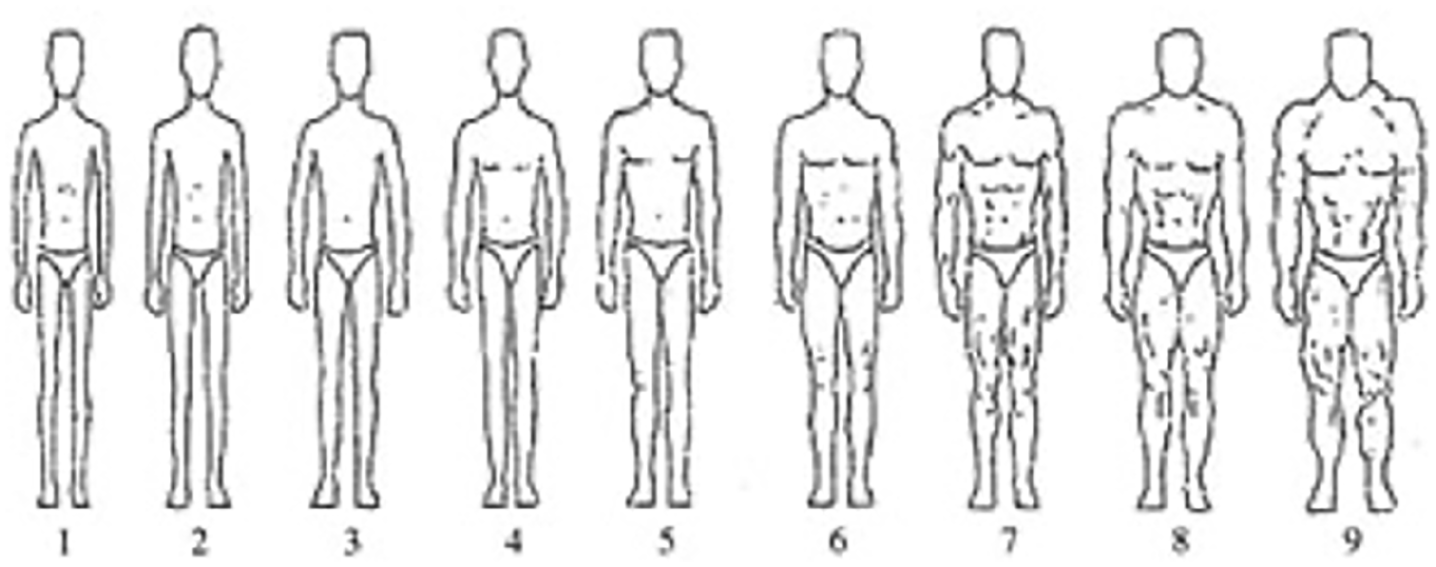
Creators’ muscularity.
The presence or absence of jewelry, tattoos, and so forth were also among our key variables. Makeup, jewelry, and the use of nail polish are often cited in mainstream news media as evidence that TikTok’s “femboy” culture is on the rise (Rodgers, 2020), or else to suggest that the boundaries surrounding traditional masculinity are shifting online. Understanding these articles of adornment as either masculine or feminine is incredibly narrow. Still their repeated citation in the mainstream media, mark each as relevant for understanding gendered behavior online. Coding for the presence of makeup, jewelry, and the use of nail polish, then, allows us to explore the extent to which men’s appearances diverge from or reinforce shared norms around masculinity and sexuality. With an eye toward men’s appearances online, we coded for creators’ race along a six-category index that included (1) White, (2), Black, (3) Asian, (4) East Asian, (5) Southeast Asian, and (6) Other. While it can be difficult to ascertain the gender or race of a creator by watching their videos, our creators’ status as widely followed stars allowed us to verify their gender and racial identities through web searches and public press reports. We also coded for creators’ age and sexuality; these elements of their identity were similarly crossed-checked with media outlets and press reports online to ensure reliability.
In addition, we code for the presence of other prominent figures in each video, including the presence of other popularly followed creators, noting their gender and appearance, and the nature of the interactions that take place between them. Behaviors such as muscle-flexing and physical exercise (Haltom, 2021), intimate and non-intimate touch (Scoats, 2017), and gestures that pantomime sex or are sexually suggestive were coded throughout. We also note men’s engagement with dance—a popular genre of video on TikTok and the one we might expect to be more closely associated with femininity (Miller, 2014). In addition, we captured the setting in which videos were coded as well as the focal activities featured across them (e.g., dancing, exercising, storytelling, etc.).
Consistent with existing work on TikTok (Hautea et al., 2021; Krutrök, 2021), we also coded for elements specific to the application’s video content, namely the music, sound clips, and filters used. Content creators routinely use these features to better contextualize their videos and to deliver messages to their audiences. While the presence or absence of filters and sound clips lend themselves well to a visual coding procedure, our analysis of lyrics relied on a qualitative textual reading of the lyrics recorded (see Lindsay & Lyons, 2018). This reading allowed us to better understand how music and lyrics are deployed to guard against accusations of effeminacy and balance men’s gendered transgressions online. Indeed, existing work suggests that music and lyrics can play an especially important part in reinforcing men’s physical, symbolic, and economic domination (Belle, 2014) and tend to produce narrow, often negative, “subject positions” both for men and women (Lindsay & Lyons, 2018, p. 629; see also Weitzer & Kubrin, 2009). This is true when, for example, lyrics degrade or sexualize women, or when music and lyrics reinforce the notion that men ought to dominate women or demonstrate wealth in their presence to enhance their desirability as sexual partners (Lindsay & Lyons, 2018).
The variables identified here allow us to comment on men’s presentation online and explore whether and to what extent their videos challenge or reinforce widely shared norms and expectations surrounding masculinity and sexuality. All variables were coded through a multi-step process. This process involved 4 weeks of training, weekly meetings, and group discussions between the authors and a team of research assistants, during which our procedure was refined. This included, for example, adding additional categories to capture gestures that we had not yet coded. These meetings were also used to establish consistency across the research team in the use of the code book and in the applications of scales related to facial symmetry, muscularity, and so forth. Our final round of coding was performed independently by the authors and research assistants. Our results were then discussed, compared, and refined to ensure agreement. This procedure identified patterns across users’ videos including related to men’s appearance and dress, as well as the use of lyrics and sexually suggestive (or explicit) behavior. These patterns are discussed in detail below.
Decoding TikTok’s “Femboys” and Appearance Ideals Online
On TikTok, men’s attractiveness and appearance are central to the content they craft, with some creators keeping only their facial features in view and others panning out to show their bodies to draw attention to their styles of dress and toned physiques. The “look” of TikTok’s most followed men is quite homogeneous; these creators are almost exclusively white, toned, and young, with perfect or near perfect facial symmetry and considerable bodily adornment. We outline some of these patterns below.
Of the figures coded in our analysis, 77% fall between the ages of 16–25 (see Table 1). This is not altogether surprising, given that the platform is, in general, frequented by members of Generation-Z and Millennials (Aslam, 2021; Doyle, 2021). Of TikTok’s most widely followed men, 82% appear with perfect or near perfect facial symmetry—an important marker of physical beauty and attractiveness (Anderson et al., 2010). Where race is concerned, the majority (67%) of TikTok’s most followed male creators is white (see Table 1). The overwhelming racial homogeneity of TikTok’s most widely followed men is consistent with existing work on beauty and fashion, suggesting that where appearance is concerned, whiteness or light skin is sure to be prized (Baumann, 2008; Glenn, 2008; Mears, 2010; Pham, 2015). Still, the sheer number of white creators among the topmost followed is striking on an application that is often heralded as egalitarian and inclusive (e.g., Morin, 2020). It appears that on TikTok, as elsewhere in our visual and virtual culture, whiteness functions as a form of “symbolic capital that affects, if not determines” (Glenn, 2008, p. 282; see also Pham, 2015) opportunities for virality and fame.
Descriptive Frequencies and Key Variables for TikTok’s Top Creators.

With respect to their physical size and muscularity, a standard TikTok “look” continues. The application’s most followed male creators are slender with toned muscles, measuring between a four or a five on a nine-point scale of muscularity (see Figure 2). 3 Creators like Noah Beck and KingBack, for example, are muscular and often pull focus to their size through articles of dress that reveal their arms, chest, and abdomen to viewers. Men’s muscularity is, no doubt, closely connected to perceptions of their masculine capital and to the hegemonic practices that typify men’s gender configuration (e.g., Connell, 1998), lending significant social visibility and esteem to men who work on and maintain their body (Bridges, 2009). On TikTok, muscular and toned physiques may serve to reinforce creators’ popularity and virality all the while ensuring, we argue, that these men are not confused for effeminate or gay should they engage in gender non-conforming behavior online.
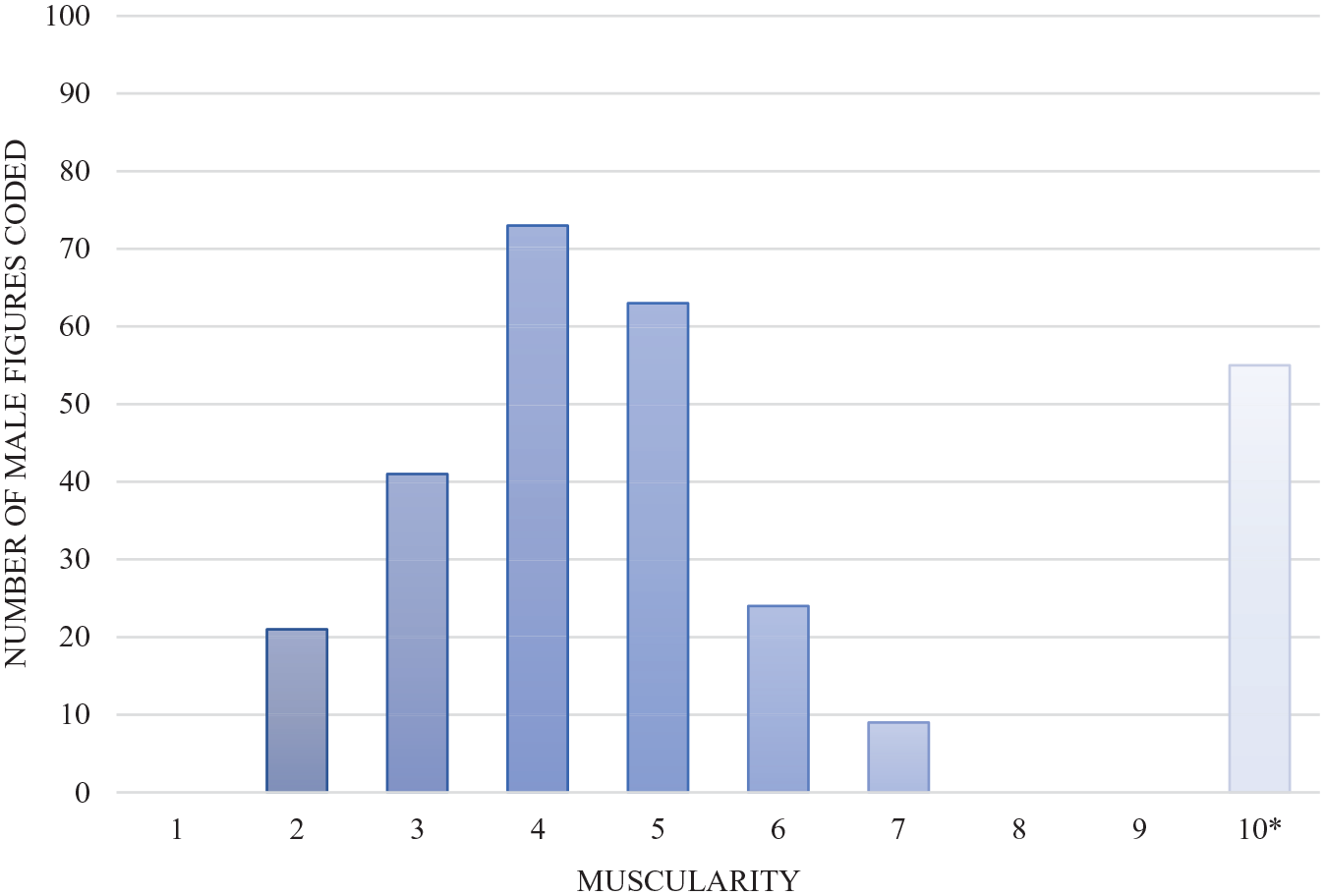
Men’s muscularity.
Outside of their muscularity, there are other indicators that these creators are attuned to maintaining a certain type of aesthetic for their followers. Modifications to hair including dyes, highlights, and semi-permanent styling treatments like perms are popular among TikTok’s most widely followed male creators. And while these modifications have long been associated with femininity, their popularity among creators online provide evidence to suggest that these aesthetic, feminized modifications are not uncommon, lending support to the notion that men’s engagement with hybrid masculinities is on the rise. Consider, for example, TikTok creator Topper Guild (@topperguild). Topper is regularly featured with dyed and highlighted hair that has been treated to enhance its body and, in some cases, to produce curls. The Stokes Twins (@stokestwins) present similarly, highlighting their hair with shades of pink. These modifications are obvious and require effortful attention to manage and maintain.
For some creators, like Jean Carlo Leon (@jashlem), treating hair with heat and color is just a start. Leon frequently styles his hair with clips and elastics and adorns his body with rings and necklaces. Jewelry—rings, necklaces, earrings, and bracelets—is frequently incorporated into men’s videos; 33% of the figures coded have ear or facial piercings and 71% wear at least one article of jewelry (see Table 1). Like styling treatments or cosmetic changes to one’s hair, jewelry is often cited by members of the press (and in broader public discussion) as feminine, and its use online as emblematic of hybridity and change (Rodgers, 2020). Chase Hudson (@lilhuddy) frequently stacks rings, necklaces, and bracelets together alongside his earrings and painted nails. Hudson’s presentation online has been praised as widely representative of TikTok’s “femboys,” “the subculture of young, hot and online teens . . . known mostly for making irony-steeped videos of themselves in their bedrooms wearing tragically hip outfits” (Jennings, 2019). Although nail-painting and the use of makeup have been similarly lauded by popular press reports surrounding men’s gender transgressions online, our analysis reveals little if any evidence to suggest that the most popular men on TikTok make use of nail-painting and makeup on a regular basis. Between the two, the use of nail-polish is more common, appearing in 6% of all videos coded, whereas makeup appears in only 2% of all coded videos. Far from a common, these elements of adornment arguably represent a more radical departure from traditional configurations of masculinity.
From elements of their adornment to their physical size, skin tone, and muscularity, TikTok’s most followed men embody a set of widely prized appearance ideals. Once the preserve of women, TikTok’s male creators highlight their looks and physical attractiveness. Their audiences take notice, rewarding these young men with symbolic capital in the form of likes and comments. For reference, the least liked video in our sample had collected a substantial 12.5 thousand likes, while the most liked video had received more than 4.8 million. In addition to the ways that the men’s appearances transgress gendered aesthetic expectations, the content of their videos, too, suggests that TikTok’s most followed men are blurring gender boundaries. Yet, we also find that much of this content reinforces hegemonic ideals, undermining the inclusive potentials of men’s gender presentation online. It is to this content that we now turn.
Masculinity and Misogyny in a 15-S Sound Bite
Online, TikTok’s most widely followed creators make use of trending music and lyrical soundbites to produce eye-catching content for viewers, including lip-synch and dance content. Indeed, lip-synch and dance are two of the top five most common video genres in our sample. On TikTok, music and lyrics play an important part in making sense of creators’ content (Abidin, 2021), with built-in tools to attach audio, such as trending music. While some of these lyrics reflect mimetic trends on TikTok, others are unique to the creators we sampled, suggesting that widely followed men select from a narrow variety of songs and are deliberate when crafting their content.
Importantly, the music male creators use contain lyrics that often degrade women and gay men, reflecting music’s well-documented issue with misogyny (Weitzer & Kubrin, 2009; Lindsay & Lyons, 2018). Put differently, men’s engagement with behavior coded as feminine or gender non-conforming—such as dance—is “reined-in” using music and lyrics and through dance moves that assert men’s hegemonic qualities and masculine capital by emphasizing sexual success and desirability. Consider, for example, TikTok creator Noah Beck (@noahbeck), a heterosexual and conventionally attractive white male. His content, albeit funny and lighthearted, is punctuated by performances set against music and lyrics that suggest sexual bravado, reinforcing the creator’s masculinity and heterosexuality. On one such occasion, Beck lip synchs to the following lyrics (Stallion, 2019): You know why these b*tches love me? (why?) ‘Cause Baby don’t give a f*ck (what you do?) I be fixin’ the weave while she suckin’ my d*ck Pull it out, then I titty f*ck (uh, uh).
To date, Beck’s video has amassed some 5.3 million views and over 680,000 likes. In another video, Beck uses song lyrics to reminds his followers that he is “comin’ for that p*ssy” (Baby, 2020). He does so while using the applications’ effects function to superimpose a set of sparkles over his face and eyes, drawing attention to his physical appearance and facial symmetry as he lip-synchs along. While elements of Beck’s content might be read in terms of hybrid masculinity—his engagement with lip-synch content and beauty filters for instance—his emphasis on appearance, alongside lyrics that sexualize women and reinforce his own sexual bravado, mirror widely recognizable and hegemonic ideals surrounding masculinity including ideals related to muscularity, virility, and whiteness. Although here we have highlighted examples from Beck’s content, we note that it is not altogether different from the content other young men craft for TikTok audiences.
Of course, music and lyrics are not just sung to; TikTok’s content creators often dance alongside lyrics or combine both lip-synching and dance to produce viral videos. Dance videos are themselves the second most common video genre among TikTok’s most widely followed men, with 34% of all videos featuring dance content. The dance moves and behaviors that accompany lyrics online often reflect broader trends across the application, with creators mirroring a set of widely recognized gestures. The “dolphin” and “dice roll,” for example, are dance moves used by the application’s most widely followed creators, with the former deployed to pantomime sex alongside lyrics that make its implication clear. Pantomiming sex, kissing, or gesturing to intimate parts of the body was also common, with some 54% of men engaging in one or more of these behaviors. Importantly, these sexual gestures frame men’s engagement with dance and its concomitant association with femininity in ways that are normatively masculine, and therefore, not altogether radical. Put differently, these sexual gestures provide heterosexual recuperation for behaviors that lie outside the boundaries of normative masculinity (McCormack & Anderson, 2010). Consider Tony Lopez’s (@tonylopez) dance videos in which he wears pearl earrings and, at times, a matching pearl necklace. His hair is permed and perfectly styled. On more than one occasion, Lopez dances along to trending songs, placing his hands by his crotch or hips, as he thrusts forward and back while lyrics like “suck my private, close your eyes . . . suck it sideways, if we in public or the driveway” play in the background (Scott, 2019). While Lopez’s content provides some evidence in favor of the platforms’ lauded potential for hybridity, namely in the styled hair, jewelry, and dance, the lyrics and physical gestures undermine any sense that masculinity’s hegemonic ideal is being challenged.
Some creators positioned their dance moves alongside close friends and TikTok stars, multiplying one another’s visibility and audience reach on the application. Some do this while next to their girlfriends and partners, reminding viewers of their desirability and, importantly, their heterosexuality. Naim Darrechi (@naimdarrechi), for example, often featured his then-girlfriend, Àngela Mármol (@amarmolmc). On one such occasion, the two dance in what appears to be a hotel bedroom, with the lyrics “can we just make love, not war” echoing behind them. Videos such as this epitomize TikTok’s emphasis on social and sexual desirability and provide intense visibility to young people who embody social privileges along the lines of race, gender, sexuality, and appearance. They also provide an avenue through which men might transgress the boundaries of normative masculinity—singing and dancing online—while simultaneously assuring viewers of their virility, attractiveness, and heterosexuality. Taken together, music, dance moves, and the behaviors these are situated against combine to negate one another or else to “rein-in” allusions toward femininity or homosexuality, casting doubt on TikTok’s celebrated potential for gender non-conformity and hybridity online.
Discussion and Conclusion
Unlike its counterparts in the traditional media circuit, TikTok is often lauded as an inclusive and egalitarian platform where young men can engage in new gendered behaviors and push the boundaries surrounding masculinity including, and especially, its normative characteristics and hegemonic qualities. That is, the platform affords men an opportunity to create content that is culturally coded as feminine, such as videos featuring dance and lip-synch content. If commentators on social and mainstream media are to be believed, these creators and their “femboy” aesthetic are helping to blur the boundaries of masculinity (e.g., Hawgood, 2020, Sherman, 2020). While content of this kind suggests that the norms surrounding masculinity may be shifting, the videos analyzed here appear to strengthen “hegemonic masculine boundaries and the subsequent power for those who conform to them” (Barry & Martin, 2016, p. 344). Importantly, TikTok’s most widely followed men, as we have shown, embody a host of social privileges related to their race, youth, and physical appearance and possess masculine capital. Indeed, the overwhelming majority of TikTok’s most widely followed men are white, cisgender, heterosexual, and physically fit and often muscular, providing visual evidence of their body work and effortful attention to appearance.
When and if men cross gender boundaries and engage with hybrid masculinities, they do so while alluding to masculinities’ hegemonic qualities, pairing their behaviors with lyrics and physical gestures that sexualize women and re-assert men’s virility, bravado, and strength as a form of heterosexual recuperation (McCormack & Anderson, 2010). Together, these gestures and lyrics serve to reproduce existing inequalities along the lines of gender, race, and sexuality. They also translate into unequal rewards for TikTok creators. TikTok’s most widely followed men are met with highly visible metrics of popularity including comments, follows, and likes which can be swapped, in turn, for brand endorsements or product sponsorships (Abidin, 2021). Josh Richards (@joshrichards), for example, reportedly earns some US$1.5 million in annual brand sponsorships, with creators like Michael Le (@justmaiko) and SpencerX (@spencerx) following closely behind (Bowman, 2021). These creators thus successfully convert the symbolic and embodied properties of appearance into economic capital.
By empirically and conceptually interrogating TikTok’s femboy aesthetic and the “radical” masculinities this aesthetic is thought to embody, we have contributed to a developing portrait of contemporary masculinity and its hybridization online, as well as the characteristics that undermine its inclusive potential. Our findings support the extant literature on hybrid masculinity and suggest that videos praised for displaying “radical” masculinities map onto and reinforce extant patterns of gender inequality (Barber, 2016; Bridges & Pascoe, 2014). While we cannot impute creators’ intentions, we suspect that it is this praise that incentivizes men’s gendered transgressions, and caution that men’s “radical” moves signal little, if any change, to the gender order. Men’s engagement with beauty and body work, for example, is often tethered to hegemonic ideals related to heterosexuality and physical size and muscularity. These characteristics effectively shift focus away from men’s appearance and its association with that which is feminine, undermining their inclusive potential. Together, they allow (some) men to reap the privileges that beauty so often confers (Anderson et al., 2010), while simultaneously escaping its penalties. White, cisgender, heterosexual, and conventionally attractive men—men who possess significant capital—are among the most followed male users on TikTok and are therefore the most likely to be rewarded for their video content and the behaviors captured therein.
The predominance and popularity of white creators on TikTok are especially noteworthy in a mediascape wrapped in democratic and inclusive appeals. These appeals can do insidious work, masking the constraints that bind creators to masculinity while dressing their presentation and the inequalities that underscore it in a guise that is “radical” and thus, “progressive.” The popularity of white creators online should be understood as part and parcel of a broad cultural apparatus that has long distributed privilege in uneven measure—as a continuation of white racial privilege and the power and visibility that it affords (Bridges & Pascoe, 2014; Burke & Haltom, 2020; Haltom, 2021b). Online, this visibility is contorted in new ways, lending visible rewards and even compensation to those who are, perhaps, least in need of it.
Moving forward, future research should more closely investigate how TikTok’s content shapes viewers’ understanding of appearance and attractiveness (e.g., Harper & Tiggermann, 2008; Tiggermann, 2003), and to the relationship between men’s appearance and concomitant demands to engage in beauty work. Our research does not allow us to speak to how these videos are received by their audience. Research in this vein demonstrates that men who follow and engage with media representations articulate an increasing amount of pressure to perform “body work,” and report more negative self-esteem because of exposure to media images that center appearance in view (Andsager & Schqartz, 2011; Vandenbosch & Eggermont, 2013). While it is unlikely that the time and effortful commitment body work commands weighs as heavily on men as it does on women, the popularity of men’s aesthetic representations on social media should raise some concern related to their effect including and especially among young men who make up a significant share of the application’s users (Aslam, 2021; Doyle, 2021). In this vein, viewers’ response to creators’ videos more generally should also be analyzed to better capture patterns related to audience reception and creators’ visibility and fame online.
Where their visibility and fame are concerned, future research might also consider a wider sample of TikTok creators including aspiring TikTok creators and creators with fewer “follows.” We suspect that aspiring creators may face important obstacles online where characteristics related to age, gender, race, and appearance shape virality. Owing to our relatively small sample size and to our focus on the application’s most followed men, we can comment only on those men who have already achieved a modicum of fame, yet failure to achieve fame matters too. In more carefully examining users who have yet to go viral, we might better understand the processes that shape visibility and fame among creators online as well as the obstacles that stand in their way. Algorithmic obstacles (Cotter, 2019; O’Meara, 2019) may present an especially pernicious obstacle to aspiring TikTok creators, especially as knowledge surrounding TikTok’s algorithm(s) has only begun to surface (Abidin, 2022). More work is needed to capture these obstacles and to understand what opportunities might exist for transgression among the applications’ less-followed creators. This work should pay particularly close attention to race as an axis informing creators’ visibility online and consider whether and to what extent creators of color have been algorithmically suppressed. This work may offer a challenge to popular notions that surround TikTok’s egalitarian appeal and shed further light on the significance of appearance on social media. As Rebecca Jennings (2019) notes in her article for Vox, “as much as it is a place for teenagers to goof off in their bedrooms, it is also the world’s largest beauty pageant.” And men, it turns out, are among its contestants.
Supplemental Material
sj-docx-1-sms-10.1177_20563051221126040 – Supplemental material for Muscles, Makeup, and Femboys: Analyzing TikTok’s “Radical” Masculinities
Supplemental material, sj-docx-1-sms-10.1177_20563051221126040 for Muscles, Makeup, and Femboys: Analyzing TikTok’s “Radical” Masculinities by Jordan Foster and Jayne Baker in Social Media + Society
Supplemental Material
sj-docx-2-sms-10.1177_20563051221126040 – Supplemental material for Muscles, Makeup, and Femboys: Analyzing TikTok’s “Radical” Masculinities
Supplemental material, sj-docx-2-sms-10.1177_20563051221126040 for Muscles, Makeup, and Femboys: Analyzing TikTok’s “Radical” Masculinities by Jordan Foster and Jayne Baker in Social Media + Society
Footnotes
Appendix
TikTok Creators.
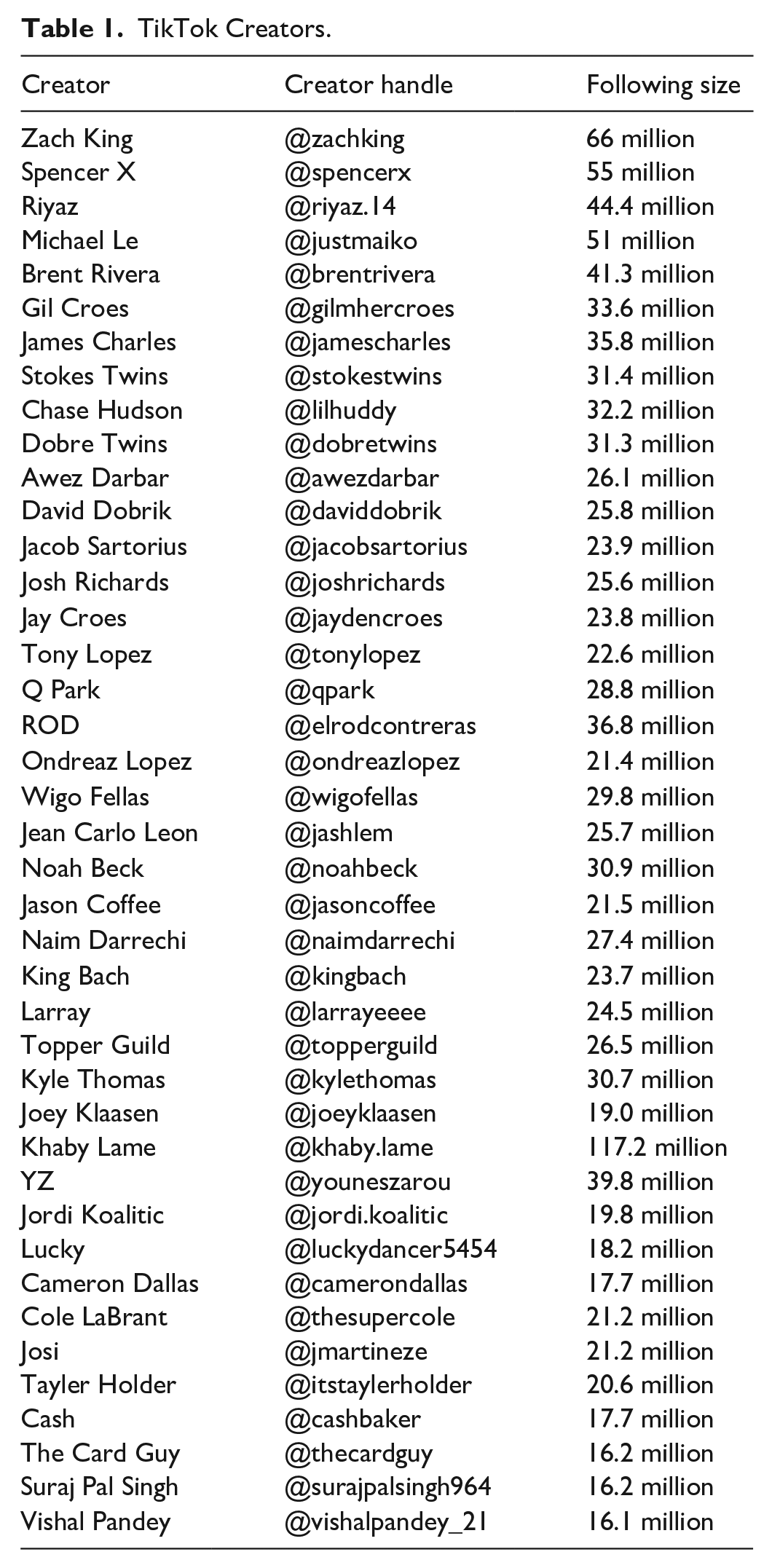
| Creator | Creator handle | Following size |
|---|---|---|
| Zach King | @zachking | 66 million |
| Spencer X | @spencerx | 55 million |
| Riyaz | @riyaz.14 | 44.4 million |
| Michael Le | @justmaiko | 51 million |
| Brent Rivera | @brentrivera | 41.3 million |
| Gil Croes | @gilmhercroes | 33.6 million |
| James Charles | @jamescharles | 35.8 million |
| Stokes Twins | @stokestwins | 31.4 million |
| Chase Hudson | @lilhuddy | 32.2 million |
| Dobre Twins | @dobretwins | 31.3 million |
| Awez Darbar | @awezdarbar | 26.1 million |
| David Dobrik | @daviddobrik | 25.8 million |
| Jacob Sartorius | @jacobsartorius | 23.9 million |
| Josh Richards | @joshrichards | 25.6 million |
| Jay Croes | @jaydencroes | 23.8 million |
| Tony Lopez | @tonylopez | 22.6 million |
| Q Park | @qpark | 28.8 million |
| ROD | @elrodcontreras | 36.8 million |
| Ondreaz Lopez | @ondreazlopez | 21.4 million |
| Wigo Fellas | @wigofellas | 29.8 million |
| Jean Carlo Leon | @jashlem | 25.7 million |
| Noah Beck | @noahbeck | 30.9 million |
| Jason Coffee | @jasoncoffee | 21.5 million |
| Naim Darrechi | @naimdarrechi | 27.4 million |
| King Bach | @kingbach | 23.7 million |
| Larray | @larrayeeee | 24.5 million |
| Topper Guild | @topperguild | 26.5 million |
| Kyle Thomas | @kylethomas | 30.7 million |
| Joey Klaasen | @joeyklaasen | 19.0 million |
| Khaby Lame | @khaby.lame | 117.2 million |
| YZ | @youneszarou | 39.8 million |
| Jordi Koalitic | @jordi.koalitic | 19.8 million |
| Lucky | @luckydancer5454 | 18.2 million |
| Cameron Dallas | @camerondallas | 17.7 million |
| Cole LaBrant | @thesupercole | 21.2 million |
| Josi | @jmartineze | 21.2 million |
| Tayler Holder | @itstaylerholder | 20.6 million |
| Cash | @cashbaker | 17.7 million |
| The Card Guy | @thecardguy | 16.2 million |
| Suraj Pal Singh | @surajpalsingh964 | 16.2 million |
| Vishal Pandey | @vishalpandey_21 | 16.1 million |
Acknowledgements
The authors would like to thank Professor Josée Johnston and Professor Shyon Baumann for their comments on early drafts of this work. The authors would also like to thank Dr Casey Scheibling for this thoughtful feedback and consistent correspondence, as well as reviewers at Social Media + Society for their engaging and instructive comments.
Declaration of Conflicting Interests
The author(s) declared no potential conflicts of interest with respect to the research, authorship, and/or publication of this article.
Funding
The author(s) received no financial support for the research, authorship, and/or publication of this article.

Supplemental Material
Supplemental material for this article is available online.
Notes
Author Biographies
References
Supplementary Material
Please find the following supplemental material available below.
For Open Access articles published under a Creative Commons License, all supplemental material carries the same license as the article it is associated with.
For non-Open Access articles published, all supplemental material carries a non-exclusive license, and permission requests for re-use of supplemental material or any part of supplemental material shall be sent directly to the copyright owner as specified in the copyright notice associated with the article.
