




Abstract
Rumors about Taylor Swift’s sexuality have persisted since the early days of her career. They have coalesced into an online subculture known as “Gaylor.” Gaylor is a novel kind of conspiracy theory known as a “Closeting Conspiracy Theory” (CCT). CCTs involve speculating about a public figure’s sexuality, gathering pertinent evidence, and producing fan knowledges, often informally, on social media. Like shipping and slash fiction (which they often involve) CCTs are largely feminized. Through a qualitative content analysis of 200 TikTok videos, this article situates Gaylor as a CCT that has developed into a kind of knowledge culture. Analyzing this knowledge culture using Emily Coccia’s notion of too-close reading and José Muñoz’s queer utopianism reveals specialized practices of knowledge production, including informal boundary work. As Gaylors get “too close” to Swift’s star text, triangulating lyrics and music videos with images and videos from Swift’s life, they produce folk literary criticism. Muñoz’s queer utopianism saturates Gaylor discourses, with many Gaylors engaging in a specific type of conspiracy-inflected queer utopianism: the doomsday coming-out. The doomsday coming-out pushes the date of the Swift’s purported coming out back further and further after each anticipated album or music video release, not unlike the date of the apocalypse in a doomsday cult. Ultimately, the function of producing CCT knowledge in the Gaylor community is propelled forward by imagining queer futures, reflecting on personal identity, building community, and pushing back against heterosexist consensus.
Introduction
In October 2022, Taylor Swift posted an Instagram reel in which she discussed the origins of the title of the first track off her upcoming studio album Midnights, “Lavender Haze.” To a casual follower, the video seemed like an innocuous bit of insight into Swift’s creative process—bathed in the 1970s-inspired color palette that suffused the Midnights promotional cycle, Swift discusses how she heard the phrase “lavender haze” in an episode of Mad Men to denote the foggy feeling of being in love. The song, Swift said, was about wanting to remain in that feeling despite “weird rumors” about her “six-year relationship” with (unnamed) Joe Alwyn. The video set the online Swift fan community (“Swifties”) ablaze, with many interpreting her incrimination of “weird rumors” as broadly condemning a subset of Swifties known as “Gaylors.” 1 Gaylors, as the name implies, interpret Swift’s star text through a queer lens by searching for coded messages in her lyrics, music video visuals, clothing choices, and social media posts. At once interpretive sense-making practice, conspiracy theory, and identity-inflected fan community, Gaylor represents a significant convergence between two consequential areas of contemporary internet culture: fandom and conspiracy theory.
Swift, whose global popularity seems to increase exponentially each year, notoriously cultivates intimacy with Swifties, who are known to be fiercely loyal (Driessen, 2022; Haden, 2021; Savage, 2022). She has invited fans to her house for listening parties, engaged with their social media posts, and surprise-attended fan bridal showers and weddings (Wong, 2023). In her 2020 documentary Miss Americana, Swift discusses her relationship with her fanbase: “. . . we feel like we grew up together. I’ll be going through something, write the album about it, and sometimes it’ll just coincide with what they’re going through. Kind of like they’re reading my diary” (Wilson, 2020). By inviting closeness and intimacy with fans, Swift proffers a fantasy of a celebrity friendship that can feel real even as it is one-sided.
Swift’s intertextual references are largely autobiographical; many if not most of her songs are about events in her own (love) life (Brown, 2012). 2 In a 2019 Entertainment Weekly video, Swift discussed how she likes to communicate with fans: “I love to communicate via easter eggs. I think the best messages are cryptic ones.” Recalling leaving messages in liner notes, music videos, lyrics, clothing, and jewelry, Swift asserted that “There are some that people still haven’t found. It will be decades before people find them all” (Rankin, 2019). In another interview, Swift invited fans to “. . . go down a rabbit hole with us. Come along, the water’s great. Jump in” (“The Tonight Show with Jimmy Fallon,” 2021). Using “we” and “us,” Swift puts herself in congress with her fans and emphasizes the collective nature of Swiftie participatory culture.
Through a qualitative content analysis of 200 TikTok videos, this article unpacks the Gaylor phenomenon and situates it as an example of a closeting conspiracy theory (CCT) with its own unique informal knowledge production practices. I argue that, like shipping and slash fiction (which they often involve), CCTs are largely feminized. Analyzing such a participatory knowledge culture using José Muñoz’s queer utopianism and Emily Coccia’s notion of too-close reading reveals specialized practices of knowledge production. Muñoz reminds us that queer futurities rooted in whiteness themselves always reproduce neoliberalism, homonormativity, and, of course, whiteness. Yet, we must also consider how treating Swift’s own whiteness, and that of her U.S. fanbase, as if that means that people of color cannot participate in fan knowledge production is an oversimplification that denies fans of color agentic fan identity (Dosekun, 2024). As Gaylors get “too close” to Swift’s star text (Coccia, 2022), triangulating lyrics and music videos with images and videos from Swift’s life, they produce what I call folk literary criticism. Queer utopianism saturates Gaylor discourses, and many Gaylors engage in a specific type of conspiracy-inflected queer utopianism: the doomsday coming out. The doomsday coming out pushes the date of Swift’s purported coming out back further and further after each heavily anticipated album or music video release, not unlike the date of the apocalypse in a doomsday cult. That Gaylor specifically, and CCTs broadly, are feminized and queer is significant. Conspiracy theorizing is a means through which sapphic women and queer people can envision equitable futures for themselves—yet, Swift’s whiteness and the whiteness of her fanbase, is significant and shapes the kinds of (White) futures that are envisioned. Ultimately, the production of CCT knowledge in the Gaylor community is propelled forward by imagining queer futures, reflecting on personal identity related to gender and sexuality (not, notably, intersecting race and class identities), building community, and pushing back against heterosexist consensus.
Background
Rumors about various stars’ sexualities have circulated in celebrity gossip and fan communities for decades, including theories that a love affair between Mel B and Geri Halliwell ultimately split up The Spice Girls, that Camilla Cabello and Lauren Jauregui of Fifth Harmony dated, and that Harry Styles and Louis Tomlinson of One Direction had a secret relationship (Glassman, 2023; Rosa, 2017; Van Der Meer, n.d.). Rumors about Swift’s sexuality have persisted since the early days of her career (Jones, 2022). “Gaylor” which refers to both the theory and its proponents, represents a form of conspiracy theory I am calling “Closeting Conspiracy Theories” (CCTs). CCTs involve speculating about a public figure’s sexuality, gathering pertinent evidence, and producing knowledge, often informally, online. A Public Relations (PR) team—whose job it is to ensure that Swift is publicly successful and well-liked—seems a consummate group of potential conspirators. Swift’s easter-egg communication style creates a fan culture that is particularly hospitable for conspiracy theorizing.
Like most conspiracy theories, Gaylor is not monolithic. The multitudes of differing opinions—who exactly Swift has dated, whether she has ever legitimately dated men, and which former paramour a given song might be about—coalesce around the notion that she is not straight. Swift’s star text has always relied on her online presence and her engagement with fans in digital spaces (Brown, 2012; Harper, forthcoming). Gaylor has its origins on Tumblr, which is still home to many master posts summarizing relationship timelines using detailed evidence collages (Harper, forthcoming; Krafft & Donovan, 2020). Gaylor communities have since formed on Reddit, Twitter/X, and TikTok.
All of Swift’s alleged relationships with women (and others, like Harry Styles) are assigned portmanteau “ship” names like “Swiftgron” 3 (Dare-Edwards, 2014). Arguably the most popular ship in the Gaylor world is “Kaylor”—referring to Swift and model Karlie Kloss. The pair met at a Victoria’s Secret fashion show in 2013 and became inseparable after taking a seemingly romantic trip to Big Sur in March 2014. They appeared to fall out sometime in 2015 or 2016. Swift and Kloss’s public relationship featured many instances of handholding, kissing, photoshoots, and displays of devotion. Private moments were caught on camera, as well—at a 2014 concert, the two were filmed by a fan, allegedly kissing. Within the community, this is known as “kissgate” (Erin, 2018). Kaylors, or fans who are devoted to shipping Kloss and Swift, are a specific subset of Gaylors with their own aesthetic and discursive tendencies. Harper (forthcoming) denotes Kaylor as an eschatological theory that contains within it an “endgame revelation” of Swift’s public coming out and confirmation of her past—or ongoing, for so-called “late-stage” Kaylors—relationship with Kloss. Kaylor theorizing figures prominently within Gaylor broadly in large part because there is a glut of Kaylor evidence. 4 Their friendship was documented in detail on their social media, in public appearances, and in joint media interviews, creating a multitude of points in their joint star text that are just mysterious enough to allow for queer interpretations.
Several splintering flashpoints within the Swiftie community at large have resulted in Gaylors experiencing both ridicule and growth in numbers. The 2021 release of Red: Taylor’s Version featured the song “The Very First Night,” whose lyrics appear to follow an AABB rhyme scheme until Swift uses “you” instead of the pronoun that would most clearly rhyme with “picture”: “her” (Kircher, 2021). Furthermore, Swift posting about the indie pop music artist “girl in red” on her Instagram stories in April 2022 was taken by Gaylors to be a significant instance of flagging because “Do you listen to girl in red?” is a recognized way for sapphics to verbally flag (Harper, forthcoming). Gaylor “defeats” like Lavender-Haze-Gate seem to be getting more frequent—most recently, Swift’s prologue to 1989: Taylor’s Version includes an indictment of all speculation about her romantic relationships: “I swore off dating and decided to focus only on myself, my music, my growth, and my female friendships. If I only hung out with my female friends, people couldn’t sensationalize or sexualize that—right? I would learn later on that people could and people would” (Swift, 2023a). Once again, this created a flurry of Gaylor discourse and knowledge production on TikTok, Reddit, Tumblr, and to a lesser extent, X (formerlly known as Twitter). During crisis points like these, Gaylors and mainstream Swifties (whom Gaylors often call “Hetlors”) come into direct conflict with one another and, in so doing, negotiate the boundaries of their interpretive practice(s) and distinctive styles of participatory knowledge production.
Some research has been done on subversion and interpretation of Swift’s work online—Prins (2020) illustrates the potential for social media to support extreme oppositional readings of star texts, as in the case of the far-right’s adoption of Swift as an Aryan emblem (Prins, 2020). Avdeeff’s (2021) comparative analysis of Twitter and TikTok responses to Swift’s 2019 allyship anthem “You Need to Calm Down,” shows that the latter platform seems to foster subversion and reimagining of the music video as text (whereas X/Twitter responses tended to be straightforward readings). TikTok’s mimetic affordances, individualized algorithmic tailoring, and exaggerated temporalities make it hospitable to a wide variety of editing styles and video lengths (Cervi & Divon, 2023; Siles et al., 2022; Zulli & Zulli, 2020). It may in fact be especially well-suited to participatory knowledge production, as its various affordances enable creators to communicate complex ideas to diverse audiences (Nguyen and Diederich, 2023). Furthermore, TikTok may be particularly hospitable for CCTs like Gaylor because its flexibility allows users to create, subvert, discuss, challenge, and disseminate new and old pieces of “lore.”
User understandings of how powerful algorithmic infrastructures like TikTok’s work, known as algorithmic folk theories, can help people make sense of black-boxed infrastructures (Karizat et al., 2021). Folk algorithmic theories “. . . can act as a high-level frame for shaping user expectations [and] may be a useful window into understanding user resistance to algorithmic change” (DeVito et al., 2017). Karizat et al. (2021) examine the role identity plays in shaping folk algorithmic theories, arguing that “TikTok users and the FYP algorithm co-produce . . . knowledge of identity on the platform . . .” Their participants indicated beliefs that the algorithm . . . recommended videos for the FYP based on how it understood their person identity, with the algorithm assuming their interest based on personal engagement networks on and off TikTok and what is popular on the platform at a certain time . . . the algorithm was believed to create an algorithmic identity, (p. 20).
Just as CCTs are a way for people to theorize about the ultimate unknowability of the true lives of celebrities and the machinations of the entertainment and PR industries, algorithmic folk theories are a way for people to theorize about the ultimate unknowability of the design and functionality of a given ever-changing, proprietary, black-boxed infrastructure. This parallel is one reason I chose TikTok for my research site—CCTs are an identity-based phenomenon and the knowledge produced around them is co-produced by Gaylor creators and TikTok itself.
Literature Review
Conspiracy Theory and the internet
Conspiracy theories resist a single, universally accepted definition, with a variety of approaches to the phenomenon evolving across academic fields. The simplest, most straightforward definition of a conspiracy involves a group of agents with a goal carrying out secret plans to achieve that goal (Dentith, 2014). Consequently, any theory positing the existence of such a conspiracy qualifies as a conspiracy theory. Knight (2000, p. 3) defines his notion of “conspiracy culture” as a pervasive belief in the ubiquity of clandestine, conspiratorial forces in a globally connected world characterized by pervasive doubt. Husting and Orr (2007) similarly argue that the United States’ culture of fear, combined with information oversaturation, fosters a climate of uncertainty. Living under surveillance capitalism can create a panopticon-like lived experience that results in perceptions of conspiracy where there may be none. This can be worsened by concomitant social consequences stemming from the label “conspiracy theorist.” Considered in this context, conspiracy theorizing can be seen as a distinct form of sense-making and knowledge construction (p. 31).
Within conspiracy theory scholarship, two predominant schools of thought emerge: generalism and particularism. Generalists regard conspiracy theorizing as irrational, treating it as a broad, homogeneous category. Conversely, particularists argue for a case-by-case examination, emphasizing epistemic diversity (Dentith, 2014, p. 32). Klein et al. (2018) similarly distinguish the “monological” view of conspiracy theories from the “iceberg model.” The monological view posits that conspiracy theorists share socio-psychological characteristics and develop a worldview centered on hidden conspiracies through socialization. The iceberg model suggests that beneath this surface lies a diverse group of individuals with varying epistemic and psychological profiles. This article asserts that feminist scholarship on conspiracy theories should adopt a particularist or iceberg approach, consistent with feminist methodology, which centers the perspectives of the studied and questions power structures. Indeed, theorizing conspiracies is one way to speak back to and subvert authoritative systems and institutions. Jane and Fleming (2014) characterize conspiracy theorizing as a form of “folk sociology,” while Harambam and Aupers (2017) show that conspiracy theorists engage in complex battles for epistemic authority with establishment scientists.
The contemporary landscape of conspiracy culture owes much to 1990s fan cultures that developed around shows like The X-Files. That these fan communities took shape on early internet message boards illustrates the interconnectedness between the internet, conspiracy cultures, and fan cultures (Scodari & Felder, 2000; Wakefield, 2001). In their analysis of QAnon research cultures, Marwick and Partin (2022) draw connections between fan literacy practices and conspiracy research cultures—both involve interpretive practice-cum-collective sense-making, and the creation and maintenance of a community through knowledge sharing.
Prevailing narratives suggest that the internet has amplified the danger of conspiracy theories, allowing them to spread and mutate rapidly (Cinelli et al., 2022; Enders et al., 2023). At once a conspiracy theory of everything, a religious movement, and an alternate reality game, QAnon charges United States Democratic Party officials with engaging in child sex trafficking and satanic ritual child abuse (Algavi et al., 2023; Hodges, 2023; Rothschild, 2021). With publicity around QAnon reaching a fever pitch in the late 2010s and early 2020s, internet-based conspiracy theories seemed in general to be more extreme, volatile, and steeped in White supremacy than earlier theories (Hannah, 2021; Knight, 2000). Online, conspiracy theories appear to move between the poles of the false fringe-mainstream dichotomy (Barkun, 2015), lurking at the ends of so-called “pipelines” and threatening to attack unsuspecting internet users (Munn, 2019; Tangherlini et al., 2020). Although work on theories like QAnon is essential, exploring the dynamics of other kinds of conspiratorial communities whose normative commitments are markedly different is crucial to understand the wider phenomenon of internet-based conspiracy theories.
Little work has been done on conspiracy theories on TikTok. Studies that do exist are generalist in approach (Grandinetti and Bruinsma, 2022). While generalist studies of conspiracy theories on TikTok are vital, particularist approaches are also needed. Furthermore, limited research has analyzed conspiracy theories through the lens of gender and sexuality. Some research indicates that men are more likely to believe in conspiracy theories than women (Cassese et al., 2020). However, feminized areas of conspiracy theory remain understudied, likely because they are perceived as either nonexistent or innocuous. Despite appearing masculine on the surface, far-right theories like QAnon engage with femininity by reifying oppressive gender dynamics (Bracewell, 2021). Heřmanová (2022) examined how Czech women spirituality influencers operationalize control over their own and other women’s bodies as a discursive tactic to bolster COVID-19 denial and other conspirituality narratives. Other conspiracy theories engage with gender and sexuality by casting various gender and sexuality minorities as the threatening “other” in a conspiratorial narrative (Billard, 2023; Marchlewska et al., 2019; Thiem, 2020). Gender, especially the construction of femininity, remains an essential and understudied aspect of the online proliferation of conspiracy narratives.
Fan practices like shipping and slash fanfiction can be considered feminized (Anselmo, 2018; Zheng, 2023). This article argues that CCTs are also feminized. Furthermore, fan communities that form around CCTs can in fact provide a safe and supportive environment for members to explore their own relationship to their sexual orientation, heal from the trauma of familial and societal rejection, and conceive of safe, supportive queer futures for themselves and others.
Authenticity, Gossip, Fandom, and Whiteness
Since the beginning of her career, Swift has built her brand on being an authentic, ordinary American girl. This relatable “good girl” persona is predicated on whiteness, heterosexuality, and normative femininity (Brown, 2012; Dubrofsky, 2022; Prins, 2020). Dubrofsky (2022) argues that whiteness and authenticity have similar organizing principles: . . . like whiteness, authenticity gains salience and power by being unspoken, seemingly natural, and appearing to require no effort . . . [it is] seen as an inherent good that some naturally possess, its qualities difficult to pin down because it is undefined and unremarked upon (p. 6).
Neoliberal White feminist values are woven throughout Swift’s star text. Authenticity and concomitant goodness are antecedents for the closeness she cultivates with her fans.
Drawing on both Dyer (1979) and Schickel (2000), Meyers (2009) emphasizes the connections between truth-seeking and intimacy-seeking—celebrity power rests on the “illusion of intimacy” between audience and celebrity. Wilkinson (2019) positions Swift’s highly successful transition from country to pop as one of negotiated authenticity—without alienating her fanbase, Swift carefully walked the line between the confessional, truth-laden aesthetics of country-music authenticity—itself suffused with significant racial politics—to an ironic, self-effacing performance of pop authenticity. As Swifties seek truth by decoding Swift’s messages, they also seek intimacy—with Swift and with each other.
Indeed, authenticity is central to the concept of celebrity as a whole—Marwick and boyd (2011) define celebrity as “. . . an organic and ever-changing performative practice . . . [involving] ongoing maintenance of a fan base, performed intimacy, authenticity and access, and construction of a consumable persona” (p. 140). Swift positions her star text-cum-consumable persona as fair game for community decoding. Celebrity gossip can play a significant role in fan community creation and cohesion (Bergmann, 1993; Harrington & Bielby, 1995). In the early 2020s, there has been a notable resurgence in discussion of so-called “blind items” 5 on social media platforms, especially TikTok (Ford, 2023). In a celebrity gossip landscape dominated by blind items, Swift’s unique relationship with her fans makes a phenomenon like Gaylor nearly inevitable.
Participatory culture involves creating new media forms in dialogue with the original work (Jenkins, 2012). As part of their participatory engagement, fans often engage in oppositional readings of a text, particularly when frustrated with mainstream interpretations. Grusauskaite et al. (2022) consider conspiracy theory YouTube videos as oppositional readings of mainstream, official claims, imbuing such claims with new significance and creating new forms of knowledge in the process. In fan communities, day-to-day oppositional readings and concomitant knowledge production contributes to deep, distinct fan knowledges, known colloquially as “lore.”
Online fan spaces are predictably feminized, queer, and White (Hannell, 2020; Hole et al., 2016; Kosnik & Carrington, 2019; Stanfill, 2018). Llewellyn (2022) argues that wlw (women loving women) fandoms can function as heterotopias, embodying Foucault’s (2005) concept of a world within a world that both mirrors and contradicts the mainstream. These heterotopias can be discursive spaces for resisting hegemonic power, although they often privilege White voices over non-White voices. Dajches and Aubrey (2023) examine how queer Swift fans’ oppositional readings of the 2020 album folklore influence their self-perception regarding sexual identity and acceptance of others’ sexual identities, finding that such forms of participatory engagement increased both self-acceptance and acceptance of others.
We must be careful to not treat Swift’s own whiteness, and the whiteness of her U.S. fanbase (74% of whom are White), as though it means people of color cannot meaningfully engage with her work. Simidele Dosekun points out that the whiteness of a given text does not preclude people of color from relating to it and engaging creatively and meaningfully with it. Problematzing the prevailing methodological whiteness in feminist media studies, Dosekun (2024) references Rachel O’Neill’s work on the wellness influencer industry in the United Kingdom, noting that, In addition to the fact that there are wellness practitioners who are not white, there are also women who are not white in the audiences and markets and maybe even fanbases of wellness practitioners who are white. And they are there for the wellness, not the whiteness (p. 305).
The same can be said for Swifties—non-White Swifties and Gaylors alike engage with Swift’s text and the fandom not for her whiteness, but for her music, her fan engagement, her joyful, high-production performances, and, in the case of Gaylors, her queer flagging. Claiming that her prodigious discography contains every kind of heartbreak and is thus universally relatable to everyone certainly universalizes thin White womanhood—but assuming that people of color cannot relate to it also universalizes whiteness.
Theoretical Framework: Queer Utopianism and Too-Close Reading
Much of the time, Gaylor knowledge production involves hermeneutic textual analysis in the form of what I call folk literary criticism. Gaylors are also often contending with their own queer identities through this work. My theoretical approach is thus rooted in queer theory, through the foundational work of cultural theorist José Muñoz, as well as the emergent research of literary scholar Emily Coccia. Both Muñoz and Coccia consider excess and trace as twin elements of queer interpretive practice, with Muñoz providing conceptual approaches—grounded in queer of color critique—to understanding queer utopianisms, futurities, potentialities, and imaginaries, and Coccia modes for considering and naming fan-inflected, feminized methodologies of the too-close.
José Muñoz (2009) conceptualizes queerness as becoming: it is always-untouchable, just over the horizon, pulling us forward through the past and into imagined queer futures. Queerness as practice thus becomes an idealization, a utopianism. Differentiating between possibility and potentiality, Muñoz defines potentiality as “a certain mode of nonbeing that is eminent, a thing that is present but not actually existing in the present tense” (9). Glimpsing queerness in Swift’s lyrics and music videos is a practice in potentiality —her queerness remains unconfirmed and interpretive, always existing in the realm of the perceivable but not-quite-tangible.
Queer utopianism strains at the confines of evidence. In Muñoz’s words: Historically, evidence of queerness has been used to penalize and discipline queer desires, connections, and acts. When the historian of queer experience attempts to document a queer past, there is often a gatekeeper, representing a straight present, who will labor to invalidate the historical fact of queer lives—present, past, and future. Queerness is rarely complemented by evidence, or at least by traditional understandings of the term. The key to queering evidence, and by that I mean the ways in which we prove queerness and read queerness, is by suturing it to the concept of ephemera. Think of ephemera as trace, the remains, the things that are left, hanging in the air like a rumor (p. 65, my emphasis).
As with many historical figures whose sexualities are inaccessible and ultimately unknowable, Gaylors must constantly confront the ultimate unprovability of their thesis. Like the historical and fictional figures she is often compared to—Emily Dickinson and Evelyn Hugo, 6 for two—Swift’s sexuality is not knowable or assessable except through traces and an embodied kind of queer knowing that operationalizes such traces: “. . . to access queer visuality we may need to squint, to strain our vision and force it to see otherwise, beyond the limited vista of the here and now” (Muñoz, 2009, p. 22).
In conversation with Muñoz’s queer futurity, Emily Coccia (2022) introduces her concept of too-close reading, which she defines as a “fan-inflected scholarly methodology” that is a way for readers to pick up on “less overt forms of queerness” in a given text. In her words, Against a disciplinary—and disciplining—tradition of critical reading that idealizes the putatively objective reader, too close reading foregrounds readerly affect, particularly desire. Such readers linger in the details of texts not often deemed worthy of close study, scouring them for traces of a queerness they long to find. In collapsing the distance meant to remain between text and reader even in typical close reading practices, too close readers risk the accusations that inhere in that impermissible, excessive “too.” Like fans who are dismissed as projecting their own desires in identifying romance and eroticism within pairings deemed platonic or even familial by showrunners and other viewers, too close readers open themselves to charges of indulging in “uncritical reading” (Warner, 2004, p. 13), “bad reading” (Bradway, 2018, p. 190), or even “misreading” (Seitler, 2021). After all, there seems to be very little objectivity in a method that embraces readerly investments and desires.
Coccia’s concept is closely related to Eve Sedgwick’s notion of reparative reading—a practice steeped in play, pleasure, and experimentation that “. . . contrasts with familiar academic protocols like maintaining critical distance, outsmarting (and other forms of one-upmanship), refusing to be surprised (or if you are, not letting on . . .)” (Love, 2010). As Sedgwick and Coccia suggest, objectivity and subjectivity are coded male and female. For women and queer people to embrace the notion of being too close, being aware of the encoding they are doing and embracing it, once again illustrates the ways in which feminized and queered discourses prioritize and reify embodied, felt truth as one way to speak back to the hegemony of the heteronormative world. Too-close reading derives its power from its closeness and embodiment. Queerness is a form of being, and a way of knowing; it allows for a kind of expertise in interpretation that rejects all notions of objectivity through an eternal kind of digging down into a text.
Queer readings of Swift’s star text subvert her ostensible commitment to heterosexual allyship, but often do not problematize her dedication to capitalism
7
and her demonstrated and continued commitment to neoliberal White feminism (McNutt, 2020; Prins, 2020). It follows that the queer futures many Gaylors envision are often rooted in a White, lesbian, upper-class past. Coccia problematizes this tendency: In scaffolding a popular lesbian genealogy on a curated canon of white, largely wealthy women, fans not only refuse affective connections to a more expansive history but also frame the future reception of other texts and characters . . . around standards for reading queerness that are indelibly marked by an unnamed whiteness. Deep fan investment in this white genealogy not only authorizes an ongoing conflation of queerness and whiteness—a conflation reflected in ongoing debates over whom fandom is for and what politics and behaviors it will condone—but also forms the basis from which queer futures are imagined.
Queer futures imagined using the aesthetics of a White past will themselves always be White futures. Muñoz (2009) reminds us that “Theories of queer temporality that fail to factor in the relational relevance of race or class merely reproduce a crypto-universal White gay subject that is weirdly atemporal . . . a subject whose time is a restricted and restricting hollowed-out present free of the need for the challenge of imagining a futurity that exists beyond the self or the here and now” (95). Queer futurities that are rooted in whiteness themselves reproduce homonormativity and uncritical White neoliberalism. Yet, treating Swift’s own whiteness, and that of her U.S. fanbase, as though it means that people of color cannot engage meaningfully with her work is an oversimplification that denies fans of color agentic fan identity. This attitude treats whiteness as universalizing and all-powerful, obscuring and dismissing the ways in which fans of color creatively engage with White texts (Dosekun, 2024).
Methods
Using specific hashtags (#lavenderhaze, #gaylor, #gaylorswift, #kaylor, #lgbetty, #swiftgron, #gaylorswifttttt), videos for this dataset were scraped in October 2022 using the python module PykTok (Freelon, 2022). The full dataset contained 2,506 videos. I took a random sample of 200 videos to be analyzed qualitatively.
This smaller dataset contains videos from 141 different creators. Videos derived from 16 countries around the world, with the vast majority (69%) coming from the United States. 10% from Great Britain, 4.5% from Canada, 2.5% from Brazil, 3% from Mexico and Australia, 1% from the Philippines, Ireland, and Germany, and 0.5% from Ecuador, Colombia, Israel, New Zealand, Russia, and Estonia. They ranged in creation date from July 12, 2020 through October 31, 2022, in length from 5 seconds to 3 minutes, in view count from three to 1.7 million, and in comment count from zero to 387,100.
Qualitative content analysis involves analyzing various forms of media using a systematic classification process to determine how frequently specific words, phrases, or other linguistic components occur (Hsieh & Shannon, 2005; White & Marsh, 2006). Qualitative content analysis has been used in multiple studies of TikTok (Foster & Baker, 2022; Eriksson Krutrök, 2021; Lookingbill, 2022; Peterson-Salahuddin, 2022). Using Airtable to develop my codebook, I coded for several observable demographics including gender presentation, sexuality, and race/ethnicity. Gender presentation and race/ethnicity were coded, in part, via subjective observation—thus, these categories are not conclusive or generalizable. Rather, they are meant to provide a general understanding of who is engaging in Gaylor discourse (Minadeo & Pope, 2022). I also coded for whether the video could be classified as “Gaylor.” Most videos were explicitly Gaylor (70%), 6% were Hetlor, 22% were neither Gaylor nor Hetlor, and 1% were not related to Swift at all.
Content analysis methods were informed by queer, feminist, and grounded theory methodologies. Grounded theory is a widely used methodology in TikTok research (Lookingbill, 2022; Lundy, 2023; Zulli & Zulli, 2020). Using techniques like the constant comparative method, memo writing, researcher reflexivity, and thematic analysis, grounded theory methods allow for theory to emerge iteratively from the data (Charmaz, 2014, p. 1). Themes emerged and converged around conspiracy culture, queer/ LGBT culture, boundary work, and use of evidence.
Queer and feminist methodologies prioritize the voices and perspectives of the people being studied—especially important for users operating in marginalized counterpublics (Clark-Parsons & Lingel, 2020). Consistent with this, queer and feminist studies of conspiracy theory should take a particularist approach, prioritizing the perspectives of those being researched and avoiding ridicule and pathologizing. Furthermore, social media data, though public, should be treated with care and responsibility. Lee and Lee (2023) note that although TikTok videos are public, creators did not give consent to participate in the research project and are thus entitled to their privacy. Visual culture is a central aspect of TikTok, but, like Lee and Lee (2023), I abstain from providing any screenshots of specific videos to minimize potential harms for creators.
Feminist methodologies also operate according to the notion that the epistemic perspective of the researcher(s) shapes the research itself (Hekman, 1997; Wuest, 1995). Feminist research necessitates meaningfully getting to know both the community and the platform being studied (Duguay, 2023; Hobart & Kneese, 2020). To do this, I became a regular TikTok user. I engaged with Gaylor content as it came across my For You Page, noting which hashtags were used to tag Gaylor content and iteratively developing the group of hashtags listed above.
Throughout the research process, I practiced memo-writing and other forms of note taking to foster researcher reflexivity. As a White, millennial, cisgender lesbian from a middle-class background, many of my intersecting identities match those of the creators of the videos in the dataset. At the beginning of this project, I would not have considered myself a fan of Swift’s. As it progressed, however, and I listened to the most frequently cited songs in the Gaylor canon, I found myself connecting personally to their queer themes. Songs like “Dress,” “seven,” and “Dancing with our Hands Tied,” spoke to my own experiences of sapphic desire and heartbreak. I have thus developed my own acafan identity through the research process. The acafan tradition within fan studies is itself grounded in queer feminist ways of knowing; both position subjectivities as legitimate and meaningful (Hannell, 2020).
Results
A Feminized Theory
A 2023 survey of self-described Swifties showed that, surprisingly, only 52% of Swifties were women. Less surprisingly, 74% are White (Blancafor & Briggs, 2023). Coding for gender presentation rather than gender (categorizing creators who are visible in their videos as femme/feminine, masc/masculine, and androgynous), I found that Gaylors were just as likely to present as femme/feminine as non-Gaylors, but that masc/masculine creators were about four times as likely to make a non-Gaylor video as they were to make a Gaylor video (Figure 1). Users presenting androgynously were more than five times as likely to make a Gaylor video than a non-Gaylor video.
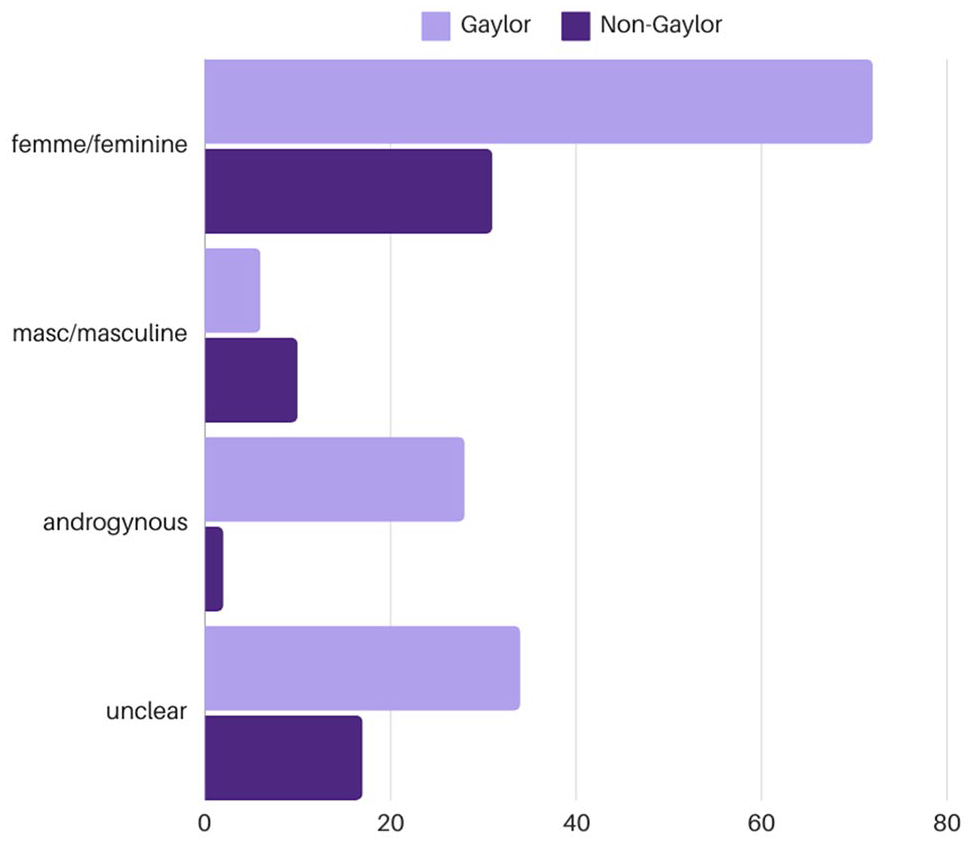
Chart showing gender presentation of creators. Own work.
I also coded for sexual orientation when explicitly stated, either in the video itself or the creator’s bio. Explicitly LGBQ + creators largely created Gaylor content. In addition to being feminized, Gaylor is unsurprisingly an explicitly queer phenomenon (Figure 2).

Chart showing sexual orientation of creators. Own work.
Gaylor is also a White phenomenon, with 15 out of 71 visible 8 Gaylor creators (21.1%) and eight out of 31 visible non-Gaylor creators (25%) appearing or stating explicitly that they are non-White. Yet, even in a relatively limited sample of 200 videos, it is clear that creators of color on TikTok are contributing to discussions around Gaylor and participating in the production of Gaylor fan knowledges. Furthermore, these numbers may not necessarily reflect the demographics of Gaylor as a whole—Black and Indigenous content creators are disproportionately targeted by TikTok’s biased content moderation filters, having their videos and accounts removed and banned much more frequently than their White counterparts (Haimson et al., 2021; Harris et al., 2023).
One video in the dataset features a masculine presenting bisexual creator of color defending his position as a Hetlor. Like many other Swifties, he feels that “There are times when I’m listening to one of her songs and it feels like it was written for me.” Despite this feeling, he derides parasociality, maintaining that he “just enjoys the music.” This creator’s identification with Swift’s music, however, illustrates that her star text, steeped as it is in whiteness, is not only for White women. Framing Swiftie fandom as a White phenomenon obscures the contributions fans of color make to Swiftie knowledge production (Dosekun, 2024).
Epistemic and Moral Boundary Work
This article explores how boundary work functions in feminized CCT knowledge cultures, introducing and exploring the notion of informal boundary work. Informal boundary work takes place in non-institutional sites—it consists of a variety of discursive activities designed to epistemically differentiate between legitimate and illegitimate knowledge production, making normative commitments in the process. Informal boundary work is a way for participants in conspiracy culture to differentiate themselves from the broader milieu of differing interpretations and oppositional readings of a given text. As a practice in fostering legitimacy, boundary work in conspiracy contexts can mirror mainstream knowledge cultures, most frequently academic knowledge cultures (Eadon, 2022; Jane & Fleming, 2014; Wood, 2017).
Epistemic boundary work is a central aspect of knowledge production—it is the primary way for scientists to construct the authority of science by publicly contrasting it favorably to nonscience (Gieryn, 1983). Boundary work is a way for a given knowledge culture to differentiate between legitimate and illegitimate questions and areas of inquiry. A kind of classificatory activity, boundary work involves grouping similar objects and ideas together, and differentiating between nonsimilar objects and ideas (Brekhus, 2015, p. 60). Maintaining and enforcing such boundaries often involves “representations of purity and contamination,” which also “. . . provide moral meaning to social objects” (Brekhus, 2015, p. 75). Boundary work is thus predicated on moral as well as epistemic normative commitments.
Vuolanto and Kolehmainen show that the boundary work done in the Finnish skepticism movement perpetuates gendered structures of power in a variety of ways. In their science-focused boundary work, skeptics and debunkers often treat the university environment as neutral, when it frequently functions as an instrument of oppression for marginalized groups. Vocal skeptics prize hegemonic masculinity—women, femmes, and nonbinary people are framed as more gullible and susceptible to pseudoscientific claims associated with astrology, homeopathy, and alternative medicine (Vuolanto & Kolehmainen, 2021, pp. 798–799). This work has significant implications for feminized sites of CCT knowledge production. As Coccia also discusses, science and objectivity are often coded as masculine, where and nonscience and subjectivity are often coded as feminine. As they are dismissed as being irrational and “too close,” informal knowledge cultures spring up and perform their own (informal) boundary work. The tension between the dismissers and the dismissed, and the negotiation of norms and values that takes place through boundary work, is integral to the knowledge that is produced (Jane & Fleming, 2014, 131).
Gaylors constantly set informal epistemic and moral boundaries. Gaylors dismiss Hetlors because of their straightness, their association with the mainstream, their immorality (manifesting as homophobia), and their uncreative epistemic approach to Swift’s work, which takes it at face value rather than engaging with it in depth.
In an angry video about Lavender-Haze-Gate, one creator said, “I don’t care what you think Taylor Swift’s sexuality is, at the end of the day, none of us know, only she knows. That doesn’t mean we can ignore her historically queer flagging. If you’re straight and angry about that, whether you know it or not . . . [that] is homophobia.” By both referencing “historically queer flagging” and accusing Hetlors of homophobia, this creator creates and enforces epistemic and moral boundaries.
In summarizing their too-close reading of the reputation prologue (particularly the line, “we think we know someone, but the truth is that we only know the version of them that they have chosen to show us”), one Gaylor aggressively offers to “. . . translate for those of you who lack critical thinking skills.” Another called Swift’s music “boring and petulant” when read without a queer lens. Yet another defined the epistemic boundary between mainstream Swifties and Gaylors by highlighting aspects of play and entertainment: “Even if this is nonsense and she’s straight, being a Gaylor is more fun because, damn, straight people are enjoying the ninth song about her and Joe fleeing paparrazi . . . Gaylors analyze media and discuss the hero’s journey. Our team is much better.” Highlighting the joy of oppositional readings and the knowledge they produce, this creator emphasizes the pleasures of queer utopian potentialities in practice.
Moral normative commitments are also prevalent. At least one creator called Gaylor a “movement,” giving it the positive moral valence of social movements and political resistance. Another creator said, “I don’t know anything but I know that I did not unlearn years of internalized homophobia to be told by straight, 14 year-old swifties that I’m creepy or invasive for assuming that [Swift] is queer.” Many of these creators acknowledge that assigning creepiness or weirdness to queer people is dangerous due to history and the link between othering and violence.
Gaylors dispute Hetlors’ evidentiary practices to counter Hetlor claims that Gaylors are too close to Swift’s star text (Coccia, 2022). One Gaylor contrasted the robust history of “lavender” within the queer community to the comparatively recent genesis of the phrase “lavender haze,” claiming that the former has “literally hundreds of primary and secondary sources” and the latter has “one urban dictionary entry from the 2000s that quotes a TV show made in 2007.” By contrasting oldness with newness, this creator draws epistemic boundaries between types of evidence. Other Gaylor creators used archival documents to directly support their claims. One examined an article on gay symbols in a digitized 1985 issue of Sappho Speaks: The Lesbian and Gay Quarterly Journal of UCSD, cataloging which symbols Swift has used. Quoting from the article, the creator discusses queer meanings of purple and lavender, analyzing purple as a symbol of liminality in queer witchcraft. This creator delights in such trace evidence, using imagination and queer expertise to move from symbol to color to song lyric.
Hetlors also set epistemic and moral boundaries with Gaylors, portraying themselves as rational and respectful and Gaylors as irrational and invasive. One Hetlor praised Swift for “posting an Instagram reel about her REAL six year relationship” and “rightfully calling Gaylors weird.” This focus on the real establishes Hetlor epistemology as the opposite of queer utopianism in its heteronormative commitments to stable, present ontology. This parallels Vuolanto and Kolehmainen’s (2021) findings that skeptics set objective “reality” as a moral and epistemic boundary. Another Hetlor compared Gaylor to 2010s Tumblr Sherlock and Supernatural fan theories, at once implying this was embarrassing and engaging in fan vernacular by saying “you are all going to turbo hell just like Cass.” The implications of telling queer fans they are going to hell are obvious.
Folk Literary Criticism
Just as Jane and Fleming suggest that conspiracy theorizing, broadly conceived, can be considered a kind of folk sociology, I argue that Gaylors produce folk literary criticism when they engage in too-close reading. Some creators summarize queer readings of songs that figure prominently in Gaylor lore—one of evermore’s bonus tracks, “right where you left me,” is a popular example. The song, about a woman who can’t let go of a past relationship even after her ex-lover has moved on, appears to reference both Stonewall (“I swear you could hear a hair pin drop”) and the Jewish wedding tradition of breaking glass (“glass shattered on the white cloth”). Many Gaylors interpret the latter to be a reference to Karlie Kloss’s wedding to Josh Kushner. Two other famously queer songs off Swift’s 2017 album reputation, “Dancing With our Hands Tied,” and “Dress,” are about relationships that must be kept secret. The former, with lyrics like “I loved you in secret,” and “loved you in spite of/ deep fears that the world would divide us” seems to describe a relationship whose integrity is threatened by being revealed to the public. “Dress,” contains lyrics like “Our secret moments in your crowded room/ They got no idea about me and you . . .” and “I don’t want you like a best friend,” 9 which appear to express sexual desire, pining, and not being able to show affection in public.
Gaylors often go beyond these initial lyrical readings to triangulate between songs and events in Swift’s life. A lyric in “Dancing with our Hands Tied” (“deep blue but you painted me golden”) melds well with another in “Dress,” referencing a “golden tattoo.” Kloss and Swift were photographed attending a party in 2016 with matching golden temporary tattoos, which many Gaylors think this lyric describes. Another song that could be interpreted to be about Kloss, “gold rush,” refers to the color again. Kloss’s association with the color gold is one of many cornerstones of Gaylor lore.
Another example of this kind of lore-informed literary criticism comes in a single TikTok, which analyzes the Lover song “It’s Nice to Have a Friend.” The creator opens the video by stating that it is “just for my queer Swifties,” establishing their audience as one with lived queer expertise. They then go on to state that many of the songs Gaylors find to be the most sapphic contain aspects of plausible deniability, but that the queerness of “It’s Nice to Have a Friend” is almost undeniable, that it “. . . can only be about a childhood and teenage and later adulthood romance between two girls.” Focusing on two phrases that appear in the song’s lyrics, “sleeping in tents,” and “no curfew,” the creator asserts that, with Swift’s conservative religious upbringing, “there is simply no way she was allowed to share a tent or have no curfew with a boy.” In such a way, this creator takes historical context into account by highlighting the restrictive gender rules that would have made a secret sapphic relationship possible in Swift’s childhood. This too-close reading looks to the past of Swift’s childhood to scaffold the queer potentialities in Swift’s star text. The video ends with the creator asserting “this isn’t subtext. It’s text,” insisting as they do on the authority of trace evidence.
Deciphering Clues: Theorizing the Doomsday Coming Out
Swift’s easter-egg fan communication style means that much Swiftie knowledge production relies on codebreaking and clue-finding. One creator argued that: . . . if you’re someone who pays attention to [Swift’s] lyrics and her easter eggs and her life history, and you’re still saying that all of the things that gaylors are pointing out are coincidences, like, how many coincidences need to occur? She taught us better than that . . . Your initiation into being a Swiftie is looking into the lyrics and the clues and easter eggs that she gives you about her real life, for you to join the dots.
Furthermore, Swift has a habit of releasing albums on significant dates and using coded countdowns to indicate release dates for albums, merchandise, and tour tickets. Gaylors often point to what she released on significant dates, including the releases of the “ME!” music video on April 26, 2019 (Lesbian Visibility Day), folklore on the four-year anniversary of Karlie Kloss and Josh Kushner’s engagement, and Fearless: Taylor’s Version on April 9, 2023 (the Day of Silence). In fact, one creator posited that Fearless: Taylor’s Version would be a coming-out album, because, in part, of the release date. Such discussions of closeting and coming out abound in the Gaylor community. While some Gaylors unpack and interpret closeting imagery in Swift’s star text, many others discuss her supposed closeting as a nonissue within the queer community; arguing that she has “already come out” to queer fans through the gay sensibility in her style, lyrics, public statements, and persona.
The queer utopianism of Gaylor lore is enmeshed in both the future and the past. Many Gaylors point to specific times and places in which they think Swift was supposed to come out, but had her plans foiled by mitigating circumstances. Rumors have circulated for years that Swift was supposed to come out during Pride in 2019, at the Stonewall Inn, and had commissioned a rainbow dress from Christian Siriano to do so. According to Gaylor lore, right before she was supposed to come out, she found out about Scooter Braun’s acquisition of her masters and backed out. 10 Siriano all but confirmed these rumors in a reaction TikTok in which he sipped tea next to the rainbow dress—heavily implying that they were true, without saying anything explicit. Gaylor creators on TikTok use this example frequently to argue Swift was supposed to come out during this, her Lover era, which is replete with rainbow imagery. One creator also argued that Miss Americana was also supposed to be a coming out documentary: “she was going to come out, and that is a hill I will die on.”
With each upcoming album, speculation swirls among Gaylors that this will finally be her “coming out album.” Many Gaylors interpreted Swift’s first promotional image for Midnights, the second in a two-image carousel on Instagram (after the album cover) as an indication that she would come out on the album (Figure 3). One creator stated that she was not convinced that Swift would come out on Midnights until she saw this image—mentions of a “fateful life-altering mistake,” facing demons, and meeting yourself, as well as the overall tone of anguish, seemed to refer to the pain of being in the closet and the anxiety and potential freedom of coming out. Gaylors would have over a month to speculate and pick apart this post before Swift announced the track list and soon after posted the infamous Lavender Haze reel.
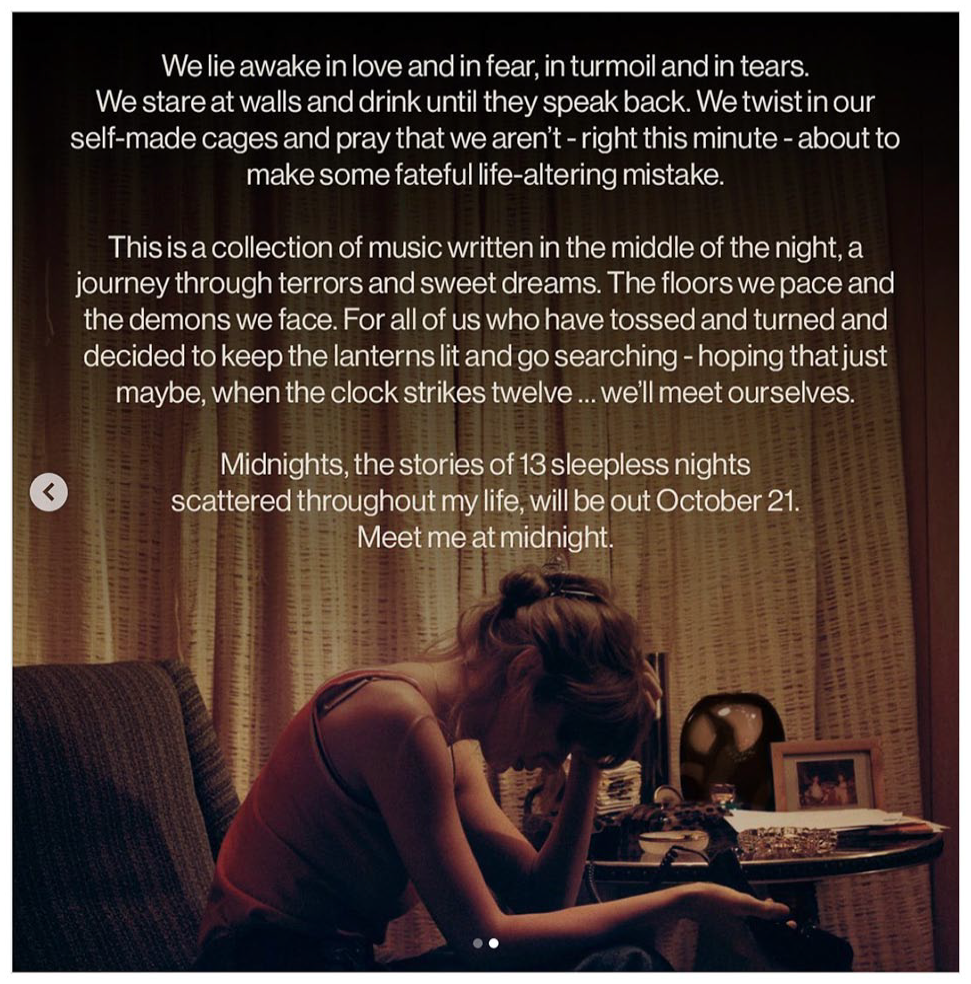
Promotional image for midnights from Swift’s Instagram. (Swift, 2022).
Even after the Lavender Haze reel controversy, some Gaylors continued to assert that Midnights would be Swift’s coming out album. One creator discussed Swift’s coming out on Midnights as a kind of strategic inevitability—coming out on the album would allow Swift to make subsequent re-releases gay, as they were originally written. Another creator refused to believe that the Lavender Haze reel meant that Midnights wouldn’t be a coming out album. The video, titled (with the text on screen) “Breaking down taylor’s TRUTH: part 1—the importance in letting the evil think they won” involved informal moral boundary work by establishing Hetlors as evil and Gaylors as good. Like many Swifties, this creator asserted that everything Swift does is orchestrated: “Why does she let hateful people think they’re right? When pursuing a goal, letting the evil think they’ve won is crucial before you pull the rug out from under them.”
Of course, Midnights was not a coming out album. Like her past work, lyrics from many of the songs (“Maroon”; “Lavender Haze”), and visuals from music videos (“Bejeweled”) can be interpreted through a queer lens. For Muñoz, queer utopias are almost always disappointed in that they do not come to fruition. Yet, “They are nonetheless indispensable to the act of imagining transformation” (Muñoz, 2009, 9). Continuing to imagine Swift coming out on each subsequent album, decoding and delving into various easter eggs and signals, extends queer potentialities.
Gaylors continue to engage in a type of queer utopianism that I am calling the doomsday coming-out, in which the date of the Swift’s purported coming out is pushed back and pushed back, not unlike the date of the apocalypse in a doomsday cult. Seemingly annually in April, some Gaylors will speculate that Swift will come out on Lesbian Visibility Day. Album covers and other visual clues are also analyzed for coming-out clues. Ahead of the release of 1989: Taylor’s Version in October 2023, Gaylors analyzed the album cover in-depth. One creator 11 conducted an in-depth comparative analysis of the original album cover (Figure 4) and the new album cover (Figure 5). The creator discusses how free Swift looks on the new cover, smiling and with her hair blowing in the wind, as opposed to her hunched-over posture and unsmiling face in the original album cover. She also discusses how the “lesbian seagulls” 12 have been released from Swift’s shirt and are now encircling Swift, contributing to the imagery of freedom. Concluding, the creator states: “I’m sorry but it’s giving coming out. We’re starting a new era. We’re actually gonna tell people our true self . . . these seagulls, these birds are coming out of their cage, they’re coming off of the shirt.”

Original 1989 album cover (Swift, 2014).

1989: Taylor’s Version album cover (Swift, 2023b).
Swift’s re-release of 1989 turned out to be a disappointment for Gaylors due to the aforementioned prologue that appeared to call them out. For Muñoz, “. . . utopia is not about simply achieving happiness of freedom; utopia is in fact a casting of a picture of potentiality and possibility. This casting or imagining is also an act of negation. What is negated is the present in lieu of another time or place. Thus, utopia has a positive valence, that of a projection forward, and a negative function, which is the work of critique” (Muñoz, 2009, p. 125). The potentialities wrapped up in Swift’s doomsday coming out are themselves unknowable, but what would the global effects of arguably the world’s biggest pop star coming out as queer? Her stratospheric popularity around the world is undeniable—as she kicked the worldwide leg of the Eras tour off in Argentina, for example, only 200,000 fans were able to see her at El Monumental, the country’s largest soccer arena. Another 2.8 million Argentinians, enough to fill the venue 40 times, were on the waiting list (Nicas, 2023). Furthermore, Swift’s popularity across Southeast Asia is undeniable—she dwarfs all other international competition and is the top-streamed artist in countries like Malaysia, the Philippines, and Singapore (Fernando, n.d.). Like Gaylor at large, the community’s queer utopianism is not monolithic—its power derives from potentiality. The queer utopian potentiality of Swift’s doomsday coming out lies in the effects it could have in places where her music is both hugely popular and it remains unsafe to be publicly queer—from Malaysia to the United Arab Emirates to hyper-religious, conservative regions in the United States. Gaylors look to the past, the present, and the future for Swift’s coming out story, which both languishes and frolics in the realm of the possible but unknown. They negate Swift’s straight present, and the straight present of Hetlorism, in favor of a multiplicity of queer futures in which Swift is publicly out.
Conclusion
Gaylor specifically and CCTs broadly represent a significant convergence between conspiracy culture and queer fan cultures. The existence of CCTs underlines the importance of the particularist approach to studying conspiracy theories, as well as the necessity of examining them through the lens of gender and sexuality. Furthermore, celebrities’ negotiations of the boundaries between public and private, authentic and performative, create the ideal circumstances for conspiracy theorizing—their true selves are ultimately unknowable to the public. Knowledge production within the Gaylor community is propelled forward by reflecting on individual identity, building community, and pushing back against heterosexist consensus through myriad knowledge production activities like informal boundary work and folk literary criticism. I have argued in this article that Gaylor specifically and CCTs broadly represent feminized areas of conspiracy theory.
TikTok is particularly hospitable not only for conspiracy theory knowledge cultures, but for queer knowledge cultures (Duguay, 2023; Grandinetti & Bruinsma, 2023). While its restrictive and often biased content moderation policies are frequently challenging for queer users and users of color, communities are still able to operationalize the platform’s affordances and algorithmic tailoring to cohere and co-create knowledges. The platform’s affordances allow for complex discursive practices including in-depth analysis of images (using the greenscreen effect, for example) sound (using the TikTok sound feature), and other creators’ videos (using the “stitch” feature). Everyday TikTok creators themselves play with notions of authenticity and intimacy, just as celebrities do. Making videos from their living rooms, cars, and beds, these creators invite intimacy just as they engage in participatory knowledge production—not unlike Swift herself.
Future research in this area could go in a variety of directions: outlining and investigating other CCTs, exploring Gaylor across a variety of platforms (Reddit, Tumblr, etc.), and examining the phenomenon in more depth regarding race: how White is Gaylor, really, and are Gaylors of color welcomed into these knowledge production spaces on different platforms? How do Gaylors of color engage with the Gaylor community and participate in conceiving of queer futurities through Swift’s imagined queerness? Is the queer utopianism of Gaylor merely reproducing the “crypto-universal white gay subject” or is there more depth and variety to Gaylor utopianism? The same question could be asked about CCTs more broadly. With this new particularist concept, we can begin to understand the functionality of conspiracy theories within a variety of ideological contexts and community environments.
Footnotes
Acknowledgements
The author thanks Casey Miller for her contributions to the data collection of this study, and the anonymous reviewers for their generous and constructive feedback on earlier drafts of this manuscript.
Declaration of Conflicting Interests
The author(s) declared no potential conflicts of interest with respect to the research, authorship, and/or publication of this article.
Funding
The author(s) received no financial support for the research, authorship, and/or publication of this article.
