



Abstract
People who lead anti-authoritarian digitally enabled movements face a leadership visibility dilemma—a necessity to balance security with publicity while mobilizing followers. The article asks how the reliance on instant messaging platforms (IMPs) to coordinate protest internally shapes the response to this dilemma revealed through internal movement organizing analysis. Our case study is social media protest mobilization by Alexei Navalny’s movement in Russia in 2017. We rely on semi-structured interviews and thematic analysis of communication on Telegram during this mobilization. We offer a theory of leadership in an IMP-organized anti-authoritarian movement. It suggests that the use of messaging platforms during social media protest mobilization enhances capacities for visibility management and polycentricity in such movements. It also fosters the emergence of a specific type of protest movement leader—or shadow anti-authoritarian leadership—that is collective, polycentric, and concealed.
Introduction
Proliferation of messaging platforms changes the nature of leadership in digitally enabled protest movements. Research on leadership in such movements is abundant, especially when it comes to democracies (e.g., Gerbaudo, 2017; Kavada, 2015; Treré, 2020). However, relatively little is known about how leaders of these movements function under authoritarian repression, and how internal movement processes are affected by the increasing reliance of leaders on instant messaging platforms (IMPs), such as WhatsApp and Telegram. IMPs may be even more important in authoritarian settings as tools for evading state surveillance. Authoritarian states co-opted internet affordances to monitor dissidents’ movements and intercept their electronic communication (Pearce, 2015). IMPs can help movement leaders to evade this monitoring through Telegram encryption and other features. Consequently, increasingly larger portions of movement internal communication happen behind the doors of private spaces on IMPs. However, it is harder to collect data on this internal communication channeled through IMPs (Karpf, 2019), especially in authoritarian settings.
Several conceptualizations of digitally enabled movement leadership in repressive political systems have emerged. Most of them focus on “anti-authoritarian movements” (Tufekci, 2017) in the countries that experienced uprisings at the beginning of the 2010s, such as Egypt, and before such movements embraced IMPs widely in addition to social media like Facebook or Twitter (Azer et al., 2019; Pearce et al., 2018; Poell et al., 2016). It is essential to update our understanding of anti-authoritarian leadership because dictatorships have dramatically increased their repressive capacities by adapting newer surveillance techniques since the days of the Arab Spring. At the same time, little research into leadership in repressive settings was completed with a focus on how IMPs aid activists. Although several authors recently offered an argument about the role of IMPs in digital activists’ information infrastructures, they are primarily focused on democratic contexts (Gil de Zúñiga et al., 2019; Valeriani & Vaccari, 2018). These authors concluded that IMPs are a popular but heavily under-researched type of platform where digitally enabled movement leadership is highly active. That is why we propose a theory of leadership in an IMP-reliant anti-authoritarian movement.
Digitally enabled protest movements that are acting in authoritarian political systems meet common challenges. One of the key challenges is linked to the visibility and security of their leaders. To prevent the spread of protest activities, many authoritarian governments target opposition protest movement leaders before mobilization occurs, thus adopting “preemptive policy” (Silitski, 2005). Preemptive policy targets leaders to remove key opposition personalities from the political arena, hence making their organizations less effective. The policy also sends a signal to the public introducing chilling effects and decreasing mobilization potential. In countries like Russia, preemptive policy means that leaders can be detained, prosecuted, jailed, and, in a few cases, even lose their lives (Kara-Murza, 2017).
Those leaders who are public and visible are often the first targets. For example, Alexei Navalny, a leader of two possibly most prominent recent anti-authoritarian movements in Russia, spent some 60 days in jail in total during the most contentious stages of collective action organizing in 2017. Volkov, chief-of-staff of his campaigns, spent 65 days in jail the same year. Most of these detentions coincided with the periods around collective action that their movement had organized. Hence, potential leaders of anti-authoritarian movements face the challenge that Melucci (1996, p. 335) describes as “the risk to pay high costs for their commitment,” which is a consequence of leaders’ status as the “agents of mobilization” and “the promoters of organizational structure.” Because of these costs, Melucci (1996, p. 335) argues, “leadership is a rare commodity.”
A movement can address the challenge of preemptive repression by creating a pool of potential leaders who may constitute multiple, often temporally, centers of influence, thus making the movement more “polycentric” (Gerlach, 2001). “For every [. . .] leader eliminated, new ones arise, making movements look like the many-headed Hydra of mythology” (Gerlach, 2001, p. 303). Gerlach, who coined the term, also argued that the polycentric model of organizing could make the efforts of the government to persecute leaders less effective.
Polycentricity is a common property of movements facing repression that enables multiplied and networked leadership, making it harder for authoritarian governments to track and detain leaders (Gerlach & Hine, 1970, p. 66). However, polycentricity creates a leadership visibility dilemma: it makes movement leadership more obscure and less recognizable. This, the literature argues, makes it harder for leaders to perform classic leadership functions of connecting followers and organizing them for ongoing and effective public campaigning (Gerlach, 2001, p. 292; Melucci, 1996, pp. 339–340; Staggenborg, 1988, p. 187).
Consequently, anti-authoritarian movements face a deep dilemma of leadership visibility: these movements need public leaders to connect and organize followers; but the more prominent leaders become, the more difficult it is to ensure leaders’ freedom and reduce a cost they pay for their position and prominence (Gerlach & Hine, 1970; Lokot, 2018; Tufekci, 2017). More visible leaders can be identified and prosecuted in accordance with preemptive policy easier. Still, only a few scholars (Lokot, 2018; Pearce et al., 2018; Tufekci, 2017) are among a few notable exceptions) examined how exactly the risk of being a leader shapes the visibility and organizing aspects of leadership in digitally enabled anti-authoritarian movements.
Our study builds on previous—including historical—work on the use of media in such movements to provide a thick descriptive account of how the leaders of anti-authoritarian movements that face preemptive repression address the leadership visibility dilemma. We rely on a unique dataset consisting of semi-structured interviews and content shared on Telegram during collective protest action organized by the Navalny movement in Russia in 2017, then, one of the most repressive regimes (international watchdogs like Freedom House (2017) placed Russia among countries with the most restrictive political and media systems). We use thematic analysis to examine how anti-authoritarian digitally enabled movements address the leadership visibility dilemma.
Our study names and describes a specific form of movement leaders—shadow anti-authoritarian leadership. We understand shadow leadership as a form of taking a lead that is enacted on IMPs and represented by concealed, collective, and polycentric users, commonly with administrative privileges, who are focused on the tasks of mobilization and collective action maintenance in an anti-authoritarian movement. They are concealed because these activists are pseudonymous and anonymous. Shadow leaders are collective because, in contrast to examples of similar stealth leadership discussed by Freeman (1972) or recently by Poell et al. (2016) and Western (2014), they coexist with other, more public denominations of leadership. However, if the most public leaders of an anti-authoritarian movement represent the organization, build structures, and inspire people, shadow leaders instead focus on collective action. In addition, these leaders need to cooperate with public leaders and between themselves, performing this leadership collectively. Finally, shadow leaders are polycentric because they form a network of multiple, often temporal centers of influence.
We argue that the adoption of shadow leadership arises due to the preemptive repression of public leaders and enhances the polycentric and visibility management capacities of anti-authoritarian movements. This explains why this form of leadership is different from other commonly debated forms in digitally enabled movements, such as connective leadership and choreographic leadership. We demonstrate the differences in the “Discussion” section.
Leadership in Digitally Enabled Movements
The literature on internal organizing in digitally enabled movements increasingly links leaders to a new type of actors who were not present in movements that emerged before the 2000s. These are the administrators of social media platform accounts maintained by movements (Kavada, 2015; Poell et al., 2016). Gerbaudo (2017) observes that these individuals often unite in the “digital vanguard” teams of account administrators and prominent users. Digital vanguards try to integrate techno-libertarian principles in their activity and thus avoid “fixed and formalized roles” emphasizing instead “cooperation and team-work.”
Poell et al. (2016, pp. 994–997) define these administrators as key “connective leaders” who “centrally position themselves in social media-facilitated networks [. . .] to connect users in online communication streams.” These people take the lead through “inviting, connecting, steering, and stimulating, rather than directing, commanding, and proclaiming.” Connective leadership is rooted in the theories of connective action activism (Bennett et al., 2014). Comparing digitally enabled protest organizations to the social movements of the past, Azer et al. (2019) argue that leadership in digitally mediated organizations is collective rather than individualistic, emergent rather than appointed or voted, and acts more like mediators rather than decision-makers who impose their authorities over followers. Thus, there is a strong argument in the literature that leadership is still vital to protest movement communication though there is no agreement on its attributes. In addition, despite being often mentioned as an important attribute of leaders in digitally enabled movements, polycentricity remains a relatively obscure property in recent models of such organizations.
What remains especially underexplored is leadership in movements that rely on IMPs to foster protest mobilization. Most recent studies of IMPs are quite descriptive, which is perhaps expected for the emerging discussion about newer forms of technologies. These studies show that messaging services facilitate citizens’ engagement in political discussions, the emergence of unofficial leadership and factions in parliamentary political parties (Herasimenka & Kavada, 2020), and reduce digital self-censorship (Valeriani & Vaccari, 2018). IMPs’ use also affects “activist forms of participation” (Gil de Zúñiga et al., 2019). They are “used as a robust organizational device, and it is now firmly integrated into the mechanisms of [. . .] movements” (Treré, 2020). One of few publications on the IMP use in non-democracies showed that they provide space to defy state efforts to suppress political speech and become a source of “popular, mainstream activism and public mobilisation” (Johns, 2020). Consequently, it is unclear whether IMPs afford different forms of activist leadership under authoritarianism.
The study explores the case of social media protest mobilization in Russia that was linked to the activity of the movement of Alexei Navalny and seeks to answer the following question: How do IMP features and affordances facilitate leading the internal organizing in an anti-authoritarian movement during digitally enabled collective action? The following pages present the background of Navalny’s movement and political activism in Russia, discuss the methodology, present findings, and link them to a broader literature on leadership in digitally enabled movements.
Russian Authoritarianism and Protests
Russian preemptive authoritarianism strictly controls the activities of political and civic groups. A common restriction on political activism is the limitation on freedom of assembly. In Russia, there is no official ban on political rallies. However, the restrictions on the assemblies are numerous. According to Russian law, organizers of demonstrations, rallies, or other public assemblies must obtain authorization from local authorities (On assemblies, meetings, demonstrations, marches and pickets, 2004). If this authorization is not obtained, the police can use force to prevent people from gathering, leaders from public speaking, and detain participants. As recently as 2017, thousands of people were arrested and tried there for participation in protests and similar political activity (Amnesty International, 2017). It is also difficult to inform about protests. It is forbidden to post information about demonstrations and other types of collective action without authorization. Distribution of information on social media about unsanctioned protests might, therefore, lead to persecution. Consequently, people who participate in political activism routinely become subjects of administrative or criminal persecution that sometimes leads to prison terms (U.S. Department of State, 2019). With the start of the war in Ukraine in 2022, this hostile political environment has only become more difficult to navigate for political activists, though not impossible, as protest mobilizations are still happening in Russia.
The Navalny Movement in 2017
Alexei Navalny is a dissident who is often considered as the main figure in the pro-democracy political opposition in Russia. In 2011–2012, he was one of the leaders of the “For Fair Elections” pro-democracy movement that was inspired, followed, and organized mainly through the internet (Toepfl, 2017). Around the same time, Navalny established an anti-corruption organization FBK, which focused on investigations into prominent Russian officials, combining journalism with political messages. Navalny’s anti-corruption activism and his prominence in pro-democracy opposition made him an important figure in Russian politics. In 2017, the FBK launched a series of anti-corruption campaigns demanding the resignation of high-profile officials, as well as registering Navalny as a candidate in the 2018 presidential election. During this period, the FBK and pro-Navalny activists created an organization that contributed to five waves of anti-corruption and pro-democracy protests between March 2017 and the presidential election in March 2018. These protests involved up to 154 cities (Meduza, 2017a). The media described the Navalny organization at-large as being led by a charismatic all-controlling leader. In December 2017, the authorities refused to register Navalny as a candidate, but his organization continued “campaigning on regional political” issues. 1
Initially, the Navalny organization was run from Moscow by a tiny group of individuals related to the FBK. We refer to them as the core activists or the federal office. Since 2016, the core activists have gradually built a vast network of local offices to campaign in provinces. By the second half of 2017, the Navalny movement had established 70 local offices in almost all the federal regions of Russia. In each office, there were a few paid staffers and dozens or hundreds of volunteers. 2 This movement was ideologically diverse and united people sharing common opposition to the authorities (Dollbaum et al., 2022). Approaching the restriction on political activism in Russia, the Navalny organization turned to digital platforms. It created and inhabited hundreds of social media spaces to connect pro-democracy minded citizens. This digital communication infrastructure ranged from the alternative television on YouTube to the hundreds of local pages and groups on VK and Telegram.
Telegram
Similar to WhatsApp, Telegram is a messaging platform with 500 million users (Durov’s Channel, 2021). According to the App Annie ranking, it was the number one application in the Android store in Russia. Telegram has three modes of interaction. First, one-to-one messages and calls are not significantly different from the functionality of WhatsApp or Signal. Second, many users interact with each other by using groups (also known as chats). Unlike WhatsApp, Telegram had a feature that allowed adding up to 5,000 users in a group in 2017. Such groups could be both public and private. Groups look like the 1990s-style internet chats, where the administrators are just one voice among many others. A key difference between an administrator and an ordinary user of a Telegram group is that the former can block, add or remove a user.
Third, public channels turn Telegram into social media as they function similarly to a page on Facebook. However, Telegram’s interface is fairly simple and did not contain any like buttons or a comment section during the studied period. On Telegram channels, anonymous users establish their venues to share information with anonymous subscribers. This default anonymity feature was a mechanism later explored by the leaders of the Navalny movement. Hence, Telegram can be described as an app that affords one-to-one messages, group messages with your friends or family, but also has very large group “chats” with unknown others, as well as one-to-many channels where one could get information about sports, news, and politics.
The Telegram company has mastered an image of as a highly secure platform. They claimed that the most sensitive users’ data could not be accessed even if the authorities confiscated the Telegram servers (Maréchal, 2018). However, security experts suggested that its encryption protocol had vulnerabilities that the authorities could exploit (Lee et al., 2017). Moreover, the full encryption of content on Telegram is only possible on “secrete chats,” something that users enable relatively rarely (Maréchal, 2018). As we studied public groups and channels, the content we analyzed was not encrypted to the same standard as on some other IMPs. Hence, we did not consider encryption in this work.
Methods
We adopted a case study approach as the research design. An analysis of semi-structured interviews and Telegram posts informed a detailed case study of the backstage interactions in the Navalny organization during social media mobilization. In particular, the analysis is based on the 16 interviews with the leaders of the Navalny organization, rank-and-file and independent activists who were involved in the organization, as well as digital security experts. See Appendix A for a list of the interviewees and details on how they were conducted. The interviewees were selected because of their direct knowledge of the social media operations of the organization and collective action coordination. The sample includes activists from the Navalny organization located in six provinces in central, northern, and eastern Russia: Chelyabinsk, Moscow, Nizhniy Novgorod, Rostov-on-Don, St Petersburg, and Ufa. The interviews lasted from 21 to 110 min; all the interviewees gave their consent. The author analyzed the transcripts thematically, focusing on the themes of leadership (Appendix E). The interviews helped to clarify the use of digital platforms by activists, their perception of platform features and affordances, as well as organizational and leadership structures of the Navalny movement. See Appendix B for indicative interview questions.
A qualitative content study of Telegram content in the form of thematic analysis (Altheide & Schneider, 2013; Braun et al., 2016) complements data from the interviews. We focused thematic analysis on interactions during the critical juncture of the campaign—a period that preceded and followed large protest mobilization on 7 October 2017. This wave of protest took place in 80 cities, with at least 321 participants detained (Meduza, 2017b). To collect data for thematic analysis, we followed 13 public Telegram venues—groups and channels—created by the Navalny organization in the studied provinces (working chats and main channels, see Appendix D). Our fieldwork in Russia informed the choice of these venues. The Navalny organization advertised the links to VK venues, across their Telegram network, and other public spaces. Anyone could join and follow them without restrictions. Hence, any user could become a rank-and-file follower—participate in discussions or even contribute to movement task lists, such as leaflets dissemination without any formal involvement with the organization. Supporters could also join the movement more formally as volunteers, who would be encouraged to join the Telegram network. According to the organization's website, by December 2017, 706,000 “supported” Navalny; 200,000 of them joined as volunteers. We informed the coordinators of the organization’s offices about our intention to read the content of the venues before we started data collection.
The resulting sample includes Telegram content—posts and documents—that appeared in the groups and channels between 00:00, October 6, 2017 and 23:59, October 8, 2017, which amounted to 5,128 posts collected in November 2017 (Appendix C). The analyzed content contained texts, images, and videos shared from official Navalny organization accounts (normally in channels) and by ordinary users (only in groups). We focused on text, while images and videos provided supplementary data that helped us learn about the events’ background. Many posts in the sample contained one or several words. We did not collect data on number of group participants.
During the fieldwork in 2017, interacting on IMPs during collective action was a little-known or poorly understood phenomenon; thus, we chose an inductive, exploratory approach to data analysis, as recommended (Guest et al., 2012). The aim of this analysis was to capture broad-based narratives and meanings associated with mediated coordination of the 7 October collective action. Combined with the interview data on the backstage practices of the use of digital platforms by activists, thematic analysis helped to analyze the practices of the users who “take the lead,” their visibility during social media protest mobilization and interactions with followers. The author undertook a close reading of the collected data adapting the protocol of Braun et al. (2016) for thematic analysis. Considering the size of the sample, we analyzed materials “based on emerging understanding of the topic under investigation” (Altheide & Schneider, 2013, p. 56). See Appendix E for details on the Telegram data analysis.
Results
We structure the presentation based on the key properties of shadow leadership that emerged from the rounds of thematic coding: collective, polycentric, and concealed.
Polycentric
To coordinate day-to-day activities and collective action, the activists created a polycentric network (Gerlach, 2001) of many cells—Telegram venues—integrated through the platform’s networking and sharing features. This IMP network facilitated the emergence of activists who could assume the role of shadow leaders during protest mobilization. We can trace how the organization connected its numerous venues in a network through hyperlinks and shared content. The links to join the venues were actively advertised on the movement’s social media. The federal-level channels reshared content from regional cells—local office channels (Appendix D). Other local cells then disseminated this content further across channels and groups in provinces, thus exposing followers in different localities to movement issues and news from across the country. However, content shared across the network during collective action periods and before or after them differed. The collective action content often focused on protest coordination, police action, risks, and security (see examples below). Content beyond collective action days included resource mobilization posts, information materials, criticism of the government, general political analysis, information about Navalny’s actions, political memes, videos, invitations to contribute to door-to-door agitation, small street actions, election monitoring training, and other activities.
In the interviews, Navalny activists discussed Telegram as an organizational base that allowed them to articulate tasks and coordinate the movement by relying on affordances for content sharing. Prominent figures of the federal office supervised the content published on Telegram by local activists. That was how Konstantin Shirokov (personal communication, 2017), the social media coordinator of the Navalny organization, described the supervision of the Telegram and other similar networks: All the pages of the local offices in VK, OK, Instagram, Telegram are created with us. Then we provide local offices with these pages. We have a manual. We have some rules that should be followed. [They are] the rules of the Russian language. [. . .] God forbid there will be something violating our recent laws that Putin imposed.
Therefore, on one hand, this movement network was a result of a series of considerations and a routinized plan controlled from the federal office. On the other hand, after it was deployed, the network was managed by little-known local administrators who could not necessarily follow the manuals or rules, as we show in the following sections. At the same time, this network contained multiple, often temporal centers of influence (we also demonstrate their temporal nature when we discuss collective action examples), which made it polycentric. Nikolay Kasyan, one of the activists of the Moscow office of the organization, is an example of such public polycentric leadership. He had often introduced himself to movement supporters an “administrator of five Moscow Telegram chats” of the Navalny movement (personal communication, 2017). Kasyan’s role was to articulate and distribute everyday tasks among rank-and-files that included actions typical for “ground wars” during political campaigning and the tasks to be performed inside Moscow’s office (Kasyan, personal communication, 2017). It did not look like Kasyan was involved in collective action coordination during protests like shadow leaders we discuss further. However, he continued recruiting followers and distributing tasks when his own coordinators, Volkov and Lyaskin, were unavailable since placed in jail.
Collective
The interviews show that IMP features can be particularly helpful in coordinating collective action because they speed up interaction with followers compared to other types of platforms. In particular, activists believed that Telegram notification features facilitated quicker interactions with the environment during protest, which reaffirms previous research about the main affordances of the internet (Earl & Kimport, 2011): We realized that we need to coordinate the actions of people somehow. It is possible [to coordinate] on VK, but it is simply not as fast [as through Telegram]. On Telegram, a person immediately receives a notification, and he instantly sees [it] (Kuchmagra, personal communication, 2017).
Thematic analysis shows how shadow leaders, who oversaw what channel content could be delivered to their rank-and-files through notifications, relied on this sped-up interaction environment of working chats to set the scene for participation. This space included people’s physical assembly during mobilization, hence assuming the role of choreographic leadership—a “form of influence over the course of a collective action” where leaders give it “a certain degree of coherence” and “a sense of direction” (Gerbaudo, 2012, p. 43). For instance, the pseudonymous user no name shared several posts on the St Petersburg working chat, one of the largest chats of the movement with hundreds of messages posted by different users every day, that helped potential participants localize themselves and establish a sense of direction within the 7 October protest when participants have moved away from its planned location, partly for security reasons (Figure 1). Almost 3 hr after its launch, no name reported that several thousands of the rally participants were marching away from its initial location: “People are marching from the Field of Mars to Vosstaniya square.” (16:52 3 ).

Posts by shadow leaders in the St Petersburg working chat on 7 October.
While having no control over participants, no name nevertheless attempted to setup a script for collective action that, in accordance with the theory of choreographic leadership, provided “participants with suggestions and instructions about how to act” (Gerbaudo, 2012, p. 12): “Do not break the police ranks—turn away and move along” the user guided participants (16:53). After sharing these instructions, no name amplified participants’ reports on their exact location that confirmed that people were still marching toward Vosstaniya square.
Notably, the titulary head of the Navalny organization in St Petersburg Polina Kostyleva was also present in this chat but did not perform the role of a choreographic leader. By contrast, she posted messages, such as “What’s going on?” (17:26) and “Why do they [protesters—go to there]?” (17:49). In the meantime, no name continued directing protesters, later commanding them to “go home” (17:47) and not to attack the police (17:52). This is one of the examples of how the shadow leader no name and the public local office leader Kostyleva coexisted in one digital space of a working chat.
Around 90 min later, no name invited participants to support “self-organized” protesters who chose to camp in the city center for a night, but simultaneously denied the involvement of the public leaders of the Navalny movement in one of the most contagious episodes of this protest: ATTENTION the FBK, the Navalny office are not the organizers of the action which is taking place on Manezh Square now. We are witnessing people’s initiative and self-organization. [. . .] Those who are interested can bring them blankets, hot tea, and powerbanks.
We have seen similar attempts to command, direct, steer or invite movement participants to perform certain actions during mobilization on the same day in other Russian cities. For instance, an anonymous administrator of the Navalny channel in Rostov-on-Don posted that “Fontannaya Square [in Rostov-on-Don] is not fenced now, there is no checkpoint, there are no prisoner vans, other events are not held” (12:15). A few minutes before the announced rally in Rostov-on-Don, the same administrator tried to establish a sense of direction by sharing the “Exact location [of the rally in Rostov-on-Don]: on the side of the fountain which is closest to Theatre Square” (12:53). Following this, the administrator posted the pictures of “the first 40 participants gathered” on Theater Square and went on directing the collective action, reporting on negations with the police and commanding participants’ further actions, for instance, directing participants to disperse: “[You should] start to disperse slowly in small groups” (14:12).
The example of the Rostov-on-Don administrator shows how the reliance on the default anonymity of Telegram channels established another, collective layer to the shadow leadership: any number of trusted activists could be an administrator of a channel, while the public would assume that the channel was administered by a single person rather than a collective.
Concealed
The challenge of state surveillance that is often organized to implement preemptive policy of persecution prompted activists to negotiate their socially mediated visibility more carefully (Pearce et al., 2018). So far, we have uncovered similarities between the experience of Navalny activists and how other activist groups approached state surveillance. First, we have seen that Navalny activists attempt to manage their visibility on IMPs by revealing (or not) their personal details, just like other activists across the Global South (Rega & Medrado, 2021). Second, shadow leaders engage in reverse surveillance of law enforcement by reporting on, for instance, police movements, which was also documented by Lokot (2018). Preemptive policy makes people approach their visibility dynamically: everyday functioning of a movement might require public leadership, but a movement during collective action needs much less visible actors, at least temporarily. That’s when shadow leaders come in.
We summarized three levels of visibility in the Navalny movement in Table 1. First, we can see that the founder could be understood as an eponymous leader (from Eponym in ancient Greek) —one who gave their name to the organization. The second level of visibility was represented by a variety of public leadership types ranging from people who interacted with the media a lot from the federal office of the organization to relatively little known but still public local Telegram administrators, such as Nikolay Kasyan from Moscow. These public leaders revealed their real names, pictures, and other information. Finally, shadow leaders adopted pseudonyms or anonymized themselves, thus becoming pseudonymous or anonymous. Pseudonymous leaders used invented names and graphics for a profile image. Anonymous leaders had no visible names or other profile information as Telegram channels hide their administrators’ profiles by default.
Navalny Movement Leadership Types.

Note. IMP = instant messaging platforms.
Careful visibility mediation distinguished shadow leaders from other administrators and helped to mitigate the consequences of preemptive policy. For example, the Telegram working group in Ufa, a large city on the Siberian border, had at least two administrators who communicated with users. First, Liliya Chanysheva, the local office coordinator, was well-known to the authorities and did not need to conceal her identity remaining a public leader (Chanysheva, personal communication, 2017). According to the media reports, from September 2017 to May 2018, she was detained by the police three times for 50 days in total. Another administrator of the same group was known as Fedor (Ufa), but no further information was presumably available to track this user. We observed similar differences in visibility between the public coordinator for St Petersburg Polina Kostyleva and a pseudonymous user no name; the public coordinator for Moscow Nikolay Lyaskin and Moscow’s group admin @ViperAnry.
Telegram seemed to be a trusted space for such careful identity concealment was possible: Telegram became popular in Russia precisely because of the recent laws [the legislature that made state monitoring and surveillance more widespread]. People have realized that their messages can be read elsewhere, and Telegram is the only platform that guarantees complete anonymity at the moment (Kostyleva, personal communication, 2017).
Little is known about the detention of movement’s local Telegram administrators, as compared to multiple reports about the arrests of the organization’s public leaders. Indeed, there was only one report on the detention associated with the use of Telegram in Russia in the International Agora (2018) database on digital persecution and internet freedom in Russia, and that case was not related to the Navalny organization. This is compared to 90 mentions of VK and 50 mentions of Twitter out of 950 entries in the same period. This is not surprising, as VK was known to cooperate with the Russian government, and the authorities were known to closely monitor the political activities on Twitter (Filer & Fredheim, 2016). Thus, the use of Telegram could be linked to the reduction of security risks for activists compared to other platforms in these authoritarian settings.
The theme of participants’ visibility and security was prominent during the potentially contentious episodes of collective action. Pseudonymous leaders used IMPs to prevent repression against participants by the police, and that was where directing rather than steering seems to be the prime style of leading on the studied Telegram venues. The already mentioned no name appeared on the chat of volunteers in St Petersburg: “OMON [riot police] are concentrating, let leave them with nothing—break up” (17:33). A post with the same message—“Break up” (13:47), authored by a user Dmitry ViperAnry—appeared around the same time on Moscow’s local Telegram group.
Upon spreading the messages above, pseudonymous administrators continued advising their Telegram followers on the best ways of reaching public transport or other safer locations. In particular, no name encouraged participants to walk together rather than remain static. “While people are walking, they are not detained”—they explained (St Petersburg Navalny group, 16:52). At times, the suggestion could be the opposite—not to walk. For example, a user G D posted in the Chelyabinsk Navalny group: “People, just do not start the march. Otherwise, you will be captured by men in uniform” (11:04). In case “people” started marching, G D suggested a way to address the police, such as “If worst comes to worst, [one should say to the police] I walked by and stared for a bit—no one would bring forward any [charges]” (11:07). Fedor (Ufa), who was one of the Ufa Navalny group administrators, even shared an example of a text that “one should write in a witness” account in case he is detained.’ Concealed leaders steered their participants into concealing their collective action participation.
Simultaneously, the federal level of the movement attempted to conceal its shadow leadership— hide them from the public eye—by framing its use of Telegram as one that facilitated completely leaderless relations within the organization, one where a hierarchy of leading activists is absent. For example, the following message was signed by Volkov and distributed on the Telegram channels of the organization on March 12, 2018, while he was in jail after protest mobilization similar to one on 7 October: They stupidly believe that the work of the headquarters [the local offices of the organization] can be hindered by sending Volkov, Navalny [. . .] or whoever else to jail. They do not understand that the headquarters are all of you. And that everyone cannot be put in jail anyway.
4
Messages like this sought to downgrade the importance of any leaders and claim that the movement contained leaderless characteristics. However, the “headquarters are all of you” rhetoric was at odds with the position of the administrators of Telegram channels. Like other social media administrator-leaders (Kavada, 2015), they were often loud and dominant broadcasters, leading the conversation during critical moments like collective action. Similar to some other platforms, the Telegram features enabled and gave power to the multitude of concealed polycentric administrators when movement key public leaders were isolated in jail.
Discussion
The features and affordances of IMPs affect how leaders organize and interact with followers, and how they approach visibility in the preemptive authoritarian communication environment. These are the affordances for content sharing and interaction moderation, as well as notification, visibility, and network features. The use of IMPs facilitates adaptive organizing structures, which allow for shadow anti-authoritarian leaders to emerge. In what follows, we discuss each of the key properties of shadow leadership in the context of the relevant literature. This allows examining how this concept differs from other leadership models in pre-digitally enabled and digitally enabled non-IMP-reliant movements. Table 2 summarizes key differences.
Three Models of Leadership.
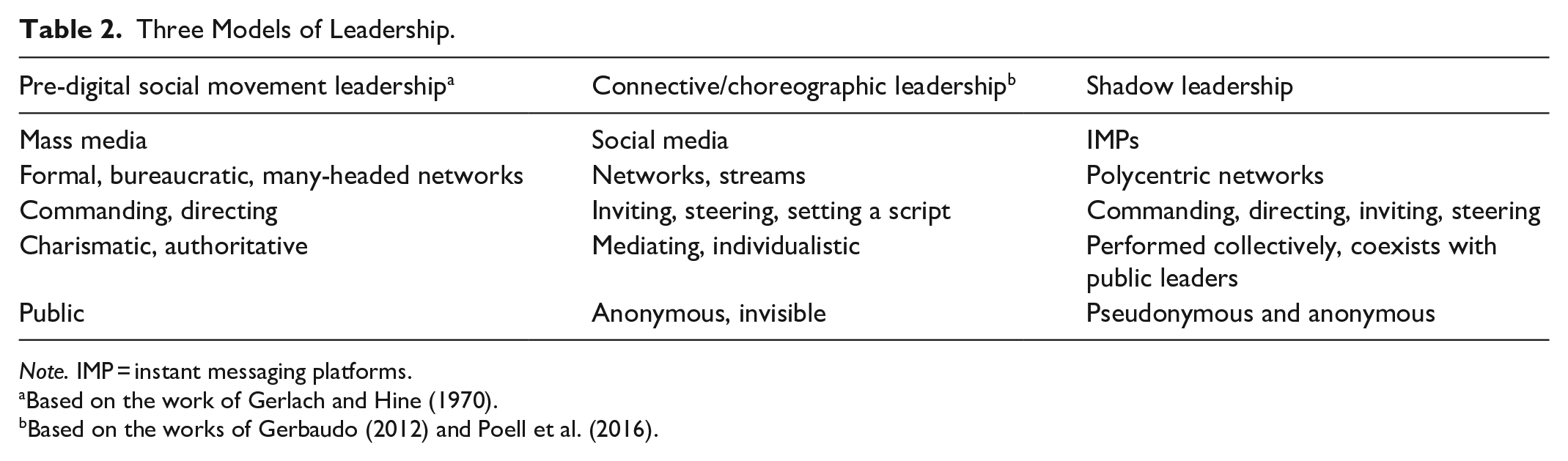
Note. IMP = instant messaging platforms.
Based on the work of Gerlach and Hine (1970).
Based on the works of Gerbaudo (2012) and Poell et al. (2016).
Polycentric
The analysis of the practices of the use of IMPs during Navalny’s collective action on 7 October suggests that several key users of the movement’s Telegram networks both maintained collective action across at least six locations and contributed to other tasks associated with some aspects of the traditional roles of social movement leaders (Melucci, 1996). A key property of these users was their polycentricity. Although polycentricity was discovered before digital-enabled movements emerged, studies rarely discussed this property in IMPs-reliant repressed groups. Navalny’s public leadership seemed to have enabled polycentricity in advance as they have been preparing for preemptive repression. The presence of polycentricity also meant that Navalny’s shadow leadership was connected in a network. Hence, we observed a network of users who took the lead during the collective action that we defined as shadow leaders.
However, this network was not merely connective; shadow leaders did not only connect users involved in peer production (Bennett et al., 2014). Instead, they could direct and even command their followers through internal interaction, though they could also steer and invite. This mix of leadership styles distinguishes shadow leaders from Gerbaudo’s (2012) choreographic leaders or connective leaders who seem to be “indirect” and “soft” “script setters.”
Our work also shows that polycentricity was propelled by default anonymity features employed by administrators and their ability to moderate the conversation by removing users and content or highlighting it. Hence, polycentricity in digitally enabled anti-authoritarian movements might indicate the presence of several types of leaders that push their followers beyond connecting and peer production into more direct and firmer modes of leader-follower relations.
Collective
A striking feature of shadow leaders is their ability to coexist with other types of leaders in the same cell of an organization. The affordances for content sharing and network features enhance this collective element of leadership. Hence, it might be too simplistic to define them as individualistic in a manner similar to Poell et al.’s (2016) connective leaders or, on the other end of the scale, as the professionalized bureaucracy of pre-digital movements (Staggenborg, 1988). Shadow leaders are part of a more complex universe of organizing than connective action activism.
Concealed
One of the key IMP affordances adopted by shadow leaders is the potential to conceal one’s identity behind a pseudonym or anonymize themselves. These activists were certainly not the first to hide their identity. For instance, “stealth leadership” looks similarly obscure (Freeman, 1972; Western, 2014). However, we observed shadow leadership in an environment where anonymity was often imposed by default. Indeed, the features of Telegram channels hide authors and administrators by default. Users need to try to reveal their identity, which is a contrast to major non-IMP platforms that encourage users to state their real names in their profiles. This might be helpful for less technically sophisticated users who might not think much about their digital identity before engaging in protest organizing. In other words, Telegram affords activists an environment where they are not pressed into publicity while affording them anonymity.
Indeed, the Navalny movement leaders perceived Telegram as most suited for the role of safer and more secure communication channels. Our analysis shows that activists' use of IMPs is associated with a perceived reduction of physical security risks. Azer et al. (2019) named physical and psychological risks among connective leaders’ key challenges. Just like in their study, Navalny’s leaders were sensitive to physical risks, and they felt safer on this platform. Overall, platform features and affordances enabled shadow leadership to be made hidden where previously visible while remaining relatively secure.
Moreover, despite their concealed status, shadow leaders remained visible as any movement administrators, which empowered them. The power of shadow leadership is linked to their origins as IMP administrators. The literature seems to agree that administrators are often pushed toward more active interaction on behalf of an activist group, which eventually establishes them as part of the image of a movement (Kavada, 2015). This more prominent position enhances power disbalance within a movement because it is very challenging to avoid the emergence of a potential leader if an organization relies heavily on platforms.
This emphasis on visibility, which was primarily dictated by the risks of the authoritarian environment, is another feature that highlights the difference between shadow leadership and other models of digitally enabled leaders, such as choreographic leadership. For example, choreographic leadership can also be “invisible” (Gerbaudo, 2012); but this invisibility does not seem to be a key feature that helps this type of leadership—and the whole network—to survive. Hence, our study supports existing literature on visibility that discusses more individual-level activism (Lokot, 2018; Pearce et al., 2018; Rega & Medrado, 2021) and also highlights the importance of leadership visibility management for the sustainability of a large anti-authoritarian movement.
Conclusion
Our study approached the leadership of digitally enabled anti-authoritarian movements from the perspective of their use of IMPs for internal organizing. This helped to complicate some key assumptions of the movement leadership literature that is primarily based on democratic contexts. We started our analysis with the leadership visibility dilemma—the tension between being secure and being visible while mobilizing followers. We examined the response to preemptive repression and uncovered key properties of a leadership model that arose in response to this dilemma. This model appears to be polycentric rather than connective, concealed rather than public, and collective rather than individualistic. Together these properties, we argue, constitute a distinctive type of IMP-enabled leadership that exists in repressive contexts—shadow anti-authoritarian leaders.
Our findings enrich recent social movement leadership frameworks because the concept we coined helps better understand why anti-authoritarian movements rely on IMPs and the consequences of this reliance. On one hand, the contours of this concept are similar to other theories of digitally enabled leadership (Azer et al., 2019; Gerbaudo, 2012; Poell et al., 2016). On the other hand, our work shows that contrary to the expectations of connective action theories (Bennett et al., 2014), leadership in repressive settings has not been largely replaced by distributed mass user activity on platforms. Moreover, a shadow leadership layer in anti-authoritarian movements that rely on IMPs is likely to combine the properties of both pre-digital and digitally enabled movements. We have seen how these leaders can direct or invite while leading collective action. However, their concealed property potentially makes their movement look like distributed mass user activity rather than a structured organization, which helps to avoid preemptive repression. Hence, an anti-authoritarian movement can rely on IMPs to enhance its polycentric and visibility management capabilities, thus avoiding preemptive repression.
Contextual conditions differ from one regime to another, and we can possibly observe variations in how shadow leaders emerge and function depending on a platform. In addition, just as most social media platforms, Telegram constitutes a specific type of socio-technical configuration (van Dijck, 2013). As Poell et al. (2016) suggest, leadership is articulated somewhat differently through different technologies. For example, the channel features establish a broadcasting mode of communication while providing its administrators with default settings that help them to preserve anonymity. This might explain why other types of leadership observed for digitally enabled movements, such as connective leaders or digital vanguards differ from shadow anti-authoritarian leadership.
This study has mapped out the emergence of the type of shadow leadership for the case of a prominent large-scale anti-authoritarian movement. The study was limited to just one wave of collective action in a portion of localities and focused only on certain leadership attributes, giving less attention to some of them, such as identity building. By broadening the scope of the study, we could trace movement interactions during other collective action events. As we do not claim that shadow anti-authoritarian leaders are exclusive to IMPs, further studies should systematically verify the presence of shadow leadership in other anti-authoritarian movements and on other types of IMPs or beyond them. Further research should also explore how these activists coexist with public leaders in the same cell of an organization.
Footnotes
Appendix A
Appendix B
Appendix C
Appendix D
Appendix E
Acknowledgements
The author gratefully acknowledges suggestions provided by Anastasia Kavada, Anna George, the participants of the “Understanding and Examining the Digital Advocacy Pioneers” workshop at the University of Portsmouth, and anonymous reviewers who helped to improve the manuscript. He is also grateful to the coordinators and reviewers of International Communication Association’s Political Communication Division who have awarded their Top Student Paper Award to the author based on the earlier version of the manuscript.
Declaration of conflicting interests
The author(s) declared no potential conflicts of interest with respect to the research, authorship, and/or publication of this article.
Funding
The author(s) received no financial support for the research, authorship, and/or publication of this article.
