




Abstract
Online communities play an important role in spreading public discontent and could contribute to polarization. This study focuses on anti-vaccination views in the Netherlands, which have intensified during the COVID-19 pandemic. We examined the structure and development of five Dutch anti-vaccination Telegram groups and studied their interactivity and posting behaviour. Using group-based trajectory modelling, we examined the development of users’ posting behaviour in these groups. We find four posting trajectories across all five groups. A small group of users contributes the majority of posts. Overall, posting frequency declines over time and our results do not show evidence for a group of users whose posting frequency increases. This is taken to indicate that only a small group of users spread their anti-vaccination views through Telegram groups. While social media can reach a broad audience, most users are not necessarily engaged to also actively contribute to the online anti-vaccination community.
With the onset of the global vaccination campaign and related policies in an effort to curb COVID-19 (e.g. rules regarding vaccination proof to visit public places), anti-vaccination views and vaccination hesitancy have intensified (Ball, 2020; Germani and Biller-Andorno, 2021; Ortiz-Sánchez et al., 2020). Vaccine opponents are increasingly active in spreading their views online, seizing the COVID-19 pandemic as an opportunity to expand their base of support (Bonnevie et al., 2021). To do so, they exaggerate and dramatize cases of adverse vaccine reactions to the media and the public (Ball, 2020; Germani and Biller-Andorno, 2021; Ortiz-Sánchez et al., 2020). Social media also facilitates the spread of misinformation and conspiracy beliefs. Exposure to misinformation can potentially harm public health because it can decrease people’s vaccination willingness (Berman, 2020; NOS, 2021).
Online, people tend to engage mostly with like-minded others and communities aligned with their beliefs, creating so-called ‘echo chambers’ (e.g. Van Raemdonck, 2019; Williams et al., 2015). Indeed, Baines et al. (2021) found that on Parler the anti-vaccination network is homogeneous, no user supported the COVID-19 vaccine and the debate focused on getting the COVID-19 vaccination. This one-sided exposure increases the risk of extremism, group polarization and radicalization (e.g. Von Behr et al., 2013). Exposure to extremist content is associated with increasingly extreme online and offline attitudes, and an increased risk of offline violence (e.g. Gallacher et al., 2021; Hassan et al., 2018). By strengthening members’ beliefs, online communities focusing on public discontent about societal issues (e.g. the COVID-19 pandemic) may thus contribute to radicalization and extremism, spawning online and perhaps even offline crime and violence. It is therefore important to understand the structure and dynamics of these online communities.
In the Netherlands (as elsewhere), expressions of extremist behaviour are prevalent on social media (NCTV, 2021). Politicians, journalists, scientists, and policemen, for example, are increasingly harassed through ‘doxing’ (i.e. posting personal information online) and employees of municipal Health Services involved in the COVID-19 campaign were sent death threats via social media (NCTV, 2021; Quekel, 2021; Von Piekartz, 2020). Especially, the instant messaging service Telegram has become a popular tool for spreading extreme views and ideas (Rogers, 2020). The platform promotes itself as fast, secure, and heavily encrypted, providing privacy and anonymity along with the opportunity to gain publicity without filtering or moderating content (Urman et al., 2021). In fact, the Dutch Public Prosecution Service recently blocked two large Telegram groups of conspiracy theorists, due to the threatening nature of the messages sent in these groups (Bouma, 2021).
Our study examines the structure—specifically, the group size, interactivity and group dynamic—and development of Telegram groups and users’ posting behaviour in these anti-vaccination groups, from a longitudinal perspective. This study adds to the literature on Telegram communities by focusing on a non-violent movement, the online anti-vaccination movement, instead of more ‘underground’ and violent extremist movements (e.g. Urman and Katz, 2020; Walther and McCoy, 2021). This is important given that anti-vaccination sentiments are not a fringe movement but are widespread among Dutch citizens, which may undermine public health. In addition, we address a research gap in the area of anti-vaccination sentiments in online spaces by using a longitudinal perspective (Neff et al., 2021) and by examining anti-vaccination views on a social media platform that is rarely monitored. By investigating a number of different anti-vaccination groups in parallel, we seek to answer the following research questions:
What is the structure of the online communities of the anti-vaccine movement in the Netherlands on Telegram?
How do these communities develop over time?
How do individuals differ in their contributions, and the timing of their contributions to these communities?
Online communities
Online communities can be defined as places where people get together to receive and provide information or support, to learn or to find like-minded strangers (Lea et al., 2006; Preece, 2001). Online communities created around anti-vaccination sentiments provide users with information and peer support. Within an online community, membership can become an important part of one’s social identity, and shared rules and social norms are able to develop (e.g. Hammond, 2017). A highly active online community might engage users enough to cause alienation or isolation from someone’s offline world and add to an ‘us/them’ feeling among its members (Ganor et al., 2007). Several studies have examined which factors affect the survival of online communities (e.g. Butler, 2001; Kraut and Resnick, 2012). Based on this research, we theorize what structural characteristics are important to understand online anti-vaccination communities.
Group size and interactivity
The survival of an online community could depend on how many members it has. Larger groups have more shared resources, such as knowledge and possibly available interactions (Butler, 2001). Moreover, users are more likely to contribute if they have a wider audience (Burke et al., 2009). Larger groups are also more strongly affected by free-riding or social loafing however, leading users to contribute less because they count on others to do so (Butler, 2001; Piezon and Donaldson, 2005). On the group level, we therefore expect that
The total number of messages will be higher in groups with more active members, but the average number of messages per active member will be lower (H1group).
On the individual level, we expect that
Active members will post less as group size increases (H1individual).
Existing research on social media furthermore shows that the majority of users remain passive online (e.g. Heiss, 2021). Madrigal (2019) found that on Facebook, a relatively small network of pages created the majority of anti-vaccine content and Germani and Biller-Andorno (2021) found that, on Twitter, the anti-vaccination movement depended on content produced by a small number of users. Users who seldom post but do regularly log in are called lurkers (Sun et al., 2014). While a community needs members who contribute regularly to survive, in a large and active community a certain number of lurkers might be desirable as they signal membership without the community being overflooded (Ridings et al., 2006). Based on these findings, we expect that
A minority of active members contribute the majority of messages in a group (H2agroup).
The distribution of messages across active members becomes less equal when the group is larger (H2bgroup).
Interactivity refers to the frequency of interaction (e.g. messages, ‘likes’) between members in a group. Grant et al. (2015) concluded that the social interactivity of anti-vaccination websites helps create communities of people who are affected by and are sceptical of vaccine practices. Examining the anti-vaccination movement on Facebook, Smith and Graham (2019) found that the community was highly active, giving a large number of ‘likes’ and posts. Getting a reply from other users is important to fulfil users’ needs and a culture of reciprocity therefore stimulates more activity (Van Varik and Van Oostendorp, 2013). Research indeed shows that receiving a response is an important motivator for ongoing contributions (Burke et al., 2009; Joyce and Kraut, 2006). At the group level, we therefore expect that
Within the group, there is a negative association between the time it takes to be reciprocated and the contribution of active members (H3group).
At the individual level, we expect that
Active members who are reciprocated faster post more (H3individual).
Time and users
Online communities and their users are constantly changing. Specifically, Panek et al. (2018) propose three archetypes of online group dynamics: the community dynamic in which many users contribute over a sustained period of time; the creator/audience dynamic, in which a small number of users contribute most of the content and a majority lurks; and a crowd dynamic, where many users contribute for a brief period before dissolving. As having an active influence on the community and its members is important for developing a sense of cohesion (Ganor et al., 2007), group dynamics may be differentially related to the survival of the community. Germani and Biller-Andorno (2021) found a strongly connected anti-vaccination Twitter community, where the majority served as a sounding board for a small group of users they called ‘anti-vaccination influencers’. We will examine the dynamic of anti-vaccination groups on Telegram based on the trajectories of contribution of the individual users in the groups.
Users differ in their levels of motivation to join, stay and participate in an online group, affecting their contribution to the group. The group’s founders and those who join a group early on might be more invested in the group and its ideas, and thus be more motivated to participate (Panek et al., 2018). Those who contribute more are also likely to find participating more rewarding, and to experience a stronger sense of belonging, autonomy and competence (Burke et al., 2009). Wang and Clay (2012) describe a vicious cycle where a user who contributes becomes more motivated with time and therefore will steadily contribute:
We expect to find a group of users whose contribution starts early on in the group’s history and consists of a high frequency of posts which remains steady over a long duration (H4a).
On the contrary, there is a group of users who contribute despite being less invested in the community. These users are active for only a short period. They may join the group at later stages, contribute less to the community’s discourse and be quick to stop participating (Panek et al., 2018). There can be different reasons for this; for example, users may lose interest in the group or topic, move to other groups or feel uncomfortable contributing:
We expect to find a group of users who join the group at a later stage on average and whose contribution is of a low frequency and short duration (H4b).
Based on qualitative interviews, Velasquez et al. (2014) distinguish members whose contribution decreased over time. This type of user has ‘learned the skills of participating in different ways in an online community, but is not currently actively contributing content’ (Velasquez et al., 2014, p. 22):
We expect to find a group of users whose contribution starts with a high frequency and has a decreasing pattern (H4c).
Finally, we also expect a group of users who over time become more interested and invested in the online community. Their pattern of online activity may result from an increasing dedication to the community’s topic, a desire for social status or both (Van der Bruggen and Blokland, 2021). For them, the Internet could serve as a gateway to offline political activism, providing opportunities to meet like-minded people and join offline activities, which could be violent and/or non-violent (Koehler, 2014):
We expect to find a group whose contribution starts with a low frequency and has an increasing pattern (H4d).
Method
Data collection
After approval from the Ethics Committee for Legal and Criminological Research (CERCO), we collected data from six public anti-vaccination Telegram groups. We exported their chat histories in November 2021. Only the chat histories of public groups were exported and no images or videos were collected. Furthermore, we used hashing to remove (nick)names and pseudonymised the text messages (i.e. removed any names that could lead to identification such as references to geographical locations or phone numbers).
Contrary to private groups, public groups are accessible to anyone who has a Telegram account. We drew a manual sample of Telegram groups, which is an appropriate method because we aimed to capture a specific population, namely, only public Dutch anti-vaccination Telegram groups. Public groups related to the anti-vaccination movement were searched on Telegram using a variety of Dutch terms, such as ‘(anti-)vaccinatie,’ ‘(anti-)vax’ and ‘(geen) vaccin(atie)’ (in English: ‘[anti-]vaccination’, ‘anti-vax’, and ‘(no) vaccination’). Using these search terms, six groups were found, the title and/or description of which suggested that the group was specifically focused on anti-vaccination, where the main language was Dutch. To protect the privacy of users, we will not disclose the actual names of the groups included in this study. After excluding service messages 1 (N = 9572), messages from bots 2 (N = 17) and messages for which the sender was missing 3 (N = 1097), 71,904 messages remained. One of the sampled groups was removed (Nmessages = 887) because that group consisted of only three active members. 4 Thus, the final sample existed of five groups, which together comprised 71,017 messages. The oldest group was created in January 2021, and the most recent group in July 2021.
Measures
Total members
It was measured by the number of members that the group had at the time of data collection.
Active members
We considered a member an active member when they had posted at least one message in the group. Conversely, ‘lurkers’ are those who joined the group as a member but have never posted anything (Nonnecke et al., 2006). The number of users visiting a group and reading its content without joining it remains unknown.
Time online
It was measured by taking the time in days between the first and last post in a group.
Average active membership
It was measured by days between the first and last message an active member had posted. Active members who only posted one message were excluded (N = 931).
Group size
Group size is the number of active members per month, per group. Incomplete months at the beginning and end of the time period were excluded for the analyses.
Time of reciprocity
It was measured by taking the average time in seconds that it took for a member to get a ‘reply’ to their message. We considered the next message from another member to be a reply. Messages sent between 0.00 and 06.00 were excluded, to account for night-time. Moreover, when the time difference between the messages was more than 6 hours, the message was excluded from calculating the average time of reciprocity for that member because as time progresses it becomes less likely that the next message is a response to the initial message (Ntotal = 27,383). Hence, the higher the number, the longer it took on average for the user to be reciprocated.
Distribution of posting
It was measured by measured by the Gini coefficient metric, a number that quantifies the amount of inequality in a distribution. The coefficient ranges from 0 to 1, where 0 represents complete equality and 1 complete inequality (i.e. Panek et al., 2018). In line with the suggestion of Fox and Tracy (1988), only those who had posted at least once were included in the calculation.
Analyses
Data were analysed in Rstudio (version ‘Ghost Orchid’) and Stata (version 15.0). First, descriptive statistics were explored and H1group was tested. Second, linear regressions on the entire sample were performed to test the hypotheses on the level of the user (H1individual and H3individual). Then, the R package DescTools version 0.99.14 (Signorell et al., 2021) was used to calculate the Gini coefficients for each group and test H2agroup and H2bgroup. Finally, H3group was tested within each group separately, by regressing posting frequency of the user on the average time it took for the user to be reciprocated.
To test hypotheses 4a to 4d, group-based trajectory modelling (GBTM) was performed in Stata using the traj package (Jones et al., 2001). With a finite mixture of Zero-Inflated Poisson (ZIP) model, which is most appropriate for count data, each individual member was assigned to a cluster for which they had the highest probability (Klijn et al., 2015). This procedure was performed separately for each group. For each Telegram group, we estimated models with three to six clusters using second-order polynomials to represent developments in their posting behaviour. 5 The dependent variable was posting frequency per week and the start of the posting trajectory was the week that the user posted their first message in the group. If a member had posted zero messages in a week, a score of zero was assigned. To account for the right-skewed distribution, a log transformation was conducted on the dependent variable. The best fitting model was decided on using the Bayesian information criterion (BIC)—which is one of the most reliable fit indicators (Nagin, 2005).
Results
Group size
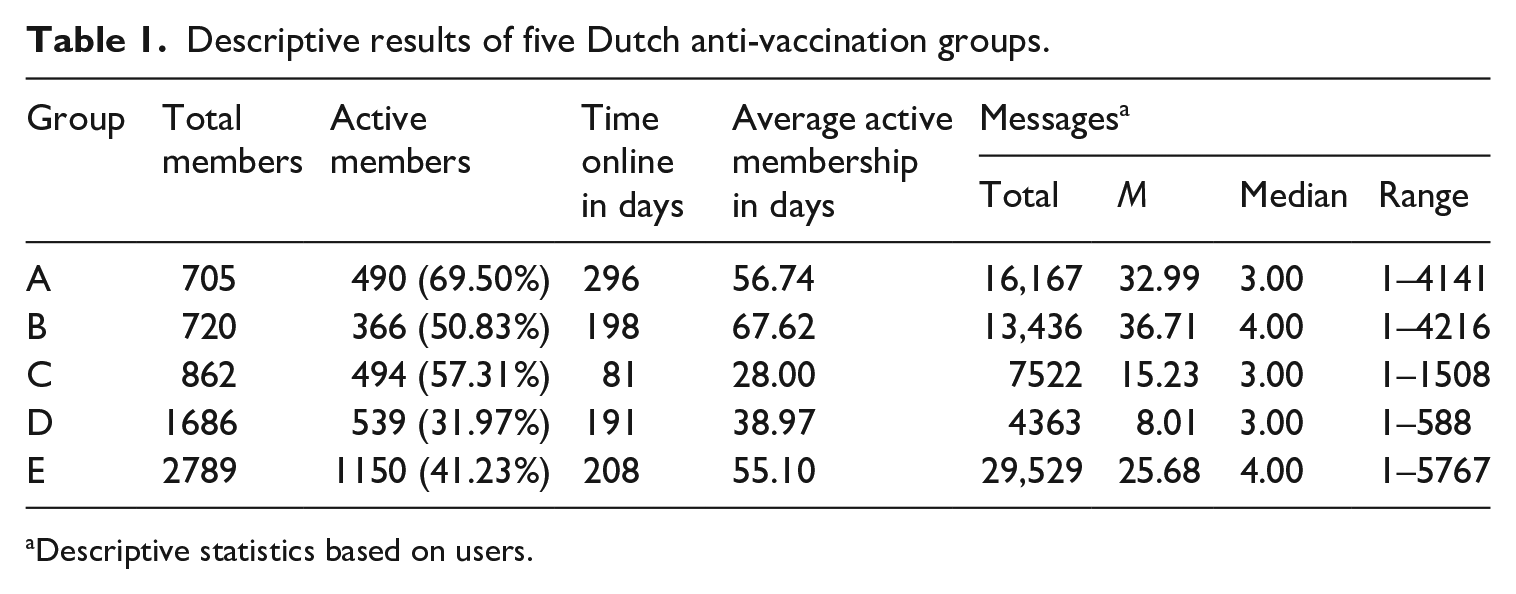
Table 1 shows the descriptive results of each group. In total, the groups had 3039 active members, with 2478 unique members. A total of 445 members were active in more than one group. Four members were active in all five groups. 6
Descriptive results of five Dutch anti-vaccination groups.
Descriptive statistics based on users.
First, we expected that the total number of messages would be higher in groups with more active members but that the number of messages per active member would be lower (H1group). When looking at the absolute numbers as shown in Table 1, the number of total messages was the highest in the group with the most active members (E). However, group A ranked second in terms of the number of messages but second lowest in the number of active members. When taking into account the relative percentages of active members, group A had the highest percentage and the second most messages. Then, considering the average number of posts in the groups, while this was not the lowest in group E, it was lower compared with groups B and C. Moreover, on average a user posted the most messages in group B, which had the lowest absolute number of active members. Overall, the descriptive results did not give a clear picture and only partly supported H1group.
Second, we expected that active members would post less as group size increased (H1individual). As shown in Figure 1, overall groups B, C and E had an upwards trend regarding group size, while groups A and D had a downwards trend. The correlation between the number of active members per month and user’s posting frequency per month was negative, but non-significant, r = −.022, p = .121, t(4985) = −1.550. While the regression coefficient was in the hypothesized direction, group size was not a significant negative predictor for posting frequency (B = −.011, SE = .007, p = .121). Thus, no support was found for H1individual.
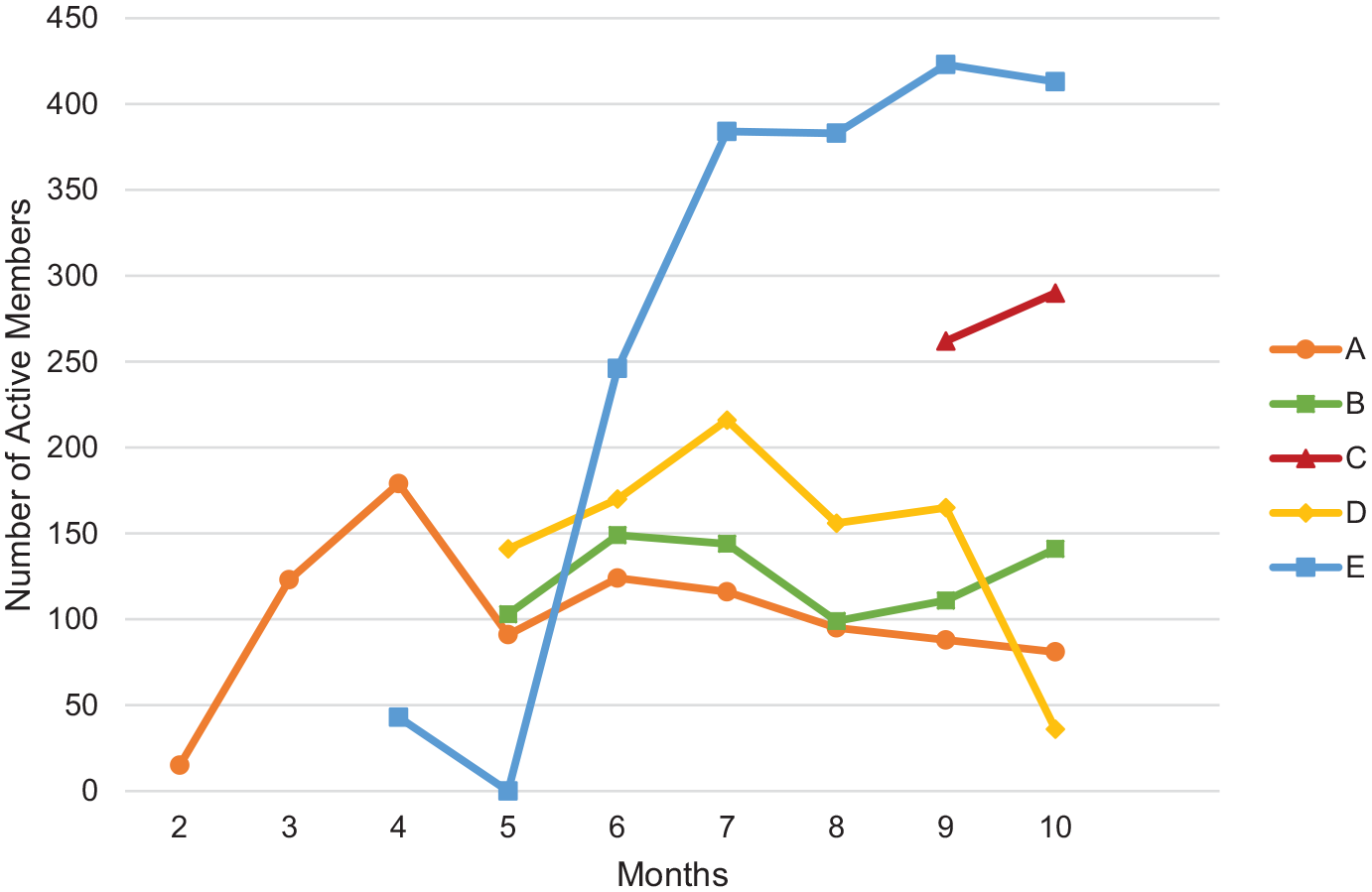
Number of active members per month per group.
In addition, we conducted the two-line test for testing a u-shaped relationship (Simonsohn, 2018) because a large group could evoke social loafing, while a small group might not stimulate users to contribute (Burke et al., 2009; Butler, 2001). There was no support for a u-shaped relation, as group size increased users were not less likely to contribute (B = .020, p = .070); however, as group size decreased users were less likely to contribute (B = −.140, p = .001).
Distribution of posting
We expected that a minority of active members would contribute the majority of messages (H2agroup). As shown in Figure 2, which plots the cumulative percentage of messages against the cumulative percentage of active members, in all groups the line was steep, indicating that the posting distribution was fairly unequal over the total time the group had been active. This conclusion was also reflected by the Gini coefficient, which from lowest to highest was D (G = .708), C (G = .780), E (G = .841), B (G = .856), and group A being the highest (G = .901). In all groups, the distribution was closer to 1 than 0 and well above .6, which strongly indicates an unequal distribution. This supports H2agroup.
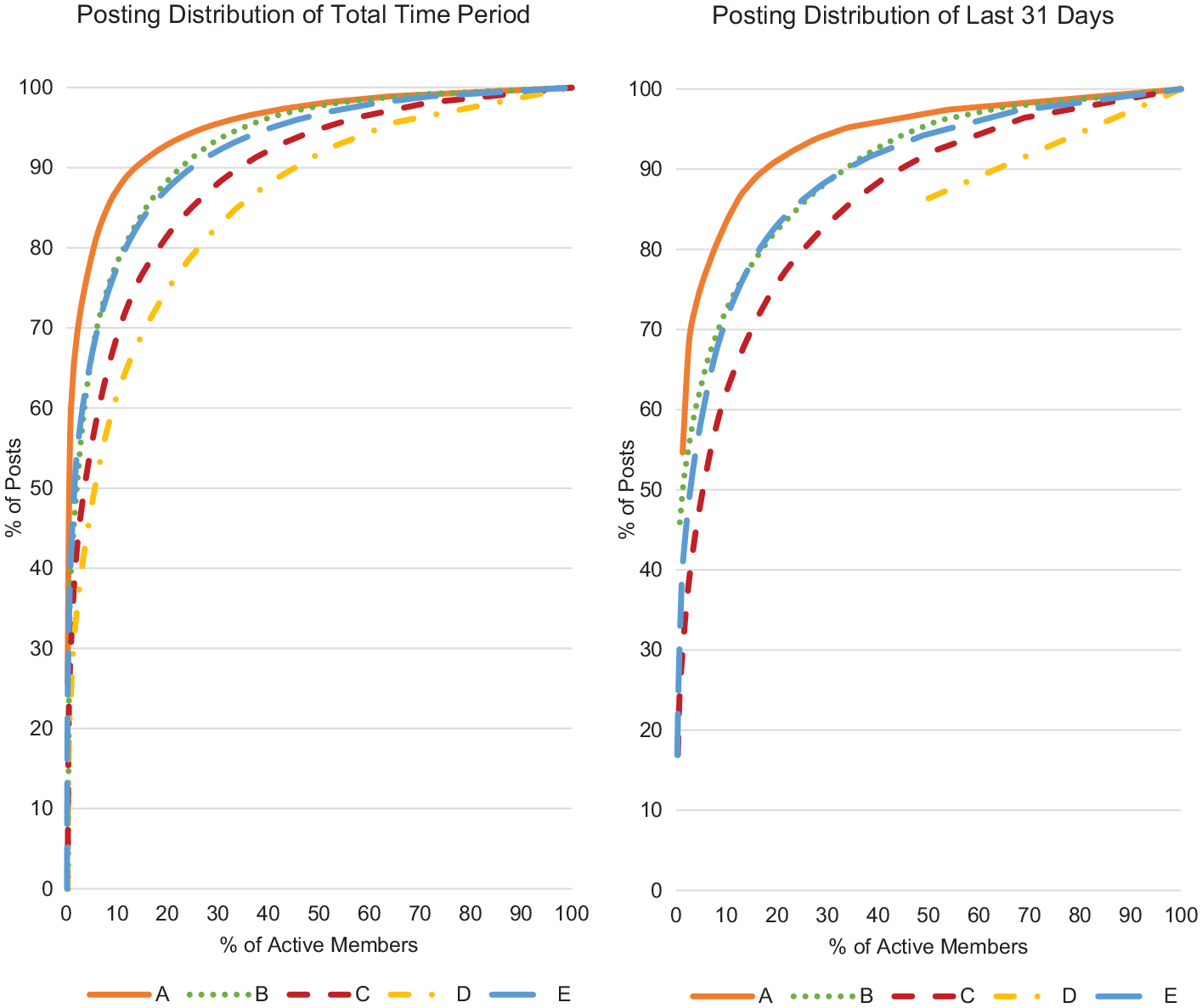
Posting distribution of cumulative percentage of total active members to cumulative percentage of total posts per group.
Furthermore, we expected the distribution of messages across active members to be less equal to the extent the group is larger (H2bgroup). We determined the size of the group based on the total number of members (see Table 1) and examined the distribution of posting of active members in the last 31 days of posting. 7 While the exact Gini coefficients changed compared with the Gini coefficients from the total sample, the distribution in the groups remained unequal and the order of the groups was similar (GC = .712, GD = .727, GE = .784, GB = .805, GA = .880; Figure 2). Thus, the largest group in members (group E) did not have the most unequal distribution, in fact, the smallest group in total members (group A) was the most unequally distributed. Therefore, we found no support for H2bgroup.
Reciprocation
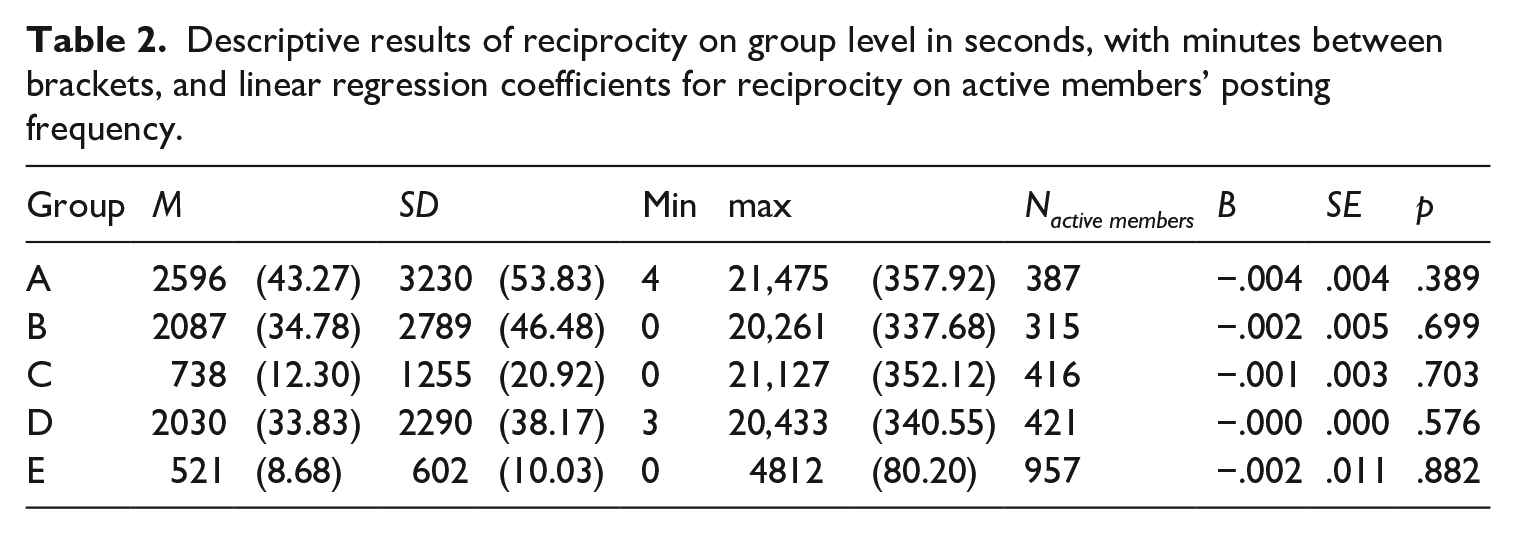
Regarding reciprocity, we expected that within the groups there would be a negative association between the time it takes to be reciprocated and the contribution of members (H3group), and that active members who were reciprocated faster would post more (H3individual). Table 2 shows the descriptive results and linear regression coefficients. The time of reciprocity was lowest in group E, which also had the most active members, and highest in group A. While in the hypothesized direction, the associations between the posting frequency of active members and the average time it took to be reciprocated were small and non-significant in all groups. 8 Furthermore, time of reciprocation did not predict posting on the user level (B = −.001, SE = .002, p = .417). 9 Therefore, no support for H3group or H3individual was found: within the groups, there was no association between the time it took to be reciprocated and contribution of individual members, and members who were reciprocated faster did not post more.
Descriptive results of reciprocity on group level in seconds, with minutes between brackets, and linear regression coefficients for reciprocity on active members’ posting frequency.
Developmental pathways of posting frequency
We expected to find four different clusters of users based on their posting frequency over time: a group whose contribution would start early and consistently be of a high frequency (H4a), a group who would join later and whose contribution was short and of a low frequency (H4b), users whose contribution would decrease over time (H4c) and those whose contribution would increase over time (H4d).
Trajectory models with an increasing number of clusters were estimated. Based on the BIC values, additional trajectories kept improving the model fit. However, when examining the trajectories, we noticed that the number of people assigned to the added trajectories became small after four clusters. In groups A, B and D, adding a fifth trajectory resulted in a small trajectory (1.0–5.1%) whose posting frequency started high and rapidly decreased. Here, the difference between four or five trajectories was the speed of this decline. In group E, the fifth trajectory accounted for 2% of the users, who consistently posted with a high frequency. Given the similarity in shape to trajectories already distinguished in a four-cluster model, and given the small number of users allocated to the fifth trajectory in the five-cluster model, we will base our results on the models with four trajectories (BICA = 4028.46, BICB = −3784.27, BICC = −2821.05, BICD = −3136.23, BICE = −9810.42). All trajectories, across all groups, had an average posterior probability of group membership (AvePP) greater than .79, which indicates that the modelled trajectories grouped individuals with similar patterns of change. 10
Table 3 displays the descriptive results for each cluster per group and Figure 3 show the trajectories of the clusters (see Supplementary Material for additional figures). Cluster 1 comprised 0.56–6.55% of the sample. On average, members allocated to this cluster posted the most messages by far and were the earliest to start posting. They showed the highest posting frequency from the onset, with the exception of group A, and their posting remained high over time. In groups C, D and E, there was a slow decrease in posting over time, whereas in group B the trajectory declined slowly yet slightly increased again at the end, and in group A posting frequency increased steadily over time.
Descriptive statistics of the four clusters for each online group based on the trajectories from the GBTM.
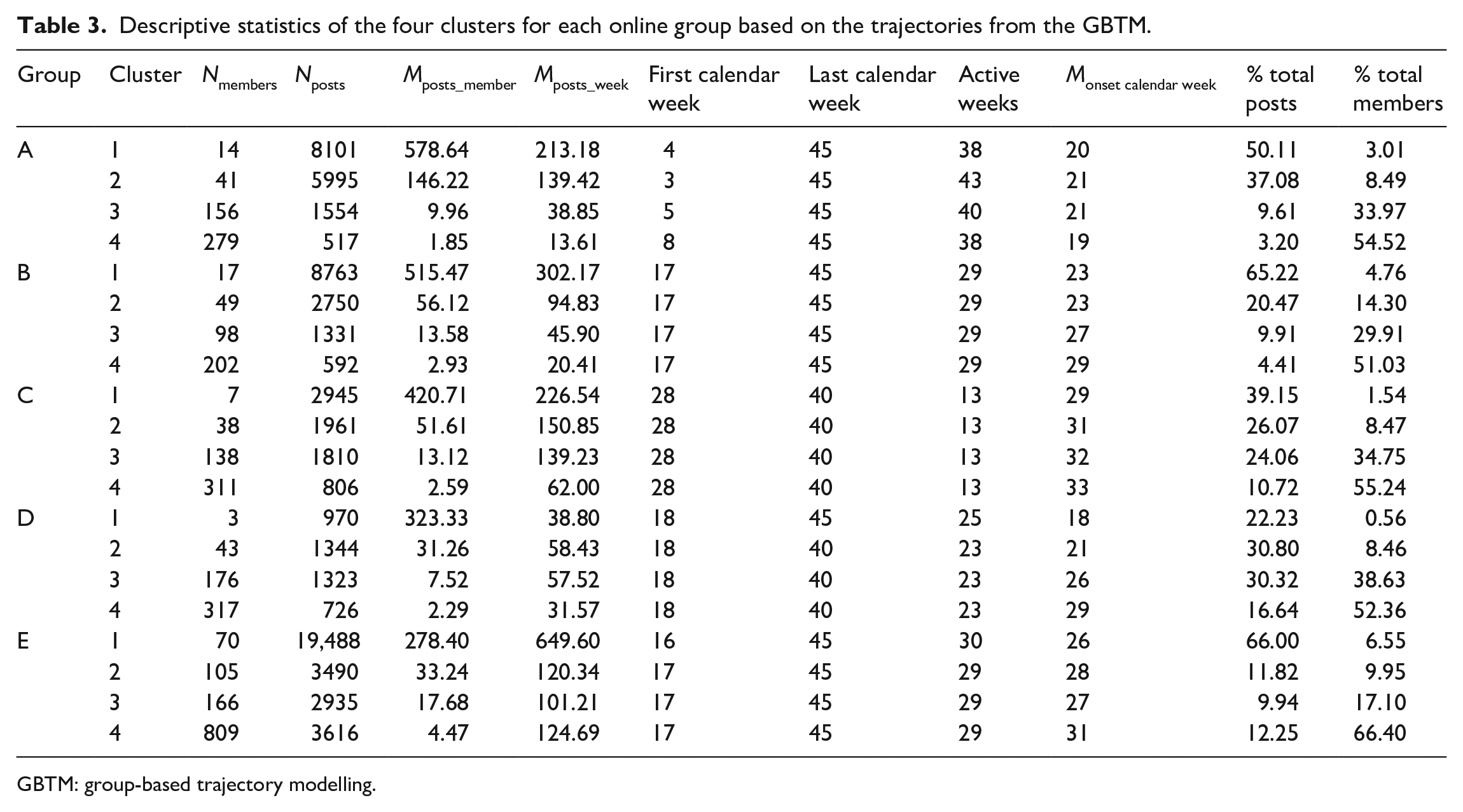
GBTM: group-based trajectory modelling.
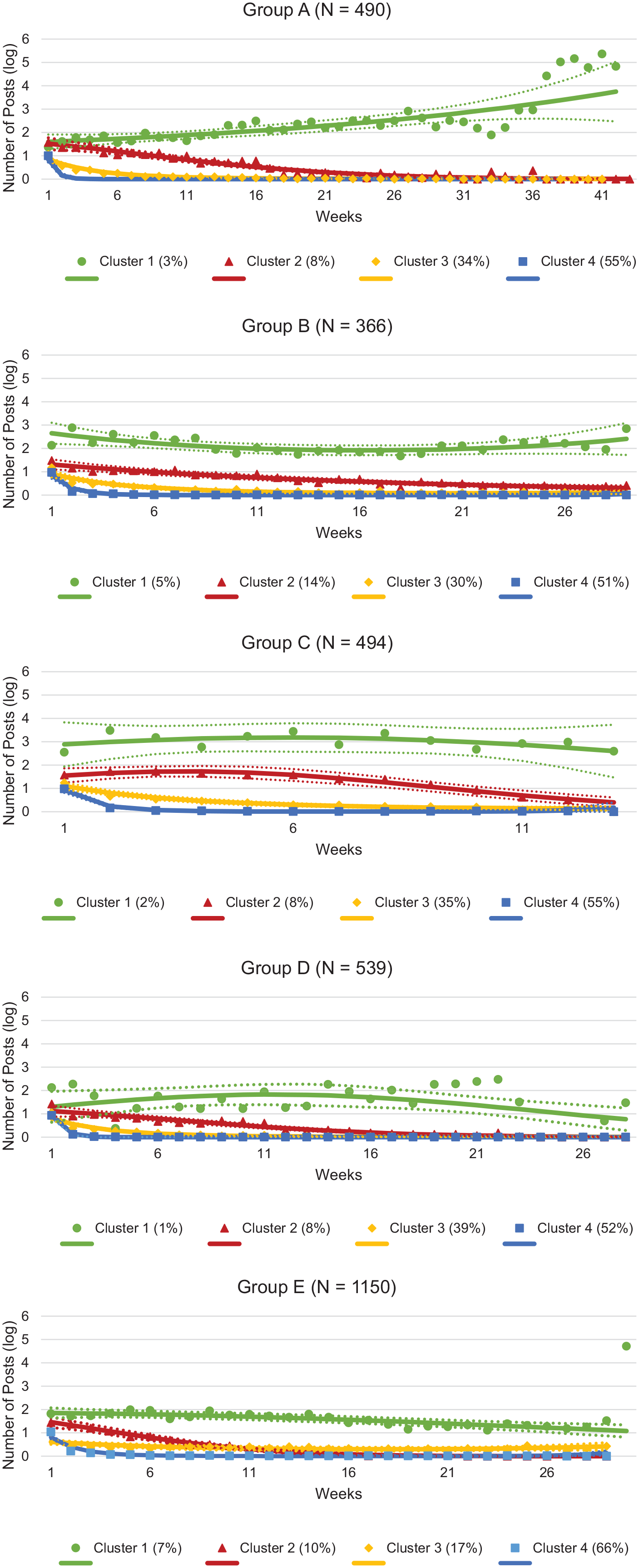
Estimated (line) and observed (symbol) posting trajectories per group per cluster, with 95% confidence intervals as dotted lines.
Cluster 2 compromised around 10% of the sample (8.46–14.30%). Their onset was medium high, lower than the first cluster, but higher than the third and fourth clusters. Across all groups, this trajectory showed a decline in posting frequency over time. This decline was rather steep, ending close to zero posts per week. Cluster 3 comprised 17.10–38.63% of the members. Members in this cluster had a low posting frequency at the onset of their posting trajectory, which declined rapidly over time. Members following this trajectory had a short posting career, which was only slightly longer than that of members allocated to cluster 4.
The fourth and final cluster consisted of the majority of users, ranging from 51.03% to 66.40%. Their posting frequencies started the lowest compared with the other clusters and declined most steeply over time. Their individual trajectories showed many ‘spikes’, indicating that members in this trajectory typically posted only for a very short period. Indeed, of the members in cluster 4, 39.80% (group E) to 63.08% (group A) posted only in 1 week. Therefore, the fourth cluster consisted of users who only posted once to a few times.
While our final model had four clusters, these four trajectories only partially matched those hypothesized in H4a to H4d. First, we did find a small group of members with an early onset and rather high frequency (H4a). Second, we found a group whose contribution was short and of low frequency; nonetheless, their onset was not particularly late (H4b). Finally, we found multiple clusters (1, 2 and 3) whose trajectory declined over time (H4c), whereas there was no cluster that followed an increasing pattern in all groups (H4d). Overall, the main difference between the four clusters seemed to be the amount of posting and the speed of the decline in posting over time. This speed increased with each cluster (1: slow decline to 4: very fast decline), while the frequency of posting decreased (1: high frequency, 4: very low frequency).
Discussion
This study examined the size and structure of online communities of the anti-vaccination movement on Telegram in the Netherlands and studied how these communities and the posting behaviour of individual members developed over time. We found that while some groups reached a large audience, most members did not actively participate in the anti-vaccination community. A core group of users dominated the discourse on Telegram. Over time, activity, and assumably interest, declined in all groups and a group of users whose activity increased over time was absent. This indicates that a small group of users use Telegram groups to spread their anti-vaccination views to a sometimes large, but seemingly unresponsive audience.
Overall, posting was not affected by the size of the group, and while together the groups had a large audience, members were not unique in each group. Contrary to our theoretical expectations, active members did not post less as group size increased and no clear relation was found between the number of messages and the group size. Over time, the number of active members waxed and waned differently within the groups; altogether, however the total number of members was more than twice the number of active members. We found that one in five active members was also active in another group. The changing pattern of active members and the lack of support for our theoretical expectations might be due to the effect of external factors that we did not examine or have taken into account. Popularity of the groups, and thus membership and posting, might increase around offline events that raise the awareness for anti-vaccination, such as media attention, government decisions surrounding COVID-19 and the vaccination campaign (Ng and Loke, 2021). Future research should explore how these offline events affect the online anti-vaccination community.
Across groups, most members were lurkers (i.e. those who did not participate) and a minority of users posted the majority of messages. This finding is consistent with other research on the online anti-vaccination movement (Germani and Biller-Andorno, 2021; Madrigal, 2019). In addition, we found no support for the idea that reciprocity positively impacted members’ contribution. However, this could be due to a relative paucity in interaction observed between members. When looking at the individual posting trajectories, only a small group of users consistently actively participated. In line with Panek et al. (2018), these members are ‘pioneers’, who joined the group early and continue to be motivated to contribute. They can be seen as the community builders, who create and maintain the online place (Van der Bruggen and Blokland, 2021). On Telegram, instead of initiating conversation between members, this small group is regularly ‘sending’ information to a larger audience. Thus, this core group of users develops and dominates the discourse in the anti-vaccination community on Telegram. Future research should examine the content of their messages to establish a better view on the goals of their postings (e.g. sending [mis]information, contributing to a discussion).
Most active members contributed little to the group’s online communication; they only post a small volume of messages and typically do so in a relatively short time frame. Even users who start with a relatively high frequency of posts show a steady decreasing pattern over time. Hence, we find declining activity across all trajectories and across all online groups. This is in line with studies on posting behaviour of users of violent and non-violent right-wing extremist forums (Scrivens et al., 2020, 2021). It may indicate that users lose interest in the topic or online community. Another explanation, however, is that users move to other, perhaps more extreme, groups or platforms, such as private Telegram groups or Darkweb forums. This might also explain the absence of a cluster of users whose participation increases over time. Either way, it seems that the groups under scrutiny here are not successful in motivating people to contribute or engaging enough for users to continue to participate, which are challenges that an online community needs to overcome in order to survive (Burke et al., 2009; Kraut and Resnick, 2012). Furthermore, taking into account the four posting trajectories, the dynamic in the groups mostly resembles the creator/audience dynamic as defined by Panek et al. (2018). The evidence suggests a small number of users who contribute most, a majority who lurks, and some users who contribute for a relatively short period before dissolving.
Our results raise important questions about the nature and future of these groups. Throughout this contribution, we have viewed the online anti-vaccination movement as a community, but the lack of social interaction among the majority of participants might question this view for their activity on Telegram. The groups are not successful in maintaining the interest of users or in getting new active users. On the one hand, this could threaten their continuation because it makes the online groups fragile. On the other hand, it might indicate that the goal of the online anti-vaccination movement on Telegram is not social interaction but spreading information. Online anti-vaccination groups might serve to attract, for example, curious or vaccine-hesitant people and could provide a ‘stepping stone’ to other, possibly even more extreme, online or offline content. Therefore, future research could examine to what extent the online anti-vaccination movement on Telegram aims to contribute to community building and how effective Telegram is as a platform to spread anti-vaccination sentiment.
Strengths and limitations
This study filled a gap in the literature by examining the anti-vaccination movement on Telegram in the Netherlands from a longitudinal perspective. Nonetheless, a few limitations must be addressed. First, our data collection was limited to publicly available groups and a specific time period. All groups, except one, were still active when data collection ended. Telegram also enables private groups and it is possible that the size and development of these private groups are different; moreover, more extreme messages could be exchanged because users perceive more security. Nonetheless, these visible anti-vaccination groups are still interesting to study because they could serve as a ‘stepping stone’ to private or more extreme groups/platforms. Although the declining activity in the groups could be suggestive for this, we were unable to test this idea within this study.
Second, since it was infeasible to code all the messages in the groups, our measure of reciprocity is an approximation that we based on the ongoing interaction we noticed in a random sample of the messages. Consequently, our measurement is prone to inaccuracies. Future research should further examine how much interaction is actually happening in these online communities.
Finally, our sample only consisted of five Dutch anti-vaccination groups on Telegram. Since there is no overview of all groups on Telegram, there is no way to know whether there were more Dutch anti-vaccination groups. In addition, people who unite in a Telegram group may not be representative of the Dutch anti-vaccination movement in general. It also remains unclear whether our findings are specific for the online anti-vaccination movement on Telegram or whether the findings can be generalized to other online social movements. Future research should examine the online structure and development of anti-vaccination groups from additional countries as well as other social movements on Telegram.
Conclusion
To conclude, our study examined the online structure and development of the anti-vaccination movement on Telegram during the COVID-19 pandemic in the Netherlands longitudinally. While some online anti-vaccination groups reach a relatively large audience, this did not translate to a large number of active users. Most members are only active for a very short period. Although members might change to more secure and/or radical platforms, we find no indication that they radicalize within the public groups studied here: a group of users whose activity showed an increasing pattern in the anti-vaccination community was absent. Instead, it seems that a small group of users use Telegram groups to spread their anti-vaccination views. For them, social media does generate a broad and easily accessible audience.
Supplemental Material
sj-docx-1-nms-10.1177_14614448221128475 – Supplemental material for The online structure and development of posting behaviour in Dutch anti-vaccination groups on Telegram
Supplemental material, sj-docx-1-nms-10.1177_14614448221128475 for The online structure and development of posting behaviour in Dutch anti-vaccination groups on Telegram by Anniek Schlette, Jan-Willem van Prooijen, Arjan Blokland and Fabienne Thijs in New Media & Society
Footnotes
Declaration of conflicting interests
The author(s) declared no potential conflicts of interest with respect to the research, authorship and/or publication of this article.
Funding
The author(s) received no financial support for the research, authorship and/or publication of this article.

Supplemental material
Supplemental material for this article is available online.
Notes
Author biographies
References
Supplementary Material
Please find the following supplemental material available below.
For Open Access articles published under a Creative Commons License, all supplemental material carries the same license as the article it is associated with.
For non-Open Access articles published, all supplemental material carries a non-exclusive license, and permission requests for re-use of supplemental material or any part of supplemental material shall be sent directly to the copyright owner as specified in the copyright notice associated with the article.
