



Abstract
Social media users hardly know who is reading their posts, but they form ideas about their readership. Researchers have coined the term imagined audience for the social groups that actors imagine seeing their public communication. However, social groups are not the only aspect that requires imagination: In the potentially borderless online environment, the geographical scope and locations of one’s audience are also unknown. Furthermore, research has demonstrated that imagined audiences vary between people and situations, but what explains these variations is unclear. In this article, we address these two gaps—the geographical scope and predictors of imagined audiences—using data from a mobile experience sampling method study of 105 active Twitter users from Berlin, Germany. Our results show that respondents mostly think of a geographically broad audience, which is spread out across the country or even globally. The imagined geographical scope and social groups depend on both the communicator and the usage situation. While the audience’s social composition especially depends on tweet content and respondents’ sociodemographic characteristics, the geographical scope is best explained by respondents’ biography and personal mobility, including their experience of living in other countries and local residential duration.
Keywords
In public communication, the content and form of conversations depend on who is addressed. Yet, the speakers in media hardly know who their audience is. They substitute this lack of knowledge with imagination. This cognitive auxiliary structure has been described with the concept of “imagined audiences” (e.g., Marwick & boyd, 2011). The imagined audience is a “mental conceptualization of the people with whom we are communicating” (Litt, 2012, p. 331). With digital media implying potentially boundless audiences of public communication, the phenomenon of imagined audiences has been applied to various contexts, platforms, and cases (e.g., French & Bazarova, 2017; Litt & Hargittai, 2016). The blurring of boundaries is a central characteristic of social media, which are accessible to heterogeneous groups of communicators and recipients (Casero-Ripollés et al., 2020, p. 97). Moreover, many social media allow asymmetric relationships between users: communicators do not need to form mutual ties with members of their audience. Lacking information and cues on their audience, communicators on social media need to address different contexts and social situations simultaneously; they navigate “collapsed contexts” (boyd, 2008, p. 3).
Imagined audiences guide users’ self-presentation, including their perception of authenticity, and practices of self-censorship or strategic communication (Marwick & boyd, 2011). Misalignments between imagined and actual audiences and failures of boundary management on social media can have tangible consequences, including the disruption of friendships or issues in professional contexts (Litt & Hargittai, 2014). The conception of audiences thus sits at the intersection of individual ideas and behaviors, on one hand, and macro-level digital social structures, on the other hand. Understanding how users conceive their audiences in different situations can further our understanding of what drives social media communication.
Imagined audiences have been analyzed mostly in terms of their social composition, the social groups that actors imagine being present in their audience. However, digital social networking sites as channels for (semi-)public communication also raise questions relating to the spatial dimensions of imagined audiences. Research has demonstrated that digital communication may transcend physical boundaries, but does not make them obsolete. Social media communication implies a variety of spatial relations and scales: It is locally anchored, translocally connected, and mirrors physical spatial structures (e.g., Hedayatifar et al., 2020; Maier et al., 2022). In a networked and translocal communication environment, the question of where communicators imagine their audience to be located is complex. Stephansen (2019) argues that not only social contexts collapse in social media communication, but so do “scalar contexts” (p. 347). Geographically distant and close actors are connected in communication networks, which “criss-cross scales and localities” (Stephansen, 2019, p. 347). At the same time, geography, distance, and proximity are related to what content people find appropriate or relevant (Takhteyev et al., 2012, p. 74). Hence, users’ self-presentation is likely related to their ideas about their readers’ locations. Yet, the geographical scope of imagined audiences and the extent to which imaginations of social groups and scalar contexts are interrelated remain open questions.
For many users of social media, the imagined audience fluctuates by post. However, it remains unclear which factors regarding message content or usage situation drive these differences (Litt & Hargittai, 2016, p. 9). Besides the usage context, attributes of the speaker (e.g., age or gender) may influence what kind of audience is imagined (Marwick & boyd, 2011, p. 118). Because of the interrelation between imagined audiences and modes of self-presentation, understanding these influences can facilitate a better grasp of who becomes a speaker online in what contexts and, thus, the mechanisms shaping digital discourses.
Our study addresses two avenues of research on imagined audiences. First, in addition to social composition, we investigate the geographical scope of imagined audiences as well as the intersection between social composition and geographical scope. Second, we establish how the imagination of audiences varies between usage situations and identify person-level and situation-level properties which explain variance. Our study draws on data from a Mobile Experience Sampling Method (MESM) survey of Twitter users. We monitored the everyday communication of over a 100 highly active Berlin-based Twitter users over the course of 10 days in 2020. The analysis is based on over 600 usage situations.
Results show that the social composition and geographical scope of the imagined audience vary between users, but also from one situation to the next. While the social composition especially depends on tweet topics and respondents’ sociodemographic characteristics, the geographical scope is best explained by respondents’ biography of mobility, including their history of living abroad and local residential duration.
Theoretical Framework
The concept of imagined audiences ties into two strands of communication research, the study of audiences and the role of imagination in public communication.
Audience: Mass, Currency, Mental Image
In the tradition of mass communication research, audiences have been understood as passive communities emerging through shared media consumption (Livingstone, 2005). The audience relates to an abstract crowd of media consumers, defined by the reach of a particular media channel or format (Livingstone, 2005, p. 23). Within journalism research, the imagined audience is equivalent to the potential recipients that journalists have in mind when investigating, reporting, or selecting the issues of coverage. Audience ratings, usage data, and information about subscribers provide media organizations and marketers with cues about their recipients. Thus, the audience becomes a “currency” (Nelson & Webster, 2016) of professional media communication.
Although big data allow increasingly precise measurements of the recipients of a media product (Nelson & Webster, 2016), “the audience” partly remains a mental construction, since the diffusion of a message cannot be completely controlled. At times, journalists may even try to evoke the imagination of an audience among recipients, for example, when they allude to a global audience of media events (Fürst, 2020). Recipients themselves have an audience in mind, as they are aware that others are watching, reading, or hearing the same media contents (Fürst, 2020, p. 1527).
Imagining the Unknown
On social media, users follow their own affinities in reception and have opportunities for follow-up communication and interactive responses (Colleoni et al., 2014). Hence, in social media settings, imagining audiences becomes necessary for regular individual users, who cannot fully know who is viewing their content (Litt, 2012, p. 332). The concept moves beyond journalism studies.
While the imagined audience is a possible or even desired audience, it might not overlap with the actual audience (Litt & Hargittai, 2016, p. 2; Marwick & boyd, 2011, p. 115). Still, the imagination has social and behavioral consequences. Anderson (2016) spelled out the importance of imaginations for political identity and social inclusion in his work on the “imagined political community”: It is imagined because the members of even the smallest nation will never know most of their fellow-members, meet them, or even hear of them, yet in the minds of each lives the image of their communion. [. . .] In fact, all communities larger than primordial villages of face-to-face contact (and perhaps even these) are imagined. (Anderson, 2016, p. 14)
Gruzd et al. (2011) maintain that social media, such as Twitter, cannot be understood as a community in the “traditional sense” of a “spatially compact set of people with a high frequency of interaction, interconnections, and a sense of solidarity” (p. 1296). However, new digital media, such as Twitter, are an infrastructure for potential imagined communities to emerge (Gruzd et al., 2011, p. 1313). Due to the potentially public nature of content, heterogeneous user base, and limited cues of true recipients, social media settings require all the more imagination from communicators.
Imagined Audiences: Abstract, Targeted, and Contextual
Due to the logics and affordances of social media, the people in a user’s network can come from a “variety of life spheres” (Litt & Hargittai, 2016, p. 1), which are usually separated spatially and temporally (Marwick & boyd, 2011). In a diary study, Litt and Hargittai (2016) investigated the social composition of people’s imagined audiences on social networking sites and inquired about the motivation of addressing different audiences. They distinguished between abstract (general) audiences and target (specific) audiences (Litt & Hargittai, 2016, p. 3). In almost half of the recorded posts, people imagined a target audience. The authors identified the following four different types of target imagined audiences relating to (1) personal ties (e.g., friends and family), (2) communal interests (e.g., people who share the same hobby), (3) professional relations (e.g., coworkers), and (4) phantasmal illusions (e.g., celebrities; Litt & Hargittai, 2016, p. 5). In most instances, when a specific audience was imagined, it was related to personal ties (Litt & Hargittai, 2016, p. 6). What kind of audience was imagined fluctuated between posts (Litt & Hargittai, 2016, p. 6). This suggests that mental conceptions of the audience depend on the user as well as the usage situation.
The Geography of Social Media Audiences
The geographical scope of imagined audiences on social media has not received much scholarly attention, even though digital communication networks reveal distinct spatial patterns. Despite social media’s capacity to cross physical boundaries and bridge distances, many communicative ties are locally bound. For Twitter, a substantial share of relations connects people within the same metropolitan area or in close physical proximity (Leetaru et al., 2013; Pfetsch et al., 2021; Samuel-Azran & Hayat, 2020; Takhteyev et al., 2012). Twitter users are clustered in metropolitan areas (Arthur & Williams, 2019; Leetaru et al., 2013). Overall, these digital networks thus exhibit geographical homophily, like most social networks (McPherson et al., 2001).
Communication networks on Twitter also feature long ties which bridge boundaries and distances. Often, they connect places with intense mobility between them (Samuel-Azran & Hayat, 2020; Takhteyev et al., 2012), or places with shared cultures or languages (Hedayatifar et al., 2020; Samuel-Azran & Hayat, 2020; Takhteyev et al., 2012). Hence, true social media audiences tend to be characterized by a complex mix of dense local clustering and far-flung long ties. How this translates into users’ audience imaginations has not been explored so far.
Desideratum and Research Questions
Building on our review of the state of research on imagined audiences, we extend knowledge on social media users’ audience imaginations in two ways. First, we shed light on the scope of imagined audiences and its intersection with what social groups are imagined. Second, we investigate the factors influencing the (varying) imaginations of audiences on both the situation level and the person level (see also Litt, 2012, p. 341). We thus ask the following:
RQ1. Who do active Twitter users imagine as the audience of their tweets, with regard to social groups and geographical scope, and how are the two related?
RQ2. In what respects does the imagination of the audience vary according to different usage situations, tweet contents, and personal characteristics?
No prior work has focused on what predicts imagined audiences of social media users. Hence, our research should be understood as explorative. However, other areas of digital communication research informed our identification of possible predictors.
At the situation level, based on the observation that imagined audiences fluctuate by post (Litt & Hargittai, 2016), we expect the topics of tweets to have an influence on the social groups as well as the geographical scope of the imagined audience. To better characterize the content, we also include users’ perception of the post as being of a private versus public nature. In addition, based on the observation that posting on-the-go versus on a desktop computer facilitate different engagement with media content (Girginova, 2020), we suspect that respondents’ location while using Twitter may influence imagined audiences.
We also expect personal characteristics to influence whom respondents imagine as their audiences and what geographical reach this audience has. Informed by the literature on digital inequalities (e.g., van Deursen & van Dijk, 2014), we expect different imaginations, depending on the sociodemographic background of respondents, including their gender, age, and education. Moreover, digital networks have been found to partly mirror offline connections between places (Samuel-Azran & Hayat, 2020; Takhteyev et al., 2012). If this finding extends to audience imagination, we expect that users’ spatial anchoring (i.e., the experience of living abroad and the length of respondents’ residential tenure in their current location) will influence the imagined audience’s geographical scope. Due to the structuring role of diasporic communities and common languages for the geography of Twitter networks (Hedayatifar et al., 2020; Maier et al., 2022), users’ multilingualism may also influence the geographical scope of their imagined audiences.
Case Study: The Imagined Audiences of Twitter Users in Berlin
To facilitate a better understanding of the imagined audiences of social media users, we conducted a diary study of active Twitter users in the metropolitan area of Berlin, Germany. Since its founding in 2006, Twitter has morphed from a platform intended mostly for personal status updates into a venue of public communication by journalists, politicians, and professionals. Its user base extends around the globe and covers a variety of languages and groups (Burgess & Baym, 2020, pp. 3–5). Compared to other social networking sites, like Facebook or Instagram, Twitter more closely follows a mass communication logic, with users not necessarily expecting responses to their posts or having specific individuals in mind while tweeting (French & Bazarova, 2017). Twitter is characterized by asymmetric ties with relatively low reciprocity and fast diffusion of content beyond the original sender through retweeting (Kwak et al., 2010). Hence, despite some cues through follower lists or interaction markers, Twitter users must navigate an especially high degree of uncertainty about their true audience. These features make Twitter a good case to study the patterns and predictors of imagined audiences.
Compared to other social media, Twitter is used by a relatively small population. In Germany, around 13% of Internet users use Twitter at least once a week (Hölig & Hasebrink, 2020). Twitter users are younger, more likely to be male, and more highly educated than the average Internet user (Hölig, 2018). Twitter users, including those in Berlin, engage in a wide variety of topical contexts, ranging from culture, fandom, and daily life, to economic activity and political issues (Pfetsch et al., 2021). In terms of geography, our investigation of the spatial structures of the Berlin Twittersphere showed that around one in four interactions remain bounded within the city. The degree of local boundedness in user interactions differs substantially depending on the discussed topic (Pfetsch et al., 2021). As a multicultural metropolis with a population with diverse cultural and geographical backgrounds, Berlin presents a pertinent case study to investigate not only the social but also the spatial dimension of imagined audiences.
Survey Design and Sample 1
Imagined audiences are usually investigated through interviews and surveys (e.g., Marwick & boyd, 2011) or diary studies (e.g., French & Bazarova, 2017; Litt & Hargittai, 2016), which allow to collect data on individual attitudes and behaviors. By employing a MESM design, we accounted for the specific situation and were able to ask questions in a timely manner and on the same device usually used to access Twitter (Karnowski et al., 2017, p. 45). MESM’s strength lies in its ability to capture immediate, subjective perceptions and experiences, rather than relying on participants’ recall or general impressions (Hedstrom & Irwin, 2017, pp. 3–5).
Our target population was highly active and visible Twitter users from Berlin. To identify relevant users, we collected Twitter data for Berlin using the rtweet package (Kearney, 2019) for the statistical programming environment R (R Core Development Team, 2019). This yielded an initial data set of roughly 250,000 unique users. We identified users who tweeted with a certain level of frequency (between 10 and 200 times during a 10-day window), had a level of originality in their content (less than 75% of all tweets were retweets), and had a certain level of prominence (belonged to the top 75% of users by follower count).
These criteria limit the amount of variance in usage patterns and intensity within our sample. This is not to suggest that light users’ perceptions are less important. Rather, given the explorative nature of our research, it reflects the decision to provide an in-depth investigation of the spatiality and predictors of imagined audiences for one type of user (intense Twitter users) which can be extended to other user types and platforms in the future. Focusing on intense users also ensured that our MESM approach would capture a sufficient number of usage situations.
More than 7,000 accounts were part of our target population based on the selection criteria. We contacted a total of 854 randomly selected individuals from this population through Twitter Direct Message (DM) until we hit our target sample size of at least 100 respondents. Finally, 106 people filled out a recruiting questionnaire and at least some of the MESM prompts, which corresponds to a response rate of 12.4%. While we cannot rule out the possibility of non-response biases, our panel closely resembled the demographic composition of German Twitter users at large (cf. Hölig, 2018). Participants received a €25 Amazon voucher as incentive. The study received Institutional Review Board (IRB) approval from Freie Universität Berlin’s Central Ethics Committee. Participants were asked for their informed consent to the storage and use of their data for scientific research and publications, in compliance with General Data Protection Regulation (GDPR) regulations.
The field period was conducted in two waves in January and early February 2020. During the 10-day period, participants received text messages to their smart phone twice a day. The texts contained a hyperlink, leading participants to a browser-based questionnaire, which was hosted on SoSciSurvey (Leiner, 2019). Each participant received 20 MESM prompts over the course of the study. Compliance was high, with participants responding to an average of 17.1 (Mdn = 18, SD = 3.4) prompts. There was hardly any panel mortality, with 94.3% of participants responding to more than half of all prompts and all but one participant still responding to some proportion of the prompts within the second half of the survey period. Not all prompts resulted in data, as respondents had not always used Twitter in the relevant time window. In total, 106 participants reported 968 usage situations. Two randomized “paths” led through the questionnaire, representing different concepts: imagined audiences and personal communication networks. In this analysis, we only used data from the former path. The imagined audience path was completed by 105 participants reporting 664 usage situations. This yielded an average of 6.3 (Mdn = 6, SD = 3.2) usage situations per respondent.
Demographically, more than 60% of respondents identified as male. The average age of the sample was 34 years (SD = 9.8). In total, 63% of respondents held a university degree, while no respondents reported not having completed secondary school education. In total, 39% of respondents were multilingual, which meant that they spoke different languages with family, colleagues, and friends.
Measures and Data
The MESM approach implied that, due to the repeated in-situ questionnaires, multiple observations were nested within each participant. Outcomes (i.e., audience imaginations) and situation-level predictors (topics, publicness, location) varied from one situation to the next, but person-level predictors (sociodemographic features, spatial anchoring) remained constant across situations (Figure 1).

Nested structure of the survey data with predictor and outcome variables.
The analysis focused on two dimensions of imagined audiences: the social group(s) they encompass and their geographical scope. 2 With regard to the social dimension, we asked, “Who do you imagine reading your last tweet/what you retweeted/your reply?” We provided a multiple-choice list of 15 social groups. For our analysis, we combined these categories into five groups which aligned with Litt and Hargittai’s (2016, p. 5) classification (Table 1). Regarding the geographical scope of the imagined audience, we asked respondents where they imagined their audience was located, with answers ranging in scope from “within my neighborhood” to “all over the world” (Table 1). 3
Operationalization of the Outcome Variables for Our Models (New Values) Compared to the Original Values in the Survey.

Multiple-choice options were given. As the differentiation between Twitter activities (tweeting, retweeting, replying) is not in the focus of our questions, we analyze responses for different activity types together. Social groups were aggregated into broader categories, which are listed in the right column. For the Twitter activity “reply,” we gave the additional answer option “The person I replied to,” which we omitted in constructing the social groups, as this answer refers to a type of interaction, rather than a group.
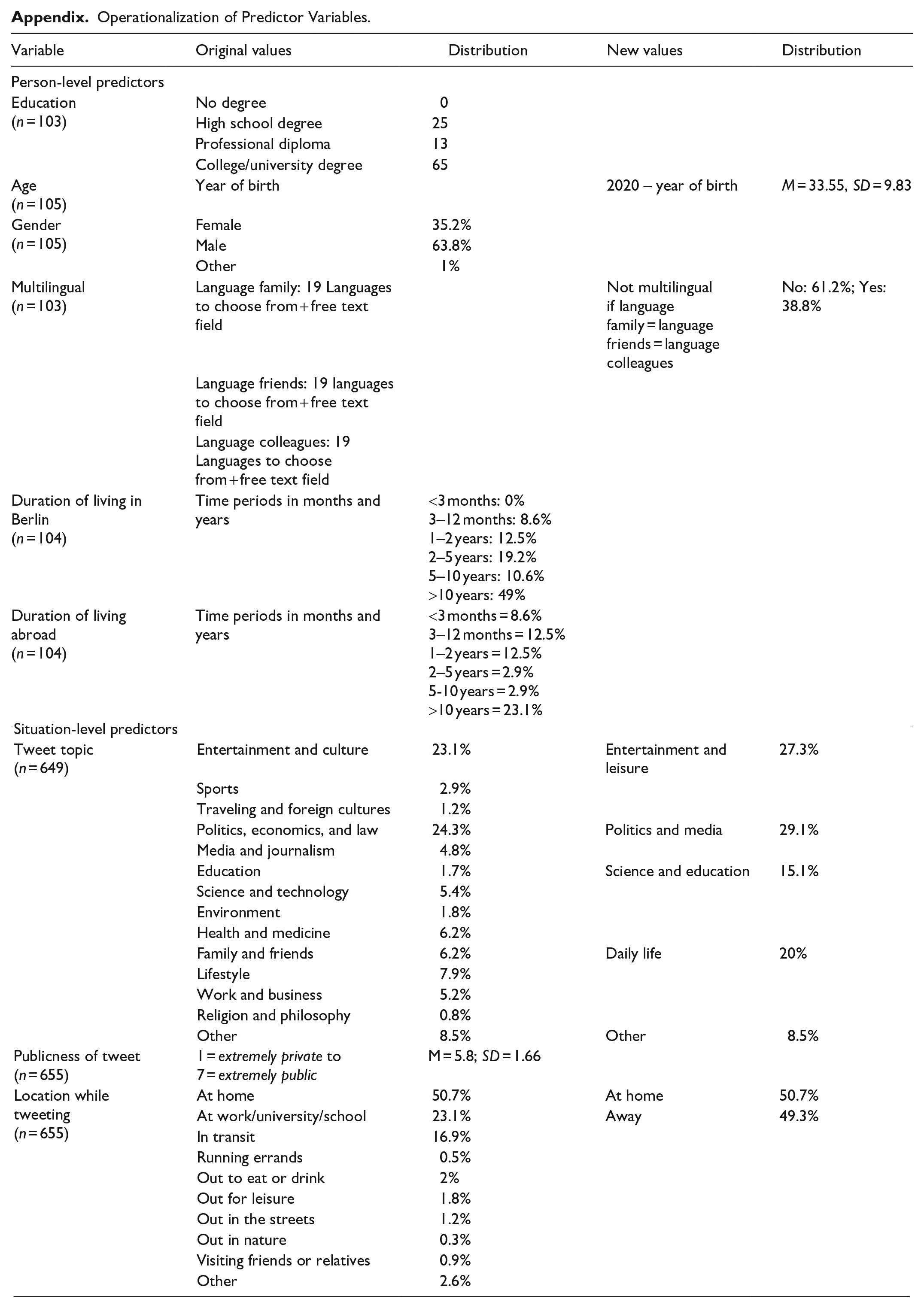
Predictors were included on the person level and the situation level (see Appendix for details on variables, categories, and descriptive statistics). At the person level, we included three variables on respondents’ sociodemographic background (age, gender, education) as predictors for both the social and spatial dimension of imagined audiences. For the geographical scope models, we included three additional predictors of spatial anchoring: users’ residential duration in Berlin, the time they spent living abroad, and whether or not they were multilingual.
At the situation level, we included three predictor variables for both social groups and geographical scope. We asked respondents to indicate what topic best described the content of their latest tweet, providing 13 categories to choose from (e.g., “Politics, Economics, and Law” or “Lifestyle”). For the analysis, answers were aggregated into the following four broader categories: Politics and Media, Science and Education, Entertainment and Leisure, as well as Daily Life (see Appendix). In addition, we asked respondents to rate the publicness of their tweet content on a 7-point Likert-type scale, ranging from extremely private to extremely public. To account for the spatial context of the usage situation, we asked respondents about their location while tweeting. We aggregated the nine response options into the following two broad categories: “at home” or “away” (Bayer et al., 2018).
Results
Our first research question inquired about the social groups and geographical scope of imagined audiences of active Twitter users, as well as how the two dimensions intersected. Respondents were able to report multiple social groups as imagined audiences for each usage situation. They reported up to 10 different social groups, but most frequently stated one (39%) or two (24%) social groups. Respondents most frequently imagined their audience to be a general public or “no one specific” (62.8%, see Table 1). Other frequent addressees were friends (37.7%), people with the same hobbies (26.6%), colleagues (19%), and those with whom they engaged in political action (16.8%). In terms of the aggregate categories aligning with Litt and Hargittai’s (2016) scheme, personal audiences (41.3%) were the most frequently imagined target audience, followed by communal (39.4%) and professional audiences (22.2%), and public figures (16.4%).
In terms of geographical scope, respondents most frequently imagined their audience to be located in their own country (49.9%). Yet, national boundaries were permeable in the minds of our respondents: In 43.2% of situations, they placed their readers “in other countries” or “all over the world.” Locally bounded audiences were less frequently imagined. In 7% of situations, respondents imagined readers within their own city, while neighborhood-specific audiences were not imagined at all.
These percentages do not tell us whether the imaginations of a given person were stable over time. To assess this question, we calculated for each respondent how frequently they imagined each audience group, leading to values between 0% and 100% of all usage situations. Figure 2 shows the distribution of these percentages. Most respondents tended to either never or always imagine a social group, as indicated by the modal outcomes being located at the distributions’ extreme values. Many respondents always imagined a general audience when tweeting. They had internalized the platform’s public nature. However, respondents often had specific audience groups in mind, additionally. For each social group, there were respondents who only imagined them in some usage situations, but not in others. Imagined audience groups were thus neither complete stable, nor completely situational.
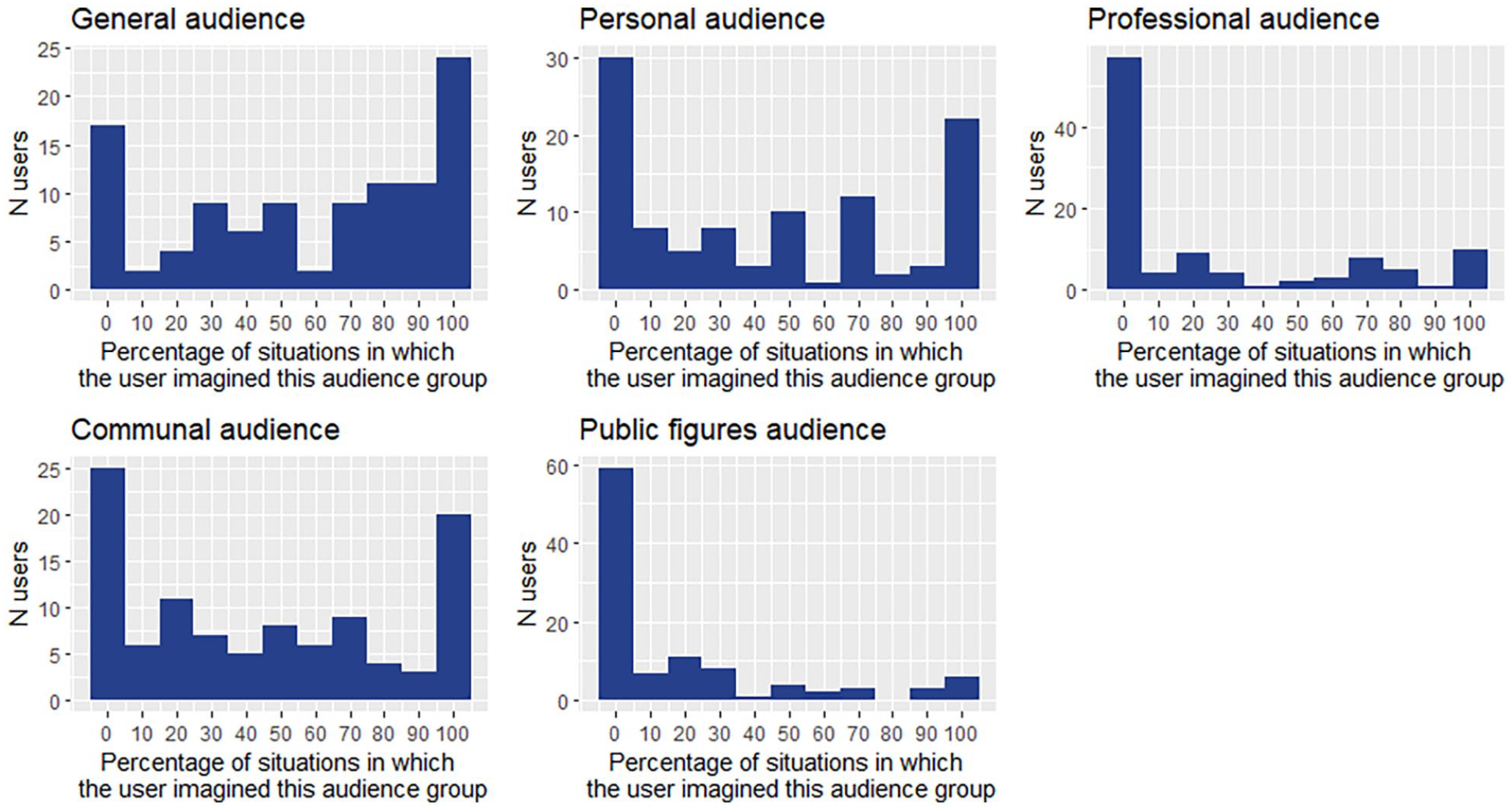
Variability in the imagined audience groups per respondent.
The same was true for the imagined audience’s scope (Figure 3). Most respondents had a stable geographical scope in mind. However, for a substantial minority of respondents, the imagined audience’s geographical scope varied between situations. These findings vindicate the use of a design which accounts for both person-level and situation-level characteristics to disentangle influences on the imagined audience.

Variability in the imagined audience scope per respondent.
Finally, we wanted to know whether the imagined audience’s social groups and geographical scope should be understood as related. We calculated a cumulative link mixed-effects model with random intercepts, setting the geographical scope as the outcome and the audience groups as predictors (Table 2). Relations between the two dimensions of imagined audiences were limited. The only significant effect was a strong positive relation between the imagination of a general audience and geographical scope (b = 1.065***, SE = 0.313). In situations where users imagined a general audience, they factored in a broad geographical distribution. They were aware that their audience may be located all over the world. Personal, professional, communal, and public figure audiences were imagined at different geographical scopes, ranging from local to global.
Mixed-Effects Regression Model for the Connection Between Scope and Social Groups of the Imagined Audience.

Note. Coefficients are from a cumulative link mixed-effects model. The coefficients are not standardized. Standard errors are listed in parentheses.
p < .10; *p < .05; **p < .01; ***p < .001.
What Explains the Imagination of Different Social Groups
Our second research question concerned the factors that explained users’ mental image of their addressees. We included the usage situation, tweet content, and personal characteristics as explanatory variables. To account for the nested data structure, we calculated mixed-effects logistic regression models for the binominal outcome variables (the social groups, which could be present or absent from the imagined audience in each usage situation) using the lme4 package (Bates et al., 2015). For the ordinal outcome variable (geographical scope), we calculated cumulative link mixed-effects models using the ordinal package (Christensen, 2018). Mixed-effects models can account for nested data by allowing intercepts and slopes to vary between respondents. We specified models with only random intercepts, as the inclusion of random slopes did not improve model fit.
We found significant effects at both the situation and person level. This indicates that both respondents’ characteristics and situation-dependent factors influenced who was imagined as addressees and where they were imagined to be located. Intraclass Correlation Coefficients (ICCs) revealed that a larger share of variance was at the person level (general audience: 52.7%, personal audience: 66.5%, professional audience: 71.6%, communal audience: 55.2%, public figures audience: 59.1%, geographical scope: 72.4%). This is consistent with the observation that, often, respondents either always or never imagined a particular audience.
Person-level characteristics, such as education or age, influenced the types of audiences which Twitter users imagined (Table 3). People with higher education were more likely to have a professional audience (including coworkers and clients; b = 0.769†, SE = 0.436) as well as public figures (such as politicians, influencers, or celebrities) in mind (b = 0.592†, SE = 0.343). Male Twitter users were more likely to relate Twitter usage to professional contacts (b = 1.382†, SE = 0.732), while women were more likely to imagine a general public (b = 0.979*, SE = 0.492). Older respondents were less likely to think about personal contacts, such as friends and family, when tweeting (b = –0.095**, SE = 0.035).
Mixed-Effects Regression Models for the Social Groups and the Geographical Scope of the Imagined Audiences.
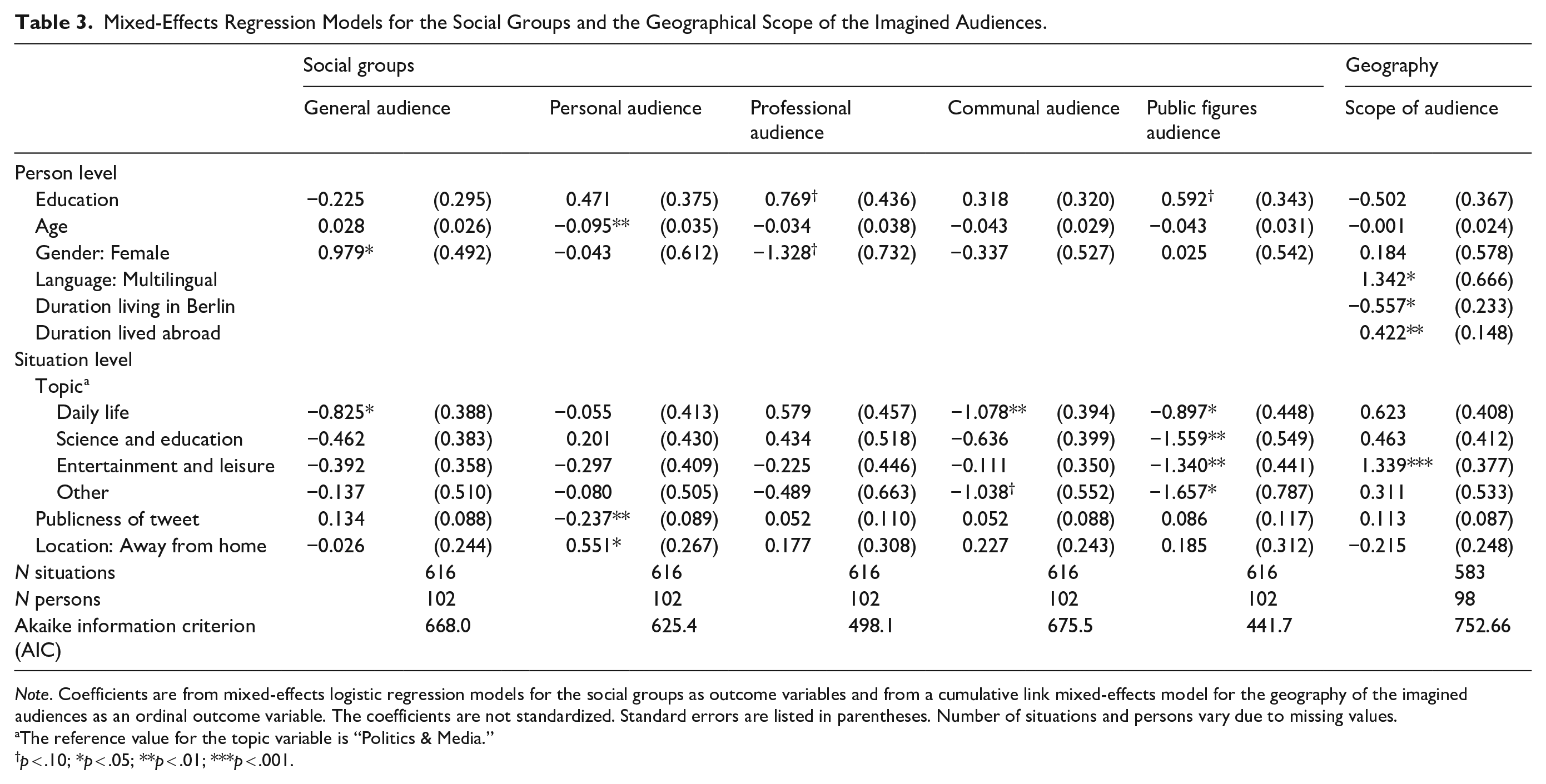
Note. Coefficients are from mixed-effects logistic regression models for the social groups as outcome variables and from a cumulative link mixed-effects model for the geography of the imagined audiences as an ordinal outcome variable. The coefficients are not standardized. Standard errors are listed in parentheses. Number of situations and persons vary due to missing values.
The reference value for the topic variable is “Politics & Media.”
p < .10; *p < .05; **p < .01; ***p < .001.
Respondents’ imagined audiences also varied depending on message content. When interpreting results for the topic variable, it should be noted that effects are relative to tweets about “Politics and Media.” Compared to situations where respondents talked about politics, tweets about “Daily Life” topics were especially unlikely to evoke a general audience (b = –0.825*, SE = 0.388). A similar pattern emerged for communal audiences, which include people with similar hobbies and those known through political engagement. They were imagined when tweeting about politics and media, but less when discussing matters of daily life (b = –1.078**, SE = 0.394). Moreover, compared to the reference topic, all other topics had a negative relationship with imagining public figures (Daily Life: b = –0.897*, SE = 0.448; Science and Education: b = –1.559**, SE = 0.549; Entertainment and Leisure: b = –1.340**, SE = 0.441; Other: b = –1.657*, SE = 0.787). That is, when users tweeted about politics or public affairs, they were especially likely to have public figures in mind as addressees. The second content variable, the perceived publicness of tweets, showed a significant effect on the imagination of a personal audience (b = –0.237**, SE = 0.089). Twitter users did not think of their friends and family when they discussed matters of public interest on Twitter.
To account for the way social media are often used on a smart phone while on the go, we included a spatial variable asking about the location of users while tweeting. Being away from home had a positive relationship with imagining a personal public (b = 0.551*, SE = 0.267). In other words, a more public surrounding did not translate to imagining a more abstract, general public; quite the contrary. Apart from that, a person’s location did not influence their imagined audience.
What Explains the Imagination of Geographical Scope
We explored the spatial dimension of imagined audience by asking respondents where they imagined their readers to be located. As we expected people’s biography and personal mobility to impact mental representations of the audience, the model for geographical scope included additional data at the person level.
Indeed, the model (Table 3, right-hand side) showed that a longer duration of living in Berlin corresponded with a more local imagined audience (b = –0.557*, SE = 0.233). The experience of having lived abroad translated to imagining one’s audience to be more geographically dispersed (b = 0.422**, SE = 0.148). Being multilingual, which may be an indicator for a more diverse and international personal network, also predicted a higher geographical scope (b = 1.342*, SE = 0.666). The other sociodemographic variables did not have a significant impact on the spatiality of imagined audiences.
Message content also impacted the scope of the imagined audience. For tweets about “Entertainment & Leisure,” which included sports and traveling, respondents imagined an audience with a higher geographical scope (b = 1.339***, SE = 0.377).
Discussion
Imagination is an important aspect in any context that goes beyond direct interactions in a small group of people. This is especially true for social media, where a multitude of laypeople can communicate and encounter a diverse audience. Communication scholars have studied imagined audiences in terms of their social composition. The question of where the addressees whom users have in mind are located had not yet been investigated. Furthermore, the state of research pointed to variations in the imagination of recipients, but the factors influencing this variation had not been further differentiated. Our study extended knowledge on the spatiality of imagined audiences and on their predictors, focusing on Twitter. As a global and potentially boundless platform with a high degree of uncertainty regarding each message’s true readers (Marwick & boyd, 2011, p. 117), Twitter presented a pertinent case to study audience imaginations. Our study thus contributed to efforts of transferring the concept from professional journalists to regular social media users (e.g., Litt, 2012; Litt & Hargittai, 2016). By investigating predictors, it moved beyond the predominantly descriptive focus toward the development of explanatory approaches.
The results of our mobile diary study are consistent with the finding that communicators imagine a general public in most usage situations, while the imagination of personal ties is prevalent for target audiences (Litt & Hargittai, 2016). By allowing multiple-choice answers, we showed that users often imagined both, a general and a target audience, at the same time. They were aware that anyone could read their posts, but still had specific groups of people in mind when creating content. With regard to the spatial dimension, respondents imagined an audience with a broad geographical scope. This was true even for target imagined audiences, like personal ties, pointing to the internationally mobile nature of our target population of highly active urban Twitter users.
Our data demonstrated that the spatial and social dimensions of imagined audiences were dependent on both the situation and the communicator. In particular, the post’s topic proved to be an important predictor for imagining different kinds of audiences. With regard to the geographical scope of the audience, the spatial anchoring of respondents influenced how geographically distributed they imagined their audience to be.
Our findings on the social and spatial dimension of imagined audiences have implications both regarding Twitter as a communication network and the differential nature of its usage patterns. Our results corroborate French and Bazarova (2017) who argue that Twitter more closely resembles a broadcast medium than a social network for local interactions. The respondents in our study did not imagine a local audience at the neighborhood level, and even imaginations of a city-wide audience were relatively rare. In most usage situations, a general public was imagined, supporting the nature of Twitter as a news channel (Colleoni et al., 2014, p. 327). This perception and use of Twitter as a public, broadcast medium may also be influenced by sociodemographic characteristics of its users. We found that older Twitter users, in particular, were less likely to imagine personal audiences. They may have perceived its broadcasting function more strongly, while younger Twitter users engaged with the platform more as a social network.
The influence of personal characteristics on the imagination of audiences ties into research on digital literacy and media usage patterns. We found that people with higher education were more likely to imagine professional audiences and public figures: Highly educated people used the platform for work and to address political actors. This finding resonates with research on digital inequality, stating that highly educated people are more likely to engage in “capital-enhancing” activities on the Internet (Hargittai & Hinnant, 2008, p. 615). In addition, male Twitter users were more likely to imagine a professional audience, which may be an expression of the gender gap in Internet usage (van Deursen & van Dijk, 2014). Users with a history of personal mobility and a cosmopolitan orientation, indicated by their use of multiple languages in their daily lives, imagined more geographically distributed audiences. By contrast, people with a longer connection to their place of residence imagined more locally bound audiences.
Altogether, these findings on predictors of the spatial and social dimensions of imagined audiences highlight the importance of personal biographies and social positions, which shape ideas about the impact and reach of users’ social media communication. At the same time, the results highlight the fluidity of perceptions, even within the same user. The imagined audience’s variability, depending on message topic, emphasizes a necessity for research to account for both personal and situational factors to understand media usage and effects in complex, digital settings.
While providing new insights into the spatial and social dimensions of imagined audiences, this research has limitations, which should be addressed in future work. Our data were collected in one specific context: Berlin as a city may have shaped the personal networks of our respondents. As we found influences of the spatial anchoring of respondents on their imagined audiences, it would be worthwhile to investigate other geographical contexts with different characteristics. More broadly, the focus on Twitter as a platform and prolific users as a target population means that our findings pertain to an urban, elite, internationally mobile group of social media users. Imagined audiences have been shown to be partially related to the communication platform (French & Bazarova, 2017; Kim et al., 2018), so our findings may not be generalized to other social networking sites. Rather, Twitter’s properties, including its highly public nature, asymmetric relationships, and possibility for anonymity, all may have shaped our respondents’ perceptions of their audiences. Focusing on highly active and experienced users of one platform also meant that we limited variation in usage patterns and media repertoires. Future research should therefore include different platforms, user groups, and usage patterns to understand the extent to which our findings are generalizable or context specific.
The MESM design had the advantage of accessing users’ imaginations close to the usage situation, but required the reduction of complex constructs to standardized questions. Mixed-methods designs, which integrate MESM and interview data, could add nuance to our understanding of users’ perceptions. Furthermore, we did not investigate the extent to which imagined audiences overlapped with actual audiences. Combining survey data on audience imaginations with platform data on users’ followers or engagement with their tweets could advance our understanding of whether users’ ideas about their audiences are accurate.
The study shows that a differentiated look at the composition of imagined audiences and their predictors provides insightful results on imagined audiences specifically, and public communication on online social networks more broadly. It provides a starting point for future hypothesis-testing studies. Finally, our results on where social media users imagine their addressees to be located brings into focus the spatial dimension of digital public communication which has been out of sight for too long.
Footnotes
Appendix
Operationalization of Predictor Variables.
| Variable | Original values | Distribution | New values | Distribution |
| Person-level predictors | ||||
| Education (n = 103) |
No degree | 0 | ||
| High school degree | 25 | |||
| Professional diploma | 13 | |||
| College/university degree | 65 | |||
| Age |
Year of birth | 2020 – year of birth | M = 33.55, SD = 9.83 | |
| Gender |
Female | 35.2% | ||
| Male | 63.8% | |||
| Other | 1% | |||
| Multilingual |
Language family: 19 Languages to choose from + free text field | Not multilingual if language family = language friends = language colleagues | No: 61.2%; Yes: 38.8% | |
| Language friends: 19 languages to choose from + free text field | ||||
| Language colleagues: 19 Languages to choose from + free text field | ||||
| Duration of living in Berlin |
Time periods in months and years | <3 months: 0% |
||
| Duration of living abroad |
Time periods in months and years | <3 months = 8.6% |
||
| Variable | Original values | Distribution | New values | Distribution |
| Situation-level predictors | ||||
| Tweet topic |
Entertainment and culture | 23.1% | Entertainment and leisure | 27.3% |
| Sports | 2.9% | |||
| Traveling and foreign cultures | 1.2% | |||
| Politics, economics, and law | 24.3% | Politics and media | 29.1% | |
| Media and journalism | 4.8% | |||
| Education | 1.7% | Science and education | 15.1% | |
| Science and technology | 5.4% | |||
| Environment | 1.8% | |||
| Health and medicine | 6.2% | |||
| Family and friends | 6.2% | Daily life | 20% | |
| Lifestyle | 7.9% | |||
| Work and business | 5.2% | |||
| Religion and philosophy | 0.8% | |||
| Other | 8.5% | Other | 8.5% | |
| Publicness of tweet |
1 = extremely private to 7 = extremely public | M = 5.8; SD = 1.66 | ||
| Location while tweeting |
At home | 50.7% | At home | 50.7% |
| At work/university/school | 23.1% | Away | 49.3% | |
| In transit | 16.9% | |||
| Running errands | 0.5% | |||
| Out to eat or drink | 2% | |||
| Out for leisure | 1.8% | |||
| Out in the streets | 1.2% | |||
| Out in nature | 0.3% | |||
| Visiting friends or relatives | 0.9% | |||
| Other | 2.6% | |||
Declaration of Conflicting Interests
The author(s) declared no potential conflicts of interest with respect to the research, authorship, and/or publication of this article.
Funding
The author(s) disclosed receipt of the following financial support for the research, authorship, and/or publication of this article: Funded by the Deutsche Forschungsgemeinschaft (DFG, German Research Foundation)—Project number 290045248—SFB 1265.
