



Abstract
Social media contributions surrounding the Charlie Hebdo attacks have been key in the creation and evolution of the image of Islam online. While the attacks were seen as an affront to French values and ways of life, online exchanges have traveled around the globe. Especially with social media platforms, such as Twitter and Instagram, offering immediate translations of captions has increased the reach of posts immensely. Specifically, hashtag use has the ability to transcend national boundaries and helps in the creation of echo chambers and or fuels trench warfare online. This article extends on this work by examining how the image of Islam is transmitted and changed on Instagram through the use of the hashtag #CharlieHebdo. Specifically, the following three primary research questions are examined: (1) How does hashtag co-occurrence, in the discussion surrounding Charlie Hebdo, indicate echo chamber behavior? (2) How does trench warfare impact the debate surrounding the image of Islam within the #CharlieHebdo conversation? (3) Which categories can posts be put into based on other hashtags that are used simultaneously? To answer these questions, Instagram posts, posted nearly 6 years after the Charlie Hebdo attack was perpetrated in Paris and during the time of the trials of the suspects took place, are used as a case study. It was found that Islamophobia within the Charlie Hebdo debate online indeed indicates echo chamber behavior. The significance of this study was found to be two-fold. First, it extends the research on detecting echo chamber behavior through social network analysis and sentiment analysis of co-used hashtags. Second, it highlights the fact that trench warfare is a well understood tactic by Instagram users, for the hijacking of hashtags, and the role it plays in the polarization of hashtag communities.
Introduction
In the 21st century, the link between the words terrorism and Islam are undoubtably established within society, politics, and (most of all) media. Social media has been found to be responsible for the shaping and forming of public opinion based on a new pattern of power relations and in the manifestation of Islam in the cyberworld (Aguilera-Carnerero & Azeez, 2016).
Social media exchange has been found to be particularly valuable for spreading far-right discourses far within the country of origin, but the far-right parties rarely engage in spreading their discourses transnationally (Froio & Ganesh, 2019). This is not to say however that racist, xenophobic, and especially Islamophobic posts do not have an international reach. Demonization of Muslims and Islam is specifically attained on social media through the conceptual simplification of Muslims at large into terrorists (Aydin et al., 2021; Civila et al., 2020). Through repetition, symbolic divergence, and euphemisms, a symbolic construction of reality is promoted “under the conceptual simplification protagonist-antagonist, which causes the ‘other’” (Civila et al., 2020).
The debate today is no longer whether social media is an environment for cyber hate, but rather how hate is being transmitted and how this affects the image of Islam. Research in social media and group formation show that it is not only selective exposure (echo chamber effect) that leads to attitude reinforcement, in fact, the exposure to opposing arguments achieves the very same result and this phenomenon is known as “trench warfare” (Karlsen et al., 2017). It is the interplay of these mechanisms that shape the online discussion surrounding Islam that are at play when discussing terror attacks perpetrated on western soil.
While much research exists on echo chambers, and the effects thereof, scholarly work on the topic is very polarized with many even questioning the validity of such a concept (Dubois & Blank, 2018). While the concept had its high time in the beginning of the social media boom in the early to mid 2010s, it since then lacks more thorough research. Especially, since most works focus on whether the echo chamber effect can even exist or not (Guess et al., 2018), the concept lacks empirical research and could benefit from more investigation of its effects in relation with other concepts. Researching this concept within the study of group polarization (viewed through the lens of persuasive argument theory) would also greatly add to scholarship surrounding this Internet phenomenon. Especially studying the effect of echo chambers with, a more recent phenomenon, trench warfare poses a fusion that has been scarcely researched, yet that poses an interesting ground on which to study the controversial debate surrounding Islam online.
One main way in which the discussion of Islam online is taken up after traumatizing events, such as terror attacks, is through the use of hashtags. Hashtags illustrate this pattern beautifully and can be seen most clearly on Twitter and Instagram. Hashtags make posts searchable (Dorsch, 2018), archive messages for a(an advocacy) movement (Bruns & Burgess, 2011), and most importantly spread virally to other users of these social media platforms (Saxton et al., 2015). The use of hashtags thus transcends country boundaries and influences echo chambers (by addressing like-minded people; Cota et al., 2019), but might also encourage trench warfare; by presenting a controlled sphere in which to have arguments between those with a negative sentiment toward Islam and those defending it (Poole et al., 2021).
This article aims to extend the scholarship surrounding the interrelated effects of echo chambers and trench warfare by examining how the image of Islam is transmitted and changed on Instagram through the use of the hashtag #CharlieHebdo. This will be done by focusing on group polarization dynamics conceptualized by the persuasive argument theory. The theory is specifically of interest to this article because it provides an approach where it is possible to investigate, not only the existence but, the coexistence of the echo chamber and trench warfare concepts. These two concepts will be applied to the data and to thus gage their possible interplay in the Charlie Hebdo discussion online. The main aim thus is to find out if and how echo chambers and trench warfare work in tandem in this case study and how it is manifested in hashtag co-occurrence.
In this article, the following three primary research questions are examined:
RQ1. How does hashtag co-occurrence, in the discussion surrounding Charlie Hebdo, indicate echo chamber behavior?
RQ2. How does trench warfare impact the debate surrounding the image of Islam within the #CharlieHebdo conversation?
RQ3. Which categories can posts be put into based on other hashtags that are used simultaneously?
To answer these questions, Instagram posts, posted nearly 6 years after the Charlie Hebdo attack was perpetrated and during the time of the trials of the suspects took place, are used as a case study.
Persuasive Argument Theory: The Interplay of Hashtags, Echo Chambers, and Trench Warfare Surrounding Charlie Hebdo
Charlie Hebdo Case Study
On 7 January 2015, two self-proclaimed Islamist brothers, Saïd and Chérif Kouachi, stormed the Parisian Charlie Hebdo offices and killed 12 people of which the majority were journalists working at the satirical magazine. The brothers were allegedly heard yelling Islamic slogans and that they had now taken revenge on the establishment for reprinting a highly controversial caricature of the prophet of Islam. The attack was the first of two further attacks that were perpetrated in and around Paris and that included the killing of a policewoman and an attack on a Jewish supermarket.
The Charlie Hebdo attack soon became a highly symbolic attack because it manifested a key conflict the Western world was facing (Luengo & Ihlebæk, 2019). The struggle between free speech and religious principles became a hotly debated topic after the initial publishing of 12 caricatures of Prophet Muhammad in 2005 by Danish newspaper Jyllands-Posten and received severe backlash from Muslim communities around the world. However, not only does the fact that the Charlie Hebdo attacks represent a conflict between two polarized communities make it an ideal case study to use for this research, but also the fact that the hashtags associated with the attack (#JeSuisCharlie, #CharlieHebdo, #JeNeSuisCharlie, #JeSuisAhmed) went viral (Giaxoglou, 2018) play a key role in this research. In addition, the continued use of the hashtags on social media after more than 6 years also contributes to the exploration of the temporal dynamics of hashtag use (Booten, 2016). This will be done implementing persuasive argument theory to investigate online polarization and how this polarity is cultivated.
Persuasive Argument Theory
Currently, there is an abundance of research that focuses on the online reactions of netizens after disruptive events, such as terror attacks. Emotional solidarity is found to be one of the main reasons for the creation of hashtag communities in which “the provision of coordinated instrumental social support is a key mediator of bonding and a predictor of collective efficacy” (Tomkova, 2020). Here, especially the Charlie Hebdo hashtags are considered to be vital because, since 2015, they have inspired a multitude of “JeSuis . . . ” spin-offs (De Cock & Pedraza, 2018) used as viral mobilizers of communal support for emotionally directed social causes (Civila et al., 2020). So, while “managing collective trauma” (Eriksson, 2016) became a core principle of sharing on social media, and more specifically through hashtags, after terror attacks, it still remains unclear why certain hashtags have the power of going viral and more importantly why a hashtag such as #CharlieHebdo is able to survive years later. Research today focuses on the linguistic (Smyrnaios & Ratinaud, 2017) aspect of social media content surrounding the debate of Islam within the Charlie Hebdo discussion shared within the realm of certain hashtags after disruptive events. A thorough and comprehensive research that studies the overview of co-used hashtags and their synergy is under-researched. Hashtag co-occurrence research, especially those performed on hashtags used years after the main disruptive event, can provide rich information that transcends issues such as language and location (of the event).
Persuasive argument theory, and the highly related concept of group polarization, describes the reason for a possible push toward extremist views or radicalization within communication groups. Here, the theory builds on the premise of common sense, that within a group, the position of an individual is based on the most persuasive argument (Sunstein, 1999). The premise builds on the understanding that people, who search for an outlet, already have a pre-conceived opinion on something and that the most persuasive opinion, in a group that reflects the basis of one’s beliefs, will sway the other members into a more polarized direction (Sunstein, 1999). Similarly, echo chambers, or more generally selective exposure behavior, lead one to interact with content that confirms ones pre-existing views and thus triggers ideological polarization (Spohr, 2017). Research suggests that echo chambering was actively happening directly after the Charlie Hebdo attacks in 2015 (Bodrunova et al., 2018) and that different Charlie Hebdo hashtags carry different sentiments (i.e., #jesuischarlie vs #jesuisahmed; An et al., 2016). However, studies prove that while most political exchanges on social media occur between people with like ideas, cross-cutting interactions are more frequent than formerly believed (Barberá, 2020) and that political polarization has actually increased in, for example, the United States (Boxell et al., 2017). Therefore, it is argued that the very exposure to cross-cutting views is what is causing the polarization effect (Bail et al., 2018). One reason for this is argued to be a phenomenon called “hashtag hijacking” in which people use trolling maneuvers on established hashtags to spread far-right or misogynistic sentiment, by co-using these hashtags with their own hashtags (Willis, 2020).
This article thus argues that it is the interplay of conversing within like-minded groups and also being confronted with cross-cutting views, for example, echo chambers and trench warfare, that can make way to increased polarization within hashtag groups. Therefore, it is assumed that the “most persuasive argument” must not be an argument that the user actually agrees with, but can also be one that the users is completely opposed to. This approach builds on previous research that has investigated echo chamber polarization on social media through persuasive argument theory (Sharma & Vasuja, 2022) and that call for a more complex approach toward online polarization (Keijzer & Mäs, 2022).
This article also takes a novel approach of using of social network mapping of hashtag co-occurrence as a means to prove echo chamber behavior, since it is shown that the more hashtags are polarized the more the hashtags are co-used with similar hashtags (Dai, 2021). Implementing this within the Charlie Hebdo conversation over 6 years after the attack illustrates how the debate on Charlie Hebdo remains alive and how it has focused on different categories, or spheres, of conversation. Social network analysis (SNA) thus makes it possible to gage not only echo chamber behavior, groups that are found through the use of similar hashtags co-used multiple times, but also trench warfare, within hashtag groups that also have a high modularity and degree to the main hub but show inconsistent sentiment. To do this, one must understand the importance of social media hashtags and what pivotal role they play in sentiment dissemination.
Hashtags and Ideology
Instagram has been found to have experienced a drastic increase in new users joining during the quarantine of the COVID-19 pandemic’s first wave (IAB Spain [IABS], 2020). Two important features that set Instagram and Twitter apart from other social media platforms is (1) the flat hierarchy of the messaging system which does not rely on degrees of connection (i.e., family or friends) and (2) the use of hashtags which allow for the automatic aggregation of all posts with the same hashtag.
At its fundament, the hashtag is nothing more than a simple keyword formatted to act as a hypertext and could perform the same function without the hash-symbol. The deliberate inclusion of the symbol, however, distinguishes posts from regular text and is a conscious decision of the user to make the post searchable within a specific online discussion (Bruns, 2012). While hashtags seem fairly similar at face value, they do serve different purposes. Two of the main purposes that hashtags play have been found to be tie formation, by maintaining communities and self-representation, but also a way to assert ideological stances (Xu & Zhou, 2020).
The hashtags surrounding the Charlie Hebdo shooting, that appeared immediately after the attack, are a clear indicator of this particular phenomenon and can be viewed in a sort of spectrum of ideologies. The hashtag #JeSuisCharlie (I am Charlie) in particular was an endorsement of not only the satire magazine but also greatly focused on the fundamental right of freedom of expression. The reactionary hashtag #JeNeSuisCharlie (I am not Charlie) directly opposed the endorsement of the publication and freedom of speech when used for xenophobic or racist purposes. Another associated hashtag which gained much attention was the #JeSuisAhmed (I am Ahmed) and refers back to one of the policemen killed in the terror attack. This hashtag is mainly made up of responses which try to differentiate between Islam and terror and raise the point that among those defending freedom of speech are also Muslims such as Ahmed (An et al., 2016).
While it can seem that hashtag use is a very exclusive means of communicating or linking posts on social media, it is very common to use a collection of hashtags in one single post. An overlap in hashtag use is a very frequent occurrence and can also be clearly witnessed in the overlap of both the #JeSuisCharlie and the #JeSuisAhmed hashtags in one post (An et al., 2016). In fact, this phenomenon has been called the “inter-ideological mingling” and documents how the use of hashtags might help avoid homophily on social networking sites (Graham, 2016). This phenomenon has been found to consist of several strategies that are used especially by white extremists to fuse right-wing extremist terms with more mainstream communication on social media sites and to gain greater exposure. The main strategies of these consist of “joining” and “blending” extremist hashtags haphazardly with trending hashtags or blending them in a logical manner and with connections between the hashtags (Graham, 2016).
Echo Chambers and Extremism
One main concept that has been discussed extensively with regard to the impact of media has been the concept of echo chambers. Although this concept dates back to traditional media studies, it had gained much popularity with the onset of wide spread social media use. Echo chambers, or alternatively filter bubbles, refer to the consumption and contribution of and to media that is similar to ones own personal beliefs and views (Wollebæk et al., 2019); which ultimately “creates positive feedback loops” for users (Jamieson & Cappella, 2008).
Social media especially is believed to be key in the creation of echo chambers, due to the makeup of some social media platforms (i.e., Facebook and Instagram) which “use algorithms that expose users to content based on previous preferences and behaviors” (Wahlström & Törnberg, 2021). It is proven that echo chambers are most likely constructed around right-wing sentiments (Hmielowski et al., 2020) and that they are especially popular with right-wing populists and are used primarily to circumvent elitist media and law enforcement (Krämer, 2017).
While echo chambers are built based on political views or personal interest, it is trigger events such as terror attacks that reinforce these filter bubbles. “Tweets” and “likes,” by so-called cybermobs, in turn boost negative sentiments like anti-Muslim hostility and can finally lead to real life targeting of Muslims (Awan, 2016).
Analysis of echo chambers and especially right-wing populist ones have shown that Muslims are strongly vilified and almost always “represented as very violent, disparaging and extremist [and] as being strongly supportive of terrorism and attacks against America and the West” (Aguilera-Carnerero & Azeez, 2016). Also, a constant fear of “White safety” at the hand of radical Islamic terrorism, or Islam at large, has been specifically identified in right-wing hashtag groups online (Eddington, 2018). One danger that these types of echo chambers pose is the fact that they are able to normalize cyber hate speech (Riley, 2022) against a perceived “out-group” (Harel et al., 2020). In addition, negative labeling of refugees or religious minorities (Lee & Nerghes, 2018) and the creation of individual definitions of terms such as “jihad” and “islamist” and can thus vilify the entire religion based on this new definition (Aguilera-Carnerero & Azeez, 2016).
Previous studies on echo chambers on social media have found that online platforms such as Twitter provide the ideal habitat for communication between far-right organizations and individuals harboring such sentiments. This is due to the minimal costs associated with sharing such posts and the range by which these posts can travel in the shortest period of time (Davey & Ebner, 2017). However, one major obstacle that far-right communication within the echo chamber, and thus, the expansion of the echo chamber, faces is transnationalization. It has been proven that while anti-Muslim prejudiced tweets are the most likely posts to be shared transnationally, and are considered to be the “transnational glue of the far-right” (Froio & Ganesh, 2019), language constraints limit the degree of transnational communication (Froio & Ganesh, 2019).
However, one recent development that social media platforms, such as Instagram and Twitter, are now implementing is the translate function that allows for captions of posts and tweets to be translated seamlessly with only one press of a button. This has the potential to bypass this issue and to ensure a higher rate of transnational communication.
Trench Warfare and Disconfirmation Bias
The echo chamber concept was a very popular topic that was studied in the earlier years of the wide spread use of social media platforms. However, studies today prove that, while individual still selectively exposes their self to information that they agree with more often, they do not tend to disregard information and ideas that are conflicting to their own views (Dubois & Blank, 2018).
While echo chambers remain a long-disputed topic, new theories such as the trench warfare approach have surfaced. This approach focuses strongly on previous user bias rather than exclusively on the media surrounding of the user. Thus, “when people are presented with opposing arguments in online debates, these arguments may not make debaters question and alter their initial opinion but instead lead to a stronger belief in the previous held opinion” (Karlsen et al., 2017). Therefore, it can be said that while people have a greater chance of meeting like-minded people through the help of the Internet, it is this environment that biases users when they are faced with views that are in opposition to their own views.
The bias that is gained through constantly moving in like-minded spheres is well-established as confirmation bias whereas disconfirmation bias is thought to be created through trench warfare, that is, the reinforcement through contradiction (Karlsen et al., 2017). Consequently, echo chambers and trench warfare do not negate each other, but can rather function alongside each other. So, while Internet users grow their filter bubbles and create their echo chambers, trench warfare allows users to spar with users of opposing views and hashtags pose the necessary battle ground. Hashtags bring together those users that see a hashtag like a “virtual wearing of a team jersey” with those of opposing views and can lead to virtual battles called “tweet wars” (Smith & Smith, 2012). Alternatively, they are also known as “hashtag wars” which are defined as “discursive struggles about the hegemonic narrative over the same facts” (Soares & Recuero, 2021) on social media.
As discussed earlier, the hashtags used after the Charlie Hebdo attack in 2015 is known to have been a platform on which opposing opinions clashed (Mondon & Winter, 2017a). Here, the use of #JeSuisCharlie especially was flooded, however, with exclaims of Islamophobia and was countered by cries defending Islam. Islamophobic content has been shown to have been of two kinds namely illiberal and liberal Islamophobia. Illiberal Islamophobia is most like the traditional forms of racism known from the extreme far-right and is based on an exclusivist notion. Liberal Islamophobia works similarly by creating a stereotypical image of Islam (belief and culture; Moe, 2019) and Muslims as that which is “inherently opposed to some of the core values espoused in mythical and essentialized culturally homogenous, superior and enlightened West or Western nation” (Mondon & Winter, 2017b).
Currently, research suggests that although the Charlie Hebdo attacks were used quite unevenly, throughout the Western nations, they were strongly tainted by right-wing Islamophobic content (Mondon & Winter, 2017b). Likewise, Poole finds that, right-wing networks active behind Islamophobic content of viral hashtags like #JeSuisCharlie are so tight knit that they have in place common memes that they used in order to “mock common criticism of Islamophobia while simultaneously propagating hate speech” (Poole et al., 2021).
Methodology
To address the research questions posed by this study, groups of hashtags were identified based on a SNA conducted on all co-occurring hashtags with the umbrella hashtag #CharlieHebdo. Instagram data were used for this research since Instagram has gained in even more in popularity during the COVID pandemic (IABS, 2020) and because of the richness in data that it provides through hashtags, captions, and visual content.
All posts with the hashtag #CharlieHebdo were downloaded from Instagram and accompanying hashtags that were used in the posts at the same time were downloaded and further analyzed. Instagram data were collected for the time frame of October 2019 to February 2021 and coincided with the trials of the suspects connected to the Charlie Hebdo attack in 2015. These data were downloaded through the Python module “instaloader,” which acts as an application programming interface (API) for Instagram. From the Instagram posts, a total of 2873 unique hashtags were extracted and cleaned with the open-source tool “OpenRefine.”
Hashtag Cleaning
During the cleaning process hashtags that were obviously related (based on colocation in the tweet) were aggregated, no data were removed, nor additional data added (Allen, 2017). Also, hashtags with the same meaning but written in different languages were not aggregated, in order to preserve the possible hashtag hubs and linkages of hashtags of the same language (i.e., “#6earsago” and “#6ansdéjà”). Only typos of popular hashtags were changed and aggregated with similar hashtags (i.e., #charlihebdo and #charliehebdo). Additionally, hashtags where the same word was in lower or upper case were aggregated. Then, a SNA was conducted in order to analyze the relation of the different hashtags to one another and to construct different groups based on these relations (Gruzd et al., 2016).
Hashtag Classification
One of the aims of this study was to find out how the different hashtags can be divided into different groups based on their interrelation to one another (Eriksson Krutrök & Lindgren, 2018). In order to find out how likely it was for a post to include another hashtag (or hashtags). For this, the software “Gephi” was used and in which the SNA was performed (Bastian et al., 2009). Here, the hashtags were ranked according to which were used the most and then which hashtags were linked to those main ones. In order to do this, the modularity of these hashtags was measured which segregated them into groups based on their relations (Pilař et al., 2021). Finally, the radial axis layout was implemented. This layout is used to measure homophily within a social network by presenting the dissemination of the hashtags in groups with their associations to other hashtags (Cherven, 2013).
Identification of Hashtag Sentiment
Once all hashtags were ordered, according to modularity percentage, and were then organized by their relation to other hashtag groups, the main hashtags of each group were labeled according to sentiment (Wang et al., 2011). From here, the groups with the most difference in sentiments were further analyzed in terms of the trench warfare dynamic. For hashtags and posts in different languages, that were not languages that the authors spoke, the hashtags were translated simultaneously by the Google API and by native speakers. Finally, a manual analysis of visuals was performed in order to gage if the hashtag sentiments matched the sentiment conveyed in the image shared.
Findings
The #CharlieHebdo was found to be linked with a large variety of other hashtags that were found to be more or less related to the actual topic of the Charlie Hebdo attacks in 2015 and the trials that took place at the end of 2020. In order to answer RQ1, all hashtags were analyzed in a SNA, further examined based on modularity class percentage, and finally plotted through the radial axis layout. This was done in order to determine the different interrelated hashtag groups that would occur and how these would translate into echo chamber behavior. For RQ3, the different groups were then assessed based on their validity of having both high modularity percentage and secondly, being closely related to the main hashtag hub. This then allowed for the categorization of the different groups into the relevant and less relevant categories. For the second research question, the relevant hashtags identified before were then further analyzed based on sentiment.
Figure 1 shows a general overview of all hashtags that were found to be related to the main hashtag. Here, each node denotes a specific hashtag used and the size of the nodes illustrates the popularity of the specific hashtag. The edges’ (i.e., the connections between the nodes) weight or the thickness of the edges show how often the hashtags were posted right after the mention of the main hashtag. It was found that while there were hundreds of hashtags used, some hashtags seem to be related more closely than others. This is why all the hashtags were divided into modularity classes. Modularity is used to measure the force of separation into units and is often used to analyze the community structure and to show denser connections between hashtags. The different colors in Figure 1 denote the different communities of hashtags.

Overview of hashtags related with #CharlieHebdo partitioned into modularity classes.
In Figure 2, the main modularity classes can be seen and correspond to the classes that scored the highest percentage. In total, 95 different categories were found, however only 16 classes scored over 1% modularity. Table 1 indicates the main hashtag of the different classes and the different percentiles that the classes scored.
Modularity Classes Denoted by Color and Ordered by Highest Degree First.

Modularity percentage and first three most popular hashtags within the modularity class.

Overview of hashtags with main modularity classes.
One main category is found to be highly central to hashtag usage and fittingly corresponds directly to the main hashtag studied in this article. The hashtags that are part of this category include the main hashtags “JeSuisCharlie,” “Charlie,” and “7Janvier2015” and relate mainly to the actual attack itself or to Charlie Hebdo the magazine (“caricature” and “satire”). In addition, hashtags “hommage” (Eng: “tribute”) and “accaddeoggi” (Eng: “today in history”) reference back to the anniversary of the attack or the trials.
While modularity classes do provide the data with an overall partition into topic communities, the resulting classes were further analyzed based on the relation of these hashtag hubs with regard to the main hashtag. This is why the hashtags were systematized according to their degree toward #CharlieHebdo. The Radial Axis Layout was thus implemented to further analyze the data (Figure 3).

Radial axis distribution. Colors denote modularity class. Nodes in counter-clockwise order from node “CharlieHebdo” according to degree.
This is of utmost importance since although some categories might have a high-modularity percentage, they are not necessarily high in degree with regard to the main node. For instance, both “bandedessinee” and “SerCuioso,” which are the most highly related hashtag categories, have a rather low-modularity percentage and are highly interdependent to the CharlieHebdo group. Both “bandedessinee” and “SerCuioso” are made up of a majority of terms in different languages other than English which seems to be the case in most of the other main groups. The first hub consists mainly of French hashtags, whereas the latter consists of a mix of English, Spanish, French, Turkish, and German terms. The first category encompasses mainly French terms that could be described as fundamental French values and include hashtags such as “laïcité,” “culture,” “famille,” and “education,” but also religious terms such as “catholiques,” “JesusChrist,” but also “sharia.” The latter hashtag hub, however, could be said to focus more on print and journalism, with “journalismo,” “booksbooksbooks,” and “fransadakitürkler” (Eng: “Turks in France”) as prevalent hashtags.
On the other end of this pattern, categories such as “Магомедисмаилов” and “munawarfaruqui” scored a low-modularity percentile and the degree was also relatively low. Category “Магомедисмаилов” is mainly made up of Russian terms and focuses on Russian boxer “Magomed Ismailov” and the Navalny issue but does not seem to be related deeply with the Charlie Hebdo attack. The hashtag hub “munawarfaruqui” also does not seem to be significantly linked with the Charlie Hebdo issue other than the connection between the debates of free speech surrounding the case of Charlie Hebdo and the recent debate about free speech in the case of Indian Muslim comedian who allegedly made a political joke insulting Hindu religious sentiments and was arrested on these charges (BBC, 2021).
The main categories that were found to be significant were those that scored a high-modularity percentage and had a relatively high degree and were considered to qualify as indicating echo chamber behavior. The hashtag hub “France” is the first category that qualifies for both characteristics. Interestingly, the first hashtag within this hub is “paris” followed directly by “muslumans,” which addresses Muslims but is a neutral hashtag. This group in general seems to be hashtag neutral and does address Islam but in an over neutral or friendly tone with “Islamfrance” and “rappelislamique” (Eng: Islamic reminders). Only one hashtag “fuckterrorism,” although a popular one within the group, conveys any type of sentiment. The next category “dankmemes” which does have a lower modularity class but has high to medium degree seems to have little connection to the Charlie Hebdo discussion other than that the #CharlieHebdo was used persistently. It does however encompass several hashtags that are very anti-Islam and Muslims such as “Islamicterrorism,” “fuckislam,” “stopislam,” and “islamsucks” and from Figure 2, it can be seen that it has a very strong connection to both “CharlieHebdo” and “Islam” nodes more so than to any other nodes in other modularity classes.
For the second research question, it was found that the hub “Islam” was the most interesting and showed some form of trench warfare happening. The hub “Islam” proves to be the category with the most hashtags that have both positive and negative sentiment toward Islam. While “islamiscancer” is the second most popular hashtag within this category, it is followed by many more with a similar sentiment such as “islamistheproblem,” “islamisajoke,” “islamexposedagain,” “wakeupamerica”/“wakeupeurope,” “crusader,” and “deusvult” (Eng.: “God wills it” a Latin Catholic slogan linked to the Crusades). However, these hashtags are juxtaposed with hashtags such as “Islamiccivilization,” “eid,” “boycottfrenchproducts,” “islamicquotes,” and “rasoolallah.”
Similarly, the hashtag hub “terrorisme” (Eng.: terrorism) seems to be similar to the latter hashtag category with regard to having a both negative and positive sentiment hashtags concerning Islam. However, the terms with a negative sentiment overweigh the others. Hashtags such as “radicalislamicterrorism,” “72virgins,” “muslimmeme,” and “radicalmuslims” predominate over hashtags such as “islamophobie” and “ProphetMuhammad.” The division “nosamislespoetes” (Eng.: Our friends the poets) is connected to the main hashtag through the mention of many of the journalists or staff that worked at Charlie Hebdo during the time of the attack and got injured such as “CatherineMeurise” and “philippelançon.” Mentions are also made of the book “lelambeau,” which is the book written by Philippe Lancon about his recooperation after the attacks, and terms such as “bookstagram” and “instapoeme” but does not mention Islam in any way.
Class “gendarmerie” has low modularity and medium degree and makes no reference at all to Islam. It mentions mostly terms that are related to police forces such as “policemunicipale” (Eng.: municipal police), “securite” (Eng.: security), and “gendarmerienationale” (Eng.: national gendarmerie).
The hashtag category “charli,” although it has a high-modularity percentage and a medium degree it has absolutely no connection to the Charlie Hebdo attacks. All of the terms are only related to a TikTok conflict between two popular TikTokers that had taken place during the period that was studied. It is believed that the link between #CharlieHebdo occurred due to the posting of hashtags generated by a popular hashtag generator app in order to gain visibility on Instagram. The connection must have thus been made due to the similarity in names of “Charlie Hebdo” and “Charli D’Amelio.” While this category includes many hashtags directly related to TikTok such as “tiktokindonesia” and “tiktokdance,” it also includes terms such as “charliebrown” which further proves that these hashtags must have been generated. Similarly, the modularity class “govegan” is not linked to the main hashtag at all and is believed to also be generated by third-party hashtag apps. This category does have a low-modularity percentage, which explains why terms promoting veganism are grouped together with hashtags such as “armenia” and “Terrorist” which most probably refer back to the Armenia–Azerbaijan dispute that was taking place in the studied period also.
The last two modularity hubs both score high on modularity percentage but are lower in degree. The class “covid_19” is a collection of hashtags mainly talking about the then current affairs with terms such as “hommagecharliehebdo,” “goodbydonald,” and “confinement.” The category “Art,” however, encompasses hashtags related to creativity and cartoon such as “drawing,” “instacartoon,” and “illustration” and is not linked to Islam in any way.
Discussion
Although the Charlie Hebdo attacks were perpetrated over 6 years ago, a link between the terror attack and Islam has been definitely made through media and is being kept alive through social media. Charlie Hebdo has become a popular motto used for a variety of disputes with Islam, both when discussing terrorism at large and also (to a lesser extent) with other issues concerning free speech. This can be seen mainly in the discussion surrounding Munawar Faruqui, in which however paradoxically the link between Charlie Hebdo is made for the sake of Muslims.
Nevertheless, Islam has become a main point of discussion in the dialogue on the Charlie Hebdo attacks and the trials almost 6 years later. It is found that the main hashtag hub “CharlieHebdo” and the highly interrelated category “bandedessinee” can be seen as indicators of echo chamber behavior where users with similar opinions (see Figure 4) discuss the trials, pay homage, and discuss French culture and values such as “liberte” (Eng.: liberty) and “laicite” (Eng.: secularism).

(a) “Let’s remember January 8, 2015. 6 years ago, Valencia gathered at Place de la Liberte, to say NO to hatred, to terrorism, to barbarism, to submission[. . .].” (b) “NOTHING IS FORGIVEN! CHARLIE AKBAR! Never forget the horror, never put a knee on the ground[. . .].” (c) “6 years . . . I’m still Charlie.”
One specific case of concentrated echo chamber behavior was found in the “dankmeme” category although it is relatively small. One significant factor in this class, however, is the islamophobic hashtags that were used and its strong connection to the “Islam” hub which can be considered the principal category for this research. Upon further analysis, it was found that only one profile had posted every single post on their profile with the same list of hashtags which included “dankmemes,” “charliehebdo,” and “islam” (Figure 5).

Posts that were posted under #dankmemes.
While it could be argued that the “dankmemes” modularity class is relatively low and considering that one user has posted the majority of the posts this might not qualify as echo chamber behavior. However, the fact that there is a large number of posts with these specific hashtags and because the individual posts are findable and offer a place for comments to be made qualify this hub also echo chamber behavior and perhaps an echo chamber in itself.
The pattern that can be observed within the modularity classes “Islam” and “terrorism,” however, show that there indeed seems to be an interaction, in the form of trench warfare, when debating Islam through the #CharlieHebdo. Specifically, the “Islam” category shows that there are indeed posts made of people having a negative and a positive image of Islam that are posting under the same main hashtag #CharlieHebdo to make their opinions heard. Interestingly, it was found that in the most cases, the list of hashtags used in one post was telling of the sentiment that the poster held. So, while users were using the #CharlieHebdo, they were trying to in fact disrupt the information flows, hence breaks echo chamber behavior. Similarly, it can be seen in Figure 6 that most of these Instagram posts were made specifically around the time of the trials or around the anniversary of the attacks. This proves that indeed not only do echo chambers exist within the #CharlieHebdo discussion online, but that there is also evidence of trench warfare.

Instagram posts pro-Islam. English translation: “The Prophet of peace.”
Nevertheless, there was also an interesting pattern observed, in which users who were posting strictly pro-Charlie Hebdo and very anti-Islam were using hashtags with a positive sentiment toward Islam (see Figure 7). This is believed to also prove that trench warfare is a very well understood principle within social media platforms and by social media users. Also, upon further inspection of the comments made under the post in Figure 7, it can be seen that indeed using contradicting hashtags is indeed a clever way in which to initiate a conversation between parties of opposing groups. As the name “trench warfare” suggests, however, this conversation is not meant to be a peaceful one or one in which either party would change their opinion or come to an understanding. On the contrary, it serves only to polarize the person and these posts become posts of the persuasive arguments of the disconfirmed type, thereby strengthening the individuals’ echo chambers.
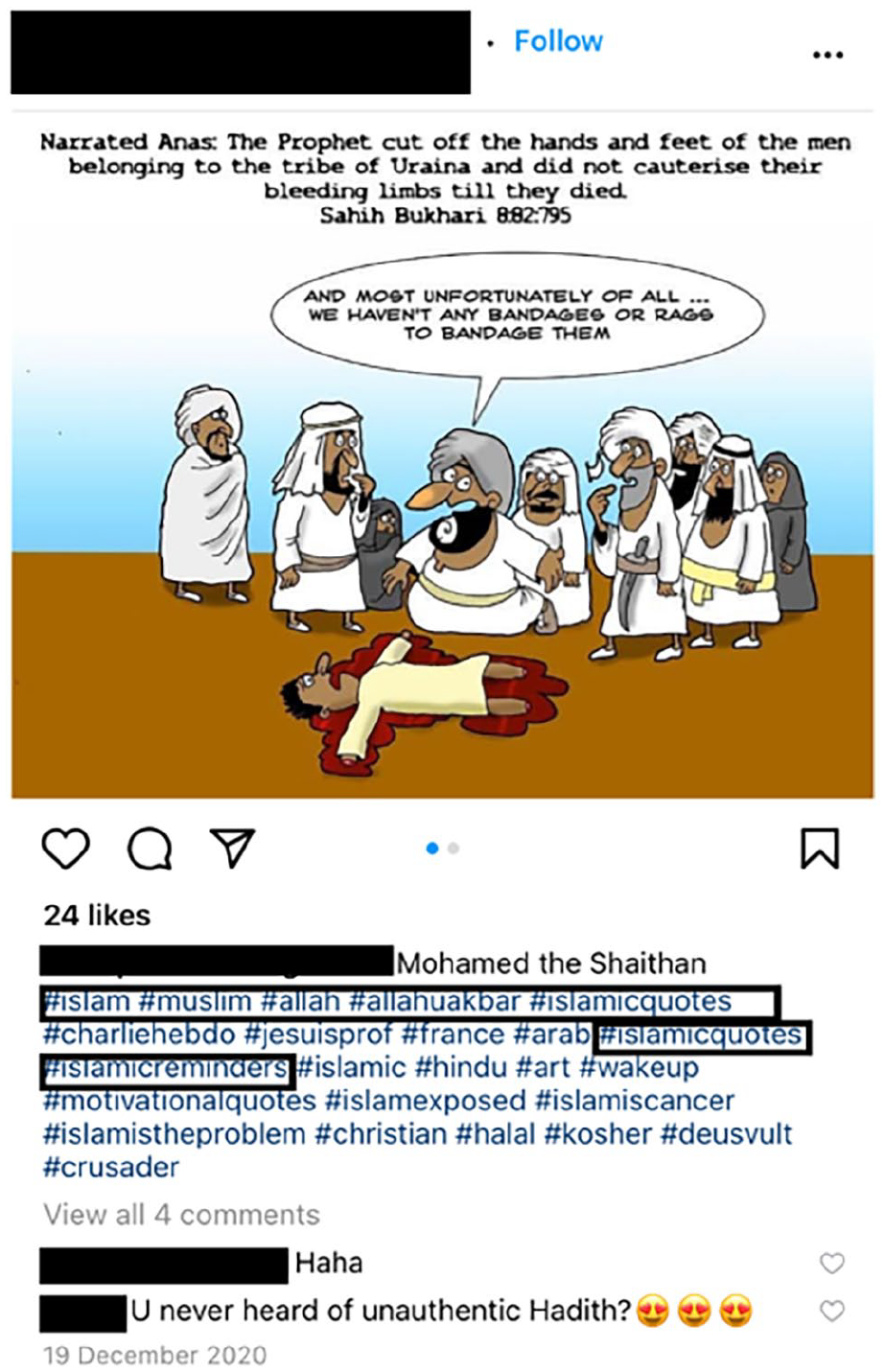
Use of contradicting hashtags as a form of trench warfare.
Therefore, it can be said that indeed a synergy was observed between echo chambers and trench warfare. This strongly suggests that the echo chamber effect is real but that it should not be studied as a stand-alone symptom of social media interactions. It is pivotal to consider the fact that online users themselves are aware of and are able to manipulate echo chambers, resulting in trench warfare.
Limitations and Future Research
Despite these key findings, the study faced some severe limitations. First, the research focused only Instagram posts and it is thus difficult to fully assess the impact the hashtag is making several years after the attacks due to the increase in social media platforms. Recreating this research across different social media platform could give rich insight into the validity of certain hashtags globally and not just on one platform such as Instagram. Similarly, Zelenkauskaite (2017) argues the cross-platform architecture must be considered, in order not to be limited by platform structure. Moreover, focusing only on the #CharlieHebdo hashtag might skew the findings toward a more neutral user group. Further analysis of the associated hashtag threads such as #JeSuisCharlie and especially #JeSuisAhmed and #JeNeSuisCharlie, would enhance the findings. Although the conversation on the Charlie Hebdo trials could have also been held through these hashtags, analyzing these hashtag conversations was outside this article’s scope and is recognized as one of the limitations of this project. Thus, it is believed that this would be a great topic for further research. In addition, while it was not the scope of this article, it would be of interest to analyze also the Instagram captions specifically for the hashtag hubs “Islam” and “terrorism.” If this were to be studied further, it could give a more detailed look into the trench warfare dynamics specifically in these identified areas of interaction. While this study is able to find these areas of trench warfare, it is not able to elaborate on the topics or mechanisms that lead to possible group polarization and might lead to the discourse surrounding the hashtag to become more extreme. Therefore, it should be noted that this study is exploratory in its nature and future studies could build on this research to discover mechanisms that support polarization within the context of Islam and the interplay of echo chambers and trench warfare in the Charlie Hebdo debate. Finally, the use of only the hashtags of the main post and not the hashtags used in comments made to these posts also limits the reach of the study and thus future research is needed to supplement the trench warfare that might be taking place in the comments.
Footnotes
Declaration of Conflicting Interests
The author(s) declared no potential conflicts of interest with respect to the research, authorship, and/or publication of this article.
Funding
The author(s) disclosed receipt of the following financial support for the research, authorship, and/or publication of this article: This paper is part of the project that has received funding from the European Union Horizon ITN research and innovation programme under the Marie Sklodowska Curie grant agreement N°813547. Open Access funding was provided by the Open Access Publication Fund of Philipps-Universität Marburg with the support of the Deutsche Forschungsgemeinschaft (DFG, German Research Foundation).
