




Abstract
Following a shooting attack by two self-proclaimed Islamist gunmen at the offices of French satirical weekly Charlie Hebdo on 7 January 2015, there emerged the hashtag #JeSuisCharlie on Twitter as an expression of solidarity and support for the magazine’s right to free speech. Almost simultaneously, however, there was also #JeNeSuisPasCharlie explicitly countering the former, affirmative hashtag. Based on a multimethod analysis of 74,047 tweets containing #JeNeSuisPasCharlie posted between 7 and 11 January, this article reveals that users of the hashtag under study employed various discursive strategies and tactics to challenge the mainstream framing of the shooting as the universal value of freedom of expression being threatened by religious extremism, while protecting themselves from the risk of being viewed as disrespecting victims or endorsing the violence committed. The significance of this study is twofold. First, it extends the literature on strategic speech acts by examining how such acts take place in a social media context. Second, it highlights the need for a multidimensional and reflective methodology when dealing with data mined from social media.
On 7 January 2015, two gunmen forced their way into the headquarters of satirical weekly magazine Charlie Hebdo in Paris and killed 12 staff cartoonists, claiming that what they did was an act of revenge against the magazine’s portrayals of the Prophet Muhammad. Within hours following the attack, the hashtag #JeSuisCharlie [I am Charlie] began trending on Twitter, in a show of solidarity for the victims and support for the magazine’s right to satirize any subject including religions. Reportedly created by an artist named Joachim Roncin, who lived in the neighborhood of the shooting site, the hashtag was used over five million times within the next 48 hr and became one of the most repeated news-related hashtags in Twitter’s history (Wendling, 2015). In the initiator’s own words during an interview with Sky News (2015), “je” in this context was important as it allowed for expressions of the self. “Je Suis Charlie” (and by extension “Nous Sommes Tous Charlie” [We are all Charlie]) also served as the principal slogan during the vigils and marches that took place in central Paris on Sunday, 11 January.
However, there too emerged #JeNeSuisPasCharlie [I am not Charlie] explicitly countering the former, affirmative hashtag. Since it was about a tragedy of 12 deaths and the fundamental right to freedom of expression, #JeNeSuisPasCharlie carried an inherent risk of being viewed as disrespecting victims or endorsing the violence committed. Despite the risk, the negative hashtag was used more than 74,000 times over the next few days after its first appearance on 7 January.
Against this backdrop, we set out to examine the ways in which users of #JeNeSuisPasCharlie attempted to achieve their conflicting goals of challenging the widely accepted frame of the shooting and, simultaneously, mitigating the sensitivity of the subject at hand. To be specific, we aim to address four interlinked questions as follows:
What were the communication patterns and content of the collected tweets containing #JeNeSuisPasCharlie?
How, if at all, did the communication patterns and content change as time progressed?
What kind of discursive strategies and tactics did the users of #JeNeSuisPasCharlie employ to mitigate the risk of opposing what seemed to be public opinion on the sensitive topic at hand?
How did the users of #JeNeSuisPasCharlie position themselves discursively via-a-vis the original #JeSuisCharlie hashtag?
The remainder of the article walks the reader through the multimethod and multi-staged analysis developed by the authors to address these questions. It does so by following a somewhat unusual structure. Due to the entanglement of the questions and the variety of methods employed (ranging from text-mining to timeline, network and content analysis) to tackle them, the research processes and the findings are presented as per each methodological step, in order to provide readers with easier navigation. To be more specific, we first outline our theoretical framework, which draws on three strands of literature: strategic speech acts, privacy and intimacy in social media environments, and taxonomy of hashtags. Next, we present the outcomes of our analysis step-by-step, in terms of communication patterns, content, and strategies employed by the contributors to the #JeNeSuisPaCharlie hashtag. We then finish by synthesizing the findings and highlight implications for future research in the field.
Theoretical Framework: Saying Without Saying
In answering the research questions, this article draws upon a combination of three strands of work in the current scholarship. In this section, we first discuss a range of discursive strategies that speakers employ to navigate sensitive social situations and how the employment of such strategies has been theorized in the literature. We then focus on social media and how users address the new and complex challenges specific to the digitally networked environment. Finally, we also examine the roles and characteristics of Twitter hashtags that have so far been identified in the literature, in order to situate #JeNeSuisPasCharlie in a broader picture. This includes a fast-growing body of academic work on #JeSuisCharlie since the shooting in January 2015.
Deliberate Ambiguity
It has long been recognized and documented that when encountering sensitive conversational situations, speakers use various strategies and tactics to minimize the chances of blame or embarrassment. There have been two prominent theories shaping discussions on this topic: Brown and Levinson’s (1987) “politeness theory” and Lee and Pinker’s (2010) theory of “the strategic speaker.” Brown and Levinson point out that many speech acts have the possibility of threatening the “face” (i.e., public self-image) of either the speaker or the hearer. Social communicators therefore often choose to engage in “off-record indirect speech” even though that may be less effective in producing the intended outcomes. Similarly, but with a different focus, Lee and Pinker demonstrate that speakers employ “deliberate ambiguity” as a way of “seeking plausible deniability” when they are uncertain of how the hearer will respond. Their examples of such situations include bribing a police officer and making a sexual advance on a colleague. Furthering these two theories, Soltys, Terkourafi, and Katsos (2014) add immediacy and intimacy as other possible motivations for indirect speech. The three authors argue that indirect speech acts do not always indicate careful calculation on the speaker’s part. According to them, indirect speech is also observed when between the speaker and the hearer there is already sufficient shared understanding of the norms associated with the scenario in play.
Besides deliberate indirectness and ambiguity, speakers also use other discursive strategies to handle sensitive topics. Especially when the topic at hand is about “the Other,” in the fear of being accused of stereotyping other ethnic groups or being racist, speakers are often found to “hedge” their statements (Galasinska & Galasinski, 2003), substantiate their statements with personal experience as evidence (Tusting, Crawshaw, & Callen, 2002), or even invoke “oracular reasoning” (Galasinska & Galasinski, 2003). Mehan (1990) coined the term “oracular reasoning” to describe his interviewees’ tendency to seek to defend their initial thesis by dismissing any evidence that would challenge it subsequently. Drawing discursive boundaries between ingroups and outgroups is another popular strategy, as observed by Ladegaard (2012) in the context of online chats among students from Mainland China and Hong Kong, for example.
Silence is also an important part of strategic communication. Noelle-Neumann (1974) points out, through her widely cited theory of “the spiral of silence,” that people are likely to remain silent when they feel that their views are in opposition to the majority view on a subject. In a similar vein, Eliasoph’s (1998) book Avoiding Politics shows how contemporary American citizens carefully avoid political topics during their everyday conversations and how hard they “try not to care” (or at least try to appear that way). Her conclusion is that the political disenchantment observed among Americans is in fact calculated apathy. Charity volunteers, for example, often steer away from issues that are considered “political,” in order to reach out to lay members of the public without putting them off (Eliasoph, 1998, p. 63).
It is important to note that silence in this context is not a mere absence of words but the result of a strategic choice. Besides, Morison and Macleod (2014) draw attention to “veiled silences” (as opposed to literal silences), where speaking takes place but serves as “noise” that masks the speaker’s inability or unwillingness to talk about a potentially sensitive topic (p. 694).
Hiding in Plain Sight
Conversations in social media are no exception from the spiral of silence. According to a survey conducted in 2013 by the Pew Research Center (Hampton et al., 2014), people are reluctant to express their opinions on controversial subjects, such as state surveillance, on social media platforms, especially if they do not feel that their Facebook friends or Twitter followers agree with their viewpoints. The survey also revealed that the extent of this reluctance to talk about sensitive topics is even greater in social media than in face-to-face settings. This finding is unsurprising, considering the highly networked and “public-by-default” nature of the environment in which communication occurs nowadays.
Farci, Rossi, Boccia Artieri, and Giglietto (2016) demonstrate, based on a qualitative study involving 120 Italian Facebook users, that social media has given rise to a new form of intimacy, which is performed and managed through implicit yet strategic collaborations between the discloser of information and the intended audience. One of the tactics that Marwick and boyd (2014) have identified being used among American teenagers to safeguard their “privacy in networked publics” is steganography, that is, hiding private or sensitive information within what appears to be an ordinary message. This technique itself has been practiced since the ancient time. A well-known example is that during the World War II, the Allies allegedly hid secret codes in regular crossword puzzles in newspapers. What is remarkable in the social media context is young users’ innovative application of the technique to create multi-layered access points for what they are really conveying in their online posts. In other words, in order to see past the surface content and unlock the full meaning of a post, specific members of the intended “imagined audience” need to be able to recognize multiple referents (Marwick & boyd, 2014, p. 22).
Speaking Through #hashtags
With particular regard to Twitter, interactions on this microblogging platform are speedy and unstructured, and therefore, the coordinating power of hashtags has attracted considerable attention from practitioners as well as academics. The initial function of hashtags was to facilitate the aggregation of related information within Twitter through a crowdsourced tagging system. However, hashtags increasingly serve as a “shared conversation marker,” and users need to include them in their posts deliberately if they wish to join established discussions (Bruns, 2011).
Some hashtags are more spontaneously organized while others are the product of careful calculation (boyd, Golder, & Lotan, 2010). Bruns and colleagues (Bruns, Moon, Paul, & Münch, 2016; Bruns & Stieglitz, 2013) compared various hashtag-mediated communications and found that different hashtags were associated with different usage patterns. Crisis- and emergency-related hashtags (such as #tsunami for the March 2011 tsunami in Japan and #londonriots in 2011) saw a dominant proportion of retweets and external URLs, while spectacle-oriented hashtags (such as British #royalwedding in 2011 and #eurovision for the annual Eurovision Song Contest in 2011) elicited more original tweets from users. Furthermore, Bruns and Burgess (2015) pointed out that these different types of hashtags give rise to different “ad hoc publics.”
Whether “hashtag publics” can lead to any concrete political results is an ongoing and inconclusive debate. On one hand, some point to examples of how Twitter has facilitated protests in different parts of the world, such as #BlackLivesMatter against police brutality in Ferguson in Missouri, United States, in 2014 (Berlatsky, 2015; Freelon, McIlwain, & Clark, 2016). Having looked into various cases of transnational activism, Mercea and Bastos (2016, p. 152) argue that such involvement is “neither fleeting nor entirely disconnected from embodied participation” and that it “may constitute a means of sustaining commitment in the face of diminished physical capacity.” A cautious voice, on the other hand, is that Twitter and other similar platforms make social movements “easier to organise but harder to win” by pushing them to scale up before they are ready for it (Tufekci, 2014). Along the same line, writers such as Gladwell (2010) and Morozov (2014) have offered more skeptical accounts of social media-based activism, often represented by pejorative terms such as “clicktivism” and “slacktivism.”
To Be or Not to Be Charlie
As mentioned earlier, the hashtag #JeSuisCharlie was popularly used on Twitter in the immediate aftermath of the Charlie Hebdo shooting. Badouard (2016, p. 4) attributes its popularity to the fact that it allowed users to express themselves in the first person. Despite no explicit reference, his statement resonates with Bippus and Young’s (2005) study, which statistically demonstrated that “I-messages” [sentences beginning with the subject “I”] are more effective in eliciting emotional response than “You-messages.”
There have been numerous studies looking into #JeSuisCharlie, reflecting the significance of this particular hashtag. The majority of those studies tend to use the case to develop and test new methodological or technical approaches (Herrera-Viedma, Bernabé-Moreno, Porcel Gallego, & Martínez Sánchez, 2015; Larson, Nagler, Ronen, & Tucker, 2016; Miro-Llinares & Rodriguez-Sala, 2016; Shaikh, Feldman, Barach, & Marzouki, 2016; Sumiala, Tikka, Huhtamäki, & Valaskivi, 2016).
Many of the studies have investigated not only #JeSuisCharlie but also other related hashtags including #CharlieHebdo and #JeSuisAhmed. The latter was created to redirect public attention to Ahmed Merabet, the French policeman of Muslim faith who had been killed in the line of duty during the attack. Based on a comparative analysis between geotagged tweets containing #JeSuisCharlie and those containing #JeSuisAhmed, An, Kwak, Mejova, De Oger, and Fortes (2016) argue that the wide variety of responses to the shooting can largely be explained by the social context (i.e., the country and its socio-demographic composition) and the structure of online interactions between individual users (i.e., whether mixed or culturally homogeneous).
Moreover, Walter, Demetriades, Kelly, and Gillig (2016) highlight that different frames induced different collective-level emotions in the context of the Charlie Hebdo attack. To be more specific, framing the attack as a result of American transgressions led to collective guilt, whereas framing it as part of American victimization elicited an anti-Islam sentiment and support for anti-immigration policy.
A semiotic analysis by Leone (2015) compares tweets of #JeSuisCharlie and tweets of #JeNeSuisPasCharlie, describing the former as “emotional, instinctive and collective” reactions to the shooting and the latter as “cold, meditated and individualistic” counter-reactions. The author also adds that the instinct of differentiation, combined with a widespread desire for attention, was the main driver behind such counter-reactions.
In a recent Special Issue of French Cultural Studies dedicated to Charlie Hebdo, Kiwan (2016) argues that “those who questioned the notion of a consensus underlying the slogan [Je Suis Charlie] were sometimes regarded with suspicion by their peers, the media and the political class” (p. 235). While surveying the deep individual and collective motivations behind #JeNeSuisPaCharlie falls beyond the scope of our study, the empirical evidence we provide in the remainder of this article sheds light on how users of #JeNeSuisPasCharlie mitigated the risk of deviating from what seemed to be the majority view on the attack.
Analytic Methods and Findings
In order to delve into the four research questions listed earlier, we employed a multimethod and multi-staged approach to data analysis. This section walks the reader through our methodological processes and what we learnt about #JeNeSuisPasCharlie in each step. 1
Our dataset consisted of 74,074 tweets containing the hashtag #JeNeSuisPasCharlie published by 41,687 unique users between 7 and 11 January 2015. Given the known limits of Twitter’s free application programming interface (API) (Morstatter, Pfeffer, Liu, & Carley, 2013), the data were purchased from Sifter, a web application that provides, in partnership with Twitter’s own Gnip service, search-and-retrieve access to every undeleted tweet in the history of Twitter. The data collected via Sifter were automatically imported into the cloud-based proprietary software platform called DiscoverText. This platform provides features that facilitated our multi-coder cloud-based content analysis. The data were also downloaded in comma-separated values (CSV) format to perform other types of analysis in R. In order to encourage further investigation, we have made the complete dataset of 74,074 tweets ids publicly available (Giglietto, 2016). The dataset can be “rehydrated” by using the public Twitter APIs.
Communication Patterns and Content of the #JeNeSuisPasCharlieTweets (RQ1)
The hashtag #JeSuisCharlie was reported to have been created at 12:59 p.m. on 7 January, immediately after the shooting at around 11:30 a.m. The first tweet with #JeNeSuisPasCharlie was published at 1:46 p.m. in its local time, less than an hour later than the original, affirmative hashtag.
The tweets in our dataset were written in various languages. Using the R extension package “textcat” for n-gram-based text categorization (Feinerer et al., 2013), we discovered that French (30%), English (25%), and Spanish (12%) accounted for the majority of the tweets. It was unsurprising that French was the most frequently used language, but the proportion was smaller than expected. Our inference is that users kept the hashtag in French even if they were tweeting in other languages given its mirroring relation to #JeSuisCharlie. This relationship will be further discussed later in this section under Research Question 4.
In terms of what the tweets were made of, 70% of the 74,074 items were retweets and 41% included URLs to external sources. As also discussed in the “Theoretical Framework” section of this article, Bruns and Stieglitz identified two distinct types of hashtags through their analysis: “media events” hashtags (e.g., #royalwedding, #eurovision) and “crisis/emergency” hashtags (e.g., #tsunami, #londondriots). In the former type, original tweets were common, while in the latter, during an urgent situation, it was more important to share vital information such as emergency numbers, and hence a characteristically high proportion of retweets and URLs was observed.
This is an insightful typology, but does not consider hashtags that are expressions of identity and political opinion, such as #JeNeSuisPasCharlie and #BlackLivesMatter, which are increasingly observed. In order to address this gap, we extended Bruns and Stieglitz’s (2013) methods and computed the ratio between retweets and tweets and the ratio between tweets with URLs in our dataset. Based on these metrics, we then compared #JeNeSuisPasCharlie with other previously studied hashtags. When mapped on the same chart, the communication patterns of #JeNeSuisPasCharlie were noticeably closer to the second cluster characterized by more retweets and more references to external sources (Figure 1). As the analysis progressed, our findings (particularly under Question 3) suggested that this relative absence of original tweets was part of the strategic repertoire of #JeNeSuisPasCharlie users.

Comparison of hashtag usage patterns. Circle size is proportional to the total number of contributors.
Since retweets accounted for almost three quarters of the dataset, we moved on to have a closer look into the most frequently shared tweets, as presented in Table 1 below.
Top Five Most Retweeted Posts Accounted for the 10% of Total Retweets.
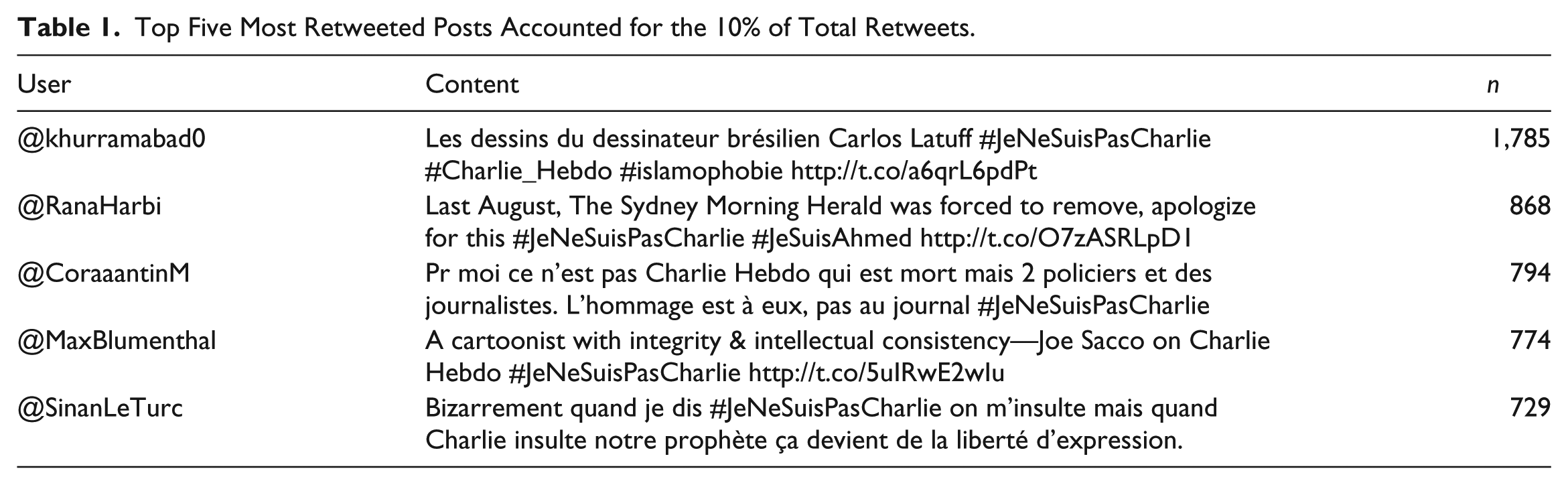
In the aftermath of the shooting, many well-known cartoonists expressed their solidarity for Charlie Hebdo by displaying tribute drawings (Telegraph, 2015). Two of the most shared tweets in our dataset also contained links to drawings, one by the Arab Brazilian freelance political cartoonist Carlos Latuff and the other by the Maltese American cartoonist and journalist Joe Sacco. The two drawings in our case, however, made a different point about the magazine from that of the mainstream cartoonists. Both Latuff and Sacco pointed out that Charlie Hebdo had published images often considered to be offensive to the Muslim population (and got away), whereas observers had not applied the same standard of freedom of expression when the magazine had published an allegedly anti-Semitic satire in the past. In the same spirit, another heavily retweeted message recalled the story of Australian newspaper The Sydney Morning Herald being forced to issue an apology and remove a drawing that was regarded as anti-Semitic in 2014 (Meade, 2015).
Links to news reports of the attack were absent among the most shared tweets. This seems to suggest that #JeNeSuisPasCharlie was not about the news. Its primary purpose was instead to mark and declare an identity by distinction.
Another notable finding was that 1,614 tweets (2% of the data collected) were made of nothing but the hashtag. The implications of this unique practice will be further discussed in the “Discussion” section later in this article.
Evolution of #JeNeSuisPasCharlie (RQ2)
Next, we used the “Breakout Detection” package for R 2 to identify “shifts,” if any, in the mean intensity of Twitter activity (i.e., tweets per minute) around #JeNeSuisPasCharlie. A breakout is typically characterized by two steady states and an intermediate transition period. Unlike most of the existing algorithms for peak detection, the tool used here was specifically developed for Twitter and it is highly configurable. 3 Figure 2 shows the by-minute time series of the activity (N = 6,444, average tweets per minute = 11.5).
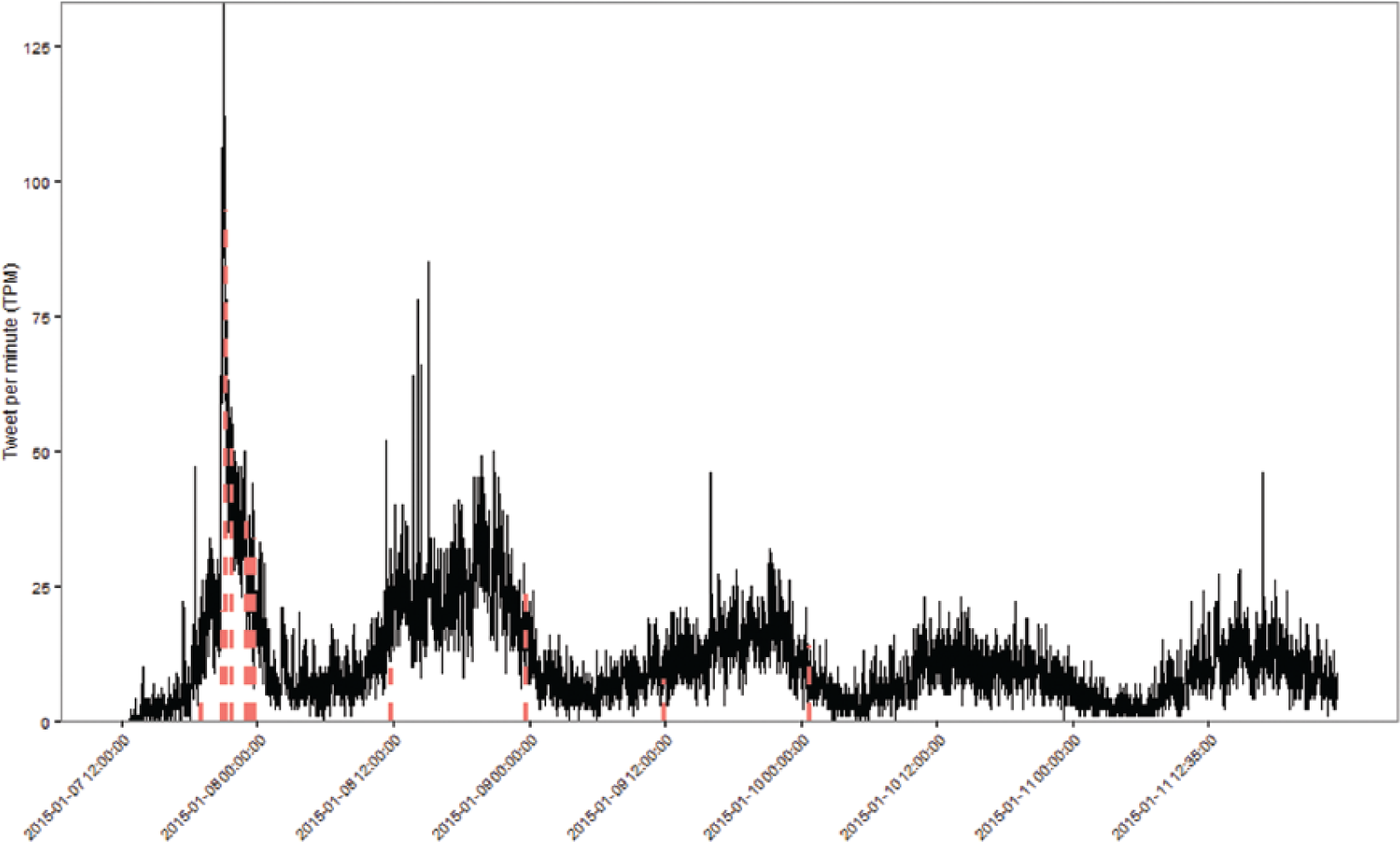
By-minute activity under #JeNeSuisPasCharlie (with dashed lines indicating breakouts).
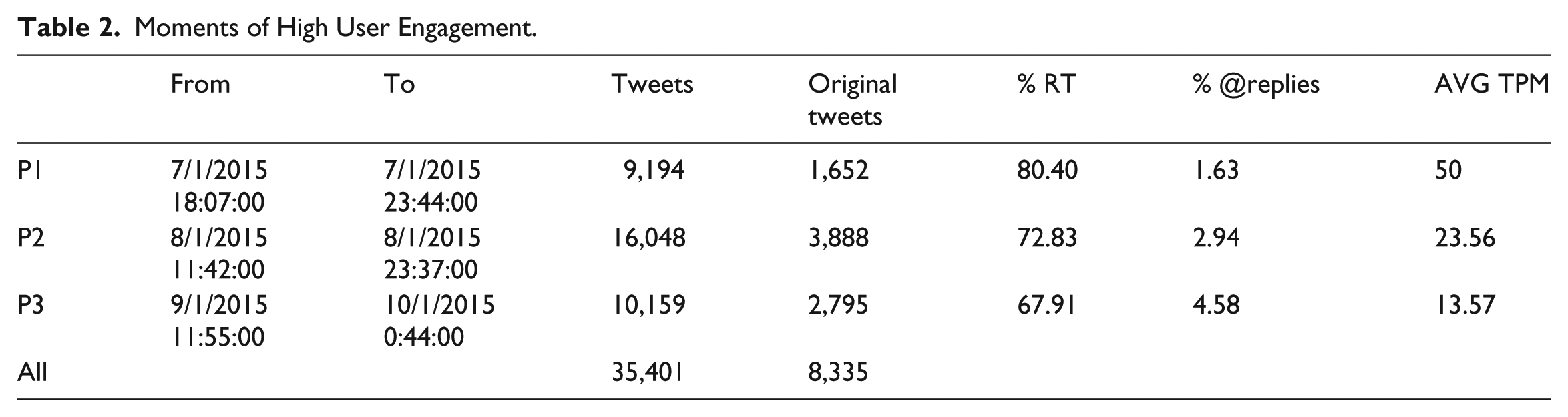
The tool detected 14 breakouts and pinpointed three moments of high user engagement (Table 2).
Moments of High User Engagement.
To better understand what those peaks entailed in terms of content, we applied the text-mining techniques provided in the R package “textcat” to the entire corpus of data (Feinerer, Hornik, & Meyer, 2008). We lowered the case of all letters and removed auxiliary words in French, English, and Spanish, as well as punctuation marks and whitespaces. We also removed “charlie,” “charliehebdo,” “hebdo,” “jenesuispascharlie,” and “jesuischarlie,” and created a document-term matrix to calculate associations among the remaining words (N = 35,401). After excluding “sparse terms,” 4 we identified the most frequently appearing terms (n = 17), their Euclidean distances, and co-word clusters (Figure 3).
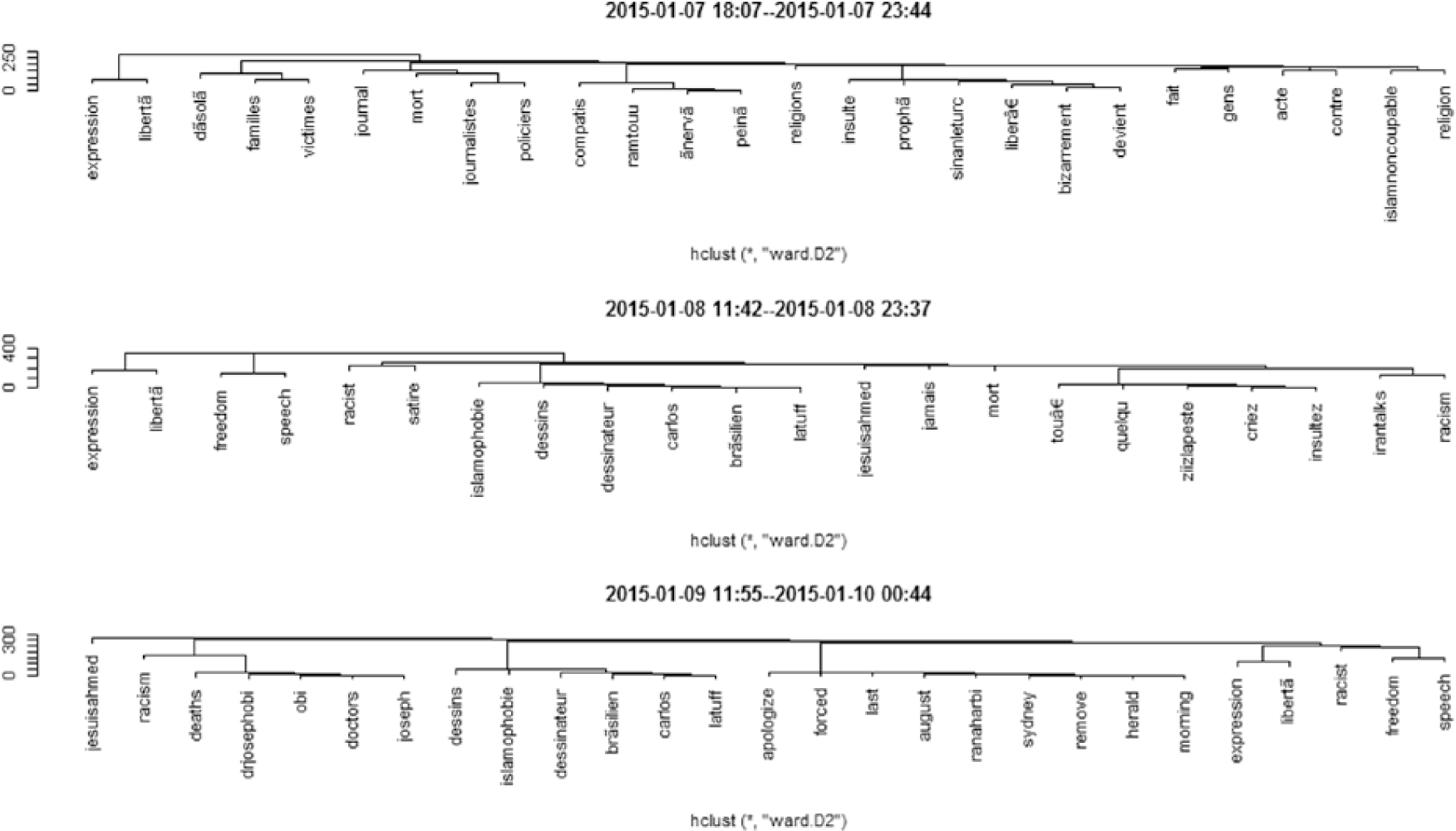
Most frequently used words and their associations during the three peaks.
As mentioned in the previous section, the first tweet containing #JeNeSuisPasCharlie was published less than an hour after what was reported as the first #JeSuisCharlie tweet. While the hashtag under study started as an immediate reaction to #JeSuisCharlie, Figure 3 shows that its nature changed over time. Besides the words from the most retweeted posts (such as Latuff’s cartoon and the Sydney Morning Herald case) in Table 1, there were some noteworthy features in Figure 3. First, the clusters of words including “désolé” [sorry] (n = 388), “familles” [families] (n = 564), “victims” (n = 628), and “compatis” [sympathize] (n = 409) were present in the first dendrogram but not in the other two. “Liberté” [freedom] and “expression” were salient in all three moments, suggesting that the freedom of expression and its contested scope was an important theme running across the entire dataset. Terms such as “racism” and “racist” stood out in the second and third peaks since users of #JeNeSuisPasCharlie started to approach Charlie Hebdo’s satires from alternative angles, such as hate speech against Muslim immigrants, rather than free speech.
To sum up, the three peaks of #JeNeSuisPasCharlie represented three distinguishable phases of manifestation of resistance to #JeSuisCharlie. In the first phase, which we propose to call “Grief,” users of #JeNeSuisPasCharlie joined the mourning for the victims of the attack despite having reservations against the attack being framed around the sacred right to the freedom of expression (see also Klug, 2016). In the second phase, “Resistance,” the users started to voice out their reservations more loudly. In the last phase, “Alternatives,” the users offered alternative frames for Charlie Hebdo cartoons, such as hate speech, Eurocentrism, and Islamophobia.
Discursive Strategies Employed by #JeNeSuisPasCharlie Users (RQ3)
The first two research questions, investigated above, provided us with a broad-stroke understanding of the usage of #JeNeSuisPasCharlie. We then moved on to look more closely at what was really said and how. We were particularly interested in the ways in which users of the hashtag challenged the dominant voice on the sensitive topic involving tragic deaths. We retrieved all tweets that were created during the three peaks identified in the previous section (Table 2). There were 35,401 in total, 68% of which were retweets and 3% were @replies.
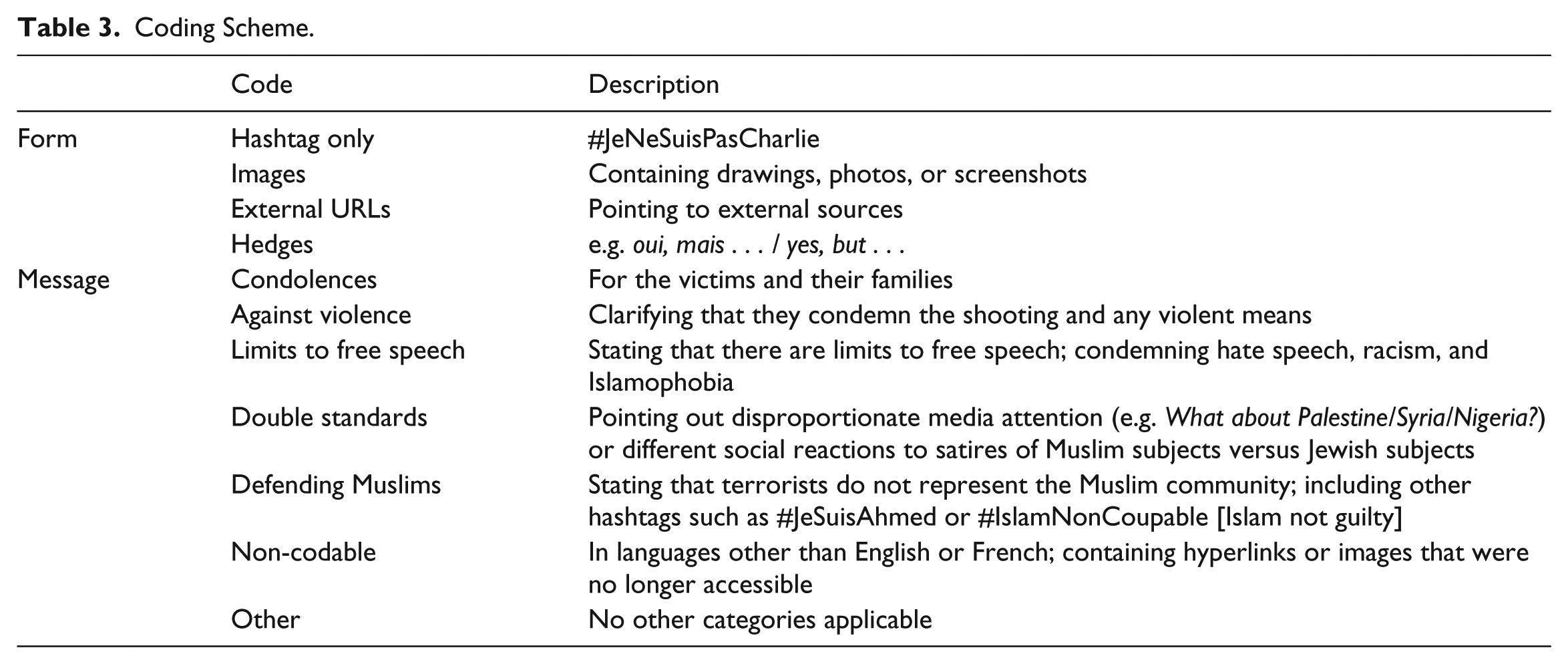
We excluded the retweets and @replies and conducted a content analysis of the remaining 8,335 original tweets. A coding scheme, concerning both the forms and messages of those tweets, was developed based on the results of the quantitative analysis in the earlier stages. For example, in addition to the prominent presence of images and external URLs, the text-mining process also revealed the unusual practice of tweeting nothing but the hashtag. Many #JeNeSuisPasCharlie users were also found to include various “hedges” to qualify their statements. Subsequently, these findings were translated into the categories “Hashtag only” and “Hedges” in the coding scheme.
Coding was carried out solely by the two authors of this article. We first completed two rounds of “mock” coding on a random sample of 150 tweets apiece to ensure a satisfactory level of intercoder agreement. The average agreement, measured by Krippendorff’s alpha, was .7. Incorporating the reflections of the initial round of training, the coding scheme was slightly modified and the categories further specified. Each of the 8,335 tweets was then coded deductively, as per the scheme summarized in Table 3. The categories were not mutually exclusive.
Coding Scheme.
Results from the content analysis corroborated the findings from the first two research questions. Looking at the communication patterns and content of the #JeNeSuisPasCharlie tweets (RQ1), we noted a high proportion of images and external URLs. Added to that, a closer reading of individual tweets revealed that external links were increasingly used for “appeals to authority”—rather than for information sharing—once a variety of opinion columns and blog posts on the topic became available (Figure 4).
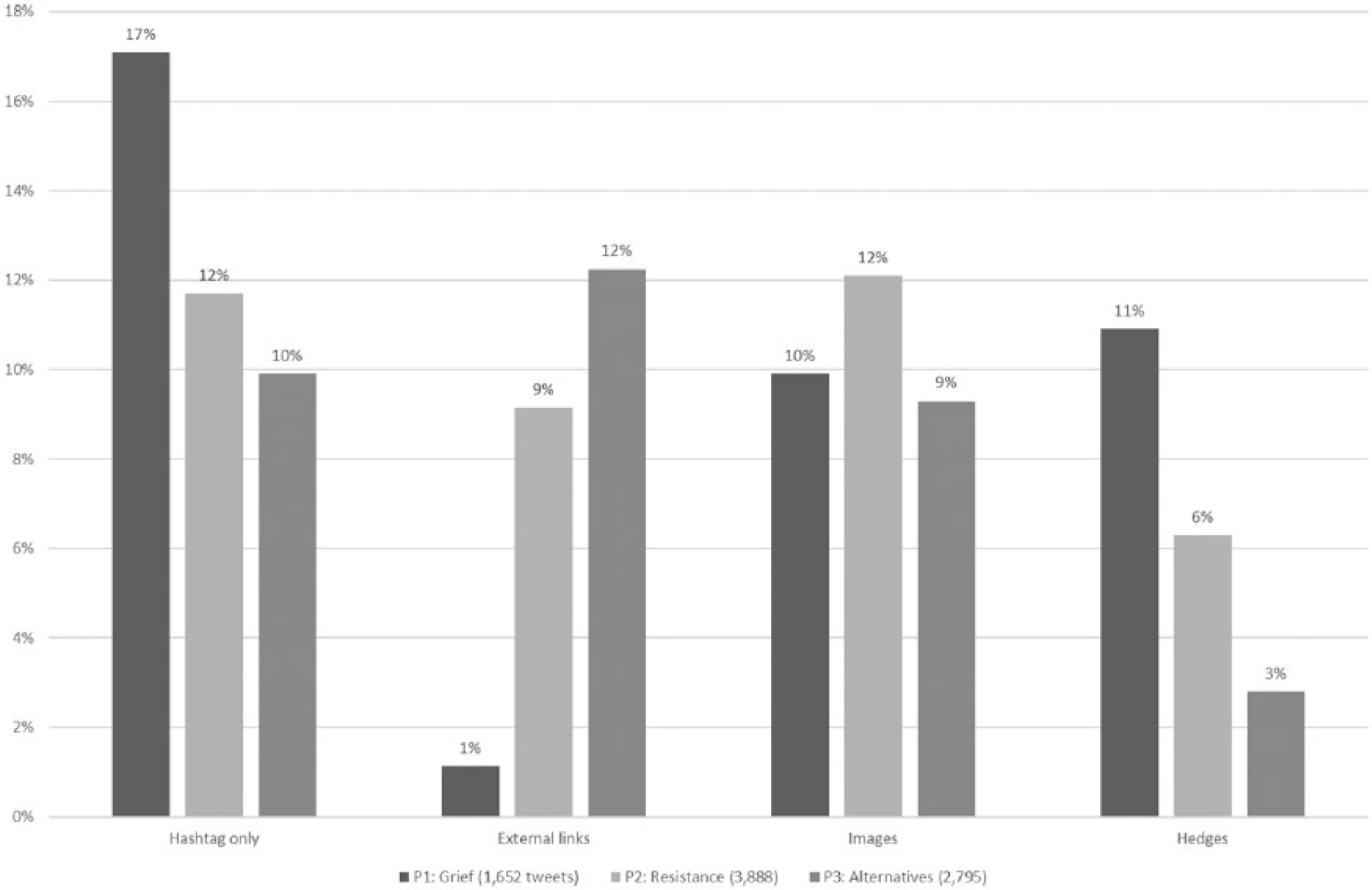
Characteristics of the form of #JeNeSuisPasCharlie tweets over the three phases.
The use of images remained consistent over time, accounting on average for 10% of the coded tweets. Furthermore, we also observed a distinct use of images containing mostly, if not only, text (Figure 5). #JeNeSuisPasCharlie users employed text-heavy images to articulate their viewpoints beyond Twitter’s 140-character limit. Those images also helped users protect their statements from “manual retweets,” which are prone to misquotations and manipulations.

Examples of images serving as a vessel for text. Twitter user names are cropped off for anonymization.
Another interesting aspect to note in Figure 4 is the use of “hedges.” Hedges took various forms in this case, but the most typical one was to preface a tweet with a pre-emptive clarification that the author of the tweet condemned the shooting. Such hedges were commonly found in the first and second phases where #JeNeSuisPasCharlie users started to challenge the majority view of the Charlie Hebdo shooting as an assault on the freedom of expression. Given the sensitivity of the topic at hand involving 12 deaths, the users approached the topic with great caution, which was reflected in the frequent occurrences of hedges. However, as time progressed, the perceived need to justify their opinions as the minority appeared to become somewhat less of an issue.
A similar pattern was observed in the “Hashtag only” category. The deliberate absence of commentary in those hashtag-only tweets resonated strongly with the existing theories of strategic speech acts including opting for silence or being deliberately ambiguous in sensitive social situations.
Figure 6 below shows how the messages of the #JeNeSuisPasCharlie tweets changed over time, elaborating the findings of RQ2. The results of the content analysis highlighted that the debate on the boundaries of free speech was central across all three phases. Users of #JeNeSuisPasCharlie sometimes paradoxically invoked their freedom of expression to criticize what they perceived as the “dogma” of freedom of expression imposed by #JeSuisCharlie (see also the fifth most retweeted message in Table 1).

Characteristics of the message of #JeNeSuisPasCharlie tweets over the three phases.
Although to a lesser extent, #JeNeSuisPasCharlie was also used to point out and criticize the “double standards” in the media’s coverage of similar tragic events. Users argued that the Charlie Hebdo shooting received disproportionately high attention compared to conflicts and violence outside Europe, such as in Palestine, Syria, and Nigeria.
Defending the Muslim community was another shared theme among #JeNeSuisPasCharlie tweets. This theme became even more evident as time progressed. Self-declared Muslim users focused on three aspects to enhance their arguments. First, they emphasized that the terrorists did not represent their religion. Second, they urged public attention to Ahmed Merabet, the French policeman of Muslim faith who was killed in the line of duty during the attack. The hashtag #JeSuisAhmed was created to that end. Third, resonating with the themes of “double standards” and “limits to free speech,” numerous tweets pointed out that #JeSuisCharlie failed to acknowledge Charlie Hebdo’s long history of publishing disrespectful and provocative cartoons against Muslim immigrants and other minorities of French society. They also included actual examples of the magazine’s particularly provocative cartoons to enhance their argument. For this third point, nevertheless, many #JeNeSuisPasCharlie users hedged their tweets by condemning the shooting and paying condolences to the deceased individuals.
Discursive Positioning of #JeNeSuisPasCharlie vis-a-vis #JeSuisCharlie (RQ4)
We were aware from the outset that #JeNeSuisPasCharlie was born as a reaction to #JeSuisCharlie. It was however the content analysis process that revealed to us an interesting entanglement among various hashtags in the tweets collected. In order to unpack the relationships between #JeNeSuisPasCharlie and all other hashtags that featured in our dataset, we produced a co-occurrence matrix (N = 3,724) and visualized the relationships in network form in Gephi (Figure 7). Filtered by the degree (equal to or greater than 49), the network map has 33 nodes and 326 edges. The node size represents the weighted degree.

Co-occurrence map of the hashtags in the dataset.
As mentioned earlier, the content analysis for RQ3 brought to our attention #JeSuisAhmed and #IslamNonCoupable. However, through the hashtag mapping process, we also found that the most frequently used one apart from #JeNeSuisPasCharlie and #CharlieHebdo in the dataset was, interestingly, #JeSuisCharlie. In the literature, previous efforts of mapping the landscape of Twitter activity have pointed to a distinct polarization between the competing sides of a debate with a negligible number of bridging actors (see, for example, Lotan’s study of the 2014 Israel-Gaza conflict). We were therefore interested in delving more deeply into the implications of including two contradictory hashtags within one tweet in order to see whether that indicates interaction between disagreeing groups.
We retrieved all tweets containing both hashtags simultaneously. There were 4,795 items in total, created by 3,808 unique contributors. In all, 2,528 (53%) were retweets and 181 (4%) were @replies. We excluded the retweets from the analysis, as in the previous step, but kept the @replies in. The @replies accounted for only a tiny fraction of the dataset, but we thought they might shed light on any latent interactions between the two “hashtag publics.” We then conducted a content analysis of the 2,267 tweets. Table 4 below summarizes the categories we used for this process. Coding was again carried out solely by the two authors, following a round of training that resulted in an acceptable level of agreement among coders (with Krippendorff’s alpha of .78). All codes were mutually exclusive this time, unlike the content analysis in the previous stage for RQ3.
Various Motivations for Including Both #JeSuisCharlie and #JeNeSuisParCharlie Simultaneously.

As can be seen in the pie chart above (Figure 8), including contradictory hashtags within the same tweet was a tactic mainly used to maximize the exposure of the tweet by reaching both #JeSuisCharlie and #JeNeSuisPasCharlie camps. This finding was further supported by the fact that in most cases, the two hashtags were also along with multiple other hashtags. Those visibility-oriented tweets were often attempts to promote personal or commercial content unrelated to the Charlie Hebdo shooting.

Characteristics of the tweets including both #JeNeSuisPasCharlie and #JeSuisCharlie hashtags (N = 2,267).
In all, 17% of the tweets containing both hashtags were about the authors of the tweets stating that they took neither side or were sympathetic to both sides. The former was broken further down into two categories. One was those who said they were unable to choose, exemplified by tweets such as “So, am I #JeSuisCharlie or am I #JeNeSuisPasCharlie? I hate it when Twitter makes me think . . .” and “I’ve googled it and I still don’t know if Charlie is the bad or the good guy!” The other was those explicitly refusing to be wound up in the “us-versus-them” discourse. Users in this last category addressed to both sides of the debate—hence including both hashtags in their tweets—that siding with one or the other was “pointless as it will do nothing but stir conflict” and that both should “stop with the childish meme shit!” and “act like adults.”
In a smaller proportion of cases, the two hashtags served different purposes despite being within the same tweet. To be more specific, the items coded as #JeSuisCharlie (approximately 8%) represented tweets and “subtweets” by which Charlie Hebdo supporters and sympathizers criticized #JeNeSuisPasCharlie (for an overview of the practices of “subtweeting,” see Parkinson, 2014). Conversely, the items coded as #JeNeSuisPasCharlie (10%) were about #JeNeSuisParCharlie users criticizing #JeSuisCharlie. Philosophy has long distinguished the “use” of an expression from “mentioning” the expression. The practice we have identified here constitutes an apt example of that “use–mention distinction.” These nuances would not have been captured if the study had remained at the macro-level.
The language used to criticize the counterpart hashtag was emotionally charged and provocative. On one hand, #JeSuisCharlie supporters criticized the emergence of the negative hashtag by describing it as “shocking,” “insulting,” and “disgusting,” and addressed their criticism specifically to “the #JeNeSuisPasCharlie,” “those with #JeNeSuisPasCharlie,” and “#JeNeSuisPasCharlie People.” According to them, contributors to #JeNeSuisPasCharlie failed to understand what the affirmative hashtag really stood for or the concept of satires. On the other hand, #JeNeSuisPasCharlie users described #JeSuisCharlie as an inherently “Islamophobic bandwagon” full of “bigotry” and “hypocrisy.” In what was one of the most recurring arguments, #JeSuisCharlie supporters were accused of invoking the “free speech” argument only when it conformed to their ideals and beliefs (see also the “double standards” category in Table 3 and Figure 6).
The chains of @replies represented only 4% of the sample tweets. Since hashtags are not automatically included in @replies on Twitter, we acknowledge that this is likely to be a tiny fraction of the actual amount of exchanges that might have taken place. Nevertheless, the @replies collected, together with our analysis of interactions between hashtags, show signs of unstructured global conversations through which diverse viewpoints were presented and, consequently, some participants experienced a shift in opinion. One user summarized his/her experience as “a journey from #JeSuisCharlie to #JeNeSuisPasCharlie, and back to #JeSuisCharlie again.”
Discussion
Hashtags in the earlier days of Twitter were nothing more than simple keywords for crowdsourced tagging of content. However, a recently growing trend is that users—especially when facing controversies, conflicts, and crises—choose a pithy phrase that serves as a “mini statement” in its own right. Examples include #BlackLivesMatter (to condemn police brutality against Black populations in the United States since the summer of 2014), #illridewithyou (to show support for Muslims in public transport in the wake of an Islamophobic backlash following a terrorist attack in Sydney in December 2014), #ThisIsACoup (to demonstrate global support for Greece in negotiations with its European creditors in July 2015), #PrayforSyria (to condemn the British Parliament’s decision to extend airstrikes against Islamic State from Iraq into Syria in December 2015), and #RestInPride (in mourning for victims of anti-lesbian, gay, bisexual, and transgender (anti-LGBT) mass murder in Orlando, United States, in June 2016).
Not only in the vanguard of this trend, #JeSuisCharlie and #JeNeSuisPasCharlie stand apart from the rest. Compared to any other hashtags, they are the most explicit declarations of the self (“I”) and identity (“being”). At the same time, the declarations took place in an extremely sensitive social situation involving 12 tragic deaths and debates on fundamental human rights such as the right to free speech and the right to religious tolerance. Against this backdrop, users of #JeNeSuisPasCharlie, being the minority voice, were found to employ a wide range of discursive strategies to navigate the sensitive situation. The users had two conflicting goals: to contest the mainstream conceptualization of Charlie Hebdo as a “martyr” of freedom of expression, but also to protect themselves from being seen as disrespecting the victims or endorsing the violence committed.
As Badouard (2016) points out, “Je Ne Suis Pas Charlie” represented a heterogeneity of voices. We have found that the various strategies used to express those voices can be put together into four groups. First, they relied heavily on the content generated by others, such as newspaper columns, blog posts, and popular retweets. The simple relaying of second-hand opinions in this context had the particular merit of users being able to shield themselves with more authoritative and eloquent accounts of what they wanted to convey anyway.
Second, when it comes to original content, users of #JeNeSuisPasCharlie routinely hedged their messages with a pre-emptive defense. A typical method was to preface a tweet with condolences for the victims and condemnations of the shooting. Muslim users also emphasized that the terrorists were not representative of their religion, often citing Quran verses about peace and love.
Third, images were an indispensable part of the #JeNeSuisPasCharlie toolkit. Images served as powerful evidence for Charlie Hebdo’s alleged discrimination against Muslim populations, as an effective means to elicit emotive responses with regard to atrocities committed elsewhere outside Europe (such as in Palestine, Syria, and Nigeria), and as a vessel for longer texts to circumvent Twitter’s 140-character limit and possible misquotations.
Finally, it has long been observed in the literature that speakers deliberately opt for ambiguity and silence in sensitive social situations. In the same spirit, approximately 2% of all original tweets collected showed an unusual practice of posting nothing but the hashtag, leaving it to their audiences to “fill in the blanks” (see also Marwick and boyd’s [2014] account of “steganography in social media”).
Conclusion
The present study has explored the structure, content, and evolution of discussions mediated through #JeNeSuisPasCharlie, a hashtag that emerged as a counter-discourse to #JeSuisCharlie in the aftermath of the Charlie Hebdo shooting in Paris in January 2015. Being the minority voice in an extremely sensitive situation encompassing tragic deaths, religion, and human rights, #JeNeSuisPasCharlie carried an inherent risk of being seen as disrespecting victims or endorsing the violence committed. We were therefore particularly interested in how and to what extent the contributors to #JeNeSuisPasCharlie achieved their conflicting goals of challenging the dominant #JeSuisCharlie and, simultaneously, avoiding possible social sanctions.
We conducted a multimethod analysis of 74,047 tweets containing #JeNeSuisPasCharlie posted between 7 and 11 January 2015. The discussions had a high proportion of retweets (70%) and hyperlinks to external sources (41%). Compared to some previously studied hashtags, #JeNeSuisPasCharlie behaved more like crisis/emergency-related hashtags than media spectacle-related hashtags.
Over time, there were three distinguished phases in #JeNeSuisPasCharlie users’ manifestation of resistance to #JeSuisCharlie and its “freedom of expression” frame. Those phases were Grief (i.e., joining the mourning for the victims of the attack but indicating a reservation against the proposed frame), Resistance (i.e., starting to voice out the resistance), and Alternatives (i.e., fully developing and deploying alternative frames such as “double standards” and “Eurocentrism”). The hashtag in this context was not a simple keyword but a discursive device that facilitated users to form, enhance, and strategically declare their self-identity.
An in-depth examination revealed that the #JeNeSuisPasCharlie tweets displayed a rich array of strategies for “saying without saying.” First, relaying someone else’s content that would justify their resistance to #JeSuisCharlie was one of the most widely used techniques. Second, in case of original content, many users were found to “hedge” their tweets pre-emptively, by prefacing their messages with condolences for the victims or condemnations of terrorism. Third, images also turned out to be a powerful and versatile tool. Contributors to #JeNeSuisPasCharlie frequently used images to “visually enhance” their criticisms of Charlie Hebdo’s alleged bias against Muslim populations or the media’s lack of coverage of atrocities committed elsewhere outside Europe. In some cases, images were also used as a vessel for longer texts to circumvent Twitter’s 140-character limit and possible misquotations. Finally, we also observed a unique practice of tweeting nothing but the hashtag, amounting to 2% of all the original tweets, as a way to opt for ambiguity.
The significance of this study is twofold. First, it extends the literature on strategic speech acts by examining how such acts take place in a social media context. Second, it highlights the need for a multidimensional and reflective methodology when dealing with data mined from social media. Users of #JeNeSuisPasCharlie showed resistance to the mainstream framing of the Charlie Hebdo shooting as the universal value of freedom of expression being threatened by Islamic fundamentalism. However, our analytic results highlighted the heterogeneity of the viewpoints, arguments, and methods for resistance, all aggregated under the hashtag.
We also found a small number of tweets containing both #JeSuisCharlie and #JeNeSuisPasCharlie despite their contradiction. Various motivations were identified for that, such as reaching multiple hashtag audiences for better visibility. In some cases, the two hashtags turned out to have different semantic functions even though being in the same tweet. These nuances would not have been captured without a multimethod approach.
Nevertheless, a study based on the analysis of contents is inherently limited in its capability of explaining the deep motivations of the authors of the contents. Investigating such motivations was beyond the scope of the present study, which focused on the manifestations of micro-level discursive strategies. We acknowledge, however, a profound need to reconcile the analysis of the traces left by the authors (behavioral data) with the more traditional, self-reported measures to get a fuller understanding—especially when the aim is to address the social, political, and cultural dimensions of an issue.
Each social media platform has been witnessing the development of a culture native and specific to that platform. The diversified use of hashtags on Twitter would be a case in point. We invite colleagues to extend this study’s methodology to other contexts for a better understanding of the growing trend of creating a hashtag that serves as a “mini political statement” amid violence and other disruptions, of which unfortunately we see more and more.
Footnotes
Declaration of Conflicting Interests
The author(s) declared no potential conflicts of interest with respect to the research, authorship, and/or publication of this article.
Funding
The author(s) received no financial support for the research, authorship, and/or publication of this article.