



Abstract
Emotions, such as anger and fear, have been shown to influence people’s political behavior. However, few studies link emotions specifically to how people debate political issues and seek political information online. In this article, we examine how anger and fear are related to politics-oriented digital behavior, attempting to bridge the gap between the thus far disconnected literature on political psychology and the digital media. Based on survey data, we show that anger and fear are connected to distinct behaviors online. Angry people are more likely to engage in debates with people having both similar and opposing views. They also seek out information confirming their views more frequently. Anxious individuals, by contrast, tend to seek out information contradicting their opinions. These findings reiterate predictions made in the extant literature concerning the role of emotions in politics. Thus, we argue that anger reinforces echo chamber dynamics and trench warfare dynamics in the digital public sphere, while fear counteracts these dynamics.
Introduction
With digitization and the rise of social media, widespread concern has developed regarding the dominance of echo chambers in public debate (Sunstein, 2007). According to the echo chamber thesis, the Internet has produced sets of isolated ideologically homogeneous echo chambers, where similar opinions reinforce each other and lead to attitude polarization (Adamic & Glance, 2005; Del Vicario et al. 2015; Del Vicario, Zollo, Caldarelli, Scala, & Quattrociocchi, 2017). This development is assumed to be linked to both the structural characteristics of the Internet and the functions of algorithms (Pariser, 2011), as well as to users’ attitudes (Bakshy, Messing, & Adamic, 2015; Iyengar & Hahn, 2009; Schmidt et al., 2017). The argument pertaining to the attitudes of users posits that because the Internet transcends physical and geographical limitations, it gives people the opportunity to seek out and maintain contact with primarily (or solely) like-minded people, creating homogeneous information and attitudinal exposure. At the same time, several studies challenge the echo chamber thesis as a general description of the online public sphere. On one hand, studies have shown that the Internet and social media create an information overflow that allows for exposure to information that is more heterogeneous (Gil de Zúñiga & Valenzuela, 2011; Ksiazek, Malthouse, & Webster, 2010; Wojcieszak & Mutz, 2009). On the other hand, it has been pointed out that people who want to discuss politics may seek confrontation via opposing views just as much as they seek confirmation, which may create dynamics of “trench warfare,” rather than “echo chambers” (Karlsen, Steen-Johnsen, Wollebæk, & Enjolras, 2017). Patterns of interaction have also been shown to depend upon the topics of discussion (Barberá, Jost, Nagler, Tucker, & Bonneau, 2015; Dubois & Blank, 2018).
If both open and closed information-seeking and debate behaviors exist in the online political public sphere, there is a need for a closer examination of the background factors that may explain variations in behaviors and outcomes. As pointed out by Vaccari et al. (2016), there is a tendency to treat the issue of echo chambers as a universal outcome that would affect all users to the same degree, and a concomitant lack of research on individual-level factors may explain whether people are exposed to agreement and disagreement on social media (p. 2). In this article, we aim to move forward the literature on exposure to agreement and disagreement by bridging perspectives from political psychology and digital media studies, as well as by suggesting that emotions are essential to understanding online political behavior and its consequences. More precisely, we examine to what extent anger and fear are related to distinct information-seeking and debate patterns. We rely on a recent survey from Norway, novel in the sense that it includes both items about emotions and online political behavior. The results show that when other relevant background factors are controlled for, the emotions of anger and fear do play distinct and different roles in leading toward exposure to agreement and disagreement, respectively. While anxious people seek out heterogeneous or contradicting information more often than others, thus increasing their exposure to disagreement, angry people seek confirming information. At the same time, angry people engage more frequently in debates with people having not only similar but also with opposing viewpoints.
Taken together, our findings suggest the relevance of including emotional factors in the analysis of online behavior. Anger stands out as an emotional factor that may reinforce echo chambers in the sense that it is directed toward agreement, that is, the confirmation of existing beliefs and discussions with like-minded people. At the same time, anger can be linked to the confrontational logic that is inherent in trench warfare dynamics (Karlsen et al., 2017).
Previous Studies of Anger, Fear, and Online Behavior
Using social media data, a set of studies has demonstrated that social media spaces are also emotional spaces (Del Vicario et al., 2017; Kramer, Guillory, & Hancock, 2014; Zollo et al., 2015). Emotions have been shown to underpin distinctive readership communities in the case of Brexit (Del Vicario et al., 2017), and in a Facebook experiment, exposure to negative or positive emotions proved to be contagious when it came to participants’ own sharing of posts on Facebook (Kramer et al., 2014). When exposed to less positive news, people posted less positive comments and more negative ones. When exposed to less negative posts, the opposite pattern occurred. In relation to sharing of content, Stieglitz and Dang-Xuan (2013), Bail (2016), and Brady, Wills, Jost, Tucker, & Van Bavel (2017) also found that emotionally charged messages on social media are more likely to be shared than neutral messages. Lottridge and Bentley (2018) found that expressing anger toward a particular event was a key motivation for sharing news on Twitter and Reddit. Berger (2011) found that experiment participants experiencing high arousal (anxiety or amusement) were more willing to share information, but this study did not examine the impact of anger.
When it comes to the emotional dynamics of polarized communities or echo chambers, these have been studied using sentiment analyses (Tumasjan, Sprenger, Sandner, & Welpe, 2010). Del Vicario et al. (2017) identified a set of distinct echo chambers in the Brexit issue, and showed that these diverged in terms of the emotions attached to core concepts in the debate. A study by Zollo et al. (2015) comparing scientific and conspiracy pages showed that discussions on the latter were more negative, but in both groups, the more active individuals showed more negative sentiments than others. Moreover, the longer the discussions between polarized communities, the more the negativity was found overall.
Despite such findings concerning the emotional dynamics of online activities based on social media data, literature linking individuals’ emotions to their overall digital behavior is scarce, and the results are inconclusive. A recent study by Hasell and Weeks (2016) based on data from the 2012 presidential election in the United States showed that consumption of partisan news invoked anger against the opposing candidate, which in turn led to an increased propensity to share political information online. Anxiety was unrelated to sharing behavior in this study. Valenzuela (2013), however, reported no relationship between politically directed anger and general social media use. Likewise, Alberici and Milesi (2013) examined anger, online political discussion, and collective action intention in the Italian Five Star Movement. They found no significant relationship between anger and online political discussion, but their sample was rather small. 1 Anger predicted collective action intention only when participants reported low levels of online discussion. In a parallel study, they did however find a significant correlation between a measure of anger and online discussion among participants in the “No Berlusconi Day.”
Overall, few studies examine the impact of emotions on online political behavior at the individual level, particularly studies that include more than one emotion, such as anger and fear. In the following sections, we first briefly present the theoretical foundations for a study of the relationship among anger, fear, and political behavior before presenting our specific expectations concerning online political behavior and the formation of echo chamber dynamics and trench warfare dynamics.
Anger, Fear, and Political Behavior
A range of studies have shown that our actions and the extent to which people are willing to re-evaluate their political beliefs have emotional underpinnings (Marcus, Neuman, & MacKuen, 2000; Wagner, 2014). In this article, our understanding of the way emotions impact political behavior gets its bearings from the most prevalent theoretical formulation in political psychology: the theory of affective intelligence (AI; Marcus et al., 2000). According to AI, emotional appraisals are preconscious neural processes occurring swiftly (five times faster than conscious awareness) and in time before conscious appraisal, that is, conscious mental representation of emotional states (Brader & Marcus, 2013). The AI perspective identifies three dimensions of affective appraisal that influence cognitive and behavioral processes: anxiety, enthusiasm, and anger. This three-dimensional account of affective appraisal generates hypotheses about the effect of emotion on political behavior. Emotions are significant to political behavior to the extent that enthusiasm influences political engagement, convictions, and identifications; anxiety affects attention, information seeking, and learning; and anger impacts protective behaviors related to norms, convictions, and identifications (Brader & Marcus, 2013).
From this perspective, different emotions (such as anxiety and anger) may be elicited by the same stimulus or salient event, and they may occur simultaneously (Vasilopoulos, Marcus, & Foucault, 2018) meaning that the constructs measuring these emotions will be correlated in empirical studies. To date, fear and anger are distinct emotions that drive different behaviors. Anger is often attributable to a particular source over which the individual feels they are exerting control. Fear, by contrast, is more frequently the result of an unknown negative feeling and a sense of a lack of control (Valentino, Brader, Groenendyk, Gregorowicz, & Hutchings, 2011). Fear tends to result in risk-averse behavior and information seeking (Lerner & Keltner, 2001; Valentino, Hutchings, Banks, & Davis, 2008; Vasilopoulos et al., 2018), whereas anger drives risk-taking behavior and reliance on simple heuristic cues and patterns of previous behavior (Lerner & Keltner, 2001). Fear sets off the cognitive “surveillance” system in which the subject is more likely to question established patterns of behavior and become more aware of their environment (Valentino et al., 2008). Fear and anxiety lead individuals to break with their habitual political attachments and seek out messages that contradict their predispositions (Valentino et al., 2008; Vasilopoulos et al., 2016). Fear causes individuals to take a step back, reconsider prior beliefs, and seek more information.
Studies have indicated that fearful people are indeed more motivated to seek out information and follow the news. This is true in particular for information containing opposing views (MacKuen, Wolak, Keele, & Marcus, 2010). As anxiety is often associated with a sense of a lack of control, seeking out more information is a means of reducing such feelings. Thus, a key motivation for anxious individuals to seek information is to reduce uncertainty (Gadarian & Albertson, 2014; Hasell & Weeks, 2016). Valentino et al. (2008) show that anxiety improves both the quality and quantity of the information gathered. They argue, “(. . .) fear can in fact stimulate political interest, enhance the quality of information seeking in the political arena, and boost learning while other negative emotions such as anger, and even positive ones like enthusiasm, tend not to” (Valentino et al., 2008, p. 249). Anxiety can diminish the detrimental effects of motivated reasoning, that is, individuals evaluate information in a biased manner if it is consistent with their prior beliefs. Anxiety is associated with paying closer attention to information and weighing opposing viewpoints against each other. This makes anxious people more receptive to contemporary information and less likely to align automatically with partisanship or ideology (Weeks, 2015).
However, the literature gives some reasons to pause with regard to the virtues of anxiety. Brader (2005) presents mixed effects of fear cues in political ads on subjects’ interest in seeking out information. Gadarian and Albertson (2014) warn that anxiety is no panacea to the problems of democracy; while anxious people are more likely to seek out information, they also process information in a biased way, attributing more weight to threatening information. Weeks (2015) finds that anxious individuals, while being more critical of the type of partisan information that angry people automatically accept, may in fact be more prone to believe false information from out-party sources.
In contrast to anxious individuals, those experiencing anger will tend to cope with threats by relying on previously learned routines. Anger also reduces cognitive effort (Vasilopoulos et al., 2018). It elicits simpler processes and reliance on heuristic cues to make snap judgments (Bodenhausen, Sheppard, & Kramer, 1994). While people experiencing anxiety will express a desire to learn more and tend to seek out information challenging prior beliefs, those experiencing anger are less likely to do so. Rather, they tend to search for confirmation of their existing convictions (MacKuen et al., 2010). Furthermore, anger is associated with a more positive risk assessment (Huddy, Feldman, & Cassese, 2007), and angry people tend to make risk-seeking choices (Lerner & Keltner, 2001). Anger has also been shown to exacerbate problems associated with motivated reasoning; in the presence of anger, incorrect messages aligning with prior convictions are more likely to be believed, and messages contradicting prior attitudes are more likely to be rejected (Weeks, 2015).
Anger, Fear, and Echo Chambers—Expectations
Based on our reading of the literature on emotions and political behavior in general, we expect fear and anger to have distinct effects also on digital political behavior and to form patterns that are consistent with the echo chamber thesis to a varying extent.
The echo chamber thesis has two distinct dimensions: debate and information. With regard to debates, these take the form of an echo chamber when debaters engage only with like-minded individuals and face little opposition from people with different opinions. Beliefs are in turn confirmed and galvanized rather than contradicted and moderated. Engaging in online debates entails exposure to risks, such as potentially being ridiculed in front of an audience of varying size and visibility or eliciting uncomfortable responses. Bringing up politics on social media may also be perceived as risky, as it conflicts with social pressures to preserve harmony and the norms of politeness (Vraga, Thorson, Kligler-Vilenchik, & Gee, 2015). Discussing politics on social media is different from and potentially more risky than face-to-face discussions, in that it entails addressing a networked public with distinct properties, namely persistence, replicability, scalability, and invisible audiences (Boyd, 2007). Vraga et al. (2015) also show that social media (specifically, Facebook) are perceived by many as a place of rants, virulent disagreement, and a high level of conflict. Consequently, conflict-avoidant individuals are less likely than others to post political content. The combination of the affordances of social media and a high conflict level is likely to make the more risk-averse individuals avoid taking part in discussions.
Thus, it is reasonable to expect angry people, who have been shown to be more risk seeking than others, to engage more frequently in online debates than others and to expect fearful and anxious individuals who are more risk averse to take part less frequently. Furthermore, as Leung (2013) shows, venting negative feelings, including discontent and anger and fighting back against perceived unfairness, are all important gratifications sought through social media use. This should also make angry people more likely to engage in online debates. Based on these arguments, we formulate the following two hypotheses concerning online debate behavior:
HP1. Angry individuals will be more likely to engage in online debate than others.
HP2. Fearful individuals will be less likely to engage in online debate than others.
It is, however, less straightforward to predict based on the existing literature to what extent angry individuals should be more or less prone to debate with those having similar or opposing views. On one hand, because anger has been shown to lead people to rely on previously learned habits and to reduce cognitive effort, one might think that the angry would tend toward discussions with their own. On the other hand, the tendency toward risk-seeking behavior might entail a drive toward confrontation with opponents. Therefore, we formulate the following hypothesis regarding debate patterns of the angry:
HP3. Angry individuals will be more likely to debate with people with both similar and opposing views than others.
When it comes to information seeking, echo chambers arise because people tend to favor information that reinforces pre-existing views. Hence, it rests on the premise of selective exposure (see Stroud (2017) for an overview). Contradicting information or messages are unpleasant and create dissonance, and this is therefore something most people want to avoid (Festinger, 1962; Hart et al., 2009). Due to increased choice, and the distinct dynamics of the digital sphere, such as friends’ networks and algorithms on social media, several scholars argue that digital media exacerbate selective exposure and allow people to selectively avoid opposing arguments and contradicting information (Nie, Miller, Golde, Butler, & Winneg, 2010; Sunstein, 2001). As the media landscape has changed and the number of media platforms multiplied, this tendency is no longer counteracted by the broad news channels that almost everybody used to watch (refer Prior (2007) and van Aelst (2017) for an overview). To date, the empirical evidence remain mixed, suggesting that social media increase selective exposure but not to the extent envisaged by some scholars (Bakshy et al., 2015; Brundidge, 2010; Dvir-Gvirsman, Tsfati, & Menchen-Trevino, 2016).
The literature on emotions and political behavior thus leads us to formulate the following two hypotheses:
HP4. Angry individuals will seek out information that confirms their worldview.
HP5. Fearful individuals will look for information that contradicts their prior beliefs.
Overall, we expect anger to reinforce echo chamber dynamics, while fear is expected to counteract them. In relation to online debate, the angry are hypothesized to be more active, but this is not necessarily limited to echo chambers. In this group, trench warfare, in the sense of fierce confrontation between opponents (Karlsen et al., 2017), may be just as likely an outcome.
Data and Operationalization
We rely on data from the 10th wave of the Norwegian Citizen Panel (NCP) carried out in November 2017. The NCP is a Web-based survey carried out twice a year by the University of Bergen and the Uni Research Rokkan center (http://www.uib.no/en/citizen). The panel consists of respondents randomly sampled from the National Registry and invited by means of post and telephone; that is, no respondents have been self-recruited. Initially, 50,000 persons in total were invited to take part in the panel, of which about 10,000 (20%) accepted the invitation. Non-response is most critical among the young and the less educated. In the uni- and bivariate analyses, we therefore apply weights adjusting for respondents’ age and education, in addition to gender and geographical location. In the regression models, we control for respondents’ age and level of education.
We use survey items developed by Marcus, Neuman, and MacKuen (2017) to gauge feelings of anger and fear. Three general (integral) targets to elicit emotions of anger and fear are used. Respondents were asked to indicate on a scale from 1 to 7, how strongly they felt different emotions when thinking about Norway (in general), about the economic conditions in Norway, and the social conditions in Norway, respectively. The fear index included the items “worried” or “scared” on each of the three dimensions, totaling six items (Cronbach’s alpha = .85). The mean value of the index was 3.08 (SD = 1.27), indicating most people did not feel fear. The anger index included the items “angry,” “annoyed,” and “bitter” when given the same three prompts. Thus, the index included nine responses in total (Cronbach’s alpha = .91), with a mean value of 2.64 (SD = 1.25), indicating that anger was not widespread. Indeed, a methodological issue associated with the measurement of emotion is the question of an appropriate target for the self-reporting of emotions and the extent to which it should be specific (incidental) or general (integral). However, as pointed by Brader and Marcus (2013), research to date suggests that both types of target produce the same behavioral consequences. This fact allows us to elicit emotions with a specific target referring to Norway, while discussion of politics on social media is a general phenomenon.
Political discussion on social media is operationalized by the variable “Over the course of the last 12 months, how often have you discussed politics on social media?” The alternatives were 1 “never,” 2 “seldom,” 3 “sometimes,” and 4 “often.” The alternative “not relevant/do not use social media” was also given, and these responses were coded as 1 on the scale. The mean of the variable was 1.61 (SD = .89, n = 1,779). The majority of respondents (62%) were given the lowest value on the scale, while 12% discussed “sometimes” and 5% “often.” In the article, we use the terms “online debate” and “online discussion” interchangeably.
Furthermore, those reporting that they seldom, sometimes, or often discussed politics on social media were asked a follow-up question enquiring how frequently they discussed politics with various out-groups. These included “people with different political opinions to you and who generally disagree with you” (n = 1,750, M = 1.40, SD = .76), “people with a different ethnic background to yours” (n = 1,745, M = 1.29, SD = .66), and “people from a different social class to you” (n = 1,745, M = 1.38, SD = .73). Respondents saying they never discussed politics on social media and they therefore were not asked these questions were given the lowest value (1) on these variables. The means of the discussion variables indicate that most people in Norway engage in such activities relatively seldom.
All respondents were asked a question about how frequently they searched for information contradicting or confirming their prior positions. These questions included “visited the website of a politician or a political party that has the same political opinions as you” (n = 1,748, M = 1.74, SD = .89), “visited the website of a politician or a political party that has different political opinions to you” (n = 1,743, M = 1.51, SD = .75), “searched online for political information that would confirm your arguments or views” (n = 1,747, M = 2.03, SD = .94), and “searched online for political information that differs from your own arguments or views” (n = 1,744, M = 2.03, SD = .89). Again, the alternatives ranged from 1 “never” to 4 “often.”
As the variables gauging frequency of information gathering and debate behavior are ordinal variables, we also carried out separate binary logistical regressions with those reporting the behavior “sometimes” or “often” being given the value 1. The same variables emerged with significant relationships at the 95% level, as the ordinary least squares (OLSs) regressions reported as follows, with one exception: the relationship with anger and searching online for political information that would confirm your arguments or views was only significant at the 90% level in the logistic regression.
Control variables included in the analyses were political interest (ranging from 1, “not interested at all” to 5 “very interested,” M = 3.68, SD = .83), female (50% of each gender), dummy variables representing party voted for in last election (2 months before the survey), education (ranging from 1 “primary” to 3 “higher education,” M = 2.52, SD = .69), age (ranging from 1 “below 25 years” to 7 “75 years and over,” M = 4.28, SD = 1.59).
Table 4 (in Appendix) shows the correlations between the key variables in the analysis. As expected, fear and anger are strongly correlated (.76). Anger is correlated with discussing politics on social media, while fear is not. Both emotions correlate with gathering information online, both confirming and contradicting the views of the respondent. When it comes to discussion with people of different opinions, ethnic group, and social class, anger correlates more strongly than fear. It is also worth noting that political interest is uncorrelated with both anger and fear, while it correlates with all forms of online political behavior. Women are generally less active than men. Education correlates negatively with both fear and anger, and it has negative relationships with two of the behavior variables. Young people feel less fear and are generally more active in all types of online political behavior.
Empirical Analysis
The empirical analysis has two main parts. In the first, we investigate the relationship between discussions and test hypotheses 1, 2, 3, and 4. In the second, we investigate the relationship between emotions and information seeking and test hypotheses 5 and 6.
Emotions and Online Discussion
We begin by investigating the relationship between emotions and online debating. The expectations were that anger would increase the tendency to discuss online, while fear would decrease it. Table 1 shows the results of an OLS regression of discussion activity on social media during the past 12 months. The results show, in accordance with expectations, that respondents who reported feeling angry about the social and economic conditions in Norway were more active in social media discussions than others. Fear, by contrast, showed no relationship with discussion activity. Furthermore, the results show that the relationship between anger and discussion activity holds even when having controlled for party preference and background variables. No single party’s voters were overrepresented among those participating in discussions. As would be expected, the politically interested took part more frequently in debates, as did young respondents.
OLS Regression, Discussed Politics on Social Media in the Past 12 Months.

Standardized coefficients and standard errors in parentheses.
p ≤ .001; **p ≤ .01, *p ≤ .05.
In Table 2, we focus on political discussions with out-groups, that is, groups that are different from the respondent in important ways. We examine three different groups: people with other political opinions, people with a different ethnic background, and people from a different social class. Engaging in debates with such groups indicates discussion activity transcending the echo chamber in which all participants are similar to each other and hold similar beliefs.
OLS Regression, Discussed Politics on Social Media with Different Groups in the past 12 Months.

Standardized coefficients and standard errors in parentheses.
p ≤ .001; **p ≤ .01; *p ≤ .05.
The results show that even when it comes to “bridging” discussion with people of different opinions, ethnic background, and class, angry people are over-represented. There is no relationship with fearfulness. Thus, anger is a dominant emotion, not only in debates within the echo chamber but also in discussions reaching beyond this sphere. The relationship with anger is strongest when it comes to discussions with people of a different ethnic origin. Taken together, these findings could indicate that the debates between people of different opinions and origins are often held in an aggressive tone, contributing to “trench warfare dynamics” rather than moderation of views.
Figure 1 summarizes the findings from model 4, in which, for ease of interpretation, the dependent variable is a count of the number of groups with which the respondent “sometimes” or “often” talks politics (maximum 3). The results show that persons scoring relatively high in anger (value 5 on the index) are predicted to discuss with on average twice as many groups as a person scoring low in anger (value 1 on the index; .50 vs. .23 groups). The figure further shows that fear is unrelated to discussion activity.

Margins plot of number of out-groups discussed with, by anger and fear.
Thus, with regard to online debates, anger does not equivocally contribute to echo chamber dynamics, as angry people are also most likely to engage in debates with out-groups. This may be linked to the higher propensity of angry people to engage in risk-seeking behavior. However, the results may be interpreted as support for a trench warfare description of online debates, in which opposing views clash in conflicting debates in which emotions run high.
Emotions and Information Seeking
In addition to the debate component of the echo chamber argument, the argument also holds that the digital sphere enables individuals to consume only information that supports prior beliefs and that this in turns leads to polarization and radicalization. How are anger and fear related to different types of information seeking?
The results in Table 3 align with our expectations. Angry people who tend to rely more on stereotypes and who exercise less critical judgment are more likely to seek out information on the Internet that confirms their prior beliefs. Anxious people who are prone to problem-seeking information gathering are more likely to seek out information contradicting their prior beliefs. As such, anger contributes to the information dimension of echo chamber (and trench warfare) dynamics, while fear and anxiety counteract it.
OLS Regression, Online Information Seeking.
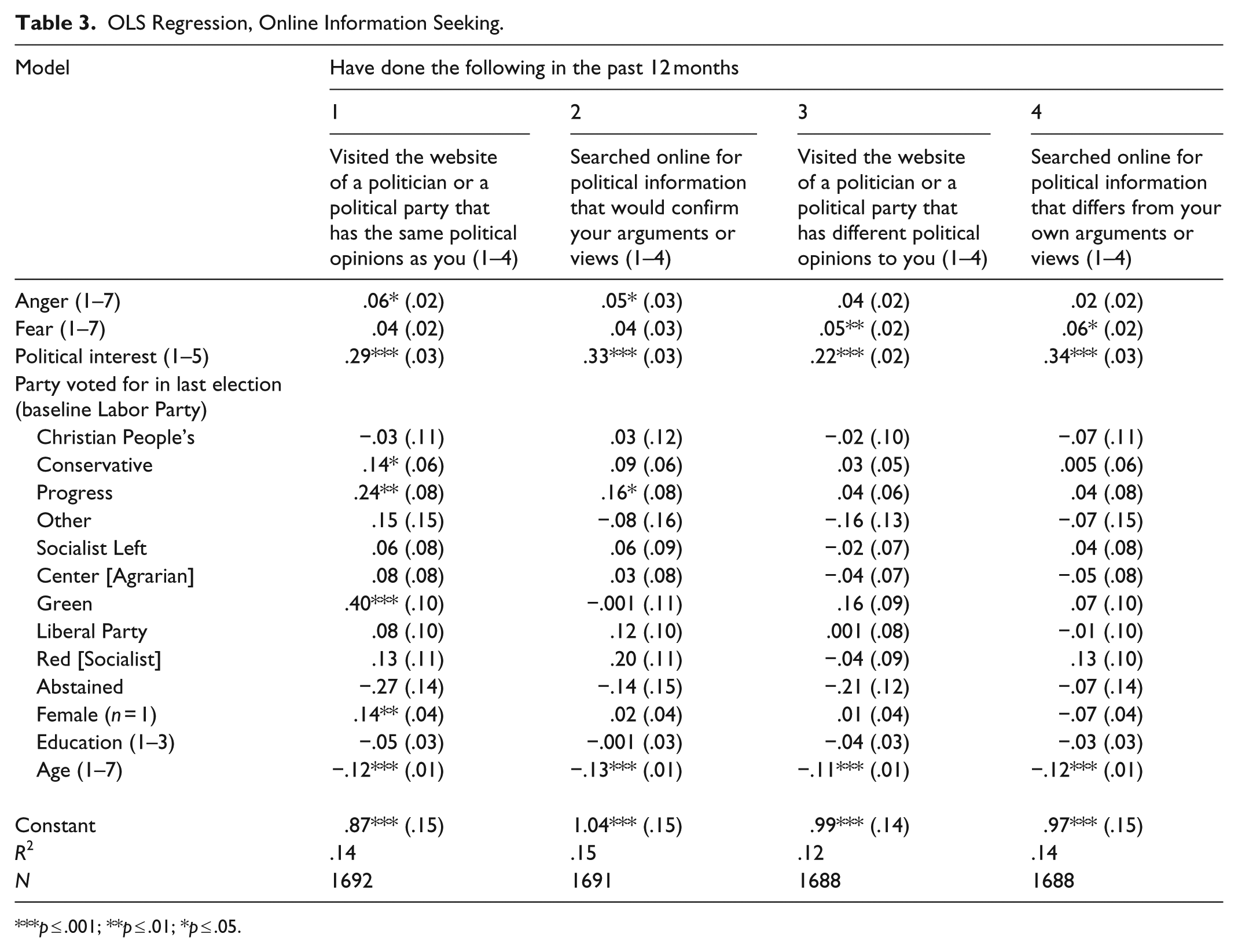
p ≤ .001; **p ≤ .01; *p ≤ .05.
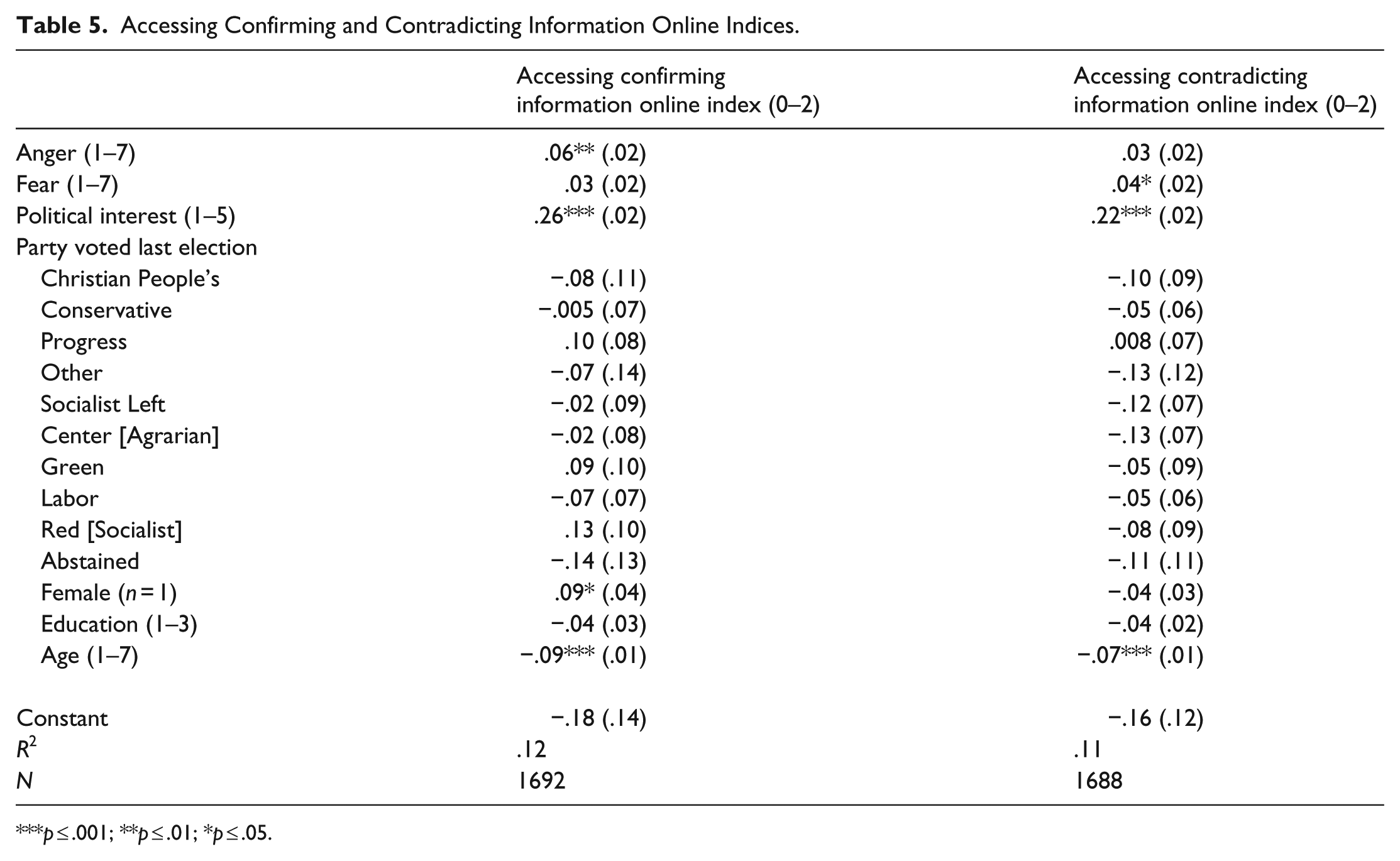
For the ease of interpretation, Figure 2 combines the variables in Table 3 in two indices: visiting the website of a politician with whom the respondent agrees and/or searching for confirmatory information online “sometimes” or “often,” which is summarized in a confirming information index with a maximum value of 2. Similarly, an index measuring accessing contradicting information is constructed based on the items “visited the website of a politician or a political party that has different political opinions to you” and “searched online for political information that differs from your own arguments or views” with a maximum value of 2. The regression analysis on which the figure is based is included in the Appendix (Table 5).
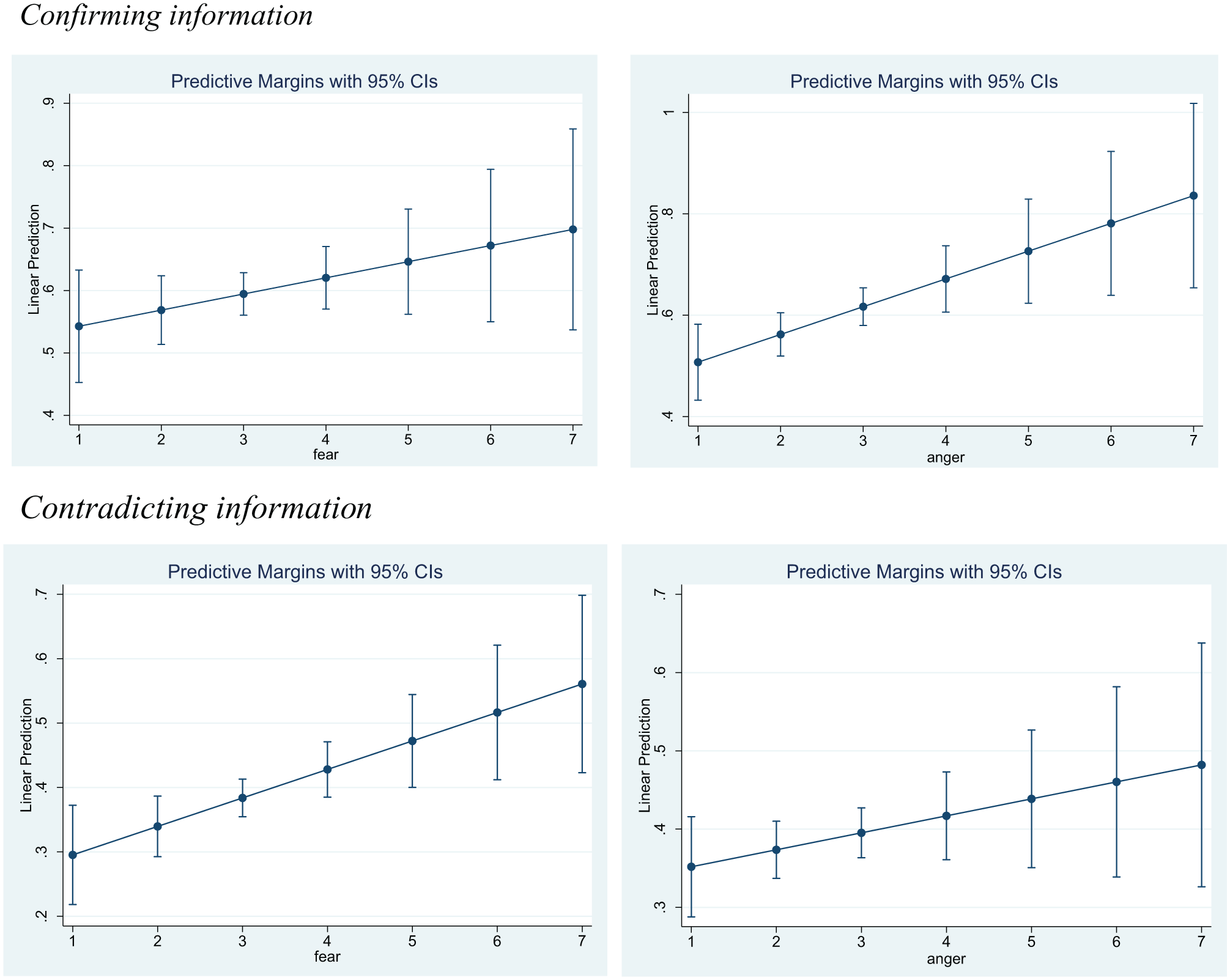
Margins plot of number of information-seeking activities (max 2), by anger and fear.
The figures show positive relationships with both fear and anger for both indices, but it is significant only for anger with regard to confirming information and fear with regard to contradicting information. Both findings are in line with our expectations.
Discussion and Conclusion
The analyses have shown that anger and fear have distinct effects on echo chamber and trench warfare dynamics in the digital sphere. With regard to the debate dimension, we have shown that anger is positively related to participation in online debates. This finding confirms the results of a recent study by Hasell and Weeks (2016). Importantly, however, the impact of anger is not limited to echo chamber discussions with like-minded and similar people. Angry individuals are also over-represented in debates between people holding opposing views and belonging to a different class or ethnic background. This entails that regarding online debates, anger contributes more to what has been previously labeled as trench warfare dynamics than to echo chamber dynamics. Trench warfare dynamics are characterized by a virulent and angry tone of discussion, wherein each side of the argument finds support among like-minded individuals and is galvanized, not moderated, by contradiction from the other side. Contrary to expectations, however, we found no relationship between fear and the propensity to engage in online debates.
With regard to the information aspect of the echo chamber thesis, anger appears to contribute to echo chamber dynamics by driving searches for information confirming prior beliefs. Because anger depresses information seeking, it can potentially create media diets consisting primarily of like-minded and partisan messages, which may in turn make individuals even angrier (Weeks, 2015). Anxiety and fear, by contrast, counteract echo chamber dynamics by driving searches for contradicting information. Our research confirms that the connections between anger and fear on one hand and online behavior on the other hand are distinct, and they underline the need to examine these two emotions in concert even though they are strongly correlated.
Anger and fear have previously barely been studied in the context of digital political behavior (with the notable exception of the aforementioned study by Hasell and Weeks (2016)). However, the findings align well with predictions based on the general literature on emotions and political behavior (MacKuen et al., 2010). Anger is tied to risk-seeking behavior. Given the distinct affordances of the digital sphere, such as scalability, searchability, and invisible audiences, debating online entails a number of risks. Based on the literature, it is therefore of no surprise, but nonetheless important to document that angry people are over-represented in online debates.
It is possible to interpret the finding positively, as anger serves as an impetus of action and increased participation. One could also argue that anger could play a constructive role in highlighting injustices and moral wrongs. However, anger is also associated with incivility and hostility, and it may serve to increase distrust and polarization (Hasell & Weeks, 2016). Experimental studies have shown that angry people rely more on stereotypes, and they exercise less critical judgment (rely more on simple heuristic cues). This is thought to be because anger arises in situations bearing risk of psychological or physical harm, which requires a quick response (Bodenhausen et al., 1994). Anger has also been found to impede cognitive effort (Vasilopoulos et al., 2017). Furthermore, anger enhances processes of motivated reasoning, in which misinformation consistent with prior beliefs is more likely to be accepted, and contradictory information will tend to be rejected (Weeks, 2015). Angry people are more likely to interpret information in a partisan manner and experience reinforcement of prior-held beliefs and affiliations. Previous research has also associated anger with a lack of a will to compromise (MacKuen et al., 2010; Weeks, 2015). As more and more of our discussion and communication take place online, the association between anger and engagement in online debates does not bode well for the quality of the public sphere.
This study has some limitations. Based on these data, we cannot conclude fully whether people engage in debates because they are angry or if they are angry because they are debating online. It is reasonable to envision a spiral of anger, in which angry emotions are stimulated by an angry online debate climate, which in turn makes participants even angrier. It is also reasonable to assume that there is a mutually reinforcing effect, where the angry tone of social media debates reinforces feelings of anger among the participants. In the absence of panel data, for now, we can only conclude that they are related. It is an important question for further research to determine the extent of how they are related, that is, if there is a unidirectional relationship or, as we expect, a mutually reinforcing effect between anger and debate behavior. Untangling the directionality of the relationship, including examining the extent to which a potentially destructive spiral of anger characterizes online debate, will be an important task for further empirical research.
The second limitation is that the study is based on survey data from a single country, namely Norway. The Norwegian political culture is in comparison with many other countries consensual, with strong traditions of interparty compromises and a low level of conflict. Levels of anger are therefore likely to be quite low in international comparison. With regard to fear, Norway is a stable country with few external enemies. For example, fear of terrorist attacks is less prevalent than in comparable countries (Wollebæk, Enjolras, Steen-Johnsen, & Ødegård, 2012). Because Norway may be a special case with regard to fear and anger, more research is needed to determine the generalizability of the study findings.
The third limitation of this study is due to the nature of survey data. Employing survey data, we are constrained to self-reports for our main variables of interest—emotions and online discussion. While most research in political science has used self-reports to measure emotion (Valentino et al., 2011), the accuracy of such measures have been questioned because they may be susceptible to social desirability bias (Berinsky, 2004), be inaccurate because people are often unable to pinpoint reasons for their behavior (Krosnick, 1988), and be rationalizations (Lodge & Taber, 2013). However, research comparing physiological measures of emotions with measures based on self-reports of emotions (Ciuk, Troy, & Jones, 2015) finds that self-reported measures are converging with physiological measures and are better predictors of political attitudes. Similarly, our measure of confirmation bias is based on self-report and may be subject to the same type of criticism. However, this self-reported measure of confirmation bias has been previousely used in studies of political discussion (Gil de Zúñiga, Valenzuela, & Weeks, 2016), and self-reports are an important means by which researchers can learn about peoples’ psychological motivations, as these are less amenable to direct observation (Touré-Tillery & Fishbach, 2014).
The public sphere has changed dramatically in the last couple of decades, and online political behavior and communication are now essential aspects of democratic politics, and increasingly so. In peoples’ online interactions and information seeking, echo chamber, trench warfare, and modification dynamics characterize the process. To increase our knowledge of what fuels the different processes, there should be an essential undertaking of future research on political behavior and political communication. In this article, we have suggested and shown that emotions are an essential piece of the puzzle.
Footnotes
Appendix
Accessing Confirming and Contradicting Information Online Indices.
| Accessing confirming information online index (0–2) | Accessing contradicting information online index (0–2) | |
|---|---|---|
| Anger (1–7) | .06** (.02) | .03 (.02) |
| Fear (1–7) | .03 (.02) | .04* (.02) |
| Political interest (1–5) | .26*** (.02) | .22*** (.02) |
| Party voted last election | ||
| Christian People’s | −.08 (.11) | −.10 (.09) |
| Conservative | −.005 (.07) | −.05 (.06) |
| Progress | .10 (.08) | .008 (.07) |
| Other | −.07 (.14) | −.13 (.12) |
| Socialist Left | −.02 (.09) | −.12 (.07) |
| Center [Agrarian] | −.02 (.08) | −.13 (.07) |
| Green | .09 (.10) | −.05 (.09) |
| Labor | −.07 (.07) | −.05 (.06) |
| Red [Socialist] | .13 (.10) | −.08 (.09) |
| Abstained | −.14 (.13) | −.11 (.11) |
| Female (n = 1) | .09* (.04) | −.04 (.03) |
| Education (1–3) | −.04 (.03) | −.04 (.02) |
| Age (1–7) | −.09*** (.01) | −.07*** (.01) |
| Constant | −.18 (.14) | −.16 (.12) |
| R 2 | .12 | .11 |
| N | 1692 | 1688 |
p ≤ .001; **p ≤ .01; *p ≤ .05.
Compliance with Human Subjects Review Procedures
The data used in this article comply with the guidelines of the Norwegian Data Protection Authority (DPA). The authors have only had access to anonymized data.
Declaration of Conflicting Interests
The author(s) declared no potential conflicts of interest with respect to the research, authorship, and/or publication of this article.
Funding
The author(s) disclosed receipt of the following financial support for the research, authorship, and/or publication of this article: The research presented in this article was funded by the Research Council of Norway under the programme for Societal Security (SAMRISK II), project no. 238118.