



Abstract
This study proposes the concept of “digital Gemeinschaft 2.0,” through examining Rich Ling’s employment of Ferdinand Tönnies’ Gesellschaft (market society) and Gemeinschaft (fellowship), when conceptualizing the “digital Gemeinschaft.” Drawing on 11 in-depth interviews with social media natives in Norway, it identifies three recurring themes, reflecting (1) a Gesellschaft attentiveness, (2) continued Gemeinschaft, with occasional public orientations, and (3) information gathering and learning without direct public partaking. This study emphasizes social media natives’ utilization of social media for maintaining social relationships through an active negotiation and construction of space. A continuous attentiveness to social space is connected to features of Gesellschaft in social media: the utilization of people’s data traces for economic purposes. The social media natives’ online activities are still tied to the market rationales of social media corporations, however, as platforms both facilitate and profit from their practices. The digital Gemeinschaft 2.0 concept hence highlights a continued tension between Gesellschaft and digital Gemeinschaft in social media as both medium and (social and public) space.
Keywords
Introduction
The term “web 2.0” has long described the online world as a place for people’s communication and community building (Fuchs, 2011, p. 288). Social media platforms have largely been developed for economic rather than social capital, however, under guise of connecting people and their communities (Gillespie, 2018; Nieborg & Poell, 2018; van Dijck, 2013, p. 16). Platforms are dependent upon advertising, in turn shaping their design (Gillespie, 2018), and strategies for attention maximizing and data collection (Flensburg & Lai, 2022). As prominent social media platforms are steered by profit rationales, reflected in emphases on virality and popularity (Klinger & Svensson, 2015), concerns have been raised that these rationales invade social life (see, for example, van Dijck & Poell, 2013, pp. 10–11). Scholars contend that social media’s profit incentives’ long overdue prominence should pose immediate calls for policies (Hwang, 2020). Despite privacy concerns connected to social media companies’ treatment of people’s data (Jensen & Helles, 2017, p. 34), people continue using social media (Demertzis et al., 2021), accepting reduced privacy (Fulton & Kibby, 2017, p. 197), or adopting protective strategies (Artieri et al., 2021). Social media are particularly embedded in young people’s social life (Boyd, 2008; Moe & Bjørgan, 2021). Easily reached through the smartphone, social media have become prominent to their day-to-day connection with others (e.g., Chambers, 2013; Vorderer et al., 2017), often to sustain their “offline” relationships (Kalogeropoulos, 2021; Lenhart & Madden, 2007). While age is not a stand-alone explanation for social media use (Lu & Hampton, 2017), familiarity with technology is partly shaped by a person’s generational status (Fang et al., 2019) and previous media experiences (LaRose et al., 2001). Asking “how do social media natives use social media as social and public spaces?,” this study provides a case of how young people in Norway, accustomed to online/offline entangled social life, use contemporary social media.
People use different platforms for different purposes (González-González et al., 2022; Karahanna et al., 2018; Velasquez & Rojas, 2017). While some scholars have investigated social media usage with a Goffmanian 1 focus (Hogan, 2010), intrigued by the unparalleled possibilities of controlling online self-presentation, others have highlighted the challenges social media pose in terms of managing one’s audience and social context (Papacharissi, 2010). Platforms afford distinct combinations of weak and strong ties (Goyanes et al., 2021), affecting how people perceive and deal with potential audiences (e.g., Lu & Hampton, 2017; Velasquez & Rojas, 2017). The ways in which social media are used are inextricably tied to the techno-economic aspects of platforms (Helmond, 2015; van Dijck, 2009, p. 55). While people’s practices have also shaped social media developments (Nieborg & Poell, 2018), platforms inevitably steer people’s online interactions as they by design continuously (dis)courage certain connections and activities (van Dijck et al., 2018, p. 11).
To investigate this relationship between social life and economic incentives, I mobilize the concepts of Gemeinschaft (fellowship) and Gesellschaft (market society) (Tönnies, 1887/2001). Here, Gesellschaft can be said to reflect the instrumental logics underlying corporate social media, shaping the utilization of people’s data and social life. Reversely, Gemeinschaft emphasizes close relationships and agentic social life. Although scholars have advanced concepts, such as “private publics,” to understand the array of social spaces and practices evolving in digital society (Papacharissi, 2010, 2014), the concept of digital Gemeinschaft is scarcely examined beyond cars and mobile phone use (Bautista, 2019; Bautista et al., 2020; Boase, 2021; Ling, 2012) and mobile-based banking (Komen & Ling, 2021). 2 The economic aspects of social media, as opposed to people’s socialization, are not explicitly captured by such previous terms. Tönnies’ dichotomy, however, explicitly demands emphasizing profit-incentives versus people’s urge for interpersonal communication. A concept of “digital Gemeinschaft” (Ling, 2012) fit to contemporary circumstances should thus be especially equipped for understanding people’s use of for-profit platforms for upholding close relationships. Market rationales have entered not just public life (Papacharissi, 2010), but the private realm (see, for example, van Dijck, 2009).
Given the increased prominence of for-profit social media platforms to people’s social interactions (Newman et al., 2020; Skogerbø & Karlsen, 2021, p. 102), questions remain as to how social media natives use social media as communicative spaces. 3 Drawing on conversations with 11 young people in Norway, this article proposes the concept of digital Gemeinschaft 2.0. Digital Gemeinschaft 2.0 extends Rich Ling’s concept of “digital Gemeinschaft” to current social media environments. The concept emphasizes that for-profit social media are not just commercially incentivized transmitting technologies, but providers of social space. In the following, I will outline relevant theory before introducing material and methods used in this study. Then, the analysis will be presented, followed by a discussion where the concept of digital Gemeinschaft 2.0 is introduced.
Theoretical Framework
Ferdinand Tönnies’ (1887/2001) terms, Gemeinschaft and Gesellschaft, are renowned for conceptualizing stark contrasts between traditional and industrialized society. To Tönnies, Gemeinschaft described the traditional society and its emphasis on community and personal relationships. This represented the familiar, comfortable, and most genuine to human life (Tönnies, 1887/2001, p. 19). Gesellschaft, however, conceptualized the market-oriented society with its rationalization and commodification, prompting individualistic calculations, detachment, and self-interest (Tönnies, 1887/2001, pp. 52–53). Gesellschaft’s rationales were transgressing into social life, increasingly replacing and damaging Gemeinschaft. One central worry to Tönnies was the detrimental consequences Gesellschaft rationales brought to the press’ normative function in public life (e.g., Tönnies, 1922, pp. 190–191). To Tönnies, it was imperative that the press was not steered by economic incentives and concerns, as it held a pivotal role as a mediator of relevant and truthful information and political opinions. In market-oriented circumstances, citizens evaluated published expressions and opinions to engage in distorted public opinion formation (Tönnies, 1922, pp. 98–99). 4 An idealized “public opinion” was hence manufactured and commodified by organized powers and self-interests while disguised as “an allegedly common interest” (Keane, 1982, p. 14). While Tönnies saw the rise of the modern concept of public opinion and Gesellschaft’s intrusion as inextricably tied, his concerns that a profit-oriented press would not properly nourish crucial public sphere functions (Tönnies, 1922, pp. 179–180) have been a major worry also to scholars valuing public discourse (Habermas, 1989, 1992; see also Benhabib, 1996). In the deliberative democratic tradition, deliberation must be “free and unconstrained” to contribute to democratic legitimacy (Benhabib, 1996, p. 68). Jürgen Habermas’ dichotomy of system and lifeworld, resembling aspects of Tönnies’ Gesellschaft and Gemeinschaft, 5 for example, continued raising concerns about the destructive consequences of capital rationalizations of the media. In Habermas’ view, the public sphere should not be “an arena of market relations but rather one of discursive relations, a theater for debating and deliberating rather than for buying and selling” (Fraser, 1992, p. 57). To the deliberative tradition, then, political life and the construction of a public opinion are inauthentic and distorted if they are not free and unconstrained. The public sphere is not contrasted to genuine human life and inherent to market rationales, although it may be taken advantage of and intruded by such rationales.
Over a hundred years after Tönnies’ first introduction of the conceptual tools, Rich Ling (2014) introduced the concept “digital Gemeinschaft.” He specifically employed Tönnies’ Gemeinschaft and Gesellschaft to show that people repurpose technologies, developed in and through market rationales, to uphold community and closeness with others. Exemplifying this by the car and the mobile phone, he points to the self-determination of humans, employing technology for their social needs (Ling, 2014, p. 8). Ling specifically advocates that Tönnies’ conviction of an inescapable take-over by Gesellschaft was too fixed and static. Simultaneously, Ling emphasizes a continuous tension between Gemeinschaft and Gesellschaft, and the latter’s continued power. This study examines the notion that people are continuously utilizing technology developed in Gesellschaft rationales for Gemeinschaft purposes (Ling, 2014). Gesellschaft rationales underlying emerging online social spaces necessitate a continuous attentiveness to social space for the Norwegian social media natives of this study when maintaining a digital Gemeinschaft. I conceptualize Ling’s digital Gemeinschaft to work beyond technologies “that mediate sociation” (Ling, 2014, p. 14), to social media technologies that construct social and public space. Simultaneously, I demonstrate the need to circle back to Tönnies’ nuances of possibilities of Gemeinschaft practices within Gesellschaft circumstances (Asplund, 1991) to conceptualize the dynamic relationship between Gemeinschaft and Gesellschaft in digital society.
Material and Methods
I conducted 11 in-depth interviews with young adults in Norway, termed “social media natives” due to their age and upbringing in one of the world’s most digital countries (Brandtzæg, 2016; Digital Economy and Society Index [DESI], 2021). The Internet is prominent to public communication, news, and politics in Norway (Skogerbø & Karlsen, 2021), a country considered safe and democratic (Global Peace Index, 2021), where freedom of expression is highly satisfied (Nielsen et al., 2019). Aged between 19 and 29 years old, the interviewees had had large parts of their youth, or the entirety of their youth, with the smartphone and social media as ingrained tools in social and public life. Participants were recruited through emails going out to students at a Norwegian university. Six women and five men were chosen for interviews. The individuals were invited to participate until theoretical saturation was achieved, the first interview held January 2020, the last February 2021. From mid-March to mid-December 2020, no interviews were held due to Norwegian Covid-19 restrictions. Toward the end, talking to new participants showed no new revelations with regard to this study’s research aim (Fusch & Ness, 2015). The participants were picked based on age and in an aim for gender balance (only gender categories of “women” and “men” signed up). Choosing this specific sampling of individuals allowed for an in-depth investigation into accustomed experiences with social media. The interviewees were all White (Fang et al., 2019) Europeans (10 Norwegian and 1 born in another European country).
Interviews were semi-structured and lasted between 1.5 and 2.5 hr each. The loose time frame of the interviews allowed for stories and elaborations, and sensitivity to the interviewees’ different ways of elaborating. During the interviews, I took inspiration from photo elicitation technique for similar purposes (Harper, 2002). Photo elicitation technique entails using images in the interview setting, to evoke emotions and memories that words alone are less equipped for reaching in an interview setting (Harper, 2002, p. 13). I used Instagram posts published by public figures in the Norwegian public, as well as made up examples of comment sections adhering to some of these posts. Interviews were conducted, transcribed (16 hr and 35 min of data), and analyzed in Norwegian. Quotations mobilized as examples in this text are translated by the author, and reliability is tested by a Norwegian-speaking colleague of the author translating the same sections of the interviews, resulting in agreement that the quotes’ meaning is captured as they are depicted in this article. All participants are anonymized, given pseudonyms, and all identifiable information is removed.
The data from in-depth interviews are of a semi-natural setting kind. The interview-situation is not a natural setting and must be acknowledged as a form of meaning-making in itself. As the conversations were not meant to reflect every individual’s experience and meaning-making, but rather provide material for understanding the use of current emerging digital social spaces more in-depth, the participants needed not to be representative of a population. This study does not try to apply any effects observed in the research setting beyond that setting, but aims for theory application, where observations “in the research (can be) employed to assess the status of theory” (Calder et al., 1981, p. 197). The interviews were qualitatively analyzed using thematic analysis (Braun & Clarke, 2006), as this allowed for detecting main themes across the interviews. A theme was constructed based on two criteria: that it was a “repeated pattern of meaning” across the data set, and that it captured “something important about the data in relation to the research question” (Braun & Clarke, 2006, pp. 82, 86). To that end, themes were carved out as particularly relevant to the research question. As explained by Braun and Clarke (2006, p. 84), such analyses provide “a detailed analysis of some aspect of the data.” Three key themes (see Figure 1) stood out as particularly relevant to the task at hand, namely, answering the research question concerning how social media natives use social media as social and public spaces.
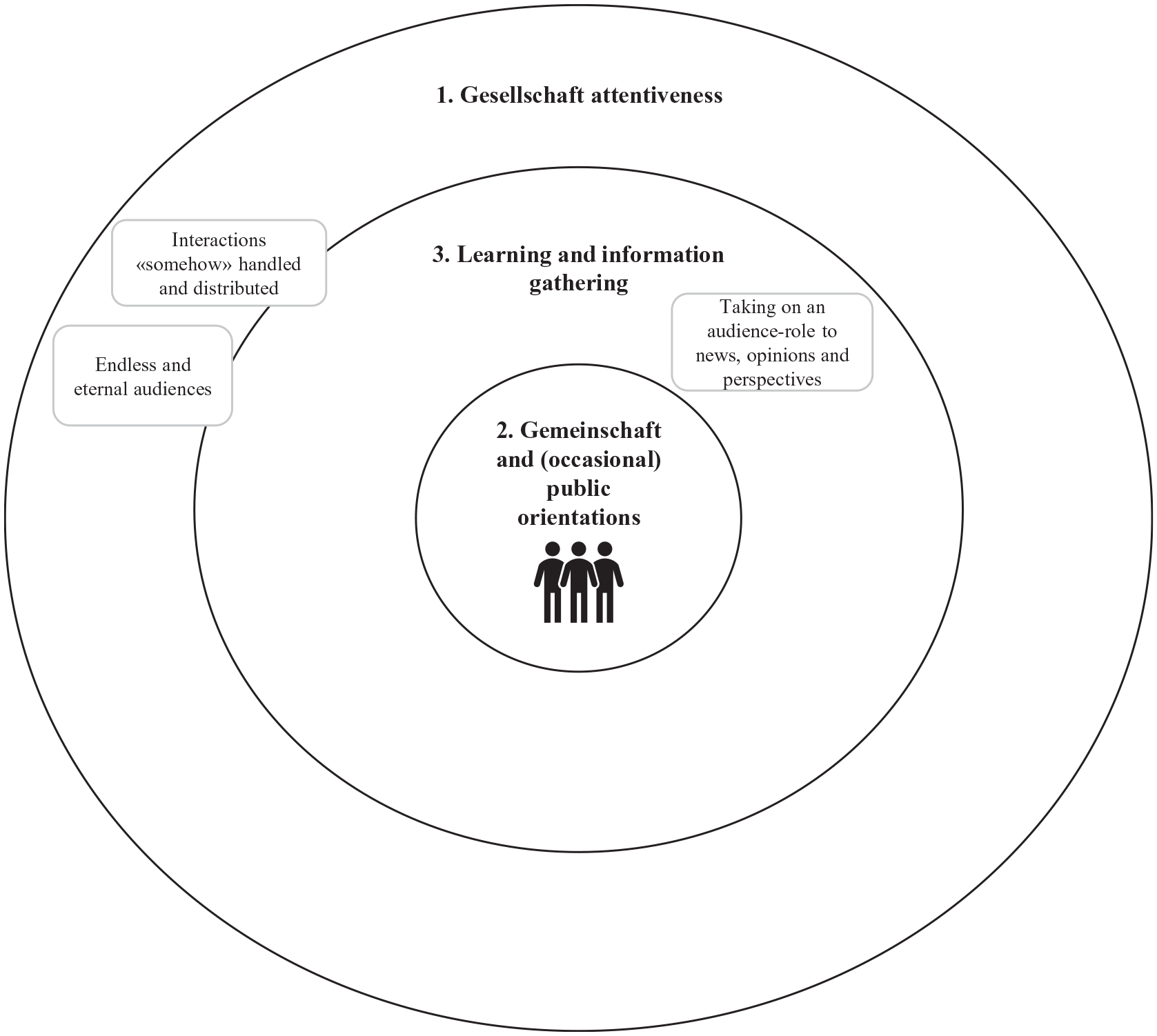
Participants’ use of social media: themes emanating from the analysis.
Digital Gemeinschaft Within Gesellschaft
Three key themes could be identified in the interviews: (1) a reluctance to participate in anything considered an “open” and hence unsafe space online, (2) an ongoing carving out of “closed” spaces for the purpose of safe socialization, and (3) learning and information gathering. As will be shown, this first theme reflects a Gesellschaft attentiveness, while the second reflects continued Gemeinschaft, with occasional public orientations. The third theme demonstrates social media as arenas for citizens’ learning and information gathering. As shown by Figure 1, the Gesellschaft attentiveness surrounds the two others.
Gesellschaft Attentiveness
Interviewees were reluctant to leave any visible trace in “open spaces” as they could not be sure where or when their online interactions could end up. Any space that was not “created” by themselves or someone they knew—with the help of the affordances within platforms (Karahanna et al., 2018; van Dijck, 2009, p. 55)—was considered open. As such, only spaces created by invitation-only-access, through features such as Facebook’s Messenger function or Instagram’s direct messaging (DM) function, were considered closed and safe. Posting something on Facebook or Instagram, outside of Messenger or the DM function, was considered posting something for a potentially endless audience. As explained by “Emerson” when elaborating on why they preferred not posting anything in spaces of “publicness” online, When something is written it is there forever, it exists eh . . . like. What is it called? Mark tags. Of everything that is written and publicized on the internet. That you can find, very easily, not difficult. And there, all of that is there for eternity.
“Emerson” referred to spaces such as Facebook when describing spaces of “publicness” online. Facebook is one example of a social media that provides a variety of close and weak social ties, shown to contribute to selective avoidance and filtering mechanisms (Goyanes et al., 2021). Interviewees frequently circled back to an uncertainty and a lack of control as given features of such online “open” spaces. While the underlying distributive processes of social media were spoken about as a given, the interviewees were highly attentive to these processes’ potential effects. Their elaborations rendered that they envisioned their interactions online as naturally somehow handled in ways possibly leading to unintentional, unwanted consequences. Although algorithms and privacy matters were rarely mentioned explicitly by the interviewees, they showed a high attentiveness to the logic of social media (see, for example, Klinger & Svensson, 2015), where they did not own or control their interactions once it was “let loose” in virality, longevity, and maximum exposure rationales. Some of the interviewees, for example, told “horror stories” of other people’s mistakes online, leading to unintentional distribution of their expressions and interactions. One told the story of a woman which—to her surprise and agony—blew up on Twitter during her flight from New York to South Africa due to what was an intended joke about AIDS (see Ronson, 2015). According to the participant, this was just one example of how your interactions and expressions could suddenly travel to unforeseen and unintended audiences, and the aftermath proved that you could never really scrape what you had posted in “open spaces” off the Internet. The social media natives were in other words not only accustomed, but highly attentive to social media as technologies of Gesellschaft (Ling, 2014, p. 8). Social media’s utilization of people’s interactions was a taken-for-granted “truth” of the online world. This first theme, then, reflects a Gesellschaft attentiveness.
Continued Gemeinschaft and Occasional Public Orientations
Despite their hesitations and attentive evaluations, the social media natives remained present online. Most were even highly active and used social media frequently throughout the day. They utilized social media for keeping in touch with friends and family in spaces they regarded as closed off from such above-mentioned uncertainties. Frequent spaces mentioned were Facebook’s messenger function, Instagram’s DM function, and Snapchat. These spaces allowed them to create boundaries and thereby certain audiences of strong ties (Velasquez & Rojas, 2017), through by-invitation-only access. For example, when elaborating on their interactions with friends and staying up to date on local news, “Arn” explained that they and their friends had created a private chat on Instagram, named after the local meeting-spot where “Arn”’s grandfather met his friends to talk about current affairs in the local community. For anonymization purposes, I refer to this group as “Slaje” (a dialectal short version of the name of the local grocery shop with adhering cafè in my own childhood hometown). The group was created in the “DM” function. Enabled by this function within Instagram, this group could neither be seen nor entered unless invited. Using this feature enabled preventing the possibility of a collapse of social contexts (Papacharissi, 2010; Velasquez & Rojas, 2017). Here, “Arn” and their friends frequently discussed news and current affairs: My grandfather goes to something called “(Slaje).” Every Saturday, they meet down at the mall, the old pensioners. And then they talk about what is going on in the local community. So, we kind of just created the same.
In this group, “Arn” further explained, they could send each other links to online news articles and ask each other about things happening in the local and regional community. There was no need for self-censorship (see Velasquez & Rojas, 2017, p. 4) as boundaries were static. Similarly, “Kersten” had a private group on Snapchat for staying in touch with friends throughout the day where conversations often got political: I use story function on Snapchat, there I have a private one, but it’s kind of also for internal stuff eh its closed so I use it for posting kind of . . . internal stuff if something happened throughout the day or if I just . . . have something to say [. . .]
Is there sometimes something political there?
Yes its very often something political (laughter)
Yes?
A lot of it is that (political) . . . and then I have a lot who disagrees with me, a lot that disagrees, so it’s always funny to see what, what kind of response I get . . . But when it comes to things like Facebook, that’s like, so open, and I don’t know . . .
Some of the social media natives also constructed temporary “spaces” for people they did not have close relationships to, like friends of friends and acquaintances. This was often done using different “story” functions on Snapchat or Instagram. As explained by “Ask,” who only used it for social issue reposting, The only thing I share usually in the story there (on Instagram) is pictures from Amnesty. If it’s some important cause and stuff like that, then I post it there.
“Kersten” illuminated different perceptions of public/private nuances (Papacharissi, 2010) when elaborating on their use of Messenger versus Snapchat: I use Snapchat, but then I just use it to talk to close friends [. . .] I just use it for the closest ones, like, my partner and . . . people that have moved and studies other places I talk a lot to also If I am to write something formal, I write an email. But if it’s more informal, I’ll write it on Messenger. If it’s really informal, I write it on Snapchat. [. . .] Messenger I can use for everyone that I know.
“Kersten” exemplifies that different social media meet different kinds of needs, depending on their action possibilities (Karahanna et al., 2018). It was interesting to note that in the beginning of my conversation with “Kersten,” they did not mention Snapchat as a prominent social media, but later emphasized it as the outmost important platform for their close social interactions and a central part of their daily online practices. To “Kersten,” being asked about the “most important social media” did not invite mentioning Snapchat because Snapchat was simply “just used for talking to close friends.” In other words, it did not fit into the same category as Facebook and Instagram. Similarly, most interviewees (except for one) mentioned Snapchat as one of the most important social media, as it was the most informal and closed-off platform. Snapchat may be seen the most socially manageable social media by the participants as it facilitates strong ties and has no “feed” where anyone can lurk on one’s content without one’s knowledge. It enables only communicating with preselected close relationships (Velasquez & Rojas, 2017, p. 4), where messages vanish quickly after being opened by recipients. Little traces are left, and certain audiences are met. Snapchat affords the needs (Karahanna et al., 2018, p. 739) sought covered by the participants, namely, interpersonal communication without the potential dangers of losing control in spaces where a logic of virality reigns (Klinger & Svensson, 2015). The second theme, an ongoing carving out of “closed” spaces for the purpose of safe socialization, is thus a reflection of a continued Gemeinschaft.
Leaning and Information Gathering
The social media natives all utilized social media for learning, staying updated on, understanding, or making up their minds about news and public issues. For example, “Quinn” explained that although they would never post anything of meaning in a comment section (they could post “@” followed by someone’s username to tag someone, making them aware of the content), they sometimes looked to comment sections to gain understanding of an issue or a dispute, or to see where people positioned themselves. Similarly, “Finley” explained, I always scroll (in comment sections) because, either to see . . . kind of, whom people mostly agree with, or if there are any comments that are funny or well written or. People that write, things I think is just nonsense.
Before remembering Snapchat, “Kersten” named Facebook’s Messenger function as the outmost important part of Facebook, along with Facebook’s “newsfeed” function, giving them a range of different sources for information, news, and opinions as they followed different news sources (e.g., González-González et al., 2022). While the social media natives for the most part explained using social media to stay in touch with their close relationships, they also used it for information gathering and evaluations through news and other people’s posts or discussions. The third theme is hence: learning and information gathering. “Emerson” was one of the few interviewees that occasionally did participate in discussions online outside of closed-off spaces: I discuss a little bit on Reddit . . . Eh. But then I’m literary meaning a little bit. I have thr, four, things I comment on a month. [. . .] Eh, but when I’m on Reddit its mostly, news reading.
Reddit is a social media platform that particularly invites and affords anonymity (K. E. Anderson, 2015; Karahanna et al., 2018, p. A22). “Emerson” hence left no visible footprints connected to their offline selves to other social media users when participating in “open” spaces, and otherwise, similar to the other participants, used such spaces mainly for information and learning.
Discussion
The social media natives of this study use social media developed in rationales of capitalism (Flensburg & Lai, 2022; Klinger & Svensson, 2015) to maintain Gemeinschaft (Ling, 2014), that is, personal relationships and community (Tönnies, 1887/2001, p. 19). They carve out spaces that they perceive private and safe, circumventing the potential of losing track and control of their data traces. As the social media natives evaluate how to best protect their interactions from traveling in unforeseen ways or to unintended audiences, they demonstrate a “reflexive awareness of Gesellschaft” (Boase, 2021) pertaining to features within (social media) applications. In Ling’s (2014, p. 14) conceptualization of digital Gemeinschaft, the mobile phone and the car are emphasized as “technologies that mediate sociation.” Alongside these are “social networking sites” positioned as one of many ways in which people “carry out social interaction” (Ling, 2014, p. 12). What the social media natives in this study illustrate, however, is that social media are not just incorporated mediating technologies allowing us to communicate and coordinate our lives with others. Platforms provide arenas for public and social life. The term digital Gemeinschaft 2.0 (see Figure 2) draws on the “web 2.0” term’s emphasis on the online world as a place for community and sharing between individuals (Fuchs, 2011). The use of “2.0” points to the role of social media as spaces, not just as distributors and transmitters.

From Gemeinschaft and Digital Gemeinschaft toward Digital Gemeinschaft 2.0.
I propose “digital Gemeinschaft 2.0” as a useful concept as it recognizes and follows the development of social media as both (1) a technology equipped for socialization processes (as in Ling’s digital Gemeinschaft concept, mid-column of Figure 2) and (2) a provider of social space (right column). Market forces and market rationales are constructed as circles imposing on the digital Gemeinschaft 2.0 to highlight not just that the technology as commodity is developed for economic profit, but that the space is continuously shaped by for-profit incentives. According to Ling (2014), the “very technologies that serve the purpose of capitalism are often reconceptualized to afford the needs of individuals and their social spheres” (p. 8). The social media natives’ online practices are, however, simultaneously afforded by the social media platforms (see, for example, Gillespie, 2018, p. 19; van Dijck et al., 2018, p. 9). They serve the political-economic interests of social media corporations (Nieborg & Poell, 2018). Giving people the option to participate in isolated groups, when seeing people’s interest in such practices, is economically profitable because people’s presence and activity “add business value,” beyond their content creation (van Dijck, 2009, pp. 4546). To that end, the social media natives do not “reconceptualize” the technology. They rather accept platforms’ architecture and “coded abilities” (Helmond, 2015; Nieborg & Poell, 2018; van Dijck, 2009, p. 45). Not only do people use technology made in Gesellschaft rationales, as “tools of industry and commerce,” to maintain community and personal relationships, then (Ling, 2014, p. 8). Platforms are developed in line with market incentives, under the disguise of being for people’s relationships and community building (van Dijck, 2009, 2013). Social media corporations appropriate the language of Gemeinschaft. Corporations thus purpose technology developed in the name of Gemeinschaft, for Gesellschaft purposes.
Tönnies warned against the development of the 19th-century press becoming “a large capitalist business whose direct and main goal is to create profit in management” (Splichal, 2007, p. 246). Scholars critical to profit-seeking social media would likely not disagree that current profit-seeking social media fit that description. Circling back to Tönnies enables recognizing the impact of the logics of the market (Tönnies, 1887/2001, pp. 52–53) on social media as spaces, mediating technologies between individuals (Ling, 2014, p. 12), and as mediators of news, public information, and perspectives (Tönnies, 1922). As seen in the model above, social media are not just single commodities built upon market rationales. They are communicative spaces continuously thriving upon such logics when handling and distributing actor’s interactions (Klinger & Svensson, 2015). The analysis shows that these logics are what necessitates a continuous attentiveness to space for the social media natives of this study. When socializing with close relationships on social media, they carve out spaces carefully with attentiveness to the Gesellschaft rationales steering how information travels.
Inherent to Tönnies’ concerns related to the media and public life is the control capital forces gain on behalf of people’s genuinely comfortable and close coexistence. Although Tönnies is often read as uncompromising in his dichotomy between Gemeinschaft and Gesellschaft, and the features connected to each life form, one may in his later additions to the traditional work of 1887 find that he was occasionally more nuanced and open to Gemeinschaft attempts and functions within the frame of Gesellschaft (see Asplund, 1991, p. 65). What was crucial was that such practices did not succumb to commerce but resisted it. While the social media natives do not resist social media altogether, illustrating its vast and integrated role in Norwegian society, they attempt to resist its logics, especially prevalent and noticeable outside of “closed” spaces. They demonstrate that people living in Gesellschaft circumstances may engage in Gemeinschaft-like practices (Asplund, 1991, p. 65).
Social media lack traditional gatekeeping functions making anyone a potential creator and broadcaster of content. The agentic potential of the Internet is what prompted utopian visions of how it would revolutionize the public sphere (Quandt, 2018). As the social media natives carve out spaces online for keeping the “Gemeinschaft,” they simultaneously reflect a lack of utilization of social media for public sphere discussions (Benhabib, 1996). When closed-off spaces are used for discussing current affairs and news, as exemplified by “Slaje” (mimicking the members’ grandparents’ café gatherings and discussions), one could expect that the participants were likely to engage with news and topics that other people in their communities were also reading and discussing, similar to features in the emergence of Habermas’ ideal publics (Habermas, 1989, pp. 42–43). However, the news they share and discuss may to different extents, as in Tönnies’ concept of the public, be shaped by instrumental and strategic reasonings, either due to social media’s occasional de facto editorial functions (Brække & Larsen, 2022) or due to news outlet’s profit-incentives. Furthermore, Slaje and its counterparts are constructed as closed spaces of few constant individuals, where exclusion is imperative, countering Habermas’ principle of publicity. Earlier research suggesting that people may discuss and share news with those they are closest to, in closed groups online for privacy purposes (Kalogeropoulos, 2021; Papacharissi, 2010), is in other words supported. The reasons given by the social media natives for not utilizing online spaces for public sphere discussions illuminate their familiarity with economic rationales underlying these online spaces. Online spaces are not seen as places for “debating and deliberating,” but places run on incentives of “buying and selling” (Fraser, 1992, p. 57). They rather utilize the “open” spaces for the purpose Tönnies’ described for the press in the 19th century, then: as providers of information and others’ opinions (e.g., Tönnies, 1922, p. 99), consequently taking the role as audiences in these spaces. According to Tönnies, Gesellschaft is “die Öffentlichkeit”; it is public life (Tönnies, 1887/2001, p. 3). Although the social media natives are oriented toward their community and the public, the groups that are created for sharing and discussing news and current affairs, with “Slaje” as example, still consist of close relationships. Such spaces are private and answers to “semi-public social needs,” then (Papacharissi, 2010, p. 50). In the words of Papacharissi (2010): “it is possible for the social to sustain elements of both public and private practices without being subsumed by either” (p. 49). A space like “Slaje” may hence not just fit as example of digital Gemeinschaft 2.0, when used for upholding close relationships, but as one out of many forms of “private publics” (Papacharissi, 2010). It is a socially motivated space, but it also carries an outwards orientation to public affairs and news. “Slaje” and its counterparts demonstrate people’s creation of a safe location “at home” for understanding and discussing what is “outside” of the home, but relevant to them (i.e., the public). They may function as “training grounds” (Fraser, 1992, p. 60) for public participation, and contribute to the creation of experiences “of belonging” to a larger community (Berlant, 2008, p. 25). That is, alongside their functions as private spaces, conducive to personal relationships. Their communication never transgresses the borders of their closed-off spaces but continue existing as “privately contained activities with a public scope” (Papacharissi, 2014, p. 153). They thus exemplify the emergence of societal functions enabled by “a private, not a public, sphere” in digital society, and hence the relevance of communication and reflection in such spaces to contemporary democracies (Papacharissi, 2014).
There are limitations to Tönnies’ Gemeinschaft and Gesellschaft as a strong-held dichotomy when attempting to understand contemporary societies and communities. Ling (2014) argued that Tönnies’ conviction of an inescapable take-over of Gemeinschaft by Gesellschaft was too fixed and static. The dynamic relationship between Gemeinschaft and Gesellschaft, rather than a linear definite progress toward the latter’s direction, is greater than explicated by Ling. Platforms enable social spaces, in the name of Gemeinschaft, but for Gesellschaft purposes. People accept some of these for-profit constructions while resisting others. Occasionally, they use closed and private spaces, enabled by the for-profit platforms, in orientations toward their public (according to Tönnies closely related to Gesellschaft) while still confined within the realm of the private and safe (where Gemeinschaft occurs).
Why it is so important for the social media natives of this study to not leave traces in “open” spaces online may be manifold, however (see, for example, Coles & Saleem, 2021; Laurison, 2015). One may start out by seeing their responses through the lens of their “distinct positionalities of privilege” (Fang et al., 2019, p. e11). Had a similar study been conducted elsewhere, where access to technology is lower, results would be different. The participants had ample and long experiences with for-profit social media (LaRose et al., 2001). Education and income are considered pivotal factors conjunctly affecting an individual’s access and use of information and communications technology (Fang et al., 2019). Higher education has moved toward becoming “mass education” in Norway (Arnesen, 2000, p. 227), and a large majority of the population has access to and use the Internet and mobile platforms (Skogerbø & Karlsen, 2021). Furthermore, while research shows that there is a large amount of aggression, incivility, and hate online (A. A. Anderson et al., 2014; Greene et al., 2022), the participants of this study rarely described their reluctance to be visible to others online as connected to fears of being harassed or as due to uncivil argumentation cultures. Such actions are often directed toward minorities in Norway (Sønsteby, 2020). The participants were all White (Fang et al., 2019), cisgender presenting, Europeans. Moreover, they also had stable social offline networks (Lu & Hampton, 2017), inherent to the creation of their closed-off spaces on social media. In other words, they share privileges making them not face or expect challenges that others not similarly positioned are more likely to experience and expect, both beyond and within the national borders of Norway.
As they explained not wanting their interactions to end up before unintended audiences (Papacharissi, 2010), they describe an “awareness of others’ awareness” (Lu & Hampton, 2017), making them careful rather than more visibly active (Velasquez & Rojas, 2017, p. 4). A need for impression management (Goffman, 1959) and the Internet’s lack of stable borders (Papacharissi, 2010) may play part as explanatory factors to the participants’ attentiveness to space. When being used to the rationales of social media stimulating sudden “virality” of content and profiles (Klinger & Svensson, 2015), one may as a young adult and student, for example, envisioning facing a job-market, be especially careful and attentive to current and future audiences (Papacharissi, 2010, p. 142). The social media natives’ “social media skills” and platform knowledge are key to their careful, rather than more (visibly) active (Velasquez & Rojas, 2017), behaviors. By utilizing their otherwise advantageous offline social network (Lu & Hampton, 2017), they can allow their previous experiences (LaRose et al., 2001) shape their use of different features afforded within and between social media (Karahanna et al., 2018; Velasquez & Rojas, 2017), the way they do. The conversations with the social media natives illustrate not only that different platforms answer to different needs (Karahanna et al., 2018) and are used differently according to what they provide, for example, in terms of strong and weak ties (Velasquez & Rojas, 2017), always enabled by social media’s incentives to keep people active (van Dijck, 2009), but that one’s offline circumstances are pivotal to one’s use of social media.
As research has emphasized the increasingly prominent role of social media for political communication and public issue contestation (e.g., Andersen, 2019; Skogerbø & Karlsen, 2021, p. 102), this article sheds light on the contingent nature of such participation. Specifically, it emphasizes perceptions of constraints and possibilities online shaped by Gesellschaft mechanisms. This study illustrates how social media structures have implications for users’ practices beyond what they enable and prevent in technological terms (see Črnič & Prodnik, 2015, for the role of platform architecture for deliberative communication). The ways that social media track, analyze, and “feed back” information to users (see Jensen & Helles, 2017) are just one (technical) dimension.
Research should look further into the perceptions of, and practices in, social media by people that have grown up with offline/online entangled public spheres. The extent to which space attentiveness and protective strategies are connected to people’s specific age, generational status (Fang et al., 2019), and/or life situation (Parviz & Piercy, 2021), or whether it becomes increasingly prevalent across generations as the amount of people accustomed to profit-seeking social media grows, should be further scrutinized. If the latter would turn out true, Tim Hwang’s (2020) call for policies (due to an “attention crisis”) may have relevance beyond online advertising systems and the status of its continuity. Concurrently, “the private” continues as commodity (Papacharissi, 2010, p. 43). Social media companies continue using technology to benefit economically from people’s interpersonal communication and close relationships. Moreover, scholars have long called for developing social media in line with public service ideals (Fuchs, 2014). Policies may play a part in inhibiting extra constraints on citizens’ utilization of the public sphere for reciprocity and participation. Currently, social media’s for-profit features and rationales continue not inviting public sphere participation, seen in the responses from the social media natives of this study. Such findings should prompt pertinent questions in a country like Norway where freedom of expression is generally considered highly satisfied (Nielsen et al., 2019) and where social media platforms increasingly provide spaces and avenues for public sphere interactions (Skogerbø & Karlsen, 2021).
Conclusion
The term digital Gemeinschaft 2.0 highlights that social media provide additional spaces for social life. The results from 11 in-depth interviews with Norwegian social media natives demonstrate that social media are used for upholding social relationships in closed-off online spaces. Outside of these spaces, the participants rather take on roles as audience members, refraining from using social media for public sphere participation. While digital Gemeinschaft 2.0 confines itself to posit that people continue to uphold close social relationships in digital society, it concurrently points to the continuous tension between Gesellschaft and digital Gemeinschaft (Ling, 2014), as it materializes in for-profit social media. People grapple with products of Gesellschaft, and its adhering rationalizing and self-interest rationales, while utilizing it for the purpose of Gemeinschaft in digital society. Simultaneously, social media corporations invite and utilize people’s social life, their interaction with close relationships, and community building for economic profit and growth.
Footnotes
Acknowledgements
The author would like to thank Hande Eslen Ziya, Anders Vassenden, Elisabeth Lund Engebretsen, and Helle Sjøvaag for indispensable editorial comments and conversations, and three anonymous reviewers whose constructive comments considerably improved the development of this article.
Declaration of Conflicting Interests
The author(s) declared no potential conflicts of interest with respect to the research, authorship, and/or publication of this article.
Funding
The author(s) received no financial support for the research, authorship, and/or publication of this article.
