




Abstract
This research explores the changes the traditional gatekeeping roles of Bangladesh social media editors have undergone. The 17 interviewed journalists also enjoyed less autonomy in moderating audience comments as they removed comments critical of the government or the ruling party to avert legal consequences. These editors even considered their jobs to be “marketing” of news, suffered volatile treatment from their colleagues in the newsroom and felt pressured by their bosses, advertisers and audiences.
Introduction
At present, news organizations, regardless of where they are based, are concentrating more on providing news to their audiences using social media platforms. With the rising popularity of news consumption on social media, news organizations across the globe have recruited social media editors to manage their social media presence (Currie, 2012; DeVito, 2014; Tandoc & Vos, 2016). Previous studies (Cassidy, 2005; DeVito, 2014; Singer, 1998, 2001, 2006, 2008; Tandoc & Vos, 2016) found that journalists in the digital media setting maintained various types of roles which included interpretation, communication and marketing functions. The studies also found that these journalists were less involved in one of the core jobs of a traditional gatekeeper or journalist—investigating the information that came from various sources.
Journalists are now finding themselves to be playing a new role—that of social media content creators. Social media content creators working in mass media go by the names of social media managers, social editors, social media specialists, digital media managers, engagement editors, online editors, digital journalists and many others (Aybar, 2019; Cohen, 2018; DeVito, 2014; Ferrer-Conill & Tandoc, 2018). The social media editors’ roles include building a brand identity (Aybar, 2019), engaging social media audiences (Elizabeth, 2017), using social media for journalistic practices (Craig & Yousuf, 2013), producing content on websites and social media on behalf of their news organizations (Cohen, 2018) and posting shorter versions of news contents on social media (Assmann & Diakopoulos, 2017).
Studies on how news organizations use their social media accounts with the aid of their teams of social media editors and on the roles of these social media editors have already been conducted, in the western part of the world (Currie, 2012; DeVito, 2014). However, no such study has been conducted on the media industry of Bangladesh, a country in the Global South. After realizing the importance of social media platforms and following the global trends in journalism, Bangladesh’s news media industries, such as print, broadcast and online/digital industries, began using the medium (Al-Zaman & Noman, 2021; Azad, 2020; Fahad, 2014; Gayen, 2019; Yousuf et al., 2019). When newspapers in Bangladesh opened their own social media accounts, traditional journalists had to learn how to adapt to the new medium. This study explores the changing role of traditional journalists in adapting to the social media as seen through the lens of Shoemaker et al. (2009) Gatekeeping Theory of Communication. Shoemaker et al. (2009) mentioned that the gatekeeping roles of journalists included selecting, writing and editing different types of information and turning them into news items and then delivering them to the masses. According to Vos (2015), the theory also enabled researchers to study issues journalists face in an era of transition to social media. The gatekeeping theory helps the researcher understand the changes in journalistic roles due to the transition; for example, journalists were now adopting social media as instruments for audience engagement. The new form of gatekeeping also empowered information professionals—journalists, editors and other press members. Vos (2015) argued that these new types of “qualitative changes” (p. 11) in the routines and behavior of journalists are still gatekeeping. Currie (2012) and DeVito (2014) used the gatekeeping theory when studying social media editors’ roles in Canadian and U.S. newsrooms.
This qualitative study focused on the journalistic practice of social media editors in newspapers of the rarely studied low-income country of Bangladesh. The study contributes to the journalism scholarship by exploring the roles and experiences of social media editors in a non-western newspaper industry.
Theoretical Framework: Gatekeeping Theory
Journalists obtain information from a variety of sources that range between human sources and technological sources. Then journalists begin crafting of a news article from a large amount of information through the process of gatekeeping that includes the selection of information, news writing and publication.
Defining the gatekeeping process, Shoemaker and her co-researchers asserted that gatekeeping was the “process of selecting, writing, editing, positioning, scheduling, repeating and otherwise massaging information to become news” (Shoemaker et al., 2009, p. 73). Shoemaker et al. (2009) termed the Gatekeeping Theory as “complex processes in mass communication” which were once seen in a simplistic way. Without gatekeeping, the journalists’ job of selecting and subsequently making use of that information to craft a piece of news would be “impossible” (Shoemaker et al., 2009).
The gatekeeping process, according to Shoemaker and Vos (2009), concluded when “news items” or contents were released by the mass media. They linked gatekeepers to customers because the decision-making processes of consumers and gatekeepers were similar in the way that “gatekeepers are consumers, producers, and distributors of messages” (p. 39). Gatekeepers are influenced in the gatekeeping process by factors such as their thinking, decision-making and personality traits.
Several studies—Singer (1998, 2001, 2006, 2008), Cassidy (2005) and Brill (2001)—noted that the gatekeepers had been witnessing changes in their traditional roles in the internet‑based media landscape. All these studies (Cassidy, 2005; Singer, 1998, 2001, 2006, 2008) found that the gatekeepers in the traditional print arena once used to provide information or make them accessible to audiences as their one of their primary functions, while the journalists were now more involved in interpreting, communicating and even embracing marketing functions in the digital age. The online-era journalists were also less involved in one of the core jobs of a print-era gatekeeper or journalist—investigating or verifying the information coming from various sources (Singer, 2001, 2006, 2008). A study conducted on the U.S. campaign coverage in 2004 also found that online journalists changed the course of their gatekeeping jobs in three preliminary ways—providing “personalizable contents,” offering “blogs” on their websites and moderating “chats or message boards or forums” on politics (Singer, 2006). By practicing these roles, as Singer (2006) wrote, journalists now did way more than their predecessors did in the 2000s and before and also “re-conceptualized their gatekeeping role” in the age of social media.
Who Is a Social Media Editor?
Social media teams started to grow in numbers in the newsrooms in the first decade of this new century when social media started to gain popularity (Alejandro, 2010). The first social media teams in the newsrooms emerged as the largest media organizations in the world. The decade in its early years saw the newsrooms of large organizations—the BBC and New York Times in 2008 and USA Today in 2009—arming themselves with social media teams (DeVito, 2014). Social media editors in the newsrooms of other countries also made their presence felt under different names such as audience development managers and community managers (Ferrer-Conill & Tandoc, 2018).
Social media editors in the newsrooms, according to the American Press Institute, could be termed “social engagement” or “audience development” teams composed of one individual or a number of people who had other duties in the newsrooms (Elizabeth, 2017). Adriana Lacey, the Los Angeles Times’ audience engagement editor, opined that social media editors were responsible for the “frontline” activities of the overall journalism process and faced the audiences on behalf of their organizations. Newman (2009) wrote that social media activity in the newsrooms began while journalists were dabbling on social media sites such as Facebook and Twitter during unrelated editorial jobs and later with time, these activities were defined as the social media editor’s job responsibilities by the employers.
Quoting former BBC journalist Nic Newman, Fischer (2014) wrote that to uphold the brand value and traditional journalism values, newspapers should use social media. Academics, journalists, media strategists and researchers echoed him in recent years and advised the news outlets to take their social media usage more seriously (Elizabeth, 2017; Fischer, 2014). Social media experts also stressed the importance of strengthening and reinventing social media teams to get more traffic and to battle with emerging issues such as misinformation and fake news (Alejandro, 2010; Elizabeth, 2017). Craig and Yousuf (2013) noted that social media editors were playing a “key role in the development of standards and best practices in journalistic use of social media.” The researchers (Craig & Yousuf, 2013) came to find that the social media editors’ role also included some major tasks in the newsrooms such as the development of strategy and training of staff members. The editors were also found to manage the news outlet’s social media accounts, create content, manage readers, analyze trends and assist with editorial decision-making (Ferrer-Conill & Tandoc, 2018). Cohen (2018) stated that these journalists were also called digital journalists who often produced and aggregated content for their own organization’s websites and later turned that content into posts for social media platforms.
Assmann and Diakopoulos (2017) wrote that the social media editors also posted shorter versions of contents, which were printed or published online, on social media platforms. The headlines of the contents published on social media were often given attractive headlines to get better SEO results. Sometimes these editors picked up tidbits from the contents to share on their social media accounts as they thought that a certain portion might be more “shareable” and “searchable.” Among the existing social media editors, only a few worked on news stories or pitched stories while most of them were involved in editorial meetings deciding on which news stories would be posted on the social media accounts along with other contents such as videos, photos, galleries and so on. After conducting studies on these editors and other members of the social media teams at different news outlets, Assmann and Diakopoulos (2017) and Tandoc and Vos (2016) also found that the social media editors’ jobs lay somewhere between marketing and journalism. Lew (2018) agreed with almost all the aforementioned roles of social media editors and said that “posting links” was one of the major jobs they performed when they did not have enough time to communicate with large-scale audiences. Mandy Velez, a social media editor of The Daily Beast, shared that the social media editors sometimes shared “paid contents” to increase revenue earnings as journalism was still a “business,” in which case, they should inform their audiences by tagging posts as “sponsored” or badly risk affecting the relationship between the organizations and their audiences (Aybar, 2019).
Social Media and Bangladesh News Media
As access to the internet expanded across the globe, social media became a popular among news organizations and journalists. A 2018 Pew Research Center study estimated that 67% of Facebook users in the United States read news on this social media platform (Shearer & Matsa, 2018). News organizations across the world now disseminate their news links, photos, video contents and even live programs on YouTube, Twitter, Instagram, Snapchat and WhatsApp (Currie, 2012; DeVito, 2014; Tandoc & Vos, 2016).
According to an estimate, 18% of the 30 million people who had access to the internet used one or another kind of social media platform in Bangladesh (Azad, 2020). This rise in the number of internet and social media users created a significant impact on the media landscape of Bangladesh. The media industry was now opting for “increasing digitalization” (Azad, 2020). Both large and small newspapers had their own websites to disseminate news among their readers while some of the large ones were running their own Facebook pages, Twitter and Instagram accounts and even YouTube channels (Azad, 2020).
Fahad (2014) pointed out that, with the proliferation of social media, newsroom journalists in Bangladesh were now using social media for newsgathering and for contacting their sources. Once upon a time, these newsroom journalists depended on telephones, faxes or their colleagues working in the fields to collect information prior to news production (Fahad, 2014). He also cited several examples of how the Bangladesh newspapers had been producing news contents from trending social media contents on various issues to keep up with their audience demands (Fahad, 2014). Al-Zaman and Noman (2021) found that newspaper audiences in Bangladesh had reduced their news consumption through social media, which had caused the newspapers’ reach to shrink on social media compared with several years back. Yousuf and colleagues (2019) investigated how social media was used by newspapers in Bangladesh and analyzed the type of contents they posted on their Facebook pages. The study conducted on English language dailies revealed that the newspapers posted news stories on various topics including diplomacy, national security, lifestyle, science and technology and international stories to meet their audience demands (Yousuf et al., 2019).
Prothom Alo, a Bengali newspaper, is one of the most circulated newspapers in Bangladesh and its online portal Prothomalo.com is claimed to be the most accessed Bangladeshi website in the world (Azad, 2020). The newspaper’s Facebook page has 14 million followers. Among the English dailies in the country, The Daily Star is one of the most popular newspapers. It went online with its website in 2006 but had a significant uplift when its digital section expanded and developed as more staff members were recruited. It diversified the content present on its website and at present boasts of a three-million follower base on its Facebook page and other social media handles. The newspaper experienced significant growth in its revenue earnings in 2017 and grew by 53% compared with 2016, thanks to its digital wings (Azad, 2020). The other major daily newspapers have their online versions and accounts on Facebook, Twitter and YouTube as well (Gayen, 2019). It is not clear how many media outlets in Bangladesh own social media accounts; however, Gayen (2019) and Fahad (2014) both claimed that almost all newspapers used the social media platforms for producing and disseminating “contents” and a group of journalists, appointed by the newspapers, managed the newspapers’ social media accounts. However, how these journalists use their organizations’ social media accounts, perform their roles and experience working in newsrooms are still uncovered by researchers or authors. This study, therefore, asks the following research questions:
How do the social media editors working at newspapers in Bangladesh use their organizations’ social media accounts?
What gatekeeping roles do the social media editors perform in newsrooms?
What perceived experiences do the social media editors have in the newsrooms?
Method
Following the purposive snowball sampling method, a total of 17 participants (15 males and 2 females) from 14 national newspapers in Bangladesh were interviewed between February and July 2020. The smaller number of female participants in the study reflects the overall low number of female journalists working in the Bangladesh print industry (UNB, 2017). Prior to the interviews, the study questionnaire of 36 questions and recruitment procedure received the Institutional Review Board approval from a southern public university in the United States. The authors also received consent from the participants prior to the interviews. The participants were asked questions such as “How long have you been in charge of your news organization’s social media pages?” “How do you decide on which contents to post on the pages?,” ‘What are your primary responsibilities in this role? “How are the editorial decisions made about which content should be posted on social media?,” ‘How do your colleagues treat you in the newsroom? “How does your job incorporate journalism?,” and so on.
The social media editors selected to be interviewed for the study worked at the following newspapers—The Daily Star, New Age, Dhaka Tribune, The Business Standard, Kaler Kantho, Prothom Alo, Daily Samakal, Daily Ittefaq, Desh Rupantor, Jugantor, Bangladesh Pratidin, Amader Shomoy, Manab Zamin and Daily Naya Diganta. According to the latest government data, nine of the aforementioned newspapers are among the top circulated newspapers in Bangladesh, while the others, except for The Business Standard, have more than 40,000 circulations (Department of Films and Publications, 2021). This study applied a long interview method as the inquiry instrument since the method has descriptive and analytical strength. McCracken (1988) stated: The purpose of the qualitative interview is not to discover how many, and what kinds of, people share certain characteristics. It is to gain access to the cultural categories and assumptions according to which one culture construes the world (p. 17).
McCracken also further noted that “qualitative research does not survey the terrain, it mines it. It is, in other words, much intensive than extensive in its objectives” (McCracken, 1988, p. 17). This study tried to investigate and find out the emerging issues experienced by social media editors in their gatekeeping roles in the print newsrooms of Bangladesh. DeVito (2014) applied the method earlier while conducting a study on social media editors in the broadcast newsrooms of the United States.
This study also applied the telephone interview method to collect data. A few decades ago, the telephone interview method was not much used by academic researchers for two basic reasons: (a) problems of sampling and reliability and (b) validity of the telephone interview (Horton & Duncan, 1978). However, Horton and Duncan (1978) also mentioned certain advantages of the telephone interview method in social science research which include speed, cost-effectiveness and mobility. The authors also used some social media applications to interview the participants as the participants often showed little interest in talking over the phone and were more comfortable with social media applications such as Facebook Messenger and Skype. On average, each participant was interviewed for 1 hour and the total duration of interviews conducted for the study was about 17 hours.
After transcribing the interviews, the authors applied the textual analysis method to understand key themes in the study. Maxwell (2012) stressed that data analysis in the qualitative method should be started right after data collection as through this process, a researcher can “stop briefly to write reports and papers” (p. 106). Maxwell (2012) mentioned the various stages of data analysis for the qualitative method which start with reading the interview transcripts followed by “writing memos, developing coding categories and applying these to your data, analyzing narrative structure and contextual relationships” (p. 107). The study followed the processes described by Maxwell (2012). After taking the interviews, all the recorded audio was transcribed first in Bengali, the native language of the social media editors interviewed and then the transcriptions were translated into English. The first author then read the verbatim of the transcriptions carefully to correspond with “writing memos.” Then the author developed codes in an attempt to understand the abstract sub-themes. After that, a more focused coding stage was followed to identify the relationships between the previously developed codes and to develop several overarching themes to correspond with the study’s goal.
Results
The study found that, overall, the gatekeeping functions of the social media editors in Bangladesh newspapers had changed significantly. For instance, the social media editors’ decision-making process about content dissemination was influenced by their superior authorities, advertisers and their audience demands. The social media editors perceived their roles to be more similar to that of a marketer or seller of newspapers and their contents. Three research questions guided this study in exploring the findings. The first research question asked, “How do the social media editors working at newspapers in Bangladesh use their organizations’ social media accounts?” The second and third research questions asked, “What gatekeeping roles do they perform in newsrooms?” and “What perceived experiences do the social media editors have in the newsrooms?”
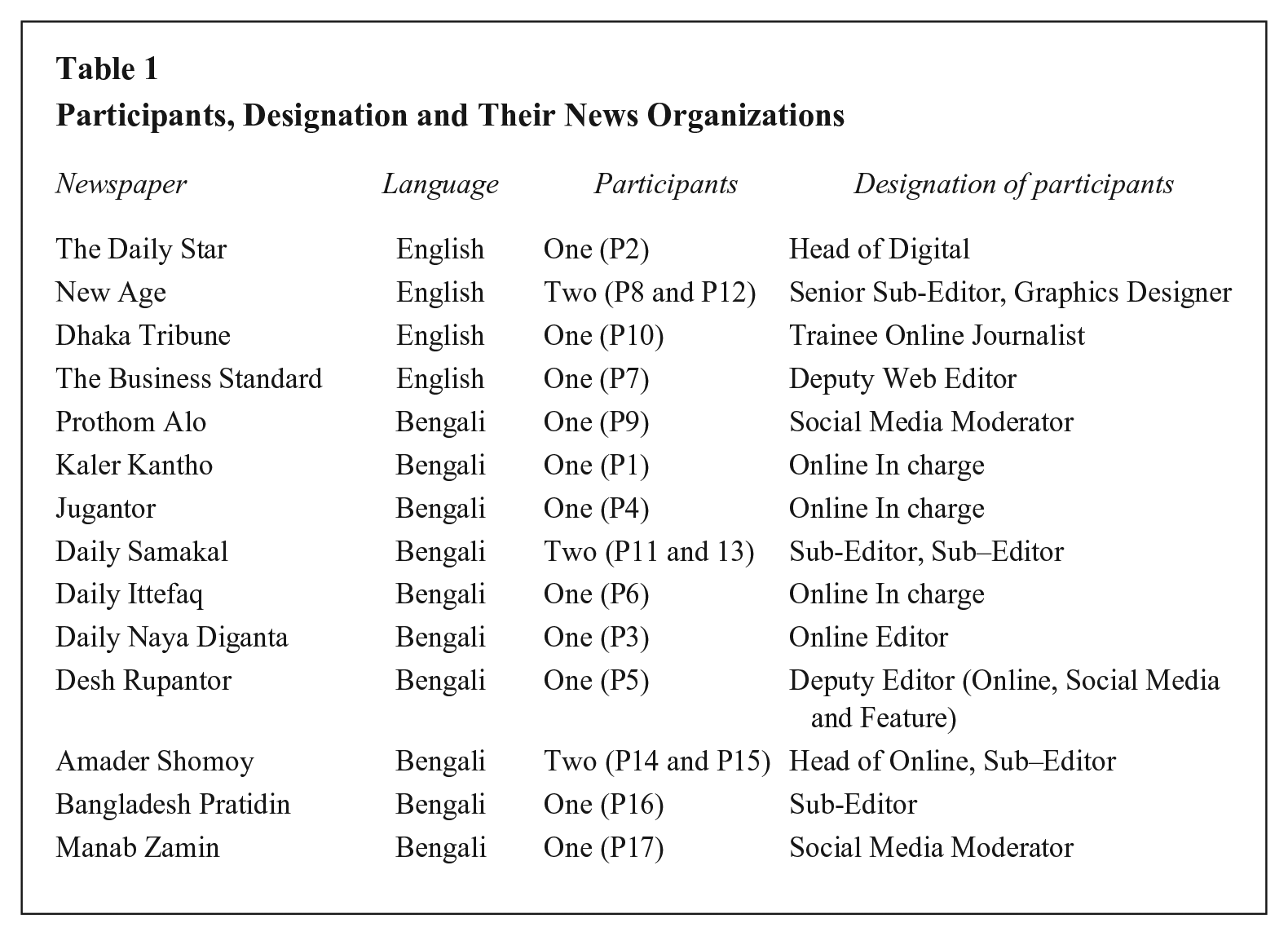
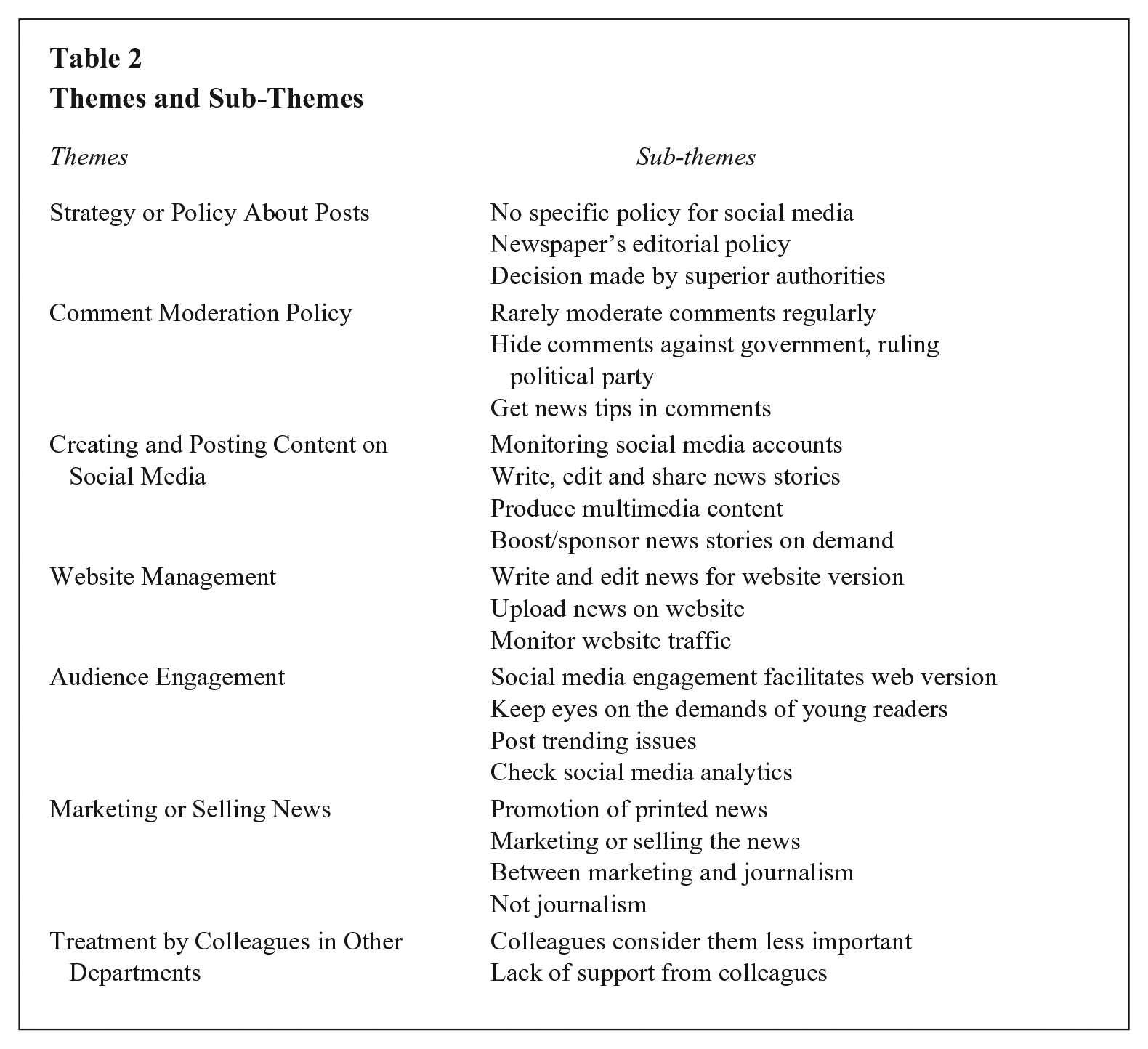
When the author asked the participants what his or her job title was, they named a total of 10 types of job titles (Table 1). Among all the 17 participants, eight claimed that they were chiefs of their teams, one called himself a trainee and the other eight were team members. The participants had a diverse set of designations as four of them were in charge of online editions, six were sub-editors and the other participants each bore the following designations—head of digital, online editor, deputy editor-online, deputy web editor, social media moderator, trainee online journalist and graphics designer. To answer the research questions, seven major themes were generated. The themes for the first research question were—strategy or policy about posts and comment moderation; the themes for the second research question were—posting content on social media, audience engagement and website management; and the third research question had one theme—treatment by colleagues in other departments. These themes (Table 2) are explained and described in the next section.
Participants, Designation and Their News Organizations
Themes and Sub-Themes
Use of Social Media
The authors investigated how the social media editors used the social media accounts of their newspapers. The first research question asked how social media editors use their newspapers’ official social media accounts. Over the course of the study, the authors developed an understanding of how the social media editors in Bangladesh’s print newsrooms used the newspapers’ social media accounts.
Strategy or Policy About Posts
When asked about how they made editorial decisions on which content to post or share on the social media accounts, the majority of the participants said that their priority with regard to posting lay on what the audiences wanted, which they measured through audience engagement. Besides, they could not share anything on their own if the news or content possibly went against or reflected negatively on national politics, the ruling class, the government, advertisers and even their own newspapers. The majority of the participants said that, most often, they did not need to make decisions about posting but rather shared almost all the contents from the website and print on social media with little or no changes. For example, a participant from a Bengali daily said, Usually for highly serious matters like national politics, the government, the ruling class or something against our advertisers or newspapers image, we need to take prior permission from the bosses to avoid consequences. Otherwise, we are not required to take any permission, we just post.
All of the journalists interviewed either said or hinted that the newspapers did not have any written or formal strategies or policies in place about managing their social media accounts but followed unofficial guidelines and editorial policies set by the newspapers. They also shared that they followed some different unofficial and temporary strategies.
Comment Moderation Policy
The majority of the participants said that there was no policy in place or they did not have the manpower to go through all the comments and moderate them regularly. In some cases, however, when they found that any comment went against their editorial agendas or policies, they hid or deleted them. Some of them said that they had to be very cautious about comments posted by a reader that might go against the ruling political party or influential groups. For example, a participant from an English daily said, Bangladesh has passed a law called the Digital Security Act to dismantle the freedom of expression and put a stop to the tiniest of criticisms against the government, we have to be very careful as any abusive word against the current government, and the ruling party on our page might cause damage to the newspaper’s entity.
The majority of the interviewed participants, however, said that they received news tips in the comments posted by the readers and they then tried to reply to those comments. The social media editors then mostly passed on the comments containing the news tips to their colleagues on the reporting team or the print section. They also said that they appreciated readers who posted such comments. A few of the participants said that they rarely replied to the comments posted by the readers, but that they replied to messages in the chat boxes.
Gatekeeping Roles
The second research question of this study asked what gatekeeping roles social media editors at Bangladesh newspapers perform in newsrooms. The study is also aimed at investigating their roles in the newsrooms and how they performed them. Social media editors working in the newspapers based in Bangladesh shared the variety of roles they played in the newsrooms among which the most common duties were posting contents on social media, creating and posting contents for the newspapers’ websites, audience engagement and marketing or selling of the news.
Creating and Posting Content on Social Media
Creating and posting contents on social media accounts was one of the major functions described by most of the participants. All the participants shared that they were key persons of their newspapers’ social media activities and that they were also responsible for the website contents. P11 shared that their major duties included news collection, editing the news, uploading them on the website and sharing the news links on the social media platforms. The majority of the participants also worked on other tasks such as news writing and editing among others. Most of them said that they regularly multitasked between activities in the newsrooms that ranged from writing news articles to social video production. They were engaged in many jobs alongside managing the social media platforms of their newspapers. Most of the participants said that they posted contents along with their other team members. In some cases, they worked in groups of two or more, split in accordance with the news or content genres they were assigned to work on. In other cases, all the team members on a social media team performed the same duties across the platforms. P4 shared that his newspaper employed 17 people in total for both the social media and website operations. The team worked in two subgroups to upload both international and national news on the website and social media accounts. Some of the participants said that not all members on their teams could access all the social media platforms. Different members were responsible for different social media platforms and their contents.
Website Management
A total of 16 participants said their job roles include management of their newspapers’ websites. Only one of the participants P10—explicitly shared his non-involvement with website management or managing and uploading of contents on their respective websites as his job responsibilities did not include managing or posting of contents on the website. All the others, whether they were team leads or just members, stated that they also wrote news articles, made other contents, uploaded them onto the website and oversaw its layout. Most of the participants seemed to work on website management and social media management side by side. Whenever they uploaded anything on the website, the first thing they did was to share it on social media. The majority of the team leads shared that they monitored the websites. For some of them, monitoring the websites was the first task they embarked on every day after waking up, and later contacted the other teammates if they found any mistakes or if any report had remained uncovered. The team leads also guided the team members to fix issues or errors as early as possible.
Audience Engagement
All the participants agreed that one of their core objectives was to maintain audience engagement on their newspapers’ social media platforms. The majority thought that proper audience engagement on social media helped the web version of their newspapers to generate better revenues. The social media editors in Bangladesh thought that nowadays both their newspapers’ print and digital or online versions could not thrive without an active social media presence. Traffic to the websites and also subscriptions for the print versions of these newspapers were highly dependent on the respective newspaper’s social media activities. According to some of the social media editors interviewed, a greater percentage of the newspapers’ revenues was now generated through their social media activities. This was because social media created more engagement with audiences on their websites and print versions and advertisers were more interested in running advertisements and spending money on the newspapers’ social media platforms. The participants shared that they focused more on young audiences and regularly followed social media analytics to measure audience engagement. For example, a participant from a Bengali daily shared, Audiences aged between 18 and 35 usually want light topics and contents on news media websites or social media accounts. We know it is not good for journalism, but we have to do it to increase website traffic engagement.
To keep the audiences engaged on their social platforms, the social media editors focused on specific types of contents on specific social media platforms. The participants said that they emphasized on trending content topics such as politics, international, national and entertainment. They shared these topics the most as their readers wanted or demanded them, while text was the most shared content type. Some of them said that they also posted videos, pictures, graphics and live videos on social media accounts.
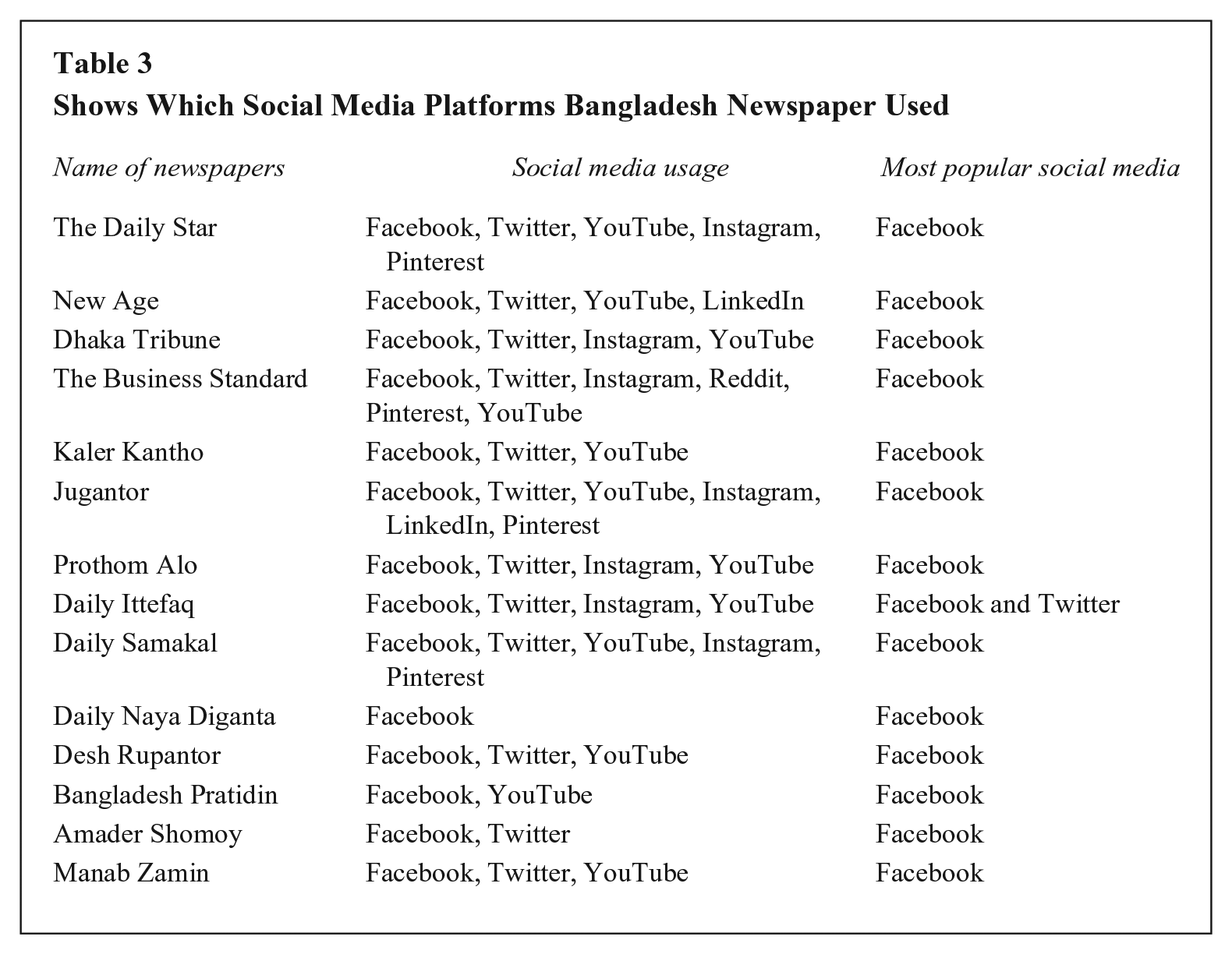
The number of posts also varied in newspapers and even on social media platforms. However, in most cases, more posts were shared on Facebook than any other social media platform due to its popularity among the Bangladeshi populace (Table 3).
Shows Which Social Media Platforms Bangladesh Newspaper Used
Marketing or Selling News
Notably, 14 out of the 17 interviewed participants termed their jobs as “marketing,” “selling” or “promotional activities” of the news their organizations produced every day. Among them, a few considered the tasks to be journalism, while some indirectly hinted that they were performing non-journalistic tasks. While P4 considered their overall social media activities as a promotion of news, P9 thought his job was to sell news published on the newspaper’s website.
P9 said, “At our newspaper, a person working on the online team is responsible for both uploading the news and sharing it on social media. But social media is not journalism. Social media helps the marketing of a story. Social media helps us to reach out to readers, but it is not journalism. It is only used to market and spice up the news.”
While some of them referred to it as journalism or partially journalism or as a job that lies between “marketing and journalism,” they said that this job had a drawback as it was changing the traditional gatekeeping process in the newsrooms. The participants were also of the opinion that the marketing role was keeping them from practicing the journalistic norms. According to the participants, before the advent of the social media era, they had focused more on the production and publication of newsworthy contents while audience demands or marketing had not always been the priority for them. Although they had their own objections regarding the issue, they said that they could not ignore prioritizing the audiences’ preferences or the marketing of news due to the demands of their superior authorities and organizations. For example, P3 said, 60–70 percent of our total readers read news on websites and social media. Without it, none of the organizations will sustain now. But the drawback is that gatekeeping roles cannot be performed on social media as it can be on print.
Experience at Newsrooms
The third research question inquired about the perceived experiences of social media editors in Bangladesh newspaper newsrooms. This section discusses social media editors’ experience in newsrooms with one theme—treatment by colleagues in other departments.
Treatment by Colleagues in Other Departments
Notably, 14 of the 17 interviewed participants shared or hinted that they were not treated well by their colleagues in other departments. On some occasions, they were treated as less important persons in the newsrooms and were thought of to be leading comfortable lives as they did not usually need to go outside like the reporters for writing reports. The participants, however, shared that their weekly working hours varied between 36 and 80 hours, while some said that they worked all 7 days a week. The interviewees also shared mixed reactions on getting support from their colleagues in other departments when they asked for any help. A participant from a Bengali daily said, Overall, I would say that my colleagues in the other departments neglect me and my team members. Those who work in the mainstream such as reporting, editing and the editorial teams are not taking us seriously as if we are doing needless jobs.
One of the crucial findings generated through this study is that given the fact that their daily functions were similar to the jobs performed by other journalists working in any newspaper and that their work added value to the newspapers’ overall news and content dissemination to the audiences, these relatively new generation journalists suffered volatile behavior at the hands of their colleagues in other departments.
Discussion
As the print, broadcast or even online/digital industries in Bangladesh became aware of the rising importance of social media platforms in the digital era and the global trends in journalism (Al-Zaman & Noman, 2021; Fahad, 2014; Gayen, 2019; Yousuf et al., 2019), more and more news outlets started to create their own on social media footprint and to actively make their presence felt online. With an increasing number of newspapers opening their own social media accounts, there emerged a need for journalists to manage the social media accounts for these organizations. Therefore, the study investigated how these social media editors in Bangladesh newspapers used their organizations’ social media accounts and the roles they performed in the newsrooms. Some of the social media editors gave information that corroborated the ideas presented in earlier studies on social media editors. The participants interviewed had a wide range of job titles, including that of the digital head, online in charge, web editor and so on. However, no single interviewee had the designation of a social media editor or digital journalist as was found in previous studies (Currie, 2012; DeVito, 2014) on the newsrooms of the West, although their job responsibilities were directly related to managing the newsroom’s social media accounts.
This study revealed the journalistic practices of the social media editors in Bangladesh. Newspapers in the country now use social media platforms to disseminate their contents among audiences. The study found that, overall, the gatekeeping functions of the social media editors in Bangladesh newspapers had changed significantly from the newspaper editors’ traditional gatekeeping functions such as investigation, verification and production of news stories (Shoemaker & Vos, 2009; Singer, 2006). For instance, the gatekeepers of the digital era could not decide on their own which content to publish or which not to, unlike their predecessors (Shoemaker & Vos, 2009; White, 1950). The social media editors’ decision-making process about content dissemination was influenced by their superior authorities, advertisers and their audience demands as found by earlier research on social media editors (Currie, 2012; DeVito, 2014; Tandoc & Vos, 2016). The social media editors perceived their roles to be more similar to that of a marketer or seller of newspapers and their contents than that of journalists. Some of them also mentioned that the attitudes of their colleagues in other departments toward them were very volatile compared to how their colleagues in the newsrooms were treated, which is also a key finding of the study.
On elaborating on the functions they carried out in the newsroom on a daily basis, the interviewees shared how they managed the social media accounts of their organizations, the roles they were assigned and the tasks they performed. The social media editors in the Bangladesh print media found themselves engaged in various activities such as posting contents on social media, creating and posting contents for the newspapers’ websites, maintaining liaison with other teams, audience engagement and marketing or selling of the news. Previous research conducted by DeVito (2014) and Currie (2012) on western newsrooms also came up with similar findings.
Creating and posting contents on social media accounts were described by the majority of the participants as the major duties performed by social media editors. All the participants said that they were kind of the key persons of their newspapers’ social media activities. Social media editors did not need to access and manage all the social media platforms on their own but often managed them by splitting them up into teams or the tasks were split up among the team members. Another finding revealed that the social media editors were involved in multitasking such as writing and editing news stories, editing photos, producing and editing videos and so on, which corresponds with what Assmann and Diakopoulos (2017) found in their study.
Website management and social media management seemed to be done side by side by a majority of the participants. Except for two social media editors, the majority were found to be engaged in tasks related to both the newspapers’ websites and social media accounts. Since the social media teams in Bangladesh newspapers did not enjoy any autonomy and worked as part of the greater online or digital teams, they had to maintain or upload contents on the websites regularly. Maintenance and enhancement of audience engagement was another key function regularly performed by the Bangladesh social media editors as was done by American and Canadian social media editors, as found in separate studies conducted by DeVito (2014) and Currie (2012), respectively. Yousuf et al. (2019) also came across similar findings according to which, Bangladesh newspapers were posting a wide range of news to meet audience demands. The Bangladesh social media editors expressed the view that, nowadays, both their newspapers’ print and digital or online versions are highly dependent on the respective newspaper’s social media activities. They shared that a greater percentage of the newspapers’ revenues now came on the back of their social media activities as social media brought in more audiences to their web versions—a finding that is closely related to those mentioned by Aybar (2019). This finding, however, contradicts the findings of Al-Zaman and Noman (2021) who asserted that the newspapers were attracting less audience on their social media pages than before.
Among the key functions, the social media editors also thought that they performed the roles of news marketers or news sellers, which supports the findings of Tandoc and Vos (2016) and Assmann and Diakopoulos (2017). This study found that these journalists were either doing marketing jobs or had jobs that crossed paths between journalism and marketing. Most of the interviewees said that they were doing jobs similar to marketing as they barely produced or created any news reports from scratch but rather disseminated ready news articles on social media platforms.
The study also set out to investigate how social media editors in Bangladesh’s newspaper industry used their organizations’ social media platforms and what they based their editorial decisions on about posting or sharing contents on social media accounts. The first finding in the study emerged when the Bangladesh social media editors shared that their decisions were highly influenced by the audiences, advertisers, the ruling class, the government and even their own authorities. They could post or share contents when they matched the preferences of these quarters. The interviewees shared that in some cases, they had to get permission from their senior colleagues or editorial bosses before posting contents. Currie (2012) referred to this situation in his study on Canadian newspapers’ social media editors as hostility toward the social media editors in the newsrooms. Singer (2006) described both the audiences and newsroom superiors as the two masters whom the social media editors were serving in the newsrooms. The study found almost no editorial decisions were made in the newsrooms or the newspapers had no strategy regarding what to post or what not to post on social media accounts. This finding contradicts the findings of Craig and Yousuf (2013) which stated that social media editors developed strategies about how their social media accounts would be managed. The interviewees also shared that they did not have any specific strategy to moderate users’ comments on the newspapers’ social media platforms, which also indicated that the social media editors lacked the intent to engage with the audiences. The interviewees, however, mentioned that they removed comments that criticized the government or the ruling party to avoid potential legal consequences, meaning that the social media editors enjoyed less autonomy in their gatekeeping roles. When anti-government or anti-ruling party comments are published, even on social media pages of any newspaper, then Bangladesh’s Digital Security Act is used against the very newspaper. However, the social media editors also received news tips from the audiences in the comment sections and would subsequently pass them on to the newspaper’s reporters.
Last but not least, this study also found that the social media editors in Bangladesh’s print media were not treated well by their colleagues in the other departments, as hinted by Currie (2012) and Singer (2006). The majority of those interviewed stated that their colleagues “neglected” them because they thought these social media editors were involved in less important jobs and had relatively comfortable responsibilities in the newsrooms.
This qualitative study revealed the journalistic practices of social media editors who worked in the newspapers of a rarely studied low-income country from the Global South in the emerging digital media sphere. This study contributed to the journalism scholarship in three ways—first, it investigated the journalistic practices of a group of social media editors inside the newspaper newsrooms of a non-western country; second, it shed light on the gatekeeping roles of journalists in a less studied print industry; and finally, the study extended the Gatekeeping Theory by applying it to a non-western print media industry. Industry managers and top officials in Bangladesh and elsewhere may find the study useful as it explored some of the major findings directly related to their newsrooms and social media editors. Print industries in other politically and socially similar countries may also benefit from the study as similar scenarios may prevail in print industries of similar scales.
Limitations
The first limitation of the study was that it had a relatively small data set as the authors could not reach all the participants they had initially planned to. This small data set might not actually represent the overall situation of social media editors in Bangladesh. However, it helped to bring to light information relating to how these 17 newspaper social media editors carried out their roles and made editorial decisions at a time when their gatekeeping roles were transitioning from the traditional functions performed by journalists in the newsrooms. The geographical distance between the journalists based in Bangladesh and the authors and the start of the COVID-19 pandemic also influenced the application of the telephone-based or social media-based interview methods to carry out the study. It was impossible for the authors to visit and conduct face-to-face interviews with the participants amid the COVID-19 restrictions. Future studies could focus on a comparative analysis of different news industries—newspaper, broadcast, digital and so on—and different countries like Bangladesh.