



Abstract
Studies have yielded mixed findings regarding the relation between older adults’ social networking site (SNS) use and well-being. Drawing on socioemotional selectivity theory, we sought to examine whether older adults’ SNS use with different socializing targets (i.e., family vs friends) would differentially predict global, social, and mental well-being outcomes indexed by life satisfaction, loneliness, and depressive symptoms, respectively. Furthermore, we examined whether social support and social strain would mediate, in parallel, the relations between SNS use and well-being outcomes. We recruited healthy, community-dwelling older adults (ages 60–93 years, N = 69). Using the PROCESS macro, we found that SNS use with friends, but not family, predicted poorer life satisfaction and greater loneliness via increased social strain. However, SNS use with neither friends nor family was linked to depressive symptoms. Furthermore, social support failed to account for the relations between SNS use and well-being indices. These results held when we controlled for a host of covariates—age, gender, education level, income, marital status, and overall physical health. Our findings reconcile disparate findings in the literature by elucidating that older adults’ SNS use with different socializing targets asymmetrically predicts life satisfaction and loneliness via varying degrees of perceived social strain.
Keywords
Introduction
Social networking sites (SNS or social media; e.g., Facebook, WhatsApp) serve as virtual platforms that facilitate social interaction via calls and instant messaging with members of one’s social network. Hence, SNS allows users to maintain and strengthen relations with family and friends (Bakshy et al., 2012; Ballantyne et al., 2010). In response to rising SNS use by older adults (Anderson & Perrin, 2017; Smith & Anderson, 2018), an emerging strand of research has examined the relations between older adults’ SNS use and well-being.
Well-being is defined as subjective evaluations of one’s own life across critical domains (Diener, 1984; Diener et al., 2002). These include global evaluations of life (i.e., life satisfaction; Myers & Diener, 1995) and domain-specific evaluations of an individual’s social relations with others (e.g., loneliness) and mental health (e.g., depressive symptoms; Hyde et al., 2003; Lindert et al., 2015; Meadow et al., 1992). Specifically, life satisfaction is viewed as a key measure of subjective well-being in old age (Celik et al., 2017; Gaia et al., 2021; Papi & Cheraghi, 2021). Furthermore, in light of age-related risk factors such as physical frailty, social isolation, and bereavement (Arslantaş et al., 2015; Ge et al., 2018; Losada et al., 2012; Szabó et al., 2019; Taylor et al., 2016), loneliness and depressive symptoms have been identified as crucial indices of well-being in older adults that warrant further empirical attention (see Li et al., 2014; Tang et al., 2021; Victor & Yang, 2012). Accordingly, an increasing number of studies have investigated older adults’ SNS use in relation to at least one of these key well-being outcomes: life satisfaction (e.g., Chen & Feeley, 2014; Chiarelli & Batistoni, 2021; Kim & Shen, 2020; Zhou, 2018), feelings of loneliness (e.g., Yu et al., 2016; Zhang et al., 2021), and depressive symptoms (e.g., Aarts et al., 2015; Chopik, 2016; Kim et al., 2020; Wiwatkunupakarn et al., 2021)—two of these well-being indices in tandem (e.g., Aarts et al., 2015; Chen & Feeley, 2014; Wiwatkunupakarn et al., 2021).
Despite considerable interest in understanding the link between SNS use and well-being outcomes in older adults, however, previous findings are inconclusive (see Newman et al., 2021). Whereas a large majority of studies have demonstrated that older adults’ SNS use enhances life satisfaction (Gaia et al., 2021) and alleviates loneliness and symptoms of depression (Kim et al., 2020; Wu & Chiou, 2020; Zhang et al., 2021), other studies have reported null relations between SNS use and indices of loneliness and mental health (Aarts et al., 2015; Quinn, 2019; Richter et al., 2013). To reconcile these mixed findings, therefore, we sought to address two major gaps in the literature.
First, given that SNS use allows social interactions with a wide range of targets, including family and friends, this begs the question of whether the relation between older adults’ SNS use and well-being outcomes would differ by their socializing targets. However, previous studies on older adults’ SNS use have primarily focused on the self-reported frequency of overall SNS use (Aarts et al., 2015; Gaia et al., 2021), social network size (Oshio et al., 2020), and daily time spent on social media (Meshi et al., 2019) in relation to life satisfaction and loneliness. As a result, they have not sufficiently delineated the socializing targets of SNS activities, which may uniquely predict well-being outcomes. According to socioemotional selectivity theory (Carstensen et al., 1999), individuals tend to prioritize distinct socioemotional goals according to their future time perspective. Specifically, given that older adults have a relatively limited future time perspective, the theory posits that older adults experience greater well-being when they pursue social goals of nurturing emotionally meaningful relationships with close others such as family as opposed to novel or peripheral connections. In light of this theoretical notion, it is crucial that we disentangle the unique relations between SNS use and well-being outcomes according to different socializing targets (family vs friends).
Second, previous studies that have examined the mediating mechanism underlying older adults’ SNS use and well-being have not comprehensively accounted for the parallel mechanisms of social support and strain. Given that SNS platforms facilitate social contact and interaction (Zhang et al., 2021), the majority of previous studies (e.g., Nam, 2019; Zhang et al., 2021) have shown that frequent interactions via SNS provide opportunities for greater social support (i.e., perceptions of care and understanding received from their social network; Walen & Lachman, 2000). However, SNS use is also theorized to concurrently elevate social strain (i.e., perceptions of critical, irritating, or unreliable aspects of their network; Walen & Lachman, 2000, p. 7) due to increased opportunities for conflict, criticism, and excessive demands (Laumer & Maier, 2021; Salo et al., 2017; Shiovitz-Ezra & Leitsch, 2010; Walen & Lachman, 2000). Moreover, social support and social strain have been conceptualized as independent constructs (e.g., Abbey et al., 1985; Okun & Keith, 1998) that separately underlie critical aspects of well-being, including life satisfaction (Chen & Feeley, 2014; Dumitrache et al., 2015), loneliness (Bai et al., 2018), and depressive symptoms (Chao et al., 2018; Santini et al., 2016). Thus, it is vital that we adopt a more nuanced approach by simultaneously investigating the parallel mediating roles of perceived social support and strain in the relation between older adults’ SNS use and well-being outcomes (Brooks & Dunkel Schetter, 2011; Newsom et al., 2003; Shiovitz-Ezra & Leitsch, 2010).
The Present Study
Our research goals were twofold. First, we examined whether SNS use with different socializing targets (i.e., family or friends) would differentially predict major well-being outcomes (life satisfaction, loneliness, and depressive symptoms) in healthy community-dwelling older adults aged 60 years and above. According to socioemotional selectivity theory (Carstensen et al., 1999), older adults experience greater well-being when they pursue social goals that enhance close relationships with immediate and extended family rather than peripheral and nonessential connections. In support of this theoretical notion, prior studies have found that intimate relations with immediate family and close others (Forsman et al., 2013) and social network quality (Theurer & Wister, 2010; Wiggins et al., 2004) facilitate older adults’ life satisfaction and quality of life (see Nyqvist et al., 2013, for a review). Therefore, we predicted that older adults’ SNS use with family versus friends would uniquely predict well-being outcomes, since distinct socializing targets would satisfy their socioemotional goals to varying degrees.
Second, we sought to examine social support and social strain (i.e., the benefits and costs of social exchanges) as parallel mediators that underlie the relations between older adults’ SNS use (with different socializing targets) and life satisfaction, loneliness, and depressive symptoms. Specifically, in view of socioemotional selectivity theory, different socializing targets likely affect the degree to which supportive or strained SNS interactions are experienced, which would have different repercussions for life satisfaction, loneliness, and depressive symptoms. Given that SNS enable older adults to circumvent physical limitations and engage in virtual interactions (e.g., communication and sharing of content; Hutto et al., 2015), several studies have shown that SNS use offers opportunities for older adults to receive greater social support from family and loved ones (Nam, 2019; Zhang et al., 2021). On the flip side, however, older adults’ SNS interactions may also implicate social strain via unsolicited online disputes, criticism, and comparison-induced distress (i.e., discomfort when comparing one’s life or attributes with those of others via SNS), especially when socializing with friends including distant acquaintances (e.g., Laumer & Maier, 2021; Salo et al., 2017).
Furthermore, given that perceived social support and strain are in part concomitant with key indices of global, social, and mental well-being—as indexed by life satisfaction, loneliness, and depressive symptoms (Chen & Feeley, 2014; Shiovitz-Ezra & Leitsch, 2010; Stevens & Westerhof, 2006; Teo et al., 2013)—it is essential that we concurrently examine the mediating roles of social support and social strain in the relation between older adults’ SNS use and such well-being indices. Specifically, a wealth of studies based on community-dwelling older adults have demonstrated that social support levels are positively related to life satisfaction (Chen & Feeley, 2014; Dumitrache et al., 2015; Okabayashi et al., 2004), while perceived social strain is associated with poorer life satisfaction (i.e., individuals’ subjective evaluation of their overall quality of life). With regard to loneliness—that is, emotional distress associated with perceived deficiencies in the quantity and/or quality of one’s social relationships (Peplau & Perlman, 1982)—studies have shown that social support from family and friends buffers against loneliness in older adults (Bai et al., 2018; Chen & Feeley, 2014; Santini et al., 2016). In contrast, older adults who perceive greater social strain from various relational sources experience elevated levels of loneliness (Chen & Feeley, 2014; Santini et al., 2016; Shiovitz-Ezra & Leitsch, 2010; Stevens & Westerhof, 2006). Concerning depressive symptoms, prior studies have found that social support protects against depressive symptoms in older adults, while higher levels of social strain are positively associated with moderate to severe depressive symptoms (e.g., Chao et al., 2018; Curran et al., 2020; Santini et al., 2016). Taken together, we hypothesized as follows:
Hypothesis 1 (H1). SNS use with specific socializing targets, especially family members, will be related to (a) bolstered social support and (b) attenuated social strain.
Hypothesis 2 (H2). SNS use with friends will be related to both (a) increased social support and (b) increased social strain.
Hypothesis 3 (H3). Perceived social support will be associated with better well-being outcomes (i.e., life satisfaction, loneliness, and depressive symptoms), whereas (b) perceived social strain will be associated with poorer well-being outcomes.
We examined these hypotheses using a series of parallel mediation models with respect to each of the three indices of well-being, while controlling for a host of key covariates—age, gender, education level, income, subjective social status, marital status, and overall physical health—that have been shown to be associated with older adults’ social and mental well-being outcomes (Ayalon, 2019; Carayanni et al., 2012; Celik et al., 2017; Steptoe et al., 2015).
Method
Participants
Sixty-nine healthy, community-dwelling older adults (Mage = 70.39 years, SD = 7.32 years; 76.8% female) were recruited via word of mouth or local senior centers that offer programs for elderly residents. The majority of the participants were Chinese (89.39%), female (74.6%), married (63.4%), and had completed secondary education (78.79%) or earned a diploma (71.21%; see Table 1).
Descriptive Statistics of Predictors, Covariates, Mediators, and Criterion Variables.

Note. SES: socioeconomic status; SNS: social networking sites.
Percentage of sample who are female = 76.8% and male = 23.2%.
Marital status was reported on a 6-point scale (1 = married, 2 = divorced, 3 = separated, 4 = single, 5 = other, 6 = widowed).
Percentage of sample who are married = 63.4%, divorced = 4.2%, single = 22.5%, widowed = 7.0%, and other = 2.9%.
Education was reported on a scale of 1 (no schooling) to 12 (PhD, EdD, MD, DDS, LLB, LLD, JD, or other professional degree).
Income was measured based on participants’ combined monthly household income from wages, pension, social security, and other sources.
Measures
SNS Use
Participants reported their social media use (e.g., Skype, WhatsApp, Facebook, Instagram) with family on a four-item scale (“On average, how often do you use social media to speak on the phone or interact in other ways with your family members?”) and friends (“On average, how often do you use social media to speak on the phone or interact in other ways with your friends?”). The frequency of engaging in these activities was reported on a 6-point scale (1 = less than once a year or never, 2 = once or twice a year, 3 = every few months, 4 = once or twice a month, 5 = once or twice a week, 6 = three or more times a week). Items pertaining to the same socializing target (family members or friends) were summed such that higher values correspond to higher frequency of SNS use with each socializing target.
Social Support and Strain
Perceived social support (α = .764) and strain (α = .846) were assessed by their respective subscales of an eight-item scale adapted from Schuster et al. (1990) and Walen and Lachman (2000). Social support items (e.g., “How much do they really care about you?”) and social strain items (e.g., “How often do your family or friends criticize you?”) were rated on a 4-point scale (1 = not at all to 4 = a lot). After reverse-coding relevant items, summed scores were calculated from their corresponding subscale items, with higher scores reflecting a greater level of perceived social support and strain, respectively.
Life Satisfaction
The five-item Satisfaction with Life Scale (Diener et al., 1985) was administered to assess perceived quality of life (e.g., “I am satisfied with my life”). Each item was rated on a 7-point scale (1 = strongly disagree to 7 = strongly agree), and scores were summed to obtain a composite score of life satisfaction. The scale has been shown to yield excellent internal consistency within comparable samples of older adults (α = .810–.850; Mirucka et al., 2016; Strachan et al., 2010).
Loneliness
A modified three-item version of the UCLA Loneliness Scale (Version 3; Hughes et al., 2004) was administered to measure feelings of disconnectedness, lack of belonging, and isolation. Participants reported the frequency with which they experienced emotions such as “feeling isolated from others” on a 3-point scale (1 = hardly ever, 2 = some of the time, 3 = often). Item scores were summed to obtain a total score ranging from 3 to 9, with higher scores denoting stronger feelings of loneliness. This scale demonstrated good internal consistency (α = .820). Independent psychometric assessments have also demonstrated that the scale gauges perceived loneliness in older adults and is robust across in-person or telephone interviews (Hughes et al., 2004).
Depressive Symptoms
As a measure of depressive symptoms in older adults, a seven-item variant of the Geriatric Depression Scale (GDS; Yesavage et al., 1982) was used. Participants answered yes (scored as 1) or no (scored as 0) to items such as “Do you feel that your life is empty?” The overall depression score was obtained by summing across all items, with higher scores denoting greater general depressive symptoms. The scale showed acceptable reliability (α = .672).
Physical Health
Participants self-reported their physical health, using the subscale of the 36-item Short-Form Health Survey (SF-36; Ware & Sherbourne, 1992) that contains five items (e.g., “My health is excellent”; α = .693). Responses on each item were based on a 5-point scale (0 = terrible, 25 = fair, 50 = average, 75 = good, 100 = excellent), such that higher scores reflect better health status.
Demographic Variables
Demographic information (age, gender, marital status, education level, household income) was obtained via a self-report questionnaire. Given the multifaceted aspects of socioeconomic status (SES), we used multiple proxies: education, household income, and subjective SES. Participants reported their highest level of education on a scale from 1 (no school) to 12 (PhD, EdD, MD, LLB, LLD, JD, or other professional degree). Household income was measured based on participants’ combined monthly household income from wages, allowances from family members, dividends, and other sources. Subjective SES was assessed using the MacArthur Scale of Subjective Social Status (Adler et al., 2000), in which participants were presented with an image of a ladder and asked to rate their self-perceived social standing in their community by selecting the most appropriate rung, ranging from 1 (lowest subjective SES) to 10 (highest subjective SES).
Procedure
Participants completed a series of measures in a fixed sequence: SNS use frequency, social support, social strain, life satisfaction, loneliness, depressive symptoms, and demographic and health information. The procedure for the study was approved by the university’s institutional review board. All participants provided informed consent prior to participation.
Results
Analytic Plan
We first conducted three ordinary least squares (OLS) regression analyses with regard to life satisfaction, loneliness, and depressive symptoms as the respective criterion variables in each model. The frequencies of SNS use with family versus friends were used as focal predictors, and perceived social support and strain served as parallel mediators. The focal predictors and key covariates were entered in Model 1, and the key mediators (i.e., perceived social support and strain) were entered in Model 2. Next, a series of separate parallel mediation analyses were conducted using the PROCESS macro Model 4 (Hayes, 2018), which estimated 95% bootstrap confidence intervals (CIs) for indirect effects based on 5,000 bootstrapped samples. In these mediation analyses, perceived social support and perceived social strain were examined simultaneously as parallel mediators, in line with recommendations from previous studies (Newsom et al., 2003; Shiovitz-Ezra & Leitsch, 2010). Collinearity statistics did not show any evidence of multicollinearity (all tolerance indices were at least .35). According to several simulation studies, our sample size offered a good prediction level (τ = .92) with multiple correlation coefficients that were greater than .50 (Austin & Steyerberg, 2015; Knofczynski & Mundfrom, 2007, p. 438). Furthermore, based on a post hoc power analysis (Soper, 2022), our sample provided sufficient power (86.4%) to detect an indirect effect in the mediation analysis, based on a medium effect size of 0.3 at α = .05.
Correlation and Multiple Regression Analyses
Our zero-order correlational analyses (see Table 2) showed that SNS use with friends positively correlated with social strain (r = .26*). Furthermore, perceived social strain was negatively correlated with life satisfaction (r = –.32**) and positively correlated with loneliness (r = .43**) and depressive symptoms (r = .27*). However, neither SNS use with friends nor SNS use with family was correlated with social support, life satisfaction, loneliness, or depressive symptoms.
Zero-Order Correlations Between Predictors, Covariates, Mediators, and Criterion Variables.
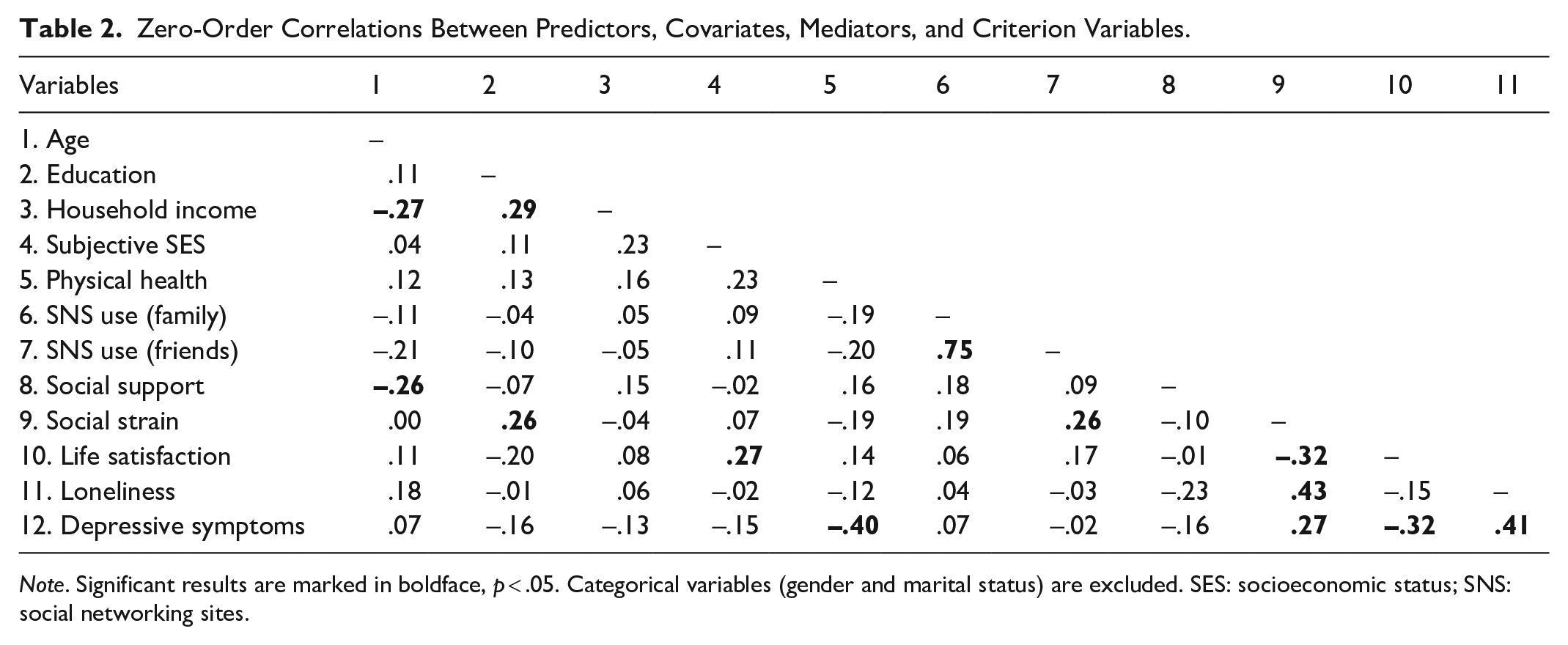
Note. Significant results are marked in boldface, p < .05. Categorical variables (gender and marital status) are excluded. SES: socioeconomic status; SNS: social networking sites.
When all key predictors, covariates, and focal mediators were regressed on life satisfaction, we found that SNS use with friends (B = 0.863, SE = 0.384, 95% CI = [0.147, 1.580]) predicted greater levels of life satisfaction, while perceived social strain (B = –0.829, SE = 0.332, 95% CI = [–1.494, –0.163]) predicted poorer levels of life satisfaction. When a similar regression analysis was conducted on loneliness as the focal criterion variable, we found that social strain significantly predicted greater levels of loneliness (B = 0.291, SE = 0.070, 95% CI = [0.152, 0.431]). Finally, with regard to depressive symptoms as the criterion variable, we again found that perceived social strain (B = 0.130, SE = 0.055, 95% CI = [0.019, 0.241]) predicted higher degrees of depressive symptoms; Table 3 reports detailed results from our regression analyses. Each regression model accounted for significant variance in life satisfaction, R2 = .352, F(11, 57) = 2.813, p = .005; loneliness, R2 = .326, F(11, 57) = 2.505, p = .012; and depressive symptoms, R2 = .301, F(11, 57) = 2.226, p = .025.
Regression Coefficients for Psychological Well-Being Outcomes of Life Satisfaction, Loneliness, and Depressive Symptoms.

Note. SEs are shown in parentheses. Significant results are marked in boldface, p < .05. SES: socioeconomic status; SNS: social networking sites.
Parallel Mediation Analyses
Life Satisfaction
Using parallel mediation analyses, we simultaneously examined perceived social support and social strain as focal mediators in the relation between SNS use (with friends and with family) and life satisfaction, while controlling for all key covariates. Our mediation analysis revealed that SNS use with friends had an indirect effect on life satisfaction via social strain (B = –0.162, SE = 0.103, 95% CI = [–0.410, –0.005]). That is, SNS use with friends predicted greater social strain (H2b; B = 0.193, SE = 0.093, 95% CI = [0.007, 0.379]), which in turn predicted poorer life satisfaction (H3b; B = –0.840, SE = 0.333, 95% CI = [–1.506, –1.174]). However, perceived social support did not mediate the relation between SNS use with friends and life satisfaction (B = –0.005, SE = 0.036, 95% CI = [–0.084, 0.070]).
Regarding the link between SNS use with family and life satisfaction, we found that neither perceived social strain (B = –0.110, SE = 0.089, 95% CI = [–0.303, 0.036]) nor perceived social support (B = –0.011, SE = 0.067, 95% CI = [–0.142, 0.139]) served as mediators. Together, these results indicate that the perceived costs of social exchanges on SNS with friends, but not with family, account for the negative relation between SNS use and life satisfaction (see Figure 1).

Parallel mediation models for the indirect effects of SNS use with friends on life satisfaction (top panel) and loneliness (bottom panel) via social strain and social support.
Loneliness
When a series of similar parallel mediation analyses were conducted with loneliness as the criterion variable, we found a significant indirect effect of older adults’ SNS use with friends on loneliness via perceived social strain (B = 0.057, SE = 0.028, 95% CI = [0.010, 0.120]). That is, SNS use with friends predicted higher levels of social strain (H2b; B = 0.193, SE = 0.093, 95% CI = [0.007, 0.379]), which subsequently predicted greater loneliness (H3b; B = 0.293, SE = 0.069, 95% CI = [0.154, 0.431]). Perceived social support did not, however, mediate the relation between SNS use with friends and loneliness (B = –0.006, SE = 0.015, 95% CI = [–0.045, 0.017]). Similarly, SNS use with family did not indirectly influence loneliness via perceived social strain (B = 0.044, SE = 0.027, 95% CI = [–0.007, 0.100]) or social support (B = –0.014, SE = 0.020, 95% CI = [–0.063, 0.015]). These results suggest that SNS use with friends, but not with family, fosters greater loneliness via exacerbated social strain.
Depressive Symptoms
Finally, we examined whether perceived social support and strain mediate, in parallel, the relation between SNS use (with friends and with family) and depressive symptoms. We found that SNS use with both family and friends did not indirectly influence depressive symptoms via perceived social strain (Bfamily = 0.018, SE = 0.018, 95% CI = [–0.016, 0.056]; Bfriends = 0.025, SE = 0.020, 95% CI = [–0.007, 0.072]) or social support (Bfamily = –0.006, SE = 0.010, 95% CI = [–0.029, 0.015]; Bfriends = –0.002, SE = 0.007, 95% CI = [–0.020, 0.010]).
Overall, our results partially supported H2b and H3b, given that SNS use with friends predicted greater social strain, which, in turn, accounted for poorer well-being indexed by life satisfaction and loneliness. However, given that perceived social support did not mediate any relations between SNS use with friends and well-being outcomes, we failed to confirm H2a and H3a. Furthermore, H1 was not supported; we found that SNS use with family did not significantly influence social support or strain.
Discussion
Using a series of parallel mediation analyses, we found that older adults’ SNS use with friends was indirectly associated with lower life satisfaction and greater loneliness via social strain. Consistent with socioemotional selectivity theory, our findings indicate that examining different socializing targets (family vs friends) of older adults’ SNS use is vital in elucidating the relations between older adults’ SNS use and life satisfaction and loneliness.
Our main contributions are threefold. First, our finding that SNS interactions with different socializing targets (family vs friends) asymmetrically influence older adults’ life satisfaction and loneliness via social strain (Carstensen et al., 1999) sheds light on the equivocal results concerning older adults’ SNS use and well-being (see Newman et al., 2021). While previous studies have focused on the role of older adults’ SNS use in facilitating social support from kin and non-kin relations (e.g., Yu et al., 2016), our results highlight the importance of different socializing targets on SNS in shaping social strain—which, in turn, influence aspects of well-being. Considering socioemotional selectivity theory in the context of SNS-based socializing, this suggests that older adults’ SNS interactions with non-kin, relative to kin, members of their social network may increase their chances of exposure to interpersonal conflicts or criticism, which have adverse spill-over effects on life satisfaction and loneliness outcomes. This corroborates findings in a nascent area of research, whereby older adults’ SNS use may lead to various forms of social strain (Salo et al., 2017), particularly arising from interactions with friends.
Second, we found that while social strain predicted poorer life satisfaction and greater loneliness, social support was surprisingly unrelated to those well-being outcomes. This lends support to the negativity effect model, which postulates that social strain (arising from negative social exchanges), compared with social support (arising from positive social exchanges), exerts stronger influences on mental well-being (Ingersoll-Dayton et al., 1997). In line with prior accounts (Kanouse & Hanson, 1972; Peeters & Czapinski, 1990; Taylor, 1991), negative events or information, such as strained social exchanges, tend to impose greater psychological weight and cognitive processing than positive events when individuals form overall evaluations of relationships with their social network. Furthermore, while positive social exchanges can be interpreted in a number of ways (e.g., genuine friendliness or being perceived as incompetent; Smith & Goodnow, 1999), negative exchanges are likely attributed to character flaws or egocentric motives (e.g., Kanouse & Hanson, 1972) in forming these evaluations. Hence, to the extent that negative social network exchanges (e.g., support failure, excessive criticism) exacerbate distress and decrease self-worth (Rook, 2015), perceptions of social strain likely exert a greater influence on well-being than that of social support (for reviews, see Brooks & Dunkel Schetter, 2011; Lincoln, 2000).
In line with this theoretical notion, our findings corroborate growing research showing that negative social exchanges, indexed by social strain, have deleterious effects on life satisfaction (Chen & Feeley, 2014; Sherman et al., 2003) and loneliness (Shiovitz-Ezra & Leitsch, 2010; Stevens & Westerhof, 2006). Consistent with this, Newsom et al. (2003) also found that older adults’ perceived social strain longitudinally predicted affective well-being (i.e., positive and negative affect) at approximately 3-month follow-up, whereas social support was unrelated to these well-being outcomes. Therefore, by considering the duality of social relations (social support and strain) within our parallel mediation model (Rook, 2015), we provide evidence that older adults’ social strain, relative to social support, may disproportionately influence well-being indexed by life satisfaction and loneliness. Nonetheless, given that the life satisfaction levels in our sample were relatively high (M = 26.38) with a positively skewed distribution, our findings should be interpreted with caution.
Third, whereas SNS use with friends predicted life satisfaction and loneliness via social strain, we found that SNS use (regardless of socializing targets) did not have direct or indirect effects on depressive symptoms via social strain or social support. This finding is at odds with prior research suggesting that SNS use predicts social support (Nam, 2019; Salo et al., 2017; Zhang et al., 2021), which in turn alleviates depressive symptoms (e.g., Chao et al., 2018; Curran et al., 2020; Santini et al., 2016; Thomas, 2015). However, our null result may be due to a range restriction issue, given the insubstantial levels of depressive symptoms in our sample; 86% of respondents reported low or subclinical degrees of depressive symptoms relative to threshold scores based on comparable measurement tools for screening major depressive disorder in elderly populations (e.g., Broekman et al., 2011). Hence, these findings should be interpreted with caution, and future research should recruit a larger and more representative sample of participants and employ more sensitive assessments of geriatric depression (e.g., the Geriatric Depression Scale-15; see Pocklington et al., 2016) when examining the relation between older adults’ SNS use and depressive symptoms.
Furthermore, while we examined the three well-being indices separately, bottom-up and top-down accounts of life satisfaction (Headey, 2014) conceptualize domain-specific indices of well-being (i.e., loneliness and depression) as closely tied to global evaluations of well-being (Koivumaa-Honkanen et al., 2004; Liu et al., 2021; Szcześniak et al., 2020). Furthermore, domain-specific indices of loneliness and depressive symptoms have consistently been found to be linked (Gonyea et al., 2016; Hsueh et al., 2019; Liu et al., 2021). In our sample of older adults, we found partial support for these theoretical accounts. Our correlational results showed that life satisfaction was significantly related to lower depressive symptoms (r = –.32**) but not to loneliness (r = –.15). Meanwhile, loneliness was significantly correlated to greater depressive symptoms (r = .41**). Hence, while domain-specific well-being outcomes (i.e., loneliness and depressive symptoms) have shown varying degrees of correlations with life satisfaction, further research is required to ascertain their relationship and their relative importance for overall well-being.
Our study is not without limitations. First, our cross-sectional design precludes causal explanations or interpretations of directionality. Although our study conceptualizes SNS use as an antecedent of well-being outcomes, it is also possible that poor well-being (e.g., severe loneliness) drives situational SNS use with friends to fulfill one’s need for relatedness and alleviate loneliness (e.g., Reissmann et al., 2018). Therefore, more sophisticated longitudinal studies are required to ascertain the directionality of relations between older adults’ SNS use, social support/strain, and well-being outcomes.
Second, our sample consisted primarily of healthy Chinese Singaporean older adults who were mostly female. Considering that female older adults constitute a greater proportion of active SNS users (see Newman et al., 2021) and have shown elevated risk for loneliness (Dong & Chen, 2017; Fokkema et al., 2012) and depressive symptoms (Li et al., 2014; Tang et al., 2021; Zunzunegui et al., 2007) compared with their male counterparts, further research with gender-balanced samples is needed to ascertain our findings. Furthermore, our results may not be generalizable to elderly populations of other ethnicities or with cognitive impairments. Given our relatively small sample size, future studies should also involve larger and more diverse samples to replicate these findings in other populations.
Third, given that we limited our operationalization of socializing targets to either family (i.e., kin) or friends (i.e., non-kin), it is important that future research more specifically delineate relational sources (e.g., spouse/partner, children, and siblings vs close ties, acquaintances, or nominal online friends; e.g., Chen & Feeley, 2014). Furthermore, since our measure of perceived social support and strain did not differentiate between relational sources, it would be helpful for future research to distinguish perceived social support and strain according to the specific relational sources (i.e., kin or non-kin) of older adults. This would enable a more fine-grained understanding of the mediational relations between specific socializing targets of SNS use and well-being outcomes via social support and/or strain.
Fourth, our use of self-reported assessments of overall SNS use may be inadequate for capturing and delineating the frequency of various SNS activities (Burke et al., 2010; Ellis, 2019). Hence, future research can employ assessments of specific SNS activities, including broadcasting activities to a wider audience and directed communication activities to a more intimate circle (Kim & Shen, 2020). Moreover, objective measures of SNS usage, such as applications that capture screen time and data on SNS behavioral activity, can be employed to circumvent the shortcomings of self-reported data (Ellis et al., 2019).
Finally, although our study did not examine trait levels of loneliness or depression, recent experience sampling studies of college students have elucidated differential relations between social media use and state-level loneliness, depending on trait levels of loneliness and social support (Reissmann et al., 2018; Wang et al., 2012). For instance, Reissmann et al. (2018) showed that young adults’ state loneliness predicted increased Facebook use, and that this relation was stronger among those with higher levels of trait loneliness. Given this nascent evidence, it is plausible that the influence of older adults’ SNS use on state well-being outcomes (e.g., loneliness, depressive symptoms) via social strain may similarly be moderated by trait levels of loneliness or depression. In view of this, future research should disentangle the relationships among older adults’ SNS use and both state and trait levels of loneliness and depressive symptoms using experience sampling studies.
Taken together, our study suggests that older adults’ SNS use with different socializing targets uniquely influences well-being outcomes via social strain. These findings inform existing theoretical accounts by elucidating social strain as the mechanism that underlies the relation between older adults’ SNS use and well-being indexed by life satisfaction and loneliness. Furthermore, our findings highlight the need to delineate between the socializing targets of SNS activities as well as the importance of considering the duality of social relations (i.e., social support and strain) in tandem when investigating the effects of such SNS interactions. Importantly, our findings bear implications for older adults’ SNS use, particularly with friends, which can have deleterious associations with their life satisfaction and loneliness, especially when such activities strain social relations.
Footnotes
Acknowledgements
Both authors equally contributed to the paper. The authors thank their research assistants, Danish Ramlan, Geraldine Tng, Jeanette Cheong, Lim Pei Shan, Luqman Nur Hakim Bin Wahab, and Ng Rui Bing, who assisted with data collection.
Declaration of Conflicting Interests
The author(s) declared no potential conflicts of interest with respect to the research, authorship, and/or publication of this article.
Funding
The author(s) disclosed receipt of the following financial support for the research, authorship, and/or publication of this article: This research was supported by a Lee Kong Chian fellowship and a grant awarded to Hwajin Yang by Singapore Management University through a research grant (17-C242-SMU-008) from the Ministry of Education Academic Research Fund Tier 1.
