



Abstract
The video-sharing social media platform TikTok has experienced a rapid rise in use since its release in 2016. While its popularity is undeniable, at the first glance, it seems to offer features already available on previously existing and well-established platforms such as Instagram, YouTube, and Facebook. To understand processes of self-making on TikTok, we undertake two methods of data collection: a walkthrough of the app and its surrounding environment, and 14 semistructured participant interviews. A qualitative analysis of this data finds three distinct themes emerge: (1) awareness of the algorithm, (2) content without context, and (3) self-creation across platforms. These results show that TikTok departs from existing platforms in the model of self-making it engenders, which we term “the algorithmized self”—a complication of the pre-existing “networked self” framework.
Introduction
Since its release in 2016, the video-sharing platform TikTok has enjoyed a meteoric rise in popularity: as of February 2021, it has been downloaded over 2.6 billion times worldwide (with 315 million of these downloads occurring in the first quarter of 2020), and has approximately one billion monthly active users (TikTok Statistics, 2021). Originally released by the Chinese company ByteDance under the name “Douyin” (as it is still known in China), TikTok only became available worldwide after merging with another Chinese social media service, Musical.ly, in 2018. Centered around video sharing, TikTok allows users to create music and lip-sync videos of 2–15 s, and looping videos of initially 2–60 s (Williams, 2020) with recent changes now allowing verified users to create videos that are up to 3 min long (TikTok Newsroom, 2021). It also allows users to “duet” (a function where users can directly respond to an existing video and display the response and original side by side), “stitch” (clip and integrate other users’ video into one’s own), and live-stream content, in addition to many other features. TikTok is a constantly evolving and dynamic platform, with new features regularly being added and changed, often rapidly. While it is perhaps best known for its music- and dance-oriented videos, the platform features a diverse variety of content, from humorous skits to beauty tutorials to political advertisements to educational DIY videos. As the New York Times states, “[On TikTok] You can join a dare-like challenge, or participate in a dance meme, or make a joke. Or you can make fun of all of these things. TikTok assertively answers anyone’s what should I watch with a flood” (Herrman, 2019).
While its rise in popularity is noteworthy, it may be slightly surprising to those only peripherally aware of the platform. At first glance, the particular services offered by TikTok seem to be similar to previously established social media platforms. Functionally, it can be understood as the latest iteration of a growing trend in social media which has seen the popularization of video creation and sharing in the form of live-streaming and short looping videos. It is regarded by many as the spiritual successor of the now-defunct app Vine, which was based on sharing videos of less than 6 s and which fostered a distinct brand of surrealist “millennial” humor that is echoed in the creative chaos that characterizes many TikTok videos (Anderson, 2020). TikTok also shares similarities with other popular social media: both Instagram and Facebook allow live streaming, and since 2016 have added a “stories” feature which allows users to create short looping videos of less than 20 s (a functionality which had been available on Snapchat since 2013) (Verstraete, 2016). In addition, the video-sharing giant YouTube, released in 2005, has long offered the ability to share short videos and added live-streaming in 2008 (Anderson, 2020). Such platforms, which are predicated primarily on the sharing of visual media, have been studied extensively in terms of the sociality and self-making processes they engender for their users (Thumim, 2012; Tiidenberg & Whelan, 2017).
However, there is one key new element that sets TikTok apart from other outwardly similar social media platforms: the prevalence of “the algorithm.” TikTok unprecedentedly centers algorithmically driven feeds and algorithmically driven experiences. On TikTok, unlike on other platforms, the user experience is obviously, unambiguously, and explicitly driven by what is commonly called the “For You” algorithm (Xu et al., 2019). While algorithms are becoming increasingly prevalent across the social media landscape, on other platforms, they are still ostensibly only an “element” (or enhancement) of an otherwise user-driven experience. Of the major social media platforms on the market, TikTok is the only one to position its algorithm at the center of the social experience it engenders; the algorithm determines the type of video content the user is exposed to, and viewing this content makes up the majority of the experience on the platform.
This key element—the forefronted algorithm—of TikTok has the potential to alter previously seen models of self-making on social media. While there has been extensive research that has examined self-making on social media, especially through the creation and consumption of visual content, and work that has probed into the connection between algorithms and user self-creation, these two areas of research have not often been put into conversation. This article seeks to fill this gap in the literature by pursuing the following research question: how is “the self” created on and through TikTok, and does the process of self-making on TikTok differ when compared to other social media sites?
To address the particular issue of “self-making” on TikTok and to accurately draw comparisons to other social media platforms, it is first necessary to review the extant literature regarding issues related to “the self” on social media platforms and establish an understanding of the common model of self-making on social media. In the next section, we explore what the current literature says about how self-making “works” on social media, and how algorithmic experiences intersect with self-making practices.
Literature Review
The Self and Self-Representation
When it comes to examining the creation of the self on social media, the concept of “self-representation” is highly relevant. Self-representation can be understood as a form of mediation and involves the social process of creating media objects that stand in for, transform, and recreate a person or object (Thumim, 2012).
While people have used technology and media to record, share, and communicate the self since time immemorial, the tools and environments furnished by social media spaces have supplemented, and arguably, propagated self-representational practices (Rettberg, 2014). Visual media sharing has become a “hallmark of contemporary internet culture” (Mirzoeff, 2016). For example, Facebook users, upload 350 million photos per day; users of Snapchat and Whatsapp share over 700 million daily photo shares (Tiidenberg & Whelan, 2017). On social media, visual self-representations “circulate between individuals and groups, facilitate the creation and maintenance of relationships, memories, norms, and ideologies, and are widely understood as tools for identity formation and communication” (Tiidenberg & Whelan, 2017, p. 141; Van Dijck, 2008).
How Does Self-Representation Work?
When it comes to the extant literature on self-representation, traditional cultural studies frameworks offer a model of how people self-represent with visual media: visual representations can be understood as indexical images that stand in for or represent a person or object (Hall, 1997, p. 1). However, conceiving of images as merely indexical representations of what they depict disregards the social contexts within which online images are embedded (Cruz & Thornham, 2015; Frosh, 2015), and risks overemphasizing the media itself as absolutely central to the meaning production process and thus understating the technocultural processes which intervene in the creation of media texts and the circulation of meaning in society (Thumim, 2012, p. 54). Thus, scholars have called for more nuanced understandings of self-representation that move away from indexicality as the primary model for how we produce and circulate meaning.
This issue has been addressed by authors such as Thumim, who proposes that self-representation be understood as a genre rather than a discrete set of practices (Thumim, 2012). Genre in this case refers to something multidimensional and intertextual, something which can be understood as a “tacit agreement” between producers and audiences (p. 166). Content within the genre of self-representation will contain combinations of certain elements, such as community, experience, interior worlds, emotion, personal artifacts, and so on, but no one work is necessarily bound to contain all the elements associated with this genre. Furthermore, examples in the genre may differ strongly in their “politics, purpose, conditions of production, and more” (p. 167). Shifting our understandings away from indexicality in this manner brings into relief the social, context-dependent, and mediated qualities of self-representation.
Tiidenberg and Whelan (2017) build on the work of Thumim to further complicate our understanding of self-representation. Departing from media and cultural scholarship, they point out that self-representation can also be understood as a process of “identification” (in the psychoanalytical sense). Psychoanalytical identification is defined as the psychological process of association between oneself and something else (Tiidenberg & Whelan, 2017). Thus, self-representation-as-identification involves the construction of the self in terms of the objects and images that we identify with (Bamberg, 2011).
A psychoanalytical lens re-centers “the self” in self-representation. Emphasizing the self and reorienting conceptualizations away from static representations to dynamic processes of self-making and identification also gives rise to a more nuanced interpretation of identity. It allows identity to be something that is often multiple, fragmented, and discordant; constructed across varying discourses, practices, and positions, and constantly in the process of change and transformation (Hall, 1997).
Within this article, we draw on the notions of genre and self-representation as proposed by Thumim (2012) and Tiidenberg and Whelan (2017), respectively, as an entry point into understanding how self-making occurs on social media. We use the term self-making to highlight the set of intertextual and flexible practices, conventions, and norms of both the production and consumption of visual content that constitutes identity creation online.
The Networked Self
Within the context of online self-making research, the “networked self” model examines how social media spaces constitute sites of self-presentation and identity management (Papacharissi, 2011). Papacharissi (2013) writes that the “appeal” of social media sites is their provision of a “stage for self-presentation and social connection” (p. 206): through their multimedia capabilities, they provide props (in the form of text, photo, video, etc.) that facilitate self-presentation. In such an environment, the self is performed through public displays of social connections: thus, the self is created through the “reflexive process of fluid association with social circles” (Papacharissi, 2013, p. 208). In this school of thought, social media sites are ultimately projects in managing sociality and negotiating self-expression through these social ties: one self-represents by engaging with one’s network within the context of the social media sites.
This understanding of a “networked self” posits that social media sites—apart from the influence they may have on social practice through their design and affordances—are relatively neutral stages, or tools, for individuals to engage in these processes of identity management and representation. Interaction and curation are ostensibly self-directed; despite the growing prevalence of algorithmically directed feeds, for example, these sites at least claim that the content that users consume is essentially within their control and is ultimately chosen by the user through their conscious choices: the site thus provides a space for free self-representation (Van Dijck, 2013). The conceit of these social media platforms is the notion that technology is mainly a tool or extension of the user’s will: digital environments merely supplement existing modes of social experience, as opposed to fundamentally shaping or altering it (Papacharissi, 2013).
In the context of visually based social media platforms, the notion of the networked self operates hand in hand with the previously discussed concept of self-making: users construct their identities by engaging with (through varied and multidimensional practices such as identification, indexicality, etc.) the visual media objects created and posted by others in their network.
Algorithms and Identity
The networked self-model operates on the assumption that social media spaces are merely neutral stages for this “reflexive process of fluid associations with our social circles.” However, in recent years, this notion has been increasingly troubled due to the growing prevalence of algorithmically directed feeds and social media experiences. Scholars have begun to question the impact that such new forms of technology can have on self-making processes.
Hearn (2010) argues that under current conditions of modernity, self-hood, and self-presentation are inextricably entangled with advances of capitalism and its ever-evolving search for new forms of profit. Therefore, it follows that the self must be understood in relation to the “datalogical turn,” wherein the capitalist mode of production that characterizes our society has become predicated on the collection, generation, and sale of vast amounts of consumer data (Gregory et al., 2015). This new form of “effective” capitalism takes as its raw material the “desires, emotions, and forms of expressivity” that users present in digital spaces; thus, the practices involved in online self-making become part of a wider economic infrastructure (Hearn, 2017, p. 63).
Affective capitalism is enabled by tools such as algorithms and automated recommendation systems. These technologies allow for the self-making practices of users to be collected and sold by companies like Twitter and TikTok, and, through processes of aggregation, abstraction, and categorization, be rendered into consumer profiles. The categories that are derived from user’s online actions are ultimately projected back onto them, enframing them in an “algorithmic identity—an identity formation that works through mathematical algorithms to infer categories of identity on otherwise anonymous beings” (Cheney-Lippold, 2011, p. 165 as seen in Hearn, 2017).
Through algorithms, affective capitalism succeeds in enacting particularly insidious and far-reaching forms of control: control over user identity. Cheney-Lippold sheds light on the implications such technologies have over self-making practices, arguing that “the automated categorization practices and the advertisements and content targeted to those categorizations effectively situate and define how we create and manage our own identities” (Cheney-Lippold, 2011, p. 177).
In summation, the current literature on the impact of algorithms on self-making argues that algorithms have the power to define and situate our identities by fitting users into predefined categorization schema for the purpose of data gathering and advertising. However, this literature tends to underscore or even overlook the agency of users within these processes of self-making. The current study seeks to bridge the gap in the literature between studies of self-representation on platforms that can be said to follow the “networked self” model of self-making, which ascribes a relatively high degree of agency to individual users, and the literature that interrogates the effects that increased algorithmization may have on user identity creation on social media (which highlights the reduced agency users experience in terms of self-making practices). The central questions guiding this project are: how do algorithms influence the process of “self-making” on social media? How do everyday users make sense of their experiences on algorithmic social media streams?
We answer these questions by exploring what new models of self-making might result from the combination of an otherwise traditional social media platform with the heightened presence of the algorithm. We take up the issues of self-hood and self-making under the influence of the algorithm by taking a look at user practices on TikTok, a platform where user experience is heavily guided by an algorithm.
Methods
To conduct a rigorous inquiry, we employed two means of data collection in this project. First, we used the walkthrough method as described by Light et al. (2018). This method, grounded in Actor Network Theory, involves the systematic collection of data throughout various steps of app registration and entry, everyday use, and discontinuation of use to analyze an app in its entirety.
In accordance with this method, our walkthrough data collection process comprised two distinct phases. First, the environment of expected use was established by examining the app store descriptions, white papers, and newsroom documents put forward by the app from its launch until February 2020. This was taken in conjunction with narratives put forward in media articles about TikTok. In the second phase, we conducted a technical walkthrough of TikTok. This was done in February 2020 on two different phones, using both Android and iPhone versions of the app. To analyze the everyday use of the app both researchers used TikTok for at least 30 min daily for a period of 1 month in 2020, and collected extensive fieldnotes, screenshots, and screen recordings. This allowed us to investigate the environment of expected use, user interface arrangement, functions and features, textual content and tone, and symbolic representations present in the app (Light et al., 2018).
In addition to collecting data through the walkthrough method, we conducted in-depth interviews with 14 college students who use TikTok, ranging in age from 18 to 24 years. College students are not necessarily a representative sample of all those who use TikTok, and the findings of this article cannot be generalized beyond the scope of this study. However, it is important to note that almost 60% of TikTok users are under 30 with roughly 41% of users between the ages of 16 and 24 years (TikTok Statistics, 2021).
Our interview participants were from a US east coast university and came from varied educational backgrounds: their completion levels (freshman through postgraduate) and courses of study included computer science, communication, engineering, and hotel management, among other subjects. These participants were recruited and compensated through the university’s research management system. The interviews were all conducted over video conferencing technology, and upon completion, participants were compensated with a university research credit. Women were greatly overrepresented in our sample (n = 11), which may reflect larger social media usage patterns (Anderson & Jiang, 2018). All of our interviewees were enrolled in university, reflecting a certain level of relative privilege.
The interviews had an average duration of 35–45 min, and followed a semistructured protocol. Discussion topics included initial use and changing experiences with TikTok, regular usage patterns, the types of content viewed and shared and why, and participants’ likes and dislikes of the platform, and forms of self-expression (e.g., “Do you often post TikToks that you think represent you?”). Interviews were recorded with permission and transcribed, and the researchers used an inductive approach to establish coding categories. We followed a grounded theory approach, which involves subjecting “inductive data to rigorous comparative analysis that successively moves from studying concrete realities to rendering a conceptual understanding from these data” (Charmaz & Belgrave, 2012, p. 347). The process of data collection and analysis was overall iterative and inductive; for example, when we heard about the different “sides”' of Tik Tok, we added more follow-up questions about this to our interview protocol.
Findings and Analysis
Upon analysis of our data, we found that three overarching themes emerged. We present the findings of our walkthrough and interview data in tandem through a discussion of these themes, which are as follows: (1) awareness of the algorithm, (2) content without context, and (3) self-creation across platforms. Taken together these themes inform what we term the “algorithmized self” on TikTok, a conceptualization of the changing nature of self-making online.
Theme 1: Awareness of the Algorithm
The predominant theme that emerged from both the participant interviews and the walkthrough analysis was a sense of heightened awareness of the “infrastructure” of TikTok: in particular, the algorithm that curates a user’s home feed. Participants often referred to this as the “For You” algorithm as it determines the content that appears on the For You page, which consists of an endless stream of videos uniquely personalized for each user. While the exact workings of the algorithm are kept secret by ByteDance, the basic mechanics are such: TikTok considers data from user interactions (such as videos liked and shared, accounts followed, comments, etc.), video information (captions, sounds, and hashtags), and device and account settings (language preference, country setting, and device type) to present users with the videos that are most relevant to their interests (Latermedia, 2020).
All participants interviewed discussed the For You algorithm at length, and indicated that their engagement with it constituted a significant portion of their overall activity on the platform. In many cases, participants stated that the accuracy of the algorithm was a significant draw, and was the reason for either their initial interest in or continued use of TikTok: “It is such a good algorithm, I have no idea how they do it. Probably a lot of data collection, I’m assuming.”
Findings from the walkthrough analysis suggested that this hyper-awareness of the algorithm is augmented by the design of TikTok. Upon opening the application, users are directed toward the For You page, which constitutes the “home page” of the platform and from where all other activity types can be found. While many social media platforms have home pages that display a “feed” of content that comprises the posts made by followed users, pages, or friends, they additionally draw attention to other “spaces” of the site: for example, while both Twitter and Facebook situate users in their home feed, to begin with, they also direct users toward other activities, such as looking at profiles, sending messages, and so on through a design which places visual prominence on a variety of interaction types. By contrast, the visual design of TikTok obfuscates the interaction types which make up the bulk of social activity in digital spaces (i.e., activities that connect users). The videos that make up the For You page feed take up the entire screen, and it can be difficult to navigate out of this space to find the relatively small icons that will allow users to comment on videos, follow others, send messages, and so on. Visually, such activities are presented as secondary to the content presented by the algorithm.
This design decenters the traditionally “social” activity on the platform: for example, users need not be following or otherwise engaging with other creators to see their videos. Rather, they need only interact with the For You algorithm for a certain period of time in order for it to “get to know” their personalities and interests well enough to present them with accurate and entertaining content: the algorithm does the work that “following” does on other platforms, but more effectively and efficiently.
The For You page is visually and organizationally dominant in the TikTok experience, and this dominance reflects its importance and prominence in the minds of users, who spend the bulk of their time on the platform experiencing and engaging with this page. The prominence of the For You page leads naturally to the prominence of the For You algorithm in the psyche of users, as they are quickly made aware that their experience on TikTok is almost entirely shaped by this algorithm. In centering the algorithm in this way, TikTok differs from other mainstream social media sites, which frequently employ algorithms to curate user content, but often do so to supplement other user interactions (e.g., Facebook uses algorithms to help curate user feeds [and promote targeted advertisements], but maintains the conceit that users design their own feeds through their choices to follow certain friends or pages) (Willson, 2017). While other platforms obfuscate the fact of algorithmic intervention, TikTok dispenses with this illusion by highlighting the role its algorithms play in shaping user experience and promoting user-generated content.
In addition to exhibiting a heightened awareness of this algorithm, many participants indicated a temporal element to their relationship with it; their experience on TikTok changed the longer they were on the platform. This often resulted in the use of distinctly personifying and humanizing language to describe the algorithm. Interviewees repeatedly described a shift in their recommended content and this shift was described as the moment that TikTok “got them” or understood them and was able to capture their personalities and interests with pinpoint accuracy. As one participant explained, “The more time I spend on TikTok, the better it gets to know my personal likes or dislikes, and it gives me more and more content that I like.” Another participant described how TikTok was “boring at first,” but once the algorithm “got me,” the app became more entertaining. Participants expressed awareness that TikTok was collecting and sharing their personal data, but this was seen as an acceptable tradeoff for the level and quality of personalization of their feeds and recommendations provided in return. However, not all interviewees viewed this hyper-personalized curation of content as a wholly positive feature of TikTok’s algorithm; many saw the content as restricting and overly fitted to the algorithm’s conceptualization of them and their tastes.
While participants discussed the algorithm at length, they were often uncertain as to exactly how it worked. At most, they understood it as an external entity that amalgamated their data input and used this information to present them with content specifically curated to their interests. One participant stated: When I first got on, it was a little bit more broad and exposed me to a lot of interesting and different things. Then, as the TikTok algorithm got to know me, the content is now more curated, which can be kind of annoying because if I see the same type of content over and over again, I want to sometimes get out of it, but it’s hard to because I don’t know how to get away from what I’m typically seeing.
Similarly, another participant stated, “The algorithm sometimes is so specific, that I just end up seeing the same video over and over again,” while another expressed bafflement at the videos TikTok was presenting to them: “one week I was getting all these videos of frogs, and everyone was like, why am I on the frog side of TikTok? It was so random.” Yet another participant mused about how, “there’s an entire side of TikTok that I’m not exposed to at all just because of what the algorithm thinks.”
The prominence of the algorithm in combination with the lack of knowledge about its inner mechanics lead to the creation of a kind of “algorithmic imaginary,” an idea defined by Bucher as the “ways in which people imagine, perceive and experience algorithms and what these imaginations make possible” (Bucher, 2017). While the algorithmic imaginary is a significant part of the experience of any social media site and is likely to become even more so as algorithms gain increasing visibility and prominence in shaping online social experience, interviewees indicated that the mental energy they devoted to the TikTok algorithm far exceeded that spent on the algorithms of other social media sites.
In addition, the prevalence of the temporal element on TikTok leads to participants moving beyond simply imagining the algorithm, toward a heightened understanding of their own relationship with the algorithm; a relationship characterized as dynamic and changeable. Participants frequently took an active role in their TikTok experience, exhibiting a high degree of what we might call “algorithmic engagement.” Not only were participants highly aware of the algorithm and invested in understanding it; they also interacted with it heavily (in fact, such activity often made up the bulk of their interactions on TikTok). Participants believed that they knew how exactly to interact with the affordances and activity corridors of the app to “work with” the algorithm so that it could provide them with more relevant or entertaining content.
Thus, while the prevalence of “the algorithm” as the main shaping force of user feeds does away with the illusion of user control present on other platforms (i.e., the illusion that users can completely curate the content they consume through conscious choices of whom to follow, what to like, etc.) and thus reduces the kinds of meaningful interactions that users partake in, it presents other avenues for user engagement. While other platforms ostensibly see users engaging with other people in their network through the activity corridors of the platform, TikTok sees users engaging almost exclusively with the algorithm itself. Interview participants often mentioned that they did not feel the need to follow certain creators to gain access to their content, nor did they make use of the commenting feature to discuss videos with others, as one would on other video sharing platforms. Instead, they repurposed these activity corridors as mechanisms through which they could further interact with the algorithm. As one participant explained: Sometimes you’ll see a post where it’ll just be dedicated to saying welcome to the x side of TikTok (maybe the black side or the queer side), which is obviously more of a joke. But then in the comments everyone will be talking about how to get on this side, talking about what side of TikTok we’re on and how we got there. And sometimes I’ll comment just to make sure that I’m engaging enough to stay on this side too if it’s something I’m into.
The status of the algorithm as the main external entity with which participants interact, in combination with the personifying language participants use to describe it, results in the algorithm occupying a unique role in the TikTok experience. Rather than being merely an element or building block in the infrastructure of the platform (part of the aforementioned “stage” that a social media site provides to enable the “real” social behavior of interacting with other egos in one’s network), or another independent ego with whom users can interact (as they would with a friend), the algorithm exists somewhere in between. It is an entity with which users can engage and which they can influence and manipulate, so users have some degree of control over what this algorithm shows them. However, it is largely impenetrable: it is thus not analogous to an inert “tool” with which they can freely enact their own independent processes of self-representation and identity construction. At the same time, it is not independent; it exists solely to present them with access to content that reflects their own internal worlds; content that reflects their interests, likes, and personality, and which might be seen as a curated collection representing their inner “self.”
Participants occasionally displayed an awareness of the strangeness of this relationship. One participant noted with unease moments when the algorithm was almost “too accurate,” describing how at one point it was presenting content that was not only reflective of their sense of humor and interests, but also their physical appearance. The participant felt “weird” about being confronted with various iterations of people who acted and looked too much like them. At this point, the participant ceased to view the algorithm’s accuracy as a positive quality and felt that a line had been crossed. Other participants pointed to moments where they realized that the algorithm was showing them “repackaged” versions of themselves. These moments frequently engendered a sense of unease as participants became aware that what they had been interacting with was a version of themselves filtered through the algorithm, rather than an external ego.
Theme 2: Content Without Context
When asked to explain the specific appeal of TikTok, participants frequently praised the quality of the “content.” They explained that, as a result of the accuracy of the For You algorithm (see Figure 1), they were usually highly interested in the videos curated for them and were more consistently entertained in comparison to their experiences on other social media platforms. In addition to appealing to their personal interests, participants explained that the content on TikTok was appealing in that it was a way to stay “up to date” with trends, memes, and current events. As one participant put it: [TikTok] just continuously recommends me content that I enjoy, like Netflix will recommend shows. I never really like any of the shows Netflix recommends me, I usually hate them [. . .] But on TikTok, the material that is recommended to me is always really good, even though it recommends such a bulk amount.
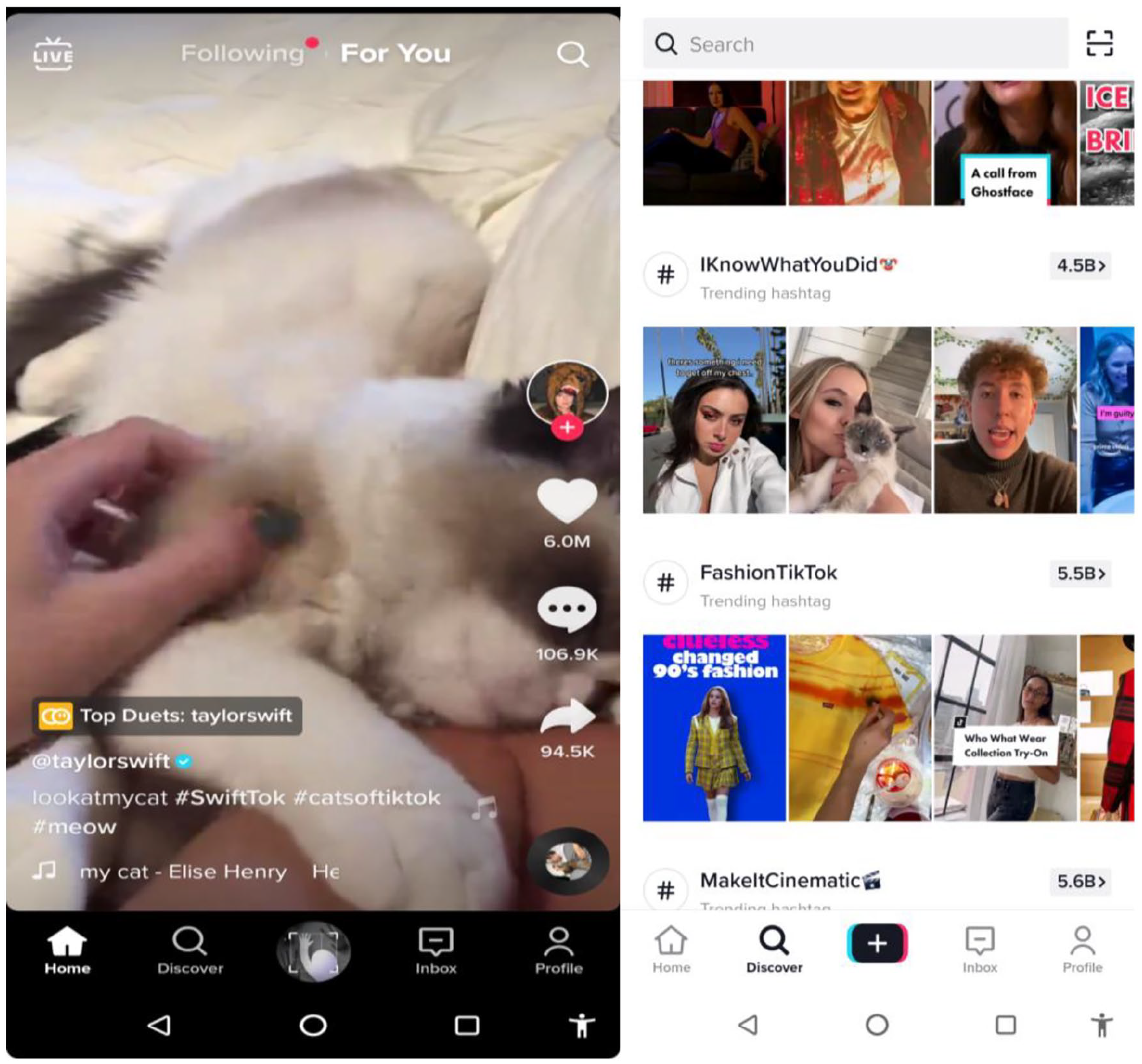
Screenshots of the TikTok app. On the left is an example of the For You page and on the right is the Discover tab.
Another participant stated: I’m not particularly on it for [the social aspect]. I just really like the content, I feel like [. . .] it can sometimes give me a lot of information and [is] super up to date. Like my TikTok feed is very political so it’ll just be a lot of different stuff from different areas of life that I need to know about and I just love that.
Many participants viewed TikTok as an access point to a store of cultural knowledge. As such, maintaining a presence on TikTok led to the accumulation of social currency in their networks, and set the stage for future social interactions. As one participant explained: “mentioning a popular sound or trend gets me social currency cause everyone will be like ‘oh yeah, I saw that too!’ Or ‘that’s so funny!”
While on other social media platforms with home feeds the presentation of content often depends on users following the creators of this content, TikTok dispenses with this requirement: content is divorced from the context in which it is created. Thus, while new users of Instagram, for example, are given a moment to organize their accounts and follow the creators that they are interested in to begin curating their feed, new TikTok users are immediately presented with content: the “default state” of the platform is one of the stimulations without reflection or planning. Users need not concern themselves with anything other than consumption of content curated specifically for them, but that they themselves do not have to curate.
As mentioned, the hyper-prominence of content resulted in social interactions falling to the wayside. One participant stated that they did not use TikTok to connect with their network; the purpose of the app was purely to gain entertainment from funny videos. Other participants expressed that they would rarely follow other users or use the commenting function (except when they wanted to “work with” the algorithm to help it curate more relevant content for them). In fact, a number of participants suggested that they did not care about creators at all, and preferred to experience content on its own, estranged from its source: I’m using it mostly for the content. And I like the For You page because it’s suggesting to me all the stuff that I like even though I might not be following the people and might not even want to actually follow them. I don’t care about them beyond that video.
In addition, participants did not use the “direct messaging” function in the same manner as they would on other social media platforms (where it functions as a private messaging service). Rather, they would only use it to share TikToks with their friends, without any additional commentary. As one participant said, “the TikTok is the message.” This reinforcement of the content as the main draw highlights the importance of self-making through identificatory practices in the TikTok experience. As the media text (the TikTok) is hyper-centered, the social contexts and technocultural conditions of its production fall to the wayside; rather, the significance of the media text as a circulator of meaning lies more heavily in the process of identification it facilitates in the psyche of the individual user who encounters it. In this regard, the prominence of the For You algorithm leads to the prevalence of individualized identificatory self-making processes over processes that are more overtly social and network dependent.
While interview participants were highly invested in experiencing content, they made little mention of creating it: in this regard, participant interviews departed from predictions made through analysis of the data collected with the walkthrough method. In terms of design, TikTok seems to incentivize and encourage “content creation.” One of the ways in which this is done is through the design of the home screen: the size and placement of the “record” button make it more natural and easy for users to record and post videos than to find people to follow or comment on videos. Despite this leading design, the participants we talked to view themselves as observers and viewers rather than creators. This illuminates the fact that user behaviors are not always predictable, and are not entirely beholden to the suggestions made by the affordances of a platform.
Theme 3: Self-Creation Across Platforms
When asked to relate their experiences using TikTok, interview participants would often, unprompted, describe it through comparison to other prominent social media platforms, explaining how various aspects of the platform differed or aligned with features of these other platforms. Interestingly, participants seemed to lack the language to explain TikTok in its own terms, and frequently struggled to articulate where exactly TikTok fell in the larger social media landscape. Users often expressed that the TikTok experience was difficult to describe: comparisons to other platforms did not exactly “fit,” or needed extensive qualifying to be accurate.
Participants most commonly compared TikTok to Instagram, Twitter, Facebook, and YouTube, often in terms of the self-making practices in which they partook. These four sites occupy distinctly different niches in the current social media landscape, and can be seen as belonging to three different “categories” according to the definitions proposed by Kaplan and Haenlein (2010, p. 62). Each category reflects a distinct purpose and offers a specific model of sociality; thus, it is somewhat curious that TikTok drew comparisons to three platforms which can be seen as differing fundamentally in ethos and organization.
Comparisons to Twitter place TikTok in the “blogging” genre of social media. This category of social media provides a stage for self-representation through the curation of content relevant to the user’s identity (Kaplan & Haenlein, 2010). On such sites, processes of self and identity construction are enacted through the curation of a collection of content relevant to the user’s identity. The user constructs and represents their identity through such identificatory processes, and thus, interaction types such as liking, retweeting, and reblogging are the predominant mode of engagement. Unlike other genres of social media, the central activity on such sites is not cross-user interaction through activities like commenting and liking, but rather engagement with content related to the project of self-making and from the fostering of relationships through the act of self-disclosure. The For You page can be said to offer a version of this process of curation, as users are able to assemble a collection of media objects that represents them and with which they identify. Participants pointed out that the act of liking TikToks and experiencing content relevant to their experiences and interests was analogous to the process of scrolling through their Twitter feeds and liking or retweeting tweets that they found relatable. They also indicated that the “direct messaging” feature was used similarly on both sites: to share content they found relevant with their friends, without much additional commentary. However, TikTok differs from Twitter in a number of significant ways. Most apparent was the lack of user control over the For You feed; in contrast, the content of Twitter’s home feed is almost entirely determined by the following choices of the user.
Comparisons to YouTube and Instagram align TikTok with the “content community” genre of social media sites. Such sites prioritize the sharing of media: experiencing the content is the main purpose of the platform. Thus, the aforementioned prominence of content on TikTok seems to support its placement within this category. The design of TikTok is similar to the design of content communities like Instagram and YouTube, which visually emphasize the content and feature a smaller section for comments. In addition, the function of the For You algorithm is perhaps most analogous to the algorithms used to supplement user feeds on YouTube: while users can to certain extent control what content they see by subscribing to channels, YouTube’s algorithms play a significant role in determining exactly which videos a user is exposed to.
Yet, TikTok does not neatly fit into this category either. In content communities, the social aspect derives from the user following other users, and from the discussion of the presented content through comments. Such engagements with a wider network (which situate users in a community bound together by common interests) in tandem with the identificatory practices involved in selecting and curating content that can be said to represent the user, constitute the self-making processes that occur on content communities. As explained by participants, these elements are minimally relevant in the TikTok experience. Rather, TikTok engenders and supports social self-making practices beyond the confines of the digital space: through the well of culturally relevant information made available by the For You algorithm, TikTok was primarily a means through which users may gain cultural knowledge which facilitates engagement in other spaces, whether this be on other sites or in real life. Participants indicated that awareness of TikTok increased their cultural literacy and “clout” on other sites such as YouTube, as well as allowing them to “keep up” with their friends online and offline.
Finally, comparisons to Facebook place TikTok in the “social network category” of social media. Such sites prioritize communication between individuals through the activity corridors offered by the platform. On social networks, users perform their identities through interaction types like commenting, following, and friending—interactions that establish ties among members of a network. When comparing TikTok to Facebook, participants pointed out that the two platforms shared a number of functionalities: it was possible to see the activity of others in one’s network, and engage with them through messages, comments, and “duets.” Analysis of walkthrough method data confirmed that there were indeed a multitude of interaction types that prioritized social communication between users. However, participant interviews revealed that, while these interaction types existed, they were seldom employed by users for their intended purpose; rather, they were frequently repurposed to interact with the algorithm.
TikTok’s combination of features seems to place it simultaneously in a variety of social media categories, and none at all: it can be seen as a microblogging site, a social networking site, and a content community, and yet, it departs significantly and fundamentally from each type. Correspondingly, the self-making practices it engenders (which can be broadly aligned with certain social media sites; for example, sites such as Instagram that prioritize the sharing of media may promote more indexical practices of self-making) also eschew distinct categorization.
Conclusion
At the outset of this project, we sought to understand what made TikTok special or unique in the eyes of users. Our findings revealed that TikTok differed from other social media platforms that, upon first glance, seemed to offer similar services and features. However, it did not do so through the creation of radically new features or affordances. Rather, TikTok engendered a mode of self-representation and identity creation that departs significantly from the model of “the networked self” that is found on other social media.
TikTok users occupy the precarious position of dually engaging with an external and internal entity; they engage with versions of themselves, as mediated through the algorithm. While other social media platforms facilitate interaction with other egos through a variety of methods (whether this be direct self-disclosure, the discussion of media, etc.), on TikTok the user interacts most heavily with the personalized algorithm which repeatedly confronts them with various aspects of their own personas. This model of sociality can perhaps be termed the “algorithmized self”—an extension and complication of the previously discussed “networked self”; while the latter posits that the self is created through the “reflexive process of fluid associations with social circles,” the former understands the self as deriving primarily from a reflexive engagement with previous self-representations rather than with one’s social connections (Papacharissi, 2011).
In addition to offering a new understanding of “the self,” TikTok offers users a new “type” of social media by refusing to subscribe to an established categorization scheme. It borrows elements from a variety of pre-existing platforms, but ultimately eludes the forms of sociality engendered by content communities, blogs, and social networks in favor of presenting a very different vision of sociality based on repeated engagement with the “algorithm.”
Rather than occupying a static position in the overall internet ecosystem, TikTok’s identity relative to other digital spaces is shifting; it can be said to exist on a spectrum rather than in a category. The precarious and ambiguous place that TikTok occupies in the experience of our participants indicates that current understandings of the function and purpose of social media platforms are overly simplistic. This issue extends beyond the question of TikTok’s identity; the existing subdivisions—indeed, the act of categorizing in itself—fail to account for changes in usage patterns and platform functionalities that occur as platforms and users co-evolve.
Indeed, factors such as increased algorithmization have already affected fundamental changes in the operation of social media and the experiences of the users therein. While TikTok is an extreme example of the prominence of algorithms in user experience, it is an example of trends that are quickly becoming visible in other digital spaces. For example, users of Instagram report increased levels of engagement with and awareness of the algorithms that play a role in finding relevant content for their home feeds, and also engage in behaviors that aim to “work with” the algorithm to generate relevant content (such as commenting on posts to indicate to the algorithm that the content is interesting). Such practices diminish the unambiguity of Instagram’s identity as a “content community.”
Similar evolutions are occurring on more traditional sites such as Facebook, which once was understood as merely a platform through which users could engage in traditional social interactions such as commenting, liking, and friending. With algorithms playing an increasingly visible role in shaping the content that Facebook users see on their feeds, Facebook overlaps significantly with platforms which employ similar methods to shape user experience, such as Instagram. In this way, the division between platforms we understand as belonging in different categories collapses: the distinction between the experience of users in “content communities” and “social networks” lessens.
The ever-changing nature of digital spaces suggests that social media cannot be understood as occupying discrete categories. Nor can they be understood in a vacuum; as evidenced by the descriptions of participants who could only explain TikTok through comparisons to other platforms. Moving forward, academic analysis of social media ontologies needs to examine and interpret social media not as discrete entities, but rather as moving nodes in a more extensive ecosystem. Individual platforms do not exist separately from one another; rather, all of the elements that comprise these digital spaces interact, influence one another, and co-evolve, changing the nature and meaning of the activities and experiences of the users that inhabit them.
Footnotes
Acknowledgements
We would like to thank Cid Decatur for his work conducting interviews through the Cornell Social Media Lab.
Author’s Note
All authors have agreed to the submission and that the article is not currently being considered for publication by any other print or electronic journal.
Declaration of Conflicting Interests
The author(s) declared no potential conflicts of interest with respect to the research, authorship, and/or publication of this article.
Funding
The author(s) received no financial support for the research, authorship, and/or publication of this article.
