



Abstract
While much research exists on the role of digital media use in protest movements, few studies compare the long-term impact of protests on online use of alternative and mainstream digital media. This holds particularly true in countries of the global south. Our study addresses this knowledge gap by examining the massive demonstrations that occurred in Chile on 18 October 2019. Based on data from 1,221,487 Facebook posts from 31 media outlets collected 10 months before and after the protests, we detected significant discontinuities in users’ interactions with news content. Whereas both media types display different baseline levels, for alternative media, the time series reflects a “step” type of shock—a long-lasting increase in news sharing—whereas for mainstream media, it is a “pulse” type of shock—a burst of interactions that quickly returned to pre-existing levels. These results suggest that social media users relied on alternative news media to amplify counter-public spheres in Chile.
Media companies have become powerful political actors in most democracies around the globe—they can influence the agenda of issue priorities and define people’s interpretations of those issues (McCombs & Valenzuela, 2020). It should not come as a surprise, then, that there is substantial research on the role of media use on protest behavior and social movements (Garrett, 2006; Kaun & Uldam, 2018; Theocharis & Van Deth, 2017). Most empirical studies in this area, however, focus on short-term dynamics. Quantitative research on the long-term, national-level impact of protest movements on online use of alternative and mainstream media is scant. This holds particularly true in regions of the global south, such as Latin America (Harlow, 2017; Mitchelstein et al., 2020).
This study seeks to contribute to the literature by examining social media users’ social media engagement with mainstream and alternative digital news outlets. More specifically, we focus on the nationwide citizen uprising that occurred in Chile on 18 October 2019, and analyze news sharing patterns of mainstream and alternative media on Facebook—a platform used by more than 70% of Chileans—long before and after the uprising. On this basis, we deploy an event studies method, which detects significant discontinuities in users’ interactions with mainstream and alternative media.
Our results suggest that the protests changed aggregate levels of news sharing—defined as “the practice of giving a defined set of people access to news content via social media platforms, as by posting or recommending it” (Kümpel et al., 2015, p. 2). Importantly, changes in news sharing were not uniform across media types. Users’ reactions to mainstream media content followed what time series analysts describe as a “pulse” type of shock, that is, a sudden impact that dies out quickly. In contrast, reactions to alternative media exhibited a “step” type of shock—an abrupt, albeit more permanent, impact (Box & Tiao, 1975; for an application, see Jennings & Saunders, 2019). As we shall argue, these findings suggest the protests empowered alternative media, which helped most of these sites to successfully produce counter-information flows aligned with protestors’ demands.
Alternative Media and Social Movements
Like other political actors, social movements need access to the news media to gain visibility. However, the news media are not a unified, monolithic institution. Rather, they can be described along two ends of a continuum: mainstream and alternative (Downing, 2000; Harcup, 2013; Holt, 2018). The differences are notable at all levels, from ownership structure and funding to norms and routines, content, and targeted publics. Mainstream media usually belong to media groups, are dependent upon corporate advertising, eschew overt advocacy for a partisan or ideological stance, give preponderance to official sources, and are geared toward large audiences. Alternative media, in contrast, tend to be independent from dominant institutions, have a clearer political stance that they openly support, prefer advocacy over neutrality, and give more voice to marginalized groups (Atton, 2001; Meyers, 2008).
The dialectal opposition between alternative and mainstream news led Holt et al. (2019) to propose that “alternative news media represent a proclaimed and/or (self-) perceived corrective, opposing the overall tendency of public discourse emanating from what is perceived as the dominant mainstream media in a given system” (p. 862). In turn, this “alternativeness” can emerge at different levels, from the micro level of alternative content creators and news content, all the way up to the macro level of alternative media organizations’ societal impact.
Importantly, the differences between mainstream and alternative media should not be interpreted as implying that mainstream media are necessarily “oppressive” and alternative media necessarily “liberating.” For instance, mainstream outlets have been at the forefront of the fight against mis/disinformation, spearheading fact-checking initiatives worldwide (Graves, 2018). Likewise, researchers have documented the rise of populist, xenophobic, and racist alternative media sites (Schwarzenegger, 2021). Nevertheless, it is still the case that most research in Latin America—in line with traditional work on alternative media (Holt et al., 2019)—finds that alternative outlets play an important role in promoting democratizing social movements (Harlow, 2015; Mitchelstein et al., 2020; Valenzuela & Somma, 2016). This is because mainstream news organizations tend to marginalize groups that challenge traditional power structures, either by excluding their voices from news coverage or by portraying them as deviant, odd, or otherwise illegitimate (Harlow et al., 2020; Hughes & Mellado, 2016).
To correct for biases in mainstream media coverage, social movements often count on alternative media to increase their visibility and mobilize supporters. These media, in turn, are often critical in the formation and expression of what Downey and Fenton (2003) termed “counter-public spheres,” where “oppositional discourses are articulated and rehearsed, oppositional identities are formed, critical messages are shared, and mobilizing information is disseminated” (Lee, 2018, p. 222). Thus, the use of alternative media might increase knowledge of political information that is critical of the dominant power structures and, thereby, foment protest participation (Chan, 2017; Karduni & Sauda, 2020; Lee, 2015).
Before the internet, alternative media were typically small in scale (e.g., community radio, flyers, magazines, and graffiti). However, the development of digital media, most notably social platforms such as Facebook, YouTube, and Twitter, increased the potential of alternative media to reach larger publics. In fact, in the last decade, several protest movements have been labeled by the social platform of the day, such as the “Twitter revolution” (Iran 2009) and the “Facebook revolution” (Egypt 2011). While these claims are hyperbolic, it is certainly the case that social and protest movements, and the alternative media that support them, are becoming more dependent upon social media (Valenzuela, 2013).
Protests and News Sharing
In the present study, we are concerned with whether and how protests are related to social media users’ engagement with both alternative and mainstream news, especially through news sharing. A central mechanism by which offline, protest movements can increase the diffusion of alternative media online is selectivity—the notion that political ideology and attitudes are major determinants of what people do with media. While selectivity is an old concept (Lazarsfeld et al., 1948; Sears & Freedman, 1967), it regained prominence with the emergence of cable TV and digital media over the past two decades (Stroud, 2011). This is most evident with social media, the content of which depends on users’ content selections and the amplification of the selected content by other users as well as the platforms’ algorithms (Aruguete & Calvo, 2018; Himelboim et al., 2013).
Empirical research has found support for the existence of two related processes of selectivity that operate in a politically salient context. Selective exposure refers to individuals’ preference for pro-attitudinal information over counter-attitudinal information when deciding what content to attend (Garrett, 2009; Mummolo, 2016). Selective sharing, in turn, refers to individuals’ preference for pro-attitudinal information over counter-attitudinal information when deciding what content to spread (Ekstrom & Lai, 2021; Shin & Thorson, 2017).
Both individual and contextual characteristics influence the likelihood of selective exposure and sharing. The strength, importance, and extremity of political attitudes held by individuals have been found to enhance selectivity (Knobloch-Westerwick, 2015; Stroud, 2011). That is, people with stronger political ideologies or partisan identities, as well as people who are more politically mobilized, are more likely to engage in selective exposure and sharing. Furthermore, in high-choice media environments, users have greater opportunities to indulge their political preferences (Fischer et al., 2008). This becomes manifest in practices such as news curation—“the reconstructing, reformulating, reframing and sharing of political news through social media” (Park & Kaye, 2019, p. 455). By engaging in news curation, politically active social media users decide what to share and when to do so based on their political identities and beliefs. Bruns (2011) defined them as “gatewatchers,” individuals who curate and provide their own commentary on the news provided by mainstream media and other official sources before sharing them (p. 117). The importance of selective sharing and news curation as means to gain visibility is not lost to protest movements. Prior research has highlighted the strategically planned social media tactics used by protest movements to mobilize and gain support for their cause (Jackson & Welles, 2015; Wang & Zhou, 2021).
For these reasons, we posit that changes in news sharing patterns ought to follow a surge in protests. The reasoning is that when an unexpected event takes place, people turn to the news media to become informed (Wolfsfeld et al., 2013). However, in countries where people are skeptical of the mainstream media, social media sources, especially alternative media, may become more prevalent. We believe that the events of October 2019 in Chile represent an ideal case to examine the amplification through social media of the counter-hegemonic discourses provided by alternative news media.
Recall that a broader-than-usual swath of the population became politically mobilized, joining demonstrations, rallies, and protests. Mobilization, in turn, reflects increased attitude polarization, which can trigger processes of selectivity. Mainstream media, in turn, are mostly conservative, that is, supportive of the political status quo and neoliberal policies against which the demonstrators took aim (Gronemeyer et al., 2021; Núñez-Mussa, 2021). In a quantitative content analysis of press coverage in Chile between 1990 and 2005, Hughes and Mellado (2016) found that “journalists relied upon official sources, allowed politicians to set the news agenda, and eschewed civil society in favor of representing citizens as voiceless individuals” (p. 48). Thus, alternative media provide users with an alternative to the coverage provided by the mainstream media. Mobilized citizens could engage in selective sharing by amplifying these alternative voices over the traditional ones. Consequently, the October 2019 protests should have increased users’ interactions with alternative media on social platforms.
The Political and Media Context of Chile
For most of the 1990s and 2000s, Chile was internationally praised as a model of socioeconomic development and political stability in Latin America (Siavelis, 2017). Since 18 October 2019, however, the country has been immersed in a political and social crisis that includes massive protesting, rioting, and mounting social discontent and distrust. What started as a student protest against a hike in public transportation fares quickly escalated into a full-fledged citizen uprising against socioeconomic inequality. A week later, on 25 October 2019, close to 3 million people (i.e., 16% of the total population) marched in the streets in what became known as “Chile’s greatest march” ever. Subsequently, more than 30 people died and more than 3,500 citizens were injured during confrontations with the police. At the same time, protestors attacked 79 of the 136 stations of Santiago’s subway system.
Seeking a solution to the social unrest, the country’s political elite agreed in November 2019 to initiate a constitutional reform process, which was to start with a national referendum to draft a new constitution to be held in 2020. However, this response did little to abate the protests. Between October 2019 and March 2020, 300 police stations across the country were systematically attacked by stone-throwing crowds. Not surprisingly, by December 2019, President Sebastián Piñera’s approval rating reached a record low level of 6%, according to the nationally representative CEP (2019) survey. Protests and rioting only ceased due to the COVID-19 pandemic, which hit the country in March 2020. Despite the public health crisis, political and social polarization continued to shape Chile’s political and social dynamics in 2020 and 2021. Furthermore, the government’s management of the pandemic placed Chile among the worst performers in Latin America (Bachmann et al., 2021).
Although unforeseen by the country’s political and social elite, the so-called “October outbreak” was long in the making (see, for example, Toro, 2008). Since the 2000s, highly personalistic campaigning gradually compensated for vanishing political identities, especially among popular sectors alienated from traditional politics (Luna, 2014; Toro & Luna, 2011). Since 2006, a series of student protest waves took place, inaugurating a new political phase in which politics in the streets began to be conceived as an alternative to institutional politics (Somma et al., 2020). New student protests took place in 2011, leading to the emergence of new political parties and coalitions that would make significant electoral inroads in the congressional elections of 2013 and 2017 (among these new coalitions was the National Front, which would end up winning the 2021 presidential election). However, street politics continued to gain steam, while those that entered the institutional arena were framed as “sell-outs.” In 2016, 750,000 protestors across the country participated in a national march against the mandatory private pension system created by the military dictatorship in 1980. In 2018, in the context of the #MeToo and #NiUnaMenos movements, feminist protests and university take-overs took place across the country. The protest of 8 March 2019 drew more than 800,000 people across the country.
Mounting social discontent coincided with a succession of corruption scandals involving political and business elites. Between 2011 and 2017, close to 20 highly visible cases involving collusion between political elites and business sectors made national headlines. Exchanges between political and business elites usually involved the exchange of campaign funding for favorable legislation and a relaxation of state regulation of key markets. Other scandals involved pivotal institutions such as the army, the police, and the Catholic church, where elite members were featured either as perpetrators and/or accomplices.
The social impact of the corruption scandals can only be assessed against the backdrop of the “Chilean model” and its unfulfilled promises. In post-transitional Chile, capitalist modernization and the expansion of tertiary education enabled the emergence of new middle-class sectors and the strengthening of upward intergenerational social mobility. However, social vulnerability, income inequality, and increasing financial debt to fund consumption were also prevalent (UNDP, 2017). Moreover, between 2010 and 2020, economic growth stalled. In such a context, the increasing exposure and politization of corruption scandals involving collusion between political and business elites gradually consolidated into a notion of “elite abuse.” The social outbreak of October 2019 finally consolidated into a cleavage between sociopolitical elites and popular sectors.
This cleavage became manifest in the polls tracking confidence in institutions. In the mid-2000s, it was possible to distinguish between two types of institutions with different levels of trust: political institutions (very low levels of trust) and other public institutions, such as the police, the army, and the Catholic Church, with intermediate levels of trust. After the most recent wave of scandals, most of which were exposed by the investigative journalism outlets, the only social institution that remained relatively highly trusted was the news media. In 2018, the Reuters Institute’s Digital News Report found that 53% of the population found the news media credible (Newman et al., 2020).
This might seem surprising considering that the ownership structure of media enterprises in Chile remained tightly associated with mainstream economic conglomerates and traditional elite groups (Valenzuela & Arriagada, 2011). In fact, Chile has the most concentrated media ownership in Latin America (Núñez-Mussa, 2021). However, in a context of generalized institutional distrust, broadcast media—especially radio stations—and national newspapers remained trusted institutions by the Chilean population. The October 2019 protests changed this situation. By 2020, the level of trust in news overall decreased by 30% (Newman et al., 2020). In fact, the rally-round-the-flag effect experienced in many countries after the COVID-19 pandemic hit, which manifested in terms of increased trust in institutions and media, was barely noticeable in Chile (Bachmann et al., 2021).
While public opinion surveys reflected a sharp decline of trust in the mainstream media in the immediate aftermath of the October uprising, our social media data suggest a corresponding decline in engagement with mainstream media. At the same time, whereas civil society began to question traditional media and its coverage of the riots, social unrest, and police repression and human rights abuses, pre-existing alternative media sources began to garner increasing public attention (Lazcano-Peña et al., 2021). Thus, in what follows, we examine how interest in alternative media manifested through news sharing before and after the 2019 protests.
Method
Data
To analyze patterns of social media news engagement and their eventual disruption after 18 October 2019, we rely on a large-n analysis of 1,221,487 Facebook posts from public pages of 31 media outlets. We used the CrowdTangle API to extract the data set from news posted between January 2019 and July 2020. CrowdTangle is an analytical platform hosted by Facebook to share data on users’ interactions with public Facebook pages, groups, and verified profiles. The API tracks and quantifies performance indicators for every post by every tracked account, providing data on different types of user reactions (i.e., shares, views, comments, likes, and so forth). In this article, we analyze data on users’ engagement with Facebook posts (for a similar approach, see Garz et al., 2020; Vargo & Hopp, 2020). To be sure, engagement is not equivalent to exposure, though the two phenomena are related to each other (Bright, 2016).
Recent work shows that in Chile, as in the rest of Latin America, older users are more likely to engage with news and political content on Facebook than younger users (Ortellado et al., 2021). Those who share political news are 10 years older (with an age average of 50 years) than those who view political news. Since the opposite trend applies to participation in protests (i.e., older participants are less likely to join demonstrations in Chile; Núcleo de Sociología Contingente, 2020, p. 5), our estimates on the impact of protest behavior on news sharing are likely to be conservative.
Operationalization of Mainstream and Alternative Media
Based on our research purposes and following Lee (2018), we classified media outlets with a presence on Facebook into two categories: mainstream and alternative. For mainstream media, we included the Facebook pages of the most used national TV and radio networks, newspapers, and digital news websites according to the Reuters Institute’s Digital News Report 2019 (Newman et al., 2019). To this initial list of 13 outlets, we added five well-known news organizations: the radio networks ADN and Agricultura, the investigative journalism website CIPER, and the free city dailies La Hora and Publimetro. For alternative media, we included two types of media, all of them established before the 2019 protests. First, we used the Red de Medios de los Pueblos (https://mediosdelospueblos.org/), a network of independent news sites, community radio stations, and indigenous media that was formed in 2009 with the specific purpose of empowering alternative media against the “informational siege” (Estrada, 2009) of news conglomerates. While this network of alternative media includes 20 different outlets, only three of them had a Facebook page tracked by CrowdTangle: El Ciudadano, El Observatodo, and Mapuexpress. Second, in line with Lee’s (2018) operationalization, we added several digital native sites (i.e., media that do not have a corresponding offline operation). While some of these sites are conservative (e.g., El Líbero) or moderate (e.g., El Dínamo), most are progressive (e.g., Gamba), left-wing (e.g., La Izquierda Diario Chile), and otherwise supportive of the protests (e.g., El Desconcierto). In other words, while not all alternative media in Chile are constituents of a counter-public, most are in the sense that they are explicit in their stance against the for profit, conglomerate-dominated mainstream media. Thus, they can be considered sympathetic to the protest movement.
Table 1 shows the list and classification of observed media outlets in each category. The table also displays the type of media, year of founding, whether they are professionally run or not, and the 10 most frequent keywords associated with each type of outlet. While the two lists of most frequent keywords are largely similar, posts about governmental and presidential affairs are more frequent in alternative media than in mainstream outlets. To detect differences between the two groups, we use keyness, a text-based analytical technique that computes a score for keywords that occur differentially across the categories. 1 In this analysis, we find that, in the case of mainstream media, different keywords relate to positions of authority such as “ministers” or “president” or sports-related issues such as “league” or “players.” In the case of alternative media, predominant keywords have all a highly political nature and are frequently associated to instances of bottom-up mobilization (i.e., they include terms such as “strike,” “workers,” “people,” or “repression”). Interestingly, alternative media often rely on the concept of “journalism.” That use is associated to the overarching claim that alternative media are the locus for “independent journalism.”
Alternative and Mainstream Media Outlets Included in the Analysis.
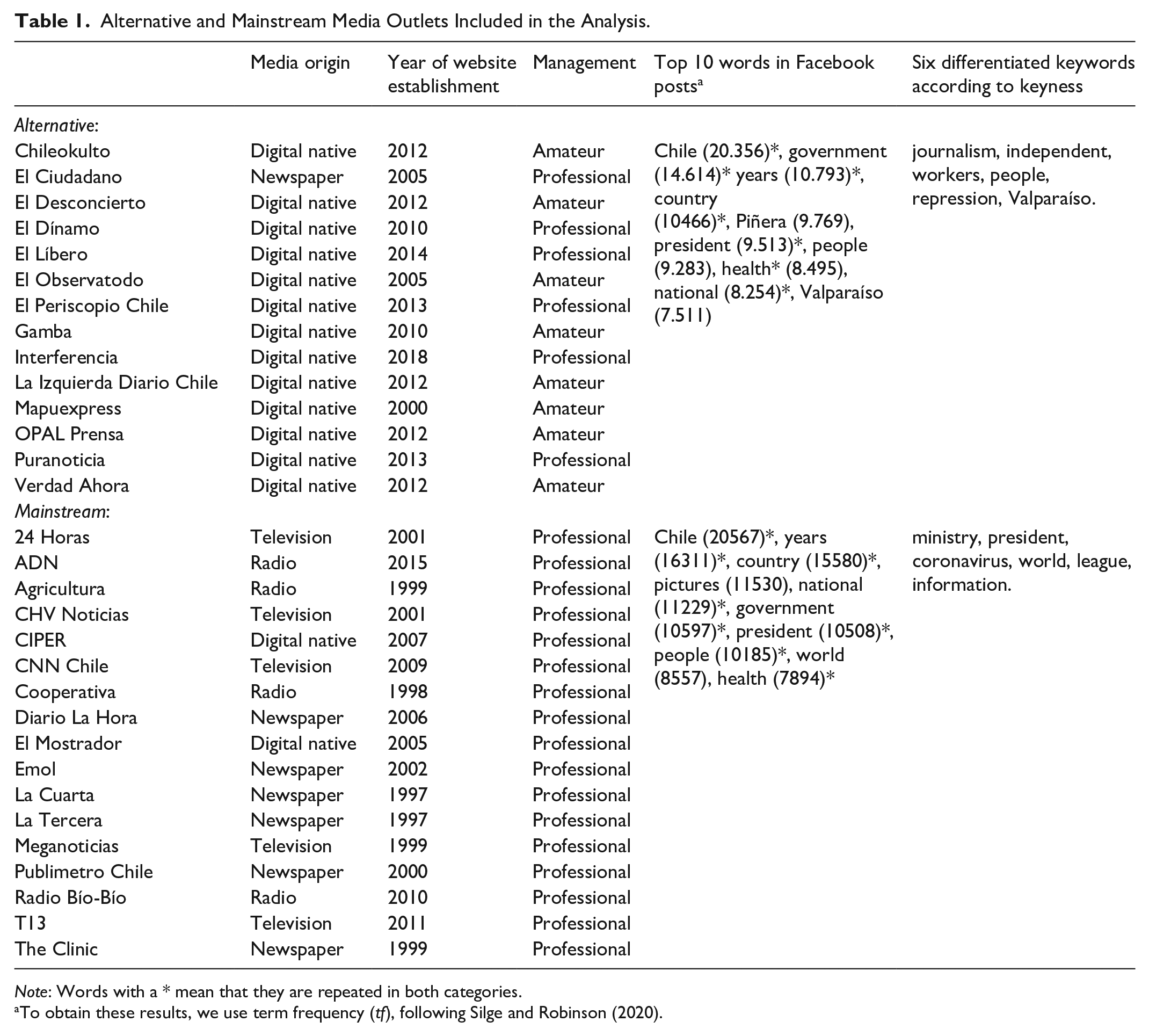
Note: Words with a * mean that they are repeated in both categories.
To obtain these results, we use term frequency (tf), following Silge and Robinson (2020).
We calculated an index of variation of shares by news post. For each media outlet, we estimated the average daily number of shares to their posts. Finally, we aggregated individual media outlet data into time series for alternative and mainstream media, and computed a daily variability index for each group, which uses the minimum daily number of shares (35.6 shares for mainstream media, and 15.3 shares for alternative media) as a baseline. The variability indicator ρi,t reflects the proportion of daily shares observed for each type of media Ii,t, considering baseline B. Variability was computed with the following formula:

Adjusting for prior use is vital to set a proper parameter for our comparison since the raw count of stories circulating is significantly biased toward mainstream media. Moreover, the raw count is driven by the fact that mainstream media feature a broad set of nonpolitical stories (i.e., sports, entertainment), which are also more frequently shared and liked by their audience (Valenzuela et al., 2017).
Results
Our results, shown in Table 2, indicate that after the uprising of 18 October 2019, alternative media increased users’ interactions by 15 times their baseline level. That increase is 10.0 times greater than the one observed for mainstream media, which increased by a factor of 4.8 only. This new pattern of interactions was largely in place even 100 days after 18 October, with a level of interactions nearly 8 times greater than the baseline. Interestingly, mainstream media interactions were decreasing in the lead-up to 18 October, and 100 days after the events of that day, they receded to their historical pattern.
Descriptive Results.

Note: Event refers to the uprising of 18 October 2019. SD: standard deviation.
The results are depicted in Figure 1. The information presented in that figure not only confirms the interpretation based on average interactions, but also crystallizes the notion that users’ interactions with both types of media reflect qualitatively different phenomena. Whereas both media types display different baseline levels, for alternative media, the time series reflects an abrupt, long-lasting, change—what econometricians define as exhibiting a “step” function. Meanwhile, the one observed for mainstream media shows a strong, albeit short-term, temporary impact, that is, a “pulse” function (Box & Tiao, 1975). Thus, our data reflect that alternative media attained long-lasting gains in user engagement. Mainstream media, in contrast, reverted to their usual engagement levels.
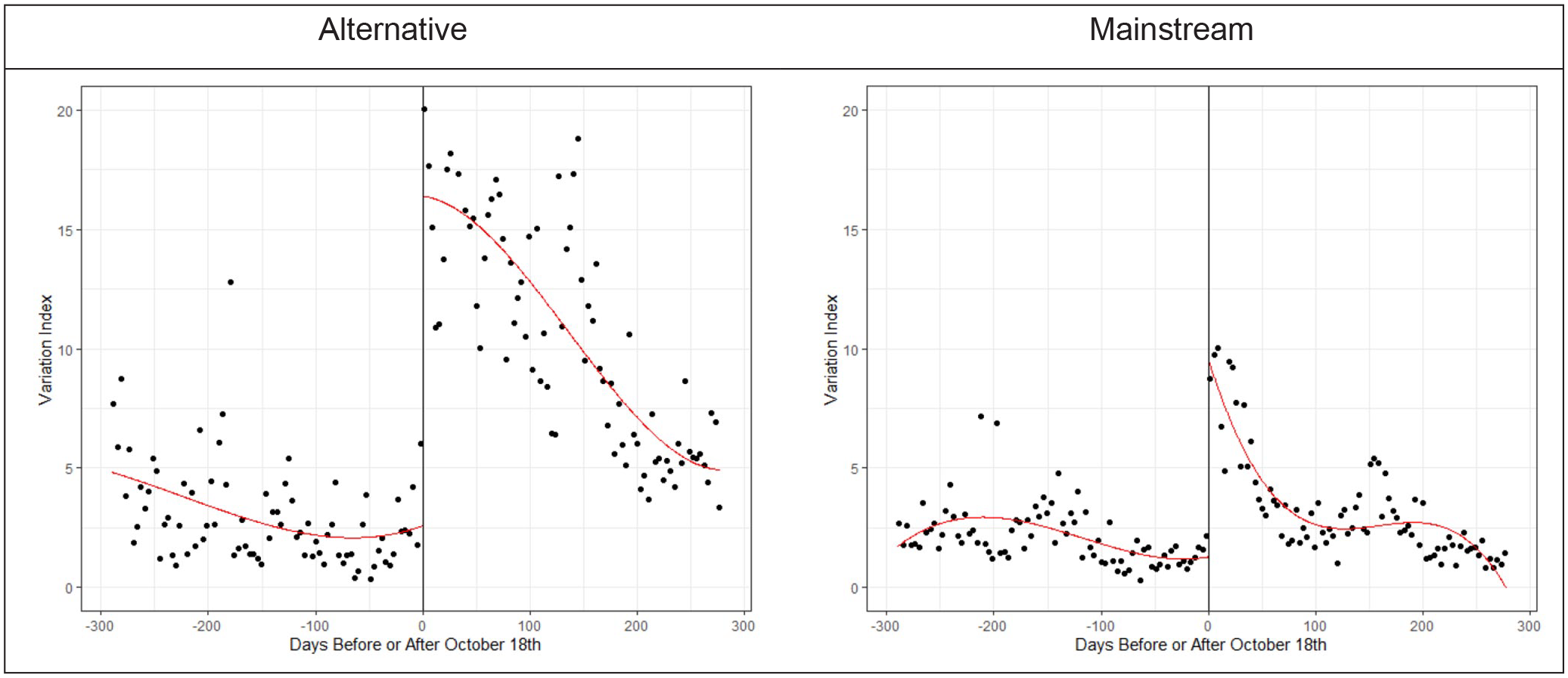
Trends in users’ interactions with alternative and mainstream media.
To assess our claim more systematically, we conducted an event study (ES). 2 This technique, developed in economics to assess the impact of a specific event on financial outcomes, seeks to estimate abnormal (financial) returns (AR) produced by a given event (Kothari & Warner, 2007). In our case, such event is 18 October 2019, and the AR is the difference between users’ interactions with both types of media predicted based on the time series preceding and following the event. The generic equation defining AR of media type i in period t is presented as follows:

where Ri,t is the ex-post return in period t and
To conduct an ES, an effect window (i.e., how many days before and after the event are considered for estimating the AR) needs to be defined first. We defined such period as 1 day before and 1 day after 18 October. Subsequently, we estimated AR using the historical mean model (HMM), the most used estimator to date (Pacicco et al., 2017). As shown in Table 3, the mass protests of 18 October 2019 produced a significant increase of interactions with both types of media. However, by January 2020, the trend had largely normalized for mainstream media, while continuing to show a significant increase for alternative media.
Event Study Estimation.

p < .05; **p < .01; ***p < .001.
Discussion
Unlike previous protest movements in Chile, the 18 October 2019 civic uprising targeted the whole political, economic, and social establishment. If prior movements had organized to enact changes in the education system, environmental policy, and women’s rights—among other issues—the estallido social aimed at the core of the so-called Chilean model of democratic neoliberalism (Nef, 2003). Thus, citizens protested not only against political and socioeconomic elites, but to media elites as represented by mainstream news outlets. This scenario represented a good case to examine how online engagement with news content can be influenced by social movements and protest behavior. The results of our longitudinal analysis of the diffusion of alternative and mainstream news media stories on Facebook found drastic changes in sharing patterns. Specifically, we found the diffusion of alternative media to be more stable and enduring than that of mainstream outlets.
We think that the most likely explanation for this finding is selective sharing—the notion that social media users are inclined to share pro-attitudinal content because it signals a particular identity, mobilizes like-minded peers, and counters political adversaries’ oppositional discourse (Osmundsen et al., 2021). Due to their concentrated ownership structure, conservative editorial line, and dependence on corporate advertising, the news media in Chile are closely linked to the country’s social and political elites (Dermota, 2002). Mainstream media have also enjoyed a strong agenda-setting and gatekeeping power over political elites (Valenzuela & Arriagada, 2011). For decades, carefully curated opinions and editorials in newspapers such as El Mercurio, La Tercera, and La Segunda consistently fed the agenda for subsequent political debates in radio and TV. This media ecosystem changed drastically, and quite suddenly, in the wake of the October 2019 riots. Existing alternative media gained renewed prominence in relation to the social movement, producing politically adversarial news stories and circulating evidence that was not widely covered by the mainstream media. At the same time, mainstream media, due to its close alignment to political elites, became a new target for social mobilization. While hashtags like #ApagaLaTele (translated as #TurnOffYourTV) went viral, TV stations became a target for oppositional graffities and protest activity. For example, the diffusion of police repression videos by alternative media not only challenged the claims made by the Piñera administration but crystallized the perception that alternative media exposed “reality” against a mainstream media system that was largely acquiescent to official narratives.
Our data and findings suggest that the success of most alternative media news sharing may have consolidated a counter-hegemonic public sphere in Chile. Of course, demonstrating that alternative media were proponents of a counter-public sphere requires content and discourse that go beyond our current purposes. Nevertheless, to the degree that most alternative media are left-wing oriented, and organized in networks against the for-profit, conglomerate-dominated, conservative-leaning mainstream media, it is possible that news sharing of alternative media news propelled the support for citizen-led protests.
Our evidence also suggests that the counter-hegemonic public sphere emerging around the 2019 protests produced lasting discontinuities. The causal dynamics that shape social and institutional trust are asymmetric in nature: Trust is hard to build but easy to lose. Moreover, doing the opposite of what caused losing trust does not necessarily rebuild confidence. Rather, it might deepen the reputational crisis. Our findings are consistent with this type of asymmetric causal dynamic. The 2019 social uprising revealed alternative public spheres that run counter to the dominant public sphere represented by Chile’s mainstream news media.
Political communication dynamics around the COVID-19 pandemic illustrate the broader implications that the emergence of a counter-hegemonic public sphere creates for governance and public policy implementation. During 2020 and well up to 2021, when a vaccine against coronavirus became available, the Piñera administration could not produce a coherent response to the COVID-19 crisis. The credibility crisis of the government and the mainstream media—even if not directly responsible for Chile’s disproportionately high per capita contagion rates—may well have played a role in the country’s health crisis. The government initially conceived the pandemic as political salvation and an opportunity to resurrect its legitimacy by reversing the effects of the October 2019 uprising. In this context, the government bet on communicating its strategy through the mainstream media to claim credit for the management of the pandemic. However, alternative media played a pivotal role in challenging the administration’s figures, as well as in highlighting the disproportionate effects of the pandemic (and of the economic crisis induced by lockdowns) on the poor.
During 2020, the government thus had to constantly dispute alternative reports on the pandemic and its effects, without being able to regain control of the media agenda. In the meantime, Chile sank in world rankings as one of the worst performers in the management of COVID-19. Performance was especially problematic in terms of citizens’ adherence to government instructions regarding lockdowns. As a result of the government’s poor performance, President Piñera reshuffled his cabinet 3 times between June and August 2020—a record by Chilean standards.
Moreover, opposition lawmakers approved a law allowing citizens to use 10% of their retirement savings to cope with the economic crisis. The project was vocally opposed by Piñera and his cabinet through interviews, press conferences, and other media events. In addition, technocratic and business elites, both of whom opposed the initiative, were featured prominently and often in interviews and op-eds in elite media. Alternative media overwhelmingly sided with the opposition, while helping to expose conflicts of interest among the private pension fund administrators (the so-called AFP) and political and business elites. The law was finally passed in Congress with the support of numerous pro-government lawmakers who changed their vote days (and hours) before the final vote. According to available survey research, by that time, close to 90% of Chilean citizens supported the project, which saw a 10% increase in support during the week prior to the vote.
The role of alternative media in countries such as Chile remains an incipient phenomenon which long-term effects on and broader implications for political mobilization remain to be observed. New research is needed to complement our preliminary empirical analysis with other data sources. In that regard, it is essential to recall that Facebook’s algorithm ranks contents in ways that remain rather obscure to researchers. Such rankings can significantly impact the currency and relevance of different contents, thus shaping news selectivity. For instance, it may be that Facebook tracked high engagement around stories shared by alternative media and boosted that early engagement by making those stories more visible. If that is the case, sharing patterns described here may not be capturing an organic set of news selections by users. In addition, we still lack access to the number of people who actually see a given post on Facebook. Hypothetically, it could be that shares increase but web traffic does not. Thus, our interpretation that increased sharing of alternative media stories supports counter-publics might be exaggerated, as the latter necessarily involves more than sharing (i.e., more profound forms of engagement such as deliberation and common-value formation, see Leung & Lee, 2014). Future studies might thus consider measuring other engagement indicators with alternative media and counter-publics and conducting qualitative interviews and focus groups with different media audiences and citizen groups. Content analyses of viral posts offer another possibility that we plan to pursue.
Increased interactions do not necessarily tell us much about the content of those interactions. For instance, it is possible that interactions generated by alternative media were critical of the content of news pieces published by them. Moreover, given the broad definition of alternative media adopted here, it is possible that different types of outlets, within that category, display different patterns of interactions. In this article, we have focused on massive and statistically significant differences between two broadly defined media types. New research should hence analyze within-group differences, as well as qualitative appraisals of the specific content of interactions and engagement with each media type.
Limitations notwithstanding, our research strongly suggests that alternative media is instrumental in shaping subsequent sociopolitical events in Chile, such as the management of COVID-19 pandemic. Alternative media have helped challenge social and economic elites’ capacity to control and frame the political agenda of the country. Alternative media has not only contributed to reshape the news diet of Chilean users but also editorial decisions in at least some mainstream media outlets. For instance, the TV network La Red changed its editorial line to match a civil society that is more critical of the status quo after the 2019 protests. Moreover, new small-scale and highly segmented media enterprises have mushroomed in the aftermath of the 2019 protests (e.g., podcasts, Twitter accounts specialized in investigative reporting, fact-checking initiatives). These new media not only compete with mainstream media for audience; they also provide professional opportunities for independent journalism to prosper in a context in which agenda-setting was previously hegemonized by an elite-controlled media system.
Although the contested reshaping of Chilean media described in this study might be thought as highly idiosyncratic, several of its structural features are shared with other cases in Latin America and elsewhere. Among others are (a) the presence of a highly concentrated mainstream media arena tied to the economic and political interests of the establishment, (b) mounting discontent that eventually breaks into massive protests and rioting, and (c) an available (web-based) technology that significantly reduces the entry costs for alternative media to contest official narratives. We are thus likely to observe similar dynamics to those described here for the Chilean case in countries sharing similar structural features.
Footnotes
Declaration of Conflicting Interests
The author(s) declared no potential conflicts of interest with respect to the research, authorship, and/or publication of this article.
Funding
The author(s) disclosed receipt of the following financial support for the research, authorship, and/or publication of this article: The authors gratefully acknowledge funding from the Agencia Nacional de Investigación y Desarrollo of Chile (ANID-Millennium Science Initiative Program-ICN17_002) and the Social Science Research Council (SMDR-010-073, SMDR-010-089).
