




Abstract
In this article, we critically examine the degree to which left-wing and right-wing alternative media appeared in US and UK mainstream media. We develop a distinctive comparative approach by carrying out a comprehensive content analysis of references to US and UK alternative media sites between 2017 and 2021 in each country's mainstream news media systems. The study identified 3481 references in total and revealed that mainstream media featured alternative right-wing sites far more than left-wing sites, and their credibility as information sources was rarely questioned or challenged by professional journalists. Our cross-national comparative study also identified where different media and political systems enhanced and moderated the perspectives of alternative media, and their contributors in mainstream media. We argue that the more national media systems evolve into market-driven and deregulated environments then the more the editorial influence of right-wing partisan media will increase and conflate with the world of mainstream media.
Introduction
Debates about the power of alternative media, and their ability to shape the agenda of political events and issues, have intensified over recent years. New technologies and affordable ways of publishing have opened up opportunities for alternative media to disseminate content online and across social media. Precisely what constitutes ‘alternative media’ remains open to debate, with scholars still grappling with what makes their characteristics distinctive from mainstream media (Coddington and Molyneux, 2024; Cushion 2024). In doing so, it has been observed that the distinction between alternative and mainstream has become more difficult to interpret, with the editorial and production values of professional journalism increasingly shaping how alternative media sites operate (Freudenthaler and Wessler, 2022; Kaiser et al., 2020). But rather than exploring the editorial differences between alternative and mainstream media, the focus in this article is on the degree to which left-wing and right-wing alternative media appear in mainstream news media reporting in the United States and United Kingdom. Or, put differently, how comparatively intertwined are alternative media with mainstream media systems.
Empirical research about alternative media has grown in recent years, but many studies have focussed on specific sites, mostly from a right-wing perspective, and through a national political lens (Thompson and Hawley, 2021). However, a few studies have adopted a comparative approach, exploring cross-national differences in alternative media output in the context of their contrasting political and media systems (Heft et al., 2023; Mayerhöffer and Heft, 2021; Staender et al., 2024). In this article, we develop a cross-national study that assesses how far left-wing and right-wing alternative media were referenced by mainstream news outlets agendas in the United States and United Kingdom over a 5-year period (2017–2021). Since mainstream media remains the dominant information source in most Western democracies (Deacon et al., 2024), our study makes an important intervention into debates about how much alternative media appears in the news agendas most people routinely use to understand politics and public affairs. We consider this an urgent and timely inquiry because it matters whether alternative media perspectives appear more regularly and uncritically as a source of information in mainstream media. Alternative media, after all, have broadly tended to promote a more partisan brand of politics than most mainstream media outlets. In many countries, including the United States and United Kingdom, the rise of right-wing populist parties has been supported by increasingly powerful alternative media sites that often champion their policies uncritically. This was evident when Donald Trump was in office during his first term as US President (and has continued in his second term), with favourable outlets and journalists from alternative media sites given access at press conferences to ask ‘soft’ questions, as opposed to more robust lines of interrogation from mainstream media outlets. In other words, our study is not just about categorising different forms of media and interpreting how intertwined they are; if the findings reveal that alternative media regularly appear in mainstream media it suggests that their role and voice has become a normalised source of professional news that will promote partisan perspectives at the expense of more objective sources of information and analysis. To date, interpreting the comparative degree of influence alternative media have on mainstream media agendas has received relatively limited empirical scrutiny. When studies have been carried out, they have tended to crudely quantify a single reference to a site as opposed to a more in-depth analysis of how substantively the salience of a particular news media appears in another news outlet. We develop a new and distinctive comparative approach to interpreting alternative media power by drawing on a content analysis of 3481 references to United States and United Kingdom alternative media sites across each country's mainstream media. In doing so, we examine the extent and nature of left-wing and right-wing perspectives featured in mainstream news reporting, and assess whether contrasting national media and political systems help promote or moderate certain viewpoints from across the political spectrum. We also examined whether professional journalists questioned the credibility of alternative media as an information source, such as whether they promoted left-wing or right-wing perspectives.
Interpreting the role of alternative media across national media and political systems
There has been limited understanding of whether alternative media have an editorial impact on the output of mainstream media. Su and Xiao's (2021) meta-analysis of research about cross-media influence published between 1997 and 2019 found that studies largely focussed on analysing a one-way flow of traditional media to another, overwhelmingly from a US perspective. But over recent years, they discovered a growing interest in understanding how online and especially social media, such as Twitter (now called X), influenced the agendas of mainstream media. Benkler et al. (2017), for example, analysed people's hyperlinking patterns – including social media sharing patterns on Facebook and Twitter across 1.25 million stories during the election campaign – to identify a right-wing media ecosystem that helped promote pro-Trump reporting and push anti-Clinton coverage. Other studies have similarly found that online alternative media, largely with a right-wing agenda, helped shape elite newspaper coverage in the United States (Stern et al., 2020; Vargo and Guo, 2017). Vargo and Guo (2017: 1031), for instance, concluded that ‘Two elite newspapers—The New York Times and The Washington Post—were found to no longer be in control of the news agenda and were more likely to follow online partisan media’.
However, Buturoiu et al.'s (2023) meta-analysis of studies exploring cross-media influence cautioned that, in an increasingly fluid online and social media environment, it was becoming methodologically challenging to establish connections between sources and news agendas. As well as assessing the degree to which one news media outlet shapes another, a major limitation of scholarship has been the US-centric nature of research and the lack of internationally comparative studies. In their meta-analysis of studies examining cross-media influence between 1997 and 2019, for example, Su and Xiao (2021: 81) concluded: ‘that the majority of them was contextualised in the United States [which] may decrease the generalisability and external validity of their findings. Cross-national comparative research is still needed’. Without an understanding of the media system that influences the prevalence and nature of how far alternative media informs mainstream media, it is difficult to identify where and why any effects take place. Our study was designed to develop a cross-national comparative approach and to consider the role different media systems play in reporting the perspectives of alternative media sites.
National media systems have long been interpreted as products of a country's social and political identity (Siebert et al., 1956). This is because national media systems do not operate in uniform ways, but diverge according to a range of factors, such as how they have been regulated or funded over time. Scholars have developed sophisticated ways of comparing and contrasting media systems to reveal how they reflect the wider political and cultural worlds they inhabit. Hallin and Mancini (2004) pioneered a study of 18 nations across Western European and North America, identifying three media systems – liberal, democratic corporatist and polarised pluralist – that, they argued, represented their national political and journalistic identities.
The book opened up academic debates about the similarities and differences between national media systems, not least in relation to the United Kingdom and United States, which were grouped together as representing a liberal media model. But we agree with several scholars’ critiques of Hallin and Mancini's (2004) book, which have suggested that the United States and United Kingdom have distinctive types of media systems. Curran (2011), for example, argued that the United States has exceptional political characteristics that have cultivated a hyper-commercialised media system, with far less regulatory oversight and funding than most European media systems, which have historically supported a plurality of news sources. Similarly, Brüggemann et al. (2014) questioned the wisdom of aligning the United States and United Kingdom media systems together because of the contrasting ways the state and market operate in each country. The United States has a market-driven media shaping its media system, creating a right-wing media ecology which fuels partisan political reporting online and across social media. While the United Kingdom has long had a partisan press system, promoting a largely right-wing perspective on the world, this has been mitigated somewhat by a highly influential public service broadcasting system that has long championed an impartial brand of political reporting (Cushion and Kyriakidou 2025).
But it is also important to understand the changing nature of political systems and how the media evolve in response to them. Political systems, after all, are not static; they can cause new forces and disruptions in society, including influencing how journalism operates. Over recent years, there has been a weakening of support for traditional mainstream political parties across the world, with a rise of disruptive political parties and movements challenging the status quo (De Vries and Hobolt, 2020). In the United States, for instance, new populist right-wing movements, parties and leaders have emerged, culminating in the election of Donald Trump in 2016 and again in 2024 (Block, 2022). Trump campaigned and governed in unconventional ways, championing a new brand of right-wing politics and treating mainstream journalists with distain (Carlson et al., 2021). Trump's politics have been supported by an infrastructure of alternative media networks, such as Breitbart and Newsmax, perpetuating false and misleading claims that would have otherwise gained little traction in mainstream media, such as alleging that the 2020 vote was rigged.
Meanwhile, in the United Kingdom, new right-wing political forces and parties, such as UKIP and, more recently, Reform UK, have disrupted the Labour-Conservative two-party dominance of many decades, successfully pushing issues such as Brexit and anti-immigration to the top of the political agenda (Tournier-Sol, 2021). Through brash and aggressive populist politics, they have challenged conventional standards and norms of campaigning, most strikingly during the 2016 referendum to remain or leave the EU. While new populist movements, parties and leaders have received some support in the United Kingdom's right-wing mainstream press, right-leaning alternative media sites such as Guido Fawkes, The Conservative Women and Breitbart have often championed their causes. Recently, the launch of a new rolling television news channel, GB News, in 2021 has given a prominent platform to populist politicians such as Nigel Farage. In doing so, it has pushed the boundaries of the UK impartiality regulations, which has long governed how broadcasters operate, and created new conditions for an alternative brand of partisan media to flourish on television (Sambrook and Cushion 2024).
In summary, the changing nature of political systems in the United States and United Kingdom has given rise to alternative media that have disrupted the political and media consensus that has long policed the boundaries of democratic debate (Cushion 2024). Our study aims to examine how far they routinely appear in mainstream media, and if their credibility as an information source are accepted or questioned over a 5-year period.
In light of the different media and political systems in the United States and United Kingdom, our study explored the extent and nature of mainstream media coverage of alternative media sites and their perspectives. We conducted a content analysis of references to right-wing and left-wing alternative media sites or their key contributors between 2019 and 2021 in United States and United Kingdom mainstream media. We answer three main research questions:
To what extent did mainstream media reference alternative media sites and their contributors, and how did they appear in coverage? To what extent did mainstream media label alternative media sites or their contributors left-wing or right-wing, or in some way cast doubt on their credibility as an information source? Were there any differences in the degree and nature of mainstream media coverage between alternative right-wing and left-wing media sites, and across United States and United Kingdom media systems?
Methods and sample
In order to interpret the degree to which alternative media appeared in mainstream news cross-nationally, we carried out a quantitative content analysis of United States and United Kingdom news outlets. We developed a detailed coding framework that examined the extent and nature of every reference to left-wing and right-wing alternative media sites in United States and United Kingdom mainstream media in three separate years: 2017, 2019 and 2021. We decided to choose different points of time over a 5-year period in order to explore whether there were changes over time or consistent patterns of references to alternative media.
We selected a sample of sites from both right-wing and left-wing perspectives in the United States and United Kingdom that largely publish in online and social media spaces (rather than on major networks or newspapers) with content that opposes mainstream media and represents their audiences as being disenfranchised from mainstream media and politics. For the US sample, this included left-wing sites, Jacobin, Daily Kos, and Raw Story. And right-wing sites, Breitbart, Newsmax, The Daily Wire. For the UK sample, this included left-wing sites, Novara Media, The Canary, and The London Economics. And right-wing sites, Breitbart London, Guido Fawkes and The Conservative Woman.
In addition, we identified two key contributors from each site (24 in total) in order to quantify whether the specific names of these writers (rather than the sites) were referenced over the 3 years of the sample period. They were selected on the basis of social media influence, which was measured according to which contributors from each site had the largest number of followers on Twitter (now called X). Many of these contributors have larger social media profiles than alternative media sites and represent their sites beyond the official Twitter accounts. Since the mainstream news media often give specific celebrities and personalities a platform to air their views, we wanted to ensure their influence was included in the comparative study. For right-wing sites in the United States, this included Peter Schweizer and Kristina Wong (Breitbart), Christopher Ruddy and John Gizzi (Newsmax), Ben Shapiro and Ryan Saavedra (The Daily Wire). For left-wing sites in the United States, this included David Sirota and Luke Savage (Jacobin), David Nir and Mark Summers (Daily Kos), Mike Rogers and Jim Small (Raw Story). For right-wing sites in the United Kingdom, this included Paul Staines and Tom Harwood (Guido Fawkes), Joel Pollak and Raheem Kassam (Breitbart London), Kathy Gyngell and Laura Perrins (The Conservative Woman). For left-wing sites in the United Kingdom, this included Ash Sarkar and Aaron Bastani (Novara Media), Kerry-Anne Mendoza and Steve Topple (The Canary), Gavin Esler and Jack Peat (London Economic).
To identify both references to specific alternative media sites and their two key contributors in mainstream media, we examined coverage in newspapers, online news and broadcast programming. This was achieved by making use of online archives to access content across both the United States and United Kingdom in order to retrospectively analyse news across newspapers, broadcast and online media. However, we would acknowledge archival sites have limitations and shortcomings, most notably in the inconsistency of accurately capturing all references to particular search terms over a set period of time (Gilbert and Kelley, 2024). Our approach to ensuring reliability in searching specific outlets in 2017, 2019 and 2021 was to primarily rely on well-known archival services, Lexis Nexis and Box of Broadcasts (Bob), as well as directly through news websites. Lexis Nexis has long been used by academic researchers to collect newspapers, Bob is a more recent service that examines transcripts of text in UK broadcasting, while online searches for articles via articles has grown more extensively over recent years. However, we would acknowledge that although online archives can generate robust and systematic samples of media output, they do not always capture every type of news (Deacon, 2007; Gilbert and Kelley, 2024). For example, studies have shown particular news formats have often been excluded from databases (Deacon, 2007). We carried out several pilot studies to ensure that all terms were being searched over the set period, and no particular types of news formats skewed the results or were excluded for one mainstream media outlet and not another. In other words, we attempted to mitigate any potential biases in the archival research, but we accept that there will be some missing items and inconsistencies.
The mainstream media selected to analyse was based on newspapers, online sites and broadcasters with the highest readership/audience reach for news. We also sampled United States and United Kingdom media outlets differently according to their contrasting media ecologies as previously explained (see Table 1). This resulted in sampling more UK than US media outlets. This was because the United States has several national media that have a wide reach, particularly in newspapers/online news. There has historically been more national press titles in the United Kingdom, largely with right-wing perspectives, whereas the United States has more regional/state level newspapers because of its far bigger geographical and population size.
List of outlets in sample (partisanship in brackets).
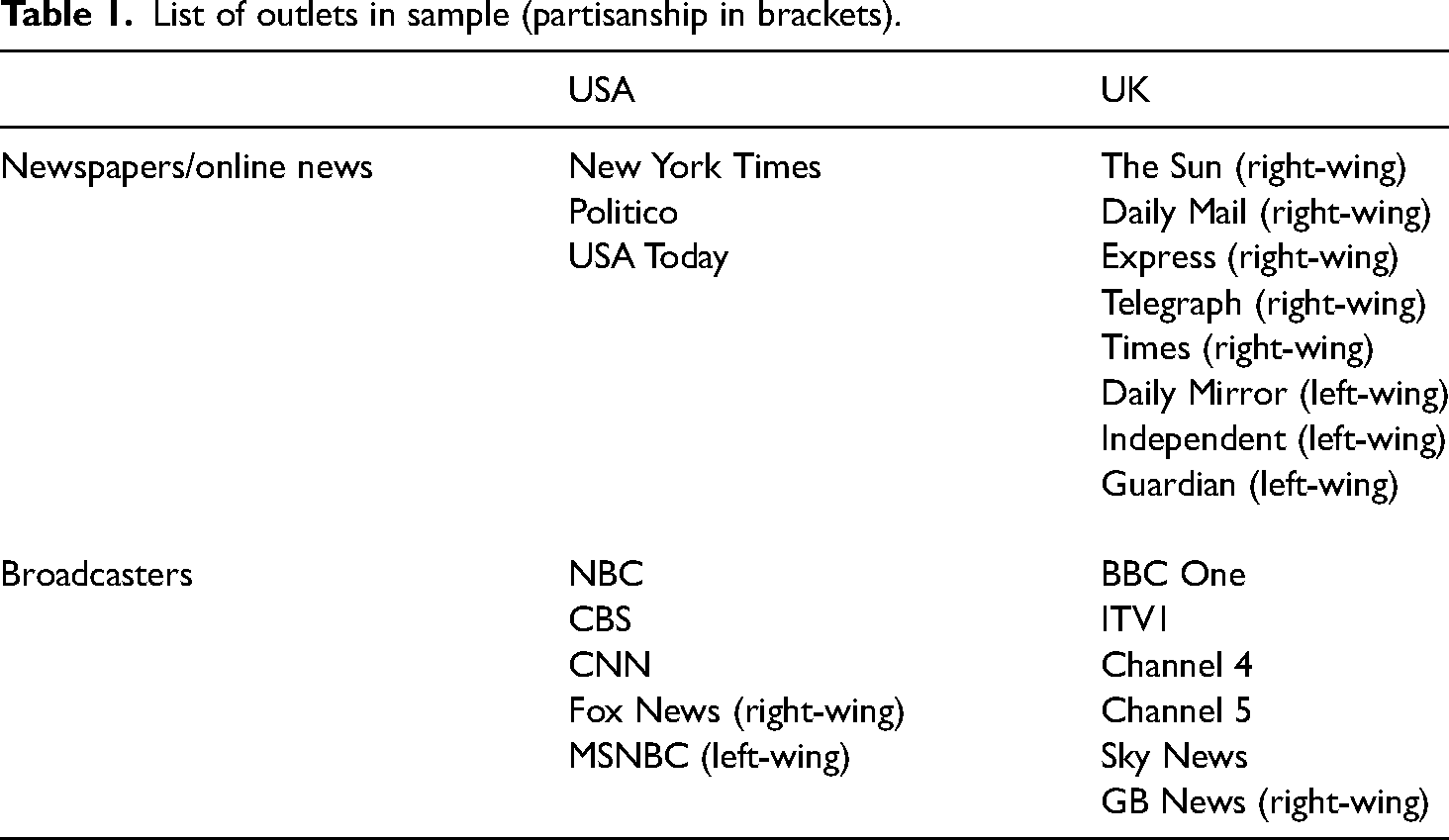
We would acknowledge that the United States and United Kingdom samples of media outlets are not directly comparable, but taken together they were selected to reflect the character of their national media systems. In the case of the United Kingdom, we have reflected the ideological balance of newspaper positions, including more right-wing than left-wing titles. In terms of the political make up of broadcasters, the UK impartiality code prohibits any overt left-wing or right-wing partisanship in media output. But since GB News launched in 2021, this regulatory code has been challenged by a new brand of right-wing partisan programming. After the US government rescinded the Fairness Doctrine in the 1980s – regulation that attempted to mitigate editorial bias – broadcast cable news outlets have steadily become more partisan. We have reflected this in the sample of US broadcast media. However, there are more subtle ideological perspectives that may be present in mainstream media newsrooms. For example, the BBC or US broadcast networks may adopt more liberal perspectives in their news agendas than, say, Fox News, such as reporting debates about immigration beyond threats to security but through the contribution of multiculturalism to society. The degree to which right-wing or left-wing alternative media appear on mainstream media could be a reflection of any liberal or conservative biases within newsrooms.
Over the 5 year analysis, we identified a large sample of references to either alternative media sites or contributors – 3481 in total – from each site across newspaper and online articles, as well as broadcast programming. These direct references to alternative media sites capture explicit instances of one media appearing in another. But we would also acknowledge there may be indirect influences with mainstream media making editorial judgements based on alternative media content without explicitly referencing particular sites.
Our content analysis was designed to systematically assess the extent and nature of coverage of references to right-wing and left-wing alternative media sites across the United States and United Kingdom mainstream media. The unit of analysis was every reference to an alternative media site or contributor. In order to measure how alternative media appeared in mainstream media, we identified whether references appeared: (1) as a direct quotation online or appearing on a programme, (2) an indirect reference in a news story or (3) if they were just namechecked. Finally, to establish whether alternative media perspectives were subject to some degree of scrutiny as an objective information source, we rigorously assessed every reference to check if the credibility of site or contributor was questioned or not within a news story, or a site was labelled left-wing or right wing to reflect their partisan editorial approach.
Over recent years, studies examining references to media texts have used computer-assisted analysis to examine large samples of data. But our distinctive approach of not just quantifying the amount of news, but interpreting the nature of coverage required careful human judgements beyond the capacity of machine learning technology. We recruited to researchers employed on the project to manually carry out the content analysis. Funded by our Economic and Social Research Council project entitled ‘Beyond the MSM: Understanding the rise of alternative online political media', we carried out several pilot studies to determine the feasibility of the research design and the rigour of every variable. Just over 5% of the sample was re-coded and subject to an intercoder reliability test. The variables achieved a high or satisfactory level according to Cohen's kappa. This included the following scores: references to sites or contributors (1.0), the type of reference (0.71), and whether a site or contributor perspective was challenged (0.71).
The degree to which alternative media informed mainstream media
The content analysis study established that references to alternative media or their contributors were significantly higher in United States mainstream media than in United Kingdom mainstream media. Of the 3481 references to alternative media sites or contributors identified in mainstream media, 2643 – 75.9% – featured in United States news sites, with under a quarter – 838 or 24.9% – in United Kingdom news sites.
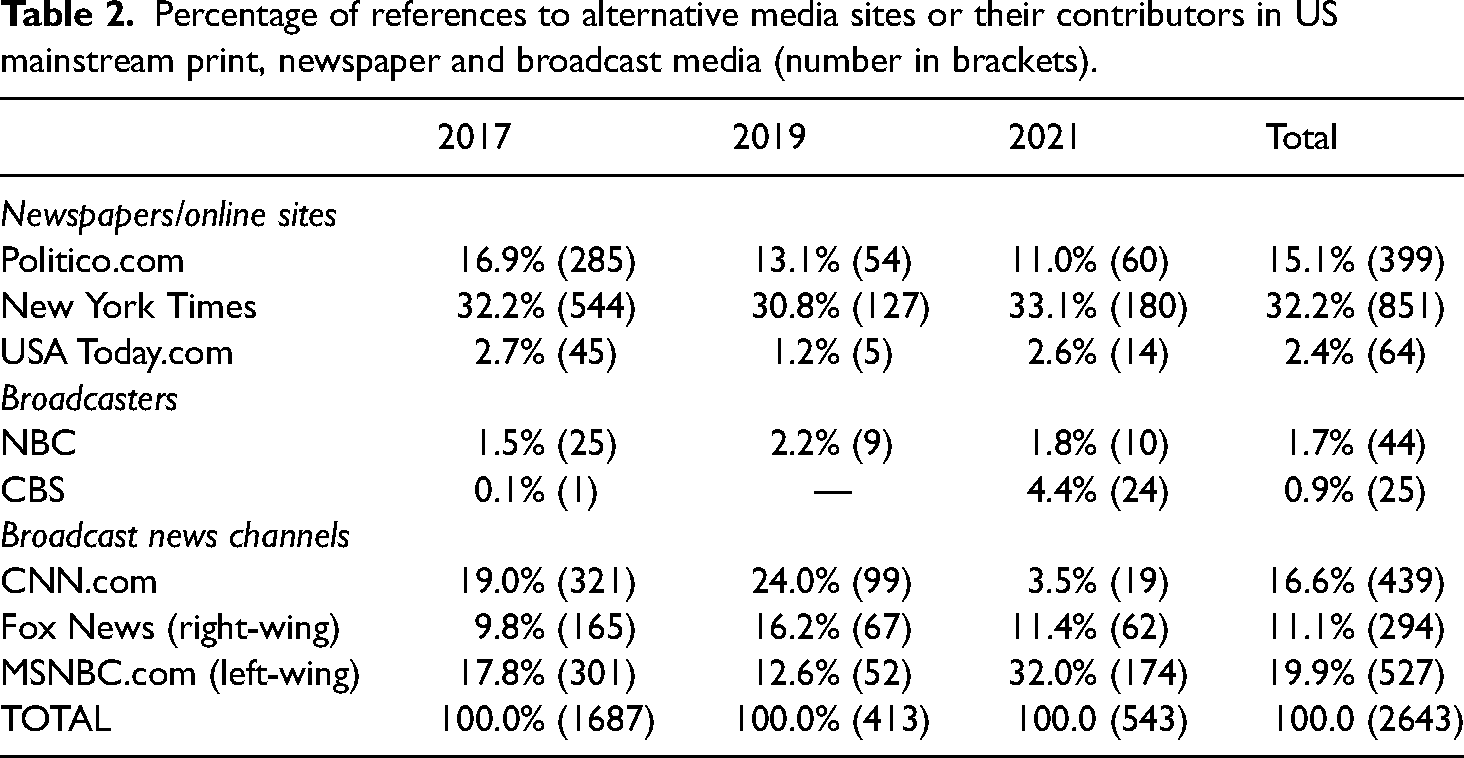
In the United States, almost all references to alternative media were made by newspapers and news channels (see Table 2). The New York Times made up a third of all references, compared to a fifth on MSNBC, and between 15.1% and 16.6% for Politico.Com and CNN.Com, respectively. In United States broadcast programming, alternative media did not regularly feature between 2017 and 2021. Close to two-thirds – 62.3% of the total United States sample – was in 2017, Donald Trump's first year in office.
Percentage of references to alternative media sites or their contributors in US mainstream print, newspaper and broadcast media (number in brackets).
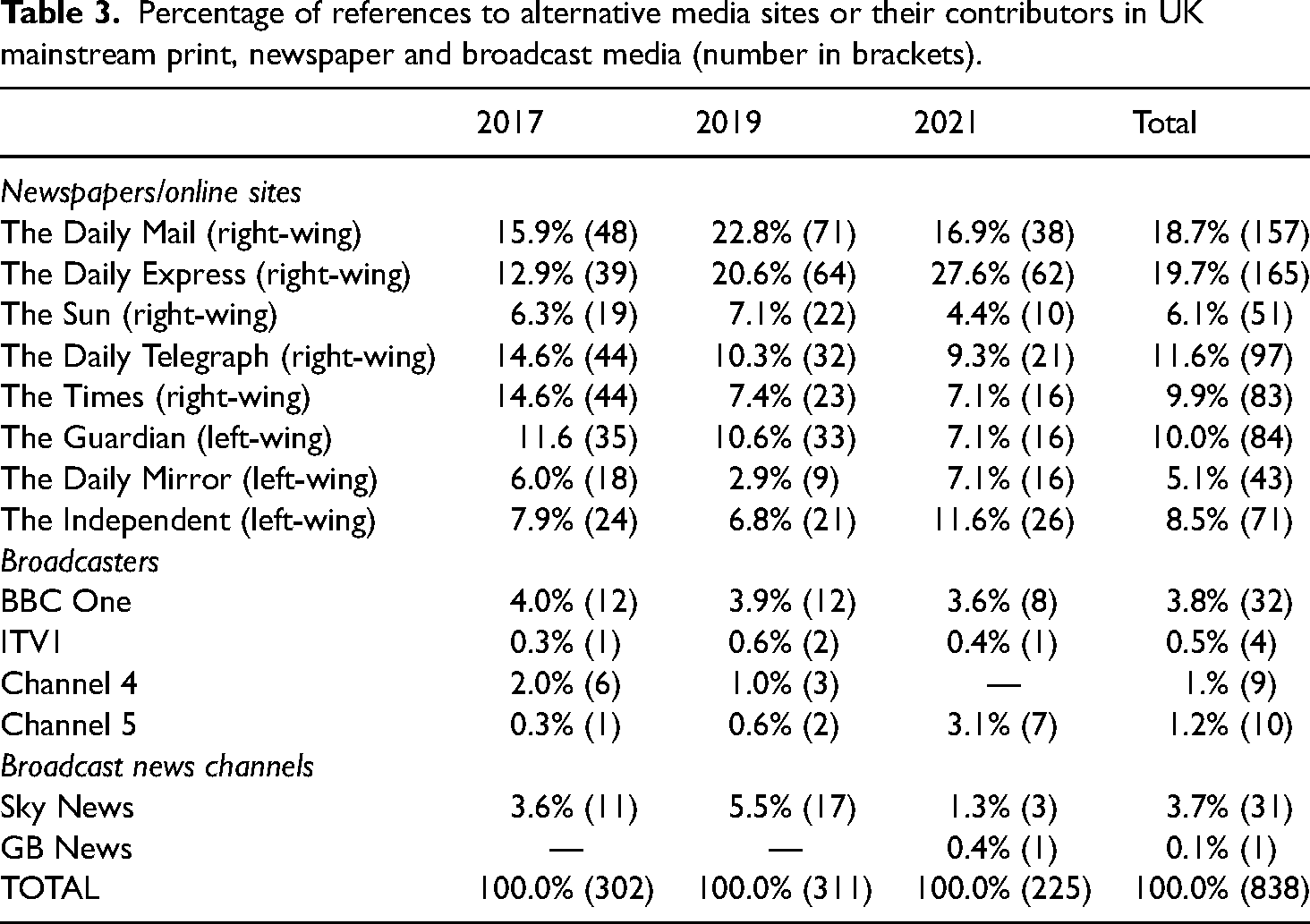
In the United Kingdom, by contrast, it was partisan newspapers, most strikingly from a right-wing perspective, that made up the vast majority of references to alternative media sites (see Table 3). The Daily Mail and Daily Express, in particular, represented almost 40% of all references to alternative media across the 14 newspapers, online sites and broadcasters examined. Broadcasters, even dedicated news channels, did not regularly draw on alternative media sites or their contributors. While the new partisan channel, GB News, was only examined in 2021 – the year it launched – the channel only made one reference to an alternative media site, in contrast to its US counterparts. Another difference with American mainstream news reporting was that references to alternative media sites were split more evenly across the sample period.
Percentage of references to alternative media sites or their contributors in UK mainstream print, newspaper and broadcast media (number in brackets).
Right-wing alternative media dominance in mainstream news
In terms of which alternative media sites appeared most in mainstream media, Table 4 reveals that the overwhelming majority of references in the US – 92.7% in total – were to right-wing sites. It might be expected that right-wing outlets, such as Fox News, would reference right-wing alternative media sites proportionally far more than other mainstream media. But with the exception of NBC, all other mainstream coverage referenced right-wing alternative media sites far more than left-wing sites.
Percentage of US alternative media sites referenced by mainstream media between 2017 and 2021 (number in brackets).
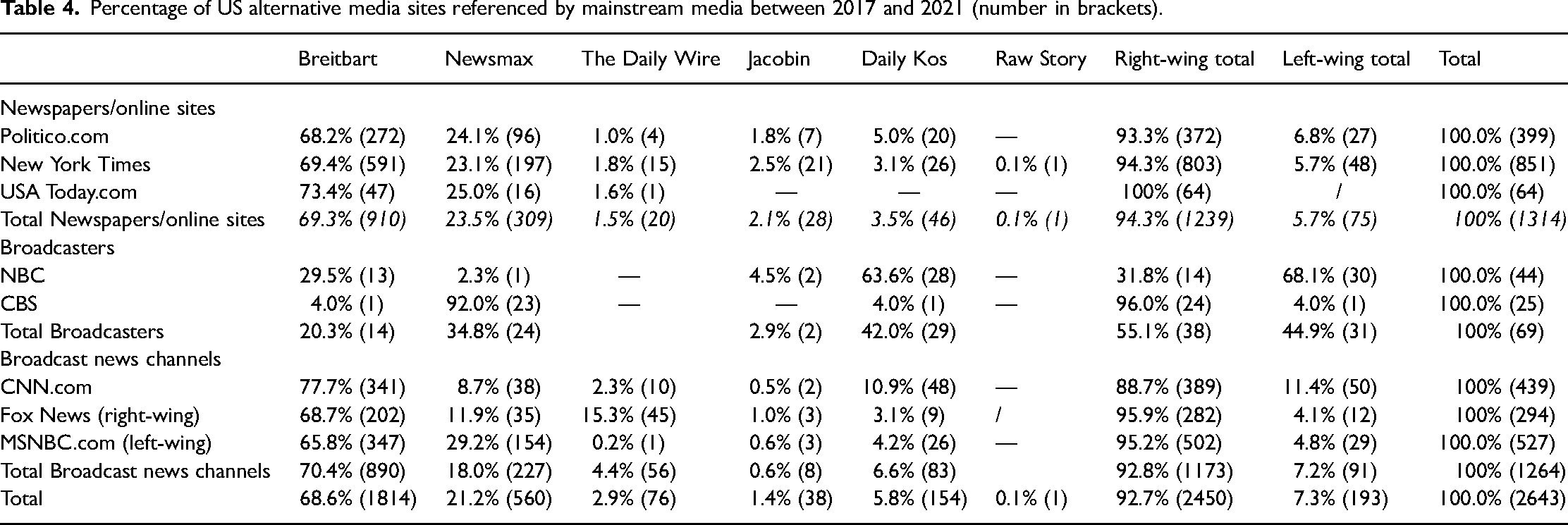
Of all the alternative media sites examined, Breitbart featured the most in US mainstream media coverage. But their contributors made up less than 1% of its total references. It was Newsmax's contributors that appeared the most in coverage, with Christopher Ruddy, its founder, making up over a quarter – 27.3% – of the news channel's references. His mainstream media prominence was largely due to championing Trump in the aftermath of the 2016 US Presidential election, and supporting his false claims of electoral fraud after the 2020 Presidential election.
Similar to the United States, Table 5 shows three-quarters of all references to alternative media in UK mainstream media were from a right-wing perspective. All newspapers and online sites featured, by far, more right-wing than left-wing alternative media sites and their contributors over the 3 years, with broadcasters providing a more balanced mix of perspectives across the political spectrum.
Percentage of UK alternative media sites referenced by mainstream media (number in brackets).
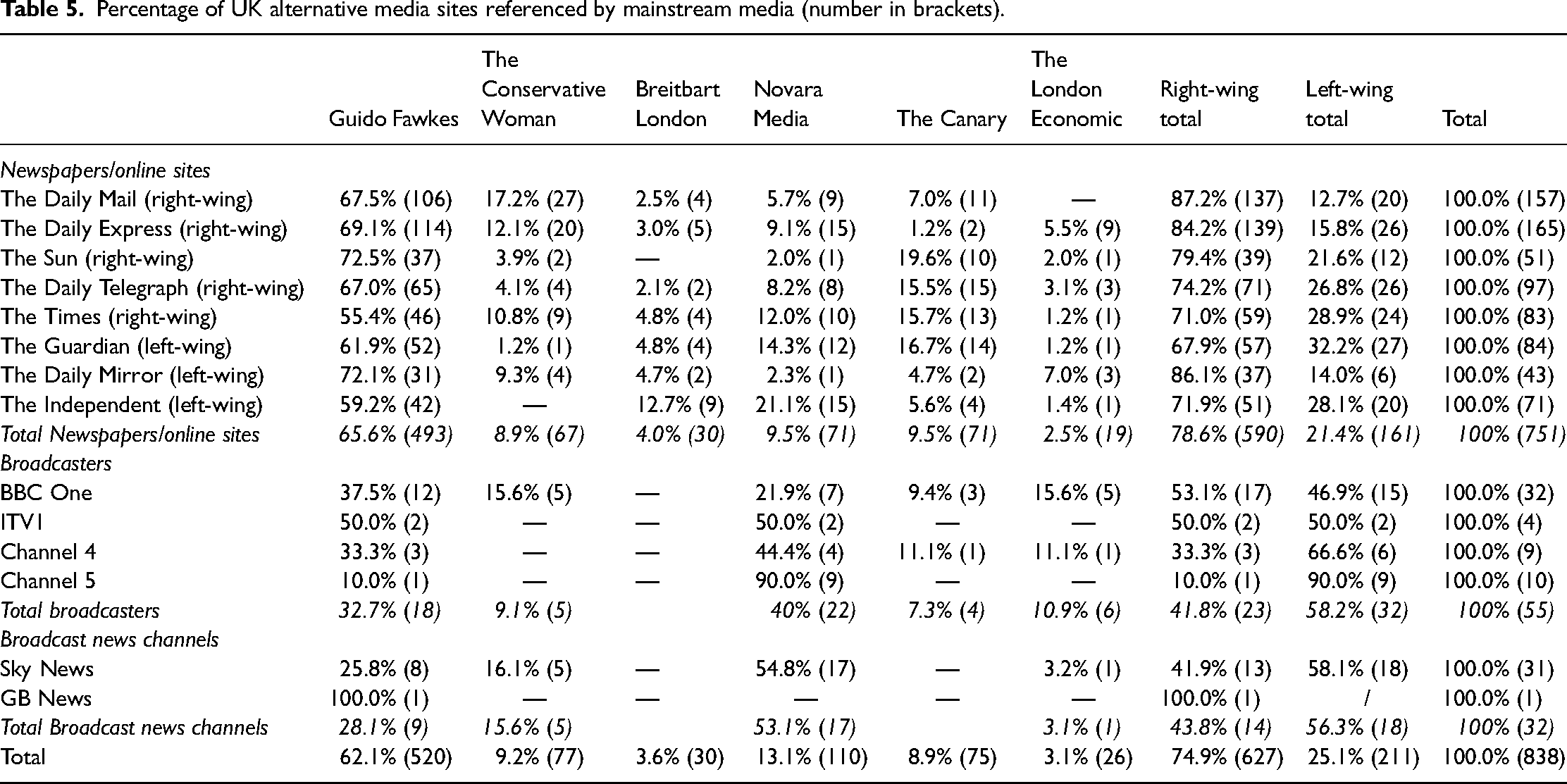
Guido Fawkes made up 62.1% of all right-wing references, and appeared in mainstream media coverage the most across all right-wing and left-wing newspapers and online sites, as well as on the broadcasters, BBC1 and Sky News. Part of Guido Fawkes elevation to mainstream media coverage was due to its high profile contributors. Its then political commentator, Tom Harwood, made up 6.1% of references in mainstream media with 2.1% of references to its founder, Paul Staines. For Conservative Woman, almost two-thirds of references by mainstream media were accounted for by its two contributors – Laura Perkins and Kathy Gyngell – with just a third namechecking the site specifically.
While Novara Media was not regularly namechecked by mainstream media, two of its key contributors, Arron Bastani and Ash Sarkar, often appeared on television news, making up 36.4% of all the alternative media sites references by mainstream media. This represents UK broadcasters’ impartiality requirements, which requires them – unlike in press or online coverage – to reflect different ideological perspectives. GB News – a UK broadcaster pushing the boundaries of the impartiality code – did not champion the voices of right-wing alternative media sites as partisan channels did in the United States, with just one reference to Guido Fawkes in 2021.
The nature of alternative media appearing in mainstream media
In order to further explore the extent and nature of the relationship between alternative and mainstream media, we categorised every reference to a specific alternative media outlet according to whether it was a direct quote or on-screen appearance, an indirect quote, or just a mention of a site. Table 6 shows right-wing US alternative media more directly than indirectly informed mainstream media compared to left-wing sites, with The Newsmax and The Daily Wire – and their contributors – prominently referenced in coverage.
Percentage of the nature of references to alternative media in US mainstream media (number in brackets).
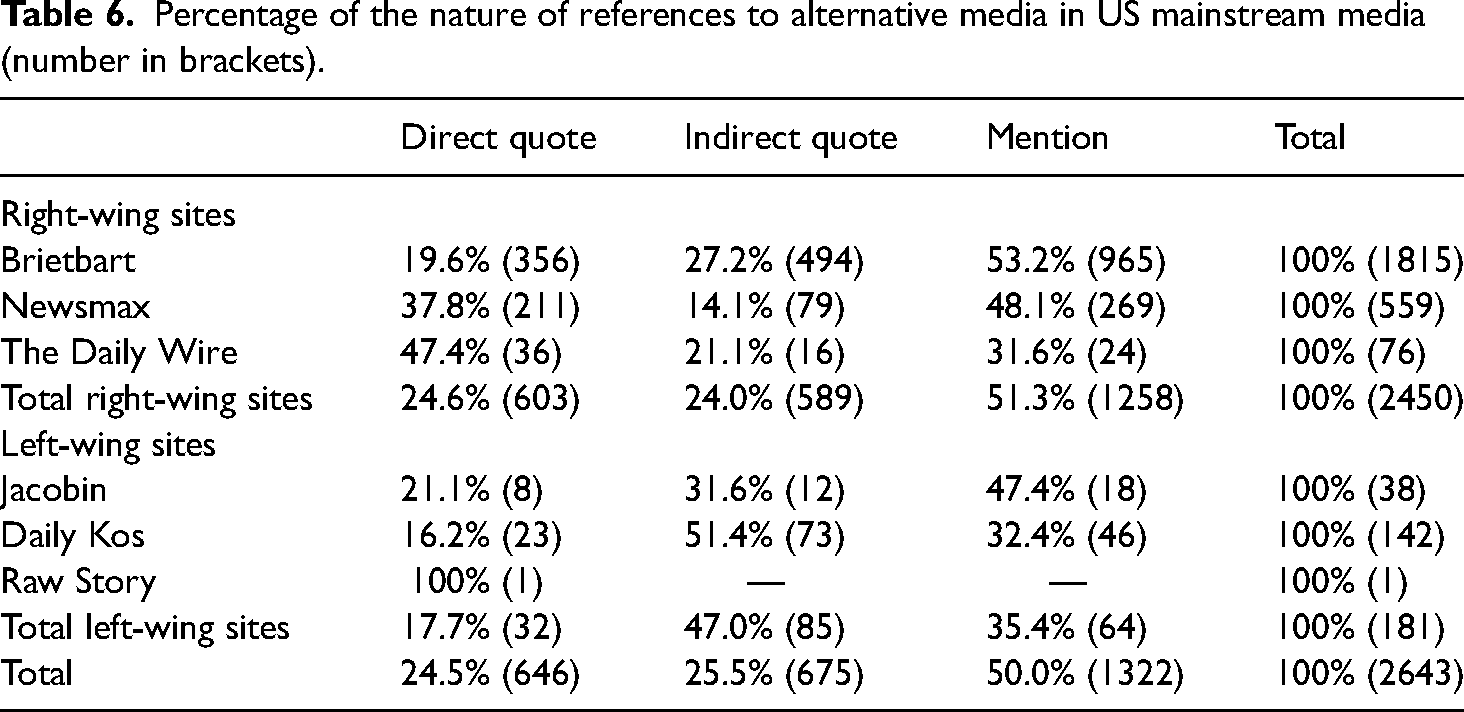
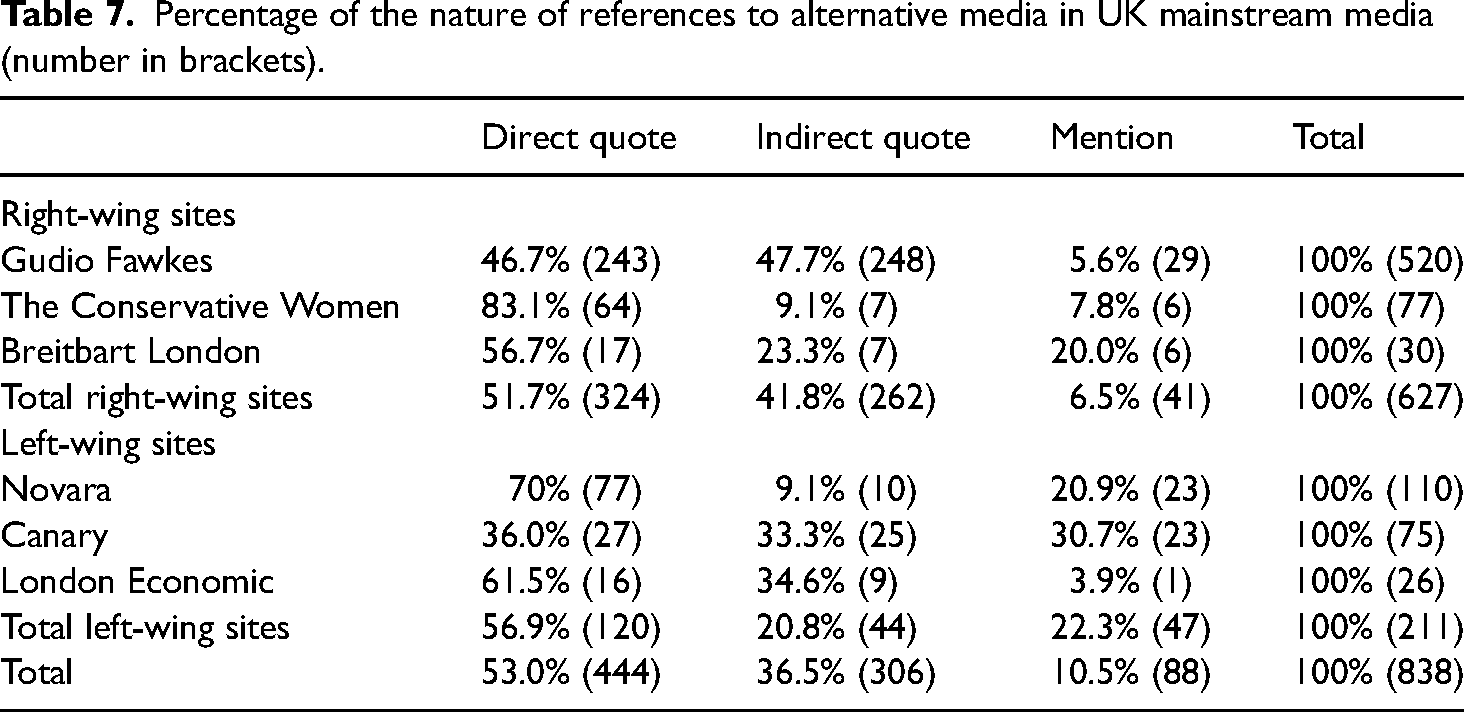
In the United Kingdom, the proportion of mainstream media items that directly sourced alternative media was slightly higher on left-wing sites – making up 56.9% of references – than the 51.7% of references on right-wing sites (see Table 7). These were largely due to Novara Media and their two high profile contributors, Ash Sarkar and Aron Bastani, who prominently featured in mainstream media on flagship news programmes that reach many millions of people on BBC1, Channel 4, Channel 5 and Sky News. That said, the number of right-wing alternative media or their contributors that directly informed coverage was close to treble the amount of left-wing media. Right-wing media also indirectly shaped coverage far more proportionally and in real terms than left-wing alternative media sites. Almost all this coverage was driven by Guido Fawkes, who was regularly sourced by mainstream media, especially from right-wing newspapers and online sites. The visibility of alternative left-wing sites and their contributors was enhanced by just a handful of broadcasters.
Percentage of the nature of references to alternative media in UK mainstream media (number in brackets).
The interpretation of alternative media in mainstream media
Finally, we assessed whether mainstream media cast doubt on the perspectives of alternative media when either a site or a contributor was quoted, referred to or mentioned in a news story, including labelling a site left-wing or right-wing. In the United Kingdom, for example, The Times referred to The Canary as a ‘Labour-left-website’, while The Guardian labelled Guido Fawkes a ‘right-wing politics blog’. Similarly, in the United States, Fox News stated the Jacobin was a ‘self-described socialist publication’ and MSNBC called Newsmax a ‘fringe, right-wing, a very pro- Trump channel’.
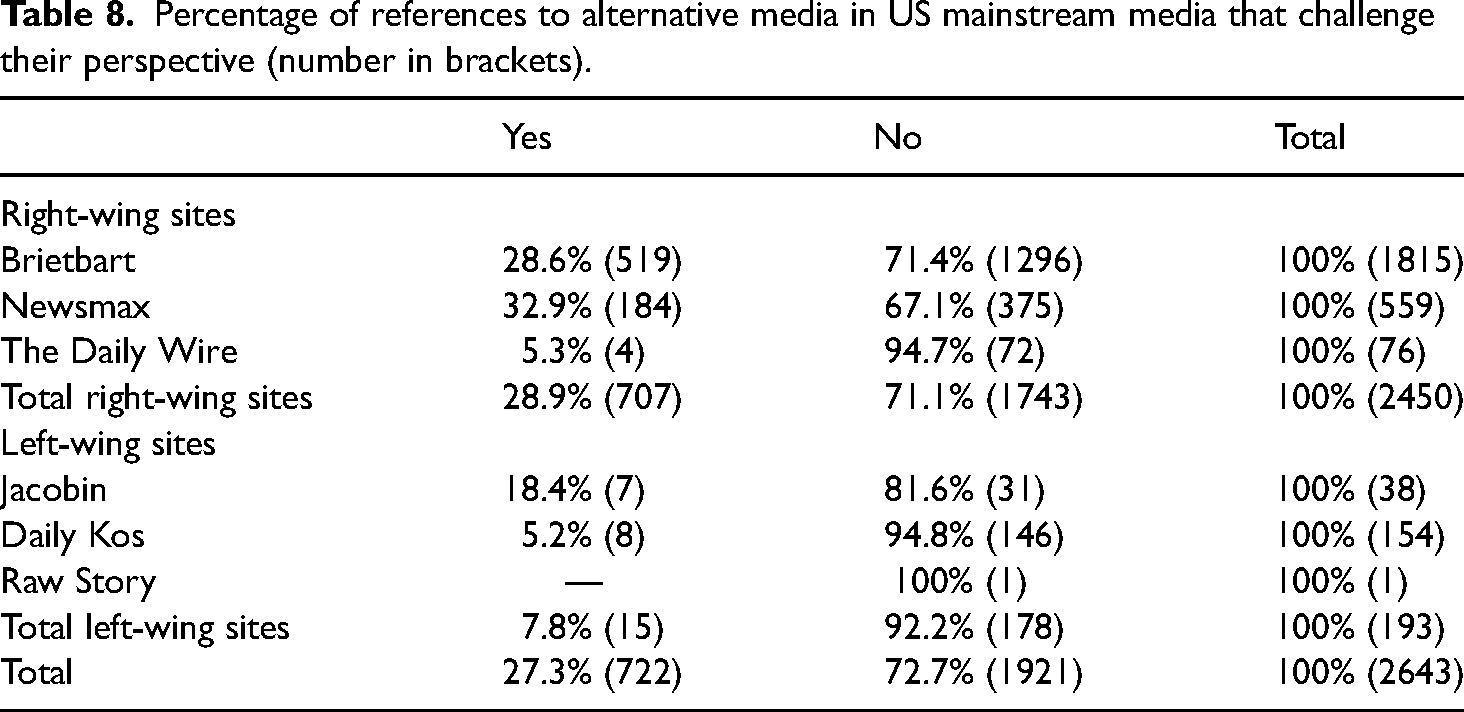
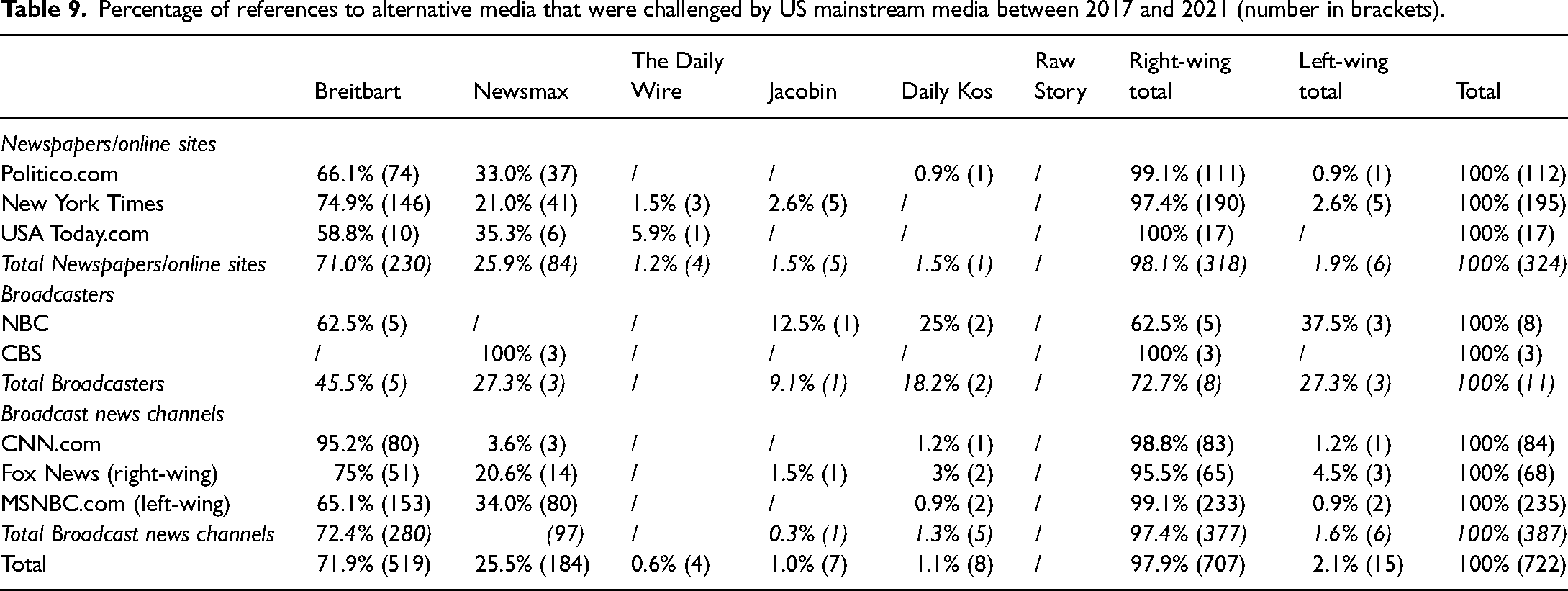
In the United States, we found right-wing sites were challenged in over a quarter of references, with Newsmax and Brietbart subject to the most journalistic scrutiny (Table 8). The left-wing news channel, MSNBC, was the most critical of Brietbart and Newsmax, giving both sites a platform, but also counteracting their viewpoints. Meanwhile, almost all perspectives by The Daily Wire or their contributors – which were voiced most vociferously by Fox News – were left unchallenged by mainstream media. Left-wing sites, which did not feature regularly or substantively in mainstream media, were only challenged in 7.8% references to them between 2017 and 2021. Table 9 shows which mainstream media cast doubt on the credibility of an alternative media site. It reveals that network news rarely challenged alternative media sites. It was US newspapers and online, along with cable news, that questioned sites and the overwhelming majority of them focussed on right-wing sites (since left-wing sites rarely featured in mainstream media, meaning few were subject to any scrutiny).
Percentage of references to alternative media in US mainstream media that challenge their perspective (number in brackets).
Percentage of references to alternative media that were challenged by US mainstream media between 2017 and 2021 (number in brackets).
By contrast, alternative right-wing sites in the United Kingdom were not regularly challenged when they informed mainstream media (see Table 10). Just 6.5% references to them or their contributors were counteracted by mainstream journalists, although for Breitbart London this increased to 43.4% of its coverage. Above all, the influence of Guido Fawkes and its contributors were the most strident, with almost all of its 520 references – 96.3% in total – left unchallenged by mainstream media.
Percentage of references to alternative media in UK mainstream media that challenge their perspective (number in brackets).
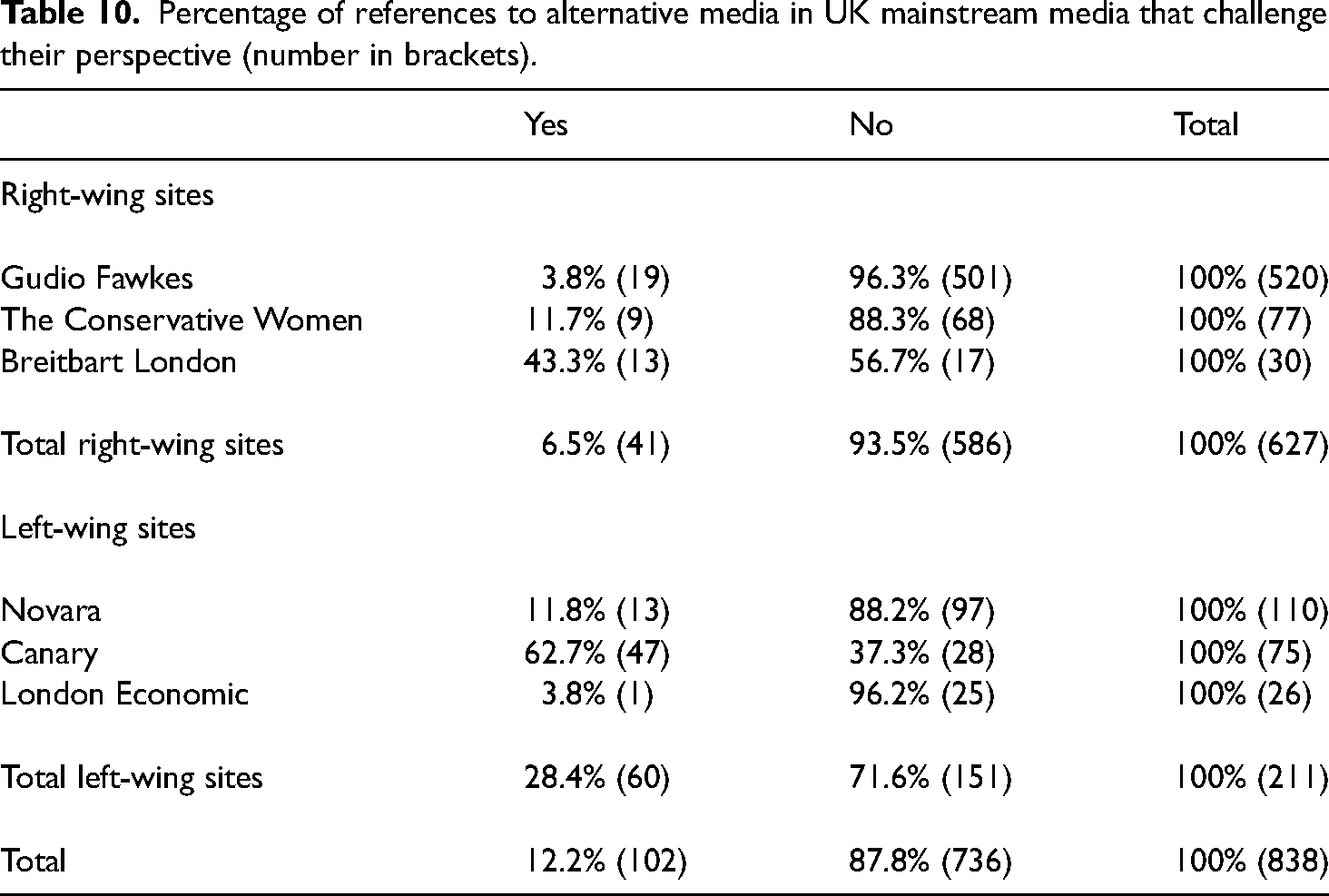
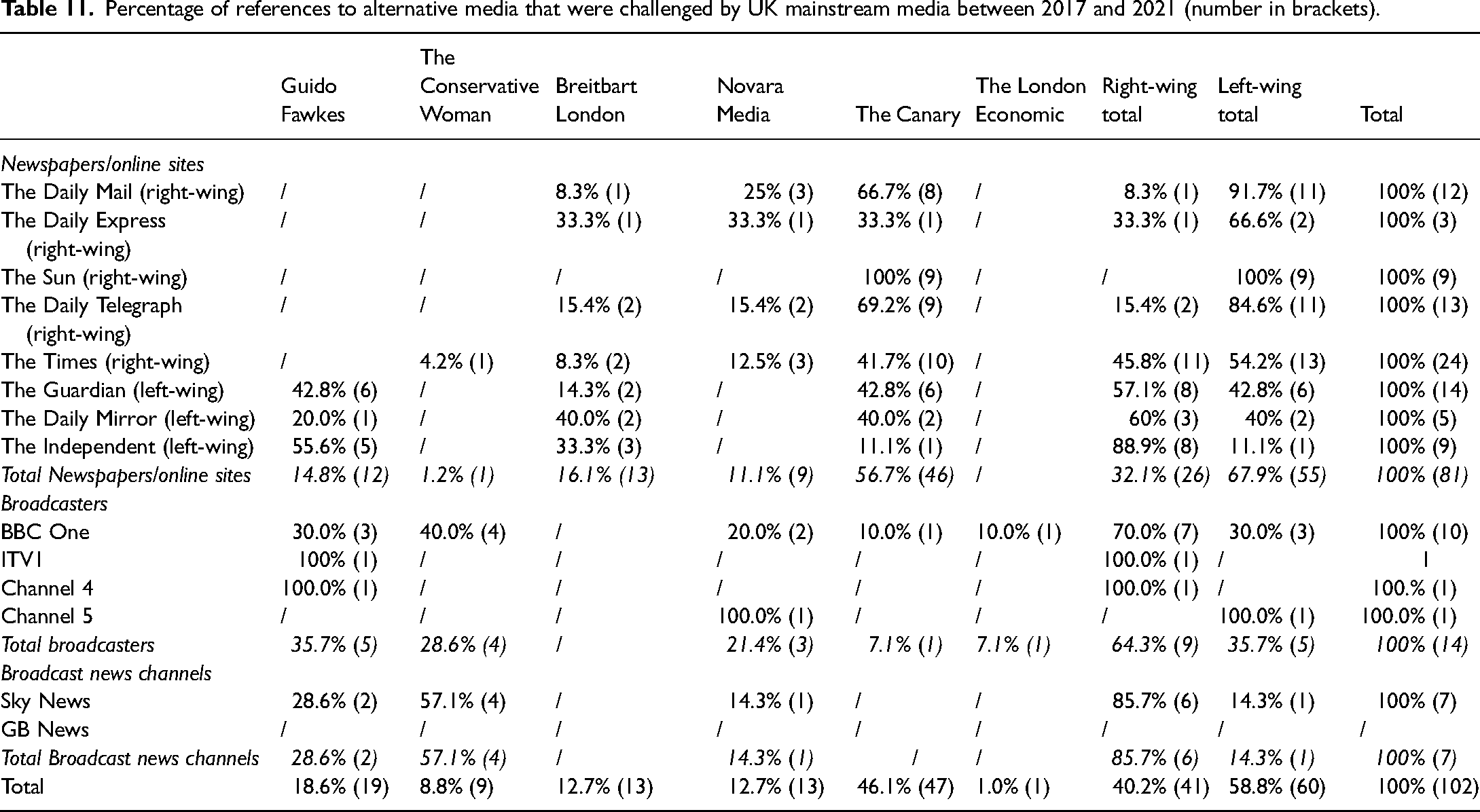
Meanwhile, almost one in three references to UK left-wing sites included mainstream media challenging their perspectives. Much of this criticism was aimed at The Canary and their contributors, with partisan UK newspapers and online sites – especially from a right-wing perspective – questioning their viewpoints. In other words, of the limited coverage of left-wing perspectives on mainstream media, a third of it was opposed, whereas 93.5% of references to right-wing sites – which featured almost three times more – went unopposed. Table 11 breaks down which mainstream media outlet challenged right-wing and left-wing alternative media sites. The UK newspapers and online sites questioned the credibility of left-wing sites over their right-wing counterparts. On TV, alternative media sites were referenced just nine times, with more left-wing than right-wing perspectives.
Percentage of references to alternative media that were challenged by UK mainstream media between 2017 and 2021 (number in brackets).
The normalisation of right-wing alternative media in US and UK media systems
Our study reinforced the growing body of scholarship documenting the increasing prevalence of right-wing sites in US mainstream media (Benkler et al., 2017; Stern et al., 2020; Vargo and Guo, 2017), but we identified this trend was also evident in the United Kingdom. Across both countries, we found that mainstream media referenced right-wing alternative media sites far more than left-wing alternative media sites. However, references to alternative media or their contributors in US mainstream media far outweighed – by a ratio of more than one to three – those in the United Kingdom. The design of many past studies that have examined cross-media transfer have tended to rely on single references to a specific alternative media site. Our new and distinctive research design developed a more in-depth analysis of how the salience of one alternative media outlet appeared in a mainstream news outlet. In doing so, we established that right-wing sites were more likely to substantively appear in mainstream media coverage than their left-wing counterparts. We also discovered that, most of the time, when alternative media were referenced, their credibility as objective information sources largely went unchallenged, with the exception of broadcast programming where we identified some scrutiny of claims and a balanced mix of competing viewpoints.
In comparing and contrasting different types of media across countries, our study's findings uncovered a complex relationship between national media systems and alternative media that advances new ways of understanding the extent and nature of alternative news appearing in mainstream media. Alternative media in the United States were referenced far more often in mainstream media than the United Kingdom, for example, principally because of their collective reliance on right-wing sites. Likewise, all the largely partisan newspapers and online sites in the United Kingdom featured, by far, more right-wing than left-wing alternative media sites. The right-wing site – Guido Fawkes – made up the vast majority of references in mainstream media, including across right-wing and left-wing newspapers and online sites, as well as on the broadcasters, BBC1 and Sky News. It was largely left to broadcasters in the United Kingdom to provide a more balanced mix of right-wing and left-wing perspectives, with sites such as Novara Media gaining high profile exposure on broadcast media. We did not find many references to GB News – a new partisan channel – featuring regularly in UK media in 2021, not long after the station launched. However, we did carry out a quick follow-up search for references to GB News in 2022 and 2024, and discovered that the right-wing news channel was featured regularly across both UK newspapers and broadcast media. This suggests that the partisan news channel is growing in influence – as many stations have in the United States – and that the worlds of alternative and mainstream broadcasting in the United Kingdom have become more intertwined in very recent years.
Our in-depth analysis of references to alternative media further revealed that national media systems helped explain how the perspectives alternative media sources were interpreted differently by mainstream media. In United Kingdom, for example, television news programming challenged competing ideological perspectives more than mainstream media in the United States. By contrast, the United Kingdom's largely right-wing press drew heavily on right-wing sites – notably Guido Fawkes and its contributors – without any real scrutiny or questioning of their perspectives. In other words, while the relatively limited views of left-wing alternative media sites on mainstream media were subject to criticism on impartial television programming, contributions from right-wing sites – which featured almost three times more – mostly went unchallenged in UK newspapers and online media. As previously explained, partisanship is a much bigger feature of the traditional press than in the United States, which might explain why right-wing perspectives were given wider latitude to express contentious viewpoints than their American counterparts. After all, this partisan brand of journalism represents the long-held expectations of their journalists and by extension their audiences, leading to fewer explicit challenges of extreme viewpoints. In the United States, right-wing voices were questioned in just over a quarter of references compared to around 1 in 13 in left-wing sites. But since there was 12 times more references to right-wing than left-wing sites in the United States, their perspectives were still far more pervasive including many viewpoints that were left unchallenged by journalists.
Our findings raise significant concerns about the degree to which right-wing alternative media inform national mainstream media systems, especially in the United States. But it is important to acknowledge the changing political systems in both the United Kingdom and the United States over recent years, and the disruption caused by new right-wing political parties and movements that have promoted populist issues, such as curbing immigration. While an infrastructure of right-wing sites supported by rich Conservative donors has grown stronger – notably in the United States – their ability to appear on mainstream media could also reflect shifting political systems, with successful right-wing politicians and movements championing causes that become newsworthy because of their electoral support and democratic legitimacy in mainstream politics and society (Cushion 2024). Or, put more crudely, given the significant political disruption over recent years, our study might not only reflect a rise in alternative right-wing media, but a shift in right-wing politics more broadly in society, politics and mainstream media.
But we would argue our study reveals that any ideological shifts in political systems can be mitigated by the nature of media systems. In media systems without any public interest obligations and fuelled by commercial demands, alternative media appeared well integrated into the editorial agendas of mainstream media. In the case of the United States, this was exacerbated by its partisan media ecology, emanating from talk radio and television news but now also driven by new alternative online and social media platforms. The US mainstream media fed off them regularly in coverage, providing high profile platforms for their influential commentators and extending their reach to mass audiences. By contrast, in media systems shaped by public service obligations – such as the United Kingdom – there was more of a balance of ideological perspectives from alternative media. Moreover, both left-wing and right-wing voices were not just accepted but challenged at times, a reflection of broadcasters’ impartiality requirements in flagship news programming. However, the UK media system is also shaped by a highly partisan press, skewed to the political right. Our study showed it promoted the perspectives of right-wing alternative media, largely marginalising the voices of left-wing sites and their contributors. Guido Fawkes, for example, was widely seen as a legitimate news source, with UK newspapers and online sites regularly drawing uncritically on the site's content. By piggy backing off mainstream news coverage, our study showed how the reach and influence of alternative media can be extended well beyond their own niche audiences.
Past academic studies about how media comparatively reference each other have called for more empirical clarity about where and how different types of news outlets wield influence, for more methodological innovation to take into account contrasting technological platforms, and to identify what moderates the flow of content between comparative media systems (Buturoiu et al., 2023; Su and Xiao, 2021). By developing new quantitative measures methodologically designed to not just assess if alternative media referenced mainstream media, but to what extent their perspectives appeared in coverage or were subject to any critical scrutiny by professional journalists, our study has empirically revealed the degree to which new alternative media were referenced in reporting across both the United States and United Kingdom media systems.
From a broader macro perspective, our comparative analysis of media systems advanced new ways of understanding the relationship between mainstream media and alternative media. For example, Ihlebæk and Nygaard (2021: 276) recently observed ‘that the distance between mainstream and alternative media depends not only on how alternative outlets describe themselves but also on how they are perceived and received by the mainstream media and broader public sphere’. But they called for a better understanding of this relationship in comparative contexts. We have identified where different media systems can both enhance and moderate the perspectives of alternative media sites, and their contributors in mainstream media. Taken together, the findings of our study suggest that if national media systems move towards more market-driven and deregulated environments – most evident in the United States and, to a lesser extent, the United States – the influence of right-wing alternative media will collectively grow stronger. In doing so, the boundaries of mainstream and alternative media will continue to blur, further naturalising largely right-wing partisanship into professional journalism and the wider digital news environment.
Footnotes
Declaration of conflicting interests
The authors declared no potential conflicts of interest with respect to the research, authorship, and/or publication of this article.
Funding
The authors disclosed receipt of the following financial support for the research, authorship, and/or publication of this article: This work was supported by the Economic and Social Research Council (grant number ES/S002510/1).
