




Abstract
How does it feel to have one’s online worth and status be based almost exclusively on metrics? We examine this question through a qualitative study of YouTube “drama” channels. Drama creators cover the conflicts and scandals taking place among top YouTube celebrities. As producers of meta-commentary, they often rely on metrics as indicators of influence and celebrity on YouTube, thus constituting a relevant site to examine the connection between social media metrics and status. Based on interviews with English-speaking drama creators, we report three main findings. First, creators have a double orientation toward YouTube, which they understand as a site of both economic opportunities and tight-knit relationships. Second, the meanings that creators attach to metrics—their own and the ones of top YouTubers—reflect this double orientation: for them, metrics correlate with economic revenue and social status. Due to this central and multifaceted role of metrics, we find that traffic numbers can turn into a spectacle of their own for drama creators. Third, even in a context in which metrics are central, we identify several distancing strategies on the part of creators. We conclude by discussing whether—and why—resistance to metrics can be found everywhere.
Introduction
In recent years, a flurry of journalistic articles analyzed the emergence of a new media genre: the so-called “drama” or “tea” YouTube channels, which cover the conflicts and scandals taking place among top YouTube influencers. “Meet the TMZs of Beauty YouTube,” Vox first published in October 2018; “How Tea Accounts Are Fueling Influencer Feuds,” The Atlantic published in May 2019; and “The Insular, Gossip-Fueled World of YouTube Drama Channels,” commented Jezebel in August 2019. While many of these accounts emphasized the pettiness and superficiality of drama channels, journalists also noted their creativity and investigative practices, often geared toward making influencers more accountable to their online audiences. As Lorenz (2019) wrote in The Atlantic, Drama channels, often called tea accounts, painstakingly documented every incremental update on the feud and shared them live, around the clock, on social media until they became too big to ignore. Tea accounts, so called because the word tea is slang for juicy information, are like online gossip magazines on steroids.
The popularity of drama channels is staggering. DramaAlert, the most popular in the genre, boasted 5.57 million subscribers, more than 17 million video views for April 2020 alone, and estimated monthly earnings ranging between US$4,500 and US$71,800 (Social Blade Drama Alert, 2020). Another popular channel, Tea Spill, had 1.53 million subscribers, 10 million monthly video views, and estimated monthly earnings ranging between US$2,600 and US$41,100 (Social Blade Tea Spill, 2020). For most drama creators, such numbers are a source of pride and a marker of authority—an authority which they feel is too often ignored or discredited outside of YouTube, especially in comparison with legacy journalism and what they sometimes call “the mainstream media.” As Keemstar, the creator behind DramaAlert, explained in one of his videos, There are outside forces that are trying to control our community. We are the YouTube community. This is ours. It’s not owned by the mainstream media. It’s not owned by people with suits and ties. [. . .] We are fully capable of policing ourselves. When we see a YouTuber do something wrong or a YouTuber step out of line, we collectively, as the YouTube community, call that person out. [. . .] If we bow down to some journalist over at the Wall Street Journal, then we are giving our power away. We are way more powerful than the Wall Street Journal. We are way more important to advertisers than the Wall Street Journal, because we are the biggest source of entertainment in the world. YouTubers and the YouTube community get way more clicks than the Wall Street Journal could ever dream of. (DramaAlert, 19 February 2017)
Drama creators take metrics seriously. First, traffic numbers directly determine their revenues through online advertising, so they rely on metrics for instrumental calculations to figure out their current and future economic prospects. In this, drama creators are similar to other content creators seeking to make a living on YouTube. Second, as producers of meta-commentary, drama creators use metrics as a gauge to assess rapidly changing patterns of social media influence: they constantly comment on who is gaining or losing “subs” (subscribers) and whose videos are attracting high numbers of views to figure out who is coming up ahead in a given round of drama. Last but not least, drama creators use metrics to make sense of their own role in the YouTube ecosystem. Like Keemstar, they rely on metrics to justify their legitimacy in the face of external criticism. In particular, they often compare their metrics with the ones of other providers of meta-commentary—for instance, journalists—as a way to prove their authority on YouTube.
Given these overlapping uses, drama channels provide a particularly relevant case study to analyze how traffic metrics shape the careers, interactions, and representations of online content creators. Specifically, we ask: how does it feel to have one’s online worth and status depend almost exclusively on metrics? To answer this question, we rely on a qualitative analysis of English-speaking drama channels conducted in 2019–2020. After identifying a corpus of 43 creators producing drama on YouTube, we conducted 12 online interviews with creators located in the United States and other countries (from the Netherlands to the United Kingdom to Mexico), complemented by a qualitative analysis of their content production and interactions on YouTube, Instagram, and Twitter, as well as three background interviews with journalists who regularly cover YouTube drama.
Based on this material, we report three main findings. First, drama creators have a double orientation toward YouTube, which they consider both as a source of income and as a site of meaningful social relationships. Second, and consequently, metrics are central for drama creators not only because they correlate with significant revenue, which empowered many of them to turn their content into a career, but also as status symbols. In the absence of other institutionalized status signals, we find that drama creators overwhelmingly rely on metrics to decipher hierarchies and perform status claims on YouTube, which in turn explains how real-time metrics can turn into a spectacle—or drama—of their own. Third, we identify several patterns of resistance and distancing strategies with respect to traffic concerns. These include an open lack of trust in how metrics are constructed, the use of alternative justifications for content creation, and strategies of income diversification across platforms. In other words, even in a context where metrics are central, creators engage in fractal position-takings and distance themselves from metrics and what they represent. We conclude by discussing the implications of these findings for the study of metrics, within and beyond social media platforms.
Metrics and Status on Social Media Platforms
Metrics have a long history in the social sciences. From early sociological critiques of the effects of quantification associated with Simmel, Weber, and Marx, to more recent work on indicators as vectors of neoliberal governance, there is a large body of research on metrics and their effects (Beer, 2016; Espeland & Stevens, 1998; Mau, 2018).
Three main points emerge from this literature. First, while metrics appear to be efficient, technocratic, and “cold” indicators, they often provoke emotional reactions when they unfold in the social world (Christin & Petre, 2020; Espeland & Stevens, 1998). Second, whereas metrics present a “patina of objectivity,” they typically reproduce and even reinforce existing patterns of stratification, mirroring or increasing inequality along the way (Mau, 2018; Porter, 1996). Third, the introduction of metrics in a given context usually provokes “reactivity”—“the idea that people change their behavior in reaction to being evaluated, observed, or measured” (Espeland & Sauder, 2016, p. 1). Thus, people who are being evaluated through numbers develop metrics-oriented practices and representations, which in turn affect what metrics are meant to measure.
Here, we focus on the role of metrics on social media platforms—a set of websites and online applications where metrics have taken center stage. The development of social media platforms in the early 2000s came with several key features, including public or semi-public individual profiles, lists of users with whom other users can share connections, and the ability for users to view and engage with those connections, addressing their “networked publics” in a variety of ways (boyd & Ellison, 2007; Gillespie, 2010; Marwick & boyd, 2011). Alongside these features, social media platforms implemented a range of metrics—including number of views, likes, shares, and comments—as a way to track, orient, and publicize user engagement and activities (Baym, 2013). Over time, metrics have come to play several roles in shaping emergent economies and social interactions on social media platforms.
Metrics as Economic Value
First, metrics often directly translate into revenue for platforms and their creators. Most social media platforms operate on an advertising-based business model: they provide a free service to users, allowing them to publish and share content, while selling their users’ sociodemographic characteristics and attention to brands and advertisers, who can target their ads to specific groups and individuals (Zuboff, 2019). To use Vallas and Schor’s (2020) formulation, platforms play the role of “tertius gaudens” benefiting from the connection between advertisers and users (see also Gillespie, 2010). Metrics are a crucial part of this equation: they signal how much attention and engagement any digital item has received, and therefore translate into advertising revenue.
Social media metrics reflect and further reinforce the economic model of platforms by shaping the behavior of online users. For instance, as Burgess and Green (2018) write about YouTube, “metrics shape the choices and performances of YouTubers, thereby intensifying the winner-take-all economics and driving the culture of the platform in directions that also serve the company’s interests” (p. 65). At the same time, the pursuit of metrics takes a great deal of labor on the part of users and the returns are never clear or predictable. This is particularly true for creators hoping to make a living through their content, whose careers are largely sanctioned by social media metrics. As Duffy (2018) documents, influencers work hard to gain visibility on Instagram as a way to get sponsored deals, even claiming that the “profile-raising elements” of their online activities “tend to eclipse the expressive functions” of their output (p. 199).
Metrics as Status Signals
In addition to economic value, metrics also represent a broader form of status and authority on social media. Thus, Marwick (2013) describes Twitter metrics as “status affordances,” or technical mechanisms that explicitly signify and perform status. Status on social media correlates with—but is not limited to—financial opportunities: high numbers of “followers” and “likes” also reflect popularity, attention, influence, and power. Popularity as represented through metrics can also act as a useful proxy for the “values and assumptions shared by a group” (Marwick, 2013, p. 74), in Marwick’s case, nascent “web 2.0” micro-celebrities (Marwick, 2013; Turner, 2009; see also Baym, 2018).
These findings in turn echo Max Weber’s (1922/2013) classical analysis of status groups (p. 932). For Weber, status (or “social honor”) differs from class (and from Marxist analyses of class that focus on economic and political endowment as key criteria for social stratification) in two main ways. First, status can only be endowed within social groups that are meaningful for the actors involved. Second, status orders involve cultural components that cannot be solely explained by economic or political domination. For instance, “old money” is typically more prestigious than “new money,” regardless of the actual amount of capital involved. To put it in Bourdieuian terms, “symbolic capital” is a key determinant of how status is distributed and negotiated within existing fields (Bourdieu, 1993).
Drawing on Weber’s classical sociological framework and expanding on Marwick’s work, one could argue that social media metrics are more likely to become status signals in social groups that are meaningful for the participants involved and where there are few established markers of status. Take the case of the “web 2.0” microcosm analyzed by Marwick (2013). Compared with highly structured social circles where wealth, cultural capital, and social networks together create highly institutionalized status orders (DiMaggio, 1982), the San Francisco technological scene that Marwick examined featured relatively few established hierarchies. At a moment when Silicon Valley reputations were volatile and innovations hard to assess, the entrepreneurs she studied latched onto Twitter metrics as the most convenient status signal in the absence of other reliable status signals.
Similar dynamics may apply to the case of social media creators, who often operate in settings with few institutionalized status milestones, with the exception of the metrics provided by the platform they publish on. In this article, we examine how such a perspective applies to the case of YouTube drama channels, a specific subset of content creators particularly concerned with the question of status—their own and the one of the celebrities they cover.
Metrics, Celebrity, and Drama on YouTube
One cannot overstate the importance of YouTube as a source of entertainment and information for young internet users. As of 2018, almost three-quarters of American adults—and 94% of 18- to 24-year-olds—used the platform (Smith & Anderson, 2018), making it the second most popular platform in the United States after Facebook. In terms of traffic numbers, as of 2020, YouTube was the second most visited website in the world, following only Google, the search engine developed by its parent company Alphabet.
Metrics and Celebrity on YouTube
Metrics have been an integral part of the YouTube interface since its early years. Created in 2005 by three former PayPal employees, YouTube was purchased by Google (now Alphabet) in November 2006. Around that time, YouTube established a series of metrics, including numbers of views, favorites, comments, and subscriptions to individual channels. In 2007, YouTube began allowing content creators to monetize their channels. Through the YouTube Partner Program (YPP), content creators started to get a share (30%) of the advertising revenue—revenue which is directly tied to viewership metrics—that their videos gather (Caplan & Gillespie, 2020). As of February 2021, to be eligible to enter the YPP, creators needed to have more than 1,000 subscribers and 4,000 public watch hours over the past 12 months. As of December 2020, there were more than 37 million channels on YouTube.
Whereas early YouTube creators typically launched platform-based careers with the goal of transitioning into mainstream media, in recent years, successful YouTubers have been more likely to stay on the platform (Burgess & Green, 2018). As the number of active and highly popular creators grew, YouTube-specific genres emerged, including vlogging (Burgess & Green, 2018), game streaming (Cunningham & Craig, 2017; Taylor, 2018), and beauty and fashion content (Abidin, 2018; Duffy, 2018), among others. As of March 2021, the most popular individual YouTube creator, PewDiePie, had 109 million subscribers (Social Blade PewDiePie, 2021). CNBC reported that YouTube’s top earner, a children’s toy review channel called Ryan’s World, earned US$26 million in 2019 alone (McKeever, 2019). New intermediaries also emerged around YouTube celebrities. For instance, multi-channel networks (MCNs) help creators with production and monetization (Cunningham et al., 2016), whereas talent and marketing agencies connect creators with brands interested in sponsoring content.
Despite this rapid growth, the YouTube ecosystem remains relatively unstructured, especially compared with traditional media and entertainment industries. For example, compared with journalism, which already had specific industry structures and professional norms in place by the end of the 19th century (Schudson, 1978), the practices and institutions surrounding YouTube content production are still in flux. Part of this open-endedness is a deliberate choice on the part of the platform: as Gillespie notes, the ambiguity of the term “platform” allows YouTube and its competitors to carefully negotiate the often-conflicting claims of users, producers, and advertisers (Burgess & Green, 2018; Gillespie, 2010). The relative absence of professional norms and institutionalized hierarchies on YouTube in turn makes it a valuable site for our analysis of metrics as status symbols. Metrics play a particularly important role for drama creators, who, as producers of meta-commentary on the platform, are especially interested in assessing status and hierarchies among YouTubers.
YouTube Drama Channels
“Drama” in the form of juicy information or conflict about creators has existed on YouTube since its inception. Initially known as “flame wars,” this type of conflict often emerged between groups of YouTubers with opposite views, such as atheist and Christian creators (Pihlaja, 2014). Over time, the role of “drama” expanded and solidified, becoming an informal category for a specific type of English-speaking channels that provide information and commentary on the conflicts between top YouTubers. Drama channels cover a wide range of feuds, both real and staged, as well as more general YouTube celebrity scandals. Drama channels are sometimes called “tea” (a term stemming from the expression “T for Truth,” which has roots in the Black drag culture) or “commentary” channels. At times, “drama” is used simply to refer to YouTube celebrity news.
To illustrate the genre of YouTube drama, we briefly compare two videos from different creators, both posted on the same day (10 May 2019) and tracking the same conflict: the fallout between beauty influencers James Charles and Tati Westbrook. While these two videos by no means provide a comprehensive description of drama videos, they illustrate the varied nature of the genre. The first, posted by the channel Here for the Tea (HFTT), is entitled “TATI WESTBROOK BREAKS HER SILENCE . . . ‘I’M DONE WITH THE RELATIONSHIP’ EXCLUSIVE” (Here for the Tea, 2019). In the video, HFTT does not show her face. She provides a voiceover against a series of video clips and screenshots, which together create a painstakingly assembled account of the Charles/Westbrook feud. For example, she shows an Instagram video clip from Charles in which he promotes a brand of hair vitamins called Sugar Bear Hair. Next, she shows an Instagram story of Westbrook crying and explaining why she felt betrayed. HFTT then fills in the gaps for the viewer by explaining that Sugar Bear Hair is a competitor of Westbrook’s own line of hair vitamins, and thus Charles’ promotion was seen as a betrayal of his former mentor. To illustrate her point, she provides evidence (called “receipts”) by including screenshots of tweets from Westbrook fans to Charles fans (see Figure 1). HFTT’s video resembles an unembellished documentary: the focus is on her rigorous research, collection of materials, and ability to form them into a cohesive explainer.
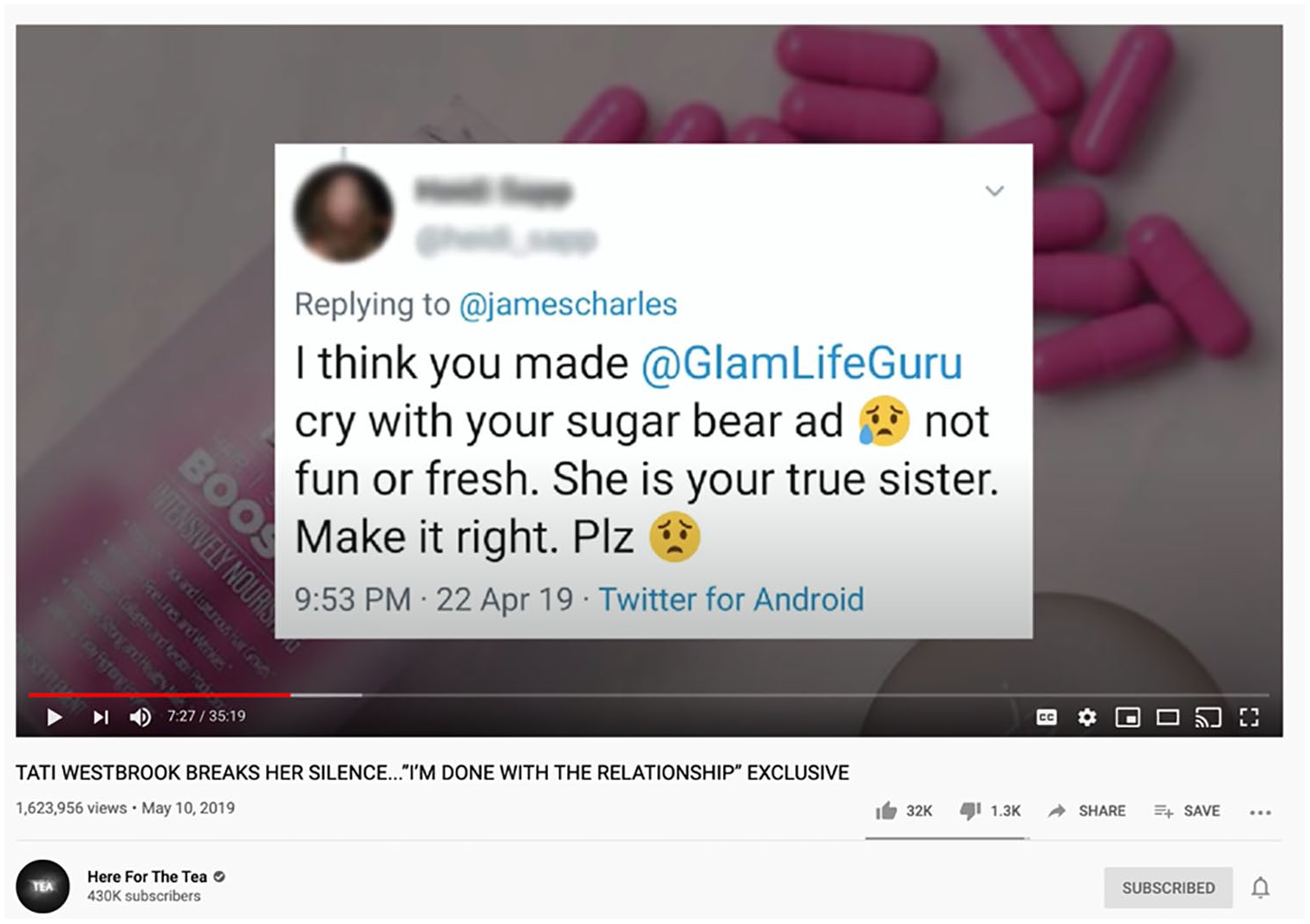
Screenshot of Here for the Tea (10 May 2019).
Compare this with the video posted by creator Rich Lux (2019) on the same day, entitled “TATI WESTBROOK DISSES JAMES CHARLES”. The video centers almost entirely around the creator’s flamboyant persona, featuring Lux in close-up in front of a series of glittering trinkets; he is decked out in jester makeup, a crown, and pearls (see Figure 2). His tone is far more theatrical and opinionated than HFTT’s. For instance, he begins the video with a faux funeral: “Ladies and gentlemen of the beauty community, we are gathered here today for the mourning of James Charles.” He continues, playfully misgendering Charles, “she was a good woman, but she was a LIAR!” Throughout the video, Lux is less concerned with explaining the events than providing humorous commentary. Using a series of personas and visual gags, Rich Lux provides judgment on everything from Charles’ style to Westbrook’s mentorship role. For instance, he speaks directly to Charles, saying “Are you serious? You’re gonna treat her that way? That doesn’t look good for you.” He includes clips of Charles and Westbrook, and special effects such as a poof of fire, but the video largely stays focused on Lux and his commentary.

Screenshot of Rich Lux (10 May 2019).
These two videos showcase both the norms and flexibility of the drama genre. Ranging from serious to goofy, restrained to exuberant, YouTube drama allows for a wide swath of content creation. It is a hybrid format—one that draw on a longer tradition of celebrity gossip and tabloid news developed in the United States and United Kingdom (Hinerman, 2006; Marcus, 2019; Petersen, 2011), as well as on some of the rules of talk shows and reality television (Andrejevic, 2004; Gamson, 1998; Grindstaff, 2002; Hearn, 2006). Interestingly, from its inception, drama was understood among YouTube creators as a genre inherently linked to metrics. As PewDiePie, the most popular individual YouTuber, explained in a 2016 video on “YouTube Drama”, “What do people want more than anything? Creative, original content? No, f*ck that, they want views, d*mmit! [. . ]) What gives views more than anything? That’s right, drama” (PewDiePie YouTube Drama, 2016).
Data and Methods
YouTube is a notoriously difficult platform to study: the glut of long-form video content makes it resistant to quantitative analysis, yet its size and scale makes it potentially overwhelming for qualitative researchers. We grappled with this by focusing explicitly on the relatively tight-knit “drama community,” researching metrics through the lens of drama channels on the platform.
To define the bounds of our research object, we drew on established qualitative methods to study social media platforms (Nieborg et al., 2020), with a particular emphasis on the approach developed by Lewis (2018) in her research on political YouTube channels. To target this loosely bound subculture on the platform as a site of social inquiry, Lewis identified a network of influencers within the anti-progressive YouTube ecosystem using a snowball sampling method based on who appeared in each other’s content. Labeling 65 channels as the “Alternative Influencer Network,” Lewis (2018) noted that the group formed “a coherent discursive system” through “an interlocking series of videos, references, and guest appearances” (p. 8).
Similarly, we focus on the English-speaking drama community on YouTube. 1 Here, we define the “drama community” as a combination of people, content, and metadata linking them together. While we acknowledge that the boundaries defining this network are fuzzy (overlapping, for example, with the world of celebrities that drama channels cover) and that there is significant variation within this network as well (e.g., between “beauty drama” channels and “commentary” channels), this approach was fruitful to identify a core group of interconnected creators and achieve a balance of both breadth and depth of analysis.
To build a robust sample of drama channels, we read news coverage and referenced the channels quoted within. We visited forums devoted to YouTube dramas, such as the subreddit r/BeautyGuruChatter. We watched drama content on YouTube, both as a way to learn about the genre and as a method to find new creators through the YouTube “recommended” algorithm (Christin, 2020a). The creators we identified frequently discussed each other within their videos. In fact, we found that drama channels not only covered the drama among top YouTube celebrities but also frequently engaged in, and covered, gossip and conflicts among drama creators (a phenomenon we discuss more below). These discussions helped us build out our corpus. We also drew on YouTube’s algorithmic content recommendations to identify additional channels.
Overall, we identified a total of 43 English-speaking channels, for which we collected descriptive information and basic metrics. We found contact information for 42 of them and eventually received 12 positive replies (see Table 1 for descriptive information about these channels). We interviewed the 12 creators remotely, through phone, Skype, WhatsApp, and Zoom. We also interviewed three journalists who frequently cover YouTube drama (and therefore interact with drama creators). The interviews were semi-structured and ranged from 30 to 90 min. They were all recorded and transcribed. Out of the 12 creators we interviewed, 7 were located in the United States, 1 in Canada, 1 in the United Kingdom, 1 in the Netherlands, and 1 in Mexico. Five of the drama creators we interviewed were female and seven were male. Six of the men publicly discussed being gay, while two of the women discussed being bisexual. Four of the creators discussed being BIPOC (Black, Indigenous, and People of Color). The age of the creators we interviewed ranged from 16 to 39 years, with a median age of 28.
Interview Sample and Channel Metrics.
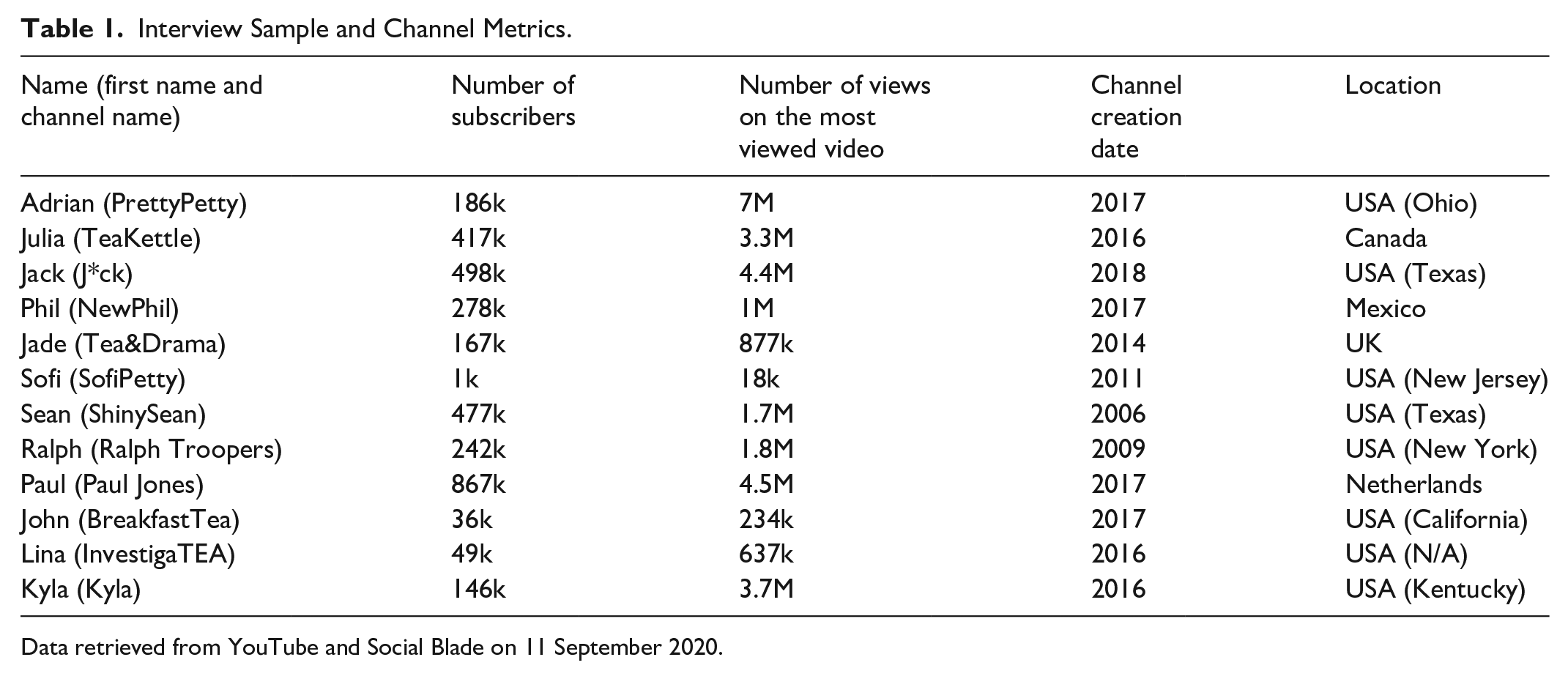
Data retrieved from YouTube and Social Blade on 11 September 2020.
As we progressed in our interviews, we noted several tendencies. First, most participants chose to use their real names, although we anonymized their quotes in the interest of protecting them from potential negative outcomes (see Duffy & Hund, 2019 for a similar approach). Second, we gradually realized over the course of the interviews that creators had begun discussing our project with each other. For instance, several told us they had spoken to other creators to learn what to expect; others conferred with their contacts before agreeing to the interview. Finally, we found ourselves seamlessly folded into some of the drama taking place and the content being made. One of our participants revealed at the end of the interview that they had been recording us and asked whether they could post it to their channel. In another case, we found that a creator was broadcasting live about a piece of drama they were involved with up to the minute before they called us for the interview. Within our interviews, creators frequently described their own feuds, nemeses, and allies on YouTube.
Findings
This section provides an overview of our findings. First, we find that drama creators have a double orientation toward YouTube: for them, YouTube drama provides both a career path and tight-knit relationships. Second, we turn to the central role of metrics for drama creators, which we argue mirrors this double orientation: metrics translate into economic opportunities, shape status hierarchies between drama creators, and even turn into a spectacle of their own. Last, we find that, even in this context where metrics are omnipresent and all-encompassing, creators engage in several resistance and distancing strategies.
YouTube as Career and Community
YouTube drama is a significant source of income for creators, although there is significant variance in both income levels and the nature of the careers involved. Overall, the creators we talked to mentioned making an average of between US$3,000 and $5,000 per month (before tax), with peaks going up to US$37,000 for highly profitable months, and “bad” months as low as US$1,000. These revenues were far from stable: most creators complained about the unpredictability of their YouTube income. As John (BreakfastTea channel) lamented, “It really varies . . . It could be like $10,000 in a month. The next month could be $3,000 and the next month could be $5,500, the next month is $20,000, it’s so all over the place.”
Given this unpredictability, the creators we interviewed relied on a wide range of career strategies. Several still had a day job but were planning to turn to YouTube full-time as soon as their YouTube revenue would allow it. For example, Jade (Tea&Drama channel), in her mid-30s, told us, I still have a job. I work as ambulance dispatcher. That was my job before YouTube, I’m just on a one-year maternity leave. My plan is to use this time and utilize it as best as possible. If I can make YouTube full time, then to eventually leave my job because I do prefer it.
Others relied on YouTube as a primary source of income. John, 28, was a full-time YouTube creator, who had another channel on top of his drama one. Kyla, 34, was a mother of three whose husband was a farmer. Following the success of her YouTube channel, she started working on it every day, between the demands of full-time child rearing. Adrian, 16, was a high school student who was saving the money to pay for subsequent education. He was upfront about the fact that he started doing drama because he thought it would bring revenue: I started my channel in October of 2017. At the time I was doing online school, so I had a bunch of free time and I didn’t know what to do with it and I saw a bunch of these drama videos being very popular and so, I figured I might as well try it.
Some creators with large numbers of views and subscribers were able to remunerate themselves and hire studios and research assistants to help them identify relevant content and publish videos frequently. This was the case for Sean (ShinySean channel), who had a full-time assistant and a studio, and Phil (NewPhil channel), who was trying to get to that point. Phil explained, Recently I hired a team, so I have two researchers now. I’m basically in the training process with them, teaching them everything [. . .]. They work from home and have day jobs. I just talk to them through Instagram. My channel’s doing well, but we’re trying to take it to that next level where I do have that ability to hire them full-time.
Only one of the creators we talked to, Sofi (SofiPetty channel), did not make any money out of her content at the time of the interview, instead describing her attachment to YouTube drama in terms of “hobby” and “community.” This in turn echoed what many creators told us about how meaningful they found the connections established through their YouTube presence, regardless of whether they made money off YouTube or not. Indeed, creators often relied on the language of community, emphasizing how their involvement in YouTube drama was driven and sustained by shared interests—for YouTube culture, celebrities, beauty, and so on—both with their audience and with other creators. As Jade told us, The reason I love the drama community is because we always hold each other accountable, we always hold ourselves accountable, because of that, we’re able to put the fault in ourselves. At the same time, I feel like there’s a mutual respect between all of the drama community. I may dislike TeaKettle with an absolute passion, but I can’t deny that she’s a fantastic YouTuber.
Relatedly, many of the drama creators we interviewed explained that they had turned to YouTube at a point in their lives where they were, as Jade put it, “shut ins,” in the sense that they were homebound for long periods of time. This was due to a variety of causes depending on the creator—from chronic illness to full-time parenting, a recent move to a place where they did not know anyone, or (in the case of younger creators) homeschooling. Creators explained that the YouTube “community”—by which they meant online viewers and fellow creators—had helped them overcome their feelings of isolation not only by engaging in a common hobby, which was to follow the drama taking place between the influencers they loved, but also by providing emotional and moral support through hard episodes of their lives.
Overall, two kinds of orientations toward YouTube emerged from the interviews. On the one hand, some creators displayed an instrumental profile: for them, drama content creation was primarily justified by the desire to rapidly make an income from YouTube. On the other hand, some creators drew on community-oriented arguments, explaining that they primarily cared about the meaningful social connections they had developed with creators and followers on the platform, and that money came later. It is important to note, however, that these two orientations cannot be kept strictly separate. As we will see, “instrumental” creators often had to handle community-driven backlash, and “community” creators could also be “exposed” for their instrumental orientation toward drama. Both of these orientations were mirrored in how creators related to traffic metrics.
Metrics and Hierarchies
The creators we interviewed had a wide range of metrics at their disposal. First, they watched the metrics publicly available on their YouTube page, including the number of video views; number of likes and dislikes; number of comments; and number of channel subscribers. Second, creators had access to a private personalized dashboard that displayed key analytics for their channel, including estimated minutes watched, estimated earnings, engagement (likes, dislikes, comments, shares, favorites, and subscribers), audience demographics, and discovery (including traffic sources and location). Third, they all regularly checked the third-party website Social Blade, which provided a wide range of aggregate data and rankings (including the “social blade rank,” the subscriber rank, the estimated earnings, and the evolution of video views and subscribers for the last 30 days, among other variables) (see Figure 3).

Screenshot of Social Blade dashboard.
When we asked creators about audience metrics and analytics, all referred to one of these three sources of data. The two most relevant types of metrics for creators were views (which correlate with revenue for creators enrolled in the YPP) and subscribers (which give a sense of the loyalty of one’s viewers over time). When talking about their own metrics, drama creators typically focused their attention on their number of views, which directly translated into advertising dollars. Their number of subscribers seemed less directly relevant, even though its evolution over time could give them a sense of how their audience was reacting to the content they were producing. Julia (creator of TeaKettle) bluntly explained her position about views and subscribers in the following exchange: Any YouTuber that tells me that they don’t look at their numbers is lying because you need videos for views. Those are the facts! You make videos for views because that determines your money. So yeah, of course I look at views because, I mean, it tells you how well you’re doing. I look at views, and I look at subscribers or subscriber numbers just to see if I’m growing, to see if I’m gaining subscribers per day. Because I think that’s also indicative of the job that you’re doing.
Most creators echoed Julia’s views and said they were following their number of views, first, and numbers of subscribers, second, to see their videos’ popularity and how it would translate into revenue. As Adrian told us, Social Blade, I look at it . . . to see how well my channel is doing overall. I can look on Social Blade and be like, “Okay, this month my views are down a little bit.” Then maybe then I’ll look back and be like, “Okay, which videos didn’t do as good as I thought they would?”
Similarly, Jack (J*ck channel) explained, You could gauge how good of a day you had on YouTube by seeing how many subscribers you got. Or to see if you’re losing subscribers, if you had a net loss of subscribers that day, and you need to do something about that.
Creators also interpreted their metrics as a signal that something needed to change with their content, using them as part of a DIY market research. For instance, Lina (InvestigaTEA channel) explained how she would instantly check her Social Blade after uploading a video on her channel and adjust her content based on her viewers’ reaction: I’ll firstly monitor my Social Blade from the second I upload. And if I don’t gain a lot of subscribers and views, then it just tells me that there is something that my audience doesn’t want to hear about, so I’ll try and refrain from covering that topic.
Similarly, Phil told us how he used his analytics to change his content: I learned a lot from my analytics. For example, my intros used to be very, very long. And I noticed from my analytics that people would just drop out of there really quick and skip ahead. [. . .] So I learned from my analytics how to change the start of my video to keep people more engaged.
Creators talked about audience metrics using an instrumental repertoire—one that mirrored the discourse we documented earlier about drama being a quick way to make money on YouTube. In these instrumental discourses, creators interpreted metrics as economic indicators correlating with revenues, which should therefore be carefully monitored. Yet metrics also took on another set of meanings among drama creators. During the interviews, we realized that creators relied on metrics to assess each other’s authority, visibility, and status what they called the “drama community,” by which they meant both audiences and other creators. Sofi detailed what this entailed when she discussed other drama creators: When I first showed up, Max Kling and TeaKettle were the two big channels for a while. Personally, I’ve found a lot of their stuff very toxic. [. . .] Everybody started like unsubscribing from him (Kling) and stopped supporting him and what not. And then TeaKettle was the biggest, she treated some other people as well, kind of just put that taste in people’s mouth and they started unsubscribing from her. They’re just no longer the top dogs, I guess. [. . .] I know Jade is getting really popular, Nate is getting very popular. I think that the most “subscribed to” channels have had a bigger voice than everybody else, I just think that the bigger voices representing us now are just, like, a lot more positive.
The adjective “big” plays an interesting role in Sofi’s account of other drama channels. “Big” is a function of the number of subscribers and views that a given channel has; it correlates with popularity with the audience. Yet metrics also serve to structure the internal status hierarchies and influencer mediating ongoing interactions among drama creators, as well as between drama creators and the public at large. As Sofi puts it, metrics affect individual authority: they define who gets to be the “top dog” and to “represent” the drama community to the outside world. At the same time, there is no clear threshold for what constitutes “big” channels versus “small.” In fact, when we asked creators how they understood their role on YouTube, many described realizing over time that they were “influencers” in their own right, based on the size of their own following and the extent to which their audience listened to and trusted their advice. Thus, metrics established hierarchies, but they did so in relation to other creators’ metrics, without institutionalized milestones. 2
At its most extreme, the metrics themselves functioned as a source of entertainment, cannibalizing all other aspects of the drama. Nowhere was this clearer than when drama creators talked about the James Charles/Tati Westbook feud mentioned above. Sofi explained the appeal of real-time metrics in that context: I use Social Blade a lot. Like when the whole drama was between James and Tati, I had that open 24/7 on my computer, just grabbing, watching it. It was just crazy to watch, I’ve never seen anyone lose subscribers that fast. I wouldn’t even say that there was any reason for me to be watching. Obviously, you want to see the aftermath of the situation. But me keeping it open and watching it, it was just wild. That’s the whole drama community, and why people engage in it in the first place, because it’s unpredictable, wild, and crazy . . . To lose subs at the speed that James Charles was losing subs was just, it was never seen before!
During this episode, metrics turned into their own spectacle, providing entertainment to YouTube creators and fans who followed the unpredictable ups and downs in the numbers of subscribers of their favorite celebrities. In this case, Social Blade eclipsed YouTube itself, becoming the primary source of entertainment for those watching subscriber counts—and the status associated with them—declining in real time. This episode also gives a sense of how different metrics come with distinct meanings. As we saw earlier, when making sense of their own metrics, drama creators paid more attention to views than to subscribers. But when they followed and analyzed celebrity YouTubers, drama creators relied primarily on subscriber counts to assess and comment on the “wild” changes in their fates and fortunes.
Hence, metrics lend themselves to interpretative flexibility, serving as instrumental economic signals, indicators of one’s status in the drama “community,” and even as their own form of entertainment. Overall, metrics helped creators interpret their role and status relationally on YouTube: numbers were not fixed, nor were the identities associated with them. In fact, rapid increases or drops in subscriber counts not only provided entertainment but also served as a reminder of the volatile and impermanent nature of social media celebrity. Thus, even as they constantly commented on the changing metrics of celebrity YouTubers, many drama creators tried to refrain from paying too much attention to their own metrics.
Resistance Strategies
Even though traffic and engagement numbers were ubiquitous in the world of drama, many of the creators we spoke to worked hard to distance themselves from metrics. They relied on several buffering strategies with respect to traffic concerns, including an open lack of trust in how metrics were constructed; the use of alternative justifications for content creation; and strategies of income diversification across platforms.
First, several of the creators we spoke to told us that they did not believe that metrics were accurate: they particularly distrusted metrics they could compare against their own lived experiences. For example, most creators contested a Social Blade metric estimating monthly income based on viewership metrics. Because the creators were all too aware of their actual monthly income, they were able to criticize the inaccuracy of this metric. Similarly, creators expressed a distrust of metrics provided by the platform because they were opaque and difficult to understand. This was the case for their ultimate calculated income, based on a combination of viewership metrics and clickthrough rates. As Adrian explained, revenues could vary significantly across videos with similar view counts: Someone who gets the same amount of views as me, they’re not getting the same amount of money as me. I don’t know every little bit about it, but I know every person gets a different amount of money for each click.
Like many other YouTube creators (Bishop, 2019), Adrian offered different theories to make sense of this opaque system, which went beyond public metrics and included engagement rates as well as the recommendation, search, and demonetization algorithms that impacted his metrics.
Beyond issues of opacity and accuracy, creators also expressed a distrust of metrics because of the emotional power they could have in shaping their sense of self. Jade explained, I feel like if you spend so much time delving into those areas, you allow it to affect your self-esteem of how you’re supposed to feel. I can have an extremely valid opinion, but then be completely bashed by people who don’t share the same opinion as me who think I’m a terrible person because of X, Y, and Z. Then I’ll internalize that and feel that myself. That’s not mine to feel [. . .] You’re literally placing your value on what other people think of you instead of just putting out the content you enjoy.
Consequently, creators resisted watching and using metrics through several interrelated strategies. Many simply stopped checking them or checked them less frequently. This is what Jade described as a way of mitigating the negative effects of metrics on her self-worth: “I don’t try and focus too much on the analytics,” she said. “I know them. I’m aware of them, but I’m not checking it constantly.” Creators also used the metaphor of addiction to describe their relationship to metrics. As John (BreakfastTea channel) told us, referring to a previous stage in his creator career, “I used to check Social Blade once a day when I was much more popular, I was addicted to watching the numbers go up and seeing how many views I was getting.” Similarly, Jack (J*ck channel) explained, I definitely use [analytics] as a reference point, but I try not to obsess over it. I have fallen victim to this before, it’s very easy for creators to kind of become obsessed with the statistics or the analytical part of it. It can be really easy to just try and chase the numbers when really you should be trying to focus on how you can improve your content. Ultimately, that’s what’s going to help improve and grow your channel at the end of the day, more than anything.
Both John and Jack claimed that they had overcome their obsession to metrics and found a better balance over time with respect to traffic numbers. Yet such stories about metrics—often offered using the past tense, which allowed creators to acknowledge the power of metrics while claiming newfound wisdom—should probably be taken with a grain of salt, since all the influencers we interviewed revealed at some point how much knowledge they had of their number of views and subscribers. For example, even though Jack professed to “not obsess over” his metrics, he was also able to provide very detailed data about his number of subscribers (220,000) as well as the growth of his channel over a given week (“from about 15,000-20,000 to about 75,000”).
Creators also explained that, while they still checked their metrics, they stopped creating content explicitly with metrics in mind. Instead, they tried to focus on making “good” or “important” content. When we asked which videos they were proud of, some listed their most popular video, but others explicitly made their choices based on other criteria, such as investigative work or communal impact. For example, Julia (TeaKettle) told us that her favorite videos were the ones where she did investigative work to reveal unethical advertising practices from influencers and their sponsors. As she explained, those videos might not be the most successful in terms of numbers, but they were the most impactful, and they changed the game. [. . .] I’m really proud of them, and I’m proud of being the one to blow the lid off of that because I think that it really helped a lot of people.
Finally, many creators strategically worked to reduce their reliance on YouTube’s volatile metrics as a sole source of income and validation. As Lina (InvestigaTEA) put it, “If YouTube ever pulled the plug on the drama and commentary community, I have a backup plan. I’ll start streaming on Twitch.” Similarly, Sean (ShinySean) explained, It’s like a strike of lightning or a strike of thunder to be able to be lucky enough to live off some of the social media platform. Then, it’s important to diversify your revenue, because if the platform goes away, you at least have other things, like real estate you can fall back on, or savings.
Thus, creators relied on distinct platforms—Patreon, Instagram, Twitch, and so on—for their content (Glatt, Forthcoming). Others tried to develop other sources of income, still related to drama but not platform based. For instance, a couple of drama creators explained that they were negotiating paid contracts with television networks.
Taken together, these findings indicate that even drama creators who swim in a sea of metrics are making important distinctions of worth, status, and quality against metrics. By claiming that metrics do not matter—or at least, that they are not the only thing that matters and that they are not slaves to the tyranny of metrics—creators seek to maintain a level of independence from the metrics-based system within which they operate.
Discussion and Conclusion
This article examined the role of metrics among YouTube drama creators. Overall, the meanings of metrics mirror the double orientation of creators toward YouTube, which they consider both as a source of revenues and as a set of meaningful relationships. First, metrics correlate with economic revenues, and thus affect the financial stability and career opportunities of creators. Second, metrics play a more symbolic and emotional role for creators, structuring status hierarchies, as well as perceptions of authority and power within the drama “community.” Consequently, metrics often turn into their own source of entertainment. However, even in this context where metrics are all-absorbing, we document several resistance strategies, including the use of alternative justifications based on impact and meaningfulness. To conclude, we briefly discuss two ramifications of these findings for future research about metrics, within and beyond platforms.
Can Resistance to Metrics be Found Everywhere?
First, our findings are surprising insofar as drama creators appear to have a relatively similar relationship to metrics as many other cultural, media, and intellectual workers. Existing studies on the role of traffic and popularity metrics among musicians (Baym, 2018), journalists (Christin, 2020b; Petre, 2015a), and professors (Espeland & Sauder, 2016) show that in these highly skilled fields the rise of metrics is often analyzed as an encroachment of market logics and commercial pressures on the autonomy of professionals (Bourdieu, 1993). Consequently, musicians, journalists, and academics have conflicted feelings about metrics and often rely on buffering strategies to maintain their autonomy.
One could expect different findings in the case of YouTube drama creators. After all, many of the creators we interviewed turned to drama for instrumental reasons—that is, with the explicit goal of making money. Their content production was also primarily taking place on YouTube, which overwhelmingly relies on metrics and algorithms to allocate attention and money to creators. Thus, one might have expected an absolute embrace of traffic metrics as a way to assess economic, social, and editorial value. Yet this is not what we found. In fact, even drama creators relied on distancing strategies against metrics. They developed highly similar buffering measures to the ones identified among journalists, musicians, and academics. Like academics, drama creators contested how metrics were constructed and what they measured (Espeland & Sauder, 2016). Like journalists, they explained that there were other values (impact, meaningfulness, and fun) that mattered more than “clicks” and quantitative success (Christin, 2020b). Like musicians, they sought to diversify their portfolio and interlocutors, working across platforms to mitigate uncertainty while meaningfully connecting with online fans (Baym, 2018).
These similarities raise fascinating questions for further research. Can resistance to metrics be found everywhere, regardless of how professionalized or “metricized” the setting under consideration is? Would this apply to other heavily metricized activities—from traders and finance “quants” to sales and marketing specialists? One potential framework to answer this question would be to analyze resistance to metrics as a fractal process. According to sociologist Andrew Abbott (2001), fractals are geometric shapes that are similar to themselves at different scales. Abbott uses the concept of fractality to examine the formation of academic disciplines. He specifically analyzes the distinction between positivism and interpretivism. In his words, if we take any group of sociologists and lock them in a room, they will argue and at once differentiate themselves into positivists and interpretivists. But if we separate these two groups and lock them in separate rooms, those two groups will each in turn divide over exactly the same issue. (Abbott 2001, p. xvi)
Whereas Abbott does not explicitly address the question of metrics, it seems that resistance to metrics operates through fractality. Together with our findings, this indicates that resistance to metrics should not be conceptualized as an absolute but rather as a relational process: regardless of how professionalized and/or metricized the field under consideration is, some fraction of the participants will position themselves against metrics, distancing themselves from metrics-driven roles, identities, and positions (Bourdieu, 1993; Goffman, 1961).
The Drama of Metrics
A second key finding is that real-time metrics can become their own form of entertainment, to which people can become “addicted,” in the words of the creators we interviewed. As we documented, creators described being mesmerized not only by their own metrics, but also by the rapidly changing metrics of celebrities being “cancelled.” This in turn evokes a broader question about the pleasure of data. In her discussion of the “data spectacle,” Gregg notes, The delight and comfort that can occur in the process of conceptualizing Big Data comes, at least partially, from witnessing the achievement of large data sets represented at scale. [. . .] As Halpern writes, in the Western tradition, vision “operates metaphorically as a term organizing how we know about and represent the world” [. . .]. It is a metaphor for knowledge, and for the command over a world beyond or outside or subjective experience. To be seen by another, to see, to be objective, to survey, all these definitions apply in etymology and philosophy to the Latin root—videre. (Gregg, 2015, p. 39)
Compared with the modernist ethos analyzed by Gregg and Halpern, the experiences of drama creators enjoying watching real-time social media metrics resemble another kind of aesthetic thrill: the dubious pleasure derived from watching a “train wreck”—an expression often used by social media creators to describe YouTube drama. Here, one can return to the original meaning of “drama,” which the Oxford English Dictionary defines as “a series of actions or course of events having a unity like that of a drama and leading to a final catastrophe or consummation.” The thrills that come with watching the wild swings of popularity metrics in real-time stems in part from the dramatic structure and unpredictable dynamics of celebrity on social media. The ups and downs of YouTubers’ numbers of “subs” in the wake of drama follow a similar form to classical forms of drama: an incident, terrible consequences, and hopefully some kind of closure at the end. By turning metrics into drama, creators are closely aligned with Andrejevic’s (2004) description of the pleasure of contemporary viewership in reality television, which he finds comes from watching others being watched.
While this drama of metrics is particularly visible in the case of YouTube creators, it is not a unique occurrence. As an increasing number of markets, and industries become mediated through the “scopic systems” of screens and platforms (Knorr-Cetina, 2003), participants avidly focus on the real-time metrics these systems provide to make sense of changing status hierarchies. Think, for instance, of how traders fixate on the falling numbers of terminal screens during financial crashes; how the annual disclosure of university and departmental rankings by the U.S. News & World Report can become the focus of intense Twitter academic chatter every year; or the ways in which abrupt changes in sovereign credit ratings become the center of international attention when they are revealed. Such dramatic moments function as rituals, or episodes of high emotional energy during which social collectives come together (Collins, 2005; Durkheim, 1902/1960). Yet metrics in such cases play an ambivalent role. On the one hand, they bring participants closer in their collective focus on shared numbers and rankings. On the other hand, metrics serve as a centrifugal force, furthering divisions, hierarchies, and fragmentation among the members of the group. At a time when an increasing number of domains are becoming metricized, future research should explore what happens when the drama of metrics unfolds.
Footnotes
Acknowledgements
The authors would like to thank Christopher Grobe, the CWIP workshop (Communication Work-in-Progress), the STS Graduate Workshop (Stanford University), as well as the anonymous reviewers, for their helpful feedback on previous versions of this article. The first author gratefully acknowledges the support of the Sorbonne Université-Paris Institute for Advanced Study Chair on “Major Social Changes,” as well as the Social Media Collective at Microsoft Research New England; the second author benefited from a Stanford Graduate Fellowship.
Declaration of Conflicting Interests
The author(s) declared no potential conflicts of interest with respect to the research, authorship, and/or publication of this article.
Funding
The author(s) received no financial support for the research, authorship, and/or publication of this article.
