




Abstract
Existing scholarly discussions of the influencer industry often take a critical stance, marked by a narrow, westernised and homogenised theme of precarity. This raises the need to explore the empirical dynamics of precarity—how it is understood, managed, and ultimately lived for influencers from different social and cultural contexts. Based on in-depth interviews with 15 Instagram influencers and 12 from Xiaohongshu (Red), this article reveals that influencers adopt a positionality I term “in and against the platform.” This approach involves both collaboration with and resistance to platform rules and rituals, ultimately enabling influencers to establish a sustainable way of living amid precarity. I argue that this “in and against” framework as a condition of labour not only highlights the active agency and creativity often overlooked in academic discussions but also complicates our understanding of precarity, opening up new possibilities for coexistence with this condition.
Introduction
In the context of escalating individualized risks (Neff, 2015), a global economic downturn, and rising unemployment rates in the post-pandemic world, the pervasive precarity expands across all industrial sectors (Standing, 2014). The influencer industry, exemplifying the rapid growth of the platform economy, frequently emerges as a quintessential symbol of precarity in our contemporary era. The substantial investment of labour, coupled with unstable monetization prospects, a lack of adequate safeguards and industry-wide regulations, and the often bewildering and unpredictable rules set by platforms and algorithms, all contribute to the exposure of influencers to various risks and uncertainties. Consequently, the potential for exploitation (Bishop, 2018; Carah and Dobson, 2016), challenging working conditions (Banet-Weiser, 2021), and unequal power dynamics (Kopf, 2020) have drawn significant academic attention. At the heart of the “digital labour debate” (Duffy, 2016), prevailing scholarly discourse on influencer work typically presents a similarly critical, if not entirely pessimistic, viewpoint. It is frequently depicted as a realm characterized by risk, insufficient compensation, and demanding workloads that encroach upon the boundaries of personal life.
The narrative outlined above, which examines influencer work around the central theme of precarity, has been widely discussed. However, our understanding of why so many influencers persist in the industry despite its perceived precarity, as well as why numerous everyday Internet users aspire to join its ranks (House of Commons, 2022), remains limited.
This raises the question of how we should understand precarity. Dominant discussion on precarity is often situated in a narrow, Westernised, and homogenised sense, seen as a deviation from “normal” work arrangements supported by the Western welfare state (Alacovska and Gill, 2019). However, such understanding is neither universally applicable nor experienced. While influencer work is often labeled as precarious, the perceived precarity is experienced differently by individuals across space and time (Waite, 2009). That is, some individuals find short and flexible commitments appealing in their particular situations and contexts (Waite, 2006). Therefore, precarity should not be understood categorically within the context of influencer work. Instead, we should move beyond conventional dystopian frameworks and understand the experiences, negotiations, and management of perceived precarity according to the relational socio-spatial contexts of individuals. This does not serve as an excuse for future exploitation, nor does it attempt to downplay or normalize the prevalent inequalities within the influencer industry. Instead, it seeks to explore nuanced understanding and experiences of precarity, and how precarity can create opportunities for collaborative survival in our time defined by a pervasive sense of precariousness.
This article looks at the lived experience of precarity and present an “alternative interpretation” (Tavory and Timmermans, 2014) regarding the empirical dynamics of precarity in the work of Instagram and Xiaohongshu (Red) influencers. Drawing inspiration from the political concept of “in and against the state” (London Edinburgh Weekend Return Group, 1979), I introduce the phrase “in and against the platform” to illustrate the dual yet contradictory stances adopted by influencers in their work and daily life. On one hand, influencers actively “collaborate” with the platforms, drawing from their knowledge, past experiences, and interactions to strategically conform to the platform’s rituals, rules, and trends. They do this in the hope that their content not only avoids restrictions or removal but also gains promotion by the platform, reaching a wider audience and enhancing their visibility and future opportunities. However, when the platform offers opportunities and independence, it also induces influencers to be further attached to the platform and steals such independence away. That is why, on the other hand, influencers intentionally opt to reject the competitive visibility game and avoid being confined by its limitations. I argue that this dual approach of collaboration and resistance not only underscores the active agency, creativity, and spaces beyond mere consumer culture, which have often been overlooked in existing research, but also complicates our understanding of precarity and offers the potential for establishing a sustainable precarious living.
The article starts with a discussion on how the platform plays an important role in contributing to the precarious nature of influencer work. I highlight the need to question the centrality and desirability of monetization as the sole ideal way of evaluating dedication (Alacovska, 2022) and experiences of perceived precarity. The empirical analysis draws from interviews with influencers on Instagram and Red. I then explore influencers’ efforts to position themselves both “in” and “against” the platform, culminating in a third-way stance of “in and against.” I conclude by acknowledging the class-based privileges embedded in the “in and against” framework, its contribution to scholarly discussions on platform resistance, and its disruptive and constructive potential for social change.
Precarity in the influencer industry: labour in platform visibility
For its extraordinary increased usage in recent years in the Western academic literature (Choonara, 2020), precarity refers to all different forms of “insecure, contingent, flexible work” (Gill and Pratt, 2008), indicating unstable living conditions in contrast to the perceived desired social security of the “Fordist” era. Notably, it has found significant application in knowledge and creative work (Hesmondhalgh and Baker, 2013), a discipline that the influencer industry falls in.
In the influencer industry, some of the prevailing sources of precarity come from its media ecosystem, particularly the dynamics of the attention economy and the somewhat enigmatic nature of platform culture. Influencers navigate and operate within this ecosystem, where their visibility and success hinge on the ever-elusive notion of attention. In this “attention economy,” visibility is regarded as the ultimate status (Marwick, 2015), and influencers vigorously compete for this coveted and finite resource, which effectively functions as a valuable and tradable commodity (Burgess, 2012). However, the platform algorithms, designed to autonomously determine the relevance of media content and direct users’ attention to what is deemed most pertinent (Bishop, 2020), render content visibility highly unpredictable.
This unpredictability significantly influences influencers’ interactions with brands, which are the primary source of monetization and income opportunities. Visibility, largely manipulated by platform algorithmic systems, emerges as a dominant factor, if not the most straightforward, for gauging online success and exerting a profound impact on influencers’ pricing. In situations where influencers are required to set their own prices with minimal industry-wide guidance, these quantifiable metrics become critical reference points, either endowing them with negotiation leverage or placing them in a less advantageous bargaining position. The level of visibility an influencer has and their perceived control over this visibility within a specific media environment dictate their negotiation flexibility with brands.
To enhance their bargaining power and exercise control over their visibility, many influencers actively engage in forward-looking labour practices. Abidin (2016) introduces the term “visibility labour” to clarify the efforts made by influencers to amplify their visibility and stand out. Raun (2018) suggests that influencers’ physical and emotional exposure can be seen as a form of “affective labour.” McRae (2017) looks into the concept of “authenticity labour,” detailing influencers’ efforts to craft an “authentic persona” for achieving success. Neff (2015) uses “venture labour” to describe how Internet workers invest their time, energy, and personal resources into their work. Duffy (2016) refers to the pursuit of productive activities by digital cultural producers that promise social and economic capital as “aspirational labour.” Kuehn and Corrigan (2013), as well as Mackenzie and McKinlay (2021), elaborate on the concept of “hope labour,” encapsulating the experiences and identities of online workers who engage in various activities with the hope of securing future employment opportunities.
Nonetheless, the tangible reality reveals that at least eight out of ten influencers consider themselves as full-time professionals, even if their income only covers basic expenses like bills and rent (House of Commons, 2022). However, based solely on their income, only two or three out of ten can be categorized as “full-time influencers” (House of Commons, 2022). In essence, the overarching power and control wielded by platforms over content visibility leave influencers with little to no bargaining power, further contributing to the precarious nature of their positions and normalizing their engagement in unpaid and undercompensated labour.
Beyond westernised imagination of precarity
The platform-based cultural work often appears as a promising bubble followed by labour exploitation—a topic widely discussed and acknowledged in normative Western knowledge and labour relations. However, breaking free from the confined Western imagination that often leads to a conclusion of precarious reality, research in developing countries has provided different understandings. Caminhas’ (2024) research on camming work in Brazil shows that female cammers consider their job as “satisfactory” and “guaranteed” in an economic context with high levels of underpaid labour. Similarly, Elbanna and Idowu (2022) find out that crowdworkers in Nigeria have transformed digital work into long-term employment, drawing on their own cultural norms. Here, we can see that these individuals’ experiences of perceived precarity vary and differ from the conventional Western understanding, particularly when confronted with contextual uncertainties including political, social, and economic precariousness. This motivates me to conduct a comparative study between influencers on Instagram, heavily influenced by American culture, and Red, a platform predominantly operating within the Chinese context.
Influencers’ work is shaped not only by the complex and at times bewildering rules set by the platforms but also by how influencers perceive and interpret these rules and affordances. In other words, their work is influenced by the degree of autonomy influencers believe they possess within a specific media ecosystem, drawing from their “knowledge, imagination, and experiences” (Tiidenberg and van der Nagal, 2020). Cotter (2019) observes that influencers are acutely aware of the power of platform algorithms and often conform to the rules set by platform owners. Bishop (2018) has termed this phenomenon “algorithmic self-optimization,” describing how content creators adjust their presentation, tone, content, words, and sentences based on prior social media experiences to optimize their visibility. Influencers even seek advice from “algorithmic experts” (Bishop, 2020) who offer insights into algorithmic visibility. One could argue that influencers’ attempts to comprehend, adapt to, and even manipulate algorithms further entrench them within the confines of the platform’s language and logic. However, these efforts also present an opportunity for influencers to take an active role in managing and mitigating the precarity inherent in platform dynamics, thereby enhancing its livability.
To explore the nuanced understanding of precarity and the potential for coexistence with the precarious condition of platforms, we also need to challenge the dominance and desirability of visibility, monetization, and, consequently, long-term stable income and contracts as the sole ideal way of existence (Alacovska, 2022). While influencers are often associated with their ability to monetize their content (Abidin, 2015), it is important to recognize that monetization should not be the default, exclusive factor used to evaluate and describe their daily experiences. In other words, their motivations, aspirations, and the lived experience of influencer work should not be evaluated purely in material, simplistic, or monetary terms. Lin and de Kloet’s (2019) research on the Chinese platform Kuaishou has shown that marginalized and grassroots individuals are transformed into the “unlikely creative class,” participating in the creative industry. Departing from their previous unsatisfactory lives, engagement in digital entrepreneurship empowers this newly emerged creative class with social mobility and visibility in Chinese media (Lin, 2023). Fung et al.’s (2023) research on influencers on Douyin, the Chinese equivalent of TikTok, emphasizes the need to consider the flexibility and interchangeability of capital gained through creative labour. This narrative, which extends beyond mere monetization understood in strictly financial terms, is valuable in explaining why influencers dedicate considerable time and effort despite receiving low pay and irregular compensation. In addition, it challenges the conventional view that waged work is the only ideal mode of work and the sole measure for defining and experiencing precarity.
From “in and against the state” to “in and against the platform”
“In and Against the State” was first published as a pamphlet in 1979 by the London Edinburgh Weekend Return Group, a working group of the Conference of Socialist Economists. This group of people held a contradictory position: they were employed by the state or organizations funded by it; yet at the same time, as socialists, they also believed that the struggle against the state was the struggle to achieve socialism. The phrase “in and against the state” thus explored how these western revolutionary socialists in the 1960s–70s reconciled working in the public sector controlled by a Tory government with their radical political ideologies and struggles.
Their contradictory relations with the state, I found, are surprisingly similar to the influencers with the platform. They recognize the need for resources and certain services and benefits provided by the state while also acknowledging that by receiving these resources, they are being pushed toward positions that are increasingly disciplined and controlled. They are wage earners working for the state, yet they are also clients of state services, as consumers. Similarly, influencers also navigate their roles as both contributors to the functioning of the platform through their content creation, yet they also rely on the platform for visibility and potential income. Their dependence toward the platform, however, also functions as a major source of their precarity.
It is worth noting here that when the socialists use the term “state,” they refer to it not just as an institution but as a form of social relations—“a network of hierarchical rules and financial powers and controls” (London Edinburgh Weekend Return Group, 1979). In this sense, while the platform is not the state itself, it reflects the economic, governmental, and infrastructural demands of the political state (Duffy et al., 2019) and also act as an architectural state that aims to organize influencers who inhabit its ecosystem and creates a form of social relation with them.
In the original pamphlet, the socialists acknowledge the frustrations, challenges, and opportunities they encountered, seeking to organize oppositional activities that challenge the state’s domination. While they may not necessarily engage in radical political actions, they are aware of the importance of maintaining oppositional space and emphasize the significance of finding alternative ways of relating to each other and the state. It is this stance that inspires me to explore the oppositional possibilities of influencers against the platform, while also being within it. The “in and against” framework thus offers a unique third-way approach, combining active cooperation with and strategic resistance against those in power and control. In the context of this research, I employ the concept of “in and against the platform” to elucidate the dual stances of influencers when negotiating with platforms.
Methods
This article is based on research conducted for a project that focused on the experiences of female food influencers on Instagram and Red. Instagram remains one of the most popular platforms for influencers to conduct quality commercial and advertorial practices, which are often intertwined in their broadcasting of everyday lives (Abidin, 2016). Red, widely considered as China’s answer to Instagram, shares a relatively similar platform design and vision, which is to “inspire lives” (Ju, 2022). Instagram and Red share a similar mentality of focusing on the monetization of content to achieve commercial goals. Yet, they also function within different media cultures and political contexts and attract different audiences. It is this similarity and difference that inspire me to conduct a comparative project that explores influencers’ everyday lives and experiences of precarity.
As part of this research, I looked into influencers’ interactions with platforms and their experiences collaborating with brands. Between June and August 2022, I reached out to a total of 152 influencers on Instagram and 168 influencers on Red, selecting individuals who met the research criteria, which included primarily food-focused content, being female, and having at least 3000 followers. While influencer marketing agencies often suggest that influencers should have a minimum of 5000 followers before partnering with brands (van Driel and Dumitrica, 2021), my eagerness to test the benchmark of follower numbers in working with brands led me to approach influencers with smaller followings who had secured brand collaborations.
As someone with limited connections to the influencer industry, my outreach process proved to be quite challenging. For the selected Instagram influencers, I initially sent a direct message (DM) explaining the purpose of my study, followed by a comment on their most recent post as a reminder to check their DMs. If they listed their email address on their page, I also sent an email. In August, I returned to Australia with the intention of conducting face-to-face interviews with the influencers who agreed to share their experiences. Despite my willingness to travel and meet them in person, most opted for Zoom interviews due to their tight schedules. Interviews took place in various settings, such as during participants’ lunch breaks or after their children had gone to sleep. In the end, I conducted 11 interviews via Zoom, one in-person interview in Melbourne, and received written responses from three participants.
Similarly, I selected Red influencers based on the same criteria and reached out to them with a direct message, a comment on their most recent post, and an email if their email address was publicly listed. Unlike Instagram, which does not limit sending direct messages to individuals who do not follow me, Red imposes a daily limit of five messages that can be sent to non-followers. To engage with more influencers, I created two Red accounts. Despite using the same message template for all accounts, one of my accounts was temporarily suspended (jinyan, “禁言,” translated as “prohibit talking”) by the platform for 7 days due to “constantly publishing violating content,” as stated by the platform. I attempted to appeal the decision, but it was final. I ultimately conducted 12 interviews with Chinese influencers via WeChat.
Given the semi-structured nature of the interviews, I designed five sets of questions ranging from topics related to personal social, cultural, and economic backgrounds to more in-depth and intimate inquiries about their understanding of platforms, content production processes, and monetization strategies. All the interviews lasted between 60 minutes and 100 minutes. I transcribed the audio recordings for each interview myself and then translated the Chinese recordings into English. The reflexive thematic analysis (TA) began when I was conducting the interviews and started “generating (initial) themes” (Braun and Clarke, 2019: 592) based on recurrent patterns. I used Atlas.ti to code the transcripts, and these codes were revised and developed throughout the whole process, helping me develop new themes.
All the influencers who participated in the research had follower bases ranging from 3.7k to 628.2k at the time of the interviews. They had either pursued or obtained at least one university-level degree, with six out of the twelve Chinese influencers from Red having studied in the West. Although I was not actively recruiting Chinese influencers who had studied overseas, my own position as a Chinese researcher conducting research in the West, along with the research being presented as a study conducted at a Western institution, may have attracted more influencers who were relatively familiar with the West. To protect anonymity, Instagram influencers were assigned English pseudonyms, while Red influencers were given Chinese pseudonyms. The research received ethical approval from the author’s institution.
Findings and DiscussionIn the platform: collaboration and risk management
When I asked Yutong from Red and Grace from Instagram to reflect on their process of making content, they immediately emphasized the need to actively engage in a form of “collaboration” with their respective platforms by incorporating trending elements. I will check what the trending posts are and then pick some elements that can be used in my content. [. . .] It’s dumb if you don’t check the trending themes to help with exposure. (Yutong) I try to keep up with the trend. Trying to stay relevant and getting people to look at your account, using the trending music or doing stuff like that. I feel Instagram just really likes it. (Grace)
For Yutong and Grace, the act of monitoring trending content is not perceived as a constraint imposed by the platform; instead, it serves as a means to gain a deeper understanding of how platforms work. This, in turn, enhances the likelihood of achieving greater visibility and engagement with their audiences.
Yingying, who underwent a significant shift in her account’s content, shared her perspective, At the very beginning of my account, I posted superfood, organic food, and those trending topics. It was something I felt I had to do because, as a new account, that’s the only way to grab attention. Later on, I shifted my focus more towards traditional Chinese eating styles. [. . .] It is impossible to completely disregard all the rules, and if you follow some trending topics, it is easier to gain exposure. To be honest, there’s no point in creating an account if your content isn’t seen by others. But I’m not saying I’m fully committed to following those trends; I just incorporate them to some extent.
Yingying possesses a deep understanding of the content preferences that resonate on Red. Crafting content that aligns with the platform’s demands has proven to be a highly effective strategy, especially during the initial stages of account growth. This approach not only contributed significantly to her early success but also granted her greater creative freedom later on. However, as Yingying pointed out, this does not mean she blindly follows every trend; instead, she does so in moderation. Here, it is evident that Yingying exercises a considerable degree of control throughout the content creation process.
Both Yingying, Yutong, and Grace display a remarkable sense of assertiveness and agency in their content creation strategies. Drawing from their past experiences, interactions, and profound insights into the platform, they strategically adhere to its established rituals, rules, and trends. Their goal is not only to evade content restrictions or deletions but also to secure platform promotion and reach a broader audience. Rather than perceiving these rules as exploitative and constricting, they view them as tools for actively shaping and, at times, manipulating their interaction with the platform to their advantage.
The active sense of collaborating with the platform is further reflected in Red influencers’ preferences for doing “registered posts” on Red. When collaborating with brands, influencers on Red have two distinct methods at their disposal: “registered posts” (报备 “baobei”) and “non-registered posts” (非报备 “feibaobei”). Registered posts involve a collaborative process facilitated and approved by the Red platform, which acts as an intermediary and supervisor between influencers and brands. In contrast, non-registered posts are sponsored posts that influencers and brands organize privately without formally registering or consulting the platform, similar to how most influencers on Instagram negotiate with brands. To create registered posts, brands or their representatives must initially register their brand on Red. Influencers who meet the minimum requirement of having usually 5000 followers, making them eligible for creating registered posts, can then establish their pricing and choose the brand they want to collaborate with. After negotiations, both the influencer and the brand are obliged to report their advertising specifications to the platform. Once the campaign is approved, the influencer can craft and publish the post on their account using a dedicated section called “brand partner.” Throughout this process, both the influencers and the brands are required to pay a 10% commission to the platform (see Figure 1).
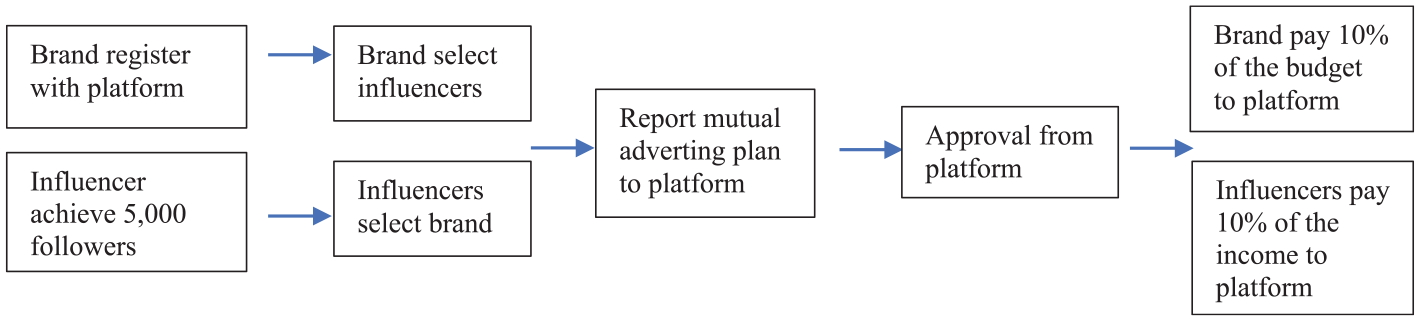
Process for creating registered posts on Red.
Xue, for example, clearly stated her preference for doing registered posts when working with brands, I definitely prefer doing registered posts. If it is a registered one, then it is accepted by the Red platform, which is safer in a sense. If it is not a non-registered one, then there’s a chance your content might violate certain regulations. The brands are also safer in a way because Red has checked it for you.
In Xue’s view, going through the platform to work with brands is a much safer, transparent, and desired option. While doing registered posts may involve more investment, the sense of security promised by the registration process, ensuring content adherence to platform policies, as well as the legitimacy of the brands, prompts influencers like Xue to engage with platform collaborations. By undergoing the registration process, influencers diminish the likelihood of content visibility being limited or content being deleted, both of which may occur in non-registered posts. This process arguably provides a degree of visibility assurance, effectively addressing a notable structural concern of unpredictability and obscurity, which serves as one of the primary causes and sources of precarity and emotional strain.
To gain a better understanding of how algorithms function, several influencers told me that social media marketing classes are prevalent in the industry, and they have taken them to gain insider knowledge and increase their visibility in a more stable, if not exponential manner.
Ava, from Sydney, adopted a template for developing content from an “algorithmic expert” (Bishop, 2020) in her class, During the marketing course,” she explains, “they actually talked about how it is a good idea to have content “killers.” So, my content “killers” are usually around a receipt, a fact, something personal, or either a client, a case, a bit more clinical and insightful.
For Ava, attending classes and gaining more knowledge about how algorithms work taught her to utilize strategies to have more control over her account and visibility. This form of collaboration with the platform is not restrictive or passive; instead, it positions her proactively to avoid her efforts going to waste and being hindered by the mysterious nature of platforms, ultimately helping her earn a livelihood.
Against the platform: resistance and content freedom
While some influencers are well-versed in the platform’s rituals and preferences, they deliberately choose to resist these norms to safeguard their creative freedom, despite the potential restrictions they may encounter.
For example, Zeya, an influencer on Red, and Mia, from Instagram, have chosen to go against the expectations set by the platform. I actually know [what kind of content will go viral], but it is quite different from my own style. First, your title needs to be exaggerated, then you will get more views. I know what the ways are to make the videos more popular, to make it exaggerated or cuter, but that’s not what I want to do. (Zeya) I’m very careful with what I post . . . I don’t post pictures of myself grabbing a latte in activewear with my babies. I don’t post bikini photos, I don’t post what I eat in a day. I find it frustrating that I would have more followers if I do post those. If I post lots of pictures of my babies, and accept sponsorship from baby brands, I get offered things from PR all the time, but I turn them down. (Mia)
Zeya and Mia are acutely aware of the kind of content that the platform expects them to produce, as well as the potential rewards it offers. However, they both have made a conscious decision not to succumb to the allure of visibility on Red. In another sense, they are also declining to collaborate with the platform, opting not to exploit the partial control and influence they wield over their followers to create content aimed at manipulating their audience.
Their experience underscores the importance of recognizing, identifying, and embracing the possibility of resistance against and defiance of the established norms, expectations, and culture set by the platform. This challenges the prevailing notion that platforms and their allure of visibility hold an all-encompassing power in shaping and dictating the lives of influencers (Khamis et al., 2017). It is essential to clarify that I am not attempting to downplay the significance of visibility when influencers operating within the platform’s attention economy. Visibility indeed plays a vital role, and the structure perpetuates an unequal power dynamic that affects influencers’ lives. However, I argue that the pursuit of visibility is a contested idea, and it does not necessarily equate to complete submission and compliance with the platform’s regime.
The recurring theme of being in control and more importantly, resisting a form of oppressive social relations with the platform, has emerged during the interviews. Many big influencers on Red you see have a manager or a team to support their work. They will design your account, your selling point, create an identity for you or even write scripts, edit your content, and even buy some visibility for you. All you need to do is just to show your face. I’m not a big fan of this kind of style; I’d rather just be myself, stay authentic, and make sure my visibility statistics are real. I don’t want to sign a “卖身契” (maishenqi: an indenture by which one sells oneself or a member of one’s family). My followers have been growing quite slowly in the past few months . . . but that’s okay. (Zixuan)
Zixuan is fully aware that partnering with an influencer management agency would make her life easier, enabling them to align her content with platform expectations more tightly and even secure exposure. However, she resolutely rejects the idea of surrendering herself into a form of obedient relationship with the platform, even if it means sacrificing the opportunity to gain a larger following. To be honest, I now feel as if I’ve been entrapped by the performance and visibility of my posts. If I were to intensify my focus on creating trending content and catering to the platform’s demands, I might become even more ensnared in the overall culture and demands of the platform . . . it is simply too tiring. (Shanshan)
Shanshan, who now has nearly 20k followers on Red, is aware of the emotional burden of pleasing the platform, which has entrapped her in an unequal relationship with it. She clearly anticipates the emotional toll that comes with deciphering the inner workings of visibility. To spare herself this trouble, she consciously chooses not to obsess over it, making it easier for her to come to terms with her influencer work.
Madeline expressed a strong enthusiasm for preserving her creative agency when discussing the level of control she has when creating content, I’m not going to be controlled, and I don’t want to compromise my own brand by doing something I’m not comfortable with. I prefer to stay true to myself. I’ve learned from past experiences where I did things I didn’t like.
Having control and the freedom to decide what to post is often considered the fundamental principle for influencers. In Madeline’s case, this is also motivated by her concerns about maintaining the consistency of her account’s branding. She understands that content misalignment with her account’s overall theme could result in a decline in her account’s popularity. Her motivation to retain control reflects a proactive effort to maintain her agency within a context of uncertainty and potential disempowerment (Khamis et al., 2017). In other words, for influencers aiming to present a mediated authentic image to their audience—signifying credibility and the cornerstone for building a successful persona—actively resisting the platform’s expectations becomes almost necessary.
For the influencers, we can see that their stance against the platform involves proactive opposition to norms and cultures that do not align with their values. In addition, it signifies a rejection of an unequal and oppressive dynamic that exists between them and the platform. None of the influencers I spoke with were engaged in particularly dramatic or radical conflicts with the platform. Yet, each was able to identify certain spaces within the conditions of their relationship with the platform in which they could resist and challenge the forms of relations imposed and expected on them. In other words, these influencers’ experiences invite us to explore alternative understandings that go beyond the commonly emphasized focus on gaining visibility, monetization, and formal employment. These should not be treated as default standards or ultimate ideals (Alacovska, 2022), when trying to understand influencers’ dedication to and their experiences within the industry.
The third way: in and against the platform
Influencers, armed with the insights they have gained about the platform’s inner workings, often find themselves balancing a dual positionality. On one hand, they collaborate with the platform to gain visibility and, ideally, make a living. On the other hand, they desire control over their content and aim to avoid entanglement in manipulative social relations with the platform, which can lead them to critique, resist, or simply overlook certain platform rules and rituals. During interviews, influencers openly acknowledged and actively practiced this dual stance.
Mia, from Sydney, and Jing, based in Shenzhen, exemplify this dual approach in managing platform expectations. I can’t be bothered. If what I do falls into a trend, I will do it. But if there are times when I can’t create content in a trending format, I need to make a regular post, and then I’ll do that. It is about finding a balance. (Mia) If I know what’s going to help with visibility, I will change. If I know exactly what’s forbidden, I will avoid it. But overall, I would focus on posting what I’d like to eat. For example, I don’t like avocados, so I don’t post anything about it, even though I know many people use it in their recipes. (Jing)
Both Mia and Jing have adopted a strategy that involves participating in platform trends and rituals to some extent, all while actively maintaining their individuality by creating content that aligns with their personal preferences. This dual stance, a combination of collaboration and resistance, characterizes their position of being “in and against the platform.”
As I am going to argue, the influencers’ decision to both “in and against” the platform, is precisely made based on their understanding of precarity within the broader context they inhabit.
When discussing the types of content she would create, Shirley, a soon-to-be solicitor from Sydney who manages a healthy eating account on Instagram, frankly shared that she would always choose the trending audio to include in her content. Interestingly, her approach to “catering” to the platform’s taste is future-oriented and a form of strategy to manage the precarity inherent in corporate labour relations, You know, hypothetically down the line, [having an influencer job] would be a great thing. For example, I want to have kids in the future and stay home with my kids and have some source of income that I could continue and be less demanding than a corporate lawyer, so I think it’s a really flexible way to make some income from home.
For Shirley, a more significant sense of precarity arises from her experiences within the inflexible and traditionally masculine corporate culture. The anticipation of eventually returning home, along with the recognition that corporate law firms often lack family-friendly policies, drove her to take proactive measures in planning and developing a monetizable influencer account. Shirley’s approach to working with the platforms is evident in her strategy of “catering” to trends, which serves as a method for managing and controlling potential future precarity.
Apart from being influencers on Instagram, Grace, Anna, Ava, and Olivia are all either in their final years of university or have just graduated. They similarly emphasize that one of the main incentives for being an influencer is to attract potential clients with whom they can further work with, which serves as their ideal primary source of income. Olivia, for example, explained that she does not expect to rely solely on the platform to make a living, I think it will facilitate making a living because it would be more like that, I would use Instagram account to get clients instead of actually getting money from Instagram. It would be more like I use Instagram to reach people and they pay me for a consulate.
This sentiment is echoed by Anna, who further mentioned that: “I think one day something will take over Instagram.” This approach of leveraging influencer status to attract clients first reflects these influencers’ middle-class backgrounds and their desire to pursue additional professions in the cultural and knowledge economy. It also mirrors influencers’ heightened awareness of the precarious nature of livelihoods in the face of rapid changes. This awareness fosters a cautious attitude toward relying solely on Instagram for sustenance. Instead, they are actively conscious of the platform’s instability and perhaps also its temporality and volatility. This active awareness, coupled with the desire to pursue additional professional careers in the long run, positions them as a sort of safeguard, simultaneously in and against the platform.
On the other hand, the positionality of Red influencers and their ability to be both “in and against” seem to convey a different narrative. Unlike Instagram influencers who leverage an additional profession as a safeguard, Red influencers appear to be more disillusioned by the precariousness inherent in traditional working culture.
Muzi, who openly admits her dissatisfaction with her work at a real estate company, acknowledges that being an influencer “has become an outlet for releasing the pressures I experience in job.” Shiwen left her stressful position at a major accounting firm, where she experienced various health issues, and chose influencer work as an outlet for personal well-being. Xue, who resigned from her highly competitive job, similarly shared, Before this job, I was an electrical engineer at [a state-owned enterprise]. I realized I wasn’t enjoying that job, which constrained me in many ways and wasn’t compatible with my values. In my husband and our friends’ companies, there were people who died suddenly, or they found new problems when they had health examinations.
For Xue, resigning from a job often dubbed as the “iron rice bowl” (Beck and Beck-Gernsheim, 2002), which is traditionally perceived as secure and desirable, represents her strategy for managing precarity. Transitioning into the role of an influencer not only empowers her to reclaim control over her life but also provides an escape from the toxic work environment and labour conditions.
Here, we can see that many Red influencers belong to the group of middle-class and professional backgrounds, which are sensitive and vulnerable to “involution.” “Involution” is a term that has gained wide usage to describe a society’s regressive tendency and the intensified competition that permeates every aspect of life. It signifies a system that does not progress efficiently, humanely, or innovatively, despite substantial investments of labour and resources, but instead fosters more cutthroat competition and social conflicts (Su, 2023). For many Red influencers in this study, who were previously immersed in China’s grueling 9–9–6 work schedule (9 am to 9 pm for 6 days a week), influencer work offers a less precarious way of life in which they can expect some degree of control, freedom, and creativity. Therefore, they use influencer work as a rejection and a form of uncooperative rebellion against the culture of involution.
It is also this strong desire for independence and against the hustle and hypercompetitive traditional labour culture that offers little to no meaningful rewards, enabling them to resist the platform. Simultaneously, the platform offers them an online presence that provides some monetary rewards and helps them navigate the precarity stemming from broader societal competition. This ultimately forges a sustainable way of living in conditions of precarity. This further emphasizes that the experiences of precarity in the platform economy should be understood with variation. While for many, it signifies instability and individualized risks, for others, it is a way to manage a precarious present and future.
Conclusion
Based on interviews with influencers from Instagram and Red, I observed that these individuals adopt a positionality that I term “in and against the platform,” wherein they both collaborate with and resist the platforms’ rules simultaneously. This dual positionality, as I argue, reflects and is based on influencers’ various understandings of precarity.
For Instagram influencers, there is an acute awareness of the transient nature of the platform and the precarious corporate culture, fostering a strategy where they leverage their influencer status to attract further and future work opportunities while also avoiding complete dependence on the platform for their livelihood. In contrast, Red influencers seem to express greater disappointment with the instability ingrained in conventional employment structures. Cases like Muzi and Xue, who turn to influencer careers to escape the pervasive precarity embedded in the Chinese middle class, reflect their attempts to reject the competitive working culture that comes with empty promises. In hopes of taking control of their lives and creative expression, they collaborate with the platform while also pushing back against similar oppressive relations imposed by the platform.
Although both Instagram and Red influencers adopt this “in and against” positionality, there are also variations in their approaches due to the different forms of precarity they experience. While Western Instagram influencers often rely on stable work in traditional professions to safeguard against precarity in the influencer economy, the Red influencers perceive traditional “stable” work as more precarious than an influencer career, which they see as a means to escape precarity. Nevertheless, it is important to recognize that the ability to adopt both an “in” and “against” stance is heavily influenced by one’s class and position. In other words, those who do not solely rely on visibility for a living, or like the sampled Red influencers who have family for backup, are more likely to have the flexibility to adopt this positionality.
In conclusion, this article has contributed to a nuanced and empirical understanding of how perceived precarity is experienced and navigated by influencers from diverse contexts. It challenges the often homogeneous narrative of creative work precarity and urges future conversations to carefully situate precarity within individuals’ socio-political contexts. Through the lens of “in and against,” this article also contributes to the emerging scholarly exploration of platform resistance (Alyanak et al., 2023) and highlights the active agency and creative spaces that exist. It demonstrates the disruptive and constructive energy that enables individuals to create meaningful livelihoods and potentially contribute to larger processes of social change.
Footnotes
Funding
The author(s) disclosed receipt of the following financial support for the research, authorship, and/or publication of this article: The author received financial support from the Department of Sociology at the University of Cambridge for fieldwork.
