



Abstract
This paper offers a comparative analysis of the international streaming trajectories of South Korean television dramas (K-dramas) and Chinese television dramas (C-dramas), highlighting their distinct approaches shaped by geopolitical and regulatory contexts. K-dramas have achieved global success through government support, strategic partnerships with platforms like Netflix, and diverse audience engagement, driving waves of Hallyu (the Korean cultural wave). In contrast, C-dramas initially lagged due to restrictive government policies and limited co-production but have gained momentum through the expansion of Chinese streaming platforms into Southeast Asia. Case studies of Kingdom (2019) and Empresses in the Palace (2015) illustrate these dynamics, revealing challenges such as platform imperialism and cultural reception. This analysis underscores the evolving landscape of digital media, streaming, and cultural exchange in East Asia, offering insights into non-Western media ecosystems.
Keywords
Introduction
Our paper focuses on the ongoing developments in the streaming market and the international distribution of Chinese and South Korean (Korea) dramas (henceforth K-dramas and C-dramas). Given that over fifty-percent of the world’s internet users reside in Asia, and that both China and Korea boast high landline subscriptions, we concentrate on these two countries to underscore the global and local dynamics of overseas drama distribution on digital platforms (Ritchie et al. 2023). Importantly, this article investigates the distinctive perspectives on globalization adopted by two non-Western nations, examining the unique challenges and opportunities that arise from their respective approaches toward distributing their cultural content internationally.
Lotz et al. (2018) stress the importance of evaluating the specificity of streaming networks to gain insights into their distinct evolutionary paths in particular countries, and thus this article sheds light on the economic and political factors influencing the streaming market landscape in China and Korea. It underscores the impact of governmental roles and cooperation with, and sometimes dependence on, international producers and disseminators like Netflix and YouTube on dissemination of cultural products and in achieving cultural influence. China and Korea share similarities in overseas drama streaming, both aiming to strengthen national soft power through cultural industries. They began distributing television dramas internationally in the 1980s, influencing each other’s streaming markets to some extent. The analysis provides insights into how legacy media organizations and streaming platforms navigate unique regulatory conditions, regional politics, and industrial practices affected by platform imperialism (Jin 2013; Lobato 2018; Park, Kim and Lee 2022).
The emergence of digital platforms as new mediators for the circulation and consumption of local cultural content reflects a key aspect of globalization, as they are increasingly shaping the dynamics between local cultural creators and global audiences. Jin (2017) further supports this idea by showcasing the ubiquity of digital platforms and their transformative role in rebalancing the distribution of popular culture. Although as he opines, while digital platforms have become important intermediaries for the two-way flow of cultural content between non-Western and Western countries, the commercialized and commodified nature of digital platforms means that they are capital repositories as well. And given the dominant digital platforms or digital media technology firms, Meta (formerly Facebook), Amazon, Apple, Netflix and Alphabet (formerly Google)—popularly known as FAANG, Fuchs (2016) draws attention to how the prevalence of US based streaming platforms is contributing to the creation of new cultural imperialistic maps, as they continue to shape and influence global flows of content. The discourse on cultural imperialism in media studies historically peaked in the late 1970s and early 1980s, marked by the formation of the New World Information Communication Order (NWICO) by developing countries seeking to address the one-way production and distribution of news, media, and information from the Anglophone Western world to developing nations (Carlsson 2003).
However, as noted by Punathambekar and Mohan (2019), while the acknowledgment of the influence and dominance of US-based digital platforms is crucial, an exclusive lens of platform imperialism overlooks the diverse practices within media industries, as well as regional geopolitical nuances that exist outside the Anglophone Western world. This argument is particularly relevant for countries like China and Korea, where cultural industries and production are not only shaped by domestic regulations and policies but are also intricately intertwined with geopolitical considerations and diplomatic relations. Our paper argues for a more nuanced approach, highlighting the calls by scholars like Appadurai (1996) and Straubhaar (1991) to shift the focus toward global-local relations. They advocate for countries to defend their local cultures not by resisting global influences but by actively participating in the global exchange of cultural products. This perspective is illustrated through examples of “contraflow,” meaning the global prominence of non-Western cultures such as Latin American telenovelas, Bollywood films, Japanese anime, and Hallyu. And in the case of China, as our paper elaborates, local streaming market limiting access for foreign platforms, has fostered the growth of a streaming ecosystem free from dominance by United States’ platforms.
Thus, against the backdrop of platform imperialism, this paper foregrounds economic and political factors shaping the distinct streaming market landscapes in China and Korea, contributing to contraflows of non-Anglophone West perspective. Furthermore, by incorporating case studies from each country, the article aims to highlight the specificities of the streaming ecosystem in China and Korea. The following sections delve into the broadcasting and streaming trajectories of Korea and China respectively, offering a comprehensive comparative examination of their experiences in the globalized world of streaming content.
An Overview of South Korea’s K-drama Industry
While K-dramas had been produced since the 1960s, Kim (2020) writes that from the 1980s onwards, the government’s protectionist measures and national restructuring of television fueled the appeal of K-dramas, because of which the domestic market became less dependent on foreign television imports. Korean television industry was further strengthened after the end of dictatorship in the early 1990s, when SBS network joined hands with KBS and MBC, to what came to be regarded as the Big Three Korean terrestrial broadcast television networks (Nam 2008; Shim 2008). Furthermore, in the 1990s, recognizing the economic potential of the cultural and creative industries for the country’s economic development, under President Kim Youngsam, cultural industries became an important part of the national economic strategy (Jang and Paik 2012; Shim 2006). This was also the period when investment was sought from chaebols or business conglomerates to develop the cultural industries. Post the 1997 Asian Financial Crisis, cultural industries became a focal tool in the country’s economic revival and during this period, using a price reduction tactic, television content was sold far below the regional market’s average, thereby increasing the imports of Korean television content in other areas (Kwon 2015; Shim 2008).
The regional distribution of K-dramas to countries such as China and Japan in the early 1990s constituted the first wave of Hallyu. Kwon (2015) notes how successful dramas like What is Love All About (MBC 1991), Star in My Heart (MBC 1997), Autumn Fairy Tale (KBS2 2000), and Winter Sonata (KBS2 2002) helped establish the romantic melodramas that contributed to Hallyu. According to Noh (2022), the success of the serialized romantic melodramas enabled the stabilization of the production style that is now understood as Hallyu dramas. The success stabilized the production style known as Hallyu dramas, and terrestrial networks continued to finance and develop the dramas and in facilitating international distribution (Noh 2022).
The international success of Winter Sonata in 2002 marked a turning point for the popularity of K-dramas in Korea’s neighboring countries. The drama gained such immense popularity in Japan that it was rebroadcast on NHK’s national network four times (Kim 2013; Yoon and Kang 2017). According to Ahn (2019), the success of Winter Sonata significantly raised production costs for K-dramas intended for export. Kim (2013) notes that Korean actors featured in popular dramas came to be recognized as “Hallyu” stars, further increasing production costs. Winter Sonata was instrumental in driving the international sales of K-dramas in the 2010s, with international sales covering 30% to 40% of production costs (2017 Broadcasting Industry White Paper, 2018; Kwon 2015). Additionally, licensing fees for these dramas in neighboring countries increased, and as Noh (2022) observes, terrestrial broadcasters played a crucial role in the production and international distribution of large-scale romantic Hallyu dramas.
The dominance of the big three terrestrial broadcasters, SBS, KBS, and MBC continued up until the deregulation of ownership was introduced under the Broadcast Law 2000 (Kim 2011). The law not only allowed multiple and cross ownership but also enabled chaebols (Korean media conglomerates) and foreign companies to own up to 33% shares in cable operation companies. Consequently, television companies which had large capital and knowledge of media production were able to venture into launching sport, entertainment and drama channels (Kim 2011). Noh (2022) writes that the Hallyu production ecosystem gradually shifted gears from terrestrial broadcasters to pay-TV, cable and general channels. For example, TvN, the cable network behind Reply series, launched Signal and The Guardian: The Lonely and Great God in 2016; Studio Dragon—a production, marketing and distribution company under the same establishment as TvN—was launched in 2016. 1 JTBC, a national-wide general television network, began its operations in 2011. 2 Together, TvN, Studio Dragon and JTBC have now emerged as a K-drama production powerhouse (Noh 2022). Furthermore, the K-drama production ecosystem in 2016 witnessed the entry of Netflix, which is a milestone of K-dramas’ overseas online streaming, as we will delineate in the following section.
Going Online in the 2010s
In the 2010s, K-dramas transitioned from terrestrial broadcasting to online streaming, marking a shift from regional distribution in Asian countries, particularly China, to international reach. During the early 2010s, China was the primary importer of Korean entertainment and played a crucial role in the global spread of Korean pop culture (Shim 2006). For instance, My Love from the Star in 2013 (SBS) was licensed to iQIYI, a Chinese online video platform, for a price 35,000 USD per episode, equivalent to 747,000 USD for the series (Ha 2016). The series became a huge hit in China, and the following year the K-drama Descendants of the Sun (KBS2) was sold to iQIYI for 266,000 USD per episode to iQIYI, which amounted to 3.4 million USD for the whole series, almost seven times the price of My Love from the Star (Kim and Kim 2018; Yu 2019). As audience demand for K-dramas grew in China, online video platforms such as iQIYI began investing in the production of these shows. in 2016, Youku, another Chinese online video platform, purchased the drama Moon Lovers: Scarlet Heart Ryeo (SBS) with a licensing fee of 400,000 USD per episode, which set a new record (Ahn 2019; Ha 2016).
However, 2016 marked a significant turning point in the distribution of K-dramas to China. In response to the Korean government’s deployment of the US-made Terminal High Altitude Area Defense (THAAD) missiles, the Chinese government banned Korean cultural products, including K-dramas, movies, commercials, and television programs (Park, Lee and Seo 2019). 3 This ban, which severed a significant revenue stream for the Korean TV and film industry, was part of Beijing’s broader economic sanctions. It leveraged Korea’s reliance on trade with China in an attempt to pressure Seoul to reverse a policy that was perceived as a threat to China’s national security (Yang 2019). In addition, Japan had been hesitant to import Korean cultural content due to historical trade and political disputes, as well as the economic sanctions it imposed on Korea since the mid-2010s. (Hosaka 2019).
Netflix entered the Korean TV and film industry market in 2016 as part of its strategy to target the Asian region and expand its subscriber base. However, despite what appeared to be a timely entry, Netflix encountered stiff competition from an already well-established streaming market and a robust national television broadcasting system (Mazur et al. 2022). Furthermore, domestic telecommunication and entertainment providers were wary of Netflix, and Seo (2018) notes that the Korean Broadcasters Association considered an alliance with Netflix will affect competition in the domestic media industry and shift the balance of power in favor of Netflix. However, Noh (2022) elaborates that despite the terrestrial broadcasters’ reluctance over Netflix’s presence, pay-TV channels like TvN and JTBC welcomed the prospect of partnering with Netflix.
When Studio Dragon initially pitched the drama Mr Sunshine to SBS, it fell through because of advertising and budgeting constraints (Hancinema 2017). The drama series was eventually co-commissioned with Netflix, and it became an “example of a successful triadic partnership among a local channel, a local production studio, and a foreign investor, helping to consolidate CJ Entertainment and Media’s (CJ ENM) position as the new Hallyu drama powerhouse” (Noh 2022, 104). Co-commissioning projects has been one of the methods by which Netflix is able to expand its library. Lotz (2021) explains that there are primarily three conditions under which Netflix is able to regularly add series and films to its catalog. First, Netflix commissions original content by funding productions for its programs. Given the scale and geographical reach of these productions, Netflix often partners with other production companies to create its series and films, which are often branded as “Netflix Originals.” Second, Netflix acquires content by purchasing licensing deals, though these deals vary by country and may include exclusive licensing and distribution rights. However, as Lotz (2021) notes, data on these licensing agreements is not readily available. Lastly, Netflix engages in co-commissions, where it shares the production costs and rights with another entity. Further, in her analysis of commissions and co-commissions by country for Netflix, amongst the countries in Asia, Europe, North America, South America, and Africa, Korea has the highest number of co-commissions (Lotz 2021). Poignantly, Lotz (2021) notes that commissions and co-commissions are an important barometer of cultural analysis in order to investigate what kind of stories Netflix makes available and content strategies in different film and television markets. Thereby in the next section, the case study of the successful K-drama Kingdom, a commissioned drama by Netflix will be used to elaborate on how the streaming network, while employing K-dramas to increase their subscriber base, is also playing a key role in peddling the Hallyu and thereby Korea’s soft power.
Case Study: Kingdom (2019)
As Netflix’s second original K-drama production and its first officially released K-drama series, Kingdom (2019) was commissioned by Netflix and created in collaboration with AStory, a Korean drama production company established in 2004. Netflix roped in famed screenwriter Kim Eun-hee, who is known for her popular K-drama Signal, and film director Kim Seong-hun whose 2016 film Tunnel was a box office hit (Netflix 2017). Director Kim Seong-hun said that “Kingdom presents the opportunity to work on long-form television at its most ambitious and on a truly cinematic scale because of the unparalleled creative freedom that Netflix as a global internet television network provides” (Netflix 2017, para 3), whereas Kim Eun-hee stated that “she wanted to write a story that reflected the fears and anxiety of modern times but explored through the lens of a romantic fascination of the historical Joseon period and working with Netflix helped to unlock this creative vision for Kingdom” (Netflix 2017, para 4).
The series went viral due to its unique offering of a narrative that married the zombie and historical genre. Set in medieval Joseon period, the drama loosely refers to the Battle of Sangju in 1592 in the Upo Wetlands and uses it to rewrite an intriguing and dangerous political game between the Crown Prince, the queen’s family, rumors over the death of Joseon King, citizens who are starving, and a mysterious plague slowly affecting everyone. When the Crown Prince Lee Chang’s position as the future king is threatened and questions over the King’s death arise, the Crown Prince sets out to uncover the truth behind the unnatural plague that somehow makes people rise from death as zombies. Following the drama’s success, Netflix released a second season and subsequently produced a special feature-length episode of the series called Ashin of the North, which is supposed to be a prequel to the series exploring the origins of the plague. The series was featured in New York Times Best International TV Show Top 10 list for years 2019 and 2020 (Nytimes 2020). The Tomatometer score for Season 1 and Season 2 on Rotten Tomatoes was 93% and 100% respectively.
Kingdom made a significant impression, particularly due to its large production scale. The drama took nearly 8 years to produce, with each episode costing 2 billion won (US $1.7 million) per episode during the first season and was filmed in twenty-four locations across Korea with more than 600 field crew staff (Deloitte 2021; Yonhap 2019). 4 Netflix also focused on production design and costumes for Kingdom. Production designer Lee Hwo-kyung, recognized for his art direction in the film The Battleship Island, which won the 2017 Blue Dragon Award (Korea’s annual film awards) (James 2019), contributed significantly to the series. Special effects director Hwang Hyo-kyun was responsible for the grotesque and realistic-looking zombies in Kingdom. Hyo-kyun’s extensive portfolio includes the zombie blockbuster Train to Busan, as well as props and makeup work for Bong Joon-ho’s Okja and the Oscar-winning Parasite.
Promotion of Korean heritage and culture was also a key aspect in the drama’s production and marketing. For instance, Netflix K-Content (formally The Swoon), Netflix’s community for global fans of Korean cultural products, is wholly devoted to providing behind the scenes of K-dramas, interviews and producing promotional content via different social media channels such as YouTube, Instagram, and TikTok. Netflix K-Content produced a segment on YouTube entitled Kingdom Explained: Oh My Gat (Figure 1) that had two actors from the drama explaining the meaning and symbolism behind different kinds of gat or hats in the Joseon era. The dissemination of cultural aspects of Korea’s historical Joseon era as part of Netflix’s marketing strategy contributes to the spread of the Hallyu. Given the established audience for K-dramas across various parts of Asia, Netflix’s strategy of acquiring licensing for K-dramas and commissioning or co-commissioning them is aimed at expanding their subscriber base. And while K-dramas (alongside Anime from Japan) have been key in driving the growth of Netflix in Asia Pacific (Zhao and Shaw 2022), what has also occurred is that Netflix has become a key player in increasing the reach of Hallyu. However, this approach also raises concerns on the cultural imperialistic influence of Netflix in determining the flow and kind of K-dramas that become globally popular.
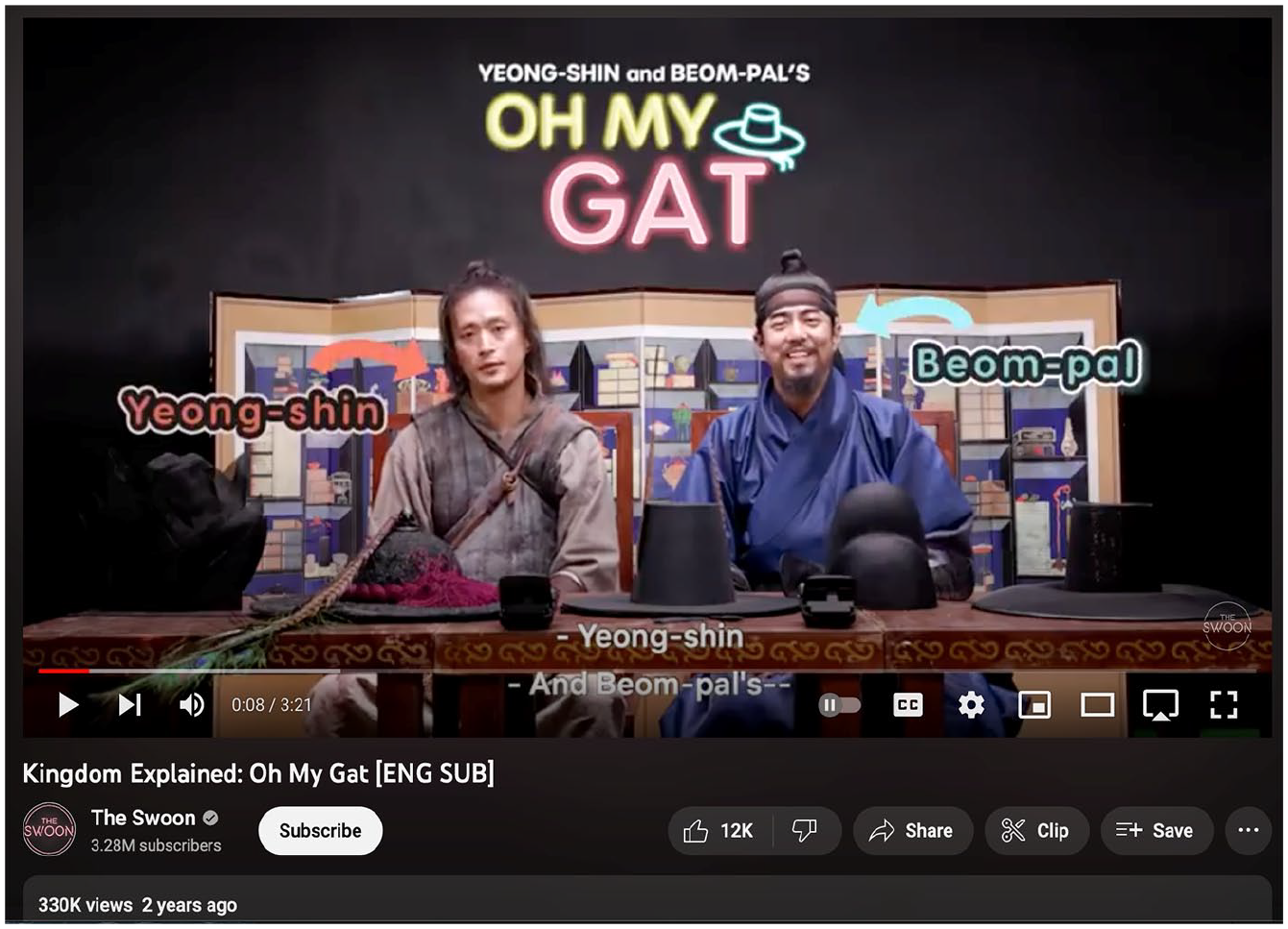
Screenshot by the author on 15 March 2022.
Lobato (2018) writes that in contrast to Netflix’s middle-class audience in the US, in other parts of the world, the audience may be limited to a cosmopolitan upper-class. A more nuanced understanding of Netflix’s audience is that the platform caters to a diverse range of global users with varying tastes and preferences, and “Netflix catalogs might be better understood through the prism of transnational class formations rather than the frame of the national audience” (Lobato 2018, 252). Lobato’s assertions give an insight into the commissioning and success of the K-drama Kingdom. Zombie horror is a popular genre in Western popular culture, with adaptations across different media, making Kingdom both familiar due to its genre and sociopolitical undertones, and unfamiliar for its depiction of medieval inspired Joseon era amongst the global audience. Thus, series commissioned or co-commissioned by Netflix ultimately pander to a global taste, which might not necessarily reflect the national audience’s taste. For instance, Kim (2022) elaborates on how the K-drama genre makjang, often criticized for its improbable plots and sensational cliches, continues to endure popularity amongst the Korean domestic audiences, even as the genre has turned out to be a cost-effective way for broadcasters to maintain viewership and revenue amidst a fragmented and competitive market. This implies that the K-dramas commissioned, co-commissioned, or licensed by Netflix not only cater to the platform’s global users but also adhere to Netflix’s storytelling aesthetics. Jin (2023, 461–62) discusses Netflix’s significant influence on cultural production in several ways. Firstly, Netflix controls the distribution schedule, rendering the traditional linear television model obsolete on digital platforms. Secondly, Netflix has reshaped the storytelling of local cultural content, where cliffhangers after each episode are less common, and the typical runtime of K-dramas has been shortened from sixty to seventy-five minutes to forty-five minutes. Finally, the platform’s content catalog, curated through machine learning and AI algorithms, has influenced the popularity of certain cultural genres, particularly romantic comedies and melodramas.
Thus, even though Netflix has inadvertently become a convenient vehicle for Hallyu since the COVID-19 pandemic, and to an extent is resolving the asymmetrical cultural flow from Western to non-Western countries, the platform is also contributing toward cementing the dominance of US based digital media technology firms, pertaining to storytelling.
Netflix and Platform Imperialism
Netflix’s expansion, along with platforms like Facebook, Google and Apple amongst others continues to reaffirm the dominance of the west, particularly of the US. Jin (2015) notes that certain transnational corporations inordinately influence relationships of power and privileges, resulting in unequal flows of capital and cultural products with non-Western countries. Platform technologies, including Netflix, offer commercial advantages by treating platforms, content, and users as commodities, generating significant capital gains for owners, primarily US media giants. This dominance, termed “platform imperialism,” perpetuates unequal power dynamics in global markets, particularly in platform technologies and cultural flows (Jin 2013; Park, Kim and Lee 2022; Punathambekar and Mohan 2019). Unlike traditional imperialism, platform imperialism hides commercial value within the platform itself, facilitated by intellectual property (IP) rights (Jin 2017). Thus, Netflix’s transnational monopolistic position as the world’s largest TV-cinema-digital media distribution system allows it to leverage economies of scale and outcompete local TV stations and platforms.
Furthermore, the centralization of media power within US based digital platforms, such as Google and Facebook, exacerbates tensions between developed countries as IP owners and developing countries as IP users, hindering non-Western countries’ global market expansion. For instance, the success of Squid Game sparked debates on the control and value of IP’s and interestingly, AStory, the production company behind Kingdom decided to retain ownership over their hit series Extraordinary Attorney Woo released in 2022. By retaining control over their content, AStory not only secured a broadcasting deal with Netflix but also expanded their revenue streams through adaptations into webtoons, musicals, and international remakes. This approach not only preserves creative autonomy but also maximizes potential earnings, as evidenced by the success of Extraordinary Attorney Woo.
Moreover, Netflix has had a considerable impact on Korea’s domestic content industry ecosystem. In response, regulations were introduced in 2020 to hold online content service providers with over one million daily users accountable for ensuring stable network services (Yonhap 2022). Internet service providers (ISPs) in Korea argued that extra fees should be paid by foreign content providers since they were free-riding, often causing service outages due to heavy daily traffic and is informally dubbed as the “Netflix Law” (Lee 2022). The law also mirrors European telecom providers like Deutsche Telekom, Orange and Telefonica’s attempts in Europe to persuade the European Commission that platforms with influence and market share partly finance telecom infrastructure due to the increasing surge in video streaming and other data usage charges (Chee 2023). Park, Kim and Lee (2022) note that Netflix’s significant investment in the K-drama industry has become indispensable to produce big-budget series, leading to a scenario where it is poised to monopolize global streaming rights. Netflix’s involvement has inflated salaries for top industry talent, including writers, directors, and actors, as production companies vie for more substantial investment from Netflix (Park, Kim and Lee 2022). The shift toward Netflix as the preferred platform for K-dramas has led to concerns about the dwindling popularity of terrestrial TV dramas and the potential monopolization of big-budget productions. This situation reflects historical instances of cultural imperialism, though through a different mechanism. Whereas cultural imperialism sought to promote US media content at the expense of local productions, platform imperialism today involves acquiring exclusive global streaming rights while simultaneously promoting local content production (Jin 2013). While K-dramas challenge US cultural dominance, Netflix’s control over their IP rights reinforces its economic power. This aligns with Jin’s (2021) observation that Netflix strategically leverages the Korean Wave to strengthen its position in the global market.
Overall, while Netflix’s involvement has brought benefits to the Korean drama industry, there are concerns about its long-term implications, including dependency, weakened domestic platforms, and the consolidation of US media power.
The International Distribution of C-dramas: A History
Akin to Korea, the international broadcasting of Chinese television dramas started in the 1980s during China’s market reform (Xu 2015). While the Korean government plays a dominant role to facilitate the production and dissemination of K-dramas, the Chinese government primarily focuses on managing, regulating, and censoring C-dramas. Before the online streaming era in the 2010s, C-dramas were predominantly distributed to culturally proximate regions – such as the Greater China area, East Asia, and Southeast Asia—in three ways: the state’s overseas satellite channels, the collaboration with local channels, and video retailing (Keane 2008; Wong 2009; Zhu 2008). China’s international satellite television broadcasting, led by the Chinese Central Television (CCTV), screened both news and television dramas embodying the state’s ideologies and discourses with subtitles in local languages (Madrid-Morales 2017; Wong 2009). The cooperation between China and overseas television channels has been under the direction and censorship of the State Administration of Radio, Film, and Television (now known as the National Radio and Television Administration) (Keane 2008). From the 1990s, many Chinese television dramas exported to channels overseas were either propagandistic or historic, two genres most likely to gain permission in the bureaucratic system. Examples include Journey to the West (1986), which was exported in the late 1990s, and Yongzheng Dynasty (1999), which was exported in the early 2000s (Zhu 2008). Concurrently, the commercialization of the Chinese cultural industry facilitated the export of melodramas and comedies, as seen in Stories from An Editorial Office (1992) and Princess Huanzhu (1998). These television series were distributed mainly in the pan-Chinese market, East Asia, and Southeast Asia. In the 2010s, coinciding with China’s further globalization, Chinese television dramas were also seen in other regions, amongst which Africa was a major market. Both the state media institutions and private enterprises, such as Huayi Brothers, collaborated with African television stations and copyright holders (Lei 2019). Daughter-in-law’s Wonderful Era, for instance, was exported to Tanzanian national television in 2011, aiming to build a positive image of China among the African audiences by exhibiting modern Chinese life (Lei 2019).
Although many C-dramas have made their way overseas in recent decades, they have not created the same cultural impact as K-dramas. C-dramas are generally more popular with Chinese audiences than with international viewers. According to Keane (2008) and Madrid-Morales (2017), Chinese television dramas typically enjoy greater popularity domestically, and the volume of C-dramas exported is significantly lower compared to those produced and distributed within China. Second, in the global market, C-dramas are still marginalized compared with English-language television dramas and the Korean and Japanese productions (Xu 2015). Indeed, these traits in C-dramas’ international distribution trajectory persisted during the online streaming era in the 2010s.
Streaming in the 2010s
The export of C-dramas from 2013 has been characterized by platformatization, during which myriad international distributors based in Western countries, including Netflix, YouTube, Viki, Amazon Prime, and Hulu, provided new opportunities to C-dramas’ overseas dissemination (Zhang 2022, 71). Among these platforms, YouTube has played an important role, and to a lesser extent Netflix. The distribution of C-dramas relies less on Netflix, primarily due to popular C-dramas in mainland China being released for free via YouTube channels, such as LeTV, iQIYI, and Tencent Video, and the Chinese state’s regulation of the cyberspace, which has prevented Netflix from making any significant inroads into China’s streaming market.
China’s cooperation with Netflix in the 2010s remains on merely selling the broadcasting rights of already-produced dramas, given the hindrances for international platforms to operate in China and co-produce cultural products. As of 2024, Netflix is yet to be accessible in mainland China. The “Great Firewall” of the Chinese Internet restricts access to major global Internet services, leaving limited market share for platforms like Netflix due to the dominance of local streaming services such as Youku, Tencent Video, and iQIYI. Furthermore, because of the Chinese government’s control over cyberspace (Yang 2014), international network services seeking to enter the Chinese market must either relinquish control of their content or, at the very least, cede significant portions of it to the State Administration of Press, Publication, Radio, Film, and Television and the Cyberspace Administration of China, both of which are authorized to approve all foreign content (Kokas 2020). 5 Foreign internet companies must also comply with China’s cybersecurity regulations, which prohibit cultural content deemed “decadent” or “obscene” and considered harmful to the Core Socialist Values promoted by the state (Cheung 2018, 317). Thus, content regarded as “harmful” and disapproved by the administrations cannot be produced. Although Netflix targeted China during its global expansion, its efforts to enter the Chinese market, including both co-producing television dramas and streaming its own products in the mainland Chinese market, face challenges related to the state’s content regulations and the process of acquiring licenses (Kokas 2020).
A key strategy for Netflix to navigate these regulations is to acquire the broadcast rights for films and television dramas that have already gained popularity among Chinese audiences. 6 For instance, in 2015, Netflix cooperated with LeTV to broadcast a popular Chinese costume drama, Empresses in the Palace, to audiences in North America. In February 2019, Netflix announced an acquisition of the global distribution right of The Wandering Earth (2019), a Chinese sci-fi blockbuster grossing a considerable box office of approximately 4.66 billion RMB (700 million USD) (Liptak 2019). Nezha (2019), an animated film that succeeded in mainland China, is available on Netflix for its North American service. Further, similar to Netflix’s strategic decision to commission the K-drama Kingdom, the platform tends to stream Chinese-language movies and television dramas with recognizable genres (such as martial arts, action, and romance) for global audiences, represented by A Love So Beautiful (2017), Eternal Love (2017), and The Untamed (2019), while popular C-dramas with a socialist theme, such as A Lifelong Journey (2022) which exhibits China’s socialist construction and marketization reform, were less likely to be selected.
Meanwhile, many C-dramas are streamed on YouTube via the official YouTube channels of major Chinese streaming platforms, including LeTV, Youku, Tencent Video, and iQIYI. The distribution model of YouTube represents an alternative to Netflix’s subscription video on demand (SVOD) model, as it is more convenient for audiences to access Chinese content that does not require paid subscription (Keane 2016). The YouTube channels of the aforementioned Chinese platforms have distributed numerous Chinese-language television dramas from old ones (e.g., A Native of Beijing in New York) to recent productions (e.g., Word of Honour and You are My Glory) for free, while dramas featuring cosmopolitan stories dominate. Interestingly, many television dramas, such as Word of Honour (2021), Boss & Me (2014), and The Untamed (2019) are streamed both on Netflix for subscription and on YouTube for free. 7
Multiple reasons explain why many Chinese broadcasters turned to YouTube. Zhao (2018) argues that, first, providing free content on YouTube is an alternative when Chinese online video platforms encounter copyright obstacles in expanding their overseas subscription services. For instance, iQIYI once tried to enter the Taiwan market by providing paid subscription service; however, due to the geoblocking of the content within and outside mainland China caused by the Great Firewall, overseas subscribers could not access to the videos holding digital licenses in mainland China only (Zhao 2018). Therefore, distributing via YouTube became another way to reach Chinese audiences in Taiwan. Second, streaming overseas can circumvent the censorship of the Chinese state. In mainland China, an online video platform generally faces the regulation of five different state departments: the Cyberspace Administration of China, the Ministry of Industry and Information Technology, the Ministry of Culture, the Cyberspace Affairs Council of China, and the National Radio and Television Administration (Keane 2016; Wang and Lobato 2019). Streaming via YouTube, therefore, is free from being censored or removed by these departments. Third, streaming television dramas on YouTube allows the mainland to not only reconnect with the Chinese diaspora communities who have been searching for Chinese-language cultural products but also broadcast Chinese culture to other international audiences (Keane 2016; Zhao 2018). In this regard, C-dramas are a means to strengthen Chinese soft power overseas, as they resonate with China’s long-term “going out” cultural strategy and are germane to China’s efforts to broadcast news via YouTube in order to forge its own discourse against the Western-dominated news agenda (Alpermann and Malzer 2020).
Although China sought to increase its cultural influence and international soft power through the global streaming of its television dramas, most content still primarily targets Chinese audiences and Chinese-speaking communities rather than a global audience. It is challenging for C-dramas on YouTube to reach global audiences for two main reasons. First, there is a lack of targeted promotion aimed at viewers outside Chinese-speaking communities. Second, unlike Netflix, which offers content with a cosmopolitan perspective for diverse audiences, YouTube’s social media nature means that most of its content is user-generated for audiences with same interests, despite the professional ones aiming to reach a broader audience (Budzinski, Gaenssle, and Lindstädt-Dreusicke 2021). In recent decades, the international distribution of Chinese products has predominantly focused on export and import. Furthermore, while the restrictions of the Chinese state have hindered deep collaboration of Chinese cultural producers with international producers, the other perspective is that this is China’s attempt at resisting the platform imperialistic forces of US based digital media technology companies. Even though Netflix has played a positive role in popularizing K-dramas amongst a global audience, Netflix’s financial and market clout in K-drama production has industry stakeholders concerned (Park, Kim and Lee 2022). As Park, Kim and Lee (2022) rightly point out, even if K-dramas are acting as contraflow to the Western cultural content, Netflix’s ownership of K-drama IP’s means that the platform can wield economic influence and thereby sustain the hegemony of Western media companies. By contrast, China’s restrictive cyberspace regulations have meant that the country’s own streaming platforms have been able to develop an ecosystem unfettered by the conditions of platform imperialism imposed by US’ digital platforms. Further, by holding onto C-dramas’ IP rights, Chinese streaming platforms can hold financial capital, and even commission K-dramas and series from Thailand and Malaysia. As we will demonstrate later, iQIYI International, the overseas arm of iQIYI, has been routinely releasing original dramas from Thailand, Malaysia and Taiwan. 8
The following case study of Empresses in the Palace (2015), a representative Chinese costume drama exported overseas via Netflix first and then YouTube, will demonstrate two key aspects: how China’s approach to overseas streaming of C-dramas resists Western platform imperialism, and how the limited global audience for these dramas prevents them from achieving the soft power impact that K-dramas have attained.
Case Study: Empresses in the Palace
Empresses in the Palace is based on The Legend of Zhen Huan released in 2011. The original drama has seventy-six episodes, produced by the Beijing Television Art Centre, a marketized state-owned enterprise. Set in the Qing dynasty, the series focuses on Zhen Huan, a 17-year-old girl chosen as a concubine for the Yongzheng Emperor. It portrays her survival amid the competition and intrigues of other concubines, her elimination of enemies, and her ascent through the ranks to ultimately become Empress Dowager. The series was aired on various local television channels, including Guangzhou Broadcasting Network and JSTV Official Channel, during prime time, quickly becoming a hit in mainland China. LeTV, a Chinese streaming platform, acquired its online broadcasting rights and offered it through a paid subscription. From 2012, The Legend of Zhen Huan went outside mainland China to areas such as Taiwan, Hong Kong, and Southeast Asia.
In 2015, The Legend of Zhen Huan became the first Chinese television drama broadcasted on Netflix to North American audiences, due to cooperation between Netflix and LeTV (Jaafar 2015). Presented in its original Mandarin soundtrack with English subtitles, the drama was renamed Empresses in the Palace and was abridged to six 90-minute episodes to cater to international audiences who are accustomed to the fast-paced American series. Unlike the chronological narrative of the original series, these episodes have faster storylines, narrated through Zhen Huan’s flashback and voice-over to help audiences quickly understand the drama’s main plot. However, the Netflix version was not well-received among international audiences because abundant details were lost during the abridgment. This failure is due to not only the lack of China-Netflix cooperation in the drama’s production stage but also Netflix’s disregard of the drama’s originally established format during the adaptation. As of September 2023, the abridged version has no user reviews and only got 371 votes on IMDb, in contrast to 12 reviews and 1,979 votes of the original 76-episode version. Three of reviews under the original version criticized the 6-episode adaption because many subsidiary characters disappeared and myriad details underpinning the whole story were eliminated (IMDb, n.d.). A review on Douban, a Chinese website for film and television reviews, comments that the missing details not only oversimplify the television drama but also make it difficult for audiences to sympathize with neither the transformation of Zhen Huan’s personality nor her successful revenge (Youfenglaiyi 2015).
The Legend of Zhen Huan was streamed overseas again in 2018 via YouTube, and it succeeded among international Chinese communities. Through the LeTV Official Channel on YouTube, the drama was presented in its original 76-episode version, using Empresses in the Palace as its official English name. At the beginning, LeTV did not target non-Chinese audiences because there were no promotional activities, nor did the episodes have English subtitles. Subtitles in multiple languages such as English, Vietnamese, and French were later provided via the community contribution function of YouTube by a voluntary translation group named The Magpie Bridge Brigade, which consists of volunteers willing to promote Chinese culture to the world. 9 As of September 2023, most episodes have been played for more than four million times, and the episodes displaying the climax of the drama, the plot that Zhen Huan became the most powerful empress, have been played more than seven million times. Audiences praised the drama in their YouTube comments, while some audiences questioned the shortened version. For example, in Figure 2, one comment provided by user “Colleen Pyle” under episode 04 appreciates the full version and says that “the shorter version was on Netflix for a time, but nothing lasts on Netflix”. Max, another user, criticizes the Netflix version because “every scene every episode matters in this show”. Both comments suggest that Netflix’s adaptation reduces the impact of the already successful C-drama by altering its original format and pacing to cater to an International Netflix’s audience. Notably, as shown in Figure 3 although the television drama attracted a number of English-speaking audiences, most comments on YouTube are in Chinese, indicating that the majority of audiences overseas are still the Chinese communities.
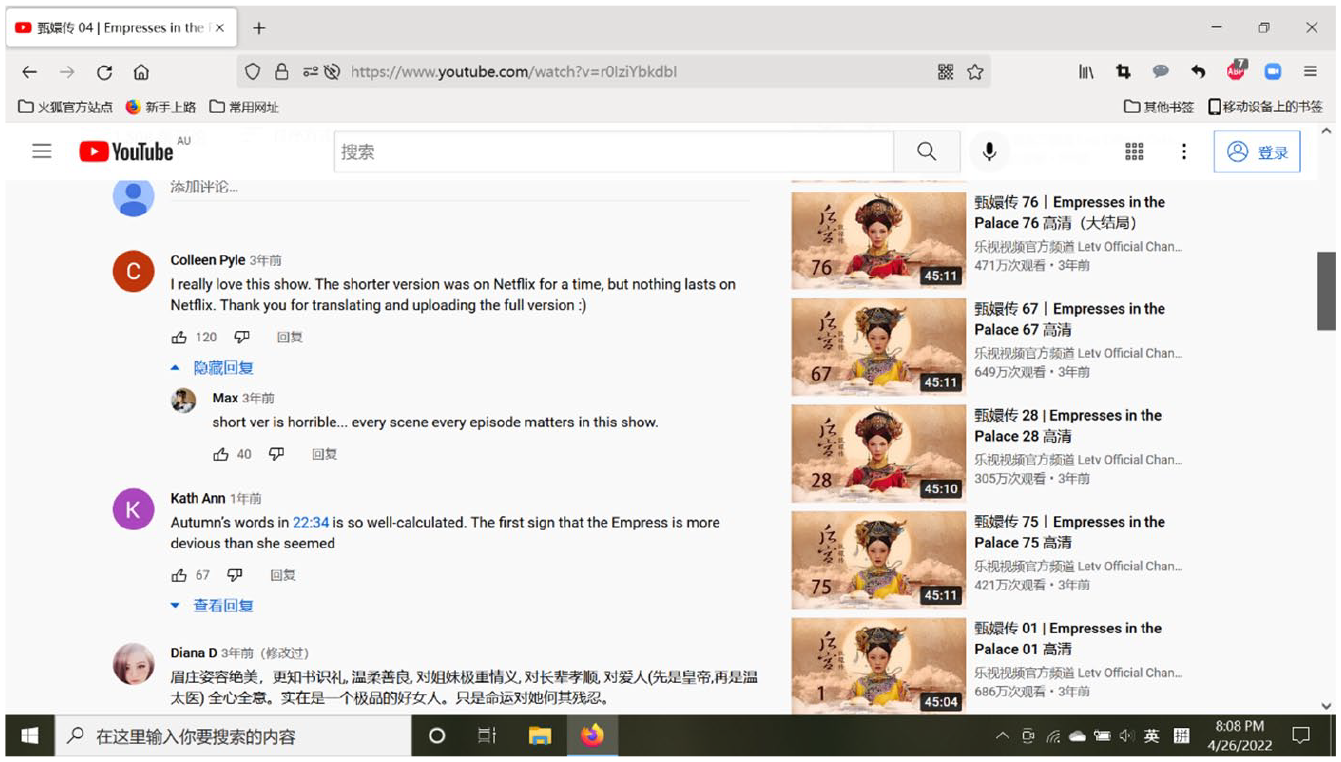
User comments on Empresses in the Palace episode 04. Screenshot by the author on 26 April 2022.
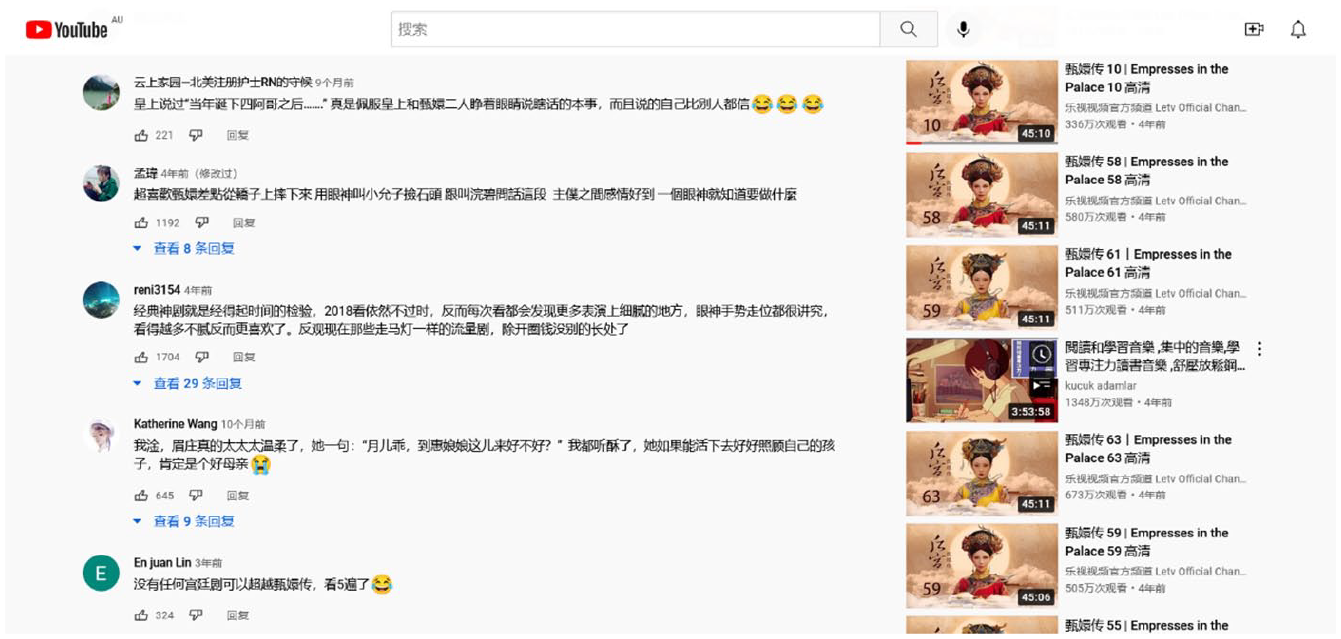
Audiences’ comments under Episode 56. Screenshot by the author on 21 July 2022.
Empresses in the Palace’s streaming on Netflix and YouTube provides insights into the international dissemination of C-dramas since the mid-2010s. This series, in particular, is popular among domestic audiences and its popularity mobilized LeTV and its production company to reach audiences overseas, which attests to Keane’s (2008, 2) argument that the exporter of C-dramas usually assumes that “national success anticipates export success.” The abridged version of the series on Netflix aimed at non-Chinese audiences, but without collaboration between its producers and international online distributors, the late adaptation of the original version did not meet the needs of global viewers. Meanwhile, the release of Empresses in the Palace on YouTube for free drew more viewers. However, initially lacking English subtitles, it still primarily appealed to Chinese communities abroad. Indeed, even with subtitles, the drama is more appreciated among the Chinese-language speaking community than global audiences. This outcome results from a lack of promotion, the inherent limitations of YouTube as a social media platform, and the fact that the original production was designed with a Chinese audience in mind.
New Possibilities and Strategies
Although C-dramas have less global influence compared to K-dramas, their international distribution during and after the COVID-19 pandemic reveals new possibilities and strategies that could foster a counterflow driven by non-Western streaming platforms and cultural products: despite China’s limited collaboration with Western streaming platforms, C-dramas have been disseminated via local platforms’ foray into the international market. Co-production between China and Netflix remains uncommon in the 2020s, although recently in March 2024, Netflix released first season of The Three-Body Problem, an adaptation of Chinese writer Liu Cixin’s sci-fi novel. The web series is based on Netflix’s acquisition of the book’s adaptation rights and produced by a team led by Alexander Woo, the producer of the HBO’s television series True Blood, and David Benioff and D.B. Weiss, the scriptwriters of Game of Thrones (Moore 2022). The series’ minimal participation of production teams and personnel from mainland China means that The Three-Body Problem is still based on international streaming platform’s purchase of Chinese copyrights, and therefore lacks deep level of co-production between China and Netflix.
The export of C-dramas through Western platforms and local channels persists, with some serving as promotional tools for Chinese streaming platforms’ international services. For example, Love Between Fairy and Devil, a fantasy web series popular in China in 2022, is available on iQIYI’s overseas version, Viki, and Netflix. The Bad Kids, iQIYI’s original web series, was screened via foreign channels such as Channel A in Korea and SBS in Australia (Morris 2021). While both television series were also uploaded on iQIYI’s official channel on YouTube, accompanied with subtitles in ten different languages to help it reach wider audiences, full versions of the episodes were not available on YouTube. Instead, iQIYI provided links in the description under the episodes that linked to their overseas streaming service. This indicates iQIYI’s endeavor to target international audiences via its own services instead of relying on Western-based platforms.
It is worth noting that a focus on overseas Chinese audiences can be attributed to the fact that the Chinese diaspora is the fourth largest globally (Fleck 2023). Additionally, China has the second largest population in the world, meaning the number of overseas Chinese is substantial. Furthermore, China is one of the top five countries for remittance inflows, indicating that the Chinese diaspora represents a significant and valuable market (Remittances 2023). Indeed, Chinese streaming platforms and the online video industry have developed during the pandemic with an intention to penetrate into the foreign market. Compared with the efforts of Empresses in the Palace that wished to attract Western audiences, in this period, audiences in areas with cultural proximity have become priority. iQIYI has cooperated with countries and regions such as Malaysia, Singapore, Thailand, Philippines, Indonesia, Dubai, and North America (Yu and Li 2021). In 2022, iQIYI turned profitable for the first time since it was launched by Baidu in 2010. Their fantasy drama Love Between Fairy and Devil topped the global ranking across iQIYI’s 191 territories and became one of the most popular iQIYI original C-dramas in history (Wong 2023). Other major Chinese platforms also stepped into the international market, and the Southeast Asian market is a primary target. The cooperation involves both distribution and co-production of C-dramas and television shows in local markets. For instance, WeTV, Tencent Video’s overseas version in 2019, chose Thailand as its first step and produced both web series and reality shows such as Chuang Asia. iQIYI co-produced a reality show titled The Hidden Character with Thailand, and Mango TV cooperated with Vietnam to produce the Vietnamese version of Chinese reality show Sisters Who Make Waves (36kr 2023; Liu 2023). While efforts and time are still needed for both the international distribution of C-dramas and Chinese streaming platforms to reach a global audience outside Asia, Chinese streaming platforms have forged a cultural counterflow by competing with Western-based platforms in Southeast Asia.
Concluding Remarks
Undertaking a comparative examination of the international streaming of K-dramas and C-dramas, this paper identifies the different trajectories of exporting cultural products in Korea and China. K-dramas have forged three rounds of Hallyu owing to the government support, the international distribution platform provided by Netflix, consumption by a diverse audience globally, and heavy marketing via platforms such as YouTube. The globalization of C-dramas in the 2010s lagged behind K-dramas given the government’s role of restricting rather than supporting, and the lack of co-production with foreign producers at the initial stage. However, the development of Chinese streaming platforms in the 2020s and their expansion to the Southeast Asian market represent alternative digital streaming models and the potential for C-dramas’ overseas dissemination.
The case studies of K-dramas and C-dramas provide intriguing insights into the dynamics of streaming, globalization, platform imperialism, and the differences between Korean and Chinese approaches. Firstly, the success of K-dramas like Kingdom demonstrates how platforms like Netflix leverage cultural heritage and storytelling to expand their global reach. By partnering with local production companies and tapping into the popularity of Korean content, Netflix has not only increased its subscriber base but also contributed to the spread of Hallyu. However, concerns about platform imperialism and the monopolization of big-budget productions by foreign platforms highlight the complex power dynamics at play. Netflix’s role raises concerns about platform imperialism, where US based digital media firms not only dominate global cultural flows, but also impact the cycle of local cultural production. This centralization of media power can marginalize local platforms and influence content production to cater to global tastes, sometimes at the expense of domestic audiences. Despite these concerns, Netflix’s involvement has undeniably boosted the global reach of K-dramas and expanding Hallyu in regions beyond Asia.
The international dissemination of C-dramas, exemplified by Empresses in the Palace, highlights both challenges and evolving strategies in reaching global audiences. Despite Netflix’s failed abridged version due to cultural and narrative oversights, the original series found success among overseas Chinese communities via platforms like YouTube. This demonstrates the potential of C-dramas to captivate niche audiences with cultural proximity. Post-COVID-19, Chinese streaming platforms like iQIYI and Tencent have strategically targeted international markets, particularly in Southeast Asia, through both distribution and co-production. China’s restrictive regulations enable local platforms like iQIYI to thrive, resisting Western platform dominance. These platforms also distribute C-dramas overseas, focusing on the Chinese diaspora. iQIYI’s Love Between Fairy and Devil and The Bad Kids highlight this strategy, streaming on multiple platforms but promoting their own services. China’s streaming platforms prioritize regions with cultural proximity, such as Southeast Asia, over Western audiences. Collaborations include co-productions and local adaptations, strengthening China’s cultural influence. This strategy, seen in iQIYI’s profitability in 2022, emphasizes targeting familiar markets, forging a cultural counterflow against Western dominance. Despite challenges, C-dramas continue to expand their international presence through strategic distribution and localized content.
Moreover, this paper demonstrates the different challenges faced by Korea and China during the dissemination of their cultural products, opening spaces for future research in this area. The major challenge for Korea is the platform imperialism during the cooperation with international producers and distributers such as Netflix. Although Korea has actively implemented regulations such as the “Netflix Law” to protect the local telecommunications and streaming market, ever since the COVID-19 pandemic, Netflix has inevitably become a strategic ally in popularizing K-dramas and henceforth Hallyu across Asia-Pacific and beyond. Netflix now acquires licenses for K-dramas, alongside commissioning and co-commissioning them. By contrast, the challenges to C-dramas involve the reception of international audiences given China’s specific political system and its image in the world, which has not been explored in this article. Rosen (2021, 206) addresses that “countries that are not liberal democracies will never be able to score high on any soft power ranking”. Whether the non-liberal democratic politics is the original sin preventing the successful global distribution of Chinese cultural products, and whether there are other ways to gauge Chinese soft power, seems to be questions requiring an interdisciplinary and systematic exploration.
Overall, while both K-dramas and C-dramas represent cultural exports from Asia and challenge Western dominance in the entertainment industry, their approaches to international distribution and platform partnerships differ significantly. These differences reflect broader geopolitical and regulatory contexts, shaping the dynamics of streaming and globalization in the digital age.
Footnotes
Acknowledgements
We would like to thank our interviewee, Jiachen Wei, the founder of the Magpie Bridge Brigade, for the valuable information and their leadership in translating Empresses in the Palace on YouTube. We also thank our two anonymous reviewers and colleague Dr Arundhathi from O.P. Jindal Global University for their constructive feedback.
Declaration of Conflicting Interests
The author(s) declared no potential conflicts of interest with respect to the research, authorship, and/or publication of this article.
Funding
The author(s) received no financial support for the research, authorship, and/or publication of this article.
