



Abstract
Social media sites offer critical opportunities for lesbian, gay, bisexual, trans, queer, and other sexual and/or gender minority (LGBTQ+) youth to enhance well-being through exploring their identities, accessing resources, and connecting with peers. Yet extant measures of youth social media use disproportionately focus on the detrimental impacts of online participation, such as overuse and cyberbullying. This study developed a Social Media Benefits Scale (SMBS) through an online survey with a diverse sample (n = 6,178) of LGBTQ+ youth aged 14–29. Over three-quarters of the sample endorsed non-monosexual and/or and gender fluid identities (e.g., gender non-conforming, non-binary, pansexual, bisexual). Participants specified their five most used social media sites and then indicated whether they derived any of 17 beneficial items (e.g., feeling connected, gaining information) with the potential to enhance well-being from each site. An exploratory factor analysis determined the scale’s factor structure. Analysis of variance (ANOVA) and Sheffe post hoc tests examined age group differences. A four-factor solution emerged that measures participants’ use of social media for: (1) emotional support and development, (2) general educational purposes, (3) entertainment, and (4) acquiring LGBTQ+-specific information. Bartlett’s test of sphericity was significant (χ2 = 40,828, p < .0005) and the scale had an alpha of .889. There were age group differences for all four factors (F = 3.79–75.88, p < .05). Younger adolescents were generally more likely to use social media for beneficial factors than older youth. This article discusses the scale’s development, exploratory properties, and implications for research and professional practice.
Introduction
Social Media
Social media can be broadly defined as a communication format wherein individuals set up profiles, generate content, and/or interact and maintain connections with other users via online platforms or other digital mediums (e.g., apps) (Carr & Hayes, 2015; Ellison et al., 2007). Participants may use social media to interact with people they already know, and as a means to meet new people. It is also used as a mechanism to consume media content and engage in a range of other activities that vary based on the specific site (Buehler, 2017; Byron et al., 2019; Ellison et al., 2007). Prevalent examples of social media sites include Facebook, Twitter, Instagram, Snapchat, and YouTube. Nearly all youth in the United States use at least one social media platform (Anderson & Jiang, 2018). In 2018, 85% of adolescents (age 13–17) in the United States used YouTube. Large majorities also used Instagram (72%), Snapchat (69%), and Facebook (51%; Anderson & Jiang, 2018). Youth (i.e., adolescents and young adults) are especially prevalent users of social media and use such sites to aid in their identity development—including their gender identity and sexual orientation—during their formative years (Alhabash & Ma, 2017; Craig & McInroy, 2014).
Studies have been mixed regarding the effect of social media on young people. Recent investigations have found social media to have a beneficial (Verduyn et al., 2017), harmful (Reer et al., 2019), or negligible (Utz & Breuer, 2017) relationship with well-being. For youth and young adults, increased social media use has been found to have a positive impact on life satisfaction (Wheatley & Buglass, 2019), and Instagram in particular has been identified as benefiting overall well-being (Pittman & Reich, 2016). Conversely, Kross et al. (2013) found that Facebook use predicted a decline in life satisfaction and affect in young adults. A recent study of Chinese adolescents (n = 1,319) identified that social media use had a positive effect on well-being, although this effect was suppressed by social overload and moderated by participants “fear of missing out” on what they saw happening on social media, suggesting that the indirect and direct effects of social media have an important impact on well-being (Chai et al., 2019).
LGBTQ+ Youth
Lesbian, gay, bisexual, trans, queer, and other sexual and/or gender minority (LGBTQ+) youth identify significant benefits from engagement with social media, as well as other Internet-enabled technologies (Craig et al., 2015). While research comparing their use to their non-LGBTQ+ peers is limited, research has suggested LGBTQ youth may spend significantly more time online (Steinke et al., 2017). Fox and Ralston (2016) suggest that social media serves as informal learning environments for LGBTQ+ youth during their identity developmental processes. As LGBTQ+ identities remain highly stigmatized, social media sites provide youth with critical opportunities to explore, label, and practice disclosing their emerging LGBTQ+ identities; control and rehearse their social interactions; as well as access identity-specific resources (Craig & McInroy, 2014; DeHaan et al., 2013; Downing, 2013; Duguay, 2016a; McInroy et al., 2019a). Even engaging more passively with social media (such as watching LGBTQ+ YouTube content) enables individuals to learn about identity-specific issues and be inspired in their coming out process, increasing identity confidence (Fox & Ralston, 2016).
Social media facilitates identity construction and communication by allowing LGBTQ+ youth to curate their online presence in a context characterized by relative safety (i.e., users can block or accept whomever they choose) and control over anonymity (i.e., users can choose how much [if any] of their life is made public) (Craig et al., 2020; Downing, 2013). The comparative anonymity available online facilitates opportunities for youth to develop and explore their LGBTQ+ identities in ways not feasible in offline communities (McInroy & Craig, 2015). Anonymous social media activities ensure that participants’ emerging LGBTQ+ identities are protected from premature disclosure and from socially significant individuals (e.g., friends, family) who may not be accepting (Craig et al., 2015). Recent research finds that LGBTQ+ youth are able to engage in self-expression by curating their profiles and navigating unwanted comments and advances, which they are unable to do to the same extent in their offline lives (Alhabash & Ma, 2017; Craig et al., 2020). The interactive nature of social media enables a closer investigation of the ways that LGBTQ+ identities and experiences are constructed and communicated using technology (Bond & Figueroa-Caballero, 2016).
For LGBTQ+ youth, online community engagement enhances well-being. Participation in online communities may allow LGBTQ+ youth to access role models who share their experiences, as well as seek emotional and social support (Gomillion & Giuliano, 2011; McInroy et al., 2019a, 2019b). As individuals become more comfortable with their identity, they may engage in sharing LGBTQ+ content and participate in educating and supporting other LGBTQ+ people within their online networks (McInroy et al., 2019b). Fox and Ralston’s (2016) research found that youth were able to use social media as a bridge to access resources within their offline communities while minimizing potential risks, making local LGBTQ+ populations more visible to young people—particularly in rural communities. The Internet is perceived by LGBTQ+ youth as an efficient way to address gaps in identity-specific information (e.g., to access sexual health resources), as well as an effective means of learning about offline services and events (DeHaan et al., 2013). Duguay (2016b) analyzed tweets (n = 68,231) generated during Toronto’s 2014 WorldPride festival and found that social media enabled users to build global networks of support around the event by creating WorldPride hashtags, utilizing common visuals and raising awareness of LGBTQ+ experience. Another study found that LGBTQ+ Twitter users leveraged “social creativity” in their response to the Pulse shooting by countering threats to their identities by supporting unity in the presence of threat (Jenkins et al., 2019). In particular, the collective LGBTQ+ response on Twitter contributed to “creative identity (re)construction, creative community building, and creative resistance” (Jenkins et al., 2019, p. 14). Overall, social media allows LGBTQ+ youth to explore their identities and social relationships, access resources, and curate their own mode of self-expression while controlling their degree of self-disclosure.
A Social Media Benefits Scale
Current instruments that assess youth social media focus on problematic use (van den Eijnden et al., 2016), such as addiction (Al-Menayes, 2015) and the debilitating impacts of social media on sleep quality and mental health (e.g., anxiety, depression) in the general youth population (Woods & Scott, 2016)—as well as among a sample of 1,391 LGBTQ+ youth and adults with a mean age of 25 (Han et al., 2019). In research, well-being generally refers to overall quality of life (Rees et al., 2010), including the state of being comfortable, happy, and healthy (Oxford Online Dictionary, 2020). Existing measures assessing youth well-being utilize items regarding social support, perception of self, interactions with others, and one’s sense of safety and accomplishment (Hymel & Greenberg, 1998; Kern et al., 2016; Land et al., 2011). These scales focus on offline environments and are primarily constructed as self-report, Likert-type scales (Hymel & Greenberg, 1998; Kern et al., 2016; Land et al., 2011).
Youth well-being online—including social connectedness and personality development—has started to be explored, with a direction for future research being a measure of how youth populations may enhance well-being through online engagement, including via social media (James et al., 2017). Scales that assess well-being (i.e., positive effects) from social media in young adults tend to focus on outcomes such as political engagement (Gil de Zúñiga et al., 2014). For LGBTQ+ issues, scales have been developed in studies of social media, such as a scale to assess attitudes from non-LGBTQ+ people toward LGBTQ+ imagery (Hefner et al., 2015). Yet, current research does not identify the particular motivations and benefits afforded to LGBTQ+ youth via social media participation. Given research indicating that social media provides a breadth of important opportunities and positive impacts for many LGBTQ+ youth (Craig & McInroy, 2014; Hanckel et al., 2019), this study sought to explore more specifically the benefits of social media for this population and develop a Social Media Benefits Scale (SMBS).
Methods
The data source is Project #Queery, an online study of LGBTQ+ youth from the United States and Canada. Project #Queery utilized Qualtrics, a web-based survey platform, for data collection during March–July 2016. As this study asked about social media platforms available during spring–summer 2016, recent changes such as the worldwide launch of TikTok in mid-2018 and the Tumblr porn purge in late 2018 (Ashley, 2019) are not integrated. The study received ethics approval from the University of Toronto’s Health Sciences Research Ethics Board (Protocol #31769), and the study protocol has been published (Craig et al., 2017).
Research Questions
Although research related to social media indicates the potential utility of social media for LGBTQ+ youth (Downing, 2013; Fox & Ralston, 2016), emerging literature suggests that different types of platforms may be preferred by particular sub-populations of LGBTQ+ youth—resulting in specific patterns of utilization (McInroy et al., 2019a). This study sought to explore the specific motivations for utilization of and benefits derived from social media through the development of a psychometric measure to assess social media’s ability to provide access to beneficial activities with the potential to enhance well-being among LGBTQ+ youth. To that end, this study aims to answer three questions:
What are the frequencies of site usage among LGBTQ+ youth?
Why do LGBTQ+ youth use social media?
How can social media’s benefits enhance LGBTQ+ youth well-being?
Respondents
The inclusion criteria were as follows: (1) self-identified as LGBTQ+, (2) aged 14–29, and (3) resided in the United States or Canada. A total of 6,309 individuals responded to the mixed-methods online survey. Participants who skipped the social media questions were eliminated (n = 313; 4.96%). This resulted in a final sample of 6,178 LGBTQ+ youth. Respondents ranged in age from 14 to 29 (M = 18.21, SD = 3.61); most of the participants were in the 14–18 age group (n = 4,140; 65.4%). Details of respondents’ demographics can be found in Table 1. In terms of sexual orientation, the largest group was pansexual (28.8%), followed by bisexual (25.9%) and queer (21.1%). For gender identity, a majority of participants self-identified as women (41.1%), followed by gender non-conforming youth (33.5%). Most participants were Caucasian (79.8%). The questions inquiring about sexual orientation, gender identity, and race/ethnicity were not mutually exclusive (i.e., participants could report multiple identities).
Demographics of Sample (N = 6,178).

Procedure
Respondents were recruited using online strategies through three channels. First, e-Flyers were sent to organizations that served LGBTQ+ youth in all states and provinces. Second, recruitment notices were posted on various online platforms, including a range of social media sites (e.g., Facebook, Instagram, Twitter, Reddit). Third, paid advertisements were posted on Facebook and Instagram. Respondents accessed the survey in Qualtrics survey software through the hyperlink in the e-Flyers and recruitment posts, where they could start responding to the survey after indicating informed consent. The survey took approximately 30–45 min to complete. At the end of the survey, respondents could indicate their intent to participate in a raffle for prizes such as an iPad or e-gift cards of different values. The survey completion rate was 76.2%.
Measures
Social Media Benefits
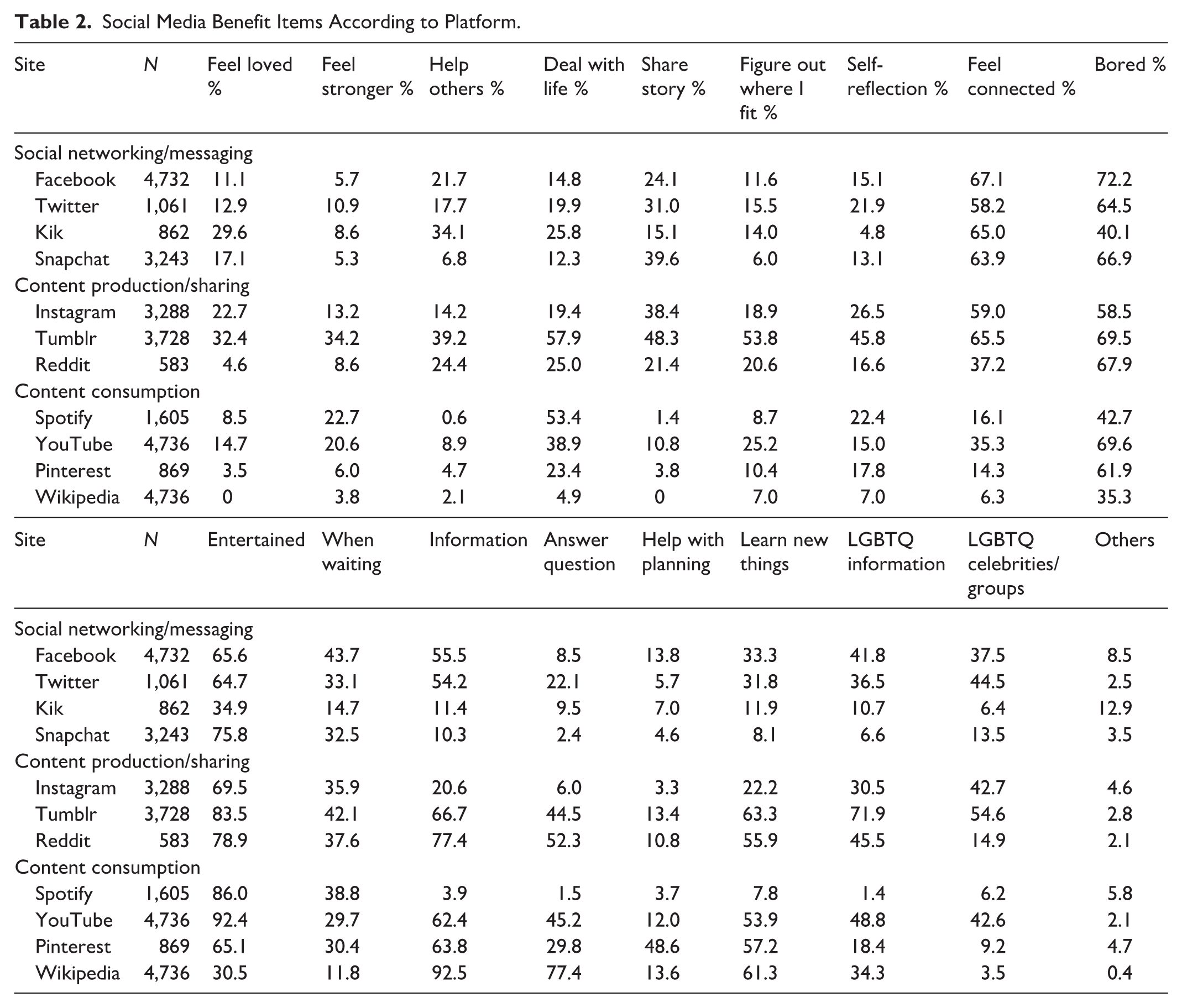
Respondents’ motivations for use of their five favorite social media sites were measured via a two-step question which included 17 individual items relating to helpful engagement and impact of engagement on each of their favorite platforms (see Table 2). In the absence of an existing scale to assess how LGBTQ+ youth use social media in positive ways, scale items were developed through a literature review, interviews with LGBTQ+ youth (Craig et al., 2015; McInroy & Craig, 2015), and consultation with a youth advisory board consisting of LGBTQ+ youth from the United States and Canada. Items such as feeling connected and helping others emerged primarily from the literature (Hanckel et al., 2019), whereas “figuring out where I fit” and “sharing my story” came from the authors’ qualitative work with LGBTQ+ youth (Craig et al., 2015; McInroy & Craig, 2015) and items regarding LGBTQ+ information and celebrities/groups were identified by a youth advisory board. This scale is designed in such a way that higher scores indicate that youths’ social media use may, at least in part, be motivated by these items with the potential to enhance their well-being, such as feeling supported (Hanckel et al., 2019) and feeling connected (Hockin-Boyers et al., 2020). Adversely, lower scores could suggest that youth’s social media participation on their favorite platforms is not motivated by these potential well-being-enhancing benefits. A separate scale would be needed to assess for negative social media factors (or harms) such as cyberbullying or the default public nature of many platforms that may cause LGBTQ+ youth to unintentionally out themselves to family (Cho, 2017) as they differ from well-being benefits.
Social Media Benefit Items According to Platform.
Question Step 1
Respondents were first asked to indicate their five favorite sites (e.g., Facebook, Instagram, YouTube, Tumblr) from an exhaustive list of platforms available at the time of study; the question was “Please choose your FIVE favorite sites.”
Question Step 2
For each of their five favorite sites, participants were then asked “Why do you use [favorite site name]?” There were 17 check-box response options for this question, including self-reflection, gaining information, and feeling connected (see Table 2 for all items). Respondents were able to check all the boxes that reflected their beneficial purposes for using that particular favorite site. For each of the 17 benefit items, data were coded as “1” (used the site for this item) if the respondents checked the box, and “0” (did not use the site for this item) if the respondents did not check the box.
To obtain each individual’s combined score for each benefit item, the values of all five favorite sites for each benefit item were summed. This coding resulted in 17 combined scores from 0 to 5: a combined score of 0 reflects that the respondent did not use any of their five favorite sites for that benefit item, and a score of 5 reflects that the respondent used all five of their favorite sites for the specific item. A higher score, therefore, indicates a more substantive use of social media sites for that particular benefit item. Cronbach’s alpha of the scale is .889. The procedure of coding and deriving the 17 items is presented in Figure 1.

Flowchart of the procedure of coding and deriving scale items.
Demographic Variables
Demographic variables include age group (age 14–18, 19–24, and 25–29; ordinal), sexual orientation (one binary variable for each identity; yes/no), gender identity (one binary variable for each identity; yes/no), and race and ethnicity.
Data Analysis
Descriptive statistics for each item were obtained according to the social media platform. An exploratory factor analysis (EFA) was conducted in SPSS to understand the factor structure of the SMBS. Using unweighted least squares extraction method, the extraction of factors stopped when eigenvalue < 1; oblique rotation was used. Factor scores were produced through the factor analysis, and these factor scores were subsequently used for analysis of age group differences. Analysis of variance (ANOVA) and post hoc tests (Sheffe) were conducted to examine whether LGBTQ+ youth of different age groups used social media for different purposes.
Results
Benefits of Social Media Platform
Table 2 shows the percentage of LGBTQ+ youth respondents who indicated that each platform was among their five favorites and which they used for each specific benefit item. For example, 11.1% of the youth who chose Facebook as one of their favorites (n = 4,732) indicated that they used Facebook because it helped them feel loved.
Descriptive Statistics
As shown in Table 3, each item of the SMBS ranges from 0 to 5. The item “to be entertained” has the highest mean (M = 3.51), followed by “because I’m bored” (M = 2.97). The item “helps me plan” has the lowest mean (M = 0.49), followed by “makes me feel stronger” (M = 0.70). The means reflect to what degree LGBTQ+ youth use social media for that particular benefit item: for example, a mean of 1.98 for “give me information” reflects that, on average, each youth uses approximately two different platforms to obtain information. Hence, even though the means are comparatively low for items like “makes me feel stronger,” the fact that the average is close to 1 means that each participant uses around one platform for that item on average.
Descriptive Statistics of Scale Items.

EFA
To explore the factor structure of the SMBS, an EFA using unweighted least squares extraction method and oblique rotation was conducted. It was performed on the 17 items of the SMBS scale for the 6,178 participants who did not have any missing data in this scale. Bartlett’s test of sphericity is significant (χ2 = 40,828, p < .0005), meaning that the correlation matrix is significantly different from identity matrix (i.e., the correlations among items are not zero).
Based on the eigenvalue (extraction stopped when eigenvalue < 1), a four-factor solution emerged (with factor loading greater than .30), which explained 50.42% of the common variances. The factor loadings are presented in Table 4. The first factor comprises eight items, which measured LGBTQ+ youth’s usage of social media for emotional support and development. The second factor consists of four items, which indicates LGBTQ+ youths’ use of social media for general educational purposes. The third factor contains three items, which represents participants’ use of social media for entertainment or “killing time.” The last factor consists of two items, which measures youth’s usage of social media for LGBTQ+ specific information.
Factor Loading of Scale Items for Four-Factor Solution (Loadings Under .30 Are Hidden).

Factor 1: Emotional support and development; Factor 2: General education; Factor 3: Entertainment; Factor 4: LGBTQ+ information.
Age Group Differences
To examine the age group differences of youths’ beneficial use of social media, four ANOVAs were conducted (presented in Table 5). Results show that there are age group differences for all four factors (F = 3.79–75.88, p < .05). Sheffe post hoc tests show that youth aged 14–18 were more likely to use social media for emotional support and development than those aged 19–24 (p < .0005) and that those aged 19–24 were more likely to use social media for emotional support and development than those aged 25–29 (p < .0005). For general education, youth aged 14–18 had significantly lower scores than those aged 19–24 (p = .024). Youth aged 14–18 were more likely to use social media for entertainment than those aged 19–24 (p = .042), and those aged 19–24 had significantly higher score than those aged 25–29 (p < .0005). Finally, the youngest age group were also more likely to use social media for LGBTQ+ information than the other two age groups (p < .0005), and those aged 19–24 had higher scores than those aged 25–29 (p < .0005). In general, the results demonstrate that younger adolescents were more likely to use social media for emotional support, entertainment, and access to LGBTQ+ information—and that use decreased as age increased. Youth between ages 19 and 24 were more likely than other two groups to access general educational opportunities through social media.
Results of Age Group Comparison for Social Media Benefits.
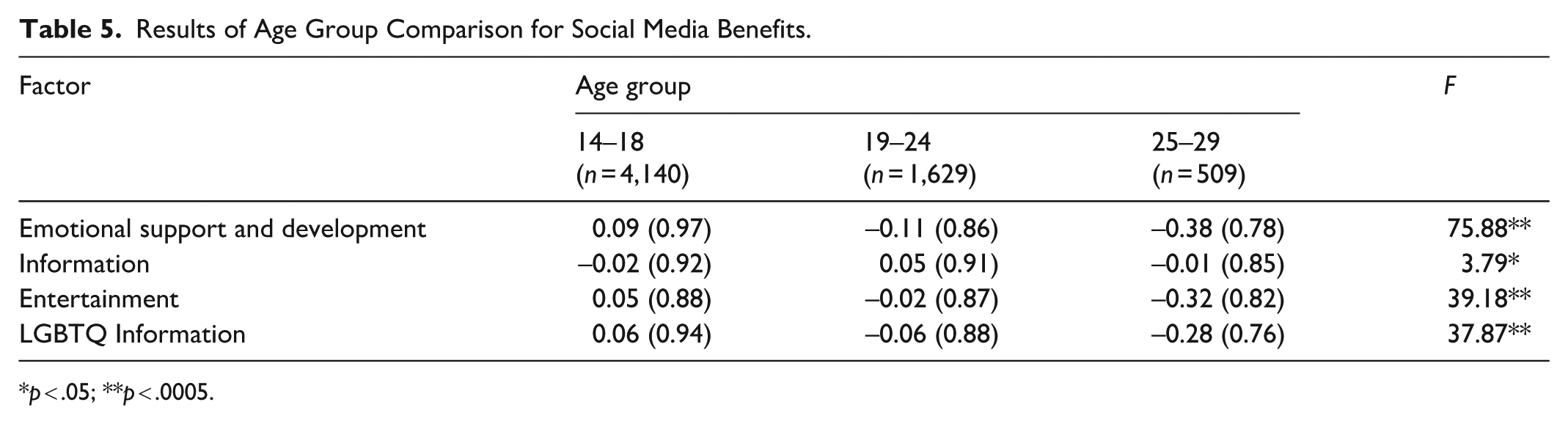
p < .05; **p < .0005.
Discussion
This study provides meaningful insight into the potential benefits derived from social media use among LGBTQ+ youth and presents the SMBS—which has promise for measuring the positive impacts of social media on this population, and potentially other similarly stigmatized groups (Fox & Ralston, 2016; McInroy et al., 2019a). The purpose of this study was to develop the SMBS and—as part of that process—begin to identify potential well-being-enhancing dimensions related to social media usage for LGBTQ+ youth. The results indicate that social media benefits can be conceptualized as multidimensional (i.e., emotional support and development; general education; entertainment; identity-specific information) as it relates to their social media use and has implications for research and professional practice (e.g., psychology, social work, counseling).
Social Media’s Effect on LGBTQ+ Youth Well-Being
First, the findings from this study support the emerging understanding that social media can have a positive effect on LGBTQ+ youth well-being. Extant research has focused disproportionately on negative effects of social media participation, identifying social media’s potential to increase anxiety, depression, and stress, as well as lower self-esteem and other aspects of mental well-being among youth (Shaw et al., 2015; Woods & Scott, 2016). This study suggests that social media also helps stigmatized youth maintain critical access to emotional support, develop their identities, find important information, and be entertained, which aligns with emerging exploratory research on the benefits of social media and forms of coping for LGBTQ+ youth (Alhabash & Ma, 2017; Craig et al., 2015; Ellison et al., 2007; Hanckel et al., 2019; McInroy et al., 2019b). Individual items (such as feeling connected and helping others) align with qualitative research on how LGBTQ+ youth use social media (Hanckel et al., 2019). Furthermore, this study parsed out some of the benefits by age, as younger participants were more likely to use social media to enhance their well-being across all four factors than their older counterparts. This supports previous studies of youth social media use (Hausmann et al., 2017; McInroy et al., 2019a), which show that younger adolescents were more likely to report more significant impacts from social media than older youth.
Second, this study provides a deeper understanding of the utility of particular types of platforms for LGBTQ+ youth, which, despite the rapid changes in technologies, can provide a framework for a broader conceptualization of the benefits.
Social Networking and Messaging Platforms
Social networking and messaging platforms used by participants at the time of study (2016) included Facebook, Twitter, Kik, and Snapchat. At that time, they served as intimate portals for users to construct and curate a life record in collaboration with and for the audience of an interconnected network of users who shared some form of emotional relationship (Robards & Lincoln, 2016). Since this study was conducted, privacy concerns and a more business-oriented approach from the developers have changed the nature of some of these platforms, to be less of a space for personal connection, and increasingly more public (Buehler, 2017; Hollenbaugh, 2019). For example, Twitter is becoming almost entirely a platform for paid promotions, public opinion, and polarizing debate with little social networking or connection (Pain & Chen, 2019).
Content Production and Sharing Platforms
Platforms where individual users are all encouraged to create content that could be shared publicly—or at least more broadly than with an interconnected group (as in the previous category)—included Instagram, Tumblr, and Reddit for participants at the time of the study. These platforms were frequently used to curate an image and representation of self that may be otherwise absent or lacking in media, with some greater privacy settings (such as not being able to save photos locally) and more limited user interaction than the platforms in the previous category (Baulch & Pramiyanti, 2018; Locatelli, 2017). With recent events such as Instagram’s acquisition by Facebook, Tumblr’s fall from prominence, and the overall trend toward commercialization of mainstream social media (O’Meara, 2019), the extent to which all users produce and share content has fluctuated and individual platforms may have shifted into or out of this category.
Content Consumption Platforms
Content consumption platforms differ from content production and sharing platforms in their primary purpose of utilization. While all users can potentially produce and share content, there is a relatively small proportion who generally choose to do so, with most users accessing the platform to consume content. YouTube, Wikipedia, Spotify, and Pinterest were examples of these platforms at the time of study. Users frequently access these platforms to see themselves reflected in content created by others, and this content can be an important component of identity development, socialization, and social recognition processes (Balleys et al., 2020; Lewallen & Behm-Morawitz, 2016). Again, the commercialization of mainstream social media has altered user patterns and behaviors, although possibly not to the same extent as in the first two categories (Schwemmer & Ziewiecki, 2018).
Strategies for Enhancing LGBTQ+ Youth Well-Being on Social Media
Third, the results from this investigation provide a scale with utility for promoting deeper understanding of the positive role that social media play in the daily lives of LGBTQ+ youth and enable professional practitioners and scholars to develop more nuanced strategies to enhance well-being efforts with this marginalized population. The scale provides a reliable multi-item, multidimensional way to measure impacts of social media use among LGBTQ+ youth which suggests positive impacts if SMBS scores are high and potentially negative or null impacts if SMBS scores are low. Moreover, the results from this investigation highlight key dimensions of well-being for LGBTQ+ youth that can be targeted in research and practice.
For example, organizations and programs that serve LGBTQ+ youth can utilize the SMBS to consider their particular approach to developing and implementing a social media strategy with the specific population of young people that they serve. When trying to further facilitate the emotional support aspect of social media articulated for LGBTQ+ youth, the media content that providers and organizations disseminate should be interactive, encourage direct engagement, and allow youth to curate their social media intake to minimize negative messages and increase messages that affirm LGBTQ+ identities (McInroy et al., 2019b). Likewise, when focused on the educational aspect of well-being, social media should be leveraged to provide important identity-specific information in a way that enhances the coping skills of LGBTQ+ youth (Goldbach & Gibbs, 2015).
Clinical Utility of the Social Media Well-Being Scale
Fourth, the SMBS also has potential as a clinical tool that can be used to individually assess the impact of social media on the well-being of a particular LGBTQ+ youth, as well as their motivations for use. This can be a starting point from which practitioners can tailor individual interventions to reinforce the positive aspects of a client’s social media engagement to promote their well-being. Such approaches can include partnering with youth to better understand the individual impact of social media and educate them on the risks and benefits of social media use as they navigate their daily lives (McInroy & Craig, 2015). The lens of positive impact on well-being serves as a more comprehensive understanding of social media and represents a shift in addressing its use among a marginalized youth population.
The Interactive Nature of Social Media Use for LGBTQ+ Youth
Finally, this study illustrates the interactive nature of social media engagement for LGBTQ+ youth. Emerging research on social media tends to divide social media use into active or passive categories which seem to have differential impact on subjective well-being (Frison & Eggermont, 2015). Active social media use typically allow users to engage directly with others (e.g., messaging, commenting) in more of a producer role that has been linked to positive well-being (Verduyn et al., 2015). These associations are enabled by perceived social support (Frison & Eggermont, 2015). Passive social media use that does not directly engage participants with one another (e.g., viewing profiles, watching videos) has been found in previous research to negatively impact well-being (Verduyn et al., 2015), although it could also be a form of escapist coping (McInroy et al., 2019b). This negativity is typically attributed to the process of social comparison to other people’s social media profiles (Tandoc et al., 2015). Although this study did not set out to capture the differences between active and passive use, several of the key variable constructs do seem to align with these categories (with entertainment as the most prominent passive category and emotional support and development as the most active). That said, the increasingly interactive nature of many social media sites (e.g., Instagram Live, YouTube Live, Twitch) allow for the co-occurrence of passive and active usage in a single interaction, which does make it more difficult to parse. Thus, the holistic approach to understanding the impact of social media use on the well-being of LGBTQ+ youth utilized by this study may be beneficial.
Opportunities for Future Research
As the platforms used in this study were diverse and with a large sample, the SMBS may be relevant regardless of the specific social media platforms (e.g., Facebook, Twitter) under study. Given the fluctuating nature of online platforms and pending validation studies, this scale is likely to have utility beyond the platforms used in its development. There may also be potential for transferability of the instrument to other marginalized youth populations who seek safety and support online and to older LGBTQ+ populations who may use social media for similar purposes. Many people develop their LGBTQ+ identity later in life, and social media could be a catalyst for this process of identity discovery. Thus, this scale could be adapted and applied in a range of populations and contexts. While the online survey included dating and hook-up apps and mental health apps as options for the five favorite sites, participants chose social networking/messaging, content production/sharing, and content consumption platforms instead of dating and hook-up or mental health platforms.
As such, this study cannot build upon extant work on sexting and online sexualization among LGBTQ+ youth (Albury & Byron, 2014) nor upon experiences of LGBTQ+ youth with mental health apps (Byron, 2019). A study that specifically focuses on dating and hook-up platforms using the SMBS may corroborate emerging research showing that these apps may not exacerbate sexual health risk and instead offer pathways to intimacy and connection (Albury, 2018). Surveying LGBTQ+ youth with the SMBS about their use of mental health apps may also be of benefit. While this study is not representative of LGBTQ+ youth in the United States and Canada, there was more youth identifying as female, gender non-confirming, pansexual, and bisexual than there were youth identifying as gay and male which is reflective of the current identity categories endorsed by LGBTQ+ youth populations in other online studies (McInroy et al., 2019a; Waite & Denier, 2019). The study sample is also disproportionately white, although this is typical of online studies with LGBTQ+ youth (Waite & Denier, 2019) and may be attributable to the snowball nature of online recruitment. As such, further studies of the SMBS with gender, sexual, and ethnic sub-populations of LGBTQ youth would be necessarily to validate its utility across groups of queer youth.
Limitations
This study has several limitations. As we could not identify an existing scale that measures positive reasons for social media use among LGBTQ+ youth, further validation studies are necessary to determine the extent to which this scale encompasses and measures the construct. This study does not focus specifically on important negative aspects related to social media use such as social overload (Chai et al., 2019) as the study’s purpose was to develop a scale that may accurately assess social media benefits that may enhance well-being. This approach may have overly prescribed the notion that social media produces positive effects on well-being, without sufficient attention to the negative impacts, which limits interpretation. As scores were high across platform categories, suggesting that participants glean benefits from social media, we are unable to infer conclusions regarding non-well-being from this data. Furthermore, this study is limited by its focus on LGBTQ+ youth in the United States and Canada; social media use may have differential impacts based on location and population.
Conclusion
This study presents a scale that aligns with emerging exploratory research on the benefits of social media for youth well-being. With a large and diverse sample, the four key factors of social media for LGBTQ+ youth (emotional support and development, LGBTQ+ information, general education, entertainment) provide a more nuanced understanding of the role of emerging technology in the well-being of this population. The promising EFA results could be attributed to the combination of inductive (i.e., literature review) and deductive (i.e., interviews, advisory board) strategies used in scale development. Adaptation of the SMBS through a similar identity-specific combination strategy could enhance the scale’s utility to explore the benefits of social media in other populations.
Footnotes
Acknowledgements
We thank the youth participants for their contributions.
Declaration of Conflicting Interests
The author(s) declared no potential conflicts of interest with respect to the research, authorship, and/or publication of this article.
Funding
The author(s) disclosed receipt of the following financial support for the research, authorship, and/or publication of this article: This work was supported by Insight and Partnership Grants from the Social Sciences and Humanities Research Council of Canada (SSHRC #495-2015-0780 and #895-2018-1000). Shelley L. Craig is the Canada Research Chair in Sexual and Gender Minority Youth. A.D.E. holds a salary award from the Ontario HIV Treatment Network (OHTN).
