




Abstract
Social media activism is often valued for its role in mobilizing physical protests, effecting social change, and raising awareness. We propose that networked care is another valuable aspect of online social movements, and that definitions of connective action should be expanded to include it. In addition, we show that when activism occurs in a response to a social crisis, it follows a temporal framework which aligns with existing social crisis schemata. This is explored through analyzing #ShutdownStories movement that sprang up on Twitter in response to the 2018–2019 government shutdown. We take a multi-methods approach, combining text mining approaches with manual content analysis, and using established social support frameworks to show how networked care manifests within digital activism. Through this we broaden and diversify what is considered political action worthy of study within the field of communication.
Keywords
Introduction
Does care work “count” as political activism? Care and support are often coded as apolitical and therefore less important (Kavada, 2020) which relates to common gender norms where work that is coded as feminine is low-status, low-paid and underrecognized (D’Ignazio & Klein, 2020). We argue that care is an essential part of connective movements and as such we introduce the concept of networked social support, building on pre-existing social support schematas (Cutrona & Suhr, 1992; Mao et al., 2010). We posit that this in an integral driver of networked social movements, intimately related to forms of connective action such as personalized storytelling and resource-sharing (Bennett & Segerberg, 2012). Recentering this activity within digital activism serves to broaden and diversify what is considered worthy of study and note within the field of communication.
This is explored through taking #ShutdownStories as a case study, using Twitter data gathered during and just after the events described. The #ShutdownStories movement developed quickly in response to the historical 2018–2019 U.S. government shutdown, the longest on record (Lu & Singhvi, 2019).
On 22 December, 9 out of 15 federal departments were closed, after Trump was unable to secure US$5.7 billion to build a border wall in the Southwestern United States (Feldman, 2019). 380,000 federal workers and contractors were furloughed, and another 420,000 employees were required to keep working without pay, including the U.S. Coast Guard and TSA agents (Feldman, 2019; USA Today, 2018). While direct federal employees were entitled to back-pay once the shutdown ended, federal contractors were not (Melink & Gregg, 2019).
In response to the economic hardship caused by the shutdown, restaurants gave out free meals, food banks saw increased demand, and workers looked to fundraisers and gig work to pay bills (Melink & Gregg, 2019). The shutdown ended on 25 January 2019 (Lu & Singhvi, 2019). Just over a year later, at the start of the coronavirus pandemic, these scenes of the formerly employed queuing for food relief or being plunged into housing insecurity were repeated. Alongside this, digital activism and mutual aid groups aimed to alleviate the worst social and economic consequences. The government shutdown foreshadowed social issues highlighted by the pandemic, including problems such as employment vulnerability, the increased precarity of the American middle class, and subsequent intersections with marginalization along the lines of race, class, and gender.
The nature of digital protest itself, and the affordances of the platforms it takes place upon, may be uniquely suited to providing care and social support, as compared to physical protest. Digital movements open up activities to those who are geographically dispersed and those who might struggle to participate in physical protest due to disabilities or health considerations, care or employment responsibilities, or financial limitations. Support can be given and received in a manner that is impossible during in-person protest due to the asynchronous digital environment on social media where hashtags enable connectivity between users (Papacharissi, 2015).
We also demonstrate a temporal framework that undergirds how connective action unfolds during a social crisis, drawing upon an established social crisis schemata (Spence et al., 2015). It has already been established that activity changes during the life cycle of a movement (Vaast et al., 2017), but much research focuses on the peak moments of ongoing massive movements, such as Ferguson with #BlackLivesMatter, or the emergence of #MeToo. A fundamental aspect of computational data is its temporal nature (Salganik, 2018), and this ability to granularly disaggregate and analyze data longitudinally is often not explored to its full extent, particularly given the flexibility within big datasets to segment the data by time in accordance with time-related theoretical frameworks.
#ShutdownStories offers a compelling case study addressing connective action in a social crisis, with clearly delineated time periods, and a strong central focus. Through taking a multi-method computational and qualitative approach combining large-scale textual analysis with granular qualitative approaches, and triangulating the two, enables us to provide a breadth and depth of analysis that contributes to our understanding of these phenomena.
Connective Action
Connective action uses the affordances of digital media technologies as a basis to generate movements around social and political issues (Bennett & Segerberg, 2012). These movements scale quickly, are highly flexible, have loose or no leadership, and are characterized by sharing “personalized ideas, plans, images, and resources with networks of others” (Bennett & Segerberg, 2012, p. 753). Weak-tie networks that are found on social media platforms, such as Twitter, enable connective action by making it easy and relatively effortless for individuals to follow, connect, and share stories, calls to action, and information with others that they are only tangentially connected to (Benkler, 2006; Bennett & Segerberg, 2012; Papacharissi & de Fatima Oliveira, 2012), often using movement hashtags to do so. Defining examples of these movements include Occupy and the 2011 Egyptian revolution (Bennett & Segerberg, 2012; Papacharissi, 2015), and later #BlackLivesMatter and #MeToo. These frequently studied later movements often tackle long-term systemic injustices, meaning that they unfold over periods of years, and are currently ongoing.
Digital activity facilitates a range of protest behaviors, which include physical, logistical, and emotional support for in-person protestors (Chrona & Bee, 2017; Tufekci, 2017). However, despite the acknowledged importance of food and medical supplies, protest libraries, solidarity, and emotional support, protestors themselves often have a hierarchy of action in which this support is seen as less important than in-person protest (Kavada, 2015). This aligns with a wider phenomenon where care and support are often not seen as political, even with activism and social movements (Kavada, 2020). Obvious gender norms abound here to do with devaluing labor that is traditionally coded as female or feminine, and which corresponds to wider societal devaluing of care work economically and socially, viewing it as low-skilled and it being low-paid. Perhaps unsurprisingly, support and care-related aspects of connective action movements are understudied.
Even before the coronavirus pandemic, in-person protesting was not possible for everyone for a variety of reasons, with limitations being posed by personal finances, employment, caregiving responsibilities, health, and location (Gerbaudo, 2020). For the federal employees and contractors impacted by the shutdown, a combination of financial concerns combined with dispersal throughout the United States made centralized protests, along the lines of the Women’s March, impractical. Instead, digital activism could be done for little cost, from home, and while balancing gig or temporary jobs, childcare, and other everyday responsibilities.
Although the most well-known examples of connective action are social justice or revolutionary movements, it is also seen in response to social crises. Two examples of this are a rescue mission to find lost hikers in Iran (Khazraee et al., 2018) and large numbers of Syrian refugees arriving in Hungary in 2015 (Dessewffy & Nagy, 2016). In both cases there was mass scale self-organization on social media to assist those in peril or need, and to provide support and assistance online and offline (Dessewffy & Nagy, 2016; Khazraee et al., 2018). Connective action related to social crises is understudied despite the political relevance of humanitarian action (Dessewffy & Nagy, 2016).
Another aspect of connective action is that it is not homogeneous over time, and often having distinct periods with different types of action (Vaast et al., 2017). For understandable reasons, research often focuses on high-impact instances of social justice movements, such as Ferguson for #BlackLivesMatter or the emergence of #MeToo. The focus on these pivotal moments in time does not mean that other periods of activity can be neglected, while the sheer size of mass-scale online movements can make less well-known episodes difficult to isolate. Moreover, social crises tend to follow a four-stage activity pattern: pre-crisis, early or acute, chronic, and post-crisis (Spence et al., 2015).
This has a two-fold relevance. In terms of connective action in social crisis, it makes it important to understand how connective action unfolds during the different crisis periods. For wider related research, it offers an opportunity to study a time-bound case-study which includes periods of both low and high activity and awareness, which often is much harder to do with massive, long-term social movements.
#Shutdown Stories displays the key characteristics of connective action. Moving to Tilly and Tarrow’s seminal definition of social movements as “a sustained challenge to power holders in the name of a population living under the jurisdiction of those power holders by means of repeated public displays of that populations worthiness, unity, numbers, and commitment” (1999, p. 257), the campaign meets these requirements, which are shown by Freelon et al. (2018) to be similarly meaningful in connective action.
It is explicitly focused on achieving a key political goal, the end of the shutdown, precipitated by Trump being unable to gain funds for a border wall. The policy was a core part of Trump’s highly politically polarizing anti-immigration platform (Rodgers & Bailey, 2020), which was heavily criticized by Democrats and left-leaning media. As such responses to the shutdown were explicitly political within the American landscape. Those affected, federal employees and contractors, live their professional lives under the command of the U.S. President and government.
Worthiness, unity, numbers, and commitment are displayed on Twitter, and then picked up on by mainstream U.S. media outlets. Worthiness is particularly interesting in this case, as the plight of those affected has strong bipartisan appeal. The U.S. Coast Guard is classed as part of the military and many federal employees and contractors are veterans (Bur, 2020). As such they benefit from the high esteem with which the military are held, Pew Research Center (War and Sacrifice in the Post-9/11 Era, 2011), and former and active military personnel tended to skew Republican (Copp, 2020; Foy & Restifo, 2018). The campaign shows unity, as those affected come together to show the human cost of the shutdown and end it, and numbers, in the volume of people tweeting. This may be particularly useful as the participants were dispersed throughout the United States. Commitment is evidence by their willingness to participate, sharing details of personal financial hardship, which is often stigmatized.
As a leaderless, community-driven movement with a clearly articulated political goal #ShutdownStories exhibits the core hallmarks of connection action: using a highly saleable digital network, resource sharing, and driven by individual experiences (Bennett & Segerberg, 2012). At its center these individual stories are clear examples of “personal action frames [that] are inclusive of different personal reasons for contesting a situation that needs to be changed” (Bennett & Segerberg, 2012, p. 744).
RQ1a. How does connective action develop over time during a time-bound social crisis?
RQ1b. Which elements of connective action come to the fore during which stages of the crisis?
Online Social Support and Connective Action
Accessing social support is a major driver of online activity (Qian & Mao, 2010), both on forums and services focused on specific needs or life-stages, and social media. This is particularly true for stressful life events, including health problems (Laranjo et al., 2015; Rui et al., 2013), living with disability (Braithwaite et al., 1999), pregnancy and new motherhood as an overseas Chinese immigrant (Mao et al., 2010; Qian & Mao, 2010), and military spouses during their partner’s deployment (Desens et al., 2019). It is also sought out by sexual assault survivors (Hosterman et al., 2018; Lowenstein-Barkai, 2020; Manikonda et al., 2018), and those suffering from stigmatized mental health conditions (De Choudhury & Kiciman, 2017; Ni et al., 2020).
Although use of social media has sometimes been associated with negative mental health outcomes (Dhir et al., 2018; Vannucci et al., 2017), several studies show a link between accessing social support online and increased emotional wellbeing and mental health (Cole et al., 2017; Ni et al., 2020; Pang, 2018). These include studies of immigrant mothers and international students, where social media enables quick responses, tangible assistance, and social and emotional support that is not always readily available in their immediate offline communities (Lee & Chen, 2018; Pang, 2018). Another study of undergraduate students showed that online social support was particularly important for those with weak in-person support (Cole et al., 2017). During the COVID-19 crisis, online social support has been important in combatting loneliness associated with social isolation, and general anxiety levels (Saltzman et al., 2020).
Giving and receiving social support can motivate social media participation (Oh & Syn, 2015). There are obvious links between learning and social engagement, the most popular motivations for using Twitter, and sharing informational resources and offering emotional support (Oh & Syn, 2015). Men receive less social support in-person, but this bias disappears online (Kim, 2014), which suggests social media may provide an outlet for populations who, for whatever reason, may struggle to find in-person support. This is particularly relevant when considering a social crisis where diverse people are geographically dispersed.
That online social support is important for those experiencing stressful and/or stigmatizing experiences and can help health and wellbeing is relevant at both the micro and macro level to connective action. This supports previous findings that social media use can encourage resilience in the face of crisis (Steensen & Eide, 2019). In the specific case of #ShutdownStories, those directly affected suffered from the obviously stressful effects of not being paid, putting many under serious financial strain. Effectively even those who were still having to work, were suffering from similar financial effects as being unemployed. Experiencing severe financial hardship is extremely stressful, associated with poor mental health (Silva et al., 2016), and it is often highly stigmatized (Shafir, 2017; Whittle et al., 2017), along with related activities such as relying upon assistance, visiting food banks, or defaulting on payments. Such experiences can be very isolating (Eckhard, 2018; Stewart et al., 2009), especially if it suddenly sets people apart from those in their regular community network.
At the macro scale, participating in long-term activism can lead to burn-out (Chen & Gorski, 2015; Gorski, 2019), as well as stress associated with acute in-person protests, particularly those met with violence by authorities. Moreover, there is often stigma associated with injustice and oppression, whether that’s the stigma of being raped, sexually assaulted or harassed (Jackson et al., 2020; Manikonda et al., 2018), or unjust stereotypes of Black people that relate to being perceived as threatening (Hon, 2016). As such, social support could play an important role in helping people cope with this and stay engaged in the movement.
Online social support takes a variety of forms. Cutrona and Suhr’s (1992) framework encompasses informational, emotional, social network, tangible, and esteem support and across a multitude of studies and contexts, informational and emotional types of social support occur most frequently (Desens et al., 2019; Qian & Mao, 2010; Rains et al., 2015; Rui et al., 2013). On social media, one meta-analysis found that the preference for informational support remained, but there was scant tangible support (Liu et al., 2018). Yet this is not always the case. When people are looking for support around bipolar disorder, a highly stigmatized health condition, emotional support was the most sought type of support, as compared to general mental health (Ni et al., 2020). This suggests that the more stigmatized an experience is, the more emotional support may be sought from understanding communities online.
The weak ties which drive connective action on digital platforms, also enable social support to happen in these movements. This is most clearly seen in the #MeToo movement, where emotional and information support is a major factor in responses (Hosterman et al., 2018), and sharing stories and support around sexual trauma was essential for the movement’s growth (Suk et al., 2019). The anonymity of Twitter may also be a factor, as gaining support from weak ties is often preferred with stigmatized conditions (Andalibi et al., 2016; Hosterman et al., 2018).
Suk et al. (2019) found that networked acknowledgment was a strong primary facilitator for more enduring activism in the #MeToo network, and there are parallels between this and forms of social support. Someone practicing networked acknowledgment is recognizing the validity of someone’s experience (Suk et al., 2019), and engaging in “an opportunity to give attention to the others we encounter in our lives and offers an opportunity to communicate care” (Suk et al., 2019). This is similar to the definitions of emotional support, which includes empathy and sympathy, and validation in esteem support (Suhr et al., 2002). The solidarity built by sharing and responding to such vulnerable personal stories helped build #MeToo’s success (Winderman, 2019). Taken together, this further suggests that social support might be important for connective movements through encouraging and supporting personal testimony and expressive stories which build widespread visibility and a platform for ongoing activism.
When social support has been analyzed in the #MeToo and associated movements, emotional and information support are not always the most common. Lowenstein-Barkai (2020) found that emotional, esteem and network support were most frequently offered in response to sexual assault disclosures, but that this could differ according to the original poster’s gender. In this case, she (2020) defined a new category, retributive justice, focused on calls to punish the perpetrator and for restorative justice. However, under Suhr et al.’s (2002) coding system this is similar to the validation and relief of blame aspect of esteem support. This is in contrast to Hosterman et al.’s (2018) and Andalibi et al.’s (2016) findings were informational support was in fact the most usual form of support. Hosterman et al. (2018) also defined a new category of support, directive action, which “encouraged readers to take action in ways that would directly help victims or address larger social problems that contribute to sexual violence” (p. 78). This was the second most frequently occurring type of tweet in their study and is similar to some types of behaviors classified as tangible support, such as offering to do something related to the problem or a willingness to help (Suhr et al., 2002).
There are “a limited number of studies done on social support messages sent via Twitter” (Hosterman et al., 2018, p. 87), and this is particularly true for connective action in relation to social crises. #ShutdownStories offers a multi-layered case study to explore the role of social support in connective action that is not related to #MeToo and survivors of sexual assault. Informational, emotional-esteem, and tangible support emerge as the most important types of social support in existing studies (Andalibi et al., 2016; Hosterman et al., 2018; Suk et al., 2019). This research seeks to ascertain if these findings are consistent in connective action around a different issue, and in a time-bound social crisis.
Although there is a major difference between the two in that #MeToo responds to systemic injustice against women, with specific reference to rape, sexual assault and sexual harassment, while #ShutdownStories is in response to a crisis the Trump administration caused and could have ended at any time, there are also a number of similarities which suggest we might find similar results. Social support responds to the impact a situation has on an individual, whether they are struggling to cope with the aftermath of sexual assault or a financial crisis. The highly politicized nature of this social crisis, along with the stress and stigma associated with financial troubles, and the dispersed locations of those affected, would seem to align with a high-level of need for giving and receiving both intangible and tangible support online. Yet, that the shutdown could cause such financial distress so quickly is a symptom of widening systematic economic inequality in the United States and associated societal issues. In this case, the growing casualization of the federal workforce through contracting, and rising cost of living contrasted with stagnating wages means that many people in even well-paid jobs are only a paycheck or two away from homelessness. The financial precarity aspect of #ShutdownStories is a key difference between the two cases and suggests that tangible support may emerge as more prominent. Digital payment platforms became more widely used between the early days of #MeToo and the time of the shutdown, with Venmo more than doubling the value of payments made between the first quarters of 2017 and 2018. Coupled with existing food bank infrastructure, this may make it easier for tangible support to be received, and therefore more likely to be solicited.
Building on the concepts of networked acknowledgment and distinct social support categories developed for online movements, we would like to propose the introduction of the concept of networked social support as an important category of activity. This has several benefits. It acknowledges the importance of care and support in political and activist contexts, and the role which this plays in connective action. Based on Cutrona and Suhr’s (1992) taxonomy of social support, it also has the benefit of being broad and flexible enough to encompass a variety of behaviors, without needing to introduce new sub-categories. Particularly as some of their categories could fit into existing ones. This should aid in replicability of future research and understanding how social support is used in various different circumstances.
RQ2a. What types of social support are prevalent in connective action during a social crisis?
RQ2b. Does this change depending on the crisis period, and whether social support is being given or sought?
Methods and Data
Tweets containing the hashtag #ShutdownStories were collected from the start of the shutdown on 23 December 2018 until 2 February 2019, a week after the shutdown ended. Retweets were not included in the dataset, giving a total of 21,000 original tweets.
We identified the four typical periods of a crisis: the initial build-up or prodromal stage; the beginning or acute stage; the ongoing or chronic stage; and the termination or post-crisis stage (Fink, 1986; Spence et al., 2015). In the case of #ShutdownStories, the initial build-up stage was extremely compressed in time and blends with the subsequent stage, as the movement started in response to the shutdown being declared. The early or acute stage was defined as running from the first full day after the start of the shutdown on 23 December 2018, until the day before federal workers and contractors missed their first paycheck on 11 January 2019 (Lu & Singhvi, 2019). The late or chronic stage was defined as running from 11 January 2019 through to the end of the shutdown on 25 January 2019 (Lu & Singhvi, 2019), and the post-crisis stage was defined as running from 26 January to 2 February 2019. The dataset was split into three according to these dates, enabling analysis for specific periods of the government shutdown crisis.
A multi method approach was taken, triangulating computational and manual text analysis. A term frequency, inverse document frequency (tf-idf) analysis was used to answer the first research question, while manual content analysis was used to answer the second. A tf-idf analysis will highlight words that are highly distinctive to, or more likely to occur in, a specific corpus of documents, in this case groups of tweets. An inverse term frequency is used to give greater weight to the less frequently used terms within a group of tweets, while decreasing the weight of common words. It is calculated by multiplying the tfs within a corpus with the idf, as shown in the following equations

This analysis offers a way to identify language and user behavior that are distinctive during the different crisis stages by cutting through the noise of common words.
Prior to the analysis being run, the dataset was split by crisis period, tokenized, and stop words were applied. When a dataset is tokenized, the text strings, in this case individual tweets, were broken down into their individual components (words, hyperlinks, at mentions, etc.). These individual tokens are then used for the text mining analysis, in a data frame which links them back to grouping ids. The tokenized dataset was cast to a document-term matrix before running the tf-idf analysis. After analysis, the dataset of full tweets was examined manually to understand the full context in which specific words occurred, allowing us to situation the computational findings within the richness of the movement as a whole.
For the content analysis, the 500 most retweeted original tweets were selected for coding at the top-line level of whether social support was present or not. If it was present, then further detailed coding took place, to assign giving or receiving support, and individual categories. For the time period analysis, the 200 most engaged with original tweets from each period were selected, ensuring that the post-crisis period wasn’t under-represented. For the acute and chronic stages, these were the 200 most retweeted original tweets. For the post-crisis period, the drop-off in Twitter activity meant that there were less than 200 tweets which had been retweeted at least once. In this case, tweets were selected by the number of favorites. The selected tweets were manually coded, and the codes were not mutually exclusive. A tweet could be coded as giving both emotional and informational support, but the categories themselves did not contain any overlap.
Suhr et al.’s (2002) codebook was used as a basis for categorizing the types of social support present, updated to reflect the types of behavior found within connective action. Starting with informational, emotional, esteem, social network, tangible, and escapism support, after initial coding some of these categories were combined owing to high levels of overlap. Those were emotional and esteem support, and social network and tangible support. Negative behaviors, while not an emotional support category, were coded too, in keeping with the initial framework. A more detailed explanation of the five categories is provided below.
Informational Support: offering or requesting ideas, actions, situational assessments, or factual information, resource sharing.
Emotional and Esteem Support: offering or requesting validation, compliments, sympathy, empathy, expressing a sense of togetherness, or concern, personal stories about the effects of the government shutdown and their responses.
Social Network and Tangible Support: offering or requesting help, including monetary and material aid, and interpersonal support. Offers or requests to take action such as contacting political representatives or signing petitions.
Tension Reduction: distracting from the situation via humor or escapist activities.
Negative Behaviors: complaints, criticism, sarcasm, and disagreements.
This is a robust framework which has been shown to be reliable and effective over several decades and in digital environments (De Choudhury & Kiciman, 2017; Mao et al., 2010). Coders were highly experienced in this field. Examples of tweets for each category are given below (Tables 1 to 4).
Example Tweets for Types and Directions of Support.

Example Tweets from the Early or Acute Phase.

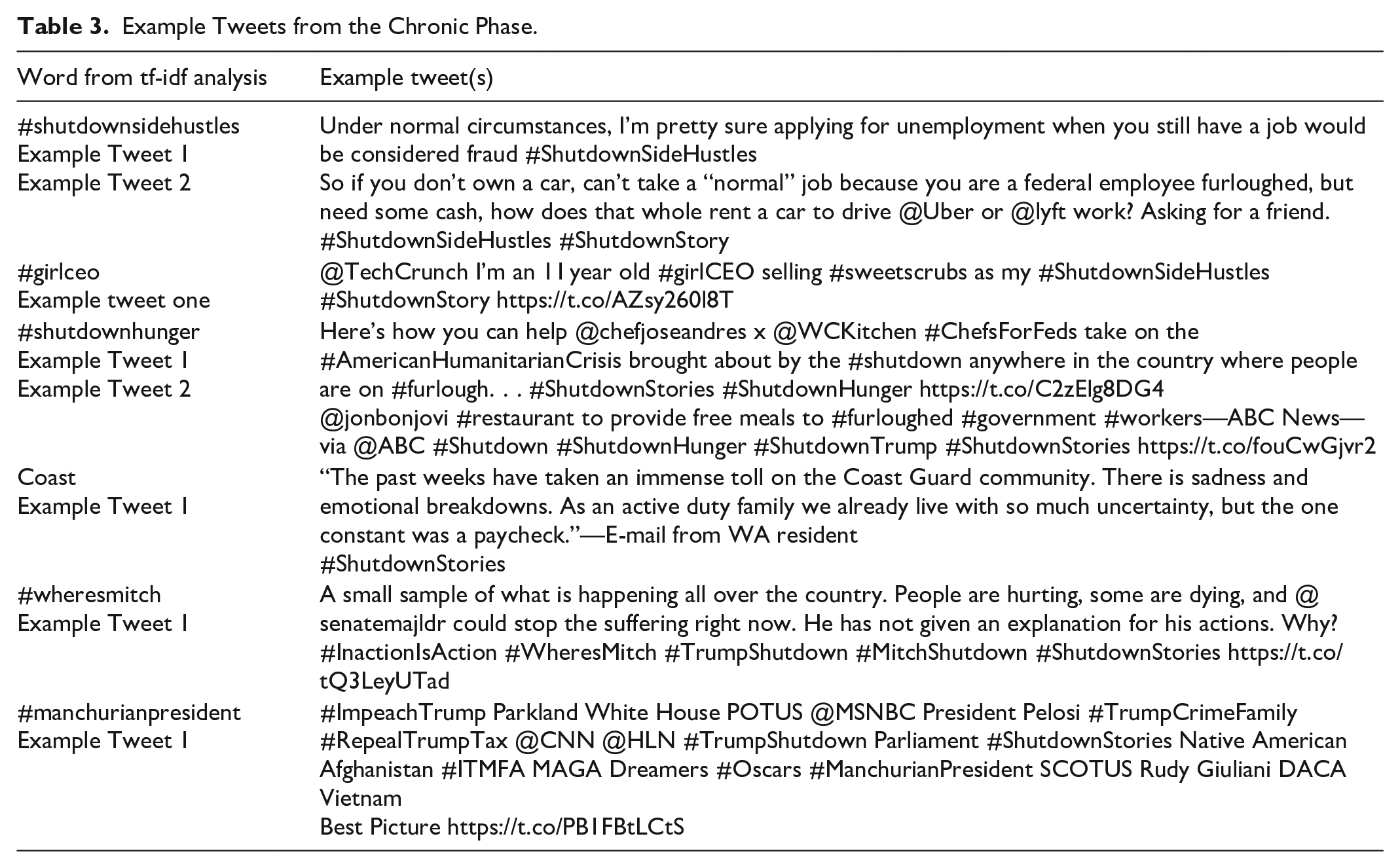
Example Tweets from the Chronic Phase.
Example Tweets from the Post-Crisis Phase.

From the 21,000 tweets gathered, the majority were from either the acute or chronic phases (Figures 1 and 2). Activity increased rapidly from 2 January, after the winter holiday period, peaking at the end of the acute phase, when people missed their first paycheck. Volume dropped rapidly once the Trump administration ended the shutdown (Figure 3).

Tweets by day.

Tweets by crisis stage.

Tf-idf by crisis stage.
Temporal Connective Action
The tf-idf analysis shows the distinctive elements of each shutdown period. The early or acute shutdown phase is marked by the emergence of personalized action frames, associated with words such as “coast” and “home,” where people were sharing their own shutdown related struggles. These included stories of Coast Guard families who were impacted by the shutdown, and those who feared losing their homes.
People also shared informational resources about the political background to the shutdown, what was closed, and environmental consequences of the shutdown, as evidenced by the word “parks” and “democrats.” High-level general calls for action to remove Trump or protest the administration,
The chronic phase, once federal employees and subcontractors had missed their first paycheck, is marked by a more practical turn. Connective resource sharing to help those struggling emerges, with sharing GoFundMe donation pages indicated by the URLs, income generating ideas under “#shutdownsidehustle,” and “#girlceo,” which publicizes a pop-up business set up by a child of federal employees to help support her family. The “#shutdownhunger” hashtag acts as both resource sharing, to indicate local restaurants and food banks offering assistance to affected families, and a call to action, to encourage people and businesses to donate. Some of these calls for assistance were further amplified by the news media featuring individual stories or covering how to help in their local area. Personalized action frames are again important, as evidenced by the word “coast.” This shows full connective action in process.
Political calls to action become more specific, focusing on bipartisan solutions to “#endtheshutdown,” and the role of Mitch McConnell, the Senate majority leader at the time, with “#wheresmitch.” Polarized tweeting is evidenced with words such as “#manchurianpresident.” Both the acute and chronic stages are distinguished by people sharing their experiences, indicated by “story,” “hear,” and “share.”
Activity during the post-shutdown periods shows an abrupt difference. There is still evidence of connective action, particularly to try and help those most vulnerable to wage loss, as shown by “#backpaynow,” “lowestpaid,” and “subcontractors.” This stage is also distinguished by fragmentation and political polarization, as the #ShutdownStories hashtag is used by people who are promoting extremely partisan actions such as a counter protest by anti-immigration activists at Speaker Pelosi’s California residence. There is little in the way of personalized storytelling during this phase of the crisis.
During a social crisis there are distinctive phases of activity, which align with the four-part social crisis model (Fink, 1986; Spence et al., 2015), something which has not been studied before and which provides a blueprint for activists and organizations to understand how campaigns may unfold. In this case, the crisis began quite abruptly, forestalling the pre-crisis phase. This temporal activity started with an early stage marked by emerging personalized action framing, basic information resource sharing, and crossover with other forms of hashtag activism. It then moved on to become mature during the chronic phase, fulfilling Bennett and Segerberg’s (2012) key components.
Alongside these developments, the movement gained traction with mainstream media, who reported on the plight of those affected and resources available to them. Building bridges with the media is often a key intermediary goal for connective movements, and one which helps bring pressure to bear on politicians (Freelon et al., 2018; Jackson et al., 2020). Mobilization became more specific to the shutdown crises, alongside continued sharing of personal stories. In the post-crisis stage, although activity drops rapidly, and becomes fragmented, with proportionally high levels of hashtag hijacking, activism to support the most marginalized continues. This indicates that the post-crisis period is a valuable time to continue activity to ensure vulnerable communities still benefit from connective action.
Overall, these patterns of activity show Twitter is such an important platform for connective action, despite its relatively low usage among general population and activity on other platforms like Facebook and Instagram. Its open infrastructure, existing ability to scale to connect with others affected, supporters, and media makes it valuable for when quick responses to a time-sensitive problem are needed—as seen in the United Kingdom with activists scaling BLM protests (Karatzogianni et al., n.d.). These findings demonstrate the importance of generating a way for people to individualize their protest early by sharing why achieving the end goal is important to them and how the injustice they are suffering under affects them. This is where other activity flows from, including building and sharing resources. Even when there are activist leaders or organizations involved, these findings suggest that this individualization is a major driving force, reaffirming previous scholarship which shows social media has a unique ability to elevate voices of protest that would otherwise be unheard (Tufekci, 2017). Beyond confirmation, these findings go further by clearly showing how that process happens and why it is important. The story, the personal lens, is what comes first and builds connections that make other actions possible.
Social Support
The results of the content analysis indicate that social support can be an integral part, and strong motivator of, connective action, but that the way this happens fluctuates depending on the crisis period involved, and whether support is being given or sought. Within the 500 most retweeted tweets during the overall crisis period, 53% indicated seeking support, followed by around 38% which were giving support. A small portion of the tweets were unrelated to social support (8.8%). Within the social support tweets, as expected, 35% the informational and 13% emotional-esteem types of support were predominant, but tangible-social network support, at 13%, also emerged as important (see Figures 4 to 7).

Types of social support present in Tweets.

Types of social support present in tweets during the acute period.

Types of social support present in tweets during the chronic period.

Types of social support present in tweets during the post-crisis period.
The early or acute period of the shutdown saw the most posts with people seeking support (61%), with little over a quarter looking to offer support (26.5%). At a more granular level, information support predominated among those offering support, and small number offered emotional-esteem or tangible support, but a different picture emerges for those seeking support. Here, just over half (51%) wanted emotional support, a third (33.5%) informational support, and around a fifth (17.5%) tangible support. Negative behaviors, such as complaints and criticism, were much higher in those seeking support than those requesting support.
During the late or chronic period of the shutdown, the number of those offering and seeking support became more equalized, and very few posts were entirely unrelated to support. For those giving support, informational assistance was the most frequently occurring type of support, followed by emotional-esteem and tangible support. Those receiving support were looking predominantly for emotional-esteem support and informational support, while around a fifth sought tangible support (16.5%). Almost half (46%) of posts seeking support displayed negative behaviors, compared to a much smaller fraction of those offering help.
Social support dropped off in the post-crisis phase, with nearly half the posts (45.5%) being unrelated. However, that still left a sizable number of posts engaging in social support. In contrast to the two earlier phases, there was a similar trend in the type of support being both sought and given. The most frequent was informational, followed by emotional-esteem and tangible support. Negative behaviors trended down noticeably among those looking for support.
These findings demonstrate that social support is an important and overlooked aspect of connective action, particularly during a social crisis. The supposition that social support may be present in a movement that responds to a stigmatized conditions prevails. They also show that while emotional-esteem and informational support remain the most common types of support, tangible support should not be overlooked.
During the chronic stage we see resource sharing that crosses over with tangible support, as people amplified tweets about food support and fundraisers. This challenges findings that social media is less helpful for tangible support (Liu et al., 2018), possibly because this study looks at those in American labor-force facing acute financial precarity as a result of social crisis, an issue that is different to those dealing with health issues or students. In connective action which relates to political and economic factors participants need tangible support. The food banks, free meals, donation pages, and links to side hustles, are a continuation of the food pantries, medicine, and libraries in the Occupy and Egypt protests (Chrona & Bee, 2017; Tufekci, 2017). Given the power imbalance which spurs these movements, this support not only alleviates the physical needs of those affected, it offers a practical means of redress, even if on a small scale.
Not only was there a pressing need for tangible support during the shutdown, but there was both the digital and physical infrastructure to make this possible. It would be interesting to see how this trend continues within connective action, for example, in recent COVID mutual aid and #BlackLivesMatter activism, and how this practical aspect of networked social care may increase the positive impact of participation for those who are most vulnerable to systemic oppression.
Networked Care
Connective action models need to be revised to include temporal elements and networked care, with further research to understand how these elements manifest in different types of protest. Triangulating the tf-idf and content analysis results, social support co-occurs with defined aspects of connective action. In the early stages of the shutdown crisis, emotional and informational support were sought, suggesting that accessing this form of support through connective action could be important to help those affected deal with and cope with the crisis. In particular, there appears to be a strong crossover where people seek emotional-esteem support through their own stories and experiences, indicating how the personalized characteristics of connective action may make it more supportive. During the chronic or late stage, both analyses show the importance of resource sharing combined with tangible-social network support. These practical resources range from suggestions for immediate tangible assistance such as food support, through to ideas for income generation, to targeted, specific political actions focused on ameliorating the situation at hand. While it might be argued that tangible support increased during this period as it required more time to co-ordinate resource, in this case it seems more likely to be driven by need. Much of the infrastructure to give help already existed (food banks, GoFundMe, restaurants, organizations such as World Central Kitchen), but it was only when people stopped receiving pay checks that the need for tangible support became urgent and so more requested. Even if there was a fragmentation of activity during the post-shutdown period, it was not a complete disintegration, as social support and connective action continued to work together. Importantly, for those interested in social justice issues, this was particularly needed to help the most vulnerable population affected by the crisis, in this case low-income contractors.
This research offers an integrative framework to understand the role of care within connective action, expanding our understanding of how activism functions and grows within digital spaces while being grounded in established, tested frameworks. It ties together diverse behavior already noted in activism scholarship, while centering often overlooked behaviors. Care in entwined in the processes which call connective action into being. The emotional aspect of care creates an encouraging space for people to share the individual experiences, stories, and actions which propel connective action. This is provided through the sympathy and empathy found in emotional support (Cutrona & Suhr, 1992), along with acknowledging the validity of someone’s lived experience (Suk et al., 2019). While previous studies show that emotional support was a driving factor in responses (Hosterman et al., 2018) and growth (Suk et al., 2019), this research shows that emotional care acts a catalyst. Full connective action flows from this care, and the individual stories which flourish in this environment are picked up by the mainstream media. This further helps the movement achieve its goals, as garnering sympathetic attention from mainstream media is useful to build awareness of the issue with the general public and bring pressure to bear on the political establishment (Freelon et al., 2018; Jackson et al., 2020).
Networked care offers a more complete understanding of how grassroots actions counter the power imbalances that drive protest (Tilly & Tarrow, 1999). This is seen in providing information and resources to those involved and affected by the problem at hand. Providing sustenance or monetary assistance is not just a supporting activity but integral to the goals of the movement and is an important aspect of movement growth. The proliferation of digital platforms that make this organization possible, from local neighborhood apps, to messaging groups (Kavada, 2020), to payment apps, have created a digital infrastructure that make this form of networked care simpler and more scalable.
For activists and organizations who are responding to a social crisis or injustice through connective action, these results suggest several ways in which their responses could be tailored. First, they show how important fostering digital space where social support can be accessed, and that this is not necessarily competing with traditional forms of action. Second, they show the importance of continued activity during post-crisis periods, as this is when the most vulnerable populations still need assistance, and this may offer a way to avoid compounding inequalities. This will only become more important due to the health, economic, and personal impacts of the coronavirus pandemic. Finally, these findings show that connective action is part of a complex digital information ecosystem (Chadwick, 2013), and there is still very much a role for legacy media in providing information, especially during the early stages, and amplifying stories, resources, and calls for tangible assistance.
Future research should address how the concept of networked social support applies and functions in a variety of different movements. These would include ongoing social justice movements during different times of activity, connective action around different social crises, movements which take place outside the United States, ones which focus on specific marginalized populations, and ones associated with differing levels of social stigma and victim-blaming. It could also be possible to understand if accessing or giving social support as part of a connective movement is related to wellbeing and mental health benefits, could be analyzed through a multi-methods computational and manual approach. Any such approach would need to take into account that political emotional expressions can be highly performative (Wahl-Jorgensen, 2019), and so ensure that any textual sentiment analysis is supplemented with data gathered from participants via interviews or surveys.
As with any study, this research has some limitations. Twitter data is not wholly representative of the population and can tend to skew toward audiences who are under 50, are college graduates, and higher earners (Wojcik & Hughes, 2019). As a result, the activity studied here may be skewed toward federal workers, contractors, and their families, friends, and supporters, who fit into these demographics. This may mean that those most marginalized by income, and potentially the most badly affected, might be underrepresented in this study. The early period of data collection in late December 2018 coincided with the winter holidays, which likely affected Twitter activity.
This research offers several significant contributions to understanding how digital activism manifests, shedding light on several chronically understudied aspects of connective action. These cover activism in response to a social crisis, distinctive temporal aspects of connective action, and networked social support as a key driver of activity. The concept of networked social support extends our understanding of why people might be drawn to digital activism and demonstrates a societally important benefit of participating in online movements, which had been overlooked.
Footnotes
Declaration of Conflicting Interests
The author(s) declared no potential conflicts of interest with respect to the research, authorship, and/or publication of this article.
Funding
The author(s) received no financial support for the research, authorship, and/or publication of this article.
