




Abstract
Communication is increasingly taking place in Facebook Groups around the world. Yet, we have little scientific knowledge of Facebook Groups at scale, especially the extent to which general systemic gendering is a pattern in participation in such groups. This knowledge deficit is problematic for digitalized and data-driven democratic societies. Therefore, this article aims to investigate gender differences in open, closed, and secret Facebook Groups. The study relies on a unique large-scale Facebook Group dataset from a sample that reflects the gender of Facebook users and the Facebook Groups they belong to in both Denmark and South Korea. By applying Bayesian models and developing a notion of participation that consists of both structural and actual participation, the study finds that the relation between country, gender, and participation is strongly modulated by gender differences. Females are more engaged than males in Denmark, while the opposite is true for South Korea. In both countries, privacy affects females’ participation more than males’. This article contributes to the field by presenting new large-scale findings that explore gender differences on three levels of Facebook Group privacy settings (open, closed, and secret) in a hitherto understudied communication space and, by doing so, it highlights the importance of privacy and country in predicting systemic gendering.
Introduction
Facebook Groups can contain a variety of topics, from health and hobbies to religion and politics, and they can also promote a specific event or act as a marketplace. Participation is often used as a synonym for civic engagement and thus refers to a broader area of topics including (but not restricted to) politics or the public sphere. It also includes what scholars have termed cultural engagement (Lutz et al., 2014). Such participation is a crucial force in shaping contemporary societies, and gender equality in engagement secures human rights and social justice (Krook & True, 2012).
Studies on general digital communication effects reveal a systemic gender inequality, with women being less civically engaged than men both off- and online (Fortin-Rittberger, 2016; Fraile, 2014). This results in “information poverty,” which is also known as the “gendered digital divide” (Kennedy et al., 2003). Participation divide studies suggest that women are significantly less likely to share content on the web than men (Hargittai & Walejko, 2008). Ono and Zavodny (2007) illustrate how digital inequality across countries mirrors existing gender inequality in those countries. For instance, gender gaps in information technology (IT) use in countries, such as South Korea, exceed the gaps in more gender-egalitarian countries, such as Sweden and Denmark. This pattern highlights the important role of social and economic macro-structures in generating and sustaining digital inequality in terms of gender and other socio-demographic attributes. Recent research on gender digital inequality has developed to include more nuanced analyses that discover emerging topics related to digital activities, such as differences in offending behavior (Robinson et al., 2020).
Social media platforms, such as Facebook, are considered useful arenas for closing potential divides across countries (Ali, 2011; Xenos et al., 2014). Yet, when we zoom in on gender, Brandtzaeg’s (2017) Facebook page “likes” study shows that, instead of closing gender divides in participation, Facebook in fact reinforces traditional divides, for instance concerning the kinds of topics users like. It is thus crucial to investigate whether we see such differences in both Facebook Group participation and civic participation dimensions across different countries with different cultural approaches to gender roles.
In this study, we investigate gender disparities in participation in Facebook Groups across two countries, South Korea and Denmark. Although cross-national comparative studies are always difficult, especially with large-scale data, we have sampled the two countries to represent nations outside the United States with similar internet and smartphone penetration and a strong Facebook presence, but with very different approaches to gender gaps on two different continents: Asia and Europe. We wish to broaden our understanding of how different genders participate and to examine how this participation is affected by privacy settings, personal network size, and number of group memberships. We also wish to investigate actual participation by examining specific posts and comments in the Facebook Groups. This participation approach adds to previously studied civic engagement forms, such as the gender effects of page likes and associated topics (Brandtzaeg, 2017). By looking more broadly at different types of participation in Facebook Groups across sampled countries, our study aims to contribute a more nuanced understanding of how country and privacy may play equally significant roles when examining gender differences in participation. Although we recognize all gender identities, for reasons of comparison and limitations in data structure and classifiers, we treat gender as binary in this article.
In the next section, we will present the theoretical framework, central concepts and literature that helped us form and support our hypotheses within this research area. We will follow this with a data and methods section in which we justify our research design, before presenting our results, conclusion and discussion, in which we explore the implications and limitations of the study and possible avenues for future research.
Theory and Hypotheses
Defining Systemic Gendering and Participation on Facebook
Systemic gendering in online participation has often been described in various ways using similar terms, such as inequality, differences, and systemic biases that refer to measurable structural differences in participation and engagement patterns: “differences in the online creation and sharing of purpose-driven content with specific audiences” (Hoffmann et al., 2015, p. 699). In this context, an existing study reveals systemic gendering in various aspects of online communication, in which men participate more than women in various ways, from the time they spend online to their level of online political activity (Calenda & Meijer, 2009). Our notion of systemic gendering thus points to gender differences in Facebook Group participation.
Civic engagement is defined as “the degree to which people become involved in their community, both actively and passively, including such political and organizational activities as political rallies, book and sports clubs” (Quan-Haase et al., 2002). Importantly, political spaces and apolitical spaces are not mutually exclusive. In Facebook Groups, people interact around public content. Conversations related to hobbies can initiate discussions on important social or political issues (Lee & Park, 2016; Shirky, 2011; Wright, 2012). Facebook as a communication space is also used by activists to contour participation in an online territory (Warren et al., 2014). Brandtzaeg (2012) defines civic engagement on Facebook as “action in response to societal needs, in the form of supportive, deliberative, and collaborative practices in social media” (p. 67). However, he only focuses on “likes” in his study. Inspired by van Dijck (2009) and Lutz and Hoffmann (2017) among others, we wish to continue the notion of online civic engagement found in the work of Quan-Haase and Wellman (2002) by broadening Brandtzaeg’s analysis of how civic engagement can take place on Facebook. We distinguish between two levels of online participation: structural participation, in which, by connecting with friends and joining a group, users secure a level of information exposure that is relevant to address to discuss information poverty as a personal network structure; and actual participation, in which users post and comment and which reveals the ways frequent users participate in the communication taking place.
Gender and Three Levels of Facebook Group Privacy
Facebook Groups are increasing in popularity, and not just among users; the Facebook newsfeed algorithm has changed to give priority to groups over Facebook pages, which makes communities as central as friends (Facebook for Developers—F8 2019 Day 1 Keynote, n.d.). The increasing number of closed online communities in the social media environment presents a challenge that requires a range of new research approaches (Boccia Artieri et al., 2021). By communicating in a group on Facebook, people can discuss their common interests in groups that contain either a smaller or larger number of people than in their newsfeed, and, in this way, being part of an interest group can expand a person’s network beyond their list of friends.
Due to issues of accessibility, large-scale Facebook Groups studies tend to focus on the content of particular open and closed groups (Fernandes et al., 2010). Both qualitative and computational studies have been conducted in an attempt to understand the communication on pages and in public groups with political, health and technological affordances for education-related content (Bender et al., 2011; Wang et al., 2012). Since they are more accessible, public groups are currently the most researched groups in existing literature. However, there are two other types of groups, namely, closed and secret groups, with stricter access policies. Closed groups are visible in the search function, but require membership to access the group content. Secret groups do not appear in the search function and members have to be invited to join (they cannot simply request access; Facebook Help Center, n.d.). 1
Communication privacy management (CPM) theory explains how people make decisions about revealing private information to others according to gender and cultural factors (Petronio, 2012). Based on this strand of literature, we expect that group privacy settings will play a role when it comes to the participation of different genders (Cirucci, 2017; Villebro et al., 2018). Women on social media show higher privacy concerns and participation than men (De Wolf et al., 2014; Hoy & Milne, 2010; Tifferet, 2019; Tufekci, 2008). An interesting study on private Facebook Groups shows that women use female-only closed and secret Facebook Groups for professional support, networking opportunities, and career development (Pruchniewska, 2019).
The Social Web Gendered Privacy Model (SWGPM; Thelwall, 2011) also explains gender disparities in privacy concerns and practices on social media. SWGPM shows that, owing to four factors—physical security, harassment, social communication skills, and social communication needs—females have more of these privacy concerns when using social media. Privacy settings can give the user a degree of control over who can read a specific content piece (Nissenbaum, 2009), and females posting videos of themselves could make themselves vulnerable to sexist comments and even personal violence (Burgess & Green, 2009, pp. 96–97). In the next section, we will operationalize our concept of participation further.
Structural Participation and Actual Participation in Facebook Groups
Information exposure is essential to determine whether and how systemic gendering takes place when it comes to information poverty. To secure a broad information base, users can connect with many friends and be members of different groups with different privacy settings, which in turn give rise to possible communication from many other users. Brandtzaeg (2012) studies how page likes play a significant role in the information poverty challenge, but, in our study, we wish to emphasize not only a user’s personal network size and number of group memberships, but also the number of posts and comments in a group, that is, a user’s actual participation, as additional elements in the specific challenge of information poverty and potentially unequal gender patterns.
A fundamental aspect of information exposure and network capital in the networked society (Castells, 2011, 2013) is the size of a user’s network. The larger the network, the more diverse information the user is exposed to (Nahon & Hemsley, 2013). This provides a solid ground for avoiding information poverty and we will therefore use network size as an important starting point when examining differences—working on the assumption that the greater the network, the larger the information exposure. The size of the network may influence the strength of the relationship. In small networks, the bonds are tight, whereas, in large networks, the bonds tend to be looser (Arnaboldi et al., 2013). A study of Facebook (Bakshy et al., 2012) confirmed that weak ties are more optimal for spreading new information than stronger bonds of homogeneity. The bridging social capital potentials of weak ties on Facebook lie in the site’s technical features, which lower the cost of maintaining and communicating with a larger network.
Information exposure on Facebook also depends on a user’s friend total, group memberships and “like” history, since the timeline displays all the user’s friends’ posts and posts from groups the user previously liked. Therefore, we also consider the number of group memberships as structural participation. We investigate group memberships by zooming in on the different privacy setting in groups (open, closed, and secret) as potential arenas for different kinds of online participation (Karimi et al., 2014), in which users have the opportunity to be exposed to information from topic- or network-related publics with stronger or weaker bonds.
This study focuses not only on the structural participation level, but also on the actual participation level using posts and comments in Facebook Groups. Rather than making friends or joining a group for structural participation, the act of writing a post and leaving a comment in a group indicates more substantial participation. Posts and comments are two different types of participation on social media, but they both represent a more active form of participation than simply viewing content and liking posts (Aldous et al., 2019). When posting in the Facebook Groups, the user provides information and news, raises issues, or organizes events. Here the user is an initiator. On the other hand, when the users comment, they rather respond to, support (Hale et al., 2020) or engage in an existing frame set by the posts. Here the user is a respondent. Since the act of leaving a post and a comment represents different participation types in Facebook Groups, we expect that there will be differences in the way males and females enact these kinds of participation in groups with different privacy settings. Due to this difference in actual participation, we choose to test posts and comments separately.
A Cross-Country Comparative Study
When studying potential gender differences in digital participation, it is important to account for potential international differences, for instance, being a less gender-egalitarian country and a more gender-egalitarian country (in our case, South Korea and Denmark, respectively). We chose to include South Korea and Denmark since both countries have a high internet and Facebook penetration, but are ranked very differently on the Global Gender Gap Index (GGGI; World Economic Forum, 2019), as illustrated in Table 1. According to the GGGI, we consider Denmark (ranked 14 out of 153), a gender-egalitarian country, and South Korea (ranked 108 out of 153), a country with a larger gender gap. The GGGI examines the gap between males and females across four main categories: economic participation and opportunity, educational attainment, health and survival, and political empowerment. We intend to compare Facebook participation in Denmark and South Korea with a particular focus on gender differences.
GGGI: South Korea and Denmark.

GGGI = Global Gender Gap Index; DK = Denmark; SK = South Korea.
Facebook is the most popular social media in Denmark, and Facebook usage among the Danish population is increasing year-on-year (Danmarks Statistik, 2020). Facebook is the social media app in South Korean where people across all generations spent most time. It was found that South Korean users spent a total of 4.6 billion minutes on Facebook per month in 2019, followed by Instagram, Naver Cafe, Band, and Kakao Story. While men prefer open social media, such as Facebook and Twitter, women prefer to use relatively closed social media, such as Kakao Story and Band (KISDI, 2019). Compared with women in Denmark, the online environment for women in South Korea has more limitations regarding gender-based discrimination and harassment (Freedom House, 2019).
Our understanding of cultural differences is inspired by Hofstede et al. (2010). According to Hofstede, South Korea is considered a collectivistic society with a score of 18 out of 100. Korean society has a long-term commitment to the “group,” be that a family, extended family, or extended relationships. Denmark is considered an individualist society with a score of 74 out of 100. Danish society has a loosely knit social framework in which individuals are expected to take care of themselves and their immediate families only. In general, people in a collectivistic culture value in-bound relationships, but, paradoxically, they are more likely to disclose their personal information on social media due to a low prior concern for online privacy (Cho & Park, 2013). There is a lack of research on the use of Facebook Groups in collectivistic and individualistic cultures, but it has been shown that gender differences in two different cultures can have a significant impact on Facebook users’ networking participation (Oliveira et al., 2016). Men tend to have more connections to boast a better online presence, and it may also be easier for male users with exhibitionistic tendencies in a collectivistic culture to take advantage of social media visibility compared with female users (Guo et al., 2018). In Danish culture, a study (Rossi et al., 2016) finds that, as part of an individualist society, many Danes view their communication on Facebook as private. They mainly communicate with close friends and family and Danes do not actively participate in political debates on Facebook with people outside their friendship group.
There is a lack of studies about the use of Facebook Groups in collectivistic and individualistic cultures, but gender differences in two different cultures can have significant impact on Facebook users’ networking participation (Oliveira et al., 2016). This study will examine gender differences in three different Facebook Groups with different privacy settings in two countries. We cannot make any assumptions about Facebook Group participation in different countries on this basis, but we will return to these studies in our discussion of our results.
Based on the literature reviewed in the previous paragraphs, we developed the following hypotheses for the relationship between gender differences and the other factors in online participation:
H1. We hypothesize gender differences to be reflected in network size as structural participation. In other words, we hypothesize that male users will have larger networks than female users and that this difference will be larger in South Korea.
H2. We hypothesize gender differences to be reflected in belonging to groups, as measured by the number of group memberships as another type of structural participation. In other words, we hypothesize that male users will have more group memberships than female users and that this difference will be larger in South Korea than in Denmark. We also expect these effects to be modulated by the social context (group privacy settings), with female users preferring more private groups (closed and secret ones).
H3. We hypothesize that male users will have more posts than female users as actual participation and that this difference will be larger in South Korea than in Denmark. We also expect these effects to be modulated by the social context (group privacy settings), with female users preferring more private groups (closed and secret ones).
H4. We hypothesize that male users will have more comments than female users as actual participation and that this difference will be larger in South Korea than in Denmark. We also expect these effects to be modulated by the social context (group privacy settings), with female users preferring more private groups (closed and secret ones).
Method
Dataset
To conduct this research, we collected data using the Digital Footprints software (http://digitalfootprints.dk/) developed by DATALAB at Aarhus University (Bechmann & Vahlstrup, 2015). Digital Footprints is a data-extraction software that allows researchers to extract data from Facebook, public streams as well as private data with user consent. A quota sampling approach was used to mirror the gender, age, education, and area of residence of the Facebook population (Bechmann, 2019). A total of 1,121 South Korean and 1,000 Danish participants were retrieved, including data from the 20,783 groups they were members of at that particular time. We collected profile data and retrieved posts, comments and metadata from all the groups, including closed and secret groups. The data were collected between 1 April 2014 and 30 April 2015, and we collected data back in time for all groups in the sample. A total of 10,662,832 posts and 44,732,331 comments were collected from the groups. Due to the relative lack of data collection time caused by Facebook’s application programming interface (API) policy change in 2015, South Korean data collection showed less accurate quota sampling on other demographics compared with Denmark, yet it yielded in depth data on gender quota sampling.
Data were retrieved with first-degree informed consent from participants and permission from both countries; from the Danish Data Agency and the University Institutional Review Board in South Korea (Bechmann & Kim, 2020). Despite obtaining all the required formal and legal clearances, we understand the important ethical dimension of handling such data (Bechmann & Kim, 2020), and we therefore only make highly aggregate claims about the dataset not to violate the privacy of the participants or the other group members. However, this dataset is a unique online dataset and allows our research field to understand potential gendered Facebook Group participation on a large scale across the three types of groups (with different privacy settings) and across countries.
Analysis
To test each hypothesis, we built Bayesian Poisson regression models (log link) with the separate measures of online participation (number of friends, group membership, posts, and comments) as count (positive integers) outcomes.
To test Hypothesis 1, we used the number of friends as the outcome measure and country and gender as predictors (both main effects and interaction):

To test Hypothesis 2, we used group membership (divided by privacy level) as the outcome measure, and country, gender, and privacy level as predictors. This implied that we had three measures of group membership per user: how many open, closed, and secret groups each user is a member of. Therefore, we implemented a multilevel structure of the model: each user might have a different propensity to join groups (random intercept by user) and a different response to levels of privacy (random slope of privacy by user):

Note that the subscript i indicates random or varying effects by participant, that is, the possibility for single users to deviate from the group level estimate. Given that we observed many users without any group, we also implemented zero inflated Poisson regression models, with a separate parameter identifying the rate at which zero memberships occur.
To test Hypotheses 3 and 4, we used the number of posts and comments, respectively, as outcome measures, and country, gender, and privacy level as predictors. We further included an offset to control for the number of groups—at that level of privacy—the user is a member of and tested whether zero inflation improved the model. Note that we did not estimate post/comment propensity for users without any group membership at that level of privacy: if a user was not a member of a private group, it did not make sense to estimate their propensity to post in a private group:

All models were implemented in a Bayesian framework using Bayesian Regression Models using Stan (BRMS) in R. Given that implementing maximal random effect structure and zero inflation have been shown to more adequately explain datasets and control for false positives, we opted for a Bayesian framework. All models included weakly informative priors to discount extreme parameter values without otherwise affecting the statistical inference. All priors were tested via prior predictive checks to ensure our expected outcomes were on the right scale (e.g., that, given the chosen priors, expected group memberships were contained in a range between 0 and a few hundred—and not a few million).
To assess whether interactions should be included in the models, we ran a Bayesian Leave-One-Out Cross-Validation Information Criterion (LOOIC)-based model selection (Vehtari et al., 2017). LOOIC is a statistical estimation of out-of-sample error, that is, how much error the model would make if it were to predict new data (e.g., the number of friends of new people, only knowing their country and gender). We fitted models with and without interactions and assessed which model was most likely to generalize to new data (i.e., fitted the data best, while avoiding estimated overfitting), by looking at differences in LOOIC and at whether these differences were credible (low standard error compared with the size of the difference). In summary, predictors are only included if they improve the estimated out-of-sample performance of the model, and therefore, all reported predictors in the results section are important in explaining the data (contrary to a frequentist framework that would not rely on model comparison but only on significance testing). Furthermore, the effects of the predictors are assessed by plotting the posterior estimates of the models and reporting the mean and standard deviations of the outcome measure in the different conditions.
Results
H1. Gender and Structural Participation: Number of Friends
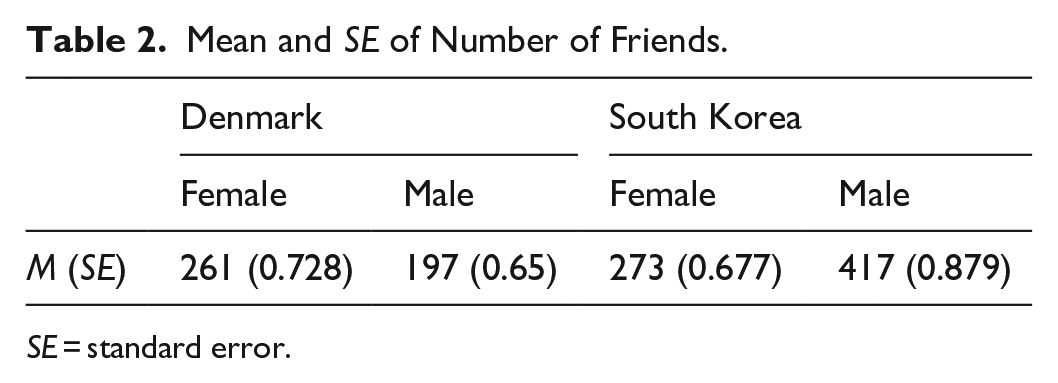
When testing Hypothesis 1, we find that Danish females have more friends than males, while South Korean females have fewer friends than males, as shown in Table 2.
Mean and SE of Number of Friends.
SE = standard error.
A Loo-based model comparison indicated that the full model including an interaction between country and gender had the lowest estimated out-of-sample error (for details on the test, see Appendix A). Figure 1 shows that the estimates indicate that South Korean users tend to have more friends than Danish users, but that effect is mostly driven by male users, with female users being more similar in their number of friends.

Country and gender effect plot on the number of friends.
H2. Gender and Structural Participation: Group Memberships
Again, a Loo-based model comparison indicated that the full model, including the interaction between country, gender, and privacy had the lowest estimated out-of-sample error without zero inflation (see Appendix B).
According to Table 3, Danish females have more group memberships than males across the three groups with different privacy settings. In South Korea, we see the opposite pattern: South Korean females have fewer group memberships than males across the three groups with different privacy settings.
Mean and SE of Number of Group Memberships.

SE = standard error.
The estimates in Table 3 also indicate that Danish users tend to have more group memberships than South Korean users. However, they also indicate that effect is mostly driven by female users, with male users being close in their number of memberships, as shown in Figure 2.

Group membership and effect on country, gender, and privacy.
H3. Gender and Actual Participation: Posts
The Loo-based model comparison of H3 indicated that the model including the interactions between country and privacy and between gender and privacy had the lowest estimated out-of-sample error without zero inflation. Including a three-way interaction between country, gender, and privacy or a two-way interaction between country and gender would not improve the model and would increase the risk of overfitting (leading to a higher rate of false positives, see Appendix C).
According to Table 4, Danish females have more group posts than males in closed and secret groups but not in open groups. South Korean females have fewer group posts than males across privacy groups, but the differences in mean are smaller in secret groups than open and closed groups.
Mean and SE of Number of Posts.

SE = standard error.
We see different gender patterns in the two countries. Figure 3a shows the number of posts by country, privacy, and gender. Males post more than females in South Korea (males: M = 6.59, SE = 50.83 vs females: M = 3.08, SE = 25.69), but the opposite holds true for Denmark (males: M = 11.06, SE = 51.61, vs females: M = 14.47, SE = 38.08). In addition, while an increase in privacy involves an increase in activity in South Korea for both genders, in Denmark, closed groups show the highest activity.

Group post and effects on country, gender, and privacy. (a) The number of group posts by country, privacy, and gender. (b) The effect between the country and privacy. (c) The effect between gender and privacy.
Figure 3b shows the effect between country and privacy. For both countries, the general trend is that the higher the privacy levels of the group, the more users post. Interestingly, the privacy effect is bigger in Denmark than in South Korea. The difference among the open and closed groups is much clearer in Denmark, while the difference between all three levels of privacy is smaller in South Korea. Figure 3c shows the effect of gender and privacy. The closed and secret groups have more posts than open groups for both countries. But females have a bigger effect on privacy than males. Furthermore, females have half the number of posts on open groups as males.
H4. Gender and Actual Participation: Comments
Similar to post activities (H3), comment activities also show no effect between country and gender and the three-way interactions of country, gender, and privacy. LOOIC indicated that the model including the interactions between country and privacy, and between gender and privacy had the lowest estimated out-of-sample error without zero inflation (see Appendix D).
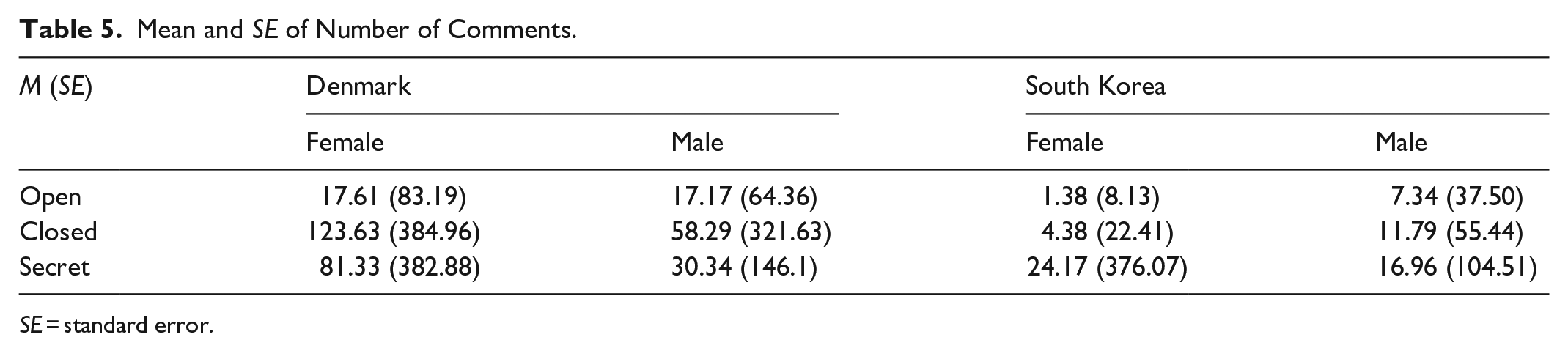
As reported in Table 5, Danish females have more group comments than males across the three groups. In South Korea, we see the opposite pattern: South Korean females have fewer group comments than males in open and closed groups, but females have more comments than males in secret groups.
Mean and SE of Number of Comments.
SE = standard error.
Figure 4a shows the number of group posts by country, privacy, and gender. Males comment more than females in South Korea (males: M = 6.59, SE = 50.83 vs females: M = 3.08, SE = 25.69), but the opposite holds true for Denmark (males: M = 11.06, SE = 52.61, vs females: M = 14.47, SE = 38.08). Moreover, an increase in privacy involves an increase in activity for both genders in South Korea.

Group comments and effects on country, gender, and privacy. (a) The number of group comments by country, privacy, and gender. (b) The effect between the country and privacy. (c) The effect between gender and privacy.
Figure 4b shows the effect between country and privacy. Similar to H3, the privacy effect is bigger in Denmark than in South Korea, but the difference between the closed and secret groups is much clearer in South Korea. Figure 4c shows the effect of gender and privacy settings. The closed and secret groups have more comments than open groups for both countries, but females have a bigger effect on privacy settings than males.
The findings show an even larger difference in online participation as a function of gender differences than we hypothesized. We see an inverse of relative gender engagement by country. Males have much fewer friends than females in Denmark and, significantly, males have more friends than females in South Korea (H1).
One exploratory analysis, however, indicates that some caution is warranted, since young people (under 30) in particular show different effects, with the Danish gender gap being largely defined by young users (for detailed accounts on age tests see Appendix E).
The findings also show a larger difference than expected in the sense that the difference made by gender in the two countries is opposite: An interesting result is that post and comment activities show that privacy effects are more prevalent among females for both countries with nuanced differences between posts and comments. While three-way interaction of country, gender, and privacy had a different impact on structural participation (membership, H2) in the two countries, only two-way interaction, between country and privacy, and between gender and privacy, had an impact on the number of posts (H3) and comments (H4) produced (no country and gender interaction). Danish females have higher participation in all the group privacy settings than Danish males, but they only have a significantly lower number of posts than Danish males in the open group. South Korean females have lower participation in all the group privacy settings than Korean males, but they only have a higher number of comments than Korean males in the secret groups. Denmark has a clearly different participation gap than South Korea between open groups (public groups) and other types of groups (closed and secret groups). However, there is a smaller participation gap between the three types of Facebook Groups in South Korea (H3 + H4).
Discussion and Conclusion
The overall finding of the study is that gender differences do matter as systemic gendering is found in Facebook Groups according to the study presented. These differences are increasingly important to investigate because we spend more and more time in online communities, and these forums could potentially give rise to societal inequality patterns. We see a genuinely clear inversion in the systemic gendering of online participation in the two countries supported by CPM theory (Petronio, 2012). Females are more engaged than males in Denmark, and the opposite pattern is the case in South Korea.
In structural participation, South Korean males have an unusually large number of friends compared with the other three groups of people (South Korean females, Danish males, and Danish females). One reason for this could be that males in collectivistic cultures are expected to be more extravert than women on social media on social media (Guo et al., 2018). For South Korean males, the number of friends is only one type of online participation to show sociality. Danish females, however, tend to have more group memberships in proportion to their number of friends. The gender gap between the number of friends a user has and the number of groups she or her belongs to shows a significant gender difference between the two countries (Ono & Zavodny, 2007), despite the fact that Facebook has been studied as a useful platform for closing potential divides between countries (Ali, 2011; Xenos et al., 2014). In the actual participation, posts and comments in Facebook Groups differed by gender in the two countries, but in different ways: The study shows that Danish females only have less participation than Danish males in the number of posts in the open groups, and South Korean females have more participation than Korean males but only in the number of comments in the secret groups. Despite or perhaps because of these findings, we suggest that more research needs to be conducted on the effect of culture on gender roles in social media participation.
Our study contributes to the field of social media studies by providing the first study across open, closed, and secret groups on Facebook, using large-scale data and examining gender and national differences in relation to privacy settings in online communities. This allows us to investigate whether we see such differences in Facebook Group participation in countries with different cultural approaches to gender. After Facebook closed Facebook API for researchers in 2015, it has become more difficult to collect data on closed and secret groups using the API.
Notably, our study also broadens the concept of online participation on Facebook by distinguishing between two levels of participation: structural participation and actual participation. We argued that it was necessary to focus on Facebook Groups because they allow us to examine other variables for online participation, such as the number of group memberships. In both Denmark and South Korea, users tend to join fewer Facebook Groups the higher the privacy settings are. Conversely, users tend to post and comment more in more private groups in their actual participation. Interestingly, the lowest actual participation as communication initiator (post) and respondent (comment) is South Korean females in the open groups, and the number of posts and comments steadily increases through the closed and secret groups. A possible reason for South Korean women preferring to join secret groups could be the relatively toxic nature of South Korea’s overall online environment (World Economic Forum, 2020). Moreover, in secret groups, South Korean women comment more than South Korean males. This difference can potentially be explained by findings in existing studies that South Korean females are more concerned with posting and commenting in a closed setting based on the SWGPM (Thelwall, 2011) than the other three tested gender groups. To examine this further, we recommend that future studies apply supplementary methods.
In this article, we focus on testing whether there is systemic gendering in participation, understood as gender differences in structural and actual participation, as these dimensions remain under-explored in existing research but theory suggests that such systemic gendering might exist. When exploring this, we uncovered the need to have a stronger cross-cultural approach to gender, participation and privacy settings. In general, the results suggest that, the more private the group, the more people engage in it. This conforms well with more general sociological communication theory, in which people are expected to participate in the communication instead of just lurking (Bechmann, 2019; van Dijck, 2009). Females and males showed different relative structural participation in Denmark and South Korea, but they had the same relative production of posts and comments across the two countries. In both countries, females tended to post and comment on secret groups more than males.
Our study revealed differences in the privacy settings of online gender groups by country. Denmark and South Korea display different sensitivities to Facebook Group privacy settings; Denmark has a clear participation gap between open groups and the other two types of groups (closed and secret groups), whereas South Korea shows a larger gap between secret groups and the other two types. This may indicate that South Koreans use closed groups as a more public communication space, whereas Danes use closed groups more similarly to the secret groups. However, while these trends are statistically robust, by exploring the data, we can also observe two divergent patterns from this general picture. First, closed groups seem to play a special role in Danish user participation, presenting more memberships and actual participation than any other group. Second, we find that the gender gap in Danes’ use of open groups is smaller than the other types of groups.
Our study is unable to make claims about countries other than Denmark and South Korea. However, one dimension that could play a role for the generalizability of the predictions found in this article is the general social media landscape and penetration rate of Facebook’s national competitors. The function of Facebook Groups and Facebook as an online community might differ across countries and gender. For example, we do see a different activity pattern in Facebook Groups in South Korea compared with Denmark, and there are more South Korean male users on Facebook than females. This might be the result of a general tendency for South Korean females to use domestic social media (KISDI, 2015). Facebook is considered an open platform in South Korea, which means that people use Facebook to expand their network and make new connections, rather than talking to people they already know (Jun, 2015).
Our definitions of the open, closed, and secret groups on Facebook are adapted solely from Facebook’s own definitions, but actual use of the groups might indicate that users understand the group privacy settings differently. This is an area that scholars could explore in future studies. Such future research could crystallize an inductive approach to privacy modulated by the actual usage patterns that is able to loop back into the defining features of, for instance, a secret group. In this study, we only compared the three types of groups labeled by Facebook’s privacy settings because there was no immediate applicable classification from existing studies that we could use to qualify a different robust privacy understanding. However, network size, topic and tie strength could potentially play a role in a more inductive understanding of Facebook Groups’ privacy levels (e.g., smaller groups with close-tie communication discussing sensitive topics being more secret). The fact that Danish females are more active in Facebook Groups than Danish males yet South Korean males are more active than South Korean females might be better explained by such future analyses. Examining how these participation patterns correlate with Facebook Group topics would shed light on the discussion of systemic gendering, comparing, for example, a gender-egalitarian country like Denmark and a less gender-egalitarian country like South Korea.
Despite these limitations and suggestions for future research, this study has provided a more nuanced understanding of Facebook participation patterns. In doing so, it has contributed to the discussion on digital sociology as Facebook Groups become increasingly popular worldwide for various types of communication and systemic inequality thus becomes a challenge for democratic societies’ focus on diversity in public engagement and opinion.
Footnotes
Appendix A
The appendix consists of four Leave-One-Out Cross-Validation Information Criterion (LOOIC) tables for each hypothesis and three plots to supplement the analysis and findings in the article.
LOOIC of H1 indicated that the full model including an interaction between country and gender is the best model which has the lowest estimated out-of-sample error.
Appendix B
LOOIC of H2 indicated that the three-way interaction of country, gender, and privacy improves the model.
Appendix C
LOOIC Result of H3

| Models | LOOIC | SE | Difference from the best model |
|---|---|---|---|
| Post | 69327.73 | 3645.50 | 54819.28, SE = 3584.66 |
| + privacy | 14678.99 | 190.65 | 170.53, SE = 27.02 |
| + country × privacy | 14516.52 | 192.53 | 8.06, SE = 0.84 |
| + gender × privacy | 14687.34 | 190.96 | 178.88, SE = 24.48 |
| + (country + gender) *privacy |
14508.46 | 192.7 | 0 |
| + country × gender × privacy | 14540.02 | 193.79 | 31.57, SE = 0.79 |
| Zero-inflated Poisson models | |||
| Post | 57158.13 | 3414.16 | 42649.67, SE = 3356.56 |
| + privacy | 15518.61 | 199.01 | 1010.15, SE = 37.27 |
| + country × privacy | 15302.55 | 202.18 | 794.09, SE = 33.36 |
| + gender × privacy | 15486.99 | 198.94 | 978.53, SE = 35.96 |
| + (country + gender) × privacy | 15260.33 | 201.66 | 751.87, SE = 32.12 |
| + country × gender × privacy | 15248.07 | 202.05 | 739.61, SE = 32.50 |
LOOIC = leave-one-out cross-validation information criterion; SE = standard error.
LOOIC of H3 shows that “Post + (country + gender) × privacy” is the best model.
Appendix D
LOOIC Result of H4

| Models | LOOIC | SE | Difference from the best model |
|---|---|---|---|
| Comments | 2,30,514.99 | 18,721.33 | 2,11,679.08, SE = 18,674.05 |
| + privacy | 18,954.8 | 204.43 | 118.88, SE = 25.51 |
| + country × privacy | 18,853.62 | 206.55 | 17.71, SE = 20.17 |
| + gender × privacy | 18,950.57 | 204.52 | 114.65, SE = 24.89 |
| + (country + gender) × privacy | 18,835.92 | 206.72 | 0 |
| + country × gender × privacy | 18,860.07 | 207.28 | 24.15, SE = 20.68 |
| Zero-inflated Poisson models | |||
| Comments | 21,4219.42 | 17,434.86 | 1,95,383.5, SE = 17,387.49 |
| + privacy | 20,642.52 | 211.87 | 1,806.6, SE = 48.64 |
| + country × privacy | 20,336.62 | 214.17 | 1,500.7, SE = 45.62 |
| + gender × privacy | 20,640.33 | 212.07 | 1,804.42, SE = 48.76 |
| + (country + gender) × privacy | 20,325.08 | 214.37 | 1,489.17, SE = 45.19 |
| + country × gender × privacy | 20,247.44 | 214.02 | 1,411.53, SE = 43.98 |
LOOIC = leave-one-out cross-validation information criterion; SE = standard error.
LOOIC of H3 shows “Comment + (country + gender) × privacy” is the best model.
Appendix E
Acknowledgements
A special thanks to participants who shared their data for the purpose of research, DATALAB developers Peter Vahlstrup & Ross Kristensen-McLachlan who helped with data retrieval and data preprocessing of both Korean and Danish datasets, Kwang-Taek Roh and In-Ho Jo of Cyber Emotion Research Center who helped with the Korean data collection and IRB process. Furthermore, we would like to thank Userneeds for agreeing to use their internet panel for the recruitment of the Danish participants and anonymous reviewers for their constructive comments on various stages of this publication.
Declaration of Conflicting Interests
The author(s) declared no potential conflicts of interest with respect to the research, authorship, and/or publication of this article.
Funding
The author(s) disclosed receipt of the following financial support for the research, authorship, and/or publication of this article: The research was funded by Aarhus University Research Foundation, Grant Number AUFF-E-2015-FLS-8-55. The article processing charges related to the publication was supported by Aarhus University, School of Communication and Culture.
