




Abstract
Our paper focuses on case studies of artistic, creative and political participation by young feminists and civil society groups in Jordan, Morocco, Tunisia and the UAE. Central questions uncover the intersecting significance of class, gender and new media in young MENA citizens’ participation; the connections between mediated cultural production and political intervention; and the role of structural barriers for online community and agency. Our conclusions challenge the notion that the democratic ethos of civic participation networks has burgeoned since digitization, and highlights that digital tools and online spaces work more effectively for youth with existing offline economic power and/or cultural capital.
Keywords
Introduction
Emerging patterns of digital media networking, consumption and collaboration, with a particular focus on political and civic identities amongst young people in Europe and North America, have recently been examined (Banaji and Buckingham, 2013; Bennett and Segerberg, 2012; Dahlgren, 2007; Jenkins et al., 2018). In these works, the notion of civic participation is broadly defined – and problematized – as democratic collective action that encompasses overtly political pursuits but goes well beyond these to a range of creative and compassionate endeavours. While civic participation thus defined is widely regarded as contributing to a wider public good, increased cohesion and tolerance in communities, and to a sense of collective well-being amongst citizens, some studies caution that it is possible for those with narrow and exclusive views of community, and with a sense of their own religious, cultural or political community’s entitlement above all others, to partake in action that gets defined as civic and guarantees access to wider civic networks, while actually undermining tolerance and general well-being (Banaji, 2008).
Building on these complex arguments, it would seem that we can, alongside the older mass media, classify personalized media as media that is formatted for and accessed in isolation or in groups via internet-connected digital devices and that, rather than catering to an entire population, appear to be amenable, for instance, to age-based, taste-based, culture-based, community-based or politics-based differentiation. Such differentiation is made possible via tools and platforms that apparently allow individuals to choose to connect with each other directly with minimal reference to the state or commercial agents, to interact with or even modify content, and to develop or refine ‘menus’ of consumption and networks of interaction at will. We use the words ‘apparently allow’ advisedly, as we will show in the paper, because it is our contention, based on the views and experiences of our interviewees as well as on existing literature (Moreno-Almeida & Banaji, 2019), that the appearance of no intermediaries in the individuation of digital content, such as person-to-person messaging on WhatsApp and Facebook or podcasts and amateur videos accessed on dispersed mobile devices, is more illusory than real. Notwithstanding such concerns, personalized media (Couldry, 2010; Lüders, 2008; Thorsen and Sreedharan, 2019) have been said to redefine the relationships between individuals, audiences and media organizations, and between citizens and the state by acting as a virtual public sphere in which people can be creative and form participatory networks to meet the challenges of civic and political life at local, regional, national or international levels, in ways that they cannot offline. According to Ibahrine (2008) and Sabbagh et al. (2014), for instance, young people in the Middle East and North Africa (MENA) region are active in the co-creation of their own entertainment, suturing cultures of production to those of consumption as outlined by Jenkins (2006). Findings from the Entertainment Media Use in the Middle East (Dennis et al., 2014 and 2017) studies have suggested that 58% of internet users accessed YouTube, Hulu or Istikana. According to this digital-optimist narrative, young people have moved from the mechanical ‘habits’ of passive content consumption to the new generative ‘habitus’ (Bourdieu, 1980) of personalized media and participatory culture.
Discussing a cultural habitat that becomes internalized and forms a particular disposition for viewing and acting in the world, Pierre Bourdieu’s scholarship encourages us to approach the concept of digital participatory culture from a historical and psychological direction, examining the ways in which people’s everyday milieus produce meanings which become the pattern for other aspects of their lives. Bourdieu’s conceptual stance orients readers towards the social distinction conveyed by particular practices of cultural consumption and creative participation, pushing us to pay attention to social class and gender as axes of access, inequality and creative participatory endeavour. In this context, this paper examines what new media participation actually consists of, and the type and extent of new and older practices and cultures in four historically contrasting countries of the MENA, Jordan, Morocco, Tunisia and the United Arab Emirates (UAE).
Just as in Europe and America, the current governance, economic circumstances and sociocultural practices of countries in the MENA region, though alike in some aspects, offer sharp contrasts. Yemen, Libya and Egypt, for instance, are characterized by dramatic agitations and transitions and deepening economic crises. Bahrain, Saudi Arabia and the UAE are stable but autocratic, with fair economic growth and tight control of media and civil society. Assad’s aggressions against the Syrians, Israel’s occupation of the West Bank and Gaza, as well as the 2003 occupation of Iraq, and the consequences of military aggression by the US–UK led coalition in Iraq and Libya, have further devastated security in the region (Fawcett, 2013). In the media sphere, while television is still the most popular medium (ASDA’A Burson-Marsteller, 2016: 41), Morocco, Tunisia and the UAE have initiated widespread digital media adoption amongst their middle classes.
Increasing personalized media adoption can translate into an assumption of horizontal and democratic dialogue (Ibahrine, 2014). This may be accompanied by the notion that previously off-limits physical borders and political boundaries are being breached (Hussain and Howard, 2013) or that, through a ‘digital elite’ who are more politically active, anti-authoritarian protest movements are being consolidated (Breur, 2016). However, in light of resilient critiques of new media and social networks as vehicles of ignorance and compliance (Carr, 2008; Mejias, 2010), and of counter-hegemonic media as potentially reinforcing hegemonic power (Saber and Weber, 2017), it is important to establish precisely what claims about democratic participation, and new and emerging media in the MENA (or the techno-social spaces enabled by these), can be supported.
Here, in order to present the complexity of young MENA citizens’ cultures of participation, we discuss how the internet and the techno-social spaces it affords are being used by groups of young people from different classes to intervene either via creative production and consumption or via more traditional political means in struggles over gender, politics or sexual identities in localities or across borders, and transforming offline practices in the region. We draw on roughly half of our 16 original in-depth case studies of groups or initiatives involving young civic, political and artistic content creators. These case studies were generated through a combination of systematic online searches and textual analysis in English, French and Arabic, offline observation, interviewing and focus groups. Analysing data generated through discussions with geographically proximate and non-proximate, interest-based clusters of young people aged 17 to 35, we find that levels of participation and agency enabled by new media vary hugely depending on age, class and gender as well as availability, censorship, surveillance and the strength of ties offline.
Our contrasting countries, Jordan, Morocco, Tunisia and the UAE, were chosen for their different colonial histories, their distinct governance structures, socio-economic patterns and the levels of internet penetration. All have a proportionally large urban middle class, a high number of university graduates and relatively significant levels of technology access, indicated here by internet users: Jordan 53.4%, Morocco 57.1%, Tunisia 48.5% and UAE 91.2%. 1 All currently enjoy relative political and economic stability, although there is evidence of mass unemployment of university graduates and of social injustices towards women, LGBTQ, migrant workers, refugees and indigenous groups. Jordan and Morocco are traditional monarchies with some contemporary political institutions. Tunisia is a newly democratized country, with a significant urban working class and a burgeoning literature on internet-fuelled protest. In the UAE, only 10% of the population hold citizenship. Taking these disparate histories and demographies into account, our aim was to answer the following research questions linked to the use of participatory networks and online communication in the MENA region:
RQ1: In selected cases in Jordan, Morocco, Tunisia and the UAE, how do young people express the connections between creative cultural production, techno-social spaces and relationships to networks?
RQ2: What role do structural barriers associated with gender and social class play in young civic activists’ and artists’ cultural endeavours across our cases in the MENA region?
Our first question was made deliberately broad in order to allow for a wider range of perspectives, links and relationships than are usually found in research which looks for links between new media and civic participation in the region.
Personalized media, participatory networks and cultures of participation
Discussions of full and partial participation in democracy, and distinctions between ‘fake’ and ‘real’ or ‘channelled’ and ‘autonomous’ participation (Arnstein, 1969; Pateman, 1970) show how the concept of participation in inherently concerned with equity and power. Banaji (2008, 2018) nuances the connections between power and participation by delineating the complex ways in which defining the ‘common good’ in inclusive or exclusive ways can lead to mass participation in networked fascism and communal othering. Drawing on the case of India, where far Right Hindutva non-state actors claim the mantel of civic organizations with covert backing from the ruling far Right party, Banaji demonstrates that it is possible for far Right actors to seize power through a combination of Right-wing populist rhetoric, violence, and ostensibly democratic elections. Sidestepping such cautions about the quality of participation and its connections to power, authors such as Benkler (2006), Bruns (2007), Jenkins (2006) and (Jenkins et al., 2018) valorize the role of collaboration, co-creation of artistic musical or literary content, sharing, remixing, and prod-usage in initiating participatory culture and civic participation. Brough and Shresthova (2012) articulate this overtly as an intersection of fan cultures and activism, decentring technology and foregrounding knowledges and networks. One might, as an instance of this, look at ‘batala’ on YouTube, a so-called hub for young women content creators in the MENA region and examine a number of funky, slightly ironic or intentionally inspiring videos about life and fashion by young women, including ones by girl gamers. Many of these young women wear headscarves and speak Arabic colloquial to the region they inhabit. There is a combination and modification of modest dress in ways that connotes modernity and urbanity.
The notion of participatory culture is commonly used to refer to ‘the involvement of users, audiences, consumers and fans in the creation of culture and content’ (Fuchs, 2014: 52), but frequently delinked from the networks of political economy, social capital and neoliberal modes of production identified by Fuchs and others (Banaji & Buckingham, 2013; Couldry, 2015; Terranova, 2010) as being equally important to new and emerging media as they were in the context of television and print media. With little reference to social class, a significant body of work in this field regards digital platforms such as Twitter and YouTube as themselves manifestations of and essential hubs for participatory culture (cf. Jenkins, 2006). In this view, these participatory activities on digital platforms can enhance transcultural organizing, mobilizing, distributing and networking, and thus civic engagement.
Herera and Sakr (2014) argue that there is a distinct break between the traditional labouring classes in rural areas or underclasses in urban ones and the contemporary ‘Young poor’, who are using their digital connections to ‘work out ways to live outside the system’; repeating a common trope of digital agency somewhat unproblematically, they suggest that during the Arab Spring, facility with social media enabled young people to ‘rewrite the script’ of democracy (pp. 1–4). From the culture of online influencers, their book suggests, grew the enormously influential ‘We are all Khaled Said’ Facebook page. But in this field of socially mediated youth culture and politics, too, findings about connections between personalized media, the online (civic) sphere and young people are neither always so hyperbolic, nor so clear-cut.
Miriyam Aouragh (2016a, 2016b) examines the pre-existing political mobilizations and confluences that enabled the emergence of protests in Lebanon during 2011–2012. She argues persuasively that low internet quality and lack of access meant that protestors from across classes did not all have the same experience of online activism and ended up being channelled through ‘brokers’ such as the techie feminist collective Nasawiya. Gajjala et al. (2010) examine the forms of empowerment emerging from personalized (female) youth media content online and argue that it is often characterized by logics of charity and fun in place of solidarity and justice; meanwhile, Gheytanchi and Moghadam’s (2014) examination of women’s cyber activism in four countries, including Tunisia and Morocco, shows that politicized uses of personal media cut across generations and are not confined to young people.
Any discussion of creative participation online must tackle the vexed concept of culture. In discussing it, we return to Raymond Williams’ (1983) formulation of its broader meaning as ‘a particular way of life, whether of a people, a period, a group, or humanity in general’ (p. 90). Williams (1983) adds, however, that the most widespread current use of this concept is in its description of ‘the works and practices of intellectual and especially artistic activity’ (p. 90) and we are conscious of this articulation in our discussion of cultures of creativity across our case studies. Further, Williams (1983) argues that we need to consider ‘culture’ as both material production and symbolic system. ‘Culture’ and the meanings with which it is imbued are subject to the shaping forces of economic and political power (Schudson, 1989), but are also productive, and thus inflect or create forms of power. As we will demonstrate in our analysis, the field of culture and personalized media also helps youth networks to garner what Pierre Bourdieu (1986) refers to as ‘social capital’ by allowing them to benefit from cross-border, cross-class and cross-generational relationships and resources.
In this sense, our interest in participatory cultures in which new and emerging media play a role is tripartite: first, addressing the ways in which young people create and co-create their own mediated communities of practice, and the taste cultures and structures of sentiment therein; second, understanding the dialectical relationship between power and culture in each given historical case; and third, unravelling whether, how and to what extent groups of young MENA citizens incorporate the idea of participatory culture and networking as a result of their use of new and emerging media as opposed to incorporating new media use into existing participatory and networked cultures. 2
Colonial rule, especially in Tunisia and Morocco, affected the countries’ ‘ways of life’ in a heterogeneous manner. French rule focused on the countries’ elites, aiming to ‘educate’ them, and produced in North Africa a ‘category of Maghrebians who spoke French with native fluency, and [with French] intellectual and artistic tastes, attitudes and mannerisms’ (Gill, 1999: 124). Ultimately, however, this urban French speaking bilingual elite became leaders of independence movements in Morocco, Algeria and Tunisia and emphasized the importance of Arabization and Islam in their anti-colonial discourses (Entelis, 1989: 6; Tessler et al., 1995). Despite independence, French is still promoted in Moroccan schools, sidelining Arabic (Boutieri, 2012: 444). Islam too has remained part of the dominant discourse of power, to an extent guaranteeing the monarchy’s legitimacy since the king is used by Moroccan nationalists as a symbol of national unity against French rule (Sater, 2010: 20; Stenner, 2012: 584; Stora, 2003: 16). In Tunisia, despite the fact that the leading anti-colonial party was secular, the use of Islamic symbols to gain the support of the masses (Tessler et al., 1995) was a frequent practice, suggesting the aim of co-opting and exercising hegemony via what Williams (1985) also calls a ‘common culture’.
Culture, seen from the perspective of historical power relationships, has played and continues to play a critical role in shaping post-colonial identities within the MENA region and across borders. In the region, artistic culture – music, cinema, literature, embroidery, museums and/or sports – is often used to shape and represent national identity (Mcdougall, 2003; Nooshin, 2009). As we will demonstrate in the work of the Tunisian groups, Les Volontaires and CHOUF, the tensions over control of cultural spaces, and over what kinds of culture and cultural relationships can be created and expressed, are evident both online and offline. Dilemmas about the extent and significance of symbolic content in French or Arabic, and associated with Islam or secularism, remain in new social media spaces.
Methods and research design
Our initial research surveyed the wide field of civic participation initiatives in Jordan, Morocco, Tunisia and the UAE. Through expert interviews, online and offline searches, regional contacts and a systematic state-of-the-art literature review, this qualitative ‘mapping’ phase saw us plotting an enormous spreadsheet of connections between groups, initiatives and movements within our case study countries and noting the overlapping creative, sociable and/or political civic networks frequented by young people between the ages of 17 and 30. We examined how widespread – in terms of claimed membership – and how digitally interconnected – in terms of links to other groups and domains – these networks appeared to be based on existing scholarship and using original searches online. Guided by offline contacts in the region and expert interviews with scholars of participation such as Wanda Krause and Francesco Cavatorta, we homed in on civic participation networks in the four countries which represented a wide range of social interests, media genres and civic activities with moderate (dozens of members) to large (thousands or hundreds of thousands of members) followings. Themes and issues ranged from gaming, film, music and football to trade unions, staff associations, refugee and migrant associations, feminist collectives, poetry slams and cultural hubs.
We undertook this qualitative mapping (see our Moroccan example in Figure 1) to demonstrate that our case studies have a certain level of typicality and share features with other similar civic networks based around distinct topics in each country and across the region. Reading civic participation as a zone that encompasses politics and extends beyond that to apparently apolitical fandoms and hubs for artistic creativity, volunteering and professional or gender-based solidarity, we chose case studies that represent a broader cross-section of young people in the MENA region than is usual in works on new media and political participation. We deliberately included not only some of the most interesting and vibrant networks in terms of online production (CHOUF artivist feminist collective, digital podcasting network) and ones that appeared to have arisen from the 2011 protests (Manich_Msamah), but also ones that were historically resilient: for instance, teachers’ associations, neighbourhood volunteers and Sufis. This, we argue, decentres the types of overtly politicized networks and initiatives that typically get chosen in discussions of the 2011 uprisings, and lends our sample a particular historical robustness that allows us to draw wider conclusions.
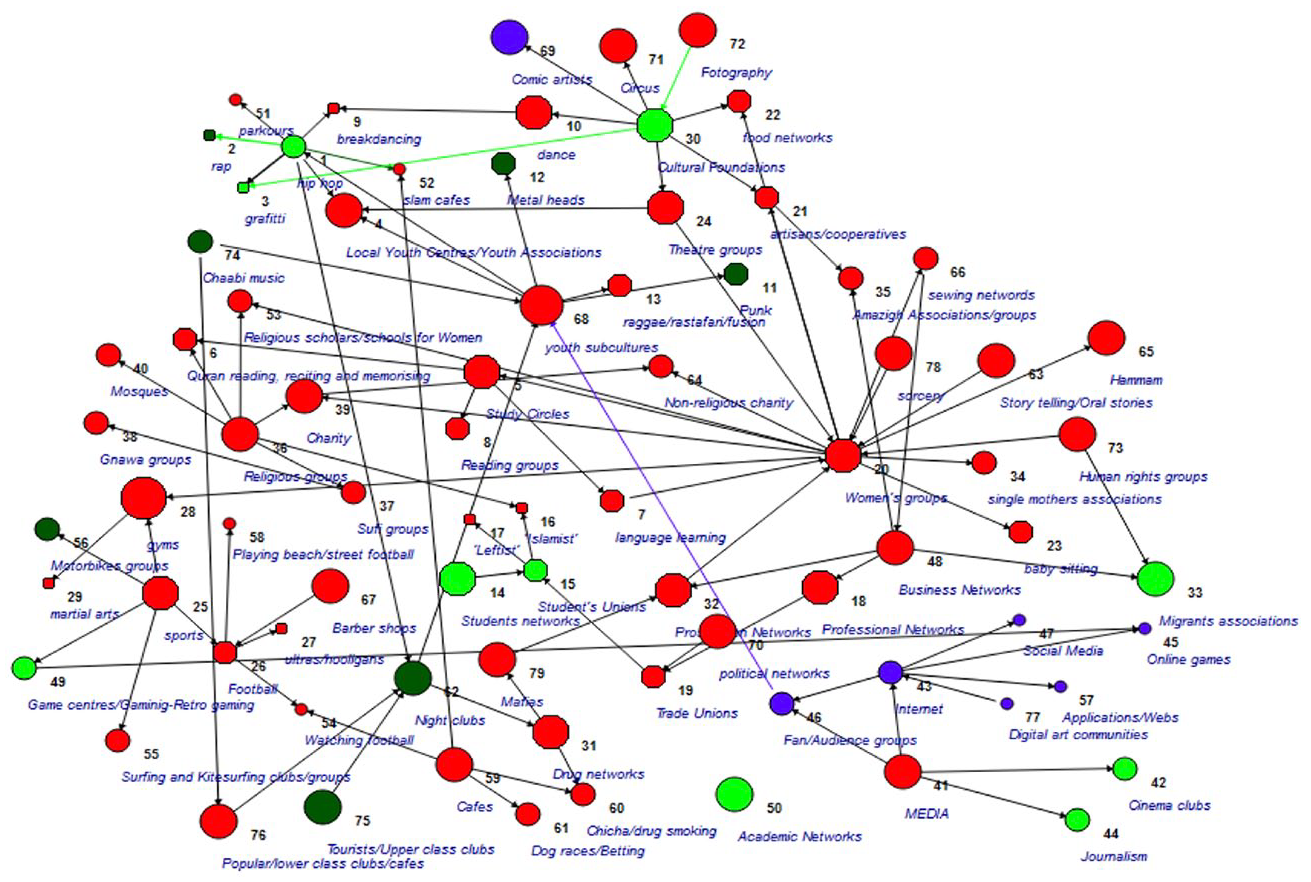
A diagram illustration of the Moroccan networks, which shows how a host of more or less civic networks exist and are connected to each other.
Each case, and each interviewee, illustrated the peculiarities of a set of young people involved in a cause in that particular country while also holding many commonalities with young people in other collectives and networks across the countries and the region more widely. Connections between the members of these initiatives were ‘organic’ (i.e. based on neighbourhoods, workplaces and economic needs) or ‘serially constituted’ (based on shared identities, interests or beliefs, as argued by Sartre and elaborated by Anderson (1998) and Young (1994)).
Four research assistants in the region, trained extensively in qualitative methods, built connections with local and diasporic young people involved in artistic and cultural, social, economic and political or spiritual and religious endeavours. Every effort was made to include both avowedly political and apolitical civic networks. As with all research, chance and serendipity played a role: rural-based activists were difficult to reach and recruit; one women’s group we selected in the UAE pulled out, and members of a Palestinian student support group proved disparate and busy. In replacing cases that did not materialize, we drew on existing resources: for instance, the personal connections of our research assistants helped to build trust amongst Sufi musicians in Morocco and metal music enthusiasts in Jordan.
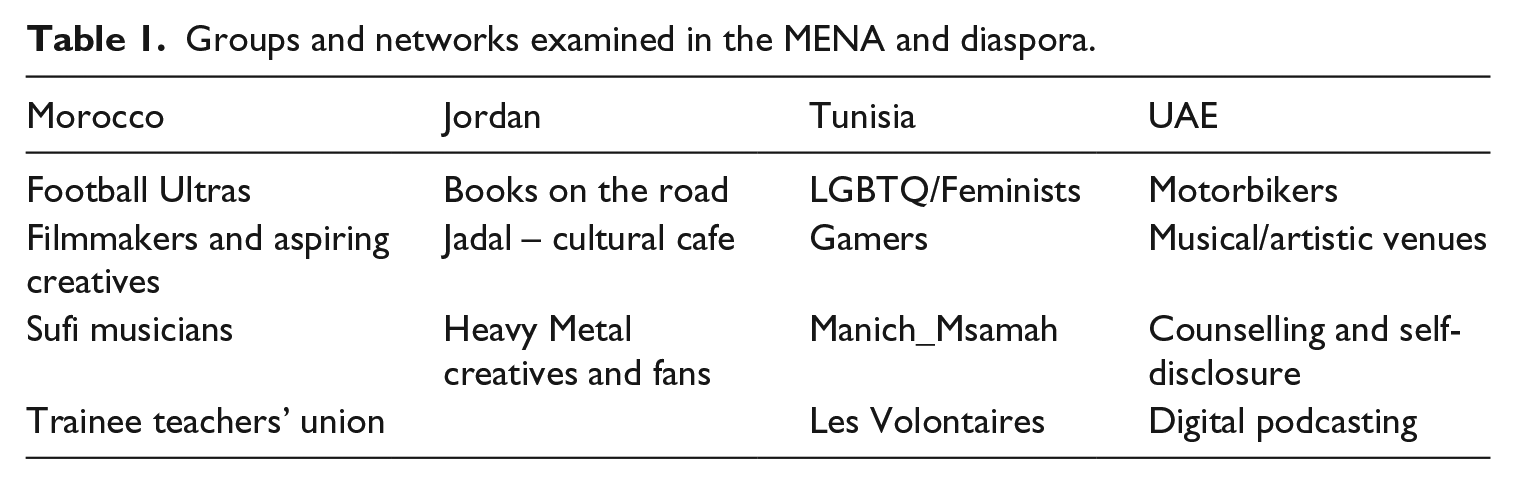
All the networks listed in Table 1 were treated with the same ethical care in terms of offers of anonymity, reciprocity and connection to the research process.
Groups and networks examined in the MENA and diaspora.
The mapping and selection of our cases was followed by observations, in-depth qualitative interviews and focus groups in each country to generate a series of contrasting case studies with the erstwhile producers or organizers and, where there was a distinction to be drawn, the members, users or audiences of these networks. Time was spent making contacts, reading and watching materials produced by the groups, building up trust, hanging out, observing and helping out at events, and meeting key organizers. The interviewees were carefully chosen to represent the different types of individuals participating in the organizations or activities selected, including newer members and experienced ones (who might have been involved in setting up the network). We allowed respondents to choose a pseudonym and later to redact transcripts if they so wished.
We coded all the data arising from interviews, focus groups and observations around issues such as national histories of participation, trust, old and new media use, the depth and types of individual and group participation in civil, religious, political and other networks offline, the connections between social class and creative production, the extent to which emerging digital platforms are being transformed into networked communities of participation, the connections between creativity and political activism, and whether there is evidence that these networks include marginalized communities. In the sections which follow, we present and then discuss findings from ten of the 16 case studies.
Results and discussion
In Amman, Books on the Road was an initiative that promoted reading as an everyday practice in the streets of the capital city. Ghaith Bahdousheh, its founder, graduated in Insurance and Risk Management from Hashemite University. His trajectory follows a pattern increasingly familiar in neoliberal metropoles: After working for four years in the corporate sector, he decided to start a cut-price bookshop. Funding or lack thereof – a problem we encountered across many networks trying to remain independent of the state – prompted Ghaith to use an aged Mercedes as an ‘alternative space’ from which to exhibit books. Using this vehicle, he moved between different neighbourhoods in Amman and visited other Jordanian towns. Ultimately, the creativity of Ghaith’s initiative showcased on blogs and by international news (Watar FM and Melody FM, and international TV channels such Al Arabiya and CCTV), attracted foreign funding. The Danish non-government organization (NGO), Action Aid, helped him to organize a book exhibition in Madaba, thus adding to the few available libraries in the country.
Thanks to the work of social media strategist Obeidat, Books on the Road has a strong social media presence. Repeating clichés about smart media and data ubiquity, Obeidat explained to us the tension between local and trans-local perspectives:
Ghaith believes in personal relationships that happen in the street. . . . But from my personal perspective I believe that we have a bigger auditorium. Everyone has a smart phone, everyone has his mobile with him or her all the time, people open all their applications on the phone: WhatsApp, Facebook, Twitter, Instagram etc.
Ghaith counters that ‘a person who walks on the streets does not need to have the internet to see the car’. Obeidat’s strategic enthusiasm for social media conceals a class bias that marginalizes groups with limited access to smart technology and expensive data packages allowing the use of apps. Other interviewees (users) claimed to have become interested in this initiative thanks to the creative Mercedes bookshop. However, our observations found that the initiative does not distribute books for free in marginalized areas to inculcate a love of reading but rather sells them, even if the price is negotiable, and more often than not, Ghaith frequents gentrified parts of Amman, where he will encounter the already literate. Confirming our observations, Anas, another interviewee, was critical, maintaining that those who surround the car seem mainly ‘hipsters, middle class people in their twenties and thirties who can speak English. That has to do with the area that he is in.’ The sharp division of the Jordanian civic sphere based on class positionality in city space became a running theme across our encounters and interviews.
Anas made a similar class critique of another initiative, the cultural centre and café, Jadal. Jadal was founded by Fadi Amireh a member of the Hirak, the main opposition movement during Jordan’s ‘Arab Spring’. Jadal is located in the trendy El Webdeh neighbourhood of Amman. Its popularity over the years has attracted the presence of white expats, and among other courses, it offers ‘Arabic for foreigners’ which attracts this audience. Jadal also caters to the Syrian refugee community present in the neighbourhood. Having become disillusioned with the quick-fix politics of political movements such as Hirak, and seeing the need for a longer contest over cultural forms and ideas, Fadi aims to promote an interest in philosophy, politics and culture and to create spaces in which open dialogue between different cultural and philosophical viewpoints can take place. As Yamen, one of our interviewees insisted, although what Jadal does might sound mundane to readers from cities where parks, museums and libraries offer spaces for conversation and debate, this is an important urban refuge as there are few similar spaces in Amman. Interestingly, despite its online hype, for Yamen, the presence of Jadal on social media is irrelevant: ‘I don’t follow anything on Facebook. On Facebook I only open my own page, or I see posts where people tag me. Yesterday I realized that it would be better if I deactivated my Facebook account, so I did.’ In line with this dismissive attitude to social media, we also noted that being self-funded, Jadal struggles to keep its doors open despite its online fame.
In the absence of a welfare state and any tradition or movement favouring one, the delivery of ‘thinking space’ falls on the shoulders of individual social entrepreneurs such as these. Reading and cultural discussion might be central issues for civic participation, but our observations suggest that the fact that these spaces are located in trendy neighbourhoods hinders the possibility of catering to the needs of the urban poor. While social media gives the illusion of broadening geographical boundaries, our research suggests that in both these cases, everyday encounters and relationships inflected by class exclusion shape the activities of Jadal and Books on the Road.
In Morocco, social media emerged as a significant communication tool for groups without access to physical spaces as is the case for the women football fans to whom we spoke. The Ultras are football fans known for their involvement in and support of football clubs, and sometimes for their politicized attitudes and slogans: they are known to create songs, tifos (visual choreography made with slogans printed on thousands of disparate plastic or card squares and displayed by fans in the stands of an arena or stadium), and other cultural expressions to support a particular team. While social class is not an impediment to joining Ultra groups, women are not allowed to become members, to follow the teams across the country or to access the areas of the stadium reserved for these groups. Sara, an Ultra-identified fan of Wydad, argued that she had to fight male family to attend matches in the stadium, saying, ‘we live in a male dominated society, a young guy can go to the stadium but a young woman cannot’. For Sara, social media is a way of keeping up with news on the team and on the Ultras she follows: ‘The internet nowadays includes everything. Mobile apps include news of Wydad, you stay informed through these applications; whenever there are updates you get notified.’ Yet, reflecting an entrenched social pattern, women and girls are notable by their visual absence in the Ultras’ online materials.
Further, Ultras are aware that social media is not a safe haven and that they are constantly surveilled. Ahmed, an Ultra, told us that while the internet is seen as an important space to share practical ideas and build up movements:
the virtual world is no longer an open space to express yourself. If you want to start an initiative, they [the state] can install people to destroy it. For example, the 20 February movement, there were people sent from the government to create obstacles and dismantle their unity and cohesion. . . . The police in Morocco base everything on the virtual world. The surveillance of cell phones and computers from satellites come first and then comes the work of the district chief.
This awareness of state surveillance and the dangers imminent in organizing civic connections or protest against autocracy was also clear in our interviews with an informal Moroccan trade union for trainee teachers.
In their fight to gain voice, this group uses hashtags, a Facebook page with over 60,000 followers, and YouTube to upload videos showcasing demonstrations. Social media actions also helped them to battle the initial void in traditional media around their struggle to get fair pay: during the period of our research, they were brutally attacked by the police for protesting a reduction in their scholarship provision and increased requirements in terms of examinations before they could teach officially (https://www.africanews.com/2016/01/11/trainee-teachers-protest-in-morocco//). Yet, as Houda, a trainee teacher told us, they prefer to organize themselves through phone calls, face-to-face contact and private WhatsApp groups, which are constantly reorganized for security reasons. Bouazza, another interviewee, insisted that their members even resort to using new media to provide the surveilling authorities with misleading information concerning their mobilization plans: ‘[W]e give a wrong spot to the Ministry of the Interior because they try to oppress us. . .we agree on all the points on the phone. . .and the time and place are the last things we know.’ This slippery relationship between social media and creative participation in the teacher trainee network exemplifies what several civic networks across our four countries reported: using social media to their advantage by showcasing symbolic content that builds solidarity for the cause, yet keeping strategic information private through face-to-face interactions or phone calls. But it also encapsulates a key feature of the Moroccan state apparatus’ relationship with its citizens: a desire to appear progressive in terms of its encouragement of a thriving digital sphere while also curtailing privacy and keeping a firm grasp of all potentially political consequences from civic connection and solidarity online.
In Tunisia, given the range of political and civil society groups and activities, we examined a cross-section of political and seemingly apolitical local and transnational activities. Manel, a young woman online gamer playing from computers in and with residents of Tunis but against other Tunisian gamers and in transnational tournaments, describes the requirements for high spec computers if any parity with western gamers is to be maintained. Members of this gamer community (without access to the requisite high-speed machines or interested in face-to-face contact with other gamers) come together in physical spaces called ‘cybers’, while others play in isolation from their homes.
Experiencing persistent sexism and misogyny from male gamers both in real life during tournaments and also in online environments, some girl gamers such as Narjess have come together to form Tunisian Girl Gamers (TGG), a resistant sub-network within a network. According to Manel, these young women need to distinguish themselves as serious and authoritative gamers against the banal and eroding sexism of their male contemporaries, but also in the wake of frequent let-downs by young female players whom they perceive as non-serious and there ‘just for fun’. In this context, Manel’s aims include a complex intermixture of implicitly political goals and proto-professional ones:
I play because I actually want to get good at the game as a person, as a gamer, not as a girl; but at the same time, I really want to say ‘I am a girl and I play as good as the boys’; that’s what I want to do too. . . . I mean, I want to make people say ‘look she is a girl and she’s better than most of the guys in gaming’. . . . I want to get to a point where I would be that good.
Other young women from this network too described their encounters with sexist behaviour and their determination to overcome and be the best (Banaji & Moreno-Almeida, 2017) in a way that positions them as a network within a network.
Les Volontaires, with their commitment to improving the cultural environment in which young Tunisians grow up, and their emphasis on highly motivated young people, were explicit about their wish to foster civility and civil society outside of the grasp of political parties and the state. The founders include a group of friends who used to meet to go to cafes or play football in high school; some of them were in another political organization with which they became disillusioned because ‘it wasn’t very neutral and was obviously working for a political agenda. . .while they wanted to be independent and neutral’ (Sami, Tunisia). One of their projects, BE-ART, involves removing what is considered vulgar language from walls and train stations, painting the walls in artistic ways and putting up graffiti that is pleasing to the eye and non-partisan. Funding remains a key difficulty for this non-profit, non-state network, which raises the money necessary for equipment and projects through other activities such as sponsored hikes or appeals for donations in radio slots and online.
In a post-revolution situation, where everyday life is finely balanced between the tentacles of the previous dictatorship and secular opposition and various Islamist tendencies, the significance of maintaining depoliticized everyday spaces cannot be underestimated. Members of Les Volontaires whom we interviewed were emphatic about wishing to remain outside the sphere of commercial culture, refusing to make a profit from their work. Tarek, himself a graffiti artist, explained the necessity of changing the slogans on train station walls, where otherwise one might await a train gazing at the ideologically loaded slogan ‘There is no rule but God’s Will’. The association is run through a series of youth committees, all autonomously constituted. The ‘communications committee’, to which Sami belongs, is ‘in charge of managing all the Twitter, Facebook, and other social media pages. . .so that young people can identify themselves with the actions and anyone who wants to collaborate finds it easier to get in touch’.
In contrast to the emphatically apolitical self-definition of Les Volontaires, Manich_Msamah (M_M) and CHOUF see themselves as challenging political and social injustice, but again without party affiliation. Dorah from CHOUF explained to us the evolution of their group and its double mission: to make visible the non-normative sexualities amongst women in safe spaces, to create dialogue between women; and to build solidarity with everyone who identifies as a woman and wishes to support gender queer rights:
It is absolutely an everyday thing if you identify yourself as a woman that you really feel the oppression that results because of your physical appearance, or because you are gender-queer (non-binary), or simply because of your reproductive role as a woman which was chosen for you by the Society without you having any opinion in it, or maybe because of daily harassment, I think it is a very natural thing to start working in Feminism. There are definitely, many types and forms of Feminism. But we are at the ‘inclusive’ end of the spectrum, we do not really discriminate against anyone. . . . If [Islamist women’s groups] can go along with our fight for these rights, we can collaborate with them. I personally do not think it would be possible honestly, but it all depends on our group’s decision. If they agree with our vision, then why not?
In this context, digital communication serves several purposes: Skype meetings with new members precede face-to-face meetings as a necessary precaution, just as they did when we made our approach as researchers; distressed emails from isolated queer women or those experiencing violence elicit a quick response; and the artistic and creative activism (‘artivism’) of the group, which might be dangerous to advertise too openly offline, is connected to an international feminist cultural scene through mail-outs, banners and web pages. Despite their desire to be inclusive, safety precautions and individual histories mean that the reach of this group into non-French-speaking and rural communities of women is curtailed.
Twenty-two-year-old Khalil joined M_M in March 2016 in frustration at the possibility that the economic Reconciliation Act might ‘let politicians from the dictatorship off the hook’. M_M’s WANTED campaign aimed to expose the corruption of the leaders of the earlier disgraced Ben Ali regime and to prevent them from being honoured or taken back into government. Figure 2 displays an image from this campaign. Khalil recounts how he was drawn to the movement when he first saw the Twitter hashtag: Reconciliation_happens_in_Court, and M_M I_will_not_Forgive.
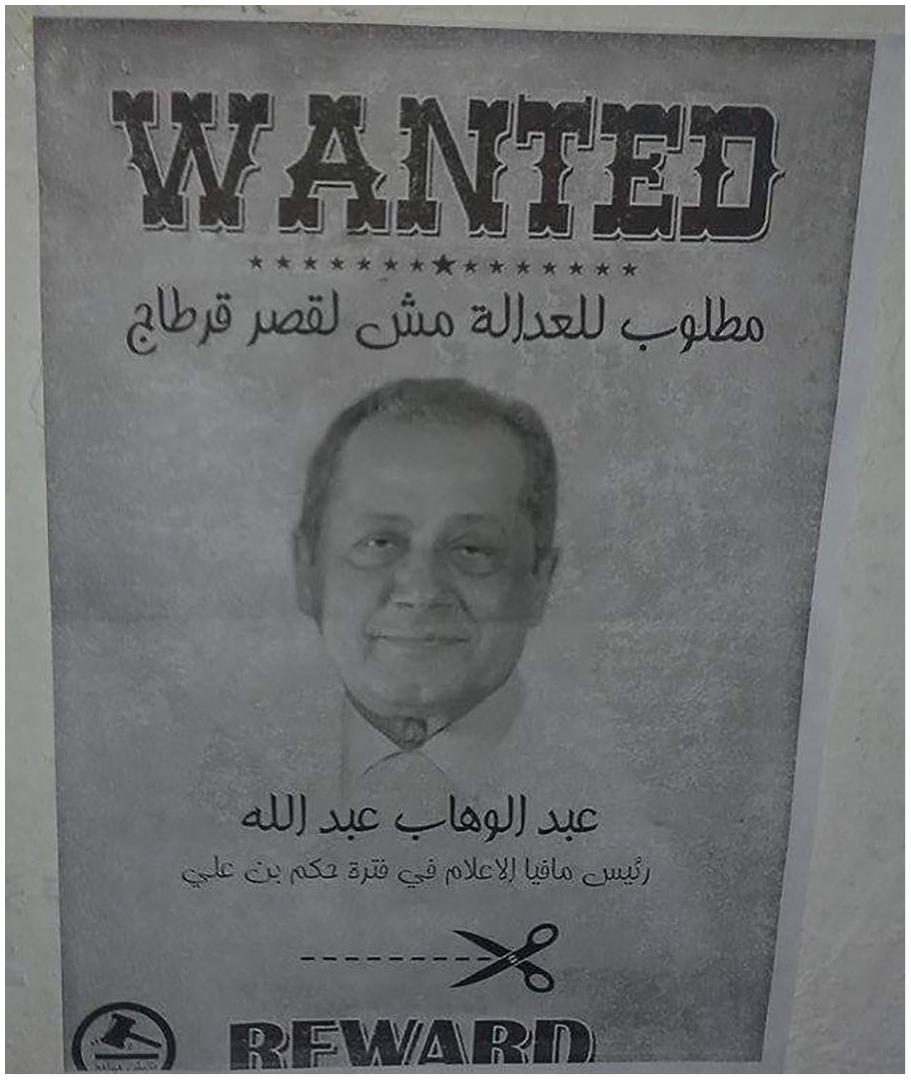
Wanted poster.
Khalil’s feeling that the release of criminal leaders from the previous regime would be a betrayal of the 2011 Tunisian revolution was shared by hundreds who attended organized protests in public places, sit-ins, talks and marches, posted on social media, tagged walls and circulated graffiti and images online. Their movement has now broadened to focus on issues of economic and civil rights under the current regime, with strong resistance to the push for neo-liberalization of the economy. Khalil explained that immediacy and accessibility are key to youth involvement: ‘what makes people join a movement or initiative or campaign is the way you talk to them and try to convince them. People don’t really like theoretical language.’
Discussing why the internet is not useful if you want a broad base, but ‘tagging’ physical walls as a means of communication is powerful, Khalil notes:
I honestly feel that we have succeeded to reach out to those we really wanted to reach. . .the common people who work by night, who spend all day at work, and could only go back home late. . . . you cannot really make these people hear about you and your message in another way. The street walls are the best place to make them see and read, make them curious. . . .
He noted that, online, those with opposing views simply block contacts or ideas of which they disapprove, whereas material walls are not so easy to avoid. Samah tells us that, given the breadth of the movement now, they need to operate through committees, which discuss some things virtually, yet always meet face-to-face to make decisions in a democratic manner. He repeatedly associated democratic decision-making with offline fora, arguing that being confined to online contact would favour a polarization of views on apparently inconsequential operational matters as much as on ideological ones, which could diminish the extensive and patient debates needed to reach democratic consensus. In all these accounts from Les Volontaires, Manich_Msamah and CHOUF members, we received a strong impression of a society in tension over unresolved injustices, of the hard work of democracy being undertaken voluntarily, outside the limelight (and therefore not labelled ‘revolution’ or ‘uprising’) but absolutely critical to ensuring that the mandate of the so-called uprisings did not get lost or hijacked by those with powerful vested interests (large businesses, politicians and, not least, the police).
In the UAE, across all of the networks we worked with and the young people we interviewed, a palpable sense of curtailment, self-censorship and frustration pervaded the accounts of all but the wealthiest white expats. Most were willing to speak freely only when the tape recorder was switched off. In some instances, we read this as a justified habit of caution formed through experience of the state; in others, we attribute it to a desire to preserve the fictitious national narrative of strong Emirati culture and openness to democratic values while also wishing to record their perceptions of lack of space for cultural exchange. The last of our four chosen networks, a women’s cooking circle comprising some expats and some refugees, withdrew their permission to use their interviews at the last minute, citing fears about government surveillance; however, since it appears that several of them were also highly connected within government circles and not perceived as a threat in any way, the possibility that they did not wish to jeopardize their position also arises.
In this highly politicized context, where paranoia, surveillance, ethnicity and economic capital play a role, we sought evidence of a strong and vibrant civil society, and in particular for one that was not entirely stratified by social class. We did find cases of individuals who, via their offline social connections and talents, had started a cultural or leisure initiative for young people. Most of these depended on the ability of the individuals involved to draw on existing social and/or financial capital to hire musical equipment or private spaces as venues. The Green Room, which we have written about elsewhere (Banaji & Moreno-Almeida, 2017), and Freshly Ground Sounds were two such initiatives.
Others unreflexively used their economic status to pursue their interest in a particular sub-culture – such as biking and bike ownership in the case of the online networks, Track Attack, the app Biker AE and individual Ducati bikers. There is something parodic about the manner in which some of these individuals boast about equipment, the price of their bikes, stunts, and the ways in which women are apparently attracted to their sub-cultural capital (‘nothing sexier than a woman on a bike’). Several of them hail from Dubai’s wealthiest families or from Europe and North America. All swear by the power and significance of social media for maintaining their sub-culture and ‘biker family ties’, noting that without the internet, none of the offline meet-ups would be possible. It becomes clear that individual connoisseurs of motorbikes have now constituted themselves as ‘groups’ and even ‘gangs’ (according to their own terminology) via word of mouth but also via social media. They meet regularly in offline spaces to show off their gear, exchange rare bike parts and race each other (a practice that is banned in the UAE and carries significant penalties). The ban adds an element of subversion to these groups that some dwelt on in interviews.
Overall, our findings in the UAE are that youth participatory networks, whether direct or mediated, are curtailed by gender, social class position and beliefs about or attitudes to surveillance and the state. Civic solidarity exists but is atomized amongst those who can either afford it or access networked spaces – in Ahmed Kanna’s (2012) words, a ‘spatialized biopolitics’ (p. 161), which thrives on cordoning off the millions of South Asian migrant workers and their protests about labour issues from the much smaller general population, and their putative struggles for self-expression. Creativity within these networks is often subjugated to and bound up with the imperatives of marketing and promotion, the desire to have one’s initiative do well and get talked about. Being talked about and becoming popular in turn bring up issues of safety and security in terms of what can and cannot be said, leading to a limiting of critique, and a watering down of messages about sex and sexuality, governance and gender. This vicious circle means, ironically, that evident creativity with new media tools is mainly allowable and spreadable when it is depoliticized or linked to entrepreneurial values.
The role of social class, knowledge and skills
While acknowledging the value of the opportunities offered by the internet, a fetishist focus on digital participation as a political motivator which ignores traditional offline forms of participation, knowledge sharing and community building amongst young people is problematic (cf. Banaji, 2017). Our reading of the data generated for our project urges us to do two things: first, to view the digital as far more complex than merely that which is online; and second, to delve far wider for an understanding of participatory cultures in the MENA region than personalized digital media. According to our analysis of observations and interviews with young Jordanians, Moroccans, Tunisians and Emiratis, a major part of lasting cultural learning, political socialization and civic participation happens in families, communities and peer groups, primarily offline. Alongside apps, film, music, digital photography, phone calls and texts, newspaper reports, television and radio continue to play a major role in their communicative practices. Knowledge from fandom, organized religion, institutional politics, formal education and household care permeate the habits young MENA citizens and residents bring to bear in their new media use.
The division of interviewees’ views with regard to the role of the internet in all four countries is clear: it is a central tool for those who have started an initiative to keep in touch with peripheral members, organize big events that require meeting offline, monitor competitors or like-minded groups, and gather the views of grass-roots members. This was the case across all our four countries, despite the fact that we chose the countries for their different histories and internet penetration rates. However, it is also seen as too ‘invasive’, ‘always on’, used for ‘self-promotion’, and ‘dangerously exposing’, which was felt most keenly in the UAE and Jordan and in particular amongst the wealthier participants. This supports the notion that combining online and offline media and action strategically and trusting neither fully is becoming second nature, especially in communities with low financial barriers to internet use.
Our interviews and observations also reveal that constant internet use is normalized amongst some of the civic groups but not amongst others; with some, it has reached saturation point, leading to reduced use or quitting social media. Although Jadal in Jordan, Les Volontaires in Tunisia and the Ultras in Morocco promote their work and organize meet-ups or donations of money and labour through photographs and online posts, their organizations cohere around physical public spaces, and young volunteers gather offline to make banners, beautify the environment, or debate philosophy, challenging inequalities, or mitigating religious and political schisms and presumptions.
In fact, like Hirzalla and van Zoonen (2011) and Gerbaudo (2018), we wish to draw attention to the intertwined nature of digital and non-digital, of leisure, fandom and activism. In making tifos for games, the Ultras meet beforehand in abandoned lots or warehouses to decide on images and slogans, and a gifted set of designers digitally designs the output for printing. The thousands of metres of printed parts of the tifo are then taken into stadia and distributed based on a computerized analysis of the stadium to make the final non-digital visual choreography, which may be, but is not always, filmed and uploaded on YouTube. The banning of the Ultras from stadia due to an avowed perception of violence or a sense of their politically anarchic potential, and an attempt by the authorities to systematize them, results in the production of political, anti-club management and anti-state boycotts, tifos and chants, demonstrations outside stadia, and generalized resistance.
Social class inflects how comfortable young citizens in our sample feel in using transnational sites on the internet and in posting original content or entering online debates. In addition, the testimonies of female football fans, girl gamers and LGBTQI activists suggest that gender too structures how such interventions are received, and how or from whom participation is encouraged. Our analysis of the data above adds weight to the finding of previous studies (Banaji, 2015; Banaji & Buckingham, 2013: 104; Lee, 2008) that, for a majority of young people, creativity, cultural production or civic participation initiated online or offline takes place in an embodied social world that is structured by historical patterns of socio-political mobilization, and by resilient inequalities. Danah Boyd (2014) argues that social interactions of teenagers on digital platforms generate new habits that are not technologically determined but are actually socially situated. In this view, technology is an enabler of social connections in virtual environments, an archive for the storage of disparate narratives and voices, and a spark or catalyst for further creative encounters when it is difficult to be geographically co-present or establish relationships and archives in real physical spaces.
Most young people in our study value their connectivity circles as well as their belonging to – and agency within – communities of friends, fans and followers. In a small number of cases, such as that of the Tunisian gamer network, the affordances of technology enable members to enhance their skills and abilities as players: however, for the sub-group of Tunisian young feminist gamers and girl gamers challenging the status quo of sexism in gaming, a new transnational identity of solidarity with other young serious women gamers is born and flourishes in part through online networks but also through trust in individuals met offline.
Conclusion
Our inclusive, historicized, contextually-specific study triangulates data from existing MENA literature, expert interviews, a survey of participatory initiatives, textual analysis of materials produced offline and online, focus groups, interviews and participant observation. It is thus uniquely placed to draw conclusions about the constitution, genealogy and boundaries of participatory networks inhabited by and available to young people in the MENA region. In the countries we examined, most participatory networks of both civic and more narrowly political provenance precede and influence the quality of communicative interactions between newly-formed creative and civic groups – friends, neighbourhoods, fandoms. The significance and level of impact of the internet in maintaining connections between persons or groups in the MENA region vary enormously and are often trivial, but phones and apps are useful in existing communities. Yoking together ‘digital networks’ and ‘participation’, as if the one precedes the other and entails an engagement with egalitarian or democratic politics, creates a narrative that short-circuits contextual histories of organization, struggle, artistic endeavour and political mobilization as well as of authoritarian and orchestrated participation in facile or dangerous ways.
In disaggregating the notion of the ‘digital’ from that of ‘networks’, our study helps to draw strong conclusions about the ways in which agency in participatory networks is enacted, enabled or curtailed. Social inequalities around gender and social class are not only reproduced, but also reinforced through agentic participation on digital platforms. Many narratives that emerged from the accounts of the 2011 uprisings or of the music cultural field in the region perpetuate the idea of a region in a constant state of upheaval, where emerging and social media play a crucially revolutionizing role. The ‘fragmented and inaudible collectives’ (Bayat, 2010: 14) of which citizens are ordinarily composed are implicitly reformulated as homogenous and purposive social movements or networks in the wake of major political events. They are often framed as being geared towards particular ends, whether in support of democracy or of authoritarianism or even of the maintenance of the status quo and cultural distinction.
However, the young people we interviewed in the MENA region asserted that their digital ‘beings’ are always only fragments of their social beings and relationships. They emphasized that physical spaces and face-to-face meetings – crosscut as these are by class-infused spatial relations – are crucial to build consensus, engage socially, co-operate culturally in civic endeavours, and to ‘do democracy’ before, during and after episodes of crisis and political discontent. Further, our analysis of the cases discussed above emphasizes that the internet and new mobile media are not only a domain within which cultural borders can be transgressed, conflicts redressed or authority challenged, but also instantiate and entrench the greater social capital of youth from economically stable backgrounds, and reinforce negative patterns of gendered and/or state surveilled interaction. The agency of historically marginalized groups in the MENA region remains significantly restricted online when it does not coincide with the choices, desires and intentions of more powerful corporations, governments, groups or individuals; it may be expressed through conformity to accepted cultural narratives online as it is offline. As such, a significant question for future research will be: How can the entrenched social, cultural, economic and political barriers to egalitarian participatory cultures be overcome online and offline?
Footnotes
Acknowledgements
The authors would like to thank the Middle East Centre at the London School of Economics and Political Science for funding the wonderful research on which this paper is based from their collaborative grants programme with universities in the Middle East. In addition, we are grateful to our co-investigator, Dr Mohammed Ibahrine of the American University Sharjah, and to our research assistants, Rita Adel, Asma Alabed, Sara Attafi, Chadi Chahdi and Monica Ibrahim for their inputs on the project. We extend our deepest gratitude to the many participants in our interviews and focus groups in Jordan, Morocco, Tunisia and UAE. Dr. Moreno-Almeida would like to offer her special thanks to the British Academy for the support received during the process of writing this paper.
Funding
The author(s) disclosed receipt of the following financial support for the research, authorship, and/or publication of this article: The authors received funding from the LSE Middle East Centre collaborative grant programme with Middle East Universities for the research discussed in this article.
