




Abstract
This study traces the retweet networks among a group of movement spilloverers spanning across five social-mediated movements (i.e., People’s Climate March, Women’s March, #GrabYourWallet, March for Our Lives, and #StoptheBans) and examines the longitudinal inter-movement dynamics. Our analysis reveals that movement spillover is a widespread phenomenon existing in ideologically compatible movements across issue areas and lasted over 5 years. We also found that movement spilloverers functioned as relationship brokers both within their original movement networks and across movements. We identified four types of brokers based on their movement memberships and flows of information, and explored the unique characteristics of these brokers. We found that itinerants and representatives are exceptionally influential among the general public and media, whereas coordinators commend considerable influence among politicians. Representatives are most effective when influencing the activist community. Theoretical and practical implications are also discussed.
Social movements are “networks of informal relationships between a multiplicity of individuals and organizations, who share a distinctive collective identity and mobilize resources on conflictual issues” (Diani, 2000, p. 387). As societies experience an exponential growth of social media, most contemporary movements to some degree utilize social media to scale up mobilization and connect otherwise disconnected individuals and organizations in their efforts to pursue social changes (Bennett & Segerberg, 2012).
Extensive research has well documented the horizontal social impact of social-mediated movements in terms of the astronomical numbers of participants, the geographic spread of such events, and the accompanied spectacular social shock (Agur & Frisch, 2019; Anduiza et al., 2014; Theocharis et al., 2015). The majority of social-mediated movement studies have focused on the structure, mobilization processes, and outcomes of single movements (Barnard, 2018; Isa & Himelboim, 2018; Micó & Casero-Ripollés, 2014). Nevertheless, the longitudinal dimension of social movements and inter-movement dynamics remain understudied with only rare exceptions (Wang et al., 2021). The focus on single events has led some to criticize social-mediated movements as click-activism or pseudo-activism (Morozov, 2011), and doubt if such low-cost movements have impact beyond a couple of hours or days.
In this study, we shift attention away from single events, and instead focus on the longitudinal inter-movement dynamics, particularly those that last for years. Drawing from the social movement spillover literature (Meyer & Boutcher, 2007; Meyer & Whittier, 1994) and the brokerage 1 research (Burt, 1992; Fernandez & Gould, 1994; Stovel & Shaw, 2012), the current study traces the retweet networks among a group of movement spilloverers spanning across five social movements that took place in the United States (i.e., People’s Climate March, Women’s March, #GrabYourWallet, March for Our Lives, and #StoptheBans) between 2014 and 2019. In our study, we recognize movement spilloverers as individuals or organizations that identify with multiple values and identities and participate in at least two movements. As they participate in different movements, they form complex networks with each other and other movement participants, and function as bridges that channel tactics, experiences, and resources between otherwise disparate movements (Meyer & Whittier, 1994).
Our analysis reveals that movement spillover is a widespread phenomenon existing in ideologically compatible movements across issue areas and time. We also found that movement spilloverers functioned as relationship brokers both within their original movement networks and across movements. We identified two types of brokers that are visible in single movements (coordinator and itinerant) and two types of cross-movement brokers (representative and gatekeeper) that are hidden when studying movements in isolation. In studies of isolated movements, these activists’ brokerage may be invisible despite their importance. In addition, we explored the unique characteristics of these aforementioned types of brokers. We found itinerants and representatives to be exceptionally influential among the general public and media, and coordinators to commend considerable influence among politicians. Representatives are most effective when influencing the activist community.
Overall, with a focus on the longitudinal dynamics of inter-movement networks, our study invites scholars to consider social-mediated movements as a continuous, interconnected system. Spilloverers and their networks, although largely understudied in previous literature, could play considerable roles in reaching general publics, media, politicians, activist communities as well as foster network formation, and warrant continued research and theorization. By considering the implications of relationships between and within issue publics for the organizing of social-mediated movements, the study also advances our theoretical understanding of how public networks without organizations at the center can have unintended consequences for organizations (Yang & Taylor, 2015; Zhou, 2019). Theoretical and practical implications are also discussed.
Social Movement Spilloverers and the Connection between Social Movements
Movement Spillover Phenomenon
Social movements are rarely isolated incidents. Instead, movements often respond to interconnected social, political, and cultural issues (Meyer & Boutcher, 2007). Especially for movements occurring contemporaneously, as they often respond to similar political opportunities, movement-to-movement interactions and influences are quite common and the boundaries between social movements are not always distinct (Terriquez, 2015). Although early studies on movement spillover focused on US domestic movements (Meyer & Whittier, 1994; Mische, 2003), later research has found that movement spillover is not only present among movements co-occurring in a same country, but such influence could also transcend time and national boundaries (Hadden, 2014; Hadden & Tarrow, 2007).
The concept of movement spillover and related research are developed to examine how previous movements affect subsequent movements both directly and indirectly (Meyer & Boutcher, 2007). Meyer and Whittier (1994) coined the term “movement spillover” to refer to the diffusion of ideas, activists, activism tactics, and organizations from one movement to another. According to Meyer and Whittier (1994), three mechanisms are critical for movement spillover: movement coalition, personnel exchanges, and changing political opportunity structure. Specifically, movement coalitions or the organizational networks among movements could provide infrastructure for movement spillover. In addition to organizations, the exchange of individual activists between movements provides another conduit for inter-movement influence (Terriquez, 2015). Finally, one movement may influence another through shaping later movements’ political opportunity structure. Political opportunity structure refers to the political context that influences movements’ emergence, development, and ultimate social impact (Meyer & Minkoff, 2004). Previous movements may transform the external political and cultural contexts through its protests and activities and thus shape the political opportunity facing future movements. A movement could also make certain strategies and frames more attractive or promising than others, and create models for its successors (Meyer & Boutcher, 2007).
Movement spillover research has generated critical insights to enrich our understanding of how movements communicate with and influence one another (Hadden, 2014; Hadden & Tarrow, 2007; Meyer & Boutcher, 2007; Meyer & Whittier, 1994; Terriquez, 2015). Nevertheless, the dominant approach to studying movement spillover has mainly focused on examining movement tactics and frames as its consequences, and has rarely looked at how movement spillover influences movement networks at the micro and meso levels. As we elaborate in the next section, the network approach offers new opportunities to explore other consequences of movement spillover.
The Unsung Heroes: Movement Spilloverers
Terriquez (2015) notes that as activists shift goals in response to changing political threats and opportunities, they could join a number of social movements while maintaining a consistent political worldview. These activists’ experiences in previous movements often allow them to emerge as skillful and prominent actors in later movements and hence gradually emerge as movement elites. The elite status here does not mean that these activists become household names but rather that they make important contributions to the movements. For instance, Hadden (2014) studied a group of activists associated with the global justice movement who later took part in the climate change movement. Her research showed that these activists helped to draw considerable attention to the relatively new climate change movement and emerged as elites through their repeated involvement in movements. Hadden also found that these spilloverers built close connections with other important actors in the climate change movement, and exerted considerable influence on other elites. Nevertheless, little is known about whether spilloverers on social media also raise to an elite status, and whether they commend exceptional influence on the activist community, politicians, and media.
Furthermore, in recent decades, with social media gradually taking up important roles in movement organization and mobilization (Bennett & Segerberg, 2012), studies have documented movement spillovers in the social-mediated context. For example, movement spilloverers have been studied as “serial activists” (Bastos & Mercea, 2016; Mercea & Bastos, 2016). Bastos and Mercea (2016) define serial activists as social media users who use social media platforms to communicate actively about multiple movements over time. Serial activists are characterized by the magnitude of their social media usage, geographic sparseness, and their sustained commitment to contentious politics. In a recent study, Wang et al. (2021) identified a group of serial activists that interacted in multiple environmental movements over 5 years, and found that serial activists formed a community with dense ties and stable interaction patterns.
In this study, we broaden up serial activists research and examine any individuals or organizations that spillover from one movement to another, regardless of their social media usage or commitment levels. We name these activists “movement spilloverers.” We use Figure 1 to illustrate the activation process of movement spilloverers. In Figure 1, Panel A shows the public’s baseline relational network. Panel B1 shows one issue that triggers public attention and activates some users to participate in the movement. Panel B2 shows another issue that activates a subgraph of individuals. Those who identify with both issues in Panel B1 and B2 might contribute to the phenomenon of movement spillover, as shown in Panel C.

The activation process of movement spilloverers.
Moreover, we not only examine spilloverers that are active in the same social issue, but activists who spillover a wide range of issues (i.e., environmental protection, women’s rights, consumer activism, gun control movement, and abortion rights) to understand the interactions and influences among a spectrum of contemporary movements. Since we know a little about how widespread this phenomenon is, we propose the following question:
RQ1. Across five social-mediated movements (i.e., People’s Climate March, Women’s March, #GrabYourWallet movement, March for Our Lives, and #StoptheBan movement), among users participating in these movements, what is the average percentage of spilloverers?
Notably, spilloverers may be uniquely capable of performing broker roles that connect social-mediated movements across time and issues. Meyer and Whittier (1994) explained that as experienced activists, spilloverers may enjoy considerable social capital in the activist community. As they join different movements and reconnect under new rallying cries, they could reactivate their previous connections and strengthen such ties; or, they could enrich relationship building opportunities in the new movement by connecting new recruits with seasoned activists. These network functions, as further discussed below, may be the key to understand the connections between social movements and the long-term impact of social-mediated movements that are often considered short lived (Meyer & Boutcher, 2007).
Information Flows, Social Capital, and Identity Negotiation: A Nuanced View on Brokerage
The concept of brokerage is a primary research tool for studying interactions between different groups (Fernandez & Gould, 1994). Brokerage is one of a few mechanisms by which disconnected actors could interact socially, economically, and politically (Stovel & Shaw, 2012). Stovel and Shaw (2012) contend that the crucial characteristics of brokers are that they bridge gaps in social structure and that they help “goods, information, opportunities, or knowledge flow across that gap” (p. 141). Scholarly interests in brokerage date back to Simmel’s work on the significance of tertius gaudens (the third who benefits). Granovetter’s (1973) work on the importance of weak ties is an important development on brokerage. Drawing from earlier research, Burt (1992) further built the theory of structure hole, and found that brokers could shape information flows in their immediate networks.
Recent research on social-mediated movements also confirms the critical roles of movement brokers and peripheral participants (Barberá et al., 2015; Bennett et al., 2018; Boler et al., 2014). Through their interviews with 75 Occupy Wall Street activists, Boler et al. (2014) revealed that in the Occupy movement, women played critical, yet often neglected roles. One of such important roles was functioning as connectors. These female activists created groups on social media and spread information about protest events through word of mouth in their communities. Barberá et al. (2015) found that peripheral participants could significantly increase the reach of protest messages to broader audiences. After analyzing three different movements, Barberá et al. (2015) found that the success of social-mediated movements often depended on the degree to which they could activate the peripheral participants. Similarly, Bennett et al. (2018) showed that the peripheral networks in the Occupy movement were able to powerfully influence public attention and media coverage, despite their agenda differed from that of the movement core.
Nevertheless, to understand spilloverers’ brokerage, a conceptual framework solely based on network position is inadequate for two reasons. First, when spilloverers bridge connections, they may encounter a range of situations. For instance, they may bridge disconnected actors in a previous movement or in a subsequent movement. Or they may bridge ties between movements. Such brokerages may require different efforts and perform different functions (Hadden, 2014; Hadden & Tarrow, 2007). Second, the direction of information flow matters. In the context of multiple social-mediated movements, the direction of information flow may signal how influence gets transmitted from one movement to another. If a spillover sends information from a previous movement to a subsequent one, she may diffuse the influence of the earlier event. If the same spillover sends information from a new movement to contacts from the previous movement, she may reactivate and mobilize others to join a new battle.
To understand complex brokerages, Gould and Fernandez’s (1989) taxonomy offers an insightful theoretical lens. It classifies different types of brokers based on the direction of information flow and the idea that brokers may affiliate with different communities (movements). Gould and Fernandez (1989) identified the following five types of brokers in a directed network: coordinators, representatives, gatekeepers, itinerants, and liaisons. As illustrated in Table 1, notably each role is associated with a particular structural configuration of information flow and movement membership (as defined by the first movement a spilloverer participates in). Below, we discuss these brokers in detail and also explain our operationalization in this study.
Movement Spilloverers’ Brokerage Roles.

Note. Movement spilloverers are marked with gray color. Shapes indicate group memberships. Those who spillovered from Movement 1 to Movement 2 are marked with Movement 1 membership.
Coordinator
Gould and Fernandez (1989) define a coordinator as the intermediary between two in-group members. In our study, a coordinator interacts with two members in a previous movement and spillover to a subsequent movement. The coordinator functions as a broker in the previous movement but may or may not form new ties in a subsequent movement.
Itinerant
Gould and Fernandez (1989) define an itinerant as an outsider who facilitates information transfer between two nodes from the same group. In our study, we define an itinerant as a movement spilloverer who facilitates interactions among two movement participants in a subsequent movement. In other words, an itinerant function as a broker in the subsequent movement.
Both coordinator and itinerant roles allow a spilloverer to function as a broker within either the previous or subsequent movement, but not necessarily bridge interactions between movements. Coordinator and itinerant roles can be observable through analyzing each movement as often demonstrated in traditional research (Diani, 2000).
Representative
According to Gould and Fernandez (1989), a representative transmits information from her in-group member to an outside group member. In our study, we define a representative as a spilloverer who interacts with a member in a previous movement first and then interacts with a new contact in a subsequent movement, and thus may disseminate influence from the previous movement to the subsequent one.
Gatekeeper
Gould and Fernandez (1989) refer to a gatekeeper as someone who feeds her in-group members with out-group information. In our study, we define a gatekeeper as a spilloverer who interacts with a new contact in a subsequent movement first and share the information with another participant from a previous movement. A gatekeeper may help to introduce new contacts to previous connections.
Being a representative or a gatekeeper allows a spilloverer to connect different movements. What differentiates these two roles is the flow of information. Moreover, these two types of brokerage are invisible if movements are studied in isolation and thus are considered hidden brokerage in our study.
Liaison
Finally, a liaison bridges communication between nodes that belong to two different groups while affiliating with a third group herself (Gould & Fernandez, 1989). Since we focus on cases that spillover from one previous movement to a subsequent one, we do not include this condition in our study.
So far, we have discussed the different types of brokerages spilloverers may occupy. According to earlier research on brokerage (Burt, 1992; Granovetter, 1973), performing these broker roles may benefit spilloverers and make them exceptionally influential in comparison to other movement participants. In this study, we examine interactions on Twitter. Given the number of retweets a user receives is a widely used indicator of the level of influence or popularity the user enjoys (Yang & Saffer, 2020), we ask,
RQ2. Across five social-mediated movements, do spilloverers taking on one or multiple broker roles (i.e., coordinator, itinerant, representative, and gatekeeper) receive significantly more retweets than other movement participants in the subsequent movement?
Furthermore, previous studies of offline movement spillover identified spilloverers’ unique roles based on their engagement with movement elites and contributions to network formation (Hadden, 2014; Hadden & Tarrow, 2007). In this study, as discussed below, we also examine whether spilloverers on social media with different brokerage influence elites and network building differently.
Movement Spilloverers’ Brokerage and Influence
In this study, we are interested in understanding a spilloverer’s role in a subsequent movement she participates in (which is the participation that qualifies a user as a movement spilloverer). Specifically, we focus on how elite actors interact with spilloverers and whether spilloverers facilitate network building through participating in triangulating relationships, which are one of the basic social structures that could lead to the formation of communities.
Spilloverers’ Engagement with Movement Elites
For spilloverers to reach a broader audience and leverage their influence on powerful decision makers, they may need to build relationships with and influence elite users in social-mediated movements. In this study, elite users are defined as social media users who take part in a social-mediated movement through tweeting, posting movement-related content, and/or hashtags, and possess important resources such as cultural and political influences that are valuable for furthering the goals of the said movement. In this study, drawing from previous research (Youmans & York, 2012), we identify media and journalists, politicians, and self-claimed activists and activist groups as movement elites.
Media and Journalists
In this study, media broadly include traditional mainstream media and digital media such as blogs, vlogs, podcasts, and YouTube channels. We also included self-claimed journalists. The success of a social movement to a large degree depends on activists’ ability to reach the mass public beyond the movement’s circle (Bennett & Segerberg, 2012). Even in the social media era, most media’s social accounts are still far more influential and popular than average activists (Freelon et al., 2016; Schradie, 2018). Moreover, research has found that digital media such as blogs could offer activists alternative channels for their voices (Anduiza et al., 2014). Likewise, when media accounts retweet or interact with activists, it helps to expand activists’ message reach, validate the importance of their issues, and empower mobilization. Freelon et al. (2016), for example, found that through gaining coverage from mainstream media, #Ferguson activists were able to attract over 40 million publics to tweet about the movement.
Meanwhile, media also benefit from interacting with activists because they provide drama, conflict, and firsthand accounts of the events, oftentimes in the forms of photos and videos (Barnard, 2018). However, media are less likely to interact with random activists. Previous research suggests that activists’ network positions could influence their chance of media catching. Barnard (2018) found that when covering social-mediated movements, journalists often follow the trending topics, unique angles, and materials that could show a sense of shared experience. Activists that are located at the center of information flow, with many connections, and located in-between online communities may have a better chance of catching journalists’ attention. Moreover, as previously discussed, these characteristics are often associated with brokerage positions. Hence, we also explore whether media are more likely to retweet brokers, and if so, which type of brokerage is most attractive:
RQ3. Across five social-mediated movements, are spilloverers taking on one or multiple broker roles more likely to be retweeted by media or journalists than other users (RQ3a)? If so, which types of spillover brokers are more likely to be retweeted by media or journalists (RQ3b)?
Politician
Politicians here refer to members of political parties that hold elected office. In recent years, a growing number of studies have examined politicians’ social media use (Enli, 2017; Weaver et al., 2018). Research suggests that social media have changed how publics perceive politicians and their messages (Enli, 2017). Social media platforms such as Twitter offer politicians channels to broadcast their political views and storyline. Research also suggests politicians use social media for purposes such as political marketing, including impression management and branding, agenda setting and bypassing gatekeeping, and internal communication aiming at motivating staff and supporters (Enli & Simonsen, 2018).
Moreover, studies have examined politicians’ Twitter networks and found that politicians’ networks tend to cluster around political ideologies with links to individuals or organizations that are popular in the contemporary political landscape (Cherepnalkoski & Mozetic, 2016). Similarly, Weaver et al. (2018) found that major political events and intra-party tension shape politician retweet networks in the United Kingdom. Contentious events such as social movements can be important political events for politicians to signal their positions on social issues and build relationships with like-minded supporters. Since brokers may occupy important positions in social movements, we expect that politicians are more likely to retweet spilloverers with broker roles. However, we do not know which type of brokers are more popular, we thus ask,
RQ4. Across five social-mediated movements, are spilloverers taking on one or multiple broker roles more likely to be retweeted by politicians than other users (RQ4a)? If so, which types of spillover brokers are more likely to be retweeted by politicians (RQ4b)?
Activist Community
The activist community here refers to self-claimed activists and activist groups. Devoted activists and activist groups are important actors in social movements both online and offline and they often take on the role of organizers and movement elites (e.g., Schradie, 2018). For instance, Micó and Casero-Ripollés (2014) studied the 15M movement in Spain and found that the organization named Real Democracy Now! led a coalition of over 500 groups and the coalition and its broad networks were behind multiple large-scale demonstrations. Research also found that in comparison to lay participants, these activists tend to possess a higher level of social media efficacy and political knowledge (Velasquez & LaRose, 2015).
Given the importance of activists and activist groups, in this study, we explore how the activist community interacts with spilloverers. As suggested by previous research, movement spilloverers may have accumulated considerable social capital through their repeated participation in movements and therefore are likely to have connections with activists. However, it is unclear spillovers with which types of brokerage are more popular among activists. Therefore, we ask,
RQ5. Across five social-mediated movements, are spilloverers taking on one or multiple broker roles more likely to be retweeted by activists than other users (RQ5a)? If so, which types of spillover brokers are more likely to be retweeted by activists (RQ5b)?
Spilloverers and Triangulating Clusters
So far, we have discussed that spillover brokers may influence media, politicians, and the activist communities participating in social-mediated movements. In addition to influencing elite actors, previous research suggests that spilloverers may foster network formation (Wang et al., 2021). Although it is difficult to attribute the formation of an entire network to some participants, it is possible to observe whether or not spilloverers are significantly more likely to be involved in micro social network structures that are critical for network formation. One such micro network structure is the forming of triad. 2 Obstfeld (2005) has explained how a large network can grow out of small triads. Triads are the structure in which new ties form and dyads start to interconnect and form large networks. In triads, all involved actors interact with each other and form tight circles, akin to the situation of “friends’ friends are also friends.” Madhavan et al. (2004) also explain that triads are important because they strategically locate between the single dyad and higher order network aggregations such as ego-networks. The value of triads in social networks has been well documented (Batjargal, 2007; Choi & Wu, 2009). In the context of movement spillover, triadic analysis is especially important because it helps to illustrate how spilloverers may play important roles in facilitating network formation across movements. Therefore, we ask,
RQ6. Across five social-mediated movements, are spilloverers taking on one or multiple broker roles more likely to be included in triads than other users (RQ6a)? If so, which types of spillover brokers are more likely to be included in triads (RQ6b)?
In addition, we also explore whether spilloverers are involved in triads with members of activist communities. This is because triads are critical structures for network formation. If spilloverers are more likely to be involved in triads with activists, it stands to reason that they are more likely to help bridge the connection between activists to other users. Therefore, we ask,
RQ7. Across five social-mediated movements, are spilloverers taking on one or multiple broker roles more likely to be included in triads with activists than other users (RQ7a)? If so, which types of spillover brokers are more likely to be included in triads with activists (RQ7b)?
Method
Research Context
Terriquez (2015) notes that activists are likely to commit to a range of movements if that allows them to maintain a relatively coherent worldview. Guided by this insight, we selected five movements that occurred over 6 years (2014–2019) with considerable differences in terms of issue areas (climate change, women’s rights, consumer activism, gun control, and abortion rights) and all reflect progressive ideologies. Below, we briefly introduce each case and additional details about associated datasets can be found in Table 2.
Data Description and Network Statistics.

Note. Network indicators are based on the largest weakly connected component.
Climate Change
People’s Climate March took place on 21 September 2014, with New York City as its center and numerous satellite marches across the world. This movement, organized by a coalition of civil society organizations named People’s Climate Movement, called for world leaders to take actions on climate change and was recorded as the largest climate change march in history by that time (Foderaro, 2014). We purchased a historical Twitter archive from Sifter, which has access to Twitter Firehose. We set the data purchase timeframe to be from 9:00 am EST to 11:59 pm EST on 21 September 2014, which is the day the march took place around the world. We used “climate” or “climate change” as the search keywords to identify all tweets containing these keywords.
Women’s Rights
In the week of 21 January 2017, after President Donald Trump’s inauguration, millions of women participated in the Women’s March. This march, organized by an activist group named Women’s March, aimed to protest against misogynist statements made by Trump and to empower women (Przybyla & Schouten, 2017). We again purchased tweets from the same data provider, with a timeframe set between 9:00 am EST 21 January to 11:59 pm EST 27 January 2017, which is the week the main march and satellite marches took place around the world. To capture relevant tweets, we searched for any tweets containing the hashtag #WhyIMarch, the official hashtag promoted by the organizers.
Consumer Activism
Grab Your Wallet was a consumer rights movement organized by a non-profit named Grab Your Wallet Alliance. This movement advocates for corporate accountability and calls for consumers to boycott against retailers that carry Trump-related products with its official hashtag #GrabYourWallet. The movement received wide public attention in February 2017 when Nordstrom stopped carrying Ivanka Trump’s clothing line (McGrath, 2017). We purchased tweets from Sifter that contained the #GrabYourWallet hashtag with the timeframe of 9 am EST 3 February to 11:59 pm EST 9 February 2017. This is the week when Nordstrom’s decision received mainstream media coverage and many tweeted with this hashtag.
Gun Control Movement
March for Our Lives was a student-led movement planned by a political action committee named Never Again MSD along with a non-profit named Everytown for Gun Safety in support of gun control in the United States (Cooper, 2018). Following the mass shooting at Marjory Stoneman Douglas High School in Parkland, Florida, this protest was staged on 24 March 2018 in Washington DC with a massive turnout. We streamed tweets using the official Twitter application programming interface (API), with a timeframe set between 9 am EST and 6 pm EST on 24 March 2018. Our search included any tweets containing #MarchforOurLives, the official hashtag promoted by the organizers.
Abortion Rights
Starting on 21 May 2019, activists in many US states organized protests against a series of state-level legal efforts that enacted abortion bans, including states such as Alabama, Mississippi, and Ohio. The protest was organized by multiple non-profit organizations including the American Civil Liberties Union (ACLU), Planned Parenthood, and NARAL Pro-Choice America, using the hashtag #StoptheBans (Wamsley, 2019). The main demonstration was scheduled on 21 May 2019 and satellite marches lasted for about a month. Purchasing data from Sifter, we collected tweets containing #StoptheBans from 9 am EST 21 May to 11:59 pm EST 20 June 2019.
Variables
User Categories
We classified users in our dataset into the following categories: movement spilloverers, individuals, politicians, media, non-governmental organizations (NGOs), and activists. To identify movement spilloverers, we first matched usernames 3 across all five social-mediated movements. For example, if a user appeared in the Climate March and later on in the March for Our Lives movement, the user is classified as a movement spilloverer from the previous movement to the latter movement. Since potentially some users could change usernames over the 6-year period, our analyses should be considered as a conservative estimate of the prevalence of spilloverers. In addition, we employed a nested labeling structure by first differentiating individual accounts from organizational accounts and then matching user handles or user description keywords that indicate media, politicians, or activists. To identify individuals, we combined the yearly 300 most popular baby names since 1960 (N = 854) and popular occupation names (N = 996) into a keywords list. Account bios containing these keywords will be classified as individuals. To identify politicians, we used a list of Congress Twitter handles and common politician titles. We also used keyword lists for media organizations, NGOs, and activists to identify those accounts. The categorization scheme is detailed in the Online Supplemental Appendix.
Brokerage Positions
As discussed earlier (see Table 1), we examined the following four distinct brokerage roles: coordinator, representative, gatekeeper, and itinerant. We employed the brokerage function of the sna package in R to measure the extent to which each node assumes these roles. The calculation is based on how many times a node serves one of the four broker functions shown in Table 1. Thus, in each instance of movement spillovers, one node (i.e., Twitter user) will have a numeric vector of a length of four, serving as our independent variables. Since our networks varied in sizes, which provided different maximums for the raw brokerage measure (see Gould & Fernandez, 1989), we adopted the brokerage function’s standardized scores. The standardized scores consider the maximum and minimum brokerage capacities a node can possibly achieve in a network, and provide an unbiased measure of the magnitude of nodes’ network function as brokers. We also confirm that the variance inflation factors (VIFs) of our statistical models, which regress outcome variables on these four brokerage measures, are all smaller than five, indicating no multicollinearity.
Network Triads
Another key outcome examined by this study is the number of triads that contain movement spilloverers. To identify this, we first extracted all cliques in (subsequent) standalone movement networks where undirected ties connected three movement participants into a triangle. We further identified triads that involved activists as identified by our user categorization scheme. We calculated two dependent variables for data analyses, by identifying participants in triads that are on our list of movement spilloverers identified earlier. For example, if a participant spills over from movement A to movement B, five triads in the standalone movement B network involve the participant, and three of the five triads contain activists, the participant’s two triangulating outcomes will be numerically marked as 5 and 3. It should be noted that the two examined network variables—triads and brokerage—are fundamentally different. The function of brokerage requires that the two nodes connected with a movement spilloverer should not have ties between them, while in triads, the two nodes connected with the movement spilloverer need to build a tie.
Analytical Strategies
We constructed five weighted and directed networks, where nodes stand for unique Twitter users and edges stand for retweet activities. We used the direction of information flow as the edge direction, so that user A retweeting user B’s content would translate to an edge from B to A in the network. Because these networks contain isolates, we used these networks’ largest weakly connected components for analyses (see statistical summaries in Table 2). To investigate movement spilloverers’ impact, we focused on 10 possible instances of movement spillover by merging two of the five networks at a time and analyzing the 10 network unions (
In summary, to answer RQ1, we matched and identified users across movement datasets to provide a description of the phenomenon. To answer the remaining six research questions, we focused on movement spilloverers in those 10 spillover instances, and examined the relationships between their brokerage scores and their communicative outcomes, including the number of retweets (RQ2), the number of media retweets (RQ3), the number of politician retweets (RQ4), the number of activist retweet (RQ5), the number of triads (RQ6), and the number of triads involving activists (RQ7). To eliminate the endogeneity issue caused by potential unmeasured confounders, we included usernames fixed effects for the last six research questions. Spillover instance fixed effects were also added, since the 10 instances of movement spillover vary in their magnitudes, contexts, and time. Ordinary least square regressions with cluster-robust standard errors for both username and spillover instance were used. Aligning ourselves with the principles of open science and data transparency, we have deposited the dataset and scripts on Open Science Framework (OSF) for replication purposes.
Results
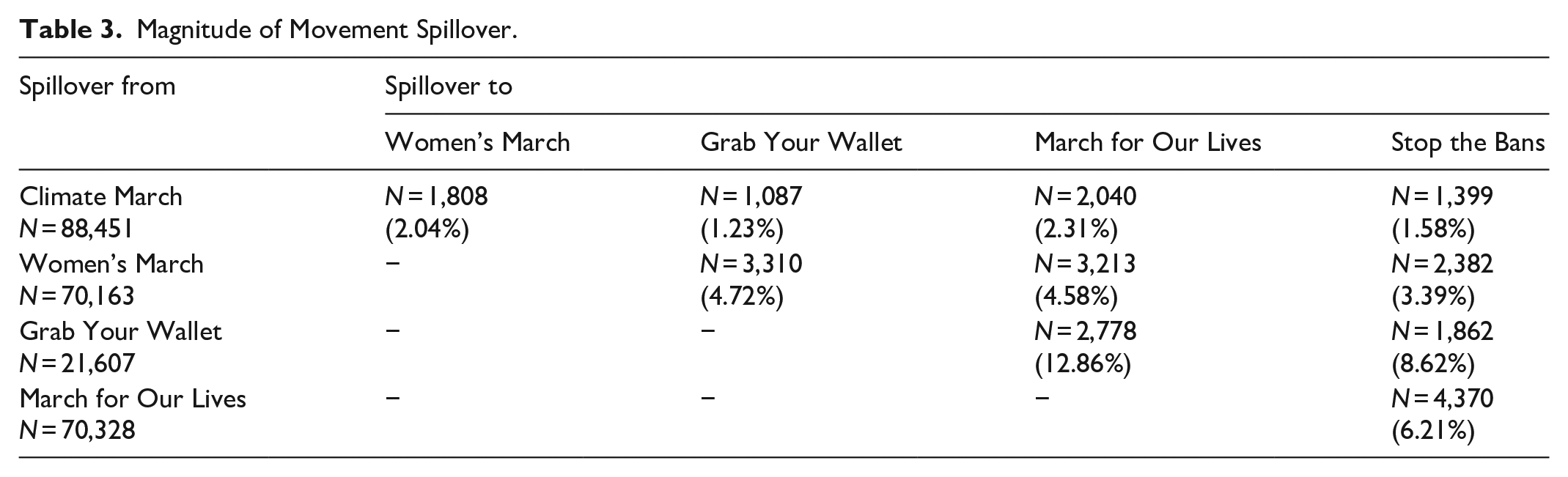
RQ1 explores how prominent the spilloverer phenomenon is across five social-mediated movements. Table 3 shows that among the five social movements, the percentage of participants who spilled over to consequent movements averages at 4.75%, with a maximum spillover rate of 12.86% (N = 2,778) from #GrabYourWallet (February 2017) to March for Our Lives (March 2018). In other words, more than one-tenth of the #GrabYourWallet participants showed up in March for Our Lives 1 year later. Of the 283,307 unique users across five datasets, we found 5.90% (16,706) of users to have spilled over at least once. To visualize the connections across movements, we put all nodes from the five movements with a force-directed layout in Figure 2, which shows that movement spilloverers connected otherwise disconnected social movement networks. As can be observed from the figure, movement spilloverers (colored black) were quite widespread across different movements, and they were often positioned between movements and function as bridges.

Visualization of the union of five movement networks.
Magnitude of Movement Spillover.
RQ2 asks whether spilloverers taking on one or multiple broker roles receive significantly more retweets than other movement participants in the subsequent movements. We found that across all individual networks, movement spilloverers have higher numbers of followers, followings, and likes than other users (all statistically significant at p < .001 level according to Mann–Whitney U test), suggesting that movement spilloverers are relatively more active and popular on Twitter than average movement participants. In addition, our analysis found that when spilloverers take on the roles of itinerant (b = .023, p < .001) and representative (b = .065, p < .001), such roles increase the number of retweets a movement spilloverer receives in the subsequent movement, while being a coordinator or gatekeeper exerted no significant effect (Table 4).
Regression Results on How Brokerage Roles Affect Movement Spilloverers’ Communicative and Networking Outcomes.

Note. Username and spillover instance fixed effects were included with cluster-robust standard errors.
p < .05; **p < .01; ***p < .001.
RQ3 explores whether taking on one of the brokerage roles leads to higher retweets by the media while RQ4 examines whether brokerage roles lead to higher retweets by politicians. The effect of brokerage roles on media retweeting is consistent with what we have reported regarding the overall retweeting pattern, though the effect size is much smaller. It seems that media follow the general popular trends and are more likely to retweet spilloverers who take on the roles of itinerants (b = .001, p < .01) and representatives (b = .001, p < .05). Regarding the effect on politician retweeting, we found that the role of coordinators (b = .027, p < .05) had a positive impact while the role of gatekeepers (b = −.033, p < .05) exerted a negative effect. Recall that coordinator role mainly requires spilloverers to engage their previous contacts. It is likely when spilloverers position in this type of role, they reactivate their previous connections and experiences, which seems to be attractive to politicians. In contrast, messages retweeted by gatekeepers would come from new contacts in subsequent networks. In this context, the spilloverer may not be able to draw from previous movement connections or experiences, and thus appeared to be less attractive to politicians.
RQ5 examines which brokerage roles are mostly likely to be retweeted by the activist community. We found that being representatives (b = .002, p < .05) attracted the activist community in the subsequent movement, while being coordinators, itinerants, or gatekeepers did not affect the retweet rate. This suggests that when a spilloverer shared ideas from participants in the previous movement to the subsequent movement, she is more likely to garner attention from other activists.
RQ6 examines whether brokerage roles affect spilloverers’ chance of being included in triads, while RQ7 analyzes the subset outcome of being included in triads with activists. We found that the role of itinerants (b = .030, p < .01) increases the number of triads a movement spilloverers are embedded in, but it does not affect triads containing activists. Instead, the gatekeeper role (b = .001, p < .001) positively affects spilloverers’ chances to be included in triads with activists.
Discussion
In this study, we focus on movement spilloverers and their roles as brokers. Our study reveals the pervasiveness of movement spilloverers across a wide spectrum of social movements. We found that although many movement spilloverers may remain obscure to the general public, they could bridge social influence and connect movements, and are in that sense, the unsung heroes that are instrumental to the lasting legacy of social-mediated movements. In addition, we also illustrated that movement spilloverers may take on one or several broker roles, each with unique characteristics. We discuss each of these points in detail below.
The Pervasiveness of Movement Spilloverers
In this study, we choose five social-mediated movements that are led by progressive activists. Our analysis showed that movement spillover is a widespread phenomenon. Across five movements, about 5% participants would participate in at least another future movement. The pervasiveness of movement spillover may illustrate the power of issue alignment in contemporary movement mobilization. The idea of issue alignment refers to the situation where individuals’ opinions on, for example, climate change can be well predicted by their opinions on same-sex marriage. The increase of political, social, and issue sorting, by which citizens’ various identities get aligned and strengthened (Lelkes, 2018), may help to explain why spilloverers may be mobilized multiple times to take part in social movements. It is important to note that while our study focuses on movements in the liberal, progressive ideological spectrum, it is likely that conservative activists also respond to identity sorting and form movement spillover. For instance, people who participated in Tea Party movements may take part in demonstrations supporting Donald Trump, and they may also be especially likely to join future conservative movements. Future studies should examine if repeated involvement in movements fortifies spilloverers’ connections and even lead to ideological radicalization.
Movement spillovers have always existed. But social media may have greatly reduced the cost of repeated activism actions and made it easier for spilloverers to stay in contact with each other. These emerging relational dynamics between and within politically motivated publics, named public–public relationships (Zhou, 2019) and manifested through and supported by their shared issue identities, can present new opportunities for movement organizing. It is likely that these movement spilloverers constitute a form of important resources that activist groups can identify, recruit, and mobilize in future social movements.
Our findings also suggest that the idea that social-mediated activism is merely click-activism or pseudo-activism with short lived impact may be an oversimplified view (Morozov, 2011). In the current digital era, social-mediated activism is not just another type of activism, it is an integral fabric of contemporary social movements (Bennett et al., 2018). Most social movements nowadays are either started online or moved to online, or take place both online and offline. As such, a proper understanding of the immediate and long-term impact of social-mediated activism is crucial for us to understand the current and future trends of activism in societies.
As established in the movement spillover literature (Meyer & Boutcher, 2007; Meyer & Whittier, 1994), repeated involvement in different social movements can provide the training ground to cultivate savvy activists. While in the past, such an experience may be reserved for a relatively small number of people whose careers or life stages allowed for dedicated involvement in activism, what our study suggests is that such opportunities may have been broadened to allow a much wider group of people to engage, and stay engaged over long periods of time. Such a trend, if continued, may democratize the class of elite activists, and allow more politically engaged citizens to join the ranks of seasoned activists and fight for the causes that they believe in.
At the same time, it is necessary to note that repeated involvement with people of similar ideological leanings across movement contexts may have a downside as well. Research on extremist groups, for instance, suggests that members of such groups are often groomed and recruited through repeated interactions across contexts (Schils & Verhage, 2017). Our study mainly focuses on mainstream progressive movements. But there is no reason to believe a similar phenomenon of movement spillover does not exist among far-right or far-left wings or extremist religious settings. Future studies should especially examine whether movement spillover among ideological extremists is a vital component of their recruitment mechanism.
In short, the pervasiveness of social movement spillover suggests that this is a critical and yet understudied aspect of social-mediated movements. This phenomenon carries profound, and potentially both positive and negative, implications for democracy and social stability. Scholars should recognize the importance of the longitudinal aspect of social-mediated movements, and further develop theories and research to understand how a series of movements relate to one another and allow networks of spilloverers to take shape and evolve over time.
The Unique Effects of Brokers
Another important contribution of this study is its identification of four types of broker roles that spilloverers may perform. As discussed earlier, coordinators and itinerants are brokers who bridge connections within a single movement whereas representatives and gatekeepers connect participants across movements. Each of these roles allow spilloverers to commend different influences with the general public and movement elites. The identified roles can thus guide activists and spilloverers to strategically deploy their network positions.
Coordinator
Coordinators are spilloverers who bridge structural gaps in a previous movement. Their positions in a previous movement have considerable strategic importance (Burt, 1992). It is possible that spilloverers who have played the role of coordinators in a previous movement have obtained influence or elite status as a result of such position before they spillover to a subsequent movement. Our analysis found that politicians are most likely to retweet coordinators. Previous studies found that politicians often use social media for impression management and branding, and that they tend to link with actors that seem to be popular in the contemporary political landscape (Cherepnalkoski & Mozetic, 2016; Enli & Simonsen, 2018; Weaver et al., 2018). It is likely that politicians recognize and respond to actors already influential and are more likely to use retweet to amplify their voices.
Itinerant
Itinerants are spilloverers who take part in a subsequent movement and actively bridge structural gaps among new participants. In comparison to coordinator, this type of spilloverers take on strategically important roles in a subsequent movement. Our analysis showed that itinerants are highly influential among the general participants of a subsequent movement, with significant high levels of retweets. Itinerants are also significantly more likely to be retweeted by media accounts. Our analysis also suggests that itinerants play critical roles for network formation in a subsequent network, as they are often involved in triads in a subsequent movement. Taken together, itinerant spilloverers are experienced movement participants who play critical roles in terms of influencing other movement participants and fostering network formation in a subsequent movement.
Representative
Representatives are spilloverers who connect two participants from two different movements and send information from the previous movement to the subsequent movement. The role of representative may best fit with the descriptions of movement spilloverers in previous movement spillover research (Hadden, 2014; Hadden & Tarrow, 2007), and serve to transmit influence from previous movements to subsequent ones. Our analysis showed that representatives are highly influential among the general movement participants and media accounts. Importantly, they are also exceptionally influential among the activist community. It is likely that experience and knowledge from previous movements are highly valued among activists, and thus, they elevate the status of representatives among them.
Gatekeeper
Gatekeepers also connect participants from two movements but they send information from a subsequent movement. In comparison to other types of brokers, gatekeeper does not seem to receive much retweets from the general public, media, and activists. They are also significantly less likely to be retweeted by politicians. Nevertheless, they are significantly more likely to participate in triads with activists, suggesting that they contribute to network formation around the activist community.
Taken together, each broker role is distinctive and serves different strategic goals. While being itinerant and representatives raise spilloverers’ profile among the general public and media, coordinators commend considerable influence among politicians. To influence and engage with the activist community, our study suggests that representatives or gatekeepers are most effective. Our finding contributes to previous research on movement brokers and peripheral participants (Barberá et al., 2015; Bennett et al., 2018; Boler et al., 2014). While previous studies have documented the power and influence of unsung heroes residing in movement peripherals (Barberá et al., 2015; Bennett et al., 2018), they have yet to map out different types of brokers. Our study extends previous research by identifying different types of brokers and exploring how their influence differs in movements. In addition, our study also provides evidence supporting the importance of brokers as revealed in previous qualitative research (Boler et al., 2014). Furthermore, our study offers a framework to guide future qualitative research efforts to closely examine different types of brokers, and further understand their motivations, struggles, and experiences.
Limitations and Future Directions
Despite its novel findings and significant contributions, our study does have several limitations. First, our study focuses on movements motivated by progressive ideologies. These movements are mobilized in response to different social issues but share ideological similarities and are largely grassroots oriented in their organization. Future studies should also examine inter-movement dynamics motivated by conservative ideologies and movements that are orchestrated by powerful political elites. For instance, studies may examine the connection between 2021 storming of the US Capitol and previous or subsequent movements. Second, our study tracked the movement spilloverers’ retweet network over time but did not analyze the content of their tweets. We do not know movement spilloverers’ views on every movement that they participated in. An interesting question for future studies to examine is the evolution of their views both at the individual level and at the community level. Do individuals become more radicalized? Or do communities become more polarized? These questions could be highly valuable to advance our understanding of the longitudinal impact of social-mediated movements.
Supplemental Material
sj-pdf-1-sms-10.1177_20563051211047545 – Supplemental material for The Longitudinal Dimension of Social-Mediated Movements: Hidden Brokerage and the Unsung Tales of Movement Spilloverers
Supplemental material, sj-pdf-1-sms-10.1177_20563051211047545 for The Longitudinal Dimension of Social-Mediated Movements: Hidden Brokerage and the Unsung Tales of Movement Spilloverers by Alvin Zhou and Aimei Yang in Social Media + Society
Footnotes
Acknowledgements

Declaration of Conflicting Interests
The author(s) declared no potential conflicts of interest with respect to the research, authorship, and/or publication of this article.
Funding
The author(s) received no financial support for the research, authorship, and/or publication of this article.
Supplemental material
Supplemental material for this article is available online.
Notes
Author Biographies
References
Supplementary Material
Please find the following supplemental material available below.
For Open Access articles published under a Creative Commons License, all supplemental material carries the same license as the article it is associated with.
For non-Open Access articles published, all supplemental material carries a non-exclusive license, and permission requests for re-use of supplemental material or any part of supplemental material shall be sent directly to the copyright owner as specified in the copyright notice associated with the article.
