




Abstract
Self-esteem, generally understood as subjective appraisal of one’s social worth and qualities, is related to how people use social media and the gratifications derived from their use—processes driven in part by social comparison. Two major components of the social media experience drive social comparison processes: (1) what content people engage with (feeds content) and (2) how they engage with such content (engagement type). We conducted an eye-tracking study (N = 38), to measure viewing time spent on individual Facebook posts and paired this measurement with clicking behaviors. We found that spending more time looking at posts and clicking on more of them was associated with lower self-esteem for people with more social content on their feeds. We discuss the importance of examining browsing behaviors as a combination of viewing time, clicking, and feed’s content—especially given its potential impact on well-being outcomes such as self-esteem via social comparison processes.
Self-esteem, defined as a person’s attitude about their own merits and worthiness (Rosenberg, 1965), is a key component of people’s self-concept and one of the established indicators of well-being (Leary & Baumeister, 2000). Self-esteem has captured the attention of social media researchers because it is deeply implicated in social comparison processes, one of the key psychological phenomena associated with social media use (Bayer et al., 2020; Burke et al., 2020). Social comparison describes the process of assessing our own ability and opinion by comparing ourselves to other people (Festinger, 1954). This article seeks to untangle some of the dynamics surrounding social comparison through behavioral data about participants’ online viewing and clicking activities, married with survey measures of self-esteem and Facebook use. We measure people’s engagement types (viewing time and clicking frequency) via eye-tracking data collected during a 7-min Facebook browsing session. Eye tracking provides insights into individual differences in viewing behaviors that are not typically captured in self-report data (Parry et al., 2021; Vraga et al., 2016). Moreover, eye-tracking data capture the level of visual attention paid to each individual post, allowing for more fine-grained analysis of engagement behaviors as they relate to different kinds of posts.
In this work, we intentionally challenge the limiting passive versus active behaviors paradigm that is often used to categorize social media behaviors (e.g., Escobar-Viera et al., 2018; Gerson et al., 2017; Rozgonjuk et al., 2019; Verduyn et al., 2015). In this paradigm, activities that generate visible traces or artifacts (a “like,” a “comment,” or a private conversation) are considered active behaviors. Meanwhile, browsing behaviors (e.g., reading posts but not commenting) are considered passive behaviors. As such, the active versus passive paradigm frames lack of clicking as unengaged and negative, which may overlook nuances in browsing behaviors. To advance more sophisticated categories of social media engagement types, we investigated and combined two components of browsing in our article: how long somebody spent looking at each post (eye gaze duration, as measured by eye-tracking methods) and how many posts they clicked on. We refer to those with longer eye gaze duration as “high viewing” and those with shorter eye gaze duration as “low viewing.” People who clicked on six or more posts during the browsing sessions are labeled “clickers,” versus “lurkers” for those with fewer than six clicks during their browsing session. We thus derive four Facebook engagement types: (1) high viewing clickers, (2) high viewing lurkers, (3) low viewing clickers, and (4) low viewing lurkers. By examining clicking and viewing as distinct activities—centering our analyses around these four, theoretically driven categories (see Ellison et al., 2020, for further explication), we interrogate prior literature that equates clicking with engagement.
Second, the content of social media—the materials enabling social comparison—differs across users and even across browsing sessions in ways that can affect social comparison (Burke et al., 2020), and consequently self-esteem. First, what do people look at while browsing content? Social media streams can include massive amounts of content, especially for users with larger Friend networks or who “follow” many news or commercial entities. Our analysis finds that, on their own, neither engagement type nor feeds content composition predicts self-esteem. However, high viewing clickers with more social feeds report lower self-esteem. We thus show that Facebook engagement has complex interactions with self-esteem via social comparison processes. In addition, our findings document individual differences in how people view content on social media at the post level and demonstrate the strength of eye-tracking methods for these kinds of inquiries, a promising direction for social media research. Finally, recent literature on social media use and well-being has focused on browsing as facilitating social comparison, but little of it has considered the content being consumed in a nuanced manner. Here, we highlight the value of distinguishing social content from other kinds of content on social media feeds, which we show to have different self-esteem implications.
Understanding Self-Esteem and Social Comparisons
Self-esteem is one of the most enduring and prevalent well-being constructs, critical to understanding people’s behaviors and self-perceptions. When considered as an outcome of social media behaviors, research highlights changes in self-esteem due to processes such as social comparison (Vogel et al., 2015). Specifically, the positivity bias documented in social media content means that social media feeds become “highlight reels” of updates from one’s network, predominantly featuring the most exciting and socially desirable content (Steers et al., 2014; Ziegele & Reinecke, 2017). Engaging in social comparison with these biased, predominantly positive portrayals can encourage negative upward comparisons (Bayer et al., 2020), which may be associated with lower self-esteem (Vogel et al., 2015) or declines in well-being (Reer et al., 2019).
This Study: The Role of Social Media Engagement Types and Feed Content
Given the influence of social comparison, recent studies have investigated this mechanism in more detail by exploring it in relation to various social media practices, such as the portion of social content on feeds and time spent browsing other people’s profiles (Burke et al., 2020). Our article follows this approach and directly investigates self-esteem, an important aspect of well-being associated with social comparison. First, to understand the relationship between social media engagement and self-esteem, via the mechanism of social comparison, our measure of engagement type captures how users visually engage with their social media feeds and their clicking behaviors. As noted above, seeing content from other users may encourage people to engage in upward social comparison, a key mechanism driving self-esteem fluctuations on social media (Vogel et al., 2015). Our focus on engagement type goes beyond crude measures of overall use by combining two central aspects of browsing: time spent viewing any individual post on social media and clicks on content.
Second, our study considers the content available for social comparison, focusing on participants’ feed compositions as a key variable. People’s feeds may differ from one another in what kind of content they are exposed to, ranging from social content (e.g., photos posted by close friends) to commercial content (e.g., content posted by celebrities, advertisements from companies). Social comparisons to similar others (e.g., classmates or friends) can be more salient than to distant targets (e.g., complete strangers, celebrities, or organizations; Festinger, 1954; Zell & Alicke, 2010). Consequently, compared with content from public figures or organizations, social content—posts shared by Facebook friends—may be more likely to trigger social comparison.
Social Media Engagement Types, Social Comparison, and Self-Esteem
Engagement Type: A Combination of Clicking and Viewing Behaviors and Self-Esteem
We operationalized social media engagement type as a combination of two behaviors—viewing and clicking behaviors—both identified by prior research as particularly salient to social comparison and self-esteem (Burke et al., 2020; Reer et al., 2019; Rosenthal-von der Pütten et al., 2019; Vogel et al., 2015). In our study, we measure viewing as duration of eye gazes on posts in participants’ feeds and clicking of content on feeds. We use high and low levels of clicking and viewing to construct four data-driven user engagement “types.” We intentionally aim to complicate assumptions in the literature about engagement and clicking being yoked (as in “active” use, where people are high on both, or “passive,” where they are low on both). We specify four engagement types: (1) high viewing clickers, (2) high viewing lurkers, (3) low viewing clickers, and (4) low viewing lurkers—with high viewing clickers as the most engaged type in terms of both clicking and viewing behaviors.
Viewing Behaviors and Social Comparison
Viewing other people’s activities and content arguably forms the foundation of most users’ social media repertoire and claims most of their time online (Metzger et al., 2018). However, greater consumption of content—such as spending more time viewing Facebook profiles—is associated with more social comparison (Burke et al., 2020). At the same time, greater social comparison tendencies can be associated with lower self-esteem (Vogel et al., 2015). As people tend to share more positive than negative content to Facebook (Reinecke & Trepte, 2014), browsing Facebook content may make one feel inadequate in comparison. This effect can be exacerbated if the fact that one is only viewing a contact’s highly curated “highlight reel”—not the entirety of their quotidian or even unpleasant daily experiences—is not salient (Weinstein, 2017). Viewing Facebook content can thus induce unhealthy forms of social comparison and lower self-esteem (Jang et al., 2016; Vogel et al., 2015). Indeed, people with higher social comparison tendencies report greater intensity of Facebook use and exhibit lower self-esteem after looking at acquaintances’ Facebook profiles (Vogel et al., 2015). A meta-analysis conducted by Liu et al. (2019) also revealed a negative association between consumption of social network site content and a composite measure of psychological well-being that included self-esteem.
Accordingly, spending more or less time viewing each piece of content while browsing can either strengthen or weaken these associations with social comparison tendencies and self-esteem. Via eye-tracking methods, we measured how many seconds each participant spent looking at individual pieces of content, as opposed to total time spent viewing social media or overall browsing frequency as with prior work (Tandoc et al., 2015; Verduyn et al., 2015). We examine whether time spent viewing each post may activate social comparison processes. Measuring engagement at the post level is important because different types of content on social media can have different effects on social comparison processes; for example, Burke et al. (2020) show that seeing more content from people with similar ages positively predicts social comparison. Given prior evidence of a relationship between social media browsing and social comparison that typically predicts lower self-esteem, we similarly expect a negative relationship between our measure of viewing time and self-esteem.
Clicking Behaviors and Their Implications
In addition to viewing behaviors, we focus on “click behaviors,” typically those that create feedback for social media sharing and leave visible traces for others to see, which can vary in frequency among individuals. Our conceptualization of click behaviors intentionally reflects how prior research has defined “active behaviors” (e.g., Verduyn et al., 2015). This category of “active behaviors” has become increasingly prominent in research on social media and well-being. Consequently, using this definition of “active behaviors” allows our arguments and empirical findings to be in conversation with this body of research (see Ellison et al., 2020, for additional discussion). Clicking on and responding to content posted by social media ties can serve as relational maintenance behaviors and help people cultivate their social network by sending signals of relational investment. As such, responding to social media content posted by others via visible clicks has been empirically associated with positive outcomes (Burke & Kraut, 2016; Ellison et al., 2014; Liu et al., 2019).
However, social comparison tendencies may complicate the relationship between clicking and well-being outcomes, whereby the act of clicking on content can make the content more salient to the clicker and thus amplify the effect of social comparison. Sherman et al. (2016) demonstrated via an experiment that people were more likely to click “like” on posts with more “likes.” Seeing posts with more likes and more positivity, in turn, is associated with greater social comparison (Burke et al., 2020), and clicking may mean that the viewer is more attuned to the amount of feedback a specific post is receiving. In addition, Yang (2016) found that more frequent Instagram interactions were correlated with greater social comparison tendency. In our study, the number of clicks that people generate during a browsing session can be associated with the valence and social desirability of the content they are seeing, resulting in more social comparison. We thus expect a negative relationship between our measure of number of clicks during the browsing session and self-esteem, via social comparison mechanism.
Engagement Type, Social Comparisons, and Self-Esteem
In summary, both viewing and interactive behaviors are constitutive of one’s social media engagement type, with multiple possible implications for self-esteem. Feedback and the act of giving feedback can amplify the effect of social comparison. Similarly, expending more viewing time to content on social media can lead to greater activation of social comparison processes. As people are more likely to engage in negative upward social comparison, which can lead to declines in self-evaluation (Gerber et al., 2018), our first hypothesis states as follows:
H1. Participants who spend longer time viewing content and click on more posts (high viewing clicker category) will report the lowest level of self-esteem compared with other engagement types.
Social Content on Feeds and Self-Esteem
Of the varied types of content on social media, posts shared by other Facebook contacts—social content—may be most influential in social comparison and self-esteem processes: with more social content, people have more opportunities for social comparison (Burke et al., 2020). However, the extent to which people may see content from other Facebook contacts, as opposed to commercial content or public pages, is far from consistent across users. Each user’s personalized collection of friends, pages, groups, and ad preferences is unique, reflecting their use goals and expected gratifications. As such, even with the exact same Facebook friends, two persons’ feeds can look drastically different (e.g., one of them chooses to follow more Facebook groups or interacts more with public pages on Facebook). In addition, not all possible content is displayed to each user. The uniqueness of each feed is amplified by the influence of algorithms which determine what content people are exposed to (Eslami et al., 2015; Mosseri, 2018; Rader & Gray, 2015). Given these algorithms, each user’s past interactions with a certain type of post shapes the likelihood that those kinds of posts will appear in their feeds.
In other words, for a more complete picture of people’s engagement with their feeds, we have to account for the qualitative composition of their social media feeds. In our article, we focus on social content, defined as content from Facebook friends—as opposed to public pages or commercial entities. Seeing social content may be associated with greater levels of social comparison, potentially because people tend to socially compare themselves with those more proximal to themselves (Festinger, 1954; Zell & Alicke, 2010). Indeed, Burke et al. (2020) found that seeing more social content was associated with greater levels of social comparison.
The potential outcome of social comparison with a known person versus a stranger is complex. The relevance of the task to self-identity may play a key role in the affect induced by social comparison. Experiments conducted by Tesser and Campbell (1982) showed that participants reported the least positive perception of a target’s task performance when the target was a friend performing task relevant to participants’ self-identity. On the contrary, when the task was not relevant to participants’ self-identity, their perception of a friend’s performance was more positive than that of a stranger (Tesser & Campbell, 1982). Although the mechanism of social comparison may depend on a variety of factors, seeing proportionally more social content from peers will increase the chances that people will engage in social comparison with a known tie. In addition, algorithmic social media feeds attempt to prioritize content that users will find relevant (and thus more engaging), which may result in content that is more salient to their self-identity. We thus hypothesize as follows:
H2. Participants with more social content in their feeds will report lower self-esteem.
When it comes to interactions with engagement types, we hypothesize that the implications of viewing social content will be greater for the category of participants who spend longer time viewing content and click on more posts (high viewing clicker category), given their stronger engagement with the browsing content. We hypothesize as follows:
H3. Participants who spend longer time viewing content and click on more posts (high viewing clicker category) with more social content in their feeds will report lower self-esteem compared with other engagement types.
Methods
We conducted a lab study from May to July 2018, where we brought participants into our lab and eye-tracked them while they browsed their own Facebook feeds for 7 min. Participants then completed a recall task, an interview, and a survey. We report findings from the interview elsewhere (Ellison et al., 2020). In this article, we focus on data from the eye-tracking session and the survey.
Eye Tracking as a Method
To understand how people pay attention in browsing, we used eye-tracking technology, which provided data on eye gaze with regard to “regions” of Facebook activity. A region consists of each post and any corresponding comment activity. Because it is important to capture the viewing time spent on each post, eye-tracking methods uniquely allow us to record how many seconds participants spend viewing individual posts. We collected data on participants’ browsing experiences of their own Facebook feeds to increase ecological validity. Eye tracking allowed us to move beyond the limitations of self-report data and log file data, which may overlook certain kinds of attention (King et al., 2019; Vraga et al., 2016). For example, Vraga et al. (2016) tested participants’ recall of Facebook feeds immediately after a browsing session and found that participants were unable to accurately report what they saw. Specifically, they overestimated the amount of political or news post and underestimated the amount of personal posts (Vraga et al., 2016), suggesting that people’s attention varies by content. Similarly, Counts and Fisher’s (2011) eye-tracking study of Twitter posts showed that people were not able to recall tweets they saw despite finding the post interesting.
Recruitment and Demographics
We recruited participants via a recruitment email sent to 500 staff members at our U.S. university. We advertised the study with a generic descriptor of “eye-tracking of social media use” and offered US$20 cash as incentives. To be eligible, participants had to be at least 26 years old and use Facebook at least once a month. We chose to recruit people older than the emerging adult category of 18 to 25 years (Arnett, 2000) because we wanted to limit the number of students in our sample: they are overrepresented in behavioral science studies yet not representative of the general population (Henrich et al., 2010). Staff affiliated with the authors’ academic unit were disqualified to minimize the likelihood of the research team seeing personal or sensitive content of immediate coworkers, an ethical issue. In addition, we opted for the recruitment email to be sent to proportionally more men and people of color because these populations are often underrepresented in social media studies. Of the 500 people emailed, we emailed 300 men and 100 people who did not identify as White. Eligible participants clicked on a link from the recruitment email to complete an online prescreening survey.
From the pool of those who competed the prescreen, we selected participants, prioritizing diversity with regard to gender, age, and race by following up with proportionally more people of color, older people, and men. Our final sample included 41 employees at the university, with 20 women and 21 men, 76.5% of whom self-reported as White. We have 10 participants aged between 26 and 34 years, 15 participants aged between 35 and 44 years, nine participants aged between 45 and 54 years, four participants aged between 55 and 64 years, and three participants aged between 65 and 75 years. Participants’ employment varied widely and included positions such as sports coach, administrative associate, event manager, custodian, nurse, construction specialist, project manager, and communications director. We experienced technical problems with three participants; as such, our data analyses and findings are based on data from 38 participants.
Study Design
When participants arrived at our lab, we conducted the eye-tracking calibration then asked them to browse our university website for 2 min to acclimate them. Afterwards, they logged into their Facebook account and browsed their own Facebook feeds for 7 min. During these 7 min, we used the eye tracker to record how many seconds participants spent viewing any individual post. 1
We instructed them to “use Facebook as you normally would.” Although we encouraged participants to stay in the feeds, they were not limited to browsing only their feeds and could go to other Facebook pages (e.g., other people’s profiles or events page). They could “like” and “comment” on content as they typically would during a Facebook use session. Following the Facebook activity, participants did other research activities and then completed a survey to report on their demographic characteristics, general Facebook use and self-esteem, as well as other measures not reported here. We measured self-esteem (α = .89) with the 10-item Rosenberg Self-Esteem scale, whose scores ranged from 1 to 7 (Rosenberg, 1965).
Eye-Tracking Apparatus and Approach
We used a Tobii X2-30 infrared eye tracker for data collection and Tobii Studio software for data analysis. The X2-30 samples gaze at a frequency of 30 Hz per second and is a small device unobtrusively attached to a computer monitor. Participants in our study sat at a desktop computer and viewed a 22″ monitor with the eye tracker affixed to the bottom of the monitor. The Tobii Studio software captured a video recording of participants’ browsing session which included metadata (location, time) for click and typing events. The software provided a visual representation of eye gazes on Facebook page as well as logs of participants’ gaze behaviors.
Data Analysis
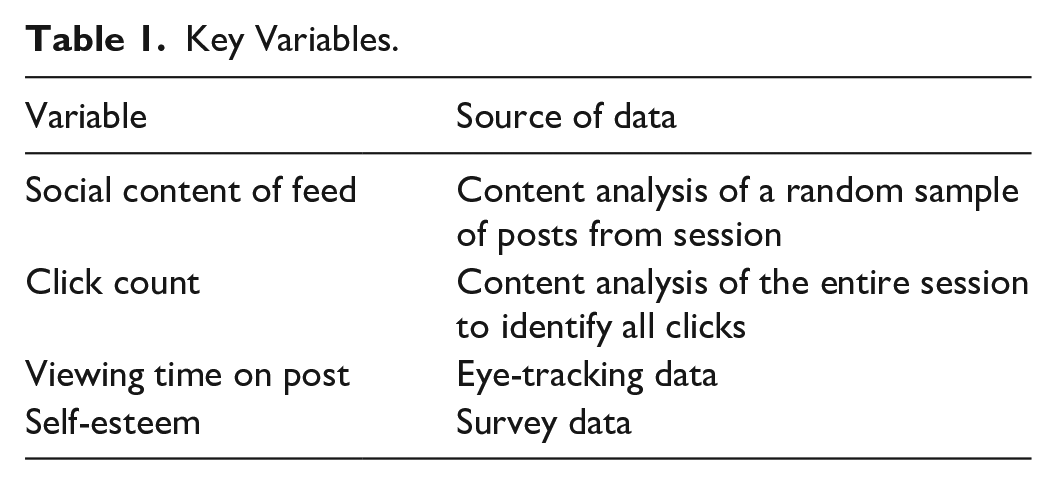
Using the recording generated by the eye tracker, we manually coded each participant’s Facebook use for every clicked post, in addition to a random sample of 21 posts from each participant’s feed. The authors collaboratively decided on the criteria of and instructions for coding together, and a research assistant conducted the coding. During the coding process, the research assistant communicated with authors frequently to resolve coding questions and decisions. We elaborate on our coding procedure below. A summary of the variables and their data source is provided in Table 1.
Key Variables.
Sampling of Posts
We used a stratified random sampling approach where we separated the 7-min (420 s) browsing period into three equal segments of 140 s each. Within each 140-s segment, we randomly generated seven timestamps per segment. We coded the post that the timestamp landed on, for a total of 21 timestamps. This stratified approach ensured that we collected roughly equal number of posts from the beginning, middle, and the end of the browsing session. Analyses revealed that there was no difference in viewing time across the three segments.
There were several exceptions when we did not code a post that the timestamp landed on. First, if the post was not on the feed but was somewhere else (e.g., a profile page), we skipped this timestamp. Second, if the timestamp landed on a post that was already coded because participants saw it earlier in the browsing session, we generated a new random timestamp. If the timestamp landed on a “clicked” post, we included the clicked post in the sample of random posts. Following this method, we captured and coded 598 posts across our participants.
Constructing Engagement Types: Viewing Time and Click Count
In coding the eye-tracking videos, we used two variables comprising each participant’s engagement type. First, our viewing variable refers to how much time participants spent looking at a post, derived from averaging the time they spent looking at the random sample of posts. In the video generated by Tobii software (see Figure 1), the area of the screen where the participant was looking is indicated by red dots, which move as their gaze shifts. When participants’ eye gaze landed on a post, we captured this timestamp, and when their eye gaze left the post, we recorded this timestamp as the end of that attention interval. After that, we averaged the time each participant spent looking at posts to compute their general viewing level when browsing.

Sample eye-tracking output (with red dots indicating gaze).
Second, we tallied each participant’s click count. For our study, we defined click as a reaction to Facebook posts that generates a visible trace on the platform. We are interested in the extent to which individuals are leaving traces that their Friends and others can see, not instances where the user is navigating the platform without visible traces. For example, “liking” a post would be a click, but scrolling the news feed or clicking on an article to read it would not. Click count refers to how many clicks participants generated during the 7-min browsing session. We calculated this click count by reviewing the eye-tracking video and tallying every single instance of a click. From our data, we captured 268 one-click reactions (207 of which were “likes”), 32 comments including one birthday message, three shares, and one RSVP (going to an event). In total, we captured 304 clicks on 289 posts because some posts received more than one click (e.g., a comment and a like).
To derive different Facebook feed engagement types, we divided participants into (1) high viewing clickers, (2) high viewing lurkers, (3) low viewing clickers, and (4) low viewing lurkers. From the 38 participants, we have 7 high viewing clickers, 12 high viewing lurkers, 7 low viewing clickers, and 12 low viewing lurkers. We aimed to develop a measure that expanded upon the dichotomous active versus passive labels used in other work. To create our four categories of engagement, we constructed two groups (high and low) of each of our variables of interest, to more clearly identify how these four categories might interact with self-esteem and other variables of interest. We calculated the median of the viewing time among our participants, which was 7.650 s per post. We classified those below and at the median as “low viewing” and those above the median as “high viewing.” Similarly, we derived the median of clicks participants generated during the session, which was six. We classified those with number of clicks below six as “lurkers” and those with six clicks or more as “clickers.”
Coding of Browsing Content
Finally, we computed the social content of each participant’s feed by coding the posts in our data set by who produced them. Asking people to recall the content of their feeds may not yield accurate findings, as certain types of posts may be more salient and memorable to people than others while browsing (Vraga et al., 2016). Thus, instead of relying on self-reports of feed characteristics, we coded each participant’s feed using a random sample of their posts (as captured by the eye-tracking video). To do so, we first classified the producer of the post into three categories depending on whether it was from: (1) a Facebook friend (categorized as social content
Results
Descriptive Statistics
Participants had an average self-esteem score of 5.96 on a scale of 1 to 7 (SD = 0.84). On average, our participants clicked 7.79 times during the session (SD = 7.25). Four participants did produce any visible clicks during the browsing session. The time spent gazing at clicked posts ranged from 1.62 to 80.48 s (median = 6.51 s, M = 8.33 s, SD = 7.49 s). The time spent gazing at unclicked posts ranged from 0.13 s to 110.68 s (median = 3.99 s, M = 7.8 s, SD = 11.12 s).
Our coding of feed’s social content confirmed that Facebook feeds varied individually in content composition and contained a range of social and nonsocial content. On average, fewer than half of posts on participants’ feeds came from other Facebook friends (M = 46.33%, SD = 22.79). An average of 47.42% of posts were produced by public Facebook pages (SD = 20.48). Finally, 6.04% on average came from Facebook groups (SD = 9.14%).
Analysis Strategies
For each model, we controlled for participants’ age, gender, and race. Due to the small percentage of people of color in our sample, we converted race into a binary variable of whether the participant is a person of color or not. In our regression analyses, the “high viewing clicker” group is treated as the dummy variable for the engagement type variable.
Findings
Engagement Type (H1) and Feed’s Social Content (H2) Not Associated With Self-Esteem
To answer research questions regarding the relationship between self-esteem and each of the three main variables—engagement type (H1) and feed’s social content (H2)—we ran a regression model with (1) engagement type and (2) social degree as main predictor variables. None of the main effects were significant (see Table 2 for detailed regression output).
Regression Analysis Output for H1 and H2.

High Viewing Clickers Reported Lower Self-Esteem With More Social Feed (H3)
To answer H3 on the interaction between engagement type and feed’s social content, we tested a model including a two-way interaction between engagement type and feed’s social content. The two-way interaction showed a significant difference between high viewing clickers and low viewing lurkers when the feed’s social content was included. In other words, among participants with highly social feeds, high viewing clickers reported lower self-esteem than low viewing lurkers (see Figure 2). Table 3 provides the detailed regression output.

Two-way interaction between engagement types and social content.
Regression Analysis Output for H3.

Discussion
Our study investigates the relationship between self-esteem and different engagement types on Facebook by focusing on the confluence of how people browse content, measured via eye tracking and click data, and what content they attend to, derived from content analysis of feeds and network size. Most notably, we found that high viewing clickers with more social content on their feeds reported lower self-esteem compared with low viewing lurkers. We draw upon the literature on social comparison processes on social media to understand these findings.
Self-Esteem and Social Comparison Processes in Social Media Activities
Discussions of social media’s possible influence on self-esteem often point to social comparison as a probable mechanism (Vogel et al., 2015)—specifically negative upward social comparison. By comparing oneself to the “highlight reels” presented by others, especially peers, on social media, people may feel worse about their lives and themselves, resulting in lower self-esteem (Chou & Edge, 2012). The magnitude of social comparison can increase when participants compare themselves with someone similar to them (Vogel et al., 2015; Zell & Alicke, 2010) but do not personally know (Chou & Edge, 2012): a weak tie that is the same age and gender would be a more powerful comparison point than an older celebrity, for instance. Although previous studies have not explored our specific variables of interest, the general thrust of the literature suggests that we would see a relationship between activities on social media (e.g., whether a user is actively engaging with their network or passively consuming) and self-esteem. However, we did not identify any main effects for our two variables of engagement type and feed’s social content when we examined them independently. The differences among our four engagement types emerged when we accounted for the social content of their feeds via interaction tests; specifically, high viewing clickers reported lower self-esteem than low viewing lurkers when the feed content is highly social. Our results indicate that self-esteem experiences are influenced by complex interrelated mechanisms, above and beyond the content of a feed and simple viewing and clicking behaviors.
The null findings of the main effects of our variables demonstrate that the self-esteem implications of social comparison may hinge on specific elements of the Facebook experience that are unique to each individual. Unlike studies exploring the effect of traditional, broadcast forms of media on self-esteem—for example, the effect of advertising images on social comparison processes via a magazine ad shown to all readers (Richins, 1991)—social media researchers must account for the fact that each viewer sees an idiosyncratic, and algorithmically curated, mix of content from commercial and personal contacts. In our study, we documented and tested the effects of social content (i.e., shared by friends vs. other entities) in combination with people’s engagement with such content. Specifically, we found high viewing clickers with more social feeds reported lower self-esteem compared with low viewing lurkers. This is in accordance with existing theories of social comparison (Gerber et al., 2018; Wood, 1989; Zell & Alicke, 2010). For example, the self-evaluation maintenance model suggests that comparing oneself on an identity-relevant task to a similar other magnifies the influence of social comparison (Tesser & Campbell, 1982). In our study, the influence of social comparison on self-esteem may be more potent when the targets of comparison are other Facebook friends. In addition, the algorithms on social media platforms typically aim to show people content they are interested in, increasing the likelihood that people are seeing identity-relevant posts.
Future research should probe the mechanisms behind these patterns by including more nuanced measures of users’ Facebook networks, such as how well they know people in their networks or how they interpret social media content. For example, do they see the content as selected highlights from their friends or as faithful representations of how others actually live on a daily basis? Moreover, future research could probe characteristics of comparison targets and whether certain aspects (such as gender or age) enhance social comparison dynamics and their implications for self-esteem. For instance, Burke et al. (2020) provided evidence that social comparison frequency was positively associated with seeing more content from people with similar ages and same gender. Meanwhile, Tazghini and Siedlecki (2013) revealed that people with lower self-esteem were more likely to accept friend requests from others they do not know as well. A strength of our feed’s content analysis is in providing a more precise measurement of what participants actually engage with, rather than simple metrics of time spent on browsing or frequency of browsing. Future scholarship in this space may wish to emulate our approach of documenting feed content and connect specific targets of social comparison to levels of self-esteem, given the relevance of these variables in our present study and prior work.
Research suggests that peers are more likely to trigger social comparison than celebrities, but what about social media influencers—presumably “real people” who attract large audiences on social media? Our findings and the extant literature would predict that this phenomenon might be contributing to unhealthy social comparison dynamics, in that these peers presumably are seen as comparable yet much more successful, stylish, and happier. This is in line with findings from meta-analysis of social comparison studies revealing a general predominance of upward social comparison—in turn associated with declines in self-evaluation (Gerber et al., 2018). Studies on viewing content from social media influencers showed outcomes of declines in body image satisfaction (Fardouly & Holland, 2018; Tamplin et al., 2018). Future research could expand to more general self-esteem outcomes. In addition, future studies can explore the self-esteem implications of another social media phenomenon: everyday individuals caught in unfortunate situations subjecting them to extraordinary public ridicule (e.g., the Star Wars kid, Rebecca Black). Presumably, these figures may encourage more downward comparisons and subsequent increases in self-esteem.
Moreover, upward comparison to content on social media may not necessarily result in lower self-esteem. Meier et al. (2020) showed that the upward social comparison associated with viewing travel and nature photos resulted in benign envy—as opposed to malicious envy—and subsequently inspiration and positive affect. However, other types of content, such as those related to body image, may not have the same effect, and future studies can further refine these mechanisms.
Acknowledging the role of feed’s content also highlights the hidden downstream effects of clicking behaviors on social comparison processes: individuals (knowingly or unknowingly) shape their future feed content via their clicking behaviors. Thus, users might entrench themselves deeper into the upward social comparison loop via their clicking activities, as Facebook algorithms interpret clicks as indicators of personal relevance and thus displays more posts with similar characteristics (Mosseri, 2018). These findings could be explored more via experimental methods that compare the effects of viewing social-heavy versus celebrity-heavy feeds and suggests interventions that could be staged by platforms or users themselves. For instance, users could be encouraged to be more cognizant of how they feel after viewing specific kinds of content and then curate different feeds using Facebook’s list feature to manage the content they are exposed to based on their current mood or mood goals. Of course, the fact that social content figured prominently in our findings also suggests that experimental approaches to self-esteem and social media use may be limited in their ability to replicate “real world” effects because the personal connection between a participant and their network is replaced with fabricated content.
Notably, our engagement type variable captures how much time our participants spent viewing each specific piece of content—not just frequency of browsing in general. In our study, there was no correlation between participants’ average viewing time and their self-reported frequency of using Facebook for browsing. Moreover, correlational tests revealed that participants with higher self-esteem actually reported more browsing (r = .342, p = .031). As such, greater frequency of browsing Facebook on its own may not be associated with self-esteem, contrary to earlier findings suggested by work that dichotomizes social media use into passive versus active categories (Verduyn et al., 2015).
Finally, future studies can further clarify the causal link between social comparison on social media and self-esteem. As a limitation of our current study design, we cannot make causal claims about the relationships we identified. For example, people with lower self-esteem may be more likely to be high viewing clickers, as opposed to low viewing lurkers. Similarly, people who have high self-esteem may be less vulnerable to the effects of social comparison on social media. Future studies can refine our understanding of the causal link between social comparison on social media and self-esteem by manipulating variables identified as significant predictors in our study, such as viewing time on post and content of viewing.
Methods, Contributions, and Limitations
Using an eye tracker allows us to obtain fine-grained data about how participants pay attention to each piece of social media content. However, eye-tracking measurements are susceptible to errors. With our study, we had to remove three participants’ data from analysis due to various technical problems with the eye tracker to ensure data quality. One limitation of conducting lab studies is external validity. We attempted to create a more naturalistic environment by asking participants to use the platform as they normally would in our instructions. We also gave them a warm-up task of browsing an unrelated website to acclimate them to being eye tracked. Nonetheless, it is likely that participants’ behaviors might differ from their Facebook browsing in the wild (e.g., on their mobile device). A fundamental assumption in eye-tracking studies is that visual attention indicates cognitive attention (King et al., 2019). However, we acknowledge that this is not always true (e.g., one can look at one thing but be thinking about something else).
Our sample size is relatively small which limits our statistical power. One possibility for future studies is to leverage remote eye-tracking technologies to observe participants’ Facebook use, with their consent, in their home environments, which would allow researchers to scale data collection up significantly. This method will also improve external validity in allowing for more naturalistic data collection of browsing behaviors. We believe there are promising opportunities for testing and refining well-established theories in social media scholarship, such as the active/passive binary divide, via eye-tracking technologies.
Conclusion
Browsing one’s feed is among the most frequent activities on social media (Metzger et al., 2018), with implications for relationship development and well-being. Our article investigates the self-esteem implications of browsing along two dimensions—engagement types and feed content. We find that by considering the interactions of these two variables, they become meaningful predictors of self-esteem, and their potential mechanisms correspond to social comparison processes. We also show the promise of eye tracking as a rigorous and fine-grained method for understanding engagement behaviors (browsing and clicking) in more nuanced terms and highlight the importance of considering people’s idiosyncratic feed composition in future work. We are excited about the insights into self-esteem suggested by our study and the methodological routes charted for future scholarship in this area, given the importance of better understanding how our activities on social media make us feel about ourselves.
Footnotes
Declaration of Conflicting Interests
The author(s) declared no potential conflicts of interest with respect to the research, authorship, and/or publication of this article.
Funding
The author(s) disclosed receipt of the following financial support for the research, authorship, and/or publication of this article: This material is based upon work supported by the National Science Foundation under Grant Nos. 1763297 and 1552503 and an unrestricted research gift from ask.fm.
