




Abstract
Previous studies have mainly demonstrated negative consequences for content labeled as sponsored. Despite this, recent industry findings indicate a growing trend for sponsored content on social media. In addition, an increasing number of users suggest that such paid content would increase their likelihood of purchasing items from social media. Nonetheless, little attention has been paid to what drives consumers’ purchase intention and engagement with sponsored content with a clear disclaimer such as “Paid Partnership.” Therefore, the present research seeks to provide insights into what drives consumer engagement and purchase intention with sponsored content and when and why such effects are observed. Conducted with an online survey, the results showed that individuals with high materialism showed greater purchase intent and higher engagement with sponsored content through hedonic enjoyment. The results also showed that the mediating role of hedonic engagement for the positive effect of materialism on purchase intent was only significant under high influencer trust. Furthermore, the mediating role of hedonic enjoyment was amplified when the need to belong was high.
Introduction
Popular social media influencers are awash with trendy brands. Just another day in their lives shows them holding Gucci handbags, wearing Nike sneakers, and so on. Research has shown that consumers perceive content crafted by a social media influencer to be more authentic and relatable than content created by a brand (e.g., Boerman et al., 2012; Carter, 2016), because it is presented in a way that seems to be congruent with their actual lives. Accordingly, marketers have increasingly incorporated social media influencers into their overall marketing strategies where the influencers showcase brands that pay them to do so on their personal social media accounts (Kim et al., 2021). This form of advertising is what we call “sponsored content,” which essentially means a purposeful integration of advertising into one’s everyday social media content (Boerman et al., 2014). Social media influencers are thought to be tremendously successful for brands looking to increase the awareness and purchase of their products (Abidin, 2016; Schwemmer & Ziewiecki, 2018). Brands are projected to spend US$15 billion on influencer marketing by 2022 (“Influencer Marketing: Social Media Influencer Market Stats and Research for 2021,” 2021).
While branded content created by influencers has led to huge gains for brands and the influencers who flaunt them, some fear that consumers have been deceived by a lack of transparency with sponsored content. The Federal Trade Commission (FTC) recently handed down regulations that specify that influencers have to conspicuously notify their audience that a post has been sponsored by a brand (e.g., a hashtag that says “sponsored”; Federal Trade Commission, 2017). In light of the growing trend of influencer marketing and the FTC regulation, predominant research has focused on the effect of sponsorship disclosure on consumers’ attitudes, content engagement, and behavioral intention (Eisend et al., 2020). In addition, prior studies have shown mixed, and mainly negative consequences for content labeled as sponsored (see Boerman et al., 2012; Campbell et al., 2013; Dekker & Van Reijmersdal, 2013). In contradiction to that series of findings, recent advertising surveys revealed a growing trend for sponsored content on social media, and an increasing number of users who said that such paid content would increase their likelihood of purchasing on social media (see GlobalWebIndex, 2020). Furthermore, a recent industry report by Statista (2019) showed that in 2018, Instagram generated a revenue of over 6.8 billion dollars in the U.S. market alone with influencer marketing; by 2019, the global Instagram revenue came to 20 billion dollars (Frier & Grant, 2020). These numbers provide indirect evidence that consumers are still positively responding to the sponsored content created by influencers with disclaimers. But little attention has been paid to what drives consumers’ purchase intention and engagement with sponsored content with a clear disclaimer such as “Paid Partnership.”
Motivated by this gap, the present research seeks to provide insights into why, and under what circumstances, social media users positively respond to sponsored content. Specifically, we propose materialism as an important driver of consumers’ purchase intent and engagement with a sponsored content, given that prior research has suggested that consumers’ materialistic values play an important role in consumer behavior and psychology (Belk, 2010; Richins, 2017). For example, Janssens et al. (2011) have shown that materialism is strongly linked to conspicuous consumption, signaling one’s wealth and status, and Kasser (2002) has argued that materialism serves as a means to maintain and enhance positive self-image through consumption. We also propose hedonic enjoyment as a mechanism for explaining the positive effect of materialism on the aforementioned focal-dependent variables. Ample research has suggested that materialistic people value material possession and acquisition as central to their life satisfaction (e.g., Richins, 2011, 2013; Shrum et al., 2013). Furthermore, according to Richins (2013), materialists often experience positive emotions such as excitement and joy even when they are simply thinking about the product and its purchase. Therefore, building on the prior literature, we argue that materialism may be positively related to the acceptance of influencer content despite an indication of sponsorship. Note that in this research, we define “influencer” to mean someone who is able to influence potential consumers’ purchase decisions by promoting and/or recommending brands on social media (Merriam-Webster, 2021). Finally, this research proposes two moderators—perceived influencer trust and need to belong (NTB), to provide a context as to when and how materialism is more likely to affect one’s sponsored post engagement and purchase intent via hedonic enjoyment. Specifically, we posit that the mediating effect of hedonic enjoyment for the positive effect of materialism on purchase intent will be significant only when influencer trust is high. Regarding sponsored content engagement, we expect that the mediating effect of hedonic enjoyment will be amplified when NTB is high rather than low. The conceptual framework is shown in Figure 1.
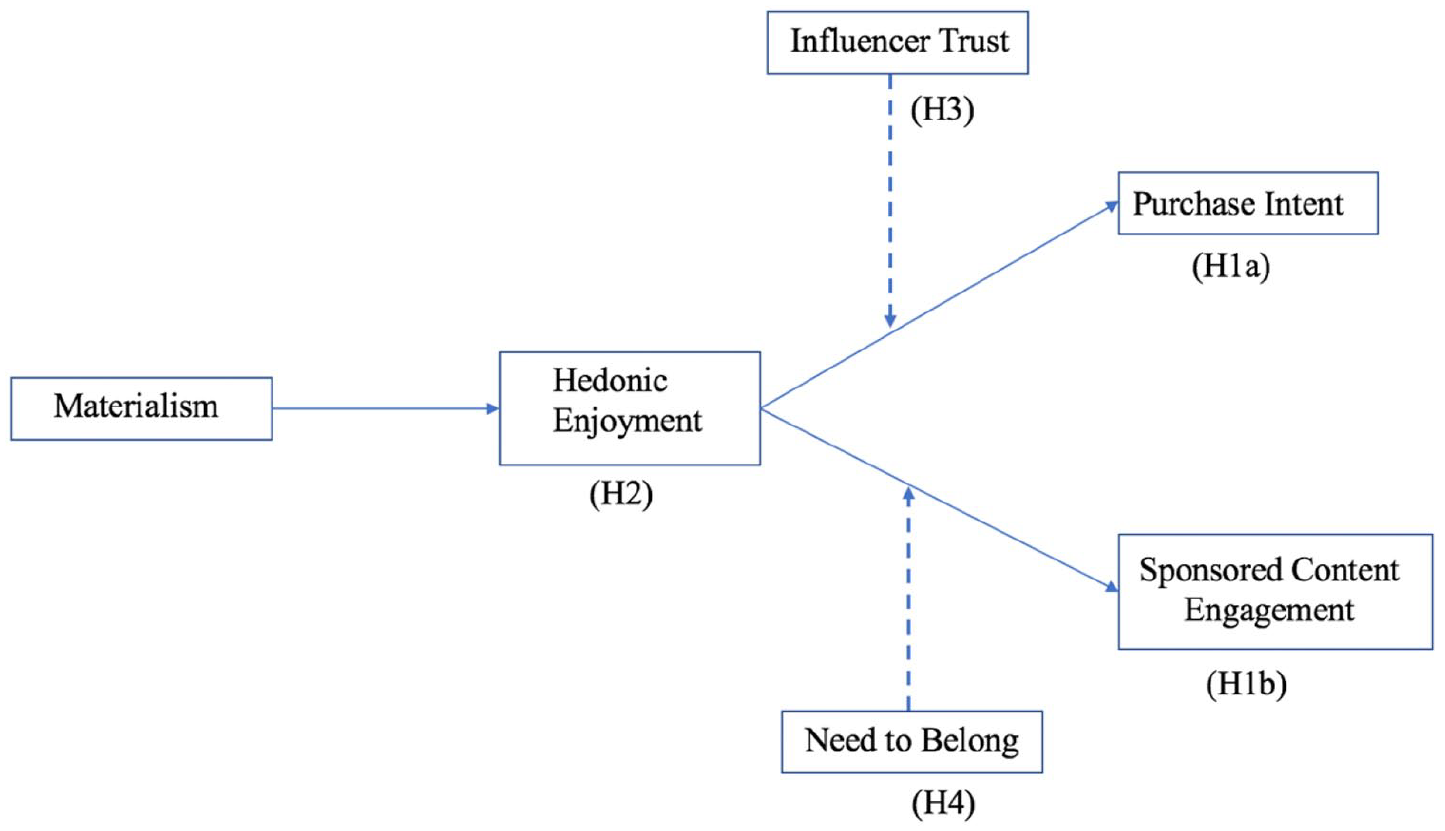
Conceptual framework.
Literature Review and Hypotheses
Materialism, Sponsored Post Engagement, and Purchase Intent
Materialism is a term loaded with connotation and often written about in the context of the American consumer society (Richins & Dawson, 1992). Some have opined that Americans are engaged in a Sisyphean pursuit of happiness or “the good life” via the accumulation of possessions (Richins & Dawson, 1992). A lot of the research on materialism has focused on the negative consequences such as experiencing lower subjective wellbeing (Christopher et al., 2009) and antecedents of the concept (e.g., Jiang et al., 2015); However, materialistic values are not so black and white as to fall squarely into a positive or negative categorization. There are certainly benefits from materialistic values such as a determination to succeed and self-reliance (Richins & Dawson, 1992) and enhancement of positive mood (Hudders & Pandelaere, 2012). In addition, possessions can be perceived as branches of the extended self which may provide joy or security (Belk, 2010; Richins, 2017).
Materialism can be defined as personal values that emphasize the acquisition and possession of material goods as a person journeys toward the fulfillment of life goals (Richins, 2011; Richins & Dawson, 1992). As per the conceptualization of Richins and Dawson (1992), we suggest that a materialistic value can be understood via three facets. The first is acquisition centrality. This dimension refers to the dominance of material goods and acquisition in the life of a person with materialistic values. Acquisition as the pursuit of happiness involves possession acquisition and ownership as central to life satisfaction (Richins & Dawson, 1992; Segev et al., 2015). The final dimension includes possession-defined success. Materialists may consider material goods as cues of success and evaluate themselves and others based on the amount and type of goods possessed (Noguti & Bokeyar, 2014; Richins & Dawson, 1992).
Materialists and Sponsored Brand Content
One of the main goals of advertising is to increase the consumption of the advertised good or service. Thus, consumers with materialistic values are of interest to advertisers. Advertising has been studied as a precursor to materialistic values (Ahmad & Mahfooz, 2018) and the American “consumer society” is often blamed for what some see as increasing materialistic values (O’Shaughnessy & Jackson O’Shaughnessy, 2002), especially among young adults (Ho et al., 2019). Although likely inflamed by contemporary advertising efforts that infiltrate nearly every waking hour of our mediated lives, materialism is not new and suggestions of materialism date back to ancient civilizations (Rigby & Rigby, 1944).
One poignant modern facet of materialism is the positive relationship found between traditional media consumption (e.g., Lou & Kim, 2019) and social media consumption (e.g., Seo & Hyun, 2018) on materialistic values. Social media has also allowed for the rise of social media influencers. Previous research has linked imitation of celebrity models and materialistic values (Chan & Prendergast, 2008). This link is theorized to be understood by social comparison theory where the consumer compares his accumulated goods with that of another to determine his own social rank (Chan & Prendergast, 2008). In the realm of influencer advertising, the relationship is likely similar to that of models or celebrities. Recent research revealed that people may perceive the influencers as “role models,” which in turn positively affects purchase intention (Lou & Kim, 2019). Therefore, by focusing on Instagram, we theorize that the relationship may be perceived as more intimate on Instagram. People can interact with their favorite influencer, and “get to know them” via daily and sometimes more than daily posting. A materialistic person may enjoy the ease of finding products they believe will offer them greater life satisfaction and allow them to be perceived as successful by others.
One issue facing the influencer community is that of exposing the sponsorship of their branded content. The FTC guidelines require influencers to disclose when they “have any financial, employment, personal, or family relationship with a brand” (Federal Trade Commission, 2019, p. 3). Notices need to be in a place that is “hard to miss” (p. 4). For example, if the influencer is showcasing their endorsement for a brand in an Instagram post, they should superimpose the disclosure on the photo. Written notices in a post and/or hashtags are appropriate as long as they are clear (e.g., #ad or #sp). The guidelines are meant to protect against deceptive advertising, but it is nearly impossible and impractical for the FTC to police every influencer and every post. The issue of influencers neglecting to provide notice about branded partnerships led the agency to call for public comments on updating the endorsement guidelines and potentially instituting civil penalties to those found in non-compliance (Constine, 2020).
While it is thought that perhaps explicit endorsements work better to inform consumers (Knoll & Matthes, 2017), it is less agreed about what consumer reactions may be to a sponsorship label (Boerman et al., 2012; Dekker & Van Reijmersdal, 2013). In fact, according to a recent industry report, 50% of Instagram users showed more interest in a brand after being exposed to an ad for it on Instagram (Newberry, 2019). Here, we suggest that when exposed to a sponsored post from an influencer, materialistic values may be directly related to the acceptance of the post by favorite influencer because the goal of the materialistic consumer is considered to be one of good accumulation to increase their life satisfaction and their own and others’ perception of their own success in pursuit of the good life. Such consumers may not mind sponsored content, because it denotes a cue of “possession defined success” of the influencer or person to whom materialistic consumers may compare themselves. We suggest this is true even though the sponsored cue may alert the consumer to the fact that the content is an advertisement. In addition, high levels of materialism have been found to be positively related to compulsive buying tendencies in many studies (e.g., Islam et al., 2017):
H1. Materialism will be positively related to the sponsored Instagram content engagement (H1a) and purchase intent (H1b).
Hedonic Enjoyment as a Mechanism
Window shopping, perusing a magazine, or scrolling through Instagram content may be enjoyable for many consumers regardless of whether or not there is a subsequent purchase made. Utilitarian and hedonic values are thought to serve as apt categories for consumer values as part of the consumer experience (Babin et al., 1994; Childers et al., 2001). Utilitarian values encompass the idea that shopping may be rational and goal driven (Batra & Ahtola, 1991; Childers et al., 2001). Utilitarian values related to shopping experiences may be rather dull or forced as it is entwined with the mentality of work (Childers et al., 2001; Hirschman & Holbrook, 1982). For example, when one is shopping for an event (i.e., a wedding or holiday), it may seem stressful and more laborious than fun. However, some consumers enjoy shopping as an activity even without an end goal of purchase as an end goal (Richins, 2013). A recreational or hedonically fueled shopping experience is linked to increased perceptions of escapism, fantasy, and enjoyment in contrast to a duty inspired shopping experience (Horváth & Adıgüzel, 2018). This type of shopping is not necessarily goal driven and may lead to increased feelings of satisfaction regardless of actual purchases (Babin & Attaway, 2000). Hedonic shopping is positively correlated to word-of-mouth and product interest (Jones et al., 2006).
Instagram provides an easy avenue to pursue hedonic shopping behaviors and is considered a form of entertainment itself. Retailers and brands are also aware they need to seek ways to entertain consumers so paying influencers is one way to take advantage of entertainment they provide as part of a marketing strategy (Arnold & Reynolds, 2003). People have long been known to participate in idea shopping or shopping to stay aware of fresh trends in innovations and fashion (Horváth & Adıgüzel, 2018; Westbrook & Black, 1985). Some people like to shop, not to make a purchase in the moment, but because they enjoy browsing as an information gathering activity (Arnold & Reynolds, 2003; Bloch et al., 1989). This activity is made easy and enjoyable via following a favorite Instagram influencer’s post. Hedonic shopping motives include shopping for fun, entertainment, and sensory stimulation (Arnold & Reynolds, 2003; Babin et al., 1994; Horváth & Adıgüzel, 2018). Even the richest materialist cannot buy every item they see in their favorite influencer’s posts but those that experience hedonic enjoyment while idea shopping may be enjoying the experience of browsing and filing ideas away that will likely lead to increased enjoyment, impulse purchases and future purchases (Arnold & Reynolds, 2003; Bloch et al., 1986). Adding context to our argument that materialists may indicate purchase intent and/or engagement with content even with cues of sponsorship, we suggest that higher levels of hedonic enjoyment will offer additional explanation for this effect:
H2. Hedonic enjoyment will mediate the effect of materialism on the sponsored Instagram content engagement (H2a) and purchase intent (H2b).
The Moderating Role of Influencer Trust
Trust in the online environment and especially, in social media is increasingly important. Ratings, number of stars, likes, reposts, and so on, have become indicators or cues of trust in the online context (Toma, 2014). Cues found on Facebook profiles such as “likes” and “number of comments” are linked to perceived trustworthiness of the user (Mena et al., 2020). We extend this reasoning to influencers on Instagram. When a person notices their favorite influencer is getting engagement with their sponsored post, it is likely to cue a high level of trustworthiness. The uncertainty reduction embedded in this cue is important for the materialistic consumer who may be making purchase decisions, in part, because they want to be seen as successful via good accumulation. Trust of an influencer is a handy shortcut while they are compiling purchase decisions and may be perceived as less risky than scouring a brand website with fewer social cues. Influencer trust is inculcated by feelings of credibility of the influencer in their niche (e.g., entertainment and fashion). Credibility is the perception that a source maintains expertise in a certain niche area and can thus be trusted for opinions in that realm (Ohanian, 1990). Brands rely on influencer trust to influence the perception of trust of their own products. Influencer trust may mitigate the perceived social risks associated with product purchase such as embarrassment and reproach from others (Schouten et al., 2020). Even the materialist, who seeks to gain possessions as an important life goal, may rely on influencer trust when making purchase decisions as a way to mitigate disappointment with products that may not reflect their own personal style or how others may perceive them:
H3. The mediating role of hedonic enjoyment for the effect of materialism on purchase intent will be greater when perceived influencer trust is high rather than low.
The Moderating Role of NTB
Baumeister and Leary (1995) defined NTB as “pervasive drive to form and maintain at least a minimum quantity of lasting, positive, and significant interpersonal relationships” (p. 497). This basic need motivates people to consciously monitor their social environment to acquire information that will help them assess how well they fit in (Escalas & Bettman, 2017). This is because everybody desires to be loved and accepted by his or her social groups (Baumeister & Leary, 1995). Studies have shown that people with an NTB are sensitive to social cues, are more likely to change attitudes and behaviors to gain acceptance, and strive to conform to the standards/norms of the group they are affiliated with (e.g., Escalas & Bettman, 2017; Leary et al., 2013).
Social media has been suggested as a vital tool for people to satisfy their affiliation needs by providing social cues as internal information which might help them gain social approval (e.g., Nadkarni & Hofmann, 2012). Because social media provides an immediate, large amount of feedback to individuals, active engagement allows them to detect both potential inclusion and exclusion cues which essentially help them regulate their attitudes and behavior (Utz et al., 2012). Prior studies have also found a positive correlation between higher NTB and increased parasocial relationships with media celebrities (Greenwood & Long, 2011). Greenwood et al. (2013) have suggested that people high in NTB may be particularly attracted to celebrity and popularity because of the social validation they offer. Similarly, Escalas and Bettman (2017) have argued that engagement with social media influencers can help high NTB consumers to build desired social identities and connect with others by signaling socially relevant meanings to others. This is because social media influencers are well-liked, widely accepted, and often perceived as credible. Furthermore, Escalas and Bettman (2017) have pointed out that endorsement by media celebrities can offer useful information to high NTB individuals about which product/brand can aid their belongness needs and therefore they are more motivated to connect with those celebrities (Escalas & Bettman, 2017).
Research has found that greater social pleasure was associated with higher NTB (Gooding et al., 2015). For materialistic individuals, they feel pleasure not only when they consume/own product brands but also when they browse and/or engage with sponsored products/brands that their favorite influencers post that may affect their lives in a meaningful way (Richins, 2011). In this research, we argue that the effect of such hedonic enjoyment on sponsored content engagement should be amplified among high NTB individuals. High NTB individuals are likely to feel pleasure and excitement even at the prepurchase stage because they know frequent engagement with their favorite influencers can help them maintain and bolster their association with a particular social group (Roseman, 1991) and therefore they are more likely to engage with sponsored content by their favorite influencers:
H4. The mediating role of hedonic enjoyment for the effect of materialism on the sponsored Instagram content engagement will be enhanced when NTB is high rather than low.
Method
Participants
Participants (n = 200) were recruited from the U.S. adults aged between 18 and 40 years via Qualtrics Panels using purposive sampling to better reflect characteristics of the population of interest. Gender quotas were also applied to ensure gender balance in the sample. After completing the survey, participants were compensated via Qualtrics (US$6 per person). All participants were active Instagram users, following influencers on Instagram, and were between 18 and 40 years old. The average age of the sample was 27.52 (SD = 6.64), 57% were female, 66% were White, and 54% had a college degree. Although every social media platform utilizes influencer marketing, this research chose Instagram not only because Instagram is the second largest social media platform in the world, with 500 million daily active users (Statista, 2019), but also because nearly four in five brands (79%) mainly utilize Instagram for influencer marketing campaigns (Influencer Marketing Hub, 2021).
Procedure
After consent, participants were subjected to screening questions. Participants who were not active on Instagram, not following any influencers, and >40 years were screened out. Next, participants were given a definition of an influencer: “We define an influencer as someone who has established credibility in a specific industry (such as sports, lifestyle, fashion, beauty, etc.). An influencer can be anyone from a local lifestyle blogger to a celebrity.” After reading the definition, participants were instructed to think about their favorite Instagram influencers and then asked to write down the one they like most. Sample responses include Kylie Jenner, Cardi B, Jessica Nigri, and Zach King. Then, we piped the name of the influencer into the subsequent questions: their purchase intent, sponsored Instagram content engagement, hedonic enjoyment, influencer trust, NTB, and materialism. Note that purchase intent and sponsored Instagram content engagement were measured prior to the other variables to minimize any demand effects. To ensure participants understood what we mean by “sponsored content,” we told participants that influencers are often paid by an advertiser or brand to showcase a product or service on their personal Instagram accounts. This is considered “sponsored content” and should have a label such as “Ad,” “Sponsored Content,” or “Paid Partnership” to let you know that the post contains an advertisement. After reading the description, participants were asked how often they engage with the sponsored Instagram content (e.g., #ad, #partnership) in which their favorite influencer talks about a sponsored product/brand. Toward the end of the survey, to make sure participants understood what a sponsored post is, participants were shown two Instagram posts in a random order and asked to identify if the Instagram post they just saw was sponsored or not. Twelve participants failed to correctly identify a sponsored post and therefore they were removed, leaving 188 responses.
Measures
All measures involved 7-point Likert-type scales (disagree/agree) except sponsored Instagram content engagement (never/all the time). We used 7-point scale because of its accuracy and appropriateness for online survey (Finstad, 2010). Detailed measures are shown in Table 1. Age, income, and gender (1 = male, 2 = female) were used as covariates.
Confirmatory Factor Analysis, Reliability, and Validity.

Note. CR = construct reliabilities; AVE = average variance extracted; NTB = need to belong.
Materialism (M = 4.52, SD = 1.44, α = .96) was measured with eight items (e.g., “I like to own things that impress people”) taken from Richins (2004).
Sponsored Instagram Content Engagement (M = 4.06, SD = 1.67, α = .94) were measured by asking participants when their favorite influencer, [piped text], talks about a sponsored product in their Instagram post with a note such as #ad, @sponsored, or #partnership, how often (a) they click the post and check it out, (b) like it, (c) share it, and (d) visit the brand/product website to find more about it.
Hedonic Enjoyment (M = 4.79, SD = 1.30, α = .92) was measured with five items (e.g., “While browsing Instagram, I feel the excitement of the hunt”) adopted from Babin et al. (1994).
Purchase Intent (M = 4.69, SD = 2.09) was measured with a single item by asking participants’ intent to purchase for a product that is endorsed by their favorite influencers. Perceived Influencer Trust (M = 5.12, SD = 1.74, α = .88) was measured with three items (e.g.,” I trust my favorite influencer”).
Need to Belong (NTB; M = 5.03, SD = 1.46, α = .93) was measured with four items (e.g., I do not like being alone”) taken from Leary et al. (2013).
Results
Measurement Model
We first assessed convergent and discriminant validity of the measures with confirmatory factor analysis (CFA) using EQS 6.3. The adequacy of model fit was evaluated by examining chi-square statistics (χ2), the Comparative Fit Index (CFI), Tucker Lewis Index (TLI), and root mean square error of approximation (RMSEA). The results met the criteria suggested by Bentler (1995), with a good fit of the model to the data: χ2(253 = 479.63), CFI = .94, NFI = .94, RMSEA = .061 (90% confidence interval of .052 to .69). All factor loadings were significant (ps < .01) and the standardized factor loadings for all items exceeded the minimum level of .50 (see Table 1). The results also confirmed that construct reliabilities (CR) and average variance extracted (AVE) of each construct exceeded the minimum criteria of .70 and .50, respectively. Therefore, these results confirm adequate convergent validity. Discriminant validity was assessed with Fornell and Larcker’s (1981) criterion of checking whether the AVE for each construct exceeds the square of the pairwise-correlations between constructs. All AVE estimates were greater than the squared inter-construct correlations, confirming discriminant validity (Fornell & Larcker, 1981).
To test H1a through H2b, two sets of simple mediation models were estimated using the bootstrapping procedure (5,000 samples) of the “PROCESS” macro (model 4, A. F. Hayes, 2017) after controlling for the effect of age, income, and gender. First, the results confirmed that materialism is positively related to sponsored Instagram content engagement (H1a: B = .54, SE = .07, p < .001) and purchase intent (H1b: B = .38, SE = .08, p < .001). Therefore, H1a and H1b were supported. The results also confirmed a significant mediating role of hedonic enjoyment for the effect of materialism on sponsored Instagram content engagement (H2a: B = .17, SE = .06, 95% CI = .06 to .28) and purchase intent (H2b: B = .13, SE = .05, 95% CI = .02 to .24). Therefore, H2a and H2b were supported. When hedonic enjoyment was included in the model as a mediator, the direct effect of materialism was still significant for both sponsored Instagram content engagement and purchase intent, indicating partial mediation.
To test H3, a moderated mediation model was estimated using the bootstrapping procedure (5,000 samples) of the “PROCESS” macro (model 14, A. F. Hayes, 2017) after controlling for the effect of age, income, and gender. First, the interaction effect of hedonic enjoyment and influencer trust was significant, B = .25, SE = .09, 95% CI = .07 to .44. Furthermore, the bootstrap results also confirmed that the index of mediated moderation effect was also significant, B = .15, SE = .06, 95% CI = .06 to .29. Specifically, the mediating effect of hedonic enjoyment was significant when influencer trust was high, B = .32, SE = .10, 95% CI = .12 to .54. However, the mediating effect of hedonic enjoyment was not significant when influencer trust was low, B = .006, SE = .12, 95% CI = -.25 to .24. Therefore, H3 was supported.
H4 was also tested with the same PROCESS macro (5,000 samples, model 14, A. F. Hayes, 2017) after controlling for the effect of age, income, and gender. The bootstrap results showed a significant interaction effect of hedonic enjoyment and NTB, B = .08, SE = .03, 95% CI = .02 to .15, and confirmed a significant mediated moderation, B = .05, SE = .02, 95% CI = .00 to .09. Specifically, the mediating effect of hedonic enjoyment for the effect of materialism on the sponsored Instagram content engagement was greater when NTB was high (B = .37, SE = .08, 95% CI = .18 to .52) rather than low (B = .18, SE = .06, 95% CI = .05 to .30). Therefore, H4 was supported.
Discussion
The present research highlights the need for more exploration on what drives consumers to engage with social media content particularly when the content clearly discloses a paid and/or material connection between the influencer and the brand. We believe this research is timely and important as FTC requires influencers to explicitly disclose their relationship with sponsoring brands and the issue is currently being discussed. Materialism has been frequently studied in the context of compulsive buying (e.g., Horváth & Adıgüzel, 2018), consumer wellbeing (e.g., Richins & Dawson, 1992), luxury and conspicuous consumption (e.g., Hudders & Pandelaere, 2012; Islam et al., 2018), and social media use (e.g., Seo & Hyun, 2018). To our best knowledge, it has not been studied in terms of processing sponsored content. In this research, we found that high materialistic values were positively related to both greater content engagement and purchase intention. This finding underscores the idea that sponsorship disclosure does not always result in a negative response. In fact, a few studies have argued that being honest about sponsorship (e.g., Hwang & Jeong, 2016) and/or message relevance (J. L. Hayes et al., 2020) can actually mitigate the negative effect of sponsorship disclosure.
Second, this research adds to the existing literature by proposing and empirically verifying the role of hedonic enjoyment as a mechanism for explaining why materialism drives positive responses to sponsored content. Consistent with prior studies, we found that high-materialist individuals experienced hedonic elevation in anticipation of a purchase (Richins, 2013), resulting in greater purchase intent and engagement with sponsored post. Research has also shown that hedonic enjoyment is a major motivator for some shoppers and Instagram influencers make digital “window shopping” easy, accessible 24/7, and entertaining (Horváth & Adıgüzel, 2018). We believe that this is particularly true for materialists in the context of influencer sponsored content. The simple act of browsing a favorite influencer’s branded content should offer hedonic pleasure for materialistic individuals while practically increasing the potential for instant gratification to purchase any products desired (Gao & Feng, 2016). This is because materialists are more likely to hold the belief that the “acquisition and/or use of a product can change their life in a significant and meaningful way by the acquisition and use of a product” (Richins, 2011, p. 145).
Third, NTB has been widely studied as one of the major drivers of social networking and media consumption (e.g., Seidman, 2013), but none of prior research has connected NTB with materialsim and hedonic enjoyment. To our knowledge, this research is the first to explore the joint effects of the three variables in the context of sponsored content engagement and thus offers noble insights. People tend to communicate with their “in-group” and follow others within their in-group. As evident from prior studies, there is a link between a high NTB and positive attitudes toward social networking sites, in general (Hughes et al., 2012). Our findings suggest that it might be intrinsically amusing for the materialistic individuals to engage with influencers they admire and to use their sponsored content as inspiration for future purchases as they can help signal materialistic success and build their social identity (Escalas & Bettman, 2017). Given that the idea of others’ perception of them is inherent in materialists’ personality, and high NTB individuals strive to satisfy their social inclusion needs by seeking socially relevant meanings through their consumption (e.g., media and brand) behaviors, this research warrants more research to further flesh out this interesting finding.
Finally, this research highlighted the importance of influencer trust by demonstrating its moderating effect. Although influencers may earn inherently more trust than brand marketers, our research points out that it is still important to gain trust when it comes to purchase decisions. Specifically, our findings revealed that the effect of materialism on purchase intent through hedonic enjoyment was significant only under high influencer trust. This result suggests that hedonic enjoyment is not enough to lead to a purchase decision if the consumer does not have a high level of trust in the influencer. Materialists may certainly shop for hedonic enjoyment, compiling ideas of what they may acquire next to prove to themselves they are successful but also to show others, via certain product accumulation, that they are doing well in life. However, they are more likely to rely on an influencer they really trust for ideas, styling tips and products to purchase as it reduces the risk that they will purchase a product that misses the “social mark” they are attempting to hit.
Our research also provides practical implications for marketing practitioners. First, marketers should utilize the degree of consumers’ materialism as a segmentation variable. As our results suggest, materialistic consumers do not mind sponsored content posted by their favorite influencers as the content provides immediate gratification and hedonic enjoyment. Second, our findings clearly demonstrate the importance of influencer trust in purchase intent. This means that hedonic enjoyment that consumers vicariously experience while interacting with sponsored content is not enough for purchase under low influencer trust. Therefore, marketers should be strategic when partnering with influencers. Popularity may not translate into “trustworthiness.” Third, it is clear the influencer trend may continue to provide successful results for brands, especially within cultures and subgroups high in materialistic values, despite the FTC suggestions to clearly label sponsored content. The notification to consumers is not only fair but not likely to be affect positive responses to the content, especially when influencer trust is high or when the content is instrumental to build a desired social identity.
A few limitations and future research suggestions are worth noting. First, due to the relatively small sample size and correlational nature of the study, our findings should be interpreted with caution, calling for more research. Future research could explore the proposed model using an experiment where casual inferences can be made with greater confidence. Furthermore, given that it is challenging to separate the effect of sponsored post from the overall impact of influencers, adding eye-tracking to an experiment should offer additional insights by capturing visual attention on sponsorship disclosure. Second, this research tested only one mediator, hedonic enjoyment, but there could be another interesting variable. For example, wishful identification with the influencer could well serve as a mediating variable. Third, this research used a static social media post. It will be interesting to investigate how media modality (static vs. video) affects consumers’ engagement with sponsored content and purchase intent. It could be the case that video content could enhance attitudes and behavioral intention with vivid and/or entertaining presentation of the product/brand endorsed by the influencer. Finally, this research suggests that one of the basic human motivations, NTB is also important as it strengthens the relationship between hedonic enjoyment and sponsored content engagement. Future research may extend our results to explore the idea of a “belongingness economy” intensified by social media where many/most purchases are made in the furtherance of being accepted within a social group. Also, future research may want to explore another moderator. Given that one’s social media activity can be immediately observed by others, it would be worth examining how identity-relevant product/brand is related to one’s engagement with the sponsored content.
Footnotes
Declaration of Conflicting Interests
The author(s) declared no potential conflicts of interest with respect to the research, authorship, and/or publication of this article.
Funding
The author(s) received no financial support for the research, authorship, and/or publication of this article.
