



Abstract
In the summer of 2018, the New York Public Library Instagram page, and Mother—New York City creative company, launched a project named Insta Novels, presenting five canonic literary works in the form of an Instagram Story. Due to its interdisciplinary nature, Insta Novels offers a glimpse into the contradictions that arise when literature and its institutions intersect with social networks, advertising agencies, and digital media. This article explores the Insta Novels project as a case study of how remediation and mediatization serve as useful theoretical concepts, enabling the examination of cultural objects in the new media environment at both the macro and micro levels. A grounded analysis of the project’s stories, articles, and Instagram hashtags revealed four embedded tensions: between literature and technology; eternity and temporality; personal and public; and readers and users.
“Let no one reduce to tears or reproach
This statement of the mastery of God,
Who, with magnificent irony, gave
Me at once both books and night
Of this city of books He pronounced rulers
These lightless eyes, who can only
Peruse in libraries of dreams. . .”
Public libraries have undergone permutations and faced challenges for almost 40 years, while the demand for their core services is declining, affecting their cultural centrality, and reinforced by media stereotypes (Goulding, 2006). Researchers point to various reasons for this condition: political policy, the establishment of an information society, and the weakening of the physical space (Goulding, 2006; Rogers, 2009; Smith, 2017). The authority given to libraries in the past due to their pivotal role in preserving and curating knowledge, history, and culture has been undermined in the information era as information leaks out by endless sources (Johnson & Harris, 1976). In particular, the rise of the internet presented a slew of threats and opportunities for public libraries (Herring, 2014; Rogers, 2009; Smith, 2017). Some scholars claimed that libraries suffer from an identity crisis (Smith, 2017), and questioned whether the internet, with its information economy, foreshadows their demise (Goulding, 2006). Others suggested that the essence of libraries would change from “collection” to “connection” (Jochumsen et al., 2017) as they would have to broaden their services to remain relevant in the ever-changing reality of the 21st century.
Arguably, libraries face three challenges: facilitating access to catalogs and archives bypassing library services, shifting the library from silent reading spaces to community centers (Weilenmann et al., 2013), and embracing the digital age by using digital platforms and interacting with library audiences (Rogers, 2009). Rogers found that although library staffs were interested in using Web 2.0 apps to reach a broader audience, they distrusted this medium, viewing it as a potential threat to their status.
To appeal to digital natives, Jochumsen et al. (2017) recommended libraries provide users with experiences, involvement, empowerment, and innovation. Furthermore, as the digital age requires traditional institutions to become more reactive, democratic, and reflexive, museums and libraries are expected to create new models of visitor participation that enhance the experience of visitors and extend it beyond their physical location (Weilenmann et al., 2013). Consequently, many libraries, and the New York Public Library (NYPL) especially (Vershbow, 2013), enabled remote access to their databases and catalogs, enriched the textual inventory with music and videos, and created interfaces for online communication with the library’s staff and loaning digital titles (Smith, 2017).
Furthermore, libraries opened social media accounts on platforms like Facebook and Instagram to contact new audiences, informing subscribers about library events, developments, and happenings “behind the scenes.” All this contributed to the institution’s authenticity and established a community of virtual readers (Weilenmann et al., 2013). Moreover, libraries use social media for branding, PR, and marketing (Rogers, 2009). The confluence between the library and social media also represents the differences and tensions between these two institutions. For example: launching and maintaining digital assets require libraries to open large digital departments, run by advertisers who specialize in marketing communication, and not librarians who specialize in the literature. Consequently, libraries are downsizing the work and status of librarians who mainly serve the physical library (Rogers, 2009). Since the endeavor to create a community-oriented image for the contemporary library is deeply linked with media skills such as branding, advertising, and content marketing, social networks are influential in shaping the values and conventions of the contemporary librarian and the evolving identity of the library.
This article discusses the attempts of veteran literary institutions and genres to maintain social and cultural relevance by adapting to the digital age. It focuses on a case study of an iconic literary institution, NYPL, which launched an Instagram campaign propagating canonic literary works. The analysis was created by combining two theoretical concepts of media internalization: remediation and mediatization, and describes a thought-provoking rift: while the library perceives Instagram as a distribution platform, it is a language and a culture with its own aesthetics. Hence, a successful transference of art into the digital age requires a contemporary deciphering of the artistic creation and its reinstatement, much like cultural translation.
The Project
NYPL’s Insta Novels project, launched in August 2018 on the library’s Instagram page, used the Instagram Story to feature five literary works: Alice’s Adventures in Wonderland by Lewis Carroll; The Yellow Wallpaper, a short story by Charlotte Perkins Gilman; the poem The Raven by Edgar Allan Poe, A Christmas Carol by Charles Dickens, and The Metamorphosis by Franz Kafka. The Insta Novels stories contained a digital edition of the piece, including its full text in readable “book pages,” optimized for smartphone screens, and original graphic covers by different designers. The project was set up as a free Instagram bookshelf; however, its press release stated that Insta Novels is a collaboration between NYPL and an advertising company (Mother—New York City). Hence, Insta Novels is not just a digital bookshelf, but also a library advertisement.
According to NYPL’s promotional video, Insta Novels received extensive media coverage with over 700,000 mentions, NYPL’s Instagram page gained 155,000 new followers, and at least 300,000 users watched the stories. These data indicate that Insta Novels was a highly successful and intriguing project that hacked the continuous decline in reading and enticed young audiences to read the classics, but is it so simple? Is the library challenge only a spatial obstacle that social media platforms can solve?
Insta Novels binds several topics of inquiry: public libraries in the digital age, Instagram affordances, and the theoretical concepts of remediation and mediatization. The first part of this article describes Instagram Stories and storytelling. The second part reviews the concepts of remediation and mediatization, which focus on media internalization and intend to describe socio-cultural changes related to media evolution. The third part presents the research methods, including user phenomenology and a grounded analysis of the project’s stories and resonance, manifested by the project’s reviews and hashtag.
The discussion explores four tensions between (1) literature and technology; (2) eternity and temporality; (3) personal and public; (4) readers and users. This article argues that Insta Novels presents the chronicle of failure in the meeting point between social and literary networks, old institutions (the library) and new institutions (Instagram), adaptations and duplication, art and advertisement. While remediation strategies inspired the project, its performance reflected mediatization by form and content. Instead of creating a new version of the canonic works for the benefit of the readers, Insta Novels is a frozen book, an Instagram advertisement that reflects a misunderstanding of the platform language. Instead of the public library marketing of canonic literature, the classics serve as an advertisement for the library’s relevance. This article contributes to discussions regarding challenges and opportunities of cultural production in the digital age, the contemporary mixture of art, PR, and marketing, and the usefulness of remediation and mediatization as similar concepts to analyze the cultural field. A comparison between the theoretical terms of remediation and mediatization with the literary terms—parody and pastiche—will serve to further illuminate the convergence of literature and media and its underlying tensions, as expressed by Insta Novels.
Instagram Story(Telling)
Instagram, a popular, smartphone-based social networking service for photo and video sharing, is a leading social media marketing platform (Chen, 2018). Launched in 2010, the app now has one billion users, of whom 68% are female, and 90% are under the age of 35 (Omnicore, 2020). Sheldon and Bryant (2016) found that Instagram users’ four main motivations are surveillance, documentation, coolness, and creativity. The users’ feed presents a collage of photos uploaded by those they follow, organized by relevance. Content can also be seen via the hashtag feature that bundles content under popular labels. On Instagram, users tell their everyday stories in real-time by uploading pictures, to which they apply various filters that become part of their distinctive style (Weilenmann et al., 2013). Using the platform requires creation and curation practices, which typify digital natives (Palfrey & Gasser, 2008). Burgess (2007) named the creative practices underlining social networks “vernacular creativity,” which, unlike highbrow ingenuity resulting from formal artistic education, involves innovations and communicative conventions that arise from mundane practices. Social media creativity includes selfies, text layers, interactive tools, emojis, hashtags, and aftereffects (Henig & Ebbrecht-Hartmann, 2020).
In 2016, Instagram launched a new form of expression—the “Instagram Story.” This feature strengthened the status of Instagram as an aesthetic “visual communication tool” (Manovich, 2017), enabling users to upload a segment of content: photos, videos, polls, and text, combined into short sequences that last 24 hours. The Instagram Story allows a broadcasting of events accompanied by a synchronous interpretation. Instagram plays on the double meaning of “story”; simultaneously a technological form (a sequence of photos that lasts one day) and metaphor. The Instagram Story is a “vital sign,” in Frosh’s terms (Frosh, 2018), recalling the traditional ethnographic, literary, or journalistic story, presented on Instagram through “revelatory moments of sensuous literalization” (Frosh, 2018, p. 12). Instagram’s documentary nature and the fact it only allows uploading posts via smartphones contribute to the platform’s distinct liveness, manifested by the technical performance that enables a broadcasting of events as they unfold; the tendency to interpret events; and the rhetoric distinction between the post and the story (Van Es, 2017). While the feed’s photos are kept in an online equivalent of a traditional photo album, the story vanishes after a while, like an old news report. The intensive transmission on Instagram has been characterized as a “social awareness stream,” wherein the substance is secondary to the continual transmission (Hu et al., 2014, p. 596).
The Instagram Story is a central configuration of digital storytelling: the daily transference of information, such as personal events, through media (Jenkins, 2006). On Instagram, the users are the heroes of their real-time stories; they are exposed to their audiences by their names and faces, amplifying the connection between the story and the storyteller. Like literary heroes, they build trust among their readers through continuous presence and aesthetic identity through patterns such as symbols, rituals, and values (Seyfi & Soydas, 2017). Digital storytelling research combines the perception of storytelling as an artistic product and mode of expression (Armstrong, 2003). Jenkins identifies the ideal form of this storytelling when “each medium does what it does best” (Jenkins, 2006) and claims that digital storytelling must offer “new levels of insight and experience” (Jenkins, 2006), whereas Lambert (2013) refers to it as “the continued construction of a healthy individual identity,” (Lambert, 2013, p. 12). Hence, the Instagram Story is a media creation that emerges from the tendency toward self-expression on social media, the empowering of reality experience through documentation, and the creativity made possible through social media affordances.
Remediation and Mediatization
Insta Novels is an example of a long-standing institution utilizing new technology to represent artifacts produced by older technology. The media’s internalization has been distilled into two theoretical concepts: remediation and mediatization.
The concept of remediation is useful for describing various media relationships, including cooperation, competition, rivalry, homage, and imitation (Bolter, 2014). Considered one of the defining characteristics of digital media (Lundby, 2009), remediation is the representation of one medium by another. For instance, Wikipedia imitates an encyclopedia, or the adaptations of works to different media—from the printed book to the cinematic movie, TV series, or graphic novel. Remediation reflects the ongoing evolution of media through two main techniques—immediacy and hypermediacy (Bolter & Grusin, 1999). Immediacy (or transparency) seeks to conceal the medium from the viewer’s eye, whereas hypermediacy tries to foreground the medium and the act of mediating. Hence, like renaissance painters, remediation attempts to hide the mediation, whereas, like avant-garde artists, remediation attempts to perpetuate the medium (Frosh, 2018). When a new medium imitates an old medium, “scraps” of content and essence are dragged along the way. Through imitation, the new medium tries to claim it improves the old medium by offering a vivid and realistic experience (Bolter, 2014). Therefore, remediation is a useful conceptual tool for analyzing the transition of the story from book to Instagram form. It can expound whether the stories are a new digital version of the canonic works or a mere duplication.
Mediatization is a theory that explores media-induced meta processes and long-term changes in society and culture (Hjarvard, 2013). It focuses on three waves of changes: mechanization, electrification, and digitalization (Hepp, 2020). Coining the term in the context of political communication, Asp (1986) argued that due to the instrumental role media play as sources of information, they shape the political system, which adapts to media requirements as well as individuals’ perception of the political reality. According to Asp and Hjarvard, mediatization denotes the ubiquity of media and its significant role as a pivotal social institution. The concept of mediatization is also used to examine the interactions between media and social or cultural changes, from the expressions of these changes in routine communication practices on a micro-level to the media’s construction of reality on a macro-level. According to Hepp, “deep mediatization is not simply produced by technology companies and appropriated by users. It is also imagined by various actors and driven forward by visions” (Asp, 1986, p. 3). Thus, mediatization is understood as a “sensitizing” concept that deals with changes caused by media and technology that are saturated in everyday life among institutions, organizations, and individuals (Hepp, 2020). Hence, the main goal of mediatization research is to identify changing values through multiple details and practice. Mediatization focuses on how media come together and affect the communicative construction of social and cultural domains.
While remediation describes a spatial transference in which one can identify both the source and the medium’s destination, mediatization depicts the intermingling of media until they are indistinguishable (Asp, 1986). While remediation is typically seen as an improvement of the original medium, mediatization does not focus on comparable relationships between old and new media, but rather on their amalgamation in creating the media environment. The concept of mediatization is used to formulate a new media ecosystem wherein the media is a dominant and permanent partner in everyday life, including cultural production, while it is perceived as natural and fixed.
The combination of remediation and mediatization provides a useful methodology for analyzing different aspects of contemporary cultural production linked to media. Hence, remediation is useful for analyzing the stories, while mediatization is suitable in analyzing the multiple institutions and actors in the project (NYPL, Mother New York agency, Instagram, readers-users).
Insta Novels manifests a powerful collaboration between central and symbolic actors: NYPL, Mother advertising agency, Instagram, and canonic works like Poe and Kafka. Therefore, Insta Novels is not a mere example but a unique case study, one through which I wish to answer the following questions: first, how does the project shape the transition from the library bookshelf to the Instagram Story through conventions of remediation and mediatization? Second, what might these transitions reveal regarding the confluence between old institutions and new institutions, old media and new media, and early poetics and new poetics in the digital age?
Method
Insta Novels was selected as a case study for two reasons. First, it had a broad reach because it was distributed on Instagram for free, unlike “iClassics Collection” (2017) or “Live Pages” (2015), which are paid apps dedicated to particular literary works or writers. Second, Insta Novels was initiated by a renowned and public library, thus it sheds light on the values and strategies of a central literary institution.
The compounded perspective taken in this article is founded on Jason Mittell’s (2001) analysis regarding the methodological understanding of cultural genres. Mittell (2001) defines genres as “categorical clusters of discursive processes that transect texts via their cultural interactions with industries, audiences, and broader contexts” (p. 12). He claims that cultural genres cannot settle for the cultural text analysis, as further layers must be included to reflect the genres’ saturation in culture among industries and audiences. Therefore, the analysis consists of three steps while using various methods: the phenomenology of the user interface that explores the sensory experience of reading Insta Novels; a study of the project’s content and form; and an assessment of the project’s resonance as manifested by magazine reviews and Instagram posts with the project’s hashtag.
The first step, in which I explored the project from a phenomenological point of view, suits the mediatization perspective since it enables lingering on the sensory reading experience and describes its “imagined affordances”—that is, the user expectations and disappointments (Nagy & Neff, 2015). Second, to analyze the project’s content and form, I surveyed the eight Instagram stories displaying the literary works, and assessed the inventory of literary works and posting style. These two steps enabled an examination of the project’s remediation aspects. Third, the project’s resonance was evaluated by examining 10 magazine reviews and the first 100 Instagram posts with the instanovels hashtag following its launch. This step helped establish the macro-level, as the project’s mediatization aspects were manifested by Insta Novels’ circulation in the media environment. To analyze the selected posts, I asked: (1) Does the post relate to NYPL’s Insta Novels project? (2) To which account is the post associated? (3) Does the post refer to the reading experience or the general idea of the project? Thus, the analysis was based on a study of the project’s interface, content, and acceptance by the media and its users.
User Phenomenology
The first step was to open the Instagram app on my Galaxy 9 Smartphone and search for NYPL’s profile. I then searched for Insta Novels and noticed the project’s low visibility. Not only did I need to know what I was looking for, but I also had to know it was located in the Instagram Highlights section, a feature that allows users to pin stories and make them available indefinitely. The first story I found was a reading tutorial, which I clicked; it was a short story with one 14-second animated slide teaching me “How to read an Insta Novel.” I was instructed to click the screen’s right side to flip the story forward and click left to go backward. The tutorial also taught me where to hold the screen while reading and where to find the stories. The tutorial’s slides progressed too quickly for new Instagram users and were unnecessary for users who know how to watch Instagram stories.
I clicked on the first Insta Novels story: “Alice’s Adventures in Wonderland” by Lewis Carroll, which the project named “Alice part 1.” Accompanied by a short and mysterious soundtrack, the story began with a beautiful animation of Alice’s journey into a big eye transforming into the shapes of a clock and cards, symbolizing Alice’s fall into the rabbit hole. Then, the name of the story and the author appeared on the upper part of the screen. The next two screens presented the book’s table of contents by chapter. However, I could only flip the page and not skip chapters, so this slide was useless. In the other stories, right before their table of contents, a slide with credits appeared, saying “Brought to you by [NYPL,]” “Illustrated by [illustrator’s name,]” and “Text sourced by [The Gutenberg Project].” The next slide contained the headline of the first chapter: “Down the Rabbit Hole.” Only on the fifth slide, the story began. The gap between the animated first slide and the other slides, which were mostly static, was quite disappointing. I clicked forward to start reading. The text slides mimicked old book pages, with page numbers and a cream-colored background. The font was easy to read but it was too small and the line spacing too compressed. Overall, the textual dominance, font size, and story length were deterrent.

On the lower right corner, I noticed blue words in a larger font, saying, “Thumb here,” instructing me to “hold” the slide while reading it, so it would not move automatically to the next one after a short time. In digital media, users and devices interact through the user interface (Frosh, 2016) and here, the interface’s first and main offer to interact was that I hold the page to conquer time. Paradoxically, holding the page made time my master; I found myself chasing the story before it faded away, which I felt consciously and physically while holding the smartphone firmly so my thumb would not move. Curiouser and curiouser: since Insta Novels “called” for my thumb to stop the story progress, it revealed that the app automatically read the book, implying that a human reader is rendered unnecessary. If reading a book requires the reader’s active action to proceed, Insta Novels is the opposite; hence, reading the story emphasizes the experience of urgency, not leisure. While flipping the pages, I waited for additional invitations to interact with the story but there were none. At some point, textual animations and mini-games appeared on the screen but they were too marginal to affect the reading experience. Even when an “animated page” instructed me, “lift thumb to play,” I could only enable the story to proceed and display a short automatic animation of the text. Although the story was viewed in full-screen mode, hiding the smartphone’s status bar, some notifications appeared while reading, adding stress and urgency to the experience. Ignoring new emails and WhatsApp messages, I continued but found myself skimming, unable to delve, linger, or reread. On Slide 14, my mother called. When the conversation ended, I accidentally pressed the wrong key and had to reopen the app. Then, when I clicked the story, it restarted, unlike typical Instagram stories that resume to unseen slides. This made navigation even harder.
This reading experience was quite different from reading books or watching an Instagram Story in terms of time and space. I had to read quickly or skim the story; I could not put a bookmark in the story to return later, and every movement made me start over. The animations performed the text formatting—redolent of old computer games. The interface’s frequent interruptions prevented me from immersing myself in the story. They encouraged a flattened and operative attention (Frosh, 2016) and an interactional reading that focuses on the contact between the text and the readers and their world. This task-oriented reading lacks a beckoning to linger, as in leisure experiences.
Subject, Length, Time: The Selection’s Rationale
The five stories featured in Insta Novels involved a transformation (“What Brands Can Learn From the New York Public Library’s Instagram Stories,” 2018) as a starting point, a process, or an outcome. Selecting works whose primary topic is change, and were already adapted into various forms (films, music, and comics), implies NYPL’s intention to make a new version of those works, as well as manifesting its perspective regarding the library’s transformation. The works represent diverse literary genres: The Raven is a poem, The Yellow Wallpaper is a short story, and the others are novellas. This selection of genres conflicts with the internet’s preference for short genres, such as proverbs, poems, fragments, and even short stories, over novels.
The project’s literary works were published in the 19th century (except “The Metamorphosis” that was published in the early 20th century). Three factors can explain the choice to highlight old, rather than contemporary literature. The first is pragmatic: century-old stories do not require copyrights royalties. Second, these works achieved canonization and hence, increased status. Third, the digital sphere is saturated by unfamiliar contemporary art; in an environment abundant with information, canonical and familiar works have a better chance of grabbing audiences’ attention, as Forbes claimed: “It was an important decision to start with a book that is [. . .] beloved by the masses, to make sure it got the most amount of attention and engagement” (“What Brands Can Learn From the New York Public Library’s Instagram Stories,” 2018).
In addition, according to D&AD magazine, the library chose these works “for the fact that their themes relate to contemporary times” (D&AD: Global Association for Creative Advertising & Design Awards, 2019). In some stories, the connection was clear: The Raven and A Christmas Carol were published during Halloween and Christmas, relating to their plots. The Yellow Wallpaper, considered one of the first examples of feminist literature, was an appropriate nod to the #MeToo movement (“What Brands Can Learn From the New York Public Library’s Instagram Stories,” 2018), and in “Alice in Wonderland” and “The Metamorphosis,” the connection seems to be the distinct theme of transformation.
The Project’s Resonance: Reviews and #Instanovels Posts
In the following, I will examine the project’s media acceptance, considered a main factor in its success. Ten reviews were published about Insta Novels in the following magazines and blogs: Fast Company, InsideHook, Adweek, D&AD, The Verge, Vogue, The Drum, Forbes, WELOVEAD, and Ebook Friendly. Seven were published by creative advertising magazines, two by lifestyle magazines, and only one by a magazine dedicated to book lovers. The magazines’ specialization may be the reason the reviews refer to Insta Novels as a social media campaign, rather than a literary project, though Ebook Friendly’s review repeated the others’ text. All reviews were enthusiastic: “The best-in-class social media marketing example” (D&AD: Global Association for Creative Advertising & Design Awards, 2019), “Out-of-the-box campaign” (“What Brands Can Learn From the New York Public Library’s Instagram Stories,” 2018), “proved to be a publicity coup for the library, which became the subject of international media attention” (“How the New York Public Library Brought Novels to Instagram With Unexpectedly Huge Results,” 2019). They focused on the innovative idea “Turning its Stories feature into a place to host actual stories” (“New York Public Library: Insta Novels by Mother New York,” 2018), and its meticulous performance “The novels are perfectly adapted to an Instagram Story format: the text is just in the right size (Georgia!) [. . .]” (“Hundreds of Thousands of People Are Now Reading Entire Novels on Instagram,” 2019). However, the only reference to the user experience was found in Vogue’s review: “So engaging and innovative are the animations, you may find yourself wanting to read the children’s classic all over again (even if it totals a sum of 75 frames of text) [. . .]” (“Could Insta Novels Be the Digital Innovation That Finally Gets You to Read More?,” 2020).
In most cases, the reviews were descriptive, echoing the press release, and quoting the project’s creators without challenging their claims. For instance: “‘The reason why I like this idea and why it feels so pure and honest is because it’s useful, and people used it,’ Falusi says” (“How the New York Public Library Brought Novels to Instagram With Unexpectedly Huge Results,” 2019). The Verge’s review, the only critical one, noted that “Given the nature of user behavior on Instagram, restraint became a core part of the animation brief,” and later, It’s a wonderful idea, with the only downside being that if you lose your place [. . .], it would be a chore to find it again [. . .]. Who knows if people will actually read an entire novel in this format [. . .]. (“The New York Public Library Is Using Instagram Stories to Bring Classic Novels to Your Smartphone,” 2018)
The reviews emphasized the mediatization aspects of the project through three characteristics: the magazines’ specialization, framing the project as a social media campaign without engaging user experience, and the reverberation of advertising material and interviews instead of analyzing the project’s strengths and weaknesses as in product or culture reviews. This bundle highlights the media circuit.
The Insta Novels hashtag showed 100 #Instanovels posts, of which 59 were NYPL ads for the project by digital marketing agencies (including Digital Keys, Guitar PR & Communication Consultancy, and The Refinery); freelance digital marketing, and other libraries and publishers. Most of these posts presented the same text: “Full classic books are coming soon to Insta Stories. For even more great titles, check out SimplyE and gain access to hundreds of books from The New York Public Library (link in bio).” Another 20 posts did not relate to the project but to a former literary project called “High on Books,” and the other 22 were written by libraries, authors, and designers. Yet none of the posts commented about actual reading. They only recommended the project (“Have you seen these? #InstaNovels check it out! So cool!”). The profiles who produced these posts were not owned by digital natives but older readers and literature teachers.
The Literary Story Versus the Instagram Story
Insta Novels plays on the catchy double meaning of the word “story,” denoting both the literary form and the technological form. Each form has its unique characteristics; therefore, the shared performance produces a clash. As argued below, the project’s design focuses on the literary story more than the technological one, which is echoed by the project’s resonance, granting most of the attention to the concept and related technical issues while neglecting its user experience.
The confluence of the two story forms created discord between the multimodal affordances of the Instagram Story’s features and the project’s aesthetics, mostly based on static texts. In their article, Nagy and Neff (2015) suggest defining affordances by including the imagined aspect of this concept. According to them, affordances is not a fixed term but a changing concept affected by the designers’ and users’ imaginations regarding the platform, hence, their expectations, beliefs, fears, and uses (Nagy & Neff, 2015, p. 4). Insta Novels is really about the clash between the affordances attributed to the Instagram Story by the designers versus those of the users. Corinna Falusi from Mother—New York City claimed that the choice to use a visual platform to present a lengthy text was subversive: “Instagram is a platform built to share visuals, and we are sharing words” (“Hundreds of Thousands of People Read Novels on Instagram. They May Be the Future,” 2019). However, Instagram users who are used to the platform’s conventions probably expected a new version of the canonic work—the Instagram version, which would include videos, music, or questionnaires.
The Inside Hook review claims the agency “crafted the experience around Instagram’s functionality rather than forcing a text-based medium into a visual space” (“Instagram Books Are the Future, According to 300K NYPL Readers,” 2019). In addition, when Falusi describes the project aesthetics, she focuses on technical issues, and Fast Company notes that the agency “took advantage of the unique nature of the platform” by featuring a short animation in the book (“Hundreds of Thousands of People Read Novels on Instagram. They May Be the Future,” 2019). However, these claims reinforce the hidden perception, whereby Insta Novels is about the transference and not the transforming of the book. In their confluence with Instagram, the works do not gain a new version, but are simply distributed via Instagram. The designers did not consider the imagined or known affordances of the users. Thus, instead of using the technological story’s aesthetic properties, like transmedia and interactivity, the Instagram Story only posed a technical constraint as a form with its aesthetic properties.
The tension between the literary and technological stories yielded a form of reverse remediation. While the classic example of remediation is a book that is rearranged to become a movie, the Insta Novels project stood out by attempting to rearrange the moving photos of the Instagram Story to become a book. It also stood out due to its designers’ attention to detail to imitate the book-reading experience, like font type and size, and background colors (“What Brands Can Learn From the New York Public Library’s Instagram Stories,” 2018). Two related posts reflected this claim as they presented photos of books (rather than the Insta Novels) to recommend the project: “This is a very cool idea and something you can do with your business, brand or blog. Learn how to use the same strategy to boost your own Instagram Stories.” The confluence between the two story forms subsequently frames Insta Novels as a branding success and not a reading experience.
Eternity Versus Temporality
Literature is considered eternal, the Instagram Story ephemeral. Insta Novels embraces these conventions in three ways: it reinforces the assumption that the library is a time-biased medium imitates the library by displaying canonic literature, and, paradoxically, nails down the ephemeral Instagram story by setting it as a permanent Instagram Highlight.
Richert Schnorr, NYPL’s Director of Digital Media, stated, “Anywhere people want to read is fine by us [. . .] We’re happy to meet people where they are” (“Hundreds of Thousands of People Read Novels on Instagram. They May Be the Future,” 2019) and D&AD’s review claimed that Insta Novels was launched to “further their mission to provide free and open access to [NYPL’s] collection” (D&AD: Global Association for Creative Advertising & Design Awards, 2019). These statements convey NYPL’s aspiration to extend itself to a popular medium. They also echo Innis’ (1971) distinction between time-biased and space-biased media, and particularly, the book and the library being time-biased. Conversely, the internet manifests both time-biased and space-biased media; Although its distribution capacity is immense, the internet functions as a huge archive of the present and the near past (Zhao et al., 2007). Unlike the physical library shelf that grants the book a long life, Instagram Stories automatically evaporate after one day. This timeframe contributes to social media’s online liveness, which enables users to satisfy the urge to post and gain feedback from followers without leaving a permanent digital mark.
It appears that NYPL’s underlying assumption is that reading canonic literature is in decline due to inaccessibility. This assumption is baffling in the age of the internet. Although Instagram is a more bustling place than NYPL, Insta Novel’s selection of works is readily available online in the Guttenberg project. Had the library chosen works that were inaccessible online, NYPL’s mission to provide “free and open access” would have been achieved. Moreover, had NYPL chosen contemporary works for its project, the tension between the eternal and ephemeral would not have been so evident, since contemporary literature, like the Instagram Story, is documentary in nature, unraveled, and prevalent in social networks.
The tension between eternity and ephemerality was also palpable in NYPL’s decision to set Insta Novels under Instagram Highlights. This choice is understandable, given the cost of the project; however, it compromised Instagram’s liveness qualities and created a virtual library shelf. Indeed, the library fulfilled its promise to create a virtual library; however, the Highlights feature may have impaired “FOMO,” the fear of missing out, which motivates digital natives and goes hand in hand with social media (Bright & Logan, 2018). It is foundational to popular platforms like Instagram and Snapchat in which content is time-limited, and users have to be constantly attentive to stay in the loop. Digital natives might dismiss stable and unchanging content like Insta Novels and consider it unworthy of consumption.
Combining well-known stories and the Highlights feature undermined the emphasis NYPL placed on reading as a central value in Insta Novels. Instead, it reinforced the significance of the familiar, or the content that should be out there but no longer needs to be read. Therefore, despite the project’s aspiration to function as a space-biased medium by distributing classic literature outside the physical library, Insta Novels ended up mimicking the attributes of the physical library. It missed out on the oral tradition that preserves the liveness of the message. Obviously, the works of Kafka, Poe, and Dickens are not only Instagram Highlights; they are considered the highlights of literature. Thus, by choosing available online works and setting the stories as permanent on Instagram, NYPL missed the manifestation of the project’s liveness and impaired the claims regarding the novelty and relevance of the library and literature.
Personal Versus Public
The tension between the personal and the public exemplifies two of the project’s characteristics: the stories’ fictional and non-documentary theme and the storyteller’s absent authorship.
Social media generally emphasize the personal: a typical social media story is “my story” and not just “a story,” due to the platform’s documentary and personal nature. This tendency is manifested in #Instanovels posts that predated the project of that name, relating to the user’s literary activities or texts, such as “Check in often for details of my upcoming book signing events.” However, Insta Novels invoked the story as a cultural text: it showcased canonical stories with an aura of timelessness, emphasizing collective fiction rather than individual documentation and sharing. Compared with user-generated stories, which are mostly random, associative, and temporary, the literary story is a public piece of art that belongs to the reader (Barthes, 2001). Using Instagram to promote stories of literary figures who are long gone contradicts the platform’s logic of personal authorship and self-promotion.
The personal story challenges the literary text that belongs to a history, a community, and culture and is not limited to a speaker, time, or platform. Ironically, the literary text stands alone in Instagram’s sphere with no promotion, countering social networks’ conventions. Likewise, the author of the literary text must share the authorship’s credit with NYPL, the illustrator, and the Gutenberg Project- the “text source,” (the library is not even the text source). Therefore, digital natives, accustomed to using Instagram and other social media to survey the happenings in their peers’ lives, may find these stories detached and foreign to read, as “The New York Public Library Is Using Instagram Stories to Bring Classic Novels to Your Smartphone” (2018) review speculates.
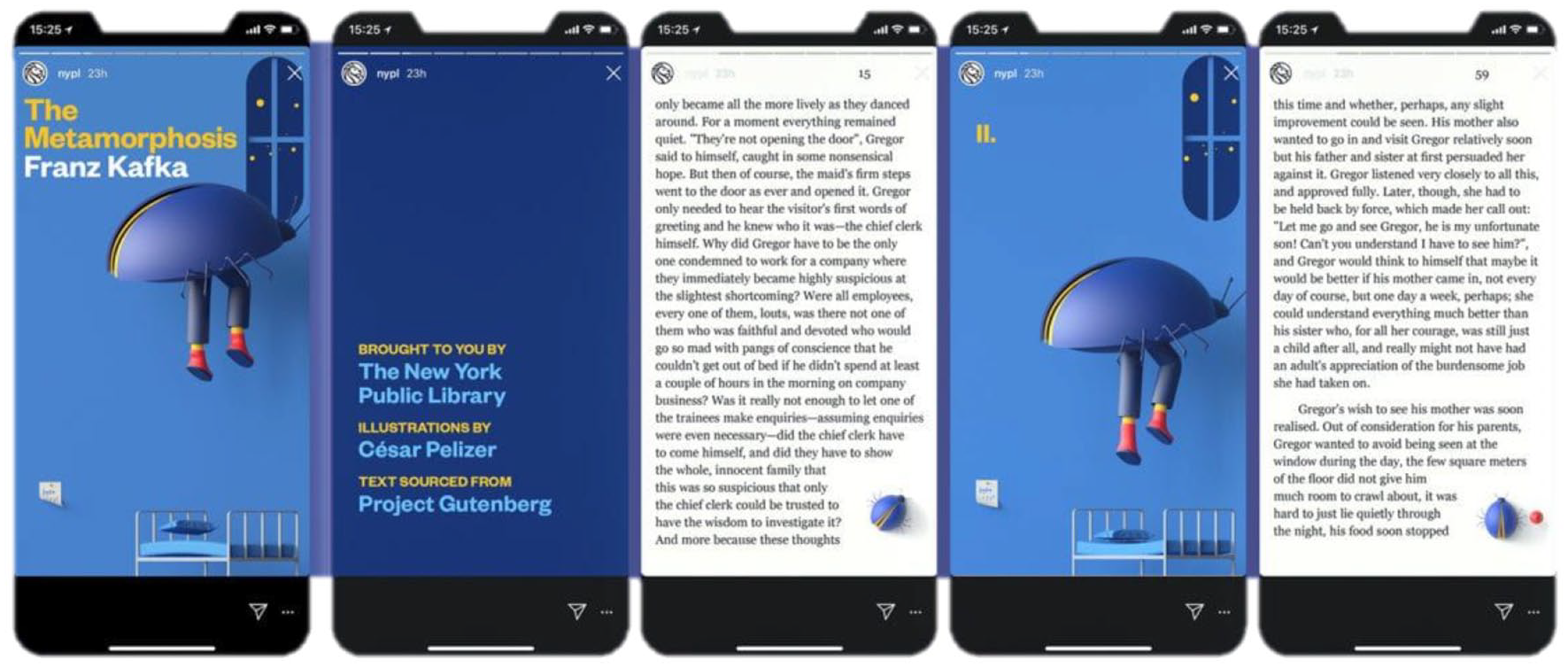
Thus, the tension between the personal and public story underscores that Instagram is a platform for storytellers to a greater extent than a platform of stories, where documentation is more welcome than fictional stories. Had the story been told personally by one of the library workers or story characters, as in Eva’s stories (Henig & Ebbrecht-Hartmann, 2020), the personal dimension would have been preserved and could have contributed to the project’s relevance.
Readers Versus Users
Insta Novels aimed to expand the library’s target audience by offering specially designed books to Instagram users. Specifically, the library wished to persuade digital natives to read classics by using the Instagram Story. Forbes’ review noted that the project’s success stems from the fact that NYPL “saw this as an opportunity to develop stronger relationships with their community” (“What Brands Can Learn From the New York Public Library’s Instagram Stories,” 2018). The tension between readers and users amplifies the gap between the library’s traditional community of readers and Instagram users, who loved the idea but swiped onward.
The library tried to appeal to digital natives by selecting works that “highlight current societal themes” (“What Brands Can Learn From the New York Public Library’s Instagram Stories,” 2018), placing them on a popular platform, adjusting the text to the smartphone screen, and imagining digital natives reading classics. However, it seems the library’s imagined audience (Litt, 2012) did not show up. Insta Novels demanded readers to engage in the process of decoding, informed by standards of high culture; hardly the favorite pastime of digital natives. To appeal to digital natives and adapt to the digital age more broadly, the project could have utilized practices and aesthetics that matched the vernacular creativity of Instagram users. For instance, it could have used the ecosystem concept, which is more suitable for digital natives, and depict Alice as a character who reports to her followers about her journey or, perhaps, design the project to be interactive, temporary, or more visual.
The library tried to reach millennials by placing the project as an expression of the brand’s “higher purpose”—reading books for free (“What Brands Can Learn From the New York Public Library’s Instagram Stories,” 2018). It is implied that, due to its nature and values, NYPL is forced to encourage reading. Still, making reading a necessity by offering chunks of text that can only be read or ignored may deter Instagram users from the project and, therefore, the library, too. As for library subscribers who are unthreatened by the task of reading long texts, one may ask, why should they read these books on Instagram in the first place?
Conclusion
Insta Novels is a significant experiment to maintain the cultural relevance of, and even renew, traditional and central institutions. The project initially appears to be a remediation project that uses the new in service of the old by offering a digital library on NYPL’s Instagram page. However, a closer look reveals that its performance reflects a misunderstanding of media values and culture; a circular, rather than progressive motion. Insta Novels did not compete with the book or other versions of the classics: it merely chose a new platform to perpetuate it. The use of the platform was mainly metaphoric, and did not take advantage of Instagram’s affordances or speak the language of its users. Thus, the project reflects a perception of Instagram as a magic bullet or a hypodermic needle that may solve the decline in reading if only someone would post some classics in it.
As for the mediatization aspect of this project, in Insta Novels, the media is both the sender and recipient of the message, obviating the actual reading and reader. The dominance of branding and advertising experts’ involvement in the project suggests that NYPL’s primary motivation may have been to promote, rather than transform itself. The hidden promotional nature of the project reveals that Insta Novels’ stories underwent mediatization, transforming Kafka and Poe into NYPL’s PR content, rather than assimilating literature in media culture, platforms, readers, or aesthetics. It also suggests that media is the contemporary power center to which the library aims to belong, hence, its adequate mediatization.
The analysis of the project performance, reviews, and hashtag attests to the significant gap between the media and users’ resonance. While its broad resonance may be perceived as an outcome of popularity among users or innovative ambition, it is an expression of the hermetic conversation between media actors: PR and marketing experts, journalists, and their peers on social media, all of which create, rather than reflect, reality.
While remediation and mediatization are useful concepts to describe the internalization of media, in literary theory, imitation, which is a performance of internalization, is often classified with the terms “parody” and “pastiche.” While parody uses imitation, references, and quotes for the sake of arguing with a previous specific text and the aspiration to rise above it, pastiche is a blank parody; an imitation devoid of critical or dialogic aspirations (Boxman-Shabtai & Shifman, 2014). Remediation is closer in spirit to parody. The parody mimics attributes of a specific text for the sake of arguing with it; remediation is a form of new media that uses older media attributes to create a dialogue between old and new, while preserving the old as part of the lineage that led to the new medium. Conversely, mediatization shares similarities with the pastiche. The pastiche imitates texts mainly to reflect the textual saturation underlining contemporary culture. Similarly, mediatization echoes media as a monologue or ambient soundtrack, reflecting the absolute saturation of media in culture. It reflects the circular culture characterized by flat and still loaded creations in which veteran and independent objects are assimilated in media to gain relevance and resonance.
Analogous to the parody immersed in the pastiche, remediation is immersed in mediatization; however, both parody and remediation are lost within pastiche and mediatization, as their specificity and intention drown in a closed circular environment. The comparison with mediatization and remediation is exploratory and calls for future research, but also sheds light on this specific study.
While Insta Novels seems like a new story that composes literature and technology, the remediation perspective reveals that it is posting the old story in the new platform. Whereas at a glance, it seems that Insta Novels stretches the boundaries between the eternity of literature and temporality of social networks content, or the personal and public story, mediatization analysis reveals that media values such as liveness and storytelling were neglected. While the library tried to reach millennials who would read canonic literature on Instagram, Insta Novels’ resonance reveals that the main audience are PR and media experts. The library asked for a parodic dialogue with new, young readers but ended up with the pastiche circular monologue, emphasizing that Insta Novels was perceived as a successful ad.
Apart from the enjoyable design and refreshing idea, it is unclear whether the library encouraged people to read these stories or flip through the pages, like in a bookstore, with no intention of buying the book. Nevertheless, it encouraged users to own literature as an archaic and fixed symbol, not as a leisure activity. Unfortunately, the project reinforced the very image that NYPL wished to eliminate in the first place: it presented the book and its institutions as irrelevant objects of the past that are now awkwardly nailed to an Instagram page, unwanted.
Footnotes
Acknowledgements
I am grateful to Amit Pinchevski for his patient guidance and advice. I further thank Limor Shifman, Hadar Levy-Landsberg, Shirin Magen, Nomi Dror, Sharon Shakargy, Gilad Meiri, Noa Granot, and Lillian Boxman-Shabtai for their valuable comments on different versions of the article.
Declaration of Conflicting Interests
The author(s) declared no potential conflicts of interest with respect to the research, authorship, and/or publication of this article.
Funding
The author(s) received no financial support for the research, authorship, and/or publication of this article.
