




Abstract
Contemporary experiences of everyday feminisms often include the use of social media platforms like Instagram. The introduction of Instagram Stories created a space for emerging feminist engagements, allowing for practices of re-sharing content that serve as small acts of political engagement, accommodating the participation of otherwise reluctant users. This article explores the feminist potential of these re-sharing practices, grounding it on the analysis of 2282 Instagram Stories, produced by 52 Instagram users in Portugal. This analysis combines qualitative textual analysis, close readings, and the use of digital methods to explore overarching patterns. The article foregrounds the multiple meanings of re-sharing, its social character, its ability to engage in intertextual conversations with the original context, while simultaneously recognising some of the limitations of the Stories’ format for feminist action. In this way, this article reflects on the tensions and possibilities of these small acts of political engagement.
Introduction
Contemporary feminisms have long adopted digital and social media for their actions, with movements such as SlutWalk, #MeToo, and countless others helping to cement their public visibility (Banet-Weiser, 2018). However, online feminisms also exist outside these highly visible peaks of feminist protest (Mattoni, 2017: 498). Like most social media practices, online feminisms also largely take place in relatively mundane contexts and practices, which are often overlooked (Brabham, 2015).
Instagram Stories emerge as a rich context to study everyday manifestations of feminist ideas – allowing for the co-existence of political messages within a platform that is commonly associated with aesthetic, entertainment and commercial practices (Leaver et al., 2020). Despite their popularity, studies that explore political uses of Stories are still scarce (see, for example, Jaramillo-Dent et al., 2022 or Cassidy et al., 2019). Introduced in 2016, Instagram Stories are an ephemeral format that disappears after 24 hours. This feature combines multi-modal content – including photos, videos, text, emojis, audio, and a wide array of interactive stickers – in a short-format digital object that lasts 5–60 seconds (Bainotti et al., 2021). While originally mimicking the competing platform Snapchat, Stories have since became a central feature on Instagram, used by millions of users daily and potentially even surpassing permanent posts as the primary mode of sharing within the platform (Constine, 2018). Similar ephemeral features were also adopted by platforms like Facebook or the now-discontinued Twitter Fleets (Conger, 2021).
The ephemeral character of Stories marks a shift from the idea of permanence as one of the defining affordances of social media (Abidin, 2021a). Stories were originally created to be transient (although this has been complicated by the introduction of Stories Highlights, which allows for Stories to be permanently featured in one’s profile, and by private Stories Archives, which save one’s Stories for later viewing or re-sharing). Prior research (e.g. Cardell et al., 2018; Kreling et al., 2022) highlights how this ephemerality, alongside the cultures of use that emerged around this feature, led to the association of Stories with a more playful environment, where people can share in more spontaneous and less strategically curated ways than on their Instagram feeds.
Using social media can be anxiety-inducing – marked by fears of being surveilled, judged or of ‘getting it wrong’ when sharing content (Gill, 2021). Engaging in political talk online can be felt as particularly sensitive or even risky (Ekström, 2016), and people with traditionally marginalised identities (such as women, racialised people, or queer people) tend to be disproportionally subjected to online hate and harassment (Harvey, 2020). For some, relegating politically charged content to the ephemeral format of Stories can feel as a way to reduce pressure and minimise potential backlash (Caldeira, 2021: 12). These concerns are also attenuated by the lack of publicly visible feedback in Stories (Triệu and Baym, 2020). Stories can be understood as allowing for ‘below the radar’ social media practices, deflecting unwanted attention while still allowing for more circumscribed forms of content circulation and interaction (Abidin, 2021a).
This article explores feminist engagements within Instagram Stories, narrowing on practices of re-sharing content – one of many political uses afforded by this feature. Re-sharing is an unusual affordance on Instagram, which tends to privilege original and platform-native content. Centring re-sharing practices, this article recognises different levels of participation on social media – not only active content creation, but also through consumption of and interaction with content created by others. Picone et al. (2019) advance the notion of small acts of engagement, understanding acts as liking, commenting, or, in this case, re-sharing content as participatory and productive. These allow for more casual and less labour-intensive forms of participation, which can be performed without ‘stepping out of the comfort zone of our daily routines’ (Picone et al., 2019: 2017–2018). These small acts of engagement also allow for different degrees of political engagement, facilitating the integration of feminist practices into everyday life, even for reticent participants. Re-sharing political content can thus complicate dichotomous views of activity versus passivity, as studies in other platforms exemplify (Ekström, 2016).
There is a long history of social movements’ engagements with digital media (e.g. Mattoni, 2020; Treré and Kaun, 2021). Within feminisms, its fourth-wave is often defined by its use of digital technologies (e.g. Munro, 2013). Digital media provides broad repertoires of communication and action, which can be used for varied objectives – from dissemination of information, challenging authority, recruitment, internal organisation, mobilisation of protests, and so on (Mattoni, 2020). While online practices co-exist with offline efforts (Mattoni, 2020), their incorporation in social media platforms that are already well-established and familiar in everyday life, like Instagram, can help to extend these repertoires and increase potential reach of political messages (Campos et al., 2018: 499).
Traditionally, social movements studies tend to focus on sustained forms of collective action, enacted by groups who share a common identity or struggle (Silva, 2020: 21). As seen earlier, this scholarship also centres peaks of mobilisation rather than more quotidian settings (Mattoni, 2020: 2830). While classically defined social movements exist on social media, these platforms also allow for more diffused efforts for social change that emerge from below, carried through individual practices (Kaun and Treré, 2020). As such, this article adopts a lens of everyday politics and, particularly, everyday feminisms (Highfield, 2016; Pruchniewska, 2019) that expands our understanding of feminist action beyond the traditional realm of institutional politics, established activists, or feminist organisations. Instead, everyday feminism focuses on the ways in which feminisms can be integrated into the everyday social media practices of ‘ordinary’ people who may not self-identify as feminists or even see their actions as deliberately political, but whose practices nonetheless help to spread awareness or contest social inequalities, while requiring less effort. Everyday feminisms co-exist and draw from popular feminisms (Banet-Weiser, 2018). These media-friendly expressions can take advantage of dominant economies of visibility to spread certain feminist ideas, however, they tend to privilege particular forms of celebrity or corporate feminism, forgoing more structural critiques or actions coming from marginalised communities.
In this context, understandings of feminisms on social media are marred with tensions. Online engagements with popular feminisms can be disregarded as ‘performative activism’, trying to gain cultural capital by engaging with fashionable causes (Hampton, 2015: 10). At the same time, small acts of political engagement like re-sharing Stories can be dismissed as slacktivism (Glenn, 2015) – a departure from traditional forms of activism, relying instead on digital acts that seem to require minimal commitment and that might have limited impact over ‘real’ politics. Rather than pushing effective action, online efforts are seen as merely providing a ‘feel-good’ sense of accomplishment (Munro, 2013: 24). Yet, it is important to recognise that while the small acts of engagement that often mark practices of everyday feminism may, in isolation, have a limited capacity to produce social change, their accumulation can gain aggregate force which may lead to structural change (Picone et al., 2019: 2022–2023).
Contextualising feminist practices in Portugal
This study draws from an analysis of Instagram practices in Portugal. This is an under-explored context, as dominant scholarship on social media feminisms often centres anglophone contexts or examples. Historically, Portuguese feminisms have been dominated by practices of ‘state feminism’, rather than by grassroots movements and bottom-up mobilisations (Santos and Pieri, 2020). While there have been moments of intense collective mobilisation, for example, around abortion rights, sustained feminist participation is not common (Santos and Pieri, 2020: 199) and there is still societal resistance and scepticism towards feminism (Simões and Silveirinha, 2022). Although online feminisms offer new avenues of participation, until recently large-scale movements and international hashtag campaigns, such as the #MeToo, have failed to gain wide public expression in Portuguese society (Garraio et al., 2020). However, in the last years, Portugal has seen a moment of resurgence of feminist discussions in both traditional and social media, partly in response to waves of public accusations of gendered sexual harassment (e.g. Ropio et al., 2021). Moving from earlier platforms like blogs or Facebook (e.g. Campos et al., 2018), in recent years, Instagram has emerged as a key platform for Portuguese feminist practices (Lamartine and Cerqueira, 2023) – as activists often privilege dominant platforms (Campos et al., 2018: 499) and Instagram is one of the most actively used social media platforms in Portugal (WeAreSocial, 2023). In this context, national hashtag movements against gendered harassment, such as #VermelhoEmBelem, have started to emerge and gain traction (Caldeira and Machado, 2023). While contemporary feminism in Portugal continue to combine on- and offline repertoires of action, this background helps to highlight the importance of exploring how feminisms can be circulated in less overt manners that might evade traditional definitions of social mobilisations. Despite centring Portugal as the locus for the exploration of everyday feminist practices reified through re-sharing within Instagram Stories, these social media practices are always entangled with transnational dimensions (Sorce and Dumitrica, 2022), thus eliciting reflections that can be significant at wider scales.
Methodological approach
This article is grounded on the analysis of Stories shared by a sample of 52 Instagram users. Given the technical challenge of low searchability of Stories within the platform (Bainotti et al., 2021), this research draws on prior research on feminist cultures on Portuguese Instagram (e.g. Caldeira, 2023b) to adopt a multi-layered approach to recruiting participants: identifying popular users who engage with political and feminist topics, identifying users who used the hashtag #FeminismoPortugal (feminism Portugal), and using Instagram recommendation features to snowball and expand the sample. This sampling was theoretically oriented (Patton, 2002: 238), guided by a focus on Instagram Stories as a means of feminist communication. The selection encompasses a wide range of feminist approaches, covering both overt and tangential engagements with feminist issues, as well as encompassing accounts that intersect with other social justice issues (e.g. LGBTQ+ rights, sexual health), thus reflecting an intersectional understanding of everyday feminisms (Caldeira, 2023b).
Following a feminist ethics of care (e.g. Franzke, 2020), users with public profiles and actively sharing Stories were contacted through Instagram Direct Message, informed about the research, its aims, and the extent of data collection, providing their informed consent to participate in the study. To minimise potential risks of feminist visibility online, the privacy of participants will be preserved: no demographic data were collected, and no usernames will be mentioned in this article. Furthermore, the analysis focuses exclusively on the content of collected Stories and, to respect expectations of use, no ephemeral content will be reproduced.
While demographic information about the people or entities managing the studied accounts was not collected, the studied sample encompasses an array of everyday feminist approaches. This includes, for example, established feminist organisations, non-governmental organisations (NGOs) concerned with youth’s gender equality, associations for migrant women, or smaller feminist collectives. Various accounts belong to people with a degree of public visibility in Portugal – including actors, comedians, journalists, or influencers, whose content touched on feminist issues (either consistently or occasionally). It also includes accounts of ‘ordinary’ people who openly identify as feminists, as well as accounts that engage with feminist issues tangentially – for example, accounts about parenting that centre gender equality and diversity; accounts dedicated to psychology, sexual education, or menstrual health; accounts promoting feminist documentaries or podcasts; or even commercial accounts, such as fashion brands with feminist positionings or a feminist bookstore. Despite their diversity, most studied accounts shared Stories in Portuguese, although re-shared content also introduced content in other languages – more than a 10th of all re-shared Stories were exclusively in English, and other 10th combined Portuguese with a foreign language, translating or contextualising the original content.
To avoid circumstantial effects associated with specific periods (Vázquez-Herrero et al., 2019: 4), four random days per month were selected, for 3 months (October to December 2022). All Stories shared on those days were collected and coded, totalling 2282 Stories. Stories were accessed and visualised through Instagram’s desktop app and manually collected using QuickTime’s screen recording tool. This sample does not intend to be representative nor generalisable, rather it provides an illustrative analysis of feminist uses of Instagram Stories.
Data from collected Stories were manually inputted in csv files, audio content was transcribed, and all Stories were qualitatively coded, regardless of their political nature. The coding was inspired by existing scholarship on Instagram Stories (e.g. Bainotti et al., 2021; Vázquez-Herrero et al., 2019). It noted the nature of users’ profiles, types of Stories shared (e.g. videos, static images, text, etc.), and formal characteristics (e.g. length, use of sound, etc.). Stories were coded as original or re-shared content. The language used in Stories was noted, as well as its visual content (e.g. self-representations, images of people, animals, graphic compositions, illustrations, screenshots from other media, etc.). The use of hashtags, username tags, and other Instagram-specific digital objects (e.g. filters, interactive stickers, GIFs, etc.) was also noted. Finally, Stories containing feminist content were analysed in-depth, noting their characteristics (e.g. personal testimonies, promotion of events, calls for action, expressions of grievances, etc.).
A multi-layered analysis was conducted, combining qualitative textual analysis (Lindlof and Taylor, 2011), qualitative close readings accompanied by extensive note taking with emerging interpretations, and the use of digital methods (Rogers, 2013) to engage with this reasonably large dataset and explore overarching patterns. This was facilitated by the use of digital tools, such as spreadsheet software, or network visualisation tools like Gephi (Gephi Consortium, 2017) to create a network of co-tagging practices in re-shared Stories.
Following the current introduction, this article offers an overview of the dynamics of the studied feminist Stories. It then narrows on practices of re-sharing, contextualising their varied meanings. The following section highlights the social character of re-sharing practices. Next, it explores how Stories can engage with and complement original content by adding text and other multi-modal content objects. The final section acknowledges some of the limitations of the Stories’ format for feminist action, while recognising the creative ways in which users circumvent them. The conclusion brings together the key insights of this article, briefly reflecting on the tensions and possibilities of these small acts of political engagement.
Instagram Stories as a site for everyday feminisms
Feminisms have always taken advantage of emerging media technologies, however, different social media platforms, with their specific affordances and cultures of use, can shape its forms of expression (Barbala, 2022; Keller, 2019). The association of Instagram Stories with mundane content and less curated practices of sharing (Bainotti et al., 2021) can create a heterogenous context in which content can easily switch between the personal and political. Within the Studied stories, recipes, mirror selfies, photos of pets, or memes could be interspersed with political Stories. Yet, in these contexts, everyday content can have a tangentially political character, further blurring the line between mundane and political (Caldeira et al., 2020). For example, a mirror selfie shared by a user on wheelchair can be linked to practices of visibility politics (Whittier, 2017), considering everyday issues of living with disabilities.
Reflecting the theoretical sample of the study which sought participants with feminist interests, most collected Stories (1702 out of the 2282) could be broadly understood as feminist or related to other social justice issues – containing open references to feminist or political issues, concerns about diversity or equality, calls for protests, or, in the vein of everyday feminism (Pruchniewska, 2019), fleeting comments that incidentally shed light on social or political topics. Examples of explicitly feminist content could be seen in Stories re-sharing statistics on gendered and sexual violence, campaigns against period poverty with actionable information on what and where to donate, or links to crowdfunding platforms to fund gender confirmation surgeries. In addition, feminist topics also emerged in more everyday contexts, in Stories reflecting about experiences of unequal gendered labour division in parenting, or Stories recommending feminist films in local festivals, among others.
As aforementioned, these feminist or political Stories were shared by a diverse array of participants. Most active and consistent sharing of Stories (both feminist and otherwise) tended to be dominated by public persons with relatively large numbers of followers – ranging between 3K and 121K followers. While the median 1 number of Stories shared by all users was of 31 Stories, these high-intensity users had a median of 102 Stories, sharing approximately seven Stories per day. As an illustration, the most active user in the studied sample was an Instagram-famous public educator on disability issues, who shared on average 26 Stories per day, totalling 240 Stories in the studied period – promoting not only her own educational posts through re-shares to her Stories, but also frequently engaging with followers through Q&As, or re-sharing both educational and humorous content from others, often on disability rights, feminism, and other social issues. Other high-intensity users included, for example, humourists, influencers, and feminist organisations. This contrasted with the 10 lowest intensity users in our sample, who shared five or less Stories during this period – including personal or organisations’ accounts whose activity seemed to dwindle, but also accounts who openly announced a hiatus during the studied period.
The studied Stories engaged with diverse feminist and political issues – intertwining feminist topics with other social justice concerns, such as questions of racism, LGBTQ+ (lesbian, gay, bisexual, transgender, queer and more) rights, disability rights, migrant rights, and others. The co-existence of these issues calls to mind concerns with intersectionality that are central to fourth-wave feminism (Munro, 2013). Likewise, Stories could also be used for different political purposes; for example, for airing feminist grievances, as with Stories exposing cases of lack of access to abortion services in Portuguese hospitals. Stories could also act as feminist informal education, often through the re-sharing of graphic compositions and Instagram slideshows (Caldeira, 2023a; Dumitrica and Hockin-Boyers, 2023), as with Stories sharing feminist news or raising awareness on varied issues, such as period poverty in Portugal. They could be used to mobilise feminist action, with Stories amplifying calls for action and promoting feminist and political events – such as protests, talks, workshops, and other events. Or they could engage with expressions of popular feminism and postfeminism (e.g. Banet-Weiser, 2018; Gill, 2016), with Stories recommending or commenting on films, books, podcasts, and other forms of media linked to feminist or social justice issues, or adopting an individualistic, empowerment-driven, can-do tone with Stories that centred love-your-body motivational messages, celebrated the professional achievements of individual women as a proxy for social progress, or with commercial content, such as the promotion of feminist merch.
Most studied Stories were static content, both original images and re-shares of Instagram posts, having a default length of 5 seconds. While Stories can last up to 1 minute, only nine in the over 2000 Stories analysed took advantage of this extended duration. On average, the studied Stories lasted circa 7 seconds, with re-shared video content usually being 15 seconds. As will be explored below, this can have implications for the political potential of this format.
While feminist Stories were consistently shared throughout the sampled 3 months, showcasing the embeddedness of feminisms in daily life (Pruchniewska, 2019), there were peaks of issue-oriented activity emerging around highly visible feminist actions – a pattern prevalent in social media activisms (Papacharissi, 2016) that also echoes prior feminist dynamics in Portugal (Santos and Pieri, 2020). In the studied Stories, this peak occurred around the organisation of nation-wide protests against obstetric violence. The days leading up to the protests were marked by increased activity, with users re-sharing calls for action, posters, manifestos, and other actionable information such as meeting times and locations. This peak extended until the day after the protests. One of the participants, a feminist collective that was involved in the organising of the protests, became a central hub and amplifier for this documentation, re-sharing 100 Stories from protesters across the country – thus reaching the maximum daily limit imposed by Instagram (Wong, 2017). These Stories documented the protests, with photos and videos of crowds, protest signs, or news coverage of the events. These forms of centralised re-sharing can help to bring together content created by different people who, despite having participated in the same protest, might not be aware of each other, thus contributing to solidify a sense of a feminist counterpublic (Jackson, 2018: 35) and making visible informal feminist networks, as will be expanded later. These observations also highlight how having a well-defined central actor, in this case a feminist organisation, can be helpful to mobilise collective action that follows more traditional social movements’ repertoires (Caldeira, 2023b).
Re-sharing as an everyday feminist practice
While Instagram Stories allow for the creation of original content, the studied sample was largely dominated by re-shared content – with nearly two thirds content analysed being re-shared Stories. Platform-sanctioned re-sharing of content is an affordance that is largely absent from other Instagram features, which tend to privilege original Instagram content. As such, the exploration of re-share dynamics on Instagram evokes scholarship on other platforms which enable similar practices, namely tumblr and its reposting function – which preceded Twitter’s retweeting or sharing on Facebook (Tiidenberg et al., 2021).
While re-sharing is a common social media practice and is not necessarily political in itself, prior scholarship highlighted the multiple meanings and political implications it can carry. Re-sharing can be an expression of appreciation and agreement, it foreground ‘relatable’ content, amplify certain issues, or fulfil a social function and foster communities (Tiidenberg et al., 2021: 25–26). As studied on Twitter, re-sharing can also help to grow the reach of political messages beyond its original source, reaching audiences who might not see these messages otherwise (e.g. Hemsley, 2019).
This political potential of re-sharing is reflected in the studied sample. Original Stories contained an almost perfect balance of political and non-political content, with feminist critiques emerging alongside the aforementioned photos of outfits of the day or videos of one’s kids. In contrast, re-shared Stories were overwhelmingly filled with political and feminist content, with almost nine out of 10 Stories being understood as political in some way: with examples including re-sharing of news items or posters for upcoming protests or feminist events, as illustrated in the previous section. As such, widely established everyday practices of re-sharing Stories seem particularly well-suited for small acts of feminist engagement. As small acts of engagement (Picone et al., 2019), re-sharing can also be used as a way for people to circumvent their discomfort with political expression online. Through re-sharing, people can express their political opinions ‘by proxy’, foregrounding statements created by others and thus alleviating risks of backlash (Tiidenberg et al., 2021: 47).
In this context, re-sharing becomes enmeshed with practices of curatorial activism – with the process of discovery, selection, interpretation, framing, and sharing of existing content and knowledge becoming central to political expression (Tiidenberg et al., 2021: 46–47). This curation can be exerted to different degrees, with some users maintaining a thematically consistent focus on specific issues, while others loosely curated content based on their current interests. Processes of selection and re-sharing, facilitated by the affordances of Stories and their cultures of use, become productive and tangentially political in themselves, relying on judgements on what issues to give visibility to and which to exclude. Drawing on the aforementioned concepts of small acts of engagement (Picone et al., 2019) and everyday feminism (Pruchniewska, 2019), with a few clicks political concerns can be interspersed in the flow of mundane content that often exists in Stories.
The added visibility gained by the curated re-sharing of certain political and feminist messages, can also be seen as a show of support, conferring more credibility and social capital to these issues (Roden et al., 2022). Through re-sharing, content can also circulate beyond the immediate network of the original content creator. Re-shared content can serve as bridge to new social groups and diverse audiences, thus expanding the circulation of political knowledge or dissemination of calls for action (Roden et al., 2022: 3). This circulation can happen ‘organically’, circumventing platforms’ systems of algorithmic recommendation (Van Raemdonck, 2022), as one can ‘accidently’ encounter feminist and political content re-shared by friends, without necessarily following overtly activist accounts. While the reach of certain political issues can be drastically increased when being re-shared and amplified by high visibility users, such as influencers (e.g. Abidin, 2021b), these practices can also be beneficial when engaged by ‘ordinary’ users, as political content tends to be better received when shared by people from our own social groups (e.g. Roden et al., 2022; Van Raemdonck, 2022).
Re-sharing can also create bridges to a wider media ecology (Mattoni, 2017). While most studied re-shared content came from within Instagram – through re-shares of posts, Reels, or even other Stories – many Stories also incorporated content from other platforms – through screenshots of Facebook posts, tweets, news websites, crowdfunding platforms, adding Spotify links to Stories, or by re-uploading TikToks are Reels or video Stories (see Figure 1). This content flows between platforms in both Instagram-sanctioned ways and through creative workarounds found by users, thus revealing a porous media ecosystem where cross-platform boundaries are negotiated by users (Zhao et al., 2016: 89–90). Stories can also create intertextual conversations with traditional media, for example, through the aforementioned re-sharing of news coverage of feminist mobilisations, or through the use of news headlines as a starting point for feminist critiques, for example, with Stories critiquing gendered inequality in Portuguese labour practices. In this way, different media ecologies and practices can be combined to enable political expressions and actions (Mattoni, 2017: 497), introducing new information to the ecology of Instagram Stories.
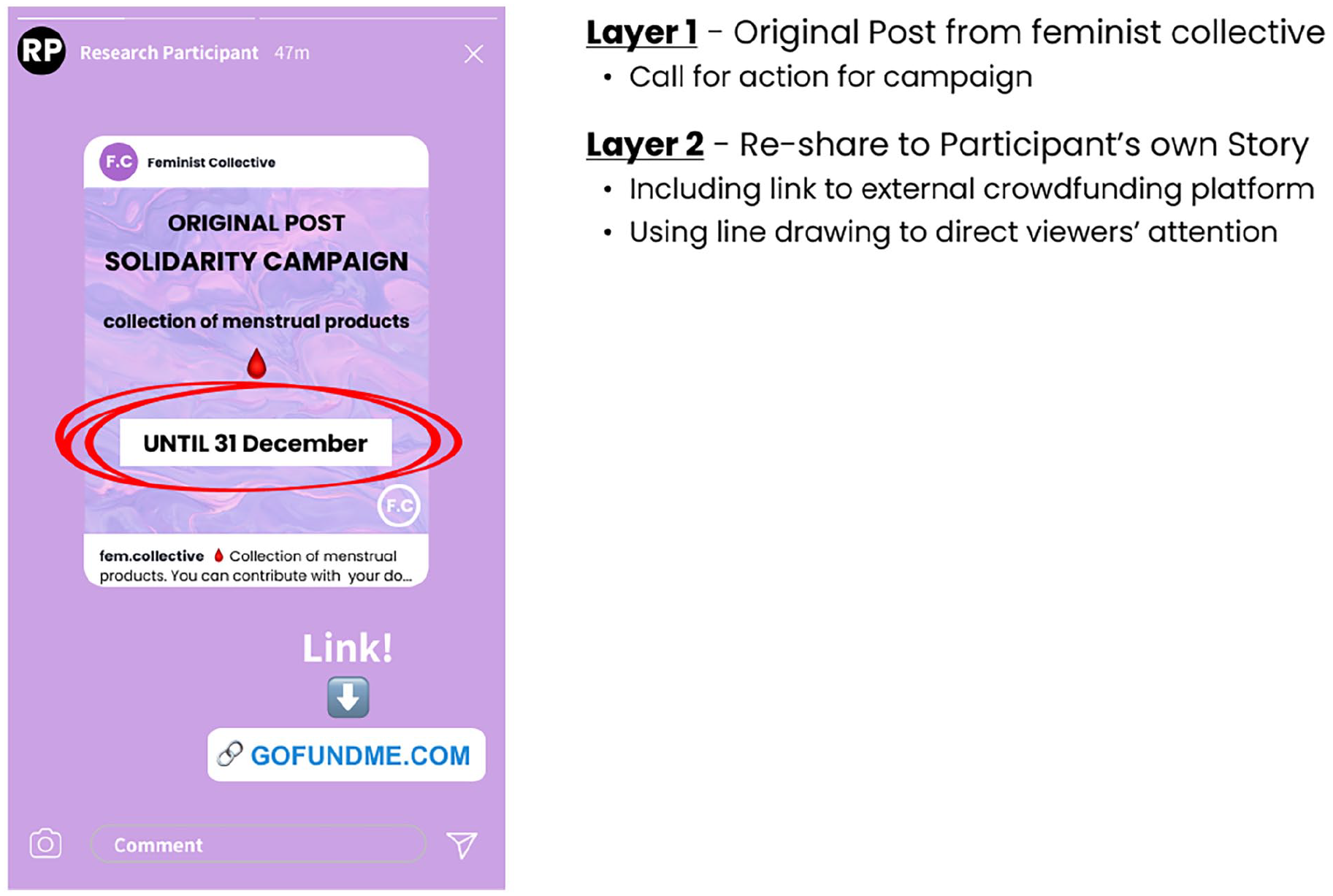
Illustration exemplifying feminist uses of re-sharing Stories and how Stories can direct to media ecologies external to Instagram. Layers’ order reads in a radial direction, starting from the centre and moving outwards.
Re-sharing as social practice
Re-sharing practices can have an inherently social component (Tiidenberg et al., 2021: 25–26). In the case of Instagram Stories, this social aspect can be made explicit by interactive digital objects such as question or poll stickers that allow users to directly engage with viewers. Questions stickers can be used to ask for viewers’ insights and contributions, for example incentivising people to share their personal preconceptions about disabilities. These contributions are then re-shared anonymously to new Stories and can be commented on by the original creator. Users with more public facing accounts also use Stories to create ‘ask me anything’ moments, as with a sexologist who used this feature to create a weekly space to engage with followers’ personal questions on issues of sex and relationships. These interactions can generate new content (Cassidy et al., 2019: 3), at times blurring the line between genuine desires for community building and strategic attempts to gain visibility in the platform and ‘feed the algorithm’ (Abidin, 2015).
Yet, even when not using interactive stickers, re-sharing Stories can still be indirectly understood as a social practice. Stories can act as an interpersonal expression of support, showing appreciation or solidarity for a certain person, movement, or organisation. These shows of appreciation can often be bi-directional. For example, as an implicit ‘thank you’ for having one’s Story shared and amplified by others, users can once more re-share these objects, complementing them with expressions of mutual admiration, or punctuating them with heart emojis or GIFs (Graphics Interchange Formats). These practices create messy digital objects, in which multiple layers of shares and re-shares are superimposed, in a loop of mutual appreciation and amplification. Drawing on an illustrative example from the studied sample (see Figure 2), an Instagram post promoting a queer poetry festival can be re-shared by the same user into their own Stories. This Story was then re-shared by the cultural venue hosting the event, further promoting it. This re-shared Story was once more re-shared by the original content producer, as an implicit show of appreciation. As Figure 2 illustrates, these back-and-forth interactions create a visual object reminiscent of a Russian doll, a nested visuality of Stories within Stories that deepens as the chain of re-shares increases – similarly to the nested cascading threads of tumblr reblogs (Tiidenberg et al., 2021: 24). This layered visuality, however, can complicate our reading, as re-sharing ‘flattens’ the image, rendering certain digital objects (such as links or interactive stickers) un-clickable and thus devoid of practical function.
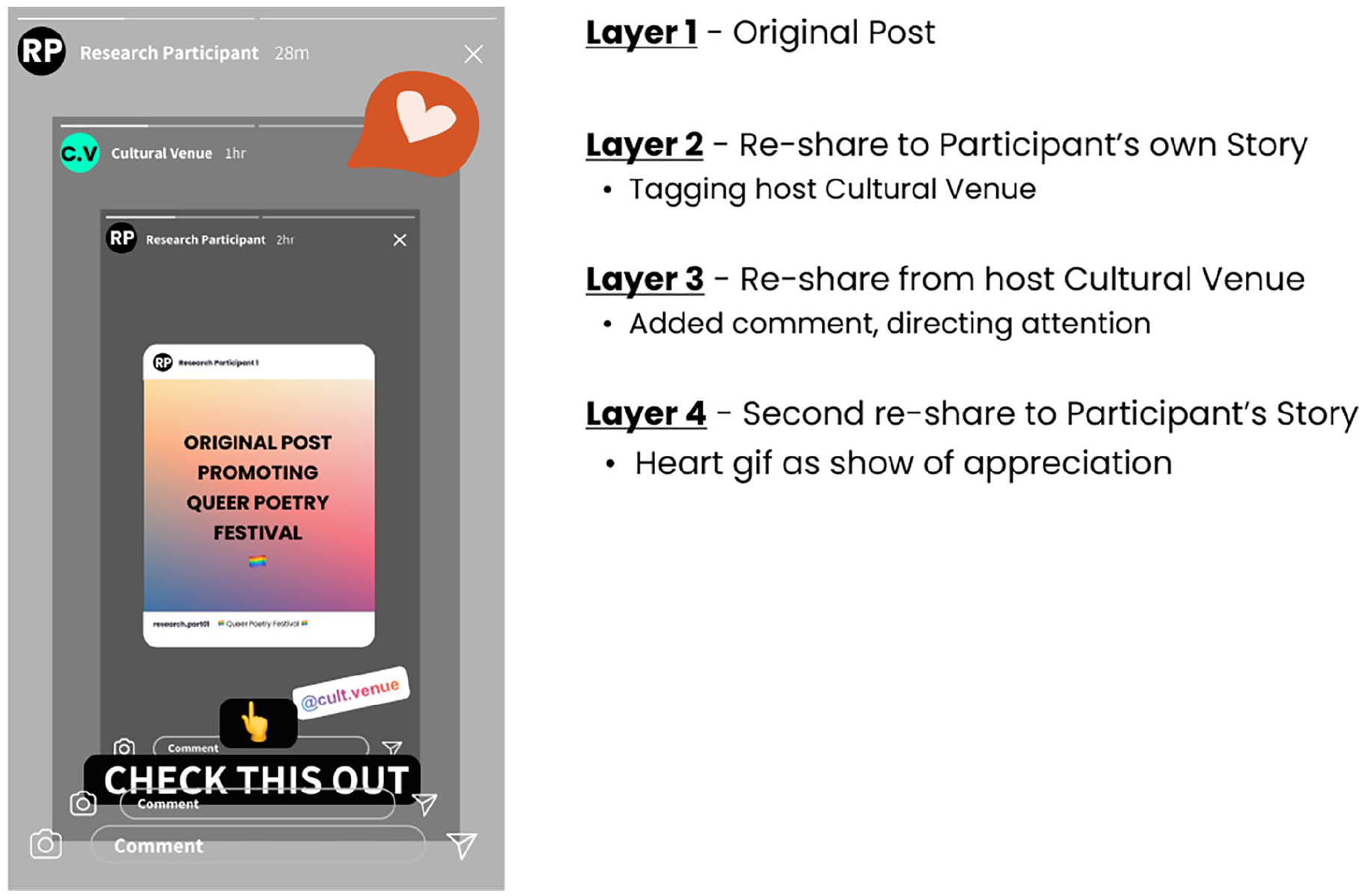
Illustration exemplifying nested re-shared Stories. Layers’ order reads in a radial direction, starting from the centre and moving outwards.
These nested Stories can also make visible informal feminist networks who cooperate to amplify the visibility of specific issues or events. These informal networks bring together users who engage with similar topics (e.g. sex education, migrant issues), who frequently re-share each other’s content. Adding username tags to re-shared Stories (often to recognise and credit authorship) also reinforces these informal networks of feminist kinship. An exploratory analysis of co-tagging practices, conducted using the open-access network visualisation tool Gephi, revealed clear thematic communities coalescing around shared issues or interests, such as obstetric violence, non-monogamies, feminist books, or around specific high visibility users, as the aforementioned public educator on disability issues. These networks of mutual amplification are also reminiscent of strategies observed on Instagram at large – in so-called ‘Instagram pods’ (Leaver et al., 2020: 143) or ‘affirmation syndicates’ (Schreiber, 2017: 182) – with groups of users who regularly and strategically engage with each other, positively affirming each other through likes, comments, or, in this case, re-shares.
The social character of re-sharing Stories also co-exists with more self-promotional practices. Almost a quarter of re-shares were of one’s own content – either by sharing one’s posts or Reels to Stories, or through second level re-shares of one’s content re-circulated by others, as in the example above. Drawing on imaginaries of algorithmic gossip (Bishop, 2019), these practices of self-amplification seek to amplify the visibility of one’s content within Instagram by using the popular feature of Stories. New posts or Reels can thus be re-shared to one’s Stories to capture viewers’ attention. Yet, to ensure that attention is directed at the original content (and quantified in more durable metrics), Stories tend to serve only as a ‘teaser’. For example, the content of a feminist educational post can be partially obscured by overlaying it with animated GIFs when re-shared to a Story, thus pushing viewers to click-through to the original post for an unobstructed view.
Instagram is largely guided by commercial and popularity logics (Leaver et al., 2020), which affect both personal, professional, or political uses of the platform. As such, the promotion and amplification of feminist events can also become enmeshed with practices of self-promotion, with Stories circulating events to which the participants are directly associated, for example, as invited speakers for workshops on diversity and inclusion. Similarly, also feminist media created by the participants – such as podcasts, books, or even TV shows – were frequently re-shared and promoted in Stories, often linking to the original content. The commercial interests underlying these self-promotion dynamics can be explicit when re-circulating content selling feminist goods or advertising services, for example, promoting one’s sexology sessions. This enmeshment of political and commercial practices, as well as the adoption of self-promotional practices popularised by influencers, emphasises the entanglement of contemporary feminisms and neoliberalism (Scharff, 2023).
Engaging in conversations with original content through re-shared Stories
Re-shared Stories also engage in conversations with the original source material by adding new layers of text providing individual commentary to political issues, to multiple purposes. Often it reinforces or reiterates the original message, expressing agreement, praising the original content, or directing the viewer to engage with it more deeply. Commentary can also frame re-shared content as ‘relatable’, a prized quality in current social media attention economies (e.g. Kanai, 2019) – as with a Story commenting ‘so true’ alongside a re-shared post on gendered inequalities in everyday experiences of parenthood. Added text can also serve pragmatic and informative functions, for example, translating foreign content to Portuguese, or including contextual information.
Adding text can also infuse new layers of personal meaning to the original message. For example, feminist grievances can be explored in light of personal experiences, as exemplified by a user completing the re-sharing a news story on use of diabetes drugs as a weight-loss solution with a long text reflecting on their personal relationship to diabetes and the repercussions of rendering a necessary drug more expensive and inaccessible just to appease societal ideals of beauty. Comments can also reinforce the affective nature of political expressions (Papacharissi, 2016), for example, through expressions of frustration and even anger in response to feminist grievances. Likewise, sarcasm and irony also emerged in reaction to re-shared content, as with Stories mocking and discrediting homophobic tweets. Unlike they dynamics observed on tumblr, where reblogged content became part of one’s blog and tended to privilege content the users appreciated (Tiidenberg et al., 2021: 25–26), the ephemeral character of Stories seems to facilitate practices of re-sharing as a form of critique – for example, with users adding comments calling out sexist ideas in the original content.
Yet, two thirds of all content was re-shared with no text added by the participants. As this study relies on textual analysis, participants’ motivations behind this contextless re-sharing are not clearcut. Some Stories amplified calls for action, increasing the visibility of petitions or campaigns, even if no direct appeal is made by the participants re-sharing. Others, like the re-sharing of news items highlighting social and economic inequalities in Portugal, seemed to be treated as self-evident critiques or efforts to raise awareness on issues. Certain protest acts, such as a video of an Iranian woman dancing and throwing her hijab in the fire, were also shared with no added commentary, allowing the original content to speak for itself, but at the same time not providing viewers with the necessary context, as will be explored in the next section.
The multi-modal nature of Stories also allows for engaging with the original content beyond the addition of text. Different media elements – for example, videos, photographs, text, emojis, GIFs, music, interactive stickers – can add new graphic or interactive layers that can help to convey personal opinions or reactions. For example, using laughing reaction GIFs in response to humorous content, or adding heart emojis as a sign of appreciation for the original message or an implicit expression of feminist solidarity, often seen in re-shares of Iranian protests.
Negotiating the partial or fragmented nature of Stories
While Instagram Stories can be used to amplify the circulation of feminist content, the affordances of this format also carry limitations. The ephemeral nature and short duration of Stories can lead to the diffusion of partial or fragmented information.
Drawing back on the earlier example of Instagram slideshows with political information (Dumitrica and Hockin-Boyers, 2023), these posts break information into smaller sections, presented sequentially across different slides. Yet, when re-shared to Stories, often only the title slide of carrousels – introducing the topic under discussion – is included. In this way, essential information or key educational points are left out of Stories, only being accessible if the viewer actively decides to click-through and continue reading.
Furthermore, textual information is often essential to share feminist knowledge, in both Stories and Instagram slideshows (Caldeira, 2023a; Dumitrica and Hockin-Boyers, 2023). This can take the form of long written reflections that cannot be fully read in the 5 seconds that Instagram Stories allows for static content. Once again, the viewer is expected to take action, pausing the Story for reading or clicking through to the original post. In this way, Stories not only present ephemeral content, but they also prompt fleeting and brief engagements from viewers (Vázquez-Herrero et al., 2019: 2). Similarly, posts’ captions can also be key sites for longer feminist reflections and knowledge sharing (Caldeira, 2023a). Yet, when re-shared to Stories captions can be altogether omitted or appear in truncated form, only showing a snippet of the caption. Certain re-shared posts can be completely dependent on the contextual information provided by the caption – as exemplified by posts that only show a photograph of a person, whose role as activist is contextualised in the caption. Without captions, without added commentary, or without accessing the original post some re-shares can be undecipherable.
A similar fragmentation of information can also occur with video content. While videos directly uploaded to Stories can last up to 60 seconds, re-shared video content, such as Reels, is trimmed to 15-second snippets. Re-shared videos can either get across their central point in these initial 15 seconds, relying on viewers to follow through and engage with the full content, or its message can be abruptly interrupted, to such extent that sometimes its meaning is impossible to perceive based only on the re-shared snippet.
This ephemeral, partial, or fleeting character of re-shared Stories can thus create a sense of context loss (Cavalcanti et al., 2017). In some cases, the meaning of Stories can depend on their reading as a part of a longer series – yet the ephemeral nature of Stories can lead to parts of the series to have disappeared by the time viewers start to engage with the content, thus creating a lack of context that disrupts the reading. But, as was seen, context loss can also emerge from the lack of contextual clues within individual Stories themselves, both through the absence of textual context or the abrupt interruption of a message.
These forms of context loss can create tensions within our understanding of the political potential of these practices. While re-shared Stories can be essential to amplify visibility for feminist issues and to allow for the political participation of a wider array of people, the limited information these often provide can defer the promise of feminist knowledge sharing, with more in-depth engagements with feminist issues being relegated to outside of the ecosystem of Stories – in feminist posts, Reels, links to news articles, podcast episodes, in-person events, and so on. Yet, this lays the labour of complementing fragmented information on the viewer, with no warranty that viewers will follow through and engage with the source content.
However, users often adopt strategies and workarounds to minimise or circumvent these limitations. Platforms’ technological affordances – which can allow for or constraint specific uses – exist in a constant process of negotiation with users’ practices, expectations, norms, and values (Nagy and Neff, 2015). Diverse strategies to counter context loss could be observed in studied sample. For example, some users complemented the re-share of posts with screenshots of their full captions. Others shared all slides of Instagram slideshows as consecutive Stories. Long texts summarising the content of posts could also be overlaid in Stories. Or workarounds like downloading a Reel and re-uploading it directly to Stories were adopted to extend the allotted time. Multi-modal elements, like GIFs, emojis, or line drawings, could also be added to Stories to direct the viewers’ attention. For example, arrows and pointing emojis were often used to instruct viewers to continue to subsequent Stories or to emphasise clickable links. GIFs could be similarly used to highlight important aspects of the content or to instruct viewers to follow through to the original post, as with GIFs urging the viewer to ‘read this’. These workarounds emphasise users’ agency in shaping Instagram Stories for feminist purposes.
Conclusion
Social media platforms, like Instagram, facilitate feminist engagements that evade classical conceptions of social movements and activisms, facilitating everyday feminist practices that take advantage of widely adopted affordances (Pruchniewska, 2019). This article explored how everyday feminisms can take shape in the ephemeral and short-format Instagram Stories, particularly through practices of re-sharing content. Re-sharing content (either created by others or by oneself) is understood as allowing for small acts of political engagement (Picone et al., 2019), easing indirect expressions one’s political opinions, even by otherwise reluctant users. While re-sharing practices should not be taken as the sole, or even main, form of everyday feminist engagement on Instagram – as it emerges alongside other online and offline efforts – it is important to explore the political potential of these practices, which can be particularly relevant in contexts such as Portugal where there is a tentative history of sustaining bottom-up collective forms of feminist activism (Santos and Pieri, 2020).
This article sought to showcase the complexity of re-sharing practices on various levels. As the studied Stories show, these practices open space for and bring together diverse feminist concerns and other social justice issues, thus reflecting the intersectional lens that is often associated with fourth-wave feminism (Munro, 2013). Re-shared Stories can also serve different purposes, ranging from exposing feminist grievances, serving as a platform for feminist education, a way of mobilising feminist action, or to engage with pop culture and postfeminist concerns (Banet-Weiser, 2018; Gill, 2016). Through practices of curatorial activism (Tiidenberg et al., 2021), re-shared Stories can bring together diverse issues and help to amplify political messages beyond the immediate networks of the original content producer. Re-sharing connects Stories to wider media ecologies (Mattoni, 2017; Zhao et al., 2016), incorporating content coming from other Instagram features (such as posts or Reels), but also opening the platform to content re-circulated across different platforms, incorporating clickable links.
Furthermore, re-sharing can carry different meanings (Tiidenberg et al., 2021) – being used either as expressions of agreement, relatability, critique, or call for action. As users take advantage of the multi-modal nature of Stories, they can establish intertextual conversations with original content, superimposing textual comments or digital elements, such as emojis or GIFs, to frame their opinion or convey personal reactions. Yet, despite this possibility, Stories are frequently re-shared with no added commentary, their meanings not always evident due to lack of context.
Re-sharing also has a social nature (Tiidenberg et al., 2021: 25–26), at times helping to foster practices of community building. This can be explicitly expressed through the inclusion of interactive digital objects like question stickers, but it is often reflected in indirect practices of amplification and support that make visible informal feminist networks, focusing on shared feminist or social justice issues. Yet, it is important to recognise that re-sharing can also serve self-promotional purposes, re-circulating one’s own content (rather than content created by others) to amplify its visibility.
Finally, it is essential to critically acknowledge the limitations of the Stories’ format. Its ephemeral character and short-format can lead to partial or fragmented information – showing only snippets of the original content, or lacking the textual context provided by captions or added comments. This can result in context loss (Cavalcanti et al., 2017), which has implications for the feminist potential of Stories, as it pushes the responsibility of feminist education to the viewer, who must actively seek to complement partial information. However, Instagram users have developed strategies and creative workarounds to subvert Stories’ affordances and minimise context loss, thus complementing shared content and seeking to instruct viewers and direct their attention.
In this way, the study of re-sharing practices in Instagram Stories highlights their tensions and complexities. Re-shared Stories can be both an important amplifier of feminist issues and a limited source of information that can, nonetheless, serve as a steppingstone for more in-depth engagements with feminist knowledge and action that are supposed to happen elsewhere – in feminist posts, websites, podcasts, or even in-person events. Like most social media activisms, the political impact of these practices becomes difficult to assess, yet these small acts of engagement can have diffuse and symbolic impacts, creating an on-going stream of feminist conversations, traces that can contribute to embed feminist concerns in the realm of everyday life.
These observations also open avenues for future studies. As shown by the intersectional nature of the studied Stories, the practices and strategies observed are not exclusively feminist, thus calling for studies of similar dynamics in other politicised contexts. Further qualitative research exploring both the concerns and motivations of feminist content creators, and how audiences engage with feminist content on Instagram and embrace (or not) its ideas would also be valuable to complement this study. Finally, while the everyday feminist dynamics observed are marked by the specificities of Instagram’s features and cultures of use, they necessarily find echoes in practices of other platforms, thus calling for further exploration in other social media platforms, such as Facebook or TikTok Stories.
Footnotes
Funding
The author(s) disclosed receipt of the following financial support for the research, authorship, and/or publication of this article: This project has received funding from the European Union’s Horizon Europe research and innovation programme under the Marie Skłodowska-Curie grant agreement No 101059460.
