



Abstract
The microvideo platform TikTok has emerged as a popular hub for self-expression and social activism, particularly for youth, but use of the platform’s affective affordances to spread awareness of important issues has not been adequately studied. Through an exploratory multimodal discourse analysis of a sample of popular climate change-hashtagged TikTok videos, we examine how affordances of visibility, editability, and association facilitate the formation of affective publics on TikTok. We describe how TikTok’s features allow creators to construct and propagate multi-layered, affect-laden messages with varying degrees of earnestness, humor, and ambiguity. Finally, we identify recurring affective themes in popular climate change messages by studying not just in-frame content but also the discursive, intertextual, and memetic linkages that propagate affective publics. Collectively, these audiovisual expressions of personal engagement and awareness demonstrate how media affordances can abet, amplify, and confuse discussions of global issues online. These affordances facilitate a unique kind of activism by helping non-expert users intervene in a discussion that generally takes place among scientists and journalists: the question of how serious a problem climate change is and what to do about it.
A woman wearing a crown of flowers cradles a monkey puppet, growing increasingly sickly as pop song croons, “You take my breath and steal the things I know.” Another young woman lectures about how rising water temperature threatens sea turtles, intercut with images and video. A young man appears with the words “Unmotivational Monday” and cheerfully riffs on the hopelessness of climate action, closing with “Go ahead, use that plastic straw. We’re all as good as dead anyway.” Varied in tone, mood, and message, these brief video clips have three key commonalities: they are highly popular, were shared on the social media platform TikTok, and relate to climate change. But are these videos just digital detritus floating through social media platforms, or do they contribute to a broader, coalescing awareness of climate change?
In this article, we present an inductive, multimodal discourse analysis of a sample of widely viewed and shared climate change–related TikTok videos (TikToks) to better understand how the affordances of this platform contribute to and reify global climate messaging. We use rich interpretation of recurring patterns in multimodal data to show how TikTok creators employ the platform’s affordances—particularly its structures encouraging imitation and replication—to harness waves of cascading social connection that Papacharissi (2015a) terms “affective publics.”
Extant research on environmental communication tends to focus on media effects or scientists’ approaches to public outreach (Comfort & Park, 2018). Most of these studies overlook the more ephemeral affective processes propelling the circulation of climate messaging on fluid social platforms populated largely by non-experts and, especially in the case of TikTok, young people (Ojala & Lakew, 2017; Stevenson et al., 2018). The present study foregrounds the extensive climate-related communication among these non-experts, who grapple with imperfect understandings and unpolished messaging techniques that nevertheless help to produce and (re)shape iterating publics through affective contagion (Papacharissi, 2015a) using a unique set of affordances that promote particular forms of social sharing. Such messages, while lacking scientific precision, spread the basic understanding that people care about what’s happening with the climate and want to pass that concern on to others, even if they are not quite sure what to do next. The principal kinds and themes of these messages, which lack the planning and centrality of traditional media but reach millions of people around the globe through affective force and algorithmic serendipity, are our focus.
Climate-related expressions on TikTok take place in a complex social media ecosystem in which earnest activists compete with mocking satirists, playful attention-seekers, and bored time-killers for visibility and clout. The effects are difficult to detach and isolate from the culture in which these videos are seen and shared, where themes fade in and out of popularity, and consumers take up popular subjects to remake them in these “hyper-discursive” public spaces (Maddox & Creech, 2020, p. 2). Social media content can be highly ambivalent: creators blend humor, irony, satire, and sincerity in ways that produce rabbit holes of potential meaning (Phillips & Milner, 2017, p. 202) that cannot readily be discerned through large-sample quantitative approaches. These complex relationships between affordances, affective social ecosystems, and climate-themed messaging are what we seek to better understand through multimodal analysis that takes all these factors into consideration rather than isolating discrete variables, thus adding a new dimension to the literature we review in the following.
Social Media, Activism, and Climate Change
New media such as social platforms have led to a variety of avenues for collective action (Lievrouw, 2012). Although they lack the centralized organization of traditional activism, networked social movements can challenge the dominant gatekeeping of traditional media (Bennett, 2003) and are changing social discourse on an unprecedented level (Garrett, 2006). Studies examining climate communication on more “mature” social media platforms have focused on such topics as discrete protest events on Twitter (e.g., Boulianne et al., 2020; Segerberg & Bennett, 2011; Thorson et al., 2016) and YouTube (e.g., Askanius & Uldam, 2011), or on how varying constituencies frame specific occurrences such as extreme weather events (e.g., Roxburgh et al., 2019). A recurring focus among extant studies is on organized activist groups pursuing specific policy or communication goals, often through diffuse and disorderly digital processes. Askanius and Uldam (2011), for instance, discuss how the Global Justice Movement “sought to find common ground and construct a coherent narrative of the causes and cures of climate change” (p. 70). Studies have also tended to find that social media, particularly Twitter, are used largely for information dissemination purposes (e.g., Boulianne et al., 2020).
Such patterns might be less salient for under-examined platforms, such as TikTok, that feature affordances facilitating different forms of cultural experience than Twitter or YouTube. A systematic review of the literature on climate change and social media (Pearce et al., 2019) recommended that future researchers pursue “(1) more detailed studies of climate change publics on social media, (2) inclusion of nontextual elements [in analysis], and (3) single platform studies beyond Twitter” (p. 8). Pearce et al. also encouraged investigating “whether social media platforms provide space for subjective and normative imaginations of climate alongside the universal, apolitical climate imaginary proffered by science” (p. 9). In the present study, we take up these calls.
Climate change is a fruitful subject of social activism to explore on TikTok. Youth activists such as Greta Thunberg have emerged as key global communicators on climate (Boulianne et al., 2020), and TikTok’s user base has been dominated by young people (Sehl, 2020) who appear to keenly intuit the compounding impacts of climate change on their generation. Social media scholarship has generally overlooked the contributions of young people, who represent “a unique but important class of content creators” (McRoberts et al., 2019). TikTok has encouraged its users to participate in climate activism by launching the #ForClimate campaign in partnership with NGOs, prompting creators to record the impact of extreme weather and affording creators the ability to edit their videos with climate-themed visual effects. At present, there is little literature examining climate activism on TikTok in depth.
Our approach examines how TikTok’s affective affordances power digital social activism and the production of publics through highly viewed and shared posts that are heavily influenced by music, mood, and aesthetic. High-arousal emotionality is a key driver of viral social media posts (Berger & Milkman, 2013), and Papacharissi’s conception of affective publics, described in the following, dwells on the resultant “affective contagion” that indicates memetic power.
Affordances and Affective Publics
Papacharissi (2015a, 2015b) suggests that instead of looking for where social media activity translates into traditional ideas of civic participation or immediate change, more attention should be paid to the affective processes that suffuse online social engagement. Social media blends the political and personal, thoughts and feelings, into “affective statements that mix fact with opinion, and with emotion, in a manner that simulates the way that we politically react” (Papacharissi, 2015a, p. 27). The liminality of expression on social media, where messages are open to interpretation (Phillips & Milner, 2017) and multidirectional connections, makes it a rich space for imagining future possibilities. This activity gives rise to affective publics, defined as “networked publics that are mobilized and connected, identified, and potentially disconnected through expressions of sentiment” (Papacharissi, 2015a, p. 311).
Such publics are enabled through the qualities of social platforms that facilitate transmission of affective messages and promote forms of interaction and participation that keep such affects in circulation. These platform qualities are termed “affordances,” defined as the “multi-faceted relational structure between an object/technology and the user that enables or constrains potential behavioral outcomes in a particular context” (Evans et al., 2017, p. 36). Common social media affordances include visibility, editability, persistence, and association (Treem & Leonardi, 2012), which contribute to collective actions such as grassroots campaigns (Zheng & Yu, 2016). These affordances become available to users through features, the design, or structural elements that permit use. An example of a feature is the hashtag—a string of text that follows the hash sign (#)—which “serves as a conduit for distributed individuals to locate, self-organize, and collectively contribute to the information streams . . . resulting in issue and affective publics that converge around a topic or event” (Zulli & Zulli, 2020, p. 3). Blevins et al. (2019) demonstrated how hashtags come into use in the wake of a highly publicized, contentious event, such as the police shooting of Black teenager Michael Brown in Ferguson, Missouri. The most active hashtags (e.g., #ICantBreathe, #IfTheyGunnedMeDown) were those that personalized the event, instead of topic-based markers like #Ferguson and #MikeBrownShooting.
Where previous work on affective publics has chiefly focused on Twitter text and hashtag activity, we examine hashtagged content produced by TikTok creators to examine the affective traits at play in climate-related TikToks. As Zulli and Zulli (2020) show, these affective traits, enacted through affordances, help produce affective publics. And as Pearce et al. (2019) suggest, the characteristics and meaning-making activities of these publics are best understood through close, multimodal analysis. In the following, we discuss the key architecture that facilitates meaning-making on TikTok.
Memes, Microvideos, and TikTok
Internet memes are “units of popular culture that are circulated, imitated, and transformed by individual internet users, creating a shared cultural experience” (Shifman, 2013, p. 367). The process of producing remixed content in the form of memes has enjoyed a long history in digital culture, including social movements (Cheliotis et al., 2014; Milner, 2013). On the surface, memes’ similarity in content and form may seem derivative and meaningless, but Katz and Shifman (2017, p. 837) contend that “digital memetic nonsense” is “intertwined with the formation, maintenance, or destruction of social ties” and is filled with affective meaning. Memes can provoke a sense of familiarity and bonding, where participation signals a creator’s literacy in group norms as well as solidarity (Knobel & Lankshear, 2008). Among young users (children and teenagers in particular), online videos are seen as a way to perform identities and express opinion (Duguay, 2016; Yarosh et al., 2016).
TikTok, formerly known as Musical.ly, is a relatively new platform launched by the Chinese company ByteDance and tangled in geopolitical conflict over its ownership and operations (Kaye et al., 2020). Marketed primarily for entertainment, TikTok features videos (up to 60 s long, typically much shorter) that often involve young people performing skits, dances, or lip-synching to popular music. The in-app interface is used to record and edit video content, annotate it with text and graphics, and post with captions and hashtags.
TikTok has been defined as “a memetic text” that raises memes “to the level of platform infrastructure” (Zulli & Zulli, 2020, p. 5). Once a TikTok is posted, other users may “like,” “share,” and comment on it, interactions which propagate it through the platform’s recommendation algorithm (“How TikTok Recommends Videos #ForYou,” 2020). The numerous remix-centered features particularly encourage users to mimic, parody, and produce creative variations on one another’s work to appeal to a broader audience (Feng et al., 2019). These qualities “illustrate how imitation and replication,” the hallmark of memetic communication, “can be encouraged at the platform level” (Zulli & Zulli, 2020, p. 6). Successful TikTok creators are “tuned in” to what other TikTok users perceive as most salient, driving their content to more feeds (and encouraging further repetition) in a recursive loop.
Most TikToks are highly multimodal and intertextual, and many are ideologically ambivalent (Phillips & Milner, 2017), leaving the viewer to derive meaning from their own knowledge. In the context of analyzing climate change messages, this makes it challenging to discern the intent of the creator, particularly for those not embedded in the platform’s culture. These factors contribute to what Massanari (2017, p. 336) refers to as “platform politics,” or “the assemblage of design, policies, and norms” in which the content and the platform simultaneously work to shape each other.
Because TikTok’s architecture of affordances “prompts users to engage content, not creators or friends” (Zulli & Zulli, 2020, p. 2, emphasis added), the publics it gives rise to are inherently affective—driven by the memetic sweep of users’ interactions with the algorithm rather than by established social or political networks. Understanding such affective networking requires analysis that stretches beyond coding discrete units to tracing their discursive origins and dispersal across modalities and mimetic patterns.
Based on the foregoing discussion, we used the following research questions to guide our analysis:
Methods
This study offers multimodal and discursive analysis of a sample of highly viewed and shared TikToks to demonstrate how the platform’s affordances facilitate creators’ affective messages, whose predominant types we derived through preliminary coding. The multimodal approach, based in social semiotics (Rose, 2016), concentrates on complex meaning-making processes achievable only through close attention to the interaction among the combination of communicative affordances available through the TikTok platform. It is particularly useful for analyzing the multilayered form and rhetorical content of internet memes (Hakoköngäs et al., 2020).
Data Collection and Sampling
Videos were collected in December 2019 through three hashtags—#GlobalWarming, #ClimateChange, and #ForClimate—which were the most used and most visible in videos featuring climate-related issues. We first explored a sample of the top 50 videos under #ForClimate, the official hashtag used by TikTok for a climate change campaign (https://www.tiktok.com/forgood?lang=en). From these, we identified a list of climate change-related hashtags whose visibility was then assessed and compared using the official record of view counts from TikTok (publicly displayed when accessing a hashtag’s page). Through this process, we identified the aforementioned three hashtags as the most popular, with associated videos totaling over 900 million views at the time of data collection.
A web scraper was used to crawl TikTok’s online archive for each hashtag and obtain metadata of relevant videos. For ethics and privacy considerations, we only included publicly available metadata of related videos in the study, such as publishing time, video caption, view/likes counts, hashtags used (referred to as “challenges” on TikTok), and background music name. No user information was retrieved (e.g., profile picture). Following the practice of prior TikTok studies, we removed usernames and blurred user faces when reporting research findings (Kaye et al., 2020).
The dataset includes 6,560 unique videos containing at least one of these hashtags published between August 2018 and November 2019. Figure 1 illustrates the distribution of TikToks across all three hashtags (with duplicate videos removed) over the collection period. The majority of TikToks were published in September, October, or November 2019, after TikTok launched its #forclimate campaign and as news coverage of the global youth climate strike led by Swedish activist Greta Thunberg peaked.

New climate change-hashtagged TikTok videos published per month. This chart displays the aggregate number of unique TikTok videos that used at least one of the following hashtags: #climatechange, #globalwarming, or #forclimate.
After assessing descriptive characteristics of the dataset, we began a “long preliminary soak” (Hall, 1975) to get a basic feel for the videos’ content and for prominent combinations of affordances offered through Treem and Leonardi’s (2012) framework. Three of the authors first watched about a dozen videos together and discussed their characteristics, selecting videos that received the most and least likes and shares. These authors then separately annotated a random sample of 10 videos, reconvening to discuss emergent themes, including semiotic interaction among images, text, and sound (Rose, 2016). From this process, we created a taxonomy of inferred message intent.
After these preliminary examinations, we opted to focus our in-depth analysis on the most popular TikToks in the data set. First, the distribution of maximum and minimum number of likes and shares on individual posts was highly skewed; in our complete data set, the most liked TikTok had nearly 2.5 million likes and 220,000 shares, while the least liked TikTok had 0 likes and 0 shares. Next, highly viewed and shared videos appeared to have more climate-relevant content and offered more complex narratives for analysis. Finally, these most popular videos self-defined into our area of analytical interest: affective publics. By selecting the most liked and shared videos, we focused on content that most successfully used the platform’s affordances to inspire sharing and contribute to the affective contagion of particular themes, memes, and audio clips.
To identify suitable thresholds to define popularity, we used a combination of k-means clustering and visual inspection to produce two subsets: (1) “most liked” TikToks with over 10,000 likes (n = 492) and (2) “most shared” TikToks with over 150 shares (n = 522). We then randomly sampled 95 TikToks from each subset to analyze; where the same video was selected in both samples, they were treated as separate videos. The first 10 videos in each subset were used to verify our preliminary categories, and the remaining 170 videos form the basis of our formal analysis. Many TikToks were not in English, but were still decipherable because of their reliance on video and sound to convey their content. Non-English TikToks for which the authors could not form a confident interpretation of meaning or the creator’s apparent intent were excluded (n = 27), as well as posts which were no longer publicly available when analysis was conducted in spring 2020 (n = 9), leaving 134 TikToks.
Multimodal Analysis
During interpretive analysis, we marked 57 videos for a second look as exemplars of the themes we observed. From these, we hand-picked the videos that best illustrated creators’ expressive patterns for frame-by-frame multimodal analysis, closely noting the interaction of affordances, caption text, screen text, images, music, sound, and cultural context. Videos were analyzed using grids noting the presence and action of each mode of communication, allowing for layered interpretation. Beyond the multimodal traits observable within TikTok videos, to approach an informed meaningful reading of this platform’s content requires exploration of the discursive environment in which they are produced. We incorporated our knowledge of intertextual references—related memes, hashtags, allusions to other platforms, or well-known social media influencers. Through unification of textual and intertextual evidence, we sought the most plausible “dominant” reading of a post. Applying such multimodal discourse methodology offers a unique opportunity to demonstrate essential connections between TikTok’s platform affordances (RQ1), creators’ content choices (RQ2), and the broader digital atmosphere in which affective publics form and persist (RQ3).
Findings and Discussion
Our findings confirm the highly multimodal, dense nature of TikTok videos. In the following, we show how the platform’s unique combination of affordances helps creators propel affective content, discuss the overlapping and interacting kinds of climate messages creators promote through these affordances, and delve into key themes emerging from this affective discourse.
RQ1: Affordances and Features Facilitating the (Re)production of Affective Publics
The networked streams of storytelling that give rise to affective publics are sustained by the structures in which they are situated. In our analysis of the affordances and features used by our sample’s creators for affective messaging, we found parallels with Treem and Leonardi’s (2012) framework focusing on visibility, editability, and association (see Table 1). The application of these affordances interacts with creators’ message kinds and discursive themes, interlinking the findings of our research questions.
Affordances and Technical Features of TikTok That Facilitate Affective Publics.

Visibility
Visibility, which involves making information easily perceivable and locatable by others, was a central tool for creators in our sample to harness and perpetuate affective waves. TikTok’s recommender algorithm, highlighted in the For You feed, encourages creators to tag content in ways that will gain heightened visibility. In addition to generating their own hashtags, creators can select from suggestions in the video editor, which displays view totals for existing tags. This feature can incentivize users to select popular hashtags that might not relate to their actual content, as we discuss in the findings for RQ2. For instance, one post in our sample included the following string of hashtags: #Allah #TikTokDiwali #BackbenchersOnFlipkart #For #ChupaChupsSplit #ForYourPage #ForYou #Miftahi #ForClimate #Indian #TikTok_India #Trand #Tranding. This “shotgun” approach of using several unrelated hashtags, including #forclimate, suggests a perception among users that hashtags drive virality. And it indicates that climate-related hashtags were, at least for a time, popular enough to use in a caption designed for maximum attention.
Editability
Editability refers to the ease with which a user can create and modify content, and TikTok’s editability features proved essential to our sample’s content creators. The app’s native video editor makes recording and editing TikToks nearly seamless—facilitating a form of affect-sharing that is distinct from other platforms and helps explain the memetic content flows we describe in the following. Creators are provided with premade templates and an array of visual, audio, and textual effects to customize recorded clips. These features encourage replication and adaptation of others’ work through the practice of remixing, or combining and manipulating existing elements to form new elements that can be reused and shared beyond the original source (Knobel & Lankshear, 2008).
In our sample, we found creators used TikTok’s video editor with varying degrees of skill and complexity. On the simpler side were videos with a single still shot with a filter applied over it. Other creators mixed angles and shots, applied varying text annotations to video of the same person to denote changing roles in short skits, or used rapid transitions and cutaways. These were low-fidelity but effective and often humorous ways to convey information. One of the most visually elaborate TikToks in our sample implored viewers to consider the plight of sea turtles using stock photos, found footage, maps, and screenshots of news articles inserted over recorded footage of the creator speaking.
Association
Association refers to the capacity to link disparate social actors or content elements together (Treem & Leonardi, 2012). Confirming Zulli and Zulli (2020), we find that TikTok encourages association through features that promote joint content creation rather than social ties between users. We saw few uses of the duet and stitch features, which allow users to create a new TikTok by editing their own video clips together with an existing post. Instead, sounds featured prominently in our sample. Users can easily appropriate audio directly from an existing TikTok by selecting a sound clip from the editor or by clicking the use this sound prompt when they visit a sound’s page. Thus, TikTok sounds can easily become “audio memes” that propagate affect across the platform (Abidin, 2021b, p. 80).
The memetic use of popular songs proved a powerful force for assembling affective publics around climate change. One song, featured in more than 300 videos in the full dataset, is “Fire on Fire” by English pop singer Sam Smith. Specifically, the videos use the lyrics, “But still, you take my breath and steal the things I know / There you go, saving me from out of the cold.” A typical example depicts a Mother Earth figure growing more broken down, beaten, or dirty, while on-screen text indicates the passage of time. The apparent intention is to communicate a warning against humanity’s unchecked activities resulting in the degradation of the planet. Even when the visuals verge on parody—for example, instead of a slowly wasting Mother Earth, one TikTok depicts an ice cream cone melting on a sidewalk—it is recognizable because of the familiar song clip and memetic framing (see Figure 2). Successful reinterpretations require comprehending the original, then using technical and creative skill to put one’s own spin on the same theme, producing something simultaneously derivative and unique.

TikToks using the Fire on Fire sound clip. (a1–a2) Sequence that contains the elements of the “standard” format (a tragic figure representing Mother Earth, numbers to indicate time, and visible degradation). (b1–b2) Parodies the format by making an ice cream cone the central figure.
In the following, we discuss the most common kinds of messages we observed creators producing through these affordances to enact affective publics around climate-themed hashtags.
Kinds of Messages in Climate-Hashtagged TikToks
Through our open coding, we arrived at several non-exclusive kinds of messages in TikToks using climate-related hashtags. These messages could intersect, overlap, and be used in ways that obscured the creator’s true intent (e.g., some mocking or parodic videos appear driven by prosocial motives). Figure 3 illustrates some of the key kinds of messages we observed, which we elaborate on in the following.
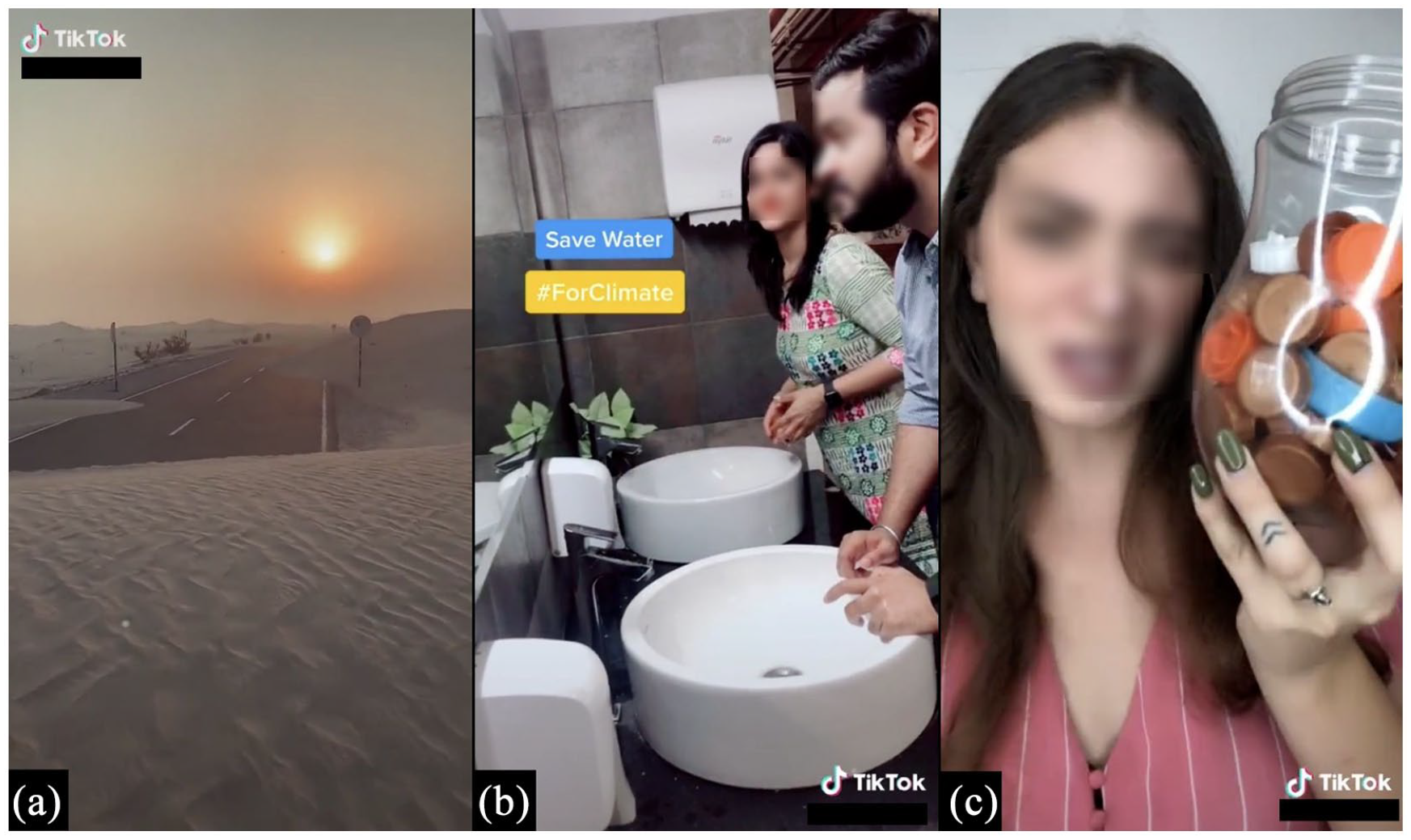
TikToks which use the #forclimate hashtag despite having a relatively weak connection to climate change, but a possible connection to environmental issues. (a) A view of a setting sun (sublime messaging); (b) discussion of water conservation; (c) advising viewers on how to dispose of plastic bottle caps. (b) and (c) use humor to convey an earnest, instructional environmental message.
Earnest Messages Indicating or Promoting Climate or Environmental Activism
The largest category in our sample were TikToks that appeared to (1) convey the creator’s sincere concern for the environment or climate, (2) elicit such concern from the viewer, and/or (3) engage in activism-related activities. This kind of message was coded in 60 posts. Some TikToks included direct statements (“I #FightTheStereotype TikToker & #ClimateChange with creative content”), rhetorical questions to provoke self-reflection (“What do you think will happen to our planet?”), or calls to action (e.g., “PLEASE SHARE! If biodiversity disappears, humanity won’t be far after it”). Other indications of earnestness or sincerity included using the Earth emoji ( ) in captions or video-embedded text, focusing attention on nature or the planet rather than people, depicting people engaged in pro-environmental activities (e.g., tree planting, use of non-plastic straws, participating in climate change actions), or including additional climate or environmental hashtags (e.g., #SaveOurOcean, #SaveThePlanet, #SaveTheEarth).
Messages Using Humor to Promote and/or Satirize Climate Awareness
Content intended to amuse or provide levity was coded in 27 posts and could take many forms. Physical humor such as exaggerated facial expressions and gestures, where creators engaged in overly theatrical acting rather than attempting to faithfully replicate realistic human interaction, were common, and might point toward a standard of bombastic performance on TikTok. Other TikToks featured more complex interplay between images, words, and sounds—sometimes deliberately contrasting elements to produce a sense of irony or satire. Some humor was deployed to support climate awareness. Other efforts mocked more earnest posts or satirized anti-environmental attitudes, serving as a form of meta-commentary on the performances of others both on TikTok and outside it.
Messages Seeking to Instruct or Inform About Climate/Environment
TikToks with the apparent aim of providing viewers with factual information or instruction were coded 14 times. We did not place TikTok videos in this category for the completeness and accuracy of their information, but rather for how the (typically non-expert) creator frames their content as informative or represents themselves as a provider of instruction. Videos ranged from recycling tips, demonstrations on how to save water, and series of images or videos with voiceover narration that were evocative of documentary-style videos one might find on the Discovery Channel. Heightening the documentary effect, some TikToks integrated clips of found footage, such as professionally shot photos or video of animals.
Messages Emphasizing Natural Beauty or the Sublime
These posts, coded 11 times, were primarily focused on showcasing some landscape or weather event (see Brady, 2013; Lindholdt, 2009)—typically filmed from first-person perspective without the inclusion of human figures. Although these posts generally offered little in terms of clearly interpretable messages, their presentation and format invited the viewer to transport themselves to another place and time, taking on the creator’s visual perspective and (re)producing a particular affective vibe.
Messages Unrelated to Climate or Environment
A large proportion (n = 51) of posts in our sample showed no apparent link to climate or environmental topics besides using a climate change-related hashtag. While we did not engage in deeper content or thematic coding of these posts, they constitute an important finding by (1) demonstrating that a large portion of popular TikToks using climate hashtags were not actually about climate, meaning message content cannot be inferred from hashtags alone; and (2) revealing a widespread strategic use of TikTok affordances, which is to “hijack” popular hashtags to draw attention to content unrelated to the hashtags’ original purpose (Abidin, 2021a).
RQ3: Key Themes of Meaning Making: A Multimodal Discourse Analysis
Our first two research questions deal with (1) the way creators use TikTok’s unique combination of affordances and features to spread affective climate-hashtagged messages through the digital social sphere and (2) kinds of messages that were discernible through qualitative analysis of discrete TikTok videos. To answer our third research question, we fully embrace the concept of affective publics by studying how TikTok’s affordances produce highly relational, contextual, and iterative messages that transcend individual posts. We do this through multimodal discourse analysis that takes into account the ambiguity of climate messages and their dependence on intertextual and cultural factors to make meaning.
We found, for instance, that TikTok creators often combined sincere appeals with humorous text or visuals. Such playful sincerity has the practical effect of improving the “palatability, appeal, and dissemination” (Chen et al., 2021, p. 2) of a topic such as climate change, around which discourse is often politically and ideologically charged. Looking at a single isolated TikTok, it is impossible to identify whether it became popular because of the sincere appeal of its message or simply because people found it funny. However, by looking across TikToks by several creators and identifying recurring narratives, one can develop a sense of what dominant messages are repeated and circulated through the platform.
We elaborate on three of these dominant themes. As with the kinds of messages identified above, these themes are not mutually exclusive—some TikToks displayed two or all three. Such interaction reinforces how TikTok creators repeat and disseminate interlinked ideas to contribute to a networked, shared depiction of climate change.
Linking or Conflating Climate and Environment
One common theme was ambiguity around whether creators using climate hashtags were aware of or concerned about distinctions between climate change and broader environmental issues. Many TikToks depict pro-environmental consumer behaviors and implicitly or explicitly linked other environmental issues to climate change—without, say, directly addressing greenhouse gases or other climate-related factors. In one sound-based meme, the video cut rapidly between the creator receiving a reusable straw in the mail, popping it into a drink and taking a sip, then tapping on the camera and telling the viewer to “save the motherfucking turtles.” The caption included the hashtags #SaveTheWorld, #SaveTheTurtles, and #ClimateChange. The link between the first two hashtags and the video’s message is clear: to humorously depict one individual’s decision to reduce their plastic waste, which has been identified as harmful to wildlife, by investing in a reusable straw. But the connection to the principal drivers of climate change is less evident.
We observed a similar pattern of linking environmental issues to climate change in several TikToks covering topics such as anti-littering, avoiding plastic usage, planting trees, and saving water; several included climate change hashtags in addition to other topical hashtags. Browsing sound pages showed how some were used both by climate change-specific TikToks, and those with broader environmental themes.
One of the few examples that tied plastics directly to climate change and fossil fuels does so mainly to make a joke. In one TikTok (see Figure 4), the creator navigates through a succession of Google image search results as he narrates, Wait a minute, check this out. All right, hear me out. Plastic [A] is made from oil [B], and oil is made from fossil fuels. And fossils. Dinosaur fossils. And what’s inside the fossil? A dinosaur [C]. So you could say plastic dinosaur toys are made from . . . real dinosaurs.
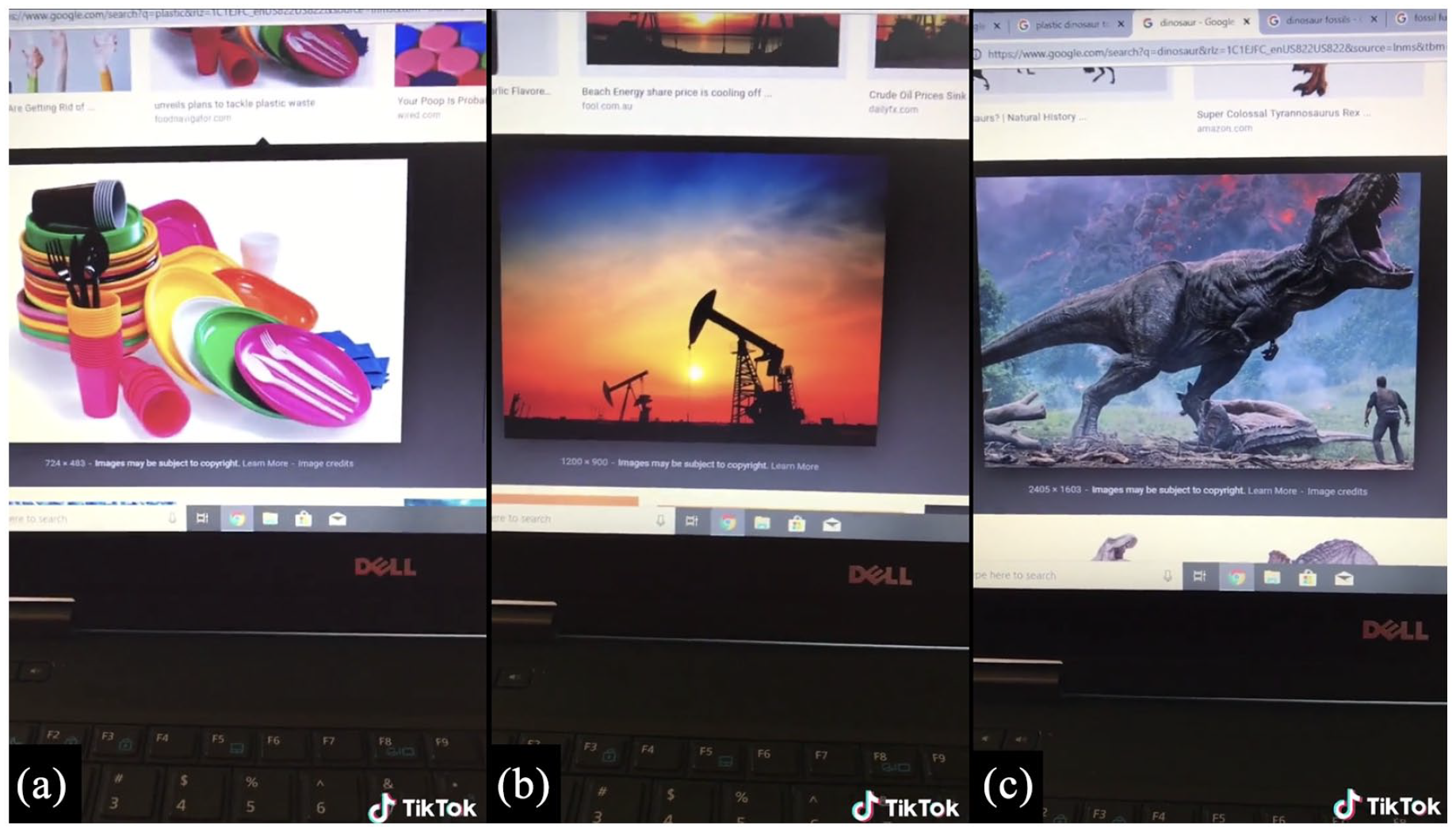
Stills from a TikTok discussing fossil fuels and plastics. As they rapidly bring up one image after another, the creator links (a) plastics, (b) fossil fuels, and (c) dinosaus, in a nearly stream-of-consciousness-like flow.
The link between plastics and fossil fuels is explicit, but mostly to serve the punchline. In a similarly ambivalent post, an exasperated young man directly addressed the camera, calling the notion that plastic straws are bad for the environment “fake news.” If everyone used their straws to drink from the ocean, he argued, the sea level would go down. Analytically, it is clear the video is satirizing the debate over plastic straws. It is less clear which side of the debate the creator actually supports, or whether he is sincerely concerned about the environment at all.
This implied interchangeability between climate-related hashtags and general environmental messages suggests a positionality in which caring about the environment (and thus, engaging in pro-environmental behavior) must also mean one cares about climate change, even if such connections are not explicitly articulated. TikTok creators contribute to climate and environmental discourse online, but the depth of their understanding of the connections between these phenomena, and between responsible individual citizenship and institutional culpability, remains ambivalent. In contrast to knowledge generated by scientific experts or interpretive journalists, such TikToks represent a form of climate change communication based primarily on non-expert knowledge, where factual accuracy is secondary to relevance and relatability. By promoting the belief in individuals’ ability to effect change through behavioral choices, these videos may also contribute to self-efficacy (Metag et al., 2016).
Assigning Generational Responsibility for Climate Change
Given that 69% of TikTok’s users are between 13 and 24 years old (Sehl, 2020), it is perhaps not surprising that many TikToks highlight generational divides, including ideas about the extent to which climate change should be a concern and who should take responsibility for it. Climate messages that portray distinct age groups tend to imbue younger/future generations with a sense of responsibility, empathy, and planetary concern, while older generations are depicted as indifferent, willfully ignorant, and deliberately destructive. These TikToks use humor in the form of irony and satire while also delivering social commentary on responsibility and agency.
Baby Boomers are frequently portrayed in a negative light, depicted as the target of jokes, the cause of environmental problems, or indifferent to the suffering of others (Gonyea & Hudson, 2020). One example (see Figure 5) was derived from a segment of a stand-up routine by American comedian Robin Williams. The scene re-enacts a Bible passage where Jesus tells his disciples that one of them will betray him, and each of them in turn asks if they are the one. As the young man in the video takes on each persona, representing the different generations, the camera cuts between different angles: Gen Z turned to the generations and said, “One of you will not aid in the fight against global warming.” The millennials said, “Is it me, Gen Z?” Gen Z said, “No, it is not you millennials.” Gen X said, “Is it me, Gen Z?” Gen Z said, “No, it is not you Gen X.” Baby Boomers said, “Is it me Gen Z?” Gen Z said, “IS IT ME GEN Z?”
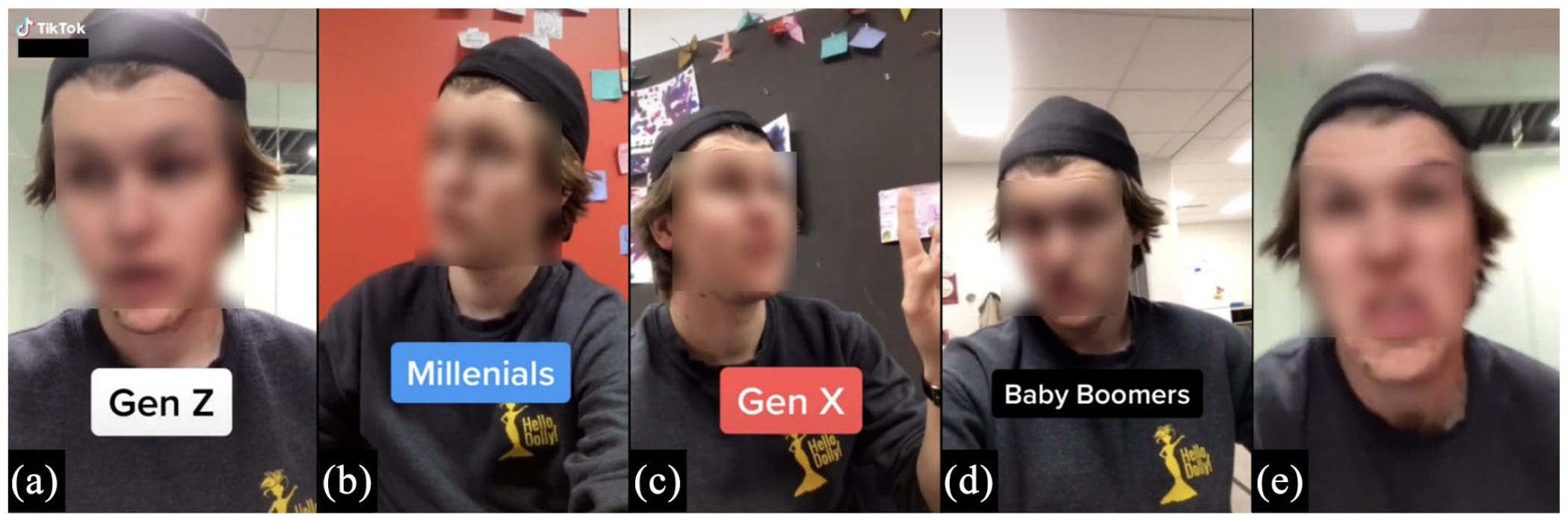
A climate change spin on a Biblical parable-inspired comedy skit. The use of text over the video is a common shorthand to indicate when a single creator is speaking in different roles.
The humor comes from the heavy sarcasm in Gen Z’s voice and the contorted facial expression the actor makes as he echoes the Baby Boomers’ words with disgust, implying that they are being disingenuous by feigning ignorance. The expressiveness calls attention to the significance of attending to bodies – “(f)acial expression, colour, music, and costume” (Flewitt et al., 2009, p. 48) as a strategy of meaning-making in multimodal analysis.
In another TikTok, a young man acts out various parts (indicated, as above, with text overlaid on the video) while lip-syncing to a clip of dialogue where reality TV personalities argue about who should perform domestic cleaning. The domestic exchange is reframed as a generational battle over who should bear the responsibility for tackling climate change, and who is caught in the crossfire: Young people wanting to save the planet: It would be nice to come back to a clean house. Boomers: Then clean it! Young people: Uh, I didn’t do it, so how about you clean it? Boomers: No! Young people: Umm, yeah, ‘cause you’re dirty! Turtles: Melissa . . .
The last, poignant shot is of the young man (as a turtle) with multiple plastic straws shoved in his mouth, looking mournfully to the side.
Examining other TikToks that use the same sound clip shows that it has been used as a skit to frame a range of interpersonal conflicts (e.g., between housemates, openers and closers in retail work, siblings). Usually the last segment of the clip (“Melissa. . .”) does not depict a third character or is omitted entirely. This creator’s remix, introducing a turtle as a victim of the argument, draws attention to the fact that regardless of which generation is at fault for the current state of the Earth, the outcome is the same: nature bears the consequences.
Demonstrating Helplessness in the Face of a Wicked Problem
A common refrain across many TikToks is a sense of resignation or hopelessness about the global situation. In the TikTok self-described as “Unmotivational Monday,” which lampoons public-service commercials, the manically grinning young man announces, Right now, the Amazonian rainforest is on fire, and scientists agree that unless every single country agrees to fight climate change, we’re all heading towards a global extinction. And there’s nothing you can do about it, ‘cause you’re only one person. So go ahead, use that plastic straw: we’re all as good as dead anyway!
The tone of this video contrasts with more earnest posts urging individuals to conserve plastic and recycle conscientiously, highlighting self-efficacy. This TikTok seems to assert there is only so much an individual can do against a system-wide problem such as climate change.
Another example of this sense of nihilistic helplessness powerfully illustrates how creators adapt existing memes and trends to their own messaging ends and send forth affective waves—so we will examine in depth its modality and its place in the flow of discourse. In the original clip, unrelated to climate change, a young woman “falls” to the mostly empty floor of a vast mall or terminal, accompanied by a strange falsetto gasp: “wHOO-ooo!” The “victim” immediately whirls from the floor and incredulously asks, “And no one’s gonna help me?” as the camera pans toward indifferent clusters of people at the margins of the scene. An offscreen male voice, probably the camera operator, echoes, “And no one’s gonna help her?” As the camera continues to pan across open space, passers-by, and indoor storefronts, the voice concludes, “Wow, some world we live in.” The post’s offscreen caption reads, “society is so cruel,” but the joke seems to turn on the contrived nature of the fall, the lack of truly available bystanders, and the ironic, mocking tone of the voiced narrative. The video is a highly ambiguous commentary on social obligation, abdicated responsibility, and virtue-signaling judgment.
That original video inspired several copycats and variations. The exemplary case from our sample (see Figure 6), at a mere 7 s, is a strong example of the narrative efficiency with which TikTok creators use the platform’s multimodal affordances to tell complex stories in brief bursts. The video is set against a giant projected image of the Earth from space, a visually arresting backdrop that centers the topic. In the foreground, the same young woman plays four parts over four quickly cut scenes set to the original audio, donning a different costume as superimposed text identifies successive characters: Kids being born into a world with climate change: wHOO-ooo! Gen Z talking about Planet Earth: And no one’s gonna help me? Gen Z talking about Planet Earth: And no one’s gonna help her? Boomers acting as if they didn’t cause it: Wow, some world we live in.

Repurposing existing audio for a climate change TikTok. A shot-for-shot comparison of the original source of the audio clip (top row) with the climate change–related variation (bottom row). The audio timings are the same for both: (a) “wHOO-oooo!,” (b) “And no one’s going to help me?” (c) “And no one’s going to help her?” (d) “Wow, some world we live in.” By adding new visuals and text, a commentary about the general indifference of society is reframed into a criticism of an older generation refusing to take responsibility for their contribution to a global problem.
The story narrates a baby born, helpless, into a threatened world. Gen Z is portrayed as desperate for the future of this baby, pleading helplessly for someone to do something for the planet. Baby Boomers are living the good life, well-dressed, care-free, winking and nodding at the crisis while deflecting responsibility for it. The offscreen caption reads, “hehe and thats [sic] the tea but like fr we dyin [sic]”: a tone of ironic acceptance accompanying a playfully bleak forecast (“the human race is dying”) common in many climate TikToks.
The video is not activist in the traditional sense, in that it does not clearly define a problem, propose a solution, or call anyone to action. Like the original video, the message is ambivalent about whether an array of marginal bystanders can or should do something about what they’ve witnessed. The video mocks older generations for their culpability and indifference, while implicating younger generations for their fecklessness. Its caption signals a fatalism that is also a cry for help—illustrating the frustration of knowing a problem exists and yet lacking the resources, as an individual, to enact meaningful change.
Conclusion
In this study, we examined popular climate-related TikToks to see how creators harness the platform’s combination of affordances and features to (re)produce affective publics. The platform’s predominantly young, non-expert users produce climate messages that can be simultaneously earnest and mocking, alternate between care and indifference, rely heavily on repetition and variation of existing music and visual memes, seek imperfectly to inform on climate and environmental issues—and, sometimes, simply “hijack” the zeitgeist created by trending climate-related hashtags to gain attention for some other purpose. Creators return repeatedly to certain forms of expression: a conflation of climate-specific and general environmental issues suggesting a vague and imprecise awareness, strong attention to and construction of generational difference and responsibility, and a pervasive sense of helplessness in the face of the wicked problem of climate change.
Our findings offer empirical traces of affective publics by documenting “the texture of storytelling that fills online platforms” and the “kinds of public formations of political expression” such textures (re)produce (Papacharissi, 2015a, p. 8). We show how individual TikToks become vehicles for personal narratives, which are then connected through features such as hashtags and viral sounds. Despite being more ambiguous and entertainment-focused than discourse on platforms such as Twitter (Chen et al., 2021), the proliferation of variably sincere and semiotically ambivalent climate change messages propels the discursive atmosphere in which TikTok creators relate (Papacharissi, 2015a, 2015b). TikTok creators connect disparate ideas through memetic themes while maintaining individualistic identities, sustain message persistence in cyberspace without explicit tethering to on-the-ground events, deploy humor and juxtaposition to disrupt dominant climate discourses, and deploy communicative power in swiftly shifting discursive environments.
Our primary theoretical contribution is to show how TikTok’s affordances allow non-expert users to visibly intervene in a discussion that generally takes place among expert-level scientists and journalists: the question of how serious a problem climate change is and what to do about it. Non-experts, including adolescents and early adults, leverage TikTok’s affordances to express their concern, frustrations, and personal stake in what they perceive to be salient issues of their time. They might not clearly grasp the causes and impacts of rising global temperatures and might not offer concrete practical solutions, but they form a networked atmosphere of concern that is influencing at least one generation’s orientation toward public affairs. Indeed, these expressions of climate change awareness may be better able to penetrate popular consciousness by attracting individuals to mimic similar sentiments with their own affective messages through riffing off someone else’s.
If we consider these posts as traces of what people are feeling in the moment, and how these feelings become more prominent and visible over time, we might view each video as a dot in the mosaic of larger social patterns that subtly transform climate indifference into a subject of social disapproval and direct action. In this way, harnessing affective publics, new media may galvanize momentum toward material forms of activism.
This study, as with social media datasets collected through similar methods, has some limitations (Tufekci, 2014). As we based our data collection on specific hashtags, this only presents a partial view of climate change messages hosted on TikTok. Our focus on creators means that besides user engagement metadata, we do not know how TikTok users reacted to or interpreted these videos. Future studies can move beyond our textual and discursive analysis to tease out creators’ motivations through methods such as ethnography, interviewing, and focus groups; and explore audience effects through experimental and survey research. What seems clear through these data is the intensive time and cognitive investment through which creators attempt to raise awareness in entertaining, personally relevant ways, and how this shapes public discourse around social issues.
Footnotes
Authors’ Note
For accessibility, all hashtags used throughout the manuscript have been changed to camel case.
Declaration of Conflicting Interests
The author(s) declared no potential conflicts of interest with respect to the research, authorship, and/or publication of this article.
Funding
The author(s) received no financial support for the research, authorship, and/or publication of this article.
