




Abstract
This article explores how successful digitally native activism generates social change. Digitally native movements are initiated, organized, and coordinated online without any physical presence or pre-existing offline campaign. To do so, we explore the revelatory case of Sleeping Giants (SG)—an online movement that led more than 4,000 organizations to withdraw their programmatic advertising spend from Breitbart, a far-right publisher. Analyzing 3.5 million tweets related to the movement along with qualitative secondary data, we used a mixed method approach to investigate the conditions that favored SG emergence, the organizing and coordinating practices of the movement, and the strategic framing practices involved in the tuning of the movement’s language and rhetoric toward its targets. Overall, we contribute to research on online movements and shed light on the pivotal role of peer production work and of language in leading an impactful online movement that aimed to counter online disinformation and hate speech.
Keywords
Introduction
In November 2016, shortly after Donald Trump was elected as President of the United States of America, an anonymous Twitter handle called “Sleeping Giants” (SG) started publicly notifying organizations whose ads appeared on Breitbart News, an online publisher known for spreading far-right narratives (Benkler et al., 2018). With the aim “to make bigotry and sexism less profitable,” 1 SG leveraged social media to encourage users to pressure organizations to withdraw their ads from Breitbart (Hao, 2017; Ingram, 2017). The SG movement shed light on the opacity of programmatic advertising and incited more than 4,000 organizations to blacklist Breitbart, allegedly reducing its ads revenue by more than 90% (Embury-Dennis, 2019). Along with the Women’s March and other online movements like MoveOn, VideoLab, and #GrabYourWallet, SG was part of the larger “Resistance” movement against the Trump presidency (Meyer & Tarrow, 2018). Initially gaining recognition for its anti-Breitbart campaign, over time the target of SG’s activism expanded toward advertisers on Fox News, contractors for the Trump administration’s family separation policy, and online platforms that allowed the monetization of disinformation and hate speech.
As a case of online activism (Freelon et al., 2020), SG stands out in several ways. First, SG represents an emerging yet not well understood type of digitally native activism, with the tactical repertoire of the movement being initiated, organized and coordinated online, making SG a fully online “e-movement” without any physical presence, pre-existing offline campaign, or significant offline mobilization components (Earl et al., 2010; Schmitz et al., 2020). Moreover, the digitally native quality of SG and its original target (the far-right publisher Breitbart) distinguishes SG from other social movements that have significant offline mobilization components, such as the human rights, environmental, animal welfare, and Black Lives Matter movements for instance.
Second, social media movements are often criticized for “slacktivism” or “clicktivism,” because of the little to no change in political and social structures they appear to generate (Bozarth & Budak, 2017; Couldry, 2015; Gladwell, 2011; Morozov, 2011). SG, in contrast, can be considered a successful case of online activism, given its tangible impacts on Breitbart’s revenues and on large advertisers’ blacklisting, the diffusion of the SG movement globally, and the adoption of SG’s tactical repertoire by similar movements (e.g., #StopFundingFakeNews).
Finally, the SG case provides insights into how online movements transform and sustain once they have reached their immediate goals. While some online movements have had staying power, partly by branching out into offline mobilization (#MeToo, Black Lives Matter), online movements tend to be rather ephemeral and short-lived (Alaimo, 2015). Over time, SG’s focus evolved toward broader agendas, targets, and tactics. SG’s targets shifted beyond Breitbart to include online platforms, conservative media, and the Trump administration.
The objective of this article is to explore SG as a revelatory case of a successful digitally native online movement, to understand when and how online activism generates social change. We use an exploratory case study approach (Yin, 2009) and mixed methods (Whelan et al., 2016) shed light on three dimensions of the movement: (1) opportunity structures, the conditions that favored SG’s emergence; (2) mobilizing structures, the participation, organizing, and coordinating patterns of the actors that compose SG’s online presence on Twitter; (3) framing tasks, the strategic articulation and tuning of the movement’s language and rhetoric toward its diversity of targets.
This article is structured as follows. In the Background section, we explain the issue of programmatic advertising and the theoretical framework that underpins our analysis. We then describe the mix of quantitative and qualitative methods that we relied upon for this exploratory case study. With regard to the three dimensions listed above, our findings, respectively, show (1) how SG exploited current events to generate peaks of attention to the movement and pressure its targets, (2) how it relied on a novel form of crowdwork driven by a tiny core of dedicated workers that was amplified by a large mass of movement participants, and (3) how SG used diagnostic, prognostic, and motivational framing in strategically differentiated ways toward its targets. Put together, these dimensions shed light on the factors that characterized the online activism of SG and made it particularly effective.
This article concludes with a discussion of several implications of our findings for research on online activism. In particular, we highlight how the tactics employed by SG constitute an innovation in the repertoire of contention used by corporate activists (Briscoe & Gupta, 2016; King & Pearce, 2010) by going beyond hashtag activism (Jackson et al., 2020) and relying upon peer production (Kittur et al., 2007); how episodes of emotional intensity affect the commitment of participants to online activism (Jasper, 1998); how the internet and its infrastructure has become not only an arena in which contentious activity takes place, but also a target in itself (Ayres, 1999; Marantz, 2020; Nagle, 2017); and how social media allows online movements to hold persuasive and confrontational stances simultaneously. We also raise questions about the viability of online activism, as a form of private politics, to influence platform self-regulation toward issues of disinformation and hate speech.
Background
Programmatic Advertising
Programmatic online advertising via ad brokers, such as the Google Display Network and Facebook’s Audience Network, has become an intrinsic part of the web’s fabric nowadays. Programmatic advertising uses “real-time bidding”—an auction technology, where advertisers submit bids for an impression, which is triggered when a user visits the website of a publisher that is monetized via advertisements. The process is fully automated and happens in milliseconds before the page is loaded for the user (UK Information Commissioner’s Office, 2019). Bidding decisions are governed by algorithms, which leverage various digital media data (e.g., page content, user profile data) to automatically place ads across a large range of websites (Sinclair, 2016). For example, Google’s Display Network covers more than two million websites and apps (Braccialini, 2020). This omnipresent technological infrastructure thus captures the traces of user flows to control and shape users’ experience on the web. In essence, it embeds what van Dijck and Poell (2013) call the connectivity, programmability, datafication, and popularity principles of the logic that underlies how social media restructure social interactions. The interactions that users encounter on social media and the web more generally (connectivity) are determined by a bundle of auction and ad allocation algorithms that are tweaked by designers over time (programmability) as more user traces are captured and processed (datafication) about the actors, channels, and experiences that users seek and interact with (popularity). In contrast to mass media advertising, programmatic advertising leverages the power of these principles to fundamentally alter how corporations and other actors connect with specific users, via micro-targeting and real-time algorithmic decisions.
Yet, while programmatic advertising allows organizations to have a wide reach, efficiently targeting relevant audiences or locations, it is criticized for its opacity (Yuan et al., 2014). Advertisers have little control over ad distribution and are thus mostly unaware of the specific websites where their ads appear. Platforms provide few affordances to audit the targeting and allocation algorithms of this technology, and those few that are available have been found deficient and incomplete (Andreou et al., 2019; Edelson et al., 2020; Matias et al., 2021). Therefore, programmatic advertising involves a reputational risk when ads appear on sites that involve not only brand-misaligned content but also disinformation, hateful statements, or immoral content (Mostrous, 2017). This opacity has enabled hate and disinformation to spread and get monetized, potentially generating real-world harms such as discrimination, affective polarization, and deviance from public health guidance (Ali et al., 2019; Finkel et al., 2020; Silva & Benevenuto, 2021). Several avenues have been proposed to shed light on how platforms govern programmatic advertising, including regulation and policy changes (Gillespie, 2018). What has been unexplored so far is the role that social movements can play in promoting reform and greater transparency, a primary objective of SGs’ activism.
Theoretical Background
Due to the increasing shift of activism to the online realm (Freelon et al., 2020), there has been renewed interest in examining how the affordances of digital technology affect and change the practices of social movements, and thus theories of collective action (Bennett & Segerberg, 2012; Earl & Kimport, 2011; George & Leidner, 2019; Selander & Jarvenpaa, 2017). Studies show that activists use digital technology to engage in new types of activism (George & Leidner, 2019), develop new action repertoires (Selander & Jarvenpaa, 2017), as well as transform mobilization, coordination, and participation in collective action (Brunsting & Postmes, 2002; Earl et al., 2014; Earl & Kimport, 2011; Schmitz et al., 2020). In parallel, scholars have examined how activists engage in private politics toward corporations, but the literature on how digital technology fits in their tactical repertoire is still nascent (Briscoe & Gupta, 2016; Luo et al., 2016). Our analysis of the SG movement extends these lines of scholarly works. In particular, we rely on the framework proposed by Garrett (2006) about the emergence, evolution, and outcomes of digital social movements. Garrett’s (2006) framework is based on the conceptual integration of McAdam et al. (1997), which is composed of three dimensions: opportunity structures, mobilizing structures, and framing. The framework allows us to highlight complementary aspects of the conditions that contributed to the emergence and growth of SG, how the movement harnessed social media affordances to facilitate collective action, and how the unusual tactics of SG activism led to material outcomes.
Opportunity Structures
Opportunity structures refer to exogenous conditions that favor the emergence of collective action (Garrett, 2006; Tarrow, 1996). Specifically, opportunity structures emerge during changes in political leadership, periods of political instability, when potential insurgents mobilize and collective actors feel inspired to join social movements and protest activities (Arzheimer & Carter, 2006; Gleditsch & Ruggeri, 2010). They also include various changes to economic, cultural and institutional conditions that may catalyze social movement activities (Arzheimer & Carter, 2006; McCammon et al., 2001, 2007).
Moreover, opportunity structures may be discursive when they manifest not only in the material configurations of resources and power relationships but also in the different attitudes and cultural schemas that circulate in the public sphere (Giugni, 2009; Koopmans & Statham, 1999; McAdam, 1982). For example, women’s suffrage movements that arose in the mid-19th century around the world were driven not only by events such as World War I but also by the changing attitudes toward women’s role and gender relations in society (Ferree, 2003; McCammon et al., 2001, 2007).
Mobilizing Structures
Mobilizing structures refer to mechanisms that support social movement by enabling participant attraction, coordination of work, and leadership practices. Following Garrett’s (2006) framework we examine three aspects of mobilizing structures: participation levels in the movement, contentious activity by participants, and organizational issues within the SG movement.
Participation Levels
Compared to offline protest activities, participation and engagement in online activism is cheaper, easier, and provides more recruitment opportunities that—in contrast to what was previously suggested to be a key factor for successful mobilization—do not always depend on institutional support or resources (Bimber et al., 2005; Earl & Kimport, 2011; McCarthy & Zald, 1977), although those can still matter (Schradie, 2018). While offline activism tends to require an infrastructure to sustain prolonged contention, online activism can generate impact from a small core of highly committed participants if they are embedded into a supportive network of low commitment participants (Bennett & Segerberg, 2012; George & Leidner, 2019).
In theory, social media can thus facilitate wider participation in collective action, indicating more powerful movements (Tilly, 1999). However, while online social movement may have thousands of participants, many of those may remain passive (i.e., “lurkers”) by not engaging in social movement activity or interactions (Tagarelli & Interdonato, 2015). The motivation to join a campaign, the retention rate of participants within a movement, and participants’ commitment may also vary depending on the drivers for their initial participation, including common interest, ideology, emotional outcomes, and moral outrage (George & Leidner, 2019; Jasper, 1998; Jasper & Poulsen, 1995).
Participation in online activism involves a variety of roles and network positions, which may not have the same activity levels. Participants differ in the human and social capital that they bring to a movement (Diani, 1997). Differences in reach, susceptibility, and influence among network participants have long been recognized as consequential for the dynamics of information diffusion processes (Himelboim & Golan, 2019; Watts & Dodds, 2007). For example, public celebrities (Wiegmann et al., 2019) may play an important role in spreading information about the movement and motivating others to participate in collective action because they act as network bridges (González-Bailón et al., 2013; Himelboim & Golan, 2019; Isa & Himelboim, 2018). Given that online collective action takes place via the linking of network clusters (Bennett & Segerberg, 2012), influencers that span structural holes (Burt, 2005) help trigger the cascades that are inherent to online firestorms (Pfeffer et al., 2014).
Contentious Activity
Digital technology has enabled new repertoires of contention, that is, the range of protest and mobilization tactics available to a movement (Earl & Kimport, 2011; Rolfe, 2005). With online tools, consumers and civil society can act as watchdogs by imposing transparency and holding organizations accountable for their actions (Lyon & Montgomery, 2013; Waldron et al., 2013). This may lead to a change in power relationships, a reverse panopticon of sorts (Garrett, 2006, p. 11), where citizens are able to fact-check, monitor and scrutinize organizations’ activities, pressuring them toward corporate responsibility.
However, there is an ongoing debate whether these new forms of contentious activity have any real-world impact. Critics often refer to “slacktivism” (Skoric, 2012) or “clicktivism” (George & Leidner, 2019) when describing participation in contentious online activities which require little effort and commitment (e.g., signing online petitions, retweeting others, mobilizing around hashtags), arguing that such actions do not facilitate substantive change (Bozarth & Budak, 2017; Gladwell, 2011; Morozov, 2011).
Still, some form of “hashtag activism” appears to have been effective in changing public discourse and bringing attention to movement grievances (Bonilla & Rosa, 2015; Freelon et al., 2018). Understanding the effectiveness of online forms of contention thus requires relaxing the assumption that online activism is either universally effective or not, toward a more nuanced examination of what forms of online activism are effective, and under what conditions.
Organizational Issues
Online activism differs not only in the opportunity structures and forms of contentious activity, but also in the tools and actions used for organization, leadership and coordination online (Earl et al., 2010; Earl & Schussman, 2003). Early cases of online activism used digital technologies mostly to distribute information and provide support for offline protest activities (e.g., Ayres, 1999; Rosenkrands, 2004; Tarrow, 1998). But over the last decades, activists explored new ways to mediate social activism through digital technologies (Bennett & Segerberg, 2012; George & Leidner, 2019), leading to the emergence of “online organizing” (Earl et al., 2010) or “digitally native” activism (Schmitz et al., 2020): entire movements are initiated, organized and coordinated online, without any respective physical presence or offline component.
Social media and digital technology allowed the emergence of social movements that are decentralized, non-hierarchical, and geographically distributed (Earl & Schussman, 2003; Garrett, 2006). The role of leadership in such movement is transformed, since any participant can be simultaneously a leader and a follower (Johnson et al., 2015), with decision making and coordination shifting between various members over time or based on evolving circumstances (Cardoso et al., 2019; Tye et al., 2018). The bottom-up, open organizational structure can also be further mediated by anonymity, which allows online activists to share less risks compared to those leading protests on the streets (Fominaya, 2018; Gerbaudo, 2012). Yet, digital technology is a double-edged sword, as online activism can also enable closer monitoring of a movement’s participants and activities (Earl et al., 2014).
Digital technology also has the potential to allow coalition building between movements that may pursue similar goals, unite against the same target or endorse each other and share membership (Ayres, 1999; Garrett, 2006). This may result in broad collective movements and global mobilization efforts that are based on the shared ideology or similarity of the issues of concern, and less on geographical co-location (Mendes et al., 2018; Piedrahita et al., 2018). For instance, the Black Lives Matter movement relied on Facebook groups that spanned the networks of local and national organizers as well as those of allied movements, thus allowing the movement to mobilize resources and develop movement knowledge at scale (Mundt et al., 2018).
Framing Tasks
In digitally native activism, framing activities take center-stage as social media involves the dissemination of talk, images, and videos that can be manipulated in ways that shape the meaning of issues and events. Framing refers to the strategic process of interpreting reality, focusing attention to certain issues, and constructing understandings (Snow et al., 2019). It involves using language and cultural elements to articulate coherent sets of beliefs that embed a movement’s activities with meaning. Activists use framing to disseminate ideas, mobilize, set the public agenda, and gain legitimacy (Benford & Snow, 2000; Cornelissen & Werner, 2014). Various lenses have been developed to study framing, depending on the research question and perspective adopted. For instance, studies adopting a processual perspective tend to focus on how frames change and the dynamics of alignment processes, by analyzing the interplay of frame bridging, amplification, extension, transformation, and brokerage (Lee et al., 2018; Snow et al., 2019).
Of interest for this study is the complementary perspective of framing tasks: how activists may use different framings depending on their pursued objectives (Snow & Benford, 1988; Snow et al., 2019). Core framing tasks include “diagnostic,” “prognostic,” and “motivational” framing (Snow & Benford, 1988; Snow et al., 2019). Diagnostic framing is used to identify problems and raise issues, as well as to define actors responsible for a social problem (Smith, 2021; Zoller & Casteel, 2021). Prognostic framing puts forward the plan of action and suggestions for how to resolve the issues (Smith, 2021; Snow et al., 2007). Motivational framing is used to mobilize and encourage individuals and organizations to act, often appealing to their moral principles and urgency of the problem (Moss & Snow, 2016; Snow & Benford, 1988; Snow et al., 2019).
Framing is also used to influence stakeholders’ and the public’s perceived worthiness of a movement (Tilly, 1999, 2006). Wouters and Walgrave (2017, p. 5) argue that worthiness helps movements “gain recognition as a respectable player that should be listened to and interacted with,” and helps to “avoid marginalization and criminalization.” Accordingly, it is still unclear how framing that involves corporate actors vary across confrontational and persuasive stances in an online environment (Briscoe & Gupta, 2016). Confrontational stances can be effective in disrupting and delegitimizing targets, but more moderate stances have also been found to be effective at persuading targets to concede to a movement’s demands (Baron et al., 2016; Haines, 1984). Given that SG relies on a tactic of “naming & shaming” (Zhang & Luo, 2013), it is unknown how the relative emphasis on confrontation and persuasion played out in the framing tasks of the movement.
Summary
The three dimensions of Garrett’s (2006) framework discussed above provide us with the conceptual apparatus for an in-depth study of the SG case. We explore opportunity structures via the identification of exogenous events affecting SG activism. For mobilization structures, we examine who are the SG activists (participation levels), how do they contribute to the movement (contentious activity), and how does the coordination and organization happen within digitally native campaigns (organizational issues). Finally, we investigate how the movement’s strategic framing tasks varies between confrontational and persuasive stances according to the issues and targets the movement is concerned with.
Method
To examine the opportunity structures that facilitated the emergence and growth of SG, the mobilizing structures that drove the movement, and the framing tasks that the movement engaged in, we used a mixed method approach that combined qualitative and digital trace data (Tunarosa & Glynn, 2017; Whelan et al., 2016), summarized in Table 1.
Summary of the Methods and Data Used. a

Replication materials can be found on: https://osf.io/yr3zt/.
Data Collection
We collected 3,468,523 tweets over a 23 month period from March 2018 till February 2020 via a Twitter crawler developed in Python (Thingnes, 2019). Using the original SG Twitter handle “@slpng_giants” as a filtering rule we collected tweets from the SG account as well as retweets, replies, mentions and quotes of @slpng_giants. For the purpose of this study we restricted our analysis to SG’s American account because the focus of this paper is on understanding the effectiveness of SG’s activism toward its primary, original target: Breitbart, an American far-right media publisher. These digital trace data are complemented by qualitative data, namely interviews and articles about SG that appeared in public media 2 (Online Appendix B).
Opportunity Structures
To understand how exogenous events affected social media activity of SG and how SG activists leverage different events to promote their goals and agenda, we performed time series analyses for the number of followers, tweets by the SG main twitter account, replies to as well as mentions and retweets of SG’s tweets. We computationally identified peaks in each of these time series using spans of 15 days and a threshold parameter of 0.2 (i.e., ignoring insignificant peaks that are less than 20% of the maximum value in each graph). The 15-day window means that a peak is defined when the number of observations (i.e., number of tweets, replies, retweets, mentions or followers respectively) on a particular day is greater than seven consecutive observations before and after that day.
To understand the reasons for the increased activity on those dates, we then extracted tweets for the time interval of a peak date ±7 days. After identifying the most popular tweets (i.e., tweets with the most retweets and replies) in each given period, we qualitatively determined the main discussion topics and key events that likely led to the spike in the movement’s activity.
Mobilizing Structures
To explore the mobilizing structures of the SG campaign, we analyzed participation levels, contentious activity, and organization issues among SG activists.
For participation levels, we first examined overall participation rate, expressed in the number of tweets per user. We assigned all users to eight tier groups based on the number of tweets each user has posted (Tier 1: users with more than 1,000 tweets, Tier 2: ⩾500 tweets, Tier 3 ⩾ 250, Tier 4 ⩾ 100, Tier 5 ⩾ 50, Tier 6 ⩾ 25, Tier 7 ⩾ 10, Tier 8 ⩾ 1).
To understand short- and long-term engagement, we created cohorts based on the users’ “joining date” (i.e., Cohort 1 represents all the users who have at least one tweet in March 2018 onwards, Cohort 2—users whose first tweets in our dataset is in April, etc.)
We also checked the participation of celebrities, who are influential users that can affect network spread and activity (González-Bailón et al., 2013; Kiss & Bichler, 2008). To identify such influential users in our dataset we have used a database of 71 706 celebrities (individuals with a verified Twitter account and a designated Wikipedia article) compiled by Wiegmann et al. (2019).
To explore contentious activity regarding programmatic advertising and to understand who accomplishes the work of pressuring organizations to withdraw their ads, we extracted a subset of “advertiser notification” tweets based on the templates most SG activists use (e.g., “@organization, do you know that your ads are on Breitbart? @slpng_giants can help” 3 ). We then performed a k-means cluster analysis 4 to identify characteristic groupings of notifiers based on the differences in their activity (i.e., number of direct notifications, notification retweets and other tweets).
To analyze organizational issues, we relied upon news reports and published interviews with the founders of SG. We deductively coded 37 articles about SG in the public media. Our coding scheme was determined by our theoretical framework with the categories of interest including: organization, leadership, and coordination within the movement.
Framing Tasks
Step 1: LDA Topic to Identify Themes
To understand framing activities employed by SG participants, we first used Latent Dirichlet Allocation (LDA) topic modeling—a type of statistical modeling that relies on a “bag-of-words” approach to discover abstract “topics” occurring in a collection of documents (DiMaggio et al., 2013). The LDA method assumes that each document (i.e., tweets combined per half-day) is a combination of latent topics with different probabilities, and each topic is a combination of tokens with various probability distributions (see more details in Online Appendix C). This analysis allowed us to identify themes across the stream of tweets over the observed period.
To inspect, validate, and interpret the results of the topic model analysis, we adapted Barberá et al.’s (2019) dashboard visualization of LDA results. 5 The dashboard for each topic shows the graph of topic usage over time, the total estimated proportion of tweets from this topic, the top 15 scoring n-grams associated with the topic, and a sample of top retweets and tweets with the highest probability for this topic (see Online Appendix E). Using this dashboard along with diagnostic model metrics (Online Appendix C), we settled on a model with 60 topics. Each topic was labeled by the lead author and then independently validated by the two other co-authors. 6
Our use of topic modeling departs from its conventional usage in social research. The model was used as a sampling device, where the aim was to maximize variance in the data selected for close reading. Via this sampling strategy, we go beyond the bag of words approach, which enabled us to simultaneously capture the benefits of algorithm-assisted coding and to interpret the context of tweets. Based on the selected topic model, we extracted the top 100 tweets with the highest probability for each of the 60 topics. We then inductively coded this subset of 6000 tweets, assigning 43 codes to 3 593 of them. 7 We grouped these 43 codes into seven broader themes that depict the discursive landscape of the tweet corpus. For each theme, we identified the core framing tasks that were dominant in the tweets of that theme: diagnostic (focusing on specific issues and those responsible for them), prognostic (focusing on what should be done to fix the issue) and/or motivational (focusing on inspiration or call to action). 8 This close reading on the tweet level made apparent that tactics and language used by SG’s main account and its participants differed significantly across the seven themes we identified.
Step 2: Natural Language Processing to Measure Variations in Confrontational and Persuasive Stances Across Themes
To identify alternative uses of persuasive and confrontational stances by SG participants, we relied on the computational linguistics R package “Politeness” (Yeomans et al., 2019). This package provides tools to measure 36 linguistic features that have been previously identified as relating to display of politeness (Brown & Levinson, 1987; Danescu-Niculescu-Mizil et al., 2013). Politeness features are identified via linguistic markers, which may be positive (e.g., words of gratitude, apologies, use of formal or informal titles) and negative (e.g., bare commands and swearing). Politeness feature scores were computed on the tweets that had been coded into one of the seven themes in the previous step. We posit that greater politeness feature scores are indicative of a persuasive stance, while lower scores indicate a rather confrontational stance.
Findings
We now present our findings along the three dimensions of the SG movement: opportunity structures, mobilizing structures, and framing.
Opportunity Structures
The Role of Exogenous Events
Figure 1 shows the distribution of the movement’s activity over time via the number of followers, tweets by the main SG Twitter account (@slpng_giants), replies to, as well as mentions and retweets of SG tweets. We also singled out the number of SG tweets that were specifically about Breitbart 9 (Panel 1 in Figure 1; 16% of all SG tweets and this proportion declined over the observed period).

Exogenous events and activity levels on SG Twitter account over the observation period.
Peaks in activity are correlated with increases in followers. We identified 17 dates that had common peaks across all five types of Twitter activity 10 and examined these peaks to understand events that impacted the movement most in terms of: SG activity (e.g., tweets from the @slpng_giants handle), conversation and engagement with the community (replies), spread of information (retweets), as well as overall attention and recruitment to the movement (followers).
Some peaks are associated with SG’s own activity targeting Breitbart (see Table 2 and Online Appendix F for details). Breitbart-related events that resulted in activity spikes included the New Yorker magazine’s invitation of Steve Bannon (former executive of Breitbart) to their festival, Facebook’s decision to include Breitbart in its list of trusted news sources, and leaked emails from Donald Trump’s senior advisor Stephen Miller to Breitbart (Rogers, 2019). In addition, SG’s activism toward Breitbart triggered retaliation from allies in the conservative media sphere. For example, the doxing of a SG founder by the Daily Caller website in July 2018 resulted in increased attention from mainstream media 11 (Maheshwari, 2018; Willis, 2018). The disclosure of the SG founders’ identities and its subsequent media coverage was followed by a major increase in SG followers.
Examples of Exogenous Events. a

See Online Appendix F for the full list of events.
However, many peaks in SG activity are associated with exogenous events that provide opportunities for SG activism. Most notably, the separation policy of migrant children from their parents at the US–Mexico border by the Trump administration was a pivotal event that helped SG gain prominence during the observation period. In June 2018, SG called out suppliers for detention facilities and contractors for the U.S. Immigration and Customs Enforcement. Outrage sentiment is prominent among the tweets during this period and tweets containing such emotion are among the most popular over the entire observation period (cf. Table 2). SG also reacted to events like mass shootings by white supremacists to reinforce its position against far-right actors.
In addition, criticism of platforms, such as Facebook, Twitter, and Spotify, for their role in the dissemination of disinformation, hate, and extremist content became another discursive opportunity structure for SG. Activists targeted the platforms’ content moderation policies and practices, and also made attempts to “deplatform” certain actors, such as 4chan and conspiracy theorist Alex Jones, by targeting their infrastructure providers (e.g., hosting services).
Overall, peaks of SG activity were only in part associated with its original Breitbart-related campaign. SG leveraged social, political, and international events to promote its agenda. Discursive opportunities related to emotionally loaded issues like immigration, racism, white supremacy, and bigotry provided conditions that allowed SG to rally participants to the movement and expand its reach.
Mobilizing Structures
Participation Levels
As of June 6, 2020, SG had more than 375,000 followers on Twitter and over 70,000 on Facebook. In our dataset, we have 426,289 unique users with at least one tweet related to SG. 12 The results of the tier group analysis (Figure 2) shows that 88.56% of all users belong to the tier 8 group that has done only one to nine tweets in the observed period of 23 months; and 52% of all users have done only one tweet. At the same time, 0.14% of all users (608 top active users) account for 20% of all tweets in the dataset, contributing the most to the campaign. Users from tier 1 to 5 (total 10 640 users, 2.5% of all users) account for 55% of all tweets (Figure 2, orange line).
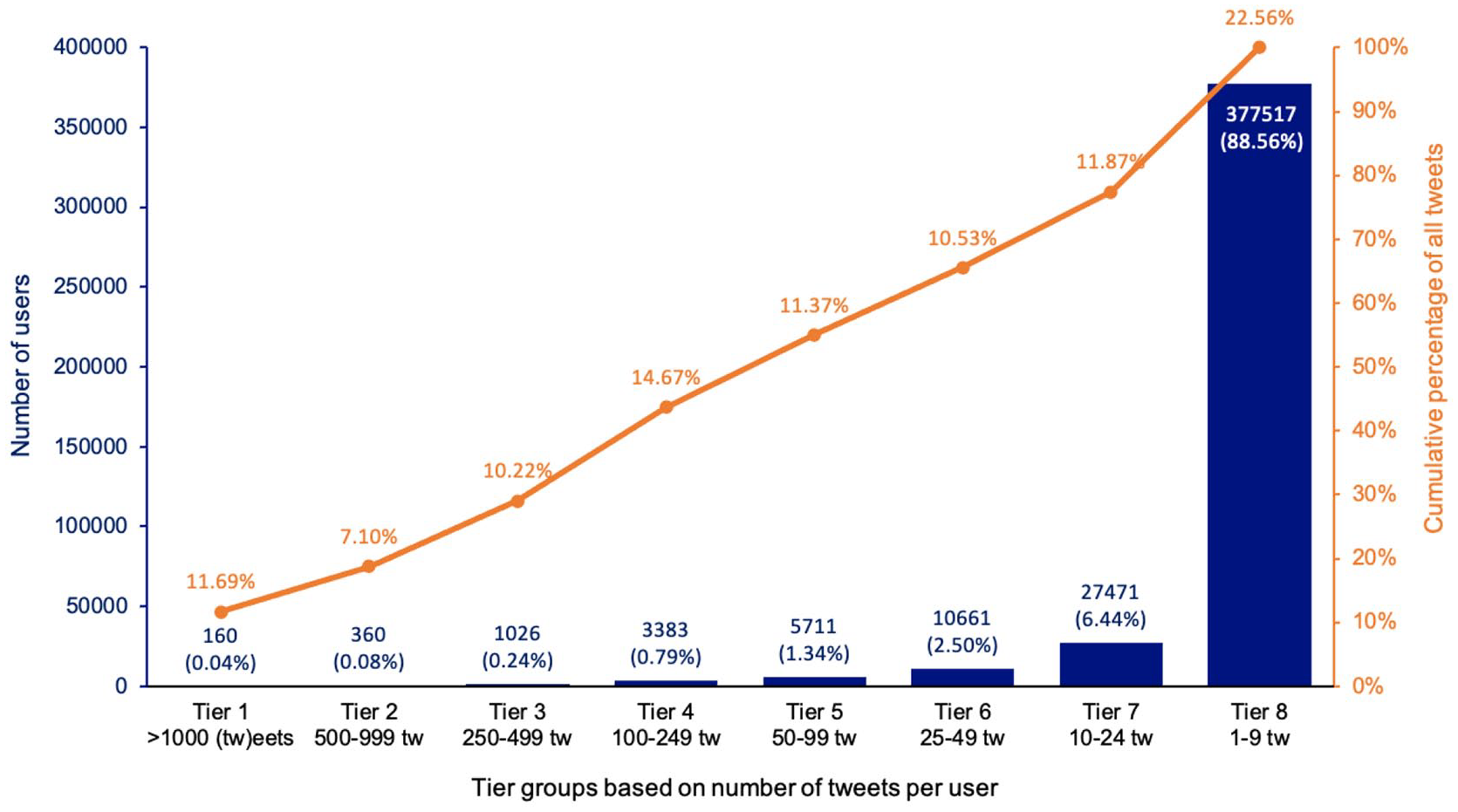
Tweets per tier group.
Figure 3 shows that the total tweet count is mostly driven by returning users from early cohorts, with cohort 1 accounting for 42% of all tweets. Users from cohorts 4 and 5, who joined in June and July 2018 at the time of Trump’s separation policy and the revelation of the SG founders’ identities, show high repeated participation rate and account for more than 9% of total tweets each. We also note a sharp increase in activity from both newcomers and existing users in August 2018 and August 2019, caused by SG activity related to far-right actor Alex Jones and the El Paso shooting, respectively.
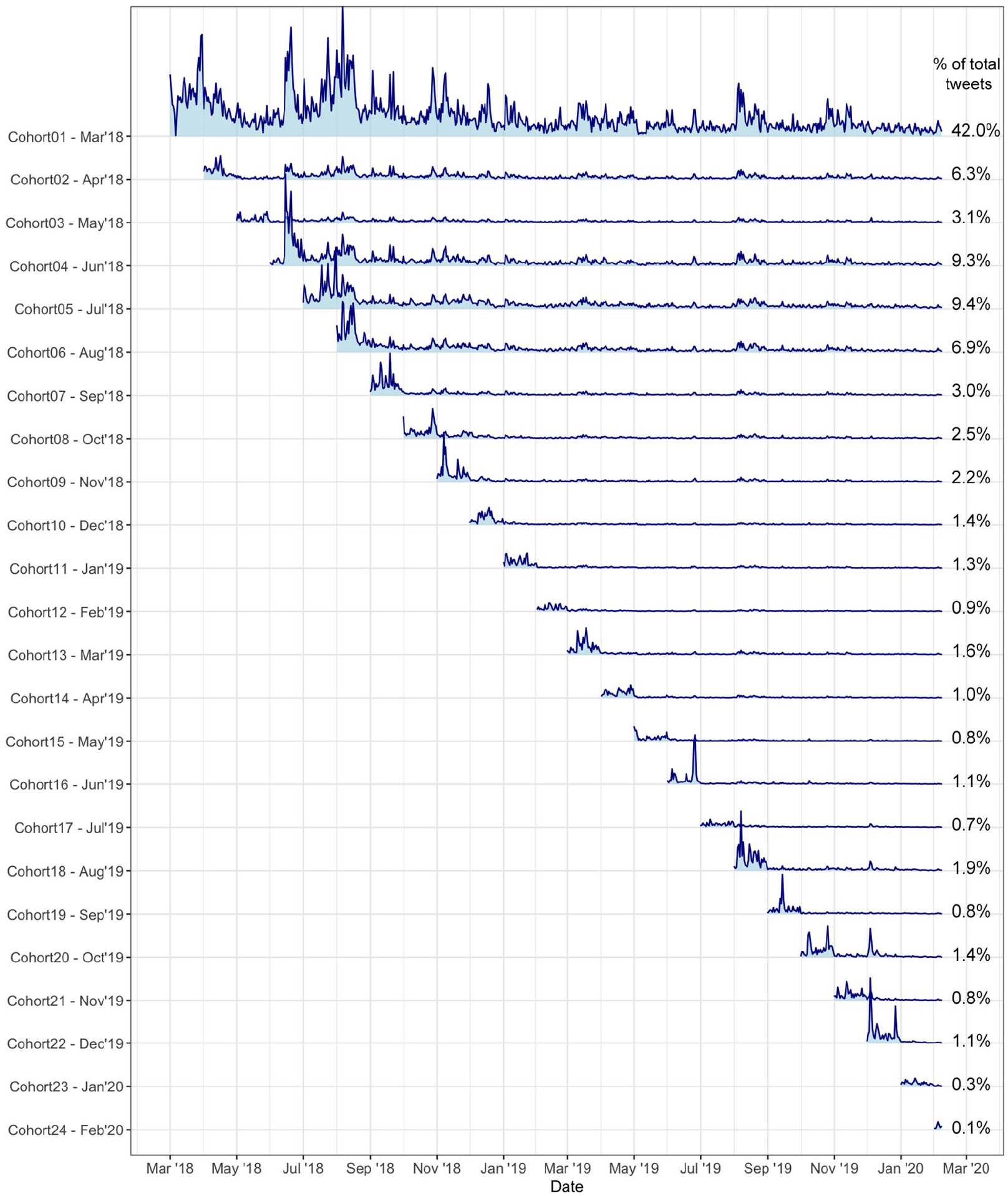
Tweets distribution by Cohort.
Finally, using the celebrities dataset by Wiegmann et al. (2019), we found 1,565 celebrities (0.4% of total users) who together account for 11,662 tweets in our dataset. Many of the celebrities did not only retweet posts related to SG but also publicly supported and endorsed the movement (Figure 4). Some celebrities acted as “super-spreaders” of the movement, having several thousands, and in a few cases millions, of followers. 13

Examples of endorsement from celebrities.
Contentious Activity
Our detailed analysis of the SG movement reveals that its activism originally revolved around an innovative kind of crowdwork which was key to the movement’s visibility and success. Organizations relying on programmatic advertising may not be aware that their online ads appear on Breitbart. SG invited its followers to monitor Breitbart’s website, take screenshots of ads displayed next to extremist content, post these screenshots on Twitter along with a mention to @slpng_giants and the advertisers’ Twitter handle, making this information visible and available for others to share (see Figure 5). SG chose Twitter because of its broadcast affordances and two-way communication 14 which allowed activists to interact directly with Breitbart advertisers in a publicly visible manner, amplified by the movement’s followers. Because Twitter also acts as an arena where elites, reporters, media outlets, politicians congregate, SG was able to leverage the threat that the disclosure of an ad placement on Breitbart might generate a reputational risk (Johnson, 2018; Nitins & Burgess, 2014).
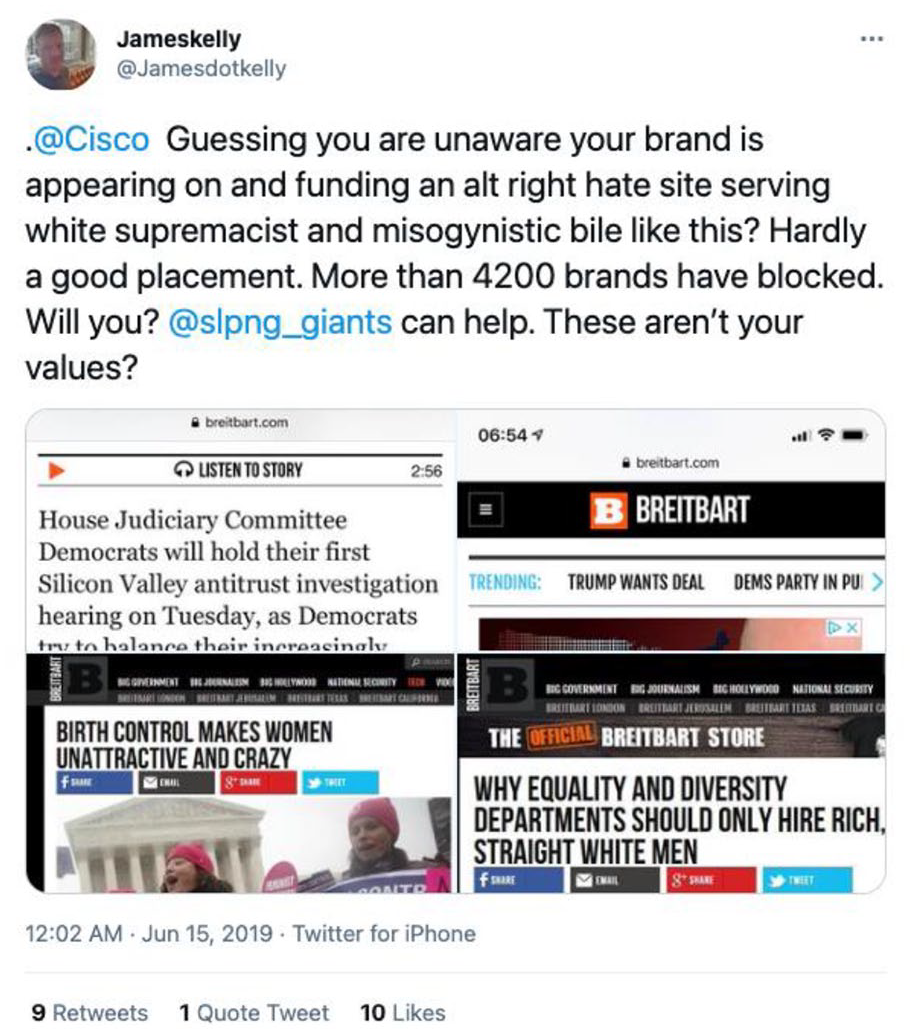
Example of a confirmation.
Once an organization replies and removes their ads from Breitbart, SG makes a corresponding post on social media (Figure 6) and adds the organization to a Google spreadsheet that is publicly accessible. 15 The spreadsheet keeps advertisers accountable for removal decisions and demonstrates achievements of the movement, serving as evidence of its effectiveness. It is noteworthy that while Breitbart is an American website, many of the organizations, whose ads appeared on Breitbart, are large international corporations (e.g., Visa, BMW, Lenovo) or entities outside the United States (e.g., Sydney Opera House, Air France, The London School of Economics). All of them, along with 4,000+ other organizations, responded to SG notifications and pulled their ads from the Breitbart site as of December 2020.
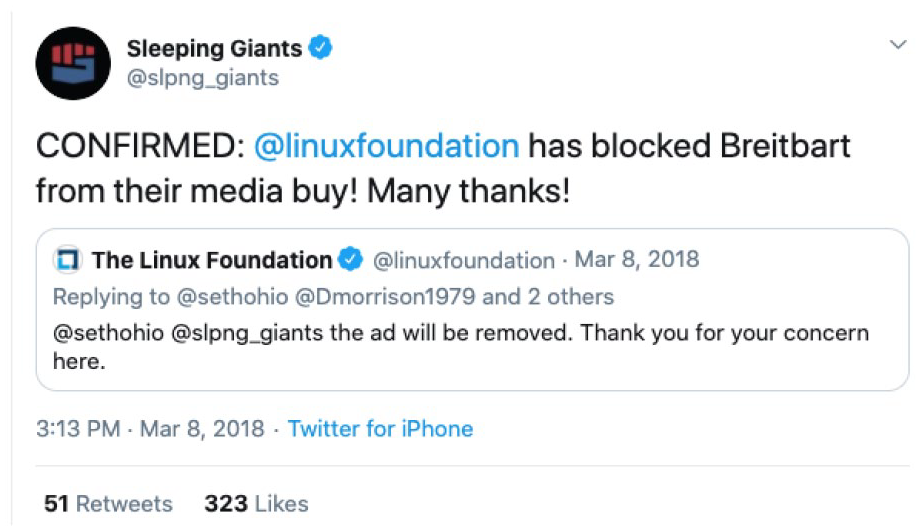
Example of a notification.
We found 194,974 advertiser notification tweets created by 27,795 users. These notifications consist of both initial notifications (i.e., a tweet notifying a company with a screenshot of their ad[s] on Breitbart; Figure 5) and retweets of such initial notifications. Thus, we distinguish between activists who produce initial notifications (i.e., “notifiers”) versus users who retweet them. We found 4,094 notifiers posting 21,425 initial notifications. These notifiers account for 85,703 (44%) notifications (initial and retweets), while the remaining 23,701 users account for 109,271 (56%) notifications, which are all retweets.
Based on a k-means cluster analysis, we identified four clusters which we labeled vigilantes, amplifiers, semi-active workers, and crowd workers. For users in each cluster, we additionally cross-checked whether they were among top-active users or celebrities (as discussed in section “Participation Levels”). Figure 7 shows summary statistics for these four clusters of users.
Vigilantes: A small cluster of seven users, each having authored a large number of initial notifications. On average these users posted 777 notifications, (max: 1,462, SD: 316). All seven users are in the top 500 active users (i.e., tiers 1 and 2). These users are dedicated workers who constantly monitor the Breitbart site, take screenshots of ads, and notify organizations via Twitter.
Amplifiers: Another cluster of seven users only. Compared to the vigilantes, these users post fewer initial notifications (M: 49, SD: 60) but they retweet significant amounts of initial notifications from other users (M: 3,034, SD: 831). Users in this cluster also have the highest number of total tweets (M: 12,916 tweets, SD: 8,739) and are all among the top 10 active users over the observed period. The SG twitter handle (@slpng_giants) is in this cluster. Amplifiers are active users who frequently reply to and retweet, therefore, increasing the visibility of the vigilantes’ work.
Semi-active workers: A group of 38 users that all produce a substantial number of initial notifications, but significantly fewer than vigilantes. Their numbers of notification retweets and total tweets are also high, indicating that users from this cluster also tweet substantially beyond the topic of Breitbart. Overall, they are less active than amplifiers and vigilantes but much more than the average crowd user. 36 users (95%) from this cluster are among top 500 active users.
Crowd workers: The largest cluster with 4,042 users who posted at least one initial notification. These participants have on average only three to four initial notifications or retweets. The average number of total tweets, both related and not related to Breitbart, is also much lower than in the other clusters. However, what defines this cluster is its size: thousands of users, each making a small contribution, together account for 11,893 (56%) of all initial notifications and for 32% of the overall notification activity (initial and retweets). Crowd workers are the only cluster that contains celebrities.
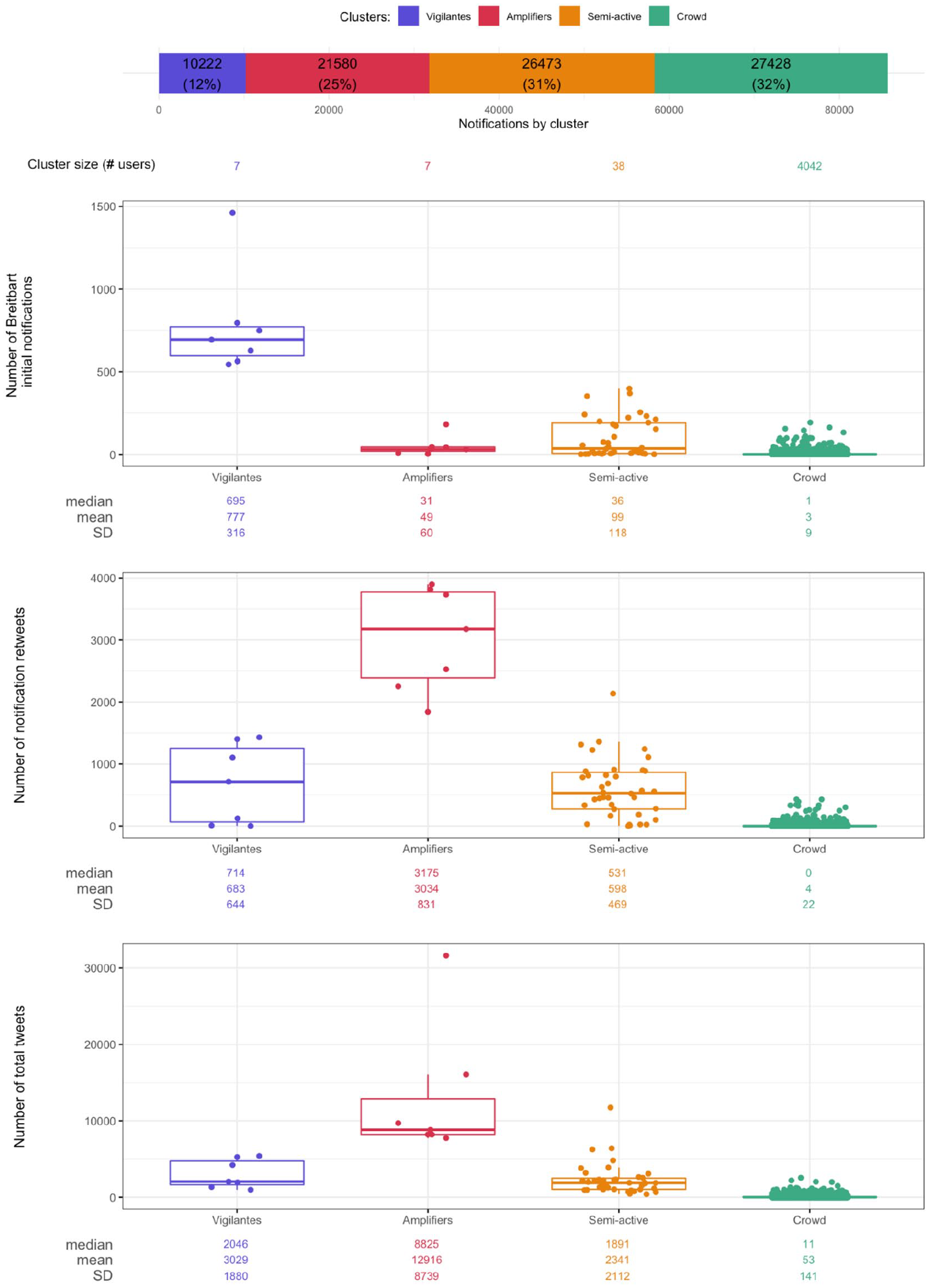
Description of notifiers’ clusters.
Organizational Issues
SG’s growth and success was enabled by the unique affordances of online activism. First, its leaders
16
remained anonymous for 20 months, which is often impossible in offline movements. Anonymity originally allowed the founders freedom, reduced risk, and the pretense of a large and legitimate movement (Farhi, 2017): “I thought it sounded cool. It sounded like there are a bunch of people . . . It was just me at first, so I wanted to seem bigger. <. . . > Because I was going be talking to big advertisers. I wanted to seem significant even though there were two followers.”—Matt Rivitz, SG founder (Johnson, 2018).
However, once the two founders’ identities were revealed by The Daily Caller in July 2018, they faced much greater scrutiny and harassment, including doxing and death threats. At the same time, the revelation had a positive effect on their social status, bringing recognition, new followers, media attention, new opportunities for collaboration and for-profit services (see corresponding peak in Figure 1 and subsequent growth in followers): “The simple act of calling myself co-founder changed so much. People looked up to me as a leader and respected what I had to say. Doors were opening and I had a pathway into the adtech industry”—Nandini Jammi, SG founder. (Jammi, 2020)
However, “the vagueness that once helped [SG] look like a mysterious [bigger] group” (Jammi, 2020) also created problems over trust and the division of labor among the founders. As the movement got prominence after winning several industry awards for activism (Cannes Lions, 2019; The Webby Awards, 2019) and receiving increased coverage in the mainstream media, tensions over titles, responsibilities, access to official communication channels, and rights to represent the SG in public worsened, resulting in Jammi’s departure from the movement in June 2020 (Jammi, 2020; Rajagopalan, 2020). Thus, the SG case highlights that leadership in digitally native activism faces specific challenges and opportunities when the movement is non-hierarchical, decentralized, and the activists only communicate digitally.
Second, the simple and rewarding aspects of SG’s tactics, where anyone can engage in the work of tweeting advertiser notifications, contributed to attracting a significant followership. SG also appropriated the affordances of social media in novel ways: they used Twitter’s pinned tweet and Google spreadsheet functionalities to broadcast their instructions to the crowd, and ensure consistency between the crowd’s actions and the movement’s objectives (Figure 8): “It quickly went from a two-week project to our entire lives. A big reason why the movement has remained so successful, though, is crowdsourcing, which was actually sort of an afterthought. <. . .> So we put some instructions up on that pinned tweet, and that’s when everything kind of caught fire—and when advertisers started coming down, tens and hundreds at a time.”—Matt Rivitz, SG founder (Willis, 2018)
This resulted in a decentralized community, where more experienced users acted as mentors, guiding, and teaching new crowd workers (Maheshwari, 2018). Interestingly, despite the importance of hashtags in online activism because of their affordance for coordination and symbolism of solidarity and movement affiliation (Freelon et al., 2020), we found that the SG movement rarely used any specific hashtags. 17 Instead, users mentioned SG’s Twitter handle to track and coordinate their activities.

Pinned Sleeping Giants tweet with work instructions for movement participants.
Coordination Among International Branches Accounts and Other Movements
The success of the SG movement in the US inspired similar campaigns in other countries, a development which posed alignment and trust challenges for leadership and coordination. First, international branches operate in different ad markets with their own institutional conditions and opportunity structures.
18
Despite these differences, the movement’s founders had to ensure that the tactics and goals of the international branches were consistent with the identity of the original SG movement (Johnson, 2018). Second, the founders faced moral hazard risks, because each international branch account is run independently from the SG founders, and the real identities of the users controlling the international branches accounts may remain unknown. All internal coordination happens online, both privately (e.g., via closed means for electronic communication) (Braun et al., 2019) and publicly (e.g., endorsing each other through tweets): “Additionally, [Sleeping Giants has] grown across the world. <. . .> People would approach in the early days, through DMs or through our Facebook account and say, “Hey, I’m really interested in taking on a similar thing in my country.” Then we’re pretty careful. I went through, made sure they’d been on our feed for a while and doing the right things and had the right tone and that kind of stuff.”—Matt Rivitz (Johnson, 2018)
This reliance on decentralized control has both benefits and risks. The easiness of creating new offshoot movements comes with the difficulties of their coordination if the anonymous individuals lack commitment. 19 For instance, the Brazilian account “@slpng_giants_br” was created back in February 2017 but remained idle for many months. In May 2020 a new Brazilian handle “@slpng_giants_pt” was launched, obtaining more followers in 10 days than @slpng_giants did over 3 years (see Online Appendix A), and attracting attention from Brazilian mainstream media (Garcia, 2020; Mann, 2020). The SG founders endorsed the newly launched “_pt” account, admitting that communication and control over the older “_br” account was lost after the activists became disengaged from the movement. 20
Framing Tasks
While SG originally channeled its activism toward Breitbart, we observe that the themes and issues raised by the movement varied beyond a single target. In this part of the analysis, we examine how the movement’s strategic use of framing and language varies according to issues and targets.
As discussed in section “Framing tasks,” we inductively assign 43 codes to a set of 3,593 tweets. 21 These codes represent a mix of individual actors (e.g., Alex Jones, Tucker Carlson), organizations (e.g., Facebook, Wayfair), issues (e.g., doxing, violation of terms of service), policies (i.e., family separation), and groups (advertisers on Fox News, people endorsing SG). We combined all codes into seven broad themes: advertisers, platforms, conservatism, separation policy, mainstream media, political donations, and endorsement (see Online Appendix L for further details).
Advertisers: This theme includes not only tweets related to advertisers on Breitbart but also a large portion of tweets appealing to advertisers on Fox News. SG was involved in a social media campaign pressuring television advertisers to remove their ads from Fox News shows such as Tucker Carlson Tonight and The Ingraham Angle, after Carlson’s controversial comments about immigration (Horton, 2018; Katz, 2018) and Ingraham ridiculing a 17 year-old survivor of a high school shooting (Victor, 2018; Visser, 2018). Unlike Breitbart advertisers, organizations that run ads on television networks are aware of their advertising’s placement. Therefore, instead of using standardized notifications about ad placements, SG participants used tailored motivational framing, by calling out the advertisers’ corporate values that are at odds with the statements of the Fox News hosts (see examples in Online Appendix L).
Platforms: In this theme, SG targeted major online platforms, social media sites and hosting providers, calling them out for spreading hate speech, extremism, misinformation while profiting from it financially. Utilizing diagnostic and prognostic framing, a common narrative among these tweets is to point out that platforms fail to enforce their terms of services and community management policies, which prohibit harassment and hate speech. For instance, SG participants used this argument to compel Facebook, YouTube, Apple, and Spotify in cutting ties with Infowars, a far-right conspiracy channel. Infrastructure and web hosting services like Cloudflare also became the target of SG’s activism for their stance on net neutrality and their unwillingness to discontinue services to websites that are known to be hosting conspiracies (e.g., Qanon) as well as hateful content (e.g., as classified by the Southern Poverty Law Center for instance) (Gimlet Media, 2020; Hatewatch, 2019).
Conservatism: This theme includes tweets related to conservative media outlets (e.g., Fox News, The Daily Caller, Breitbart), conservative media actors (Carlson, Ingraham, Pirro), alt-right actors and organizations (Steve Bannon, Alex Jones, Gavin McInnes and the Proud Boys), conservative political donors (Mercer family), and policy makers (White House advisor Stephen Miller). Most tweets in this theme involve diagnostic framing, where SG activists bring attention to extremist affiliations, disinformation and conspiracy narratives spread by conservative actors, and white supremacy associations.
Separation policy: SG participants called out vendors dealing with the U.S. Immigration and Customs Enforcement (ICE) that provided goods and services for detention facilities ran under the Trump administration’s family separation policy. Among notable targets were airline companies for carrying members of separated families, and the e-commerce company Wayfair for supplying beds to children detainment camps. The tweets in this category tend to be prognostic: SG not only identified corporate support of family separation and children detainment as a problem, but also asked participants to contact vendors and question their relationship with ICE (e.g., “Please contact them and ask that they cease transporting children apart from their parents”).
Mainstream media: Occasionally non-conservative mainstream media outlets became SG’s target. This happened when certain actors who associate with extremist views were interviewed or invited to public forums. Using diagnostic and prognostic framings SG participants argued that giving a public platform to these actors not only provides visibility to these individuals but also legitimizes their actions and ideology. Some prominent examples include SG targeting MSNBC and the Financial Times for interviewing Steve Bannon; the New Yorker for inviting Bannon to its Festival, and the Fortune Magazine for inviting Kirstjen Nielsen, the U.S. Director of Homeland Security who led the implementation of the family separation policy, to their Most Powerful Women Summit.
Political donations: SG participants tweeted at organizations which financially support politicians with histories of ethically questionable actions and ideas. For example, as the result of SG’s activism, AT&T, Leidos and Walmart withdrew donations to Mississippi Republican Senator Cindy Hyde-Smith after her “public hanging” remarks (Clark, 2018; Mangan & Breuninger, 2018). Through motivational framing, SG participants also pressured organizations to withdraw their contributions to Republican Congressman Steve King, who has publicly used racist and anti-immigrant rhetoric.
Endorsement: This last theme involves tweets where relationships with allied movements are highlighted and calls are made to join forces (i.e., motivational framing). SG participants regularly endorsed other social movements with similar aims, like the GrabYourWallet movement, which boycotts Trump-related products and retailers who sell them. 22 Participants of the movement also praised activists, celebrities, and media for supporting the SG movement, and promoted the sale of SG merchandise, which proceeds are reportedly used to fund activities of the movement and chosen charities.
Politeness Analysis
The SG founders publicly stressed to their followers that their primary communication tactic involves persuasive polite notifications (Figure 9), and that they avoid calling for boycotts, differentiating themselves from other types of confrontational corporate activism which often relies on shaming organizations and can involve emotional outpours of angriness on social media (cf., Zhang & Luo, 2013): “We don’t want to add to the outrage too much—it’s just not valuable. Now, it’s kind of a self-policing community. If someone starts with the outrage, someone else will just say, “Look, we’re not about that here.” It’s a different tone”—Matt Rivitz (Willis, 2018)
Yet, analyses using the “Politeness” R package for computational linguistics show that the language employed by SG participants varies depending on the combination of issues and targets addressed (see Online Appendix M for root mean squares of 36 politeness features across seven different themes). Tweets appealing to advertisers are indeed mostly polite: SG encourages organizations to reconsider their ads placement, often using words of gratitude, second personal pronoun (you), direct and indirect requests (e.g., “can you,” “would you”) and positive emotions. In contrast, swearing (vulgarity of all sorts), negations (contradictory notes), and negative emotions prevailed in the tweets targeting platforms and the Trump administration’s separation policy. Examples of polite (high score) and impolite tweets (low score), identified by the politeness package are shown in Table 3 below.

Sleeping Giants tweet instructing followers to be polite with advertisers.
Examples of Most and Least Polite Tweets.

Limitations
Our findings must be carefully considered in the light of the limitations of our study. First, while the collected dataset provided insights in the tactics and framing of the movement, we acknowledge that this study presents a left-censored snapshot and that data from earlier periods might have provided important insights about SG’s formation and development.
This paper focused on the main SG account in the United States (@slpng_giants). Future analysis of international branches accounts may help to better understand the structure and dynamics of inter-organizational contentious activity. It is important to note that such combined analysis presents certain challenges not only because international branches accounts may have different targets and agendas, but also because many of them are run in different languages, so linguistic analysis to understand framing tactics will become more complex.
Future work could involve social network analysis of the movement, including the network of main actors, their demographics, followers, and other related campaigns. This analysis might help to reveal the larger network of the Resistance movement (Meyer & Tarrow, 2018). Such meso-mobilization among digitally native movements is particularly relevant in the light of mid-2020 events, when SG started the #StopHateForProfit campaign in collaboration with other organizations. 23 The outcomes and challenges of online coordination among allied movements, when activists unite, join forces, and work online together sharing common goals and supporters are still misunderstood.
Likewise, the framing analysis could be extended to include frame-alignment processes (Benford & Snow, 2000) such as bridging, amplification, and transformation of frames used by activists over time. Such a process approach would complement a static approach, presented in this paper, and contribute to understanding of digitally native activism dynamics.
Discussion and Conclusion
Social movements rely increasingly on social media for coordination and mobilization. Yet, they often retain elements of legacy social movements, such as engaging in street protests, demonstrations, and pressure tactics (e.g., #BlackLivesMatter, #metoo, Arab Spring, Occupy Wall Street). In contrast, SG can be considered a revelatory case of successful self-organizing, digitally native activism (Earl et al., 2010; Schmitz et al., 2020), where mobilization, coordination, and contentious activity happen entirely online, and which embeds characteristics of peer-production organization. Our findings have several implications for the literature on online activism and platform governance with regards to disinformation and hate speech.
An important boundary condition to our findings lies in the fact that, whereas the aforementioned movements targeted structurally induced inequalities, cultural norms, or the state, SG targeted identifiable corporate actors: Breitbart, its advertisers, platforms, and far-right actors. The practices of SG can therefore be considered as innovations to the repertoire of contention used by corporate activists (Briscoe & Gupta, 2016; King & Pearce, 2010) for which the classic tactics of “naming & shaming” (Bartley & Child, 2014; Eesley et al., 2016; Zhang & Luo, 2013) and “proxy targeting” (Briscoe et al., 2015; Walker et al., 2008) have been transposed from the analog world to the online world via peer production. Another boundary condition lies in the fact that SG was able to exploit a specific structural vulnerability: the dependence of its ultimate target (Breitbart) on a multitude of proxies (advertisers) which may have been predisposed to make concessions to the movement, either out of perceived reputational risk, value congruence, or social comparison (Gupta & Briscoe, 2020; Luo et al., 2016; McDonnell & Adam Cobb, 2020). This vulnerability was also brought to the fore via digital affordances, by the simple acts of users who capture and post website screenshots, thus exploiting the connectivity and programmability dimensions of the social media logic to unpack the algorithmic black box of programmatic advertising (van Dijck & Poell, 2013). The crowd thus engaged in a rudimentary algorithmic audit to discover its participants and its functioning (Sandvig et al., 2014), a tactic which seems primed to be diffused to other corporate activists that have grievances toward platforms.
SG leveraged discursive opportunities by crafting emotionally resonant frames that leveraged the sense of injustice and harm generated by the policies of the Trump presidency as well as the narratives put forward by the right-wing media ecosystem. For example, tweets related to the separation policy and child detention facilities are among the most retweeted and replied tweets in our dataset, confirming previous studies that emotions are critical drivers for online activism participation (George & Leidner, 2019; Jasper, 1998). Users who joined during such periods of moral outrage show relatively higher commitment to the movement than other users, as seen in higher repeat participation rates (Jasper, 1998; Jasper & Poulsen, 1995).
Moreover, the networked public sphere presents novel opportunities for online activism reinforcing Ayres’ (1999, p. 136) suggestion that “the internet has become an international opportunity [structure] in its own right.” Many targets of SG activism involve online actors and practices, including not only actors that diffuse hate and disinformation (Marantz, 2020; Nagle, 2017), but also online advertising platforms, web infrastructure vendors, and social media platforms that supports the networked public sphere (Donovan et al., 2019). SG organized a counter-movement aimed at both reforming platforms content moderation policies and “de-platforming” key actors from far-right movements as a response to their tactics of media manipulation and disinformation. The digital nature of such targets shows how insurgents are provided with novel opportunities to generate conflict and social change, both on the left and on the right of the political spectrum (Freelon et al., 2020). SG, thus, took part in movement/counter-movement dynamics that happen in an online arena for which the governance and infrastructure are as much subject to problematization as the actors it enables.
We also observe new ways of coordination online. Previous studies argue that hashtag activism remains the dominant style of left-wing movements online (Freelon et al., 2020; Jackson et al., 2020), and a critical way to trace and expand related activities (Bonilla & Rosa, 2015; Freelon et al., 2018). The case of SG shows, however, that online activists on the left can leverage other affordances of social media, such as public Google spreadsheets, as well as Twitter’s pinned tweet and mention functionalities to broadcast and track activities of a campaign. Hashtags can be used as rallying slogans to attract a mass of followers and demonstrate a movement’s worthiness, unity, numbers, and commitment toward elites and policy makers (Tilly, 2006). Instead, SG organized a form of crowdsourcing among movement participants to target the social media presence of specific actors (advertisers), thus putting these actors, rather than the SG movement, in the limelight. This “non-hashtag” activism can be explained by the type of change sought by SG: disrupting the business model of political opponents via transparency work rather than demanding concessions from elites toward practice or policy changes. Such tactical innovation expands existing knowledge of online social movements by highlighting the importance of online work and the division of labor in contentious activity, especially of the disruptive kind. The success of the SG campaign depended on a handful of committed workers (e.g., vigilantes) that generated the grunt of advertiser notifications, the key tactic behind the movement’s leverage. This reinforces the argument that affordances of social media increase the efficiency of activism, allowing a small core of participants to be impactful (Bennett & Segerberg, 2012; George & Leidner, 2019).
In the case of SG, vigilantes are the committed workers whose actions go beyond mere clicktivism, and include site monitoring and creation of initial notifications with a screenshot, targeting companies whose ads being spotted on Breitbart. It is important to note that commitment in this regard becomes a relative term, as online activism requires much lower commitment than protest activities offline. The groundwork of the SG’s vigilantes got amplified by a critical periphery (Barberá et al., 2015) that contributed via low commitment actions (i.e., retweets and replies), which could then be noticed by the media and amplified further, thus generating a substantial reputational risk for the targeted advertisers. Therefore, SG’s contentious activity required both the work of vigilantes but also micro-contribution by the crowd to be impactful. There is thus promise in considering online activism as a form online peer production (Kittur et al., 2007) that involves coordination, division of labor, and control in future inquiries.
Finally, our analysis demonstrates how a movement strategically complexifies its framing tactics to be effective. SG participants used the flexibility afforded by social media to choose and switch between multiple targets, addressing a variety of framing tasks depending on the respective target. In the case of SG, we argue that polite language used to notify advertisers allowed SG to gain recognition and legitimacy (Tilly, 1999, 2006; Wouters & Walgrave, 2017), which were then leveraged as proxies to pressure opponents with less polite approaches. Our analysis is consistent with the observation that a movement’s framing is likely to be more persuasive toward potential allies and victims (e.g., the advertisers) and more vindictive toward opponents and perceived culprits (e.g., tech platforms and far-right actors) (Snow et al., 2019). Paradoxically, SG engaged in “naming & shaming” in a polite way, a tactic that is usually associated with the repertoire of confrontational activists (Briscoe & Gupta, 2016; Zhang & Luo, 2013). This polite stance could be due to SG’s strategic intention to be perceived as moderate activists within the broader Resistance movement (Meyer & Tarrow, 2018), and thus to benefit from a radical flank effect: when targets are faced with confrontational activists, they are more likely to give concessions to moderate activists (Baron et al., 2016; Haines, 1984). Also, while naming & shaming is usually targeted at organizations that are perceived as culpable of poor social responsibility (e.g., Zhang & Luo, 2013), the diagnostic framing of the SG leadership instead positioned advertisers as victims rather than culprits, due to their apparent ignorance of the opacity of programmatic advertising. These observations suggest that future research should pay attention to the tuning done between persuasive and antagonistic stances by online movements, how this tuning differ between opponents, supporters, and how this tuning is affected by platform affordances and variations in diagnostic framing.
Our examination of the SG movement contributes to the discussion about regulation and governance of online platforms, content moderation policies, and de-platforming of actors that breach platform policies (Donovan, 2019). Online activists have become a key mechanism in nudging the definition and enforcement of platform’s malleable content moderation policies (Crawford & Gillespie, 2016; Gillespie, 2018). The absence of formal legislation to govern platforms and algorithmic amplification has created an opportunity for the rise of online movements in this space. While online activists such as SG have had localized impact so far, it is still unclear if such private politics can be effective at a broader scale to motivate platforms to engage in self-regulation, in lieu of state mandated reforms and oversight (e.g., Vogel, 2010). Considering the ever-increasing role of the internet and platforms in the political, cultural, and social sphere, the question of accountability of platforms for content moderation, algorithms and policies is particularly important, and emerging social media movements have become an integral part of this discourse.
Supplemental Material
sj-docx-1-sms-10.1177_20563051211035357 – Supplemental material for Beyond Clicktivism: What Makes Digitally Native Activism Effective? An Exploration of the Sleeping Giants Movement
Supplemental material, sj-docx-1-sms-10.1177_20563051211035357 for Beyond Clicktivism: What Makes Digitally Native Activism Effective? An Exploration of the Sleeping Giants Movement by Yevgeniya Li, Jean-Grégoire Bernard and Markus Luczak-Roesch in Social Media + Society
Supplemental Material
sj-xlsx-2-sms-10.1177_20563051211035357 – Supplemental material for Beyond Clicktivism: What Makes Digitally Native Activism Effective? An Exploration of the Sleeping Giants Movement
Supplemental material, sj-xlsx-2-sms-10.1177_20563051211035357 for Beyond Clicktivism: What Makes Digitally Native Activism Effective? An Exploration of the Sleeping Giants Movement by Yevgeniya Li, Jean-Grégoire Bernard and Markus Luczak-Roesch in Social Media + Society
Footnotes
Declaration of Conflicting Interests
The author(s) declared no potential conflicts of interest with respect to the research, authorship, and/or publication of this article.
Funding
The author(s) received no financial support for the research, authorship, and/or publication of this article.

Supplemental Material
Supplemental material for this article is available online.
Notes
Author Biographies
References
Supplementary Material
Please find the following supplemental material available below.
For Open Access articles published under a Creative Commons License, all supplemental material carries the same license as the article it is associated with.
For non-Open Access articles published, all supplemental material carries a non-exclusive license, and permission requests for re-use of supplemental material or any part of supplemental material shall be sent directly to the copyright owner as specified in the copyright notice associated with the article.
