



Abstract
Adopting a comparative cross-platform approach, we examine youth political expression and conversation on social media, as prompted by popular culture. Tracking a common case study—the practice of building Donald Trump’s border wall within the videogame Fortnite—across three social media platforms popular with youth (YouTube, TikTok, Instagram), we ask: How do popular culture artifacts prompt youth political expression, as well as cross-cutting political talk with those holding different political views, across social media platforms? A mixed methods approach, combining quantitative and qualitative content analysis of around 6,400 comments posted on relevant artifacts, illuminates youth popular culture as a shared symbolic resource that stimulates communication within and across political differences—although, as our findings show, it is often deployed in a disparaging manner. This cross-platform analysis, grounded in contemporary youth culture and sociopolitical dynamics, enables a deeper understanding of the interplay between popular culture, cross-cutting political talk, and the role that different social media platforms play in shaping these expressive practices.
Keywords
In both scholarly and general debate around youth political participation and expression, the U.S. post-2016 context shows signs of a change. If in the early 2000s, the scholarly focus was on increasing youth interest in politics, under the assumption that many youth are disengaged from or disinterested in traditional politics (e.g., Delli Carpini, 2000), the current, highly politicized and polarized U.S. context (see J. Kahne & Bowyer, 2017; Rogers, 2017) raises a different challenge. We see evidence that many young people are, or are becoming, more politically engaged—for example, according to the Center for Information and Research on Civic Learning and Engagement (CIRCLE), well over half of young people (61.1%) are saying that a growing number of their peers are talking about social and political issues in their community, and youth voting rates in the 2018 midterm election have increased significantly as well (CIRCLE, 2018). Yet at the same time, the same poll finds that youth are deeply uncertain about the state of American democracy. For example, a majority (59.7%) say they are feeling more cynical about politics after the 2016 election. Thus, the salient challenge today seems to be: How do we encourage and sustain forms of youth political participation and expression that are beneficial for democracy, in the sense of accepting the basic tenets of democracy, including respect for differing views?
To do so, we must first better understand young people’s political expression, in the diverse contexts in which it takes place organically. We argue that this requires looking beyond the “usual suspects” of political spaces (for example, participation oriented around political parties and candidates) in several ways. First, we need to look at youth expression where it occurs naturally—most prominently, on social media. Recent research confirms the role of social media as salient spaces for young people’s social connections (e.g., boyd, 2014) and political expression (e.g., Lane et al., 2019; Literat & Kligler-Vilenchik, 2019). At the same time, the variance in how different social media platforms afford political expression (e.g., Lane et al., 2019) points at the importance of cross-platform approaches, including ones that focus on the social media platforms most popular with youth today. Moreover, there is a need to understand political expression as experienced and understood through the lens of young people’s everyday lives. While only a subset of youth are active in institutional political spaces, many are negotiating their relations to the political realm by contextualizing it within areas salient to them—including their popular culture interests (Jenkins et al., 2016). Thus, this article examines youth political expression across social media platforms popular with this demographic, prompted by a salient youth popular culture phenomenon—the videogame Fortnite. We ask: How do popular culture artifacts prompt youth political expression on social media? And to what extent does expression around popular culture stimulate cross-cutting political talk?
To answer these questions, we undertake a comparative cross-platform analysis of youth interaction across political differences on three social media platforms chosen due to their popularity with youth and their shared emphasis on visual/audio-visual content (YouTube, Instagram, TikTok). Across these platforms, our case study revolves around the concept of building Donald Trump’s proposed border wall within the videogame Fortnite. This idea has become a popular internet meme, manifested playfully across social media platforms and through different text genres (e.g., image macro memes, video memes, gameplay videos; see Shifman, 2014). Tracking this meme across three social networks allows for a cross-platform comparison of political expression and discussion. To holistically understand these dynamics, we combine in-depth qualitative and quantitative content analysis of comments posted on relevant artifacts. Building on these findings, we advance a theoretical model addressing the interplay between popular culture, cross-cutting political talk and social media in shaping youth political expression and conversation online.
Collective Political Expression: Social Media, Popular Culture, and Cross-Cutting Talk
Scholars dating back to John Dewey (1927) have recognized political expression and discussion as valuable activities for democratic citizens to grasp the significance of politics to their everyday lives. We understand political expression as “communications expressing a specific opinion on current events or political processes, or disseminating information relevant to the interpretation of those events or processes” (Velasquez & Rojas, 2017, pp. 2–3), yet our empirical research shows that youth political expression on social media also takes a distinct character: it is often personal, emotional, and infused with everyday life experiences (Kligler-Vilenchik & Literat, 2018; Literat & Kligler-Vilenchik, 2018, 2019).
Our conceptual framework perceives social media as affording “collective political expression” for youth, by allowing them to deliberately connect to an assumed like-minded audience through the use of shared symbolic resources (Literat & Kligler-Vilenchik, 2019). When enacted through social media, collective political expression can be seen as a hybrid between interpersonal communication (with known others) and broadcasting to a large (unknown) audience. In enacting collective political expression, youth communicate toward an imagined audience (see also Litt & Hargittai, 2016). They may imagine their audience as similar or dissimilar to themselves, both politically and in terms of other variables (age, gender, interests, etc.); indeed, online political expression is an important site of identity work for young people (see, e.g., Jenkins et al., 2016; Literat & Kligler-Vilenchik, 2019), as the nature of online participatory spaces requires the active and explicit (re)drawing of personal and collective boundaries (boyd, 2014; Gal, 2019). Different social media with their respective affordances may enable or constrain conversing with homogeneous versus heterogeneous participants, yet, ultimately, one’s actual audience online is often unknown.
In our previous empirical research (Literat & Kligler-Vilenchik, 2019), we examined young people who communicated mostly with homogeneous political audiences, using social media affordances to add their voice to a certain side of a political debate. Here, we consider how collective political expression may also be conducive toward youth communication with heterogeneous others. We examine how this is shaped by the content, norms, and affordances of different online platforms.
How Social Media Shape Political Expression Online
In today’s digital media environment, the centrality of social media as a space for self-expression and identity negotiation for young people (boyd, 2014) represents a valuable opportunity to study youth political expression. In contrast to methods such as interviews and focus groups, which may run the risk of social desirability (see Buckingham, 2000), social media offer a valuable window into youth (political) expression in naturally occurring contexts, where young people are interacting among themselves, for themselves, in their preferred modes of expression.
Yet, not all social media are “born equal” in the ways they afford or constrain political expression (Lane et al., 2019; Stromer-Galley et al., 2015). While young Americans often bring to social media the same conflict-avoidant norms that guide them off-line (Thorson et al., 2015; Vraga et al., 2015), the nature and salience of youth political expression is significantly shaped by the norms (boyd, 2014; Thorson et al., 2015), content (Edgerly et al., 2013), and affordances (Lane et al., 2019; Literat & Kligler-Vilenchik, 2019) of different platforms. For instance, in terms of norms, Thorson et al. (2015) showed how young Americans perceived Facebook as a social media space that should be devoted to social, rather than political, conversation, leading them—for the sake of maintaining social harmony—to dislike or avoid political conversation on this platform. The kinds of content uploaded to each platform in turn shape the conversation they spark; for example, in regard to YouTube videos about Proposition 8 in California, Edgerly et al. (2013) found that the topics addressed in the video are often picked up in the comments, and even uncivil tone may “transfer” from videos to comments. In examining YikYak, a (now defunct) anonymous social media platform, Lane et al. (2019) found that this platform’s affordances—anonymity, geo-boundedness, and ephemerality—created a beneficial environment for youth political expression, that could counteract some of the challenges of youth political talk on mainstream social media.
The affordances perspective can help us understand how social media platforms shape not only political expression but also political discussion, for example, through the way they structure dialogue. Comparatively examining online discussion forums, Wright and Street (2007) argue that design choices—including the role of moderation and the structure for presenting threads—can facilitate or thwart deliberation. For instance, threaded systems of messages encourage replies and dialogue, in contrast to structured designs encouraging people to respond individually to a specific prompt. Affordances such as level of anonymity may also shape the extent to which political discussion on different platforms is impolite or uncivil (Rowe, 2015).
Popular Culture as a Resource for Youth Political Expression and Cross-Cutting Talk
When youth political voice occurs naturally, in their preferred spaces, it is often contextualized within young people’s areas of interest and the content worlds pertinent to them. This applies both for activist youth, and for those who are not engaged politically. Surveying a range of youth activist groups, Jenkins et al. (2016) found that they aimed to achieve change “by any media necessary,” while heavily relying on references and content worlds from popular culture. Conceptually, Jenkins et al. (2016, p. 30) introduced the term “civic imagination” to describe the ways young people employ popular culture and imaginary worlds as they “identify and frame political issues in language that speaks to themselves and their peers.” Popular culture references may be particularly important for young people who are not yet politically engaged, but rather are negotiating their relationship to the political realm (Kligler-Vilenchik, 2016); in this latter case, contextualizing politics within popular culture—as is often done on social media—may serve as a shared symbolic resource that can engage youth by speaking to their interests.
Social media can thus be an important locus for youth political expression, but to what extent are they productive for political communication, in the sense of interpersonal conversation with potential political consequences? Rojas et al. (2005) consider several forms of political communication—conversation, dialogue, and deliberation—distinguished by an increasing degree of formality, and the attempt to reach decision-making and consensus. Along with others (e.g., Dahlgren, 2002; Eveland et al., 2011), we find that the “ideal” threshold of deliberation sets too high a bar for the kinds of everyday conversations we may find online—particularly among youth. Rather, we acknowledge the value of even very informal communication, referring to the gamut of conversation types as “political talk” (Wyatt et al., 2000).
While youth online political talk may be very informal, we are interested in the extent to which it allows youth to perceive—and interact with—those holding differing views. In most life contexts, we are usually surrounded by those whose political views are similar to ours. Cross-cutting talk across political differences is recognized as a challenge, particularly in the U.S. context (Mutz, 2006). This is due both to structural factors such as the American two-party system where identifying with one party automatically means alienating members of the other party, as well as to norms of political talk avoidance (Eliasoph, 1998). Where political interaction crosses partisan lines, it may be fraught with impoliteness and incivility (Rowe, 2015). With U.S. political polarization at peak levels, including among youth (Rogers, 2017), there is a pressing need for productive dialogue across political lines (J. Kahne & Bowyer, 2017).
Scholars focusing on friendship-based social media (particularly Facebook) claimed that their mix of affordances, combined with their aim of increasing engagement, generally increase political polarization (Settle, 2018). The potential for conversations across partisan lines may instead be found in those online contexts that are not convened based on existing off-line connections, but rather based on shared interests. Wright (2012) refers to this as the potential of non-political “third spaces” where, during the course of everyday talk, diverse people connect politics with their lives. Empirical research backs this idea. Wojcieszak and Mutz (2009) found that online groups convened around shared interests, where politics comes up only incidentally, may have the greatest potential for cross-cutting exposure. Swartz and Driscoll (2014) examined how an online message board for “jewelry geeks” became a salient site for political discussion during an election period, with the shared interest in jewelry serving to ameliorate tensions among holders of different political views. Specifically among youth, K. Kahne et al. (2011) found that young people who do interact with others around politics (many don’t) are usually exposed to divergent political views and that this exposure is related to engaging in online participatory activities that are non-political in nature, including pursuit of hobbies and shared interests. Finally, humor, playfulness, and irony are often a central aspect of communication online (Boxman-Shabtai & Shifman, 2014). In the context of online interactions between divergent groups, humor and irony may serve to construct superiority over the “other,” in a way that may promote in-group social bonding but further out-group segregation (Gal, 2019).
We continue this line of research, examining the role of popular culture in stimulating youth political expression (Jenkins et al., 2016) and discussion (K. Kahne et al., 2011) in the social media spaces most popular with youth. We thus ask:
RQ1: How do popular culture artifacts prompt youth political expression across platforms?
RQ2: To what extent does expression around popular culture stimulate cross-cutting political talk?
Methods
Selection of Sites and Artifacts
Our research design consists of a quantitative and qualitative content analysis of comments posted on three social media platforms—YouTube, TikTok, and Instagram—chosen due to their popularity with youth 1 and their comparable emphasis on visual/audio-visual content. According to recent statistics, YouTube and Instagram are the two most popular social media platforms among teens and young adults (Statista, 2021). A comparatively newer and understudied platform, TikTok (formerly, musical.ly; a mobile app that enables the creation and sharing of short looping videos) has been documented as the fastest growing social media app among youth demographics with more than 1 billion monthly active users worldwide (Wallaroo Media, 2021) and a significant impact on youth contemporary culture.
To examine youth political talk as prompted by popular culture, we decided to focus on comments posted on youth-oriented politically-relevant content on each of the three sites. To locate such comments, we looked for popular culture artifacts that (1) refer to politics in some way (i.e., mention political actors, groups or issues, and might therefore stimulate political talk); (2) are of interest to a primarily youth audience, making it more likely that commenters are youth; and (3) are thematically similar on all three platforms, allowing for a cross-platform analysis. To maximize a youth focus, our approach was to identify political texts emanating from youth popular culture, which led us to the popular meme imagining the construction of Donald Trump’s proposed border wall within Fortnite.
Released in 2017, the online videogame Fortnite is incredibly popular with youth demographics: 61% of U.S. teens have played it (Common Sense Media, 2018); worldwide, there are more than 250 million players (Iqbal, 2020). Unlike most videogames, its popularity extends beyond those who actually play it, as its cultural impact on youth culture is felt in the form of dance moves, viral challenges, slang, memes, and more (e.g., Paumgarten, 2018). Construction is central in the game, as players gain advantage by building protective structures such as ramps, forts, and towers. The idea of building Donald Trump’s proposed border wall with Mexico within Fortnite has taken off due to Fortnite’s emphasis on construction as a strategic move and has been popularized in the form of image-based memes and gameplay videos. To conclude, this example was selected for its fit with our three criteria: (1) its political nature, making it appropriate for an analysis of political expression (as the border wall was a prominent and very controversial element of Trump’s immigration policy); (2) its youth focus (based on Fortnite’s immense popularity with youth), and (3) the presence of topically similar—and therefore comparable—political Fortnite artifacts on all three platforms.
After identifying relevant content by searching for “Fortnite,” “wall,” and “Trump” on each platform, we selected the two most commented-upon artifacts revolving around building the wall in Fortnite, on each of our three platforms. These artifacts, uploaded in 2018 and early 2019, served us to access the comments and conversations posted in response to them. The six artifacts garnered a total of 6,398 comments (see Table 1)—and these comments form our corpus for quantitative and qualitative analysis. Comments and metadata on the artifacts were accessed using a variety of tools (i.e., Phillip Klostermann’s YouTube comment scraper; Instagram’s API; TikTok Browser). We received Institutional Review Board (IRB) approval for this research. Although all artifacts included in this study were shared publicly, we assume that many of the users posting and commenting are minors; therefore, we took further precautions to protect participant privacy (Livingstone & Third, 2017; Markham & Buchanan, 2012) by anonymizing usernames and replacing them with pseudonyms, ensuring that comments are not searchable, and omitting links and titles for the artifacts examined.
Proportions of Political Comments Across Platforms.

Data Analysis and Measures
To capture both broad patterns and specific nuances of political expression and cross-cultural political talk, comments were analyzed both quantitatively and qualitatively. For quantitative content analysis, we developed a codebook (see Supplemental Appendix) with two levels of analysis: the single comment, and the thread (i.e., a parent comment with its corresponding replies). This allowed us to closely evaluate each individual comment, while also understanding its contribution to the larger discussion (Papacharissi, 2004). Comments were first coded for political content. We employed a rather broad lens here, including any comment that mentioned either political actors (e.g., Trump, Putin, the government), social/political groups (e.g., immigrants, liberals, Mexicans) or social/political issues (e.g., the border, nuclear bombs, war, racism, taxes). Mentions could be (and often were) playful, humorous, or ironic—for example, ORANGE MAN or Donny Trumpz for Trump.
If comments were categorized as political, we proceeded to code for political view (pro-Trump, anti-Trump, or unclear/neutral), politeness, and civility. For the latter two variables, we followed Papacharissi (2004) in considering “politeness as etiquette-related, and civility as respect for the collective traditions of democracy” (p. 260); therefore, impoliteness included communicative moves such as name-calling, aspersions, or use of vulgarity, while incivility included verbalizing threats to democracy, assigning stereotypes, or threatening other individuals’ rights (Papacharissi, 2004; see the appended codebook for more details and examples). If the comment was part of a thread, we proceeded in the second level of analysis to code for cross-cutting political talk (between pro- and anti-Trump views, as well as between them and those holding unclear/neutral views).
Following multiple rounds of refining the codebook, two coders conducted an intercoder reliability test on 20% of the sample. We assessed intercoder reliability using Krippendorff’s (2004) alpha, a rigorous measure with an acceptable cut-off level of .67. The results indicated very good levels of agreement, with Krippendorff’s alpha above .88 for all variables, except cross-cutting political talk (.77). The rest of the sample was then coded by one coder. Due to the comments’ relation to specific media artifacts, the quantitative analysis should not be seen as generalizable to all (political) expression on these platforms—rather, it serves us to contextualize our qualitative analysis, and to hint at areas where cross-platform differences may occur. For this reason, we use the quantitative data descriptively rather than inductively.
Comments and artifacts were then analyzed qualitatively. The qualitative analysis started off with an analysis of the image- and video-based artifacts themselves, paying attention to both content and metadata (e.g., descriptions, tags). Next, we focused on comments posted on these artifacts, examining communication within and across ideological camps, and the use of popular culture content to make political arguments. In comparison to quantitative coding, qualitative analysis could much better capture the complex and playful uses of language and popular culture references, including aspects such as humor, irony, sarcasm, double meaning (see Boxman-Shabtai & Shifman, 2014; Gal, 2019), as well as the use of misspellings, all-CAPS, emojis, and so on. The quantitative coding aided our qualitative analysis, as it enabled us to split up the comments corpus by political versus non-political content, and within political content, to look separately at Trump supporters, opponents, and their cross-cutting conversations. The two approaches were thus complementary: the quantitative analysis provided a birds-eye-view of the data and hinted where cross-platform differences may shape resulting expression, while the qualitative analysis allowed us to understand this data within the situated context of youth culture and expression.
Findings
RQ1: How Popular Culture Prompts Youth Political Expression
In our data, popular culture can be analyzed as prompting youth political expression on two levels: within the artifacts themselves, and in the comments on these artifacts. We begin with a brief analysis of the artifacts, to ground the subsequent discussion of comments.
Artifacts
The YouTube artifacts we included (see Figure 1) belong to the genre of gamestream videos, where the video shows a player interacting within Fortnite, while the audio focuses on the player narrating their actions. Posted by IsaacIsaacs, 2 a popular YouTuber and gamer with 2.2 million subscribers, YouTube1 depicts a competitive fight-to-the-death Battle Royale game, where the main avatar builds “Trump’s wall” as a strategic move. The video starts off with a songified compilation of Donald Trump talking about the border wall (“Do you want to build a wall?”) and includes an image of a Hispanic immigrant crossing the border through a hole in the wall, while the creator’s avatar does the same within the game. The American national anthem and American flag are overlaid at key moments over the gamestream. Posted by a prominent YouTuber and gamer called Roamer (1.5 million followers), YouTube2 is a Playground (i.e., collaborative mode) gamestream that follows a team of players building a wall—which the creator claims is the biggest build ever attempted in Fortnite (“something out of the president’s wildest wet dreams, designed to keep all of the no-skins 3 out of the regular part of the map”). The wall includes “border checkpoints and patrol towers” and is “made out of realistic steel, of course, because you don’t want the no-skins to just break right through it [. . . ] to where us elite PC players, us John Wicks and Battle Pass holders, 4 live.”

Screenshots from YouTube1 (top) and YouTube2 (bottom).
The TikTok artifacts (Figure 2) are also videos of Fortnite gameplay, but—true to the character of TikTok—both are interlaid with (the same) musical audio background: a popular songified remix of Trump’s “we need to build a wall” speech (“We need to build a wall! We need to build a wall! We need to build a big beautiful wall!”), which has become an online meme itself. Posted by tyler.skw, a teenager with 5k followers, who describes himself as “25% Mexican, 25% white, 50% Filipino,” TikTok1 is a looping gamestream video which depicts a player shooting at a wall in Fortnite, then throwing explosives at it and destroying it. TikTok2 is a similar looping gamestream, where the Fortnite avatar stands in front of a wall spelling USA, as the wall is being built taller and taller. It was posted by playerbro012, a TikToker with 2.5k followers whose account is devoted to Fortnite content. While both artifacts feature the same humoristic soundtrack, TikTok1 did not include a description and was perceived as polyvalent (Boxman-Shabtai & Shifman, 2014), that is, there was controversy over its connotation (most users interpreted it as pro-Trump, despite the creator’s insistence in the comments that it was meant as a criticism of Trump). In contrast, the creator of TikTok2 added a description clarifying their anti-Trump stance (“walls only work in fortnite”), which prevented similarly ambiguous readings.

Screenshots from TikTok1 (left) and TikTok2 (right).
Our Instagram artifacts (Figure 3) include one image-based meme and one video-based meme, both humorous. Instagram1 is a meme that spoofs the emergency test message sent out in October 2018 with the header “Presidential Alert.” The meme changes the content of the alert to “How do I build a wall in Fortnite?” The description of the artifact reads “Anyone else get this? #presidential #alert #fortnite.” The image was posted by epiccc, a prominent user known for creating original memes and remix videos, who had, at the time of writing, 3.2 million subscribers. Instagram2—posted by lol_fortnite, a meme account with nearly 400k followers dedicated solely to Fortnite memes—is a video-based meme containing Fox News footage of Donald Trump saying “we need to build a wall,” along with the text “me whenever my mate tries to revive me without cover on Fortnite.” The text references the positive practice of building a defensive structure in Fortnite—in the form of walls—before reviving another player, to protect from enemy snipers. The artifact’s description states: “Donny Trumpz is Correct .”
.”

Screenshots from Instagram1 (left) and Instagram2 (right).
For creators, Fortnite thus functioned as a space to deploy their civic imagination (Jenkins et al., 2016). The artifacts facilitated creative political expression, using the idea of building walls in Fortnite as a playful symbolic resource to either praise (as in YouTube1), criticize (as in TikTok2), or mock (as in Instagram1) Donald Trump and his proposed border wall—though, as illustrated by TikTok1, political stances were also open to interpretation. Like Edgerly et al. (2013), we found topics from the artifact content reflected in comments—on which we now focus.
Comments
We first examined where users are more likely to post comments of a political nature in response to the analyzed artifacts. 5 As seen in Table 1, the proportion of political comments posted on these artifacts varied across platforms, with an average proportion of 44% political comments on TikTok, 40% political comments on YouTube, and only 4% political comments on Instagram. One possible explanation for the variance are the social norms governing each platform, as political topics are known to be quite prominent on YouTube (see, for example, Edgerly et al., 2013) and increasingly on TikTok (Literat & Kligler-Vilenchik, 2019). Instagram, however, is usually perceived as a platform geared toward sharing visual content around lifestyle topics (with the top content including selfies, friends, and activities, followed by foods and gadgets; see Hu et al., 2014) and is not commonly thought about as political—though that perception might gradually be changing in the post-Black Lives Matter era (Stewart & Ghaffary, 2020).
Beyond platform norms, the political content of the video also shaped the resulting dialogue (Edgerly et al., 2013). This emerged very clearly when comparing YouTube1 (where 31.5% of comments were political) and YouTube2 (48.9% political comments). Although both videos consisted of gameplay streams, they differed in the extent to which they highlighted the political aspect of building the wall on Fortnite. In YouTube1, the focus was on competitive Fortnite gameplay (with the construction of the wall being a strategic move), whereas in YouTube2 the purpose of the gameplay was constructing the wall. In YouTube2, using the Fortnite world for explicit political metaphors (no-skins as Mexican immigrants, “battle pass holders” as “real, hard-working Americans”) translated into an abundance of Fortnite-inspired political metaphors in comments as well. While some of these were word-plays on political slogans (e.g., Make Fortnite Great Again, often abbreviated into MFGA), others were used in a more disparaging manner: The no skins are taking our jobs and raping our children. We need to build a wall (AnotherPizza, YouTube2) We pay money for our battle pass and these no skins just come into our territory and get free stuff from playing while we pay taxes that pay for their free loading. (. . .) #MakeFortniteGreatAgain (JacobTheConsoleDude, YouTube2)
Humor, including online humor, is often used as a mechanism of exclusion, with laughter generated by a feeling of superiority over the inferior other (Boxman-Shabtai & Shifman, 2014). In our data, Fortnite-based symbolic resources served similar purposes, particularly in pro-Trump comments. Yet this disparaging use of game metaphors was not received well by commenters with differing (anti-Trump, or pro-immigration) viewpoints, who often referred to their ethnicity or immigration status as they accused the creators and other commenters of being racist: [The creator] is making fun of Mexican me (wolfninja33, TikTok1) F*** you I’m Hispanic and that’s not cool (Arvindwrites, YouTube1) Had to dislike cus I’m Mexican living in Frisco and hate walls (PsychedNinja, YouTube2)
On both TikTok and YouTube, commenters expressed solidarity rooted in shared heritage, with many comments and replies to the effect of “I’m Mexican too” or “I’m an immigrant too.” On TikTok, this was taken a step further, with calls for mobilization based on shared identities: People if ur Mexican lets do a campaign against this kid [the creator], many people feel affected like me. (zackbukowski, TikTok1)
RQ2: Expression Around Popular Culture as Prompting Cross-Cutting Political Talk
To consider cross-cutting political talk, we first analyzed the comments’ political valence (Table 2). The majority of political comments on all platforms had no clear political affiliation, or were politically neutral. Among those who did express a clear political view in our corpus, pro-Trump voices were more pronounced than anti-Trump voices, on all platforms. In our data, comments on YouTube and Instagram were more pro-Trump in comparison to TikTok, though this does not necessarily generalize to all comments on these platforms.
Proportions of Political Views Across Platforms.

Illustrating the ways in which political talk revolving around popular culture may enable cross-cutting exposure (Swartz & Driscoll, 2014; Wojcieszak & Mutz, 2009), all platforms included both pro- and anti-Trump views, presenting at least the potential for cross-cutting dialogue. Across platforms, however, levels of cross-cutting talk—among commenters holding different political views—were very low (see Table 3), and on Instagram they were non-existent, again showing the relatively non-political nature of expression on that platform.
Proportions of Cross-Cutting Talk Across Platforms.

Our qualitative analysis showed that, where it did occur, cross-cutting political talk between Trump supporters and opponents was a polarized discussion around the border wall—shaped, of course, by the content of the artifacts they responded to. Pro-Trump comments stated the perceived need for a wall, usually without providing a rationale, or—in rarer cases—including a very simplistic one (“to keep baddies out,” “SO MEXCANS DONT ATTACK,” “to stop South American people from coming in cuz there poor”)—while anti-Trump comments argued that the wall is not a good solution, practically or morally. In general, when cross-cutting political talk did take place, it did not include explaining one’s perspective, offering evidence, or building complex arguments. With few exceptions (most on YouTube), it consisted of stating your perspective—is Trump good or bad? is the wall good or bad?—and arguing that others are wrong. The following thread from YouTube1 illustrates this:
ORANGE MAN BAD!!
ORANGE MAN VERY BAD INDEED
@RobotZak Surely orange man isn’t as bad as you purport him to be
@RobotZak if you are referring to our great president then no he is not bad. He is one of the best
On both YouTube and TikTok, we could find a few attempts to listen to and understand others’ perspectives, as in this thread from YouTube1:
Trump is the best!!!
yes finally someone agrees
Trump is a down right racist b*tch
However, such questions—inviting an explanation or dialogue (“care to elaborate?,” “how so[?]”)—most often remained unanswered. One explanation may have to do with platform affordances in regard to comment design (Wright & Street, 2007), as commenters may be unaware that a reply had been posted due to the lack of notifications on YouTube and TikTok. Another explanation may involve perceived platform norms—if most users perceive of comments as a space for ironic puns, those who attempt more serious discussion may be looked at with suspicion, or simply ignored.
A rare exception to the pattern described above is the following conversation from YouTube1, where FarawayBull’s framing of the question (“I’m actually curious, don’t get defensive or anything”) may have encouraged DanielRodriguez, the original commenter, to reply. Conversely, insults hurled at him by Delete and JoeJACK may have ended the exchange:
I dont want to say it but I HATE TRUMP
Why do you hate Trump? I’m actually curious, don’t get defensive or anything.
@FarawayBull well 1 im mexican so the wall two he is disrespectful AND he is a type of guy that doesnt care about politics the truth is he didnt want to be president anyways he just got elected
He’s not putting it up for the legal mexicans, he’s putting it up to keep out the ILLEGAL mexicans, or any trespasser that is illegal. Another thing, he didn’t want to be president? lmao whatdoyoumean?
@DanielRodriguez you sound like your one of those little kids on fortnite who scream into the mic and play shitty music.
Nam but everything that they’ve said is logical you libtard.
The last two comments in the thread above exemplify the prevalence of impoliteness in our data, and are also representative of the most common types of insults used. On all platforms, a sizable share of the political comments was impolite, ranging from 13.8% on TikTok1 to 27.3% on Instagram2 (but for a very small number of messages). In addition, we noted contrasts in the use of insults by pro- versus anti-Trump voices. Comments coded as pro-Trump used insults more extensively, with “libtard” being their preferred insult across all platforms, followed by other politicized terms generally related to political correctness: “snowflake,” “triggered,” “butt-hurt liberals,” “crybaby,” “a bunch of sensitive ‘feminists.’” The following are examples of such uses from YouTube2, our most contentious artifact:
Sit down snowflake and worship daddy trump
aww poor baby, do you need a safe space?
Dont worry snowflake Roamer [YouTube2 creator] is making a safe space for you as well on the other side of the wall.
Other insults used in pro-Trump comments were racist attacks against immigrants, including the use of Fortnite metaphors as symbolic resources in this context (e.g., “shut up no skin”; “@ImranAhmed you sound like you’re an illegal skimmigrant”). Insults, even those using game metaphors, were not well-received by their targets, who often expressed feeling offense.
In our corpus, Trump opponents used fewer insults, the most frequent one being “racist.” In terms of the direction of insults, while for pro-Trump comments, most insults were directed toward other participants in the discussion, anti-Trump comments often included insults directed against Trump himself (“Fuck trump,” “dump trump,” “ORANGE MAN BAD”) or against the creators for being racist. In the latter case, when accused of racism, the creators chose different approaches. For TikTok1 and YouTube2, the creators replied to commenters, clarifying that the video is meant to be against Trump (tyler.skw for TikTok1) or, respectively, “a parody, not endorsement” (Roamer for YouTube2). Conversely, on YouTube1, IsaacIsaacs—a very prominent YouTuber—replied to an accusation of racism by calling the commenter “dumb.”
Finally, our analysis also considered uncivil comments. As Papacharissi (2004, p. 260) notes, impolite comments are rarely uncivil (in the sense of lacking respect for the collective traditions of democracy). Our analysis confirms this (see Table 4)—despite the high rate of impoliteness, there are very few instances of incivility (ranging from 0 to 5.4% of comments across platforms). Uncivil comments consisted of assigning stereotypes (“Darnit another armed mexican”; “triggered SJWs”), denying others’ rights (usually immigrants’), and threatening to kill Trump or overthrow the government. Echoing Edgerly et al. (2013), we found that incivility transferred from the artifact content to the comments, with the most uncivil comments being posted on YouTube2. However, as incivility was rather rare in our data, it played a minor role in shaping political talk in comparison to impoliteness, or simply ignoring the other side.
Proportions of Impolite and Uncivil Comments Across Platforms.

Discussion
Acknowledging the democratic importance of political expression and discussion (Rojas et al., 2005; Velasquez & Rojas, 2017), our research investigates youth political expression where it occurs naturally and organically. We show how youth popular culture functions as a shared symbolic resource that may prompt political expression and communication within and across political differences. In contrast to findings showing hesitation about political expression in mainstream social media (Thorson et al., 2015; Vraga et al., 2015), our examination of the platforms most popular with young people showed that popular culture content—here, the world of Fortnite—prompted significant political expression on their part on all platforms besides Instagram. On both YouTube and TikTok, youth contextualized political stances through connections to the Fortnite world, which enabled them to playfully praise, criticize, or mock Donald Trump, while metaphorically conveying their views about a policy issue—the proposed border wall with Mexico—and its ramifications. At the same time, the resulting picture of political expression and dialogue is a fairly bleak one, with little cross-cutting exposure, and a general lack of productive cross-cutting dialogue. Even the symbolic resources from the world of Fortnite (e.g., avatar skins, construction of walls) were often used in disparaging ways to enforce social stereotypes and deepen social cleavages (see Gal, 2019), in contrast to the more idealized view of the civic imagination (Jenkins et al., 2016). In our case, then, popular culture played a limited role in bridging divergent viewpoints and was mostly used as another tool for disparaging the other side in a polarized environment. 6
Based on our findings, we can suggest a broad model to consider the interplay between popular culture, cross-cutting political talk, and social media in shaping youth online political expression and conversation (see Figure 4). Given the challenges of cross-cutting political talk in the current U.S. environment (see row 1), we suggest that popular culture may play a potentially bridging role (row 2), by bringing together politically heterogeneous audiences (Swartz & Driscoll, 2014; Wojcieszak & Mutz, 2009) and providing shared symbolic resources for collective political expression (Kligler-Vilenchik & Literat, 2018; Literat & Kligler-Vilenchik, 2018, 2019). Yet, as our case showed, while popular culture may potentially bring together politically heterogeneous audiences, the result is not necessarily productive cross-cutting dialogue. Rather, we may see more ignoring of the other side, as well as collective political expression that uses the symbolic resources of popular culture in the context of a polarized discussion of “us-vs.-them.” Like humor and irony, popular culture references may also be used predominantly to promote in-group social bonding—and widen out-group cleavages (Gal, 2019). However, one could imagine an alternative scenario, in which Fortnite players conceive themselves as an in-group, thus creating dialogue among each other even across political differences.
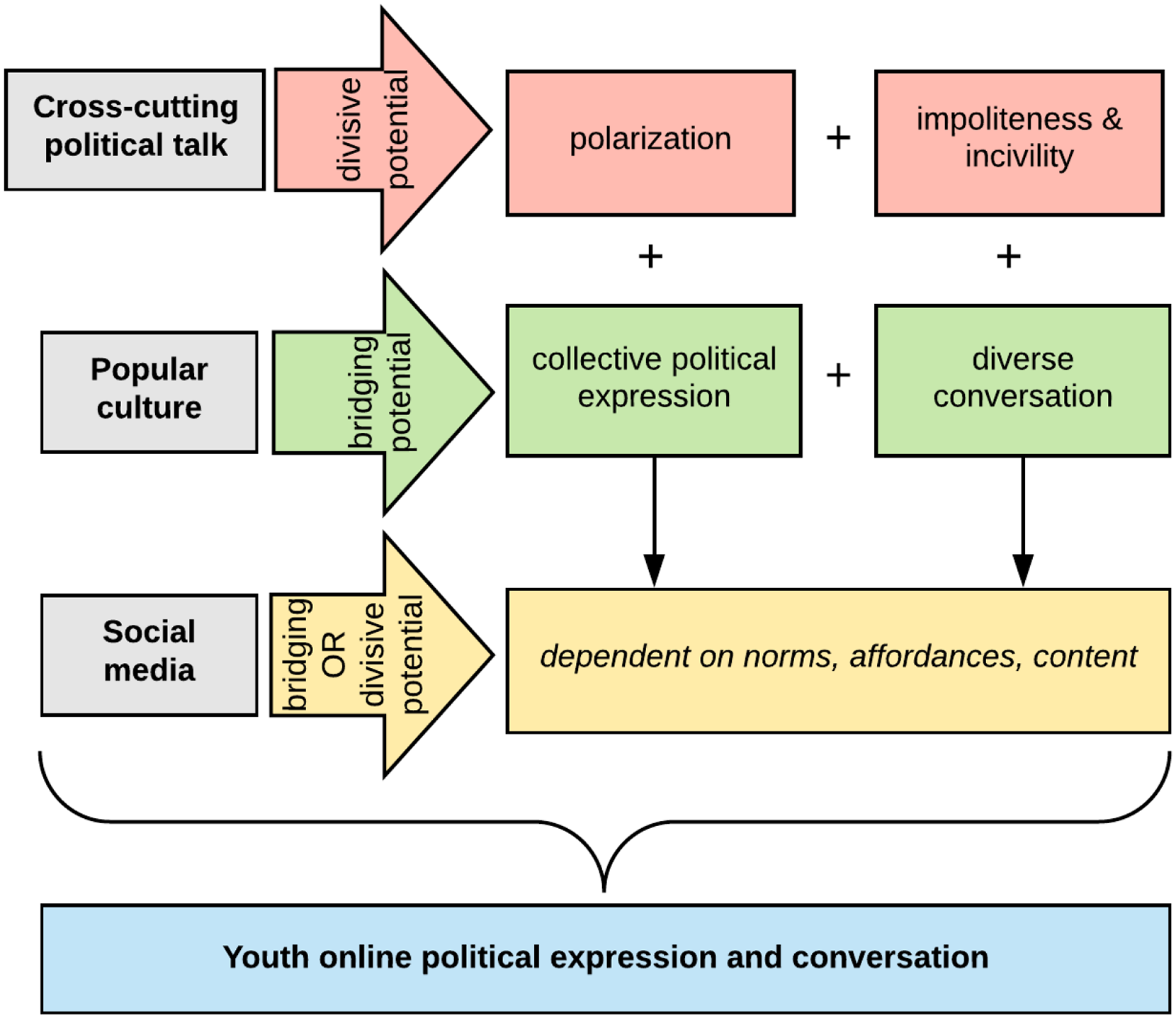
The interplay between popular culture, cross-cutting political talk, and social media in shaping youth online political expression and conversation.
Our cross-platform analysis thus suggests that the bridging potential of popular culture interacts with the divisive potential of cross-cutting political talk; and how this plays out is shaped by the content, norms, and affordances of different social media platforms. While our cross-platform approach was exploratory, we did find notable differences between the platforms in the extent to which they spurred political comments, the political orientation of these comments, and the resulting cross-cutting talk. The most striking case here is Instagram. While the Instagram artifacts were of a political nature comparable to the artifacts on the other platforms, it seems that the norms and affordances of Instagram exerted a depoliticizing influence, with the result of minimal political expression in comments, and no cross-cutting talk at all on that platform. We therefore conceive of these elements as shaping—though not determining—resulting youth cross-cutting political talk as prompted by popular culture.
Our model is thus applicable to a variety of contexts, helping researchers identify relevant variables to consider in examining how popular culture shapes political talk. For example, in our study, we selected the top most-commented artifacts on each platform, which likely shaped the pattern of political expression we found; studies found that video popularity is associated with increased hostility in the comments (Ksiazek et al., 2015). At the same time, our model is also somewhat culturally specific, designed based on the attributes of cross-cutting talk in the current, polarized U.S. context. Future research may examine to what extent these claims also hold in contexts that are less polarized, or more open toward cross-cutting political talk (see, e.g., Mor et al., 2015), as well as for non-youth populations.
At a time when the dominant view about the role of social media for political expression is a fairly bleak one (see, e.g., Quandt, 2018), we suggest—building on existing research (Literat & Kligler-Vilenchik, 2018, 2019; Jenkins et al., 2016)—that popular culture can play an important expressive role for youth, supplying them with symbolic resources to express themselves politically and bringing together diverse audiences. Yet the bridging potential of popular culture is exerted within a tense and polarized political and digital environment, where cross-cutting talk is difficult. At least in our case study, popular culture played only a limited role in enabling youth to overcome some of the problems plaguing cross-cutting dialogue in the current, polarized U.S. society. However, we maintain a sense of cautious optimism, suggesting possible avenues in which youth political expression online, that is deeply rooted in youth interests and passions, may also offer opportunities to productively connect to the other side.
Supplemental Material
sj-docx-1-sms-10.1177_20563051211008821 – Supplemental material for How Popular Culture Prompts Youth Collective Political Expression and Cross-Cutting Political Talk on Social Media: A Cross-Platform Analysis
Supplemental material, sj-docx-1-sms-10.1177_20563051211008821 for How Popular Culture Prompts Youth Collective Political Expression and Cross-Cutting Political Talk on Social Media: A Cross-Platform Analysis by Ioana Literat and Neta Kligler-Vilenchik in Social Media + Society
Footnotes
Declaration of Conflicting Interests
The author(s) declared no potential conflicts of interest with respect to the research, authorship, and/or publication of this article.
Funding
This work was supported by the Spencer Foundation (grant #201900088).

Supplemental Material
Supplemental material for this article is available online.
Notes
Author Biographies
References
Supplementary Material
Please find the following supplemental material available below.
For Open Access articles published under a Creative Commons License, all supplemental material carries the same license as the article it is associated with.
For non-Open Access articles published, all supplemental material carries a non-exclusive license, and permission requests for re-use of supplemental material or any part of supplemental material shall be sent directly to the copyright owner as specified in the copyright notice associated with the article.
