



Abstract
While social media creates the opportunity for exposure and engagement with cross-cutting political views, they may not always be well-received. Drawing on research related to tie strength, the need to belong, and affective intelligence theory, the present study examined how a combination of social and emotional factors informed how social media users respond to exposure to cross-cutting political views. Survey participants (N = 288) were presented with scenarios where they were exposed to cross-cutting views on a self-identified important political topic with a close friend and an acquaintance. Social media response strategies assessed included public (comment), private (messaging), ignoring (scrolling past), hiding (muting), and unfriending–unfollowing. The tie strength of the person posting and emotions toward a political topic were identified as salient factors. Results indicated that if the cross-cutting view was shared by a strong tie, participants were more likely to respond by engaging publicly or private messaging, while cross-cutting views shared by weak ties were more likely to lead to ignoring the post as well as the decision to hide or unfriend. Participants also identified how they felt about the political topic selected (enthusiasm, aversion, or anxiety). Anxiety was largely unrelated to the identified response strategies, while aversion predicted the same responses regardless of tie strength. Enthusiasm predicted public and private response for both ties, and predicted ignoring (negative), hiding, and unfriending for close friends.
Political polarization and fragmentation in the United States have increased in recent years, with little evidence of change for the better (Dimock & Wike, 2020). Indeed, a recent poll found that many Americans experienced significant stress when thinking about engaging in political discussions with people who held different opinions (Van Green, 2021). This is important, as past research has argued that exposure to and engagement with cross-cutting political views may increase knowledge and foster greater tolerance (Min & Wohn, 2020; Mutz, 2012; Mutz & Mondak, 2006). Identifying spaces for exposure and engagement can be one to way to understand the current political climate.
Offline, acquaintances, including colleagues, represent the most common source of cross-cutting exposure (Mutz, 2012; Mutz & Mondak, 2006), while stronger tie relationships, such as family and friends, are more common political discussion partners (Morey et al., 2012; Mutz, 2012). Online, social media provides the opportunity for users to sustain large networks often comprising a diverse mix of strong and weak ties (Bozdag, 2020; Pennington, 2020). This can also increase the potential for diversity in terms of political exposure and discussion with weak ties (Lee et al., 2019). In their study of cross-cutting exposure on social media, Min and Wohn (2020) found that 33.6% of their sample indicated they were exposed to political disagreement often, with an additional 53.5% noting it occurred at least sometimes, and only 1.8% saying they were never exposed to opposing views on social media. Together, this work provides evidence that social media is a space where individuals are exposed to cross-cutting political views. How users choose to respond may have implications for individual relationships and future political engagement, both online and offline.
To better understand the potential to respond, we also turn to research on emotions and politics, including affective intelligence theory (Marcus et al., 2000). Political topics that are of importance may increase the willingness to engage in political disagreement (Bozdag, 2020; Hopmann, 2012; Lu, 2019). Furthermore, when individuals hold strong emotions about a political issue, it can influence their willingness to communicate about that topic both in-person and online (Choi & Lee, 2021; Valenzuela & Bachmann, 2015; Wolak & Sokhey, 2022). In particular, there is evidence that feelings of enthusiasm, aversion, and anxiety may inform engagement (Marcus et al., 2006). Results have been mixed regarding possible effects, however, with Henry and Eveland (2023) suggesting that the source of the emotional affect (e.g., how one feels about a person vs. a political issue) may help to explain variability. In this case, exploring the intersection of emotions felt toward a political issue and tie strength of the person sharing cross-cutting views may offer insight into how social and emotional factors relate to how individuals respond through social media.
Drawing on research related to tie strength (Granovetter, 1973), the need to belong (Baumeister & Leary, 1995), and affective intelligence theory (Marcus et al., 2000) the present study explores social media response strategies when individuals are exposed to cross-cutting political views. Researchers have called for work that assesses the role of tie strength and relational closeness factors when it comes to cross-cutting discussions both online and in-person (Matthes et al., 2021; Peacock, 2019). Furthermore, situating disagreement and politics within the frame of issues that participants see as important can help to shed light on political discussion at a more personal level, including how the intensity of emotions felt influence response (Henry & Eveland, 2023; Marcus et al., 2006). Finally, Chan et al. (2021) argue for research that considers cross-cutting exposure and cross-cutting discussion as distinct constructs; social media may increase exposure to opposing views, but it does not guarantee engagement with someone on that topic. As such, the present study also reflected on strategies of avoidance. In doing so, we seek to provide a clearer picture of engagement and avoidance of cross-cutting political views on social media. In the sections that follow, we discuss the literature on cross-cutting political exposure and engagement through social media and identify possible response strategies. From there, we turn to a discussion of research on tie strength and emotional affect as they relate to how social media users may engage with cross-cutting political content online.
Cross-Cutting Political Exposure and Response Strategies
Research often stresses the value of informal political talk within one’s network for its ability to increase engagement in the political process (Eveland & Hively, 2009). Informal political discussions are characterized as organic rather than deliberative, but can arise from interpersonal and small group interactions in day-to-day life (Eveland et al., 2011). Informal discussions can foster learning and spur further engagement but most often occur with like-minded others (Eveland & Hively, 2009). In considering the effects of exposure and discussion, it is important to consider how individuals respond to conflicting views (Eveland et al., 2011). In this regard, the question becomes, what leads individuals to move from being exposed to cross-cutting views, to engaging in a political discussion with members of their network? Offline, research has focused on strategies that assume a directed interaction occurs. For example, Hopmann (2012) found that greater disagreement on a political issue increased the probability participants attempted to dominate (e.g., fight for one’s own opinion, searching for arguments against the opposing view), while less disagreement led to yielding (e.g., giving in to their opinion). Additional research has also focused on avoidance strategies; Peacock (2019) identified keeping quiet (abstaining) or changing the subject (averting) as common approaches participants reported for responding to disagreement. While these response strategies may apply within the context of social media, most interactions are not directed or happening in real time.
Through social media, exposure to cross-cutting views is often indirect. This is because many features allow users to broadcast content to their whole network asynchronously, rather than one-to-one discussions occurring synchronously (Su et al., 2022). As users’ self-disclosure to their network, context collapse can lead to sharing views unintentionally as well. This form of incidental exposure (happening across political content while scrolling one’s feed) can in some ways mimic the organic nature of informal talk offline, but the features of social media allow for greater variability in how users may respond to opposing views.
As a result, we argue for assessing response strategies through the lens of social media features. This approach to engagement emphasizes social media as a tool that can enable a variety of possible ways to respond (Lane et al., 2022). In this regard, the emphasis is not on what someone says in response, but how they respond. In reflecting on shared features of social media, the present study identified five response strategies to explore further that have been discussed within the literature, which we detail below.
The first three strategies represent avoidance. The most studied strategy is the ability to unfriend or unfollow the person who shares oppositional views, allowing users to avoid further exposure or potential discussion. While early research found the percentage of participants who had ended a relationship digitally due to political reasons was comparatively low (e.g., just 10% in Bode, 2016), recent analyses found that more than a third of participants have unfriended someone for political reasons, cementing this is a strategy used (Barnidge et al., 2023; Neubaum, Cargino, Winter, & Dvir-Gvirsman, 2021). Hiding as a strategy, by comparison, can allow users to keep the connection but limit exposure to content in their feed (Yang et al., 2017). Similarly, ignoring content by simply scrolling past it can be seen as a decision to avoid engagement while maintaining a connection (Bozdag, 2020; Pennington, 2020). The final two strategies represent the potential for an active response, either through commenting or private messaging. For some users the publicness of commenting can be seen as a possible face-threat, discouraging response (Mascheroni & Murru, 2017). Private messaging may be one way to overcome challenges presented from a public response (Neubaum, Cargino, & Maleszka, 2021). In the section that follows, we discuss these five strategies as they relate to specific network ties.
The Role of Relationship Type
Interpersonal networks are comprised of a range of relationships, often represented as strong ties (e.g., close friends, family, romantic partner) and weak ties (e.g., acquaintances, colleagues, neighbors). Strong ties are central to one’s network, serving as a source of bonding social capital (Granovetter, 1973). Weak ties, conversely, are important for their ability to provide bridging social capital, helping to connect individuals to a wider network of resources (Granovetter, 1973). This is particularly true in the case of social media, wherein the increase in network size online is often a greater number of weak rather than strong tie relationships (Lee et al., 2019; Pennington, 2020). Within these categories, acquaintances, classmates, and colleagues are often identified as weak tie connections sustained on social media, while close friends and family typically represent strong ties maintained (Bozdag, 2020; Pennington, 2020).
Although research has often argued informal political talk in-person is more likely to occur among strong ties (Morey et al., 2012; Mutz, 2012), research on political disagreement and tie strength is mixed. Individuals may feel more comfortable expressing opposing views within stronger network ties, as the relationship is more stable (Morey et al., 2012). At the same time, individuals may be afraid of hurting a relationship (even if it is established) and thus refrain from engaging with opposing views, particularly in the case of friendship. One way of understanding this is the need to belong (Baumeister & Leary, 1995). The need to belong argues that humans desire connection and will seek to avoid ending relationships to continue to satisfy that need. When individuals are motivated to form or sustain social connections, they may avoid political disagreement on social media so as not to harm their relationships (Chan et al., 2021; Mascheroni & Murru, 2017; Pennington & Winfrey, 2021). This would suggest that, particularly in the case of close friends, users may refrain from engaging in cross-cutting discussion through social media to protect that relationship.
Indeed, concerns about one’s relationships often predict avoiding political discussion (Bozdag, 2020; Mascheroni & Murru, 2017; Pennington & Winfrey, 2021). This argument is supported by the body of research on unfriending in response to political content, with much of the existing literature finding that those who are unfriended are weak ties (John & Dvir-Gvirsman, 2015; Neubaum, Cargino, & Maleszka, 2021; Neubaum, Cargino, Winter, & Dvir-Gvirsman, 2021; Yang et al., 2017). Even outside of the context of politics, Pennington (2020) found that social media users are more likely to unfriend a weak tie over a strong tie. In this regard, the social cost of ending a weak tie relationship is lower, with users able to sustain their network needs by focusing on stronger relationships within their network. Collectively, this supports unfriending as more common with weak ties compared with strong ties, thus we pose the following hypothesis:
H1: Social media users are more likely to unfriend-unfollow weak ties (acquaintance) with opposing political views compared with strong ties (close friend).
Although ignoring content has been identified as a strategy, it has not necessarily been tied to one relationship more so than another (Neubaum, Cargino, & Maleszka, 2021; Pennington, 2020). Part of the decision to ignore may be because of a perception that response requires public engagement; as social media posts invite discussion with one’s entire network, the risk of additional comments from other users could also lead to avoidance (Neubaum, Cargino, & Maleszka, 2021; Neubaum, Cargino, Winter, & Dvir-Gvirsman, 2021), highlighting a broader network effect. Hiding has also been identified as a strategy, with Yang et al. (2017) suggesting that this may be more common with weak ties based on their finding that participants with larger networks engaged in greater filtering behaviors. At the same time, Bozdag (2020) emphasized ignoring and hiding as ways to keep the friendship but avoid the politics, consistent with our theorizing about the need to belong driving avoidance strategies. As the existing literature is inconclusive on how hiding and ignoring relate to tie strength, we pose the following research question:
RQ1: Are there differences in a person’s decision to (a) hide and (b) ignore when social media users are exposed to opposing political views from strong versus weak ties?
Active response strategies (i.e., public and private response) while often touted as an end goal, are less studied. As previously shared, Neubaum, Cargino and Maleszka (2021) explored response strategies through interviews, with some participants noting that for strong ties they would be more likely to use a private channel (e.g., direct message) to confront a disagreement and share their views. Participants also noted they would respond directly to posts that had misinformation or to better understand the motives behind the poster’s opinions. In this regard, tie strength may be more predictive of a lack of engagement through avoidance strategies, but further work is needed to make sense of active strategies. As such we pose the following research question:
RQ2: Are there differences in a person’s decision to (a) comment publicly and (b) direct message privately when social media users are exposed to opposing political views from strong versus weak ties?
The Role of Emotions
In addition to relationship type, prior evidence suggests that emotions can play a role in decision-making regarding politics (Marcus et al., 2000, 2006). Affective intelligence (AI) theory argues that emotions inform choices for how individuals respond and engage in politics. This can include attention to political topics, engaging in political talk, and other political behaviors (e.g., voting) (Marcus et al., 2000, 2006). AI situates three dimensions of emotions: enthusiasm, anxiety, and aversion (Marcus et al., 2006). Enthusiasm represents “positive” emotions, including pride and hope. Anxiety is the first of two “negative” dimensions and includes emotions such as afraid and worried. While past research often operates from a two-dimension (one positive, one negative) measurement of emotions, Marcus et al. (2006) argues for the importance of integrating aversion as a third dimension, representing emotions such as angry and bitter. More specifically, Marcus et al. argue that, when confronted with opposing views, aversion and anxiety emerge as two separate negative dimensions. Although research on AI and emotions has been previously applied to political discussion and social media, results have been mixed, supporting the need for further study.
Positive emotions (enthusiasm, pride, hope) have demonstrated the greatest predictive value in explaining political engagement. Valenzuela and Bachmann (2015) note that an individual’s pride in their views about a political candidate was a reliable predictor of willingly exposing themselves to opposing views. While Wolak and Sokhey (2022) found enthusiasm was related to engagement in political expression on social media, it was not related to engaging with oppositional views, but instead, was more predictive of discussion with like-minded members of one’s network. Importantly, the look at opposing and like-minded discussion partners presumed in-person discussion, so it may be that the significant finding about expression online would extend to cross-cutting views. For example, Choi and Lee (2021) found that enthusiasm toward an opponent helped to allow for cross-cutting discussion on social media, which may also extend to enthusiasm about a political topic.
In the case of aversion, Wollebaek et al. (2019) found that anger was related to a greater probability of engaging not only with those who held the same views but opposing views as well. While not the primary focus of their study, Bozdag (2020) also quoted a participant who discussed how being “blinded by anger” led to responding and commenting on oppositional posts on social media (p. 7). At the same time, Neubaum, Cargino and Maleszka (2021) quoted participants who found that anger led to withdrawal from that relationship, as users experienced frustration that someone they know would hold opposing views (p. 194). In Wolak and Sokhey’s (2022) study, increased anger was negatively related to engagement with cross-cutting discussion about a political candidate; however, this was in a general sense, and not through social media specifically. This same study did find that greater feelings of anger predicted social media political expression (Wolak & Sokhey, 2022), which may show that in a mediated context users feel more comfortable engaging compared with in-person. Offline, Valenzuela and Bachmann (2015) found that anger about a political candidate was not a reliable predictor of participation in cross-cutting discussions. This could suggest that anger is more related to broadcasting one’s views rather than engagement or interaction with cross-cutting views on social media.
Anxiety (feelings of fear and worry) is most often associated with information-seeking behaviors to reduce uncertainty (Marcus et al., 2006; Wollebaek et al., 2019). As Marcus et al. (2006) explain, anxiety is more likely when confronted with oppositional views. In support of this, Wollebaek et al. (2019) did not find a relationship between social media discussion and fear but did find that greater fear was related to a greater chance of seeking out information from the opposing side. However, Lu (2019) found that anxiety in the case of a political topic that was highly relevant to participants did encourage greater corrective political participation, which included engaging in discussions on social media about that issue. Lyons and Sokhey (2014) also found that out-party fear predicted greater engagement.
Collectively, while the influence of a specific emotion appears to vary across past work, a more consistent takeaway appears to be that more intense emotions are linked to greater participation. Ultimately, while there are some trends related to emotions and engagement in politics, less is known in terms of social media encounters and cross-cutting discussion specifically. Furthermore, there is very little work on how tie strength in combination with emotion toward a topic informs engagement and response (i.e., do we see emotions shift expectations for response with strong and weak ties?) As such, we pose the final research question:
RQ3: Are there differences in how emotions felt toward a political topic (enthusiasm, anxiety, and aversion) inform how social media users respond (unfriend-unfollow, hide, ignore, publicly comment, or privately direct message) to opposing political views from strong versus weak ties on social media?
Methods
Participants
A total of 288 participants completed the survey, of which 170 (59%) were recruited through Amazon’s Mechanical Turk (MTurk) and 118 (41%) were students recruited through a research pool at a large southwestern university. An additional 26 individuals started the survey but were not eligible for participation (e.g., did not use social media), of which the majority were from the MTurk sample (65.3%). Participants from MTurk were paid US$1.25 upon successful of the survey, while students received extra credit for a current communication course upon completion. Participants were recruited through multiple means to ensure greater sample diversity and representativeness (Weigold & Weigold, 2022).
Participants ranged in age from 18 to 63 (median = 30, M = 30.43, SD = 10.53). Just over half of the participants identified as female (55.6%, n = 160), and the remaining identified as male (44.4%, n = 128). Participants were allowed to select all that applied for race-ethnicity, with the majority identifying primarily as White (62.5%), followed by Hispanic/Latino/a (20.1%), Asian (14.2%), African American/Black (11.8%), Native American/Indian (2.4%), Pacific Islander (1.7%), and Other (.3%). The plurality of participants was either currently in college (36.1%) or had completed a 4-year degree (33.7%). Of the remaining participants, 14.6% had completed high school, 6.6% had a 2-year degree, and 7.3% had an advanced degree (e.g., MA, PhD).
Participants primarily identified as Democrats (58%), followed by an equal number of Independents and Republicans (19.4% each). The remaining 3.1% selected Other. Responses shared included Green Party, Libertarian, and non-partisan. Of those who selected Independent or Other, 48.2% leaned Democrat, 21.4% leaned Republican, and the remaining 30.4% stated they did not lean either way. In terms of social media use, most participants had an Instagram account (77.1%), followed by Facebook (66.3%), and Twitter (54.9%). A third of participants indicated they used all three sites (34%), with Instagram ranked the most used (43.1% of those who use two or more sites). While participants did not report on their individual site use frequency, they did share their general typical use of social media. Roughly a third (34%) of participants reported they spent 45–75 min a day on average on social media, with 32.6% spending 44 min or less on social media daily, and the final third (33.3%) spending 76+ min on social media each day. Finally, participants reported on average having 515.99 friends or followers on social media (SD = 769.50).
Procedures
Following institutional review board (IRB) approval, the study was made available to potential participants through MTurk and a large southwestern university student research participation pool. To be eligible to participate from MTurk, a user must have completed at least 1,000 prior studies and had a 99% acceptance rate for prior studies completed. These requirements were used to help filter out potential bots and ensure data quality (Thomas & Clifford, 2017). Participants from the university were currently enrolled in a basic course in communication (e.g., public speaking) and provided the opportunity to select from a variety of available studies for participation. For both samples, the survey began with the informed consent form and screening questions to determine eligibility, which required that participants be at least 18 years of age and regularly use Facebook, Twitter, or Instagram to interact with friends and family. Those who passed the screening were then provided with a definition of what counts as politics. A definition is recommended to ensure participants understand what counts as politics for the sake of the study (Eveland et al., 2011). In this case, the definition and instructions provided read: What do we mean by politics? This includes topics like: neighborhood and community affairs (e.g., decisions about a neighborhood watch crime prevention program), local and state concerns (e.g., school board disputes and/or sales taxes), national issues (e.g., health care, social welfare programs, and/or foreign affairs), as well as broad cultural and social issues (e.g., civil rights, moral values, and/or the environment). (definition from Moy & Gastil, 2006, p. 448)
Based on that definition, participants were asked to share a political topic they felt was important to them at this time, with the instructions stating: Keeping this definition in mind, what political issue do you believe is the most important to you right now? Coding of responses identified 39 different topic categories, with the most shared including climate change/global warming (26.8%), healthcare (15.8%), and equal rights (8.6%). Participants were later asked to identify how important the topic was to them (1 = not important, 5 = very important), with a mean score of 4.66 (SD = .58) reported, suggesting participants for the most part felt very strongly about the topic chosen. The selected topic was used to answer a series of questions regarding different emotions they had in relation to the topic, and to consider how they would respond if a close friend or an acquaintance posted on social media about that topic in opposition to their views. Participants also answered questions regarding their general social media use, communication about politics within their network and demographics.
Measures
For the political issue identified as most important, participants were asked to identify how much (1 = not at all, 5 = very much) the topic elicited different affective responses (emotions). Using Marcus et al.’s (2006) measure of emotional response, the study included three categories: enthusiasm, anxiety, and aversion. Enthusiasm included three items: enthusiastic, hopeful, and proud (α = .87, M = 2.60, SD = 1.22). Anxiety also included three items: scared, worried, and afraid (α = .89, M = 3.65, SD = 1.09). Finally, aversion consisted of four items: hateful, angry, bitter, and resentful (α = .87, M = 2.62, SD = 1.03).
To measure response to disagreement, participants were asked to reflect on social media disagreement within the context of two relationship types they relate to through social media: a close friend and an acquaintance. In the present study, a close friend represented a strong tie relationship, with acquaintance representing a weak tie relationship. These were chosen based on commonly reported relationship types through social media for each category. For each relationship participants were provided with the same instructional text: You see [relationship type] share a post about [piped text political issue] on social media, and it turns out their views on that issue differ from your own. Participants were then asked to identify how likely (1 = not at all likely, 5 = very likely) they were to respond in a particular way to the post, representative of five distinct choices one can take across platforms: public response (respond directly to the post), private response (direct message the person about the post privately), ignore (keep scrolling and don’t engage with the content), hide (mute or unfollow the person’s content), and end the connection (unfriend or unfollow the person). These response types were chosen as they can be equally applied across the three sites allowed (Facebook, Twitter, or Instagram).
Finally, in addition to the above-mentioned measures, this study also included the following demographic, political, and social media items as control variables for analysis: sex (female), age, education, race (white), political party (democrat), political knowledge (single item, 1 = not at all knowledgeable, 5 = very knowledgeable), time spent on social media, and their average number of friends–followers across platforms.
Results
To assess the effect of tie strength on how one responds to cross-cutting views shared on social media, a series of paired t-tests were conducted. As Table 1 shows, a significant difference was found for response strategy depending on if it was a close friend (strong tie) or an acquaintance (weak tie). More specifically, if the opposing views were expressed by a close friend, participants were more likely to respond through a public post or private message (RQ1). If the cross-cutting views came from an acquaintance, participants were more likely to ignore or hide (RQ2), and, in full support of H1, unfriend that person.
Paired T-Test for Response to Social Media Disagreement by Relationship Type.
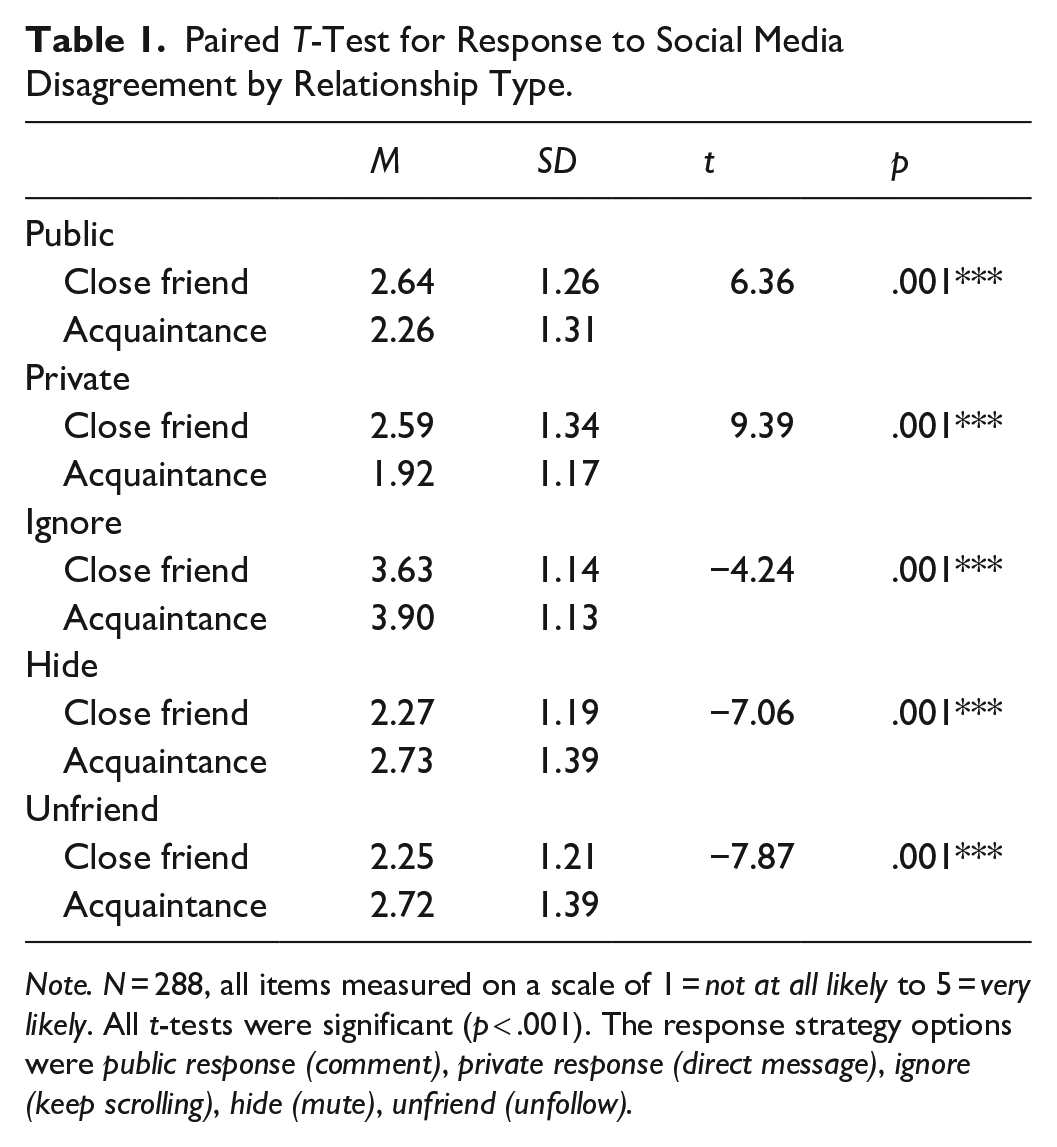
Note. N = 288, all items measured on a scale of 1 = not at all likely to 5 = very likely. All t-tests were significant (p < .001). The response strategy options were public response (comment), private response (direct message), ignore (keep scrolling), hide (mute), unfriend (unfollow).
RQ3 asked how the strength of emotion (anxiety, enthusiasm, aversion) regarding a political issue relates to how someone responds to cross-cutting views on social media. Table 2 shares the result of initial correlation analysis, which suggests that for most strategies emotions played a role. To better understand these results, a series of multiple regressions were conducted to explore emotions by response type and relationship. For each regression demographic, political, and social media items were entered first as control variables for analysis (Table 3). These analyses found that anxiety was not predictive of response strategies for acquaintances and was only a weak negative predictor for the ignoring strategy for close friends. Greater feelings of aversion predicted the same response strategies regardless of tie strength, showing evidence that feelings of anger were predictive of engaging in a response through public and private social media features but also the potential to hide or unfriend. Finally, enthusiasm produced similar results between strong ties and weak ties, wherein greater enthusiasm was a predictor for both public and private response. Enthusiasm was also a significant positive predictor of hiding or unfriending and negative predictor of ignoring a close friend, but not an acquaintance.
Correlation Matrix for Emotions and Response to Disagreement by Relationship Type.
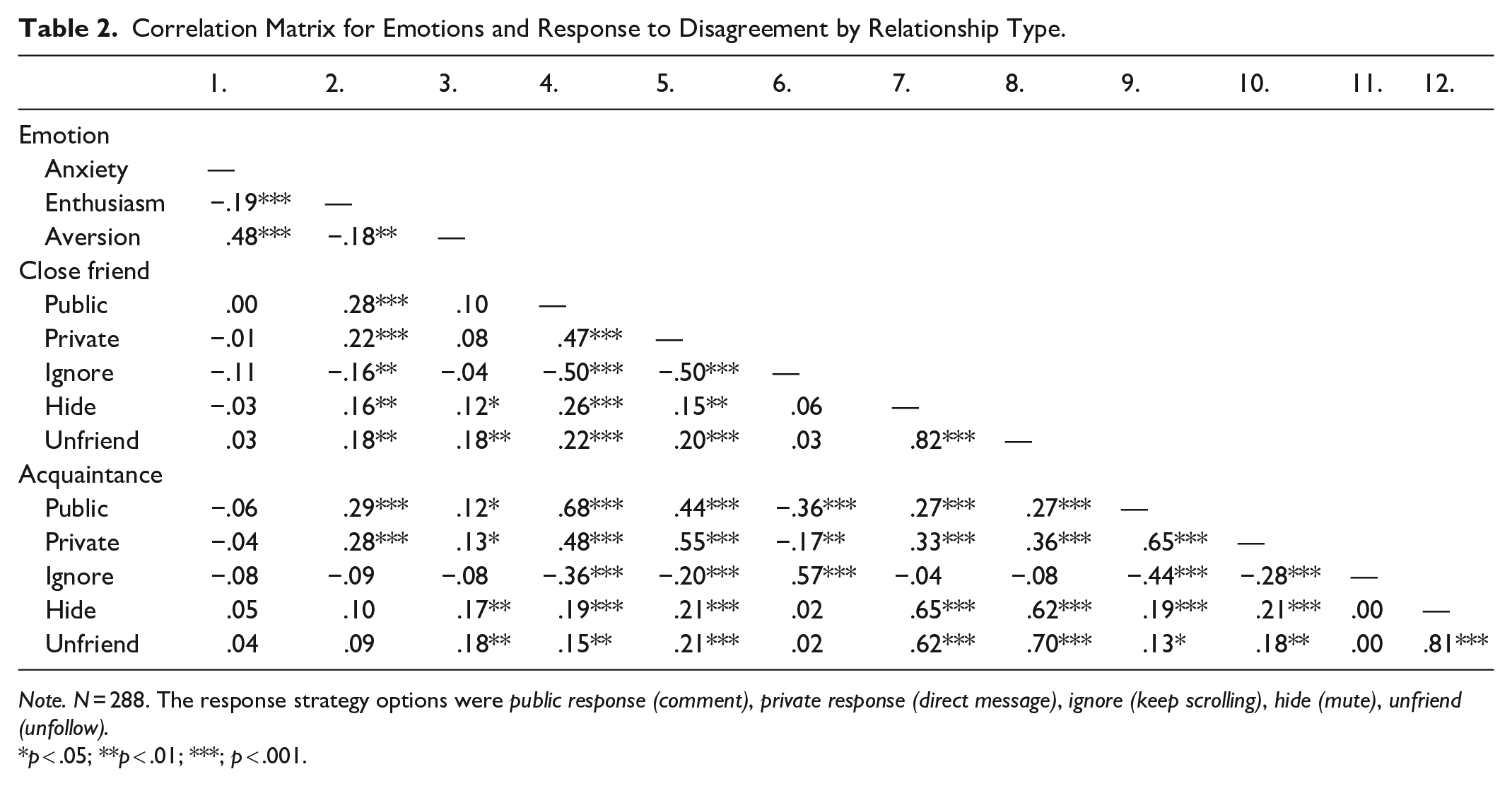
Note. N = 288. The response strategy options were public response (comment), private response (direct message), ignore (keep scrolling), hide (mute), unfriend (unfollow).
p < .05; **p < .01; ***; p < .001.
Multiple Regression Analysis by Relationship Type.

Note. Standardized Beta (B) and standard error (SE) reported are for final full model, r-square change reported is for inclusion of the predictor variables (emotions).The response strategy options were public response (comment), private response (direct message), ignore (keep scrolling), hide (mute), and unfriend (unfollow).
p < .05; *p < .01; ***p < .001.
Discussion
The present study gives insight into how social and emotional factors inform response strategies when exposed to cross-cutting political views on social media. Our results emphasize the tension users experience between the emotions felt toward a political issue and the tie strength of the person sharing opposing views when determining how they will respond in a more public environment. Critically, we approached the study from the frame of political topics that are perceived as important to participants, which can promote engagement (Mascheroni & Murru, 2017). The ability to self-identify an important topic helped to assess how feelings of enthusiasm, anxiety, and aversion relate to response strategies for strong and weak ties.
A primary takeaway from our study is that participants were more likely to engage in active response strategies with strong ties, both publicly and privately. While active strategies were still less commonly selected overall, these results do support the literature offline regarding tie strength and disagreement. The decision to engage close friends may point to the investment in that relationship. When individuals feel comfortable with someone, the risk-reward for engaging in disagreement can lessen, increasing the chance for communication across political lines (Matthes et al., 2021; Morey et al., 2012). Individuals may also feel a stronger desire to understand the opposing view when it comes from a close friend (Bozdag, 2020; Neubaum, Cargino, & Maleszka, 2021). Responding to a close friend may be a form of information seeking to reduce the uncertainty produced when a strong tie offers conflicting views.
Weak tie relationships, conversely, signaled a greater probability of engaging in avoidance strategies. This is largely consistent with past research on unfriending (John & Dvir-Gvirsman, 2015; Neubaum, Cargino, & Maleszka, 2021; Neubaum, Cargino, Winter, & Dvir-Gvirsman, 2021; Pennington, 2020; Su et al., 2022) while offering support for prior speculation that hiding and ignoring may be more common with weak ties (e.g., Yang et al., 2017). The loss of weak ties online has implications both in terms of political communication and interpersonal relationships that are worth further study. Weak ties can be a key source of bridging capital (Granovetter, 1973), and can increase exposure to diverse political views that may facilitate greater learning and future political engagement (Mutz, 2012).
The emotions tied to the political issue in question add another layer of understanding to response strategies and tie strength. When participants experienced greater enthusiasm about a topic, it signaled a greater likelihood of both engaging in communication with a close friend (publicly and privately) but also a greater likelihood of hiding or unfriending. This tension in results may be partially explained by topic and the severity of the disagreement. Indeed, participants may have felt at odds when an opposing view came from a strong tie. This is further supported in comparison to the findings for acquaintances, wherein greater enthusiasm predicted active response but was not tied to hiding or unfriending. In their work on engagement with opposing political views on Facebook, Neubaum, Cargino, & Maleszka (2021) noted when participants saw differences as unresolvable, tie strength could increase the probability of unfriending (p. 199). Similarly, Bozdag (2020) noted that for some participants, tie strength was irrelevant in the decision to unfriend if that person held unacceptable political views.
That enthusiasm predicted active engagement strategies for both strong and weak ties is, however, consistent with past research (Choi & Lee, 2021; Valenzuela & Bachmann, 2015) and affective intelligence theory (Marcus et al., 2006). This makes sense insofar as one’s pride or excitement regarding a topic can help to make informal political discussion an enjoyable activity where their beliefs are validated and reinforced (Valenzuela & Bachmann, 2015). Importantly, this offers evidence that emotions felt toward a topic may differ from research on emotions held toward a political party or candidate. High enthusiasm among participants may forecast that the mood will remain light, and no one will suffer the discomfort of feeling their views have been challenged despite conflicting opinions.
Aversion was also strongly tied to the response strategies identified in the present study, and offer a case where emotion drove response, more so than tie strength, as the results identified were true of both close friends and acquaintances. Consistent with Wollebaek et al. (2019), aversion predicted active engagement strategies. That tie strength did not influence engagement strategies in the case of aversion also offers support for previous qualitative work from Bozdag (2020) and Neubaum, Cargino and Maleszka (2021). In each case, individual participants noted anger influencing response strategies. Like enthusiasm, aversion also predicted avoidance strategies. In the present study participants reported the probability of engaging in each strategy, suggesting that for some, these strategies may occur in combination (e.g., commenting and then unfriending, or hiding but also private messaging). Future work is needed to better understand these results and interactions.
Finally, while the most reported emotion was anxiety, it was only a significant negative predictor for ignoring in the context of a close friend. This aligns with research that suggests anxiety may be more likely to lead toward information-seeking rather than engagement (Chan et al., 2021; Wollebaek et al., 2019). That anxiety was related for close friends and not acquaintances could signal the discomfort experienced when a strong tie holds oppositional views, resulting in additional information seeking on the topic.
Our results also situate the value of exploring a broader range of response strategies when confronted with cross-cutting political views on social media. The features of social media create the potential for users to take a multitude of paths when exposure occurs. Public versus private response strategies have been less studied, despite initial evidence that users may choose private channels for engagement (Neubaum, Cargino, & Maleszka, 2021). Private response may be indicative of a relational focus and desire to better understand the other side. Private responses may also help avoid unknown audiences, as a response on a public post could risk interaction with other network ties, not just the original poster (Mascheroni & Murru, 2017).
In this same vein, it is also worth noting that participants were more likely to ignore (keep scrolling) rather than engage in a directed response or take action to hide or unfriend for both strong and weak ties (Table 1). This is not inconsistent with past research (e.g., Neubaum, Cargino, & Maleszka, 2021; Pennington, 2020) and pushes back against fears that social media contributes to echo chambers. Which is to say, while weak ties are more likely to be unfriended than strong ties, in the present study, unfriending was less commonly reported. While users do not always actively engage with cross-cutting views through comments or direct messages, participants in this study primarily opted to continue exposure rather than hiding or ending a relationship. This is important to consider as some research suggests that exposure to cross-cutting views, not necessarily engagement with others who hold those views, may be sufficient to counter act political polarization and spur engagement (Barnidge et al., 2023; Chan et al., 2021). In this case, participants relational needs (e.g., need to belong, Baumeister & Leary, 1995) may in part explain the decision to not end the relationship virtually. Social media use can help fulfill belongingness needs, with the perceived benefits of connection outweighing costs of exposure.
Limitations and Future Directions
While the results of the present study may not be generalizable to the general population, they do show some alignment with the typical demographics of social media users (Auxier & Anderson, 2021). The present study also did not account for potential platform variations within one’s network. Users were directed to consider their use of social media broadly. Some response strategies may be more tied to one platform over another. That said, the present study limited response strategy options to only those that crossed the three platforms used in this study. Future work that explores features across platforms could allow the potential to consider additional response options, such as retweeting, reacting, sharing a post, or responding in a story that are more platform specific (Lane et al., 2022). Similarly, platforms that are more private, such as WhatsApp, may present the opportunity for individuals to have more control, and as a result, comfort, engaging in political disagreements digitally (Gil de Zúñiga et al., 2021).
Another possible limitation is the range of political topics identified. Participants were directed to reflect on the political topic they viewed to be most important in their life, which resulted in over 30 topics shared. Some response strategies may be more common in the context of moral issues (Neubaum, Cargino, & Maleszka, 2021; Neubaum, Cargino, Winter, & Dvir-Gvirsman, 2021). Issues related to identity politics have also been linked to avoidance (Kligler-Vilenchik et al., 2020; Yarchi et al., 2021), and more controversial topics may hamper discussion (Matthes et al., 2018). Topics that are niche or have a direct effect on participants may also reflect stronger emotions, informing response strategies (Lu, 2019). Future work exploring issue type may find greater variance in strategies than the present study.
Similarly, the present study did not assess outcomes based on response strategies from a relational standpoint. Matthes et al. (2018) suggest that unfriending on social media may be seen as “exerting social pressure” and influencing future communication on part of the person who was unfriended (p. 7). While the study asked participants to imagine a close friend or acquaintance for response, no data were collected regarding the person who they considered, and as such there may be additional variance unaccounted for. In addition, emotion toward a person, rather than the topic itself, may also influence engagement (e.g., liking, Barnidge, 2018). Future work looking at specific network members may help to shed light on this phenomenon.
Ultimately the results of our study encourage continued research into the intersections that drive political engagement with cross-cutting views online, particularly in the case of tie strength and emotional affect. Through our study we have identified possible factors that contribute to engagement with cross-cutting political views online, and future work should continue to build on these findings to better understanding how social and emotional factors may inform engagement following exposure. Accounting for additional interpersonal and psychological variables may help to shed light on the unique context that is social media as a site for political exposure and discussion.
Footnotes
Data Availability Statement
A variance–covariance matrix and variable-level descriptive statistics are available via email from the corresponding author, Dr Natalie Pennington:
Declaration of Conflicting Interests
The author(s) declared no potential conflicts of interest with respect to the research, authorship, and/or publication of this article.
Funding
The author(s) disclosed receipt of the following financial support for the research, authorship, and/or publication of this article: This research was supported through funding from the Communication Studies department at the University of Nevada, Las Vegas.
