




Abstract
There are growing concerns that social media exacerbates the selective exposure of audience members to content that supports their political views. However, despite the hype, the existing literature does not fully address the extent to which social media users selectively consume like-minded news stories, in part due to different methodologies. In an attempt to move toward a common framework, this study examined the partisan selective exposure of a representative sample of Twitter users by combining survey data with digital trace data. Specifically, the study linked survey responses (n = 558) from Twitter users with their media following and exposure to news via their friends. The study found that selectivity bias was present in all types of data, including self-reported media consumption (survey), media following (Twitter), and indirect exposure to media (Twitter). However, the study found some differences between self-reports and digital measures such that the overlaps in media diets between partisan groups were much larger based on the digital trace data than the self-reported data. In addition, the study observed an asymmetric pattern of selective exposure between conservatives and liberals in the digital trace data, but not in the self-reported data. The implications of these findings are discussed with reference to the contemporary news environment, hostile media effects, and normative assumptions of selective exposure.
Introduction
Social media is commonly described as a space where users are enclosed in a media bubble of their own. This behavior is termed selective exposure, and it refers to an individual’s preferences for information that is consistent with their pre-existing beliefs (Iyengar & Hahn, 2009; Sears & Freedman, 1967; Stroud, 2008). There has been mounting concern about partisan behaviors on social media, in that users can easily filter out disagreeable information through various tools (e.g., following). This intuition has led to the popular belief that partisan social media users share little common ground, coalescing into ideological echo-chambers (Sunstein, 2018).
However, recent empirical studies using traced data have found that partisan segregation via the news media is not prevalent. For example, studies examining the browsing behaviors of Internet users have shown that media consumption habits are highly comparable across the political spectrum (Dvir-Gvirsman et al., 2016; Guess, 2020; Mukerjee et al., 2018; Nelson & Webster, 2017). Similarly, studies of the media diets of social media users have reported a moderate amount of cross-media exposure among partisans (Bakshy et al., 2015; Barberá et al., 2015; Eady et al., 2019). This line of research generally highlights overlaps in media consumption between partisan groups, contrary to differences.
The observed common media repertoire between partisan groups is reasonable given that media choices can be influenced by external forces that drive mass attention (e.g., popularity of a source, reputation, and availability) in addition to internal forces such as partisanship (Webster, 2014). One common characteristic of these recent studies is that they investigated the media consumption patterns of individuals in real news environments, rather than in a laboratory setting with a limited choice of media. That is, when given a choice, partisans would prefer pro-attitudinal sources and messages. However, such an individual partisan tendency may not be as strongly pronounced when other competing factors are also in play.
Against this backdrop, this study examined the media diets of social media users by adopting the emerging research trend (Dvir-Gvirsman et al., 2016; Eady et al., 2019; Guess, 2020) that combines survey responses with digital trace data. More specifically, this work examined how a representative sample of Twitter users in the United States selectively consumed news media based on three different measures: individuals’ perception of ideological news consumption on Twitter, actual following of news media, and exposure to news messages via friends.
Importantly, this study focused on two phenomena. First, a series of analyses were conducted to investigate whether media choices were a function of political ideology across different measures. Second, the study examined the extent to which the media diets of partisan groups overlapped in three different measures. Furthermore, based on the recent evidence of ideological asymmetry in media behaviors, the study explored whether there was a substantial difference between liberals and conservatives in the tendency for selective exposure.
Consistent with the principle of selective exposure, the results showed that the ideological slant of the media diet of Twitter users was significantly associated with their political predisposition. This pattern was consistent across different measures of media diet, including self-reported measures or behavioral measures from digital trace data. Despite such a partisan tendency, partisan groups had a moderate amount of overlap in terms of their media diets. In particular, the overlap was a lot larger based on digital trace measures than self-reported data. In addition, the study found that selective media exposure was more pronounced among liberals than conservatives in digital trace data, but not in self-reported data. The implications of these findings are discussed with reference to the roles of the contemporary news media landscape.
Literature Review
Selective Exposure at the Individual Level
Partisan selective exposure has been an ongoing topic of debate for more than half a century. It is concerned with the tendency of people to selectively attend to news sources that are aligned with their own views (Iyengar & Hahn, 2009; Sears & Freedman, 1967; Stroud, 2008). Exposure to diverse points of views is normatively desirable because a well-functioning democracy requires citizens to weigh in on both sides of an issue. Therefore, intense selective exposure has been regarded as a threat to civil society (Stroud, 2017).
A number of frameworks have been proposed to explain why selective exposure occurs. A widely adopted account is that people experience an unpleasant state of psychological tension (i.e., cognitive dissonance) when confronting contradictory cognitions (Festinger, 1957). This theory argues that people avoid opinion-challenging information because it causes mental discomfort. Another explanation is that selective exposure takes place because attitude-consistent messages are perceived to be higher in quality or credibility than incongruent messages (Fischer et al., 2008; Metzger et al., 2020). In addition, some argue that it requires more cognitive effort to process disagreeable information than agreeable information (Ziemke, 1980).
Although it is not clear which mechanism best accounts for selective exposure, scholars generally agree that political ideology or partisanship is associated with a bias in media consumption. For instance, two well-known experimental studies (Iyengar & Hahn, 2009; Stroud, 2008) reported that partisans are more likely to select news from media brands that match their ideology. In particular, the study of Iyengar and Hahn (2009) showed that selective exposure based on partisanship holds not only for news coverage of controversial issues but also for soft news such as travel. Another study (Garrett, 2009) used a simulated online news environment and found that partisan news readers are more likely to select news stories that confirm their own views.
More recently, research on selective exposure has received renewed interest due to changes in the media environment that have arguably led to increased media selectivity bias. Today, media consumers have more options to choose from for their information sources, including highly partisan news outlets (Barnidge & Peacock, 2019). In addition, people now have more tools to customize their news feeds (Sunstein, 2018). For example, social media users can follow preferred news channels (or unfollow opposing news channels) and share news that they think is important with their social media friends. Studies that have examined social media users’ attention to news have consistently documented a pattern that supports the notion of selective exposure (Bakshy et al., 2015; Barberá et al., 2015; Eady et al., 2019).
In line with this evidence, this study tested whether political ideology predicts a bias in media diet among Twitter users. However, this study extends past work by examining both self-reported data and behavioral data. Self-reported media consumption data, albeit useful and widely examined, are known for being subject to systematic biases such as overreporting or underreporting caused by memory errors (Araujo et al., 2017; Guess, 2015; Prior, 2013) or other psychological motivations (Hart et al., 2020; Kreuter et al., 2008). To overcome these issues, in addition to the survey data, the study adopted two additional types of digital measures—one for direct media following on Twitter and the other for indirect exposure to media messages via Twitter friends. These behavioral measures reflect distinctive concepts. Whereas media following reflects a more intentional act to pay attention to certain media, exposure through friends is an indirect measure because the types of media that the user encounters depend largely on the user’s network (i.e., level of homophily). Although the underlying mechanisms of the three measures may be different, an individual’s political ideology can still be a factor that consistently influences ideological media consumption. Therefore, the following hypotheses were tested:
H1. Twitter users’ political ideology predicts a slant in their self-reported news media consumption.
H2. Twitter users’ political ideology predicts a slant in their news media following.
H3. Twitter users’ political ideology predicts a slant in their exposure to news media via friends.
Overlap in Media Diet Between Partisan Groups
A positive association between individual political ideology and ideological media consumption does not indicate that partisans expose themselves exclusively to like-minded sources. Stroud (2017) argues that, unlike in a laboratory setting, selective exposure in the real environment is not an all-or-nothing phenomenon. There are many other factors that can influence media choices. People may select news that is readily available in their media environment or that is popular (Webster, 2014). They may also be motivated to arrive at correct conclusions (i.e., accuracy motivation) rather than to reach preferred conclusions (i.e., directional motivation) (Hart et al., 2009).
Taking this perspective leads to an investigation of overlap (similarity) in media repertoire between partisan groups. A number of previous studies (Bakshy et al., 2015; Eady et al., 2019; Guess, 2020) found a moderate level of selective exposure among news audiences, leaving room for an overlap between partisan groups. For example, Bakshy et al. (2015) found that partisan Facebook users are exposed to a considerable amount of cross-cutting news stories through their friends. In addition, Eady et al. (2019) found that the media diets of conservatives and liberals are not strikingly different in terms of ideological distribution. Although it was not in the news context, another study found that only some users form ties with other users on social media based on political like-mindedness (Cargnino & Neubaum, 2020).
Building on this prior work, this study examined the extent to which the media diets of Twitter users converge (or diverge). This approach allows researchers to compare audience fragmentations over time or across different platforms. Although there is no threshold that indicates a troubling sign for a partisan divide, tracking snapshots of partisans’ media consumption may be used as a useful reference for future research (Guess, 2020). In addition, self-reported versus digital trace measures provide an opportunity to examine any potential bias that exists from relying solely on self-reported data for diagnosing polarization. Therefore, the following question was examined:
RQ1. How much overlap do partisan groups exhibit in terms of media diet across different measures of selective exposure?
Partisan Asymmetry in Selective Exposure
Findings are mixed with respect to whether conservatives and liberals engage equally in selective exposure. Historically, selective exposure has been conceptualized as a symmetrical tendency for partisans on both sides of the political spectrum (Faris et al., 2017; Rodriguez et al., 2017). That renders a mirror image of conservatives watching Fox News and liberals watching MSNBC. Specifically, Frimer et al. (2017) used a series of experiments to test for ideological asymmetry in selective exposure. They showed that liberals and conservatives are equally motivated to avoid the views of their ideological opponents.
However, several studies have shown alternative and sometimes conflicting conclusions. For example, Iyengar et al. (2008) reported that Republicans are more prone to engage in attitude-consistent messages than Democrats. Using self-reported data, Rodriguez et al. (2017) similarly found that conservatives tend to consume more like-minded media than liberals. By contrast, other studies (Bakshy et al., 2015; Eady et al., 2019) have reported that conservatives are more likely to consume cross-cutting information than liberals based on trace data.
These conflicting findings might be due to different methodological approaches (e.g., whether the measure was based on self-reported or traced data) used in previous studies. In addition, external factors such as the platform architecture and the news media environment at the time of the study may have differentially influenced a media behavior of partisan groups. Against this backdrop, the study investigated how selective exposure compares between two partisan groups:
RQ2. Is there evidence for ideological asymmetry in selective exposure (consumption of pro-attitudinal media) between liberals and conservatives?
Methods
This study examined the ideological media consumption patterns of Twitter users. It should be noted that only 20% of the US population are Twitter users and that these users are younger and more highly educated than the general population (Hughes & Wojcik, 2019). However, the news-centric nature of Twitter makes it an appropriate site to examine selective media exposure. Twitter is the most widely adopted social media site by news organizations and journalists (Mullin, 2015; Willnat & Weaver, 2018), thereby serving as a one-stop shop for news. Despite a small userbase, more than 70% of Twitter users indicated they get news on the site (Shearer & Matsa, 2018).
To overcome the limitations of relying on one method of data collection, this study linked survey data with digital trace data at the individual level (see Stier et al., 2020 for review). Specifically, the study conducted a survey asking the respondents’ permission to collect their Twitter data. The variables collected in the survey serve two purposes in the current study. First, they offer accurate demographic information and political profiles that account for selective media exposure measured in digital trace data. Second, they also provide a self-reported measure (perception) of selective exposure which is one of the dependent variables. This triangulation of data not only allows for a richer analysis by providing variables specifically designed for the study, but can also mitigate the ethical challenges of using digital data by obtaining consent from the respondents.
Ideological Slant of Media Outlets
This study relied on the ideology alignment scores of the top 500 news websites developed by Bakshy et al. (2015). Based on media sharing data of partisan Facebook users (self-identified ideology through profile pages), they computed an ideological slant for each site. 1 The logic is that public sharing on social media (as opposed to private exposure) reflects the political identity of the sharer (Shin & Thorson, 2017). The media alignment scores range from −1 (liberal) to 1 (conservative). As Bakshy et al. (2015) noted, this measure is a relative indicator rather than an absolute benchmark of media bias. According to this measure, MSNBC (−0.81), Huffington Post (−0.62), the New York Times (NYT) (−0.55), and CNN (−0.27) were on the left spectrum of media bias. On the contrary, Breitbart (0.91), the Daily Caller (0.87), Fox News (0.77), and Washington Times (0.70) were on the right side of the spectrum. These scores are consistent overall with measures from other academic research (e.g., Weeks et al., 2016) as well as media bias rating websites such as AllSides.com. For example, the alignment scores of media outlets from Bakshy et al. (2015) correlated highly with the measures from AllSides.com (r = .92, n = 115).
This list of media ideology scores was used to identify the extent to which respondents follow and encounter news media and their media bias on Twitter. After excluding sites that were not directly relevant to news, and sites that did not have a Twitter account, 359 news outlets (78%) were available for the analysis (see Supplemental Appendix A for the list). The average ideology slant of these news sources was close to the center (−0.03).
Study Population
To test the hypotheses and research questions outlined above, the current study used data from Twitter users who were part of the Understanding America Study (UAS) maintained by the Center for Economic and Social Research (CESR) at the University of Southern California. The UAS is a probability-based Internet panel of approximately 6,000 US residents aged 18 or older at the time of this study. The sample selection for this survey was based on all respondents who indicated that they used Twitter regularly (n = 1,459). The proportion of Twitter users in the sample (22%) was consistent with a recent Pew research survey result (Wojcik & Hughes, 2019). In April 2019, those Twitter users were invited to participate in a survey and they were asked to provide their Twitter handle (account name) so that the research team could collect their social media data. This study was reviewed and approved by two institutional review boards at large universities in the United States. All study participants provided informed consent and acknowledged that they understood the goals and procedures of the study.
A total of 819 (56%) invited panel members provided their Twitter username and completed the survey questions. Comparison of those who participated in our survey and those who did not participate showed that there were no significant differences in terms of gender, education, race, or citizenship status. However, those who participated were slightly younger (M = 46.6) than those who did not respond (M = 51.11), t(583.76) = −4.70, p < .01. Of the participants, the analysis focused on 558 users (68%) with publicly accessible accounts. There were no significant demographic differences between individuals who held private accounts or public accounts in age (t = 1.05, p = .30), gender (χ2 = 0.60, df = 1, p = .43), race (χ2 = 11.42, df = 6, p = .08), or education (χ2 = 1.63, df = 5, p = .80).
Variables From the Survey
Demographics
Demographic variables were provided by the UAS, which manages information about panel participants. These included age (number of years), gender (male, female, and other), race (recoded as white and other), and the highest level of education (responses grouped into five categories ranging from “less than high school” to “postgraduate degree”).
Ideological Orientation and Political Usage of Twitter
The survey asked participants to place themselves on a standard political-ideology spectrum (“In general, do you consider yourself as. . .” 1 = very liberal, 2 = somewhat liberal, 3 = moderate, 4 = somewhat conservative, 5 = very conservative). 2 In addition, the survey asked participants whether they used Twitter mainly for political news (Yes or No).
Slant in Self-Reported Media Diet
Because it was not possible to list all of the media outlets for consumption in the survey, the study chose to measure an abstract level of media diet, as perceived by the participants. Thus, the survey asked participants to think about the kind of news they read on Twitter. Specifically, they were asked to estimate three numbers reflecting the relative proportions of conservative media, moderate media, and liberal media in their total news reading. The survey indicated whether the three numbers provided by the respondent added up to 100%. Respondents were given an option to put in a value of 0 if they did not read the news on Twitter. Using these proportions, a slant in self-reported media exposure was constructed by subtracting the proportion of liberal media consumption from that of conservative media consumption. 3 This variable was rescaled to a range between −1 and 1 for comparison with the other measures of media exposure. Positive values indicated a conservative bias, whereas negative values indicated a liberal bias.
Pro-Attitudinal Exposure in Self-Reported Media Diet
For partisan groups (excluding moderates), a slant in media diet was further converted to the distance between the respondent’s own ideological position and the overall slant in self-reported media consumption. Therefore, positive values indicated more pro-attitudinal exposure, and negative values indicated more counter-attitudinal exposure.
Variables From Twitter
Basic Account Information
Using the Twitter REST API, the study retrieved information about each respondent’s Twitter account, including the date that they joined Twitter, a list of their friends (98,048 accounts the respondents followed), and tweets posted by each respondent (292,501 tweets; up to the most recent 3,200 tweets for each user). In addition, tweets posted by friends of each respondent (259,620,667 tweets) were collected.
Slant in Media Following
The study measured the extent to which each participant’s media diet leaned toward conservative or liberal direction. First, the study extracted Twitter followings that corresponded to media outlets in the list mentioned above (n = 359). Next, the study averaged over the ideology scores of the media accounts that each participant followed. Consistent with the self-reported measure, scores for this variable could range between −1 (liberal) and 1 (conservative).
Pro-Attitudinal Exposure in Media Following
For partisan groups, the distance between a respondent’s own ideological position and the overall slant in media following was calculated. Positive values indicated more pro-attitudinal exposure.
Slant in Media Exposed via Friends’ Sharing
The study measured the extent to which each user’s media exposure through friends was skewed toward conservative or liberal sources. Here, “friends” referred to the accounts that the user followed. This study collected news media messages (retweets) posted by the friends 4 of each respondent over the most recent 1-year span. Next, for each user, the ideological scores of these exposed messages (range between −1 and 1) were computed. This study conceptualizes this measure as “indirect and potential exposure” because the respondents may not have seen the messages that were shared by friends.
Pro-Attitudinal Exposure in Friends’ Sharing
Again, for partisan users, the distance between respondent’s own ideological position and the overall slant in media exposure through friends was calculated. Positive values indicated more pro-attitudinal exposure.
Results
Descriptive Analysis
When political ideology was collapsed into three categories (conservative, moderate, and liberal), 34% of the respondents identified as liberal, 38% as moderate, and 28% as conservative. The average age of the respondents (n = 558) was 45.4 years (SD = 13.3 years). In all, 42% of the respondents were male, and 58% were female; 87% were White; 97% of the respondents were US citizens; 41% of the respondents indicated that the main purpose of using Twitter was to follow up with political news; and more than half of the respondents possessed a bachelor’s degree or higher (54.7%).
As expected, the Twitter users in the sample were younger, included more females, were more likely to be White, and were more highly educated than the demographics of the overall US adult population (Census, 2019). In addition, the Twitter users in this study were more liberal than that of the general population. See Supplemental Appendix B for comparisons. 5 These results are consistent with the Pew survey (Wojcik & Hughes, 2019) finding that Twitter users are younger and more likely to be Democrats than the general public.
Consistent with the general direction of selective exposure, the average ideological slant of conservatives’ media diet in self-reported data was on the right side (M = 0.41, SD = 0.42) of the spectrum. Showing the exact opposite pattern, the average slant of liberals’ media diet was on the left side (M = −0.40, SD = 0.37). However, the digital trace data showed a shift toward the left among conservatives compared with self-reported data. That is, whereas the average slant of the liberals’ media following was −0.37 (SD = 0.25), the average for the conservatives was 0.15 (SD = 0.51). For media messages shared by friends, the average slant of conservatives’ exposure moved even further to the left (M = −0.02, SD = 0.37). Liberals’ exposure through their friends remained on the left (M = −0.34, SD = 0.16). The average ideological slant of moderates’ media diet was −0.04 (SD = 0.26) for the reported data, −0.27 (SD = 0.33) for media following, and −0.28 (SD = 0.23) for exposure via friends. The distributions of three slant measures are illustrated in Supplemental Figure A1.
Media Exposure as Individual Tendency
The first set of analyses used ordinary least squares (OLS) regression for hypothesis testing. The political ideology of the respondents was specified as an independent variable in linear regression equations predicting the extent of bias in the media diet of individuals. Each model included the following demographic controls: education level, age, gender, and race. Whether respondents used Twitter for political news was also included as a control because some previous studies (e.g., Knobloch-Westerwick & Meng, 2009) found a correlation between political interest and selective exposure. In addition, the models predicting traced media consumption included two control variables: the number of accounts followed by respondents (i.e., amount of exposure) and the number of tweets posted (i.e., Twitter activity). These variables indicate how active users are in terms of an information recipient and an information producer, thus can affect their overall news consumption.
Table 1 shows the relationships between political ideology and slant in media diet across three distinct measures. The models indicated that the political ideology variable was significantly associated with news media consumption in all three datasets in the expected directions: slant in self-reported media diet (β = 0.68, p < .001), media following (β= 0.43, p < .001), and media exposure via friends (β = 0.38, p < .001).
Regression Analysis Predicting a Slant in Media Diet.
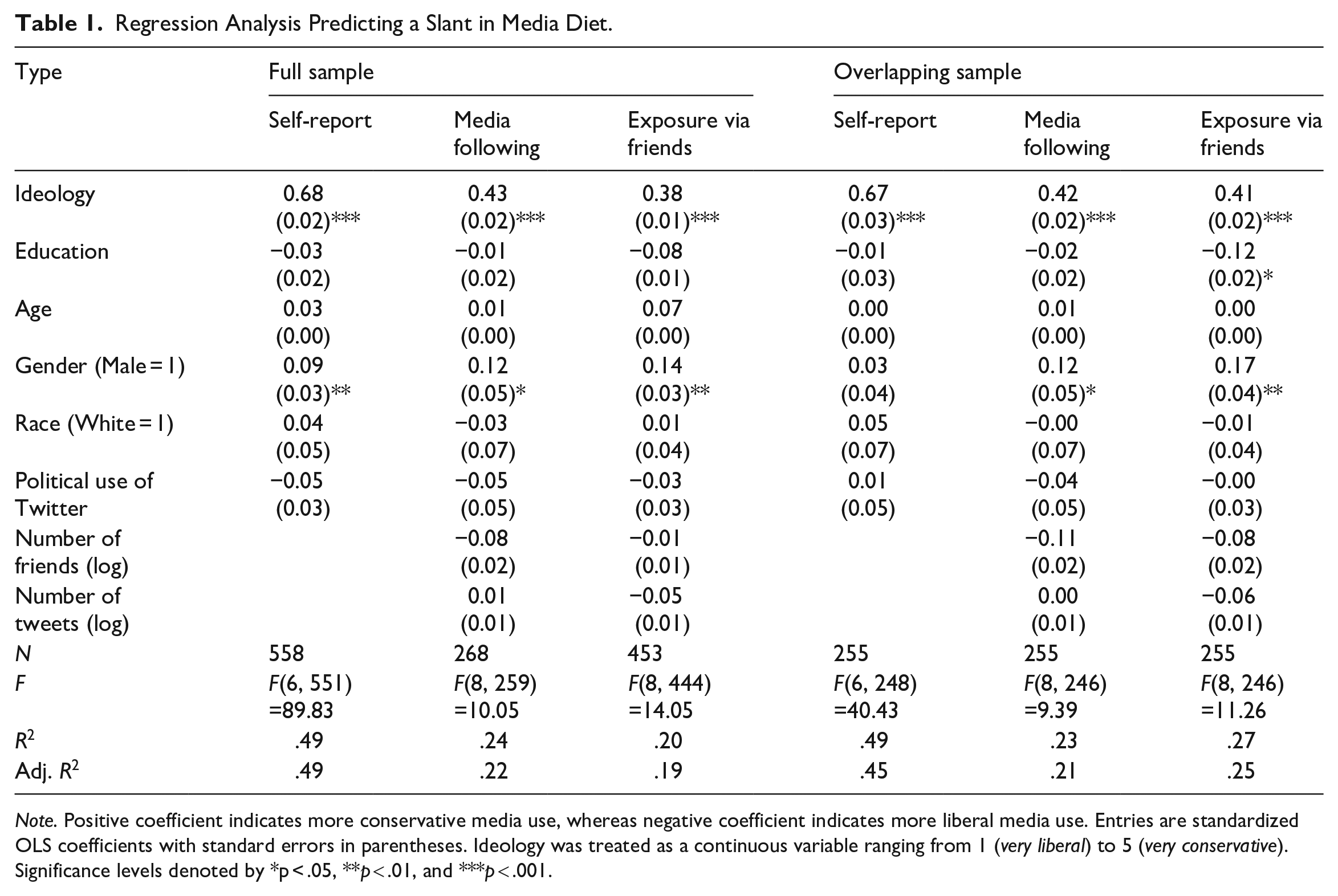
Note. Positive coefficient indicates more conservative media use, whereas negative coefficient indicates more liberal media use. Entries are standardized OLS coefficients with standard errors in parentheses. Ideology was treated as a continuous variable ranging from 1 (very liberal) to 5 (very conservative).
Significance levels denoted by *p < .05, **p < .01, and ***p < .001.
Because different sample sizes were available for each model, the study conducted an additional series of analyses with a subset of overlapping samples (n = 255) in all three models. The results were consistent. Political ideology was a significant predictor for slant in self-reported media diet (β = 0.67, p < .001), media following (β = 0.42, p < .001), and media exposure via friends (β = 0.41, p < .001). Therefore, H1, H2, and H3 are supported.
Overlap Between the Media Diets of Partisan Groups
To assess similarities in the distribution patterns of media diets between conservatives and liberals, we calculated the overlap (OVL) coefficient (Inman & Bradley, 1989). This statistic is a commonly used as a similarity measure to identify the proportion of overlap between two distributions. OVL coefficient ranged between 0 (no overlap) and 1 (100% overlap).
Overall, partisan media diets based on digital trace data showed much larger overlap than that from self-reported data (see Figure 1). Specifically, when we compared the distributions of media diets (average ideological slant) between conservatives and liberals using all available data (different sample sizes), the OVL coefficient in the self-reported data was 0.20, whereas the coefficient was 0.39 for media following and 0.38 for media exposure through friends. Similar results were found when the analysis was repeated using the overlapping sample. The coefficients for the digital trace data (following = 0.40; exposure = 0.35) were much higher than the coefficient for the self-reported data (0.17).
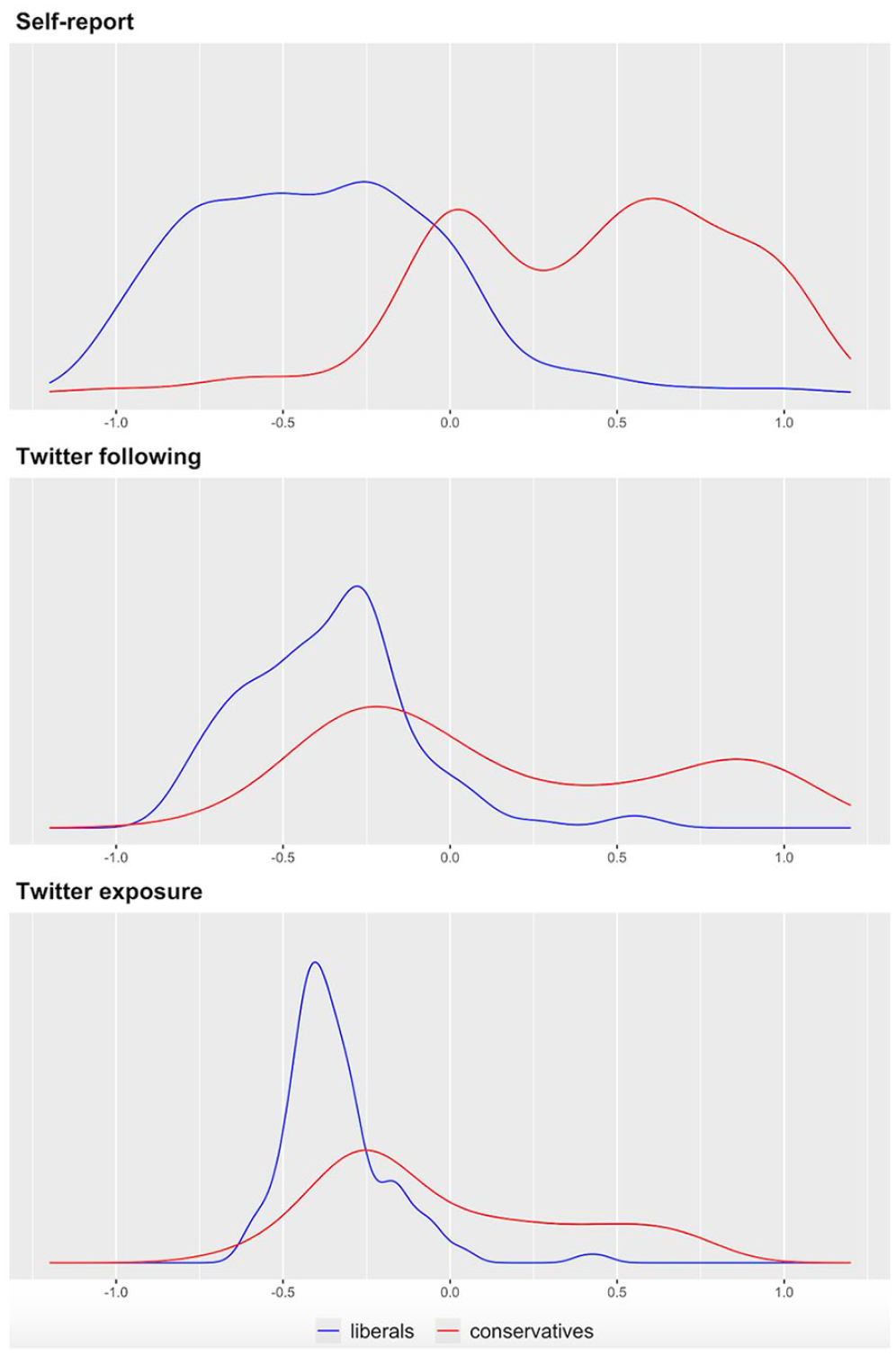
Ideological distributions of media diets for conservatives and liberals using the full sample. The x-axis represents the average ideological slant ranging from −1 (liberal) to 1 (conservative).
Ideological Asymmetry in Selective Exposure
To examine differences in selective exposure between partisan groups, we conducted a series of t tests on the pro-attitudinal exposure of respondents (i.e., the distance between a respondent’s own ideology and the media slant). Using the full sample, the results revealed that although conservatives and liberals did not differ in their media bias based on self-reported data, t(302.87) = 0.31, p = .76, d = 0.03, there was a significant difference in digital trace data. The extent to which partisans actually followed pro-attitude media was significantly higher among liberals (M = 0.37, SD = 0.25) than conservatives (M = 0.15, SD = 0.51), t(75.12) = 3.01, p < .001, d = 0.52. Also, the extent to which partisans were exposed to pro-attitude media via friends was significantly higher among liberals (M = 0.34, SD = 0.16) than conservatives (M = −0.02, SD = 0.32), t(166.91) = 10.3, p < .001, d = 1.27. This pattern was also seen when the analysis was conducted using only overlapping samples. The pro-attitudinal media following of liberals (M = 0.35, SD = 0.25) was significantly higher than that of conservatives (M = 0.16, SD = 0.52), t(72.78) = 2.61, p = .01, d = 0.51. Also, the exposure of liberals to pro-attitudinal messages (M = 0.33, SD = 0.17) was significantly higher than that of conservatives (M = 0.07, SD = 0.38), t(70.35) = 4.80, p < .001, d = 0.96. However, there was no difference in self-reported pro-attitudinal exposure between liberals (0.41 SD = 0.39) and conservatives (0.47, SD = 0.38), t(120.87) = 0.94, p = .35, d = 0.15. See Figure 2.

Box plots depicting differences in pro-attitudinal exposure between conservatives and liberals (full samples).
Discussion
This study investigated whether Twitter users selectively consumed ideological news media by linking survey responses from US Twitter users with their behavioral data. First, the study found that an individual’s political ideology was significantly associated with ideological bias in news consumption in all types of data, which included self-reported media consumption on Twitter (survey), media following (digital trace), and indirect exposure to media via friends (digital trace). Conservatives were significantly more likely to use right-wing media sources, whereas liberals were more likely to use left-wing media sources. In fact, of all variables that were included in the three tested models, an individual’s political identity was by far the strongest predictor of ideological media use. A partisan’s preference for congenial media consumption has been extensively shown in previous studies (Garrett, 2009; Iyengar & Hahn, 2009; Peterson et al., 2019; Stroud, 2008). However, this study demonstrated that this pattern holds for various types of media measures when drawing on a representative sample of Twitter users.
However, despite the significant association between political ideology and media diet at the individual level, the distribution of media slants between two partisan groups overlapped much more in the digital trace data than in the self-reported data. The OVL coefficients in the trace data, which included both following and exposure through friends, were almost two times larger than those of the self-reported data. This finding may be due to the possibility that self-reported media consumption is biased in a direction that mirrors the political identity of the individual (Brenner & DeLamater, 2016). On the contrary, actual media following and exposure via friends on Twitter may be influenced by other factors (e.g., media popularity, reputation, and trending topics) that deviate from the partisan motivation of the individual. Such a finding is consistent with previous studies that observed a moderate level of cross-cutting media exposure on social media (Bakshy et al., 2015; Eady et al., 2019). Similarly, a line of research using a network approach to audience overlap (Mukerjee et al., 2018; Nelson & Webster, 2017) showed a strong common set of media repertoires among individuals across the spectrum.
Focusing on the overall convergence or divergence in media diets between partisans can shed additional light on the selective exposure phenomenon. Traditionally, studies investigating selective exposure (e.g., Iyengar & Hahn, 2009) primarily focused on the directional relationship between partisanship and ideological media choices. That is, Democrats are more likely to select liberal media, whereas Republicans are more likely to select conservative media. However, as Guess (2020) pointed out, “the literature on partisan selective exposure is largely silent on the question of how much of a preference for congenial content is acceptable or desirable” (p. 15). Although there is currently no consensus on this issue, accumulating references over time and across different platforms may be a starting point for more discussion around this topic.
Furthermore, this study observed an asymmetric pattern of selective exposure between conservatives and liberals in actual media consumption. Based on the self-reported data, both groups of partisan respondents similarly indicated their congenial media bias. However, comparing the levels of pro-attitudinal media exposure between partisan groups revealed that liberals’ selective exposure was statistically higher than that of conservatives’ selective exposure. That is, whereas the self-reported data showed a mirroring pattern between partisan groups departing from the neutral point, conservatives’ actual media following and exposure were shifted toward the liberal side of the spectrum. In addition, the study found that for conservatives, although the most influential media outlet was Fox News both in terms of following and indirect exposure, the top 10 most-followed and most-encountered news sources included liberal-leaning outlets such as CNN, the NYT, and the Washington Post. By contrast, the top 10 news sources for liberals did not include any conservative sources, even Fox News.
However, this finding does not necessarily suggest that conservatives have a higher tolerance toward a different point of view. A large body of literature has generally found that conservatives tend to be less tolerant of ideological outgroups (Ganzach & Schul, 2020) and ambiguity than liberals (Jost, 2017). Then, how can we explain this seemingly inconsistent finding? Several possible explanations exist. First, the current media echo-system is characterized by few prominent conservative news sources, with the exception of Fox News (Faris et al., 2017; Grossmann & Hopkins, 2016). Previous studies (e.g., Mitchell et al., 2014) have shown that whereas liberals trust a wide array of news sources, such as CNN, MSNBC, NYT, and WP, which are relatively long-standing and mainstream media sources, conservatives name only a single news source (Fox News) as their trusted media outlet. Due to such limited options, conservatives may consume news media that seems to be ideologically inconsistent. Alternatively, the Twitter environment itself may be a contributing factor. As this study and a Pew Research study (Wojcik & Hughes, 2019) have found, more Twitter users seem to be liberals (i.e., Democrats) than conservatives (i.e., Republicans). This imbalance may promote the visibility of liberal-leaning media through user media sharing compared with conservative-leaning media.
The findings of this study have implications for the effects of media on partisans and offer an opportunity to debate whether selective exposure to diverse opinion is normatively positive. Using field experiments, Bail et al. (2018) observed that when social media users are exposed to opposing political views, they become even more extreme in their views. This backfire effect was stronger for Republicans. Such a finding seems to be related to a stronger hostile media effect among Republicans than Democrats (Lin et al., 2016; Shin & Thorson, 2017). Similarly, numerous surveys have shown that conservatives place less trust in mainstream news media than liberals (Gallup, 2018; Jurkowitz et al., 2020). This stronger hostile media perception among conservatives could potentially result in them resorting to unsubstantiated information sources such as disinformation campaigns (Hjorth, Adler-Nissen, 2019).
Methodologically, this study advances our understanding of selective exposure on social media by linking self-reported estimates of media consumption with digital trace data. Media scholars (Garrett, 2013; Prior, 2013) have called for objective measures of selective exposure via tracking data due to biases observed in self-reported responses. For this reason, digital trace data are increasingly being used as an alternative to surveys. However, tracking data alone have drawbacks, such as a lack of accurate demographic information (e.g., even a simple task as to whether the account is a bot or a human). In addition, there are ethical challenges associated with the use of digital trace data such as obtaining consent from the users (Williams et al., 2017). Therefore, a combination of both approaches can make an important contribution to the literature. Consistency or inconsistencies arising from different measures are real opportunities to enhance our understanding of selective exposure, rather than rejecting one form in favor of another (Garrett, 2013).
In this study, some incongruencies between self-reports and digital trace were documented. In particular, conservatives’ shift toward the left in their news consumption in the digital trace data compared with the self-reported data deserves more attention. This suggests a gap between what survey respondents report and what they actually do on social media. Ascertaining a source of the gap could help us better understand ideological selective exposure.
This study has several limitations. First, the study used a predefined set of news outlets to measure the slant in media diets for news following and exposure via friends, whereas respondents were asked to self-report their ideological news consumption using approximate proportions. When answering this survey question, respondents may have considered other outlets that were not included in the predefined set. In particular, a retrospective assessment of ideological media consumption can be susceptible to biased responses. Future research is needed to compare other self-reported measures of media consumption, such as name listing or open-ended survey prompts, to improve the accuracy of the results. In addition, the findings were drawn from a relatively small sample of Twitter users (maximum 558 users in the full sample, 255 users in the overlapping sample) who opted to provide their account information. Future studies are needed to expand the sample size to more accurately assess the demographics and media behaviors of Twitter users.
Conclusion
Despite these limitations, this study contributes to the literature of selective exposure by examining various measures of media consumption among social media users. The findings of this study provide overall support for the principle of selective exposure at the individual level. However, it was also found that the average media diets of the left and the right overlap considerably. This finding offers important implications for current debates about the prevalence of selective exposure on social media. These findings warrant more research on the various factors (e.g., Messing & Westwood, 2014) influencing the news choices of social media users in conjunction with political motivation.
Furthermore, this study provided some evidence of asymmetric media behavior between the left and the right. This suggests that the extent of cross-cutting media exposure could be different between conservatives and liberals. Selective exposure and partisan polarization have traditionally been treated as symmetrical concepts. This asymmetric pattern requires further investigation regarding the causes as well as the consequences. In particular, the consequences of frequently consuming challenging information deserve more attention, including a hostile perception of the media and lack of trust in journalism.
Supplemental Material
sj-pdf-1-sms-10.1177_2056305120981039 – Supplemental material for How Do Partisans Consume News on Social Media? A Comparison of Self-Reports With Digital Trace Measures Among Twitter Users
Supplemental material, sj-pdf-1-sms-10.1177_2056305120981039 for How Do Partisans Consume News on Social Media? A Comparison of Self-Reports With Digital Trace Measures Among Twitter Users by Jieun Shin in Social Media + Society
Footnotes
Acknowledgements
The author thanks the editor and the anonymous reviewers for their thoughtful feedback.
Author’s Note
This publication relies on data from survey(s) administered by the Understanding America Study (UAS), which is maintained by the Center for Economic and Social Research (CESR) at the University of Southern California (USC). The content of this paper is solely the responsibility of the authors and does not necessarily represent the official views of USC or UAS.
Declaration of Conflicting Interests
The author(s) declared no potential conflicts of interest with respect to the research, authorship, and/or publication of this article.
Funding
The author(s) disclosed receipt of the following financial support for the research, authorship, and/or publication of this article: This study was supported by the College of Journalism and Communications at the University of Florida.

Supplemental Material
Supplemental material for this article is available online.
Notes
Author Biography
References
Supplementary Material
Please find the following supplemental material available below.
For Open Access articles published under a Creative Commons License, all supplemental material carries the same license as the article it is associated with.
For non-Open Access articles published, all supplemental material carries a non-exclusive license, and permission requests for re-use of supplemental material or any part of supplemental material shall be sent directly to the copyright owner as specified in the copyright notice associated with the article.
