




Abstract
This discourse analytical article deals with the power relations between social media corporations and content creators in the context of monetization schemes of social media businesses, i.e., schemes that allow creators to monetize their social media content. Specifically, this study presents an analysis of discourse material pertaining to YouTube’s monetization scheme (the YouTube Partner Program [YPP]) to shed light on the broader point of how social media corporations position themselves in relation to creators who (seek to) earn money on social media. While some research on social media has focused on their potential to empower users/content creators, less optimistic scholars have addressed social media corporations generating massive profits by exploiting creators, for example, in the form of free digital labor. By comparison, there is a lack of research, especially empirical discourse analytical research, on creators’ paid digital labor and on how social media corporations conceptualize paid creators. This study redresses this gap regarding one of the oldest monetization schemes—the YPP. Using corpus linguistic tools to explore textual data from 46 YouTube sites detailing the YPP, this study homes in on references to content creators, YouTube, and how these players are connected to one another. The findings show that although the name YPP elicits the impression of cooperation on equal terms, YouTube represents itself as legislator, judge, and executive authority. This indicates that despite the ability of partnered content creators to share in the social media businesses’ profits, they do not inhabit a particularly empowered position.
Introduction
The digital platform economy, 1 especially the business with social media (SM), is booming and has been for a number of years. Indeed, a number of corporations provide SM platforms with the aim to generate profit, for example, YouTube, a Google subsidiary that hosts the eponymous video-sharing platform, and Facebook, the corporation behind SM sites such as Facebook and Instagram. While these businesses have enjoyed impressive profits from dealing in SM, the ones who make SM what they are have not shared in the financial gains for the most part. SM users and content creators, the individuals who either just use the site or even produce the content that motivates site visits, have, predominantly, not received financial compensation for their work and the resulting product, that is, in the case of content creators—compensation for their producing/uploading content and the content itself as a digital product.
In this context, it is worth noting that increasingly, SM operators are devising schemes that enable creators to earn money by, for example, allowing platform providers to insert advertisements into creators’ content (e.g., Constantine, 2020). Thus, while many factors may motivate creators to produce content and SM content production must not be viewed through the economic lens only (cf. Zajc, 2014), there are creators whose main motivation might be an economic one—creators who seek to earn money from their SM activities via a monetization scheme. While these content creators’ role and position in relation to SM businesses has remained underresearched in discourse studies especially, this element deserves attention in particular in light of Fuchs’ theorization of SM businesses as exploiting content creators’ free digital labor 2 (see more below).
As a matter of fact, regarding SM monetization schemes, Fuchs’ theory of SM as sites of exploitation of free labor leads to a field of tension between empowerment and dependence. That is, on the one hand, monetization schemes enable content creators who actually get paid to escape this form of exploitation—after all, instead of providing free labor which SM businesses capitalize on, these creators share in profits. Hence, paid creators may be viewed as a particularly empowered group of creators. Another argument in support of this view of paid creators as particularly empowered is that SM businesses rely on the so-called network effect. 3 That is, SM businessses generally depend on content creators as they can only turn a profit if content is uploaded. Moreover, in order for SM providers to generate advertising revenue, there has to be enough content suitable for advertisers. 4 Therefore, monetization schemes might be an attempt to stimulate and guide creators’ content production. However, to provide the contrasting perspective, SM businesses choose to run monetization schemes. In other words, creators may overcome the disadvantaged position of providing free labor only because these businesses have decided to allow monetized content creation on the businesses’ terms and not because the creators asserted themselves in any way. Further arguments in support of this perspective are that SM sites, such as YouTube, provide the platform infrastructure that creators depend on, and that these SM sites typically seem to have numerous creators who are willing to upload content free of charge, that is, YouTube might not depend on paid creators to make a profit.
This article homes in on this field of tension between empowerment and dependence. It sheds light on the power relations (as envisioned by an SM provider) between SM businesses and creators seeking to monetize their content by empirically examining one of the longest-standing monetization schemes—the YouTube Partner Program (YPP), established in 2007 (YouTube, 2010). YouTube provides detailed information on the YPP, that is, on how creators can monetize YouTube content, online. Taking the discourse analytical examination of information on the YPP as an example, this article takes a first step toward exploring how SM businesses position themselves in relation to creators seeking to monetize, for example, on whether this relationship is one of “partners” as the name of YouTube’s program implies. Specifically, this study seeks to address the following interconnected questions:
In detailing the YPP, how does YouTube represent itself?
In these texts, how does YouTube represent creators seeking to monetize their content?
How is the relationship between these creators and YouTube represented?
First, I provide an overview of perspectives on the participatory web, a discussion of digital labor, and how YouTube’s monetization scheme ties into this. This is complemented with background information on the YPP. The subsequent section gives an overview of the data and methods of analysis employed, followed by a discussion of findings, and finally, concluding remarks.
The Participatory Web, Digital Labor, and Discourse Analysis
The development of the “participatory internet” and the associated rise of SM (KhosraviNik & Unger, 2016, p. 207) has led to new forms of media production where the focus has shifted from traditional top-down creation/dissemination of information to content production/sharing by SM users/creators (also see Broersma & Graham, 2018; Fisher & Fuchs, 2015, p. 4). This change in media production has received scholarly attention with surprisingly contradictory results concerning questions of users’/creators’ 5 empowerment. For one, a number of scholars focusing on political and communicative empowerment take an optimistic stance. Castells (2013), for example, concludes that—arising from this shift from top-down to bottom-up creation and distribution of information—SM redistribute communicative power from the few to the many. Tufekci (2013) also finds that “participatory media may change the power media have to frame social movements” (p. 853). Other research echoes this view and argues that SM may strengthen civil society because they may serve as coordinating tools for political protests (e.g., Hermida & Hernández-Santaolalla, 2017; Shirky, 2011). 6 Aykurt and Sesen (2017) also draw attention to this function of SM—they find that the majority of respondents in their study on public perception of SM focus on this element and other benefits associated with SM.
In contrast to this optimistic view of the participatory web and SM, other researchers, for example, in the field of Critical Discourse Studies (CDS), have cautioned against an overly celebratory perspective on the Web 2.0. While acknowledging the potential political/communicative empowerment afforded by SM (see, for example, KhosraviNik, 2018), researchers such as Unger et al. (2016) highlight that SM platforms’ practices and design require careful assessment not least of all to achieve an understanding of different forms of (dis)empowerment. In this context, a number of researchers has begun to theorize SM and users’/creators’ activities on SM in terms of economic (dis)empowerment. They have identified SM users’ and content creators’ activities as unpaid digital labor and have drawn attention to the exploitation of users/creators in this context (e.g., Beverungen et al., 2015; Fuchs, 2014b; Rey, 2012). This vein of research has also highlighted that the term social media obfuscates this form of exploitation in that it hides that economic interests drive SM providers’ activities (Beverungen et al., 2015, p. 474; Fisher & Fuchs, 2015, p. 37; Fuchs & Sevignani, 2013, p. 237). Moreover, as a rule, users and creators do not have to pay for the service and infrastructure that SM operators provide, which again serves to background that the primary objective of SM businesses is making profit.
And profit they make—reportedly, YouTube’s 2019 advertising revenue alone was US$15.1 billion (Spangler, 2020). To generate revenue and, ultimately, make profit, SM businesses commodify users/creators and their content. Fuchs and Sevignani (2013) even argue that the “dominant capital accumulation model of contemporary corporate internet platforms is based on the exploitation of users’ [and content creators’] unpaid labour” as these users/creators “engage in the creation of content and the use of blogs, social networking sites, wikis, microblogs, content sharing sites for fun and in these activities create value that is at the heart of profit generation” (p. 237). There are several elements of how SM businesses may commodify users/creators to generate revenue. First, SM may sell user data to third parties (Fuchs, 2014a, p. 265). Second, SM businesses may, in essence, sell audience attention to advertisers (Lillqvist & Harju, 2018, p. 64; also see Smythe, 1977). Third and connected to this, SM businesses may commodify creators’ SM content, for example, by inserting paid advertising into uploaded videos.
Focusing on the latter element, it could be argued that this form of commodification empowers content creators economically and strengthens their position in relation to SM businesses. As Fuchs notes, SM creators “are economically powerful because they create economic value” for the company that operates the SM platform (Fuchs, 2015a, p. 199). That is, as per the network effect (footnote 3), SM depend on creators’ content, for example, YouTube can only attract other businesses to advertise on it if creators upload enough videos that YouTube can insert advertisements into. Arguably, this content needs to be plentiful and interesting enough to attract large numbers of visitors because then YouTube may charge correspondingly high advertising rates to make a profit (cf. Leighton, 2013, p. 196). This also means that if creators refused to upload content “they [would] have the power to bring corporate social media to a standstill” (Fuchs, 2015b, p. 39).
As already noted in the “Introduction”, the creators’ power as providers of content versus the businesses’ power as providers of platform infrastructure leads to a field of tension of empowerment and dependence. On the one hand, the fact that content creators have some power over SM businesses’ economic success—that SM businesses depend on creators’ digital products to generate revenue—might explain why some of these businesses have developed monetization schemes benefiting content creators. As SM sites’ ability to make advertising profit hinges on the amount and the quality of creators’ content, 7 the businesses behind SM may have to employ content acquisition strategies. In this context, schemes that allow creators to monetize their content via advertising may be one element of such strategies: such monetization schemes may serve to attract particular creators 8 and entice them to work for a specific site (Alexander, 2020). The discursive composition of texts detailing these monetization schemes might reflect the empowered position of monetizing content creators. Indeed, the name of YouTube’s scheme implies that monetizing creators enjoy such an empowered position: the YPP, with partner (used in reference to creators who are in the YPP) implying a relationship of equals.
On the other hand, to counter this argument of empowered creators, it is worth noting that the SM businesses provide the platform infrastructure that hosts creators’ content and that creators thus depend on. Moreover, one could argue that the number of content creators seeking to monetize their content is sufficiently high for SM businesses to be selective in who they permit to share in profits. That is, instead of attempting to attract creators, information on monetization schemes might be designed to discourage a large number of interested creators. In the vein of this argument, the discursive composition of texts detailing monetization schemes might be very different and might not represent monetizing creators as particularly empowered.
Against this backdrop of two diverging potential approaches to content creators, this article uses the case of YouTube as an example to shed light on the broader issue of how SM businesses conceive of the power relations and (im)balance between the businesses and creators seeking to monetize their content. 9 This issue of power relations between content creators and SM businesses, let alone creators’ content monetization, has not yet yielded in-depth empirical—specifically discourse analytical—research attention. Although the theoretical background presented above demonstrates that research has discussed the exploitation of SM users/creators and thus has begun to explore the power imbalance between media providers and content producers or, more broadly, users in general, these discussions have been limited to theoretical investigations, have focused on unpaid digital labor, and have not incorporated empirical discourse analytical study.
This study redresses this gap in research by taking a critical discourse analytical view on SM textual data. The theoretical assumption underlying this approach is that discourse (i.e., language use in speech and writing) is dialectically linked to broader social practice (Fairclough & Wodak, 1997, p. 258). That is, on the one hand, language use is understood as creating/contesting social reality. On the other hand and, more importantly in the context of this article, norms, values, and views as well as the societal status quo, including the power relations among subgroups, are reified in discourse, that is, language use (Fairclough et al., 2011 p. 357). Consequently, the systematic analysis of discourse material produced by SM businesses allows a glimpse into their conception of their position in relation to content creators. As this study focuses on shedding light on how a SM business (YouTube) constructs its relationship with creators in texts about the YPP, my corpus-assisted critical discourse analysis homes in on linguistic references to the pertinent actors—YouTube, content creators, and personal pronouns used in reference to these two players (see section “Data and Method”). It is also worth noting that the present empirical study focuses on textual analysis and does not incorporate contextual information exceeding what is essential to make sense of the data. Yet, in line with the critical agenda of CDS, this study elucidates on the power relations between YouTube and creators established in YouTube’s texts (Koller, 2014, p. 149). It also moves from explanatory to normative critique by considering the wider implications of the power (im)balance envisioned by YouTube (see the “Conclusion” section) (Fairclough & Fairclough, 2012, p. 79).
The YPP
The YPP, established in 2007, enables content creators to generate revenue from their YouTube channels and uploaded videos (YouTube, 2010). Content creators can find information on the YPP and on how YouTube monetization works in YouTube’s Creator Academy and the YouTube Help Center. These two YouTube-run sites are support platforms specifically designed to provide information for YouTube users and content creators, for example, information on how to create a YouTube channel.
On these sites, YouTube also details the various features available to YPP members and the different ways YPP partners can monetize (e.g., by selling their own merchandise via YouTube or by having YouTube insert advertisements into creators’ content). Furthermore, the company specifies how to become a YPP partner, that is, creators have to have at least 1,000 subscribers and 4,000 hr of watchtime (i.e., content watched by site visitors). They also have to comply with a body of policies as part of their joining and remaining a YouTube partner in addition to the community standards all YouTube creators (i.e., paid as well as unpaid creators) and visitors have to adhere to.
In the context of the YPP’s watchtime requirements, YouTube’s algorithm, and the power it equips the company with, deserves brief mention. Using an algorithm that (dis)privileges particular creators and their content, YouTube can control whose content reaches a broader audience. The rules and logic underlying this algorithm are largely unknown to visitors of YouTube—beyond the fact that personal search history and interest are taken into account, visitors are not informed about the algorithm’s criteria (Pasquale, 2015). More importantly, even content creators do not know (or at least claim not to know) the logic that guides the YouTube algorithm (e.g., Blake, 2018; Scott, 2017). 10 Consequently, creators can hardly tailor their content to this algorithm, that is, ensure it appears in a large number of viewers’ “Suggested Videos” sections and thus gain enough subscribers and achieve the watchtime required for YPP eligibility.
Data and Method
The data consist of textual material of 46 YouTube-operated subsites dedicated to providing information on the YPP, that is, sites specifically aimed at content creators who wish to monetize or are already monetizing. By comparison, general information aimed at all creators and users of YouTube was excluded. This was done to arrive at a clear understanding of YouTube’s representation of creators seeking to monetize and not a conflation of this group of creators with general content creators or even just YouTube users. The sites relevant to creators seeking to monetize can be found through YouTube’s company website. The company website provides different sites for different stakeholders, for example, advertisers, artists, and content creators. Via the “YouTube creators” site (YouTube, 2020) it is, in turn, possible to access the YouTube Creator Academy (see section “The YPP”) and the creator support site (YouTube Help Center, see section “The YPP”). For the purpose of this study, the YouTube Creator Academy site “Make money on YouTube” (YouTube Creator Academy, 2020) and the creator support tab “Monetise with the YouTube Partner Programme” (YouTube Help, 2020) were used as starting points of data collection 11 (Figure 1).

YouTube Help Center.
The sites linked to under this tab and their respective hyperlinked subsites 12 were collected to achieve a holistic perspective on the YPP. In the main, the sampled sites cover general information on what the YPP is (e.g., “How to earn money on YouTube”) and how creators can make use of particular functions as part of their being a YPP member (e.g., “Manage Super Chat and Super Stickers”). They also cover the different means of monetizing as a YPP member (e.g., “Paid product placements and endorsements”) and YPP policies (e.g., “Advertiser-friendly content guidelines”).
The 46 YouTube sites sampled were converted into individual .txt files with markup to indicate hyperlinks, headings, and subheadings. As there were videos embedded in a number of these policy sites, I inserted transcriptions of these videos into the files with markup to signal the beginning and end of the video transcriptions. Altogether, this body of YPP information, including transcriptions (but excluding markup), amounts to 40,622 word tokens.
This corpus was subjected to a qualitatively oriented corpus-assisted discourse analysis (see, for example, Baker, 2006; Mautner, 2009). Using the concordance software AntConc (Anthony, 2020), I ranked the word tokens by frequency of occurrence and examined the list for references to creators and YouTube—“youtube”, “creator*” and the personal pronouns “we”, “our” and “you*” (as these are used to refer to YouTube and creators 13 ) were then examined in more detail. On the one hand, the collocational profiles of these tokens were examined. That is, the statistically significant co-occurrence of these with other word tokens was calculated (using t-score 14 with a threshold of-score 2.0 and a span of five words). On the other hand, the concordance lines of these tokens and collocations were explored, that is, the tokens/collocations were viewed embedded in co-text (using alphabetical sorting to the left/right of the node to aid the identification of patterns of usage).
A caveat of this study is that multimodal aspects were not taken into account. However, this does not constitute a significant limitation regarding my ability to address the research questions given above. Finally, while data collection was carried out to the best of my abilities, some subsites might be missing. This is due to several factors: (a) these sites are interconnected through numerous hyperlinks but the link network does not follow a recognizable structure or pattern, (b) the hyperlinks YouTube provides are, at times, mislabelled, (c) the sites are changed and updated regularly, and (d) some sites are only accessible via hyperlinks on particular subsites but cannot be found through the overarching YouTube support site.
Data Discussion
Before discussing the linguistic qualities of information on the YPP, YouTube’s hyperlink organization deserves mention as it already constitutes a gatekeeping mechanism. 15 As noted above, the link structure of the YouTube Help Center forms a complex gestalt. That is, each site contains numerous links that connect it to super- or subordinate layers of information or to another same-level site. This has disadvantageous effects for creators. First, creators might not find all information relevant for monetization. Second, since information is not provided in a clearly discernible order, creators need to spend a considerable amount of time on clicking through the sites to ensure they have identified the most pertinent information. Moreover, there is a lack of stability and consistency regarding the information on the YPP, for example, even during the data collection period (January to February 2020), YouTube made a number of changes to the YPP information sites. This might constitute a notable source of insecurity for creators as it illustrates how quickly the company may add or change the YPP’s nature. By visibly reworking/adding/removing information, YouTube very clearly—if inadvertently—signals to creators that everything is in flux.
In addition to a confusing multidirectional hyperlink construct, the YPP information sites link to two diverging versions of the community guidelines (Figure 2). On the one hand, there are numerous links to the version that all content creators ought to observe. On the other hand, there is one link to a community standards site apparently directed at creators seeking to monetize only. The latter differs from the former in several points in that it is more detailed. Seeing as the former is linked to frequently, and the latter more detailed version is only linked to once, a number of creators may not observe the more detailed version and thus might not have their content monetized. At the very least, the fact that two diverging editions exist may induce insecurity among creators regarding whether they have found and read all relevant information to ensure that their content is eligible for monetization.
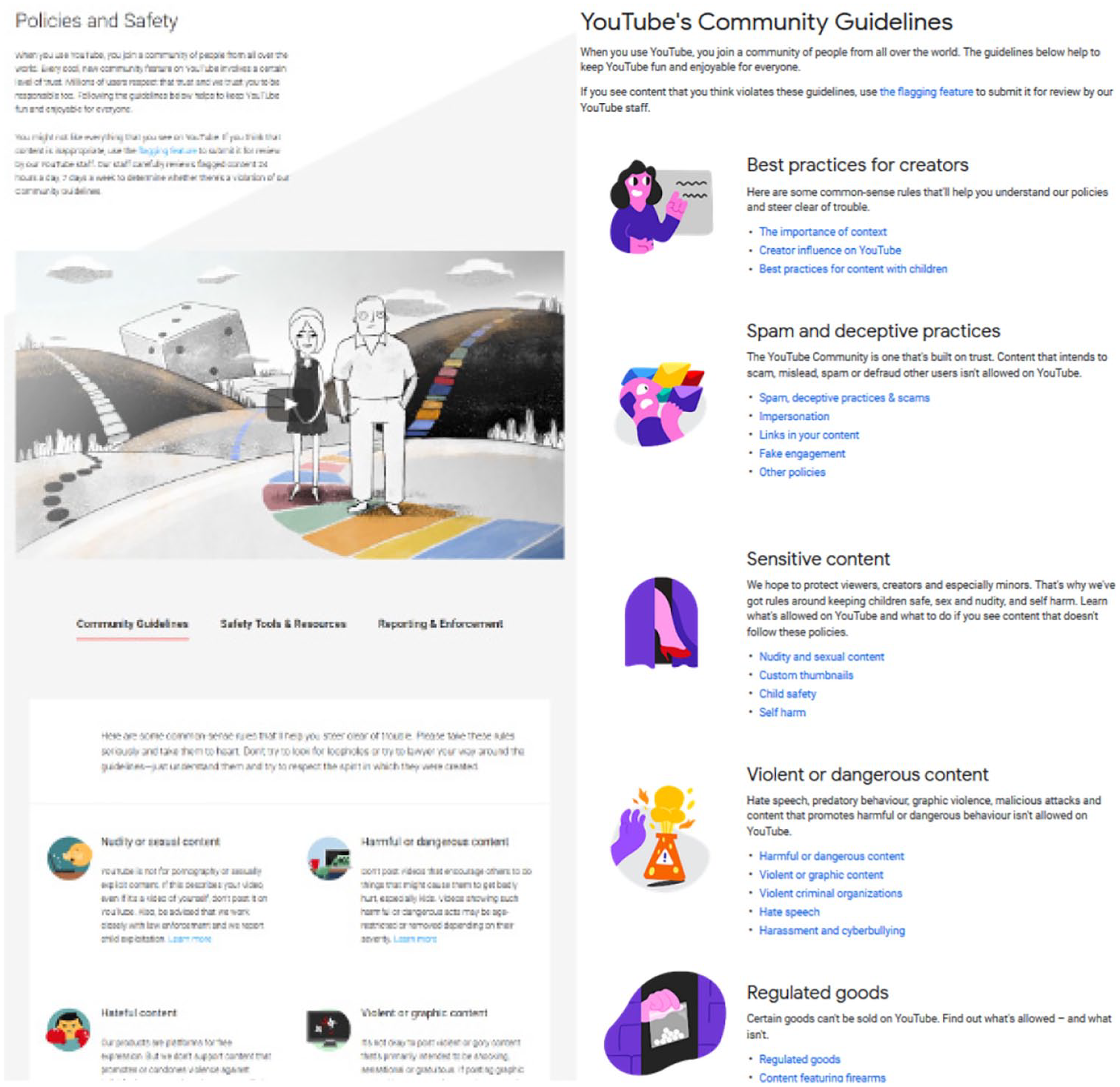
Two versions of YouTube’s guidelines (left: for all YouTube users/creators; right: for creators seeking to monetize their content).
Moving on to the corpus’ linguistic characteristics, the word frequency ranking already allows a glimpse into what YouTube discusses in connection with the YPP and monetization. Unsurprisingly, among the topmost frequent tokens are words relating to creators’ products: “content” (rank 13), “video” (rank 15), and “channel” at 21. In addition, the purpose of the YPP, that is, to earn money and the means through which to do so, is a central element in this corpus: “revenue” (49), “monetisation” (35), “ads”/“ad” (rank 19 and rank 37), and “merch” (for merchandise) at 74. The frequency list already gives an inkling concerning the power relation between YouTube and monetizing creators as envisioned by YouTube in that tokens that relate to authority, policies, and rules take high frequency positions, for example, “guidelines” and “policies” are among the top 50 most frequent tokens taking rank 47 and 45, respectively.
The collocational profiles of “we” and “youtube” indicate a notable discursive strategy, namely, that the company frequently directly addresses creators by use of the second person pronoun “you”, which collocates with “we” at a t-score of 6.2 and with “youtube” at 8.9. This may be intended to increase immediacy, which, in turn, might serve to create the fiction of familiarity and closeness between YouTube and creators. Moreover, the direct address might also serve to increase accountability regarding creators’ policy compliance. To give qualitative evidence of how “we” and “you” are used in the corpus, “we hold you to a higher standard” and “[i]f you violate this policy, we may take action”.
YouTube—Authority, Monitor, and Enforcer
In line with the corpus’ frequency ranking, the concordance views of the items “we” and “youtube” confirm that, throughout the corpus, the company focuses on YouTube’s role of monitor, rule enforcer, 16 and general authority regarding content monetization. That is, despite the fact that the term “partner” for content creators who join the YPP implies a relationship of equals, the examination of the YPP corpus does not support this notion of equality between YouTube and YPP members. To give both quantitative and qualitative evidence of this focus on YouTube as authority, of 210 lines of “we” that unambiguously refer to YouTube, 130 concordance lines deal with YouTube exerting control and oversight of creators’ activities. That is, approximately 60% of these lines address that, and how, YouTube exerts control over YPP members or creators that seek to become members—by reviewing their channels and enforcing policies, for example, “[w]e also constantly review channels to ensure you’re meeting all our policies and guidelines” and “[l]earn more about how we enforce our policies”.
Examining the concordance lines about YouTube as authority/policy enforcer in more detail allows an insight into several phenomena. First, the company touches on why it imposes particular regulations on creators who seek to monetize their content and, in this context, constructs the idea of being paid as a privilege rather than a right. That is, YouTube represents the creators’ possibly getting paid for their efforts as an extraordinary bonus rather than as a form of remuneration one can expect to receive for creating economic value, here in the form of SM content. Indeed, the company states that it intends to “reward” particular content creators by allowing them to become a YouTube partner, for example, “[t]o make sure we’re rewarding good creators, we review your channel before you’re accepted in the YouTube Partner Programme”. The following example illustrates how the company uses the idea of “wanting to reward” creators as the reason for the YPP requirements regarding watchtime: “because we want to reward good creators, we need to make sure we have enough context on your channel—which generally means we need more content to look at” 17 . Finally, the notion that creators’ getting paid is a privilege rather than a right is reflected in the following example defending the YPP regulations: “you have the ability to earn money through YouTube, and because of that, we hold you to a higher standard”.
Second, YouTube casts itself in the role of almost unchallengeable authority regarding the YPP and creators’ ability to monetize their content by emphasizing the company’s monitoring activities. That is, the company establishes itself as the ever vigilant overseer, for example, “[w]e also constantly review channels to ensure you’re meeting all our policies and guidelines” and “we constantly review channels to make sure your content is in line with our policies”. In both examples, YouTube underscores its nonstop watchfulness by use of the adverb “constantly”. Moreover, YouTube regularly directly addresses creators (“you”, “your content”), which serves to drive home that creators as the intended audience of the texts are the objects of observation (or at least their channels, videos, content, etc.).
What is more, YouTube discusses its choices with regard to (not) allowing certain actions and meting out punishment when necessary and thus drives home its position of authority. Here, it is also clear who inhabits the empowered position of the entity that takes (punitive) action on another. To give examples: “[w]e don’t allow egregious behaviour” and “[w]e allow static title cards and end cards”—these examples illustrate that “we”, that is, YouTube, is the actor who permits/tolerates certain content/creator behavior while leaving the creator backgrounded (Van Leeuwen, 1996, pp. 38–39). By comparison, when discussing concrete acts of punishment, the company uses conditional phrases/sentences that directly address creators/refer to their content and thereby highlight the target of YouTube’s actions. To give examples: “[i]f you fail to comply with these policies without permission from Google, we reserve the right to disable ad serving to your website and/or disable your AdSense account at any time”, “[i]f your content violates our Community Guidelines, it may be removed from YouTube” and “[i]f you violate any of our policies, YouTube may take the following actions: (a) Turn off ads from your content [. . .]”.
It is worth noting that the company admits to a degree of fallibility. YouTube concedes that sometimes it makes mistakes when enforcing policies and invites YPP members to appeal these decisions, that is, if a member files an appeal, YouTube—not a neutral third party—may decide to review a decision. Yet, YouTube assumes absolute authority—an authority that can be appealed to and might be reasoned with, but it is ultimately the entity that gets to pass judgment. Moreover, YouTube mitigates its concessions of fallibility, for example, in iterations such as “[i]f you think that a yellow icon is a mistake, you can appeal” YouTube does not admit to mistakes as such but merely allows for creators to possibly “think” so in the conditional form. What is more, YouTube backgrounds the actor who committed a potential mistake—the yellow icon “is a mistake” hides the entity that possibly mistakenly assigned this icon. In another concession of fallibility, YouTube does not assume responsibility for making a mistake but ascribes this to a “machine”: “Algorithms take time, so that should be the expectation too. Your feedback matters, but machines make mistakes. We’re always trying to make them better”. Here, YouTube even represents itself as aiming to correct and improve the entity that commits errors.
Finally, YouTube again cements the idea that it holds a position of absolute authority by informing creators that YouTube may change the YPP at will and that it is the creators’ responsibility to keep informed: “We’re making some changes to how you apply for YPP” and “[s]ince we may change our policies at any time, please check here regularly for updates”.
YouTube—Informant, Advisor, and Aide
YouTube’s second main role present in the corpus is one of an informant, or even advisor and aide to creators seeking to monetize their content. To give an example, of 210 concordance lines of “we”, 67 lines (i.e., approximately 30%) refer to YouTube informing, aiding, and advising creators regarding various issues related to monetization. 18
Delving into these concordance lines shows that YouTube frequently provides metacomments informing content creators of changes to the YPP sites. That is, YouTube offers assistance in the form of guiding creators’ attention and signposting documents, for example, “we’re clarifying some rating options for content. The following is a brief overview” and “[w]e also added more guidance to rating options to help music creators understand how profanity in lyrics might change a video’s ad suitability”. The latter example represents YouTube as an aide to creators in producing content that is acceptable for advertisers (“help music creators”)—this might have the function of portraying the business as supportive of and helpful to creators. At the same time, the use of metacomments as given in the latter example might have the additional function of attempting to ensure that YPP members produce advertiser-friendly videos, that is, content that does not harm the brand image of businesses advertising on YouTube and thus does not negatively affect YouTube’s ad revenue.
YouTube also provides suggestions and recommendations that aid creators in monetizing their content by advising them how to create content that is particularly appealing to site visitors. To name but a few examples of how YouTube performs its role of advisor and aide: “we recommend picking a family name that is easily recognisable as your brand”, “[w]e suggest you select all ad formats as your upload default”, “[t]here’s no time limit, we recommend you keep it short”, and “we recommend uploading your video as unlisted for at least 2 hours before going public”. These recommendations (together with the above focus on “helping” creators) might serve to mitigate YouTube’s self-representation discussed in the section “YouTube—Authority, Monitor, and Enforcer”. That is, YouTube as aide and advisor still implies a power imbalance in relation to creators. However, in contrast to YouTube as rule enforcer/punisher, the role of aide and advisor might increase its likeability and appeal to creators.
Another element of its self-representation that ties into this is that the company casts itself as generally being of service to creators in terms of working on or providing something site-related for their benefit, for example, “[w]e now have an additional paid promotion disclosure feature that creators can use to help inform viewers” and “[w]e now offer an additional feature that enables creators to opt in to a visible disclosure for viewers” and “[w]e’re continuously working to make this process happen faster”. In addition to framing YouTube as supportive aide to creators, these instances also serve to strengthen the notion that YPP members enjoy a particularly privileged position relative to “ordinary” content creators.
Finally, YouTube highlights that creators who seek to monetize their content and the business are on the same side. Both YouTube and creators allegedly share the same wishes and goals: both parties want creators to understand YPP rules but still—and this is the primary goal—produce content that suits their audience. To give evidence of how YouTube makes this point: the company quotes a content creator “[. . .] as content creators, we want to make sure that we’re doing all that we can to get educated [on YouTube/YPP policies], but then also make the content that we want to make to suit our audience”. Then, a YouTube representative is quoted as responding with: “we want that for you as well”. To give another example of how YouTube represents itself as aiming to serve the aims/wishes of creators: “we want YouTube to be the optimal platform where you can produce content your audience loves” and “we are committed to making sure all our creators are familiar with YouTube policies”.
Monetizing Creators—Recipients of Instructions and Beneficiaries of the YPP
The examination of “you” used in the subject position of sentences/clauses sheds light on two notable phenomena. On the one hand, “you” is used to underscore the power imbalance between YouTube and creators who seek to monetize their content—it highlights YouTube’s role as rule maker/enforcer. On the other hand, “you” is used to represent YPP creators as enjoying particular privileges due to their YPP membership. This depiction of the YPP coupled with YouTube’s persistently drawing on a discourse of policy enforcement/legal discourse (see this section and “YouTube—Authority, Monitor, and Enforcer”) portrays YPP membership as a reward graciously granted by YouTube (again see “YouTube—Authority, Monitor, and Enforcer”).
First, the concordance lines of top collocates of “you” show that YouTube instructs creators to comply with the YPP policies and informs creators of the consequences of non-compliance, that is, YouTube again assumes a position of power in relation to creators. For example, “you should” (30 lines) and “you must” (16 lines) 19 are used as follows: “you should only turn on ads for videos that meet our advertiser-friendly content guidelines”, “[y]ou must not use Google AdSense to facilitate [. . .]” and “[y]ou must disclose clearly any data collection, sharing and usage”. Moreover, “you” collocates with “if” at a t-score of 14.5. YouTube uses the conditional “if you” to inform creators of the consequences of policy violations/YPP ineligibility, for example, “if you use slurs excessively even for comedy, then we might limit ads” and “[i]f you’re inactive on your channel for six months and fall below the threshold, we may remove your channel from the Partner Programme”.
YouTube also uses conditional constructions to inform creators about their options to appeal if they feel one of YouTube’s actions of policy enforcement was unjust (see “YouTube—Authority, Monitor, and Enforcer”). That is, while creators’ possible recourse against YouTube’s policy enforcement is discussed, the overarching theme is still policy enforcement and thus these statements still highlight that ultimately YouTube is in power. After all, creators are only empowered in the sense of being appellants—as having the option to object to YouTube’s policy enforcement. It is still YouTube that passes the verdict on whether this objection is valid. To give examples: “If you feel it was mistakenly upheld, you may be able to appeal”, “[i]f you think that a yellow icon is a mistake, you can appeal”. Furthermore and as the latter example indicates, “you” is frequently followed by the modal verb “can” (t-score: 15.0, 208 lines with only two negations)—the construction “you can” is also used to provide information on creators’ options to contest YouTube’s policy enforcement actions, for example, “you can appeal the strike on your account” and “you can request a human review”. The latter example especially highlights the weak position even YPP members inhabit according to YouTube—here, their recourse merely consists of “requesting” review instead of, for example, demanding or insisting on a review.
In addition, YouTube uses “you can” to highlight creators’ privileged position as a beneficiary of the YPP. Apart from instances where YouTube just sets out creators’ options for purely informational purposes, 20 the company regularly mentions that these options are open only to creators who have been “accepted into” 21 the YPP. In other words, YouTube highlights that being/becoming a YouTube partner puts creators in an empowered position and represents YPP members as beneficiaries of the rewards afforded by the YPP, for example, “[a]s a YouTube partner, you can filter the AdSense ads”, “[i]f you’re accepted into YPP: Congratulations! You can now set up ad preferences”. The above discussed conditional construction “if you” is also used to map out the range of options available “if you’re in the YouTube Partner Programme”. To give some examples: “If you’re in the YouTube Partner Programme, you have the ability to [. . .]” and “[i]f you’ve been approved for the YouTube Partner Programme (and are in compliance with YouTube Partner Programme policies), you can explore these monetisation options”. In addition to portraying YPP as an attractive program, the latter example illustrates that YouTube chooses whether a creator is empowered in this manner: “If you’ve been approved” for the YPP—YouTube highlights that entering the YPP hinges on its approval. 22 The fact that it is “you” who hinges on approval might serve to represent YouTube as wielding absolute power over creators rather than just their product (i.e., the channel and the channel content).
An examination of “creator*” sheds light on additional components of YouTube’s conception of creators who seek to monetize their content. One aspect—alluded to in concordance lines of “you” but developed further in the concordance lines of “creator*”—is the company’s representation of digital labor. YouTube reframes the digital labor that is YouTube content production in terms of being a “passion” and an activity one loves. Receiving financial compensation is depicted as just an additional element motivating creators’ producing content for YouTube, albeit an important one for “many creators”: “For many creators turning their passion into revenue is an important aspect of the YouTube platform”. The following example incorporating both “you” and “creator*” also expresses this notion: On YouTube, you can connect with a community and have an opportunity to make money while doing what you love. Creators around the world have shared their voices on YouTube, and many have turned their passions into earnings.
Another nondominant component of YouTube’s representation of YouTube creators in general is that these individuals are valued in their singularity—occurring only once throughout the corpus, YouTube states that “[e]ach and every creator on YouTube is unique and contributes to the vibrancy of YouTube” and that it wishes for creators to make use of their “freedom of expression”. However, there is a limit to YouTube’s appreciation of individualism and freedom of expression, especially when it comes to creators who wish to monetize. YouTube emphasizes that at the very least, content intended for monetization must not violate YouTube’s policies and guidelines (“[a]nyone who earns money on YouTube must follow our YouTube monetisation policies”). Moreover, the company also conveys that some content might not be suitable for monetization through advertising (“[w]e know there’s a lot going on in the world and people are going to want to upload videos to talk about it. But there’s just some stuff that advertisers don’t want to be connected to”).
Conclusion
In setting out the YPP, YouTube portrays content creators who manage to become YouTube “partners” as particularly empowered because of their partner status. That is, creators who have been “accepted into” and “approved” for the YPP take a coveted and privileged position (“[i]f you’re accepted into YPP: Congratulations!”) with a range of options afforded by YPP membership. However, it is also important to note that YouTube represents content creators who manage to escape exploitation in the form of unpaid digital labor (by joining the YPP) as empowered only in comparison with creators who are not (yet) “partners”. Here, YouTube makes clear that it is up to the company to decide which creators to “reward” and grant empowerment in the form of YPP membership.
In the main and apart from representing itself as supportive advisor to some degree (see section “YouTube—Informant, Advisor, and Aide”), YouTube emphasizes its status as authority that controls and limits creators’ scope of action. 23 In other words, in the information sites detailing the YPP, the company focuses on portraying itself as legislator, judge, and executive authority of the YPP—YouTube stresses that it assesses/monitors creators and enforces its policies (e.g., “we review your channel before you’re accepted”, “we enforce our policies”). Even when referring to YPP members’ recourse in the form of appealing decisions, YouTube does not ascribe a particularly empowered position to monetizing content creators (e.g., “you can request a human review”—see section “Monetizing Creators—Recipients of Instructions and Beneficiaries of the YPP”).
The generally disempowered representation of creators seeking to monetize their content—despite the fact that content creators produce economic value—allows diverging interpretations. YouTube might have created this discursive power imbalance intentionally to obfuscate the true economic power content creators could wield—after all and once again, YouTube (and other SM companies) depend on creators and their willingness to provide marketable content. Alternatively and arguably more likely, the findings of this study suggest that YouTube’s overall profitability does not depend on the YPP. It suggests that if YPP members were to stand up against YouTube and cease content production, YouTube could decide to abolish the YPP entirely and still fall back on a large number of unpaid creators. 24
This interpretation hints at a phenomenon concerning SM in general. It appears that as long as there are enough SM content creators willing to engage in free labor, the ones who might wish to escape this form of exploitation and share in profits cannot gain leverage and exercise power over SM businesses. In other words, even if a number of content creators refused to engage in anything but paid digital labor, they could not bring SM to a standstill and thus put pressure on SM businesses as long as these can rely on legions of creators happy to provide unpaid labor. Thus, the logical conclusion seems to be that the way toward true SM creator empowerment is for as many (if not all) content creators as possible to band together and take collective action. 25 Yet, the empirical analysis presented in this article merely allows tentative observations regarding the broader SM landscape—future research should further explore SM content creators/users as providers of digital labor and possible means of empowerment.
Footnotes
Declaration of Conflicting Interests
The author(s) declared no potential conflicts of interest with respect to the research, authorship, and/or publication of this article.
Funding
The author(s) received no financial support for the research, authorship, and/or publication of this article.
