




Abstract
As opposed to traditional nomads, backpackers, or tourists, digital nomads are defined as Internet-enabled remote workers, who maintain a focus on connectivity and productivity even in leisure. This essay discusses the relationship between Instagram and the digital nomad from a theoretical perspective, proposing a critique of the aesthetics and urban politics that underlie this figure. Inspired by recent theories that combine geopolitical and technological insight with a speculative approach, the article positions the digital nomad as a cultural avatar of contemporary neoliberalism, which celebrates a depoliticized aesthetics of work and helps establish a material geography of globalization through social media. In particular, the essay leverages the concept of tagging (not only intended as the use of hashtags like #digitalnomad, #solotraveller, or #remotework, but also geotagging) as a tool for cultural critique, discussing Instagram as a key site of intersection between the imaginary appeal of the traveling entrepreneur and the material effects of globalized gentrification. The conclusion provocatively suggests that, with the increasing economic and geopolitical influence of digital nomadism, Instagram might become a site of negotiation of the figure’s culture and aesthetics, potentially steering them toward a more radical re-imagination of borders and life beyond work. By offering a cultural critique of the digital nomad, the essay contributes to critical discourse on Instagram as a cultural platform.
Introduction: Critiquing the Digital Nomad
From Alvin Toffler’s (1980) electronic cottage to ubiquitous ads promising easy money while working from home, the idea of remote work has been one of the most exciting promises of the internet. By 2019, however, the dramatic shift in work–life balance ushered in by the globalization of ICT (information and communications technology) has brought us from the enthusiasm of the sharing economy (Lessig, 2004) to the harsh reality of platform capitalism (Srnicek, 2016). Rather than a hybrid system of peer-to-peer exchanges, the current power structure is increasingly centralized, and critical accounts on the lowering work standards of the gig economy and sharing economy—championed by companies like Uber and Airbnb, as well as services like TaskRabbit and Amazon Mechanical Turk—are multiplying (e.g., Gandini, 2016a, 2016b; Schor & Attwood-Charles, 2017; Woodcock & Graham, 2019). Digital work has to rely on a global and uneven marketplace, with structural problems such as bargaining power and discrimination (Graham et al., 2017, p. 159), while growing economic insecurity, low productivity, diminished autonomy, and worrying levels of personal debt lead to a “radical responsabilisation” of the workforce (Fleming, 2017, p. 702). In the name of human capital (Becker, 1962; Schultz, 1961) and creative destruction (Schumpeter, 1942), today’s workers are increasingly part of an “entreprecariat” (Lorusso, 2018).
Despite these dire conditions, the rhetorics of community, sharing, and remote work are still being sold as a quasi-utopian horizon: as Airbnb becomes a global actor in gentrification from Amsterdam (Van der Zee, 2016) to Oakland (Robinson, 2016), less expensive locations around the world become dotted with co-working and co-living spaces destined to a new class of nomadic freelancers on the look-out for authenticity and wi-fi. If the nomad was once a marginalized figure, associated to the subversion of the state (Deleuze & Guattari, 2010) and feminist politics (Braidotti, 2006), a certain kind of nomadism has now ascended to élite status (Bauman, 2000; Castells, 1989).
The digital nomad is emerging in this scenario. Although first named in the late 1990s (Makimoto & Manners, 1997), the figure has surged in popularity in more recent times, representing a loose international patchwork of online communities as well as a target demographic for a range of online and offline services, from travel agencies and marketing courses to temporary accommodations and ad hoc office space. As I discuss in the next section, the digital nomad is significantly motivated by an entrepreneurial ethos: taking the meanderings of the backpacker and the thirst for authenticity of the tourist (MacCannell, 1999) into the more globalized and digitized 21st century, it embraces the pursuit of productivity even in leisure (Reichenberger, 2017; Richards, 2015).
This essay contextualizes the digital nomad as a contradictory avatar of neoliberalism, highlighting the figure’s role in the definition of a depoliticized aesthetics of global work and offering a theoretical discussion of the ways in which Instagram helps spread and materialize those aesthetics. Toward the conclusion, however, I provocatively suggest the platform may also become the site of a critical re-imagination and re-politicization of the digital nomad as a utopian avatar of post-work. Since Instagram accounts and memes do increasingly contribute to the emergence of alternative cultural narratives and political categories, creative tactical interventions on the platform may eventually steer the digital nomad imaginary toward more radical ideas, like the surpassing of employment and borders altogether, for all humankind.
The article begins with an introduction to the digital nomad and related scholarly debates. I focus in particular on the contradictory connotations of its “nomadic” status, as well as the political undertones of its relationship with both movement and labor. I also highlight how the figure of the new rich and the notion of life design (Ferriss, 2007) have inspired the definition of the digital nomad imaginary in non-political terms.
The following section outlines the core argument of the essay. First, I discuss a few similarities between Ferriss’s idea of remote work as an individual endeavor and the reclamation of a post-work future as a utopian collectivist horizon, theorized by Srnicek and Williams (2015). Then, building on Franco “Bifo” Berardi’s (2018) call for a techno-poetic platform to channel the collective subjectivation of cognitive workers, I rely on Dean’s (2017) theorization of the selfie as a communist form of communication to frame Instagram as a potential site for the repoliticization of the digital nomad.
The rest of the essay is dedicated to exploring the materiality and aesthetics of digital nomadism through a reconceptualization of relevant tagging practices on Instagram.
In terms of movement, I explore the materiality of the digital nomad aesthetics and critique their urban politics through an exploration of geotagging. I start by discussing MacCannell’s (1999) theorization of the tourist, according to which tourism is a collective cultural production based in part on a process of social dematerialization, and relate these concepts to the notion of the Stack (Bratton, 2015): an “accidental megastructure” that materially alters the concept of sovereignty through digital platforms, universal addressability, and globalized urbanism. Highlighting the role of Instagram geotagging and other map-based services in the growing influence of digital nomads on cities and landscapes worldwide, I close this section by wondering what kind of politics a distributed “digital nomad nation” would entail.
In the penultimate section, I discuss the digital nomad imaginary in more directly aesthetic and political terms, highlighting how some of the visual tropes associated with hashtags like #digitalnomad, #solotraveller, #remotework, and #4hourworkweek can be read through a political lens that confirms the neoliberal accent of the figure. Then, I refer to a range of artistic tactics and satirical appropriations of work-related imaginaries on Instagram to suggest a similar approach may be applied to the digital nomad imaginary.
The essay concludes without any definite answers as to whether the re-imagination of the digital nomad as a collective, inclusive political subject is possible or not, as of yet. However, I reiterate the suggestion that it is through a cultural and aesthetic appropriation of the figure’s imaginary that such repoliticization might happen.
The Contradictions of the (Digital) Nomad
The “digital nomad” formula was first used by Makimoto and Manners (1997), but as a sociological category, a distributed patchwork of communities, and a collective cultural production, the figure has only been conjured up in recent years. In this respect, Müller (2016) interrogates the sparse presence of the digital nomad in academic literature, wondering whether it can even be used as a research category or if it is indeed just a buzzword. Moving beyond recent literature, I relate the figure to the more established concept of the nomad, notably prominent in philosophical and critical discourse since Deleuze and Guattari (2010). My goal is not only to expand the theoretical context of the debate but also to critically highlight the potential of the digital nomad as an emerging part of the collective imaginary.
While there are different definitions of the digital nomad in sociological terms, technology-enabled mobility is always the common denominator. Noting its evolution from a fictional character to a social figure, Müller (2016, pp. 344–345) fittingly points out that, far from being a backpacking dropout, the digital nomad puts great value on labor and productivity as important features of lifestyle and self-actualization. Reichenberger (2017) similarly places the figure at a crucial socio-historical juncture, in which a holistic balance to maintain freedom and self-motivation are encouraged and made increasingly necessary by the blurring of work–life balance. Richards (2015, p. 12) also highlights how both work and leisure contribute equally to self-identity and self-worth, which helps understand the relationship between the digital nomad and travel.
A digital nomad may in fact simply be someone working from a café, free from the constraints of an office. It is no longer the opposite of a settler, then, but someone seeking to plug and play in places that increasingly strive to provide the required infrastructure (Richards & Palmer, 2010, cited in Richards, 2015, p. 349): internet access is a must, but there is a growing network of co-working and co-living spaces that increasingly determine the digital nomad geography.
Together with professional, personal, and spatial freedom, exposure to different cultures is still a potent drive toward the digital nomad lifestyle (Reichenberger, 2017, pp. 7–9); however, there are significant differences in comparison to the past. Richards (2015) outlines a more fine-grained taxonomy of new global nomads, among which the backpacker is joined by the traveler, the tourist, the volunteer, the language student, the exchange student, and the intern; as well as migrants and explorers. The evolution is both theoretical and social: on one hand, there is a shift from the drifter, represented, for example, by the writings of Bruce Chatwin in the 1960s, to the nomadic deterritorialization of the 1980s, which are used to challenge disciplinary limits and academic hegemony (Kaplan, 1996, cited in Richards, 2015); on the other, there is the emergence of the flashpacker: a backpacker with a higher budget who benefits from the touristic enclaves established by its predecessor, now major destinations for mainstream travelers (Richards, 2015, p. 341). While the flashpacker represents the rise of nomadism as an industry (Jarvis & Peel, 2010), the global nomads of Ibiza and Goa (D’Andrea, 2007) embody a seemingly deeper commitment to culture: be it a foreign one to immerse oneself in, a new age focus on spirituality, or an artistic enclave escaping the regimes of state and market (Richards, 2015, p. 342). As for the digital nomad, Richards (2015) characterizes the figure as less compelled by the need to form tribes of its own (p. 343). In other words, be it because of widespread internet access and facilitated mobility, or as a response to cyclical scarcity, digital nomads seem to be more individualistic—this does not mean there is no community aspect to the digital nomad, but as Cook (2018) notes, the label may be used only temporarily.
Discussing financial status and the gig economy, Thompson (2018) outlines a clear imbalance between the cultural capital of digital nomads, who are mostly well-educated English speakers with strong passports, and their professional options (p. 12). There is also an imbalance between their home countries, where living standards are declining, and the affordable destinations where digital nomads travel to—which, as a consequence—are subject to increased gentrification (p. 3).
In this sense, it is worth highlighting that the digital nomad lifestyle has been greatly inspired by the notion of new rich—a new kind of mobile, adaptable, time-savvy entrepreneur that Timothy Ferriss (2007) defines in The 4-Hour Work Week, widely regarded as a proto-digital nomad manifesto. Ferriss’s book is a guide for a new class of entrepreneurs to come, styled as a hybrid between a practical how-to for business-minded people and a personal memoir tinged with self-help, carpe diem ethos. While fundamentally about work, Ferriss’s (2007) conceptual contribution is holistically defined as “lifestyle design,” a discipline that is as useful as it is inevitable in today’s globalized world. In fact, the new rich are defined by their currencies: time and mobility (p. 7). The solution to dissatisfaction and instability is thus a sort of life hacking, a way to figure out how to combine profit and fun—notably, this is achieved not by finding professional fulfillment but by freeing time and automating income. The new rich do not want to buy stuff, they want to own a business—not having what one wants, being what one wants (p. 21). On an emotional level, the new rich strives for excitement, not happiness (p. 51) and is conscious that “eustress”—a type of stress that also makes you euphoric (p. 37)—is good.
Apart from economic instability and the association with a “tech bro” stereotype (Spinks, 2017), however, there are some downsides to the digital nomad lifestyle. Several stories, FAQs, and how-to’s in fact mention social skills as a necessary tool to establish oneself during prolonged traveling, with solitude being a collateral effect and often the reason long-term digital nomadism is not for everyone. Thomas (2016) paints a bittersweet portrait of influential nomad Pieter Levels, who launched websites NomadList and RemoteOK and in many ways represents the ideal success story to sanction digital nomadism as the ultimate millennial dream. In the article, Levels warns that the lifestyle is not always as it is portrayed on Instagram and describes his own struggle with depression and homesickness. Manson (2013), on his own account, admits how it is easy to fall into a kind of quiet narcissism: the new rich may be able to visit the Taj Mahal and Machu Pichu within just a few months, but they mostly do so in loneliness or in the company of acquaintances. Ultimately, Manson (2013) says that the new rich are “just as guilty of materialism” as the old rich, except “Instead of an addiction to status and possessions, we are addicted to experience and novelty” (para. 28).
When reading these accounts and taking note of the conflation of the nomad with the new rich, it is easy to see that the relative exclusivity of digital nomadism stands in stark contrast with the anti-hegemonic nature of the philosophical theories that have championed the figure of the nomad in the past. Its contradictory character, however, does not. For Deleuze and Guattari (2010), in fact, the figure of the nomad is significantly related to what the French philosophers call “the war machine,” a force that is disruptive to the state. Different from the migrant, the nomad is a vector of deterritorialization, changing the territory on its trajectory rather than reterritorializing after reaching a point from another (Deleuze & Guattari, 2010, pp. 45–46). The radical reconfiguration of space and territory operated by nomads—currently enacted by the impact of globalization and neoliberal capitalism that replaced state sovereignty with market values—has thus been seen as both a sign of postmodern fluidity and hyper-capitalist instability.
In this sense, in relation to the nomadic subject, Braidotti (1999) emphasizes that “a conceptual persona is no metaphor, but a materially embodied stage of metamorphosis of a dominant subject towards all that the phallogocentric system does not want it to become.” Referencing feminist politics of location, Braidotti (1999) highlights these locations are not cognitive entities, but politically informed cartographies that aim at making visible and undoing power relations (pp. 90–91). Making these relations visible is of course different from disentangling subjects from their influence, and in fact, Braidotti recognizes the inherently contradictory character of the nomadic in the current global context:
the poly-centred, multiple and complex political economy of late postmodernity is nomadic in the sense that it promotes the fluid circulation of capital and of commodities. In this respect, it favours the proliferation of differences, but only within the strictly commercial logic of profit. (Braidotti, 2006, p. 8)
For Braidotti, then, the nomadic subject today is significantly bound by both capitalism and also to embodied and situated experiences that maintain its political potential.
Decades after Deleuze and Guattari published their text on nomadology, the rise of the nomad is being discussed as the new status quo. Zygmunt Bauman (2000) notes, for example, how the historical dismissal of nomads has turned: it is now the “besieged sedentary populations” who “refuse to accept the rules and stakes of the new ‘nomadic’ power game,” while the “up-and-coming global nomadic elite” looks down upon the sedentary barbarians (p. 198). In terms of the nomad’s relation to identity, Castells (2009) makes a distinction between a vast majority of disenfranchised victims of the impositions of global flows, clinging onto identitarian concepts, and a small elite of “globapolitans” (half beings, half flows) who, on the contrary, are devoid of communal identity (pp. 69, 356).
In this scenario, contemporary debate on whether the nomad is still a valuable theoretical figuration has been fierce, and Sutherland (2014) provides a synthetic overview of the discussion. Rather than challenging the relevance of the concept of becoming for feminist theory, the stated goal of Sutherland’s review is to ask “whether the ontology of becoming tied to a figural posthuman is the best way to challenge structures of domination in an epoch when change, mobility, and flexibility would seem to be closer to hegemonic constructs than ideals of resistance” (p. 935). After considering several critical accounts about the risks of minimizing the persistence of unequal mobility and romanticizing difference, Sutherland ultimately warns against confusing the radical and the necessary, the metaphysical category of becoming with the contingencies of mobility (p. 949).
The contemporary nomad is thus a contradictory figure: at once a sociological probe into contemporary neoliberal capitalism and a conceptual persona to explore its power structures, it represents a fitting critical device to approach the contradictions of digitized living.
Fully Automated Luxury Nomadism: The Imaginary Momentum of the Digital Nomad
A recent meme has tweaked the chorus of a popular late-1990s hit by Cher from “Do you believe in life after love?” into “Do you believe in life after work?” (Figure 1). Appearing on signs at demonstrations and in academic papers alike, this ironic appropriation encapsulates two of the main concerns about work today: the disappearance of employment due to automation and the erosion of work–life balance in the desperate attempt to keep up with the competition.

Several critics have been concerned with the impact of capitalism on the imagination of the future. Mark Fisher (2009) notably focused on the idea of “capitalist realism,” which implies the “pre-emptive formatting and shaping of desires, aspirations and hopes by capitalist culture” (p. 9). Most optimistically, recent theoretical developments have framed the rampant tech-driven automation coming from Silicon Valley as an opportunity to revitalize an agonizing left, calling for a “post-work” future (Srnicek & Williams, 2015) or even a “fully-automated luxury communism” (Bastani, 2019).
Within the current cultural climate, the digital nomad can be seen as a capitalist realist answer to the post-work debate. One of the key points of the new rich philosophy is in fact that, instead of waiting for retirement, the individual is expected to free up as much time as possible by automating their income streams to enjoy regular mini-retirements. These are enabled by delegating tasks in pure neoliberal fashion: when human work is necessary, a response is outsourcing to digital workers in Asian countries, thus saving on expenses; in terms of manufacturing, instead, selling merchandising can be streamlined by leveraging specific services offered by corporations like Amazon. While the technical methods of choice are delegation and automation, the important imaginary contribution of Ferriss’s new rich lies in the aforementioned “mini-retirements,” which prefigure glimpses of a life without work—not understood as a right, but achieved after lots of smart planning and business building.
Interestingly, Ferriss’s account has several points in common with another, in many ways antithetical theory: Inventing the Future by Nick Srnicek and Alex Williams (2015). If Ferriss (2007) has captured the imagination of digital nomads with a depoliticized idea of remote work and automated income, Srnicek and Williams (2015) instead provide a Leftist take on post-work, outlining a clear cultural and political goal: in order to defeat neoliberalism and reclaim hegemonic status, the Left needs to aim for utopian, universal goals—that is, a post-capitalist, post-work society, achieved by setting smaller political milestones like the full automation of the economy and Universal Basic Income (UBI). Beyond Srnicek and Williams’s Leftist utopian thinking, technological automation and the decreasing of working hours are in line with the tenets of “lifestyle design” advocated for by Ferriss (2007). While Ferriss aims to leverage automation of income by outsourcing work to others, however, Srnicek and Williams (2015) argue for a state-driven, rather than corporate-driven, automation (p. 109). Significantly, according to Srnicek and Williams (2015), a way forward is to translate the aforementioned goals into slogans, memes, and chants: a post-work imaginary aimed at generating an image of progress that may inspire political change in the present (pp. 126–127).
Less optimistic about salvaging the political left, Franco “Bifo” Berardi’s most recent work on “futurability” also attempts to respond to the current capitalist realist predicament by acting on the imaginary. In particular, Berardi (2018, p. 79) proposes a reprogramming of the relationship between technology and life that starts from work and the subjectivation of cognitive workers. Noticing that globalization allows the movement of economic flows and not people, thus disconnecting the mind from the social body, Berardi calls for a new techno-poetic platform for the collaboration of cognitive workers worldwide, freeing their conscience from economic or religious dogmas (p. 156). The word “poetic” is here very important, as Berardi gives great value to aesthetics: while capitalism produces semiotic models that constrain social imagination, the content within those models can create possibilities that exceed their capitalist container. Significantly, the way out needs to come from an “ethico-aesthetic intuition” (Berardi, 2018, pp. 180–181).
While social media are proprietary infrastructures—and would thus ultimately be inadequate in terms of the autonomy that Bifo has always advocated for—they have occasionally proven to be instrumental to channeling a surprising imaginary potential, occasionally informing the collective subjectivation of new identities. The main example of this is the Occupy movement: thanks to labels like “We are the 99%” and hashtags like #OWS, protesters worldwide were able to voice their opposition to the global financial system, temporarily coalescing into a collective subject.
In this sense, political philosopher and media theorist Jodi Dean (2017) goes as far as calling the selfie “a communist form of expression,” albeit appropriated by capitalism (p. 6). In a text about selfies and reaction GIFs—web animations featuring emotional expressions by other people, often celebrities, which are routinely shared on social media—Dean writes, “In communicative capitalism, images of others are images of me. [. . .] I convey who I am by sharing a photo of someone else.” A stable identity is thus replaced by a temporary synch into plural feeling:
The face that once suggested the identity of a singular person now flows in collective expression of common feelings. Reaction GIFs work because of the affect they transmit as they move through our feeds, imitative moments in the larger heterogeneous being we experience and become.
Selfies, reaction GIFs, memes, and emojis—or in general the commoning of the face—are thus tools to tap into collective feelings, perhaps even channeling them into a conflict: “trending hashtags generally point to battles, contestations over a meaning rather than its acceptance. If there wasn’t a conflict, something at stake in the circulation of the image, why bother?” (p. 8).
Given the centrality of aesthetics (and selfies) to Instagram culture, Dean’s take might constitute a case for an “ethico-aesthetic” hi-jacking of the app. If Twitter was the starting point for injecting labels such as #OWS in the collective imaginary, then, could Instagram be the “techno-poetic” platform of choice for negotiating the imagination of post-work through the (re)politicization of the digital nomad?
In order to address this issue, in the rest of this essay I provocatively explore the digital nomad as a cultural avatar and a catalyst for collective subjectivation. In particular, I discuss the figure’s relationship to the platform’s affordances in terms of tagging practices, highlighting not only how the digital nomad aesthetic emerges from imagery tagged with certain keywords, but also how Instagram geotagging has a material influence on the locations visited by digital nomads, putting the figure in indirect political dialogue with forms of transnational governance. By combining an aesthetic reading of the platform with a critical theorization of these practices, I propose a critique of digital nomadism as a collective cultural production.
The Politics of Geotagging: Digital Nomadism as a Cultural Production
Before venturing into how the digital nomad imaginary could possibly be renegotiated, I shall discuss how this imaginary is materially stitched together. Having introduced the importance of mobility as one of the main currencies for the digital nomad, this section discusses how the globe-trotting of digital nomads and their digital trail establishes a geography that is entangled in specific cultural and touristic flows, exploring what kind of politics of location and nomadic cartographies are materialized by it.
In order to do so, this section delves into geotagging, the assignment of global positioning system (GPS) coordinates as metadata to a piece of content produced online. Through this function, an item—a photo, for example, but also a tweet or a Facebook message—can be linked to other items attached to the same location or visualized on a map. Even though the practice is by no means exclusive to traveling entrepreneurs or solo travelers, the necessary reliance on location-based apps to gain information while abroad makes the practice materially enmeshed in the collective cultural production that shapes the digital nomad as a cultural avatar.
Following Facebook groups like “Digital Nomads Around The World” (more than 120,000 members as of March 2020), in fact, quickly reveals that questions within the community revolve around “where” as much as “how.” Beyond exchanging practical know-how to tackle tax or visa issues, nomads are initially preoccupied with finding the perfect location to start their journey and, as a consequence, some of the most popular websites that cater to nomadic hopefuls are services involved in structuring and classifying a shared digital nomad geography. NomadList.com and HoodMaps.com, for example, reveal much not only about the geography of digital nomadism but also about its culture, social imaginary, and even economics.
NomadList.com is centered on a listing of cities around the world, arranged by a variety of criteria. One of these is the cost of living, which is notably tailored on a certain type of living expenses. By expanding the “cost of living” tab on any listed city, in fact, there is an explicit break-down of whose living the money is expected to cover (Figure 2): in Chiang Mai, for example, a local is expected to live with less than $500 a month, an expat with $765, and the Nomad Cost™ is $1,108 per month 1 —a taxonomy that sheds some light on the class awareness of digital nomads.

A screenshot from the NomadList website, taken on 1 June 2019.
HoodMaps.com offers a different, culturally fuzzier type of classification. The website allows users to tag entire neighborhoods by overlaying a geometric shape over a city map, naming those shapes with arbitrary labels like “where hipsters go clubbing,” “tourist trap,” and so on (Figure 3). Interestingly, the website’s interface has a fixed menu bar with “Suits,” “Rich,” “Hipsters,” “Students,” “Normies,” and “Tourists”: labels that appear driven both by economic parameters and a cultural focus.

A screenshot from the HoodMaps website, taken on 3 June 2019.
Instagram plays a role in these processes as well. In fact, the platform has been influential on travel, as well as photography: the app is a great tool for tourism professionals, promoters, and traveling influencers alike, and thus also plays a role in materializing a type of geography of tourism—a fact confirmed by the launch of Lonely Planet’s own Instagram-like app in 2017 (Buhr, 2017). At the time of this writing, critical accounts of digital nomad presence on Instagram are missing from scholarly discourse; however, while there is no evidence of direct correlation between the establishment of Instagram as a mainstream platform and the popularization of the digital nomad, it is safe to say the figure has captured the imagination of an Instagram-aware public. According to Google Trends, the query “digital nomad” had been plateauing up to early 2014, but it has been rising since (Figure 4). By then, responding to an increasingly international user base, Instagram had already expanded to Android, Windows Phone, and had been acquired by Facebook.

A screenshot of the Google Trends results page for “digital nomad,” taken on 6 September 2019.
To discuss why the digital nomad—as a cultural avatar—is a crucial element at the nexus of aesthetics and materiality, I situate Instagram geotagging within two critical discourses: the classic theorization of the tourist by MacCannell (1999) and the recent conceptualization of the “Stack” by Bratton (2015). The former is particularly relevant because it describes the touristic experience as a cultural production, detailing how tourism also entails a process of differentiation and dematerialization of social relations. The latter, instead, is useful to highlight how technology-driven globalization has rematerialized those relations in part through mobile interfaces like Instagram.
It is easy to associate the digital nomad with the figure of the tourist; however, there are significant differences between the two—not least, the relationship with work, leisure, and authenticity. According to MacCannell (1999), the tourist expresses all the quintessentially modern eagerness to “see it all, know it all and take it all in” (MacCannell, 1999, p. xxi), with “all” meaning “the authentic.” The authentic is juxtaposed to the inherent inauthenticity of modern life, in which leisure and cultural consumption are increasingly defining life instead of work (p. 5). The tourist is thus defined as leisurely by definition, always in contemplation of work done by others. This dialectic between the tourist’s own active leisure and the fetishization of other people’s work is not only fundamental to MacCannell’s argument but also relevant to my focus on aesthetics.
Cultural production is in fact another central element to MacCannell’s theory of the tourist: if cultural experiences are the ultimate deposit of values in modern society (MacCannell, 1999, p. 28), these productions are something strangers can come together in, before even meeting (p. 32). It is especially so for the digital nomad: if tourists dislike tourists (MacCannell, 1999, p. 10), traveling entrepreneurs instead rely on digital and physical networking as vital means of support. This shift reflects on the relationship between materiality and immateriality outlined in MacCannell’s theory. The entire touristic complex is, in a sense, the dematerialization of basic social relations (p. 85): the modern disruption of real life and the simultaneous fascination for “real life” in fact challenges and redefines categories like “truth” and “reality” (p. 91). In this sense, MacCannell’s understanding of touristic experiences relies heavily on the theory of front and backstage elaborated by Goffman (1956), making sightseeing a matter of collective cultural productions that are both signs and rituals (p. 23): we are all not only tourists but also tour guides, and public behavior is itself a touristic attraction (p. 39). Tourism establishes its own layer of reality, and aesthetics play an important role in this process.
According to MacCannell, “modern society divides its industrial and aesthetic elements and reunites them on a higher social plane” (p. 70). This higher social plane is where the differentiation acquires significance through the marking and framing of sights: tourist attractions are a taxonomy of structural elements that, taken together, “constitute one of the most complex and orderly of several universal codes that constitute modern society (after language)” (MacCannell, 1999, p. 46). The universality of this taxonomy is due not to the system’s completeness, but to the logic behind it being potentially inclusive (p. 51). In fact, “sightseers have the capacity to recognize sights by transforming them into one of their markers” (p. 123). In other words, tourism works like a combination of GPS and Web 2.0’s “folksonomies” (Vander Wal, 2007), the bottom-up taxonomies engendered by social media tagging: it structures everything by giving it a technically addressable identity as well as a culturally intelligible name. But, while in tourism there is a detachment marked by the authentic/inauthentic divide, on social media social processes are re-materialized through both geotagging and hashtags.
In this sense, the concept of “Stack” theorized by Bratton (2015) is especially useful. If MacCannell (1999) imagines separate layers to describe the relationship between tourist and society, Bratton (2015) conceptualizes a six-layer “accidental megastructure.” Comprising Earth, Cloud, City, Address, Interface, and User, the Stack links the minerals being mined in Africa all the way up to the human swiper/tapper, through the tech-heavy cities of the globalized world, the cloud in which data are ubiquitously accessible, and an infinitely fine-grained layer of universal addressability where everything is digitally recorded and traceable. For the scope of this article, it is worth highlighting the importance of the address layer and the interface layer. The former is especially relevant to the differentiation and re-materialization of social relations discussed just above, the latter is important to understand the political potential of a platform like Instagram.
The address layer is where every object—physical locations, smart devices, user identities, and so on—is recorded, identified, and potentially reached. According to Bratton’s (2015) definition, the address layer is “not only a master plane, where individuated addressees are situated, but also a medium of communication between them” (p. 192). Bratton points out how “any thing or event must have an identity and a location in order to connect with other things or events,” making the ability to assign an address “critical to any geopolitical system” (p. 193). In fact, the addressing regime does not only imprint identity onto an existing geography of things, it overhauls the relations between what is enrolled within it, regardless of whether it is physical or virtual space (p. 194). The address layer is thus crucial to imagine the materiality of the Stack and how it connects digital and physical entities.
The interface layer (of which Instagram is part) is also relevant in geopolitical terms. This layer is constituted by “any technical-informational machine that links or delinks users and addressed entities up or down columns within the Stack” (p. 220). Notably, this layer is not only a point of contact, but it also governs the conditions of exchange between the systems it connects—and thus reflects specific ideologies. According to Bratton (2015), for example, Facebook embodies “a specific prototype of cloud geopolitical future, reliant on the symbolic interactionist theory of ‘presentation of self-identity’” (p. 125). For Facebook and Instagram, the archive is the primary channel of communication, the index being the medium (p. 126). The aesthetics of self-presentation and the structuring power of classification discussed previously in relation to tourism are thus at work again: in the case of Instagram geotagging, the interface layer communicates with the address layer by relying on Facebook Places, an archive that shares the markedly commercial and data-driven nature of its parent platform, 2 reflecting its tendency toward acceleration and the bypassing of local governance.
Interestingly, Instagram geotagging has been found to inspire copycat photographers to take pictures of locations they found on the platform (McGinn, 2018), even leading to the touristic invasions of the most photogenic spots. Knepper (2017) writes about how tagging trends in Instagram photography can drive touristic flows to the point of prompting local authorities to logistically react to the human influx—for example, by installing handrails or other security features that spoil the landscape. The phenomenon described by Knepper is akin to a tech-driven “gentrification” of nature, which exemplifies both the old-fashioned dynamics of global tourism and new geopolitical shifts facilitated by technology.
The habitual use of location-based apps is even more relevant to a nomad lifestyle, and users of Airbnb, Yelp, and Google Maps all over the world rely on global coordinates to interact with local urban geographies, following a “dynamic of embodied prescription” (Bratton, 2015, p. 236). Having checked-in or geotagged the right amount of “cool” places can also impact on the profile of the individual traveler, trying to match and mingle with like-minded locals. In this sense, Beekmans (2011) has investigated in detail a process he calls “check-in urbanism”: starting with the premise that young, tech-savvy millennials moving into gentrifying neighborhoods are more likely to leave a data trail of their routines, Beekmans highlights the relationship between location sharing at specific spots and the urban landscape of gentrifying neighborhoods. By mapping out the geotagging of the coolest new spots, in other words, a researcher might get a glimpse of gentrification dynamics as they happen. 3
Software and globalization are both necessary to the digital nomad lifestyle, so the Stack is an important conceptual device in a political critique of the figure. Grounded in a new kind of US exceptionalism, albeit an infrastructural one (Bratton, 2015, p. 35), the Stack makes governance complicated: private corporations clash with sovereign nations over labor laws and data ownership regulations, extracting surplus value from users to their advantage (p. 369). Global citizens thus become less the political subject of any one location, but rather respond to a globally uneven urban mesh of “amalgamated infrastructures and delaminated jurisdictions” (p. 152). This “plasticity of sovereignty” actualizes into a type of urbanism that is driven by the assumption that user interaction equals value generation and concerns “billions of noncitizens in temporary residencies” (p. 159). This last element is very important, as it regards the status of digital nomads as well.
In fact, I argue that the layered geopolitical dimension highlighted by Bratton is crucial to the potential repoliticization of the digital nomad, especially as the category becomes more economically relevant and politically self-reflexive. An example of this trend is a spin-off project of the aforementioned Digital Nomads Around the World group, called Digital Nomads Nation. The project is built on the premise that, by the sheer number of its digital nomad members, if the group were a nation it would be the world’s 200th by population size. The nation’s stated goal is thus specifically aimed at establishing some kind of governance, offering not only a “unique global identity / country” but also an entity willing to partner with sovereign nations in order to ease visa processes and generate value through knowledge exchange. While many of the website’s functions make it look like yet another online community or even a commercial service, some of the language used relies on institutional terms like “citizens,” “embassies,” “mayors,” and “ministries.” 4 This and other digital nomad-driven endeavors seem to respond not only to a growing market but also to the increasing openness toward the category demonstrated by countries like Estonia, whose e-residency program is probably the most notable institutional nod to nomadic entrepreneurs worldwide.
By materializing a worldwide geography of interaction, then, digital nomad websites and location-based apps contribute to the re-imagination of borders. However, who will benefit from such a re-imagination—privileged tech-savvy freelancers, temporary residents, local populations, refugees, the globally dispossessed—remains a matter of cultural and political negotiation.
The Aesthetics of Remote Work: Renegotiating the Digital Nomad Imaginary
If the physical presence of digital nomads’ geotagging content embodies a specific politics of location, the global digital nomad imaginary emerges most clearly from another labeling practice: predictably, hashtags. Quite consistently with the literature review in the previous section, on Instagram the #digitalnomad hashtag is mostly related to tags like #travel, #remotework, #entrepreneur, #workandtravel, #laptoplife, and #freelance, 5 demonstrating a conflation of travel and work imagery. As an identity label, #solotraveller also appears often in relation to #digitalnomad, although more consistently attached to travel-related content.
Hashtags are an important element in the definition of social media communities, especially because of the practice’s role in the performance of identity and self-branding. In the context of Instagram, for example, a study by Baker and Walsh (2018) explores the gender stereotypes sustained by the healthy eating community through a visual analysis of common tropes associated with tags like #cleaneating and #eatclean—for example, glamor shot, kissing pout, food, before/after, muscle presentation, and so on. Motivated by the need of approval from certain groups of reference, hashtag use blurs the line between commercial and community posting, thus contributing to the commodification of identity on the platform (Baker and Walsh, 2018, p. 4568).
The next paragraphs attempt a break-down of the remote work imaginary as it emerges from digital nomad-related hashtags and visual tropes, albeit with a different approach. It should be noted, in fact, that Instagram encourages a very liberal use of hashtags, usually appearing in long lists and thus making the use of different spellings or concepts equivalent to each other, as long as the keywords overall link into the appropriate cultural milieu. Since this habit engenders a type of aesthetics of its own, in this article hashtags are intended less as key identifiers of networks to point at and more as loose markers that outline a broad aesthetic and cultural imaginary of reference. In this sense, the aforementioned take on the selfie by Dean (2017) is still very useful, as it conflates tags, memes, and emojis into the category of “secondary visuality.”
The Instagram presence of the digital nomad is heterogeneous. On one hand, there is content posted by users who identify, even fleetingly, with the #digitalnomad hashtag; on the other, there is a range of services that target digital nomad-types as a demographic, but might not mention the formula directly. 6 In trend with the Baker and Walsh (2018) article, it is sometimes difficult to tell when content is posted by a self-branding digital nomad, a digital nomad-oriented company, or a digital nomad-sympathizing user. This makes the definition of the digital nomad aesthetic a fuzzy, collective endeavor. Tagging oneself into this specific imaginary is a fleeting gesture, but it does materially add to the user, vocabulary, and image pool that constitute the digital nomad as a collective cultural production. The impersonal quality and the visual character of this gesture go hand in hand: the tagged content may be the depiction of a picturesque landscape, a co-working desk, or any other type of reference to the digital nomad imaginary, so the user is at once pulling themselves toward that imagery and drawing from it to assemble part of their own social media self.
Instead of referring only to images tagged #digitalnomad, then, a collateral constellation of networked content can be ascribed to the same imaginary. In particular, I am interested in discussing #solotraveller, #remotework, and #4hourworkweek, as they are especially expressive in terms of individualization and productivity in leisure: the first through a recurring pose, the second through the “laptop shot,” and the third through motivational memes.
The most iconic example of the #solotraveller pose is in fact the picture of a person depicted from behind as they contemplate an exotic landscape, a hiking path, or an urban skyline from the edge of an infinity pool (Figure 5). The subject is notably depicted alone; however, the person portraying them may or may not be tagged in the picture’s description. Interestingly, while there have been critical investigations of the cultural roots behind the selfie phenomenon (e.g., Peraica, 2017), for an individual traveler, this type of portrayal—which necessarily requires the contribution of an external aid, albeit excluded from the image—may be preferable to the more intuitive self-shot format. While Peraica (2017) traces the selfie back to the myth of Narcissus, framing the phenomenon in critical terms, it has to be noted that #solotraveller photos of female Instagrammers traveling in unfamiliar countries also have empowering undertones. Albeit faceless, the subject is enjoying an exclusive, personal experience that the viewer is encouraged to literally “follow” on the platform or imitate in life—depending on whether the image is part of a marketing campaign or a diary entry from a celebrated influencer. While the focus is on the person being shown, there are both a simulated privateness and an implicit, albeit obscured, collaboration being involved.

A screenshot of a portion of the #solotraveller feed on Instagram, taken on 29 May 2019.
Another iconic visual trope pertaining to the digital nomad imaginary is the laptop shot, a common occurrence when searching for tags like #digitalnomad or #remotework. The image always includes a laptop, usually a Mac, shown on a desk on a beach or next to a coffee cup in a trendy café, often paired with a fern that gives an exotic touch, or sometimes even held in a subject’s lap as the person sits in a natural landscape (Figure 6). Combining productive items and a leisurely environment, this trope conjures up what is arguably the most synthetically contradictory representation of remote work as an aspirational lifestyle predicated on both freedom and constant connectedness: when the shot is from a first-person point of view, for example, depicting the laptop next to a cappuccino on a wooden desk, the very aesthetics of the office space—and the relative consumption of tech gadgets and caffeine/sugar treats—are celebrated; when the subject is photographed by a third person within a picturesque frame, in a pose that may even look uncomfortable or contrived, the ethos of overwork seems to surpass the carpe diem spirit.

A screenshot of a portion of the #remotework feed on Instagram, taken on 29 May 2019.
The laptop shot, especially when it includes its surroundings, also taps into the familiarity of physical co-working and co-living spaces, as well as coffee houses and Airbnbs. Chayka (2016) defines the globalized aesthetics of these new spaces of distributed work as “AirSpace”: describing the sterile, faux-artisanal style of interior design encouraged by Silicon Valley companies, Chayka points out how this kind of aesthetic gentrification is accompanying actual gentrification. In this case, then, Instagram is contributing to the globalization of the airspace aesthetics.
Predictably, the #4hourworkweek imaginary is marked by motivational memes, entrepreneurial advice, and celebratory lifestyle achievement staples (stack of cash, infinity pool shot, etc.). The ironic and self-reflective commentary typical of the meme form is also common, but it mingles effortlessly with commercial advertising. There is in fact a structural contradiction that lies in the immaterial work (Lazzarato, 1996) required by Instagram and normally embraced by the digital nomad lifestyle, 7 but beyond that the visual and meme-friendly nature of the medium makes it a crucial site for the diffusion of an ethos of productive leisure.
Like the selfie, these formats are popular across hashtags, communities, and platforms; however, their combination with digital nomad tags helps consolidate an aesthetic that, by hiding the cumbersome nature of labor and emphasizing its individualism, has muddled political undertones. Divorced from the related metrics and hashtags, the plethora of sunny beaches and wholesome breakfasts that crowd the #digitalnomad feed could be interpreted as a partial fulfillment of Bifo’s wish for content to generate possibilities that exceed their capitalist container: for example, the enjoyment of a moment through a healthy experience of the body. As enmeshed as they are in Instagram’s feedback-driven interface, however, they stand more as a reminder of the capitalist realist struggle to look and feel good in pursuit of a “hedonic model of health” (Fisher, 2009, p. 73).
For Fisher (2009), who tragically took his own life in 2017, the depression epidemic caused by the unsustainable expectations of contemporary work needs to be countered by a repoliticization of mental illnesses (p. 37). In this case, Instagram has shown to provide an unlikely form of support: despite its mainstream association to “healthist” modes of being, aspirational memes, and unattainable standards of beauty, the platform also hosts a variety of images and stories that express frustration and dark feelings, with potentially cathartic effects. Combined with this type of content, the tangle of links around each post—both in terms of hashtags and tagged-users in the comment—might gesture toward the solidarity advocated for by Bifo. As memers discussing issues of mental health have an increasing following on the platform (@gothshakira, @scariest_bug_ever, and @yung_nihilist being some of the most famous), perhaps the idea of “post-work” could also, one day, evoke more than selfies at post-work drinks.
In this sense, and in terms of “techno-poetic” endeavors, it is useful to mention @mturkpoems, an Instagram art project that publishes haikus written by Amazon Mechanical Turk workers who are paid only a few cents a piece (Figure 7). The nuanced feelings of insecurity, worthlessness, or hope expressed by anonymous participants are shared with a wider audience, raising awareness of the working conditions within the gig economy while respecting individual expression. Each post is tagged #poetry, #poetsofinstagram, #poet, #poem, #gigeconomy, which places the account firmly within a poetic-critical environment. Perhaps the addition of tags like #remotework or #digitalnomad could create a productive disturbance and some critical dialectic within the digital nomad imaginary, giving voice to the people to whom boring tasks are delegated to.
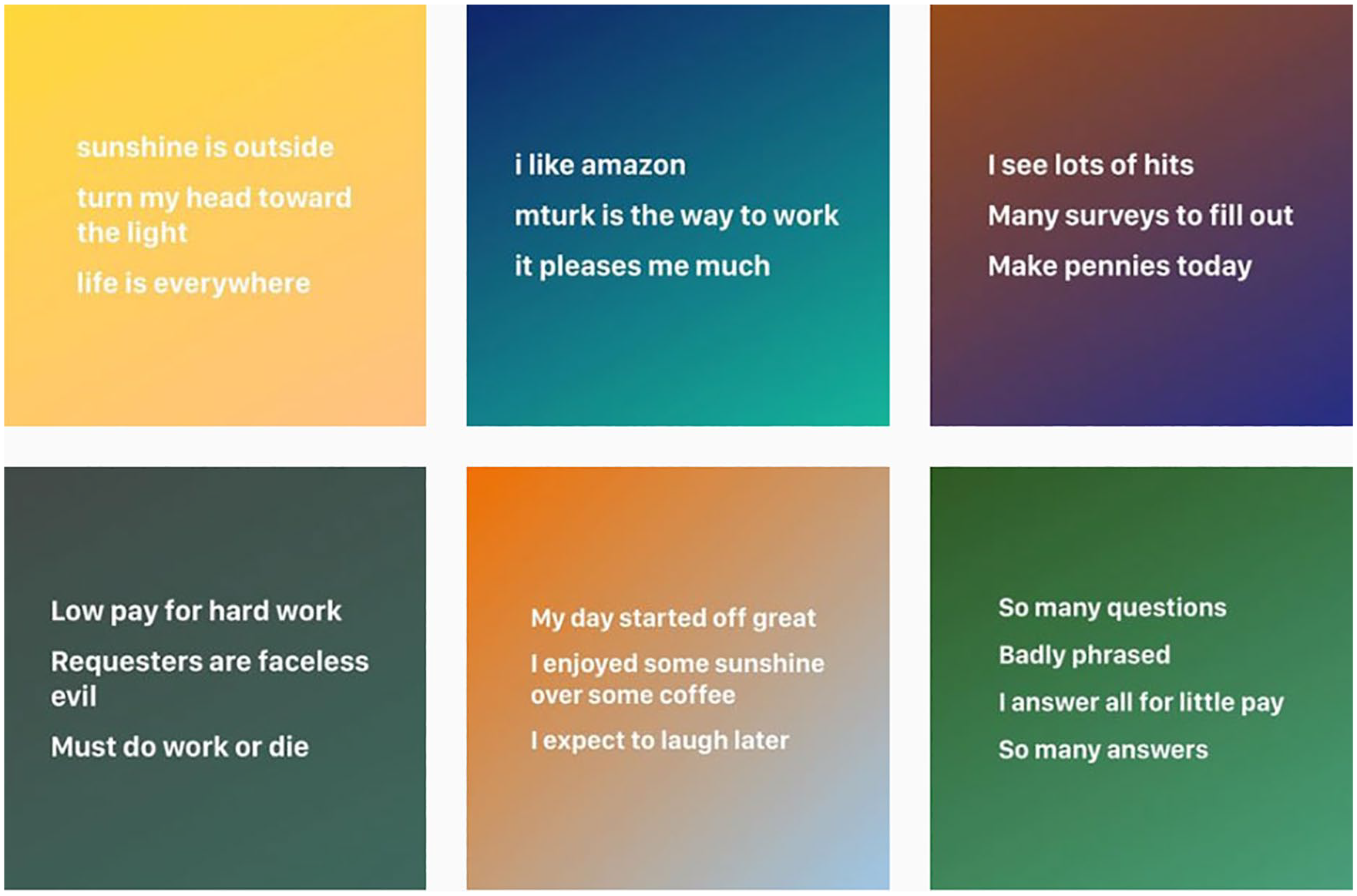
Some posts from the @mturkpoems Instagram account.
Other projects, in fact, use this technique as a way to infiltrate mainstream discourse and inject some criticality in it. For example, @catonacci_official hijacks traffic flows on the platform by using cat-related hashtags like #instacat or #catsofinstagram to promote the fictional persona of a former Marlboro model forced by student debt to become a cat sitter. Marked by a surreal, trollish aesthetic, the project touches upon issues of self-branding, masculinity, and the psychically trying conditions of the attention economy. Other interesting critiques of branding cultures on Instagram are accounts like @tabaskosweet, who playfully satirizes the so-called “hypebeast” community, and @jenya_kenner, who participates in celebrity-driven fashion trends and hashtags with a satirical twist. As of this writing, parodic digital nomad or remote-working themed accounts on Instagram seem to be almost non-existent, 8 but there is room for hope.
Recent literature has in fact highlighted the political potential of Instagram aesthetics and memes. In terms of bottom-up political taxonomies, Joshua Citarella (2018) explores the ideological fluctuations of alienated teenagers through a cultural analysis of the so-called “Politigram,” highlighting the radical aesthetics of Post-Left memes on the platform. In terms of top-down propaganda, a New Knowledge report (DiResta et al., 2018, p. 8) highlights instead how Instagram engagement outperformed Facebook as a tool in image-centric memetic warfare within the activities of the infamous Internet Research Agency (IRA), a Russian company engaged in online influence operations and most notably discussed in association to the 2016 US election. Generally, then, a future aesthetic development of the digital nomad imaginary toward more political tropes, at least on Instagram, is not inconceivable.
Conclusion: Toward an Aesthetics of Post-Work?
This essay has dissected the figure of the digital nomad as a cultural avatar of remote work and an increasingly influential category in public discourse. In particular, I have highlighted the figure’s contradictory character: on one hand, the inclusive promise of the “digital” evokes a utopian, borderless world of possibilities; on the other, the appropriation of the traditionally marginalizing term “nomad” mystifies the persistence of borders and global disparities.
Throughout the essay, I have also argued that Instagram plays a significant role in defining and materializing digital nomadism as a cultural production—not only through the diffusion of travel and work-related imagery but also by establishing networks and geographies through collective labeling practices like hashtagging and geotagging.
Despite the argument that the social imaginary and geography that the digital nomad contributes to still reflect neoliberal values, the essay has provocatively suggested a potential appropriation of Instagram as a techno-poetic platform for the collective subjectivation of knowledge workers worldwide might be possible. The creation and diffusion of fictional personas and memes, for example, might help put the nomadic imaginary of the 21st century (dominated by a Silicon Valley–inspired ethos of entrepreneurship, quasi-algorithmic body hacks, and unbridled capitalism) in dialogue with other nomadic cultures (e.g., the experiences of the gig economy workers whom tasks are outsourced to, or even refugees).
As digital nomadism gains cultural momentum and the dream of remote work becomes a more and more widespread response to office alienation, precarious working conditions, and globalized #FOMO, 9 in the future the digital nomad imaginary might have to accommodate a more diverse spectrum of desiring crowds, opening itself up to become a more inclusive utopia rather than a minority lifestyle—a mass retirement, instead of a multitude of mini-retirements. An alliance between workers’ rights advocates and aspiring digital nomads through the appropriation of digital nomad aesthetics could be the first step toward such future.
In order to reconcile its internal tensions, then, the notion of “digital nomad” could be expanded from a privileged and relatively homogenous demographic to a utopian avatar of post-work—a more inclusive figuration that enables the imagination of a future without borders and without work for all humankind.
Footnotes
Declaration of Conflicting Interests
The author(s) declared no potential conflicts of interest with respect to the research, authorship, and/or publication of this article.
Funding
The author(s) received no financial support for the research, authorship, and/or publication of this article.
