




Abstract
The advent of ‘digital’ ways of working and organising is unequivocally transforming the very fabric of work, leading to an increasingly uncertain, unsettled, and fluid environment. Research has traditionally anchored worker identity in fixed and place-bound concepts. However, in the digital workplace, where work is more akin to a performance, unfolding over time, and processual in nature, our understanding of work and theories of worker identity are called into question. In this paper, we ask the question: how is digital worker identity performed in such fluid and unsettled work settings? To explain digital worker identity performance, we investigate digital nomadism as an extremely fluid and unsettled case of digital work. We study digital nomads, high-skilled professionals who use digital technologies to work remotely and lead a nomadic lifestyle, in a multi-sited ethnographic field study. Based on a process-relational perspective, we are theorising how the identity of digital nomads, their “becoming,” is performed as an ongoing process along lines of identity performance. This is an intermediate “product of theorising,” in accord with the aim of the special issue, but provides a foundation for a novel process-relational theory of identity performance in unsettled digital work.
Keywords
Introduction
‘Digital’ ways of working and organising are undeniably changing the nature of work (Aroles et al., 2019; Fayard, 2021). The changes call into question our understanding of work and our conceptions of worker identity as an individual’s work-based definition of the self, which is less and less centred on ‘the workplace' (Barley et al., 2017). Identity in digital work is becoming more uncertain, ambiguous, slippery, and fluid (Ahuja et al., 2020; Petriglieri et al., 2019). Therefore, the fluidity of identity in digital work necessitates a shift in traditional ways of working and organising, calling for increased adaptability, new means of communication, and redefined leadership roles (Ashford et al., 2018).
One group of digital workers who are at the forefront of this fluid and unsettled world of work are ‘digital nomads'. Digital nomads are high-skilled professionals who use digital technologies to work remotely and lead a nomadic lifestyle (Wang et al., 2020). ‘Digital nomadism' is the term used to describe this phenomenon (Schlagwein, 2018). Importantly, digital nomads also exhibit a strong sense of having a unique 'digital nomad' identity. This 'digital nomad' identity includes notions of personal freedom and mobility, a distinct desire to craft one’s individual lifestyle, and a high affinity towards digital tools (Olga, 2020). This identity is most visibly expressed in a variety of everyday events with the ‘digital nomad' branding, including self-help books, meetings, conferences, co-working spaces, and even cruises.
Work identity, the conception of oneself in a professional capacity, is a valuable concept to make sense of work practices, and it seems to be even more crucial for explaining fluid and unsettled work settings (Ashford et al., 2018). Using an identity perspective to define work in such settings, scholars have recently developed theoretical concepts that highlight fluidity and uncertainty. For example, Petriglieri et al. (2019) refer to personal holding environments in gig work as a set of cultivated connections to routines, places, people, and purpose that keep ‘the self’ bound to work in the absence of organisational structures. Similarly, Idowu and Elbanna (2021) developed the concept of identity flexibility which allows platform workers to present themselves differently depending on the particular social situation on and off the digital platform (Idowu and Elbanna, 2021). However, for extremely fluid and unsettled work settings such as digital nomadism, we argue that we need to move beyond holding environments as emotionally comforting social contexts, multiple but stable careers, and fixed workplaces. Much of the current research on digital nomads depicts them as occupying a liminal position, caught between work-related and lifestyle mobility (Olga, 2020), organisational development, individual preferences, and technological advances (Richter and Richter, 2020), or culture, technology, and economy (Wang et al., 2018). Digital nomads thus problematise even those concepts of identity that emphasise fluidity and uncertainty. What is overlooked are the ways in which identities are continuously enacted through performance and social and technological interaction. So instead of exploring what digital nomad identity is, in this paper, we attend to the fluidity of digital nomad work and ask, ‘How is identity performed for digital nomads such that the worker accomplishes a coherent sense of self as well as a recognisable form of identity for others?'
To investigate the above research question, we conducted a multi-sited ethnographic study of digital nomads between the years of 2016 and 2022 to explore the identity of a particular kind of digital workers. We study the performance of identity in the everyday working and living practices of digital nomads as well as how people come to identify themselves as digital nomads based on 14 months of ethnographic fieldwork in several physical and digital sites. Our in-depth study highlighted the inherently processual nature of digital nomad identity performance that led us to adopt a process-relational perspective (Mesle, 2008) and, more specifically, engage with the ideas from Tim Ingold’s (2015, 2017) work, particularly as applied to fluid, digital phenomena (Mousavi Baygi et al., 2021).
What we discovered is that digital nomad identity is performed by ongoing travel, a unique blend of work and social life, and a continuous assembling and reassembling of personal digital infrastructures. Rather than assuming this identity as given or existing outside of digital nomading processes, we argue that digital nomads’ everyday working and living processes are the digital nomad identity. We refer to these processual performances as three lines of identity performance – journeying, workliving, and digital reassembling. As what we see as an intermediate step towards a new theory of digital worker identity, this paper explicates the concept of identity performance via lines for the case of digital nomads, in line with the aim of this special issue, as a ‘product of theorising' (Hassan et al., 2022; Weick, 1995). The ‘lines of identity performance' contribute to the literature by providing a foundation for a process-relational theory of digital worker identity.
The paper is organised as follows. The next section reviews the prior work on digital work, work identity, and digital nomadism. The process-relational perspective that served as our theoretical approach is presented after that. After describing the research method of this paper, the next section details the empirical findings. The subsequent section then presents the theoretical analysis and development of our product of theorising. The penultimate section discusses the contributions of this paper to the literature. The paper concludes with a brief summary.
Literature review
Digital work and unsettled work identities
Digital work is a prominent area of interest in recent discussions of the changing nature of work and organisational transformation (Bandi et al., 2020; Baptista et al., 2020). We refer to digital work as work done entirely through digital means, either fundamentally reconfigured from conventional work forms (Orlikowski and Scott, 2016) or sui generis new, digital work forms that did not exist ‘pre-digital' (Aroles et al., 2019). Conventional work forms that have been digitally transformed include those of digital marketers, software developers, and telehealth nurses. Additionally, digital work includes various new forms of work, such as those of social media influencers, gig workers, or digital nomads.
Digital work research has highlighted significant implications for organisations and individual workers, such as increasing work complexity, transformation of structures and processes, spatial and temporal independence, and flattening organisational hierarchies (Davison and Ou, 2017; Forman et al., 2014; Grønsund and Aanestad, 2020; Morton et al., 2020). As we dedicate a substantial portion of our time to our jobs, our sense of self and identities are intricately intertwined with our work (Pratt et al., 2006). Emerging digital work practices are therefore calling into question our understanding of one of the most fundamental concepts of working and organising – that is, identity (Ashford et al., 2018; Barley et al., 2017).
Scholarship on identity at work has developed into a major stream of research in organisation studies (Ibarra, 1999; Pratt et al., 2006) and is also gaining traction in the IS field (Carter and Grover, 2015; Whitley et al., 2014). Work identity, which is the focus of this paper, refers to an individual’s work-based definition of the self that shapes the roles workers adopt and the corresponding ways they behave when performing work in the context of their jobs (Riemenschneider and Armstrong, 2021; Vaast and Pinsonneault, 2021; Walsh and Gordon, 2008). Given the importance of work in our lives, and given the centrality of identity in how workers make sense in increasingly digital environments, how work is changing has implications for worker identity.
The changing nature of work has made work identity more uncertain, ambiguous, slippery, and fluid. For decades, research has assumed that identity construction is tied to the organisation for which we work (Ashforth et al., 2008; Pratt, 2000) or a profession with which we are affiliated (Walsh and Gordon, 2008). However, as digital workers increasingly no longer work for traditional organisations and jobs transcend conventional professions, work identity construction is becoming an individual endeavour (Barley et al., 2017). Prior literature has highlighted the independence and directly associated precarity of digital work arrangements that lead to anxiety, overwork, social unrest, and unfulfilled desires for secure employment (Barley and Kunda, 2006), making it challenging to maintain a consistent identity (Ibarra and Obodaru, 2016; Petriglieri et al., 2019). For example, Petriglieri et al. (2019) have highlighted the emotional tensions entailed in digital work and how workers connect to personal routines and workplaces to develop a viable identity and vitality of self that can thrive in digital work environments.
Increased opportunities and job variety may grow work complexity as well as career path uncertainty, posing a threat to work identity (Caza et al., 2018). To respond to these challenges, digital workers need to practice identity flexibility – that is, increasing the degree to which one can imagine different identities for oneself (Ashford et al., 2018). In a study of knowledge workers on digital platforms, Idowu and Elbanna (2021) emphasise how platform work shows identity flexibility and multiplicity as workers move fluidly between multiple work roles and envision themselves in different future jobs. For example, they observed how platform workers followed traditional working routines and rented office space purely for their symbolic meaning to appear as legitimate workers.
Scholars have applied various theoretical perspectives to explain digital work identity and the corresponding shifts in its formation. These perspectives have in common a more dynamic and flexible theoretical apparatus (Ashford et al., 2018; Barley et al., 2017) than theories of work identity developed in traditional organisational settings that conceptualise identity as a relatively stable characteristic of the worker derived from professional roles, organisational hierarchies, or the workplace (Pratt et al., 2006; Walsh and Gordon, 2008). For example, scholars have employed the concept of personal holding environments to theorise how digital workers establish work identity through connections to people, places, personal routines, a sense of purpose, as well as digital technologies such as digital platforms (Petriglieri et al., 2019; Sutherland et al., 2020).
Others have theorised the work that goes into constructing, maintaining, and discarding digital work identities over time – that is, the performance of identity work (Boudreau et al., 2014). Vaast and Pinsonneault (2021) conceptualised a composite life-cycle of data scientists’ identity work that involves managing the tensions of occupational identity associated with digital technologies to form temporary expressions of occupational identity. Furthermore, to challenge the view of IT and identity as distinct entities, scholars have introduced the concept of IT identity to draw attention to IT as an integral part of how individuals come to know and define themselves in relation to technology (Carter et al., 2020; Carter and Grover, 2015).
While this stream of research and the corresponding theoretical projects have contributed greatly to our understanding of digital work identity, in particular what new structures and holding environments may replace traditional identity referents, the principal question of how digital work identity is performed in such fluid and unsettled settings remains open. As more people engage in freelance, gig, and other forms of digital work, for which nurturing coherent and fulfilling work identities may be crucial for thriving, it is increasingly important to understand digital work identity. By analysing processes of work identity performance, we aim to go beyond the focus in the literature on individuals’ identity work and the ways in which digital technologies afford identity formation and shift attention to ongoing flows of action that make identity performance in unsettled digital work possible.
Digital nomadism as an extreme case of unsettled digital work
Digital nomads are a group of workers that exemplify and take to the extreme the fluidity and unsettledness of digital work. Digital nomads share some common characteristics with ‘traditional nomads' who travel with the seasons for food, with livestock or for trade as well as with ‘neo-nomads' such as travelling festival people or long-term backpackers (Schlagwein, 2018). However, they are unique in that they are highly skilled professionals who leverage digital technologies to work remotely and lead an independent and nomadic lifestyle (Makimoto and Manners, 1997; Olga, 2020). Living out of their backpacks, they often change countries every few weeks, a pace set by the duration of short-term tourist visas.
Although already existing before, the COVID-19 pandemic has turned digital nomadism into a significant and growing part of the remote workforce. In 2020, the State of Independence in America Report found that 10.9 million workers, more than 6% of the US workforce, described themselves as digital nomads (MBO Partners, 2020). This number is only expected to grow after the pandemic, as more companies plan to offer remote work arrangements, providing millions of people with the opportunity to become digital nomads in the coming years.
For digital nomads, the notion of being unsettled manifests along at least four dimensions: temporal, spatial, operational, and professional unsettledness. Being temporally unsettled becomes visible in the freedom as well as the responsibility to manage long-term schedules and day-to-day minutia (Cook, 2020; Wang et al., 2020). For example, many digital nomads choose this lifestyle to be able to work according to their preferred schedule rather than the institutionalised 9-to-5 workday. Being spatially unsettled, for digital nomads, means that they can work from anywhere where there is a Wi-Fi connection (Nash et al., 2021). Being operationally unsettled is highlighted in the digital nomads’ flexibility over the kind of tasks and work-related activities they need to, or want to, complete (Jarrahi et al., 2019; Jarrahi and Thomson, 2017). Being professionally unsettled manifests, in the rate at which digital nomads change careers and jobs (Aroles et al., 2019; Prester et al., 2020). For example, whether it is independent work, freelancing, entrepreneurship, or employment at an all-remote company, digital nomads are frequently experimenting with new career paths and organisational forms outside traditional employment.
While research on the identity of digital nomads is only emerging (Prester et al., 2019), some insights about how these different dimensions of unsettledness are conditioning digital nomad identity can be drawn from other types of remote and mobile digital workers. For example, D’Mello and Sahay (2007) develop the concept of ‘mobility-identity' to explain how the identity of global software developers, rather than being anchored to static spaces, is constructed by moving between ‘cultural, technological, spatial and existential spaces and places' (p. 184). Similarly, Cousins & Robey (2015), in a study of mobile workers, highlight how work-life boundary management practices, enabled by mobile technology affordances that make boundary transitions easier, allow workers to assume a unique identity, such as a mobile parent who uses mobile technologies to stay in touch with children while being away from home for work purposes. Jarrahi et al. (2022) show mobile knowledge workers’ high degree of individualisation when it comes to assembling personal digital infrastructures for work, which bring together various tools, devices, and technological platforms. This freedom to craft their own digital assemblages hints at a form of IT identity reflecting the increasing independence of work from organisations and physical locations.
What this review of the literature shows is that traditional conceptions of identity are fundamentally transformed in the case of fluid and unsettled digital workers such as digital nomads. For organisations to work with digital nomads (Everson et al., 2021) or for nation-states to integrate them into local labour markets (Choudhury, 2022), it is crucial to understand how digital nomad identity aligns with organisational identity (Frick and Marx, 2021) or digital nomads’ socio-cultural impact on local communities (Jiwasiddi et al., 2022). Some initial explanations can be found in research that has explored mobile workers’ mobility (D’Mello and Sahay, 2007), boundary management (Cousins and Robey, 2015), and infrastructuring practices (Jarrahi et al., 2022). For example, D’Mello and Sahay (2007) argue that rather than through a physical place such as an office or desk, mobile workers may construct a sense of identity by securing a ‘psychic place' inside organisations, markets, and social groups.
While some of these findings may be more or less transferable to the case of digital nomads, we argue that the theoretical concepts being deployed in these studies may background the fluidity and unsettledness of digital nomad identity. For example, while ‘mobility-identity' shifts attention to multiple places of identity construction, identity is still spatialised rather than situated in journeys and transitions between places. Similarly, while ‘work-life boundary management' highlights the agential possibilities of the worker, it underplays the timing and temporal conditions that make identity performance possible in the moment. In other words, worker identity remains anchored in fixed and place-bound concepts. However, in the digital workplace, where work is more akin to a performance (Prester et al., 2021), unfolding over time and processual in nature, emphasising spatial over temporal identity referents becomes unconvincing (Prester et al., 2019). For example, digital nomadism is not just a more flexible form of office work but so fundamentally fluid that an explicitly processual perspective seems more suitable for theorising digital nomad identity.
This shift in perspective leads us to ask: ‘How is identity temporally performed for digital nomads such that the worker accomplishes a coherent sense of self as well as a recognisable form of identity for others?' To answer this research question, we engage with a process theoretical perspective that is particularly suitable to theorise the temporally uncertain, slippery, and fluid identities in digital work.
Theorising unsettled digital worker identity with a process-relational perspective
Theorising grounded in a process-relational perspective opens up a new way of understanding digital work. This perspective is based on process philosophy, a thoroughgoing processual understanding of the world (Mesle, 2008). It gives primacy to processes and relations over distinct entities or external and solid structures, to “becoming” over “being” (Whitehead, 1929). This focus on process and fluidity resonates with how digital nomads experience the world.
A process-relational perspective starts from the assumption that everything is always “in becoming”, always in flux, created and re-created through processes (Sandberg et al., 2015). In other words, what kind of “being” someone or something becomes is determined through its being-with-others, not only as a momentary being but as a going-along-together (for a full discussion and history of process philosophy, see Seibt (2022)).
Process-relational theories are intended to be more modest and provisional without seeking objective or final representations of reality. Processes and events are always a combination of chance and uncertainty (Mesle, 2008). For process theorists, it is essential to maintain openness to the fluidity and complexity of the world rather than clinging to certainty, neat categories, abstract explanations, and simple models that are increasingly unhelpful (Pyyhtinen, 2017). As Law (2004) warned us, when social scientists strive to reduce ambiguity and the messiness of the world by presenting what they perceive to be simple and obvious descriptions, they merely serve to exacerbate the mess: 'The very attempt to be clear simply increases the mess' (p. 2). This quote summarises the key difference between process theorising and substantive approaches. While substantive approaches try to reduce the messiness of the social world by spatialising what they perceive to be simple and straightforward categories, process theory embraces messiness and intentionally draws attention to questions of fluidity, hybridity, and uncertainty.
A process-relational perspective shifts attention to process not only in its theories but also in the theorising process itself. In being more modest in its claims and embracing temporality, fluidity, and messiness, such a view opens up space for future theorising rather than cutting off lines of thinking (Cecez-Kecmanovic, 2023). Hassan et al. (2022), drawing from Weick (1995), refer to these more modest claims as “products of theorising.” These intermediate products represent approximations of theory, the interim struggles on the way towards full-fledged theories. Weick (1995) argues, citing TenHouten and Kaplan (1973), that “theorists start with a vision for a theory and change it ‘from entwined ideas at the edge of words to a linear order in which the ideas are unravelled and set forth in the form of a propositional argument’ (TenHouten and Kaplan, 1973: 147).” (p. 386). However, rather than trying to inch towards ever “better” approximations, a process-relational perspective to theorising stays with the “entwined ideas” and acknowledges the intermediate and approximate nature of its products of theorising; a theory in a constant state of becoming.
To explore the “entwined ideas” of digital nomad identity, we engage with a specific kind of process-relational perspective. We draw from Tim Ingold’s (2017) work and his concept of the ‘lines of becoming’, or simply ‘lines’. According to Ingold, everything in the world is made up of lines of life, growth, and movement. For Ingold, all phenomena are best understood as bundles of lines (Ingold, 2015). Consider, for example, a website. Rather than viewing it as a fixed, static page, we can see it as a bundle of lines pages, content, and algorithms that make up the website that extends across servers and infrastructures, dynamically responding to inputs and events. Lines of hyperlinks connect one page to another both within the site and across the internet. When a user views the website, their lines of attention and interest tangle with the lines of the site as they scroll, click links and consume information and behind the scenes, lines of the site’s algorithms are capturing data, adapting to usage patterns and updating recommendations and content. In other words, Ingold directs our attention to ongoing processes, actions, and performances, such as travelling, working, nomading, and computing, as opposed to thinking about the phenomena of the digital nomad in terms of discrete entities, such as traveller, worker, nomad or computer.
We should note that while lines in Ingold’s vocabulary (and processes in process philosophy in general) share many theoretical characteristics with practices in practice theoretical approaches, there are significant distinctions. Lines and practices share a focus on the processual and relational nature of phenomena (Ingold, 2017). However, as Mousavi Baygi et al. (2021) argue, a practice perspective foregrounds patterns or repetitive doings that enact actors in more or less spatial relations, whereas a process perspective foregrounds the flow of action and the temporal unfolding of relations. With the concept of lines, Ingold sensitises us to the temporal qualities of ever-unfolding processes. Therefore, in studying digital nomad identity, Ingold’s concept of lines allows going beyond recurrent actions and instead foregrounds the temporal becoming of digital nomads and the ways in which opportune timings and timely confluences such as fortunate work opportunities, sudden changes of travel plans, and timely meetups with friends always already condition identity performance.
Lines relate to one another and join to keep life going (Ingold, 2015). In “a world of becoming, of fluxes and flows” (Ingold, 2015, p. 80), where life is characterised by lines, the joining and knotting with one another serves as the foundational principle of coherence. Going back to the example of the website, without the meshwork of proliferating, intersecting and co-responding lines – between code, algorithms, users and infrastructure – the website would cease to exist. Such joining of lines in an ongoing forward movement describes an inherently temporal relationality (Mousavi Baygi et al., 2021). That is, identity performance cannot take place at any time when a practice is repeated in a particular place, but rather, identity performance requires opportune moments and timely confluences for certain lines to emerge as obvious, meaningful, and legitimate opportunities to act.
The process-relational perspective based on Ingold’s theoretical vocabulary is conducive to more modest and provisional forms of theorising about digital nomad identity because it attends to an inherently fluid, unsettled, uncertain, and complex world. In studying lines, Ingold provides us with a uniquely processual vocabulary that enables us to be attentive and responsive to the vitality and uncertainty of life processes. From this perspective, digital nomads neither choose, adopt, or intentionally enact a particular way of working and living nor do they intentionally form an identity. Rather, digital nomading emerges along lines of life that, in knotting together, perform the “digital nomad.” We draw on Ingold’s vocabulary of lines to develop products of theorising about digital nomad identity, which we investigated via an extensive multi-sited ethnography, described next.
Research Method
Overview of data collection and analysis.
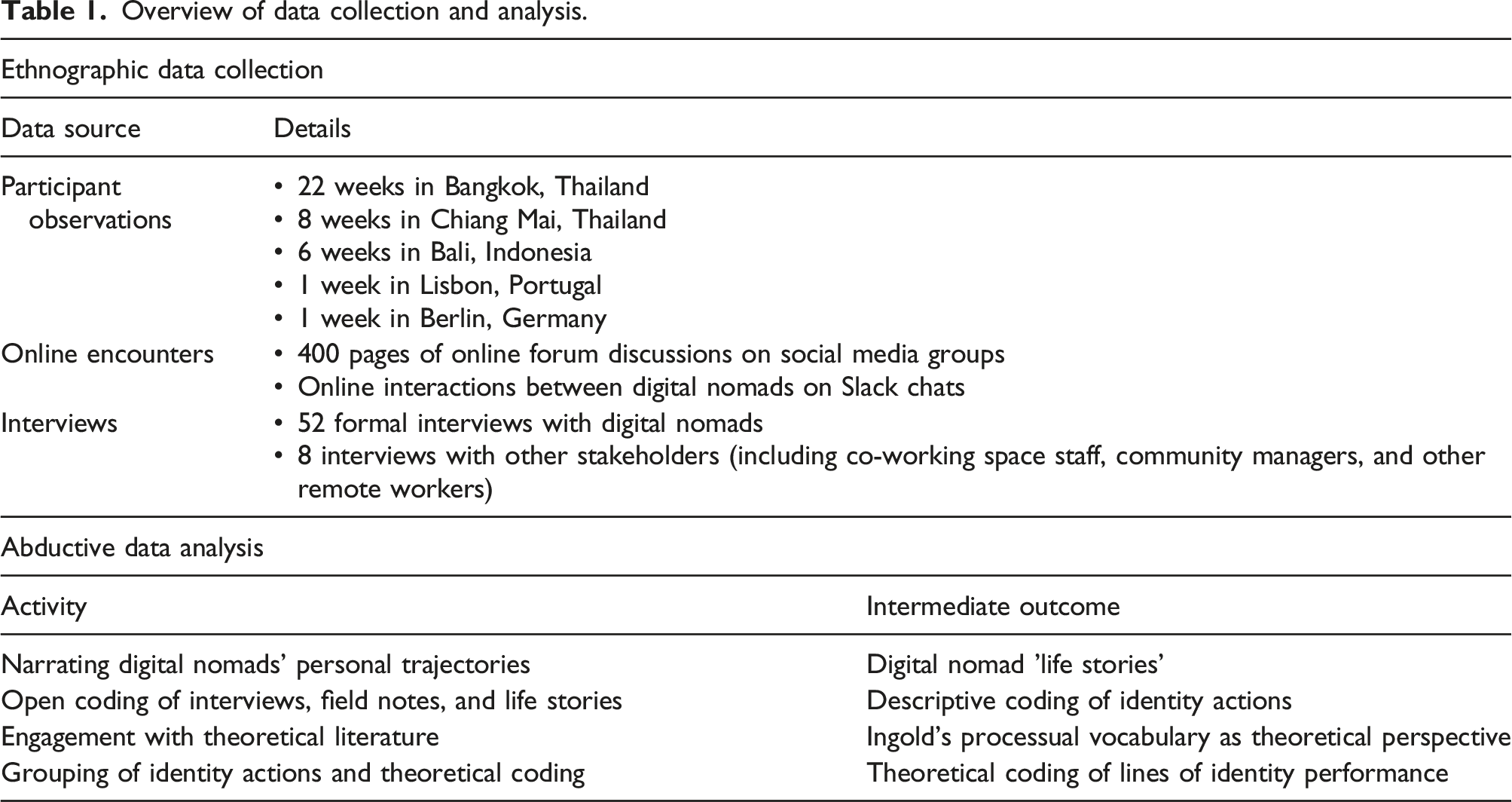
The data sources for our multi-sited ethnography included participant observations in multiple physical locations, online observations, and semi-structured interviews. First, as part of an ongoing research program between October 2016 and December 2022, all three authors conducted a total of 38 weeks of participant observation. We visited the typical workspaces of digital nomads in Bangkok, Chiang Mai, Bali, Berlin, and Lisbon, which are some of the most popular destinations for digital nomads, to observe and participate in their work practices and to develop an in-depth understanding of their actions and interactions in situ. The field trips also allowed us to work alongside digital nomads and take part in their professional and private social activities, such as workshops, meetups, and social events.
Second, we extended our observations from physical sites to digital sites. Such observations included data on online activities, such as digital work and community chats where we followed actors and their actions across social media, online communities, and personal websites. These digitally mediated interactions proved instrumental for making sense of how networks and experiences connect digital nomads across physical sites.
Third, we conducted 52 interviews with digital nomads. The digital nomads we spoke with had a variety of jobs, came from a range of socio-economic backgrounds, and were at different points in their journeys as digital nomads. In the interviews, we asked the participants to describe a typical workday, share tales from their lives as digital nomads, and recall memorable experiences, among other things.
We used an abductive data analysis method (Gioia et al., 2013) or a combination of inductive and deductive analysis techniques (Dubois and Gadde, 2002). In particular, we used inductive qualitative data analysis techniques borrowed from the grounded theory method yet also built “deductively” on concepts from Ingold’s theoretical vocabulary at higher levels of analysis. We started by creating narratives of each digital nomad’s “life story” (Ingold, 2011). Our goal was to provide a thorough description of the activities that happened in the lives of digital nomads. These stories served as the foundation for how we present our findings below.
We then coded the interviews, field notes, and life stories, seen through the process-relational perspective, seeking to uncover digital nomads’ becoming and their identity performances. From “sightseeing” to “working on platforms,” “moving with light equipment,” “balancing work-life cycles,” and “identifying business prospects on social media,” we coded all actions that were performed as part of the digital nomads’ lives. Through further engagement with the theoretical literature, and especially Ingold’s processual vocabulary (2017), we then focused on performative moments in which digital nomads become distinct. In analysing the heterogeneous lines of, for example, different time zones, workplaces, videoconferencing technologies, and Wi-Fi infrastructure that are all joining together in the ongoing process of digital nomading we identified bundles of lines that appeared as consequential for digital nomad identity performance. To sum up, along this abductive theorising process, we identify three bundles of lines, or simply lines of identity performance, as products of our theorising that may not yet resemble a full-fledged theory of digital nomad identity but that can help us understand how and along which lines digital nomad identity is performed.
Empirical findings
In this section, we present the most illustrative findings from analysing digital nomads’ life stories. In the first part, we present a general description of digital nomad life. In the second part, we then zoom in on one composite story of a “day in the life” of a digital nomad to show how digital nomad identity is performed in and through everyday actions and to foreground the timely moments at which digital nomad identity performance becomes possible.
Digital nomad life and identity
Digital nomads have a strong sense of identity and experience their lives as ‘digital nomads’. For example, the digital nomad identity has become most visibly manifested in extremely fast-paced travel patterns, specialised co-working spaces, and digital nomad conferences. Indeed, digital nomading has been recognised as a legitimate form of working and living in some countries that offer ‘digital nomad visas’ as a formal visa category and the necessary legal frameworks to accommodate such unsettled workers. A 42-year-old senior change manager working nomadically in the communications department of a large French organisation as part of a corporate remote work experiment articulates this digital nomad identity succinctly: “You suddenly realise that we are all using the same tools. We have actually the same kind of schedule. You will never see someone at 8[am]. You will always see people working at noon. We have codes between us. You relate to other people because they are also sitting on their laptops. You go to the same kind of co-working space or café. […] I know the spots where we are going now. I know the kind of equipment digital nomads have.” (Charlotte)
While the fluid and unsettled lifestyle makes it challenging to clearly define a ‘digital nomad’ identity, the above quote and empirical material below highlight that digital nomad identity is a conjunction of ongoing multiscale travel from local to global, a blend of work and social life, and an assemblage of personal digital infrastructures.
The lives of digital nomads involve ongoing travel as well as other qualities of hyper-mobility. For instance, digital nomads seldom remain more than 4 weeks in a single location They often end up going on so called 'visa runs', leaving a country and re-entering it immediately with a new passport stamp, to avoid problems with temporary tourist visas. They are being drawn to ongoing travel because they are seeking to experience as many cultures and nations as they can as quickly as possible. A former 'conventionally working' marketer who is now a digital nomad explains her travelling style: “We’ve been travelling all the time for the last five years. We’ve been to all seven continents in the world. I’ve been to almost 60 countries, I think 58. I don’t know. I don’t count anymore. So, it’s quite fast because sometimes we’re only in a country for like three days, one week or two weeks.” (Dale)
This ongoing travel unfolds at multiple scales. Another digital nomad, a software engineer, explains these micro and macro scales of travel in more detail: “I change locations both at the macro and micro level because I just need that stimulus. So, I just arrived here in Costa Rica about a week ago, after six months in Mexico City, which is actually the longest time I’ve spent anywhere. But even within the city I changed locations five or six times, changed neighbourhoods. […] I spent some time working at co-working spaces. I’m at one now. I spend some time working at home. And then I do spend some time working from cafes some days.” (Francesco)
Digital nomad identity is a manifestation of this spatial freedom, combined with ongoing travel from the smallest scale (e.g. adjusting work areas in a co-working space based on the task at hand) to the largest scale (e.g. travelling from Bali to Colombia just to move on to Portugal a few weeks later).
Digital nomads find themselves blending their personal and professional lives in a unique way while going through the challenges that arise from this blend. Digital nomads rarely work in conventional organisations and the traditional office spaces that come with them; they work, for instance, as freelancers, independent contractors, entrepreneurs, gig workers, and, only if a company offers flexible remote working options, in traditional employment. These non-traditional employment arrangements allow digital nomads to work from anywhere in the world often according to their own schedule. For example, as we can see from the introductory quote by Charlotte, some digital nomads fall into a routine of working later in the day because they are drawn to explore their surroundings and do sightseeing in the morning. This blending of work and social life is of course not without its challenges as on digital nomad explains: ‘It’s definitely not easy when you first start out. I almost got fired, twice. You land in new country, want to explore the city, meet lots of people, go out a lot more than normal. Try balancing all that working 30 hours a week without any noticeable drop in quality of your code'. (Ralf)
Yet, digital nomads have found ways that allow them to stay productive at work and at the same time experience a sense of community and enjoy their social life. Co-working spaces, or in an even more blended form co-living spaces, offer a space that paradoxically closely resembles a traditional office but at the same time are a place for socialising, exercising, eating, relaxing, and networking. Francesco, a nomadic software developer notes: ‘One of the great things about working in co-working spaces is that when you’re travelling you’re much more likely to meet other people doing exactly what you’re doing. So, the co-working spaces are the best way to meet other digital nomads'.
Digital nomad identity is a form of lifestyle configuration that blends work and social activities in a way that boundaries between the two become blurred.
Digital nomads end up continuously experimenting with their personal digital infrastructures to support their nomadic lifestyle. To be able to work from anywhere in the world, without stable Wi-Fi connections, and without a traditional office infrastructure, digital nomads find themselves setting up and breaking down their personal mix of mobile technologies, cloud apps, and digital platforms on a regular basis. Charlotte explains that it is the lightweight infrastructure of nomadic life that becomes part of who they are as digital nomads: ‘So, your computer begins to be your very best friend especially because I realised, for example, that my computer which was just a tool to work, is now a tool for me to live'.
This process of temporarily setting up and breaking down personal digital infrastructures does not unfold without friction. For instance, just as digital nomads have prepared their desk at a co-working space to take calls with clients, unexpected disruptions of the technological setup may require ad hoc improvisations. Another digital nomad, a mobile app developers, illustrates such a situation: ‘Every day is different and having flexibility in that, I think, is also important because things change. I mean, we had an experience where we were in Bolivia and for two days we didn’t have any internet. The country was out. So, what do you do? How do you switch gears?'
Digital nomad identity involves a continuous assembling and reassembling of personal digital infrastructures in such a way that distinctions of whether digital nomads use the technologies for work or the other way around become meaningless.
The above findings provide an overview of digital nomad life. Digital nomad identity is conjunction of ongoing multiscale travel, a blend of work and social life, and a continuous assembling and reassembling of personal digital infrastructures. Because this identity is fluid and manifests, if at all, only temporally, we now 'zoom in' on one particular story to show how digital nomad 'Annika' performs her digital nomad identity during a typical work day in Chiang Mai, Thailand. We present a composite story (Humphreys and Watson, 2009; Smets et al., 2015) to present the full breadth and depth of our data within a single evocative story. In other words, while it is not specifically the story of any one of the digital nomads we met and surely every digital nomad performs their identity differently, most of them could find themselves in parts of this composite story.
Annika’s story – as an exemplar of digital nomad identity performance
Annika is a 29-year-old Dutch digital nomad. Before becoming 'nomadic' her life followed a conventional path. She graduated from university, got married, and bought a house, following the ideals and patterns of a settled life. However, for her, it did not work out as planned. She got divorced, had to sell the house, and was increasingly looking for a fundamental change.
Annika became interested in travelling the world, something she has always enjoyed as a teenager. In the summer of 2017, she was met with an opportunity to travel to Asia. She considered working remotely to extend her travels to a longer period instead of just a short trip from which she would soon have to return home to the Netherlands. At the time, Annika was working as an event planner at a company that did not allow remote work, as well as a part-time yoga teacher, both jobs that she found difficult to do remotely. Although it took her some time and many applications, she came across a sales representative job at an event planning company that allowed remote work. A few months later, Annika found herself on what she considered at that point an 'open-ended', potentially multi-year journey around the world.
It is February 2018 when we are doing fieldwork and when Annika is getting ready to start work. She has just arrived in Chiang Mai, Thailand, after a 3-week trip through Cambodia. She will stay in Chiang Mai for 2 weeks mostly to meet up with friends and get some work done. She plans to go on a skiing trip to Japan after that. Annika reflects on her continuous travels and the experiences she makes along the way: ‘I really value getting to see the world, getting to see other cultures, learning about them. I think there’s nothing better than learning about people, places and history than being there. It contextualises everything. I think it adds a lot more meaning to the world that you live in as an individual'.
She is staying at a small Airbnb apartment in Chiang Mai’s Nimman area. Next to the window, she has set up her workspace overlooking the lush, green garden. It took her less than 15 min to set up her desk. Wherever she is working from, she brings all her gear in a small tote bag: computer, laptop stand, and noise-cancelling headphones. To get work done, she then only needs a good internet connection for Zoom calls. The Airbnb platform helps her find places with decent internet, as she explains: ‘If you’re fully nomadic and you’re a full-time traveller, it’s really nice to always know what to expect. You always know you’re going to get roughly the same wi-fi quality and decent bed and all that. So it’s a really nice way to have stability when your environment is changing so often'.
As with most days in Asia, Annika starts her workday late today. The five-hour time difference between her team and most clients in the Netherlands gives her some time for herself in the mornings. It also means that she usually has to work until 8 or 9 pm.
While the remote sales job affords her the flexibility to work nomadically, Annika complains that it does not yet offer her this flexibility in terms of working hours: ‘So, again, my job is really flexible. I get to kind of create my own hours but it’s still a sales job, which still means I have to be able to make calls during US business hours. So, when I was in Asia for three months, I was working night shifts for three months, and by the end of that third month I was really depressed'.
Although she does not have any calls scheduled before 2 pm, Annika ends up leaving her apartment to walk to a nearby co-working space. She is looking to get lunch with a few fellow digital nomads there. As she is usually working from her Airbnb apartment, she does not go to co-working spaces to get work done. Most of them are too noisy for taking sales calls and she cannot book the Zoom room for the entire day. She comes here mostly to socialise, as she explains: ‘I definitely think there’s a community there. And I think, for me, that is a big draw of going to co-working spaces. I have travelled on my own before so I know the option to do solo travel and be able to just go. I still do a bit of that even now, but because I’ve been a part of this community, I actually know people a lot of times, and often I will even base my next destination on who is around'.
Today, at the co-working space, there is a 'skill-sharing' workshop (a common type of event in digital nomad co-working spaces) scheduled on: 'how to set up your own web shop'. Annika first thinks of joining but then gets caught up in a conversation with a few digital nomads that have just arrived in Chiang Mai. She is always looking to meet new people and someone to explore the city with.
In the late afternoon, around lunchtime in Europe and when Annika is back in her apartment, she has a two-hour window where she does not have any calls scheduled. She ends up using the time to buy some groceries at the local market. This is also an opportunity to take a few pictures for her social media accounts. She is taking different kinds of shots: pictures of the locals and their market stalls for her personal Instagram account and pictures of exotic vegetables and Buddhist temples on the way for the social media channels of her remote yoga business. She also has a Twitter profile to promote important events that she is managing, but she rarely posts about her travels there. Annika does not fully understand all the tax and legal implications of working for a Dutch company from Asia, so she usually stays quiet about it.
Annika happens to use the ride-sharing app Grab to get back to 'her' Airbnb. Both Grab and Airbnb are apps that do not only offer convenience but, when travelling in a foreign country, also some sense of familiarity.
After she finishes the last sales call, she finds herself working for a few more hours on her side business. She was drawn to the remote yoga business 3 years ago when she first started working nomadically. Initially, she was not planning to make any money with it but now the business has grown into a respectable online community. She had already responded to some community questions throughout the day, but now she is met with an opportunity to record a quick yoga lesson and post the pictures she took earlier on social media. Annika likes how the sales job and the remote yoga business are intertwining throughout the day: ‘Today I’ve got about six work calls for the main job and between like normal admin work, I’ve got this call with you. I’ve got an interview with a news source later this afternoon on yoga helping with breakups. And I’m teaching a yoga class tonight randomly. You know, it’s different every day and that’s kind of what I appreciate'.
Annika is offering recorded yoga lessons, live sessions, and even one-on-one consultations. She is still keeping the remote sales job to pay for her travels, but if the remote yoga community continues to grow she will be able to take the business full-time in a few months.
With the sales job, she only ends up using Zoom for calls and the CRM system of her company but with her remote yoga business, she finds herself running an entirely digital business. She explains how many of the usual business processes are automated to make it possible for the business to run on the side while she is working a full-time job and travelling the world: ‘I mean with the small business, there’s always a million tools, right? So, I’ve got apps that run my calendar for me. I’ve got robots that run my social media for me. I’ve got the website popups, landing pages, and membership pages, video editor. Like there’s just a million different things'.
Six months later, in mid-2018, Annika will be in Medellín, Colombia. Since her time in Chiang Mai, she has quit her sales job and started working on her remote yoga business full-time. She will be at a point where she can fully decide her own hours and can even step away from her business for a few weeks without anyone noticing. She will have automated most aspects of the business. Until Annika finds a place that she would want to stay long-term, she will continue to travel and work nomadically.
Theoretical analysis
Grounded in the empirical material, this section presents a theoretical analysis of how digital nomad identity is performed, illustrated by Annika’s story above.
The lives of digital nomads are overflowing with actions that are constitutive of their digital nomad identities. Annika is a fast-paced traveller: 3 weeks in Cambodia, 2 weeks in Thailand, and soon off to Japan. Even in Chiang Mai we can see patterns of travel and movement albeit on a smaller scale. For example, depending on the time off day and her work tasks, she is moving between her workspace at the Airbnb apartment to a co-working space and back to the apartment.
Annika’s workday illustrates how her identity appears as a seamless blend of her professional and personal lives. While also having to get work done, she mainly travelled to Thailand for socialising purposes and to meet up with digital nomad friends. She visits the co-working space – a place where she cannot get much work done – to have lunch with other digital nomads. The time difference with her professional colleagues in Europe creates further possibilities to perform her identity. Although she has to work until late and continues to work even longer on her remote yoga business, in the morning Annika finds herself exploring Chiang Mai.
Annika’s identity is further performed through a continuous assembling and reassembling of her digital workspace. Similar to how traditional nomads are constantly setting up and breaking down their camps, digital nomads find themselves constantly setting up and tinkering with their personal digital infrastructures. Annika has her usual workspace set up at the Airbnb, but when she goes to the co-working space she ends up taking all her mobile technologies and desk equipment with her in a small bag. She is dependent on a good Wi-Fi connection at the co-working space; the rest of her lightweight infrastructure is set up in less than 15 min. What makes her digital setup so lightweight is the fact that she is using, often automated, cloud apps for most of her work as well as sharing economy platforms for personal activities such as accommodation and transport.
That is, the identity of digital nomads, what they are continuously 'becoming', is performed through an ongoing process involving changing locations locally and globally, engaging in blended work and social activities, and assembling and reassembling digital workspaces. Admittedly, one could read this ongoing process and the activities unfolding within it from a practice perspective. After all, travel patterns, workday routines, and habitual technology setups appear as routinised sociomaterial practices that could explain the enactment of digital nomad identity (Orlikowski and Scott, 2016).
Summary of lines of digital nomad identity performance in Annika’s story.
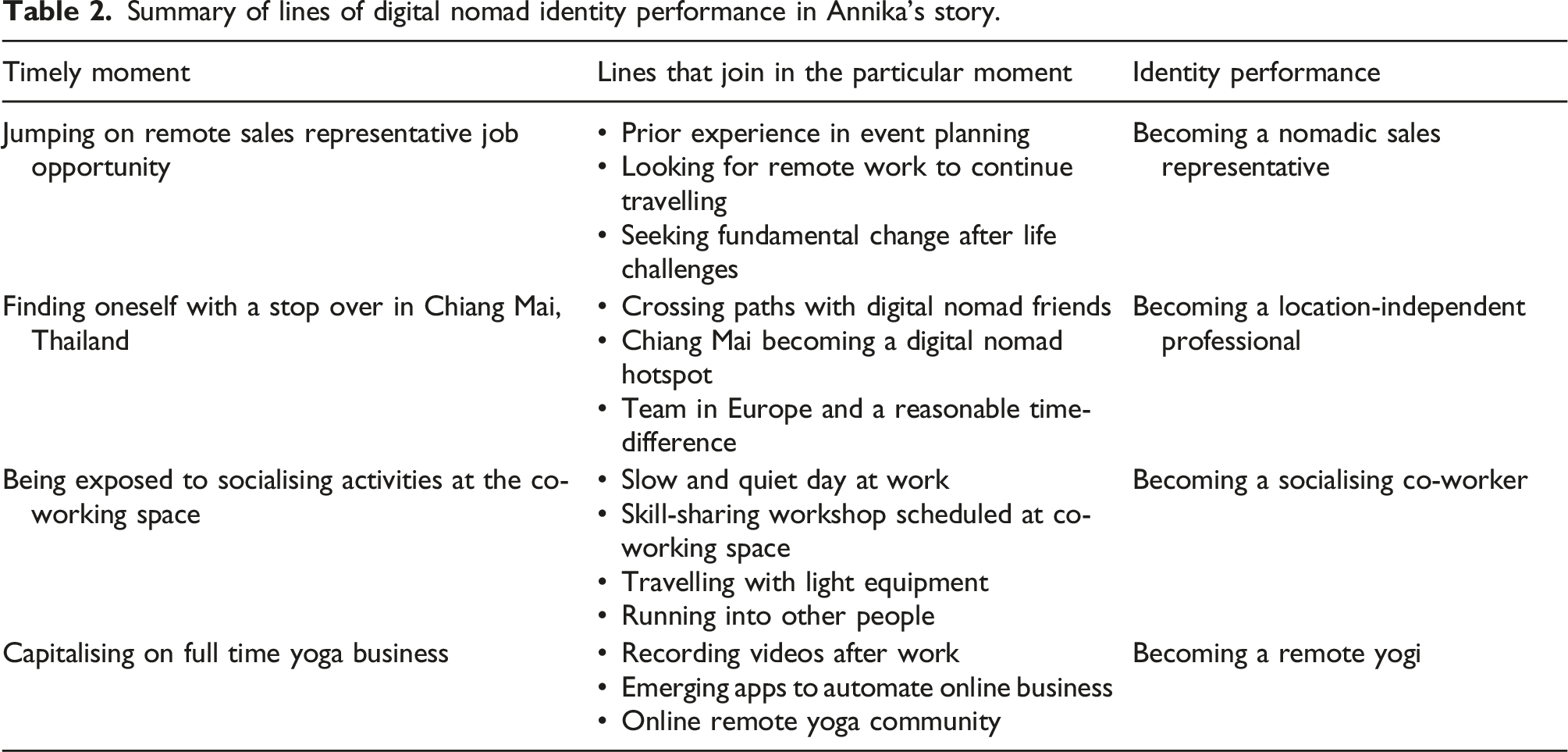
While the digital nomad identity is, of course, one indivisible performance, we can analytically distinguish – for explanatory and educational purposes – between bundles of lines that matter for how identity is performed. In particular, grounded in our study, we found digital nomad identity as being constituted by three such lines that we refer to as lines of identity performance: ‘journeying' (actions related to ongoing multiscale travel), ‘workliving' (actions related to blending of work and social life) and ‘digital reassembling' (actions related to the continuous assembling and reassembling of personal digital infrastructures).
Journeying line of identity performance
For Annika, visiting places and travelling to new locations with different climates, cultures, and languages is a way of life; it performs her identity as ‘digital nomad Annika'. We refer to the flow of such nomadic and travelling actions as the journeying line of identity performance.
Journeying is an ongoing process of becoming. Identity is never given but continuously performed through everyday actions of travel and movement. For Annika, journeying in Thailand means that she is experiencing a particularly well-developed local infrastructure and a way of living, which in turn makes it possible for her to work and live differently than in Cambodia, Japan, or back in the Netherlands. Even during what are seemingly relatively sedentary periods, for example when Annika is visiting Chiang Mai for a few weeks, she is still journeying. She is journeying in her neighbourhood to explore the local market, in-between her Airbnb apartment and the co-working space to interact with other digital nomads on their journeys, within the co-working space to find the ideal workspace, and even in digital spaces where her journey continues across social media platforms for others to follow virtually.
The journeying line of identity performance, although it could be understood as an extreme travelling practice, is better understood as the flow of a line. Annika ended up in Chiang Mai because several actions unfolded simultaneously in a timely moment. She knew that some of her friends, who she is following on social media would be there, and she was hoping to catch up with them. At the same time, Chiang Mai happened to have a reasonable time difference with her team in Europe, which is important for her to take calls. All this is happening while Annika is in Cambodia and only a short flight away from Chiang Mai. So it is the temporal qualities with which these lines of action unfold and the timing of their joining that make it possible for Annika to travel to continue her journeying to Thailand and work as a nomadic sales representative there.
Journeying is, therefore, not something that the digital nomad sets out to do as a more or less intentional action or practice. Although digital nomads may and do make plans for their journeys, in attending to unexpected events and opportunities along the way, they soon find themselves thrown into life circumstances with new and unexpected challenges as well as possibilities. It involves digital nomads’ continual responsiveness to travel patterns and places along their journeys. For example, although Annika had carefully planned her move to remote work and actively looked for a job that would allow her to do so, she described her journey as ‘open-ended' and ‘potentially multi-year'. When the time was 'right', she jumped on the remote sales representative opportunity, but she was not sure how long she would be able to sustain her travels and was open to new opportunities that may arise along the way. Thus, digital nomads are not creating their identity by travelling; rather, everyday actions along the journeying line are continuously performing them as digital nomads.
Workliving line of identity performance
Annika is neither a remote worker who sometimes travels nor a kind of digitally enabled tourist; she is a digital nomad. She integrates her professional life with her social life in a way that it becomes unconvincing to distinguish between working and living. To capture this blending of work and social actions in the lives of digital nomads, we refer to it as the workliving line of identity performance.
Workliving does not refer to the merging of otherwise separate working and living practices. The flow of workliving as a line of identity performance is conditioned by opportune timings that make it possible to blend work and social life in a flexible and creative way. For example, we can see how digital nomads blend work and social life at co-working spaces where they can meet other like-minded people. For Annika to be exposed to socialising opportunities at the co-working space, a few lines join in the particular moment. She does not have much work on the day, she can easily move her equipment from her Airbnb, she gets drawn into a skill-sharing workshop, but ultimately runs into other people with whom she goes for lunch. With Annika, in this particular moment, becoming a socialising co-worker, the workliving line traces how the continuous enfolding of work and social life is becoming constitutive of the digital nomad identity.
Although workliving appears as a seamless blend of work and social actions, it is not without challenges and friction to the digital nomad identity. The timing with which lines of action join can be ‘wrong' or pulling digital nomads into undesirable directions. Annika’s remote sales job offers her some flexibility in work hours, but she still has to be able to make those calls during regular working hours in her clients’ time zones. This means that, conditioned by client availabilities, her location, and local infrastructure, she often has to be available for calls during late and even night hours. Another challenge is the lack of socialising opportunities and interaction with local communities. Although Annika is able to meet with friends at the co-working space, these opportunities for socialising are maintained only temporary until she or the other digital nomads are continuing their journeys.
In workliving, various heterogeneous working and living lines become enfolded into the digital nomad identity performance. Let us consider something as simple and mundane as making calls for Annika’s sales job. For most sales representatives that work in traditional offices, the practice of calling and talking through a list of prompts is taken for granted. But because Annika is working nomadically, the timely moments and confluences of lines that need to happen to make it possible for her to become a nomadic sales representative come to the fore. Time zones, rhythms of her local workplace, and norms around working hours are all required for Annika to reach anyone. What is more, if Annika would not have had to go through a challenging life period and would not have been already travelling, she would not have looked for remote work opportunities that ultimately made it possible for her to work and live as a digital nomad.
Digital reassembling line of identity performance
Annika could not perform her work as well as most social activities without her laptop and the countless apps running in the cloud. She could not be a ‘digital' nomad. However, this personal digital infrastructure of hers is not given or provided to her by an organisation. Instead, it is continuously assembled and reassembled in her everyday actions of working and living as a digital nomad. We refer to the flow of this assembling and reassembling of personal digital infrastructures as the digital reassembling line of identity performance.
Digital reassembling is a matter of continuously assembling and reassembling personal digital infrastructures as digital nomads move between workplaces. Annika’s digital nomad identity does not appear to be merely her view of an individual, fixed technology as a form of IT identity. Whether a technology is used for work or personal matters, whether it works or breaks down, digital reassembling is performing digital nomad identity differently in every moment. Further, while her technology setup appears as a kind of routinised practice of assembling her personal digital infrastructure, it is, in fact, an ever-evolving process. New apps are being added, obsolete ones are being replaced, breakdowns are being worked around, and the latest technology trends are being followed. Although Annika has a temporarily stabilised setup at her Airbnb, she easily breaks it down, packs everything she needs in a small tote bag, carries it to the co-working space, connects to the Wi-Fi, opens her apps, and sets up her new workspace there. For this reassembling of her infrastructure to be possible, several lines are joining in timely moments. For example, Annika finds a free desk at the co-working space and, at the same time, the internet connection at the space is good enough to connect to her cloud apps. But as she does not have a permanent desk at the co-working space, even this new setup space will only last for a few hours until she breaks it down again to go back home.
Digital reassembling is not only a fluid process because it involves ongoing assembling and reassembling of personal digital infrastructures, it is even more so because the infrastructure itself is continuously evolving. This lightweight, nomadic digital infrastructure requires ongoing attendance to her social channels and recommendations from fellow digital nomads. New tools are emerging on the digital landscape, and Annika is constantly tinkering with them and experimenting with her setup. She maintains several automated tools and bots that help her to keep track of her work and social life while she does not have a good enough Internet connection, is travelling, or is simply taking time off work. It is partly these emerging apps, timely research into tools for automation, and opportunities for new digital business models that open up the possibility for Annika to take the yoga business online. At this 'right' moment, she capitalises on the opportunity and becomes a full-time remote Yogi.
We refer to these flows as the line of assembling and reassembling personal digital infrastructures. These flows of digital technologies and infrastructures, from laptops with built-in microphones, videoconferencing apps, and always-online cloud servers to the internet itself with its standards and protocols, all condition how Annika becomes a digital nomad. Annika could not make a single call unless these time zones, places, local digital nomad friends, remote colleagues, and digital infrastructures are corresponding with her actions, which, as we have seen, they do not always do (e.g. when the power is out or the Wi-Fi does not work). What the line of digital reassembling adds to our understanding of digital nomad identity is the way in which agency is the outcome of the process of assembling and reassembling personal digital infrastructures from which digital nomads and their digital tools emerge. So, what at first seemed an isolated, individual action of Annika making calls in Chiang Mai is instead connected to a bundle of human-technological flows of action.
The lines are conjoined in one process of digital nomad identity performance. Although we analytically differentiated three lines of identity performance as distinct types of processes, digital nomad identity performance is one, complex process. We see how actions across different lines are related and conditioning each other. For instance, the desire for socialising with friends during work (workliving) conditioned travel to a different country (journeying) and the lightweight setup of laptop and cloud apps (digital reassembling) ultimately makes it possible to relocate to a co-working space to meet these friends (workliving). If any one of these actions was missing, would unfold at a different time, or flow in a different direction, unable to join with the other lines, it would no longer be possible for 'digital nomad Annika' to be performed in this way. In short, digital nomad identity is performed along the joining of three lines of identity performance – journeying, workliving, and digital reassembling.
Identity performances along journeying, workliving, and digital reassembling are always momentary. In Annika’s story and the summary in Table 2 above, we can see how the particular identity performance is made possible and, if at all, stabilised only until new lines are joining together and making possible different identity performances. Annika is only a 'socialising co-worker' until it is time for her to get back to work and return to her Airbnb. Similarly, that she is working as a 'nomadic sales representative' was just a temporary experience until it was the 'right' time for her to take the yoga business full-time and become a remote yogi. Importantly, digital nomad identity is not any one of these momentary performances, nor is it the assemblage of all of them into a multiple identity. Digital nomad identity is the continuous performance of identity along the flow of lines that join together at timely moments.
Discussion
The three lines of identity performance contribute an explanation of how identity is performed in a fluid and unsettled digital work setting. They add to the literature by explaining how digital nomad identity is ongoingly performed along the flow of lines (Ahuja et al., 2020; Wang et al., 2020). These lines of identity performance are the digital nomad identity, that there is no ‘identity' outside of and separate from these performances. In other words, the digital nomad identity is journeying, workliving, and digital reassembling. It is not a momentary identity such as ‘a remote yogi' or a ‘location-independent professional', or even a mix of these identities, but rather a continuous performance. In the following, we discuss the potential implications of our concept of lines for theorising digital work identity and processes of identity performance more broadly.
Lines of identity performance help us see the fluidity, messiness, and unsettledness of identity that is traditionally perceived as something more coherent and stable (Ashford et al., 2018; Barley et al., 2017). We saw how lines are not distinct but joining with one another (Ingold, 2015). The three conjoined ‘lines of identity performance', as products of our theorising, reveal the constitutive processes through which the identity of digital nomads is ongoingly performed.
Lines of identity performance offer initial insights into how digital nomad identity is performed. Journeying highlights how identity is more than a product of moving between places (D’Mello and Sahay, 2007). We see that in the case of digital nomads, continuous movement along multiple scales is the identity performance. With the erosion of traditional boundaries between work and social life (Cousins and Robey, 2015), the workliving line foregrounds how digital nomading performs an identity that is blending work and social life. Our digital reassembling line recognises the work that goes into assembling and reassembling personal digital infrastructures (Jarrahi et al., 2022). It shifts attention to the way in which this process of assembling and reassembling is a process of bringing into connection various heterogeneous actors (Gherardi, 2016). Furthermore, it hints at a potentially even more profound way in which digital nomads inhabit their world primarily through, with, and along digital processes by which they come into being; a kind of ‘digital agencing' (Ingold, 2017). This is not the same as acting with digital technologies but rather discovering from within the way technologies are sweeping us along. It is important to note that digital reassembling cannot be reduced to digital technology (tools, infrastructures, media); it is as much a social as it is a technological process, intricately enfolded with the journeying and workliving lines.
So what do these products of theorising – the lines of digital nomad identity performance – mean for future theorising on digital work? Fundamentally, the notion of lines highlights the fact that identity is performed in processes (Mesle, 2008). Actors, be they workers, places, or technologies, are performed by these processes rather than the other way around. As theorists, we tend to draw boxes around certain sets of processes and categorise them as our theoretical building blocks (Hassan et al., 2022). In doing so, we simplify the fluidity of life and close off its transformative possibilities (Tsoukas, 2017). The conjoined lines of digital nomad identity performance turn boxes into flows and open inquiry up to many processes that would otherwise remain hidden (Mousavi Baygi et al., 2021).
The lines of identity performance are not yet a full-fledged theory; they are tentative and contextual ‘products of theorising' (Hassan et al., 2022) that explain the performances of digital nomad identity as an important intermediary step towards a process-relational theory of digital worker identity. Furthermore, the three lines do not aspire to be a universal theory of worker identity or 'identity' as a general concept. Building on the notion of lines, we envisage further theorising steps that themselves would result in new products of theorising (Weick, 1995). For example, for digital nomading, we suggest substantiating the identified lines of identity performance by zooming into the different actions and types of action that enact a particular line. By following the actions wherever they might take one, one can start theorising the entire field of actions in which the lines of identity performance unfold (Pentland et al., 2017). Overall, to develop a full-fledged theory of digital worker identity from the lines of identity performance, we suggest diving deep into the action and following its flow – for nomads and other digital workers.
The power of lines for theorising is that they allow us to ask new research questions. Traditionally, we would ask questions such as how a particular technology affects how digital workers perform their identity (Boudreau et al., 2014; Carter and Grover, 2015). Along the flow of conjoined lines, there is no such sense of direction or causality along which effects unfold (Ingold, 2017). The products of theorising thus suggest instead questions such as how relations between the worker, the laptop, the remote team, and the local co-working community come together to create conditions of possibility for digital nomads to be performed as a unique kind of digital workers. In other words, how does someone become a digital nomad along the flow of lines? Instead of asking how we can reduce the messiness of social phenomena, lines invite questions that explore this messiness (Law, 2004; Tsoukas, 2017) and ask what fluidity and unsettledness mean for certain digital work phenomena (Ahuja et al., 2020). These kinds of new questions may seem disturbing as those inquiries question uncertainties, unsettle final knowledge claims and lay bare the complexity of the world. However, if we do not ask these questions, we would not be able to attend to the open-ended process of formation in which things are always already becoming.
Beyond theorising digital work, the process-relational perspective that sensitised our products of theorising may have implications for IS research more broadly. Digital work is not the only IS phenomenon that appears fluid and unsettled (Mousavi Baygi et al., 2021). For other phenomena say, platform ecosystems, AI-supported work practices, or decentralised autonomous organisations, other lines of flow could be explored to explain various sociotechnological transformations. When studying platform ecosystems, instead of journeying, workliving, and digital reassembling other lines that follow, for example, the flow of digital platforms, governance mechanisms, and global labour markets may matter more for bringing such practices into being (Wagner et al., 2021). Drawing attention to ongoing performance, creation, and growth, the concept of lines can help IS researchers understand why certain processes and relations come into being as they do and thus develop tentative and potentially useful knowledge claims.
Conclusion
In this paper, we have explicated lines of identity performance as products of theorising that offer explanations of how digital nomad identity may be performed via journeying, workliving, and digital reassembling. That is, digital nomad identity is a process along which digital nomads engage in actions that are constitutive of their identity, such as ongoing multiscale travelling, blending work and social lives, and continuously assembling and reassembling personal digital infrastructures. The products of theorising developed here, albeit tentative and provisional, have the potential to understand digital work identity in a new light and to open up exciting research questions that push theorising in new directions, seeking to explain better the fluid and unsettled realities of the world. We hope future research will build upon these intermediate outcomes of our theorising and develop a full-fledged theory of digital nomad identity performance. Instead of clinging to old categories and simple explanations, they cultivate openness to the messiness of identity performance and invite us to follow the relations, processes, and actions along which digital nomads come into being.
Footnotes
Acknowledgements
The authors acknowledge the support for this work through the Australian Research Council (ARC) Discovery Project DP190102780 and a UNSW Sydney Scientia PhD scholarship. The authors also thank the Special Issue Senior Editor handling this paper, Ulrike Schultze, for her thoughtful and detailed commentary.
Declaration of conflicting interests
The author(s) declared no potential conflicts of interest with respect to the research, authorship, and/or publication of this article.
Funding
The author(s) received no financial support for the research, authorship, and/or publication of this article.
