




Abstract
The use of social media for developing and maintaining relationships can offer a gateway for users to open up and express their political views. Building on previous literature on the “spillover effect” in which relational use of social media motivates political expression, this study examines the circumstances under which the “spillover” effect is more likely to occur. To do so, we measured respondents’ (a) dialogic openness and (b) perception of other users’ political open-mindedness to examine how the two perceptions condition the spillover process on social media. Analyzing original panel survey data of Facebook users in the United States, we found that relational use of social media was positively associated with political expression on Facebook over time. Furthermore, there was suggestive evidence that this relationship was more likely to exist among individuals who perceive (a) themselves as dialogically open and (b) the platform as closed-minded and that the two perceptions may interact to condition the spillover effect. Possible explanations for how these self- and other-perceptions jointly shape the spillover process are discussed.
Social media are spaces in which people can freely record and share their everyday lives to develop and strengthen their relationships. At the same time, social media facilitate the circulation of political information, enabling encounters with the political lives of other users. As social life and politics are often intertwined in such spaces, people who use social media for primarily relational purposes can become motivated to share their political views. Studies have documented this so-called “spillover process” on social media, in which relational use leads to political expression (Gil de Zúñiga et al., 2014; Skoric et al., 2016; Yu, 2016).
Yet, contrary to such findings, a growing body of literature suggests that there is an emerging tendency to avoid political talk on social media altogether (Duggan & Smith, 2016; Jang et al., 2014; Thorson, 2014; Vraga et al., 2015). This line of research attributes avoidance of politics in part to “context collapse” in which one’s various social circles are collapsed into one single network on social media (Marwick & Boyd, 2011; Vitak, 2012). When users’ online networks consist of different types of ties that come from a variety of social contexts, there is an increased likelihood that they will encounter diverse political views. The prevalence of context collapse on platforms like Facebook may make it more challenging for individuals to share their political opinions on social media, as doing so can risk encountering unfavorable reactions or disagreements from politically diverse networks (Marwick & Boyd, 2011, Vitak, 2012).
This conflicting evidence raises questions about the spillover potential of social media and whether there are certain circumstances under which the spillover process is more or less likely to occur. Prior research has indicated that opinion sharing on social media can depend on psychological predispositions (e.g., Bäck et al., 2018; Vraga et al., 2015) as well as perceptions of various social media environments (e.g., Litt & Hargittai, 2016). In this study, we use original two-wave panel survey data collected in 2016 to examine one such factor that is particularly likely to influence the spillover process: perceived political open-mindedness. Previous research hints that people are more willing to express their political views when they perceive both themselves and others as politically open-minded (Lee et al., 2015; Mutz, 2008). Accordingly, in this study, we test whether the spillover potential of social media is conditioned by peoples’ perceptions of (a) themselves and (b) others as politically open-minded. Furthermore, we explore how these two perceptions may interact to influence the spillover process.
Our findings make several contributions to previous literature. First, using panel data, we find a positive relationship between relational use of social media and political expression on social media over time. This offers more robust evidence of the spillover potential of non-political social media use (e.g., Yu, 2016). Second, we find suggestive evidence that the spillover process may have occurred only among individuals who perceived themselves as politically open-minded and others’ interaction on the platform as closed-minded. Our findings add important nuance to the current debate over whether the social contexts created by social media can serve to motivate political expression.
The Spillover Effect: How Relational Use of Social Media Can Motivate Political Expression
On social media, people’s mundane social lives are intertwined with conversations about politics and social issues. Such blurred boundaries between social and political realms on social media have important implications for political behavior. Studies have found that using social media to stay in touch with close ties (e.g., friends and family) can lead to political expression by providing more opportunities and motivation for individuals to share their political opinions (Gil de Zúñiga et al., 2014; Skoric et al., 2016; Yu, 2016). Previous literature suggests multiple mechanisms through which this spillover process can occur. First, prior research has found that using social media can help increase users’ overall exposure to politics. As social media enable various kinds of information to be disseminated across a wide range of users, people are likely to stumble upon political information that is shared by their network of social contacts (Brundidge, 2010; Wojcieszak & Mutz, 2009). Such incidental exposure has the potential to motivate more frequent information sharing and political expression (Brundidge, 2010; Valeriani & Vaccari, 2016; Weeks et al., 2017).
Second, as sharing one’s social life on social media becomes routinized, people may become more comfortable with expressing their political views. Swigger (2013) found that individuals who shared their social lives frequently online perceived lower barriers for publicly sharing more sensitive information about themselves. Given this, sharing one’s social life can encourage expression in other domains that are private or sensitive, such as one’s views on political or social issues (Morey et al., 2012).
Third, research has shown that frequent social interaction on social media can strengthen relationships between social ties (Burke & Kraut, 2014; Ellison et al., 2007) as people develop feelings of closeness and intimacy (Chamber, 2013). Furthermore, learning about others through everyday exchanges can help reduce uncertainty about their intentions and behaviors (Berger & Calabrese, 1975), which can serve as a basis for developing a sense of trust (Valenzuela et al., 2009). Others have suggested that mundane online activities can cultivate collective identity (Bakardjieva, 2009), which can grow into a commitment toward one’s network. Relationships that are built upon intimacy, trust, and solidarity may in turn encourage individuals to discuss more communal and high-stakes topics such as recent news about government policy or controversial social issues.
Given such evidence, we first test whether relational use of social media is positively related to political expression on social media. We focus on Facebook as our site of investigation, given that it is the most used social network site (SNS) in the United States and is primarily used for developing and maintaining relationships (Ellison et al., 2007; Smith & Anderson, 2018). To test the spillover potential of relational use of social media, we offer the following hypothesis:
H1. Relational use of social media (W1) will be positively related to political expression on Facebook over time (W2).
Dialogic Openness as a Precondition for Political Expression
The willingness to tolerate and interact across lines of political difference is an important motivator of political discussion (Mutz, 2006; Pattie & Johnston, 2008). Some scholars have used the term, dialogic openness to describe such an openness to dialogue with strangers or those with differing political views and have argued that dialogic openness can be an important precondition for engagement in online political talk (Lee et al., 2015). We argue that those who are dialogically open should be more likely to experience spillover effects, given that they are pre-disposed to capitalize on opportunities to express their political views. Theoretically, being dialogically open should help individuals overcome the social risk involved in political interaction on social media and express their political views. As we have noted, context collapse on social media creates barriers to political expression as users are led to interact with various social circles that hold different attitudes and opinions (Marwick & Boyd, 2011; Thorson, 2014; Vitak, 2012). This can lead to increasing the social risk one perceives in expressing unpopular or disputable opinions and motivating users to self-censor their opinion expression on social media (Fox & Holt, 2018). Unique characteristics of social media may also make political talk challenging. On some platforms, social media content becomes persistently visible to a wide audience (Baym & Boyd, 2012). Such publicness of expression can discourage people from posting their political views due to the concern over potential disagreement (e.g., Neubaum & Krämer, 2017). Given these challenges posed for political expression on social media, the inclination to open-mindedly interact with diverse political views may play an important role for the spillover process to occur by reducing the concern of encountering political disagreement.
As discussed, relational use of social media can motivate political expression, because frequent social interaction on these platforms can (a) provide more exposure to political information, (b) lead individuals to become more comfortable with expressing their political views, and (c) develop intimacy and trust toward their social contacts, thereby fostering deeper relationships that can sustain discussion of serious or contentious topics. Those who are dialogically open may be more likely to benefit from these consequences of relational use precisely because they are less sensitive to the social risk involved in political expression. Ultimately, we argue that it is among those who perceive themselves as politically open-minded that the spillover process is most likely to occur. In line with these considerations, the following was hypothesized:
H2. The positive relationship between relational use of social media (W1) and political expression on Facebook (W2) will be stronger among those with higher levels of dialogic openness (W1).
Perceived Platform Open-Mindedness as a Precondition for Political Expression
Perceiving one’s social surroundings as open-minded is also an important precondition for political expression (Mutz, 2008). Scholars have long discussed the importance of the social environment in understanding opinion expression (Abercrombie & Longhurst, 1998; Hayes, 2007; Neubaum & Krämer, 2017; Noelle-Neumann, 1993). Spiral of silence theory (Noelle-Neumann, 1974, 1993) suggests that people’s perceptions of the opinion climate can play an important role in determining their willingness to express their opinion. Due to fear of social isolation, individuals constantly monitor their surroundings to assess whether their own opinion aligns with the dominant opinion (Noelle-Neumann, 1974, 1993). Prior work has found that such a tendency can also be observed on social media (Hampton et al., 2014), suggesting that the perception of a hostile or incongruent opinion climate can suppress opinion expression on social media (Fox & Warber, 2015). In contrast, the perception of a friendly and congruent opinion climate can encourage active political expression (Gearhart & Zhang, 2015). These findings suggest that the perception that one holds a minority opinion and concerns for social punishment for voicing such an unpopular opinion can be a substantial obstacle to political expression on social media. Furthermore, this implies that perceiving the social media environment as open-minded can be an important precondition for political expression because such a perception allows individuals to have the confidence that their opinion will be received without undue social judgment.
In social media environments, perceptions of audiences can be derived from the observation of others’ interactions. Litt (2012) suggests that the perceived norms of a given social media platform can shape perceptions of one’s imagined audience—a “mental conceptualization of the people with whom they think are communicating” (Litt, 2012, p. 331)—on that platform. Given that the imagined audience can determine intention to express as well as guide what is appropriate and relevant to share on social media (Hogan, 2010; Litt & Hargittai, 2016; Marwick & Boyd, 2011), perceiving the imagined audience as politically open-minded may play an important role in motivating political expression on social media.
As noted earlier, one factor that may potentially make social media expression challenging is that social media can engender uncertainty and concerns about how one’s expression will be received by others (Thorson, 2014; Vraga et al., 2015). Perceiving other users as politically open-minded, however, may alleviate concerns about receiving negative reactions from the social media audience, and hence encourage the spillover process. In other words, the spillover process may be more likely to occur among individuals who perceive a given platform as open-minded because such a perception might reduce the uncertainty and social risk involved in expression. While this conditioning influence of the perceived platform open-mindedness is suggested by prior literature, we have insufficient evidence to make clear predictions in this regard. As such, we offer a research question as follows:
RQ1. Will the positive relationship between relational use of social media (W1) and political expression on Facebook (W2) be stronger among those with higher levels of perceived platform open-mindedness (W1)?
The Interplay Between Dialogic Openness and Perceived Platform Open-Mindedness in Conditioning the Spillover Effect
We have argued thus far that relational use of social media can motivate political expression, and that this may be more likely when people perceive themselves or the platform to be politically open-minded. Yet, research on social influence suggests that behaviors can be jointly influenced by individual goals and group norms (Cialdini & Trost, 1998). This raises the possibility that the impact of one’s own political openness may interact with the perceived openness of one’s social environment. To better understand the conditional factors for the spillover effect, we explore the dynamics of the two perceptions—dialogic openness and platform open-mindedness—in influencing the spillover process.
One obvious possibility is that the spillover process is most likely to occur when people perceive both themselves and the social media platform as open-minded. This assumes an additive effect of the interactions predicted in H2 and RQ1, in which high levels of dialogic openness and perceived platform open-mindedness work together to reduce or overcome the social risk of opinion expression. It is difficult to hypothesize, however, how the two perceptions will condition the said process when they do not align with each other. If an individual perceives herself as open-minded but the platform as closed-minded, how would this affect the spillover process? We provide two possibilities for this. First, the spillover process might be undermined as one’s open-mindedness is overwhelmed by the perceived closed-mindedness of the platform. The literature on social influence suggests that when there is a salient group norm that guides interactions among group members, people often choose to conform to the group norm rather than pursuing their personal desire to avoid conflicts and maintain relationships with others (Cialdini & Trost, 1998). In an environment in which individuals think the majority of users do not welcome differing views, any inclination they have to be open-minded may be suppressed by what they perceive as the dominant norm. This may in turn weaken the spillover process.
The opposite prediction, however, can also be made: the spillover process may be strengthened if a dialogically open individual perceives a social media environment to be closed-minded. This may be the case on social media platforms like Facebook, where many users have networks dominated by close ties. Prior work suggests that people tend to feel more comfortable with expressing their true self and less concerned about becoming socially isolated around their close ties (Gudykunst & Shapiro, 1996; Hays, 1985; Morey et al., 2012). Within close-ties network, users’ open-minded orientation may not necessarily be discouraged even if the predominant norm of their environment conflicts with their tendency. Rather, closed-mindedness in one’s social circle might serve as a motivating force for political expression as observing friends’ narrow-minded views may create the need to inform and persuade others (e.g., Morey et al., 2012). In this instance, the closed-minded norm might play a positive role in encouraging the spillover process among dialogically open individuals. Given the two plausible yet conflicting scenarios discussed, there is insufficient evidence to posit a hypothesis. We therefore form a research question as follows:
RQ2. How does perceived platform open-mindedness (W1) impact the conditional effect of dialogical openness (W1) on the relationship between social media relational use (W1) and political expression (W2)?
Method
Sample
To test our hypotheses and research questions, we utilized original, two-wave panel survey data collected in the United States. The sample was collected through an online-survey research company, YouGov which has its own pool of panels that are recruited through online advertising. The two waves of survey data were collected in 2016 with Wave 1 (W1) completed in late September, and Wave 2 (W2) in early November. Among 6,213 individuals who were invited to participate in W1, 1,800 respondents completed W1, resulting in a response rate of 29%. Respondents who failed a simple attention check question were removed, resulting in 1,434 valid responses. Invitations for W2 participation were sent to all W1 respondents, from which 1,056 valid responses were collected. We further limited the sample to those who reported using Facebook as their primary social media platform (N = 613). Demographically, our final sample was comparable to that of US Facebook users as reported by Pew Research Center (2018) in terms of median educational attainment for those 18 or older (Pew = Some college, no degree—includes some community college, W1 = Some college) and median household income (Pew range = US$50,000–US$74,999, W1 = US$50,000–US$75,000). Our sample had a higher percentage of females (Pew = 49.1%, W1 = 62.6%), and median age for individuals over 18 (Pew = 48 years, W1 = 53).
Measures
Social Media Relational Use
To measure the independent variable, respondents were asked how often they used any social media to stay in touch with family and friends in the past 30 days. The item was measured on a 6-point scale ranging from 1 (Never) to 6 (Every day in the past 30 days) (W1; M = 4.63, SD = 1.54).
Facebook Political Expression
To measure the dependent variable, we asked respondents how frequently they performed a range of expressive behaviors on Facebook in the past 30 days (W1) and 14 days (W2), respectively. Five items were asked including posting one’s own opinion, sharing links to news stories or political websites, posting photos or videos about political or social issues, commenting, and liking political content that was posted by others. The items were measured on a 6-point scale ranging from 1 (never) to 6 (every day in the past 30/14 days) and combined to create an index (W1; M = 2.42, SD = 1.46, α = .93; W2: M = 2.34, SD = 1.48, α = .93).
Dialogic Openness
To measure the first moderator, dialogic openness, three items that tap into respondents’ orientation toward political dialogue were adopted from a prior study (Kwak et al., 2018). The items include “I enjoy discussing political issues with others I don’t know very well,” “I enjoy talking to others with different political views,” and “I am open to listening to political perspectives that challenge my own.” The items were measured on a 7-point scale ranging from 1 (strongly disagree) to 7 (strongly agree) and combined to create an index (W1; M = 4.29, SD = 1.37, α = .78).
Perceived Platform Open-Mindedness
To tap into the second moderator, perceived political open-mindedness of the platform, we asked respondents to rate the extent to which political interactions among Facebook users are politically open-minded. This item was asked using a semantic differential scale ranging from closed-minded (1) to open-minded (7) (W1; M = 3.70, SD = 1.70).
Control Variables
Demographic variables such as age, gender, and education were included as control variables. We further controlled for several known predictors of political expression. First, prior research has suggested that political interest (Hasell & Weeks, 2016) and news consumptions (Gil de Zúñiga et al., 2014; Hasell & Weeks, 2016) are positively associated with political expression on social media. Thus, political interest (W1; M = 4.91, SD = 1.83, 7-point scale ranging from 1 = strongly disagree to 7 = strongly agree) and general news use including traditional (e.g., national nightly news, cable news, local television news, daily newspapers) and online news were controlled for (W1; M = 2.61, SD = 0.98, 5-point scale ranging from 1 = None to 5 = Everyday).
Second, individuals who report strong affiliation with a political party are more likely to express their political views by sharing or commenting on others’ posts on social media (Chan, 2018). To control for the strength of partisanship, we first measured respondents’ political affiliation using the following options: strong Democrat, moderate Democrat, Independent, moderate Republican, strong Republican, and other. The variable was then “folded over” to produce a 3-point scale, such that 1 indicates weak partisans (Independents/other affiliation, n = 230), 2 indicates moderate partisans (moderate Democrats/Republicans, n = 199), and 3 indicates strong partisans (strong Democrats/Republicans, n = 184). The recoded variable was labeled as strength of partisanship and included in the model as a control (W1; M = 1.95, SD = 0.82).
Next, previous literature has found that the extent to which one perceives that their online network shares similar political views influences behaviors and attitudes toward posting about politics (Barnidge et al., 2018; Vraga et al., 2015). Thus, we controlled for network homogeneity by asking respondents, on a 5-point scale ranging from 1 (None) to 5 (All), how many individuals in their network on Facebook share (a) the same views on social issues or politics, and (b) support the same presidential candidate. These questions were combined to create an index of network homogeneity (W1; M = 2.95, SD = 0.94, r = .78).
Finally, prior work suggests that informational use of the internet positively predict forms of political interactions online (Ekström & Östman, 2013). Others have also suggested that using social media for news is positively associated with political expression on social media (Gil de Zúñiga et al., 2014). To examine the influence of relational use of Facebook on political expression above and beyond the informational use of the platform, we controlled for respondents’ reception of political information on Facebook (W1; M = 3.61, SD = 2.05, a 6-point scale ranging from 1 = Never to 6 = Every day).
Results
Analysis
To test our proposed hypotheses and research questions, we conducted a series of lagged-dependent variable regression analyses using both waves of panel data. The use of panel data strengthened our test of the causal links between our independent and dependent variables as well as conditional relationships of interest. First, we conducted an ordinary least squares regression (OLS) to test the association between the independent and dependent variables. Second, we used model 1 of the PROCESS macro for SPSS (Hayes, 2013) to test the interaction between social media relational use (W1) and the two moderators: Dialogic openness (W1) and perceived platform open-mindedness (W1). Third, to address RQ2, we examined a three-way interaction among social media relational use (W1), dialogic openness (W1), and platform open-mindedness (W1) on Facebook political expression (W2) using model 3 of the PROCESS macro. To provide a more thorough understanding of the interactions, we followed a two-step procedure that was recommended by previous literature (Aiken & West, 1991; Berry et al., 2012; Kingsley et al., 2017). We first tested the statistical significance of omnibus interaction coefficients to examine whether marginal relationships between the independent and dependent variables (i.e., regression slopes) across different levels of moderators were discernibly different from one another. Then, by using the “pick-a-point approach” (Hayes, 2013), we examined whether marginal relationships at three different levels of moderators (−1 SD mean, mean, and +1 SD mean) were statistically different from zero, respectively.
Hypothesis Testing
To begin with, H1 predicted that social media relational use (W1) would be positively associated with political expression on Facebook (W2) over time. Results of an OLS regression indicated that social media relational use (W1) is positively related to Facebook political expression (W2), b = .06 (.02), p < .05, when controlling for W1 Facebook political expression and other control variables (Table 1, Model 1). Thus, H1 was supported.
Summary of Lagged-Dependent Variable Regression Analyses.

Note. df: degrees of freedom; W1: Wave 1; W2: Wave 2. Unstandardized coefficients reported. Standard errors in parentheses. N = 613.
p < .05, **p < .01, ***p < .001, (two-tailed).
Next, H2 predicted that the relationship between social media relational use (W1) and Facebook political expression (W2) would be stronger among individuals with higher levels of dialogic openness (W1). As shown in Table 1, the interaction between social media relational use (W1) and dialogic openness (W1) was not significant, b = .01 (.02), p = .39 (Model 2). We next examined the relationship between social media relational use (W1) and Facebook expression (W2) at three different levels of dialogic openness (W1). Table 2 indicates that the association between social media relational use (W1) and Facebook political expression (W2) at each level of dialogic openness (W1) differs in its significance level. While the relationship between social media relational use (W1) and Facebook political expression (W2) was not significant at the lowest level of dialogic openness (−1 SD mean), there was a significant relationship at mean and +1 SD mean levels of dialogic openness (W1). This offers suggestive evidence that among those who perceived themselves as dialogically open, there was a significant association between relational use of social media and Facebook expression over time. No such significant relationship, however, appeared to exist among those who reported the below-average level of dialogic openness.
Conditional Effect of Social Media Relational Use (W1) on Political Expression (W2) at Values of Dialogic Openness (W1).

Note. SD: standard deviation; SE: standard error; W1: Wave 1; W2: Wave 2. Path estimates are unstandardized coefficients. Indirect effects based on 10,000 bootstrapping samples with 95% biased corrected confidence intervals. All control variables included in the model. N = 613.
RQ1 asked whether the relationship between social media relational use (W1) and Facebook political expression (W2) would be stronger among individuals who perceived higher levels of platform open-mindedness (W1). We found the omnibus interaction coefficient to be negative but not significant, b = −.02 (.01), p = .11 (Table 1, Model 3). We further examined the relationship at each level of platform open-mindedness (W1). As shown in Table 3, the relationship between social media relational use (W1) and Facebook political expression (W2) was significant both at −1 SD mean and mean level of platform open-mindedness (W1). At the level of +1 SD mean, however, the relationship was not significant. This offers suggestive evidence that among those who perceived Facebook as politically closed-minded, relational use of social media was associated with an increase in Facebook political expression, but among those who perceived others as open-minded, there was no such significant relationship.
Conditional Effect of Social Media Relational Use (W1) on Political Expression (W2) at Values of Perceived Platform Open-Mindedness (W1).

Note. SD: standard deviation; SE: standard error; W1: Wave 1; W2: Wave 2. Path estimates are unstandardized coefficients. Indirect effects based on 10,000 bootstrapping samples with 95% biased corrected confidence intervals. All control variables included in the model. N = 613.
Finally, RQ2 explored the relationship between perceived platform open-mindedness (W1) and the conditional effect of dialogic openness (W1). As shown in the last column of Table 1, the coefficient for the three-way interaction was not significant, b = −.01 (.01), p = .50 (Model 4). We further probed this three-way interaction by plotting the conditional effect of dialogic openness (W1) at various levels of perceived platform open-mindedness (W1). Figure 1 presents the conditional effects and 95% confidence intervals (CI) across three levels of platform open-mindedness (W1). Regions in which the CIs do not cross zero indicate statistically significant conditional relationships. Among those who reported the highest level of platform open-mindedness (W1; +1 SD mean), the relationship between social media relational use (W1) and Facebook political expression (W2) was not significant at any level of dialogic openness (W1). On the other hand, among those who reported mean and −1 SD mean levels of platform open-mindedness (W1), social media relational use (W1) had a significant association with Facebook political expression (W2) at the highest (+1 SD mean) and mean level of dialogic openness (W1). This pattern offers suggestive evidence that the positive association between relational social media use and political expression on Facebook only existed among those who perceived themselves as dialogically open and Facebook as closed-minded.
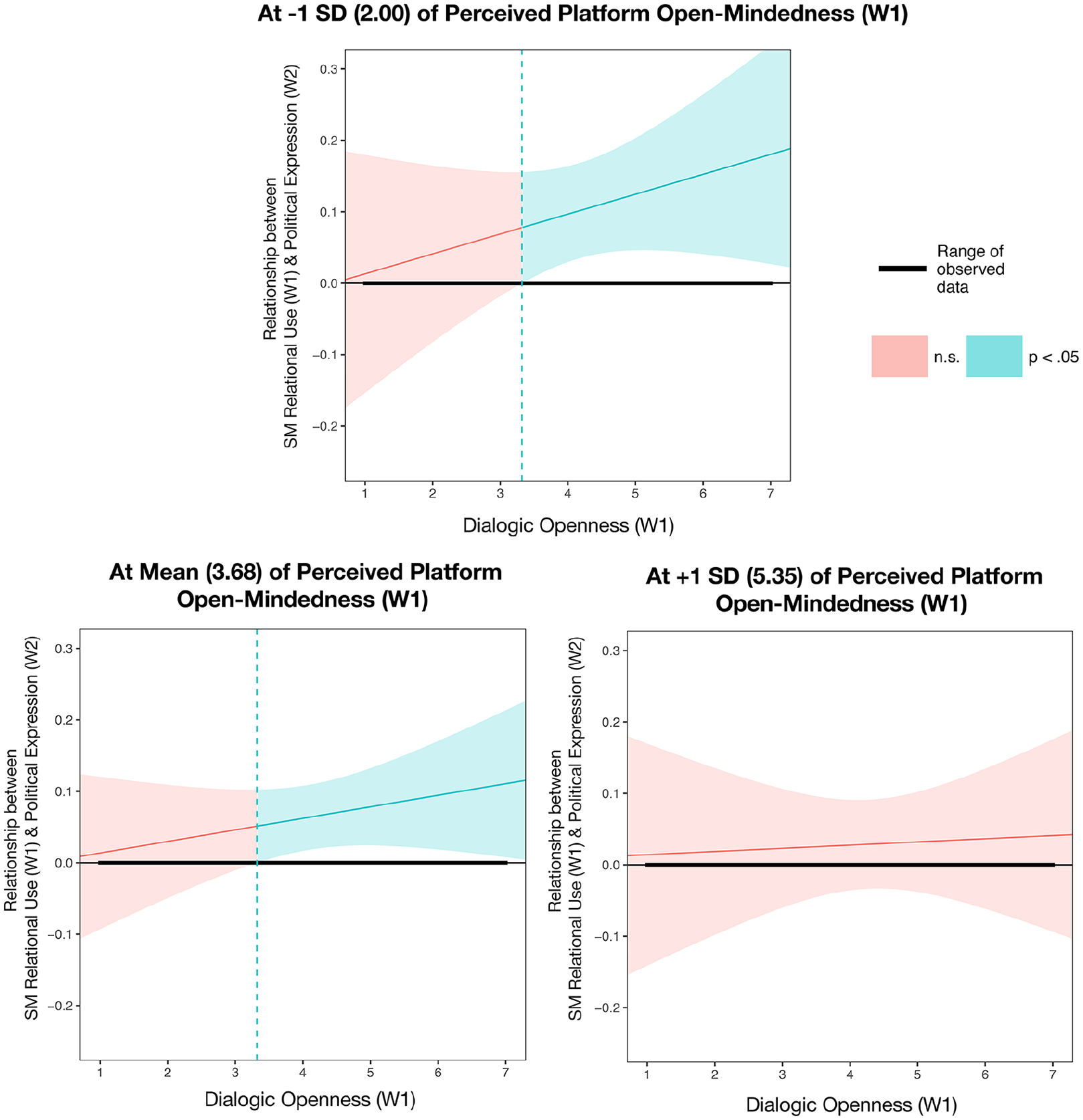
The role of dialogic openness (W1) in conditioning the impact of social media relational use (W1) on political expression (W2) at the values of perceived platform open-mindedness (W1).
Discussion
The use of social media for maintaining relationships with close ties can offer one pathway to online political engagement (Papacharissi, 2010). Our findings provide empirical support for this “spillover effect,” as we find a positive relationship between relational social media use and political expression on Facebook over time. Our findings further offer suggestive evidence that the spillover effect may be conditioned by two factors, perceived political open-mindedness of self and that of others on the platform. This indicates that the spillover process may not occur uniformly across individuals. Probing of the interactions hinted that the spillover process may have occurred only among respondents who perceived themselves as dialogically open. Perceptions of platform open-mindedness, on the other hand, may have conditioned the spillover effect in the opposite way: the spillover relationship was observed only among respondents who perceived their platform climate to be politically closed-minded. While more research is clearly needed to replicate and clarify the pattern of findings we observe, we offer a possible explanation for the impact of the platform closed-mindedness.
To begin with, the perception of platform open-mindedness is likely derived in part from the impression of one’s discussion network—that is, social contacts with whom one discusses politics often—on the platform. Therefore, when our respondents reported that their Facebook environment is closed-mined, it could have meant that they perceived the interaction of their personal network as closed-minded. This perception in turn could have motivated political expression as a means of informing or persuading their network to become more open-minded (e.g., Morey et al., 2012). As discussed earlier, one of the possible mechanisms through which relational use can motivate political expression is the establishment of stronger relationships that can sustain discussion of high-stakes topics, such as social issues or politics. Previous research indicates that with close ties, individuals are less likely to avoid political conflicts because their relationship can produce a safety net for exploring political differences more freely (Morey et al., 2012). This implies that if a user’s close-tie network is perceived as closed-minded, expression may represent an appealing means of having influence over those with whom they have a meaningful social relationship. In other words, the perceived closed-mindedness of respondents’ networks may have provided an incentive to engage in more active political expression, potentially to persuade their close-ties discussion network.
The three-way interaction between relational use and the two perceptions also hints at this possibility. To better make sense of this finding, we reverse-plotted the identical three-way interaction reported for RQ2 to visualize the conditional impact of perceived platform open-mindedness at different levels of dialogic openness. As shown in Figure 2, the conditional impact of platform open-mindedness on the spillover process is only significant among respondents who reported at least some level of dialogic openness (mean, +1 SD mean level). Among those who reported the lowest level of dialogic openness (−1 SD mean level), on the other hand, no such tendency was found. This suggests that although platform closed-mindedness can condition the spillover effect, this conditional impact may be limited to those who are at least moderately dialogically open. That is, individuals may express themselves on the social media platform they perceived as closed-minded only if they are pre-disposed to engage in a contentious or challenging political interaction in the first place. Ultimately, these results raise the possibility that the spillover process is most likely to occur among dialogically open people who find themselves in closed-minded social media environments.

The role of perceived platform open-mindedness (W1) in conditioning the impact of social media relational use (W1) on political expression (W2) at the values of dialogic openness (W1).
While we believe this study makes an important contribution to existing literature on political expression on social media, it is not without limitations. First, the measures used in our study are based on respondents’ self-report and are therefore vulnerable to reporting errors. This is of particular importance given that several of the variables of our interest are based on self-reports of past social media behaviors. While there is no reason to believe that any potential reporting error has systematically biased our findings, future studies in this area should incorporate behavioral data to more accurately capture social media behavior.
Second, there is an important difference in our measurements of the independent and dependent variables worth noting. While our dependent variable captures political expression on Facebook, the independent variable taps into relational use of any social media. This raises the possibility that the independent variable captured relational use of SNSs other than Facebook. Yet we consider this possibility minimal given that our sample was limited to those who consider Facebook as their primary SNS. Nevertheless, future research with more consistent measurements of independent and dependent variables is needed.
Third, our second moderating variable—perceived platform open-mindedness—taps into perceptions of Facebook in general and therefore does not allow us to examine how users’ perceptions of their own Facebook networks are related to political expression. Although the perception of platform open-mindedness can partially be informed by the impression of one’s social media contacts or discussion network (Litt, 2012; Litt & Hargittai, 2016), it is possible that perceptions of one’s own social network can have a unique influence on political expression (e.g., Barnidge et al., 2018; Vraga et al., 2015). Future studies should therefore investigate how norms and culture of people’s immediate social media environment—for example, close-tie network—can influence the spillover process.
Fourth, our study focused on a single platform, Facebook. As interaction norms and perceptions of open-mindedness may differ due to various factors (e.g., the demographics of the dominant user groups), additional work is needed to examine whether the patterns we observed hold in other social media contexts. Relatedly, it is important to note that our study focused on a single national context. As political open-mindedness can be defined and perceived differently across cultures and societies, future work is needed to examine the generalizability of our findings to other cultural contexts.
Finally, despite our theoretically driven hypotheses, our findings regarding the conditional relationships did not meet the traditional criteria for statistical significance. This has led us to carefully discuss our findings as offering suggestive evidence regarding the process we examine. Yet, we also note that the traditional test of statistical significance should not be the only criterion for meaningful results. Prior work contends that a complete test of interaction should consist of examining two distinct questions; (a) whether marginal relationships between independent and dependent variables differ from one another for any two values of a moderating variable and (b) whether a marginal relationship is statistically different from zero for any specific value of a moderating variable (Aiken & West, 1991). In our data, these were, respectively, answered through the statistical significance test of omnibus interaction coefficients and the “pick-a-point” approach. Prior research also warns of the risk of omitting the second test when there is a non-significant interaction and suggests that doing so can lead to understating the importance of moderators being tested (Berry et al., 2012; Kingsley et al., 2017). While the interaction coefficients in our models are not statistically significant, Tables 2 and 3, respectively, show that there are a range of values for dialogic openness (74% of the sample) and perceived platform open-mindedness (73% of the sample) over which the hypothesized marginal relationship is statistically significant. This offers meaningful information for understanding the intricate nature of the spillover effect. Furthermore, given that most interaction tests are underpowered (Marshall, 2007), the non-significant interaction terms we find may be attributable to low power. As one of the first studies to examine the conditional roles of open-mindedness perceptions, we hope our study provides a guide for calibrating appropriate sample sizes in future work.
Conclusion
Given that a significant portion of our everyday interactions take place on social media, it is vital to examine when our use of these platforms can “get political.” This means not only examining the mechanism through which relational use of social media spills over into political expression, but also exploring the psychological conditions that make this process more likely. Our findings suggest that perceiving one’s self as dialogically open as well as the platform as politically closed-minded may open one pathway between relational and political use of social media. Considering the growing concerns over the avoidance of political talk on social media (Duggan & Smith, 2016; Thorson, 2014), these perceptions present an important avenue through which social media might facilitate more active political communication.
It is important to note that our data echo the generally negative view of social media for political discussion (Duggan & Smith, 2016). Two thirds of the respondents in our study perceived political interactions on Facebook as generally closed-minded. Yet, the moderate level of dialogic openness we observed as the average in our data suggests that the orientation toward open political dialogue may be more prevalent among social media users than typically assumed. Furthermore, our findings suggest that even a basic level of dialogic openness (value of 3.31 on a 7-point scale, equivalent to 25th percentiles value) can encourage the spillover process. In other words, it may be that this precondition for the spillover effect is not terribly difficult to obtain. Overall, our findings paint an optimistic picture of the spillover process, with a significant relationship observed among more than half of our sample (53%) who met the threshold levels of dialogic openness and platform open-mindedness.
Despite this optimism, it is clear that institutional and collective efforts can play an important role in helping the spillover process occur more widely. For instance, social media companies should consider ways to attract and cultivate dialogically open users. Although such endeavors may indiscriminately encourage expressions of any kind, including narrow-minded or uncivil expression, our results suggest that the very visibility of such political interaction on social media may motivate some to engage in political expression. Mutz (2006) observed a related paradox: robust political discussion requires a careful balance between the safety of like-minded opinion and exposure to political difference. In a similar manner, this study illustrates the need to further study how a balance of open-mindedness and closed-mindedness can unlock the political potential of social media.
Footnotes
Declaration of Conflicting Interests
The author(s) declared no potential conflicts of interest with respect to the research, authorship, and/or publication of this article.
Funding
The author(s) disclosed receipt of the following financial support for the research, authorship, and/or publication of this article: This work was supported by Marsh Research Grant from the Department of Communication and Media at the University of Michigan.
