




Abstract
While many scholars have studied collective action with a strong social media component led by marginalized groups, few have unpacked how this form of political engagement captures the attention of established political elites and, in some cases, influences the mainstream political narrative and policy outcomes. Fewer have focused on the political impact of social media-intensive Indigenous protest movements. This article addresses these gaps in the academic literature. It does so by examining the online and offline impact of the Indigenous-led Idle No More movement at the federal level in Canada. To evaluate the movement’s effects on the public political narrative on Indigenous-related issues, this article reviews the content of the House of Commons Question Period before and after the emergence of the movement in December 2012. To measure Idle No More’s impact on policy outcomes, this article compares federal budgets and the volume of policy proposals pertaining to Indigenous Affairs introduced in the years preceding the beginning of the movement to those that came in the years following it. Semi-structured interviews with key stakeholders are also conducted to better comprehend the political impact of the movement. The study posits that protests coincided with momentary changes to the salience of Indigenous policy issues, but not with significant policy outcomes in that area.
Introduction
Over the last two decades, social media have become important tools for political communication, mobilization, and organizing. On the one hand, established political elites—including politicians and public servants—have turned to these communication platforms to replicate and, in some cases, strengthen existing patterns of distribution and exercise of political power (e.g., Munger et al., 2019; Spaiser et al., 2017). In some respects, these dynamics have been beneficial solely to narrow segments of the public (Firmstone & Coleman, 2015; Sasaki, 2017). On the other hand, and more importantly for this article, a growing body of academic work has demonstrated how political players more on the edges of the formal political arena—notably protest groups, issues-based organizations, and individual citizens—have turned to social media to empower themselves “and [. . .] democratize information production” (Nemer, 2016). Specifically, members of marginalized communities (e.g., social, economic, ethnic, sexual, religious, linguistic) have leveraged these platforms’ structural and functional properties to make their voices heard and be active politically outside more institutionalized paths of political and civic engagement (e.g., Bonilla & Rosa, 2015; Raynauld et al., 2018). In some cases, they have enabled marginalized communities to challenge the status quo and bringing about political change of varying depth and scope (e.g., Lindgren & Cocq, 2017).
Many members of Indigenous communities internationally have turned to social media to be active politically in the last decade (e.g., Duarte, 2017; Raynauld et al., 2018). Of particular interest is social media’s role and effects on Māori political empowerment (Lee, 2018; Waitoa et al., 2015) and the ways in which they were used by “Indigenous Australians to make sense of and cope with trauma” (Carlson et al., 2017, p. 1). Also of interest are uses of social media by Indigenous communities in the United States in their fight for social justice and environmental rights, such as in the context of the #NoDAPL movement challenging the Dakota Access Pipeline project (H. Johnson, 2017).
Few scholars have drilled down on how members of Indigenous communities are utilizing social media to capture the attention of established political elites and, in some cases, influence the mainstream political narrative. In the context of this article, political narrative is defined as “stories about sociopolitical issues, which exist within an imagined community where the actions of political actors and/or the outcomes of political events have important causal effects” (McLaughlin & Velez, 2019, p. 22). Many scholars point out that narratives are especially important for social movements. They allow them to reach various objectives, including shedding light on and building public support for their cause, shaping the public conversation, and generating political action (see Harlow, 2013; Yang, 2016). E. W. Johnson (2008) also argues that success in shaping the ways in which political causes are discussed is pivotal in setting the stage for action by established political elites, which can manifest itself through policy change (p. 972). Furthermore, little research has examined how uses of social media for political engagement by Indigenous communities can lead to changes in policy outcomes, namely, the effects of policymaking processes. In fact, there is still an unsettled debate within the broader academic literature on whether social media-intensive protest can foster institutional political change (Duarte, 2017; Rohlinger & Bunnage, 2017). This study addresses and helps to fill some of these gaps in the academic literature.
This article takes a deep dive into the Canadian Indigenous-led Idle No More (INM) Movement to evaluate the role and effects of political protest by members of marginalized communities on formal political structures. First, it offers a review of the academic literature on digital-intensive collective action and its effects on formal political life. Second, this article describes how INM emerged, and the role played by social media in the expansion of its reach and support as well as on its protest activities. Third, it provides a detailed description of the methodological approach used to unpack INM’s effects on different facets of formal politicking at the federal level in Canada. This article suggests that INM-related activism coincided with changes to the political narrative and increased the salience of Indigenous political and policy issues. However, it was followed by limited developments in policy areas related to Indigenous Affairs.
Social Media and Political Change
Social media have emerged as increasingly core components of members of marginalized communities’ political engagement toolkit over the past decade (e.g., Nemer, 2016; Nemer & Tsikerdekis, 2017). While these communication platforms can be used to engage in wide-range digital political activity, they can also have spill-over effects on offline politicking. The hybrid nature of the mass-mediated political engagement environment contributes to this dynamic (Dahlberg-Grundberg, 2016). This hybridity can be viewed as “‘a situation in which the borders between remote and contiguous contexts no longer can be clearly defined,’ forming a meshwork consisting of a constant covariation of immaterial space of flows and physical places, seeing the two as coterminous (de Souza e Silva, 2006, p. 269)” (Dahlberg-Grundberg, 2016, p. 527). In other words, political identities, actions, and struggles are present in and are impacting “both online and offline logics” (Dahlberg-Grundberg & Örestig, 2017, p. 311).
Recent studies have focused on the effects of social media-intensive protest movements led by members of marginalized communities on formal political processes. While some scholars argue that these movements can only have limited influence (e.g., Dreher et al., 2016; Raynauld et al., 2016), others point out that they can lead to political transformations of varying depth and scope (e.g., Brantly, 2019; Hutter & Vliegenthart, 2018). This article examines the growing traction of this form of protest activity through the consideration of three main perspectives: (1) resource mobilization, (2) public outreach and framing strategies, and (3) political opportunities and context (Brantly, 2019; Mundt et al., 2018). These perspectives have been used previously to unpack and analyze the reach and effects of more conventional, predigital protest initiatives (Amenta et al., 2010). This article adds to this stream of scholarship by considering these perspectives when assessing hybrid movements’ impact on formal politicking.
Resource Mobilization
From a resource mobilization perspective, social movements’ efficacy relies heavily on their capacity to mobilize their members’ resources, whether they are social, technical, or financial (Andrews, 2001). Specifically in the case of this article, social media can help facilitate, intensify, and diversify protest action. First, they can lower the threshold (e.g., costs, technical knowledge) for protest action (Brantly, 2019; Van Laer & Van Aelst, 2009, 2010). Still, there is an enduring democratic divide when it comes to uses of digital media for political engagement. Different variables, including Internet connectivity (e.g., speed, bandwidth), sociodemographic variables (e.g., income, education), and familiarity with the dynamics of digital political engagement, can shape the uses of digital media for political action (Martin, 2015; Min, 2010). Second, social media’s distinct affordances can enable geographically dispersed, like-minded people to connect and interact with each other more easily and rapidly (Castells, 2012; Haggart, 2013; Uldam, 2013). Third, social media can enable supporters of protest movements to be active outside the realm of established media and political elites. Building on Khamis and Vaughn’s (2012) work, Mundt et al. (2018, p. 2) note that social media can provide protected spaces where protesters can “meet, as well as ‘a type of public commons for free speech’ not available elsewhere.”
Public Outreach and Framing Strategies
Social media’s distinct properties can also be leveraged by members of protest movements with a strong social media component for public outreach and issue framing purposes. Specifically, they can allow them to connect with members of the public and affect the political narrative to generate political change (Dreher et al., 2016; Freelon et al., 2018; Mundt et al., 2018). As noted by Freelon et al. (2018), “changing the conversation about the issue [or issues] in question is the ultimate goal” (p. 992). More specifically in the case of Indigenous Australians, Dreher et al. (2016) point out that they “are harnessing emerging technologies to voice opinions and share contributions on policy developments” (p. 34). Members of protest movements’ capacity to shape the political narrative rests on how issues are broken down and presented to the public. Breindl and Briatte (2013) attribute some of activists’ success against copyright reform in France and the European Union to their ability to frame policy debate online and make it accessible and relevant to wider audiences.
Political Opportunities and Context
Finally, political opportunities and context can impinge or increase hybrid protest movement’s political impact. The concept of opportunity structures refers to “the broader institutional, social, and political context of formal and informal rules and norms within which actors pursue their interests” (Samman & Santos, 2009, p. 3). In his study of the Facebook-based contestation of the Canadian copyright legislation in 2007, Haggart (2013) argues that even with social media’s capacity to extend the breadth and scope of mobilization, the outcomes of mobilization are contingent on the structure of political institutions. On the one hand, traditional political institutions have struggled to develop ways to consult groups lacking formal organizational structures, such as online movements (Milan & Hintz, 2013), despite a few exceptions (e.g., Badouard & Monnoyer-Smith, 2013; Bekkers et al., 2011). On the other hand, the non-hierarchical nature of these movements prevents them from engaging with more institutionalized political leadership (Calderaro & Kavada, 2013; Milan & Hintz, 2013). Individuals taking part in collective action with a strong social media component are often uninterested in interacting with formal political institutions and prefer to operate outside traditional politics (Milan & Hintz, 2013). Freelon et al. (2018, p. 1005) also posit that social media protest often attracts political elites’ attention when it is relayed by legacy media. In sum, there are several sources to the disconnect between formal political organizations and social media-intensive forms of political action.
Social movement scholarship shows that mobilization can shape the political narrative but is less likely to generate more traditional political dividends, including concrete policy change (Dufour & Savoie, 2014; McAdam & Su, 2002; Soule & King, 2006). As mentioned previously, E. W. Johnson (2008) suggests that shaping the political narrative is essential for social movements to influence established political elites and, in some cases, bring about policy change. More research is needed to better understand political opportunities and context, especially when involving marginalized segments of society such as Indigenous communities who are challenging the political status quo (e.g., Raynauld et al., 2018). It would be important to determine whether these movements can go beyond mobilizing the public and influence the formal political narrative and impact policy outcomes. This article takes a deep dive into these patterns. Specifically, it hypothesizes that the presence of hybrid protest movements can lead to variations in the political narrative, but not necessarily variations in public policy.
The INM Movement
The INM Movement—which is the focus of this article—emerged in reaction to Bill C-38
1
and omnibus Bill C-45
2
that were introduced by the Canadian Conservative government of Prime Minister Stephen Harper and passed in 2012 (Inman et al., 2013; Woo, 2013). Through these bills, Harper made sweeping changes to policy areas linked to Indigenous and treaty rights,
3
with little to no consultation with Indigenous communities (Inman et al., 2013; Woo, 2013). Among them include weakening environmental impact assessment procedures, reducing the number of protected water bodies, and interfering with Indian bands’ reserve land governance (Inman et al., 2013; Woo, 2013). At first, INM represented more conventional, mostly bottom-up political movement seeking to have portions of Bills C-38 and C-45 repealed (Woo, 2013). However, as this movement gained traction and momentum, its mission expanded: Idle No More calls on all people to join in a peaceful revolution, to honor Indigenous sovereignty, and to protect the land and water.’ INM has and will continue to help build sovereignty & resurgence of nationhood. INM will continue to pressure government and industry to protect the environment. INM will continue to build allies in order to reframe the nation to nation relationship, this will be done by including grassroots perspectives, issues, and concern. (Idle No More [INM], n.d.)
Initially, INM was fueled by a mixture of environmental, governance, and nationhood concerns. However, the challenging socioeconomic conditions of Indigenous communities throughout Canada coupled with the legacy of colonialism—like the cultural genocide brought by residential schools—quickly became dominant drivers for mobilization (Wotherspoon & Hansen, 2013). Canadian authorities have attempted to address these historical grievances over the past decades. However, the wellbeing gap between Indigenous and non-Indigenous Canadians has not narrowed and many Indigenous rights claims remain unresolved (United Nations Human Rights Council, 2014).
INM emerged in November 2012 when four women 4 traded emails and discussed the implications of the passage of Bill C-38 and omnibus Bill C-45 for Indigenous Peoples in Canada. These exchanges led to the organization of a teach-in session in Saskatoon (Saskatchewan) promoted in part through a Facebook page titled “Idle No More” (Inman et al., 2013; Woo, 2013). Over the following months, it garnered support among Indigenous Peoples and their allies, both in Canada and internationally (Woo, 2013; Wotherspoon & Hansen, 2013). On 10 December 2012, the first “day of action” cemented INM as a pan-Canadian movement as it led to rallies in more than 13 cities (Inman et al., 2013). INM peaked in January 2013 with Chief Theresa Spence’s hunger strike, which pushed Harper to meet with Indigenous leaders (Woo, 2013; Wotherspoon & Hansen, 2013). During the meeting, Harper pledged to improve relations between Indigenous Peoples and the Canadian state (Galloway et al., 2013). While INM mobilization efforts are ongoing, they have wound down since then.
Social media channels rapidly became a key fixture of INM as many of its supporters used them for self-expression, information sharing, and connecting with other users (Raynauld et al., 2018; Simpson, 2013). While INM supporters relied heavily on offline protest tactics, including rallies, demonstrations, hunger strikes, cross-country walks, and flash mob round dances, to make their voices heard (Inman et al., 2013; Woo, 2013; Wotherspoon & Hansen, 2013), digital strategies were an integral component of their protest action repertoire (Callison & Hermida, 2015; Moscato, 2016; Wotherspoon & Hansen, 2013). In early November 2012, the #IdleNoMore hashtag gained traction on different social media platforms, including Twitter (Callison & Hermida, 2015; Woo, 2013). At the height of the movement between December 2012 and January 2013, 743,365 tweets with at least one #IdleNoMore hashtag were shared on Twitter’s public timeline (see Callison & Hermida, 2015). In some cases, there was clear complementarity and coordination between online and offline protest. For example, many #IdleNoMore tweets “consisted of invitations to participate in mobilization events [. . .] or more general calls to personal and collective political action in online and offline settings” (Raynauld et al., 2018, p. 633). In addition, roundtable discussions and town hall meetings allowed for online participation (Simpson, 2013). Still, it remains unclear if social media gave INM a real edge in achieving its political and policy goals (MacLellan, 2013; Sinclair, 2014).
Methods
This study focuses on INM’s impact on the political narrative and policy outcomes on the federal political scene for four reasons: (1) while INM gained support internationally, its supporters are located mostly in Canada (Moscato, 2016); (2) the Constitution Act, 1867 stipulates that the Government of Canada has jurisdiction over “Indians, and Lands reserved for the Indians”; (3) INM’s emergence was mostly fueled due to actions by the Canadian federal government; and (4) most of INM supporters’ demands were made to the Government of Canada. We examine the impact of INM activism, which had a strong online component, through different approaches. We compare the political narrative (dependent variable 1) and policy outcomes (dependent variable 2) during two consecutive time periods. We then determine whether the differences observed can be attributed to the presence or absence of sustained INM’s mobilization efforts—the independent variable.
Political Narrative
Analyzing the impact of social movements on the political narrative in Westminster-style parliamentary systems can be done through the consideration of interventions during the Question Period (QP; Dufour & Savoie, 2014). When the House of Commons is in session, Canadian Members of Parliament (MPs) can question members of cabinet—the Prime Minister and ministers—about their executive actions in different policy portfolios for 1 hr each day. To evaluate INM’s impact on the political narrative, we looked at MPs’ interventions during the QP before and after the emergence of the movement. While INM emerged in November 2012, it consolidated itself on 10 December 2012 with the first day of action (Inman et al., 2013). By the summer of 2013, INM mobilization had lost traction among the Canadian public. During the period of sustained INM mobilization, the House of Commons held 78 QPs. We compared the questions asked during those 78 QPs to the 78 QPs held prior to start of INM.
We began by selecting “Aboriginal Affairs”-related interventions during the QP. We identified 3,057 questions prior and 3,074 questions after the emergence of INM. While many questions were already categorized as “Aboriginal Affairs” on the House of Commons website, other questions related to “Aboriginal Affairs” were not classified as such. Accordingly, we searched with a list of 17 keywords and key phrases 5 throughout the QP to help determine whether a question belonged to “Aboriginal Affairs” but was unidentified. We assessed whether the difference between the percentage of “Aboriginal Affairs”-related questions asked before INM and the percentage of “Aboriginal Affairs”-related questions asked after INM was statistically significant using two-sample chi-square test for proportions.
We also determined whether “Aboriginal Affairs”-related questions explicitly mention “Idle No More,” and what the specific topic of each question is (see topics in section “Findings”). In cases of questions containing more than one topic, we assessed qualitatively which topic was the most significant. While one researcher was responsible for coding the whole dataset, another one looked at all instances where a question contained more than two “Aboriginal Affairs”-related topics. When there was disagreement on how a particular question was coded, a consensus was found through conversations.
Policy Outcomes
We investigated INM’s impact on policy by considering law passage (Schumaker, 1975) and governmental funding related to Indigenous Affairs (Burstein & Freudenburg, 1978). We made multiple-year period comparisons for policy outcomes because social movements can have a delayed policy impact for various reasons, including the length of the legislative process (Andrews, 2001; Tarrow, 1993). Comparisons were made on the number of Indigenous Affairs-related parliamentary bills and yearly budgets passed 3 years before and after INM’s emergence. Specifically, we focused on the period between 10 December 2012, when INM became consolidated, and 4 November 2015. We decided not to look beyond that date as it coincides with the election of the Justin Trudeau Liberals and would render the comparison between the pre- and post-INM period problematic. The duration of the period before the emergence of INM is equivalent to that of the post-period to permit comparison.
To determine which legislation to include in our analysis, we searched titles of bills proposed from December 2009 to November 2015 on the Parliament of Canada (n.d.) website, using seven Indigenous Affairs-related keywords and key phrases. 6 We also searched for legislation proposed by the Minister of the Department of Indigenous and Northern Affairs Canada (DINAC). 7 One limit of this approach is that it does not identify bills such as omnibus bills that amend several statutes with a different subject matter, some of which may relate to Indigenous Affairs. However, omnibus bills are rare in Canadian legislative procedure (Bédard, 2012) and we have included omnibus Bills C-38 and C-45, which were integral to INM’s rise (Inman et al., 2013; Woo, 2013), to offset this issue. We identified 31 Indigenous Affairs-related bills during the two 3-year periods considered for this study, four of which were reintroduced and one reinstated after dying on the order paper. 8
One criterion for determining policy effect was the number of bills passed that are Indigenous Affairs-related following INM relative to the period before. To investigate whether or not INM had an impact on policy outcomes, we examined the differences in proportion of bills that were passed before and after the emergence of INM using Pearson’s chi-square test. We also measured the relative number of bills introduced but not necessarily passed. Some bills may be more important than others, but evaluating the relative importance of each bill is beyond the scope of this study. We obtained the yearly budget allocated to DINAC through an access to information request made to the Government of Canada on 23 October 2015. To examine the effects of INM, we looked at the yearly budget in the 3-year period before and after INM; then, we compared the differences in yearly percentage change in budget size between the two periods using an independent-samples t-test.
Interviews With Stakeholders
The proposed single-case study, even though it encapsulates diachronic variations by comparing the pre-INM period to that of the post-INM period, offers little variation on the independent variable and makes it difficult to ascertain the causal inference of hybrid movements on the political narrative and policy outcomes (see Gerring, 2004). We complemented our methodology with interviews with Indigenous Affairs stakeholders to shed further light on the causal mechanism that may be at play in the case of movements with a strong digital component. We used eight interviews conducted as part of a larger project on INM mobilization spearheaded by the same research team. The interview sample includes three categories of stakeholders: (1) MPs and their staffers as they are the ones preparing questions for or asking questions during the QP; (2) public servants as they are for the most part responsible for generating public policy in the Canadian legislative system; (3) civil society members as they have firsthand knowledge of how policy is formulated and applied on the ground. Interviews with Indigenous Affairs stakeholders were conducted between September and October 2016, following our institutional review board (IRB)-approved protocol. 9 The semi-structured interviews lasted an average of 45 minutes. After providing informed consent, interviewees were asked to comment in their personal and/or professional capacity on the impact of INM as a hybrid movement on the political narrative and policy outcomes. The interview data was organized according to themes building on research questions and the review of academic literature.
Findings
Analysis of the Political Narrative
The analysis suggests that INM likely had an impact on the political narrative at the federal level in Canada. While there were only five oral questions mentioning “Idle No More” in the House of Commons after INM’s emergence, Indigenous Affairs were an integral part of MPs’ narrative. Specifically, 139 out of the 3,074 oral questions were identified by Parliament as “Aboriginal Affairs” (4.52%) and 63 were identified by us as relating to Indigenous Affairs (2.05%), while 2,872 (93.43%) were unrelated to Indigenous Affairs. In comparison, 2,910 of the 3,057 questions considered for the pre-INM period were not related to Indigenous Affairs (95.19%), 100 were identified by Parliament as “Aboriginal Affairs” (3.27%), and 47 were identified by us as related to Indigenous Affairs (1.54%). When combining formally and informally identified Indigenous Affairs questions, there were 147 questions in the pre-INM period (4.71%) and 202 questions in the post-INM period (6.57%). We observe an increase of 37.41% in Indigenous Affairs-related questions following the emergence of INM. Our study shows significant differences in the proportions of Indigenous Affairs-related questions asked between the two periods, with χ2(1, N = 6131) = 8.87, p < .05. 10
We further analyze the data by looking at the volume of Indigenous Affairs-related questions before and after INM (see Figure 1). The percentage of Indigenous Affairs-related questions spiked at the beginning of the movement and then decreased and stabilized until the House of Commons adjourned for the summer in June 2013. The percentage of Indigenous Affairs-related questions also spiked a few months prior to the emergence of the movement in June 2012. Questions pertained to the lack of food security and were likely triggered by the United Nations special rapporteur comments on the lack of food security for Indigenous Peoples in Canada in May 2012.

Percentage of oral questions asked in the House of Commons during each Question Period per type from 4 May 2012 to 18 June 2013.
The topics of Indigenous Affairs-related questions (both identified and unidentified by Parliament) correspond to INM’s concerns and demands. Figure 2 shows the percentage of Indigenous Affairs-related topics discussed during the QP for both the pre- and post-INM periods. It shows that the issue of “economy and revenue sharing” was the most discussed topic after the emergence of the movement. Wotherspoon and Hansen (2013) point out that Indigenous socio-economic conditions have been at the heart of INM’s concerns. The second most-discussed topic was “women and violence,” (e.g., missing and murdered Indigenous women, domestic violence against Indigenous women). The third most discussed topic was “health.” Many questions regarding “education” and “land claims and land-based rights” were also asked during the QP. The latter pertained to the duty to consult—the government’s constitutional obligation to consult Indigenous Peoples when its actions may impact their protected rights—which was one of INM’s main demands (Inman et al., 2013; Woo, 2013). “Indigenous Affairs governance” and “residential schools” were part of the political narrative. As discussed previously, concerns related to the legacy of colonialism are one of the driving forces behind the INM movement (Wotherspoon and Hansen, 2013). “Environmental issues” were one of the least-discussed topics in the post-INM period. While environmental policy measures were partly responsible for the blossoming of INM, the movement was not able to bring this topic on the political agenda. When comparing the topics of questions during the pre-INM period, similarities and differences emerge. Topics related to “health” and “poverty” were more important, while those related to the “economy and revenue sharing” and “violence and women” were less important than in the year that followed. Finally, no Indigenous Affairs–related questions criticized Indigenous Peoples or advocated harm to them.

Percentage of Indigenous Affairs-related oral questions asked in the House of Commons per topic before INM (4 May 2012 to 7 December 2012) and after INM (10 December 2012 to 18 June 2013).
Analysis of Policy Outcomes
Although we noticed a change in the political narrative following the consolidation of INM, we cannot say the same thing about policy outcomes. Figure 3 shows which Indigenous Affairs-related bills were introduced in the Parliament of Canada during the period under study. A review of the data reveals that more bills were introduced in the 3-year period preceding the emergence of INM than during the three subsequent years (20 vs 11). While 50.00% of bills introduced prior to INM received royal assent (10 out of 20) and 63.64% of those introduced in the post-INM period did (7 out of 11), our analyses indicate no significant differences in the proportions of bills that received royal assent before and after the emergence of INM, χ2(1, N = 31) = .53, p = .47. Before INM, 70.00% of those bills (14 out of 20) were introduced by Conservative Cabinet members, whereas the remaining 30.00% (6 out of 20) were private members’ bills introduced by MPs outside the executive branch. In the 3-year period following INM, 72.72% (8 out of 11) of bills were introduced by Conservative Cabinet members, and 27.27% (3 out 11) by Private Members. The passage rate of bills in both periods combined was 84.21% (16 out of 19) for government bills and 12.50% (1 out of 8) for Private Members’ bills. 11 This is not surprising as Private Members’ bills rarely become law by receiving royal assent (Blidook, 2010).
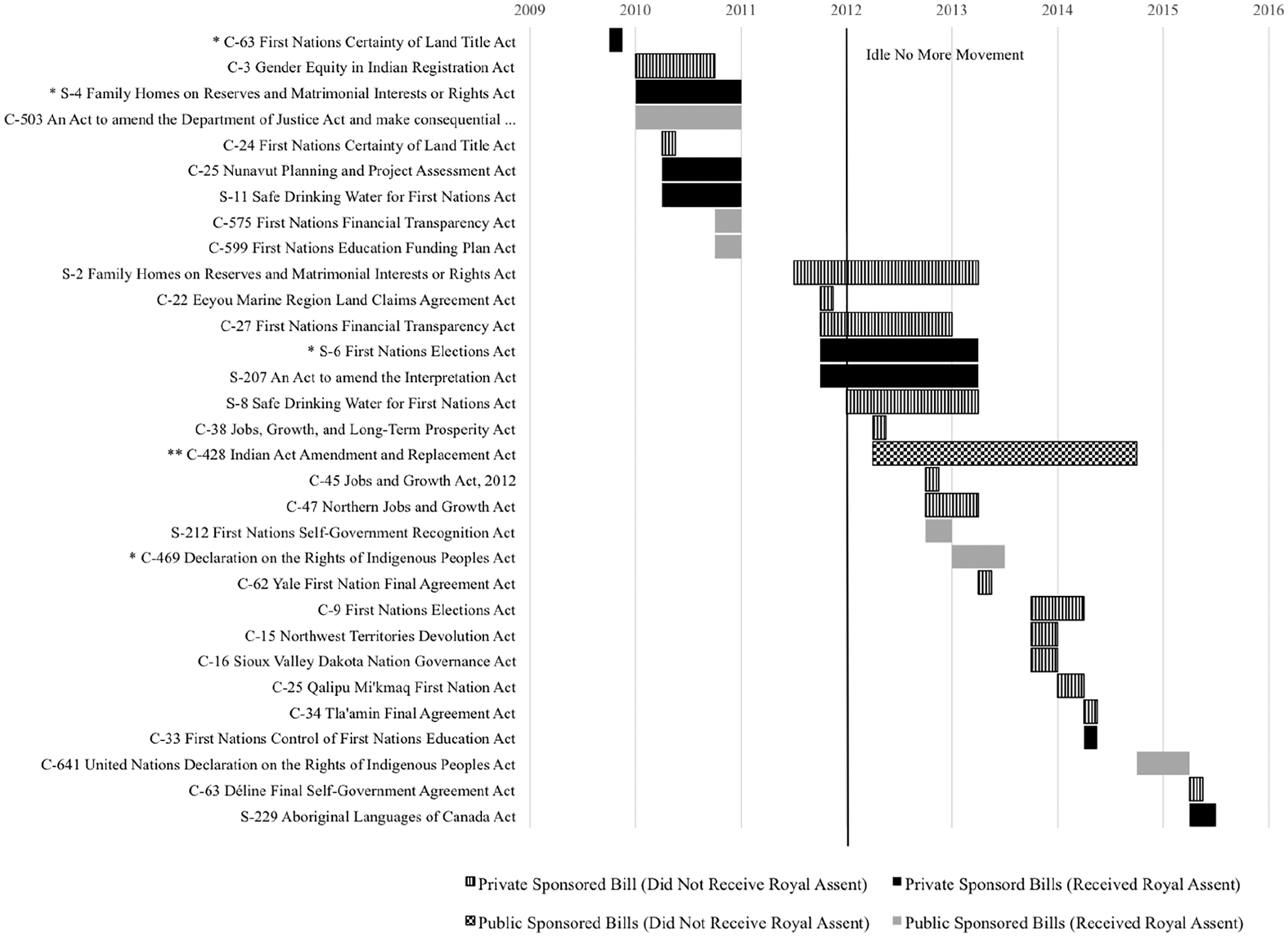
Parliament of Canada bills in the area of “aboriginal affairs” timeline, 3 November 2009 to 4 November 2015.
The analysis of the bills introduced in Parliament after the emergence of INM shows that the Indigenous protest movement did not prompt the Conservative government to formulate new Indigenous policies, as several legislative initiatives undertaken previously were pursued. Notable here Bill S-2 Family Homes on Reserves and Matrimonial Interests or Rights Act, Bill S-8 Safe Drinking Water for First Nations Act, Bill C-27 First Nations Financial Transparency Act, and Bill C-9 First Nations Elections Act which ultimately received royal assent. Bill C-33 First Nations Control of First Nations Education Act was the only significant political initiative to emerge in the aftermath of INM, but it died on the order paper. In addition, many bills that were passed into law during that period were related to comprehensive land claim agreements, which address Indigenous rights and title, and may include provisions relating to self-government (Indigenous and Northern Affairs Canada, 2015). This could be interpreted as a victory for INM supporters. However, it must be noted that these agreements take between 5 and 20 years to negotiate (Indigenous and Northern Affairs Canada, 2003), and that the federal government did not modify its approach to negotiations following INM’s emergence (Senior Public Servant #1, October 3, 2016; Litigator and negotiator on behalf of Indigenous groups C. Devlin, personal communication, September 8, 2016). Nevertheless, the government did not amend or repeal Bill C-38 and omnibus Bill C-45 which triggered INM. As for Private Members’ bills, only C-428 Indian Act Amendment and Replacement Act, introduced by Conservative MP Rob Clark received royal assent. The other Private Members’ bills that died on the order paper dealt mostly with Indigenous rights protection.
Finally, the consideration and analysis of DINAC expenditures helps to better understand INM’s policy impact (Figure 4). We notice a 2.64% increase in the overall budget the year following the rise of the movement in December 2012 (from CAD7,930,048,199 to CAD8,139,037,000 ). We then observe a drop of 1% the following year, which remains stable the year after that. Our statistical analysis demonstrates no significant differences in the yearly percentage change 3 years before (M = 3.49, SD = 10.18) and after (M = .64, SD = 1.77) the emergence of INM, t(1.04) = .393, p = .759. This leads us to conclude that INM did not have a significant impact on the federal budget allocated to Indigenous Affairs in Canada. This assertion is supported when considering that the biggest increase of DINAC’s budget during the period surveyed (10.7%) took place in 2010, before the emergence of INM.

Expenditures of the Department of Indigenous and Northern Affairs Canada from 3 November 2009 to 4 November 2015.
Contextualization Through Interviews With Stakeholders
Our interviews conducted with Indigenous Affairs stakeholders contextualize and corroborate our quantitative findings. INM’s mobilization of resources outside the more traditional realm of politics was strong enough to change the political narrative of some MPs and political staffers. For example, former advisor of Justin Trudeau, Louis-Alexandre Lanthier (Personal communication, October 3, 2016), MP for Churchill-Keewatinook Aski, Niki Ashton (Personal communication, October 3, 2016), and other elected officials (Elected Official #1, personal communication, October 13, 2016) observed what was happening online from the beginning. Many of them were influenced by or interacted with INM activists online and offline (Elected Official #1, personal communication, October 13, 2016; Elected Official #2, personal communication, October 4, 2016; L. A. Lanthier, personal communication, October 3, 2016; N. Ashton, personal communication, October 3, 2016), which led them to raise questions in parliament. INM’s outreach and issue framing capacity through social media was mostly mediated by legacy media, however. Most MPs learned about INM through conventional media more than 1 week after the movement’s emergence (Senior Public Servant #1, personal communication, October 3, 2016). This disconnect between legislators and the movement early on may have diminished the structure of opportunity available to INM for policy change.
We observe that no significant policy change followed the INM’s mobilization. For example, DINAC was trying to monitor the movements’ protest activities both offline and online (Senior Public Servant #1, personal communication, October 3, 2016; Senior Public Servant #2, personal communication, 2016). They were aware that the conversation on Indigenous Affairs was moving to Twitter, Facebook, and other social media channels (Senior Public Servant #1, personal communication, October 3, 2016). Yet for government officials, social media was not an accurate measure of public opinion, but rather an antenna (Senior Public Servant #1, personal communication, October 3, 2016; Senior Public Servant #3, personal communication, 2016). As senior public servants conceded, social media allows government to know which topics are trending, but it seldom gives a clear and unbiased view of citizens’ attitudes (Senior Public Servant #1, personal communication, October 3, 2016; Senior Public Servant #3, personal communication, 2016). INM’s issue framing strategy did not succeed at sending a clear message to political authorities that could translate into concrete policy change.
As previously discussed, many Indigenous-related pieces of legislation were in the works prior to the emergence of INM, but stakeholders disagree on whether the movement pushed the Conservative government to wrap up these initiatives before the 2015 election or if these would have been completed anyway (Senior Public Servant #1, personal communication, October 3, 2016; Senior Public Servant #2, personal communication, 2016; Senior Public Servant #3, personal communication, 2016; Elected Official #1, personal communication, October 13, 2016; Elected Official #2, personal communication, October 4, 2016). Nevertheless, INM’s strong mobilization of resources put significant pressure on the government to act (Elected Official #2, personal communication, October 4, 2016; Indigenous Affairs journalist J. Barrera, personal communication, October 6, 2016), but it put even more pressure on the Assembly of First Nations (AFN) as the government’s primary interlocutor on Indigenous Affairs (Senior Public Servant #1, personal communication, October 3, 2016). Although the AFN was not an official spokesperson for INM, it appropriated its discourse (Indigenous Affairs journalist J. Barrera, personal communication, October 6, 2016). However, it lacked a credible mandate to represent Indigenous Peoples due to the criticism it had received from INM (Senior Public Servant #1, personal communication, October 3, 2016; Senior Public Servant #3, personal communication, 2016; Elected Official #1, personal communication, October 13, 2016). Since the Conservative government was facing a divided Indigenous community, it was wary to move forward with a new policy agenda for Indigenous Peoples, especially when it comes to education (Senior Public Servant #1, personal communication, October 3, 2016; Senior Public Servant #3, personal communication, 2016; Indigenous Affairs journalist J. Barrera, personal communication, October 6, 2016). In this case, formal institutions did not develop ways to adequately consult the movement and at the same time, INM did not engage with the institutionalized leadership. This lack of political opportunity may have impinged INM’s policy impact.
Discussion
While several scholars have explored the manifestation of Indigenous political and civic action on social media (e.g., promotion of culture and identity, hashtag activism, production, and circulation of political information; e.g., Raynauld et al., 2018; H. Johnson, 2017), few have explored the effects of their actions on various facets of formal political life. This article fills part of this gap by unpacking the short-term effects of the uses of social media by INM activists on the political narrative and policy outcomes in Canada. It concludes that INM activists were more likely to bring attention to Indigenous issues in parliament than to impact legislation in a significant way.
Our analysis corroborates E. W. Johnson’s (2008) findings on the effects of offline movements. INM’s emergence and growing momentum coincided with a larger volume of questions related to Indigenous Affairs during the QP in the House of Commons. Furthermore, the proportion of questions related to the “economy and revenue sharing” as well as “women and violence” was significantly higher, while the proportion related to “health” was significantly lower. In sum, some issues that were more salient in INM-related mobilization made it onto the political narrative of MPs more than others.
While INM’s demands captured the attention of the QP, they were not followed by significant short-term effect on policy outcomes under the Conservative government. First, more Indigenous Affairs-related bills were introduced in the 3 years before the birth of the movement than in the following 3 years and the amount of bills passed after INM was not statistically more significant than the number of bills passed before it. Second, DINAC’s budgets stagnated after INM was founded. In addition, the Conservative government turned a blind eye on Indigenous demands throughout its last mandate. Despite pressure from the Opposition and Indigenous governmental organizations, it refused to put in place a commission of inquiry on missing and murdered Indigenous women and to ensure Canadian laws conform with the principles laid out in the United Nations Declaration on the Rights of Indigenous Peoples (UNDRIP). 12
The methodology used in this article has some limitations. First, the observable data does not permit us to measure what would have happened in the absence of INM. Second, there are too many variables that are unaccounted for to determine the exact influence of INM on the political narrative and policy outcomes. Still, our methodology led to the production of a reliable study of the short-term effects of hybrid movements on the political narrative and policy formulation. Our qualitative interview data corroborated our analysis of the quantitative data, thereby lending more confidence to our single-case-study findings that movements with a strong digital component can impact the political conversation but not necessarily lead to policy changes. Furthermore, stakeholders shed further light on the causal mechanisms that may be at play in the case of INM. They stressed the intervening role of legacy media in changing the political narrative and that of formal organizations attempting to personalize social movements. Future researchers should study the impact of these intervening variables in a more systematized way in the context of digital movements.
From a broader perspective, movements with a strong social media component face challenges when trying to bring about political change. For marginalized communities in particular, social media can increase their capacity to mobilize resources and the framing of issues to impact the political narrative. Nevertheless, the policy outcome of their activism may be dependent on the structure of opportunity, which is seldom sympathetic to their demands and objectives. The marginality of Indigenous Peoples in Canada impacts their political influence via social media. As they are situated on the edges of the formal political arena, they can be successful at impacting the political narrative, but not as much when it comes to political outcomes. This is unless they are able to find a champion among political elites.
It should be noted that INM was not able to influence the government immediately under the Conservatives. However, it had more success in shaping its policies under the Liberals following the 2015 general election. Liberal Prime Minister Justin Trudeau’s first budget in 2016 announced the investment of 8.4 billion dollars over 5 years on programs targeting Indigenous Peoples, starting in 2016–2017 (Department of Finance Canada, 2016). His government also established the National Inquiry into Missing and Murdered Indigenous Women and Girls (Government of Canada, n.d.). These policy changes came more than 3 years after the movement’s emergence. Much more work is required to study the more delayed effects of social movements led by marginalized communities.
Footnotes
Acknowledgements
The authors acknowledge the invaluable financial support of the Social Sciences and Humanities Research Council of Canada (SSHRC) through an Insight Development Grant which helped with all aspects of the production of this article. They also thank the University of Windsor and Emerson College for providing logistical and financial support. Finally, the authors thank Dr. Derek Antoine and Ms Katie Boudreau Morris for providing insights and support during the early stages of the research project, as well as the editors of this special issue and the anonymous reviewers for their insightful comments and suggestions.
Declaration of Conflicting Interests
The author(s) declared no potential conflicts of interest with respect to the research, authorship, and/or publication of this article.
Funding
The author(s) received the following financial support for the research, authorship, and/or publication of this article: This study was funded by the Social Sciences and Humanities Research Council of Canada (SSHRC) through an Insight Development Grant which helped with all aspects of the production of this article. In addition, the University of Windsor and Emerson College provided logistical and financial support.
