




Abstract
Political communication that occurs in Sundanese indigenous communities in West Java has a distinctive social structure and cultural values, thus affecting the dynamics of communication and political decision-making. In the context of general elections, the dynamics of political communication take place through group communication channels and social media platforms such as WhatsApp where the role of traditional leaders in leading deliberations is still dominant. The purpose of this study is to explain the role of traditional leaders in the political decision-making process, Sundanese cultural values, communication actions, local and national political contexts, and participation of Sundanese indigenous people. This research uses case studies on several Sundanese indigenous communities in West Java. The results showed that Sundanese traditional leaders play an important role in bridging indigenous communities with candidates and the government, providing advice on candidates worthy of election, and encouraging political participation through deliberation and consensus based on cultural values. Political communication is carried out through traditional channels and digital media such as WhatsApp, with community participation driven by respect for customary leaders and awareness of the importance of fighting for rights to religious freedom, customary land, and political freedom. The conclusion of this study shows that the dynamics of political communication in Sundanese indigenous communities are still centered on the customary head, which is characterized by the symbols implied by the words of the customary head when making decisions in supporting certain political party candidates.
Plain Language Summary
Study using interviews with indigenous leaders and community members to understand how traditional symbols and digital tools like WhatsApp shape political participation in West Java’s Sundanese communities. Why was the study done? Many indigenous communities have unique ways of engaging in political life that are often not recognized in mainstream discussions. These include traditional symbols, religious gatherings, and now digital tools like WhatsApp. This study aimed to explore how Sundanese indigenous communities in West Java participate in politics using both ancestral traditions and modern media. What did the researchers do? The research team conducted interviews with 16 key informants—four from each of four Sundanese indigenous communities: Cigugur, Talaga, Cigumentong, and Dukuh. Informants included traditional leaders and politically active community members. A semi-structured interview format was used, which allowed the researchers to explore both symbolic expressions (such as siloka, or metaphorical sayings) and newer practices like political messaging through WhatsApp groups. The interviews were analyzed using NVivo software to identify major themes. To ensure accuracy, the same questions were asked to different informants (triangulation) and repeated over time (member checking) to validate the findings. What did the researchers find? The study found that political participation in these communities is often guided by indirect cues. Leaders may remain formally neutral but subtly express preferences using symbolic language or silence, which community members interpret as guidance. Political communication also happens through cultural rituals and group meetings, such as tawasulan or Panggih Lemah Cai. WhatsApp is now widely used to share information, clarify rumors, and maintain political engagement, even among geographically distant members.
Keywords
Introduction
Political communication is a key aspect of molding democratic involvement because it affects how people express their hopes, make sense of politics, and react to institutional frameworks. A lot of research has been done on political communication in modern, urban, and digitally saturated settings, but not much has been done on how it works in traditional or indigenous civilizations. This study aims to fill that gap by looking at the complex ways that political communication works in West Java’s indigenous groups, where oral traditions, symbolic language, and digital adaptation all come together.
Political communication goes beyond designated voting areas and urban civic centers. It also includes the encompassed traditional societies, such as the West Javanese Indigenous groups, where communication is deeply interdisciplinary and hierarchy driven. In these contexts, political discussions frequently take place during casual gatherings, in what could be termed “traditional halls,” or during ritual meetings. Decisions are made collectively following discourse. The most micro forms of communication not only foster cohesion within small groups, but also facilitate their engagement with broader national systems and politics. Settle (2025) states that political communication greatly contributes to the transformation of emotions and attitudes into actions. This is evident in indigenous assemblies; however, it tends to get overlooked in more conventional scholarly political analysis.
Another area that hasn’t been looked at enough is how symbolic power might make political endorsements and decisions in these groups seem more legitimate. Traditional leaders don’t tell people how to vote directly, but they often provide culturally coded signs that show support. These symbols, which are found in religious gestures, speech patterns, and rituals, have a lot of political power and often take the place of explicit directives.
This illustrates Bourdieu’s concept of symbolic power, which suggests that the ability to shape reality is more impactful than physical force. “Thematic analysis,” to my knowledge, has not been applied very often—if at all—to interactions within Indonesian indigenous groups. Lefthand-Begay et al. (2024) highlight an absence of indigenous knowledge and other communication networks in discussions of national policy frameworks. While there appears to be an increase in participation among indigenous voters, the government frequently ignores these populations’ communicative access rights. This research argues that ignoring the socio-symbolic dimensions as well as the sociotechnical-diagrammatic dimensions of Indigenous political communication undermines democracy and cultural self-determination.
Understanding how Indigenous peoples craft narratives for mobilization and negotiation is crucial as political contention becomes concentrated in media spaces. The proliferation of WhatsApp groups provides unprecedented opportunities for rapid dissemination of messages, correction of misinformation, and large-area coordination that were once time-consuming in-person activities among community leaders. New technologies offer fresh opportunities and possibilities. However, they must also be critically examined to understand how cultural meaning and power are inscribed within these platforms (Pasquetto et al., 2022; Raynauld et al., 2018). For these reasons, this study examines the scope of political communication in four indigenous villages of West Java—Cigugur, Talaga, Cigumentong, and Dukuh—using thematic analysis. These villages present diverse belief systems, rituals, as well as differing interactions with governmental and religious authorities, which make them ideal for comparative communicative analysis.
West Java encompasses one of the most intricate political contexts in all of Indonesia. This is the only part of the country where self-governing indigenous people still hold complete political and cultural power. Under the adat model of government, the Sundanese of Cigugur, Talaga, Cigumentong, and Dukuh have created a unique co-governance model where state and customary authorities share power. State agencies recognize the local moral authorities of these communities, not because of their political or legal recognition, but due to ritual, kinship, and memory frameworks. Political and legal authorities align publicly to the mental frameworks of ritual. And every integration of the ritual framework into the performative aspects of the politics re-establishes the people’s identity for every participant. In every ritual framework tied to a political performance, a participative mentality is invoked. Yet, the rise of digital media especially in remote localities creates friction in the balancing act of the colonially silenced local citizens. In the political study of Sundanese people, we see for the first time the use of cultural authority and respect to shape democracy and civic political order, while legally it remains politically unregulated.
This study addresses governance and elections as separate yet interconnected aspects of political life. In this context, “election” refers to formal democratic contests in which indigenous tribes engage as citizens inside the national system. In contrast, governance in this study refers to the informal, customary, and symbolic mechanisms through which authority, consensus, and legitimacy are established within local sociocultural contexts. The study distinguishes indigenous governance from state administration; instead, it analyzes the intersection of internal systems of symbolic leadership with electoral participation and communication practices during political cycles.
Research Objective
This research aims to examine how political communication is practiced, interpreted, and negotiated by indigenous communities in West Java within the intersecting domains of cultural symbolism and digital technology. Specifically, it seeks to:
Describe the role of traditional leaders in mediating political messages and shaping voter decisions through culturally encoded communication.
Analyze the function of symbolic power in legitimizing or challenging political alignments within customary frameworks.
Investigate the hybrid use of communication channels, from traditional group forums to contemporary social media platforms, especially WhatsApp.
Compare the interplay of local and national political contexts, including issues of autonomy, religious recognition, land rights, and political marginalization.
Assess how indigenous political participation contributes to civic resilience, community identity, and democratic negotiation under both traditional and modern influences.
Literature Review: Governance, Participation, and Political Communication
To provide a conceptual foundation for the analysis, this section presents a dedicated review of relevant literature on governance, political participation, and communication frameworks in indigenous democratic contexts. It also situates the study within the specific cultural and political realities of West Java’s Sundanese communities.
Election and Governance
Scholars differentiate governance—the administration of communal decision-making by discourse, shared standards, and moral leadership—from elections, which are regular battles to validate authority. In indigenous settings, government manifests as deliberative and symbolic processes rather than bureaucratic organizations. In the indigenous villages of West Java, decisions are made in “traditional halls” and ritual gatherings where consensus and symbolic cues take the place of formal voting. Their involvement with political figures demonstrates moral continuity rather than transactional motivation (Agbalajobi et al., 2025; Taufiq et al., 2022). So, in these communities, administration is based on a cultural system of authority that values social peace and symbolic legitimacy more than formal power.
Political Participation
Participation in indigenous societies encompasses more than just formal voting. It entails ethical dialog, ritual contemplation, and communal manifestations of agreement. Raynauld et al. (2018) and García-Espín (2025) emphasize that civic involvement grounded in cultural values fosters inclusivity and civic resilience. The Sundanese principle of Silih Asih, Silih Asah, Silih Asuh (mutual care, learning, and nurturing) exemplifies participatory ethics, wherein democracy is enacted through cooperation and a common moral framework rather than through rivalry. Zhao (2001) notes that this kind of engagement that is rooted in culture turns communication into a moral activity that keeps indigenous democracy alive.
Frameworks for Political Communication
In indigenous societies, political communication serves as both an exchange of knowledge and a symbolic performance. Redvers et al. (2023) elucidate that ceremonial language and metaphor shape collective identity and moral validity. In the digital era, conventional practices such as Panggih Lemah Cai, Tawasulan, and Rebo Wekasan coexist with contemporary platforms like WhatsApp, which facilitate dialog, mobilization, and narrative management (Pasquetto et al., 2022; Yuliawati et al., 2024). This hybridization shows how indigenous groups can adapt to modern life without losing their cultural significance. Bourdieu’s (1991) symbolic power theory elucidates the manner in which communication, when situated within ritual and discourse, constructs reality and fortifies legitimacy. Consequently, indigenous political communication ought to be perceived as a dual system—symbolic and digital—facilitating the interplay of governance, participation, and identity.
This study is theoretically grounded in three complementary frameworks: participation theory as delineated in contemporary civic engagement scholarship (García-Espín, 2025), elucidating citizens’ modes of involvement; Bourdieu’s (1991) concept of symbolic power, which explicates the cultural transmission of legitimacy and authority; and the notion of civic resilience (Norris et al., 2008), which encapsulates the adaptive strength of communities in upholding democratic values. These frameworks collectively enrich the study’s topic analysis and offer an interpretive lens for comprehending the functioning of indigenous political communication within both symbolic and digital realms.
Methods
This study employs a qualitative approach with a descriptive case study design to explore the symbolic and digital dimensions of political communication among indigenous communities in West Java, Indonesia. The research aims to understand how traditional leaders, cultural values, and evolving media channels—particularly social media—shape political participation and collective decision-making processes during the 2024 electoral cycle. Anchored in an interpretivist paradigm, the study emphasizes meaning-making processes and sociocultural dynamics that influence political behavior in localized contexts. Given the focus on discourse, symbolism, and sociopolitical agency, thematic analysis following Braun and Clarke (2006) six-phase framework was adopted as the primary analytical strategy. This approach allows for systematic identification of patterns and themes across qualitative data while remaining grounded in the lived experiences and narratives of indigenous actors.
The fieldwork was placed in four selected indigenous communities in West Java: Cigugur, Talaga, Cigumentong, and Dukuh. Each of these communities has its own distinct sociocultural traits, belief systems and methods of self-governance. For example, Cigugur follows the Sundanese Wiwitan belief system which upholds ancestral rituals and a strong tradition of symbolic spiritual authority. Talaga has an identity that is an Islam-traditional fusion where religious observances are coupled with local adat practices. In contrast, Dukuh is a forest bordering village that is deeply conservative religiously reliant on customs and group solidarity.
Through purposive sampling focusing on politically active communities with robust civic engagement in political communication practices contemplating structured leadership frameworks deliberative forums/systems, we chose these three sites. To ensure a thematic depth to the analysis while also providing breadth across cases within participatory diversity across varying layers of democratic life spanning civil engagement our focus culminated toward deep yet diverse participative situations from three scenarios centraling around multi-layered responsiveness grounded action.
The study employed a purposive sampling strategy to select participants who could provide rich and diverse perspectives on indigenous political communication. People from these communities who took part included traditional leaders, community elders, and active indigenous people who were members of local forums or digital communication groups. The sample technique focused on getting a wide range of jobs and points of view while yet being culturally sensitive and respecting traditional limits. This design helped us understand how indigenous political communication is mediated both symbolically and digitally, which adds to larger conversations about civic resilience and democratic inclusion.Data were gathered using three primary techniques:
In-depth Interviews: Conducted with 16 key informants (four from each community), including customary leaders and politically active members. Semi-structured format allowed flexibility to explore both symbolic expressions (e.g., siloka) and digital practices (e.g., WhatsApp groups). Data collection reached theoretical saturation after 16 key informants, as no new themes or perspectives emerged from subsequent interviews. This level of saturation was consistent with qualitative standards for cross-community comparative studies, where depth of meaning takes precedence over sample size.
Participant Observation: Researchers attended and documented deliberative forums (e.g., Panggih Lemah Cai, Tawasulan, Balai Rakyat), where political discussions took place. Field notes emphasized language use, symbolism, ritual enactments, and digital interactions during electoral seasons.
Document Analysis: Included visual and textual artifacts (photos, WA screenshots, community bulletins), local regulations, and relevant journal articles, enabling triangulation with interview and observational data.
The data analysis process in this study employed thematic analysis, guided by the six-phase framework developed by Braun and Clarke (2006). The first phase involved familiarization with the data, in which the researchers read and re-read transcripts from interviews, observation notes, and field documentation to identify preliminary insights and recurrent ideas. In the second phase, initial codes were generated manually using open-labeling, focusing on three conceptual dimensions: symbolic acts, media use, and political interaction. These codes captured discrete elements of communication behavior, cultural expression, and power negotiation within the indigenous political context.
The third phase entailed searching for themes by clustering related codes into broader thematic patterns. Emerging candidate themes included Symbolic Endorsements, WhatsApp-based Mobilization, and Moral Legitimacy. In the fourth phase, these themes were reviewed across all data sets to ensure internal coherence, conceptual saturation, and distinctiveness from one another. The fifth phase involved defining and naming the themes, which were ultimately refined into five major analytic categories aligned with the study’s theoretical and structural framework. These include the role of traditional leaders, symbolic power, communication channels, political context, and civic participation. Finally, in the sixth phase, the researchers proceeded with report production, weaving the validated themes into the findings section. This was done through the use of direct participant quotations, references to cultural rituals and symbolic practices, and analytical interpretation that bridges empirical evidence with scholarly discourse.
The thematic analysis differentiates between communication practices associated with governance—ritual debates, symbolic expressions, and established authority—and those related to elections, including message dissemination, candidate endorsement, and voter mobilization. This analytical distinction guarantees that indigenous governance is regarded as a cultural phenomenon, but election-related communication is understood as civic engagement within established democratic frameworks.
This study adhered to strict ethical standards throughout the research process. All participants were informed about the objectives of the study and gave their verbal informed consent prior to data collection. The researchers ensured that the identities of participants were anonymized, and that any sensitive information was handled with confidentiality and cultural sensitivity. Ethical approval was obtained in accordance with the standards and procedures set by the university’s research ethics committee, ensuring that the study respected both academic integrity and the values of the indigenous communities involved.
Triangulation was applied through the convergence of interviews, observations, and documents. Peer debriefing was conducted with fellow researchers to ensure analytical credibility. Inter-subjective agreement was pursued by revisiting preliminary findings with key participants to verify interpretations and cultural accuracy.
The following Table 1 outlines the main themes, codes, and illustrative indicators that emerged from the analysis:
Thematic Framework of Political Communication in West Java’s Indigenous Communities.

Source. Field data analysis by researchers using thematic analysis (Braun & Clarke, 2006).
To align analysis with the thematic structure of the study, five major nodes were created in NVivo 14, corresponding to the predefined analytic themes: (1) Role of Traditional Leaders, (2) Symbolic Power and Political Legitimacy, (3) Communication Channels and Media, (4) Local versus National Political Context, and (5) Political Participation and Civic Resilience. These nodes were used as the primary categories during manual coding and served as the basis for visual outputs such as word clouds and code comparison matrices. From the entire coding process, a total of 42 thematic category nodes were obtained from 56 informative quotes from in-depth interviews with traditional leaders from four Sundanese communities in West Java. To ensure data validity, a triangulation process was carried out through member checking, which involved asking the same questions to traditional elders from different communities to confirm the similarity of their answers and strengthen the validity of the findings. Additionally, the same questions were repeated to the same informants on different occasions to confirm the consistency of meaning and enrich the contextual understanding of the narratives presented. This process aims to enhance the credibility and dependability of qualitative data, as recommended by Guba and Lincoln within the naturalistic research paradigm.
Operationalization of Key Variables
This study used a thematic qualitative methodology to examine the impact of traditional authority, symbolic communication, and media practices on democratic participation in indigenous communities. We turned each variable into thematic indicators by coding interviews, observing participants, and analyzing documents.
Table 2 shown indicators functioned as coding references in NVivo-assisted thematic analysis. Thematic saturation was attained when repetitive communication acts—ritual expressions, moral discourses, and mediated interactions—consistently demonstrated community-level democratic engagement. The use of interviews, observations, and archival materials together made sure that the analysis was correct and that there was less chance of bias in the interpretation.
Operationalization of Variables and Analytical Indicators.

Source. Research results.
Results and Discussion
This section summarizes the findings based on emergent themes identified through thematic analysis, rather than by predetermined factors. The research investigates the impact of traditional authority, symbolic communication, and media; yet, these aspects were intricately interconnected in the participants’ actual experiences. The thematic form thus illustrates the interaction of these elements in practice, uncovering contextual patterns of indigenous political communication instead of considering each variable as a separate entity.
The results show that traditional authority, symbolic communication, and digital media all have different but related effects on democratic practices. Traditional authority validated political decision-making by moral support and ancestral narratives. Symbolic communication, shown through rituals and metaphorical discourse, functioned to preserve communal cohesion and influence moral reasoning in political discourse. Digital media, notably WhatsApp, on the other hand, made it easier for people to get involved in their communities by making it easier to quickly coordinate while still following the rules of respect for elders and symbolic hierarchy.
Political communication involves various factors/components, such as language, symbols, actors, media, society, and various public policies (Malik, 2022). These factors can sometimes affect the political skills of individuals. Politically skilled individuals are agreeable, conscientious, stable, and extraverted (Furnham & Horne, 2024). The core task of politicians is to address societal problems (Senninger & Seeberg, 2024).
In reality, politicians who interact with indigenous peoples aim to solicit support and make political promises by framing populist issues to get people to support them. Politicians argue that political promises have an important and distinctive role in building and maintaining reciprocal relationships with voters (Zalik & Baden, 2025). However, these political promises are often not kept by politicians when they win. This leads to reactions from indigenous peoples and is taken into consideration by the public in their political decision-making. Populist issue framing leads voters to report more dissatisfaction, hopelessness and anxiety, and these emotions mediate the positive influence of populist messages on mobilization (Aytaç et al., 2025). The decision to make political choices by the Sundanese indigenous people is inseparable from the various factors that influence it, such as the role of traditional leaders and cultural values, communication actions, and political participation which ultimately illustrate the dynamics of political communication in the region.
Based on the research results, the dynamics of political communication of the Sundanese community in West Java can be seen in Figure 1 below:

Dynamics of political communication in indigenous communities.
Theme 1: Role of Traditional Leaders
The way Sundanese people in West Java live is based on ancient beliefs, and their society is hierarchical and collaborative. These cultural roots make it easier to create political communication patterns based on discussion and agreement. In this system, people’s trust in traditional leaders is still very important, especially when it comes to their function as mediators of political policy. In this cultural setting, traditional leaders are at the center of community life and have power over politics as well. Suhartono and Nur (2021) says that traditional leaders use cultural tools to get people involved in their communities and support candidates during election cycles.
Traditional leaders within these communities often embody the qualities of coalition builders—they are consensus-driven, egalitarian, and adaptive to shifting socio-political landscapes (Pieratos et al., 2021). Their political authority, though informal, is vital in shaping decisions and guiding the governance of their communities (Agbai, 2024). The role of such leaders in political decision-making is nuanced and varies by region, as highlighted in the comparative account of four Sundanese villages: Cigugur, Talaga, Cigumentong, and Dukuh. In Cigugur, leaders communicate symbolic political messages through siloka—traditional metaphoric sayings drawn intuitively from nature and communal wisdom. These siloka serve as indirect yet powerful cues for the community to interpret the political climate. If a siloka’s meaning is deciphered and leaked to the community, it often guides their political stance. As Hundley (2024) emphasizes, such symbolic expressions sustain a shared universe of meaning, through which leaders represent collective understanding. As one elder in Cigugur noted, “We don’t tell people who to choose; we guide them through stories. If they understand the story, they’ll know the way.” This illustrates how symbolic communication functions as moral guidance rather than explicit instruction, aligning with Bourdieu’s notion of symbolic legitimacy.
Interestingly, this symbolic influence persists even when a siloka diverges from the personal convictions of families or individuals. The high value placed on obedience and harmonious relationships encourages the community to follow the guidance of traditional leaders, minimizing political conflict (Sinha & Mishra, 2024). In this case, the leader’s influence is not coercive but persuasive, rooted in longstanding communal respect.
In Talaga, leadership legitimacy is tied to royal lineage. Leaders must provide tangible proof of descent from the Talagamanggung Kingdom—through certificates and ancestral artifacts such as crowns and ceremonial weapons (Barandiaran & Partridge, 2025). The community’s willingness to support political candidates is contingent on the candidate’s connection to this lineage. Leaders with verified noble descent command unified community support in political decisions. This alignment of indigenous identity and political endorsement can galvanize communal solidarity in defense of shared interests (Hung et al., 2025).
The situation in Cigumentong is more implicit. Leaders do not overtly direct political choices but subtly express favorability toward specific candidates. This nuanced expression is often enough for the community to interpret their preference. The community, in turn, aligns its support accordingly, reflecting the leader’s influence through non-verbal endorsement. This subtlety underscores the leaders’ ability to build collaboration without command (Defriend & Cook, 2024).
In Dukuh, a religiously conservative village, traditional leaders refrain from explicit political endorsements. They respect the individual autonomy of each member to make political decisions. However, out of deference and cultural ethics, community members often seek their leaders’ advice. These leaders’ moral stature influences decision-making in indirect but meaningful ways. As Olubukola and Abigail Joseph (2024) argue, religious figures often foster unity and community cohesion, reinforcing inclusive and transparent political behavior—especially in multi-faith or high-context environments (AbdulRauf Adewale & AbdAzeez Temitope, 2024). Across these villages, a shared pattern emerges: traditional leaders do not impose political choices but offer guidance—whether symbolic, factual, or advisory. Despite their non-partisan stance, the presence of endorsement—either implicit or symbolic—often holds significant sway over voter preferences (Brierley & Ofosu, 2024). Even subtle symbols expressed by these leaders are interpreted as legitimizing cues, which the community follows almost reflexively (Hundley, 2024).
Symbolic expressions—such as siloka, lineage-based identity, or verbal advice—are all forms of legitimizing authority in these communities. They help navigate political ambiguity, assert indigenous agency, and foster resilience during electoral transitions (Bhutia, 2024; Cayul & Corvalan, 2024). These symbols connect deeply with the Sundanese value system, which prizes mutual cooperation, ethical leadership, and ancestral respect—all of which shape political communication in distinctive ways. So, traditional leaders in West Java use a mix of democratic and traditional ways of running things. Their leadership shows both continuity and change, which is an important part of keeping legitimacy, unity, and civic involvement during political cycles (Mawere & Mukonza, 2024). Adnan et al. (2021) say that this influence is strongest in civilizations where traditional systems are deeply embedded in the social fabric.
To back up this theme, a word cloud was made from coding done in three villages (Cigugur, Talaga, Cigumentong, and Dukuh). The word cloud showed the most important words used to talk about the role of traditional leaders in political communication. Figure 2 shows that the most used words, such “leaders,”“political,”“community,”“symbolic,” and “siloka,” illustrate how traditional authority is linked to moral legitimacy and trust in the community.

Word Cloud of Node: Role of Traditional Leaders.
This image illustrates the frequency and significance of concepts such as symbolic direction, community leadership, and non-coercive influence. Terms “respect,”“consensus,”“consensus,”“religious,” and “ancestral” also show us how politics draws heavily from cultural norms. The emergence of siloka further highlights the fact that symbolic communication serves the purpose for which Sundanese traditional leaders settle political disputes. The word cloud complements tell-a-story and coded data by demonstrating that traditional leaders shape politics within communities not through open endorsements but via culturally anchored, interpretative symbolism.
The results show that indigenous government and voting work through different but overlapping ways of communicating. Governance communication is based on symbolic authority, ceremonial discourse, and community moral norms. On the other hand, communication about elections depends on selective digital adaption and strategic partnerships with outside groups. Instead of mixing the two, communities deal with both at the same time, employing traditional governance to make modern political activity seem legitimate.
Thema 2: Symbolic Power and Political Legitimacy
In Sundanese indigenous civilization, political legitimacy doesn’t come from formal elections very often. Instead, it comes from a deeper source of symbolic power that is based on moral stories, spiritual cosmologies, and the traditions of our ancestors. This symbolic power lets traditional leaders have an impact without having to hold official political positions or titles. Pieratos et al. (2021) say that indigenous leadership is typically based on the community’s acceptance of someone’s ability to keep peace, reflect traditional values, and express the group’s goals. A young participant from Talaga reflected, “In WhatsApp groups, we still begin every message with salam and siloka — it keeps our manners even online.”
Such expressions reveal how traditional communicative norms migrate into digital spheres, reinforcing continuity between ritual and mediated interaction.
The usage of siloka, which is language that is both metaphorical and symbolic, is a great example of how symbolic authority works. These sayings aren’t just stories; they are hidden signals that tell people how to vote. When leaders say things like “adat kakurung ku iga,” the community doesn’t think it’s just random speech; they see it as an intuitive sign about moral direction and how well the leader is doing (Hundley, 2024). The symbolic message works as a kind of legitimacy that comes from profound trust and agreement on how to understand it, not from force.This interpretive legitimacy plays a crucial role during political contests. Even when leaders claim neutrality, the public often interprets certain gestures, phrases, or silences as implicit endorsements. As Sinha and Mishra (2024) argue, obedience to symbolic instruction minimizes interpersonal conflict and reinforces communal harmony. Thus, symbolic leadership simultaneously maintains peace and directs civic behavior. Also, being legitimate in these communities is typically linked to proving your ancestry. For example, in Talaga, political candidates must show that they are descendants of the Talagamanggung Kingdom by showing certificates or inherited artifacts. This need turns symbolic capital into the ability to run for office. Candidates are often turned down outright if they don’t have ancestral legitimacy. This shows how symbolic authority becomes an unofficial condition for political power.
Nonverbal endorsements are another way that the symbolic system works. In Cigumentong, leaders can get a lot of support just by saying they “favor” something without giving direct orders. This relationship supports what Defriend and Cook (2024) call “relational legitimacy,” which says that how close a leader and a candidate seem to be to each other affects how people vote more than formal campaigning. Even in Dukuh, where people usually don’t take sides in politics, symbolic actions like giving counsel, being quiet, or using proverbs in context can affect political decisions. Olubukola and Abigail Joseph (2024) say that religious and traditional leaders affect decision-making by giving moral legitimacy and ethical authority. AbdulRauf Adewale and AbdAzeez Temitope (2024) also says that in civilizations where race and religion are mixed, symbolic cues often take the place of logical reasons when it comes to civic engagement.
These results support Bourdieu (1991) idea of symbolic power, which is the ability to give meaning and validity through culturally accepted signs. In Sundanese culture, symbolic power is not only known, but it is also actively decoded, respected, and used as a guide for making decisions at the communal level. This influence is strong, quiet, and deeply rooted in culture, which makes it a stabilizing force during times of political change or instability. A word cloud visualization was made using NVivo analysis across four villages to back up these results. It was based on qualitative coding under this theme. The most used words are “symbolic,”“political,”“legitimacy,”“cultural,”“authority,” and “signs.” This shows how important symbolic legitimacy is in political talk and community activity (Figure 3).
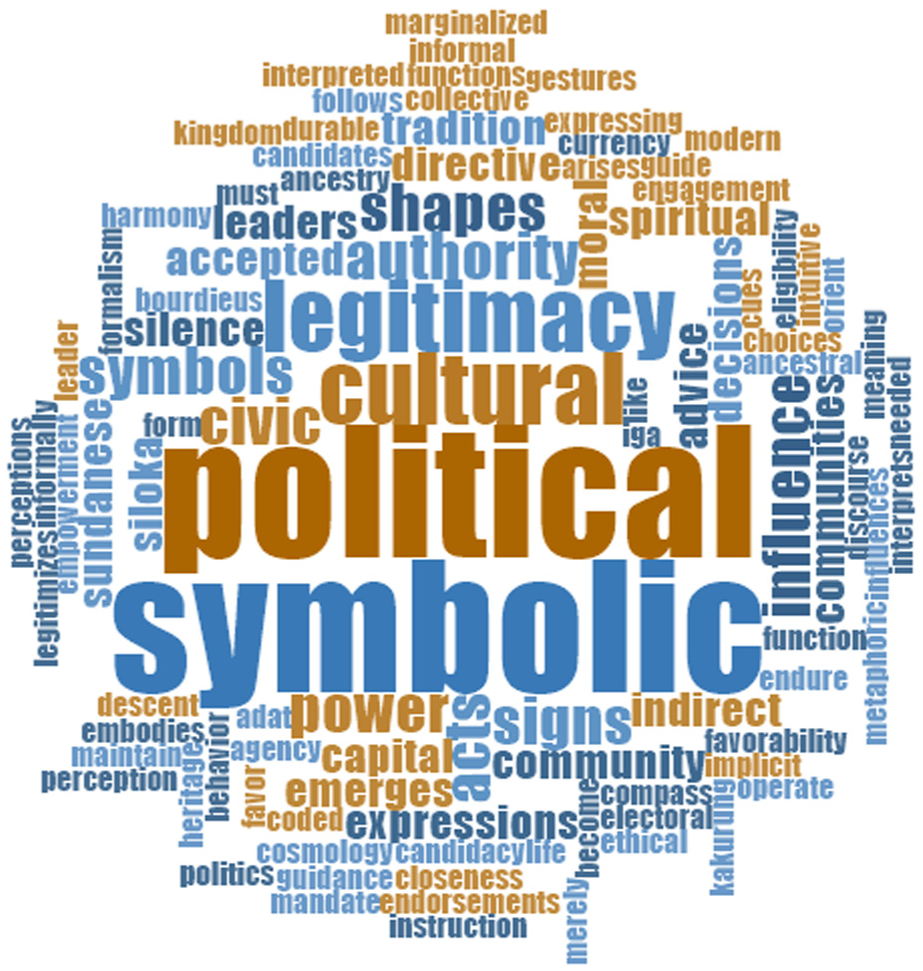
Word Cloud of Node: Symbolic Power and Political Legitimacy.
This picture shows how important symbolic gestures, cosmological allusions, moral authority, and community interpretations are to the construction of legitimacy. In this symbolic system, meaning turns into power and cultural codes turn into political actions. Bhutia (2024) says that these kinds of symbolic systems are very important for oppressed groups to be able to participate in modern politics while yet keeping their cultural identity.
Thema 3: Communication Channels and Social Media
In Sundanese indigenous groups, political communication is still very much connected to both traditional ways of doing things and modern media. Sundanese society is informal, collective, and based on values. This makes it a unique place for deliberative communication, where people trust traditional leaders to help them make decisions. These leaders are not only moral authorities, but they also help people communicate by connecting indigenous ways of knowing with the reality of elections (Baldwin & Holzinger, 2019).
Each traditional community has its own way of doing group discussions. In Cigugur, this happens every month at Panggih Lemah Cai, where people talk about social, cultural, and political issues. Dotsey (2024) says that these forums are open to everyone and allow traditional leaders to talk to both the government and the community. This keeps the conversations about government going. Tawasulan is a ritual Islamic gathering in Talaga where people worship, eat together, and talk about morals. The tawasulan is a religious event that also serves as a political communication arena, when candidates talk about their plans and show how they fit in with community values. The method is also a quiet but potent way to get people to vote, allowing for nuanced political positioning without overt campaigning.
Cultural preservation and politics can be discussed in the Rebo Wekasan meetings held in Cigumentong as well as the Balai Rakyat meetings in Dukuh. Through these meetings, community members are able to express their ideals and respond to political events while fostering solidarity. These gatherings often incorporate different forms of religion, which, as Fitzgerald et al. (2024) note, serves to bolster power and provide greater support for the participants. It is critical to observe that these traditional frameworks are increasingly losing relevance due to the rise of social media platforms such as WhatsApp (WA), which has made communication easier. WA groups have become a vital feature of communities; they assist people in organizing responses to political events, dispel misinformation, and maintain connections with distant relatives. Embracing WA means a shift has taken place toward new methods of communication within indigenous cultures, merging oral customary methods with advancements in technology (Baulch et al., 2024).
In Talaga, WA participants resolved a political dispute concerning a candidate’s genealogy. After confirming the genealogical information with local leaders, WA sent out a message clarifying the matter. This illustrates how the platform serves to falsify shreds of untrue evidence, thereby maintaining its symbolic validity (Pasquetto et al., 2022). Due to WA’s end-to-end encryption, there is a sense of privacy that makes politically sensitive dialogs possible, particularly in regions where people are paranoid about scrutiny or external interference (Ooko, 2023).
Social media aids mobilization as long-distance community members are connected virtually. As Lupien (2020) notes, Indigenous peoples utilize social media for fostering distinct communal identities and coordinated transnational collective action. In Sundanese culture, WA fosters and nurtures closeness alongside trust which enables leaders to keep constituents engaged without having physical meetings. This mixed communication style, which includes both ritual forums and digital networks, is now a key part of Sundanese political communication. Informal messaging, trust amongst people, and symbolic meaning are still important, whether they come from tumpeng rites or WA broadcasts. Hanlon (2021) and Szmidt (2024) show how informal channels strengthen relationships, lower political friction, and encourage communal cooperation. These are all results that this research has consistently found. This mixed communication strategy also makes civic engagement more durable. WhatsApp, for instance, has filters and formats that community leaders can use to send targeted messages, steer conversations, and develop political consensus across geographic boundaries (Carrière & Koop, 2023; Chagas, 2022). WA organizations also actively affect conversations around political exclusion and ethnic representation (Wefwafwa et al., 2025) as shown in Table 3.
Each village deploys distinct forums in tandem with WhatsApp.
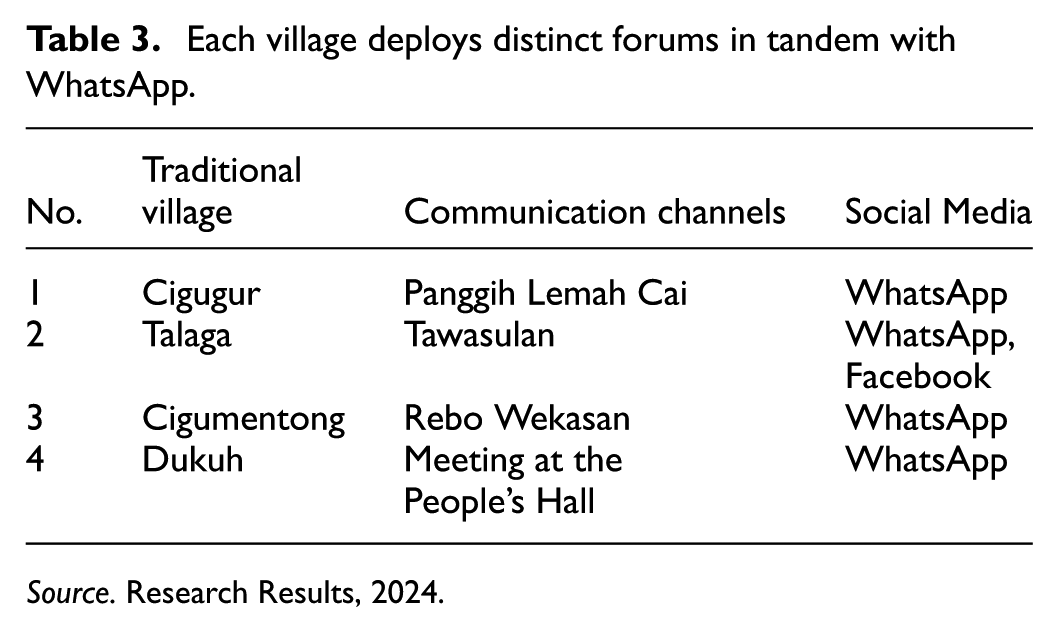
Source. Research Results, 2024.
The word cloud below shows the most important lexical patterns associated to this theme to support the thematic conclusions. Words like “political,”“communication,”“forums,”“WhatsApp,”“mobilization,” and “symbolic” show how traditional speech and digital media are coming together as two ways to talk about politics (Figure 4).

Word cloud of node: communication channels and Social Media.
The results support Dabin et al. (2019) claim that group communication methods, whether they are physical or digital, help indigenous groups come to an agreement and get everyone involved. Also, combining ancient values with new technology is a smart way to adapt to the political needs of modern times without losing the authenticity of indigenous cultures.
Thema 4: Local and National Political Context
In Sundanese indigenous groups, the political communication environment is determined by the conflict between local goals and national political systems. Indigenous political engagement is generally based on traditional values and cultural systems, and it often comes from dialogic communication, which values consensus and respect for community standards. But these same traditions can also make it hard to openly criticize, especially when decisions go against what the community thinks is right. So, clear and honest communication is necessary for getting to the bottom of things and understanding each other (Woodard & Hyatt, 2024). Gram et al. (2019) say that this kind of conversation is also very important for raising awareness and getting people to work together.
The fight for indigenous sovereignty and self-determination is at the heart of these political changes. Indigenous movements in West Java focus on territorial governance, cultural sovereignty, and control over resources. This has been their goal for a long time and fits with national policies of decentralization and legal recognition (Altamirano Rayo et al., 2024; Hundley, 2024). Indigenous people often vote in national elections, but they still want more political representation that respects their cultural differences and collective rights. The study identified four key local issues across different villages, revealing how place-based concerns shape political engagement (Table 4):
Issues that Indigenous Peoples are Fighting For.

Source. Research Results, 2024.
In Cigugur, the quest for legal recognition of Sundanese Wiwitan beliefs—through inclusion in identity documents—is a central issue. Indigenous residents seek recognition of their ancestral religion on par with the six officially recognized religions in Indonesia. Carrière and Koop (2023) notes that formal protections often fail in practice, impeding the religious freedom and broader participation of indigenous groups in civic life. The community uses the Sawala ritual, a political-ritualistic gathering, to assert their collective identity and values. Through the Dawuhan mandate, leaders articulate principles of divinity, humanity, and nationality, framing these as guiding filters in political decision-making. These values are invoked when evaluating political candidates and form a moral compass for communal choices.
In Talaga and Cigumentong, economic and infrastructure-related concerns dominate political discourse. Talaga’s ambition to export corn to Japan and Cigumentong’s need for road development and access to arable land require cooperation with state actors. However, as Tomateo (2021) emphasizes, addressing such issues demands the integration of indigenous knowledge systems into broader development and infrastructure planning—a process often hampered by bureaucratic delays and lack of political will.
The Dukuh community has been fighting over land for a long time. The State Forestry Company (Perhutani) says it manages 912.53 hectares of forest, but Dukuh chiefs say their traditional area is more than 5,400 hectares. This difference hasn’t been fixed, and it shows that there are bigger problems between governmental claims and indigenous territorial sovereignty. Not only policy but also political incentives and pressure from grassroots movements are important for a successful resolution (Altamirano Rayo et al., 2024).
In addition to local issues, Sundanese indigenous groups also take part in national elections and discussions about policies that affect indigenous rights. They get involved with politicians who come to their areas and judge them based on how they deal with problems like land rights, preserving culture, and spiritual freedom. These interactions aren’t only about institutional politics; they also include political ontologies, which are culturally and relationally based ways of understanding and organizing politics (Kramm, 2024).
The idea of Free, Prior, and Informed Consent (FPIC) is very important here. Indigenous peoples want real ways to consult and get consent, not simply token inclusion. Yakovleva et al. (2023) says that FPIC is the basis for making civil, political, and economic rights stronger. Carpenter (2021) makes the same point that true democracy requires the government to recognize indigenous territory, culture, and belief systems, as well as actively participate in politics. To reinforce these insights, the following word cloud visualization synthesizes the most salient lexical patterns from coded data across the four villages (Figure 5):

Word cloud of node: local and national political context.
This word cloud shows words like “indigenous,”“local,”“national,”“recognition,”“territory,”“land,”“rights,” and “state.” These common words show how land conflicts, identity documentation, cultural sovereignty, and state integration are the most important issues for Sundanese indigenous tribes in terms of communication and politics. In the end, the Sundanese indigenous people’s involvement in both local and national politics shows that they want to have a say, be treated with respect, and be included. Their political conflicts are based on local realities and traditional government, but they also connect to national and even global discussions about indigenous sovereignty.
Thema 5: Political Participation and Civic Resilience
Sundanese indigenous populations in West Java participate in politics based on shared values, respect for traditional authority, and a strong cultural understanding of what it means to be a citizen. They mostly participate in politics indirectly through traditional institutions, with traditional leaders acting as gatekeepers and messengers of political information.
People in Cigugur see political engagement as a civic duty that is strongly tied to the community’s moral duty to the country. People in the community are involved in more than just voting in local and national elections. They are also on election committees. This shows that people have a developed political awareness based on being aware of their rights and responsibilities as citizens (Li & Li, 2024). This kind of understanding strengthens civic stability and shows that traditional values may go hand in hand with democratic duties.
Some people in the Talaga community actively join political parties, which makes their type of participation more formal. A person who lives in Majalengka Regency decided to join a party since they want to run for regional head. His political vision includes making the economy better by giving farmers more authority and making Osaka a sister city. This story shows how people in indigenous communities can work together with larger global and developmental goals. It shows that every citizen, no matter where they come from, has the same rights and chances to get involved in politics and the economy (Höhmann & Kroeber, 2025).
On the other hand, communities in Cigumentong and Dukuh use more traditional ways to participate, such as getting people to vote and aligning symbols through traditional channels. People don’t always become involved in politics directly here; instead, they rely on a trustworthy communication system run by well-known people. This indirect way of participating makes communities stronger and more resilient, especially when people see engagement as a way to develop solidarity and self-determination (Duque Monsalve et al., 2024).
Recent democratic changes, such making political information more available, encouraging public conversations, and adding more political parties, have made indigenous populations more aware of politics. People are becoming more conscious of how their votes affect policy results and their political rights. Njonge (2023) says that this rising understanding changes how people participate politically, from passively receiving information to actively taking part in democratic processes. The following word cloud combines the most important ideas from the data analysis on political engagement to help you see these dynamics (Figure 6):

Word cloud of node: political participation and civic resilience.
Terms such as “participation,”“community,”“civic,”“resilience,”‘leadership,”“customary,” and “democratic” indicate the ways in which indigenous groups are addressing contemporary political matters while maintaining their traditions. Symbolic, collective, or strategic as well as election demonstrate the degree of complexity in indigenous involvement politic; interplay of ritual, pragmatism, and optimism. To summarize, the political participation of Sundanese indigenous peoples goes beyond voting; it is a holistic civic practice rooted in tradition, deep reverence for ancestral authority, and emerging democratic consciousness. It evidences civic resilience where adaptable traditional communities get involved with politics while retaining their values, identities, and culturally autonomous backsliding.
These patterns suggest that indigenous democratic participation in West Java is not driven by institutional enforcement but by symbolic legitimacy and moral persuasion. Traditional and digital systems of communication converge to produce a culturally grounded model of civic engagement.
Across the four indigenous communities, variations in symbolic authority and digital engagement reveal the diverse ways in which political communication operates. In Cigugur, symbolic rituals and spiritual guidance remain the dominant channels of civic mobilization. Talaga, by contrast, demonstrates a more pragmatic synthesis, where agricultural rituals are intertwined with WhatsApp coordination for electoral participation. In Cigumentong, symbolic legitimacy is preserved through collective reflection forums, while Dukuh shows the most visible integration of digital platforms for advocacy and community organization. Despite these differences, all four communities share a communicative ethos grounded in moral persuasion, ritual continuity, and collective harmony.
Discussion and Thematic Reflection
The interpretation of findings was guided by three theoretical lenses—Bourdieu’s concept of symbolic power, Weberian legitimacy, and Norris et al.’s civic resilience framework—which collectively informed both the coding process and the thematic synthesis. These perspectives allowed the analysis to move beyond description toward explaining how authority, participation, and communication intertwine in indigenous democratic practices. Rather than making universal claims about democracy, this study interprets “negotiating democracy” as a situated process through which indigenous communities balance moral authority, symbolic continuity, and civic participation within their own sociocultural systems.
Symbolic Power and the Cultural Grammar of Legitimacy
Bourdieu (1991) theory of symbolic power says that authority is not just enforced but also believed, and this is true for the political communication of Sundanese indigenous groups in West Java. Leaders employ siloka (symbolic utterances), rituals, and small hints to change how others think and what they do, which Weber (2019) called “traditional legitimacy.” This fits with Defriend and Cook (2024) idea of relational legitimacy, which says that leadership authority comes from people seeing that their morals and culture are in line with those of the leader, not from rules set by institutions. This kind of communication goes against the formal logic of election systems, but it works quite well. Gram et al. (2019) say that dialogic traditions that are part of symbolic language are very important for forming group political activity, especially in civilizations with strong moral and ancestral ties. Without any clear mobilization, symbolic messages become performative, turning beliefs into actions.
Hybridization of Communication: Ritual Forums and Digital Media
The fact that traditional forums like Panggih Lemah Cai, Tawasulan, and Balai Rakyat still exist alongside modern platforms like WhatsApp shows that a hybrid communication ecosystem is forming. This backs up what Lupien (2020) said: indigenous groups are not stuck in one place; they use digital tools in smart ways to keep their independence and make their opinions heard. Baulch et al. (2024) say that WhatsApp is more than just a way to talk to people; it’s a safe place for political discussion that lowers governmental surveillance and builds trust. Hanlon (2021) calls this kind of informal political learning, when civic conduct is formed by conversations instead of top-down campaigns. Messages that are sent by ritual or digital threads have a symbolic legitimacy that is important to everyone and has moral weight.
Local Versus National Context: Negotiating Dual Political Ontologies
The results show that there are two types of political ontologies: local cosmologies based on customary rights and national frameworks set by the state. Kramm (2024) says that indigenous political action is not just taking part in politics defined by the state; it is also a manner of expressing political existence that is rooted in culture. Land rights (Dukuh vs. Perhutani), legal acknowledgment of religious systems (Cigugur), and agricultural growth (Talaga) are all examples of local issues that are connected to national conversations about citizenship, inclusion, and development. Yakovleva et al. (2023) says that Free, Prior, and Informed Consent (FPIC) is very important in these situations to protect democratic participation and stop forced assimilation.
Collective Participation and Civic Resilience
The indirect, symbolic, and participatory politics that have been seen fit with Duque Monsalve et al. (2024) claim that civic power in indigenous communities is relational, negotiated, and community-driven. Voter attendance and committee activity are signs of formal participation, but the actual content is in community consensus and symbolic alignment that traditional leaders help create. Norris et al. (2008) calls this kind of civic conduct “civic resilience,” which is the ability of communities to adapt, resist being pushed to the outside, and stay together as political situations change. The Talaga scenario, in which a resident wants to combine their traditional identity with global ties (such a sister city with Osaka), is an example of a smart mix of local values and goals for growth.
Reflexive Integration and Theoretical Contribution
This study adds to the field of political communication by focusing on indigenous ways of knowing when looking at legitimacy, involvement, and media adaption. It also builds on Braun and Clarke (2006) paradigm for thematic analysis by looking at how themes like “symbolic power,”“civic trust,”“ritual media,” and “territorial sovereignty” are not separate but are very much connected. The results also contradict common ideas about how people might participate in democracy by showing that there are other ways to be involved that aren’t Western, such as spiritual cosmology, oral transmission, and symbolic interactionism (Blumer, 1986).
Limitations
This study is bounded by several methodological and contextual limitations.
First, as a qualitative inquiry involving 16 participants across four communities, the findings are context-specific and not intended for statistical generalization.
Instead, they aim for analytical transferability, providing insights applicable to comparable indigenous settings.
Second, while the study achieved theoretical saturation, further research could expand the scope to include gender perspectives, intergenerational communication, and other Indonesian indigenous groups.
Third, as the fieldwork occurred during post-election transitions, participants’ narratives may reflect the political climate of that period.
Despite these constraints, the study’s interpretive depth and cross-community design contribute valuable empirical and theoretical understanding of symbolic and digital political communication among indigenous populations.
Conclusion
This study looks at how Sundanese indigenous tribes in West Java use symbolic communication, traditional authority, and modern media to take part in democratic processes. Using NVivo for thematic analysis and a qualitative case study approach, five main themes were found: the role of traditional leaders, symbolic authority and legitimacy, communication routes, the political backdrop at the local and national levels, and civic participation.
The results demonstrate that in these societies, political legitimacy comes more from symbolic traditions than from formal institutions. Leaders use moral clues, rituals, and siloka to help people make political decisions, often in a subtle but strong way. WhatsApp and other social media are also used by the communities to keep up conversations and share political news. Also, when indigenous communities get involved in national elections, they push their own political ontology, putting ancestral values, collective rights, and local needs ahead of party dogma.
These results support Bourdieu’s idea of symbolic power and show that political involvement in indigenous settings needs frameworks that are relevant to the specific situation. In this sense, democracy is not just about voting; it is also about culture, stories, and identity. Future research should look into how digital platforms and traditional legitimacy work together in different indigenous communities and how these systems might help create inclusive government models at the national and global levels.
This study offers a distinctive contribution to political communication research by uncovering how traditional symbolic authority and digital communication—particularly WhatsApp—intersect to sustain indigenous democratic participation. Unlike conventional analyses that separate cultural and technological spheres, this research demonstrates that digital media in Sundanese communities do not replace ritual communication but extend and hybridize it. Through symbolic utterances, ritual forums, and mediated exchanges, indigenous leaders and citizens negotiate legitimacy, moral order, and collective decision-making. This hybrid communicative system reveals an alternative model of democracy—rooted in moral persuasion and relational legitimacy rather than institutional enforcement.
Theoretically, this study integrates Bourdieu’s concept of symbolic power, participation theory, and civic resilience to explain how indigenous communication can thrive within digital ecosystems. Empirically, it contributes a culturally grounded perspective on how local communities adapt new technologies to reaffirm ancestral authority, offering a framework for understanding non-Western pathways to democratic engagement.
Footnotes
Acknowledgements
The authors would like to thank the National Research and Innovation Agency (BRIN) for providing research opportunities and funding through the Riset dan Inovasi untuk Indonesia Maju (RIIM) Scheme, under the 2023–2024 research cycle (Decision Number: 12/II.7/HK/2023). We also express gratitude to the indigenous communities of Cigugur, Talaga, Cigumentong, and Dukuh for their invaluable participation and insights.

Ethical Considerations
This research received ethical approval from the Research Ethics Committee, Universitas Padjadjaran, Bandung, Indonesia. Approval Number: 1065/UN6.KEP/EC/2024. Issued: 07 October 2024. The study adhered to established ethical standards, including confidentiality, voluntary participation, and protection of participant identities. Data validity was strengthened through triangulation by (1) repeating key interview questions with different traditional leaders and (2) applying member checking to verify the accuracy and interpretation of responses.
Consent to Participate
All participants provided informed consent prior to data collection. They were informed about the study purpose, procedures, potential risks and benefits, and their right to withdraw at any time without consequences.
Funding
The authors disclosed receipt of the following financial support for the research, authorship, and/or publication of this article: This research was supported by the Riset dan Inovasi untuk Indonesia Maju (RIIM) Gelombang 3 Program, administered by the National Research and Innovation Agency (BRIN), under the Decision of the Deputy for Research and Innovation Facilitation, No. 12/II.7/HK/2023.
Declaration of Conflicting Interests
The authors declared no potential conflicts of interest with respect to the research, authorship, and/or publication of this article.
Data Availability Statement
The qualitative data supporting the findings of this study (i.e., anonymized interview excerpts and NVivo-coded themes) are available upon reasonable request from the corresponding author. Due to the sensitivity and confidentiality of indigenous cultural knowledge, full transcripts are not publicly archived.