




Abstract
The development of social media challenges the established conceptualizations of resources in social movements. While previous theories largely illustrated social movements as constantly searching for new and more resources, the development of social media has allowed some actors to gather and mobilize extensive resources rapidly, calling for an analysis of resource abundance. The aim of this article is to analyse how netroots organizations strategically act upon digital resource abundance and particularly focuses on how resources are mobilized and managed and how netroots organizations create organizational structures on social media. Three Swedish netroots organizations are used as empirical cases. This article shows that digital resource abundance is rewarding but also resource demanding as netroots organizations has to act like a Phoenix, the Greek mythological bird, as they constantly need to ‘reinvent’ themselves by being present and active on social media in order to maintain their digital resource abundance.
Keywords
Introduction
The development of social media challenges established conceptualizations of resources in social movements. Resource mobilization theory (e.g. Edwards and Kane, 2014; McAdam, 1982; McAdam et al., 2001; McCarthy and Zald, 1977, 2001; Pichardo, 1988; Travaglino, 2014) and resource-dependency theory (e.g. Froelich, 1999; Hager et al., 2004; Nienhüser, 2008; Pfeffer and Salancik, 2003) tend to illustrate social movements and civil society organizations (like non-governmental organizations and non-profit organizations) as constantly searching for new and more resources. While these theories have been central and shaped research fields, they offer less analytical guidance in understanding the abundant amount of resources to which online mobilization can sometimes give rise. Social media has the potential to bring many people together in terms of abundance of likes, followers or group members, yet there is limited knowledge about what it means for online movements to face situations of what we term ‘digital resource abundance’. The term illustrates the apparently rare situations when online campaigns and mobilizing events, almost as if by accident, take off, get public attention and start being followed and supported by ‘large numbers’. They get their voice heard in the social media noise and, unlike most actors, gain wide attention (e.g. Johansson and Scaramuzzino, 2019; Guo and Saxton, 2020; Webster, 2014; Webster and Ksiazek, 2012).
The potentials for and challenges of online mobilization have been studied previously. We find extensive case studies of well-known and large-scale protests and events such as the Arab Spring, G20 protests (e.g. Bennett and Segerberg, 2012), Occupy movement (e.g. Croeser and Highfield, 2014; Penney and Dadas, 2014; Theocharis et al., 2015) and the 2015 European refugee crisis (Kaun and Uldam, 2018), in which social media was used for massive mobilizations. A great deal of attention has moreover been paid to the ‘low thresholds’ of online mobilization (e.g. Bennett and Segerberg, 2012, 2013; Karpf, 2012; Shirky, 2008; Tufekci, 2017), yet some scholars question this approach for being techno-deterministic and unable to capture the social, political and cultural contextual settings that shape the people’s interest both online and offline (e.g. Theocharis et al., 2015). This debate undoubtedly has advanced knowledge on what drives online mobilization at the start, but scholars have neglected to investigate the opposite end of online mobilization, as actors mobilize the big masses. Such a bias reflects established theoretical assumptions of resources as scarce, a potentially flawed assumption concerning online mobilization.
The aim of this article is to advance knowledge on digital resource abundance as a social media phenomenon and discuss its implications for social movement theories. Although situations of resource abundance have been previously described (e.g. Ruzza, 1997, analysis of the Italian peace movement), social media has certainly made the phenomenon more common and widespread. Instead of facing the risk of not having sufficient resources to pursue their aims and mission, digital resource abundance puts other forms of pressure on online organizers, for instance, to cope with digital resources being as easily lost as they are gained. The article thus seeks to answer the following research questions: How do netroots organizations strategically act in and upon situations of digital resource abundance? What are the consequences of digital resource abundance for netroots organizations?
The article explores digital resource abundance in relation to netroots organizations as a particular type of online mobilization, which tends to be successful when it comes to gaining digital resource abundance. The term suggests a type of collective actors that are created and operate on social media primarily, and unlike traditional social movement organizations, mobilize netroots rather than grassroots. They have come to fill niches in existing advocacy group systems (Karpf, 2012), as they tend to focus on online political campaigning (e.g. Chadwick, 2007; Karpf, 2016), yet are organized by different principles than traditional ‘grassroots organizations’ as being far more individualized and network oriented (cf. Bennett and Segerberg, 2012). Following from this, the type of digital resources that the analysis focuses on are likes, followers and group members on Facebook. This article draws on a study of three Swedish netroots organizations operating on social media: Not racist but, #Iamhere and #wecannotstandit. Each of them is a major anti-racist or online hate speech mobilization and they have all managed to gain digital resource abundance.
Three types of strategies for digital resources
To capture strategies to gain and maintain digital resource abundance, this article draws upon theories on resource mobilization and resource-dependency, as two classic accounts on how social movement and civil society scholars have conceptualized resources and their relevance for mobilizing and organizing. We contrast such classic approaches with more recent studies of social media, online mobilization and netroots organizations and propose three ideal types of strategies of key relevance for our understanding of digital resource abundance – mobilizing, managing and embedding digital resources.
Mobilizing digital resources
The use of social media raises questions regarding how we can understand the mobilization of resources. Mobilization is a key term with regard to studies of social movements and generally refers to practices by actors in their efforts to control resources. Resource mobilization theory takes an ‘entrepreneurial-organizational approach to movements’ (McCarthy and Zald, 2001: 533; see also Edwards and Kane, 2014; Travaglino, 2014) and illustrates social movements as organizations that are strategically involved in resource mobilization and less based on people’s grievances (e.g. McCarthy and Zald, 1977). It offers a perspective that ‘. . . focuses attention on the ability of social movement promoters to gain and manipulate resources of power, to organize, to recruit members [. . .] and to provide individual incentives or coercion in motivating participation in social movement activities’ (Kerbo, 1982: 646). It examines the ‘. . . rational, purposive aspects of social movement behavior’ (Pichardo, 1988), and while societal structures and political processes are certainly relevant, the emphasis lies on the actors’ strategic actions. This approach thus largely sees people as the main resource, and ‘people management’ constitutes a crucial element as movement organizers ‘. . . transform bystander publics into sympathizers and sympathizers into adherents’ (McCarthy and Zald, 2001: 538).
Notions like ‘professional movement organizer’ (e.g. Kleidman, 1994) or ‘movement entrepreneur’ (e.g. Staggenborg, 2013) suggest social movements as being at least partially strategically managed. However, there have been intense debates regarding the rationalistic element of this theory (e.g. Fireman and Gamson, 1977) and the significance of structural, economic and political factors (McAdam, 1982; McAdam et al., 2001), as well as the normative and cultural elements (Fox Piven and Cloward, 1991) in addressing mobilization (see also McCarthy and Zald, 2001).
While this has formed the mainstay of theorizing on mobilization for decades, it seems less suited to illustrating the opportunities for mobilizing online resources. Research on social media has clearly shown how the cost of creating new initiatives has fallen (Shirky, 2008), and extensive research is being conducted on the ‘new masses’ (Baxmann et al., 2016; Tufekci, 2017), and large-scale action networks (Bennett and Segerberg, 2013) as a kind of scale shift (McAdam et al., 2001; Tremayne, 2014). While classic accounts of resource mobilization saw resources as being scarce and difficult to mobilize, social media has greater potential for bringing ‘large numbers’ together (Karpf, 2012; Shirky, 2008; Theocharis et al., 2017). Resources certainly need to be allocated, produced or aggregated, but digital resources appear to be much less limited because likes, followers and group members can be aggregated on a greater scale. Yet, the ‘lower-thresholds-argument’ has also been questioned. Vaccari et al. (2015) propose a distinction between lower and higher thresholds for political engagement and Treré and Mattoni (2016) make a distinction between low, medium and high engagement. Scholars also suggest that in some situations the costs for mobilizing online might be low, while in other situations the costs are high (Treré and Mattoni, 2016; Vaccari et al., 2015). Earl et al. (2015) argue that since digital resources are fluid and ephemeral, they also require specific kinds of control strategies.
Managing digital resources
Scholars have also focused on how actors seek to manage and control the type (and volume) of resources they have managed to mobilize. Such arguments can be explored from resource dependence theory (Pfeffer and Salancik, 2003). The theory primarily asserts how the environment and external funding structures affect formal organizations and has been used in relation to non-governmental organizations, non-profit organizations and voluntary sector organizations (Froelich, 1999). Due to its distinct perspective on resources and strategies, we argue that it is a key perspective to capture also netroots organizations’ strategies. The approach draws on a general assumption that reliance on external resources makes an organization vulnerable to both changes in the flow of resources and to outside pressure. Resources are largely understood as material resources (mostly financial), but also less tangible resource types such as information and social or political support (i.e. legitimacy). As long as actors depend on external resources, they cannot freely determine their aims and missions (Pfeffer and Salancik, 2003), and whoever ‘. . . controls resources has the power over those actors who need these resources’ (Nienhüser, 2008: 13). Emphasis lies on the actors’ control strategies as organizations are driven towards compliance with the requirements of the strategic resource providers. This is due to the pressure of uncertainty (lack of control) and scarcity (competition over limited resources) in their environment (Froelich, 1999; Hager et al., 2004).
Actors who heavily depend on one (or very few) resource providers are likely to experience stronger constraining influences from their environment, consequently calling for strategies of resource diversification. Although this might portray a static view of actors and their environments, the meaning of ‘an environment’ is subject to interpretation by the actors involved (Nienhüser, 2008). Scholars have primarily analysed funding as a type of resource that actors seek to control, and research shows that reliance on government funding shapes non-profit organizations and voluntary sector organizations in unwanted ways, for example, linked to mission drift and hybridization of organizations (see Froelich, 1999; Suykens et al., 2019).
Resource control has also been studied by social media scholars. However, scholars propose resource management rather than resource control as dominant online strategy. Shirky (2008), for example, considers resources to be largely embedded in netroots organizations and less under the control of external actors (e.g. governments or external donors). He uses economic theory and argues that social media has changed the way in which groups gather and cooperate and that the costs of creating or joining groups ‘. . . have collapsed’ (Shirky, 2008: 18). This makes resource management different because there are no transaction costs. Managing digital resources furthermore does not require any funding and hardly any effort, attention or time (Shirky, 2008). This suggests that less external resource control is involved.
Others think this is misleading. Social media is not an open space (Boler et al., 2014; Morozov, 2011; Tufekci, 2017) and it includes rules for participation and interaction, often designed by social media companies. Access to digital resources is unequally distributed and social media platforms are commercially controlled. Available resources and the opportunities to gain digital resource abundance are thus shaped by external conditions, for instance, tied to political debates, shaping the ebbs and flows of people’s interest in a topic. Concepts such as ‘information bubble’ (Pariser, 2012) or ‘echo chambers’ (Karpf, 2016) illustrate how interaction and mobilization depend on algorithms, and scholars have found that netroots organizations tend to adapt to their social media environment, thereby illustrating forms of adaptation to external resource control (Kaun and Uldam, 2018; Penney and Dadas, 2014). In this latter understanding, digital resources could also be captured as externally controlled because they are partially controlled by algorithms and multi-national corporations (Johansson and Scaramuzzino, 2019) that affect both the opportunities for digital resource mobilization and control, suggesting that online actors are not as resource independent as they might be perceived to be.
Embedding digital resources
The form of organizing has been a key topic in discussions on offline and online mobilizations. This has long been a debate in social movement studies in which distinctions between social movements and organizations are at the centre of much theorizing. Social movements are largely seen as forms of collective action that build on open and voluntary participation and network structures, while organizations are more generally defined as hierarchical, stable, with clear boundaries (Den Hond et al., 2014). Such classic propositions suggest that social movements almost inevitably become more stable, professionalized and formalized over time (e.g. McCarthy and Zald, 2001). Den Hond et al. (2014) however suggest that our understanding of social movements would benefit from seeing them as somewhere in between emerging and decided social orders. They largely lack formal rules on membership, decision-making, monitoring and sanctioning, which are definitional elements in most organizations (e.g. Ahrne and Brunsson, 2011). They rely more on flat structures than formal hierarchies yet are in the process of becoming more like formal organizations.
Online mobilization makes these discussions relevant again (e.g. Bennett and Segerberg, 2013; Karpf, 2012; Shirky, 2008; Tufekci, 2017). Online movements and netroots organizations have often been described as leaderless (Boler et al., 2014) and lacking sufficient organizational structures (Tufekci, 2017). Several scholars have shown that groups on social media are created spontaneously building on fluid or flexible flat structures (Dahlgren, 2013; Monshipouri, 2016; Theocharis, 2013; Theocharis et al., 2015; Tufekci, 2017). It has been shown that they struggle extensively with how to best organize their resources. There is an ongoing debate among researchers about the durability and effectiveness of online movements and netroots organizations (e.g. Bennett and Segerberg, 2013) and whether they are like one-hit wonders that burst on the scene (gain extensive recognition and support) but then fade away. Like classic theorizing on resource mobilization and resource-dependency, also current social media studies see organizational forms as partly a result of the structural and contextual factors that set conditions for online movements and netroots organizations, yet also that there is an element of strategic decision-making involved as regards what form netroots organizations choose to embed people in (e.g. Chadwick, 2007).
To sum up, these three types of strategies (mobilization, managing and embedding) build our analytical framework for the study of the strategies of netroots organizations. They have been used previously, but less in combination and even less so in relation to digital resource abundance. Resource mobilization and resource-dependency theories assume a temporal interlink between the three types of resource strategies, as online mobilization takes place before managing resources and creating organizational structures. The former (resource mobilization) suggests a point that the actors which to reach, whereas the latter two (management and organizing) are performed at a point where the resources gained are being maintained and controlled. It is relevant to consider whether such temporality and purpose also capture the strategies of digital resource abundance. The theories of resource mobilization and dependency assign actors a strategic form of agency, which we partly also find in more current discussions on online mobilization. Key analytical distinctions, for example, transforming passive bystanders to active followers or between external and internal resource control, form key tools to capture how netroots organizations act upon digital resource abundance. Finally, we find that the one-hit-wonder metaphor is analytically significant, as it assumes that digital resource abundance can emerge, explode, but also quickly fade away, suggesting that established theories’ focus on how to gain resources needs to be complemented with an analysis on how to maintain digital resources. This suggests that the strategies of netroots organizations might be significantly more compressed in time and are perhaps not as linear as previously theorized.
Case selection and methods
This article compares three cases of netroots organizations in a Swedish context and the comparison allows us to build knowledge on how extensive resources are mobilized and managed. In Sweden, almost everyone has access to the Internet and most of the population uses social media (Andersson and Alexanderson, 2020). In global terms, Sweden moreover stands out for being highly organized when it comes to membership in civil society organizations. Statistics Sweden (2019) count to more than 250,000 (2016) organizations (mostly associations) among a population of approximately 10 million. In recent years, the structure of formal associations has been complemented with a growth of loosely connected networks of citizens and groups, primarily operating on social media, often in the form of netroots organizations (Scaramuzzino and Scaramuzzino, 2020). The Swedish context is not necessarily unique in these concerns, but it enables an assessment of our research questions.
The three netroots organizations used as empirical cases in this article are Not racist but, #Iamhere and #wecannotstandit. Each of them is a major anti-racist mobilization or online hate speech mobilization and is a key example of digital resource abundance. In a short time, they have mobilized large numbers of people and have created digital arenas in which thousands of people engage, sometimes on a daily basis. Starting from personal initiatives, they quickly turned into key collective actors, holding significant legitimacy and power to act and speak about anti-racist or online hate speech issues. However, they are different when it comes to their organizational form and can illustrate how access to and management of resources changes in organizational processes.
Not racist but was started in the spring of 2012 by a young member of a Swedish trade union for industrial workers. The founder felt that the union was not doing enough to address the growing number of people who sympathized with the Sweden Democrats, a nationalistic, right-wing party with a socially conservative and anti-immigration agenda. One distinct aspect of Not racist but is that it uses political satire to examine the Sweden Democrats. At the time of the interview, this netroots organization had a website, Facebook page, Twitter account and Podcast, and is now also active on Instagram.
#Iamhere was started on 13 May 2016 by a Swedish journalist, but is now a formal association. At the time of the interview it had a website and a closed Facebook group that coordinated its actions. #Iamhere ‘patrols’ social media in order to try to maintain a minimum standard of ‘civilized speech’ and it works for an inclusive society without hatred. By writing comments in threads, sometimes using the hashtag #Iamhere, and by reporting hateful content on social media, it is combating online hate speech, trolls, filters, bubbles, algorithms, fake news and post-truths. By hate speech, it means sexism, racism, homophobia and funcophobia. Instead of writing comments separately as individuals, people can now do so as part of a group. The concept has spread to several other countries such as the United Kingdom, the United States, Slovakia, Germany, Norway, Finland, Italy, France, Canada, Australia and Poland, and an international network against online hate speech has also been created (#Iamhere, 2019).
#wecannotstandit started on 27 September 2016 as a protest against how unaccompanied asylum-seeking children were being treated in Sweden. #wecannotstandit demands that unaccompanied children are guaranteed justice and demands an amnesty for those children who have been in Sweden for more than 1 year. At the time of the study, #wecannotstandit had a closed Facebook group. Its members comprised professionals and volunteers who worked with and met unaccompanied children. Now it also has a website and a Twitter account.
The netroots organizations that we have selected as cases were created on social media and use social media as their main platform. The cases are illustrations of contemporary digital resource abundance that might, in varying degrees, affect and be relevant to other types of actors such as social movement organizations and civil society organizations (like non-governmental organizations and non-profit organizations). Previous research has tended to focus only on one netroots organization and has assumed that they are all more or less the same (e.g. Karpf, 2012; Tufekci, 2017 for exceptions). By comparing three different netroots organizations, we can see that the resource management differs depending on whether or not the netroots organizations, for example, have group members on Facebook.
Our analysis is based on a qualitative study. Although gaining access to representatives of netroots organizations can be quite difficult, three semi-structured interviews were conducted between November 2016 and February 2017 with representatives of Not racist but, #Iamhere and #wecannotstandit, that is, one interview per organization. The interviewees had a central position in each netroots organization and great knowledge about the netroots organizations’ strategic decisions. The interviews lasted for around 1 hour and were used in order to gain a deeper understanding of how these netroots organizations strategically manage digital resources. The interviewees were asked about how the netroots organizations started and developed internal rules, main activities and strategies. They were asked questions about challenges in using social media, time and effort to manage members and followers, and why they thought that they had been successful in getting likes, followers or group members on Facebook. All interviews were recorded and transcribed. We collected empirical material from websites and social media channels as a complement, for example, information about the number of followers, likes and group members, group rules, description of the groups and their development and we observed several of the groups’ joint actions. For ethical reasons, we have not included any data from ‘closed’ groups on social media without having first obtained consent.
After the empirical material was gathered, we conducted a thematic analysis (cf. Nowell et al., 2017). To limit the empirical material, only resource-related content was included in our analysis. We read the empirical material multiple times to check for recurring themes. In our empirical material analysis, we found no scarcity of resources, as had been described by previous scholars. On the contrary, we saw what we would describe as resource abundance. We developed codes in relation to what strategies the netroots organizations had developed to collect and handle digital resources. Initial codes such as ‘number of likes, group members and followers on social media’, ‘single-issue’, ‘lowest common denominator’, ‘membership control’, ‘rules’, ‘engagement’, ‘moderate’, ‘administrators and moderators’, ‘joint actions’ and ‘organizational form’ were used as sensitizing concepts. We identified three empirical strategies of resource abundance – mobilizing and managing digital resources and setting up organizational structures – and we categorized the empirical material accordingly. Later, we identified a forth strategy – constantly posting – to maintain digital resource abundance. We conducted a comparative analysis by studying both the differences and the similarities between the three cases.
Mobilization towards digital resource abundance
While most actors mobilizing on social media (cf. Johansson and Scaramuzzino, 2019; Guo and Saxton, 2020; Webster, 2014; Webster and Ksiazek, 2012) often find it challenging to get their message across, our three cases attracted a wide audience as they started to mobilize against online hate speech and racist expressions.
They quickly gained people’s attention, managed to create a social media presence and grow in numbers. They experienced a situation of rapid mobilization that was unprecedented and stated that their netroots organization grew extremely quickly: ‘It went much better than I’d ever imagined’ (Interviewee 1). After only 2 months, #wecannotstandit already had quite a large follower base on social media: ‘To date, we have had 13,000 likes. Yesterday, it was two months since we started. We have more than 7,000 group members on Facebook [. . .] Right now, many people are waiting to join . . .’ (Interviewee 3). Both #wecannotstandit and #Iamhere described how they had people waiting to become group members: ‘At the time, we were getting several thousand membership requests a week’ (#Iamhere website, 10 April 2017). This suggests mobilization as reflecting the low affordance on social media.
We also find strategic elements that form a key part in their mobilizing efforts. One reason why they were able to attract so many members was that they organized around a single issue, regardless of political affiliation or political views: ‘We used the lowest common denominator. For example, we haven’t talked about structural racism because there are many different opinions about what that is. We have used the lowest common denominator from the start . . .’ (Interviewee 1). The tendency, for new social movements, to mobilize around a single issue (and often ad hoc) has been recognized previously, also before the advent of social media (e.g. Offe, 1985). However, when it comes to the netroots organizations, it was a strategic decision to balance left-wing and right-wing sympathizers and this decision appears to have paved the way for even more attention. Thus, in order to gather as many people as possible, it sought to create a common identity and let its followers and group members keep their individuality.
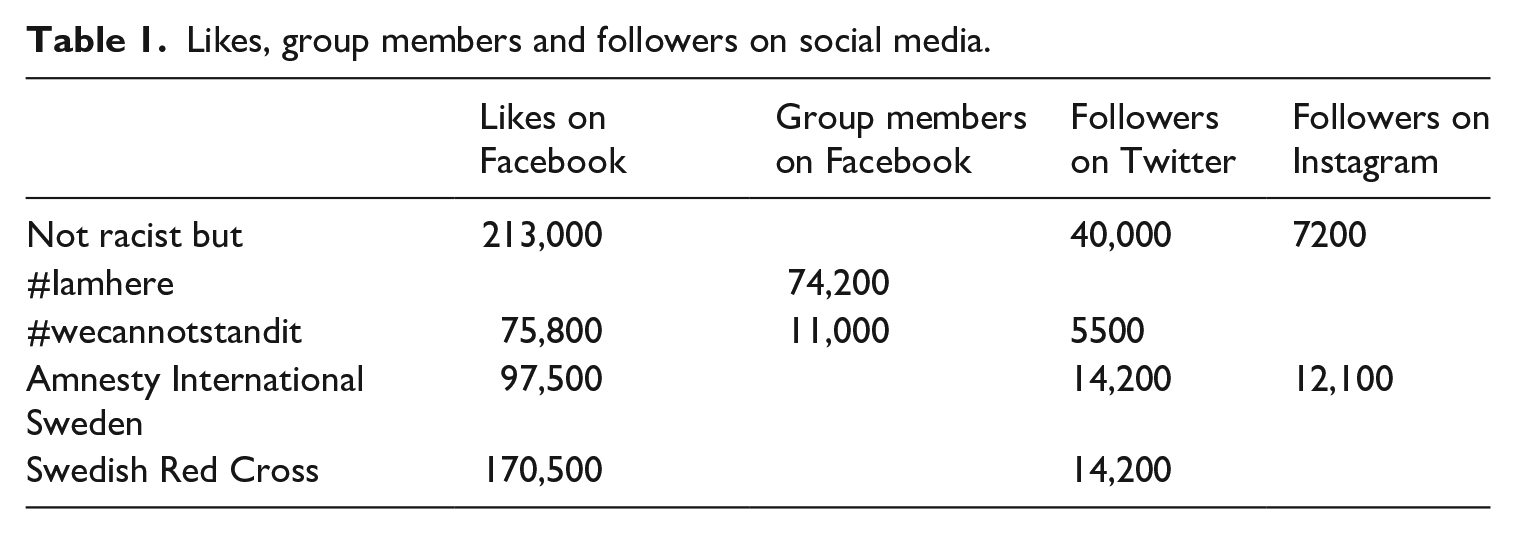
Figures are, of course, relative. When we compare these figures with well-established Swedish non-governmental organizations, we find that they mobilized very well. For instance, Not racist but was so successful in attracting people’s attention and support on social media that it mobilized more digital resources (213,000 likes on Facebook, 40,000 followers on Twitter and 7200 followers on Instagram) than the Swedish Red Cross. As Table 1 shows, in a Swedish context, our three cases managed to gain digital resource abundance. However, they also had to manage the ‘masses’.
Likes, group members and followers on social media.
Managing the ‘masses’
The cost of both creating and joining groups, for example on Facebook, has significantly been reduced which paves the way for digital resource abundance (e.g. Shirky, 2008), yet our study of digital resource abundance shows that online mobilization requires extensive management to keep and utilize digital resource abundance. High numbers of likes, followers and group members put pressure on netroots organizations, particularly those who have group members. Reflecting on how they were mainly organized as loose informal networks, ‘managing of the masses’ soon became a crucial issue (e.g. Baxmann et al., 2016). This was partly reflected in practical issues, but also required more strategic thinking on how to manage and make use of the likes, followers and group members.
A lot of activity (#Iamhere and #wecannotstandit) was focused on setting up procedures for membership, as a form of resource management activity. For example, in order to minimize the risk of being ‘trolled’, #Iamhere and #wecannotstandit reviewed and screened all individuals before accepting them as group members. An interviewee from #Iamhere explained, ‘We check to ensure that they don’t have any hate speech on their pages. We check every member’ (Interviewee 2). However, this process was described as extremely time consuming and it was sometimes difficult to keep up: For a while, there was so much pressure that we had 40 people reviewing membership requests for the Facebook group to ensure that no trolls joined the group. Nevertheless, we had to reject anyone who had been invited by someone else, because we simply couldn’t keep up. (#Iamhere website, 10 April 2017)
In a Swedish context, it is rare to have as many as 40 volunteers reviewing membership requests. #wecannotstandit had a similar experience, as explained by the interviewee: At the moment, many people are waiting to become a member. But we screen all member requests, so it take some time before they become group members (laughter). Initially, we didn’t review everyone because we only received requests from professionals who knew about the group. Now that more people know about the group, we have made it private. It is no longer visible. Now you can only search for it, although we still need to screen new members. We’ve not had many trolls, but we’ve had some. We banned them and got rid of them. (Interviewee 3)
Although online mobilization might be associated with low costs, this demonstrates that digital resource abundance is also resource demanding and that digital resource abundance in followers and group members creates scarcity in other types of resources such as coordination and moderation.
This was even more apparent as the netroots organizations’ extensive membership also involved costs for setting up rules of engagement. In the first 6 months, one of the founders of #Iamhere started developing the group and the rules have been clearly stated on Facebook, that is, no hateful or insulting comments. #Iamhere actively monitors its Facebook group and the interviewee explained that the fact that it does not compromise with the rules was one of the reasons why the group has worked so well and become so successful: ‘If you state there must be no patronizing remarks in this group, you have to be quite strict about it, but it’s extremely hard (laughter)’ (Interviewee 2). Every day, so-called action administrators ensure that group members follow the rules. #wecannotstandit focused on what group members were not permitted to write and express, ‘There are huge limits regarding what people can state on our Facebook page. There are 100 words that cannot be used, otherwise you’ll get blocked immediately’ (Interviewee 3).
Not racist but also developed rules about what people could write. ‘The rules for comments are like most other groups. Stick to the subject and don’t make any personal attacks’ (Not racist but Facebook, 10 April 2018). Not racist but did not have any group members and, therefore, did not appear to be actively monitoring its Facebook page or moderating the threads, which was also stated on Facebook: ‘As far as possible, the page will not be moderated. However, if we see any stupid comments or personal attacks, you can expect to be thrown out and blocked’ (Not racist but Facebook, 10 April 2018). The most common sanction was to block people from the Facebook page: ‘We’ve had a few but we responded to them and then removed them’ (Interviewee 3).
Interestingly, netroots organizations sought to turn passive clicktivists to do more than just share and like posts on social media and, hence, turn them into ‘real participants’ (like the distinction between bystanders and participants assumed). However, the size of these netroots organizations could also imply a risk on social media platforms. An interviewee from #Iamhere explained that because they were so many and big, they had to be careful to not ‘take over’ the Facebook threads: ‘We have started dividing ourselves into smaller actions [. . .] then it’s not like there are so many of us who rush into the threads’ (Interviewee 2). Every day, many of the group members of #Iamhere became involved by writing in Facebook threads. Getting people involved beyond clicktivism was arguably not a challenge but coordinating their actions and making use of their large-scale engagement was.
Setting up organizational structures
Reflecting that digital resources are fluid and ephemeral, all three netroots organizations started to set up more stable organizational structures. To keep the followers and group members and create a more predictable situation, they had to build more lasting structures and to embed the followers and group members. However, the need to find more structure in abundance took different forms: Not racist but developed into a ‘digital campaign organization’ with no members, #Iamhere founded a formal association with formal members and #wecannotstandit built an ‘air castle’ on Facebook.
According to the interviewee, Not racist but set up an ‘editorial’ with a few people producing the material that was published on its website, Facebook, Twitter and through its podcast. In the interview, it was stated that all activities were based on voluntary work but, according to its website, it now also has an employee who handles administration. The interviewee described the netroots organization as follows: ‘You could say that we have become a sort of lobbying organization’ (Interviewee 1). The interviewee stated that it would be difficult for Not racist but to create a formal association, because it would then become like a political party. If it were a political party, it would be difficult to merge people with different political views.
#Iamhere followed a similar pathway and soon had two main administrators who made all the strategic decisions. Around 26 to 30 people constitute the core group. Several so-called action administrators act as moderators once a week. Around 10 people review and screen anyone who wants to become a member of the Facebook group. However, managing this large Facebook group was too time-consuming and too resource demanding, so the netroots organization decided to start a formal association alongside its Facebook group (founded at the beginning of 2017, #Iamhere website, 10 April 2017). This was partially a way of further embedding resources into a stable structure but even more because the netroots organization wanted to promote civil courage offline and offer lectures and workshops.
#wecannotstandit has four founders: ‘We have built it together. We are four founders who are trying to hold together this huge number of people (laughter) safely’ (Interviewee 3). They did not want to become a formal association and saw themselves as a movement. They considered themselves as having more influence if they kept this network structure. Nonetheless, they set up an organizational structure on Facebook and built an ‘air castle’ with many different rooms and many think tanks: ‘We work in a castle inside Facebook. We have lots of rooms (laughter)’ (Interviewee 3). Each room in the air castle had different characters: ‘It’s magical how you can create structures in other digital structures, and yet it’s people who are involved (laughter)’ (Interviewee 3). The air castle was built in a hurry and one interviewee explained that everything had gone so ‘incredibly’ fast that ‘they’re building an airplane while flying it’ (Interviewee 3). They saw the considerable benefits of building a digital organization because it could be used to reduce hierarchies and increase the influence of the group members. The founders planned to divide the responsibility between rooms in order to let as many people as possible become involved and take responsibility.
These three experiences call for extensive interpretation. They illustrate the ambition to also build more stable structures on social media, and even though only one of them engaged in building a formal association, they have all engaged in creating more formal structures in terms of decision-making, internal procedures and so on. Thus, there are elements of increasing professionalization and of a formal organization that digital resource abundance seems to demand. They also engaged in creating hierarchies (even if they might be more or less flat) in order to be able to work more effectively. Those people who were responsible for setting up the groups on Facebook continued to act as strategic leaders, despite the groups taking new forms. All of the netroots organizations had main administrators who made all the strategic decisions. Unlike other studies into online mobilization (e.g. Tufekci, 2017), our cases did not have any problems with continuity and were not leaderless.
Constantly posting
The transition towards more stable or even formal ways of organizing stands in sharp contrast to the netroots organizations’ experience of trying to maintain digital resource abundance on a daily basis. They were aware that keeping digital resource abundance required a constant feed of new posts in order to keep involvement high (e.g. Johansson and Scaramuzzino, 2019). What was typical of this type of online mobilization was then not only digital resource abundance, but also digital resource fluidity.
However, being present and active on their social media platforms was challenging. Above all, as time cycles were short and repetitive because they had to engage on a daily basis. This was particularly evident for #Iamhere, which engaged in countering online hate speech. Every day it had to choose which threads to enter. Moderators and netroots had to be visible and present online, and in social media debates. Considering it reacted to online hate speech, it had difficulty predicting what would happen tomorrow or next week, what the media was going to write about and how, and how much online hate speech the published articles or posts on social media were going to trigger. In order to counter online hate speech, it had to be alert and be both flexible and have a solid structure for joint actions, as well as acting in real-time because ‘yesterday’s news is old news’.
Another of our cases stated the need to publish a constant flow of posts on Facebook. #wecannotstandit frequently (sometimes several times a day) posted on its social media channels. This included forwarding articles and TV programmes, informing about and showing pictures of joint actions and protests, and sharing personal stories about children who were going to be deported. Frequent reporting and sharing were a means of responding to, interacting with and trying to maintain its large number of followers. Not racist but explained that producing and publishing good political satire was a way of getting people’s attention, particularly from people affiliated with the group.
Conclusion
How to gain resources is a central theme in current scholarly discussions, yet this article shows that we need to shift analytical focus from resource scarcity to digital resource abundance. Moreover, the types of strategic actions that classic theories on resource mobilization and resource dependence tend to consider are only partly relevant when it comes to netroots organizations’ strategies to gain and maintain digital resource abundance. Instead, digital resource abundance gives rise to what we refer to as the ‘Pheonix syndrome’, a concept that can advance our understanding of online mobilizations and digital resources.
The Phoenix syndrome makes another aspect of what Guo and Saxton (2020) refer to as the ‘quest for attention’ on social media visible (see also Johansson and Scaramuzzino, 2019; Webster, 2014; Webster and Ksiazek, 2012). It is not only a quest for attention. We find that time cycles on social media are short. Once the netroots organizations have gained abundant number of followers they have to live up to the conditions of acting like the mythological bird Pheonix. The netroots organizations studied in this article had to constantly ‘reinvent’ and ‘renew’ themselves and rise from the ashes more or less every day. Trying to maintain their digital resources required them to constantly ‘feed the bird’, that is, to garner the attention of netroots and to maintain visibility in the public debate. Although social media might offer seemingly extensive opportunities to gain resources, they seem to be ephemeral and depending on the netroots organizations’ ability to win the competition for social media presence and public attention (cf. Johansson and Scaramuzzino, 2019; Guo and Saxton, 2020; Webster, 2014; Webster and Ksiazek, 2012). Being able to maintain digital resource abundance thus implies to constantly reinvent and renew oneself as the vital strategy to keep ‘the masses’ interested, active and committed.
The Pheonix syndrome can also be understood as a consequence of how social media companies design algorithms, as a kind of structural prerequisite for gaining and maintaining digital resource abundance. While previous theories, for example, resource dependency theory, have focused on dependency on the state due to public funding, our analysis instead illustrates another form of digital resource dependency, because it is the corporations that own Facebook, Instagram and Twitter that both directly and indirectly control opportunities on social media. It is however, a matter for further debate whether the Pheonix syndrome has relevance mainly for those who have gained extensive attention (digital resource abundance), or whether the term also is applicable to those with less digital resources, as a general social media practice.
Our study also contributes to discussions on the low threshold debate (e.g. Bennett and Segerberg, 2012, 2013; Karpf, 2012; Shirky, 2008; Tufekci, 2017) and in what situations the costs for mobilizing online might be low or high (e.g. Treré and Mattoni, 2016; Vaccari et al., 2015). However, instead of addressing what it takes to gain resources, we find that digital resource abundance comes with both costs and risks. Our analysis shows that the high number of followers, likes and group members must be coordinated and there is a need to create stable organizational structures in order to ‘make use’ of the people who are mobilized and to maintain them. On social media platforms there can be too many resources, to the extent that they become difficult and costly to handle. In other words, social media pushes for the management of resources, and it clearly takes resources to have resources, also when mobilizing on social media.
To conclude, this article demonstrates that we need to develop existing theories so that they also include digital resource abundance and digital resource fluidity. Even though this article gives some indication into why some netroots organizations manage to bring together the high numbers, to engage loads of followers and to gain substantive number of group members on Facebook, we still have limited knowledge on what factors that seem to be at play. Moreover, even though social media has been used for mobilization for more than two decades, the value of certain digital resources such as ‘followers’ and ‘likes’ is yet to be determined and is still being negotiated. Thus, there is also a need for further research on how digital resource in general and digital resource abundance in particular potentially contribute to the devaluation of ‘traditional’ resources.
Footnotes
Authors’ note
Both authors have agreed to the submission and that the article is not currently being considered for publication by any other print or electronic journal.
Funding
The author(s) disclosed receipt of the following financial support for the research, authorship, and/ or publication of this article: This work was supported by the Swedish Research Council for Health, Working Life and Welfare (Grant number: 2015-00038).
